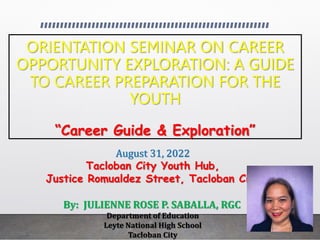







ORIENTATION SEMINAR ON CAREER
OPPORTUNITY EXPLORATION: A GUIDE
TO CAREER PREPARATION FOR THE
YOUTH
“Career Guide & Exploration”
August 31, 2022
Tacloban City Youth Hub,
Justice Romualdez Street, Tacloban City
By: JULIENNE ROSE P. SABALLA, RGC
Department of Education
Leyte National High School
Tacloban City
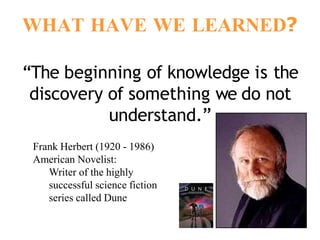
WHAT HAVE WE LEARNED?
“The beginning of knowledge is the
discovery of something we do not
understand.”
Frank Herbert (1920 - 1986)
American Novelist:
Writer of the highly
successful science fiction
series called Dune
CAREER
GUIDE &
EXPLORATION
DEPARTMENT OF
EDUCATION
• CAREER GUIDANCE PROGRAM
(DM-OUCI-2021-347)
• HOMEROOM GUIDANCE
PROGRAM (DM-OUCI-346)
(KINDERGARTEN – GRADE 12)
• NATIONAL CAREER
ASSESSMENT EXAMINATION
(NCAE) – GRADE 9
• CAREER GUIDANCE MODULES
(GRADE 11 & 12)
At the end of this session, it is expected that
participants will be able to:
1. Learn about DepEd’s Career Guidance
programs and activities
2. Know more about basic career
concepts and steps on how to plan
their careers;
3. Identify their skills, interests, and
preferences, thus enabling them to
appreciate their own uniqueness and
individuality; and
4. Be guided, inspired and motivated in
making wise decisions for their future.
Have you already decided
which career path to take?
Do you already know
what curriculum exits to
take after Senior High
School?
Do you already know
what academic
program to take in
college?
Are you sure of your
decision?
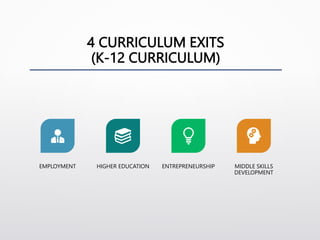
4 CURRICULUM EXITS
(K-12 CURRICULUM)
EMPLOYMENT HIGHER EDUCATION ENTREPRENEURSHIP MIDDLE SKILLS
DEVELOPMENT
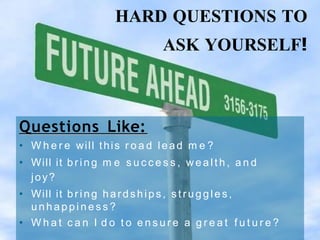
HARD QUESTIONS TO
ASK YOURSELF!
Questions Like:
• W h e r e will this r o a d lead m e ?
• Will it br ing m e s u c c e s s , w e a l t h , a n d
joy?
• Will it br ing hardships, st r uggle s,
u n h a p p i n e s s ?
• W h a t c a n I d o t o e n s u r e a g r e a t f u t u r e ?
PEOPLE OFTEN ASK:
"I don't know what I want to
do. Is there a 1 test or
something that can tell me
what career is right for me?"
SIMPLY PUT
NO!
Unfortunately, there is no 1
single test that can magically
tellyou what to do with the
rest of your life.
SO THEN?
WHERE DO I TURN FOR
ANSWERS?
THE SLOW
LANE
• It's possible toquickly choose a
career. But tofind a career that's right
for you, it's helpful toslow down,give it
some thought, and take thetimetoget
itright.
• This is useful whetheryou’re
choosing a career for thefirst time
or changing careers for thethirty-
first time.
THE
ANSWER
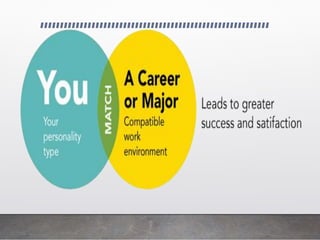
• By taking a careful look atyour personal values,
interests, personal attributes, and skills you can
obtain valuable information thatwillhelp you in
making your decision.
TAKING THE WHEEL!
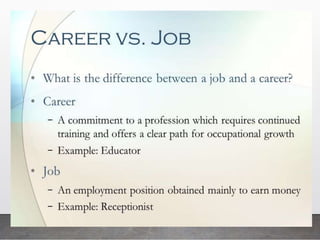
Career exploration is not the same as
job searching. Job searching is a short-
term pursuit of a position that matches
your financial and career goals.
Career explo ation is a long,
progressive pr cess of choosing
education, trainin
your interes
g, and jobs that fit
ts and skills.
TAKING
STOCK
• Learning whatyou have tooffer an employeris a
first step.It’s important toknow who you are, as well.
People succeed atthings thattheyenjoyeas er than
in doing things thattheydon’tenjoy.
SELF-
ASSESSMENT
Self assessment is theprocess of gathering information about
yourself in order tomake an informed career decision. It is the
first step of the Career Planning Process.
• Whatshould a self assessment look at?
• A self-assessment should includea look atyour
values, interests, personality and skills.
Benefits of Self Awareness:
• You appreciate and value who you are.
• You become more capable of actualizing your
potentials to the fullest.
• You respect others and relate with them more
meaningfully.
• You are empowered to cope well with the
demands in school, at home, and of your
relationships with others.
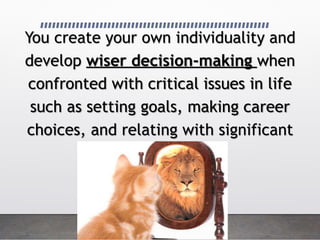
You create your own individuality and
develop wiser decision-making when
confronted with critical issues in life
such as setting goals, making career
choices, and relating with significant
others.
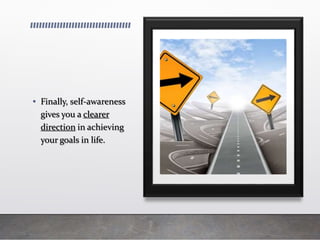
• Finally, self-awareness
gives you a clearer
direction in achieving
your goals in life.
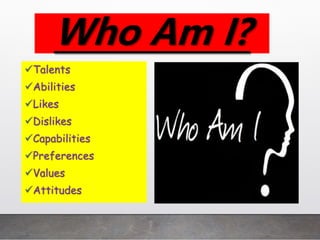
Who Am I?
Talents
Abilities
Likes
Dislikes
Capabilities
Preferences
Values
Attitudes
John Holland’s
Theory
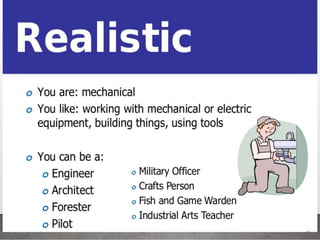
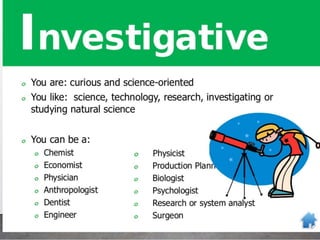
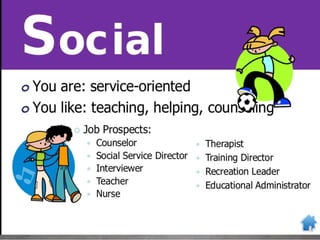
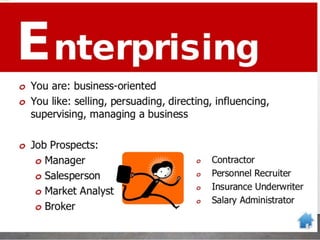
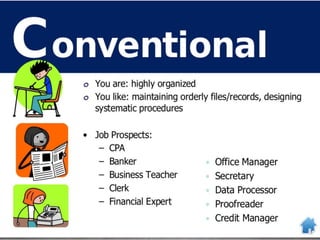
John Holland's Theory of
Career Choice (RIASEC)
maintains that
in choosing a career, people
prefer jobs where they can be
around others who are
like them.
They search for environments
that will let them use their skills
and abilities, and express their
attitudes and values, while taking
on enjoyable problems and
roles.
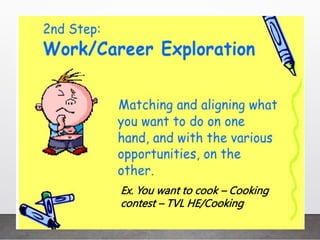
Ex. You want to cook – Cooking
contest – TVL HE/Cooking
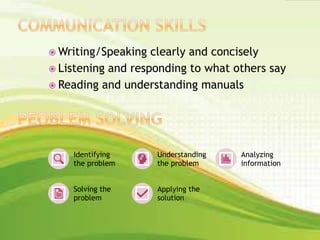
 Writing/Speaking clearly and concisely
 Listening and responding to what others say
 Reading and understanding manuals
Identifying
the problem
Understanding
the problem
Analyzing
information
Solving the
problem
Applying the
solution
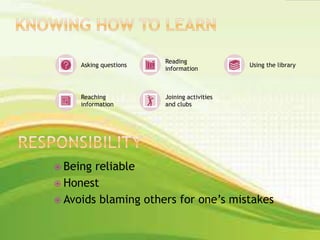
Asking questions
Reading
information
Using the library
Reaching
information
Joining activities
and clubs
 Being reliable
 Honest
 Avoids blaming others for one’s mistakes
Getting along
with others
Meeting new
people
Working on a
team
Respecting the
ideas of others
 Learning how others have been creative
 Using your imagination
 Trying new ways of doing things
 Looking at issues from a different point of
view
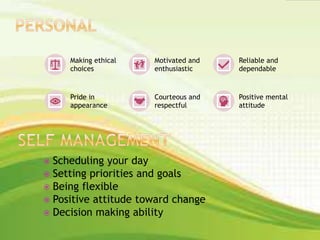
Making ethical
choices
Motivated and
enthusiastic
Reliable and
dependable
Pride in
appearance
Courteous and
respectful
Positive mental
attitude
 Scheduling your day
 Setting priorities and goals
 Being flexible
 Positive attitude toward change
 Decision making ability
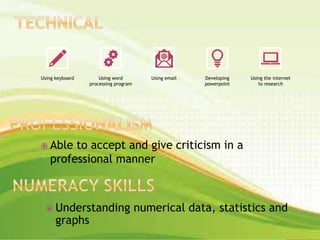
Using keyboard Using word
processing program
Using email Developing
powerpoint
Using the internet
to research
 Able to accept and give criticism in a
professional manner
 Understanding numerical data, statistics and
graphs
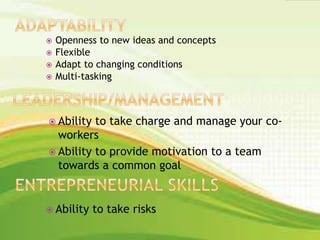
 Openness to new ideas and concepts
 Flexible
 Adapt to changing conditions
 Multi-tasking
 Ability to take charge and manage your co-
workers
 Ability to provide motivation to a team
towards a common goal
 Ability to take risks
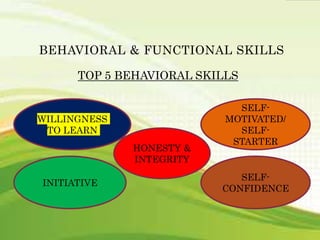
TOP 5 BEHAVIORAL SKILLS
WILLINGNESS
TO LEARN
SELF-
MOTIVATED/
SELF-
STARTER
HONESTY &
INTEGRITY
INITIATIVE
SELF-
CONFIDENCE
BEHAVIORAL & FUNCTIONAL SKILLS
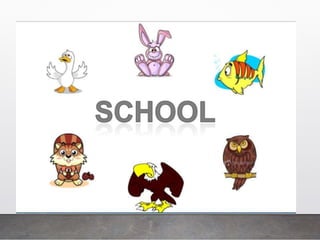
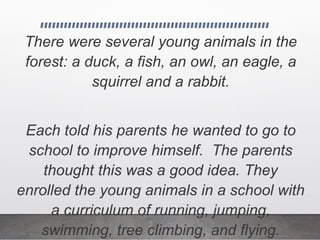
There were several young animals in the
forest: a duck, a fish, an owl, an eagle, a
squirrel and a rabbit.
Each told his parents he wanted to go to
school to improve himself. The parents
thought this was a good idea. They
enrolled the young animals in a school with
a curriculum of running, jumping,
swimming, tree climbing, and flying.
On the first day of school, the
little rabbit got up early to be in
school on time. He brushed his
teeth, combed his hair, ate his
breakfast, and went to school
with high expectations and
excitement.
His first class was running. He did great!
His teacher told him he was a wonderful
runner, and he got an A+ and his self-
esteem got a boost. The next day, the
little rabbit went to jumping class. Again
he did very well, received compliments
from his teacher, and got an A+ and a
boost to his self-esteem.
The day after that, the little rabbit
went to swimming class. He
wasn’t very good at it.
His teacher said he didn’t do very
well at swimming, gave him a low
grade, and told him he had to
learn to enjoy being wet.
His self-esteem suffered.
The little rabbit was determined to
succeed.
For two weeks, the rabbit tried as
hard as he could, but he just couldn’t
get the knack of swimming.
He became discouraged and began
to lose interest in school.
The rabbit was called to the principal’s office
with his parents. He was told that he was
failing swimming class.
As a remedy, the principal and the little rabbit’s
parents decided that he would be taken out of
the running and jumping classes (because he
could already do these things so well) and
instead would be assigned to three swimming
classes each day.
•The little rabbit tried to
improve his swimming, but
eventually became totally
discouraged. When he was
told that flying classes were
next, he dropped out of
school.
What is the Morale of
the Story?
References:
https://www.slideshare.net/kesiamargot/career-planning-
presentation
https://www.slideshare.net/waqasdilasa/career-planning-
10520579
Cayaco, Mico May R. slide presentation of Career Planning
for Incoming Senior High School
Tenebro, Arabelle slide presentation on Career Planning,
May 26, 2022

CAREER EXPLORATION 101.pptx

  • 1.
    ORIENTATION SEMINAR ONCAREER OPPORTUNITY EXPLORATION: A GUIDE TO CAREER PREPARATION FOR THE YOUTH “Career Guide & Exploration” August 31, 2022 Tacloban City Youth Hub, Justice Romualdez Street, Tacloban City By: JULIENNE ROSE P. SABALLA, RGC Department of Education Leyte National High School Tacloban City
  • 2.
    WHAT HAVE WELEARNED? “The beginning of knowledge is the discovery of something we do not understand.” Frank Herbert (1920 - 1986) American Novelist: Writer of the highly successful science fiction series called Dune
  • 3.
  • 4.
    DEPARTMENT OF EDUCATION • CAREERGUIDANCE PROGRAM (DM-OUCI-2021-347) • HOMEROOM GUIDANCE PROGRAM (DM-OUCI-346) (KINDERGARTEN – GRADE 12) • NATIONAL CAREER ASSESSMENT EXAMINATION (NCAE) – GRADE 9 • CAREER GUIDANCE MODULES (GRADE 11 & 12)
  • 5.
    At the endof this session, it is expected that participants will be able to: 1. Learn about DepEd’s Career Guidance programs and activities 2. Know more about basic career concepts and steps on how to plan their careers; 3. Identify their skills, interests, and preferences, thus enabling them to appreciate their own uniqueness and individuality; and 4. Be guided, inspired and motivated in making wise decisions for their future.
  • 6.
    Have you alreadydecided which career path to take?
  • 7.
    Do you alreadyknow what curriculum exits to take after Senior High School? Do you already know what academic program to take in college? Are you sure of your decision?
  • 8.
    4 CURRICULUM EXITS (K-12CURRICULUM) EMPLOYMENT HIGHER EDUCATION ENTREPRENEURSHIP MIDDLE SKILLS DEVELOPMENT
  • 12.
    HARD QUESTIONS TO ASKYOURSELF! Questions Like: • W h e r e will this r o a d lead m e ? • Will it br ing m e s u c c e s s , w e a l t h , a n d joy? • Will it br ing hardships, st r uggle s, u n h a p p i n e s s ? • W h a t c a n I d o t o e n s u r e a g r e a t f u t u r e ?
  • 13.
    PEOPLE OFTEN ASK: "Idon't know what I want to do. Is there a 1 test or something that can tell me what career is right for me?"
  • 14.
    SIMPLY PUT NO! Unfortunately, thereis no 1 single test that can magically tellyou what to do with the rest of your life.
  • 15.
    SO THEN? WHERE DOI TURN FOR ANSWERS?
  • 16.
    THE SLOW LANE • It'spossible toquickly choose a career. But tofind a career that's right for you, it's helpful toslow down,give it some thought, and take thetimetoget itright. • This is useful whetheryou’re choosing a career for thefirst time or changing careers for thethirty- first time.
  • 17.
    THE ANSWER • By takinga careful look atyour personal values, interests, personal attributes, and skills you can obtain valuable information thatwillhelp you in making your decision.
  • 18.
    TAKING THE WHEEL! Careerexploration is not the same as job searching. Job searching is a short- term pursuit of a position that matches your financial and career goals. Career explo ation is a long, progressive pr cess of choosing education, trainin your interes g, and jobs that fit ts and skills.
  • 19.
    TAKING STOCK • Learning whatyouhave tooffer an employeris a first step.It’s important toknow who you are, as well. People succeed atthings thattheyenjoyeas er than in doing things thattheydon’tenjoy.
  • 20.
    SELF- ASSESSMENT Self assessment istheprocess of gathering information about yourself in order tomake an informed career decision. It is the first step of the Career Planning Process. • Whatshould a self assessment look at? • A self-assessment should includea look atyour values, interests, personality and skills.
  • 26.
    Benefits of SelfAwareness: • You appreciate and value who you are. • You become more capable of actualizing your potentials to the fullest. • You respect others and relate with them more meaningfully. • You are empowered to cope well with the demands in school, at home, and of your relationships with others.
  • 27.
    You create yourown individuality and develop wiser decision-making when confronted with critical issues in life such as setting goals, making career choices, and relating with significant others.
  • 28.
    • Finally, self-awareness givesyou a clearer direction in achieving your goals in life.
  • 29.
  • 30.
    John Holland’s Theory John Holland'sTheory of Career Choice (RIASEC) maintains that in choosing a career, people prefer jobs where they can be around others who are like them. They search for environments that will let them use their skills and abilities, and express their attitudes and values, while taking on enjoyable problems and roles.
  • 39.
    Ex. You wantto cook – Cooking contest – TVL HE/Cooking
  • 44.
     Writing/Speaking clearlyand concisely  Listening and responding to what others say  Reading and understanding manuals Identifying the problem Understanding the problem Analyzing information Solving the problem Applying the solution
  • 45.
    Asking questions Reading information Using thelibrary Reaching information Joining activities and clubs  Being reliable  Honest  Avoids blaming others for one’s mistakes
  • 46.
    Getting along with others Meetingnew people Working on a team Respecting the ideas of others  Learning how others have been creative  Using your imagination  Trying new ways of doing things  Looking at issues from a different point of view
  • 47.
    Making ethical choices Motivated and enthusiastic Reliableand dependable Pride in appearance Courteous and respectful Positive mental attitude  Scheduling your day  Setting priorities and goals  Being flexible  Positive attitude toward change  Decision making ability
  • 48.
    Using keyboard Usingword processing program Using email Developing powerpoint Using the internet to research  Able to accept and give criticism in a professional manner  Understanding numerical data, statistics and graphs
  • 49.
     Openness tonew ideas and concepts  Flexible  Adapt to changing conditions  Multi-tasking  Ability to take charge and manage your co- workers  Ability to provide motivation to a team towards a common goal  Ability to take risks
  • 50.
    TOP 5 BEHAVIORALSKILLS WILLINGNESS TO LEARN SELF- MOTIVATED/ SELF- STARTER HONESTY & INTEGRITY INITIATIVE SELF- CONFIDENCE BEHAVIORAL & FUNCTIONAL SKILLS
  • 55.
    There were severalyoung animals in the forest: a duck, a fish, an owl, an eagle, a squirrel and a rabbit. Each told his parents he wanted to go to school to improve himself. The parents thought this was a good idea. They enrolled the young animals in a school with a curriculum of running, jumping, swimming, tree climbing, and flying.
  • 57.
    On the firstday of school, the little rabbit got up early to be in school on time. He brushed his teeth, combed his hair, ate his breakfast, and went to school with high expectations and excitement.
  • 58.
    His first classwas running. He did great! His teacher told him he was a wonderful runner, and he got an A+ and his self- esteem got a boost. The next day, the little rabbit went to jumping class. Again he did very well, received compliments from his teacher, and got an A+ and a boost to his self-esteem.
  • 59.
    The day afterthat, the little rabbit went to swimming class. He wasn’t very good at it. His teacher said he didn’t do very well at swimming, gave him a low grade, and told him he had to learn to enjoy being wet.
  • 60.
    His self-esteem suffered. Thelittle rabbit was determined to succeed. For two weeks, the rabbit tried as hard as he could, but he just couldn’t get the knack of swimming. He became discouraged and began to lose interest in school.
  • 61.
    The rabbit wascalled to the principal’s office with his parents. He was told that he was failing swimming class. As a remedy, the principal and the little rabbit’s parents decided that he would be taken out of the running and jumping classes (because he could already do these things so well) and instead would be assigned to three swimming classes each day.
  • 62.
    •The little rabbittried to improve his swimming, but eventually became totally discouraged. When he was told that flying classes were next, he dropped out of school.
  • 63.
    What is theMorale of the Story?
  • 66.
    References: https://www.slideshare.net/kesiamargot/career-planning- presentation https://www.slideshare.net/waqasdilasa/career-planning- 10520579 Cayaco, Mico MayR. slide presentation of Career Planning for Incoming Senior High School Tenebro, Arabelle slide presentation on Career Planning, May 26, 2022