Methodology for estimating the control derivatives of a helicopter in ground effect from flight test data  Presented by Andrei Popov Sep 7, 2009
In ground effect (IGE) theory Sep 7, 2009 The momentum theory treats the rotor as an actuator disk through which a uniform flow passes. For a given gross weight it is required a certain airspeed of the wake which is named “induced velocity”. Blade element theory states that the rotor blades function as high aspect ratio wings constrained to rotate around a central mast as the rotor system advances through the air.  The induced velocity is given by the blades collective pitch angles and is controlled by the collective stick. To maintain the helicopter in the air, the pilot must displace the collective stick in a certain position.  In the proximity of the ground ( h < D main rotor diameter), the air wake forms a cushion under the helicopter which is the “in ground effect” (IGE)
In ground effect (IGE) theory Sep 7, 2009 In ground effect for same thrust as OGE: Less induced velocity (inflow ratio) Less collective blade pitch angle When altitude decrease, what is the effect on the derivative of CT versus collective control position ? ? In ground effect aerodynamical phenomenon when altitude Helicopter in hover: Thrust coefficient [1],[2],[3]:
Linear Model Sep 7, 2009 Helicopter linear and angular accelerations in 6 degrees of freedom State vector Control vector Stability derivatives Control derivatives influenced by IGE Forces and Moments x,u, X y,v, Y z,w, Z M,q L,p N,r
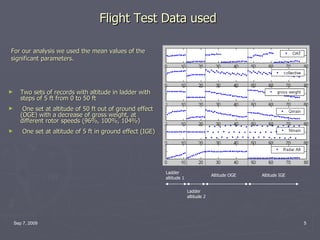
Flight Test Data used  Sep 7, 2009 Ladder altitude 1 Ladder altitude 2 Altitude OGE Altitude IGE For our analysis we used the mean values of the significant parameters. Two sets of records with altitude in ladder with  steps of 5 ft from 0 to 50 ft One set at altitude of 50 ft out of ground effect (OGE) with a decrease of gross weight, at different rotor speeds (96%, 100%, 104%) One set at altitude of 5 ft in ground effect (IGE)
Data processing Sep 7, 2009 Torque coefficient for helicopter in hover [1],[2]: Polynomial fitting of  C Q  ( C T  ) out of ground effect: Polynomial fitting of  C Q  (collective) : C Q  vs. H  C Q  vs.  C T C Q  vs. collective
Data processing 2 Sep 7, 2009 K(H)  – Constant of ground effect vs. altitude [3]: Polynomial fitting of  K(H)  : Polynomial fitting of  C Q  (C T  ,H)  :
Results validation Sep 7, 2009 Surface obtained by functions  C Q (C T ,H)  and  C Q (collective)  where from we obtain  C T (collective,H)  and its derivatives  dC T /d(collective) (H)
Final conclusion Derivative  dC T /d(collective)  10% greater @ 5 ft altitude 20% greater @ 0 ft altitude. Important for the linear model of a helicopter simulator: Take Off  Landing dynamics. Sep 7, 2009
Bibliography Seddon, J. (1990).  Basic helicopter aerodynamics an account of first principles in the fluid mechanics and flight dynamics of the single rotor helicopter . Washington, D.C.: American Institute of Aeronautics and Astronautics. Bramwell, A. R. S., Done, G., & Balmford, D. (2001).  Bramwell's helicopter dynamics  (2nd ed.). Reston, Va. Oxford, England: American Institute of Aeronautics and Astronautics Butterworth-Heinemann. Prouty, R. W. (2002).  Helicopter performance, stability, and control . Malabar, Flor.: R. E. Krieger. Sep 7, 2009

Hover Ige

  • 1.
    Methodology for estimatingthe control derivatives of a helicopter in ground effect from flight test data Presented by Andrei Popov Sep 7, 2009
  • 2.
    In ground effect(IGE) theory Sep 7, 2009 The momentum theory treats the rotor as an actuator disk through which a uniform flow passes. For a given gross weight it is required a certain airspeed of the wake which is named “induced velocity”. Blade element theory states that the rotor blades function as high aspect ratio wings constrained to rotate around a central mast as the rotor system advances through the air. The induced velocity is given by the blades collective pitch angles and is controlled by the collective stick. To maintain the helicopter in the air, the pilot must displace the collective stick in a certain position. In the proximity of the ground ( h < D main rotor diameter), the air wake forms a cushion under the helicopter which is the “in ground effect” (IGE)
  • 3.
    In ground effect(IGE) theory Sep 7, 2009 In ground effect for same thrust as OGE: Less induced velocity (inflow ratio) Less collective blade pitch angle When altitude decrease, what is the effect on the derivative of CT versus collective control position ? ? In ground effect aerodynamical phenomenon when altitude Helicopter in hover: Thrust coefficient [1],[2],[3]:
  • 4.
    Linear Model Sep7, 2009 Helicopter linear and angular accelerations in 6 degrees of freedom State vector Control vector Stability derivatives Control derivatives influenced by IGE Forces and Moments x,u, X y,v, Y z,w, Z M,q L,p N,r
  • 5.
    Flight Test Dataused Sep 7, 2009 Ladder altitude 1 Ladder altitude 2 Altitude OGE Altitude IGE For our analysis we used the mean values of the significant parameters. Two sets of records with altitude in ladder with steps of 5 ft from 0 to 50 ft One set at altitude of 50 ft out of ground effect (OGE) with a decrease of gross weight, at different rotor speeds (96%, 100%, 104%) One set at altitude of 5 ft in ground effect (IGE)
  • 6.
    Data processing Sep7, 2009 Torque coefficient for helicopter in hover [1],[2]: Polynomial fitting of C Q ( C T ) out of ground effect: Polynomial fitting of C Q (collective) : C Q vs. H C Q vs. C T C Q vs. collective
  • 7.
    Data processing 2Sep 7, 2009 K(H) – Constant of ground effect vs. altitude [3]: Polynomial fitting of K(H) : Polynomial fitting of C Q (C T ,H) :
  • 8.
    Results validation Sep7, 2009 Surface obtained by functions C Q (C T ,H) and C Q (collective) where from we obtain C T (collective,H) and its derivatives dC T /d(collective) (H)
  • 9.
    Final conclusion Derivative dC T /d(collective) 10% greater @ 5 ft altitude 20% greater @ 0 ft altitude. Important for the linear model of a helicopter simulator: Take Off Landing dynamics. Sep 7, 2009
  • 10.
    Bibliography Seddon, J.(1990). Basic helicopter aerodynamics an account of first principles in the fluid mechanics and flight dynamics of the single rotor helicopter . Washington, D.C.: American Institute of Aeronautics and Astronautics. Bramwell, A. R. S., Done, G., & Balmford, D. (2001). Bramwell's helicopter dynamics (2nd ed.). Reston, Va. Oxford, England: American Institute of Aeronautics and Astronautics Butterworth-Heinemann. Prouty, R. W. (2002). Helicopter performance, stability, and control . Malabar, Flor.: R. E. Krieger. Sep 7, 2009