PRINCIPLES OF
HOUSING
Milan Thapa
BPH 8th batch
MMIHS
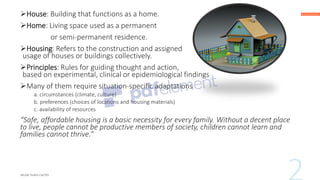
āž¢House: Building that functions as a home.
āž¢Home: Living space used as a permanent
or semi-permanent residence.
āž¢Housing: Refers to the construction and assigned
usage of houses or buildings collectively.
āž¢Principles: Rules for guiding thought and action,
based on experimental, clinical or epidemiological findings
āž¢Many of them require situation-specific adaptations
a. circumstances (climate, culture)
b. preferences (choices of locations and housing materials)
c. availability of resources
ā€œSafe, affordable housing is a basic necessity for every family. Without a decent place
to live, people cannot be productive members of society, children cannot learn and
families cannot thrive.ā€
āž¢Housing is intimately related to health. The structure, location, facilities,
environment and uses of human shelter have a strong impact on health (PMS).
āž¢Right to housing is codified as a human right in the Universal declaration of Human
rights as well.
āž¢People spend 50% or more of every day inside their homes. Consequently, it makes
sense that the housing environment constitutes one of the major influences on
health and well-being.
REGULATING BODY
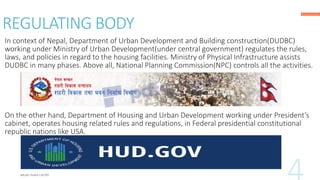
In context of Nepal, Department of Urban Development and Building construction(DUDBC)
working under Ministry of Urban Development(under central government) regulates the rules,
laws, and policies in regard to the housing facilities. Ministry of Physical Infrastructure assists
DUDBC in many phases. Above all, National Planning Commission(NPC) controls all the activities.
On the other hand, Department of Housing and Urban Development working under President’s
cabinet, operates housing related rules and regulations, in Federal presidential constitutional
republic nations like USA.
Nepal has promulgated National Building code in 1994 AD and recently has been
revised in 2015 AD primarily focusing on Earthquake safety.
Social Goals of Housing (@SAFFE)
Shelter: provide a sanitary shelter, which is a basic need.
Access to Community facilities: health services, school, communication etc.
Family life: provide adequate space for family life and activities.
Family participation in community life: Participatory activities in different events.
Economic stability: form of investment of personal savings.
Fundamental Physiologic Needs
Housing should provide for the following physiologic needs:
•Protection from the foreign elements
•Thermal environment that will avoid undue heat loss
•Thermal environment that will permit adequate heat loss from the body
•Atmosphere of reasonable chemical purity
•Adequate daylight illumination and avoidance of undue daylight glare
•Direct sunlight
•Adequate artificial illumination and avoidance of glare
•Protection from excessive noise
•Adequate space for exercise and for children to play.
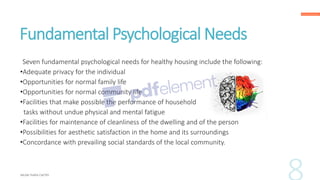
Fundamental Psychological Needs
Seven fundamental psychological needs for healthy housing include the following:
•Adequate privacy for the individual
•Opportunities for normal family life
•Opportunities for normal community life
•Facilities that make possible the performance of household
tasks without undue physical and mental fatigue
•Facilities for maintenance of cleanliness of the dwelling and of the person
•Possibilities for aesthetic satisfaction in the home and its surroundings
•Concordance with prevailing social standards of the local community.
Principles of Housing
PRINCIPLES RELATED TO HEALTH NEEDS
1. Protection against communicable
diseases.
2. Protection against injuries,
poisonings and chronic diseases.
3. Reducing psychological and social
stresses to a minimum.
4. Improving the housing environment.
5. Making informed use of housing.
6. Protecting populations at special risk.
PRINCIPLES RELATED TO HEALTH ACTION
7. Health advocacy
8. Economic and social policies
9. Inter-sectoral action for
development, planning and
management
10. Education on healthy housing
11. Community cooperation and
self-help
Principles related to health needs
1. Protection against communicable diseases.
Adequate housing provides protection against exposure to agents and vectors of
communicable diseases, through
ā‘Safe water supply: An adequate supply of safe and potable water assists in preventing the
spread of gastrointestinal diseases, supports domestic and personal hygiene and provides an
improved standard of living.
ā‘Sanitary disposal of excreta: Sanitary disposal of excreta reduces the fecal-oral transmission
of disease and the breeding of insect vectors.
ā‘Disposal of solid wastes: Adequate and safe disposal of solid domestic wastes reduces health
risks and helps to provide a more pleasant living environment; appropriate methods of
storage and disposal discourage insect and rodent vectors of disease and protect people
against poisonous substances and objects likely to cause accidental injury.
ā‘Drainage of surface waters: Efficient drainage of surface waters helps to control
communicable diseases, safety hazards, and damage to homes and properly.
ā‘Personal and domestic hygiene: Adequate housing includes facilities for personal and
domestic hygiene, and people should be educated in hygienic practices.
ā‘Safe food preparation: Healthy dwellings provide facilities for the sate preparation
and storage of food, so that householders can employ sanitary food handling
practices.
ā‘Structural safeguards against disease transmission: Adequate housing provides
structural safeguards against the transmission of disease, including enough space to
avoid overcrowding.
2. Protection against injuries, poisonings and chronic diseases
Adequate housing provides protection against injuries, poisonings and thermal and
other exposures that may contribute to chronic disease and malignancies; special
attention should be paid to
ā‘Structural features and furnishing: The proper siting, structure and furnishing of
dwellings protects health, promotes safety and reduces hazards.
ā‘Indoor air pollution: Adequately designed, constructed and ventilated dwellings, free
of toxic and irritating substances, reduce the risks of chronic respiratory diseases and
malignancies.
ā‘Chemical safety: Sensible precautions in the household reduce exposure to
hazardous chemicals.
ā‘The home as a workplace: Where a dwelling is also used as a workplace, those who
live in it should be protected against hazards and contamination.
3.Reducing psychological and social stresses to a minimum
Related to holistic approach of health
Society with frequent antisocial activities and conducts like robbery, crimes, bullying, rape, murder etc.
creates a sort of mental and social stress.
Stress may also be self created due to uncooperative society and people.
Adequate housing helps people's social and psychological development and reduces to a minimum the
psychological and social stresses connected with the housing environment.
To reduce unhealthy psychosocial stresses to a minimum, following things should be taken into account
in the dwelling environment:
ā‘Living space: There should be adequate living space, properly ventilated and lit, decently equipped
and furnished, with a reasonable degree of privacy and comfort
ā‘Security: A sense of personal and family security, reinforced by the community structure
ā‘Enough space: For children's play, sports and recreation, with minimum risks of injury and infection
ā‘Location of residence: Location selection should be taken into a/c focusing to reduce exposure to
noise, provide contact with greenery and enable people to have access to community amenities
ā‘Maintenance: Be easy to keep clean and in good order.
4. Improving the housing environment
Suitable housing environments provide access to places of work, essential services and
amenities that promote good health.
Minimum commuting distance plays an important role in stabilizing quality of life. Commuting
refers to periodically recurring travel between one's place of residence and place of work, or
study, and in doing so exceed the boundary of their residential community.
Three provisions are of special concern to health:
ā‘Security and emergency services: These services should be in reach for the following
purposes:
a. To protect against bodily harm, victimization and substances harmful to health
b. To reduce the risk and damage caused after accidents like fire, rescue
c. To establish best emergency medical services in case, needed.
ā‘Health and social services: People should have access for both preventive and curative
purposes.
ā‘Access to cultural and other amenities: The provision of facilities for play and recreation in
the neighborhood and the encouragement of participation in communal activities promote a
sense of belonging and of social support that contributes to personal health as well as to
community well-being.
5. Making informed use of housing
Only if residents make proper use of their housing can its health potential be realized to the
full.
Designs and structure of building varies according to the usage. Use of building may include
residence(general, limited commercial use, apartments, hotels),assembly, academics,
hospitals and clinics, commercial, offices, industries, storage house etc. and basic structure,
requirements are also dissimilar as per NBC.
Floor area, exit doors, corridors and passageways, staircase, room dimension(l*b*h), lights
and ventilation, lifts, basement, parking, rise etc. varies according the usage of housing.
Informed use of housing assist in maintaining well-being by:
āž¢Good hygiene and sanitation
āž¢Reduced health hazards
āž¢Reduction in accidents
āž¢Positive attitude built-up
6. Protecting populations at special risk
Housing should reduce to a minimum hazards to the health of groups at special risk
from the conditions they live in, including
ā‘Women and children: They spend more time in the home and their activities involve
greater exposure to whatever safety deficiencies and health hazards are present.
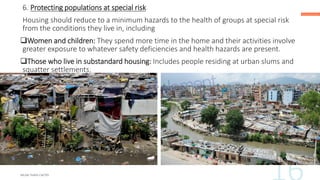
ā‘Those who live in substandard housing: Includes people residing at urban slums and
squatter settlements.
ā‘Displaced and mobile populations :
Refugees from war and civil disturbance,
those uprooted by large-scale development
projects, and migrant laborers' families are
groups of special concern.
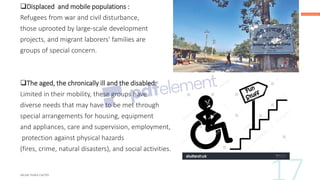
ā‘The aged, the chronically ill and the disabled:
Limited in their mobility, these groups have
diverse needs that may have to be met through
special arrangements for housing, equipment
and appliances, care and supervision, employment,
protection against physical hazards
(fires, crime, natural disasters), and social activities.
Principles related to health action
7.Health advocacy
Health advocacy, carried out by health authorities and bodies in related fields, should
be an integral part of public and private decisions about housing.
8.Economic and social policies
Economic and social policies that affect the state of housing should support the use
of. land and housing resources to maximize physical, mental and social health.
9.lntersectoral action for development planning and management
Economic and social development, as it affects human shelter, should be based on
appropriate processes of planning, the formulation and implementation of public
policy and the provision of services, with intersectoral collaboration in:
ā‘Development planning and management
ā‘Urban and land-use planning
ā‘Housing legislation and standards and their enforcement
ā‘Design and construction of housing
ā‘Provision of community services
ā‘Monitoring and surveillance of the situation
10. Education on healthy housing
Education-public and professional-should actively foster the provision and use of
housing to promote health.
The targets of educational efforts are multiple:
ā‘Householders
ā‘Architects, builders, and the manufacturers and suppliers of materials
ā‘Health workers
ā‘Policy leaders, development planners and managers, and local officials
11. Community cooperation and self-help
In dealing with the needs and problems of the human habitat, community
involvement at all levels should support the processes of self-help, help between
neighbors, and communal cooperative activities.
References
1. Health principles of housing, WHO Geneva 1989-
https://apps.who.int/iris/handle/10665/39847
2. Brian Edwards, David Turrent - Sustainable Housing_ Principles and Practice (2000,
Taylor & Francis)- https://epdf.pub/sustainable-housing-principles-and-practice.html
3. Ministry of Urban Development- http://moud.gov.np/np
4. American Public Health Association- https://www.apha.org/publications-and-
periodicals/reports-and-issue-briefs/healthy-housing-standard
5.National Building Code- http://dudbc.gov.np/buildingcode
6. Centers for Disease control and Prevention-
https://www.cdc.gov/nceh/publications/books/housing/cha02.htm

Principles of housing

  • 1.
  • 2.
    āž¢House: Building thatfunctions as a home. āž¢Home: Living space used as a permanent or semi-permanent residence. āž¢Housing: Refers to the construction and assigned usage of houses or buildings collectively. āž¢Principles: Rules for guiding thought and action, based on experimental, clinical or epidemiological findings āž¢Many of them require situation-specific adaptations a. circumstances (climate, culture) b. preferences (choices of locations and housing materials) c. availability of resources ā€œSafe, affordable housing is a basic necessity for every family. Without a decent place to live, people cannot be productive members of society, children cannot learn and families cannot thrive.ā€
  • 3.
    āž¢Housing is intimatelyrelated to health. The structure, location, facilities, environment and uses of human shelter have a strong impact on health (PMS). āž¢Right to housing is codified as a human right in the Universal declaration of Human rights as well. āž¢People spend 50% or more of every day inside their homes. Consequently, it makes sense that the housing environment constitutes one of the major influences on health and well-being.
  • 4.
    REGULATING BODY In contextof Nepal, Department of Urban Development and Building construction(DUDBC) working under Ministry of Urban Development(under central government) regulates the rules, laws, and policies in regard to the housing facilities. Ministry of Physical Infrastructure assists DUDBC in many phases. Above all, National Planning Commission(NPC) controls all the activities. On the other hand, Department of Housing and Urban Development working under President’s cabinet, operates housing related rules and regulations, in Federal presidential constitutional republic nations like USA.
  • 5.
    Nepal has promulgatedNational Building code in 1994 AD and recently has been revised in 2015 AD primarily focusing on Earthquake safety.
  • 6.
    Social Goals ofHousing (@SAFFE) Shelter: provide a sanitary shelter, which is a basic need. Access to Community facilities: health services, school, communication etc. Family life: provide adequate space for family life and activities. Family participation in community life: Participatory activities in different events. Economic stability: form of investment of personal savings.
  • 7.
    Fundamental Physiologic Needs Housingshould provide for the following physiologic needs: •Protection from the foreign elements •Thermal environment that will avoid undue heat loss •Thermal environment that will permit adequate heat loss from the body •Atmosphere of reasonable chemical purity •Adequate daylight illumination and avoidance of undue daylight glare •Direct sunlight •Adequate artificial illumination and avoidance of glare •Protection from excessive noise •Adequate space for exercise and for children to play.
  • 8.
    Fundamental Psychological Needs Sevenfundamental psychological needs for healthy housing include the following: •Adequate privacy for the individual •Opportunities for normal family life •Opportunities for normal community life •Facilities that make possible the performance of household tasks without undue physical and mental fatigue •Facilities for maintenance of cleanliness of the dwelling and of the person •Possibilities for aesthetic satisfaction in the home and its surroundings •Concordance with prevailing social standards of the local community.
  • 9.
    Principles of Housing PRINCIPLESRELATED TO HEALTH NEEDS 1. Protection against communicable diseases. 2. Protection against injuries, poisonings and chronic diseases. 3. Reducing psychological and social stresses to a minimum. 4. Improving the housing environment. 5. Making informed use of housing. 6. Protecting populations at special risk. PRINCIPLES RELATED TO HEALTH ACTION 7. Health advocacy 8. Economic and social policies 9. Inter-sectoral action for development, planning and management 10. Education on healthy housing 11. Community cooperation and self-help
  • 10.
    Principles related tohealth needs 1. Protection against communicable diseases. Adequate housing provides protection against exposure to agents and vectors of communicable diseases, through ā‘Safe water supply: An adequate supply of safe and potable water assists in preventing the spread of gastrointestinal diseases, supports domestic and personal hygiene and provides an improved standard of living. ā‘Sanitary disposal of excreta: Sanitary disposal of excreta reduces the fecal-oral transmission of disease and the breeding of insect vectors. ā‘Disposal of solid wastes: Adequate and safe disposal of solid domestic wastes reduces health risks and helps to provide a more pleasant living environment; appropriate methods of storage and disposal discourage insect and rodent vectors of disease and protect people against poisonous substances and objects likely to cause accidental injury.
  • 11.
    ā‘Drainage of surfacewaters: Efficient drainage of surface waters helps to control communicable diseases, safety hazards, and damage to homes and properly. ā‘Personal and domestic hygiene: Adequate housing includes facilities for personal and domestic hygiene, and people should be educated in hygienic practices. ā‘Safe food preparation: Healthy dwellings provide facilities for the sate preparation and storage of food, so that householders can employ sanitary food handling practices. ā‘Structural safeguards against disease transmission: Adequate housing provides structural safeguards against the transmission of disease, including enough space to avoid overcrowding.
  • 12.
    2. Protection againstinjuries, poisonings and chronic diseases Adequate housing provides protection against injuries, poisonings and thermal and other exposures that may contribute to chronic disease and malignancies; special attention should be paid to ā‘Structural features and furnishing: The proper siting, structure and furnishing of dwellings protects health, promotes safety and reduces hazards. ā‘Indoor air pollution: Adequately designed, constructed and ventilated dwellings, free of toxic and irritating substances, reduce the risks of chronic respiratory diseases and malignancies. ā‘Chemical safety: Sensible precautions in the household reduce exposure to hazardous chemicals. ā‘The home as a workplace: Where a dwelling is also used as a workplace, those who live in it should be protected against hazards and contamination.
  • 13.
    3.Reducing psychological andsocial stresses to a minimum Related to holistic approach of health Society with frequent antisocial activities and conducts like robbery, crimes, bullying, rape, murder etc. creates a sort of mental and social stress. Stress may also be self created due to uncooperative society and people. Adequate housing helps people's social and psychological development and reduces to a minimum the psychological and social stresses connected with the housing environment. To reduce unhealthy psychosocial stresses to a minimum, following things should be taken into account in the dwelling environment: ā‘Living space: There should be adequate living space, properly ventilated and lit, decently equipped and furnished, with a reasonable degree of privacy and comfort ā‘Security: A sense of personal and family security, reinforced by the community structure ā‘Enough space: For children's play, sports and recreation, with minimum risks of injury and infection ā‘Location of residence: Location selection should be taken into a/c focusing to reduce exposure to noise, provide contact with greenery and enable people to have access to community amenities ā‘Maintenance: Be easy to keep clean and in good order.
  • 14.
    4. Improving thehousing environment Suitable housing environments provide access to places of work, essential services and amenities that promote good health. Minimum commuting distance plays an important role in stabilizing quality of life. Commuting refers to periodically recurring travel between one's place of residence and place of work, or study, and in doing so exceed the boundary of their residential community. Three provisions are of special concern to health: ā‘Security and emergency services: These services should be in reach for the following purposes: a. To protect against bodily harm, victimization and substances harmful to health b. To reduce the risk and damage caused after accidents like fire, rescue c. To establish best emergency medical services in case, needed. ā‘Health and social services: People should have access for both preventive and curative purposes. ā‘Access to cultural and other amenities: The provision of facilities for play and recreation in the neighborhood and the encouragement of participation in communal activities promote a sense of belonging and of social support that contributes to personal health as well as to community well-being.
  • 15.
    5. Making informeduse of housing Only if residents make proper use of their housing can its health potential be realized to the full. Designs and structure of building varies according to the usage. Use of building may include residence(general, limited commercial use, apartments, hotels),assembly, academics, hospitals and clinics, commercial, offices, industries, storage house etc. and basic structure, requirements are also dissimilar as per NBC. Floor area, exit doors, corridors and passageways, staircase, room dimension(l*b*h), lights and ventilation, lifts, basement, parking, rise etc. varies according the usage of housing. Informed use of housing assist in maintaining well-being by: āž¢Good hygiene and sanitation āž¢Reduced health hazards āž¢Reduction in accidents āž¢Positive attitude built-up
  • 16.
    6. Protecting populationsat special risk Housing should reduce to a minimum hazards to the health of groups at special risk from the conditions they live in, including ā‘Women and children: They spend more time in the home and their activities involve greater exposure to whatever safety deficiencies and health hazards are present. ā‘Those who live in substandard housing: Includes people residing at urban slums and squatter settlements.
  • 17.
    ā‘Displaced and mobilepopulations : Refugees from war and civil disturbance, those uprooted by large-scale development projects, and migrant laborers' families are groups of special concern. ā‘The aged, the chronically ill and the disabled: Limited in their mobility, these groups have diverse needs that may have to be met through special arrangements for housing, equipment and appliances, care and supervision, employment, protection against physical hazards (fires, crime, natural disasters), and social activities.
  • 18.
    Principles related tohealth action 7.Health advocacy Health advocacy, carried out by health authorities and bodies in related fields, should be an integral part of public and private decisions about housing. 8.Economic and social policies Economic and social policies that affect the state of housing should support the use of. land and housing resources to maximize physical, mental and social health.
  • 19.
    9.lntersectoral action fordevelopment planning and management Economic and social development, as it affects human shelter, should be based on appropriate processes of planning, the formulation and implementation of public policy and the provision of services, with intersectoral collaboration in: ā‘Development planning and management ā‘Urban and land-use planning ā‘Housing legislation and standards and their enforcement ā‘Design and construction of housing ā‘Provision of community services ā‘Monitoring and surveillance of the situation
  • 20.
    10. Education onhealthy housing Education-public and professional-should actively foster the provision and use of housing to promote health. The targets of educational efforts are multiple: ā‘Householders ā‘Architects, builders, and the manufacturers and suppliers of materials ā‘Health workers ā‘Policy leaders, development planners and managers, and local officials 11. Community cooperation and self-help In dealing with the needs and problems of the human habitat, community involvement at all levels should support the processes of self-help, help between neighbors, and communal cooperative activities.
  • 21.
    References 1. Health principlesof housing, WHO Geneva 1989- https://apps.who.int/iris/handle/10665/39847 2. Brian Edwards, David Turrent - Sustainable Housing_ Principles and Practice (2000, Taylor & Francis)- https://epdf.pub/sustainable-housing-principles-and-practice.html 3. Ministry of Urban Development- http://moud.gov.np/np 4. American Public Health Association- https://www.apha.org/publications-and- periodicals/reports-and-issue-briefs/healthy-housing-standard 5.National Building Code- http://dudbc.gov.np/buildingcode 6. Centers for Disease control and Prevention- https://www.cdc.gov/nceh/publications/books/housing/cha02.htm