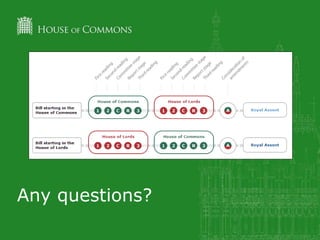
The legislative process
Georgie Holmes-Skelton
Senior Clerk, House of Commons Public Bill Office
Types of Bills
•

•

•

Public Bills
– either Government or Private Members’ Bills
Private Bills
– “legislation of a special kind for conferring particular powers
or benefits on any person or body of persons – including
individuals, local authorities, companies, or corporations”
(Erskine May)
Hybrid Bills
– affect “a particular private interest in a manner different
from the private interest of other persons or bodies of the
same category or class” (Speaker Hylton-Foster)
– Eg. Crossrail Bill
Where do Bills come from?
•

•

•
•

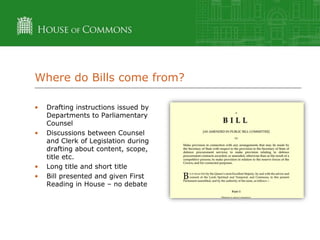
Drafting instructions issued by
Departments to Parliamentary
Counsel
Discussions between Counsel
and Clerk of Legislation during
drafting about content, scope,
title etc.
Long title and short title
Bill presented and given First
Reading in House – no debate
Where can I find them?
• Bills printed by the House of Commons
and made available at First Reading
• House, rather than Government,
documents
• Printed with Explanatory Notes
• Texts of all Bills before Parliament, and
Explanatory Notes, available at
www.parliament.uk
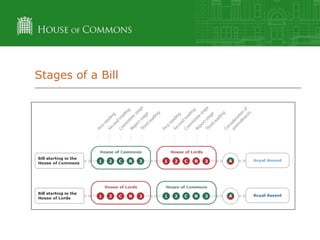
Stages of a Bill
Second Reading
• First substantive proceedings on the Bill, usually a
whole day
• Debate on general principles of Bill
• Debate will usually be opened or wound up by Cabinet
minister in charge of the Bill
• Opponents of a Bill can table a “reasoned amendment”
– statement of reasons why Bill should be rejected
• Often no vote at Second Reading
What’s next?
• Most Bills committed to a Public Bill Committee
• Some Bills considered “in Committee” on the floor of the
House: known as Committee of the whole House (CwH)
– Major constitutional importance (e.g. Fixed-Term
Parliaments Bill)
– Emergency legislation (e.g. Northern Ireland (St Andrews
Agreement) Bill)
– Uncontroversial Bills (e.g. Geneva Conventions and
United Nations Personnel (Protocols) Bill)
• Bills can be divided between CwH and PBC
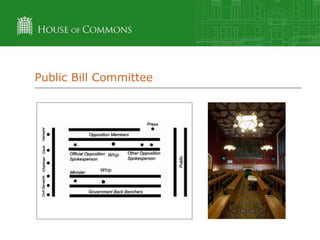
Public Bill Committee
1. Take oral and written evidence
– Public can submit evidence like a Select Committee inquiry
– Written evidence published on website and circulated to
Members
2. Line-by-line scrutiny of the Bill
Public Bill Committee

Whip
Whip
Order of consideration
•

•

Text of Bill considered in a set order:
– Clauses
– New clauses
– Schedules
– New schedules
– Preamble (if any)
– Title (if amended)
Programme motion can vary this order, usually to debate
schedules after the clauses to which they apply
Amendments
•
•
•
•
•
•

Can be tabled by any Member of the House
Clerks advise backbenchers and Opposition
front bench on amendments as required
Amendments grouped together to assist
debate
Amendments must be in order: relevant
and within scope
Chair has power of selection of
amendments
Not all amendments formally put to
decision

Tip: amendment
papers can be
found on the Bill
pages at
www.parliament.uk
/business/bills-andlegislation
Report Stage and Third Reading
•

•
•
•

•

New version of Bill “as amended in Committee” printed and debated
on the floor of the House
Any Member can table amendments
Grouping and selection as at Committee, but more stringent
Different order of consideration
– New clauses
– Amendments to clauses
– New schedules
– Amendments to schedules
Third Reading:
– one hour, immediately after Report
– Similar to Second Reading
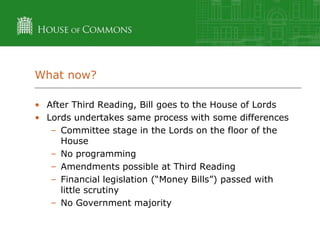
What now?
• After Third Reading, Bill goes to the House of Lords
• Lords undertakes same process with some differences
– Committee stage in the Lords on the floor of the
House
– No programming
– Amendments possible at Third Reading
– Financial legislation (“Money Bills”) passed with
little scrutiny
– No Government majority
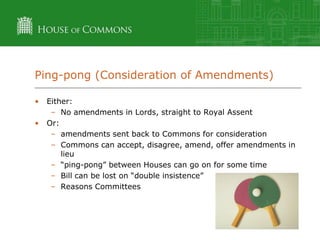
Ping-pong (Consideration of Amendments)
•
•

Either:
– No amendments in Lords, straight to Royal Assent
Or:
– amendments sent back to Commons for consideration
– Commons can accept, disagree, amend, offer amendments in
lieu
– “ping-pong” between Houses can go on for some time
– Bill can be lost on “double insistence”
– Reasons Committees
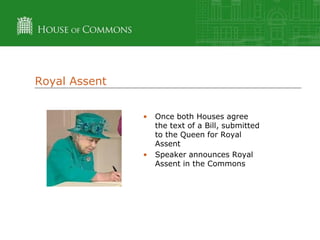
Royal Assent
•

•

Once both Houses agree
the text of a Bill, submitted
to the Queen for Royal
Assent
Speaker announces Royal
Assent in the Commons
The Parliament Acts
• The Parliament Act 1911 and the Parliament Act 1949
define the relationship between the Commons and the
Lords in terms of the passage of legislation
• If Commons passes a Bill in two successive Sessions
and the Lords rejects it, it can become law after the
second rejection without the consent of the Lords
• Used very rarely – last was the passage of the Hunting
Act 2004
Any questions?

House of Commons legislative process

  • 1.
    The legislative process GeorgieHolmes-Skelton Senior Clerk, House of Commons Public Bill Office
  • 2.
    Types of Bills • • • PublicBills – either Government or Private Members’ Bills Private Bills – “legislation of a special kind for conferring particular powers or benefits on any person or body of persons – including individuals, local authorities, companies, or corporations” (Erskine May) Hybrid Bills – affect “a particular private interest in a manner different from the private interest of other persons or bodies of the same category or class” (Speaker Hylton-Foster) – Eg. Crossrail Bill
  • 3.
    Where do Billscome from? • • • • Drafting instructions issued by Departments to Parliamentary Counsel Discussions between Counsel and Clerk of Legislation during drafting about content, scope, title etc. Long title and short title Bill presented and given First Reading in House – no debate
  • 4.
    Where can Ifind them? • Bills printed by the House of Commons and made available at First Reading • House, rather than Government, documents • Printed with Explanatory Notes • Texts of all Bills before Parliament, and Explanatory Notes, available at www.parliament.uk
  • 5.
  • 6.
    Second Reading • Firstsubstantive proceedings on the Bill, usually a whole day • Debate on general principles of Bill • Debate will usually be opened or wound up by Cabinet minister in charge of the Bill • Opponents of a Bill can table a “reasoned amendment” – statement of reasons why Bill should be rejected • Often no vote at Second Reading
  • 7.
    What’s next? • MostBills committed to a Public Bill Committee • Some Bills considered “in Committee” on the floor of the House: known as Committee of the whole House (CwH) – Major constitutional importance (e.g. Fixed-Term Parliaments Bill) – Emergency legislation (e.g. Northern Ireland (St Andrews Agreement) Bill) – Uncontroversial Bills (e.g. Geneva Conventions and United Nations Personnel (Protocols) Bill) • Bills can be divided between CwH and PBC
  • 8.
    Public Bill Committee 1.Take oral and written evidence – Public can submit evidence like a Select Committee inquiry – Written evidence published on website and circulated to Members 2. Line-by-line scrutiny of the Bill
  • 9.
  • 10.
    Order of consideration • • Textof Bill considered in a set order: – Clauses – New clauses – Schedules – New schedules – Preamble (if any) – Title (if amended) Programme motion can vary this order, usually to debate schedules after the clauses to which they apply
  • 11.
    Amendments • • • • • • Can be tabledby any Member of the House Clerks advise backbenchers and Opposition front bench on amendments as required Amendments grouped together to assist debate Amendments must be in order: relevant and within scope Chair has power of selection of amendments Not all amendments formally put to decision Tip: amendment papers can be found on the Bill pages at www.parliament.uk /business/bills-andlegislation
  • 12.
    Report Stage andThird Reading • • • • • New version of Bill “as amended in Committee” printed and debated on the floor of the House Any Member can table amendments Grouping and selection as at Committee, but more stringent Different order of consideration – New clauses – Amendments to clauses – New schedules – Amendments to schedules Third Reading: – one hour, immediately after Report – Similar to Second Reading
  • 13.
    What now? • AfterThird Reading, Bill goes to the House of Lords • Lords undertakes same process with some differences – Committee stage in the Lords on the floor of the House – No programming – Amendments possible at Third Reading – Financial legislation (“Money Bills”) passed with little scrutiny – No Government majority
  • 14.
    Ping-pong (Consideration ofAmendments) • • Either: – No amendments in Lords, straight to Royal Assent Or: – amendments sent back to Commons for consideration – Commons can accept, disagree, amend, offer amendments in lieu – “ping-pong” between Houses can go on for some time – Bill can be lost on “double insistence” – Reasons Committees
  • 15.
    Royal Assent • • Once bothHouses agree the text of a Bill, submitted to the Queen for Royal Assent Speaker announces Royal Assent in the Commons
  • 16.
    The Parliament Acts •The Parliament Act 1911 and the Parliament Act 1949 define the relationship between the Commons and the Lords in terms of the passage of legislation • If Commons passes a Bill in two successive Sessions and the Lords rejects it, it can become law after the second rejection without the consent of the Lords • Used very rarely – last was the passage of the Hunting Act 2004
  • 17.