Public Bills :  An Overview Huw Edwards for  Parliamentary Outreach Programme  4 May 2011 www.huwedwardstraining.com
Presenter:  Huw Edwards Training Consultant -  Academy for Parliamentary and Policy Studies  Parliament, legislation, government, devolution, public policy.  www.ap-ps.org Former Member of Parliament (Labour) for Monmouth  1991-1992  and 1997-2005
Functions of Parliament  Legislation – make the law of the land  Scrutiny – monitor the work of Government Control tax & expenditure Produce a Government Forum for National Debate  Redress of Individual   Grievances
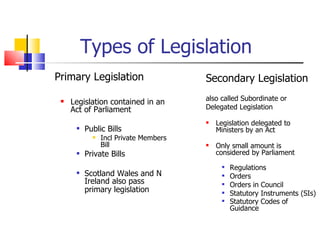
Types of Legislation Primary Legislation Legislation contained in an Act of Parliament  Public Bills Incl Private Members Bill  Private Bills Scotland Wales and N Ireland also pass primary legislation   Secondary Legislation also called Subordinate or Delegated Legislation Legislation delegated to Ministers by an Act Only small amount is considered by Parliament   Regulations Orders Orders in Council  Statutory Instruments (SIs) Statutory Codes of Guidance
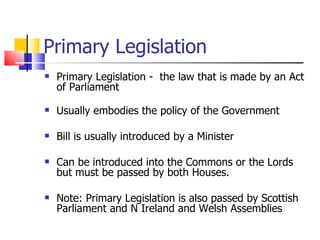
Primary Legislation Primary Legislation -  the law that is made by an Act of Parliament  Usually embodies the policy of the Government  Bill is usually introduced by a Minister Can be introduced into the Commons or the Lords but must be passed by both Houses.  Note: Primary Legislation is also passed by Scottish Parliament and N Ireland and Welsh Assemblies
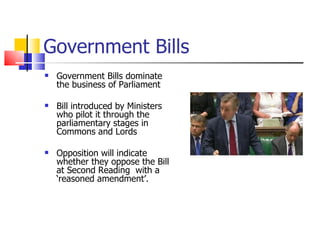
Government Bills Government Bills dominate the business of Parliament  Bill introduced by Ministers who pilot it through the parliamentary stages in Commons and Lords  Opposition will indicate whether they oppose the Bill at Second Reading  with a  ‘reasoned amendment’.
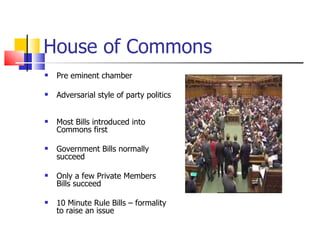
House of Commons  Pre eminent chamber Adversarial style of party politics  Most Bills introduced into Commons first Government Bills normally succeed  Only a few Private Members Bills succeed 10 Minute Rule Bills – formality to raise an issue
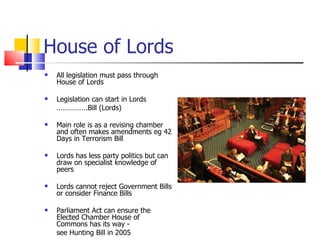
House of Lords  All legislation must pass through House of Lords Legislation can start in Lords  …………… .Bill (Lords)  Main role is as a revising chamber and often makes amendments eg 42 Days in Terrorism Bill  Lords has less party politics but can draw on specialist knowledge of peers  Lords cannot reject Government Bills or consider Finance Bills  Parliament Act can ensure the Elected Chamber House of Commons has its way -  see Hunting Bill in 2005
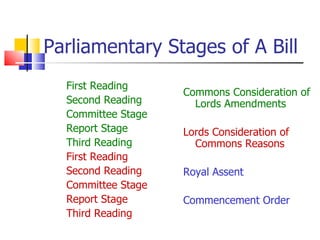
Parliamentary Stages of A Bill  First Reading  Second Reading Committee Stage  Report Stage Third Reading  First Reading  Second Reading  Committee Stage Report Stage Third Reading Commons Consideration of Lords Amendments Lords Consideration of Commons Reasons Royal Assent Commencement Order
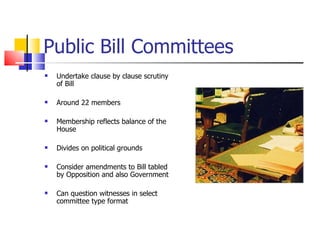
Public Bill Committees  Undertake clause by clause scrutiny of Bill Around 22 members Membership reflects balance of the House  Divides on political grounds  Consider amendments to Bill tabled by Opposition and also Government  Can question witnesses in select committee type format
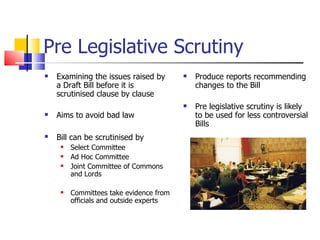
Pre Legislative Scrutiny  Examining the issues raised by a Draft Bill before it is scrutinised clause by clause Aims to avoid bad law  Bill can be scrutinised by   Select Committee Ad Hoc Committee Joint Committee of Commons and Lords Committees take evidence from officials and outside experts Produce reports recommending changes to the Bill Pre legislative scrutiny is likely to be used for less controversial Bills
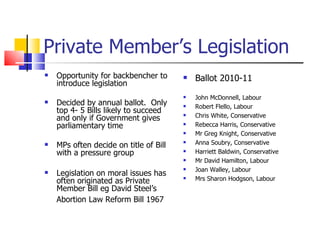
Private Member’s Legislation  Opportunity for backbencher to introduce legislation Decided by annual ballot.  Only top 4- 5 Bills likely to succeed and only if Government gives parliamentary time  MPs often decide on title of Bill with a pressure group Legislation on moral issues has often originated as Private Member Bill eg David Steel’s Abortion Law Reform Bill 1967   Ballot 2010-11   John McDonnell, Labour Robert Flello, Labour Chris White, Conservative Rebecca Harris, Conservative Mr Greg Knight, Conservative Anna Soubry, Conservative Harriett Baldwin, Conservative Mr David Hamilton, Labour Joan Walley, Labour Mrs Sharon Hodgson, Labour
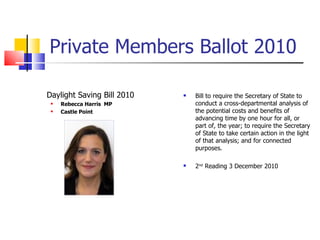
  Private Members Ballot 2010 Daylight Saving Bill 2010 Rebecca Harris  MP Castle Point Bill to require the Secretary of State to conduct a cross-departmental analysis of the potential costs and benefits of advancing time by one hour for all, or part of, the year; to require the Secretary of State to take certain action in the light of that analysis; and for connected purposes.  2 nd  Reading 3 December 2010
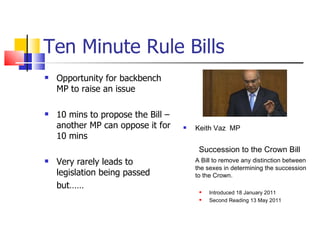
Ten Minute Rule Bills Opportunity for backbench MP to raise an issue 10 mins to propose the Bill – another MP can oppose it for 10 mins Very rarely leads to legislation being passed but…… Keith Vaz  MP  Succession to the Crown Bill A Bill to remove any distinction between the sexes in determining the succession to the Crown.  Introduced 18 January 2011 Second Reading 13 May 2011
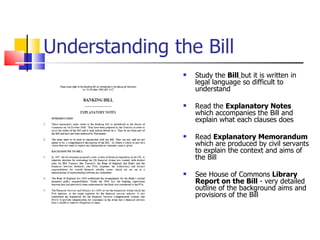
Understanding the Bill Study the  Bill   but it is written in legal language so difficult to understand  Read the  Explanatory Notes  which accompanies the Bill and explain what each clauses does Read  Explanatory Memorandum  which are produced by civil servants to explain the context and aims of the Bill See House of Commons  Library Report on the Bill  - very detailed outline of the background aims and provisions of the Bill
Remember Devolution Scottish Parliament  -  can legislate in any area except those reserved in 1998 Scotland Act – eg foreign affairs Northern Ireland Assembly  -  can legislate in any areas part from those excepted in 1998 Northern Ireland Act National Assembly for Wales -   can make legislation in devolved areas under 2006 Government of Wales Act – can pass Acts from May 2011
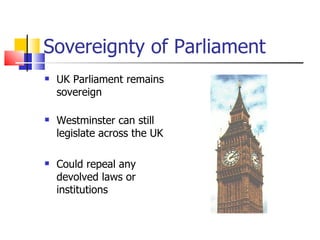
Sovereignty of Parliament UK Parliament remains sovereign  Westminster can still legislate across the UK  Could repeal any devolved laws or institutions
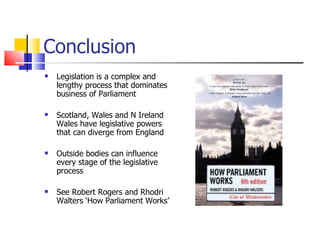
Conclusion  Legislation is a complex and lengthy process that dominates business of Parliament Scotland, Wales and N Ireland  Wales have legislative powers that can diverge from England Outside bodies can influence every stage of the legislative process See Robert Rogers and Rhodri Walters ‘How Parliament Works’

Public Bills: An overview

  • 1.
    Public Bills : An Overview Huw Edwards for Parliamentary Outreach Programme 4 May 2011 www.huwedwardstraining.com
  • 2.
    Presenter: HuwEdwards Training Consultant - Academy for Parliamentary and Policy Studies Parliament, legislation, government, devolution, public policy. www.ap-ps.org Former Member of Parliament (Labour) for Monmouth 1991-1992 and 1997-2005
  • 3.
    Functions of Parliament Legislation – make the law of the land Scrutiny – monitor the work of Government Control tax & expenditure Produce a Government Forum for National Debate Redress of Individual Grievances
  • 4.
    Types of LegislationPrimary Legislation Legislation contained in an Act of Parliament Public Bills Incl Private Members Bill Private Bills Scotland Wales and N Ireland also pass primary legislation Secondary Legislation also called Subordinate or Delegated Legislation Legislation delegated to Ministers by an Act Only small amount is considered by Parliament Regulations Orders Orders in Council Statutory Instruments (SIs) Statutory Codes of Guidance
  • 5.
    Primary Legislation PrimaryLegislation - the law that is made by an Act of Parliament Usually embodies the policy of the Government Bill is usually introduced by a Minister Can be introduced into the Commons or the Lords but must be passed by both Houses. Note: Primary Legislation is also passed by Scottish Parliament and N Ireland and Welsh Assemblies
  • 6.
    Government Bills GovernmentBills dominate the business of Parliament Bill introduced by Ministers who pilot it through the parliamentary stages in Commons and Lords Opposition will indicate whether they oppose the Bill at Second Reading with a ‘reasoned amendment’.
  • 7.
    House of Commons Pre eminent chamber Adversarial style of party politics Most Bills introduced into Commons first Government Bills normally succeed Only a few Private Members Bills succeed 10 Minute Rule Bills – formality to raise an issue
  • 8.
    House of Lords All legislation must pass through House of Lords Legislation can start in Lords …………… .Bill (Lords) Main role is as a revising chamber and often makes amendments eg 42 Days in Terrorism Bill Lords has less party politics but can draw on specialist knowledge of peers Lords cannot reject Government Bills or consider Finance Bills Parliament Act can ensure the Elected Chamber House of Commons has its way - see Hunting Bill in 2005
  • 9.
    Parliamentary Stages ofA Bill First Reading Second Reading Committee Stage Report Stage Third Reading First Reading Second Reading Committee Stage Report Stage Third Reading Commons Consideration of Lords Amendments Lords Consideration of Commons Reasons Royal Assent Commencement Order
  • 10.
    Public Bill Committees Undertake clause by clause scrutiny of Bill Around 22 members Membership reflects balance of the House Divides on political grounds Consider amendments to Bill tabled by Opposition and also Government Can question witnesses in select committee type format
  • 11.
    Pre Legislative Scrutiny Examining the issues raised by a Draft Bill before it is scrutinised clause by clause Aims to avoid bad law Bill can be scrutinised by Select Committee Ad Hoc Committee Joint Committee of Commons and Lords Committees take evidence from officials and outside experts Produce reports recommending changes to the Bill Pre legislative scrutiny is likely to be used for less controversial Bills
  • 12.
    Private Member’s Legislation Opportunity for backbencher to introduce legislation Decided by annual ballot. Only top 4- 5 Bills likely to succeed and only if Government gives parliamentary time MPs often decide on title of Bill with a pressure group Legislation on moral issues has often originated as Private Member Bill eg David Steel’s Abortion Law Reform Bill 1967 Ballot 2010-11 John McDonnell, Labour Robert Flello, Labour Chris White, Conservative Rebecca Harris, Conservative Mr Greg Knight, Conservative Anna Soubry, Conservative Harriett Baldwin, Conservative Mr David Hamilton, Labour Joan Walley, Labour Mrs Sharon Hodgson, Labour
  • 13.
    PrivateMembers Ballot 2010 Daylight Saving Bill 2010 Rebecca Harris MP Castle Point Bill to require the Secretary of State to conduct a cross-departmental analysis of the potential costs and benefits of advancing time by one hour for all, or part of, the year; to require the Secretary of State to take certain action in the light of that analysis; and for connected purposes. 2 nd Reading 3 December 2010
  • 14.
    Ten Minute RuleBills Opportunity for backbench MP to raise an issue 10 mins to propose the Bill – another MP can oppose it for 10 mins Very rarely leads to legislation being passed but…… Keith Vaz MP Succession to the Crown Bill A Bill to remove any distinction between the sexes in determining the succession to the Crown. Introduced 18 January 2011 Second Reading 13 May 2011
  • 15.
    Understanding the BillStudy the Bill but it is written in legal language so difficult to understand Read the Explanatory Notes which accompanies the Bill and explain what each clauses does Read Explanatory Memorandum which are produced by civil servants to explain the context and aims of the Bill See House of Commons Library Report on the Bill - very detailed outline of the background aims and provisions of the Bill
  • 16.
    Remember Devolution ScottishParliament - can legislate in any area except those reserved in 1998 Scotland Act – eg foreign affairs Northern Ireland Assembly - can legislate in any areas part from those excepted in 1998 Northern Ireland Act National Assembly for Wales - can make legislation in devolved areas under 2006 Government of Wales Act – can pass Acts from May 2011
  • 17.
    Sovereignty of ParliamentUK Parliament remains sovereign Westminster can still legislate across the UK Could repeal any devolved laws or institutions
  • 18.
    Conclusion Legislationis a complex and lengthy process that dominates business of Parliament Scotland, Wales and N Ireland Wales have legislative powers that can diverge from England Outside bodies can influence every stage of the legislative process See Robert Rogers and Rhodri Walters ‘How Parliament Works’