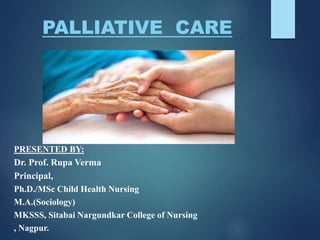





PALLIATIVE CARE
PRESENTED BY:
Dr. Prof. Rupa Verma
Principal,
Ph.D./MSc Child Health Nursing
M.A.(Sociology)
MKSSS, Sitabai Nargundkar College of Nursing
, Nagpur.
OBJECTIVES
 What is Palliative care.
 Identify goals and need of
Palliative care.
 Identify scope , philosophy
& phases of Palliative
care.
 Identify principle of
Palliative care.
 Myth about Palliative
care.
 Discuss assessment and
management of actively dying
patients
 Describe Palliative Care and
how it differs from hospice care
 Identify benefits of Palliative
care.
 Describe the role of Palliative
care in patients with serious
illness
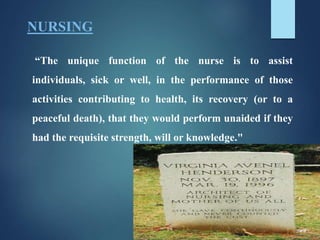
NURSING
“The unique function of the nurse is to assist
individuals, sick or well, in the performance of those
activities contributing to health, its recovery (or to a
peaceful death), that they would perform unaided if they
had the requisite strength, will or knowledge."
WHAT IS PALLIATIVE CARE
 The word “palliative” Latin word ‘pallium’ meaning to
cloak, deceive or cover.
 Palliate- “to lessen or mitigate without curing”
 Palliative Care- term first coined in 1974 by Dr. Balfour
Mount
 Palliative care is an multidisciplinary approach and
specialized medical care for people with serious illness.
CON….
 It focuses on providing patients with relief from the symptoms,
pain, and stress of a serious illness-whatever the diagnosis.
 The term "palliative care" is increasingly used with regard to
diseases other than cancer such as
– Chronic, progressive pulmonary disorders
– Renal disease
– Chronic heart failure
– HIV/AIDS and
– Progressive neurological conditions
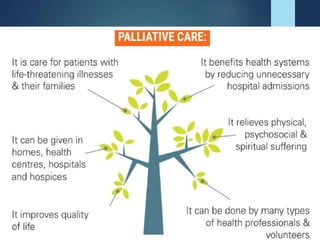
PALLIATIVE CARE
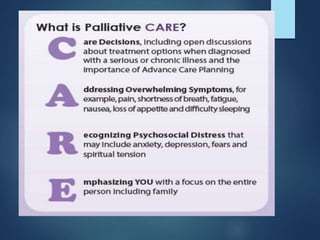
“ An approach that improves the quality of life of patients and
their families facing the problems associated with life-
threatening illness, through the prevention and relief of
suffering by means of early identification and impeccable
assessment and treatment of pain and other problems,
physical, psychosocial and spiritual "
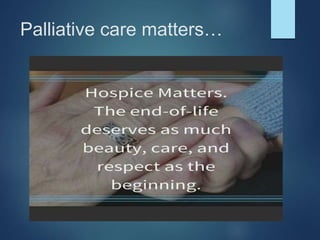
Palliative care matters…
AIMS OF PALLIATIVE CARE
 To relieve symptoms and improve the quality of living and
dying for a person and family living with a life threatening
illness.
 To reduce over all health-related suffering for patients and
families living with life limiting or life threatening
conditions
CON…
 Palliative care strives to help individuals and their
families
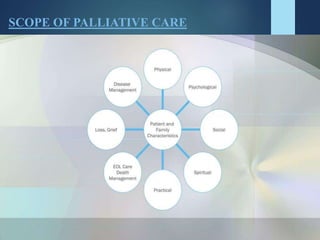
 It address physical, psychological, social, spiritual
and practical issues and associated expectations,
needs, hopes and fears.
 Prepare for and manage life closure and the dying
process and
 cope with loss and grief during the illness and
bereavement.
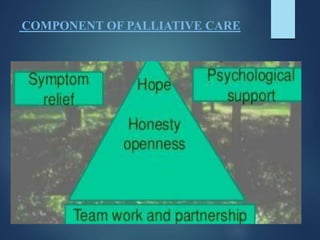
COMPONENT OF PALLIATIVE CARE
CURRENT SCENARIO
GLOBAL :
 According to WHO , Each year an estimated 56.8 million
people, including 25.7 million in the last year of life, are in
need of palliative care.
 Worldwide, only about 14% of people who need palliative
care currently receive it.
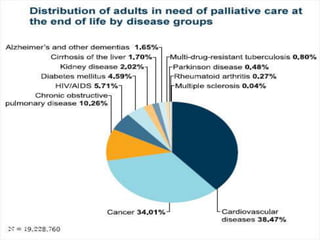
Palliative care is required for a wide range of diseases.
The majority of adults in need of palliative care have
chronic diseases.
CON…
 Demographically, the proportion of fatalities
requiring palliative care increased from 72.5% in
2006 to 74.9% in 2014 .
 Moreover, the need for palliative care will increase
from 38.0% in 2014 to 56.0% by 2040.
 Annually, 40 million people require palliative care.
 Around 78% of persons needing palliative care
reside in low- and middle-income economies
INDIAN SCENARIO
 In India according to a recent survey, more than
108 entities currently provide facilities
 To improve the quality of life and palliative
treatment services in 16 states/union territories .
 These are mainly restricted to major cities and
regional cancer centers, with the exception of
Kerala, where services are more readily available
than in other states.
 NGOs, public and private hospitals, and hospices
are primary care providers.
SCOPE OF PALLIATIVE CARE
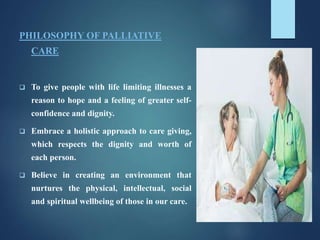
PHILOSOPHY OF PALLIATIVE
CARE
 To give people with life limiting illnesses a
reason to hope and a feeling of greater self-
confidence and dignity.
 Embrace a holistic approach to care giving,
which respects the dignity and worth of
each person.
 Believe in creating an environment that
nurtures the physical, intellectual, social
and spiritual wellbeing of those in our care.
CON…
 Palliative or comfort care recognizes that death is a
normal part of life and strives to prepare patients
and their families.
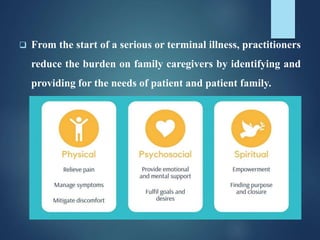
 From the start of a serious or terminal illness, practitioners
reduce the burden on family caregivers by identifying and
providing for the needs of patient and patient family.
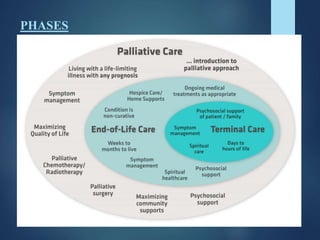
PHASES
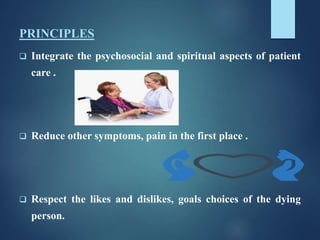
PRINCIPLES
 Integrate the psychosocial and spiritual aspects of patient
care .
 Reduce other symptoms, pain in the first place .
 Respect the likes and dislikes, goals choices of the dying
person.
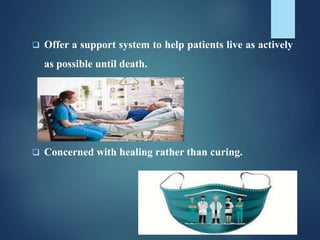
 Offer a support system to help patients live as actively
as possible until death.
 Concerned with healing rather than curing.
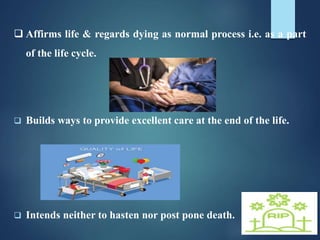
 Affirms life & regards dying as normal process i.e. as a part
of the life cycle.
 Builds ways to provide excellent care at the end of the life.
 Intends neither to hasten nor post pone death.
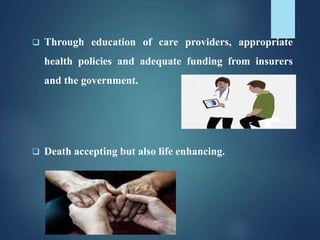
 Through education of care providers, appropriate
health policies and adequate funding from insurers
and the government.
 Death accepting but also life enhancing.
 “Adds life to days and not days to life”
 Patient centered rather than disease focused.
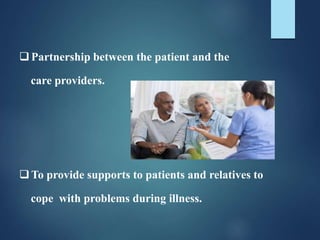
Partnership between the patient and the
care providers.
To provide supports to patients and relatives to
cope with problems during illness.
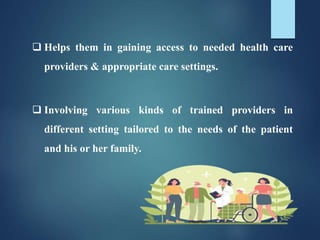
 Helps them in gaining access to needed health care
providers & appropriate care settings.
 Involving various kinds of trained providers in
different setting tailored to the needs of the patient
and his or her family.
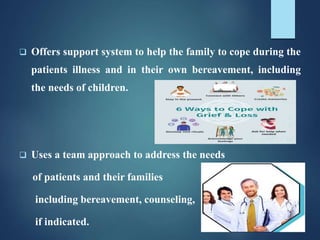
 Offers support system to help the family to cope during the
patients illness and in their own bereavement, including
the needs of children.
 Uses a team approach to address the needs
of patients and their families
including bereavement, counseling,
if indicated.
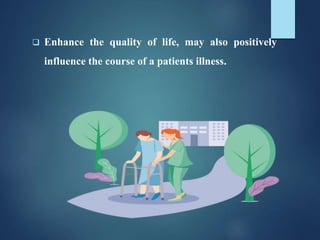
 Enhance the quality of life, may also positively
influence the course of a patients illness.
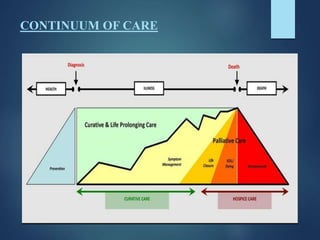
CONTINUUM OF CARE
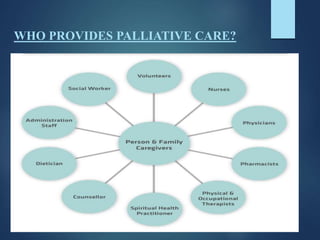
WHO PROVIDES PALLIATIVE CARE?
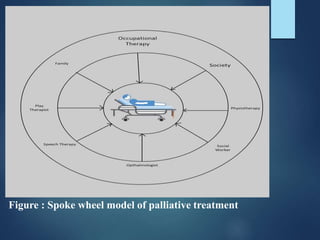
Figure : Spoke wheel model of palliative treatment
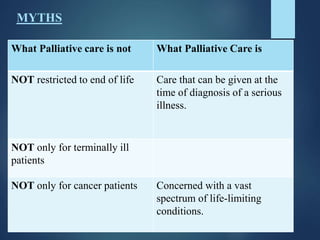
MYTHS
What Palliative care is not What Palliative Care is
NOT restricted to end of life Care that can be given at the
time of diagnosis of a serious
illness.
NOT only for terminally ill
patients
NOT only for cancer patients Concerned with a vast
spectrum of life-limiting
conditions.
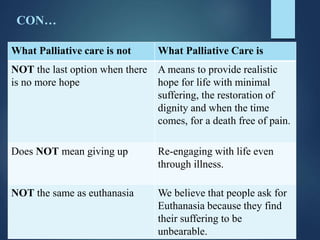
CON…
What Palliative care is not What Palliative Care is
NOT the last option when there
is no more hope
A means to provide realistic
hope for life with minimal
suffering, the restoration of
dignity and when the time
comes, for a death free of pain.
Does NOT mean giving up Re-engaging with life even
through illness.
NOT the same as euthanasia We believe that people ask for
Euthanasia because they find
their suffering to be
unbearable.
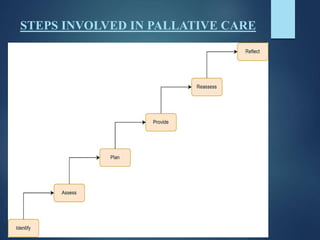
STEPS INVOLVED IN PALLATIVE CARE
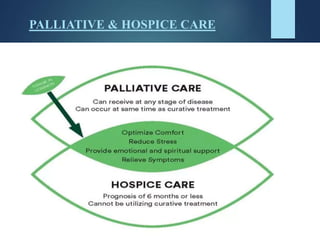
PALLIATIVE & HOSPICE CARE
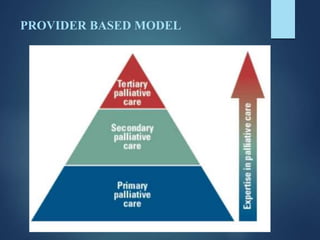
PROVIDER BASED MODEL
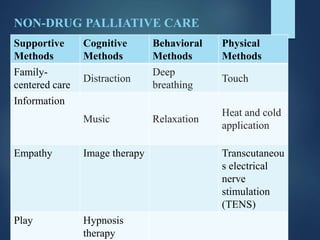
NON-DRUG PALLIATIVE CARE
Supportive
Methods
Cognitive
Methods
Behavioral
Methods
Physical
Methods
Family-
centered care
Distraction
Deep
breathing
Touch
Information
Music Relaxation
Heat and cold
application
Empathy Image therapy Transcutaneou
s electrical
nerve
stimulation
(TENS)
Play Hypnosis
therapy
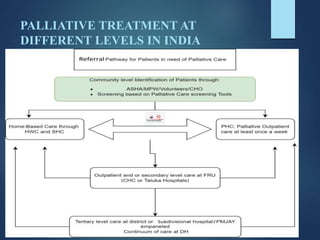
PALLIATIVE TREATMENT AT
DIFFERENT LEVELS IN INDIA
ADVANTAGES Of EARLY PALLIATIVE
CARE
 Patients who received early palliative care survived
longer than patients who received conventional
treatment but required less vigorous care in the last
phases of their illness
DISADVANTAGES OF LATE OR
INAPPROPRIATE PALLIATIVE CARE
 Families misconceptions of palliative care
 Poor doctor-patient communication
 Families insufficient readiness to deteriorate
patient’s situations.
SERVICES PROVIDED BY PALLIATIVE CARE
 Interdisciplinary team care- nursing services, medical,
social, counseling, home health aide
 Bereavement counseling
 Dietary counseling
 Physical therapy
 Occupational therapy
 Speech therapy
 Investigations and drugs
 Durable medical equipments and supplies
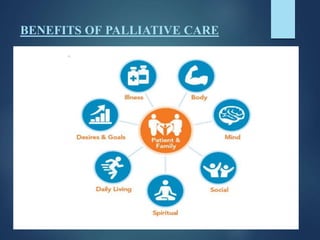
BENEFITS OF PALLIATIVE CARE
CON…
 Palliative approach offers many benefits to the residents, their
families and the health care team,
 Some of these are:
 Better pain and symptoms management
 Reducing the admission ,fewer emergency and ICU visits
 More advance care planning
 Improve the life expectancy
 Family support
 Increasing the involvement of the resident and their family
in the decision making .
 Encouraging open and early discussion on death and dying
 Offering the resident and family consistent and continuous
care
CASE :
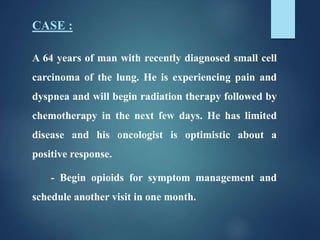
A 64 years of man with recently diagnosed small cell
carcinoma of the lung. He is experiencing pain and
dyspnea and will begin radiation therapy followed by
chemotherapy in the next few days. He has limited
disease and his oncologist is optimistic about a
positive response.
- Begin opioids for symptom management and
schedule another visit in one month.
CURRENT FACILITIES AND PROVISIONS
 WHO and other international organizations emphasis on
providing physical, psychosocial, and spiritual .
 Indian palliative care development at its most successful has
innovated and produced services .
 Home-based palliative care services
 The aim of home-based care is ultimately to “promote,
restore, and care toward a dignified death.”
 Palliative care is an important and essential part of cancer
care therapy and twelfth 5-year plan makes a special
provision for it.
RECENT ADVANCES
 Better management of chronic cancer pain through use of
common analgesics, opioids, and neuropathic pain requires
additional treatment with anticonvulsants or tricyclic
antidepressants
 Improved management of other symptom - gastrointestinal
symptoms, dyspnea, confusion states, and depression
(J Andrew Billings, director “Recent advances in palliative care
BMJ. 2000 Sep 2; 321(7260): 555–558)
CON…
 Advance care planning to preserve patient
autonomy and choice around the time of death.
 Improved understanding of the role of artificial
feeding and hydration for dying people.
 General consensus on the acceptability of
withholding or withdrawing life sustaining
supports, which permits use of opioids and sedatives
to relieve suffering even if death may ensue
NATIONAL PROGRAMME FOR
PALLIATIVE CARE (NPPC)
 The Ministry of Health & Family Welfare,
Government of India constituted an expert group
on Palliative care
 Palliative Care is part of the ‘Mission Flexipool’
under National Health Mission (NHM).
 Centrally sponsored scheme
 Funding pattern : 40% share from the states
(10% in case of Hill states)
SCHEME:
 GOAL:
 Availability and accessibility of rational, quality pain relief
and palliative care to the needy.
 OBJECTIVES:
 Improve the capacity to provide palliative care service
delivery within government health programs.
 Such as the National Program for Prevention and Control
of Cancer, Cardiovascular Disease, Diabetes, and Stroke.
 National Program for Health Care of the Elderly.
 National AIDS Control Program and the National Rural
Health Mission.
CON…
 BENEFICIARIES: The terminal cases of Cancer, AIDS
etc.
 The regulatory aspects, as mentioned in the Program,
for increasing Morphine availability would be addressed
by Department of Revenue in coordination with Central
Drug Standards Control Organization.
 Cooperation of international and national agencies
would be taken for successful implementation of the
program.
GLOBAL ORGANIZATIONS
 Worldwide Hospice Palliative Care Alliance
(WHPCA)
 International Association for Hospice &
Palliative Care (IAHPC)
 International Children’s Palliative Care
Network (ICPCN)
EDUCATION, TRAINING & RESEARCH
 Educational efforts in palliative and end-of-life care have
targeted nurses, physicians and disciplines.
 WHO recommended three foundation measures for
developing Palliative care - Governmental policy,
Education, and Drug availability.
 Research in Palliative care is very essential to deliver
high-quality palliative care.
 Many developments like Megestrol for cancer cachexia,
Bisphosphonates for pain in bone metastasis, Opioids for
the palliation of breathlessness in terminal illness have
come from the research in palliative care.
TAKE HOME MESSAGE
 To care for a dying person is an honor and privilege
afforded few in our society. Our main goal is to reduce
suffering while maintaining consciousness, yet refractory
symptoms may engender increased suffering and a reduced
quality of life.
 Live as well as you can ,for as long as you can.
 Let's hope for a pain free India.
“ Together everyone achieves more.”
Palliative care ppt gins.pptx

Palliative care ppt gins.pptx

  • 1.
    PALLIATIVE CARE PRESENTED BY: Dr.Prof. Rupa Verma Principal, Ph.D./MSc Child Health Nursing M.A.(Sociology) MKSSS, Sitabai Nargundkar College of Nursing , Nagpur.
  • 2.
    OBJECTIVES  What isPalliative care.  Identify goals and need of Palliative care.  Identify scope , philosophy & phases of Palliative care.  Identify principle of Palliative care.  Myth about Palliative care.  Discuss assessment and management of actively dying patients  Describe Palliative Care and how it differs from hospice care  Identify benefits of Palliative care.  Describe the role of Palliative care in patients with serious illness
  • 3.
    NURSING “The unique functionof the nurse is to assist individuals, sick or well, in the performance of those activities contributing to health, its recovery (or to a peaceful death), that they would perform unaided if they had the requisite strength, will or knowledge."
  • 5.
    WHAT IS PALLIATIVECARE  The word “palliative” Latin word ‘pallium’ meaning to cloak, deceive or cover.  Palliate- “to lessen or mitigate without curing”  Palliative Care- term first coined in 1974 by Dr. Balfour Mount  Palliative care is an multidisciplinary approach and specialized medical care for people with serious illness.
  • 6.
    CON….  It focuseson providing patients with relief from the symptoms, pain, and stress of a serious illness-whatever the diagnosis.  The term "palliative care" is increasingly used with regard to diseases other than cancer such as – Chronic, progressive pulmonary disorders – Renal disease – Chronic heart failure – HIV/AIDS and – Progressive neurological conditions
  • 7.
    PALLIATIVE CARE “ Anapproach that improves the quality of life of patients and their families facing the problems associated with life- threatening illness, through the prevention and relief of suffering by means of early identification and impeccable assessment and treatment of pain and other problems, physical, psychosocial and spiritual "
  • 8.
  • 10.
    AIMS OF PALLIATIVECARE  To relieve symptoms and improve the quality of living and dying for a person and family living with a life threatening illness.  To reduce over all health-related suffering for patients and families living with life limiting or life threatening conditions
  • 11.
    CON…  Palliative carestrives to help individuals and their families  It address physical, psychological, social, spiritual and practical issues and associated expectations, needs, hopes and fears.  Prepare for and manage life closure and the dying process and  cope with loss and grief during the illness and bereavement.
  • 12.
  • 13.
    CURRENT SCENARIO GLOBAL : According to WHO , Each year an estimated 56.8 million people, including 25.7 million in the last year of life, are in need of palliative care.  Worldwide, only about 14% of people who need palliative care currently receive it. Palliative care is required for a wide range of diseases. The majority of adults in need of palliative care have chronic diseases.
  • 14.
    CON…  Demographically, theproportion of fatalities requiring palliative care increased from 72.5% in 2006 to 74.9% in 2014 .  Moreover, the need for palliative care will increase from 38.0% in 2014 to 56.0% by 2040.  Annually, 40 million people require palliative care.  Around 78% of persons needing palliative care reside in low- and middle-income economies
  • 15.
    INDIAN SCENARIO  InIndia according to a recent survey, more than 108 entities currently provide facilities  To improve the quality of life and palliative treatment services in 16 states/union territories .  These are mainly restricted to major cities and regional cancer centers, with the exception of Kerala, where services are more readily available than in other states.  NGOs, public and private hospitals, and hospices are primary care providers.
  • 17.
  • 18.
    PHILOSOPHY OF PALLIATIVE CARE To give people with life limiting illnesses a reason to hope and a feeling of greater self- confidence and dignity.  Embrace a holistic approach to care giving, which respects the dignity and worth of each person.  Believe in creating an environment that nurtures the physical, intellectual, social and spiritual wellbeing of those in our care.
  • 19.
    CON…  Palliative orcomfort care recognizes that death is a normal part of life and strives to prepare patients and their families.
  • 20.
     From thestart of a serious or terminal illness, practitioners reduce the burden on family caregivers by identifying and providing for the needs of patient and patient family.
  • 21.
  • 22.
    PRINCIPLES  Integrate thepsychosocial and spiritual aspects of patient care .  Reduce other symptoms, pain in the first place .  Respect the likes and dislikes, goals choices of the dying person.
  • 23.
     Offer asupport system to help patients live as actively as possible until death.  Concerned with healing rather than curing.
  • 24.
     Affirms life& regards dying as normal process i.e. as a part of the life cycle.  Builds ways to provide excellent care at the end of the life.  Intends neither to hasten nor post pone death.
  • 25.
     Through educationof care providers, appropriate health policies and adequate funding from insurers and the government.  Death accepting but also life enhancing.
  • 26.
     “Adds lifeto days and not days to life”  Patient centered rather than disease focused.
  • 27.
    Partnership between thepatient and the care providers. To provide supports to patients and relatives to cope with problems during illness.
  • 28.
     Helps themin gaining access to needed health care providers & appropriate care settings.  Involving various kinds of trained providers in different setting tailored to the needs of the patient and his or her family.
  • 29.
     Offers supportsystem to help the family to cope during the patients illness and in their own bereavement, including the needs of children.  Uses a team approach to address the needs of patients and their families including bereavement, counseling, if indicated.
  • 30.
     Enhance thequality of life, may also positively influence the course of a patients illness.
  • 31.
  • 32.
  • 33.
    Figure : Spokewheel model of palliative treatment
  • 35.
    MYTHS What Palliative careis not What Palliative Care is NOT restricted to end of life Care that can be given at the time of diagnosis of a serious illness. NOT only for terminally ill patients NOT only for cancer patients Concerned with a vast spectrum of life-limiting conditions.
  • 36.
    CON… What Palliative careis not What Palliative Care is NOT the last option when there is no more hope A means to provide realistic hope for life with minimal suffering, the restoration of dignity and when the time comes, for a death free of pain. Does NOT mean giving up Re-engaging with life even through illness. NOT the same as euthanasia We believe that people ask for Euthanasia because they find their suffering to be unbearable.
  • 37.
    STEPS INVOLVED INPALLATIVE CARE
  • 38.
  • 39.
  • 40.
    NON-DRUG PALLIATIVE CARE Supportive Methods Cognitive Methods Behavioral Methods Physical Methods Family- centeredcare Distraction Deep breathing Touch Information Music Relaxation Heat and cold application Empathy Image therapy Transcutaneou s electrical nerve stimulation (TENS) Play Hypnosis therapy
  • 41.
  • 42.
    ADVANTAGES Of EARLYPALLIATIVE CARE  Patients who received early palliative care survived longer than patients who received conventional treatment but required less vigorous care in the last phases of their illness
  • 43.
    DISADVANTAGES OF LATEOR INAPPROPRIATE PALLIATIVE CARE  Families misconceptions of palliative care  Poor doctor-patient communication  Families insufficient readiness to deteriorate patient’s situations.
  • 44.
    SERVICES PROVIDED BYPALLIATIVE CARE  Interdisciplinary team care- nursing services, medical, social, counseling, home health aide  Bereavement counseling  Dietary counseling  Physical therapy  Occupational therapy  Speech therapy  Investigations and drugs  Durable medical equipments and supplies
  • 45.
  • 46.
    CON…  Palliative approachoffers many benefits to the residents, their families and the health care team,  Some of these are:  Better pain and symptoms management  Reducing the admission ,fewer emergency and ICU visits  More advance care planning  Improve the life expectancy  Family support
  • 47.
     Increasing theinvolvement of the resident and their family in the decision making .  Encouraging open and early discussion on death and dying  Offering the resident and family consistent and continuous care
  • 49.
    CASE : A 64years of man with recently diagnosed small cell carcinoma of the lung. He is experiencing pain and dyspnea and will begin radiation therapy followed by chemotherapy in the next few days. He has limited disease and his oncologist is optimistic about a positive response. - Begin opioids for symptom management and schedule another visit in one month.
  • 50.
    CURRENT FACILITIES ANDPROVISIONS  WHO and other international organizations emphasis on providing physical, psychosocial, and spiritual .  Indian palliative care development at its most successful has innovated and produced services .  Home-based palliative care services  The aim of home-based care is ultimately to “promote, restore, and care toward a dignified death.”  Palliative care is an important and essential part of cancer care therapy and twelfth 5-year plan makes a special provision for it.
  • 51.
    RECENT ADVANCES  Bettermanagement of chronic cancer pain through use of common analgesics, opioids, and neuropathic pain requires additional treatment with anticonvulsants or tricyclic antidepressants  Improved management of other symptom - gastrointestinal symptoms, dyspnea, confusion states, and depression (J Andrew Billings, director “Recent advances in palliative care BMJ. 2000 Sep 2; 321(7260): 555–558)
  • 52.
    CON…  Advance careplanning to preserve patient autonomy and choice around the time of death.  Improved understanding of the role of artificial feeding and hydration for dying people.  General consensus on the acceptability of withholding or withdrawing life sustaining supports, which permits use of opioids and sedatives to relieve suffering even if death may ensue
  • 54.
    NATIONAL PROGRAMME FOR PALLIATIVECARE (NPPC)  The Ministry of Health & Family Welfare, Government of India constituted an expert group on Palliative care  Palliative Care is part of the ‘Mission Flexipool’ under National Health Mission (NHM).  Centrally sponsored scheme  Funding pattern : 40% share from the states (10% in case of Hill states)
  • 55.
    SCHEME:  GOAL:  Availabilityand accessibility of rational, quality pain relief and palliative care to the needy.  OBJECTIVES:  Improve the capacity to provide palliative care service delivery within government health programs.  Such as the National Program for Prevention and Control of Cancer, Cardiovascular Disease, Diabetes, and Stroke.  National Program for Health Care of the Elderly.  National AIDS Control Program and the National Rural Health Mission.
  • 56.
    CON…  BENEFICIARIES: Theterminal cases of Cancer, AIDS etc.  The regulatory aspects, as mentioned in the Program, for increasing Morphine availability would be addressed by Department of Revenue in coordination with Central Drug Standards Control Organization.  Cooperation of international and national agencies would be taken for successful implementation of the program.
  • 57.
    GLOBAL ORGANIZATIONS  WorldwideHospice Palliative Care Alliance (WHPCA)  International Association for Hospice & Palliative Care (IAHPC)  International Children’s Palliative Care Network (ICPCN)
  • 58.
    EDUCATION, TRAINING &RESEARCH  Educational efforts in palliative and end-of-life care have targeted nurses, physicians and disciplines.  WHO recommended three foundation measures for developing Palliative care - Governmental policy, Education, and Drug availability.  Research in Palliative care is very essential to deliver high-quality palliative care.  Many developments like Megestrol for cancer cachexia, Bisphosphonates for pain in bone metastasis, Opioids for the palliation of breathlessness in terminal illness have come from the research in palliative care.
  • 59.
    TAKE HOME MESSAGE To care for a dying person is an honor and privilege afforded few in our society. Our main goal is to reduce suffering while maintaining consciousness, yet refractory symptoms may engender increased suffering and a reduced quality of life.  Live as well as you can ,for as long as you can.  Let's hope for a pain free India. “ Together everyone achieves more.”