Horizontal communication networks and the evolution of journalism Donica Mensing, PhD. Reynolds School of Journalism University of Nevada, Reno [email_address]
Summary This project uses an examination of Twitter and Facebook posts about climate change to consider how horizontal communication structures are changing journalistic practices, and in turn, affecting the creation of public agendas.
Climate science “… The basic consensus is almost universally accepted. That is, the planet is warming, that human activities are contributing to the greenhouse gases in the atmosphere (chiefly, but not exclusively CO2), that these changes are playing a big role in the current warming, and thus, further increases in the levels of GHGs in the atmosphere are very likely to cause further warming which could have serious impacts.”  Guardian.co.uk, 25 June 2010 http://www.guardian.co.uk/environment/2010/jun/25/what-climate-scientists-think
Proceedings of the National Academy of Sciences  of the United States of America  (2010) 97–98% of the climate researchers most actively publishing in the field support the findings about climate change outlined by the Intergovernmental Panel on Climate Change  The relative climate expertise and scientific prominence of the researchers unconvinced of human caused climate change are substantially below that of convinced researchers
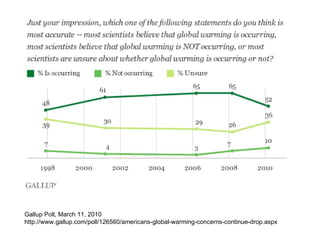
Gallup Poll, March 11, 2010 http://www.gallup.com/poll/126560/americans-global-warming-concerns-continue-drop.aspx
 
 
Journalism and climate change Significant journalistic resources dedicated to the subject over the past 20 years Yet coverage is often sporadic, lacks context, focuses on conflict Balancing viewpoints to achieve “objectivity” gives undue credibility to some sources
Changes in communication The structure of communication and information flows is changing, adding an active horizontal dimension (Benkler, Castells) Communication is now mobile, global, peer to peer, asynchronous (horizontal) as well as institutional (vertical)
Agenda setting theory Agenda setting is the process that determines what issues are considered most important (salient) by the public, and by legislators, candidates, and politicians. (Dearing & Rogers, 1996, p. 8). Media agenda setting refers to the influence of the media on public and policy agendas Agenda setting is also influenced by public relations (Ohl, 1995), interpersonal communication (Wyatt, Katz and Kim, 2000) and other audience factors.
Questions How do horizontal communication networks affect the practices of journalism? How might these changes in journalism effect media agenda setting/agenda building?
Social networks Facebook is now the most popular online site after Google. Every day a third of all online users globally access the site for an average of 30 minutes (NYT reaches 1.2% of the Internet population for 4.8 minutes a day) Twitter is the 11 th  most popular site online. Approximately 300,000 people create new accounts daily.
Study design Downloaded 50* Facebook updates and 50 Twitter posts in English that mentioned the word “climate” and were relevant to climate change every night for five nights Collected 413 posts for analysis
 
Who is posting?
Seven observations about changes in news practices on social networks
News is for sharing  80% of all posts included a link to an information source People like to share what they are reading and viewing Social networks facilitate conversation about news, encourage action and provide interpretation. Conversation about the news has been shown to increase knowledge.
News is persuasive Users post links to make a point, sway opinions, convince others to act 41% of all links were to mainstream news sources 59% of all links were to partisan news sources, alternative news, interest groups, bloggers
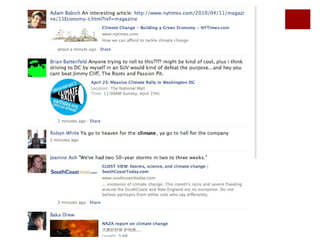
News and information are found in many places
News distribution is story-by-story The prominence of stories is determined by friends and followers, not by editors “ News finds me” -- news is consumed as part of social interaction, not by appointment Stories are stripped of context, placement, timing; brand becomes less important
  News has new forms  and new authors
The Guardian is one major media brand making the transition to networks No media organizations used Facebook to promote climate stories in the selected study sample; all were on Twitter The most linked to stories on Twitter were from the Guardian (UK)  The most popular Twitter feed was by the Guardian Example: http://www.guardian.co.uk/environment/2010/apr/16/google-climate-chief-price-carbon
 
News is global One each:  Bolivia, Bulgaria, Denmark, El Salvador, Greece, Haiti, Jamaica, Japan, Kenya, Mexico, Pakistan, Peru, Scotland, Sweden, Switzerland, Thailand, UAE
News on social networks is continuous and voluminous River of news is flowing constantly On Twitter, climate related posts are being posted at the rate of 100+ per hour, 24 hours a day, 7 days a week (one week = 16,800 posts) The five most visited online news sites posted four short stories about climate change during the week of this study (BBC, New York Times, Yahoo, Google, CNN)
Implications News is determined more by personal networks than by professional editors News consumption is more interactive, more social, more value driven It is more difficult for mainstream media to maintain agendas There is no single ‘media agenda;’ agendas become highly personalized Agenda setting likely to be far more complex and chaotic than in the past
The future Need to develop structures for integrating and co-producing professional news in social networks Need to understand how variations in network design affect news creation, distribution, conversation and deliberation Need to develop process mechanisms for editing, curation and knowledge building, and ultimately improved civic capacity
Thank you

Horizontal communication and the evolution of journalism

  • 1.
    Horizontal communication networksand the evolution of journalism Donica Mensing, PhD. Reynolds School of Journalism University of Nevada, Reno [email_address]
  • 2.
    Summary This projectuses an examination of Twitter and Facebook posts about climate change to consider how horizontal communication structures are changing journalistic practices, and in turn, affecting the creation of public agendas.
  • 3.
    Climate science “…The basic consensus is almost universally accepted. That is, the planet is warming, that human activities are contributing to the greenhouse gases in the atmosphere (chiefly, but not exclusively CO2), that these changes are playing a big role in the current warming, and thus, further increases in the levels of GHGs in the atmosphere are very likely to cause further warming which could have serious impacts.” Guardian.co.uk, 25 June 2010 http://www.guardian.co.uk/environment/2010/jun/25/what-climate-scientists-think
  • 4.
    Proceedings of theNational Academy of Sciences of the United States of America (2010) 97–98% of the climate researchers most actively publishing in the field support the findings about climate change outlined by the Intergovernmental Panel on Climate Change The relative climate expertise and scientific prominence of the researchers unconvinced of human caused climate change are substantially below that of convinced researchers
  • 5.
    Gallup Poll, March11, 2010 http://www.gallup.com/poll/126560/americans-global-warming-concerns-continue-drop.aspx
  • 6.
  • 7.
  • 8.
    Journalism and climatechange Significant journalistic resources dedicated to the subject over the past 20 years Yet coverage is often sporadic, lacks context, focuses on conflict Balancing viewpoints to achieve “objectivity” gives undue credibility to some sources
  • 9.
    Changes in communicationThe structure of communication and information flows is changing, adding an active horizontal dimension (Benkler, Castells) Communication is now mobile, global, peer to peer, asynchronous (horizontal) as well as institutional (vertical)
  • 10.
    Agenda setting theoryAgenda setting is the process that determines what issues are considered most important (salient) by the public, and by legislators, candidates, and politicians. (Dearing & Rogers, 1996, p. 8). Media agenda setting refers to the influence of the media on public and policy agendas Agenda setting is also influenced by public relations (Ohl, 1995), interpersonal communication (Wyatt, Katz and Kim, 2000) and other audience factors.
  • 11.
    Questions How dohorizontal communication networks affect the practices of journalism? How might these changes in journalism effect media agenda setting/agenda building?
  • 12.
    Social networks Facebookis now the most popular online site after Google. Every day a third of all online users globally access the site for an average of 30 minutes (NYT reaches 1.2% of the Internet population for 4.8 minutes a day) Twitter is the 11 th most popular site online. Approximately 300,000 people create new accounts daily.
  • 13.
    Study design Downloaded50* Facebook updates and 50 Twitter posts in English that mentioned the word “climate” and were relevant to climate change every night for five nights Collected 413 posts for analysis
  • 14.
  • 15.
  • 16.
    Seven observations aboutchanges in news practices on social networks
  • 17.
    News is forsharing 80% of all posts included a link to an information source People like to share what they are reading and viewing Social networks facilitate conversation about news, encourage action and provide interpretation. Conversation about the news has been shown to increase knowledge.
  • 18.
    News is persuasiveUsers post links to make a point, sway opinions, convince others to act 41% of all links were to mainstream news sources 59% of all links were to partisan news sources, alternative news, interest groups, bloggers
  • 19.
    News and informationare found in many places
  • 20.
    News distribution isstory-by-story The prominence of stories is determined by friends and followers, not by editors “ News finds me” -- news is consumed as part of social interaction, not by appointment Stories are stripped of context, placement, timing; brand becomes less important
  • 21.
      News hasnew forms and new authors
  • 22.
    The Guardian isone major media brand making the transition to networks No media organizations used Facebook to promote climate stories in the selected study sample; all were on Twitter The most linked to stories on Twitter were from the Guardian (UK) The most popular Twitter feed was by the Guardian Example: http://www.guardian.co.uk/environment/2010/apr/16/google-climate-chief-price-carbon
  • 23.
  • 24.
    News is globalOne each: Bolivia, Bulgaria, Denmark, El Salvador, Greece, Haiti, Jamaica, Japan, Kenya, Mexico, Pakistan, Peru, Scotland, Sweden, Switzerland, Thailand, UAE
  • 25.
    News on socialnetworks is continuous and voluminous River of news is flowing constantly On Twitter, climate related posts are being posted at the rate of 100+ per hour, 24 hours a day, 7 days a week (one week = 16,800 posts) The five most visited online news sites posted four short stories about climate change during the week of this study (BBC, New York Times, Yahoo, Google, CNN)
  • 26.
    Implications News isdetermined more by personal networks than by professional editors News consumption is more interactive, more social, more value driven It is more difficult for mainstream media to maintain agendas There is no single ‘media agenda;’ agendas become highly personalized Agenda setting likely to be far more complex and chaotic than in the past
  • 27.
    The future Needto develop structures for integrating and co-producing professional news in social networks Need to understand how variations in network design affect news creation, distribution, conversation and deliberation Need to develop process mechanisms for editing, curation and knowledge building, and ultimately improved civic capacity
  • 28.

Editor's Notes

  • #9 However, coverage doesn’t appear to have changed substantially over time. What accounts for variation in opinion?