Charles Williams
HOME.B4
Innovation and Industry for Security
Security Union Policy context
- Call 2020 -
LEGALLY NOT BINDING
European Agenda on Security (2015)
COM(2015) 185 final (28 April 2015)
"Research and innovation are essential if the EU is to
keep up-to-date with evolving security needs.
Research can identify new security threats and their
impacts on European societies.
Horizon 2020 can play a central role in ensuring that EU's
research effort is well targeted, including factoring in the
needs of law enforcement authorities by further
involving end-users at all stages of the process, from
conception to market."
Security Research: not a stand-alone process
Security Research is part of a wider process:
Capability Development Process
Seventeenth Progress Report towards an
effective and genuine Security Union:
(11.12.2018, COM(2018) 845)
•“EU security research is one of the
building blocks of the Security Union …
crucial for developing capabilities to
address today's security challenges,
anticipating tomorrow's threats and
contributing to a more competitive
European security industry. …”
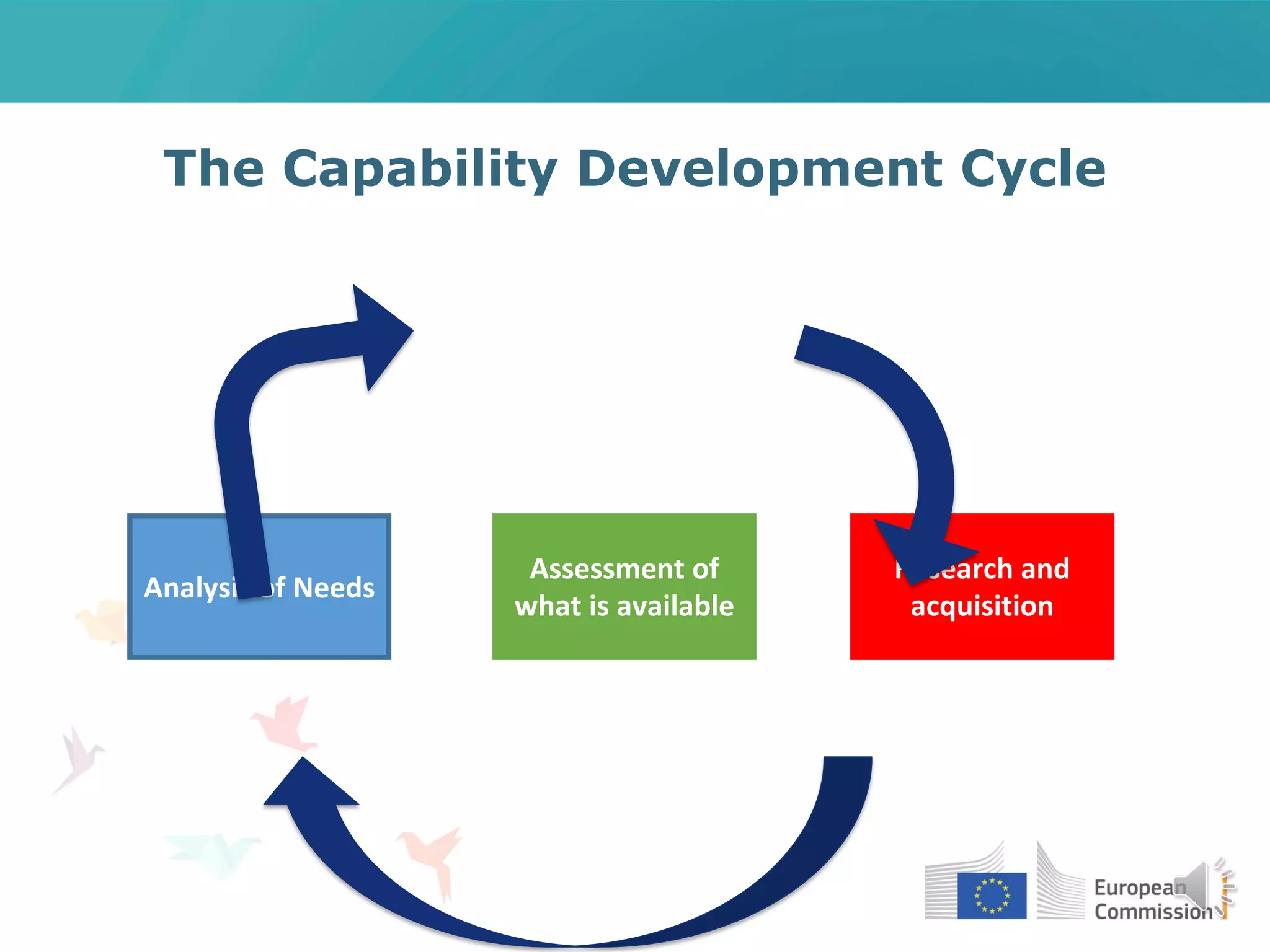
The Capability Development Cycle
Analysis of Needs
Assessment of
what is available
Research and
acquisition
What will be the impact of your project?
Speaking about impact…
• What is the impact on the ultimate objective(s)?
• How will results/outcomes lead to that impact?
• How to ensure deployment & market uptake?
(Our biggest challenge in the Secure Societies programme)
4/
23
H2020 Secure
Societies
Programme of Work
2020
Zale Johnson
NCP Secure Societies
26th March 2020
Withdrawal of the
UK from the EU
• From 1 February 2020
• Transition Period:
February 1st until 31st December 2020
(possibility for UK to request an extension
of 1 or 2 years).
• During Transition Period, UK to be treated “as
if it were a Member State”
• (EU law applies to the UK), unless otherwise
stated in the Withdrawal Agreement.
EU-funded programmes:
notice for UK applicants
In conformity with the
Withdrawal Agreement
the UK and persons or entities established in
the UK, continue to be
fully eligible to participate and receive funding
in the current 2014-2020 EU programmes
including Horizon 2020,
as if the UK were a Member State
until the closure of the programme
EU-funded programmes:
notice for UK applicants
During Transition Period, all security
arrangements with the UK in relation to
their possibility to participate in classified
or sensitive parts of the projects under the
Work Programme 2018-2020 part on
Secure Societies – Protecting freedom
and security of Europe and its citizens
remain unchanged.
BUSINESS
AS
USUAL!
Horizon Europe
2021 - 2027
• Research and Innovation Programme of
a Proposed budget of €100 Billion
• EU Commission and MS still talking
• How will UK participate?
• Associate/third country?
• Negotiations taking place, may know by
Autumn?
• HE to start 1st January 2021?
Good luck and
Thank you
zale.johnson@innovateuk.ukri.org
Challenges and Merits
Secure Societies
Horizon2020 Programme
Presented by: Shaun Mallinson
Date: 26th March 2020
Purpose of the Presentation
Ø Outline opportunities
Ø The challenges and
problems
Ø The merits
2
End User Perspectives
The Opportunities
Ø Funded R&D
Ø Societal impact
Ø Collaborative activity
3
End User Perspectives
Challenges
Ø Funding gaps
Ø Short term needs
Ø Local requirements
Ø R&D not a core priority
Ø Resource availability
Ø Business as usual
4
End User Perspectives
Merits
Ø Wider international skills
Ø Projects are funded
Ø Closer to implementation
Ø Increased scale
Ø Increased EU audience
Ø Common standards
5
The Impact
Ø What are the pressing
issues?
Ø What difference will it
make?
Ø Who will this affect?
Ø What indirect issues need to
be considered?
6
The Way Forward
Ø Need to develop a culture that promotes
R&D
Ø R&D should be embedded into strategy
planning
Ø Capacity should be developed to
facilitate R&D
Ø Need to provide ‘safe spaces’
Ø Build a supportive community network
with true collaboration
Ø Advisory panels to support R&D
7
Considerations
Ø Strategic oversight
Ø Benefits management
Ø Identifying risks and issues
Ø Implementation
Ø Funding
Ø Interaction between sectors
8
Contact details:
Shaun.mallinson@homeoffice.gov.uk
+44 7720997316
9
Horizon 2020 Secure Societies Webinar, 26th
March 2020
EU Collaborative R&D - An SME Perspective
Dr Neil Adams - InnovaSec Ltd
Email: nadams@innovasec.co.uk
Tel: (+44) 7968 841940
1
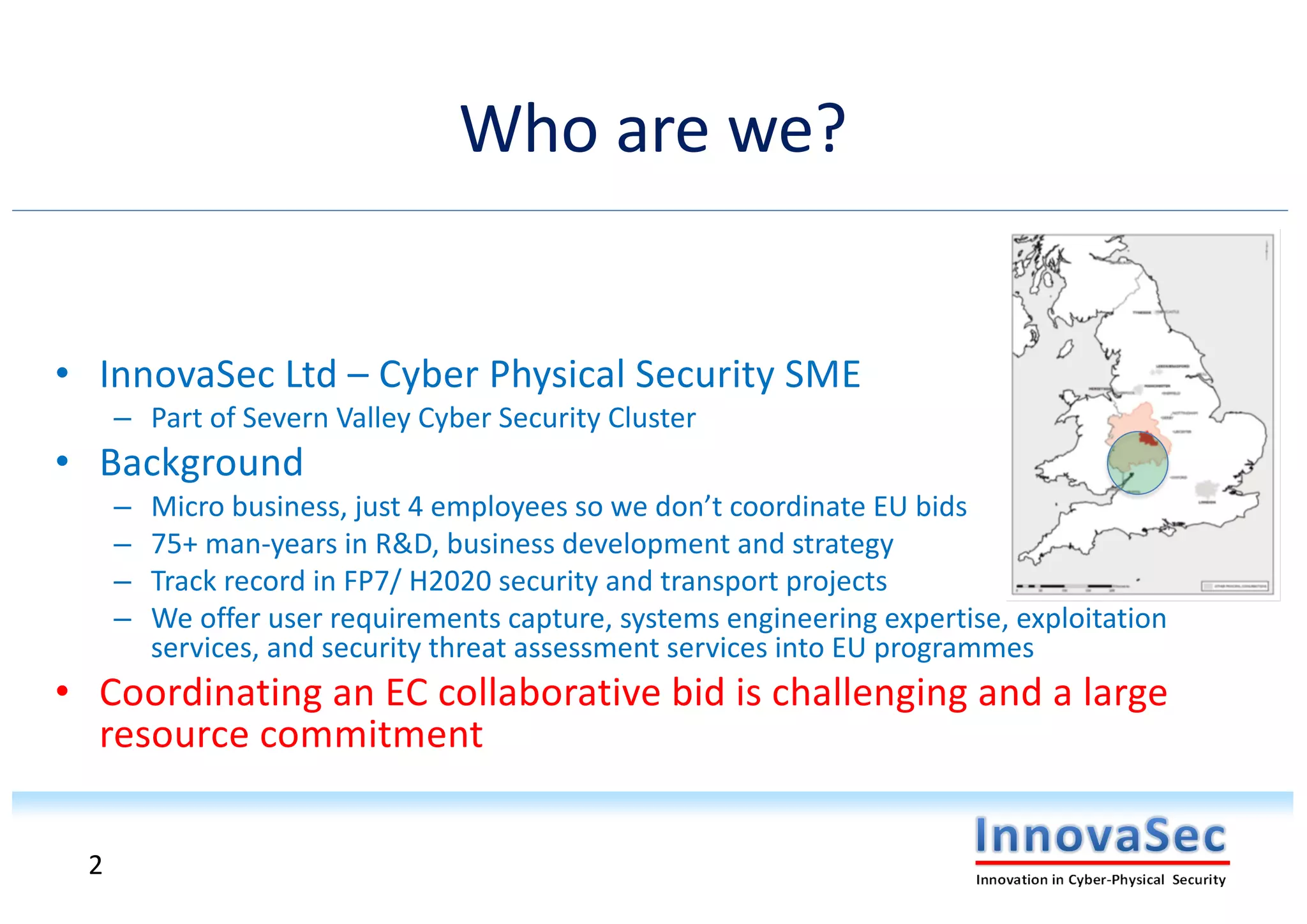
Who are we?
• InnovaSec Ltd – Cyber Physical Security SME
– Part of Severn Valley Cyber Security Cluster
• Background
– Micro business, just 4 employees so we don’t coordinate EU bids
– 75+ man-years in R&D, business development and strategy
– Track record in FP7/ H2020 security and transport projects
– We offer user requirements capture, systems engineering expertise, exploitation
services, and security threat assessment services into EU programmes
• Coordinating an EC collaborative bid is challenging and a large
resource commitment
2
QUESTIONS FOR SMEs TO ASK BEFORE PARTICIPATING
– Will it address the company’s business needs - is this something you want to do anyway?
– What is your role in the project and does it fit your business strategy?
– How much time will your company need to commit?
– Who is going to do the work and will they be available?
HOW SHOULD SMEs TRY TO PARTICIPATE
– The effort required to lead a bid is high: it is easier for large companies/ research
organisations than SMEs
– The key to success in EU R&D Programmes is partnering - overseas partners are key
– Choose partners carefully, chemistry is important as well as competence
– Ideal solution is to work with large companies/ research organisations you already work with
HOW DO SMEs GET MOST BENEFITS FROM PARTICIPATING
– Work with partners that can help you strategically outside the project for long-term benefits
EC R&D Projects Checklist for SMEs
3
Top tips (bidding)
• Attend EC (and National) Information/ Brokerage Events
– Present ideas and capabilities and find partners
• Make sure the proposal idea fits the Work Programme topic description
– For specific calls – understand and answer the question
• Try to choose consortia where the coordinator is experienced in the bid
process
– They will guide you through the paperwork
• Start early: form the consortium at least 6 months prior to the bid deadline
• Choose partners carefully – complementary teams are essential
• Understand the evaluation criteria and aim for 14.5 out of 15 to win!
– Excellence, Impact, Implementation
4
For (SME)
• Funding is significant, especially for high-risk projects that would be
hard to start otherwise
• It helps you get into new supply chains - the Partners are potential
exploitation collaborators for other projects
• Cash flow is positive with significant advance at start
• Long-term contracts providing income over 3-4 years
– Allows R&D recruitment to work on new ideas for products/ services
• It links you with the best organisations in participating nations with new
ideas you can learn from
• International contacts give you understanding of new overseas markets
and can help your regular business
• It is challenging but rewarding, and definitely enjoyable!
5
Against (SME)
• Bid costs are high, especially as some international travelling to bid
meetings is often essential
• Rates are not full commercial rates (part funded, no profit)
• It is very competitive so only ‘excellent’ bids are worth pursuing
– We know of a security bid that scored 15/15 and was not funded!
• The bid cycle of 12 months (or sometimes longer) from call to
award is long and market conditions (and technical state of the art)
may evolve
• These are risky projects – partners may not deliver!
6
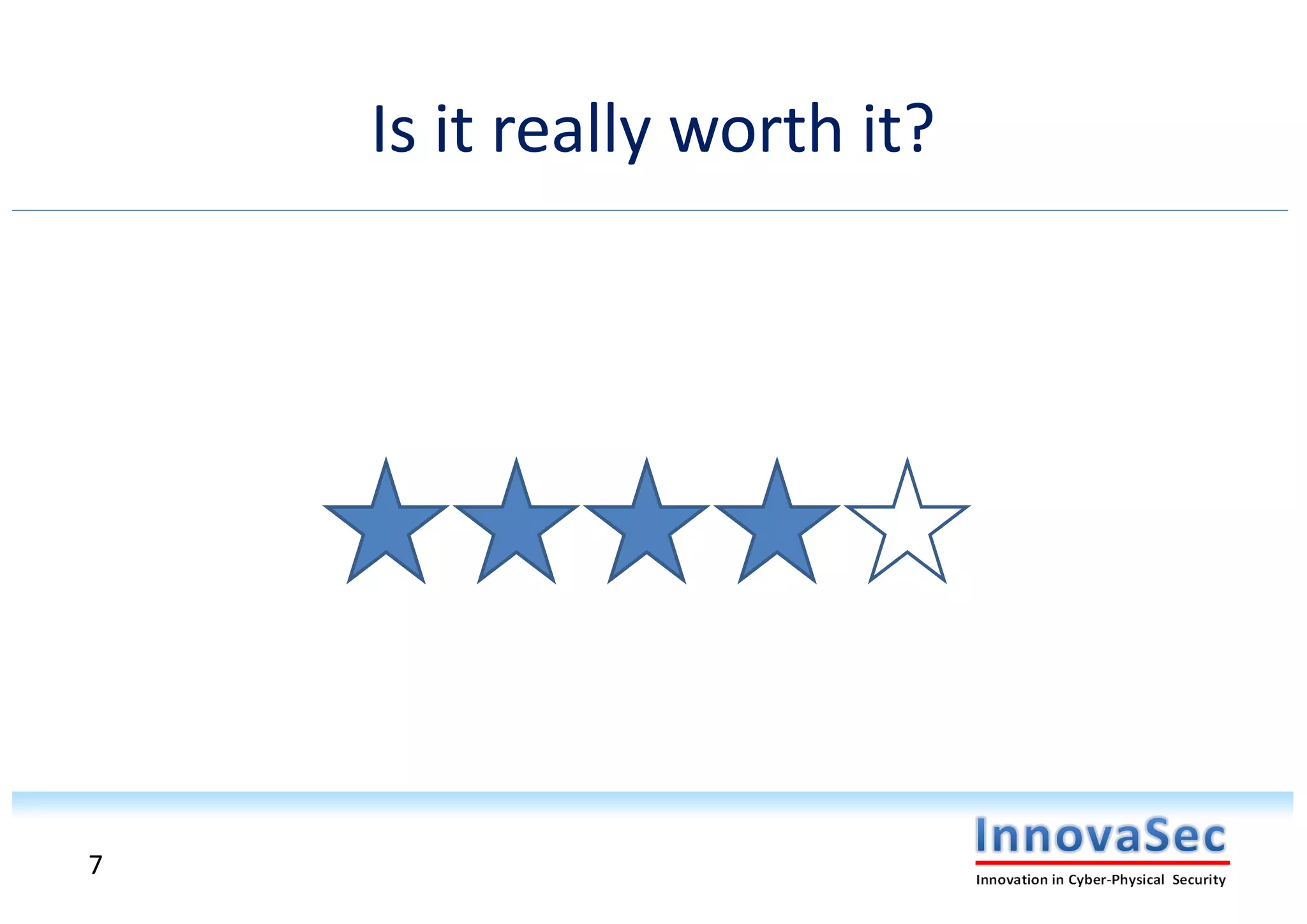
Is it really worth it?
7
LIMITLESS POTENTIAL | LIMITLESS OPPORTUNITIES | LIMITLESS IMPACTLIMITLESS POTENTIAL | LIMITLESS OPPORTUNITIES | LIMITLESS IMPACTCopyright University of Reading
CASE STUDY: PROTECT
Prof. James Ferryman
james@computer.org
1
SMPCS / Dept. Computer Science
LIMITLESS POTENTIAL | LIMITLESS OPPORTUNITIES | LIMITLESS IMPACT
OVERVIEW
• Project PROTECT
• Challenges
• Benefits & Risks
• Best advice
2
LIMITLESS POTENTIAL | LIMITLESS OPPORTUNITIES | LIMITLESS IMPACT
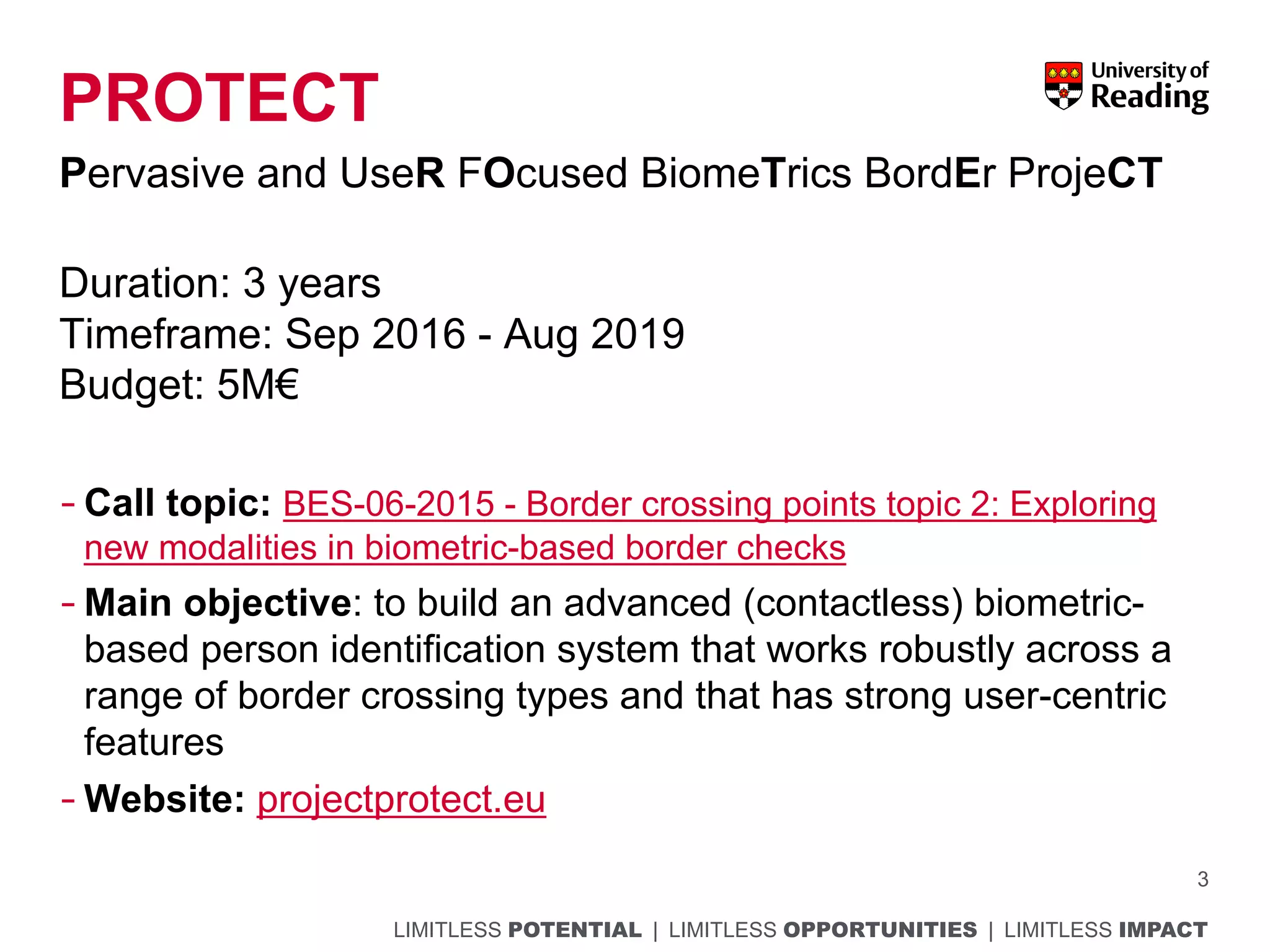
PROTECT
Pervasive and UseR FOcused BiomeTrics BordEr ProjeCT
Duration: 3 years
Timeframe: Sep 2016 - Aug 2019
Budget: 5M€
- Call topic: BES-06-2015 - Border crossing points topic 2: Exploring
new modalities in biometric-based border checks
- Main objective: to build an advanced (contactless) biometric-
based person identification system that works robustly across a
range of border crossing types and that has strong user-centric
features
- Website: projectprotect.eu
3
LIMITLESS POTENTIAL | LIMITLESS OPPORTUNITIES | LIMITLESS IMPACT
PROTECT
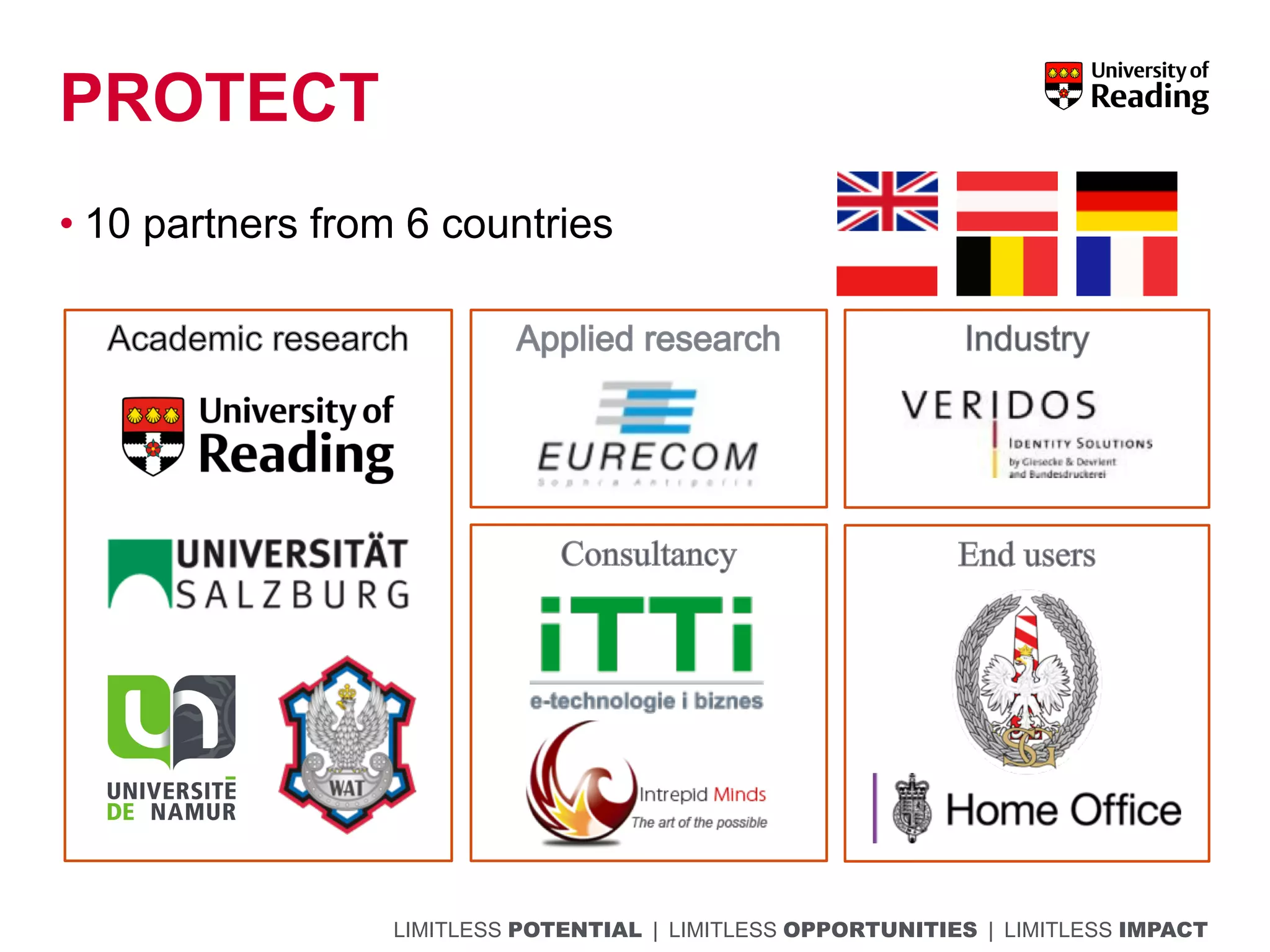
• 10 partners from 6 countries
4
LIMITLESS POTENTIAL | LIMITLESS OPPORTUNITIES | LIMITLESS IMPACT
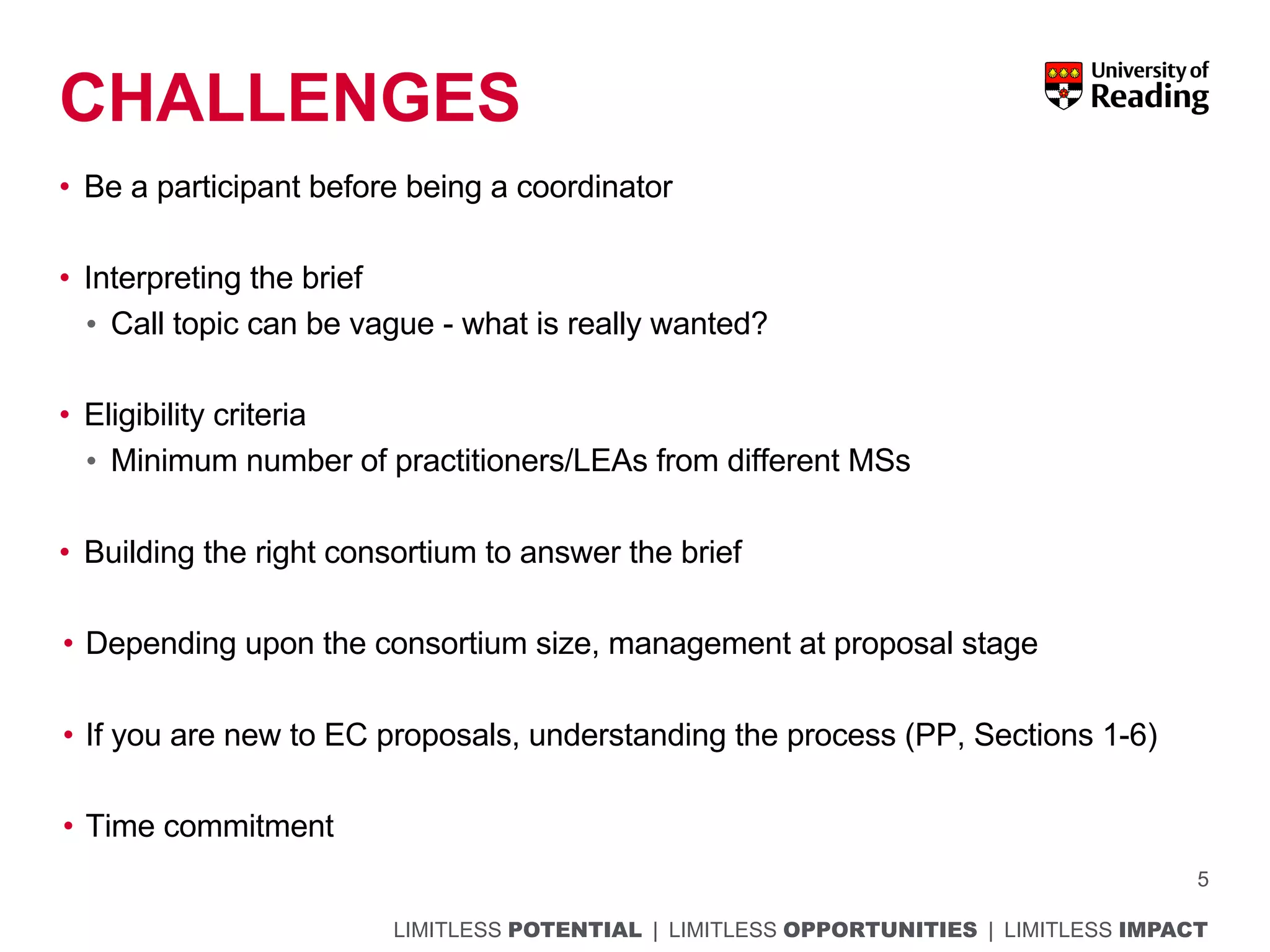
CHALLENGES
• Be a participant before being a coordinator
• Interpreting the brief
• Call topic can be vague - what is really wanted?
• Eligibility criteria
• Minimum number of practitioners/LEAs from different MSs
• Building the right consortium to answer the brief
• Depending upon the consortium size, management at proposal stage
• If you are new to EC proposals, understanding the process (PP, Sections 1-6)
• Time commitment
5
LIMITLESS POTENTIAL | LIMITLESS OPPORTUNITIES | LIMITLESS IMPACT
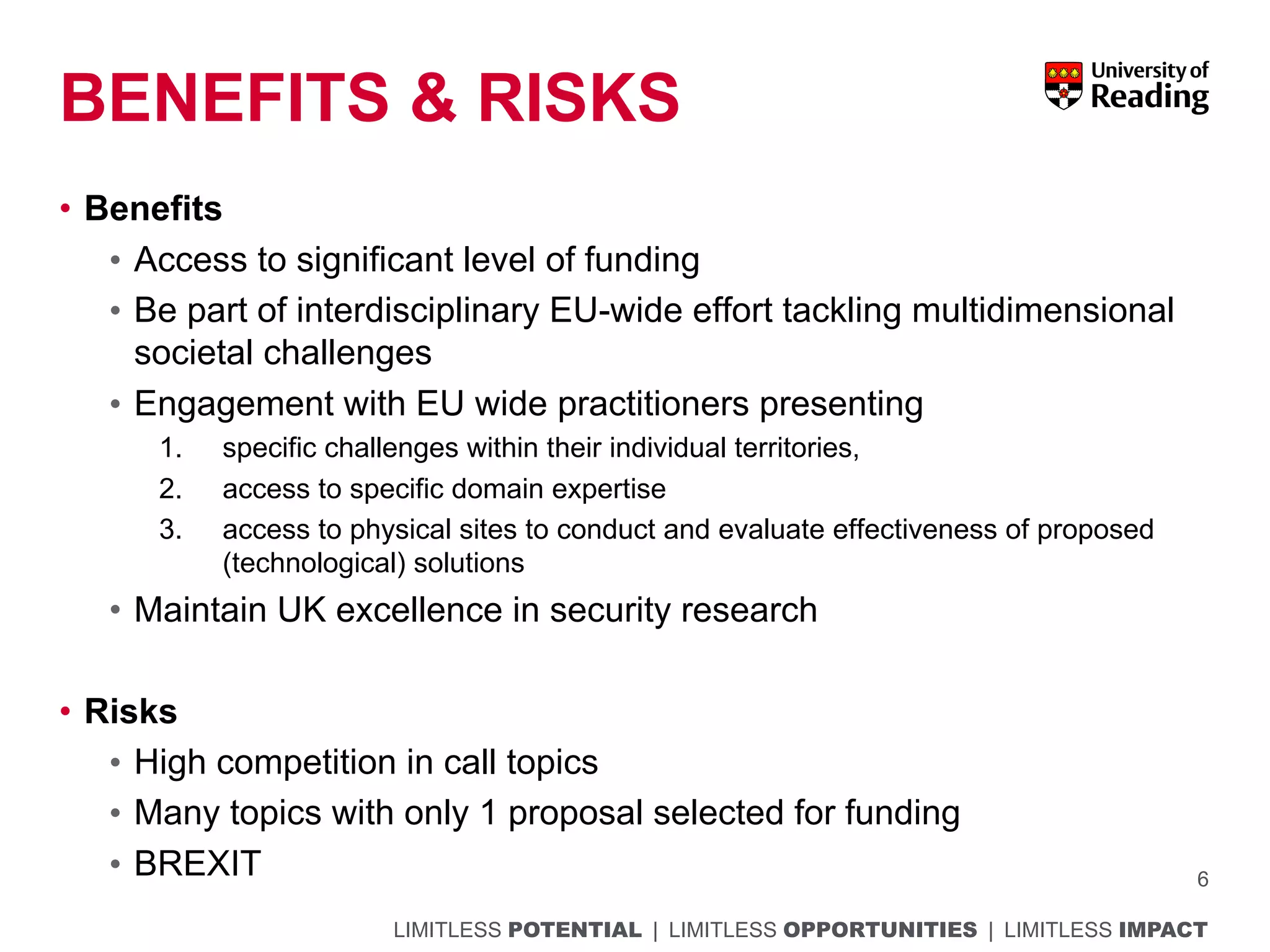
BENEFITS & RISKS
• Benefits
• Access to significant level of funding
• Be part of interdisciplinary EU-wide effort tackling multidimensional
societal challenges
• Engagement with EU wide practitioners presenting
1. specific challenges within their individual territories,
2. access to specific domain expertise
3. access to physical sites to conduct and evaluate effectiveness of proposed
(technological) solutions
• Maintain UK excellence in security research
• Risks
• High competition in call topics
• Many topics with only 1 proposal selected for funding
• BREXIT 6
LIMITLESS POTENTIAL | LIMITLESS OPPORTUNITIES | LIMITLESS IMPACT
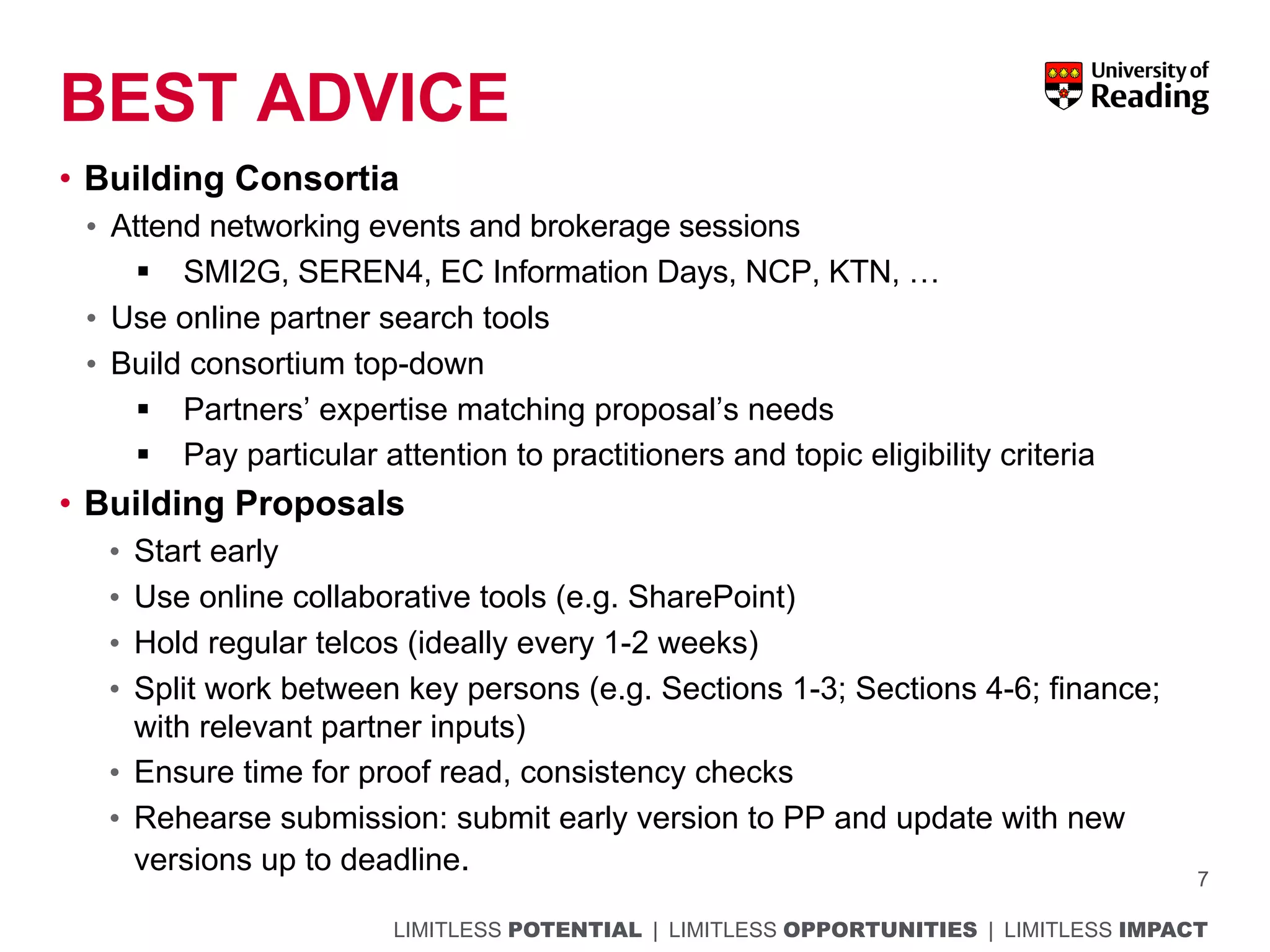
BEST ADVICE
7
• Building Consortia
• Attend networking events and brokerage sessions
§ SMI2G, SEREN4, EC Information Days, NCP, KTN, …
• Use online partner search tools
• Build consortium top-down
§ Partners’ expertise matching proposal’s needs
§ Pay particular attention to practitioners and topic eligibility criteria
• Building Proposals
• Start early
• Use online collaborative tools (e.g. SharePoint)
• Hold regular telcos (ideally every 1-2 weeks)
• Split work between key persons (e.g. Sections 1-3; Sections 4-6; finance;
with relevant partner inputs)
• Ensure time for proof read, consistency checks
• Rehearse submission: submit early version to PP and update with new
versions up to deadline.
LIMITLESS POTENTIAL | LIMITLESS OPPORTUNITIES | LIMITLESS IMPACTLIMITLESS POTENTIAL | LIMITLESS OPPORTUNITIES | LIMITLESS IMPACTCopyright University of Reading
CASE STUDY: PROTECT
Thank you.
Any questions?
8
SMPCS / Dept. Computer Science
Collaboration Support
Landscape
Viola Hay
Knowledge Transfer Manager – European Programmes
Helping ambitious SMEs
innovate and grow internationally
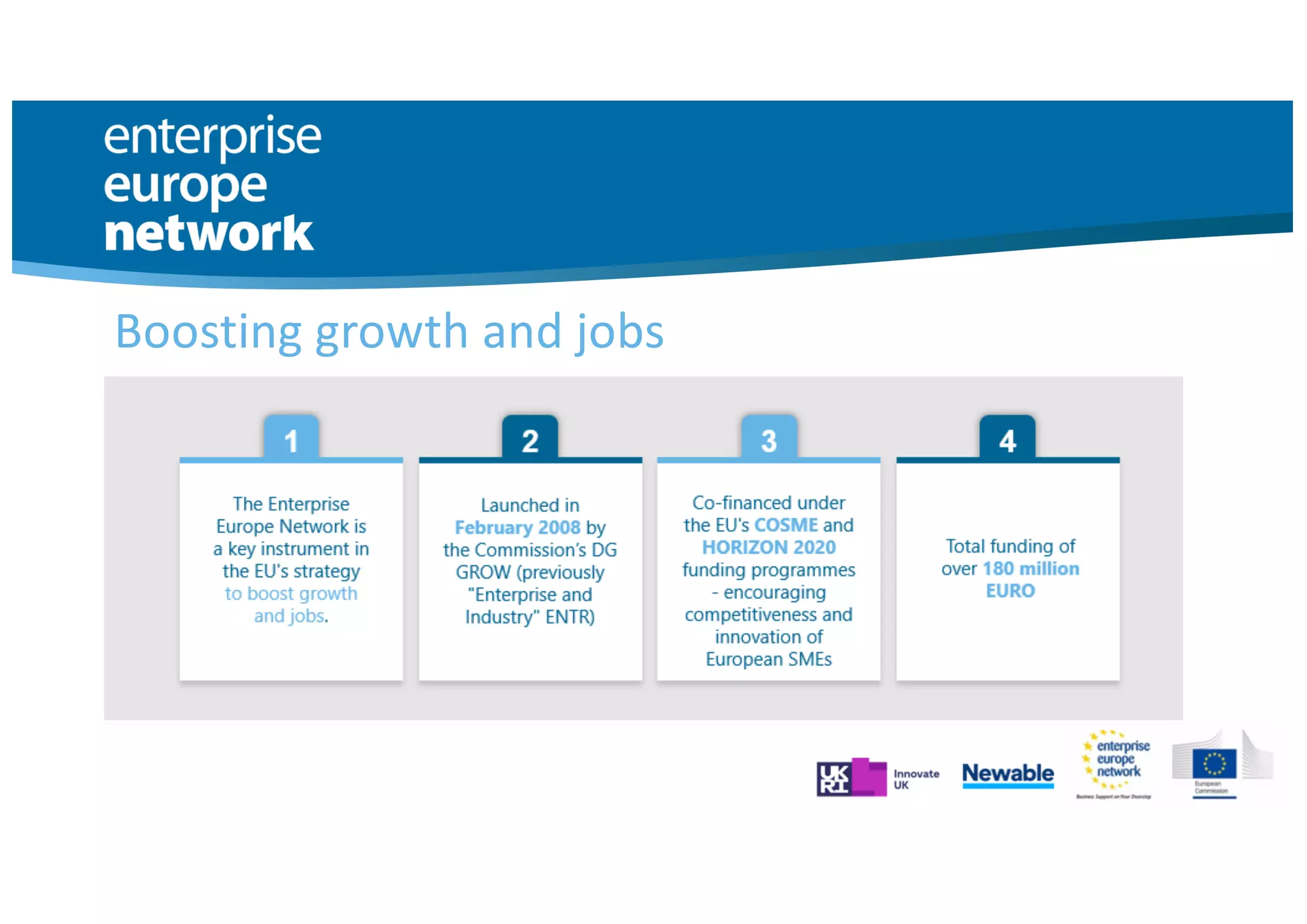
Boosting growth and jobs
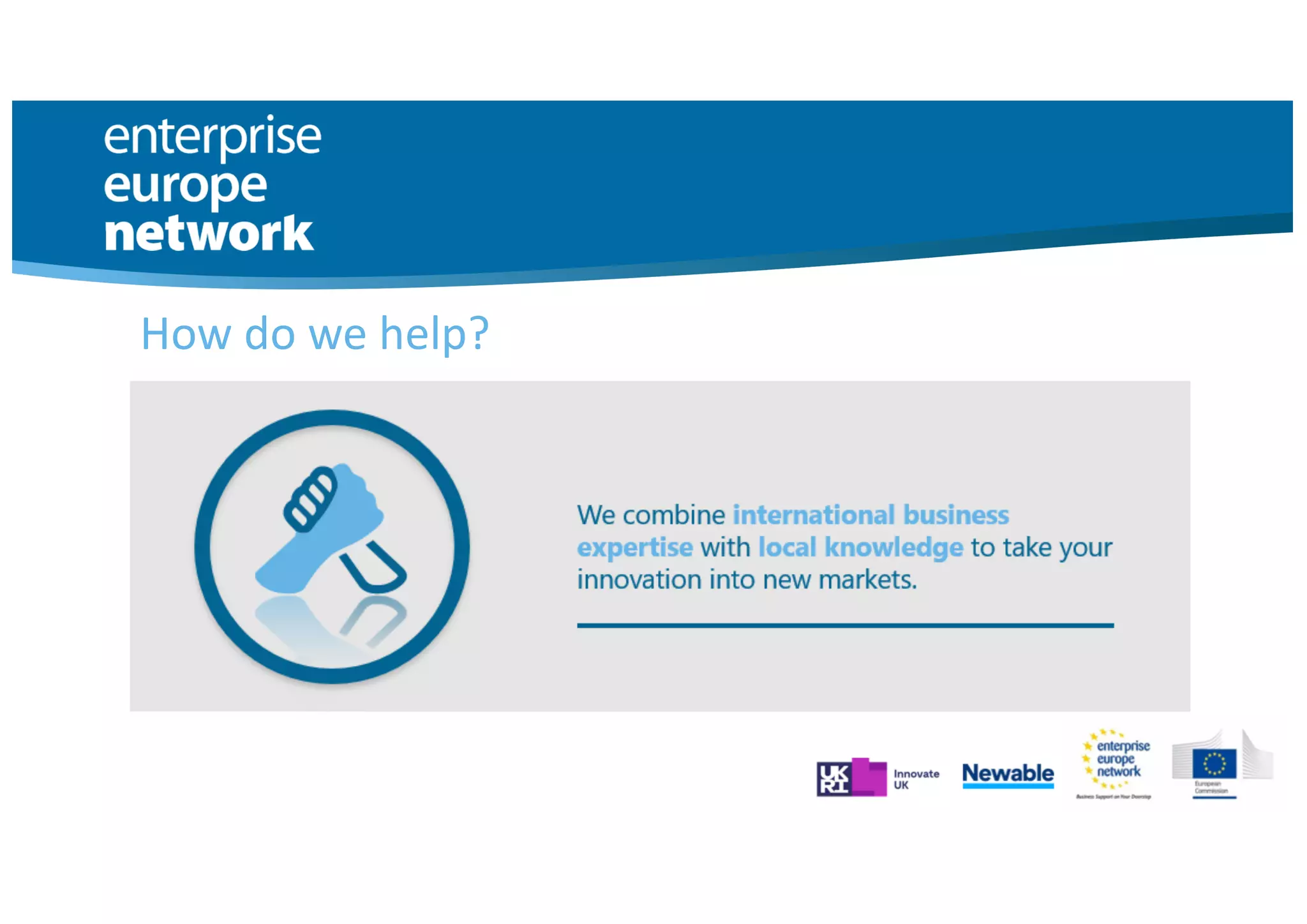
How do we help?
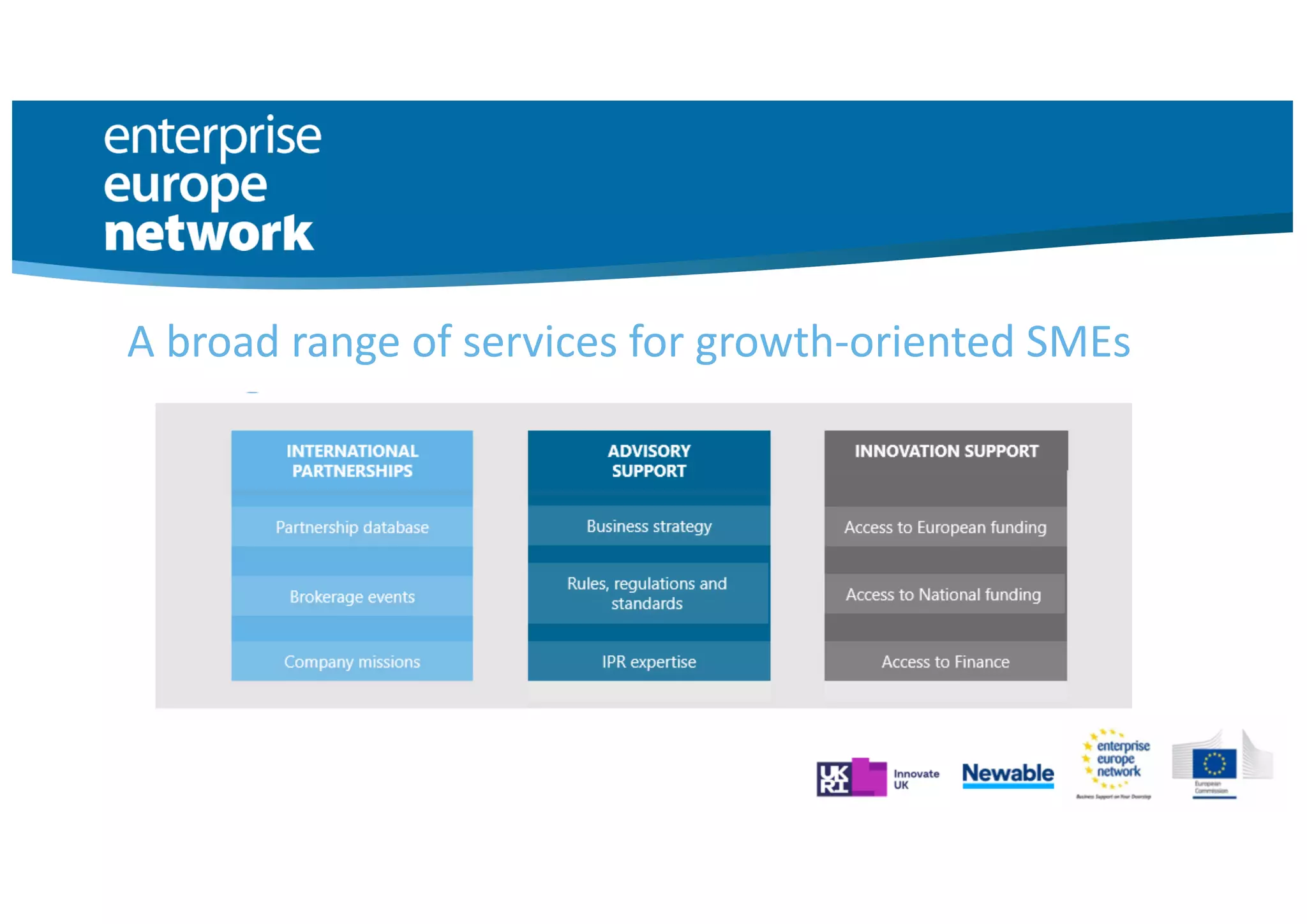
A broad range of services for growth-oriented SMEs
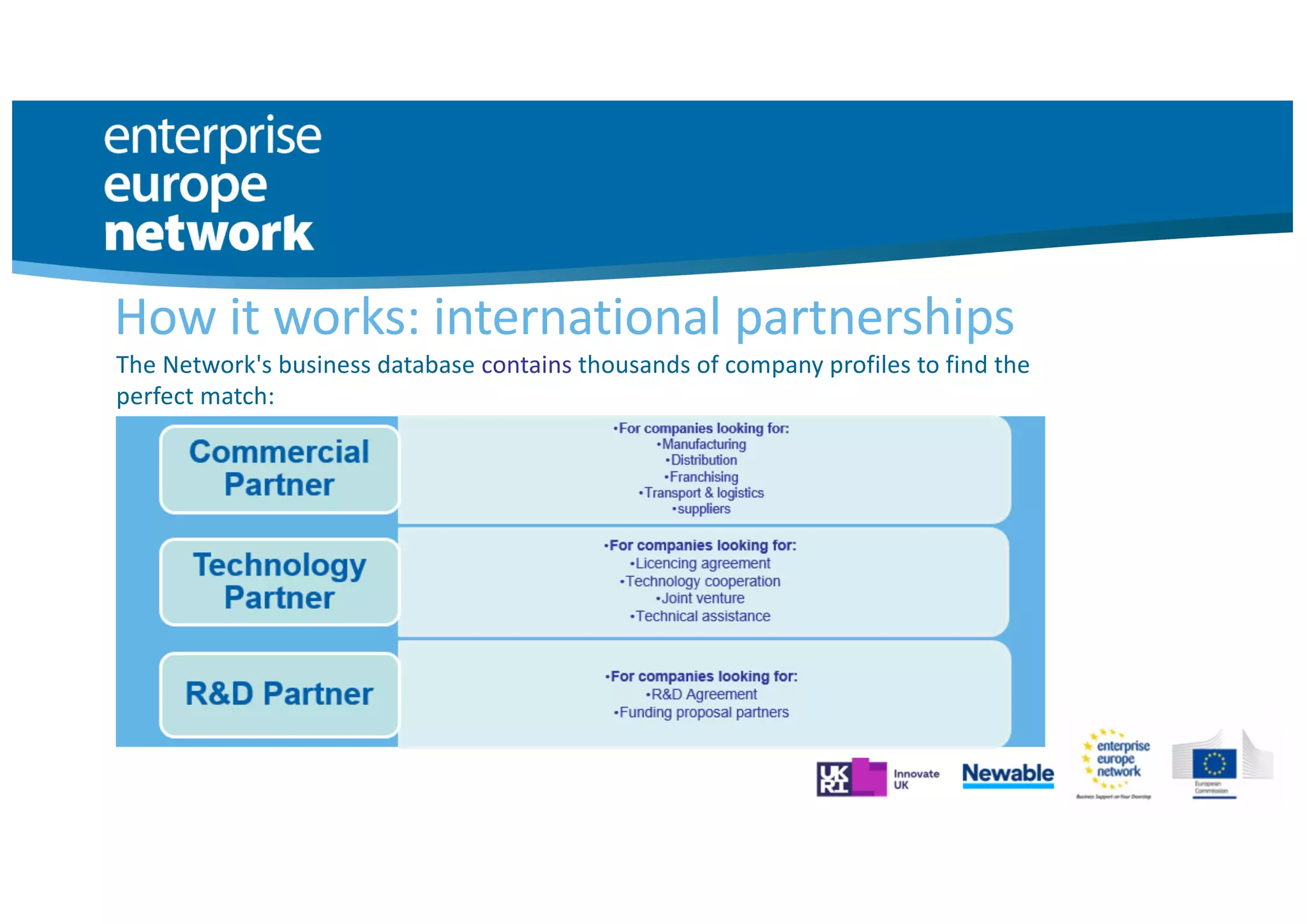
The Network's business database contains thousands of company profiles to find the
perfect match:
How it works: international partnerships
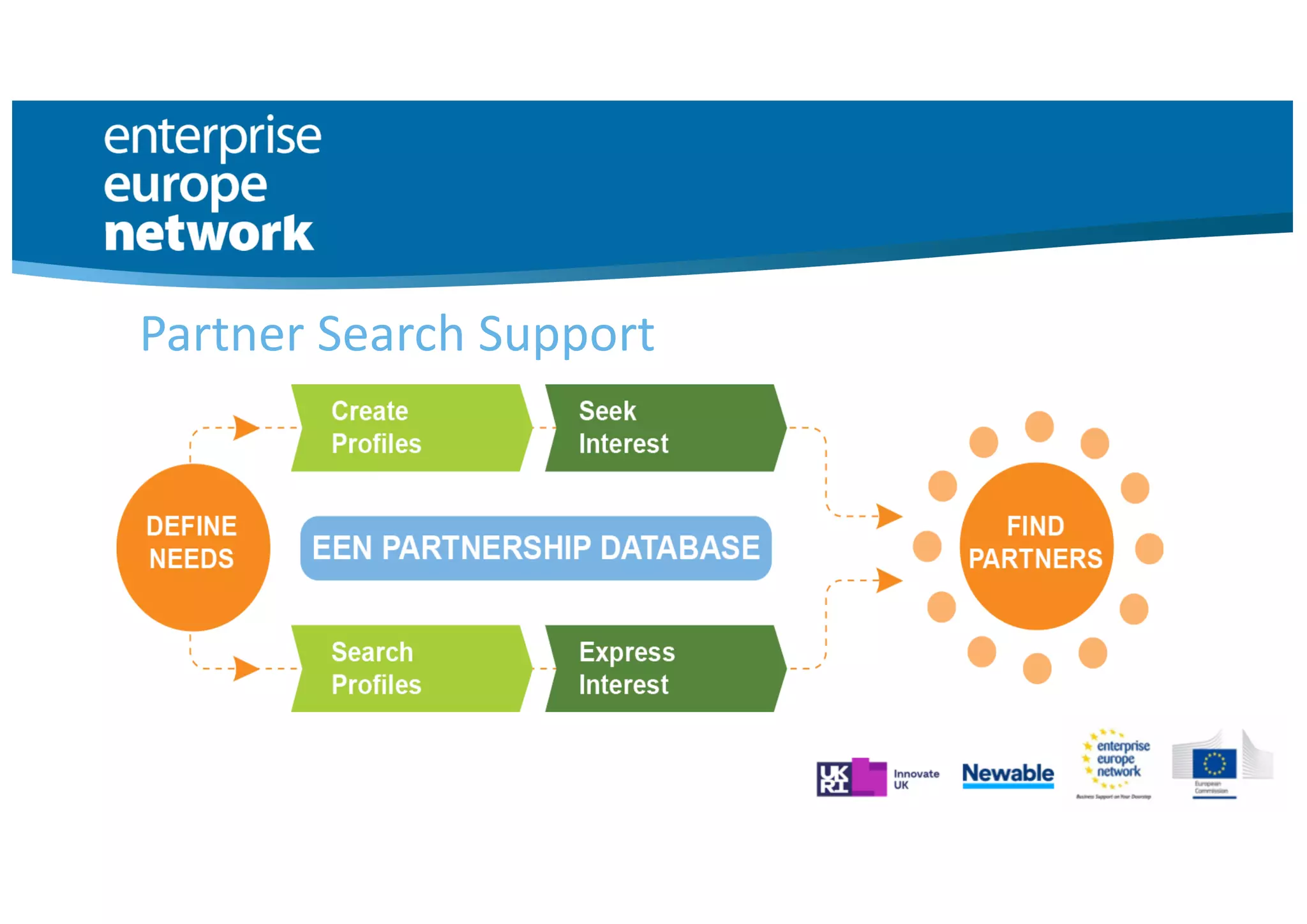
Partner Search Support
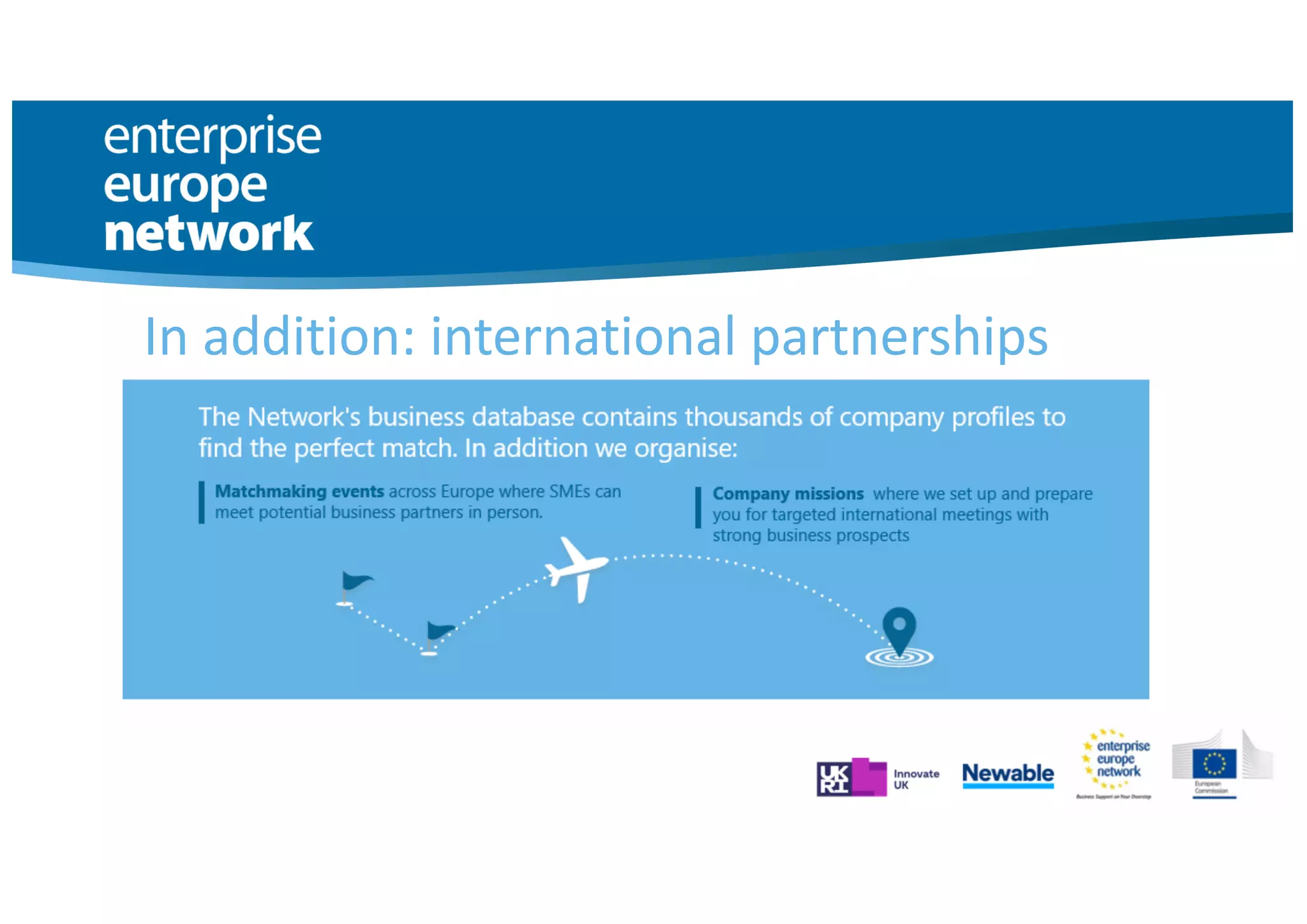
In addition: international partnerships
Knowledge Transfer Network
Who we are
- Not-for-profit SME, Innovate UK’s networking partner
- We help businesses get the best out of creativity, ideas and the
latest discoveries, to strengthen the UK economy and improve
people’s lives
- From agri-food to autonomous systems and from energy to design,
KTN combines in-depth knowledge in all sectors with the ability to
cross boundaries – 120+ sector experts
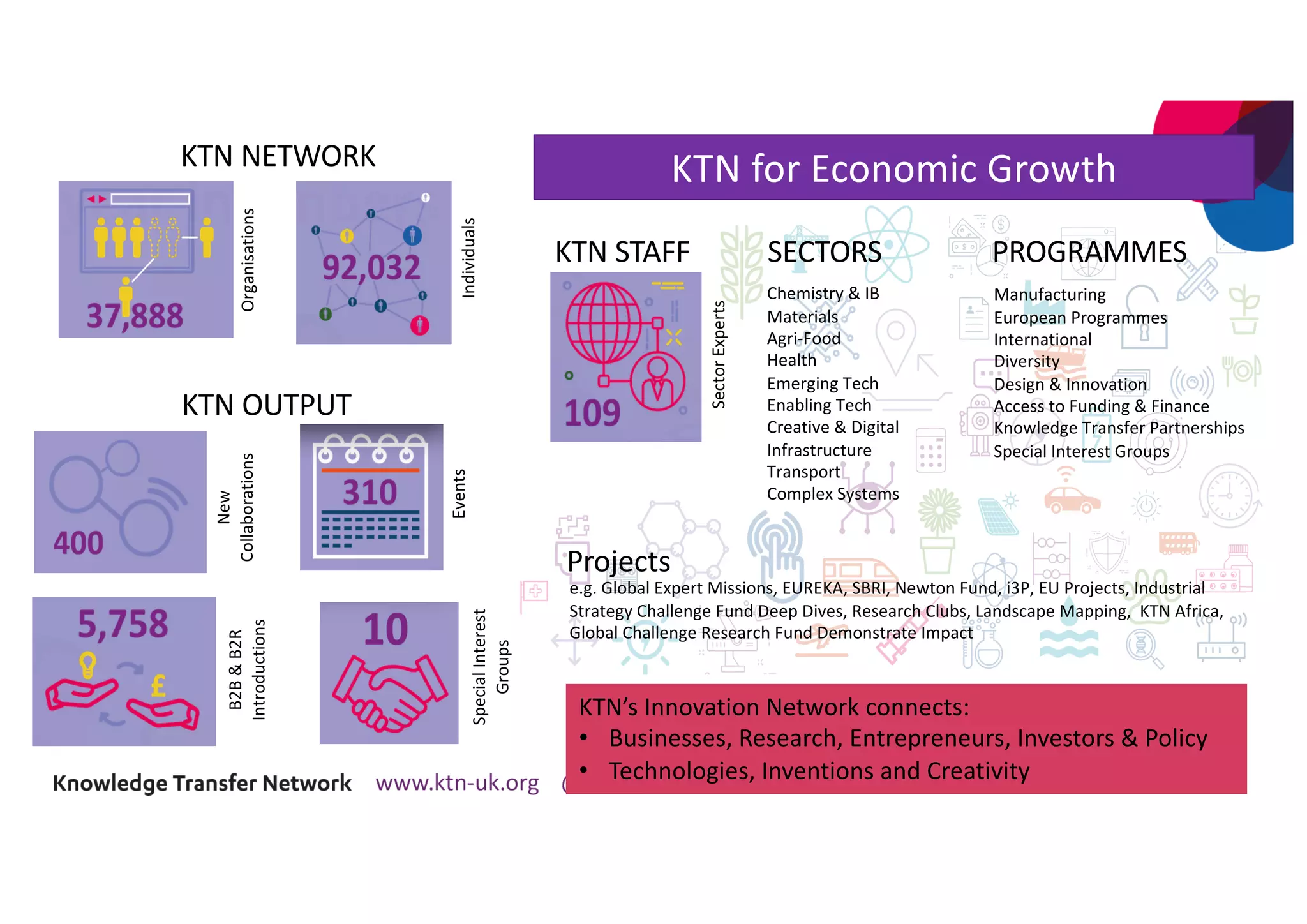
Events
SpecialInterest
Groups
Organisations
Individuals
KTN NETWORK
KTN OUTPUT
New
Collaborations
B2B&B2R
Introductions
SectorExperts
KTN STAFF
Chemistry & IB
Materials
Agri-Food
Health
Emerging Tech
Enabling Tech
Creative & Digital
Infrastructure
Transport
Complex Systems
SECTORS PROGRAMMES
Projects
e.g. Global Expert Missions, EUREKA, SBRI, Newton Fund, i3P, EU Projects, Industrial
Strategy Challenge Fund Deep Dives, Research Clubs, Landscape Mapping, KTN Africa,
Global Challenge Research Fund Demonstrate Impact
Manufacturing
European Programmes
International
Diversity
Design & Innovation
Access to Funding & Finance
Knowledge Transfer Partnerships
Special Interest Groups
KTN for Economic Growth
KTN’s Innovation Network connects:
• Businesses, Research, Entrepreneurs, Investors & Policy
• Technologies, Inventions and Creativity
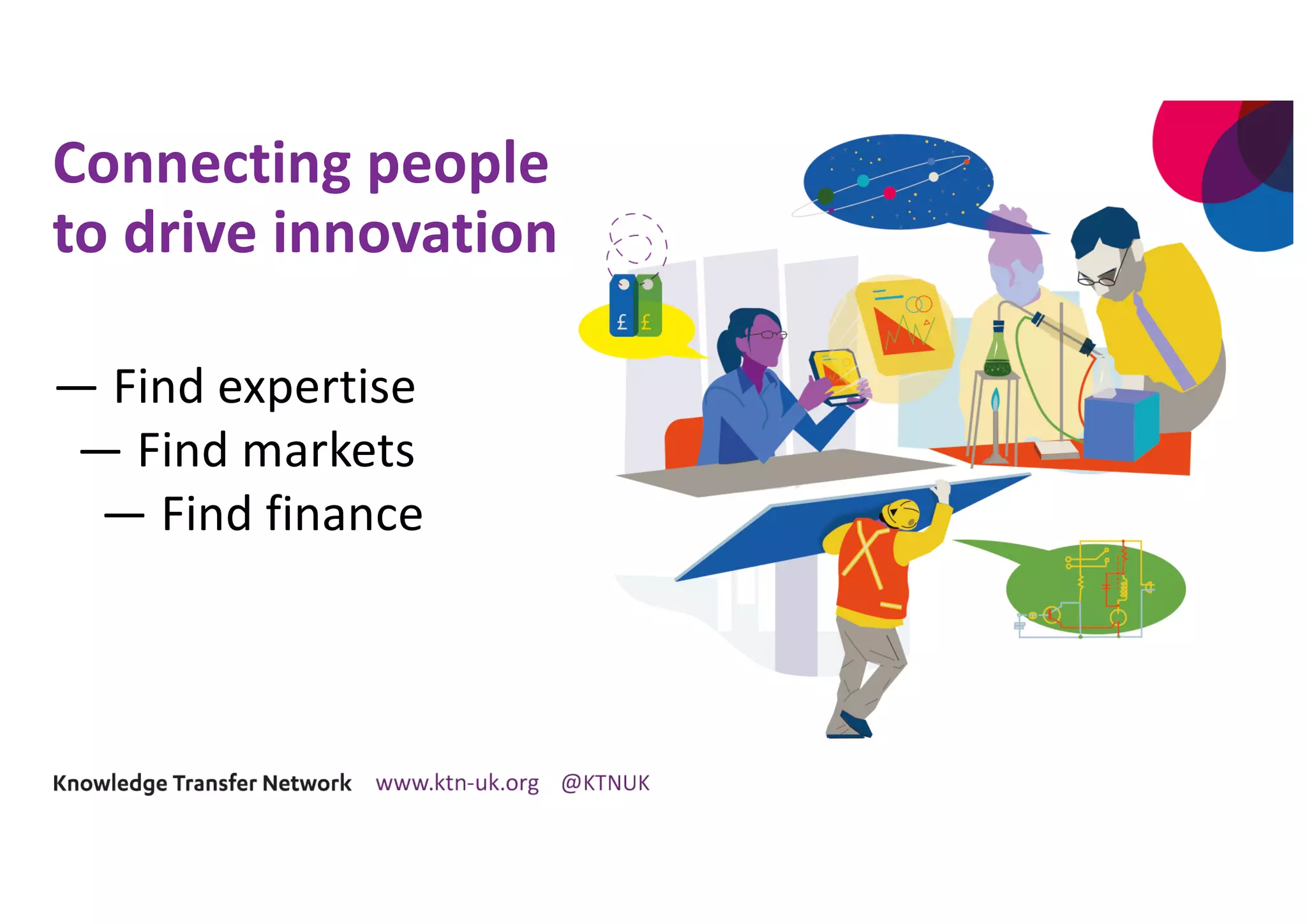
Connecting people
to drive innovation
— Find expertise
— Find markets
— Find finance
Support for European Programmes
by
•Working with NCPs and the EEN within the UK to optimise support to UK
companies
•Building on links with the European Commission, European Technology
Platforms (e.g. SusChem) and PPPs (e.g. BBI, SPIRE)
•Participate in projects where they support the KTN purpose and strategy
(eg Co-ordination & Support Actions)
•Identifying opportunities for collaborations across sectors and along value chains
Support UK based businesses in engaging with Europe and H2020
Influence the funding priorities within H2020
Support for European Programmes
For UK companies, we complement the National Contact Points and the EEN by
providing support in:
‒ Consortium building in selected topics
‒ Offering travel support to attend EU brokerage events
‒ Providing sector specific advice –good understanding of business needs across all
sectors;
‒ Advice on market opportunities and project impact
‒ Advice on the implications of being part of a Horizon 2020 project – we do it!
KTN as a Partner
The KTN aims to participate in European projects that increase business collaboration,
facilitate exploitation, and increase business led R&D.
Anticipated roles within projects are:
• Finding partners and advance networking across sectors and value chains
• Mapping of capabilities
• Identification of mechanisms to exploit developed IP and developing the capabilities of
businesses to innovate.
• Dissemination & communication activities using our 60,000+ contacts
• Link to KTN organised events
• Two-way transfer of expertise between EU programmes and UK strategy and align to
business R&D to enhance exploitation opportunities
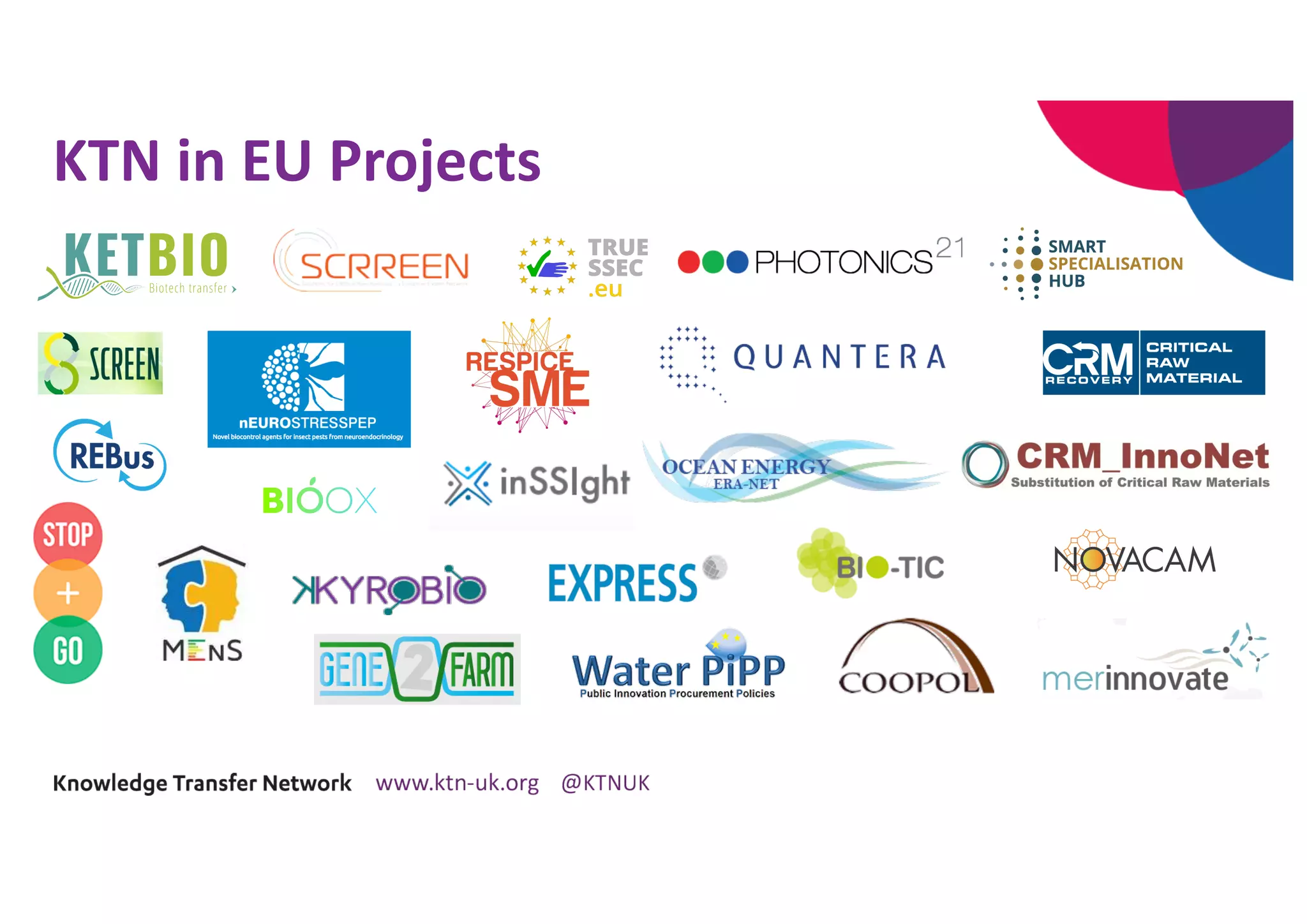
KTN in EU Projects
twitter:
email:
phone:
Viola Hay
KTM - European Programmes
viola.hay@ktn-uk.org
07964-565115
@KTNUK_EU; @viola_hay
The SeReMa Database
Talia Passiar, Secure Societies
National Contact Point (NCP), Israel
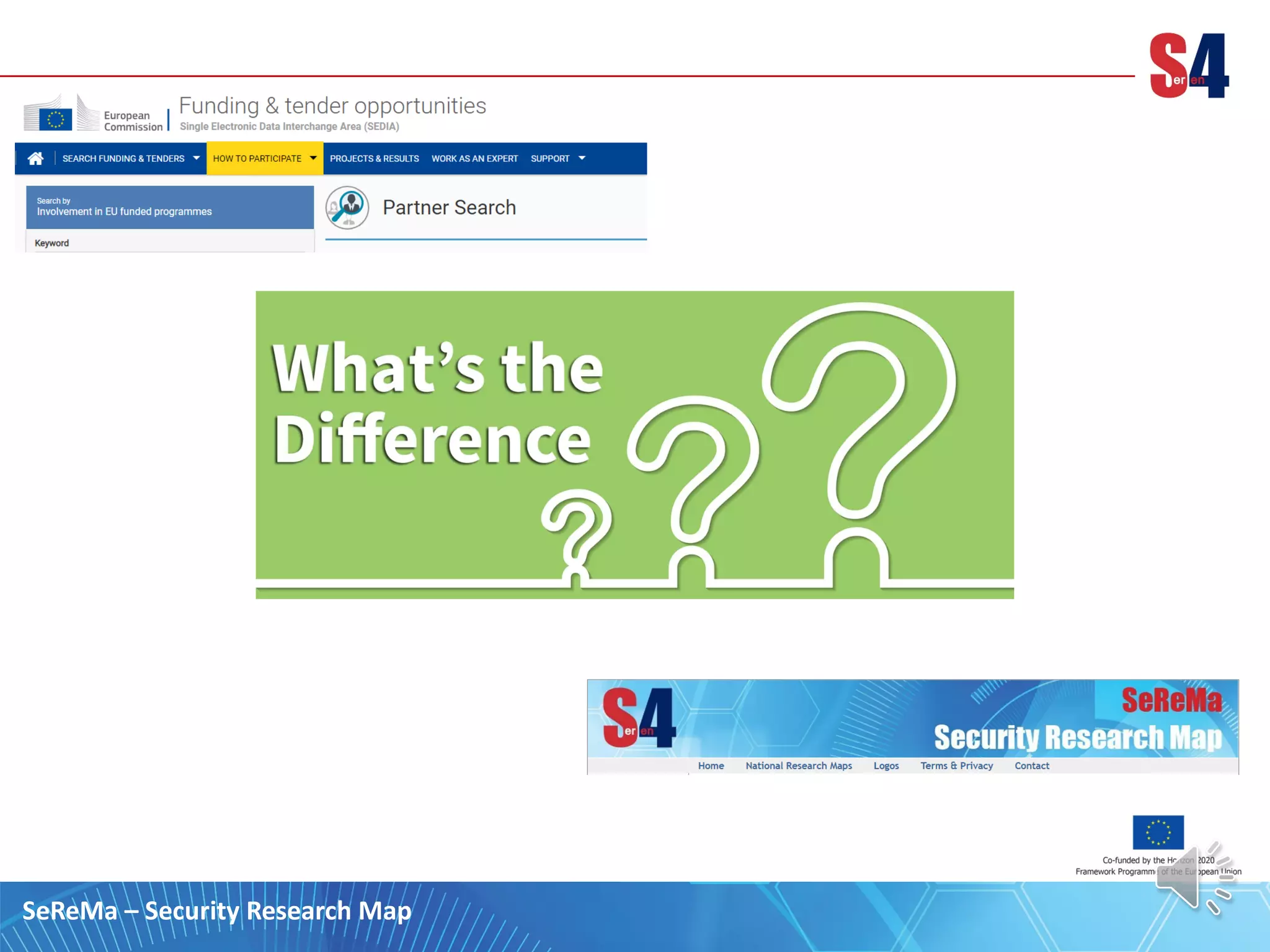
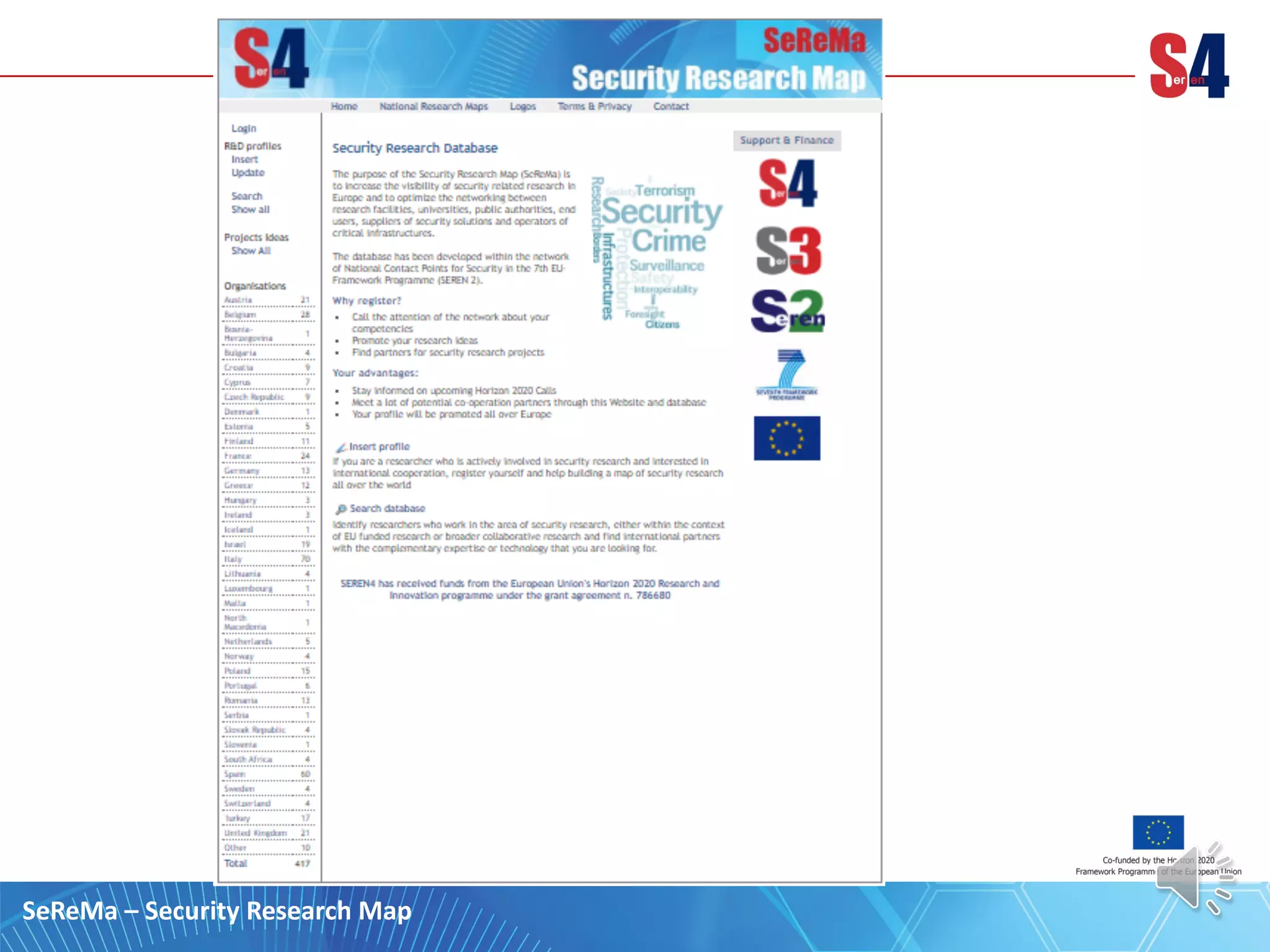
What is SeReMa?
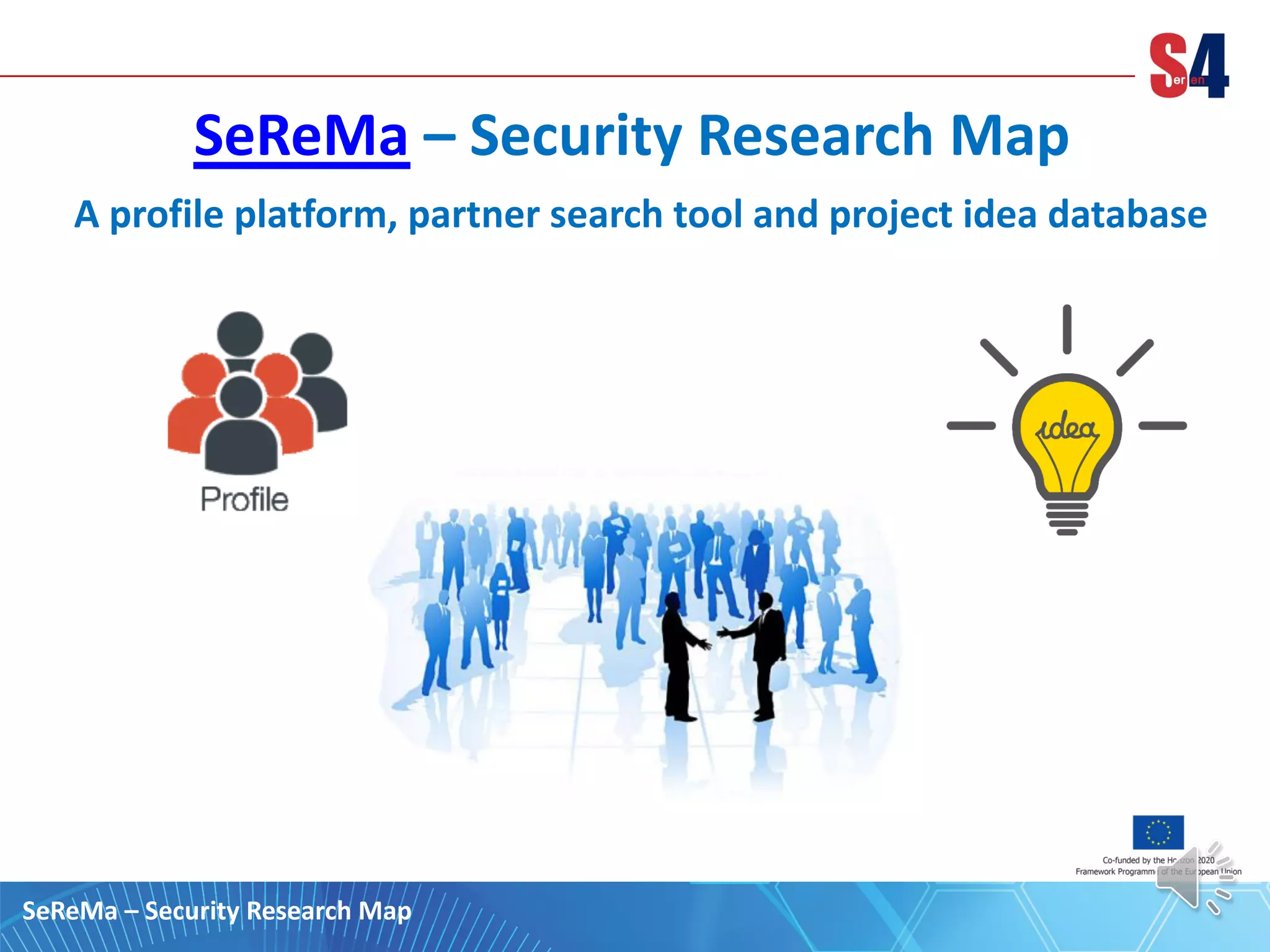
SeReMa – Security Research Map
A profile platform, partner search tool and project idea database
SeReMa – Security Research Map
ü Highlight your added value
ü Promote your research ideas
ü Find partners for your security research project
SeReMa – Security Research Map
ü Quality-check
ü Specific and security related
ü Chosen contact person
SeReMa – Security Research Map
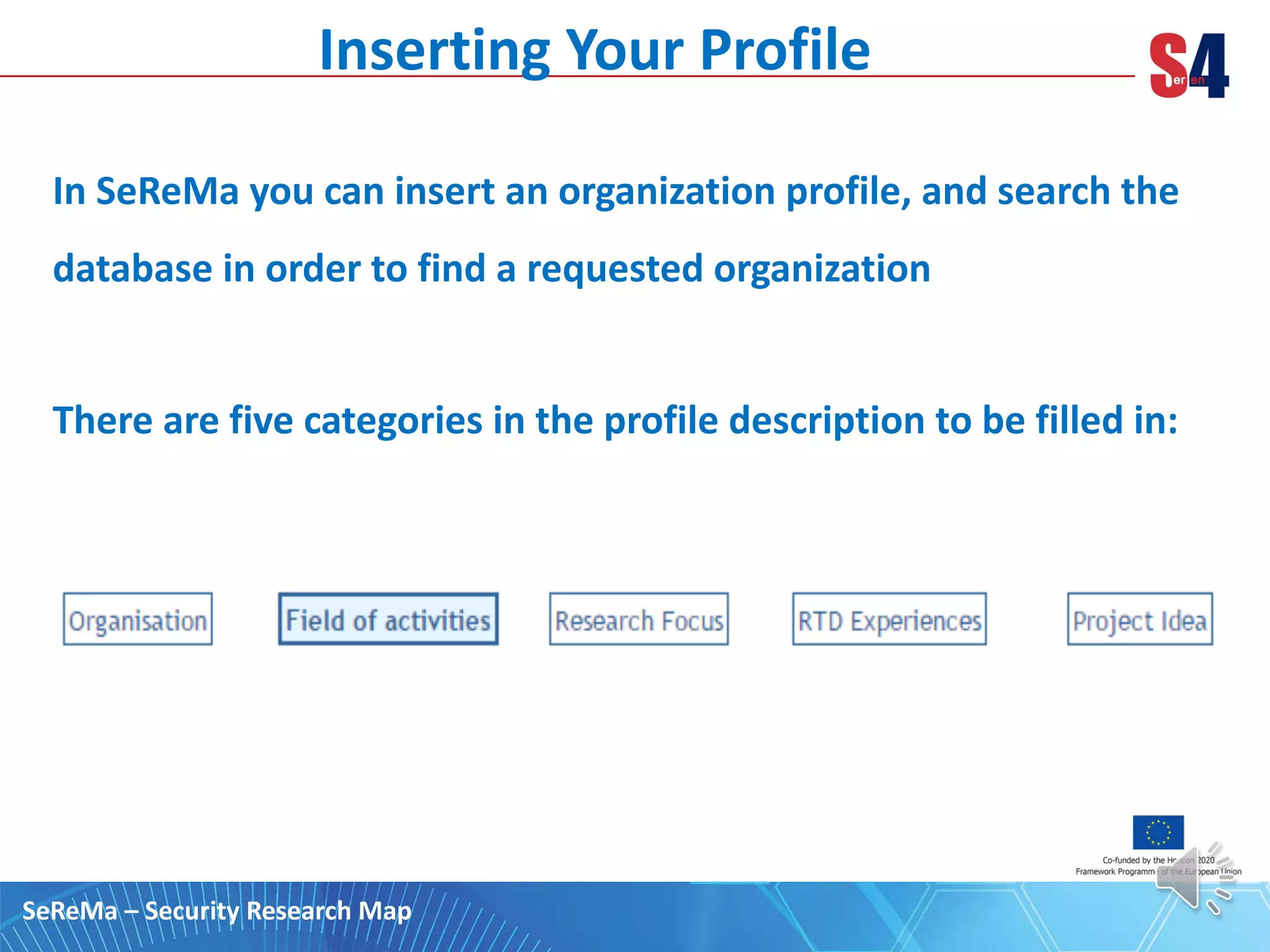
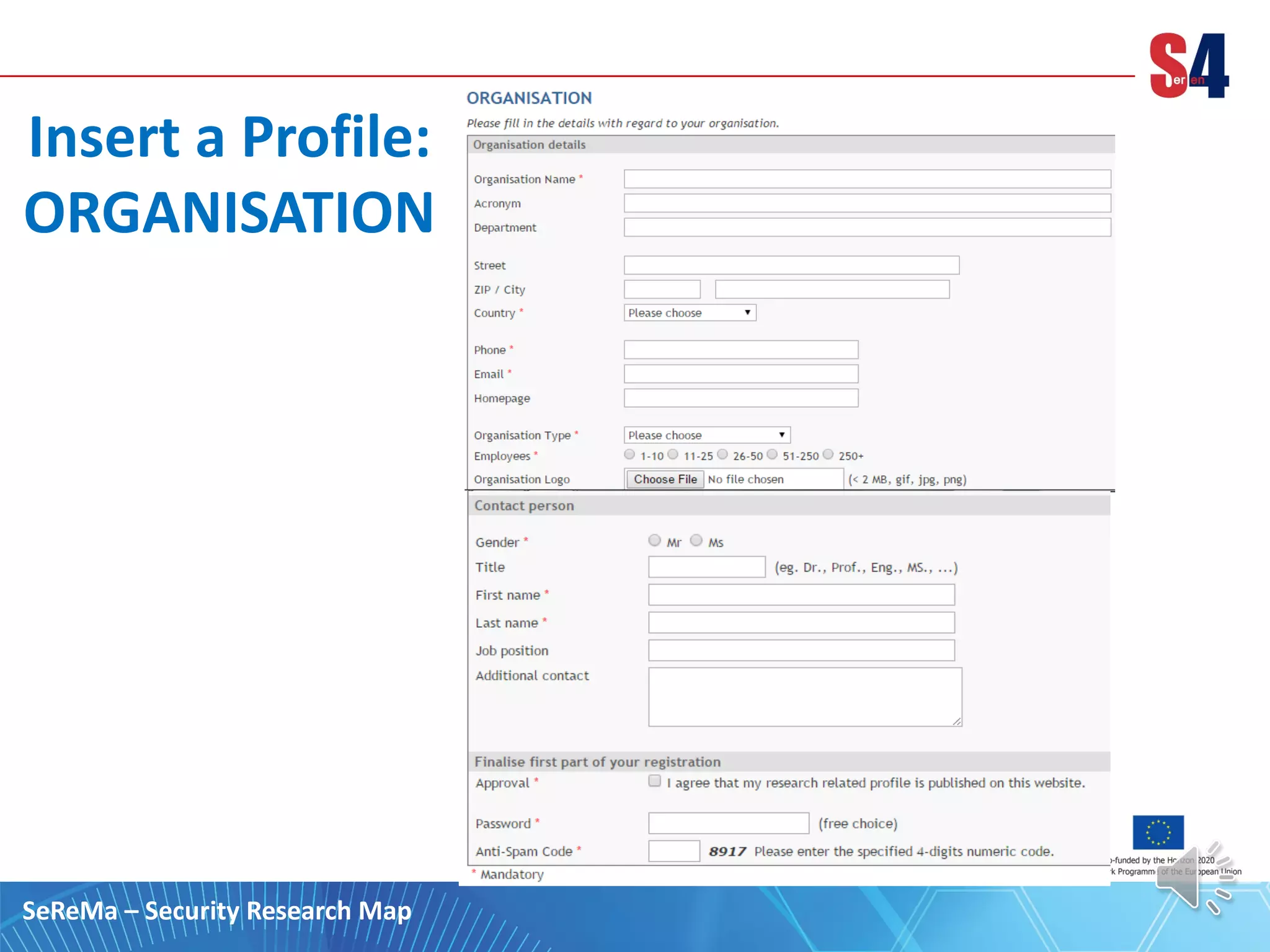
In SeReMa you can insert an organization profile, and search the
database in order to find a requested organization
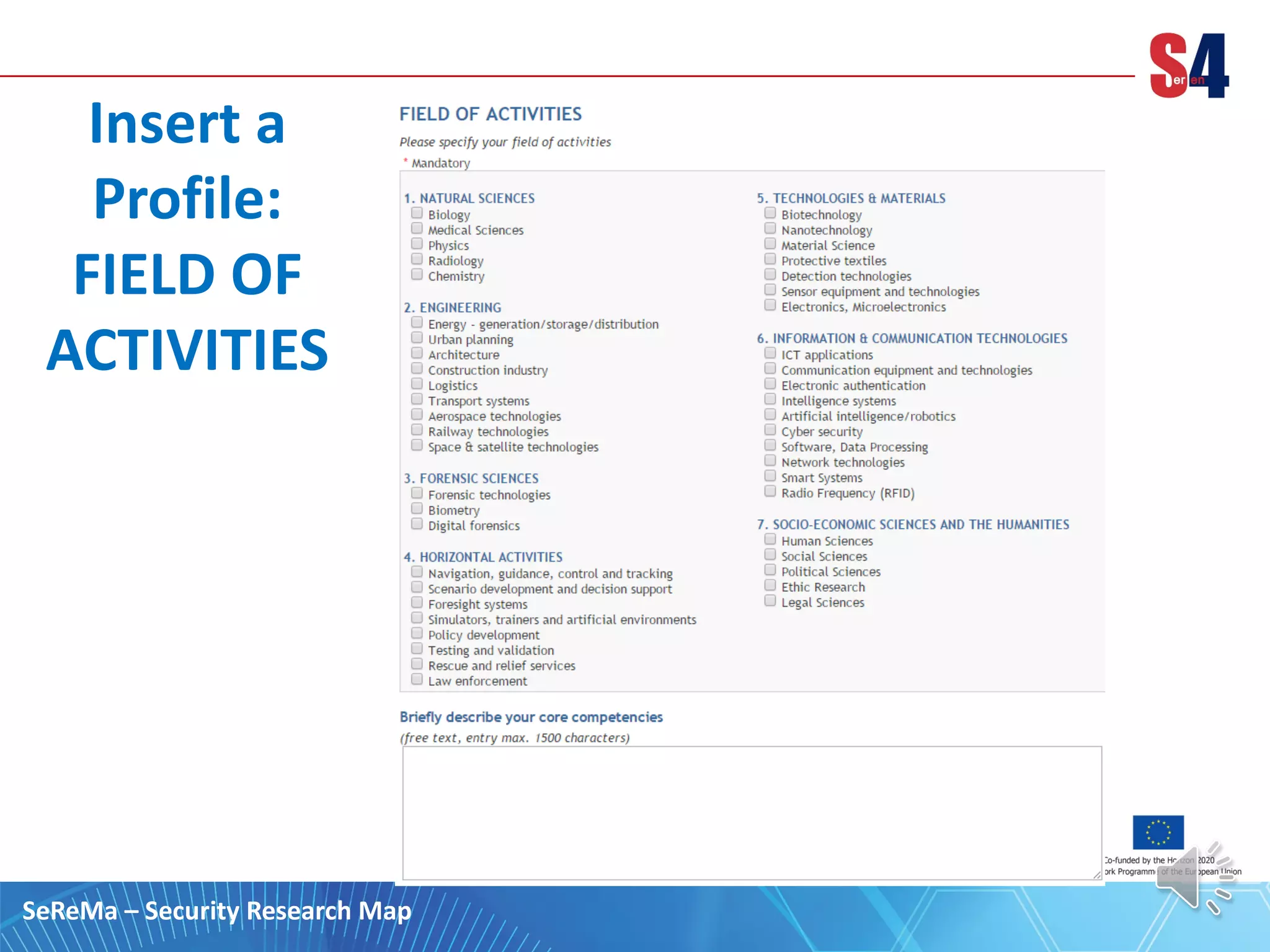
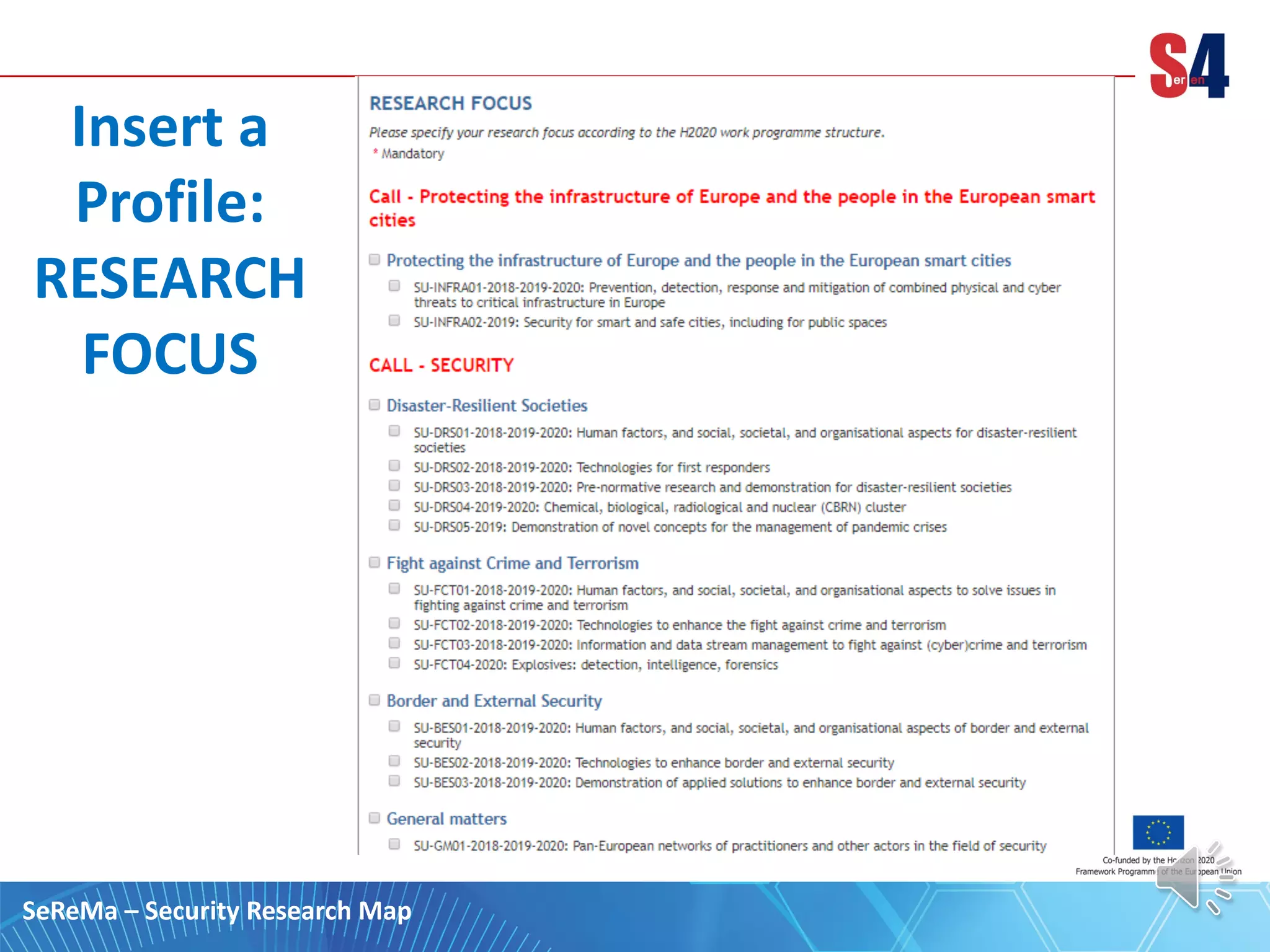
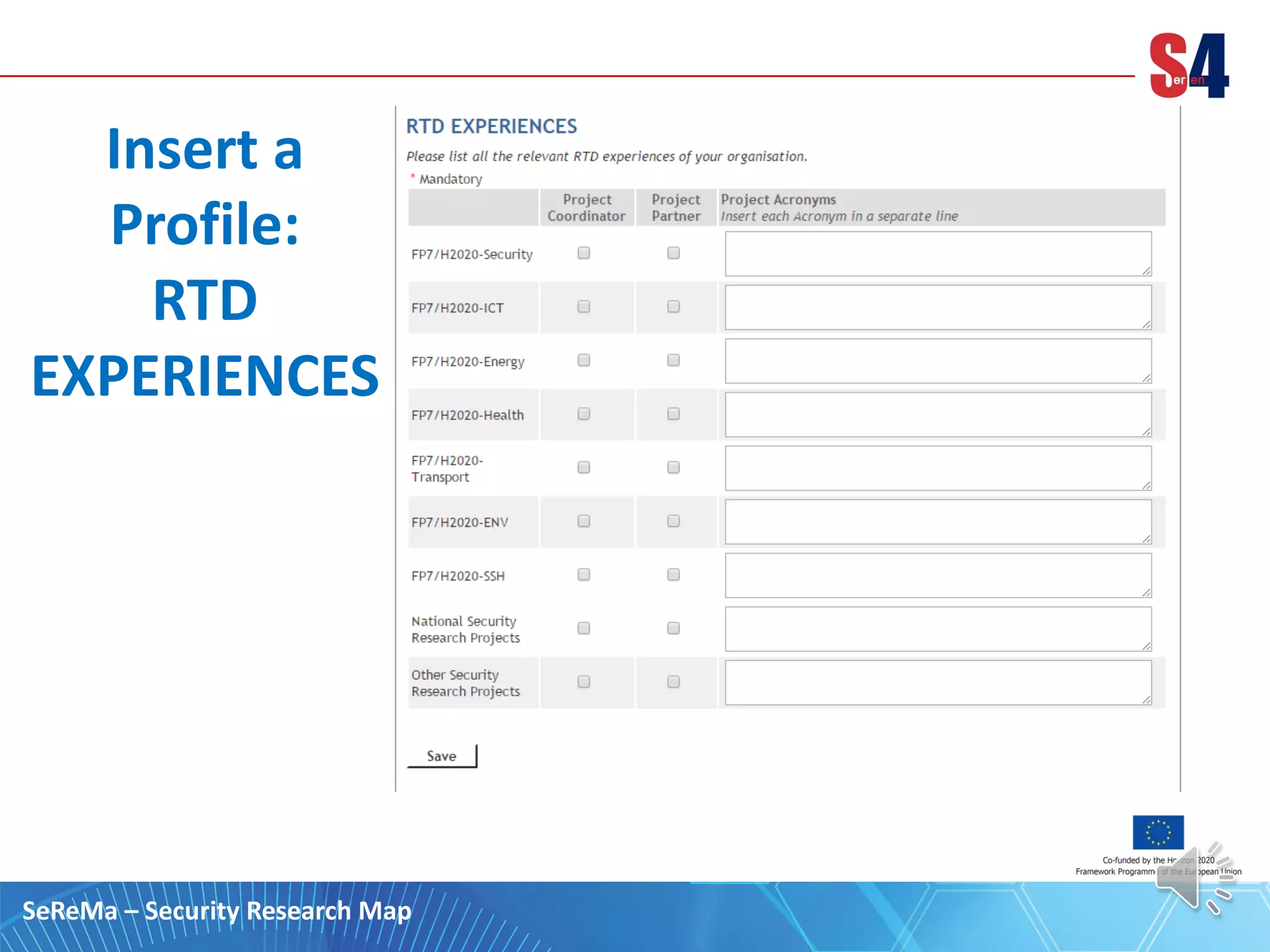
There are five categories in the profile description to be filled in:
SeReMa – Security Research Map
Inserting Your Profile
Insert a Profile:
ORGANISATION
SeReMa – Security Research Map
Insert a
Profile:
FIELD OF
ACTIVITIES
SeReMa – Security Research Map
Insert a
Profile:
RESEARCH
FOCUS
SeReMa – Security Research Map
Insert a
Profile:
RTD
EXPERIENCES
SeReMa – Security Research Map
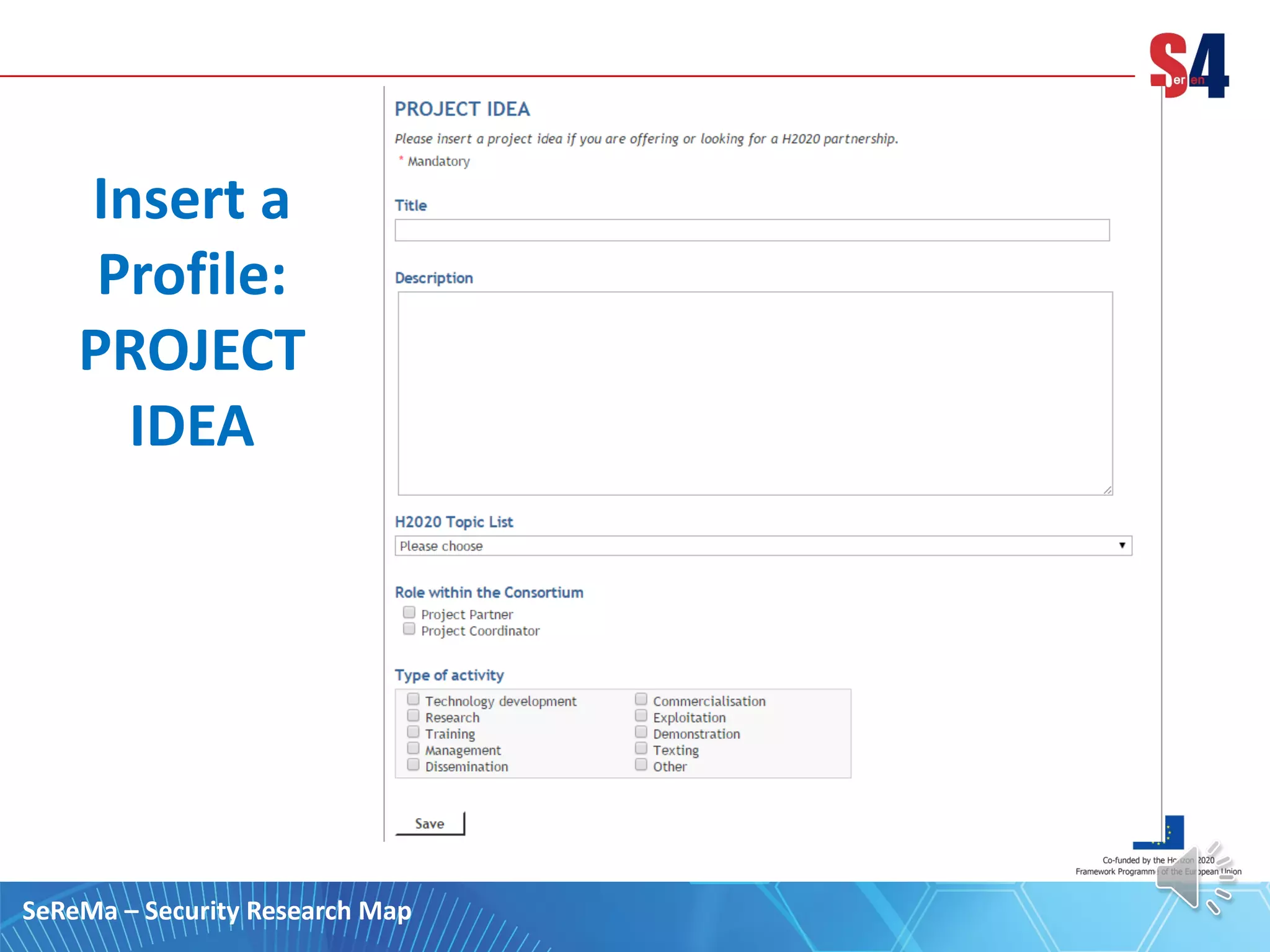
Insert a
Profile:
PROJECT
IDEA
SeReMa – Security Research Map
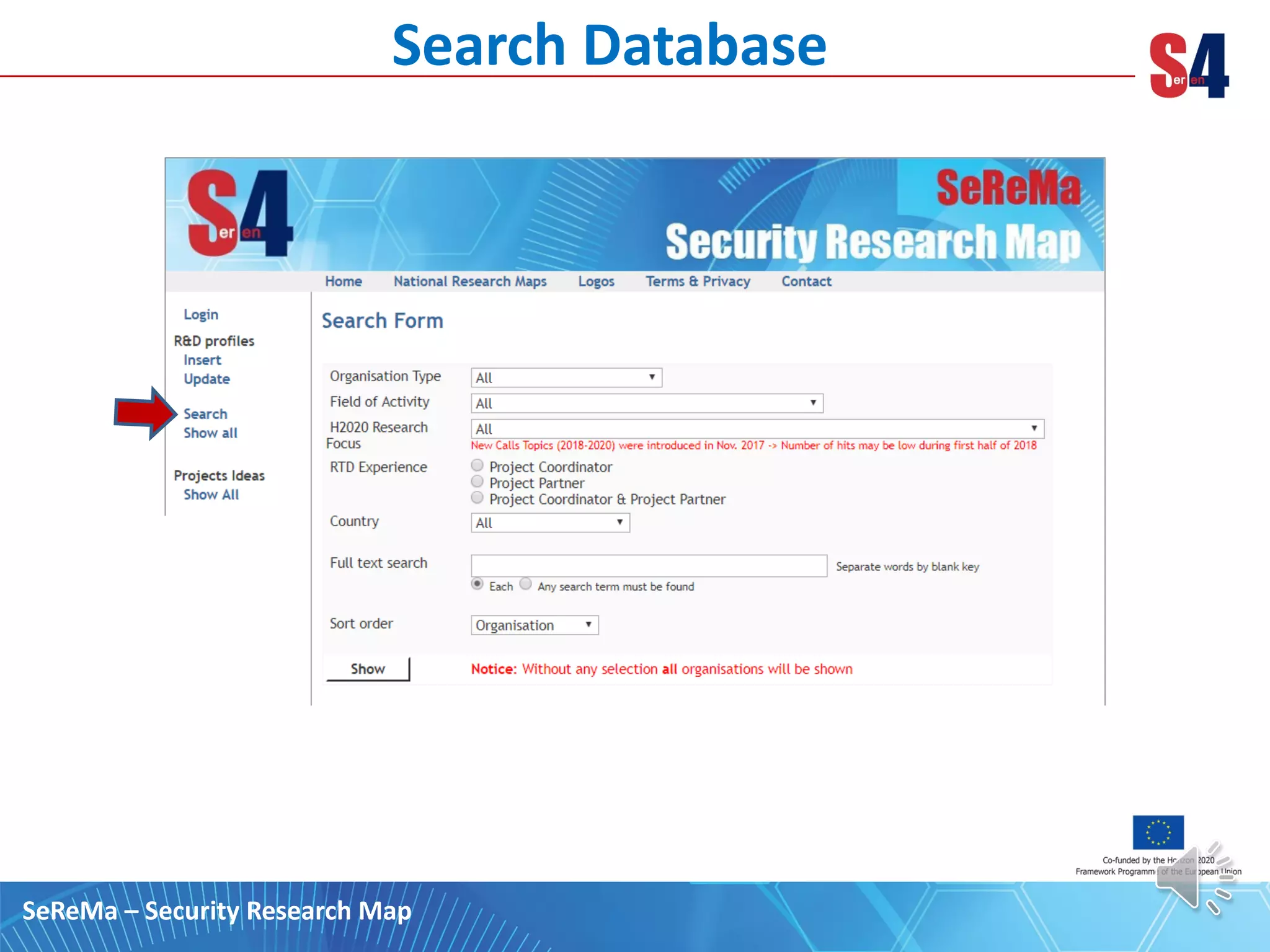
Search Database
SeReMa – Security Research Map
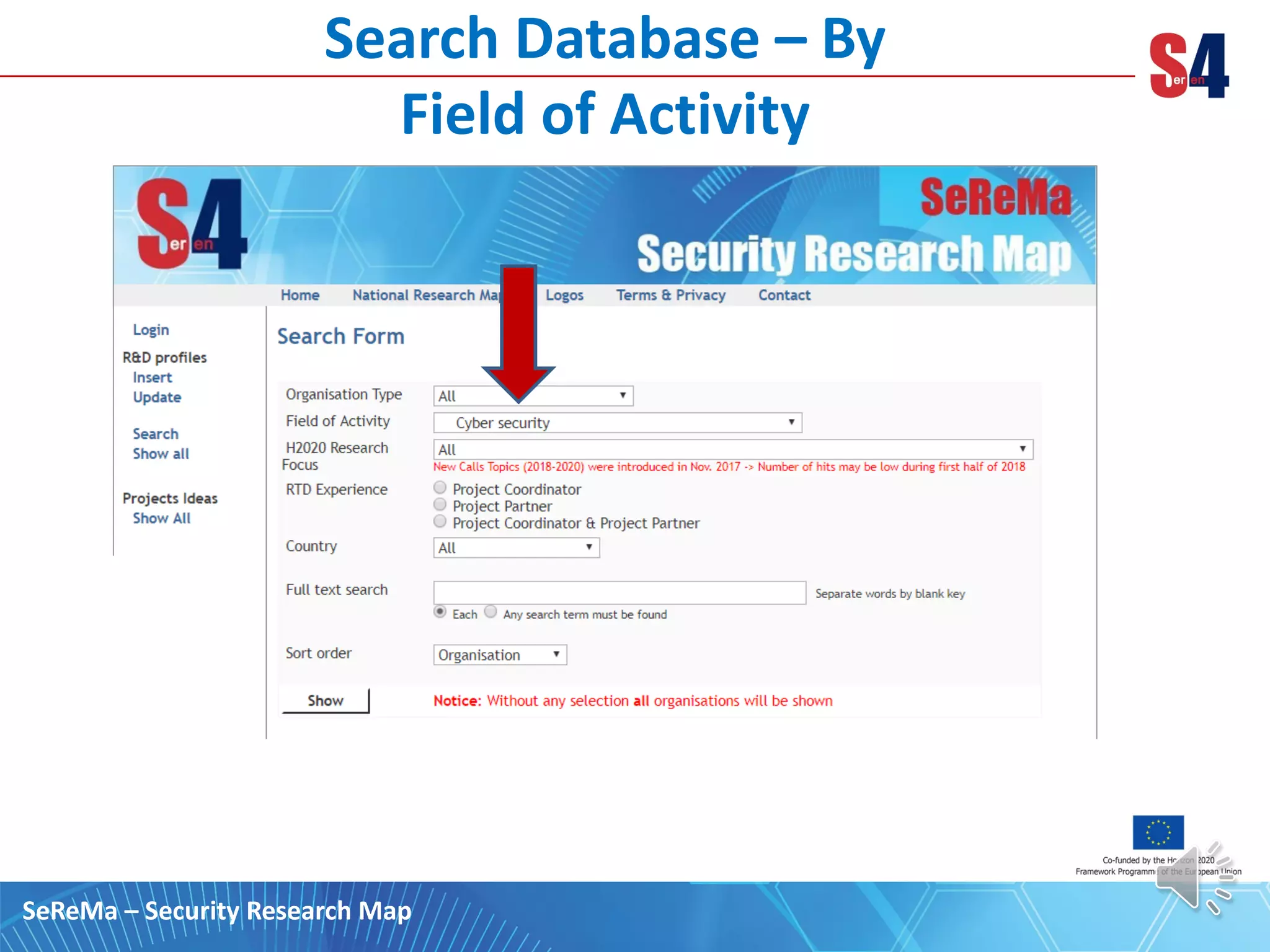
Search Database – By
Field of Activity
SeReMa – Security Research Map
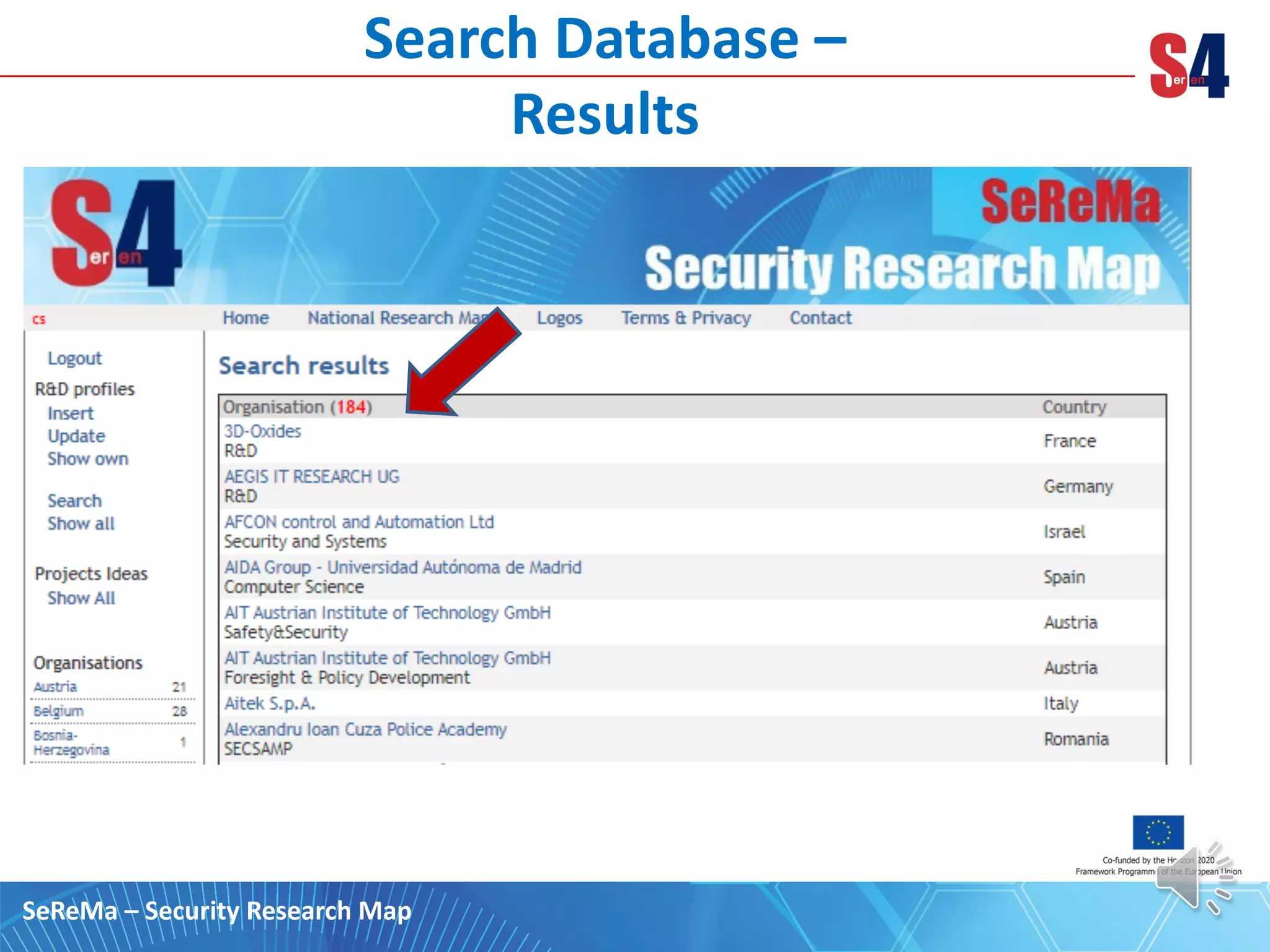
Search Database –
Results
SeReMa – Security Research Map
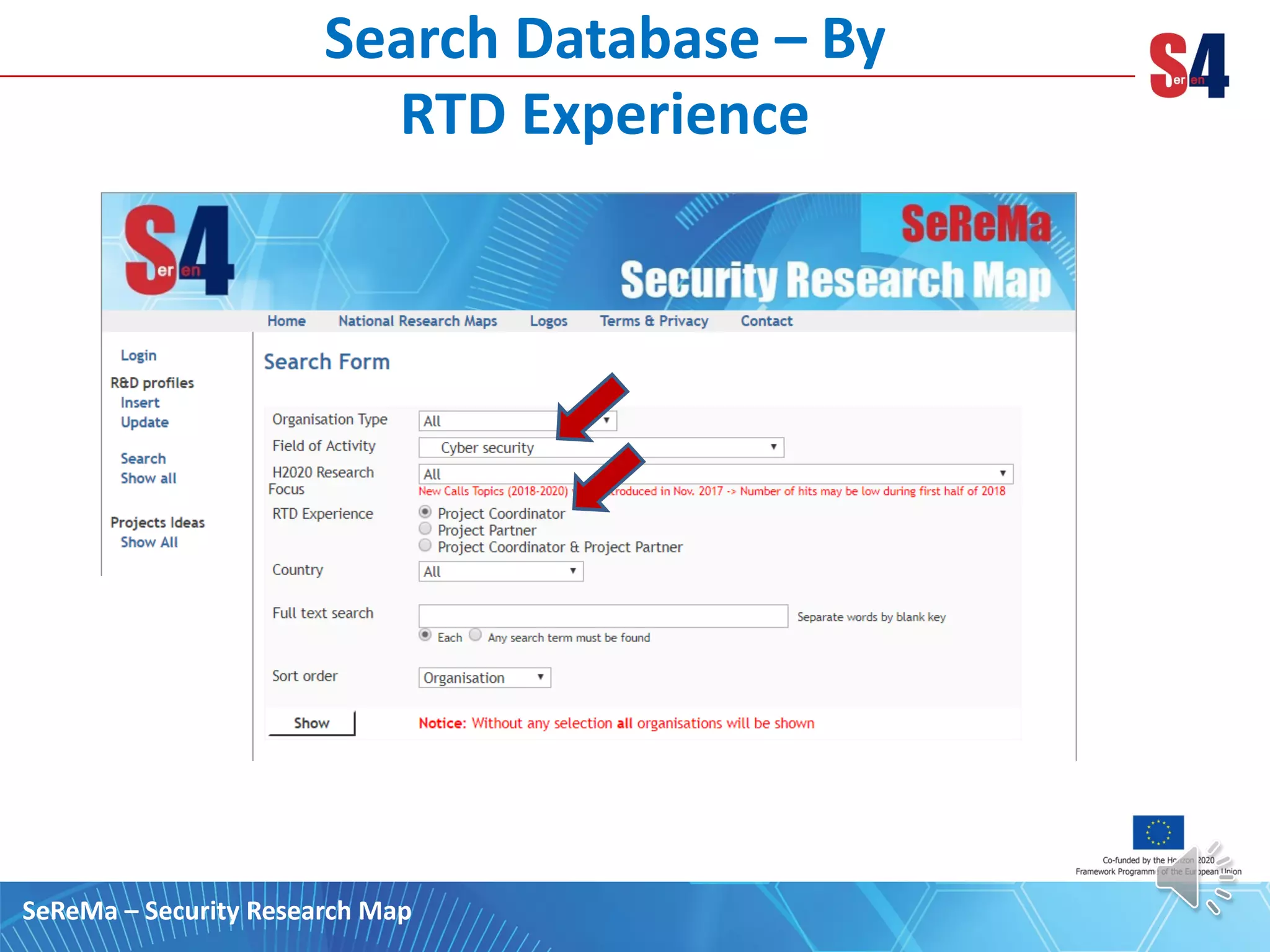
Search Database – By
RTD Experience
SeReMa – Security Research Map
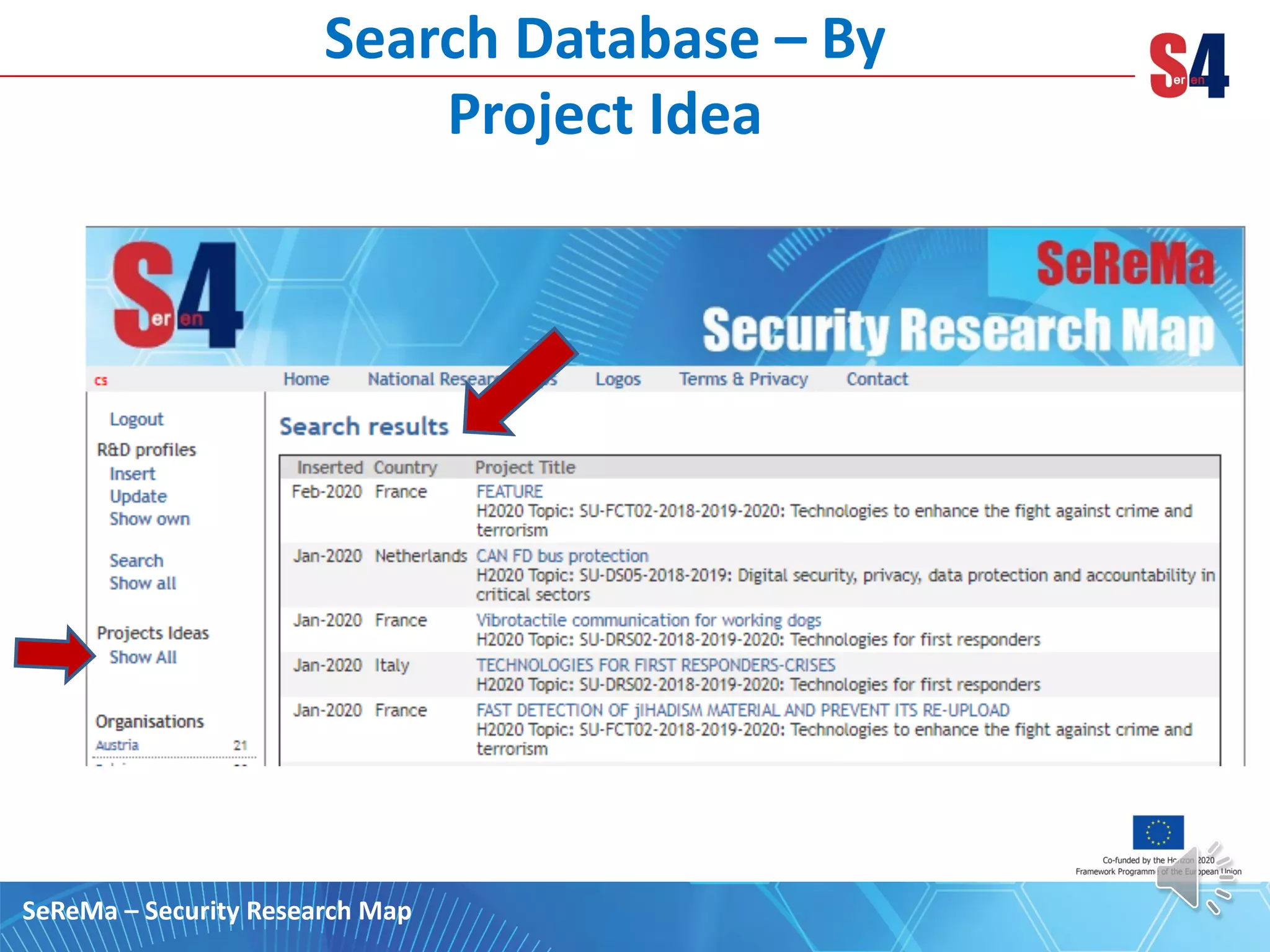
Search Database – By
Project Idea
SeReMa – Security Research Map
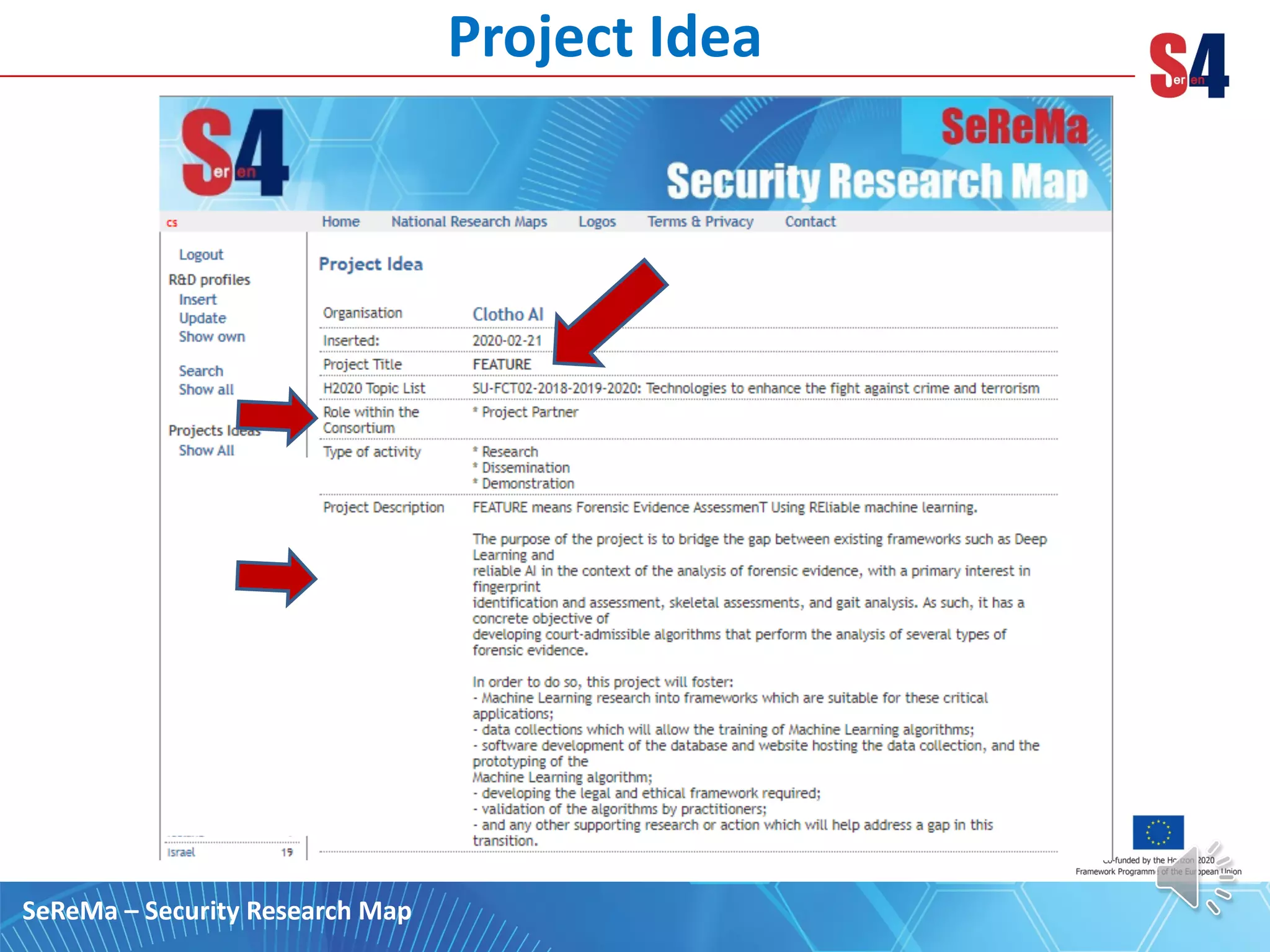
Project Idea
SeReMa – Security Research Map
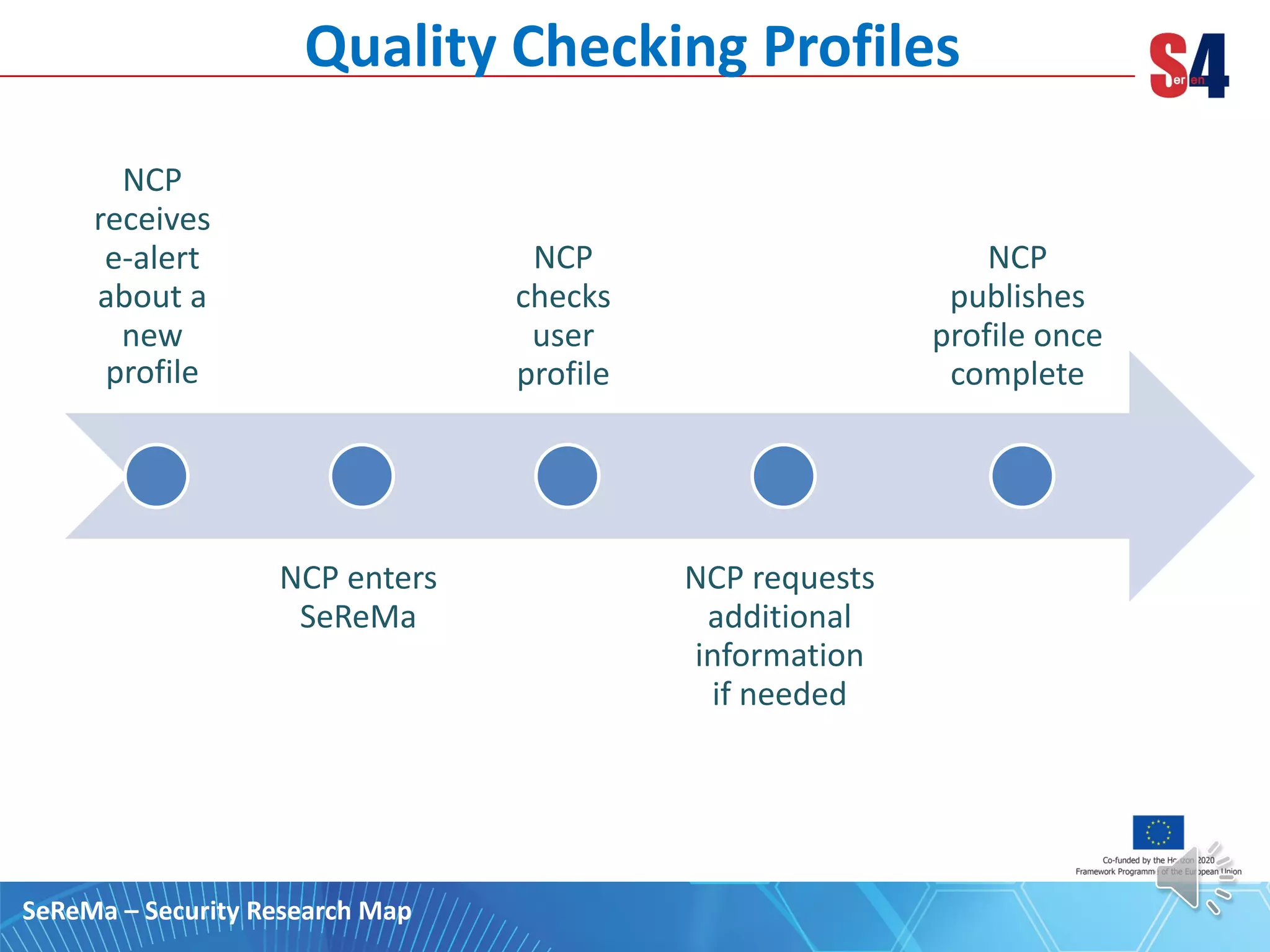
Quality Checking Profiles
NCP
receives
e-alert
about a
new
profile
NCP enters
SeReMa
NCP
checks
user
profile
NCP requests
additional
information
if needed
NCP
publishes
profile once
complete
SeReMa – Security Research Map
http://www.security-research-map.eu/Thank you for your attention
The Participant Portal
Louise.Mothersole@innovateuk.ukri.org
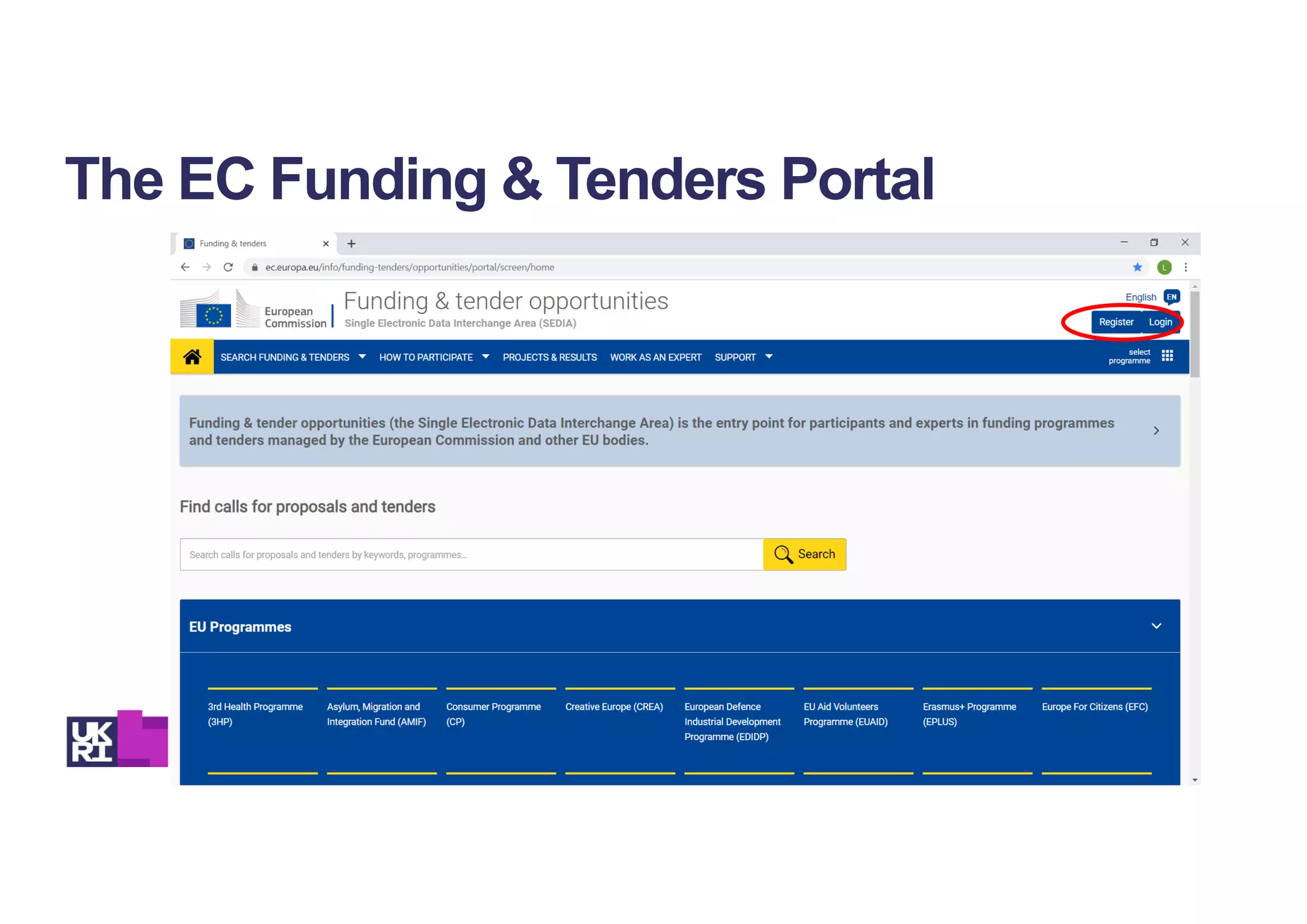
The EC Funding & Tenders Portal
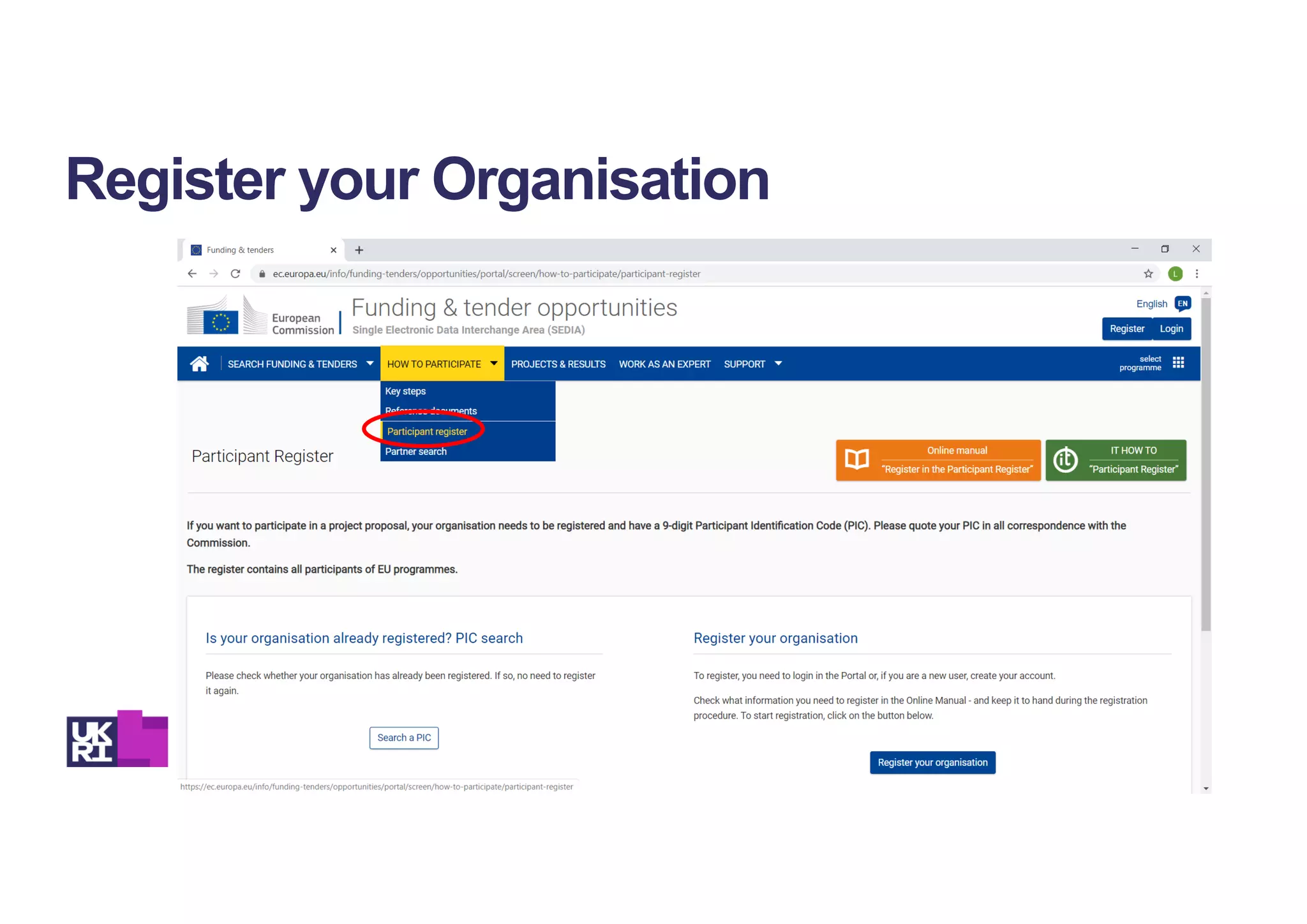
Register your Organisation
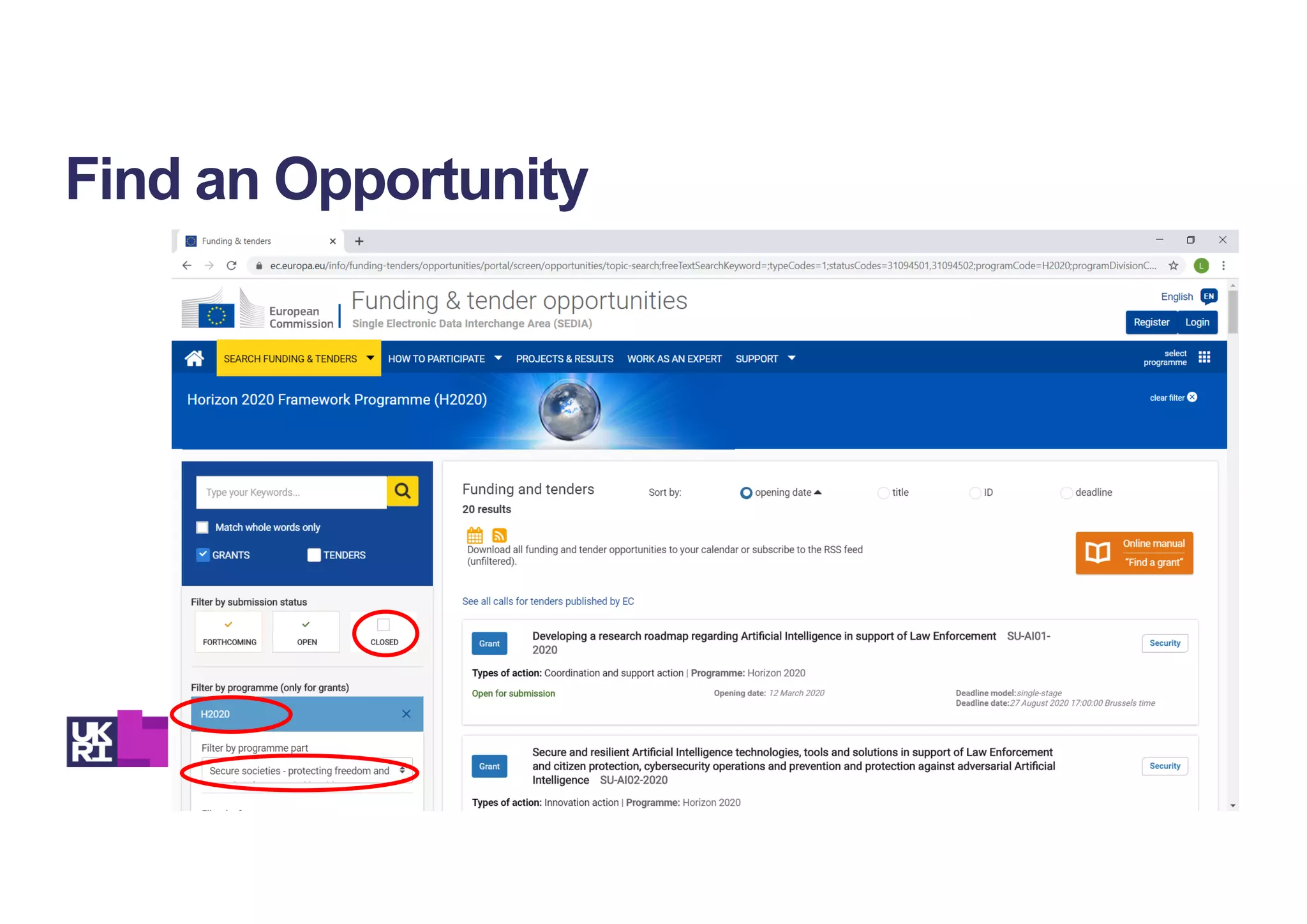
Find an Opportunity
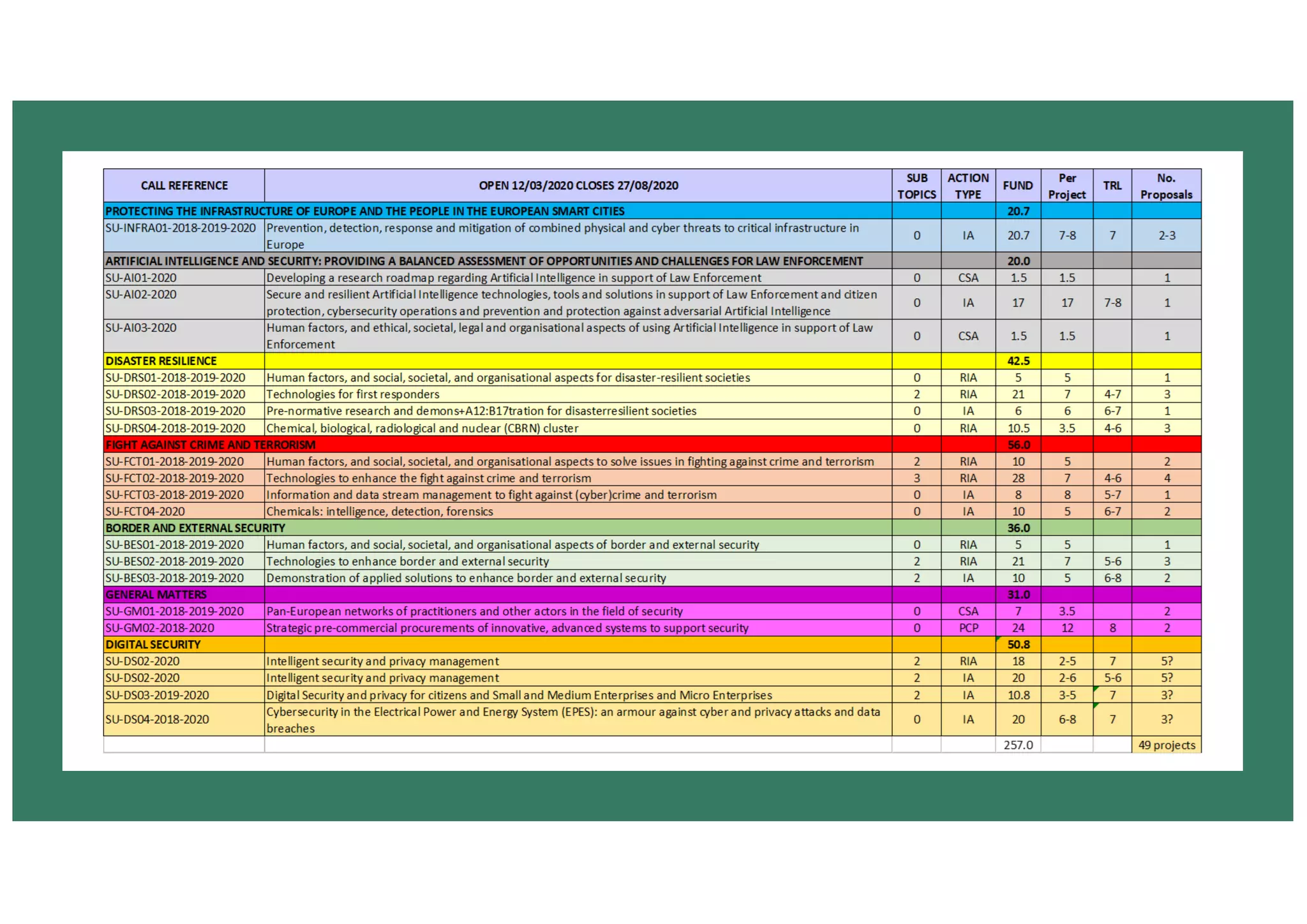
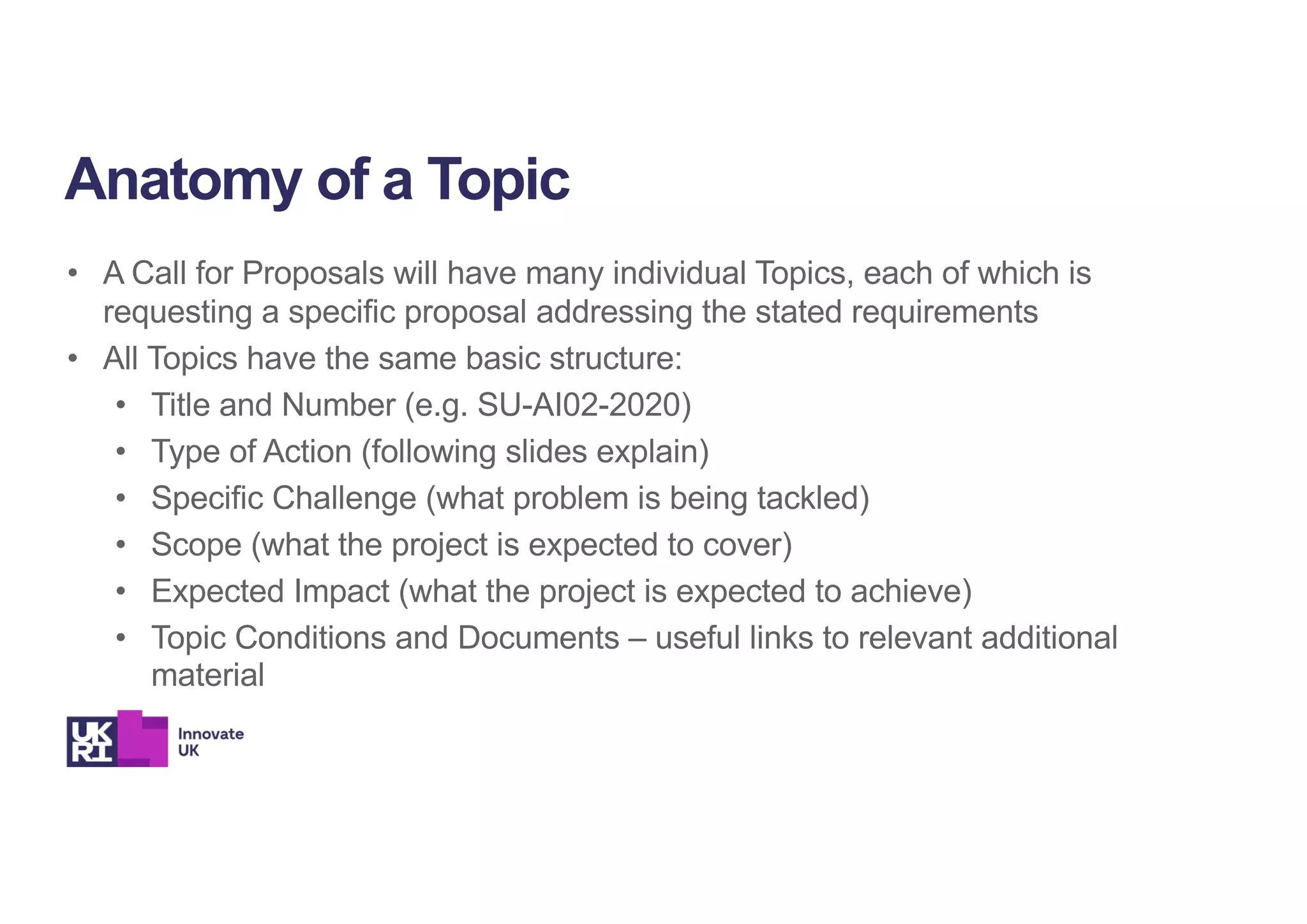
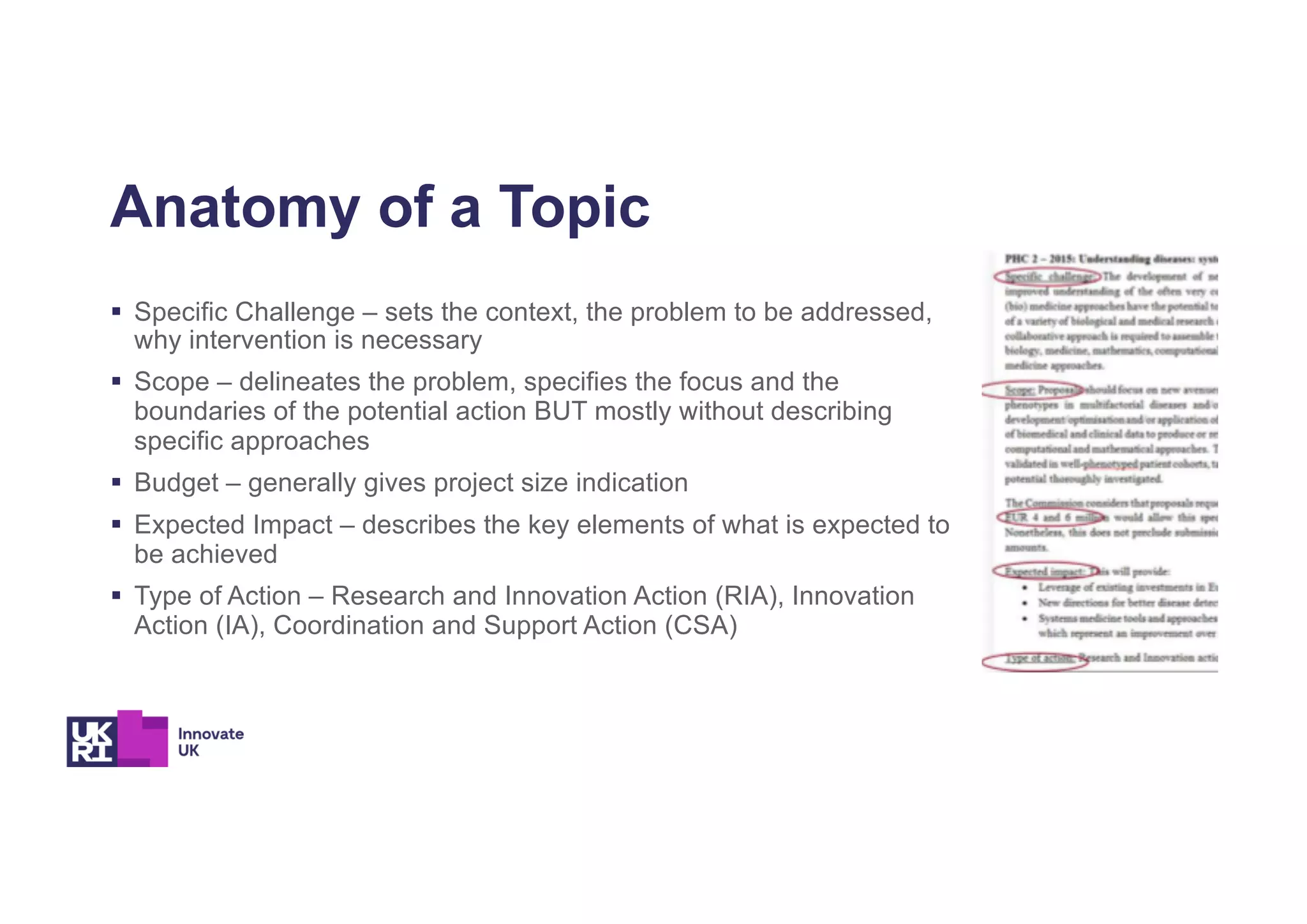
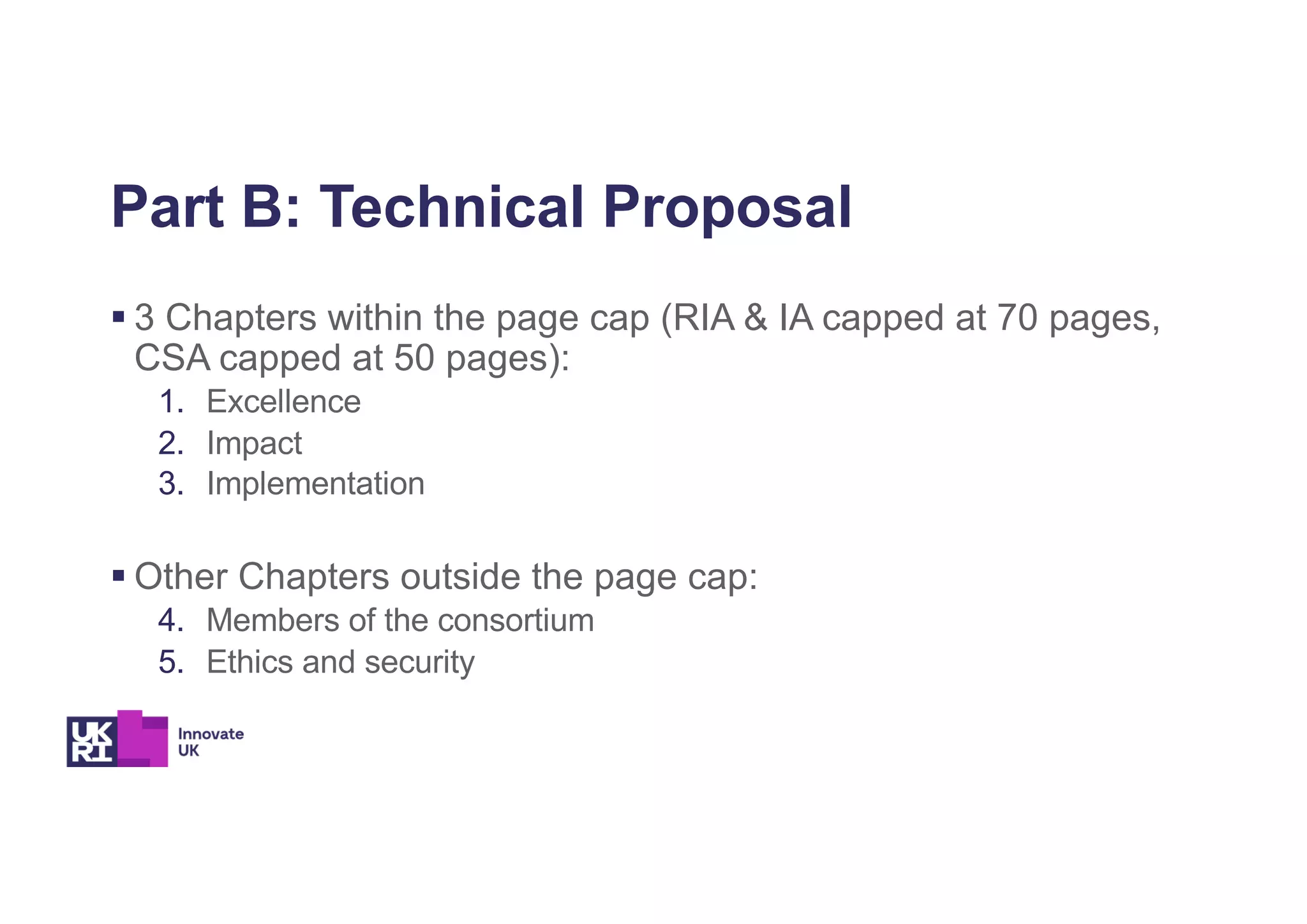
• A Call for Proposals will have many individual Topics, each of which is
requesting a specific proposal addressing the stated requirements
• All Topics have the same basic structure:
• Title and Number (e.g. SU-AI02-2020)
• Type of Action (following slides explain)
• Specific Challenge (what problem is being tackled)
• Scope (what the project is expected to cover)
• Expected Impact (what the project is expected to achieve)
• Topic Conditions and Documents – useful links to relevant additional
material
Anatomy of a Topic
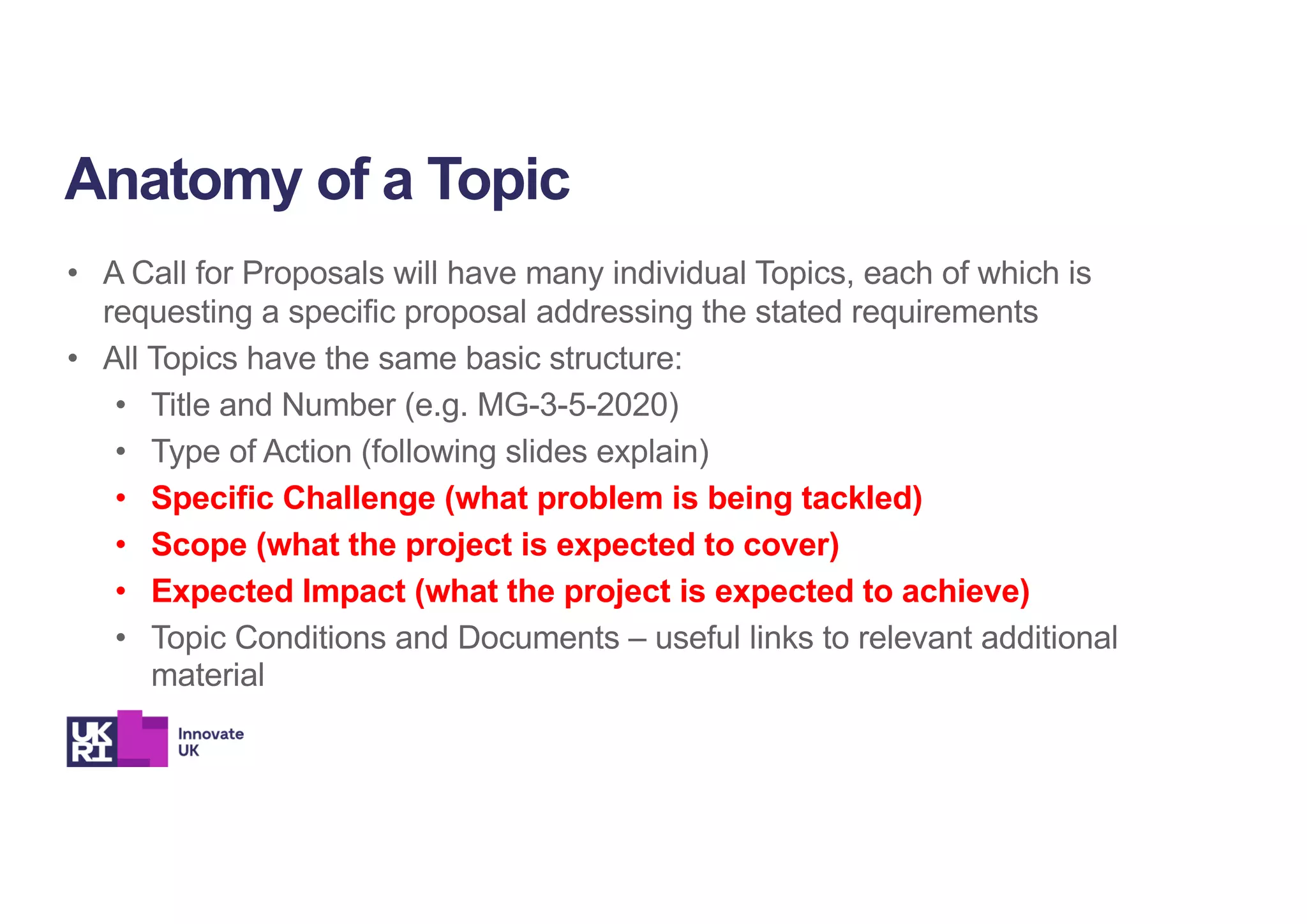
• A Call for Proposals will have many individual Topics, each of which is
requesting a specific proposal addressing the stated requirements
• All Topics have the same basic structure:
• Title and Number (e.g. MG-3-5-2020)
• Type of Action (following slides explain)
• Specific Challenge (what problem is being tackled)
• Scope (what the project is expected to cover)
• Expected Impact (what the project is expected to achieve)
• Topic Conditions and Documents – useful links to relevant additional
material
Anatomy of a Topic
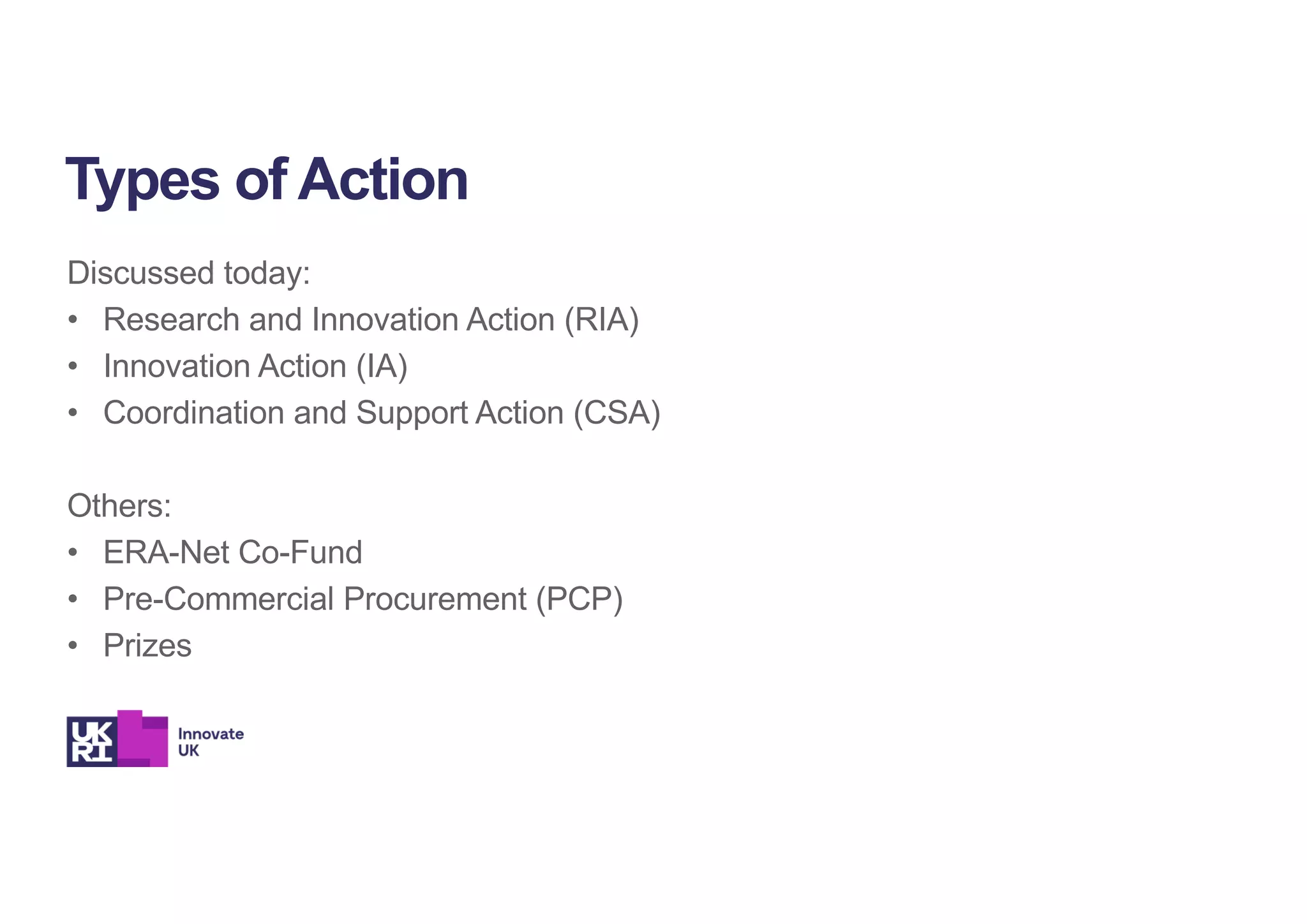
Discussed today:
• Research and Innovation Action (RIA)
• Innovation Action (IA)
• Coordination and Support Action (CSA)
Others:
• ERA-Net Co-Fund
• Pre-Commercial Procurement (PCP)
• Prizes
Types of Action
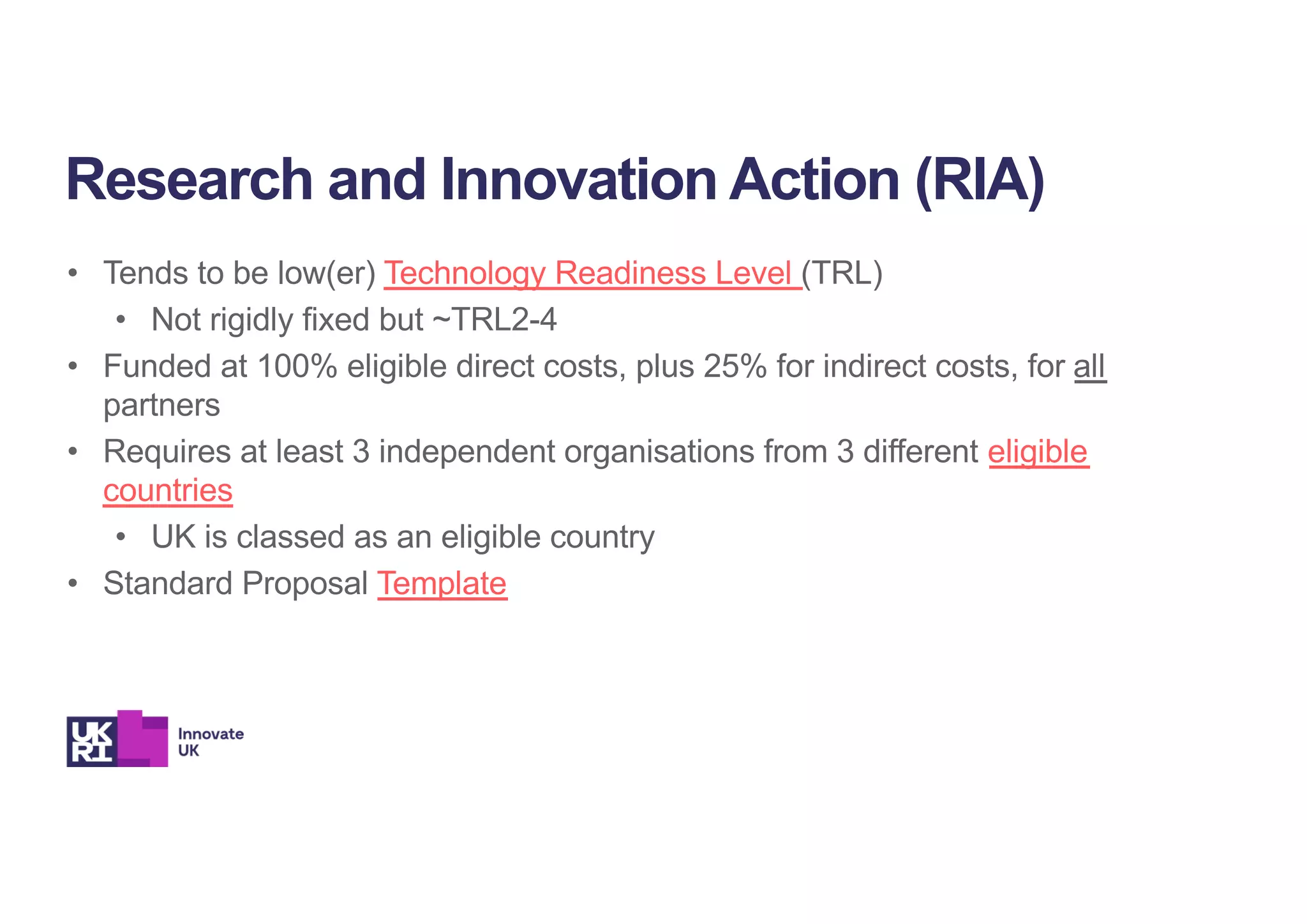
• Tends to be low(er) Technology Readiness Level (TRL)
• Not rigidly fixed but ~TRL2-4
• Funded at 100% eligible direct costs, plus 25% for indirect costs, for all
partners
• Requires at least 3 independent organisations from 3 different eligible
countries
• UK is classed as an eligible country
• Standard Proposal Template
Research and Innovation Action (RIA)
• Tends to be high(er) Technology Readiness Level (TRL)
• Not rigidly fixed but ~TRL5-7
• Funded at 100% eligible direct costs, plus 25% for indirect costs, for ‘Not
for Profit’ partners ONLY
• Funded at 70% eligible direct costs, plus 25% of that for indirect costs, for
ALL ‘for Profit’ partners
• Requires at least 3 independent organisations from 3 different eligible
countries
• UK is classed as an eligible country
• Standard Proposal Template
Innovation Action (IA)
• As the title implies, these are for coordination and supporting activities
rather than the creation of new knowledge or research
• Funded at 100% eligible direct costs, plus 25% for indirect costs, for all
partners
• Theoretically requires only one organisation from a single eligible country
but usually requires a very broad participation of the relevant stakeholder
group
• UK is classed as an eligible country
• Standard Proposal Template
Coordination and Support Action (CSA)
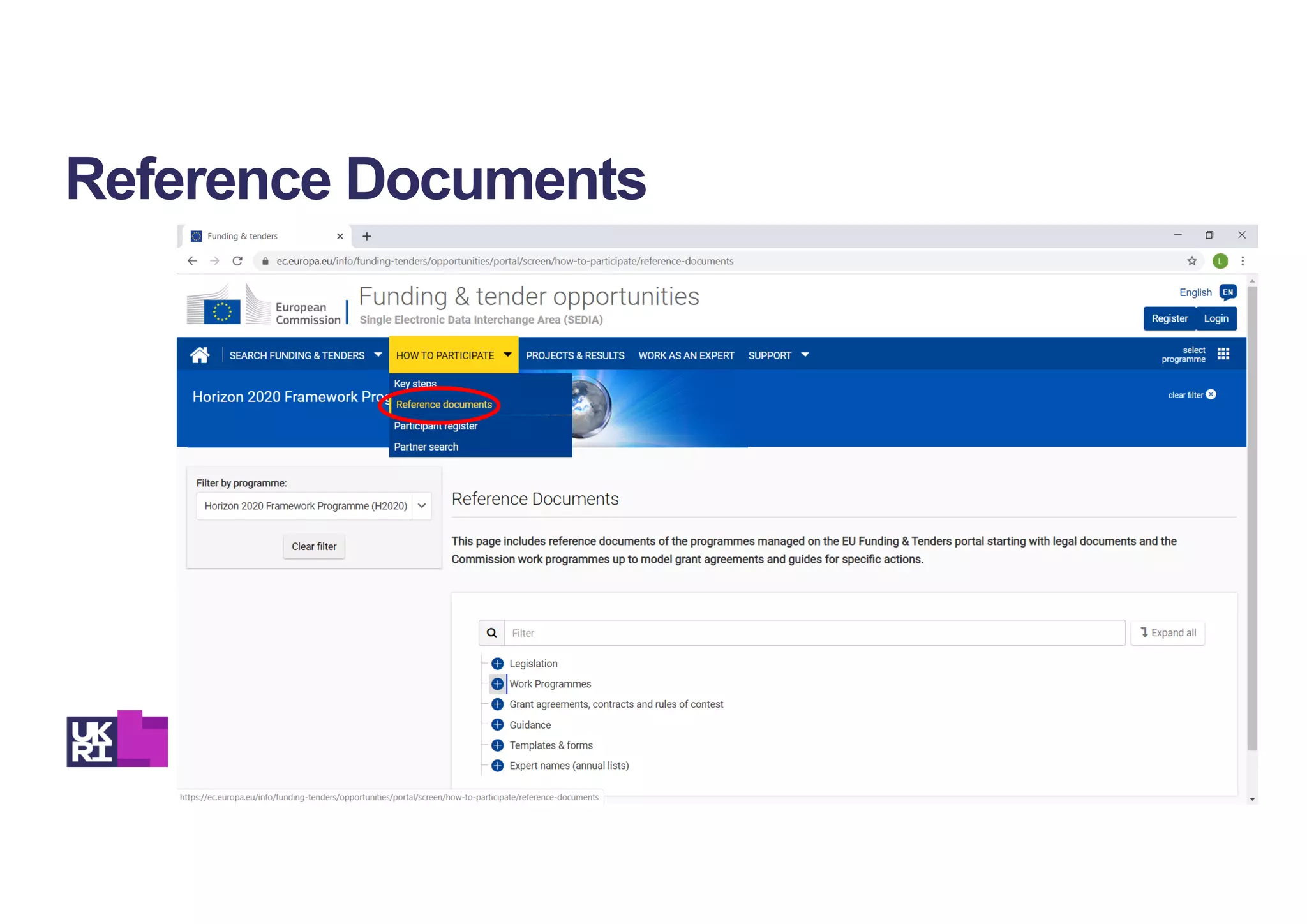
Reference Documents
Additional Information and Support
Horizon 2020 Online Manual
• Useful for post Grant Award too
Annotated Model Grant Agreement (AMGA)
• Currently 846 pages long so don’t print!
National Contact Point for Legal and Financial – Stephen Alexander
• Has a printed and well-thumbed copy of AMGA
European Commission IPR Helpdesk
• Lots of useful templates and guides e.g. NDA, Team Agreement, etc
Frequently Asked Questions (FAQ) – can be filtered by Keyword or select theme
• Each Topic web page has a Partner Search section
• ‘Interrogate’ these to find those with a good track record
• Create your own partner profile and upload
• Make it specific to the topic
• Reference the part of the Scope you can address
• Demonstrate how you can help the consortium to win the work
• Enterprise Europe Network (EEN), part of the Innovate UK Family as is KTN
• Brokerage Event was held as part of the Transport Information Day in
October – ‘pitches’ available to view online
• Past project participants – key word search on Portal in How to Participate
Building a winning consortium
Active Networking
• Actively participate in European working groups, trade bodies,
conferences and events
• For example, EU Cyber Security cPPP (contractual Public Private
Partnership)
• Volunteer to be the one that collates newsletters, technology roadmaps,
organises workshops, etc
• Demonstrate to your counterparts that your expertise, enthusiasm and
commitment are essential components of a winning team
By far the best way to build a winning team
Any questions so far?
National Contact Point
Secure Societies
Zale Johnson – NCP Secure Societies
26th March 2020
NCP Secure Societies
Core Functions
An NCP is an essential
component of H2020
and provides UK
entities with a support
service to successfully
apply for H2020
funding
Informing
• Circulate general and specific documentation
on the Horizon 2020
• Organise information and promotional
activities
Awareness Raising
• Innovation activities within H2020
• Interdisciplinary nature of calls
• Gender balance
• Link between science and civil society
NCP Secure Societies
Core Functions
Assisting
• Increase participation of UK entities –
especially SME’s and new entities
• Review draft proposals and give feedback
• Partner search activities
Advising
• Administrative procedures, rules and issues
• Smaller organisations and SMEs -
management and legal structures in projects
with large budgets and/or numerous
participants
NCP Secure Societies
Core Functions
Training
• Organise courses and training sessions on
Horizon 2020 where appropriate
Co-operation
• The Commission considers NCPs to be
important partners in the implementation of
Horizon 2020, and the main structure for
providing practical information and
assistance to potential participants.
NCP Secure Societies
Core Functions
Contactdetails
Zale.johnson@inovateuk.ukri.org
ncp-security@innovateuk.ukri.org
Mobile:+44(0)7880462093
Thank you
For
listening