Quantum Technologies
US Global Expert Mission
Agenda
10:00 Welcome
10:10 Overview of the ISCF programme (Roger McKinlay)
10:40 Innovate UK International programme (Brendan Vickers)
11:00 Outputs from the Mission (Sir Peter Knight
11:40 Support for British companies working in the US (Mike Short
12:00 Q&A
12:30 Close
UK Research
and Innovation
Quantum Technologies Global Expert Mission
Dissemination Workshop
Roger McKinlay
ISCF Challenge Director – Quantum Technologies. UKRI
27 March 2020
UK Research
and Innovation
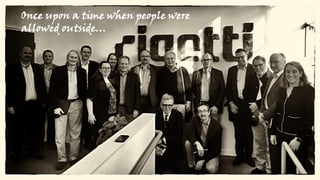
Once upon a time when people were
allowed outside…
UK Research
and Innovation
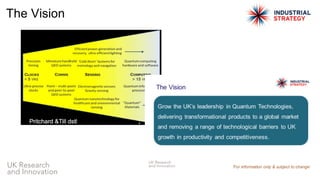
The Vision
UK Research
and Innovation
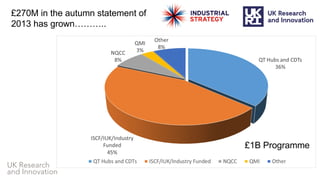
£270M in the autumn statement of
2013 has grown………..
£1B Programme
UK Research
and Innovation
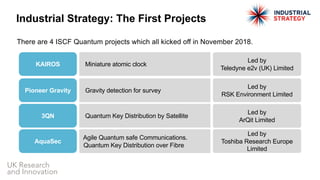
Industrial Strategy: The First Projects
KAIROS
Pioneer Gravity
3QN
AquaSec
Miniature atomic clock
Gravity detection for survey
Quantum Key Distribution by Satellite
Agile Quantum safe Communications.
Quantum Key Distribution over Fibre
There are 4 ISCF Quantum projects which all kicked off in November 2018.
Led by
Teledyne e2v (UK) Limited
Led by
RSK Environment Limited
Led by
ArQit Limited
Led by
Toshiba Research Europe
Limited
UK Research
and Innovation
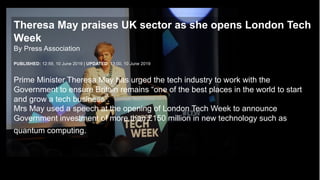
Theresa May praises UK sector as she opens London Tech
Week
By Press Association
PUBLISHED: 12:59, 10 June 2019 | UPDATED: 13:00, 10 June 2019
Prime Minister Theresa May has urged the tech industry to work with the
Government to ensure Britain remains “one of the best places in the world to start
and grow a tech business”.
Mrs May used a speech at the opening of London Tech Week to announce
Government investment of more than £150 million in new technology such as
quantum computing.
UK Research
and Innovation
The Second Bit – The Strands
UK Research
and Innovation
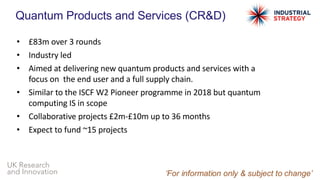
Quantum Products and Services (CR&D)
• £83m over 3 rounds
• Industry led
• Aimed at delivering new quantum products and services with a
focus on the end user and a full supply chain.
• Similar to the ISCF W2 Pioneer programme in 2018 but quantum
computing IS in scope
• Collaborative projects £2m-£10m up to 36 months
• Expect to fund ~15 projects
UK Research
and Innovation
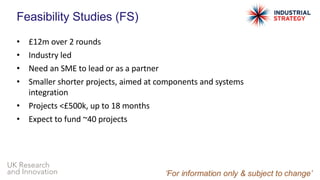
Feasibility Studies (FS)
• £12m over 2 rounds
• Industry led
• Need an SME to lead or as a partner
• Smaller shorter projects, aimed at components and systems
integration
• Projects <£500k, up to 18 months
• Expect to fund ~40 projects
UK Research
and Innovation
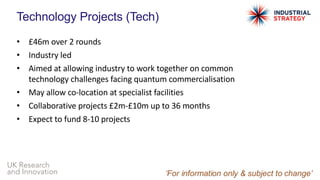
Technology Projects (Tech)
• £46m over 2 rounds
• Industry led
• Aimed at allowing industry to work together on common
technology challenges facing quantum commercialisation
• May allow co-location at specialist facilities
• Collaborative projects £2m-£10m up to 36 months
• Expect to fund 8-10 projects
UK Research
and Innovation
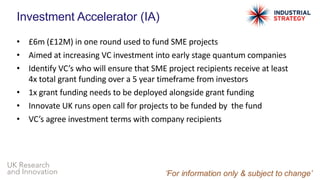
Investment Accelerator (IA)
• £6m (£12M) in one round used to fund SME projects
• Aimed at increasing VC investment into early stage quantum companies
• Identify VC’s who will ensure that SME project recipients receive at least
4x total grant funding over a 5 year timeframe from investors
• 1x grant funding needs to be deployed alongside grant funding
• Innovate UK runs open call for projects to be funded by the fund
• VC’s agree investment terms with company recipients
UK Research
and Innovation
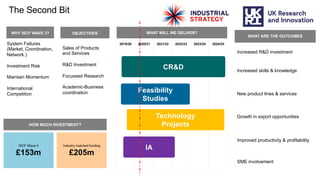
The Second Bit
HOW MUCH INVESTMENT?
ISCF Wave 3
£153m
Industry matched funding
£205m
WHY ISCF WAVE 3?
System Failures
(Market, Coordination,
Network.)
Investment Risk
Maintain Momentum
International
Competition
OBJECTIVES
• Products and
Service
• s
2019/20 2021/22 2022/23 2023/24 2024/252020/21
CR&D
Feasibility
Studies
Technology
Projects
IA
WHAT WILL WE DELIVER?
WHAT ARE THE OUTCOMES
Increased skills & knowledge
Growth in export opportunities
New product lines & services
Increased R&D investment
SME involvement
Improved productivity & profitability
Sales of Products
and Services
R&D Investment
Focussed Research
Academic-Business
coordination
UK Research
and Innovation
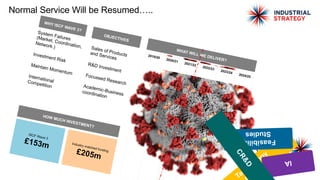
Normal Service Will be Resumed…..
HOW MUCH INVESTMENT?
ISCF Wave 3
£153m Industry matched funding
£205m
WHY ISCF WAVE 3?
System Failures(Market, Coordination,
Network.)
Investment Risk
Maintain Momentum
InternationalCompetition
OBJECTIVES
• Products andService
• s
2019/20
2021/22
2022/23
2023/24
2024/25
2020/21
Technology
rojects
IA
Feasibility
Studies
CR&D
WHAT WILL WE DELIVER?
Sales of Productsand Services
R&D Investment
Focussed Research
Academic-Business
coordination
UK Research
and Innovation
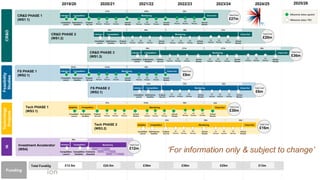
Total Funding
2019/20 2021/22 2022/23 2023/24 2024/252020/21 2025/26
CR&D
CR&D PHASE 3
(WS1.3)
Initiation Competition Monitoring
Competition
Launch
Submissions
Deadline
Projects
Go Live
Annual
Review
Annual
Review
Annual
Review
Close-Out
Q1
Review
Q2
Review
Q3
Review
Q1
Review
Q2
Review
Q3
Review
Q1
Review
Q2
Review
Q3
Review
Feasibility
Studies
FS PHASE 1
(WS2.1)
Initiation Competition Monitoring
Competition
Launch
Submissions
Deadline
Projects
Go Live
Annual
Review
Annual
Review
Close-Out
Q1
Review
Q2
Review
Q3
Review
Q1
Review
Q2
Review
Q3
Review
FS PHASE 2
(WS2.1)
Initiation Competition Monitoring
Competition
Launch
Submissions
Deadline
Projects
Go Live
Annual
Review
Annual
Review
Close-Out
Q1
Review
Q2
Review
Q3
Review
Q1
Review
Q2
Review
Q3
Review
Tech PHASE 1
(WS3.1)
Initiation Competition Monitoring
Competition
Launch
Submissions
Deadline
Projects
Go Live
Annual
Review
Annual
Review
Annual
Review
Close-Out
Q1
Review
Q2
Review
Q3
Review
Q1
Review
Q2
Review
Q3
Review
Q1
Review
Q2
Review
Q3
Review
Technology
Projects
Tech PHASE 2
(WS3.2)
Initiation Competition Monitoring
Competition
Launch
Submissions
Deadline
Projects
Go Live
Annual
Review
Annual
Review
Close-Out
Q1
Review
Q2
Review
Q3
Review
Q1
Review
Q2
Review
Q3
Review
IA
Investment Accelerator
(WS4)
Initiation Competition
Competition
Launch
Competition
Deadline
Contracts
Awarded
Monitoring
£12.5m £24.5m £39m £39m £25m £13m
Funding
£6m £11m £11m £8m
CR&D PHASE 1
(WS1.1)
Initiation Competition Monitoring
Competition
Launch
Submissions
Deadline
Projects
Go Live
Annual
Review
Annual
Review
Annual
Review
Close-Out
Q1
Review
Q2
Review
Q3
Review
Q1
Review
Q2
Review
Q3
Review
Q1
Review
Q2
Review
Q3
Review
£11m £10m £6m
Total Cost
£27m
CR&D PHASE 2
(WS1.2)
Initiation Competition Monitoring
Competition
Launch
Submissions
Deadline
Projects
Go Live
Annual
Review
Annual
Review
Annual
Review
Close-Out
Q1
Review
Q2
Review
Q3
Review
Q1
Review
Q2
Review
Q3
Review
Q1
Review
Q2
Review
Q3
Review
£3m £8m £8m £1m
Total Cost
£20m
Total Cost
£36m
Total Cost
£6m
Total Cost
£6m
Total Cost
£30m
Total Cost
£16m
Total Cost
£12m
£0.5m £3.5m £2m
£1m £3m £2m
£7m £12m £8m £3m
£3m £8m £5m
£6m
Milestone dates agreed
Milestone dates TBC
Batch 1
Batch 2
Batch 3
UK Research
and Innovation
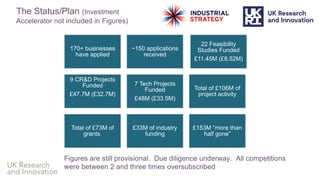
170+ businesses
have applied
~150 applications
received
22 Feasibility
Studies Funded
£11.45M (£8.52M)
9 CR&D Projects
Funded
£47.7M (£32.7M)
7 Tech Projects
Funded
£48M (£33.5M)
Total of £106M of
project activity
Total of £73M of
grants.
£33M of industry
funding
£153M “more than
half gone”
The Status/Plan (Investment
Accelerator not included in Figures)
Figures are still provisional. Due diligence underway. All competitions
were between 2 and three times oversubscribed
UK Research
and Innovation
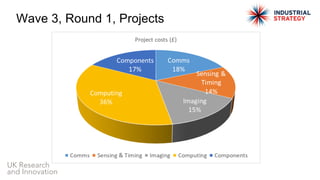
Wave 3, Round 1, Projects
UK Research
and Innovation
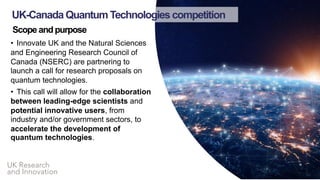
Scope and purpose
• Innovate UK and the Natural Sciences
and Engineering Research Council of
Canada (NSERC) are partnering to
launch a call for research proposals on
quantum technologies.
• This call will allow for the collaboration
between leading-edge scientists and
potential innovative users, from
industry and/or government sectors, to
accelerate the development of
quantum technologies.
UK-Canada Quantum Technologies competition
UK Research
and Innovation
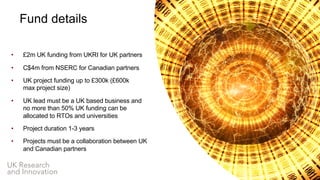
Fund details
• £2m UK funding from UKRI for UK partners
• C$4m from NSERC for Canadian partners
• UK project funding up to £300k (£600k
max project size)
• UK lead must be a UK based business and
no more than 50% UK funding can be
allocated to RTOs and universities
• Project duration 1-3 years
• Projects must be a collaboration between UK
and Canadian partners
UK Research
and Innovation
Questions?
Quantum Technologies
GEM USA 2019
Brendan Vickers
Partnership Manager – North
America
• UK is good at starting businesses but not so good when it comes to their growth
• OECD Entrepreneurship at a Glance 2017 - UK comes first globally for start-ups, but not
in the top ten for growing businesses into established, medium-sized companies with a
lasting impact on our economy
• The Scaleup Institute Scaleup Review 2018 highlights that being able to access UK and
international markets is the second most important factor for businesses looking to
grow and scale
• 95% of the world’s R&D takes place outside of the UK
• In exploring global markets, businesses often lack confidence and face the challenges of
finding international partners, customers and having the right connections
• Businesses look for trusted support and ability to open opportunities
Innovate UK supporting global R&D and innovation
• Aim is to help innovative UK businesses to grow and scale globally – even before they
have a market-ready product or service to sell
• Range of different types of support to facilitate partnership building and development
• Financial and non financial
Innovate UK supporting global R&D and innovation
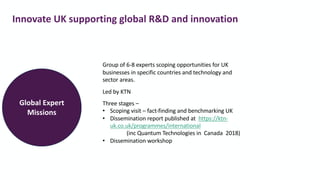
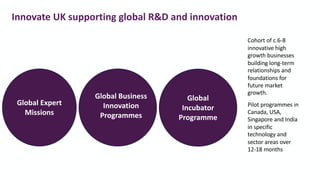
Global Expert
Missions
Group of 6-8 experts scoping opportunities for UK
businesses in specific countries and technology and
sector areas.
Led by KTN
Three stages –
• Scoping visit – fact-finding and benchmarking UK
• Dissemination report published at https://ktn-
uk.co.uk/programmes/international
(inc Quantum Technologies in Canada 2018)
• Dissemination workshop
Innovate UK supporting global R&D and innovation
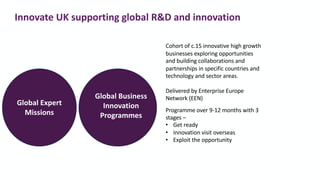
Global Expert
Missions
Global Business
Innovation
Programmes
Cohort of c.15 innovative high growth
businesses exploring opportunities
and building collaborations and
partnerships in specific countries and
technology and sector areas.
Delivered by Enterprise Europe
Network (EEN)
Programme over 9-12 months with 3
stages –
• Get ready
• Innovation visit overseas
• Exploit the opportunity
Innovate UK supporting global R&D and innovation
Global Expert
Missions
Global
Incubator
Programme
Global Business
Innovation
Programmes
Cohort of c.6-8
innovative high
growth businesses
building long-term
relationships and
foundations for
future market
growth.
Pilot programmes in
Canada, USA,
Singapore and India
in specific
technology and
sector areas over
12-18 months
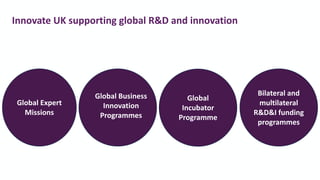
Innovate UK supporting global R&D and innovation
Global Expert
Missions
Global
Incubator
Programme
Global Business
Innovation
Programmes
Bilateral and
multilateral
R&D&I funding
programmes
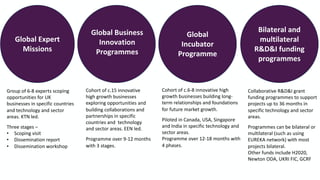
Innovate UK supporting global R&D and innovation
Global Expert
Missions
Global Business
Innovation
Programmes
Global
Incubator
Programme
Bilateral and
multilateral
R&D&I funding
programmes
Group of 6-8 experts scoping
opportunities for UK
businesses in specific countries
and technology and sector
areas. KTN led.
Three stages –
• Scoping visit
• Dissemination report
• Dissemination workshop
Cohort of c.15 innovative
high growth businesses
exploring opportunities and
building collaborations and
partnerships in specific
countries and technology
and sector areas. EEN led.
Programme over 9-12 months
with 3 stages.
Cohort of c.6-8 innovative high
growth businesses building long-
term relationships and foundations
for future market growth.
Piloted in Canada, USA, Singapore
and India in specific technology and
sector areas.
Programme over 12-18 months with
4 phases.
Collaborative R&D&I grant
funding programmes to support
projects up to 36 months in
specific technology and sector
areas.
Programmes can be bilateral or
multilateral (such as using
EUREKA network) with most
projects bilateral.
Other funds include H2020,
Newton ODA, UKRI FIC, GCRF
Global Business
Innovation
Programmes
Eureka: UK-Canada activities
• Canada member of EUREKA –
• Eurostars programme – SME focused R&D&I programme with calls twice a
year
• EUREKA Clusters – Smart Cluster on advanced manufacturing
• Network Projects – joint calls in different areas
• UK-Canada bilateral quantum technologies programme – call Summer
2020
Any questions?
brendan.vickers@innovateuk.ukri.org
UK – US Quantum Technologies
Global Experts Mission
September 2019- Boston/Yale
November 2019-Washington/Boulder/Denver/Los Angeles/San Francisco
Peter Knight
Key messages
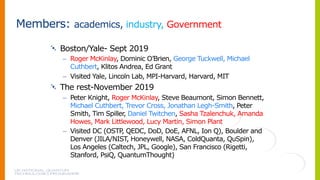
Members: academics, industry, Government
Boston/Yale- Sept 2019
– Roger McKinlay, Dominic O’Brien, George Tuckwell, Michael
Cuthbert, Klitos Andrea, Ed Grant
– Visited Yale, Lincoln Lab, MPI-Harvard, Harvard, MIT
The rest-November 2019
– Peter Knight, Roger McKinlay, Steve Beaumont, Simon Bennett,
Michael Cuthbert, Trevor Cross, Jonathan Legh-Smith, Peter
Smith, Tim Spiller, Daniel Twitchen, Sasha Tzalenchuk, Amanda
Howes, Mark Littlewood, Lucy Martin, Simon Plant
– Visited DC (OSTP, QEDC, DoD, DoE, AFNL, Ion Q), Boulder and
Denver (JILA/NIST, Honeywell, NASA, ColdQuanta, QuSpin),
Los Angeles (Caltech, JPL, Google), San Francisco (Rigetti,
Stanford, PsiQ, QuantumThought)
Introduction and purpose
• In November 2019, an Expert Mission travelled to Washington DC,
Colorado and California, following on from a smaller group who
visited the Boston area in September. These sought to inform the
UK’s international strategy for quantum technologies by exploring the
US quantum landscape and examining opportunities to collaborate
with US organisations. Our report summarises the information and
insights gathered.
• The UK National Quantum Technology Programme brings together
academia, industry and government in a coordinated drive towards
commercial applications, across quantum sensing, imaging,
communications and computing. Now entering its second five-year
phase, with committed and planned investment amounting to £1
billion, the programme has been a great success.
• But to reap the rewards, the UK must also forge links with the right
international partners: not only universities and research
organisations, but also global companies who can provide access to
markets and finance.
Perceptions of US QT Programme
• The US government has stepped in with the National Quantum Initiative (NQI),
a five-year, $1.27 billion programme. This will include up to ten new centres for
quantum information science (QIS) research and education; and a business
consortium, QED-C, has been set up to give a voice to industry. The initiative
has a stated “science first” aim, with the expectation that the market will
handle innovation – exploiting new science coming out of the federal
programme. However, US government can also drive quantum technology
directly through strategic procurement in defence and elsewhere.
• The scale of investment and the quality of research are both impressive. As
NQI is spread across several agencies and many labs, it is not yet clear how
well coordinated the initiative will be; however, there is a smooth flow of
people, ideas and sometimes funding between academia, industry and national
labs. Joint ventures between national labs and universities, such as JILA and
JPL, are effective players in the quantum landscape.
• By comparison with the enormous computing effort, there seems to be
relatively less work on quantum communications, sensors and imaging;
however the mission concentrated on civil applications rather than defence,
where there may be greater activity in these fields.
Appetite for collaboration with the UK
We found a widespread appetite to collaborate with the UK, especially
on quantum software, components, materials, and training. The UK’s
planned National Quantum Computing Centre can provide a focus for
collaboration with some of the major quantum computing companies,
and we can enable further joint efforts with funding tools such as lead
agency agreements.
Key Messages we brought back
1. The US scale on quantum computing platforms is surprisingly not
so very different from our own. Most industry led programmes
seem to have of order 100 scientists and engineers, although this
may well accelerate rapidly. We appear to still be in the game.
2. The venture capital appetite is much greater in the US than in the
UK. We need to find mechanisms to de-risk investment in the UK.
3. Collaboration on pure quantum science carries little risk, and
mechanisms for open engagement, for example through the QTFP
SPF, could be an important opportunity for leverage and influence.
Support for British companies working in the US
Mike Short, Chief Scientific Adviser, Department for International Trade)
a) Export promotion
b) Export controls – how many examples have we blocked and what rules or list are we
working to ? Any particular do’s and don`ts in this area ?
c) FDI – who are the leading contenders and how do we show a rounded welcome?
Does this include any incentives such as grants or procurement ?
Questions

Quantum Technologies Global Expert Mission Dissemination Workshop

  • 1.
  • 2.
    Agenda 10:00 Welcome 10:10 Overviewof the ISCF programme (Roger McKinlay) 10:40 Innovate UK International programme (Brendan Vickers) 11:00 Outputs from the Mission (Sir Peter Knight 11:40 Support for British companies working in the US (Mike Short 12:00 Q&A 12:30 Close
  • 3.
    UK Research and Innovation QuantumTechnologies Global Expert Mission Dissemination Workshop Roger McKinlay ISCF Challenge Director – Quantum Technologies. UKRI 27 March 2020
  • 4.
    UK Research and Innovation Onceupon a time when people were allowed outside…
  • 5.
  • 6.
    UK Research and Innovation £270Min the autumn statement of 2013 has grown……….. £1B Programme
  • 7.
    UK Research and Innovation IndustrialStrategy: The First Projects KAIROS Pioneer Gravity 3QN AquaSec Miniature atomic clock Gravity detection for survey Quantum Key Distribution by Satellite Agile Quantum safe Communications. Quantum Key Distribution over Fibre There are 4 ISCF Quantum projects which all kicked off in November 2018. Led by Teledyne e2v (UK) Limited Led by RSK Environment Limited Led by ArQit Limited Led by Toshiba Research Europe Limited
  • 8.
    UK Research and Innovation TheresaMay praises UK sector as she opens London Tech Week By Press Association PUBLISHED: 12:59, 10 June 2019 | UPDATED: 13:00, 10 June 2019 Prime Minister Theresa May has urged the tech industry to work with the Government to ensure Britain remains “one of the best places in the world to start and grow a tech business”. Mrs May used a speech at the opening of London Tech Week to announce Government investment of more than £150 million in new technology such as quantum computing.
  • 9.
    UK Research and Innovation TheSecond Bit – The Strands
  • 10.
    UK Research and Innovation QuantumProducts and Services (CR&D) • £83m over 3 rounds • Industry led • Aimed at delivering new quantum products and services with a focus on the end user and a full supply chain. • Similar to the ISCF W2 Pioneer programme in 2018 but quantum computing IS in scope • Collaborative projects £2m-£10m up to 36 months • Expect to fund ~15 projects
  • 11.
    UK Research and Innovation FeasibilityStudies (FS) • £12m over 2 rounds • Industry led • Need an SME to lead or as a partner • Smaller shorter projects, aimed at components and systems integration • Projects <£500k, up to 18 months • Expect to fund ~40 projects
  • 12.
    UK Research and Innovation TechnologyProjects (Tech) • £46m over 2 rounds • Industry led • Aimed at allowing industry to work together on common technology challenges facing quantum commercialisation • May allow co-location at specialist facilities • Collaborative projects £2m-£10m up to 36 months • Expect to fund 8-10 projects
  • 13.
    UK Research and Innovation InvestmentAccelerator (IA) • £6m (£12M) in one round used to fund SME projects • Aimed at increasing VC investment into early stage quantum companies • Identify VC’s who will ensure that SME project recipients receive at least 4x total grant funding over a 5 year timeframe from investors • 1x grant funding needs to be deployed alongside grant funding • Innovate UK runs open call for projects to be funded by the fund • VC’s agree investment terms with company recipients
  • 14.
    UK Research and Innovation TheSecond Bit HOW MUCH INVESTMENT? ISCF Wave 3 £153m Industry matched funding £205m WHY ISCF WAVE 3? System Failures (Market, Coordination, Network.) Investment Risk Maintain Momentum International Competition OBJECTIVES • Products and Service • s 2019/20 2021/22 2022/23 2023/24 2024/252020/21 CR&D Feasibility Studies Technology Projects IA WHAT WILL WE DELIVER? WHAT ARE THE OUTCOMES Increased skills & knowledge Growth in export opportunities New product lines & services Increased R&D investment SME involvement Improved productivity & profitability Sales of Products and Services R&D Investment Focussed Research Academic-Business coordination
  • 15.
    UK Research and Innovation NormalService Will be Resumed….. HOW MUCH INVESTMENT? ISCF Wave 3 £153m Industry matched funding £205m WHY ISCF WAVE 3? System Failures(Market, Coordination, Network.) Investment Risk Maintain Momentum InternationalCompetition OBJECTIVES • Products andService • s 2019/20 2021/22 2022/23 2023/24 2024/25 2020/21 Technology rojects IA Feasibility Studies CR&D WHAT WILL WE DELIVER? Sales of Productsand Services R&D Investment Focussed Research Academic-Business coordination
  • 16.
    UK Research and Innovation TotalFunding 2019/20 2021/22 2022/23 2023/24 2024/252020/21 2025/26 CR&D CR&D PHASE 3 (WS1.3) Initiation Competition Monitoring Competition Launch Submissions Deadline Projects Go Live Annual Review Annual Review Annual Review Close-Out Q1 Review Q2 Review Q3 Review Q1 Review Q2 Review Q3 Review Q1 Review Q2 Review Q3 Review Feasibility Studies FS PHASE 1 (WS2.1) Initiation Competition Monitoring Competition Launch Submissions Deadline Projects Go Live Annual Review Annual Review Close-Out Q1 Review Q2 Review Q3 Review Q1 Review Q2 Review Q3 Review FS PHASE 2 (WS2.1) Initiation Competition Monitoring Competition Launch Submissions Deadline Projects Go Live Annual Review Annual Review Close-Out Q1 Review Q2 Review Q3 Review Q1 Review Q2 Review Q3 Review Tech PHASE 1 (WS3.1) Initiation Competition Monitoring Competition Launch Submissions Deadline Projects Go Live Annual Review Annual Review Annual Review Close-Out Q1 Review Q2 Review Q3 Review Q1 Review Q2 Review Q3 Review Q1 Review Q2 Review Q3 Review Technology Projects Tech PHASE 2 (WS3.2) Initiation Competition Monitoring Competition Launch Submissions Deadline Projects Go Live Annual Review Annual Review Close-Out Q1 Review Q2 Review Q3 Review Q1 Review Q2 Review Q3 Review IA Investment Accelerator (WS4) Initiation Competition Competition Launch Competition Deadline Contracts Awarded Monitoring £12.5m £24.5m £39m £39m £25m £13m Funding £6m £11m £11m £8m CR&D PHASE 1 (WS1.1) Initiation Competition Monitoring Competition Launch Submissions Deadline Projects Go Live Annual Review Annual Review Annual Review Close-Out Q1 Review Q2 Review Q3 Review Q1 Review Q2 Review Q3 Review Q1 Review Q2 Review Q3 Review £11m £10m £6m Total Cost £27m CR&D PHASE 2 (WS1.2) Initiation Competition Monitoring Competition Launch Submissions Deadline Projects Go Live Annual Review Annual Review Annual Review Close-Out Q1 Review Q2 Review Q3 Review Q1 Review Q2 Review Q3 Review Q1 Review Q2 Review Q3 Review £3m £8m £8m £1m Total Cost £20m Total Cost £36m Total Cost £6m Total Cost £6m Total Cost £30m Total Cost £16m Total Cost £12m £0.5m £3.5m £2m £1m £3m £2m £7m £12m £8m £3m £3m £8m £5m £6m Milestone dates agreed Milestone dates TBC Batch 1 Batch 2 Batch 3
  • 17.
    UK Research and Innovation 170+businesses have applied ~150 applications received 22 Feasibility Studies Funded £11.45M (£8.52M) 9 CR&D Projects Funded £47.7M (£32.7M) 7 Tech Projects Funded £48M (£33.5M) Total of £106M of project activity Total of £73M of grants. £33M of industry funding £153M “more than half gone” The Status/Plan (Investment Accelerator not included in Figures) Figures are still provisional. Due diligence underway. All competitions were between 2 and three times oversubscribed
  • 18.
    UK Research and Innovation Wave3, Round 1, Projects
  • 19.
    UK Research and Innovation Scopeand purpose • Innovate UK and the Natural Sciences and Engineering Research Council of Canada (NSERC) are partnering to launch a call for research proposals on quantum technologies. • This call will allow for the collaboration between leading-edge scientists and potential innovative users, from industry and/or government sectors, to accelerate the development of quantum technologies. UK-Canada Quantum Technologies competition
  • 20.
    UK Research and Innovation Funddetails • £2m UK funding from UKRI for UK partners • C$4m from NSERC for Canadian partners • UK project funding up to £300k (£600k max project size) • UK lead must be a UK based business and no more than 50% UK funding can be allocated to RTOs and universities • Project duration 1-3 years • Projects must be a collaboration between UK and Canadian partners
  • 21.
  • 22.
    Quantum Technologies GEM USA2019 Brendan Vickers Partnership Manager – North America
  • 23.
    • UK isgood at starting businesses but not so good when it comes to their growth • OECD Entrepreneurship at a Glance 2017 - UK comes first globally for start-ups, but not in the top ten for growing businesses into established, medium-sized companies with a lasting impact on our economy • The Scaleup Institute Scaleup Review 2018 highlights that being able to access UK and international markets is the second most important factor for businesses looking to grow and scale • 95% of the world’s R&D takes place outside of the UK • In exploring global markets, businesses often lack confidence and face the challenges of finding international partners, customers and having the right connections • Businesses look for trusted support and ability to open opportunities Innovate UK supporting global R&D and innovation
  • 24.
    • Aim isto help innovative UK businesses to grow and scale globally – even before they have a market-ready product or service to sell • Range of different types of support to facilitate partnership building and development • Financial and non financial Innovate UK supporting global R&D and innovation
  • 25.
    Global Expert Missions Group of6-8 experts scoping opportunities for UK businesses in specific countries and technology and sector areas. Led by KTN Three stages – • Scoping visit – fact-finding and benchmarking UK • Dissemination report published at https://ktn- uk.co.uk/programmes/international (inc Quantum Technologies in Canada 2018) • Dissemination workshop Innovate UK supporting global R&D and innovation
  • 26.
    Global Expert Missions Global Business Innovation Programmes Cohortof c.15 innovative high growth businesses exploring opportunities and building collaborations and partnerships in specific countries and technology and sector areas. Delivered by Enterprise Europe Network (EEN) Programme over 9-12 months with 3 stages – • Get ready • Innovation visit overseas • Exploit the opportunity Innovate UK supporting global R&D and innovation
  • 27.
    Global Expert Missions Global Incubator Programme Global Business Innovation Programmes Cohortof c.6-8 innovative high growth businesses building long-term relationships and foundations for future market growth. Pilot programmes in Canada, USA, Singapore and India in specific technology and sector areas over 12-18 months Innovate UK supporting global R&D and innovation
  • 28.
    Global Expert Missions Global Incubator Programme Global Business Innovation Programmes Bilateraland multilateral R&D&I funding programmes Innovate UK supporting global R&D and innovation
  • 29.
    Global Expert Missions Global Business Innovation Programmes Global Incubator Programme Bilateraland multilateral R&D&I funding programmes Group of 6-8 experts scoping opportunities for UK businesses in specific countries and technology and sector areas. KTN led. Three stages – • Scoping visit • Dissemination report • Dissemination workshop Cohort of c.15 innovative high growth businesses exploring opportunities and building collaborations and partnerships in specific countries and technology and sector areas. EEN led. Programme over 9-12 months with 3 stages. Cohort of c.6-8 innovative high growth businesses building long- term relationships and foundations for future market growth. Piloted in Canada, USA, Singapore and India in specific technology and sector areas. Programme over 12-18 months with 4 phases. Collaborative R&D&I grant funding programmes to support projects up to 36 months in specific technology and sector areas. Programmes can be bilateral or multilateral (such as using EUREKA network) with most projects bilateral. Other funds include H2020, Newton ODA, UKRI FIC, GCRF Global Business Innovation Programmes
  • 30.
    Eureka: UK-Canada activities •Canada member of EUREKA – • Eurostars programme – SME focused R&D&I programme with calls twice a year • EUREKA Clusters – Smart Cluster on advanced manufacturing • Network Projects – joint calls in different areas • UK-Canada bilateral quantum technologies programme – call Summer 2020
  • 31.
  • 32.
    UK – USQuantum Technologies Global Experts Mission September 2019- Boston/Yale November 2019-Washington/Boulder/Denver/Los Angeles/San Francisco Peter Knight Key messages
  • 33.
    Members: academics, industry,Government Boston/Yale- Sept 2019 – Roger McKinlay, Dominic O’Brien, George Tuckwell, Michael Cuthbert, Klitos Andrea, Ed Grant – Visited Yale, Lincoln Lab, MPI-Harvard, Harvard, MIT The rest-November 2019 – Peter Knight, Roger McKinlay, Steve Beaumont, Simon Bennett, Michael Cuthbert, Trevor Cross, Jonathan Legh-Smith, Peter Smith, Tim Spiller, Daniel Twitchen, Sasha Tzalenchuk, Amanda Howes, Mark Littlewood, Lucy Martin, Simon Plant – Visited DC (OSTP, QEDC, DoD, DoE, AFNL, Ion Q), Boulder and Denver (JILA/NIST, Honeywell, NASA, ColdQuanta, QuSpin), Los Angeles (Caltech, JPL, Google), San Francisco (Rigetti, Stanford, PsiQ, QuantumThought)
  • 34.
    Introduction and purpose •In November 2019, an Expert Mission travelled to Washington DC, Colorado and California, following on from a smaller group who visited the Boston area in September. These sought to inform the UK’s international strategy for quantum technologies by exploring the US quantum landscape and examining opportunities to collaborate with US organisations. Our report summarises the information and insights gathered. • The UK National Quantum Technology Programme brings together academia, industry and government in a coordinated drive towards commercial applications, across quantum sensing, imaging, communications and computing. Now entering its second five-year phase, with committed and planned investment amounting to £1 billion, the programme has been a great success. • But to reap the rewards, the UK must also forge links with the right international partners: not only universities and research organisations, but also global companies who can provide access to markets and finance.
  • 35.
    Perceptions of USQT Programme • The US government has stepped in with the National Quantum Initiative (NQI), a five-year, $1.27 billion programme. This will include up to ten new centres for quantum information science (QIS) research and education; and a business consortium, QED-C, has been set up to give a voice to industry. The initiative has a stated “science first” aim, with the expectation that the market will handle innovation – exploiting new science coming out of the federal programme. However, US government can also drive quantum technology directly through strategic procurement in defence and elsewhere. • The scale of investment and the quality of research are both impressive. As NQI is spread across several agencies and many labs, it is not yet clear how well coordinated the initiative will be; however, there is a smooth flow of people, ideas and sometimes funding between academia, industry and national labs. Joint ventures between national labs and universities, such as JILA and JPL, are effective players in the quantum landscape. • By comparison with the enormous computing effort, there seems to be relatively less work on quantum communications, sensors and imaging; however the mission concentrated on civil applications rather than defence, where there may be greater activity in these fields.
  • 36.
    Appetite for collaborationwith the UK We found a widespread appetite to collaborate with the UK, especially on quantum software, components, materials, and training. The UK’s planned National Quantum Computing Centre can provide a focus for collaboration with some of the major quantum computing companies, and we can enable further joint efforts with funding tools such as lead agency agreements.
  • 37.
    Key Messages webrought back 1. The US scale on quantum computing platforms is surprisingly not so very different from our own. Most industry led programmes seem to have of order 100 scientists and engineers, although this may well accelerate rapidly. We appear to still be in the game. 2. The venture capital appetite is much greater in the US than in the UK. We need to find mechanisms to de-risk investment in the UK. 3. Collaboration on pure quantum science carries little risk, and mechanisms for open engagement, for example through the QTFP SPF, could be an important opportunity for leverage and influence.
  • 38.
    Support for Britishcompanies working in the US Mike Short, Chief Scientific Adviser, Department for International Trade) a) Export promotion b) Export controls – how many examples have we blocked and what rules or list are we working to ? Any particular do’s and don`ts in this area ? c) FDI – who are the leading contenders and how do we show a rounded welcome? Does this include any incentives such as grants or procurement ?
  • 39.