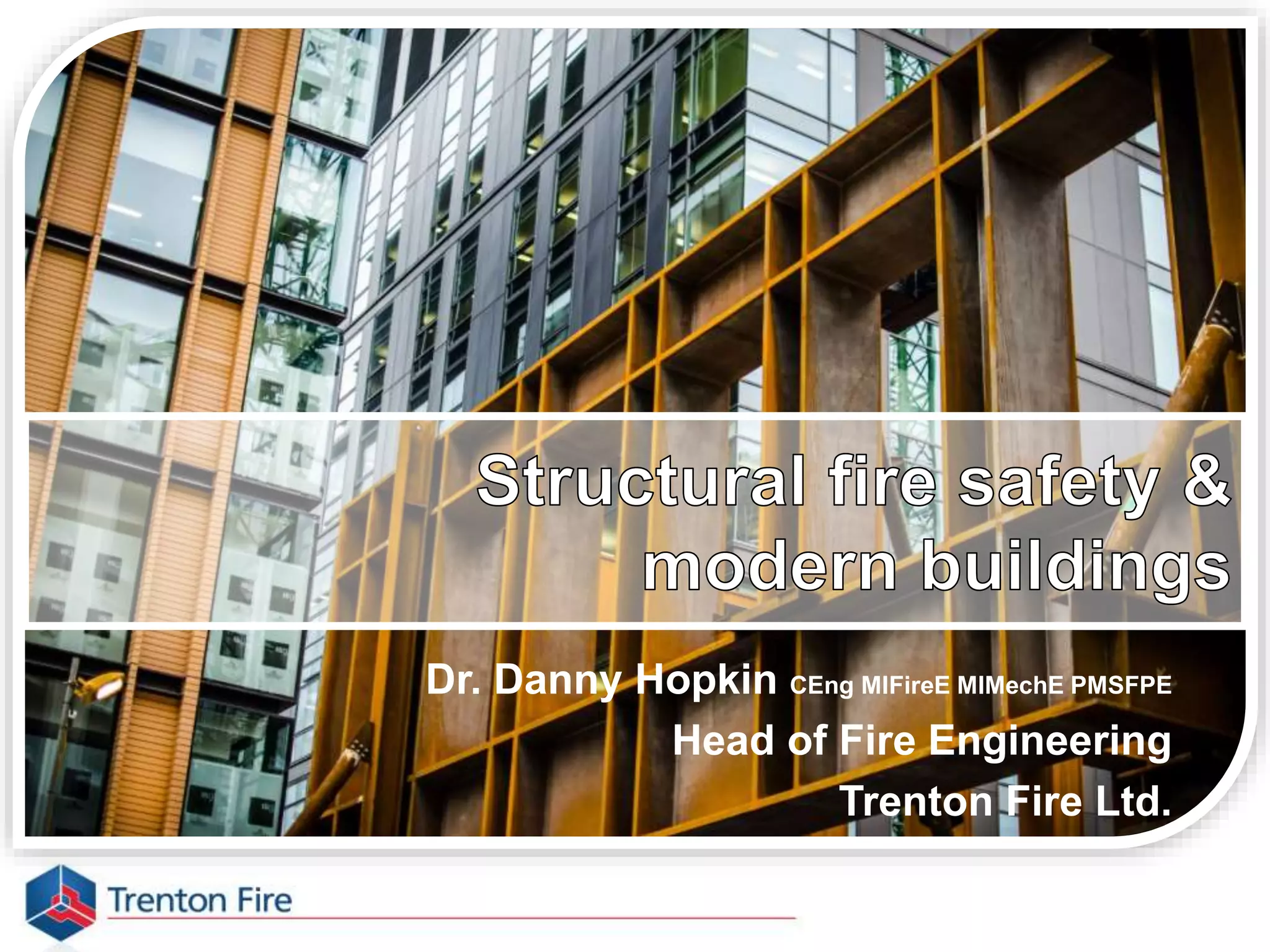
Dr. Danny Hopkin CEng MIFireE MIMechE PMSFPE
Head of Fire Engineering
Trenton Fire Ltd.
Who am I?
Struct. Eng. graduate,
Joined the BRE (2007-2011),
Doctorate “Fire resistance of engineered
timber”,
Chartered Fire/Mech Engineer,
Fire engineering nerd:
– Chair IFE FR SIG, IStructE FESG
– Member BSI B/525/5 & FSH/24
Lead a team of 12 FEs across 2 offices
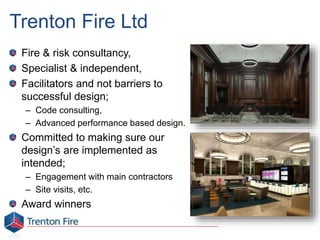
Trenton Fire Ltd
Fire & risk consultancy,
Specialist & independent,
Facilitators and not barriers to
successful design;
– Code consulting,
– Advanced performance based design.
Committed to making sure our
design’s are implemented as
intended;
– Engagement with main contractors
– Site visits, etc.
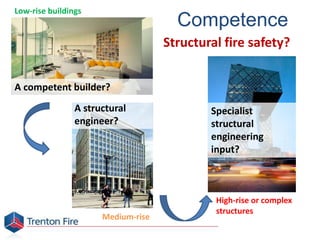
Award winners
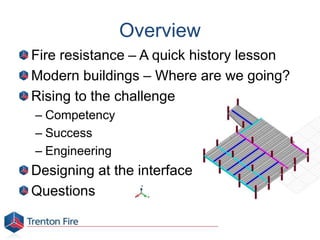
Overview
Fire resistance – A quick history lesson
Modern buildings – Where are we going?
Rising to the challenge
– Competency
– Success
– Engineering
Designing at the interface
Questions
‘Fire resistance’
A history lesson
FR – A need identified
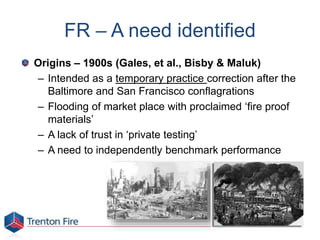
Origins – 1900s (Gales, et al., Bisby & Maluk)
– Intended as a temporary practice correction after the
Baltimore and San Francisco conflagrations
– Flooding of market place with proclaimed ‘fire proof
materials’
– A lack of trust in ‘private testing’
– A need to independently benchmark performance
FR – A level playing field
Emergence of federal and municipal
testing laboratories
No ‘standardised’ test method/criteria
Ira Woolson – NFPA (1903) – A need
to:
– “unify all fire tests under one single
standard and remove an immense
amount of confusion within the fire testing
community”
The concept of fire resistance is born
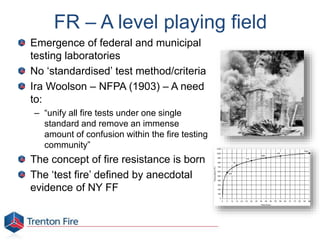
The ‘test fire’ defined by anecdotal
evidence of NY FF
FR – 112 years on….
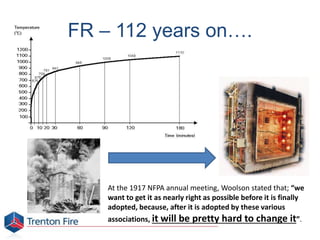
At the 1917 NFPA annual meeting, Woolson stated that; “we
want to get it as nearly right as possible before it is finally
adopted, because, after it is adopted by these various
associations, it will be pretty hard to change it”.
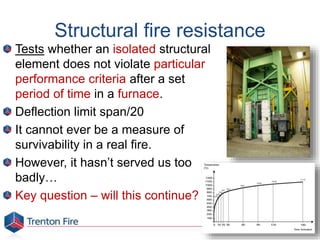
Structural fire resistance
Tests whether an isolated structural
element does not violate particular
performance criteria after a set
period of time in a furnace.
Deflection limit span/20
It cannot ever be a measure of
survivability in a real fire.
However, it hasn’t served us too
badly…
Key question – will this continue?
A divergence
Future trends
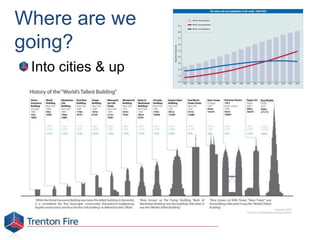
Where are we
going?
Into cities & up
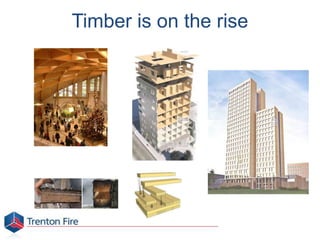
Timber is on the rise
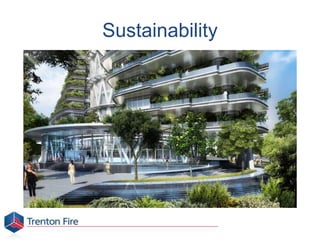
Sustainability
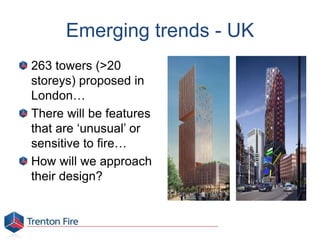
Emerging trends - UK
263 towers (>20
storeys) proposed in
London…
There will be features
that are ‘unusual’ or
sensitive to fire…
How will we approach
their design?
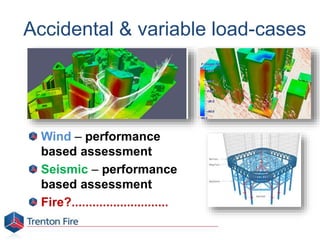
Accidental & variable load-cases
Wind – performance
based assessment
Seismic – performance
based assessment
Fire?............................
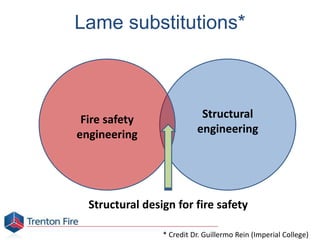
Lame substitutions*
Fire safety
engineering
Structural
engineering
Structural design for fire safety
* Credit Dr. Guillermo Rein (Imperial College)
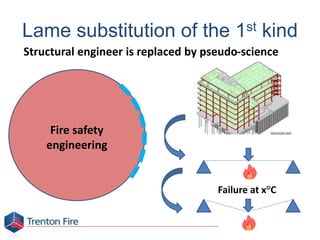
Lame substitution of the 1st kind
Structural engineer is replaced by pseudo-science
Fire safety
engineering
Failure at x°C
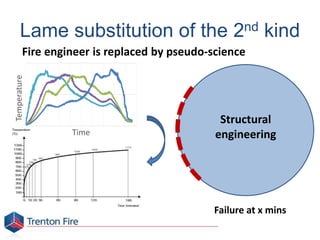
Lame substitution of the 2nd kind
Fire engineer is replaced by pseudo-science
Structural
engineering
Temperature
Time
Failure at x mins
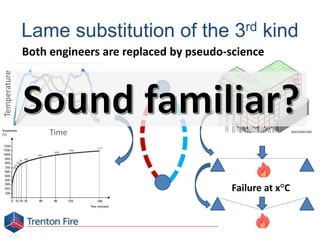
Lame substitution of the 3rd kind
Both engineers are replaced by pseudo-science
Temperature
Time
Failure at x°C
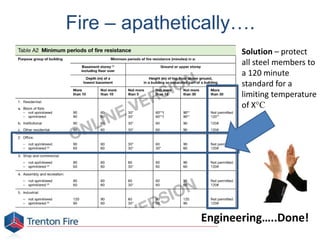
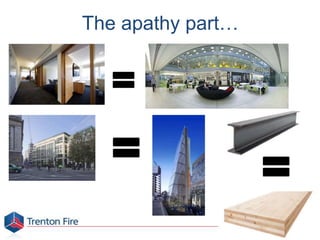
Fire – apathetically….
Solution – protect
all steel members to
a 120 minute
standard for a
limiting temperature
of X°C
Engineering…..Done!
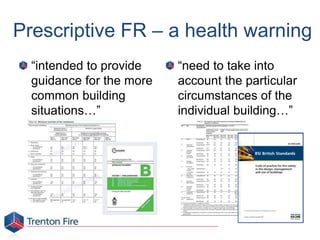
“intended to provide
guidance for the more
common building
situations…”
Prescriptive FR – a health warning
“need to take into
account the particular
circumstances of the
individual building…”
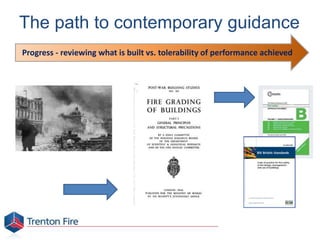
Progress - reviewing what is built vs. tolerability of performance achieved
The path to contemporary guidance
The apathy part…
Rising to the challenge
Modern Buildings
Competence
Low-rise buildings
Medium-rise
High-rise or complex
structures
A competent builder?
A structural
engineer?
Specialist
structural
engineering
input?
Structural fire safety?
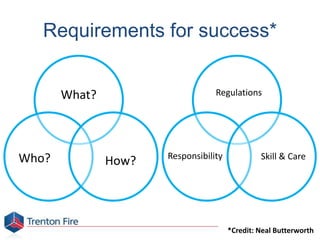
Requirements for success*
What?
Who? How?
Regulations
Responsibility Skill & Care
*Credit: Neal Butterworth
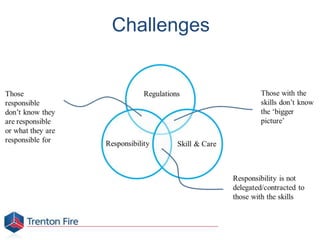
Challenges
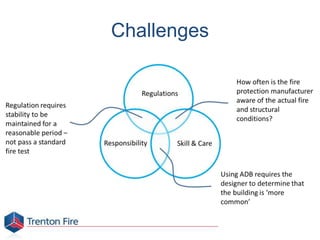
Challenges
Successful FR design
Defining goals (Regulation & aspirations)
Assessing the appropriateness of a prescriptive
solution & delegation of responsibility
Skill to deliver performance in tangible terms:
– Quantifying the design goals,
– Defining what the fires might look like,
– Computing how hot the structure might get,
– Ensuring adequate structural performance in fire
Care to ensure that the designer’s intentions
are achieved in practice
Something in common?
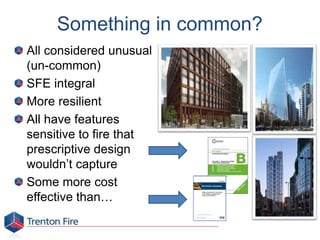
All considered unusual
(un-common)
SFE integral
More resilient
All have features
sensitive to fire that
prescriptive design
wouldn’t capture
Some more cost
effective than…
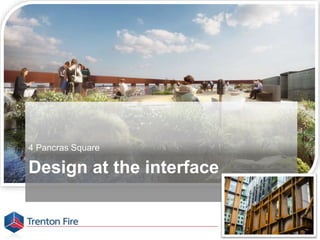
Design at the interface
4 Pancras Square
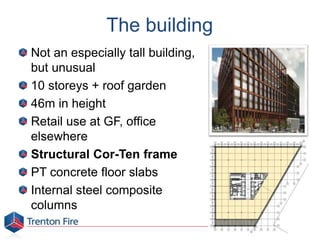
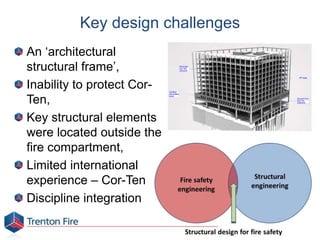
The building
Not an especially tall building,
but unusual
10 storeys + roof garden
46m in height
Retail use at GF, office
elsewhere
Structural Cor-Ten frame
PT concrete floor slabs
Internal steel composite
columns
Key design challenges
An ‘architectural
structural frame’,
Inability to protect Cor-
Ten,
Key structural elements
were located outside the
fire compartment,
Limited international
experience – Cor-Ten
Discipline integration
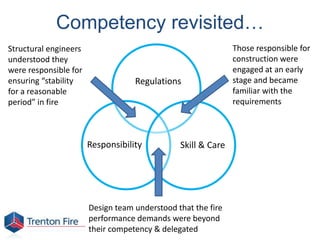
Competency revisited…
Regulations
Responsibility Skill & Care
Structural engineers
understood they
were responsible for
ensuring “stability
for a reasonable
period” in fire
Those responsible for
construction were
engaged at an early
stage and became
familiar with the
requirements
Design team understood that the fire
performance demands were beyond
their competency & delegated
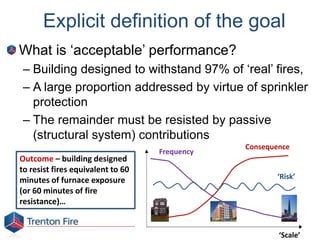
Explicit definition of the goal
What is ‘acceptable’ performance?
– Building designed to withstand 97% of ‘real’ fires,
– A large proportion addressed by virtue of sprinkler
protection
– The remainder must be resisted by passive
(structural system) contributions
‘Scale’
Frequency
Consequence
‘Risk’
Outcome – building designed
to resist fires equivalent to 60
minutes of furnace exposure
(or 60 minutes of fire
resistance)…
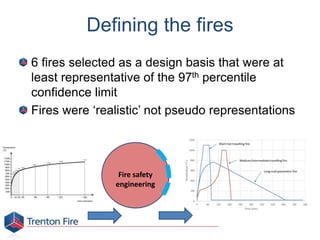
Defining the fires
6 fires selected as a design basis that were at
least representative of the 97th percentile
confidence limit
Fires were ‘realistic’ not pseudo representations
Fire safety
engineering
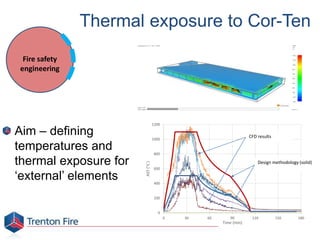
Thermal exposure to Cor-Ten
Aim – defining
temperatures and
thermal exposure for
‘external’ elements
0
200
400
600
800
1000
1200
0 30 60 90 120 150 180
AST(°C)
Time (min)
CFD results
Design methodology (solid)
Fire safety
engineering
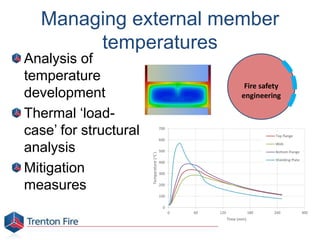
Managing external member
temperatures
Analysis of
temperature
development
Thermal ‘load-
case’ for structural
analysis
Mitigation
measures
0
100
200
300
400
500
600
700
0 60 120 180 240 300
Temperature(°C)
Time (min)
Top flange
Web
Bottom Flange
Shielding Plate
Fire safety
engineering
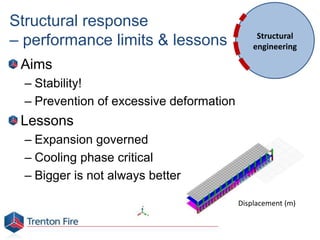
Structural response
– performance limits & lessons
Aims
– Stability!
– Prevention of excessive deformation
Lessons
– Expansion governed
– Cooling phase critical
– Bigger is not always better
Displacement (m)
Structural
engineering
Fire safety
engineering
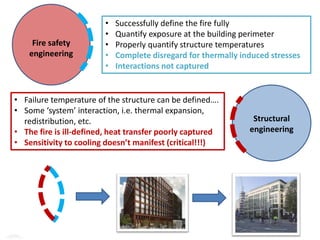
• Successfully define the fire fully
• Quantify exposure at the building perimeter
• Properly quantify structure temperatures
• Complete disregard for thermally induced stresses
• Interactions not captured
Structural
engineering
• Failure temperature of the structure can be defined….
• Some ‘system’ interaction, i.e. thermal expansion,
redistribution, etc.
• The fire is ill-defined, heat transfer poorly captured
• Sensitivity to cooling doesn’t manifest (critical!!!)
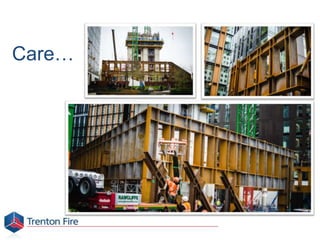
Care…
Thanks – Questions?
Danny Hopkin
– 07894483449
– Danny.Hopkin@trentonfire.co.uk
– http://uk.linkedin.com/in/dannyjhopkin
– https://twitter.com/DannyHopkin
– http://www.slideshare.net/DannyHopkin

BYL Rainham CPD - Structural Design for Fire Safety - Nov 15

  • 1.
    Dr. Danny HopkinCEng MIFireE MIMechE PMSFPE Head of Fire Engineering Trenton Fire Ltd.
  • 2.
    Who am I? Struct.Eng. graduate, Joined the BRE (2007-2011), Doctorate “Fire resistance of engineered timber”, Chartered Fire/Mech Engineer, Fire engineering nerd: – Chair IFE FR SIG, IStructE FESG – Member BSI B/525/5 & FSH/24 Lead a team of 12 FEs across 2 offices
  • 3.
    Trenton Fire Ltd Fire& risk consultancy, Specialist & independent, Facilitators and not barriers to successful design; – Code consulting, – Advanced performance based design. Committed to making sure our design’s are implemented as intended; – Engagement with main contractors – Site visits, etc. Award winners
  • 4.
    Overview Fire resistance –A quick history lesson Modern buildings – Where are we going? Rising to the challenge – Competency – Success – Engineering Designing at the interface Questions
  • 5.
  • 6.
    FR – Aneed identified Origins – 1900s (Gales, et al., Bisby & Maluk) – Intended as a temporary practice correction after the Baltimore and San Francisco conflagrations – Flooding of market place with proclaimed ‘fire proof materials’ – A lack of trust in ‘private testing’ – A need to independently benchmark performance
  • 7.
    FR – Alevel playing field Emergence of federal and municipal testing laboratories No ‘standardised’ test method/criteria Ira Woolson – NFPA (1903) – A need to: – “unify all fire tests under one single standard and remove an immense amount of confusion within the fire testing community” The concept of fire resistance is born The ‘test fire’ defined by anecdotal evidence of NY FF
  • 8.
    FR – 112years on…. At the 1917 NFPA annual meeting, Woolson stated that; “we want to get it as nearly right as possible before it is finally adopted, because, after it is adopted by these various associations, it will be pretty hard to change it”.
  • 9.
    Structural fire resistance Testswhether an isolated structural element does not violate particular performance criteria after a set period of time in a furnace. Deflection limit span/20 It cannot ever be a measure of survivability in a real fire. However, it hasn’t served us too badly… Key question – will this continue?
  • 10.
  • 11.
  • 12.
    Timber is onthe rise
  • 13.
  • 14.
    Emerging trends -UK 263 towers (>20 storeys) proposed in London… There will be features that are ‘unusual’ or sensitive to fire… How will we approach their design?
  • 15.
    Accidental & variableload-cases Wind – performance based assessment Seismic – performance based assessment Fire?............................
  • 16.
    Lame substitutions* Fire safety engineering Structural engineering Structuraldesign for fire safety * Credit Dr. Guillermo Rein (Imperial College)
  • 17.
    Lame substitution ofthe 1st kind Structural engineer is replaced by pseudo-science Fire safety engineering Failure at x°C
  • 18.
    Lame substitution ofthe 2nd kind Fire engineer is replaced by pseudo-science Structural engineering Temperature Time Failure at x mins
  • 19.
    Lame substitution ofthe 3rd kind Both engineers are replaced by pseudo-science Temperature Time Failure at x°C
  • 20.
    Fire – apathetically…. Solution– protect all steel members to a 120 minute standard for a limiting temperature of X°C Engineering…..Done!
  • 21.
    “intended to provide guidancefor the more common building situations…” Prescriptive FR – a health warning “need to take into account the particular circumstances of the individual building…”
  • 22.
    Progress - reviewingwhat is built vs. tolerability of performance achieved The path to contemporary guidance
  • 23.
  • 24.
    Rising to thechallenge Modern Buildings
  • 25.
    Competence Low-rise buildings Medium-rise High-rise orcomplex structures A competent builder? A structural engineer? Specialist structural engineering input? Structural fire safety?
  • 26.
    Requirements for success* What? Who?How? Regulations Responsibility Skill & Care *Credit: Neal Butterworth
  • 27.
  • 28.
  • 29.
    Successful FR design Defininggoals (Regulation & aspirations) Assessing the appropriateness of a prescriptive solution & delegation of responsibility Skill to deliver performance in tangible terms: – Quantifying the design goals, – Defining what the fires might look like, – Computing how hot the structure might get, – Ensuring adequate structural performance in fire Care to ensure that the designer’s intentions are achieved in practice
  • 30.
    Something in common? Allconsidered unusual (un-common) SFE integral More resilient All have features sensitive to fire that prescriptive design wouldn’t capture Some more cost effective than…
  • 31.
    Design at theinterface 4 Pancras Square
  • 32.
    The building Not anespecially tall building, but unusual 10 storeys + roof garden 46m in height Retail use at GF, office elsewhere Structural Cor-Ten frame PT concrete floor slabs Internal steel composite columns
  • 33.
    Key design challenges An‘architectural structural frame’, Inability to protect Cor- Ten, Key structural elements were located outside the fire compartment, Limited international experience – Cor-Ten Discipline integration
  • 34.
    Competency revisited… Regulations Responsibility Skill& Care Structural engineers understood they were responsible for ensuring “stability for a reasonable period” in fire Those responsible for construction were engaged at an early stage and became familiar with the requirements Design team understood that the fire performance demands were beyond their competency & delegated
  • 35.
    Explicit definition ofthe goal What is ‘acceptable’ performance? – Building designed to withstand 97% of ‘real’ fires, – A large proportion addressed by virtue of sprinkler protection – The remainder must be resisted by passive (structural system) contributions ‘Scale’ Frequency Consequence ‘Risk’ Outcome – building designed to resist fires equivalent to 60 minutes of furnace exposure (or 60 minutes of fire resistance)…
  • 36.
    Defining the fires 6fires selected as a design basis that were at least representative of the 97th percentile confidence limit Fires were ‘realistic’ not pseudo representations Fire safety engineering
  • 37.
    Thermal exposure toCor-Ten Aim – defining temperatures and thermal exposure for ‘external’ elements 0 200 400 600 800 1000 1200 0 30 60 90 120 150 180 AST(°C) Time (min) CFD results Design methodology (solid) Fire safety engineering
  • 38.
    Managing external member temperatures Analysisof temperature development Thermal ‘load- case’ for structural analysis Mitigation measures 0 100 200 300 400 500 600 700 0 60 120 180 240 300 Temperature(°C) Time (min) Top flange Web Bottom Flange Shielding Plate Fire safety engineering
  • 39.
    Structural response – performancelimits & lessons Aims – Stability! – Prevention of excessive deformation Lessons – Expansion governed – Cooling phase critical – Bigger is not always better Displacement (m) Structural engineering
  • 40.
    Fire safety engineering • Successfullydefine the fire fully • Quantify exposure at the building perimeter • Properly quantify structure temperatures • Complete disregard for thermally induced stresses • Interactions not captured Structural engineering • Failure temperature of the structure can be defined…. • Some ‘system’ interaction, i.e. thermal expansion, redistribution, etc. • The fire is ill-defined, heat transfer poorly captured • Sensitivity to cooling doesn’t manifest (critical!!!)
  • 41.
  • 42.
    Thanks – Questions? DannyHopkin – 07894483449 – Danny.Hopkin@trentonfire.co.uk – http://uk.linkedin.com/in/dannyjhopkin – https://twitter.com/DannyHopkin – http://www.slideshare.net/DannyHopkin

Editor's Notes

  • #5 To introduce the idea of how structures can be designed better to resist fire, there is a need to understand where we’ve come from, what we do and what approaches purport to deliver… We can begin to see how current approaches become increasingly challenging to apply in the modern world… Need to begin to think about how we evolve our thinking to cater for increasingly complex buildings, in terms of minimum levels of competency, requirements for successful design, etc. Then I will run through a brief case study & answer some questions…
  • #11 We’ve heard the history of how the concept of materialised and why? It should also now be clearer as to what it actually delivers and how this might begin to diverge from current ambitions…
  • #13 We build more with timber, the ambition is to build higher with timber…. Murray Grove in London at 10 storeys used to be the world’s tallest timber frame building. Soon the world’s first 40 storey timber building will be complete.
  • #14 Achieving a sustainable building is a key goal for most clients. This means influencing material choices and their thermal performance, which all impact upon fire development and fire performance…
  • #17 Structural fire resistance is delivered at the interface of two disciplines. Perhaps the best articulation of how we will approach the design of these future challenging buildings is that of the lame substitutions proposed by Dr. Guillermo Rein at imperial college, London. Designing at the interface is tough, as it requires two disciplines to work together.
  • #18 For a moment I shall wear my fire engineer’s hat, and you will be the proxy of the structural engineer. I’ve no interest in understanding your structure, so instead I dilute the problem, first from a complex structure to a single element and then, in lieu of trying to understanding this element, I’ll assign a temperature at which I consider it might fail.
  • #19 Next, I will wear my structural engineers hat and you shall be the proxy of the fire engineers. Again, I’ve not interest in understanding your discipline, fires are complicate, so I will dilute all of the possible manifestations of a fire and massage them into a single time-temperature curve….the standard fire curve.
  • #20 Then there is the 3rd kind, where both parties are replaced by pseudo-science. Where neither the structure’s performance or the fire’s characteristics are represented in any realistic form. This, unfortunately, is what some might suggest is representative of how fire resistance is dealt with…
  • #23 If we follow the path of the progression of our guidance, we see that disasters shape its evolution, not science. In their current manifestation, ADB, etc., are an example of a series of rules born out of surveys of buildings considered to be adequately safe.
  • #25 If we are to try and do things better, we need to look at: competency – specifically, competency that is commensurate with the complexity of the project… What it means to deliver a successful design in the context of structural fire safety… Delivering solutions at the interface of two disciplines that traditionally don’t work well together…
  • #26 First, lets consider competence. More specifically, who might be competent to do what? If we draw analogies with structural engineering…. We are all likely comfortable placing our trust in the experience of a competent builder in the delivery of a house, We are likely to accept we need specialist input, say a structural engineer, when the project gets more complex, As we get more complex, specialist specialists are likely to be required? People with seismic expertise for instance. Structural design for fire safety? We might appoint a fire engineer – but what does the fire resistance section of the strategy say?
  • #27 In terms of delivering a successful design, on the face of it, it’s really quite simple. You need to have three things. Firstly a clear definition of what it is that needs to be achieved, secondly making someone responsible for achieving it, and finally the knowledge and know how to achieve it.
  • #28 We have everything we need to be successful,… good clear regulations, an industry with the skill & ability, clear responsibility for decisions… The challenges are at the interfaces…
  • #29 In the case of structural design for fire safety…
  • #30 In summary, successful design hinges on having the right people, with the right level of competency undertaking the right tasks. As an industry, we have everything in place to do this….and it is done better than any other country in the world.