
The Transfusion Trigger:
  When Should You
    Give Red Cells?

    Harriet W. Hopf, MD
    Professor of Anesthesiology
         University of Utah
Goals
   To understand
     the effect of anemia on oxygen transport
     mechanisms that compensate for anemia

     the risks of transfusion

     the concept of a transfusion trigger
Objective
   Participants will be able persuasively to
    defend their decision to transfuse / not to
    transfuse red cells
Why Transfuse Red Cells?
   To maintain O2 delivery to organs
   To prevent inadequate O2 consumption
How Do We Measure Need?
   Ideal
       Tissue oxygen
   Good-- but not practical
       O2ER (VO2/DO2)
           Madjdpour and Spahn. BJA 2005; 95:33-42
   Real
       Hemoglobin
       Hemodynamics
Physiologic Effects of Anemia
   Why is there a wide range of “normal” and
    “acceptable” hemoglobin?
Physiologic Effects of Anemia
   Compensate by increased cardiac output
       CO = HR X SV
   HR increases 4 bpm / g Hb
   SV increases as well
       Increased contractility (active)
       Decreased SVR (passive)
       Increased venous return (passive)
                 Weiskopf et al. Transfusion 2003; 43: 235-40
Physiologic Effects of Anemia
   Under anesthesia, no HR increase
   Increased CO is from increased SV


              Majdpour and Spahn. BJA 2005; 95:33-42.
Fick’s Principle
Fick’s Principle
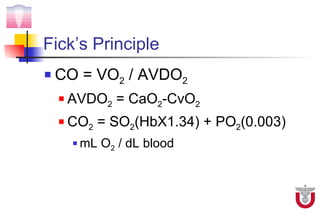
   CO = VO2 / AVDO2
       AVDO2 = CaO2-CvO2
       CO2 = SO2(HbX1.34) + PO2(0.003)
           mL O2 / dL blood
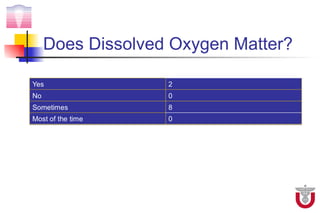
Does Dissolved Oxygen Matter?
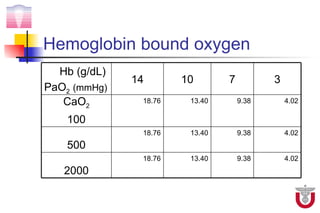
Hemoglobin bound oxygen
  Hb (g/dL)
              14       10       7          3
PaO2 (mmHg)
   CaO2        18.76    13.40       9.38       4.02

    100
               18.76    13.40       9.38       4.02
    500
               18.76    13.40       9.38       4.02
   2000
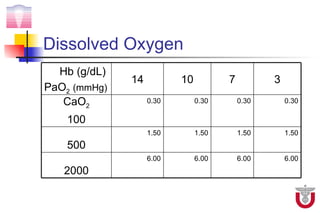
Dissolved Oxygen
  Hb (g/dL)
              14          10          7          3
PaO2 (mmHg)
   CaO2            0.30        0.30       0.30       0.30

    100
                   1.50        1.50       1.50       1.50
    500
                   6.00        6.00       6.00       6.00
   2000
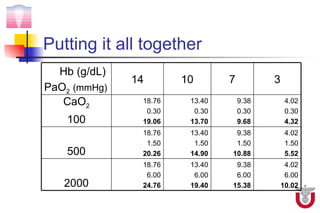
Putting it all together
  Hb (g/dL)
              14       10       7          3
PaO2 (mmHg)
   CaO2        18.76    13.40       9.38        4.02
                0.30     0.30       0.30        0.30
    100        19.06    13.70       9.68        4.32
               18.76    13.40    9.38           4.02
                1.50     1.50    1.50           1.50
    500        20.26    14.90   10.88           5.52
               18.76    13.40    9.38           4.02
                6.00     6.00    6.00           6.00
   2000        24.76    19.40   15.38          10.02
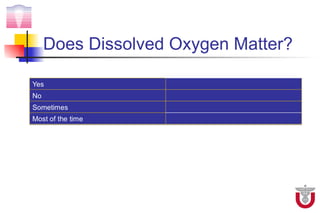
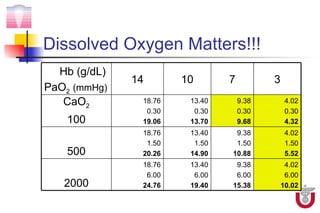
Does Dissolved Oxygen Matter?
What if you can’t transfuse?
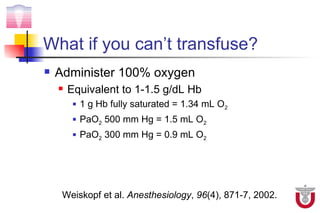
   Administer 100% oxygen
       Equivalent to 1-1.5 g/dL Hb
            1 g Hb fully saturated = 1.34 mL O2
            PaO2 500 mm Hg = 1.5 mL O2
            PaO2 300 mm Hg = 0.9 mL O2


     Weiskopf et al. Anesthesiology, 96(4), 871-7, 2002.
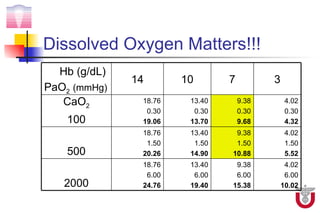
Dissolved Oxygen Matters!!!
  Hb (g/dL)
              14       10       7          3
PaO2 (mmHg)
   CaO2        18.76    13.40       9.38        4.02
                0.30     0.30       0.30        0.30
    100        19.06    13.70       9.68        4.32
               18.76    13.40    9.38           4.02
                1.50     1.50    1.50           1.50
    500        20.26    14.90   10.88           5.52
               18.76    13.40    9.38           4.02
                6.00     6.00    6.00           6.00
   2000        24.76    19.40   15.38          10.02
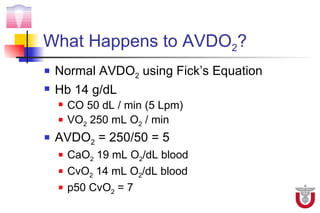
What Happens to AVDO2?
   Normal AVDO2 using Fick’s Equation
   Hb 14 g/dL
       CO 50 dL / min (5 Lpm)
       VO2 250 mL O2 / min
   AVDO2 = 250/50 = 5
       CaO2 19 mL O2/dL blood
       CvO2 14 mL O2/dL blood
       p50 CvO2 = 7
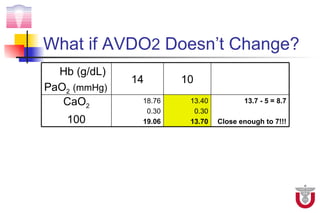
What if AVDO2 Doesn’t Change?
  Hb (g/dL)
              14       10
PaO2 (mmHg)
   CaO2        18.76    13.40          13.7 - 5 = 8.7
                0.30     0.30
    100        19.06    13.70   Close enough to 7!!!
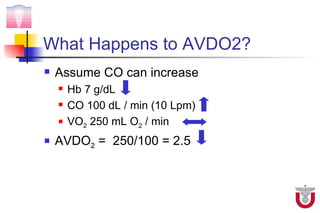
What Happens to AVDO2?
   Assume CO can increase
       Hb 7 g/dL
       CO 100 dL / min (10 Lpm)
       VO2 250 mL O2 / min
   AVDO2 = 250/100 = 2.5
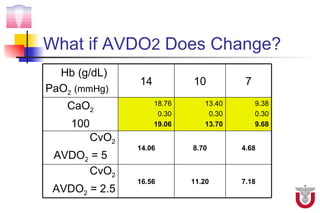
What if AVDO2 Does Change?
  Hb (g/dL)
                 14           10          7
PaO2 (mmHg)
   CaO2               18.76      13.40        9.38
                       0.30       0.30        0.30
    100               19.06      13.70        9.68

          CvO2
                 14.06        8.70       4.68
 AVDO2 = 5
      CvO2
                 16.56        11.20      7.18
 AVDO2 = 2.5
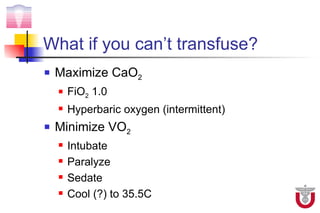
What if you can’t transfuse?
   Maximize CaO2
       FiO2 1.0
       Hyperbaric oxygen (intermittent)
   Minimize VO2
       Intubate
       Paralyze
       Sedate
       Cool (?) to 35.5C
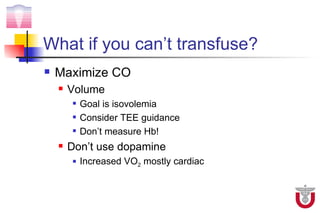
What if you can’t transfuse?
   Maximize CO
       Volume
           Goal is isovolemia
           Consider TEE guidance
           Don’t measure Hb!
       Don’t use dopamine
           Increased VO2 mostly cardiac
Dissolved Oxygen Matters!!!
  Hb (g/dL)
              14       10       7          3
PaO2 (mmHg)
   CaO2        18.76    13.40       9.38        4.02
                0.30     0.30       0.30        0.30
    100        19.06    13.70       9.68        4.32
               18.76    13.40    9.38           4.02
                1.50     1.50    1.50           1.50
    500        20.26    14.90   10.88           5.52
               18.76    13.40    9.38           4.02
                6.00     6.00    6.00           6.00
   2000        24.76    19.40   15.38          10.02
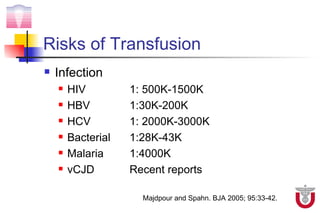
Risks of Transfusion
   Infection
       HIV         1: 500K-1500K
       HBV         1:30K-200K
       HCV         1: 2000K-3000K
       Bacterial   1:28K-43K
       Malaria     1:4000K
       vCJD        Recent reports

                      Majdpour and Spahn. BJA 2005; 95:33-42.
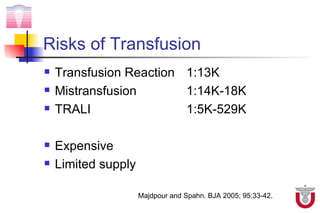
Risks of Transfusion
   Transfusion Reaction 1:13K
   Mistransfusion       1:14K-18K
   TRALI                1:5K-529K

   Expensive
   Limited supply

                     Majdpour and Spahn. BJA 2005; 95:33-42.
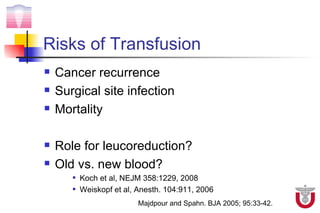
Risks of Transfusion
   Cancer recurrence
   Surgical site infection
   Mortality

   Role for leucoreduction?
   Old vs. new blood?
          Koch et al, NEJM 358:1229, 2008
          Weiskopf et al, Anesth. 104:911, 2006
                           Majdpour and Spahn. BJA 2005; 95:33-42.
Transfusion Guidelines
   Are there guidelines?
       ASA Guidelines, Anesth 105:198-208, 2006.
   Are they based on data?
       “strongly agree” transfuse < 6 g/dL
       “strongly agree” don’t transfuse >10g/dL
   How good are physicians at following them?
Joint Commission
          Patient Blood Management Performance Measures Project
             Transfusion Consent

             RBC Transfusion Indication

             Plasma Transfusion Indication

             Platelet Transfusion Indication

             Blood Administration Indication

             Preoperative Anemia Screen

             Preoperative Blood Type / Antibody Screen


http://www.jointcommission.org/patient_blood_management_performance_measures_project/
Transfusion Trigger
   Really a TARGET not a TRIGGER
   Healthy patient
       7 g / dL
   Cardiopulmonary disease
       10 g / dL (?8-9)
       Prevent tachycardia
What does this mean?
   Healthy patient, Hb 14 g/dL
   Assume 500 mL (1 unit) whole blood loss = 1
    g/dL Hb decrease
   Assume volume replaced
   EBL >3500 mL before consider transfusion
How low can you go?
   Unmedicated, healthy volunteers at rest
       Hb 5 g / dL
            No VO2-DO2 dependency
            Fatigued
            Mild cognitive impairment
                  Slightly slower and less accurate
                  Still in normal range
                  Reversed by RBC transfusion at Hb 7 g/dL
                  Reversed by 100% O2 via NRB
                  Weiskopf et al. Anesthesiology, 96(4), 871-7, 2002.
What about surgical patients?
   Anemia increases 30-day mortality, CV
    complications, and LOS
       Non-cardiac surgery
            Polycythemia similar effects
                 Wu et al. JAMA 297:2481, 2007 (98% men)

       Colorectal surgery
                 ~50% women but not analyzed separately
                 Leichtle et al, J Am Coll Surg 212:187, 20011

       Cardiac surgery
                 Koch et al, Crit Care Med 34:1608, 2008
How Should We Manage Anemia?
    Is anemia a marker for disease or inherently
     causative?
    Preoperative treatment:
        2 weeks oral iron (200 mg) reduces transfusion
             9.4 vs 27.4%, p<0.05
                  Okuyama et alSurg Today 35:36, 2005

        ESA reduces transfusion, increases DVT
             Laupacis and Fergusson, Transfus Med 8:309, 1998
How Should We Manage Anemia?
    Is anemia a marker for disease or inherently
     causative?
    Risk-adjusted, propensity-matched
        ≥4 U blood predicts increases:
             Mortality
             Infection
             LOS
                  Dunne et al, J Surg Res 102:237, 2002
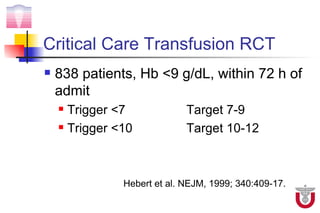
Critical Care Transfusion RCT
   838 patients, Hb <9 g/dL, within 72 h of
    admit
     Trigger <7             Target 7-9
     Trigger <10            Target 10-12


               Hebert et al. NEJM, 1999; 340:409-17.
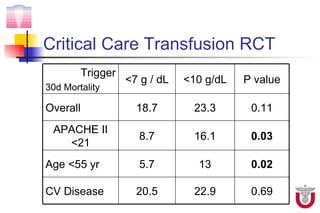
Critical Care Transfusion RCT
          Trigger
                    <7 g / dL   <10 g/dL   P value
30d Mortality

Overall               18.7        23.3      0.11
 APACHE II
                      8.7         16.1      0.03
   <21
Age <55 yr            5.7         13        0.02

CV Disease            20.5        22.9      0.69
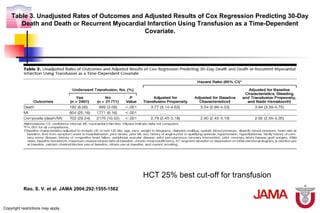
Table 3. Unadjusted Rates of Outcomes and Adjusted Results of Cox Regression Predicting 30-Day
       Death and Death or Recurrent Myocardial Infarction Using Transfusion as a Time-Dependent
                                              Covariate.


                                                       HCT 25% best cut-off for transfusion
           Rao, S. V. et al. JAMA 2004;292:1555-1562


Copyright restrictions may apply.
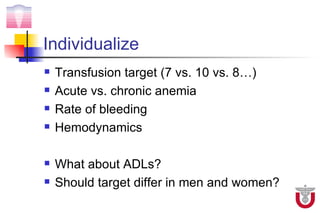
Individualize
   Transfusion target (7 vs. 10 vs. 8…)
   Acute vs. chronic anemia
   Rate of bleeding
   Hemodynamics

   What about ADLs?
   Should target differ in men and women?
Summary
   Transfusions of RBC can be life-saving
   Also cause serious morbidity and mortality
   Individualize therapy
       Underlying disease
       Adequacy of compensatory responses
       Rate of bleeding
       Starting point

Hopf anemia09

  • 1.
    The Transfusion Trigger: When Should You Give Red Cells? Harriet W. Hopf, MD Professor of Anesthesiology University of Utah
  • 2.
    Goals  To understand  the effect of anemia on oxygen transport  mechanisms that compensate for anemia  the risks of transfusion  the concept of a transfusion trigger
  • 3.
    Objective  Participants will be able persuasively to defend their decision to transfuse / not to transfuse red cells
  • 4.
  • 5.
    Why Transfuse RedCells?  To maintain O2 delivery to organs  To prevent inadequate O2 consumption
  • 6.
    How Do WeMeasure Need?  Ideal  Tissue oxygen  Good-- but not practical  O2ER (VO2/DO2)  Madjdpour and Spahn. BJA 2005; 95:33-42  Real  Hemoglobin  Hemodynamics
  • 7.
    Physiologic Effects ofAnemia  Why is there a wide range of “normal” and “acceptable” hemoglobin?
  • 8.
    Physiologic Effects ofAnemia  Compensate by increased cardiac output  CO = HR X SV  HR increases 4 bpm / g Hb  SV increases as well  Increased contractility (active)  Decreased SVR (passive)  Increased venous return (passive) Weiskopf et al. Transfusion 2003; 43: 235-40
  • 9.
    Physiologic Effects ofAnemia  Under anesthesia, no HR increase  Increased CO is from increased SV Majdpour and Spahn. BJA 2005; 95:33-42.
  • 10.
  • 11.
    Fick’s Principle  CO = VO2 / AVDO2  AVDO2 = CaO2-CvO2  CO2 = SO2(HbX1.34) + PO2(0.003)  mL O2 / dL blood
  • 12.
  • 13.
    Hemoglobin bound oxygen Hb (g/dL) 14 10 7 3 PaO2 (mmHg) CaO2 18.76 13.40 9.38 4.02 100 18.76 13.40 9.38 4.02 500 18.76 13.40 9.38 4.02 2000
  • 14.
    Dissolved Oxygen Hb (g/dL) 14 10 7 3 PaO2 (mmHg) CaO2 0.30 0.30 0.30 0.30 100 1.50 1.50 1.50 1.50 500 6.00 6.00 6.00 6.00 2000
  • 15.
    Putting it alltogether Hb (g/dL) 14 10 7 3 PaO2 (mmHg) CaO2 18.76 13.40 9.38 4.02 0.30 0.30 0.30 0.30 100 19.06 13.70 9.68 4.32 18.76 13.40 9.38 4.02 1.50 1.50 1.50 1.50 500 20.26 14.90 10.88 5.52 18.76 13.40 9.38 4.02 6.00 6.00 6.00 6.00 2000 24.76 19.40 15.38 10.02
  • 16.
  • 17.
    What if youcan’t transfuse?
  • 18.
    What if youcan’t transfuse?  Administer 100% oxygen  Equivalent to 1-1.5 g/dL Hb  1 g Hb fully saturated = 1.34 mL O2  PaO2 500 mm Hg = 1.5 mL O2  PaO2 300 mm Hg = 0.9 mL O2 Weiskopf et al. Anesthesiology, 96(4), 871-7, 2002.
  • 19.
    Dissolved Oxygen Matters!!! Hb (g/dL) 14 10 7 3 PaO2 (mmHg) CaO2 18.76 13.40 9.38 4.02 0.30 0.30 0.30 0.30 100 19.06 13.70 9.68 4.32 18.76 13.40 9.38 4.02 1.50 1.50 1.50 1.50 500 20.26 14.90 10.88 5.52 18.76 13.40 9.38 4.02 6.00 6.00 6.00 6.00 2000 24.76 19.40 15.38 10.02
  • 20.
    What Happens toAVDO2?  Normal AVDO2 using Fick’s Equation  Hb 14 g/dL  CO 50 dL / min (5 Lpm)  VO2 250 mL O2 / min  AVDO2 = 250/50 = 5  CaO2 19 mL O2/dL blood  CvO2 14 mL O2/dL blood  p50 CvO2 = 7
  • 21.
    What if AVDO2Doesn’t Change? Hb (g/dL) 14 10 PaO2 (mmHg) CaO2 18.76 13.40 13.7 - 5 = 8.7 0.30 0.30 100 19.06 13.70 Close enough to 7!!!
  • 22.
    What Happens toAVDO2?  Assume CO can increase  Hb 7 g/dL  CO 100 dL / min (10 Lpm)  VO2 250 mL O2 / min  AVDO2 = 250/100 = 2.5
  • 23.
    What if AVDO2Does Change? Hb (g/dL) 14 10 7 PaO2 (mmHg) CaO2 18.76 13.40 9.38 0.30 0.30 0.30 100 19.06 13.70 9.68 CvO2 14.06 8.70 4.68 AVDO2 = 5 CvO2 16.56 11.20 7.18 AVDO2 = 2.5
  • 24.
    What if youcan’t transfuse?  Maximize CaO2  FiO2 1.0  Hyperbaric oxygen (intermittent)  Minimize VO2  Intubate  Paralyze  Sedate  Cool (?) to 35.5C
  • 25.
    What if youcan’t transfuse?  Maximize CO  Volume  Goal is isovolemia  Consider TEE guidance  Don’t measure Hb!  Don’t use dopamine  Increased VO2 mostly cardiac
  • 26.
    Dissolved Oxygen Matters!!! Hb (g/dL) 14 10 7 3 PaO2 (mmHg) CaO2 18.76 13.40 9.38 4.02 0.30 0.30 0.30 0.30 100 19.06 13.70 9.68 4.32 18.76 13.40 9.38 4.02 1.50 1.50 1.50 1.50 500 20.26 14.90 10.88 5.52 18.76 13.40 9.38 4.02 6.00 6.00 6.00 6.00 2000 24.76 19.40 15.38 10.02
  • 27.
    Risks of Transfusion  Infection  HIV 1: 500K-1500K  HBV 1:30K-200K  HCV 1: 2000K-3000K  Bacterial 1:28K-43K  Malaria 1:4000K  vCJD Recent reports Majdpour and Spahn. BJA 2005; 95:33-42.
  • 28.
    Risks of Transfusion  Transfusion Reaction 1:13K  Mistransfusion 1:14K-18K  TRALI 1:5K-529K  Expensive  Limited supply Majdpour and Spahn. BJA 2005; 95:33-42.
  • 29.
    Risks of Transfusion  Cancer recurrence  Surgical site infection  Mortality  Role for leucoreduction?  Old vs. new blood?  Koch et al, NEJM 358:1229, 2008  Weiskopf et al, Anesth. 104:911, 2006 Majdpour and Spahn. BJA 2005; 95:33-42.
  • 30.
    Transfusion Guidelines  Are there guidelines?  ASA Guidelines, Anesth 105:198-208, 2006.  Are they based on data?  “strongly agree” transfuse < 6 g/dL  “strongly agree” don’t transfuse >10g/dL  How good are physicians at following them?
  • 31.
    Joint Commission  Patient Blood Management Performance Measures Project  Transfusion Consent  RBC Transfusion Indication  Plasma Transfusion Indication  Platelet Transfusion Indication  Blood Administration Indication  Preoperative Anemia Screen  Preoperative Blood Type / Antibody Screen http://www.jointcommission.org/patient_blood_management_performance_measures_project/
  • 32.
    Transfusion Trigger  Really a TARGET not a TRIGGER  Healthy patient  7 g / dL  Cardiopulmonary disease  10 g / dL (?8-9)  Prevent tachycardia
  • 33.
    What does thismean?  Healthy patient, Hb 14 g/dL  Assume 500 mL (1 unit) whole blood loss = 1 g/dL Hb decrease  Assume volume replaced  EBL >3500 mL before consider transfusion
  • 34.
    How low canyou go?  Unmedicated, healthy volunteers at rest  Hb 5 g / dL  No VO2-DO2 dependency  Fatigued  Mild cognitive impairment  Slightly slower and less accurate  Still in normal range  Reversed by RBC transfusion at Hb 7 g/dL  Reversed by 100% O2 via NRB Weiskopf et al. Anesthesiology, 96(4), 871-7, 2002.
  • 35.
    What about surgicalpatients?  Anemia increases 30-day mortality, CV complications, and LOS  Non-cardiac surgery  Polycythemia similar effects  Wu et al. JAMA 297:2481, 2007 (98% men)  Colorectal surgery  ~50% women but not analyzed separately  Leichtle et al, J Am Coll Surg 212:187, 20011  Cardiac surgery  Koch et al, Crit Care Med 34:1608, 2008
  • 36.
    How Should WeManage Anemia?  Is anemia a marker for disease or inherently causative?  Preoperative treatment:  2 weeks oral iron (200 mg) reduces transfusion  9.4 vs 27.4%, p<0.05  Okuyama et alSurg Today 35:36, 2005  ESA reduces transfusion, increases DVT  Laupacis and Fergusson, Transfus Med 8:309, 1998
  • 37.
    How Should WeManage Anemia?  Is anemia a marker for disease or inherently causative?  Risk-adjusted, propensity-matched  ≥4 U blood predicts increases:  Mortality  Infection  LOS  Dunne et al, J Surg Res 102:237, 2002
  • 38.
    Critical Care TransfusionRCT  838 patients, Hb <9 g/dL, within 72 h of admit  Trigger <7 Target 7-9  Trigger <10 Target 10-12 Hebert et al. NEJM, 1999; 340:409-17.
  • 39.
    Critical Care TransfusionRCT Trigger <7 g / dL <10 g/dL P value 30d Mortality Overall 18.7 23.3 0.11 APACHE II 8.7 16.1 0.03 <21 Age <55 yr 5.7 13 0.02 CV Disease 20.5 22.9 0.69
  • 40.
    Table 3. UnadjustedRates of Outcomes and Adjusted Results of Cox Regression Predicting 30-Day Death and Death or Recurrent Myocardial Infarction Using Transfusion as a Time-Dependent Covariate. HCT 25% best cut-off for transfusion Rao, S. V. et al. JAMA 2004;292:1555-1562 Copyright restrictions may apply.
  • 41.
    Individualize  Transfusion target (7 vs. 10 vs. 8…)  Acute vs. chronic anemia  Rate of bleeding  Hemodynamics  What about ADLs?  Should target differ in men and women?
  • 42.
    Summary  Transfusions of RBC can be life-saving  Also cause serious morbidity and mortality  Individualize therapy  Underlying disease  Adequacy of compensatory responses  Rate of bleeding  Starting point

Editor's Notes

  • #15 1.5 with 500 mmHg or 1.34 with 1 g Hb
  • #41 Table 3. Unadjusted Rates of Outcomes and Adjusted Results of Cox Regression Predicting 30-Day Death and Death or Recurrent Myocardial Infarction Using Transfusion as a Time-Dependent Covariate