© U N I V E R S I T Y O F U T A H H E A L T H
INFECTION CONTROL CONSIDERATIONS
FOR COVID-19: LESSONS LEARNED
HARRIET W. HOPF, MD
PROFESSOR OF ANESTHESIOLOGY & BIOENGINEERING
UNIVERSITY OF UTAH
66th Annual Update in Anesthesiology February 2021
© U N I V E R S I T Y O F U T A H H E A L T H
DISCLOSURES
• Paid consultant for Ambu, Inc., which
manufactures anesthesia circuits and filters
© U N I V E R S I T Y O F U T A H H E A L T H
LEARNING OBJECTIVES
• Participants should be able to:
– Apply infection control principles to
protect themselves and their
patients
– Select anesthesia equipment and
supplies that reduce vulnerability to
supply chain interruptions during a
pandemic
© U N I V E R S I T Y O F U T A H H E A L T H
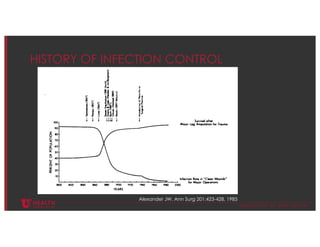
HISTORY OF INFECTION CONTROL
Alexander JW. Ann Surg 201:423-428, 1985
© U N I V E R S I T Y O F U T A H H E A L T H
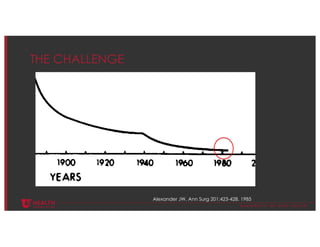
THE CHALLENGE
Alexander JW. Ann Surg 201:423-428, 1985
© U N I V E R S I T Y O F U T A H H E A L T H
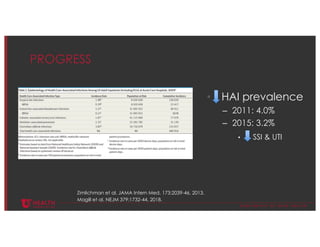
PROGRESS
• HAI prevalence
– 2011: 4.0%
– 2015: 3.2%
• SSI & UTI
Zimlichman et al. JAMA Intern Med. 173:2039-46, 2013.
Magill et al. NEJM 379:1732-44, 2018.
© U N I V E R S I T Y O F U T A H H E A L T H
PRESENT DAY
• Persistent focus on better antisepsis
– Small potential incremental impact
– Drives use of single use disposables
• Introduced w/o evidence of benefit
• Distracts from higher yield approaches
– Strengthen host defenses
– Non-scrubbed personnel actions to
reduce cross-transmission
Hopf, et al. Inflammation, Wound Healing, & Infection. In Barash P,
et al. (Eds.), Clinical Anesthesia 8th
Edition
© U N I V E R S I T Y O F U T A H H E A L T H
HIGH YIELD APPROACHES
• Clean hands
• Clean work area
• Clean medications & administration
• Antibiotics
• Attention to physiology
http://jamanetwork.com/journals/jamasurgery/fullarticle/2623725
© U N I V E R S I T Y O F U T A H H E A L T H
AND THEN CAME COVID-19
• COVID-19 pandemic reframed:
– patient safety patient & personal safety
• Increased focus on PPE & prevention
of cross-transmission may have side
benefits on HAI & public health
– Will impact be sustained long term?
© U N I V E R S I T Y O F U T A H H E A L T H
LESSONS FROM COVID-19
© U N I V E R S I T Y O F U T A H H E A L T H
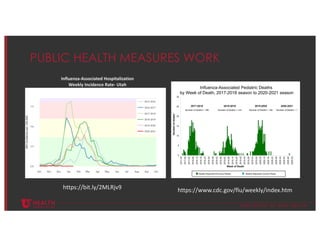
PUBLIC HEALTH MEASURES WORK
Influenza-Associated Hospitalization
Weekly Incidence Rate- Utah
https://www.cdc.gov/flu/weekly/index.htm
https://bit.ly/2MLRjv9
© U N I V E R S I T Y O F U T A H H E A L T H
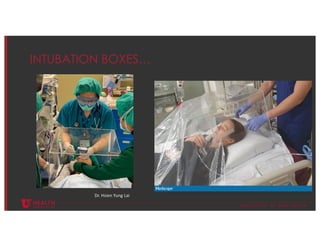
INTUBATION BOXES…
Dr. Hsien Yung Lai
© U N I V E R S I T Y O F U T A H H E A L T H
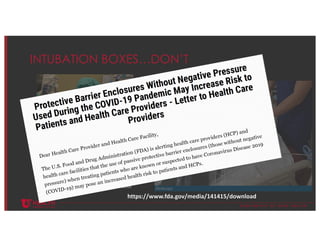
INTUBATION BOXES…DON’T
https://www.fda.gov/media/141415/download
© U N I V E R S I T Y O F U T A H H E A L T H
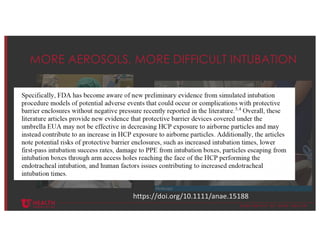
MORE AEROSOLS, MORE DIFFICULT INTUBATION
https://doi.org/10.1111/anae.15188
© U N I V E R S I T Y O F U T A H H E A L T H
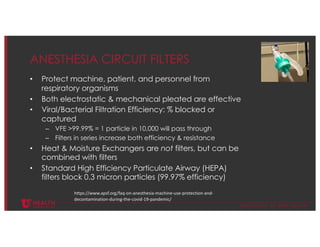
ANESTHESIA CIRCUIT FILTERS
• Protect machine, patient, and personnel from
respiratory organisms
• Both electrostatic & mechanical pleated are effective
• Viral/Bacterial Filtration Efficiency: % blocked or
captured
– VFE >99.99% = 1 particle in 10,000 will pass through
– Filters in series increase both efficiency & resistance
• Heat & Moisture Exchangers are not filters, but can be
combined with filters
• Standard High Efficiency Particulate Airway (HEPA)
filters block 0.3 micron particles (99.97% efficiency)
https://www.apsf.org/faq-on-anesthesia-machine-use-protection-and-
decontamination-during-the-covid-19-pandemic/
© U N I V E R S I T Y O F U T A H H E A L T H
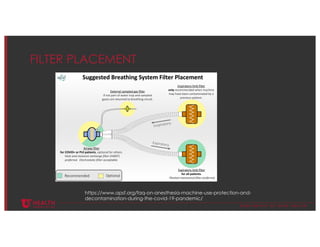
FILTER PLACEMENT
https://www.apsf.org/faq-on-anesthesia-machine-use-protection-and-
decontamination-during-the-covid-19-pandemic/
© U N I V E R S I T Y O F U T A H H E A L T H
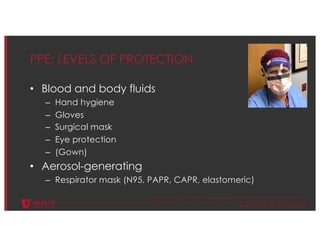
PPE: LEVELS OF PROTECTION
• Blood and body fluids
– Hand hygiene
– Gloves
– Surgical mask
– Eye protection
– (Gown)
• Aerosol-generating
– Respirator mask (N95, PAPR, CAPR, elastomeric)
https://www.cdc.gov/infectioncontrol/guidelines/isolation/appendix/standard-precautions.html
© U N I V E R S I T Y O F U T A H H E A L T H
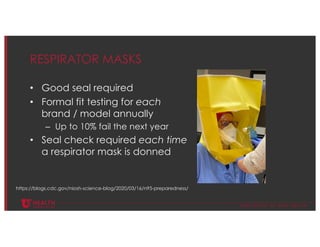
RESPIRATOR MASKS
• Good seal required
• Formal fit testing for each
brand / model annually
– Up to 10% fail the next year
• Seal check required each time
a respirator mask is donned
https://blogs.cdc.gov/niosh-science-blog/2020/03/16/n95-preparedness/
© U N I V E R S I T Y O F U T A H H E A L T H
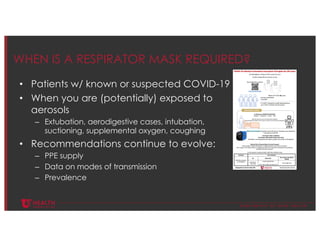
WHEN IS A RESPIRATOR MASK REQUIRED?
• Patients w/ known or suspected COVID-19
• When you are (potentially) exposed to
aerosols
– Extubation, aerodigestive cases, intubation,
suctioning, supplemental oxygen, coughing
• Recommendations continue to evolve:
– PPE supply
– Data on modes of transmission
– Prevalence
© U N I V E R S I T Y O F U T A H H E A L T H
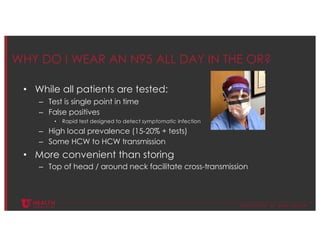
WHY DO I WEAR AN N95 ALL DAY IN THE OR?
• While all patients are tested:
– Test is single point in time
– False positives
• Rapid test designed to detect symptomatic infection
– High local prevalence (15-20% + tests)
– Some HCW to HCW transmission
• More convenient than storing
– Top of head / around neck facilitate cross-transmission
© U N I V E R S I T Y O F U T A H H E A L T H
What caused PPE shortages?
© U N I V E R S I T Y O F U T A H H E A L T H
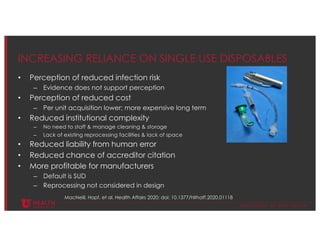
INCREASING RELIANCE ON SINGLE USE DISPOSABLES
• Perception of reduced infection risk
– Evidence does not support perception
• Perception of reduced cost
– Per unit acquisition lower; more expensive long term
• Reduced institutional complexity
– No need to staff & manage cleaning & storage
– Lack of existing reprocessing facilities & lack of space
• Reduced liability from human error
• Reduced chance of accreditor citation
• More profitable for manufacturers
– Default is SUD
– Reprocessing not considered in design
MacNeill, Hopf, et al. Health Affairs 2020; doi: 10.1377/hlthaff.2020.01118
© U N I V E R S I T Y O F U T A H H E A L T H
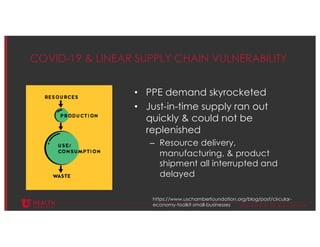
COVID-19 & LINEAR SUPPLY CHAIN VULNERABILITY
• PPE demand skyrocketed
• Just-in-time supply ran out
quickly & could not be
replenished
– Resource delivery,
manufacturing, & product
shipment all interrupted and
delayed
https://www.uschamberfoundation.org/blog/post/circular-
economy-toolkit-small-businesses
© U N I V E R S I T Y O F U T A H H E A L T H
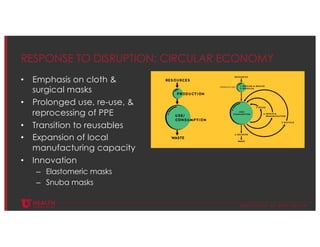
RESPONSE TO DISRUPTION: CIRCULAR ECONOMY
• Emphasis on cloth &
surgical masks
• Prolonged use, re-use, &
reprocessing of PPE
• Transition to reusables
• Expansion of local
manufacturing capacity
• Innovation
– Elastomeric masks
– Snuba masks
© U N I V E R S I T Y O F U T A H H E A L T H
IMPLICATIONS FOR THE FUTURE
• U.S. Healthcare industry:
• 8% of US greenhouse gas emissions
• 5.9 million tons solid waste/year; ~1/3 from OR
• Public health harm equivalent to that of medical errors
• SUDs increase resource use, pollution, & waste
• Climate change likely to cause more frequent
disruption of linear supply chains
• Transition to more circular economy will reduce
environmental impact, cost, & vulnerability of supply
chain
@ H a r r i e t H o p f M D # c l i n i c a l l y s u s t a i n a b l e
Chung & Meltzer, JAMA 302 (18): 1970-2; 2009
Eckelman & Sherman PLoS ONE 2016; 11: e0157014
Eckelman & Sherman Am J Public Health 2018; 108:S120-S122
© U N I V E R S I T Y O F U T A H H E A L T H
SUMMARY
• Infection control measures have dual benefit in
protecting both patients & health care professionals
• Single-use disposables have few advantages, but
increase cost, environmental impact, and supply
chain vulnerability
• Reversion to a more circular economy requires
commitment, regulatory changes, and more
comprehensive assessment of costs & benefits
– The COVID-19 pandemic underscored the importance
and urgency of this effort

Infection Control Considerations for COVID-19: Lessons Learned

  • 1.
    © U NI V E R S I T Y O F U T A H H E A L T H INFECTION CONTROL CONSIDERATIONS FOR COVID-19: LESSONS LEARNED HARRIET W. HOPF, MD PROFESSOR OF ANESTHESIOLOGY & BIOENGINEERING UNIVERSITY OF UTAH 66th Annual Update in Anesthesiology February 2021
  • 2.
    © U NI V E R S I T Y O F U T A H H E A L T H DISCLOSURES • Paid consultant for Ambu, Inc., which manufactures anesthesia circuits and filters
  • 3.
    © U NI V E R S I T Y O F U T A H H E A L T H LEARNING OBJECTIVES • Participants should be able to: – Apply infection control principles to protect themselves and their patients – Select anesthesia equipment and supplies that reduce vulnerability to supply chain interruptions during a pandemic
  • 4.
    © U NI V E R S I T Y O F U T A H H E A L T H HISTORY OF INFECTION CONTROL Alexander JW. Ann Surg 201:423-428, 1985
  • 5.
    © U NI V E R S I T Y O F U T A H H E A L T H THE CHALLENGE Alexander JW. Ann Surg 201:423-428, 1985
  • 6.
    © U NI V E R S I T Y O F U T A H H E A L T H PROGRESS • HAI prevalence – 2011: 4.0% – 2015: 3.2% • SSI & UTI Zimlichman et al. JAMA Intern Med. 173:2039-46, 2013. Magill et al. NEJM 379:1732-44, 2018.
  • 7.
    © U NI V E R S I T Y O F U T A H H E A L T H PRESENT DAY • Persistent focus on better antisepsis – Small potential incremental impact – Drives use of single use disposables • Introduced w/o evidence of benefit • Distracts from higher yield approaches – Strengthen host defenses – Non-scrubbed personnel actions to reduce cross-transmission Hopf, et al. Inflammation, Wound Healing, & Infection. In Barash P, et al. (Eds.), Clinical Anesthesia 8th Edition
  • 8.
    © U NI V E R S I T Y O F U T A H H E A L T H HIGH YIELD APPROACHES • Clean hands • Clean work area • Clean medications & administration • Antibiotics • Attention to physiology http://jamanetwork.com/journals/jamasurgery/fullarticle/2623725
  • 9.
    © U NI V E R S I T Y O F U T A H H E A L T H AND THEN CAME COVID-19 • COVID-19 pandemic reframed: – patient safety patient & personal safety • Increased focus on PPE & prevention of cross-transmission may have side benefits on HAI & public health – Will impact be sustained long term?
  • 10.
    © U NI V E R S I T Y O F U T A H H E A L T H LESSONS FROM COVID-19
  • 11.
    © U NI V E R S I T Y O F U T A H H E A L T H PUBLIC HEALTH MEASURES WORK Influenza-Associated Hospitalization Weekly Incidence Rate- Utah https://www.cdc.gov/flu/weekly/index.htm https://bit.ly/2MLRjv9
  • 12.
    © U NI V E R S I T Y O F U T A H H E A L T H INTUBATION BOXES… Dr. Hsien Yung Lai
  • 13.
    © U NI V E R S I T Y O F U T A H H E A L T H INTUBATION BOXES…DON’T https://www.fda.gov/media/141415/download
  • 14.
    © U NI V E R S I T Y O F U T A H H E A L T H MORE AEROSOLS, MORE DIFFICULT INTUBATION https://doi.org/10.1111/anae.15188
  • 15.
    © U NI V E R S I T Y O F U T A H H E A L T H ANESTHESIA CIRCUIT FILTERS • Protect machine, patient, and personnel from respiratory organisms • Both electrostatic & mechanical pleated are effective • Viral/Bacterial Filtration Efficiency: % blocked or captured – VFE >99.99% = 1 particle in 10,000 will pass through – Filters in series increase both efficiency & resistance • Heat & Moisture Exchangers are not filters, but can be combined with filters • Standard High Efficiency Particulate Airway (HEPA) filters block 0.3 micron particles (99.97% efficiency) https://www.apsf.org/faq-on-anesthesia-machine-use-protection-and- decontamination-during-the-covid-19-pandemic/
  • 16.
    © U NI V E R S I T Y O F U T A H H E A L T H FILTER PLACEMENT https://www.apsf.org/faq-on-anesthesia-machine-use-protection-and- decontamination-during-the-covid-19-pandemic/
  • 17.
    © U NI V E R S I T Y O F U T A H H E A L T H PPE: LEVELS OF PROTECTION • Blood and body fluids – Hand hygiene – Gloves – Surgical mask – Eye protection – (Gown) • Aerosol-generating – Respirator mask (N95, PAPR, CAPR, elastomeric) https://www.cdc.gov/infectioncontrol/guidelines/isolation/appendix/standard-precautions.html
  • 18.
    © U NI V E R S I T Y O F U T A H H E A L T H RESPIRATOR MASKS • Good seal required • Formal fit testing for each brand / model annually – Up to 10% fail the next year • Seal check required each time a respirator mask is donned https://blogs.cdc.gov/niosh-science-blog/2020/03/16/n95-preparedness/
  • 19.
    © U NI V E R S I T Y O F U T A H H E A L T H WHEN IS A RESPIRATOR MASK REQUIRED? • Patients w/ known or suspected COVID-19 • When you are (potentially) exposed to aerosols – Extubation, aerodigestive cases, intubation, suctioning, supplemental oxygen, coughing • Recommendations continue to evolve: – PPE supply – Data on modes of transmission – Prevalence
  • 20.
    © U NI V E R S I T Y O F U T A H H E A L T H WHY DO I WEAR AN N95 ALL DAY IN THE OR? • While all patients are tested: – Test is single point in time – False positives • Rapid test designed to detect symptomatic infection – High local prevalence (15-20% + tests) – Some HCW to HCW transmission • More convenient than storing – Top of head / around neck facilitate cross-transmission
  • 21.
    © U NI V E R S I T Y O F U T A H H E A L T H What caused PPE shortages?
  • 22.
    © U NI V E R S I T Y O F U T A H H E A L T H INCREASING RELIANCE ON SINGLE USE DISPOSABLES • Perception of reduced infection risk – Evidence does not support perception • Perception of reduced cost – Per unit acquisition lower; more expensive long term • Reduced institutional complexity – No need to staff & manage cleaning & storage – Lack of existing reprocessing facilities & lack of space • Reduced liability from human error • Reduced chance of accreditor citation • More profitable for manufacturers – Default is SUD – Reprocessing not considered in design MacNeill, Hopf, et al. Health Affairs 2020; doi: 10.1377/hlthaff.2020.01118
  • 23.
    © U NI V E R S I T Y O F U T A H H E A L T H COVID-19 & LINEAR SUPPLY CHAIN VULNERABILITY • PPE demand skyrocketed • Just-in-time supply ran out quickly & could not be replenished – Resource delivery, manufacturing, & product shipment all interrupted and delayed https://www.uschamberfoundation.org/blog/post/circular- economy-toolkit-small-businesses
  • 24.
    © U NI V E R S I T Y O F U T A H H E A L T H RESPONSE TO DISRUPTION: CIRCULAR ECONOMY • Emphasis on cloth & surgical masks • Prolonged use, re-use, & reprocessing of PPE • Transition to reusables • Expansion of local manufacturing capacity • Innovation – Elastomeric masks – Snuba masks
  • 25.
    © U NI V E R S I T Y O F U T A H H E A L T H IMPLICATIONS FOR THE FUTURE • U.S. Healthcare industry: • 8% of US greenhouse gas emissions • 5.9 million tons solid waste/year; ~1/3 from OR • Public health harm equivalent to that of medical errors • SUDs increase resource use, pollution, & waste • Climate change likely to cause more frequent disruption of linear supply chains • Transition to more circular economy will reduce environmental impact, cost, & vulnerability of supply chain @ H a r r i e t H o p f M D # c l i n i c a l l y s u s t a i n a b l e Chung & Meltzer, JAMA 302 (18): 1970-2; 2009 Eckelman & Sherman PLoS ONE 2016; 11: e0157014 Eckelman & Sherman Am J Public Health 2018; 108:S120-S122
  • 26.
    © U NI V E R S I T Y O F U T A H H E A L T H SUMMARY • Infection control measures have dual benefit in protecting both patients & health care professionals • Single-use disposables have few advantages, but increase cost, environmental impact, and supply chain vulnerability • Reversion to a more circular economy requires commitment, regulatory changes, and more comprehensive assessment of costs & benefits – The COVID-19 pandemic underscored the importance and urgency of this effort