1
Challenging hemorrhagic shock
resuscitation guidelines
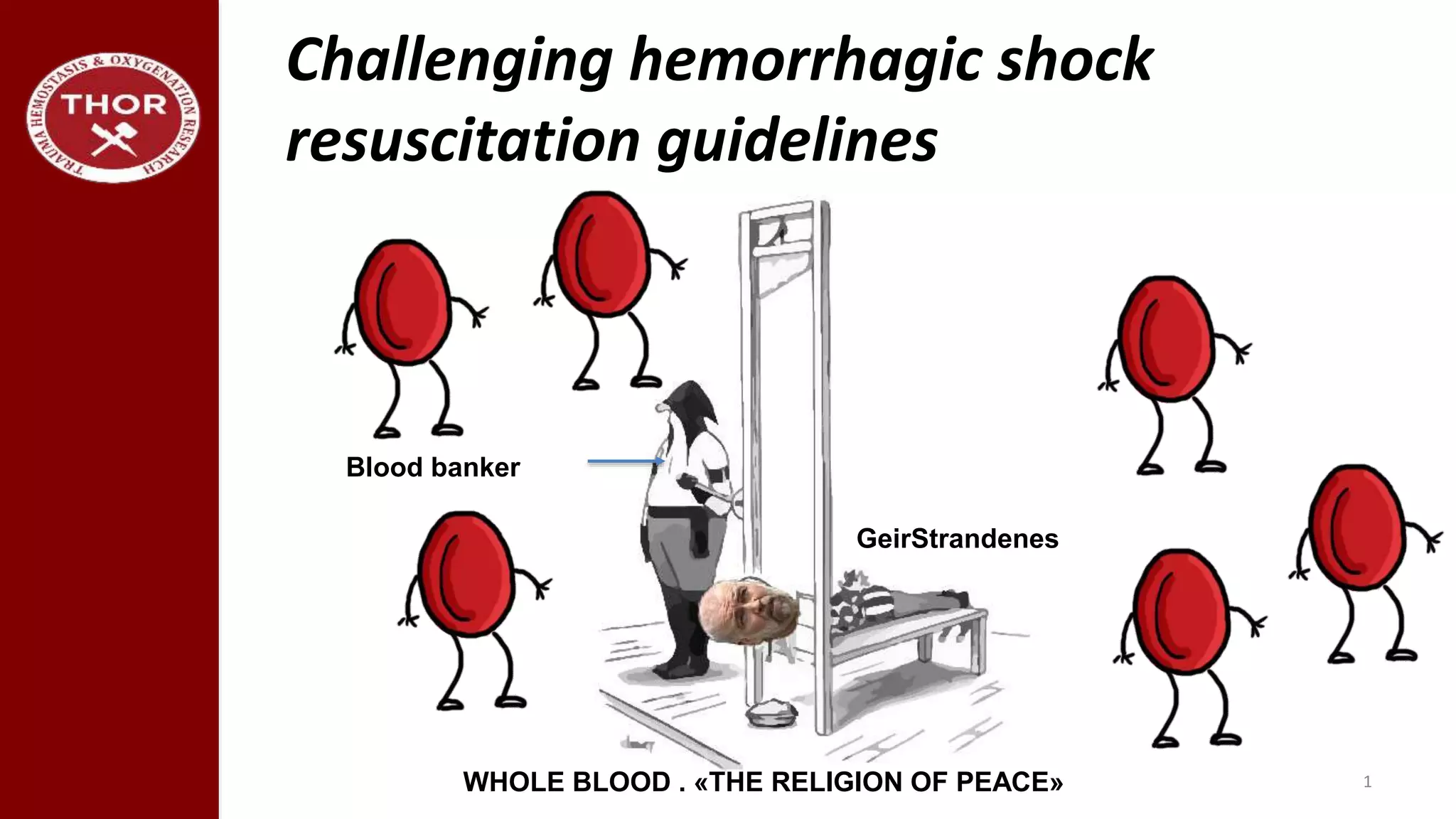
WHOLE BLOOD . «THE RELIGION OF PEACE»
GeirStrandenes
Blood banker
2
3
4
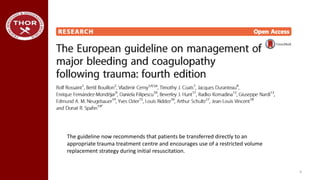
The guideline now recommends that patients be transferred directly to an
appropriate trauma treatment centre and encourages use of a restricted volume
replacement strategy during initial resuscitation.
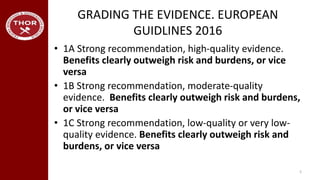
GRADING THE EVIDENCE. EUROPEAN
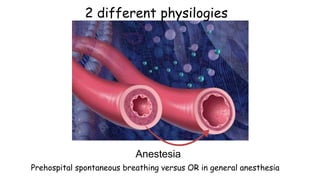
GUIDLINES 2016
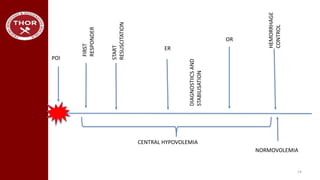
• 1A Strong recommendation, high-quality evidence.
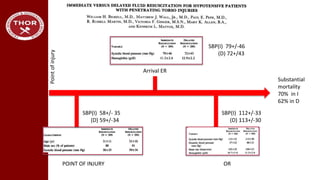
Benefits clearly outweigh risk and burdens, or vice
versa
• 1B Strong recommendation, moderate-quality
evidence. Benefits clearly outweigh risk and burdens,
or vice versa
• 1C Strong recommendation, low-quality or very low-
quality evidence. Benefits clearly outweigh risk and
burdens, or vice versa
5
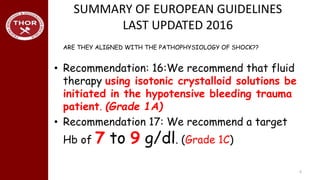
SUMMARY OF EUROPEAN GUIDELINES
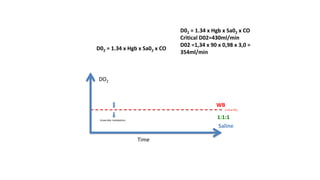
LAST UPDATED 2016
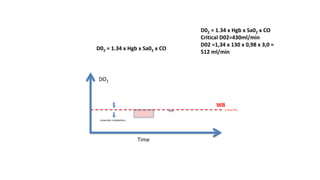
• Recommendation: 16:We recommend that fluid
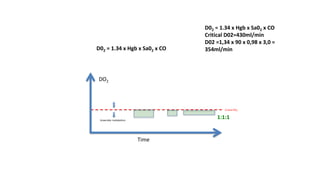
therapy using isotonic crystalloid solutions be
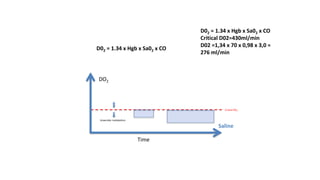
initiated in the hypotensive bleeding trauma
patient. (Grade 1A)
• Recommendation 17: We recommend a target
Hb of 7 to 9 g/dl. (Grade 1C)
6
ARE THEY ALIGNED WITH THE PATHOPHYSIOLOGY OF SHOCK??
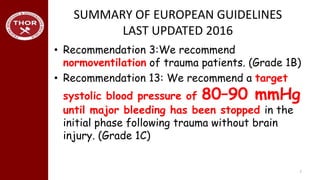
SUMMARY OF EUROPEAN GUIDELINES
LAST UPDATED 2016
• Recommendation 3:We recommend
normoventilation of trauma patients. (Grade 1B)
• Recommendation 13: We recommend a target
systolic blood pressure of 80–90 mmHg
until major bleeding has been stopped in the
initial phase following trauma without brain
injury. (Grade 1C)
7
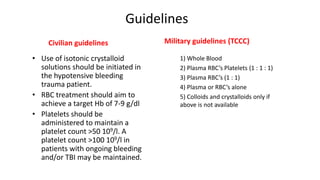
Guidelines
Civilian guidelines
• Use of isotonic crystalloid
solutions should be initiated in
the hypotensive bleeding
trauma patient.
• RBC treatment should aim to
achieve a target Hb of 7-9 g/dl
• Platelets should be
administered to maintain a
platelet count >50 109/l. A
platelet count >100 109/l in
patients with ongoing bleeding
and/or TBI may be maintained.
Military guidelines (TCCC)
1) Whole Blood
2) Plasma RBC’s Platelets (1 : 1 : 1)
3) Plasma RBC’s (1 : 1)
4) Plasma or RBC’s alone
5) Colloids and crystalloids only if
above is not available
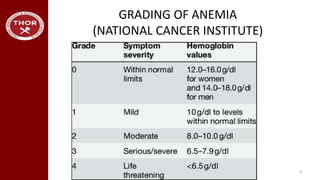
GRADING OF ANEMIA
(NATIONAL CANCER INSTITUTE)
9
TO PUT IN IN A SIMPLE WAY
• EUROPEAN GUIDELINE RECOMMEND SEVERE ANEMIA
FOR SEVERE BLEEDING
• EUROPEAN GUIDELINES ACCEPT UP TO 50%
HEMODILUTUION IN SEVERE BLEEDING PATIENTS
• EUROPEAN GUIDELINE RECOMMEND HYPOTENSIVE
RESUSCITATION PRIOR TO SURGICAL CONTROLL
• EUROPEAN GUIDELINE RECOMMEND
NORMOVENTILATION FOR ALL TRAUMAPATIENTS
10
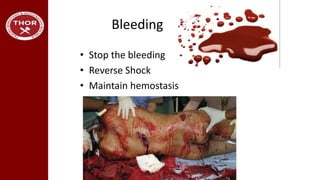
Bleeding
• Stop the bleeding
• Reverse Shock
• Maintain hemostasis
PROBLEM 2 FOLD
• Maintain best possible Oxygen Deliver (DO) during
ongoing central hypovolemia until bleeding is
controlled.(Avoid delivery dependent Oxygen
consumption(V02) )
• Maintain hemostatic potential
• HYPOTENSIVE RESUSCITATION?? OXYMORON OR A
GOOD IDEA??
12
Anestesia
Prehospital spontaneous breathing versus OR in general anesthesia
2 different physilogies
14
POI
FIRST
RESPONDER
START
RESUSCITATION
ER
DIAGNOSTIICSAND
STABILISATION
OR
HEMORRHAGE
CONTROL
NORMOVOLEMIA
CENTRAL HYPOVOLEMIA
POINT OF INJURY
Arrival ER
OR
SBP(I) 58+/- 35
(D) 59+/-34
SBP(I) 79+/-46
(D) 72+/43
SBP(I) 112+/-33
(D) 113+/-30
Pointofinjury
Substantial
mortality
70% in I
62% in D
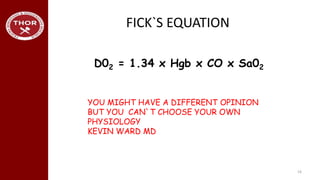
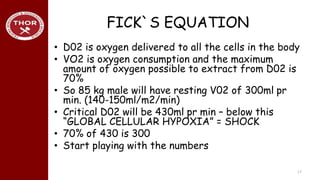
FICK`S EQUATION
16
D02 = 1.34 x Hgb x CO x Sa02
YOU MIGHT HAVE A DIFFERENT OPINION
BUT YOU CAN`T CHOOSE YOUR OWN
PHYSIOLOGY
KEVIN WARD MD
FICK`S EQUATION
• D02 is oxygen delivered to all the cells in the body
• VO2 is oxygen consumption and the maximum
amount of oxygen possible to extract from D02 is
70%
• So 85 kg male will have resting V02 of 300ml pr
min. (140-150ml/m2/min)
• Critical D02 will be 430ml pr min – below this
“GLOBAL CELLULAR HYPOXIA” = SHOCK
• 70% of 430 is 300
• Start playing with the numbers
17
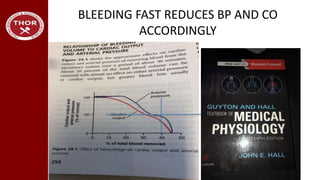
BLEEDING FAST REDUCES BP AND CO
ACCORDINGLY
18
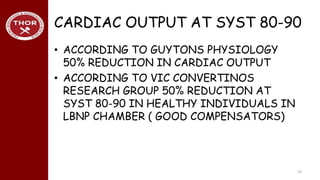
CARDIAC OUTPUT AT SYST 80-90
• ACCORDING TO GUYTONS PHYSIOLOGY
50% REDUCTION IN CARDIAC OUTPUT
• ACCORDING TO VIC CONVERTINOS
RESEARCH GROUP 50% REDUCTION AT
SYST 80-90 IN HEALTHY INDIVIDUALS IN
LBNP CHAMBER ( GOOD COMPENSATORS)
19
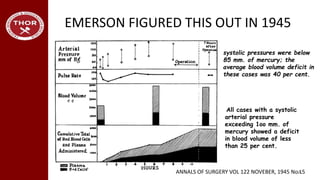
EMERSON FIGURED THIS OUT IN 1945
20
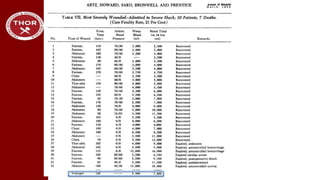
systolic pressures were below
85 mm. of mercury; the
average blood volume deficit in
these cases was 40 per cent.
All cases with a systolic
arterial pressure
exceeding 1oo mm. of
mercury showed a deficit
in blood volume of less
than 25 per cent.
ANNALS OF SURGERY VOL 122 NOVEBER, 1945 No.L5
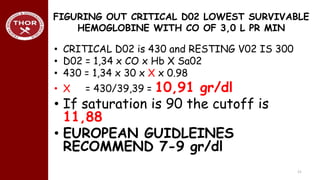
FIGURING OUT CRITICAL D02 LOWEST SURVIVABLE
HEMOGLOBINE WITH CO OF 3,0 L PR MIN
• CRITICAL D02 is 430 and RESTING V02 IS 300
• D02 = 1,34 x CO x Hb X Sa02
• 430 = 1,34 x 30 x X x 0.98
• X = 430/39,39 = 10,91 gr/dl
• If saturation is 90 the cutoff is
11,88
• EUROPEAN GUIDLEINES
RECOMMEND 7-9 gr/dl
21
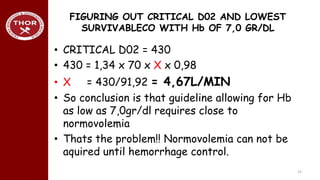
FIGURING OUT CRITICAL D02 AND LOWEST
SURVIVABLECO WITH Hb OF 7,0 GR/DL
• CRITICAL D02 = 430
• 430 = 1,34 x 70 x X x 0,98
• X = 430/91,92 = 4,67L/MIN
• So conclusion is that guideline allowing for Hb
as low as 7,0gr/dl requires close to
normovolemia
• Thats the problem!! Normovolemia can not be
aquired until hemorrhage control.
22
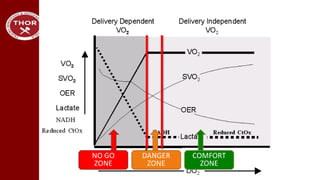
NO GO
ZONE
DANGER
ZONE
COMFORT
ZONE
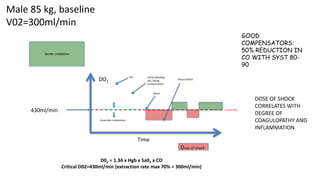
DO2
Time
D02 = 1.34 x Hgb x Sa02 x CO
Critical D02=430ml/min (extraction rate max 70% = 300ml/min)
Critical DO2
Aerobic metabolism
Dose of shock
POI Active bleeding
DO2 falling
Compensation
Shock
Resuscitation
Anaerobic metabolism
Male 85 kg, baseline
V02=300ml/min
430ml/min
GOOD
COMPENSATORS:
50% REDUCTION IN
CO WITH SYST 80-
90
DOSE OF SHOCK
CORRELATES WITH
DEGREE OF
COAGULOPATHY AND
INFLAMMATION
DO2
Time
D02 = 1.34 x Hgb x Sa02 x CO
Critical DO2
Anaerobic metabolism
WB
1:1:1
Saline
D02 = 1.34 x Hgb x Sa02 x CO
Critical D02=430ml/min
D02 =1,34 x 90 x 0,98 x 3,0 =
354ml/min
DO2
Time
D02 = 1.34 x Hgb x Sa02 x CO
Critical DO2
Anaerobic metabolism
WB
D02 = 1.34 x Hgb x Sa02 x CO
Critical D02=430ml/min
D02 =1,34 x 130 x 0,98 x 3,0 =
512 ml/min
DO2
Time
D02 = 1.34 x Hgb x Sa02 x CO
Critical DO2
Anaerobic metabolism
1:1:1
D02 = 1.34 x Hgb x Sa02 x CO
Critical D02=430ml/min
D02 =1,34 x 90 x 0,98 x 3,0 =
354ml/min
DO2
Time
D02 = 1.34 x Hgb x Sa02 x CO
Critical DO2
Anaerobic metabolism
Saline
D02 = 1.34 x Hgb x Sa02 x CO
Critical D02=430ml/min
D02 =1,34 x 70 x 0,98 x 3,0 =
276 ml/min
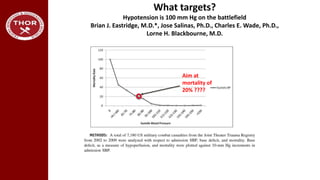
What targets?
Hypotension is 100 mm Hg on the battlefield
Brian J. Eastridge, M.D.*, Jose Salinas, Ph.D., Charles E. Wade, Ph.D.,
Lorne H. Blackbourne, M.D.
Aim at
mortality of
20% ????
30
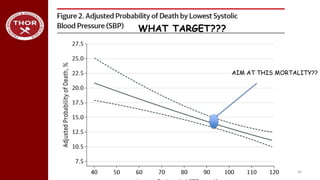
WHAT TARGET???
AIM AT THIS MORTALITY??
Outcomes following trauma laparotomy for
hypotensive trauma patients: A UK military
and civilian perspective.
• Despite improvements in survival after trauma for
patients overall, the mortality for patients undergoing
laparotomy who arrive at the ED with hypotension has
not changed and appears stubbornly resistant to all
efforts
31
Mortality was higher in hypotensive patients (47.6% vs. 12.4% in normotensive patients; p < 0.001).
In both cohorts of hypotensive patients, neither the average injury severity, the prehospital time,
the ED arrival systolic blood pressure, nor mortality rate changed significantly during the study
period.
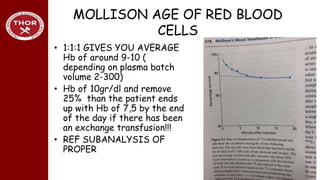
MOLLISON AGE OF RED BLOOD
CELLS
• 1:1:1 GIVES YOU AVERAGE
Hb of around 9-10 (
depending on plasma batch
volume 2-300)
• Hb of 10gr/dl and remove
25% than the patient ends
up with Hb of 7,5 by the end
of the day if there has been
an exchange transfusion!!!
• REF SUBANALYSIS OF
PROPER
32
Ann Emerg Med. 2018 Nov 14. pii: S0196-0644(18)31326-X. doi:
10.1016/j.annemergmed.2018.09.033. [Epub ahead of print]
Older Blood Is Associated With Increased Mortality and Adverse Events in Massively
Transfused Trauma Patients: Secondary Analysis of the PROPPR Trial
• CONCLUSION:
• Increasing quantities of older packed RBCs are
associated with increased likelihood of 24-hour
mortality in trauma patients receiving massive packed
RBC transfusion (≥10 units), but not in those who
receive fewer than 10 units.
33
34
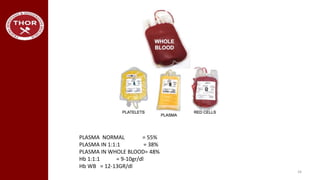
PLASMA NORMAL = 55%
PLASMA IN 1:1:1 = 38%
PLASMA IN WHOLE BLOOD= 48%
Hb 1:1:1 = 9-10gr/dl
Hb WB = 12-13GR/dl
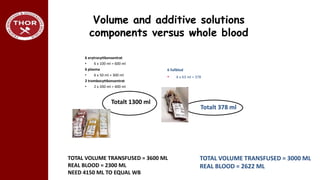
Volume and additive solutions
components versus whole blood
6 erytrocyttkonsentrat
• 6 x 100 ml = 600 ml
6 plasma
• 6 x 50 ml = 300 ml
2 trombocyttkonsentrat
• 2 x 200 ml = 400 ml
Totalt 1300 ml
6 fullblod
• 6 x 63 ml = 378
Totalt 378 ml
35
TOTAL VOLUME TRANSFUSED = 3000 ML
REAL BLOOD = 2622 ML
TOTAL VOLUME TRANSFUSED = 3600 ML
REAL BLOOD = 2300 ML
NEED 4150 ML TO EQUAL WB
Advantages of Whole Blood
• Natural
• Organic
• Non-GMO
• Free range
• Gluten Free
• High in protein
• Low in carbs
EMERSON 1945
• It was the experience of many surgeons operating at
the front in the African and Sicilian campaigns, that a
considerable proportion of patients in severe shock
failed to respond adequately to plasma transfusions,
death occurring preoperatively or in the course of
operation.
• DILLUTION : INADEQUATE D02 = DEATH BY
HEMODILLUTION.
37
EMERSON 1945
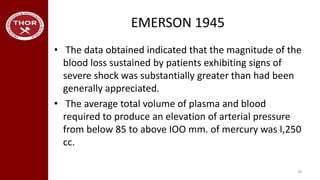
• The data obtained indicated that the magnitude of the
blood loss sustained by patients exhibiting signs of
severe shock was substantially greater than had been
generally appreciated.
• The average total volume of plasma and blood
required to produce an elevation of arterial pressure
from below 85 to above IOO mm. of mercury was I,250
cc.
38
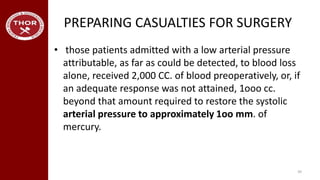
PREPARING CASUALTIES FOR SURGERY
• those patients admitted with a low arterial pressure
attributable, as far as could be detected, to blood loss
alone, received 2,000 CC. of blood preoperatively, or, if
an adequate response was not attained, 1ooo cc.
beyond that amount required to restore the systolic
arterial pressure to approximately 1oo mm. of
mercury.
39
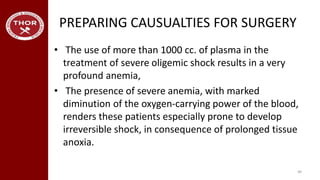
PREPARING CAUSUALTIES FOR SURGERY
• The use of more than 1000 cc. of plasma in the
treatment of severe oligemic shock results in a very
profound anemia,
• The presence of severe anemia, with marked
diminution of the oxygen-carrying power of the blood,
renders these patients especially prone to develop
irreversible shock, in consequence of prolonged tissue
anoxia.
40
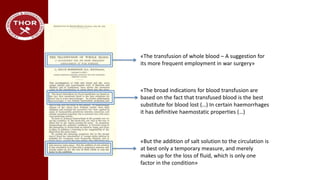
«The transfusion of whole blood – A suggestion for
its more frequent employment in war surgery»
«But the addition of salt solution to the circulation is
at best only a temporary measure, and merely
makes up for the loss of fluid, which is only one
factor in the condition»
«The broad indications for blood transfusion are
based on the fact that transfused blood is the best
substitute for blood lost (…) In certain haemorrhages
it has definitive haemostatic properties (…)
PERFUSE IT OR LOSE IT
43
THE SOLUTION TO
TRANSFUSION IS
AVOIDANCE OF DILUTION
44
Questions???
45
All truth passes through
three stages. First, it is
ridiculed. Second, it is
violently opposed. Third,
it is accepted as being
self-evident.
Arthur Schopenhauer
46
DONTDISCONNECT THE HEART LUNGMACHINE
WARNING

Challenging hemorrhagic shock resuscitation guidelines

  • 1.
    1 Challenging hemorrhagic shock resuscitationguidelines WHOLE BLOOD . «THE RELIGION OF PEACE» GeirStrandenes Blood banker
  • 2.
  • 3.
  • 4.
    4 The guideline nowrecommends that patients be transferred directly to an appropriate trauma treatment centre and encourages use of a restricted volume replacement strategy during initial resuscitation.
  • 5.
    GRADING THE EVIDENCE.EUROPEAN GUIDLINES 2016 • 1A Strong recommendation, high-quality evidence. Benefits clearly outweigh risk and burdens, or vice versa • 1B Strong recommendation, moderate-quality evidence. Benefits clearly outweigh risk and burdens, or vice versa • 1C Strong recommendation, low-quality or very low- quality evidence. Benefits clearly outweigh risk and burdens, or vice versa 5
  • 6.
    SUMMARY OF EUROPEANGUIDELINES LAST UPDATED 2016 • Recommendation: 16:We recommend that fluid therapy using isotonic crystalloid solutions be initiated in the hypotensive bleeding trauma patient. (Grade 1A) • Recommendation 17: We recommend a target Hb of 7 to 9 g/dl. (Grade 1C) 6 ARE THEY ALIGNED WITH THE PATHOPHYSIOLOGY OF SHOCK??
  • 7.
    SUMMARY OF EUROPEANGUIDELINES LAST UPDATED 2016 • Recommendation 3:We recommend normoventilation of trauma patients. (Grade 1B) • Recommendation 13: We recommend a target systolic blood pressure of 80–90 mmHg until major bleeding has been stopped in the initial phase following trauma without brain injury. (Grade 1C) 7
  • 8.
    Guidelines Civilian guidelines • Useof isotonic crystalloid solutions should be initiated in the hypotensive bleeding trauma patient. • RBC treatment should aim to achieve a target Hb of 7-9 g/dl • Platelets should be administered to maintain a platelet count >50 109/l. A platelet count >100 109/l in patients with ongoing bleeding and/or TBI may be maintained. Military guidelines (TCCC) 1) Whole Blood 2) Plasma RBC’s Platelets (1 : 1 : 1) 3) Plasma RBC’s (1 : 1) 4) Plasma or RBC’s alone 5) Colloids and crystalloids only if above is not available
  • 9.
    GRADING OF ANEMIA (NATIONALCANCER INSTITUTE) 9
  • 10.
    TO PUT ININ A SIMPLE WAY • EUROPEAN GUIDELINE RECOMMEND SEVERE ANEMIA FOR SEVERE BLEEDING • EUROPEAN GUIDELINES ACCEPT UP TO 50% HEMODILUTUION IN SEVERE BLEEDING PATIENTS • EUROPEAN GUIDELINE RECOMMEND HYPOTENSIVE RESUSCITATION PRIOR TO SURGICAL CONTROLL • EUROPEAN GUIDELINE RECOMMEND NORMOVENTILATION FOR ALL TRAUMAPATIENTS 10
  • 11.
    Bleeding • Stop thebleeding • Reverse Shock • Maintain hemostasis
  • 12.
    PROBLEM 2 FOLD •Maintain best possible Oxygen Deliver (DO) during ongoing central hypovolemia until bleeding is controlled.(Avoid delivery dependent Oxygen consumption(V02) ) • Maintain hemostatic potential • HYPOTENSIVE RESUSCITATION?? OXYMORON OR A GOOD IDEA?? 12
  • 13.
    Anestesia Prehospital spontaneous breathingversus OR in general anesthesia 2 different physilogies
  • 14.
  • 15.
    POINT OF INJURY ArrivalER OR SBP(I) 58+/- 35 (D) 59+/-34 SBP(I) 79+/-46 (D) 72+/43 SBP(I) 112+/-33 (D) 113+/-30 Pointofinjury Substantial mortality 70% in I 62% in D
  • 16.
    FICK`S EQUATION 16 D02 =1.34 x Hgb x CO x Sa02 YOU MIGHT HAVE A DIFFERENT OPINION BUT YOU CAN`T CHOOSE YOUR OWN PHYSIOLOGY KEVIN WARD MD
  • 17.
    FICK`S EQUATION • D02is oxygen delivered to all the cells in the body • VO2 is oxygen consumption and the maximum amount of oxygen possible to extract from D02 is 70% • So 85 kg male will have resting V02 of 300ml pr min. (140-150ml/m2/min) • Critical D02 will be 430ml pr min – below this “GLOBAL CELLULAR HYPOXIA” = SHOCK • 70% of 430 is 300 • Start playing with the numbers 17
  • 18.
    BLEEDING FAST REDUCESBP AND CO ACCORDINGLY 18
  • 19.
    CARDIAC OUTPUT ATSYST 80-90 • ACCORDING TO GUYTONS PHYSIOLOGY 50% REDUCTION IN CARDIAC OUTPUT • ACCORDING TO VIC CONVERTINOS RESEARCH GROUP 50% REDUCTION AT SYST 80-90 IN HEALTHY INDIVIDUALS IN LBNP CHAMBER ( GOOD COMPENSATORS) 19
  • 20.
    EMERSON FIGURED THISOUT IN 1945 20 systolic pressures were below 85 mm. of mercury; the average blood volume deficit in these cases was 40 per cent. All cases with a systolic arterial pressure exceeding 1oo mm. of mercury showed a deficit in blood volume of less than 25 per cent. ANNALS OF SURGERY VOL 122 NOVEBER, 1945 No.L5
  • 21.
    FIGURING OUT CRITICALD02 LOWEST SURVIVABLE HEMOGLOBINE WITH CO OF 3,0 L PR MIN • CRITICAL D02 is 430 and RESTING V02 IS 300 • D02 = 1,34 x CO x Hb X Sa02 • 430 = 1,34 x 30 x X x 0.98 • X = 430/39,39 = 10,91 gr/dl • If saturation is 90 the cutoff is 11,88 • EUROPEAN GUIDLEINES RECOMMEND 7-9 gr/dl 21
  • 22.
    FIGURING OUT CRITICALD02 AND LOWEST SURVIVABLECO WITH Hb OF 7,0 GR/DL • CRITICAL D02 = 430 • 430 = 1,34 x 70 x X x 0,98 • X = 430/91,92 = 4,67L/MIN • So conclusion is that guideline allowing for Hb as low as 7,0gr/dl requires close to normovolemia • Thats the problem!! Normovolemia can not be aquired until hemorrhage control. 22
  • 23.
  • 24.
    DO2 Time D02 = 1.34x Hgb x Sa02 x CO Critical D02=430ml/min (extraction rate max 70% = 300ml/min) Critical DO2 Aerobic metabolism Dose of shock POI Active bleeding DO2 falling Compensation Shock Resuscitation Anaerobic metabolism Male 85 kg, baseline V02=300ml/min 430ml/min GOOD COMPENSATORS: 50% REDUCTION IN CO WITH SYST 80- 90 DOSE OF SHOCK CORRELATES WITH DEGREE OF COAGULOPATHY AND INFLAMMATION
  • 25.
    DO2 Time D02 = 1.34x Hgb x Sa02 x CO Critical DO2 Anaerobic metabolism WB 1:1:1 Saline D02 = 1.34 x Hgb x Sa02 x CO Critical D02=430ml/min D02 =1,34 x 90 x 0,98 x 3,0 = 354ml/min
  • 26.
    DO2 Time D02 = 1.34x Hgb x Sa02 x CO Critical DO2 Anaerobic metabolism WB D02 = 1.34 x Hgb x Sa02 x CO Critical D02=430ml/min D02 =1,34 x 130 x 0,98 x 3,0 = 512 ml/min
  • 27.
    DO2 Time D02 = 1.34x Hgb x Sa02 x CO Critical DO2 Anaerobic metabolism 1:1:1 D02 = 1.34 x Hgb x Sa02 x CO Critical D02=430ml/min D02 =1,34 x 90 x 0,98 x 3,0 = 354ml/min
  • 28.
    DO2 Time D02 = 1.34x Hgb x Sa02 x CO Critical DO2 Anaerobic metabolism Saline D02 = 1.34 x Hgb x Sa02 x CO Critical D02=430ml/min D02 =1,34 x 70 x 0,98 x 3,0 = 276 ml/min
  • 29.
    What targets? Hypotension is100 mm Hg on the battlefield Brian J. Eastridge, M.D.*, Jose Salinas, Ph.D., Charles E. Wade, Ph.D., Lorne H. Blackbourne, M.D. Aim at mortality of 20% ????
  • 30.
    30 WHAT TARGET??? AIM ATTHIS MORTALITY??
  • 31.
    Outcomes following traumalaparotomy for hypotensive trauma patients: A UK military and civilian perspective. • Despite improvements in survival after trauma for patients overall, the mortality for patients undergoing laparotomy who arrive at the ED with hypotension has not changed and appears stubbornly resistant to all efforts 31 Mortality was higher in hypotensive patients (47.6% vs. 12.4% in normotensive patients; p < 0.001). In both cohorts of hypotensive patients, neither the average injury severity, the prehospital time, the ED arrival systolic blood pressure, nor mortality rate changed significantly during the study period.
  • 32.
    MOLLISON AGE OFRED BLOOD CELLS • 1:1:1 GIVES YOU AVERAGE Hb of around 9-10 ( depending on plasma batch volume 2-300) • Hb of 10gr/dl and remove 25% than the patient ends up with Hb of 7,5 by the end of the day if there has been an exchange transfusion!!! • REF SUBANALYSIS OF PROPER 32
  • 33.
    Ann Emerg Med.2018 Nov 14. pii: S0196-0644(18)31326-X. doi: 10.1016/j.annemergmed.2018.09.033. [Epub ahead of print] Older Blood Is Associated With Increased Mortality and Adverse Events in Massively Transfused Trauma Patients: Secondary Analysis of the PROPPR Trial • CONCLUSION: • Increasing quantities of older packed RBCs are associated with increased likelihood of 24-hour mortality in trauma patients receiving massive packed RBC transfusion (≥10 units), but not in those who receive fewer than 10 units. 33
  • 34.
    34 PLASMA NORMAL =55% PLASMA IN 1:1:1 = 38% PLASMA IN WHOLE BLOOD= 48% Hb 1:1:1 = 9-10gr/dl Hb WB = 12-13GR/dl
  • 35.
    Volume and additivesolutions components versus whole blood 6 erytrocyttkonsentrat • 6 x 100 ml = 600 ml 6 plasma • 6 x 50 ml = 300 ml 2 trombocyttkonsentrat • 2 x 200 ml = 400 ml Totalt 1300 ml 6 fullblod • 6 x 63 ml = 378 Totalt 378 ml 35 TOTAL VOLUME TRANSFUSED = 3000 ML REAL BLOOD = 2622 ML TOTAL VOLUME TRANSFUSED = 3600 ML REAL BLOOD = 2300 ML NEED 4150 ML TO EQUAL WB
  • 36.
    Advantages of WholeBlood • Natural • Organic • Non-GMO • Free range • Gluten Free • High in protein • Low in carbs
  • 37.
    EMERSON 1945 • Itwas the experience of many surgeons operating at the front in the African and Sicilian campaigns, that a considerable proportion of patients in severe shock failed to respond adequately to plasma transfusions, death occurring preoperatively or in the course of operation. • DILLUTION : INADEQUATE D02 = DEATH BY HEMODILLUTION. 37
  • 38.
    EMERSON 1945 • Thedata obtained indicated that the magnitude of the blood loss sustained by patients exhibiting signs of severe shock was substantially greater than had been generally appreciated. • The average total volume of plasma and blood required to produce an elevation of arterial pressure from below 85 to above IOO mm. of mercury was I,250 cc. 38
  • 39.
    PREPARING CASUALTIES FORSURGERY • those patients admitted with a low arterial pressure attributable, as far as could be detected, to blood loss alone, received 2,000 CC. of blood preoperatively, or, if an adequate response was not attained, 1ooo cc. beyond that amount required to restore the systolic arterial pressure to approximately 1oo mm. of mercury. 39
  • 40.
    PREPARING CAUSUALTIES FORSURGERY • The use of more than 1000 cc. of plasma in the treatment of severe oligemic shock results in a very profound anemia, • The presence of severe anemia, with marked diminution of the oxygen-carrying power of the blood, renders these patients especially prone to develop irreversible shock, in consequence of prolonged tissue anoxia. 40
  • 42.
    «The transfusion ofwhole blood – A suggestion for its more frequent employment in war surgery» «But the addition of salt solution to the circulation is at best only a temporary measure, and merely makes up for the loss of fluid, which is only one factor in the condition» «The broad indications for blood transfusion are based on the fact that transfused blood is the best substitute for blood lost (…) In certain haemorrhages it has definitive haemostatic properties (…)
  • 43.
    PERFUSE IT ORLOSE IT 43 THE SOLUTION TO TRANSFUSION IS AVOIDANCE OF DILUTION
  • 44.
  • 45.
    45 All truth passesthrough three stages. First, it is ridiculed. Second, it is violently opposed. Third, it is accepted as being self-evident. Arthur Schopenhauer
  • 46.
  • 47.
    DONTDISCONNECT THE HEARTLUNGMACHINE WARNING

Editor's Notes

  • #14 BT vs Flow. Pressor på traumer øker BT, men ikke flow. Veldig kontrahert pasient vil få stor BT stigning ved relativt små volumer væske.
  • #30 Emerson 2 verdenskrig 100 systolisk gir best resultat
  • #36 Totalt volum komponentpakken: erytrocytter 300ml x 6 = 1800ml, plasma 6x 200ml = 1200ml, trombocytter 300 ml x 2 = 600 ml totalt 3600ml – additivløsninger = 2300ml Totalt volum fullblodpakke: 4 x 500ml = totalt 2000ml – aditivløsninger = 1748ml