CLASS-Bsc(AG-4TH
SEM)
SUBJECT-AGRICULTURAL MARKETING,TRADE & PRICES
COURSE NO-AEC251
BIDHAN CHANDRA KRISHI VISWAVIDYALAYA
o History of puffed rice :-
Chandrasekhar and Chattopadhyay(1989) developed the pneumatic rice puffing machine for
increasingthe production capacity of puffed rice. The physical properties of the rice grains and
other fluidizationparameters, necessary for this study was experimentally determined. The
surface heat transfer coefficient in caseof hot air fluidized bed puffing was found to be 155.39
W/m2K. The calculated grain surface temperature forpuffing was about 170°C and this did not
vary significantly for experimental puffing air temperatures rangingfrom 200°C to 270°C. the air
temperature ranging from 240°C to 270°C with corresponding exposure time of9.7 s to 7s was
found to be optimum for higher expansion ratio (8.5 to 10) and better color of the
product.Thetemperature differential between surface and center temperatures and between
surface and average temperaturesof the grains at the time of puffing were found to vary linearly
with various puffing air temperatures and theirratios remained almost constant at 2.056.
Srivastava and Batra(1998) studied relationship between physical properties and popping
qualities ofvarious genotypes of foxtail millet, finger millet, barnyard millet and pros millet.
Significant differences inpuffing yield of various genotypes of above mentioned millets were
observed. Of all the millets, the highestpopping yield (92.77%) and expansion volume (6.51)
were observed for proso millet followed by finger millet,foxtail millet and barnyard millet.
Foxtail millet revealed significant positive correlations between 1000-kernel weight and popping
per cent; 1000 kernel weight and expansion volume; 1000-kernel volume and expansionvolume.
Finger millet showed significant positive correlations between hydration capacity and popping
per centand between per cent floaters and expansion volume .
Madhuri(2002) studied physical and chemical characteristics of fifteen rice varieties and
wereevaluated for popping and puffing qualities. The rice varieties showed a wide significant
variation for Physicochemicaland processing qualities. Grain dimensions, L: B ratio, thousand
kernel weight, volume and bulkdensity were strongly related to processing quality of rice
varieties. The optimum total amylose content 27.60per cent and 13.40 percent hot water
insoluble amylose of rice variety were found to be the best combination forbetter expansion of
puffed and popped rice. Intan, a commercial cultivar showed superior puffing and
poppingqualities over the newly developed rice varieties (Prasanna, MTU-1001,
Mugadbasumati, and Pusa-basumati) aswell as earlier varieties (Dodiga, Udarsali, Navali etc.).
IMPORTANCE-
Paddy is the most important and extensively grown food crop in the World. It is one among the
threeleading food crops of the world, i.e., rice, wheat, and maize. Although grown practically in
all continents,climates and altitudes, about 90% of the world’s rice crop is grown as well as
consumed in East, South-East andSouth Asia .Paddy is the staple food for 65% of the population
in India. It is the largest consumed calorie sourceamong the food grains. With a per capita
availability of 73.8 kg it meets 31% of the total calorie requirement ofthe population. India is the
second largest producer of rice in the world next to China. India produces annuallyaround 93
Million Tons of paddy (2012-13).
Changing of lifestyles, food habits, organized food retail and urbanization are the key factors
forprocessed foods in India. These are the post-liberalization trends and they give boost to the
processing sector.There has been a notable change in consumption pattern in India. Unlike
earlier, now the share and growth ratesfor fruits, vegetables, meats and dairy have gone higher
compared to cereals and pulses. Such a shift implies aneed to diversify the food production base
to match the changing consumption preferences. Going by thispattern, in future, there will be
demand for prepared meals, snack foods and convenience foods and further onthe demand would
shift towards functional, organic and diet foods.Once milled, rice can be stored without
refrigeration for over one year and consumed directly by thehousehold with no further major
transformation except simple cooking. For these reasons, rice is generallyconsidered an “easy”
food. Nonetheless, in response to new consumer needs, processing of raw rice into newproducts
has been undertaken, with the development of instant rice, specialty a ready to serve rice value
addedproducts viz., rice flour, starch and puffed food; cakes and puddings, baked bread and
crackers; breakfastcereals; rice snacks and noodles, baby/weaning foods, canned rice, instant
rice, expanded rice, flaked rice, ricemilk, fermented foods and beverages; pet foods and bran
products etc. There are many ways of domestic uselike khichadi, pulav, kheer, zeerarice, iddli,
dosa etc. Among them puffed rice is most important as a value added product of rice.There has
been a remarkable growth in the varieties and popularity of such products because they are easily
affordable, tasty, easy to make and nutritive.
So without any doubt we can say that puffed rice is a very popular snack foodproduct in India
and it has been widely produced for centuries. It has been estimated that about 10% of rice is
converted into snack foods .The processing of puffed rice from paddy is traditionally takes about
6 days. Some of the tasks, particularly manual roasting of paddy and immersing in water, mixing
the ingredients with milled rice and stirring the rice in roaster pan for uniform heating are highly
labour intensive operations. Though complete mechanization of the process has not yet been
undertaken.
This product is flavoured with cheese, spices, onion, garlic or chilly etc. It not only offers few
calories but also provides low fat per serving & contains very little fibre .Now a days
Muriproduction has been the main family business among many villages around India. In
many area snacks typically given to children.,puffed rice is made into ball with jaggerysuger
syrup..Murmura is a staple food of people of odisha,northernodisha.
especiallyBaripada,Mayurbhajan district is disignificant for production of puffed rice. NGOs
have taken forward initiatives to engage village women in muri production . Intellectual
Property Rights (IPR) cell of Orissa University of Agriculture and Technology has decided to
bring out Geographical indication registration of puffed rice .Central Government of India in
the banner of Make in India decided puffed rice will be part Indian traditional food among 12
traditional dishes from different states that would be launched globally.
o Nutritional aspect:-
• Calories & macronutrients:
One cup of puffed rice cereal provides 56 calories and just .1 gm of fat .The calories mostly
come from the 13 g of carbohydrates. The cereal has only .9 g of protein, making it an
insignificant source .
• Vitamins & minerals :-
Puffed rice is full of extra vitamins and minerals..It contain iron and vitamin B . One cup of
puffed rice provides 25%of daily value of iron and niacin & 24% of thiamin; based on a 2000
calories diet. Cereals also provides 24% of daily need of riboflavin& 10% of manganese.
We can use puffed rice to extend our serving sizes of more nutritious cereals. Eating puffed
rice along may leave us feeling hungry sooner because it contains no fibr or protein . It provides
at least 25% of most vitamins and minerals.
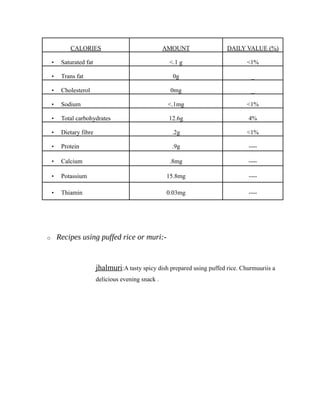
CALORIES AMOUNT DAILY VALUE (%)
• Saturated fat <.1 g <1%
• Trans fat 0g _
• Cholesterol 0mg _
• Sodium <.1mg <1%
• Total carbohydrates 12.6g 4%
• Dietary fibre .2g <1%
• Protein .9g ----
• Calcium .8mg ----
• Potassium 15.8mg ----
• Thiamin 0.03mg ----
o Recipes using puffed rice or muri:-
jhalmuri:A tasty spicy dish prepared using puffed rice. Churmuuriis a
delicious evening snack .
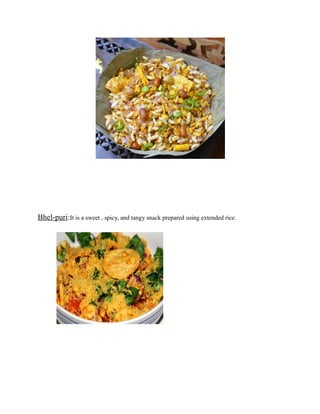
Bhel-puri:It is a sweet , spicy, and tangy snack prepared using extended rice.
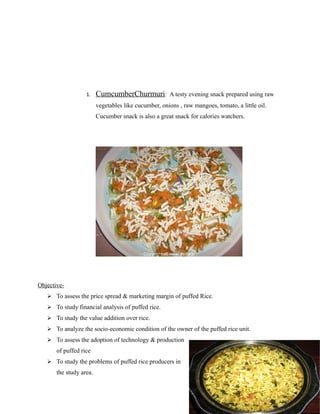
1. CumcumberChurmuri: A testy evening snack prepared using raw
vegetables like cucumber, onions , raw mangoes, tomato, a little oil.
Cucumber snack is also a great snack for calories watchers.
Objective-
 To assess the price spread & marketing margin of puffed Rice.
 To study financial analysis of puffed rice.
 To study the value addition over rice.
 To analyze the socio-economic condition of the owner of the puffed rice unit.
 To assess the adoption of technology & production
of puffed rice
 To study the problems of puffed rice producers in
the study area.
 To analyse the future prospects of the unit in the study area.
 To make strategies for survival of puffed rice production unit of Angula.
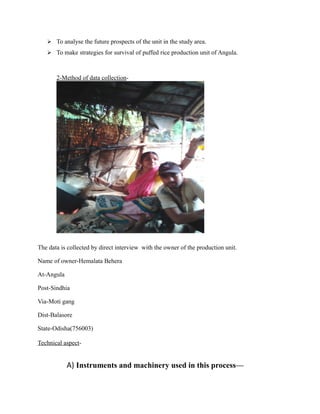
2-Method of data collection-
The data is collected by direct interview with the owner of the production unit.
Name of owner-Hemalata Behera
At-Angula
Post-Sindhia
Via-Moti gang
Dist-Balasore
State-Odisha(756003)
Technical aspect-
A) Instruments and machinery used in this process—
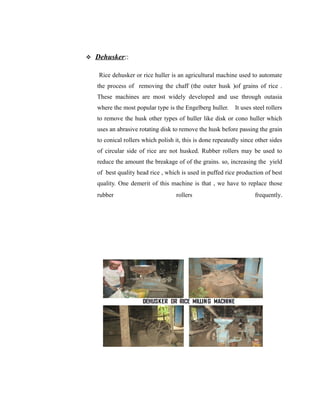
 Dehusker::
Rice dehusker or rice huller is an agricultural machine used to automate
the process of removing the chaff (the outer husk )of grains of rice .
These machines are most widely developed and use through outasia
where the most popular type is the Engelberg huller. It uses steel rollers
to remove the husk other types of huller like disk or cono huller which
uses an abrasive rotating disk to remove the husk before passing the grain
to conical rollers which polish it, this is done repeatedly since other sides
of circular side of rice are not husked. Rubber rollers may be used to
reduce the amount the breakage of of the grains. so, increasing the yield
of best quality head rice , which is used in puffed rice production of best
quality. One demerit of this machine is that , we have to replace those
rubber rollers frequently.
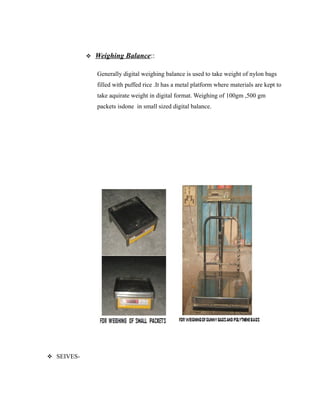
 Weighing Balance::
Generally digital weighing balance is used to take weight of nylon bags
filled with puffed rice .It has a metal platform where materials are kept to
take aquirate weight in digital format. Weighing of 100gm ,500 gm
packets isdone in small sized digital balance.
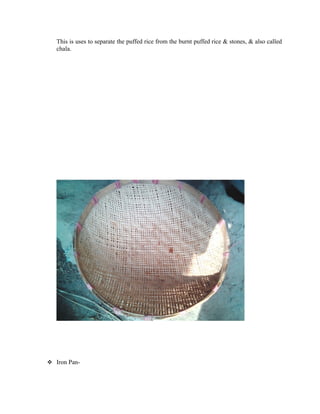
 SEIVES-
This is uses to separate the puffed rice from the burnt puffed rice & stones, & also called
chala.
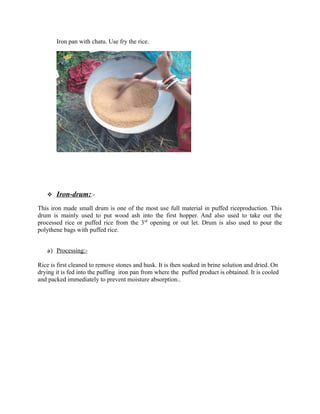
 Iron Pan-
Iron pan with chatu. Use fry the rice.
 Iron-drum::-
This iron made small drum is one of the most use full material in puffed riceproduction. This
drum is mainly used to put wood ash into the first hopper. And also used to take out the
processed rice or puffed rice from the 3rd
opening or out let. Drum is also used to pour the
polythene bags with puffed rice.
a) Processing:-
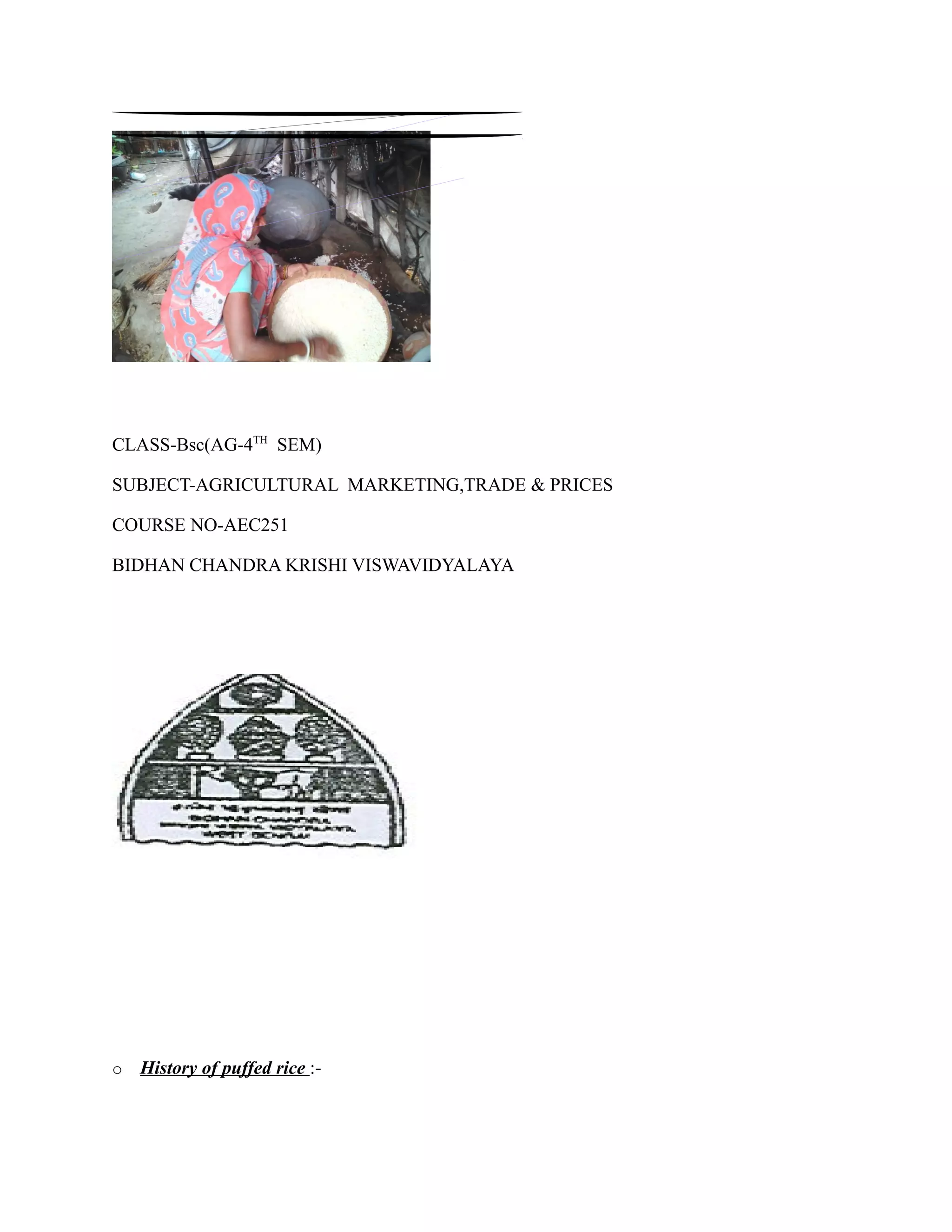
Rice is first cleaned to remove stones and husk. It is then soaked in brine solution and dried. On
drying it is fed into the puffing iron pan from where the puffed product is obtained. It is cooled
and packed immediately to prevent moisture absorption..
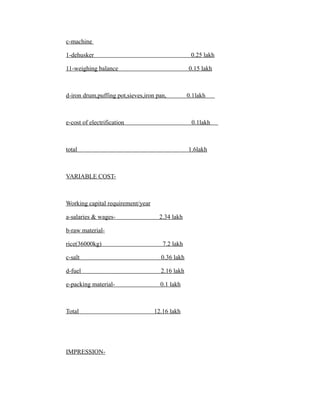
o Financial analysis-
Production capacity -
• The plant will be in operation for one shifts a day.
• The estimated production per day is 75 kilograms.
• The total production per month will be 2.25t while the annual production is
estimated at 27t
• The time period required for achieving full capacity utilization is one year.
Sales revenue-
The home made selling price will be Rs. 50 per kilogram thereby yielding a sales
revenue of Rs. 13.5 lakhs on full capacity utilization.
Fixed cost-
a-land own
b-building shed of 500sq ft 1lakh
c-machine
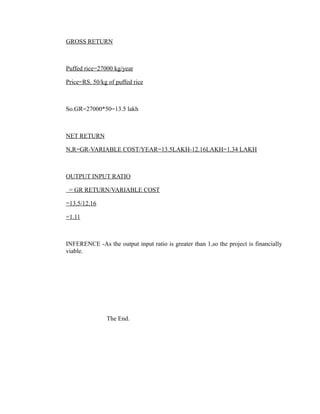
1-dehusker 0.25 lakh
11-weighing balance 0.15 lakh
d-iron drum,puffing pot,sieves,iron pan, 0.1lakh
e-cost of electrification 0.1lakh
total 1.6lakh
VARIABLE COST-
Working capital requirement/year
a-salaries & wages- 2.34 lakh
b-raw material-
rice(36000kg) 7.2 lakh
c-salt 0.36 lakh
d-fuel 2.16 lakh
e-packing material- 0.1 lakh
Total 12.16 lakh
IMPRESSION-
GROSS RETURN
Puffed rice=27000 kg/year
Price=RS. 50/kg of puffed rice
So.GR=27000*50=13.5 lakh
NET RETURN
N,R=GR-VARIABLE COST/YEAR=13.5LAKH-12.16LAKH=1.34 LAKH
OUTPUT INPUT RATIO
= GR RETURN/VARIABLE COST
=13.5/12.16
=1.11
INFERENCE -As the output input ratio is greater than 1,so the project is financially
viable.
The End.

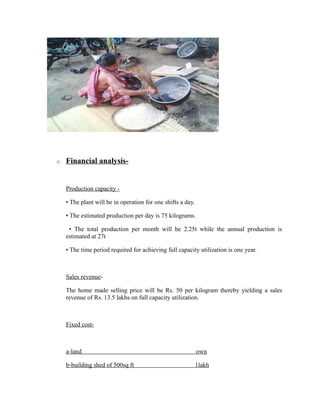
Home made puffed Rice

  • 1.
    CLASS-Bsc(AG-4TH SEM) SUBJECT-AGRICULTURAL MARKETING,TRADE &PRICES COURSE NO-AEC251 BIDHAN CHANDRA KRISHI VISWAVIDYALAYA o History of puffed rice :-
  • 2.
    Chandrasekhar and Chattopadhyay(1989)developed the pneumatic rice puffing machine for increasingthe production capacity of puffed rice. The physical properties of the rice grains and other fluidizationparameters, necessary for this study was experimentally determined. The surface heat transfer coefficient in caseof hot air fluidized bed puffing was found to be 155.39 W/m2K. The calculated grain surface temperature forpuffing was about 170°C and this did not vary significantly for experimental puffing air temperatures rangingfrom 200°C to 270°C. the air temperature ranging from 240°C to 270°C with corresponding exposure time of9.7 s to 7s was found to be optimum for higher expansion ratio (8.5 to 10) and better color of the product.Thetemperature differential between surface and center temperatures and between surface and average temperaturesof the grains at the time of puffing were found to vary linearly with various puffing air temperatures and theirratios remained almost constant at 2.056. Srivastava and Batra(1998) studied relationship between physical properties and popping qualities ofvarious genotypes of foxtail millet, finger millet, barnyard millet and pros millet. Significant differences inpuffing yield of various genotypes of above mentioned millets were observed. Of all the millets, the highestpopping yield (92.77%) and expansion volume (6.51) were observed for proso millet followed by finger millet,foxtail millet and barnyard millet. Foxtail millet revealed significant positive correlations between 1000-kernel weight and popping per cent; 1000 kernel weight and expansion volume; 1000-kernel volume and expansionvolume. Finger millet showed significant positive correlations between hydration capacity and popping per centand between per cent floaters and expansion volume . Madhuri(2002) studied physical and chemical characteristics of fifteen rice varieties and wereevaluated for popping and puffing qualities. The rice varieties showed a wide significant variation for Physicochemicaland processing qualities. Grain dimensions, L: B ratio, thousand kernel weight, volume and bulkdensity were strongly related to processing quality of rice varieties. The optimum total amylose content 27.60per cent and 13.40 percent hot water insoluble amylose of rice variety were found to be the best combination forbetter expansion of puffed and popped rice. Intan, a commercial cultivar showed superior puffing and poppingqualities over the newly developed rice varieties (Prasanna, MTU-1001, Mugadbasumati, and Pusa-basumati) aswell as earlier varieties (Dodiga, Udarsali, Navali etc.). IMPORTANCE-
  • 3.
    Paddy is themost important and extensively grown food crop in the World. It is one among the threeleading food crops of the world, i.e., rice, wheat, and maize. Although grown practically in all continents,climates and altitudes, about 90% of the world’s rice crop is grown as well as consumed in East, South-East andSouth Asia .Paddy is the staple food for 65% of the population in India. It is the largest consumed calorie sourceamong the food grains. With a per capita availability of 73.8 kg it meets 31% of the total calorie requirement ofthe population. India is the second largest producer of rice in the world next to China. India produces annuallyaround 93 Million Tons of paddy (2012-13). Changing of lifestyles, food habits, organized food retail and urbanization are the key factors forprocessed foods in India. These are the post-liberalization trends and they give boost to the processing sector.There has been a notable change in consumption pattern in India. Unlike earlier, now the share and growth ratesfor fruits, vegetables, meats and dairy have gone higher compared to cereals and pulses. Such a shift implies aneed to diversify the food production base to match the changing consumption preferences. Going by thispattern, in future, there will be demand for prepared meals, snack foods and convenience foods and further onthe demand would shift towards functional, organic and diet foods.Once milled, rice can be stored without refrigeration for over one year and consumed directly by thehousehold with no further major transformation except simple cooking. For these reasons, rice is generallyconsidered an “easy” food. Nonetheless, in response to new consumer needs, processing of raw rice into newproducts has been undertaken, with the development of instant rice, specialty a ready to serve rice value addedproducts viz., rice flour, starch and puffed food; cakes and puddings, baked bread and crackers; breakfastcereals; rice snacks and noodles, baby/weaning foods, canned rice, instant rice, expanded rice, flaked rice, ricemilk, fermented foods and beverages; pet foods and bran products etc. There are many ways of domestic uselike khichadi, pulav, kheer, zeerarice, iddli, dosa etc. Among them puffed rice is most important as a value added product of rice.There has been a remarkable growth in the varieties and popularity of such products because they are easily affordable, tasty, easy to make and nutritive. So without any doubt we can say that puffed rice is a very popular snack foodproduct in India and it has been widely produced for centuries. It has been estimated that about 10% of rice is converted into snack foods .The processing of puffed rice from paddy is traditionally takes about 6 days. Some of the tasks, particularly manual roasting of paddy and immersing in water, mixing
  • 4.
    the ingredients withmilled rice and stirring the rice in roaster pan for uniform heating are highly labour intensive operations. Though complete mechanization of the process has not yet been undertaken. This product is flavoured with cheese, spices, onion, garlic or chilly etc. It not only offers few calories but also provides low fat per serving & contains very little fibre .Now a days Muriproduction has been the main family business among many villages around India. In many area snacks typically given to children.,puffed rice is made into ball with jaggerysuger syrup..Murmura is a staple food of people of odisha,northernodisha. especiallyBaripada,Mayurbhajan district is disignificant for production of puffed rice. NGOs have taken forward initiatives to engage village women in muri production . Intellectual Property Rights (IPR) cell of Orissa University of Agriculture and Technology has decided to bring out Geographical indication registration of puffed rice .Central Government of India in the banner of Make in India decided puffed rice will be part Indian traditional food among 12 traditional dishes from different states that would be launched globally. o Nutritional aspect:- • Calories & macronutrients: One cup of puffed rice cereal provides 56 calories and just .1 gm of fat .The calories mostly come from the 13 g of carbohydrates. The cereal has only .9 g of protein, making it an insignificant source . • Vitamins & minerals :- Puffed rice is full of extra vitamins and minerals..It contain iron and vitamin B . One cup of puffed rice provides 25%of daily value of iron and niacin & 24% of thiamin; based on a 2000 calories diet. Cereals also provides 24% of daily need of riboflavin& 10% of manganese. We can use puffed rice to extend our serving sizes of more nutritious cereals. Eating puffed rice along may leave us feeling hungry sooner because it contains no fibr or protein . It provides at least 25% of most vitamins and minerals.
  • 5.
    CALORIES AMOUNT DAILYVALUE (%) • Saturated fat <.1 g <1% • Trans fat 0g _ • Cholesterol 0mg _ • Sodium <.1mg <1% • Total carbohydrates 12.6g 4% • Dietary fibre .2g <1% • Protein .9g ---- • Calcium .8mg ---- • Potassium 15.8mg ---- • Thiamin 0.03mg ---- o Recipes using puffed rice or muri:- jhalmuri:A tasty spicy dish prepared using puffed rice. Churmuuriis a delicious evening snack .
  • 6.
    Bhel-puri:It is asweet , spicy, and tangy snack prepared using extended rice.
  • 7.
    1. CumcumberChurmuri: Atesty evening snack prepared using raw vegetables like cucumber, onions , raw mangoes, tomato, a little oil. Cucumber snack is also a great snack for calories watchers. Objective-  To assess the price spread & marketing margin of puffed Rice.  To study financial analysis of puffed rice.  To study the value addition over rice.  To analyze the socio-economic condition of the owner of the puffed rice unit.  To assess the adoption of technology & production of puffed rice  To study the problems of puffed rice producers in the study area.
  • 8.
     To analysethe future prospects of the unit in the study area.  To make strategies for survival of puffed rice production unit of Angula. 2-Method of data collection- The data is collected by direct interview with the owner of the production unit. Name of owner-Hemalata Behera At-Angula Post-Sindhia Via-Moti gang Dist-Balasore State-Odisha(756003) Technical aspect- A) Instruments and machinery used in this process—
  • 9.
     Dehusker:: Rice dehuskeror rice huller is an agricultural machine used to automate the process of removing the chaff (the outer husk )of grains of rice . These machines are most widely developed and use through outasia where the most popular type is the Engelberg huller. It uses steel rollers to remove the husk other types of huller like disk or cono huller which uses an abrasive rotating disk to remove the husk before passing the grain to conical rollers which polish it, this is done repeatedly since other sides of circular side of rice are not husked. Rubber rollers may be used to reduce the amount the breakage of of the grains. so, increasing the yield of best quality head rice , which is used in puffed rice production of best quality. One demerit of this machine is that , we have to replace those rubber rollers frequently.
  • 10.
     Weighing Balance:: Generallydigital weighing balance is used to take weight of nylon bags filled with puffed rice .It has a metal platform where materials are kept to take aquirate weight in digital format. Weighing of 100gm ,500 gm packets isdone in small sized digital balance.  SEIVES-
  • 11.
    This is usesto separate the puffed rice from the burnt puffed rice & stones, & also called chala.  Iron Pan-
  • 12.
    Iron pan withchatu. Use fry the rice.  Iron-drum::- This iron made small drum is one of the most use full material in puffed riceproduction. This drum is mainly used to put wood ash into the first hopper. And also used to take out the processed rice or puffed rice from the 3rd opening or out let. Drum is also used to pour the polythene bags with puffed rice. a) Processing:- Rice is first cleaned to remove stones and husk. It is then soaked in brine solution and dried. On drying it is fed into the puffing iron pan from where the puffed product is obtained. It is cooled and packed immediately to prevent moisture absorption..
  • 13.
    o Financial analysis- Productioncapacity - • The plant will be in operation for one shifts a day. • The estimated production per day is 75 kilograms. • The total production per month will be 2.25t while the annual production is estimated at 27t • The time period required for achieving full capacity utilization is one year. Sales revenue- The home made selling price will be Rs. 50 per kilogram thereby yielding a sales revenue of Rs. 13.5 lakhs on full capacity utilization. Fixed cost- a-land own b-building shed of 500sq ft 1lakh
  • 14.
    c-machine 1-dehusker 0.25 lakh 11-weighingbalance 0.15 lakh d-iron drum,puffing pot,sieves,iron pan, 0.1lakh e-cost of electrification 0.1lakh total 1.6lakh VARIABLE COST- Working capital requirement/year a-salaries & wages- 2.34 lakh b-raw material- rice(36000kg) 7.2 lakh c-salt 0.36 lakh d-fuel 2.16 lakh e-packing material- 0.1 lakh Total 12.16 lakh IMPRESSION-
  • 15.
    GROSS RETURN Puffed rice=27000kg/year Price=RS. 50/kg of puffed rice So.GR=27000*50=13.5 lakh NET RETURN N,R=GR-VARIABLE COST/YEAR=13.5LAKH-12.16LAKH=1.34 LAKH OUTPUT INPUT RATIO = GR RETURN/VARIABLE COST =13.5/12.16 =1.11 INFERENCE -As the output input ratio is greater than 1,so the project is financially viable. The End.