16-06-17
1
1
Virtual	mirrors	and	
the	power	of	tangibility
Dr.	Tibert	Verhagen
2
• Introduction
• New	product	presentation technologies
• The	research:	three studies
Overview presentation
16-06-17
2
33
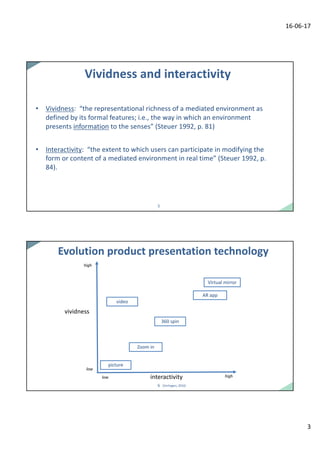
Online	shopping
• Buying on	distance
– Convenient
– Large	assortment
– Much information
– Efficiënt
• But	also:
– Limited	sensory experience
– Touch	and scent are	lacking
44
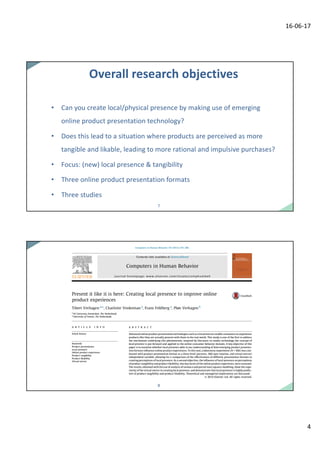
Online	product	presentations
16-06-17
3
55
Vividness	and	interactivity
• Vividness:	 “the representational richness of	a	mediated environment	as	
defined by its formal features;	i.e.,	the way	in	which an environment	
presents	information to the senses”	(Steuer 1992,	p.	81)
• Interactivity:	 “the extent to which users	can participate in	modifying the
form	or	content	of	a	mediated environment	in	real	time”	(Steuer 1992,	p.	
84).	
66
Evolution	product	presentation	technology
(Verhagen,	2016)
vividness
interactivity
high
high
low
low
picture
AR	app
360	spin
video
Zoom	in
Virtual	mirror
16-06-17
4
77
Overall	research	objectives
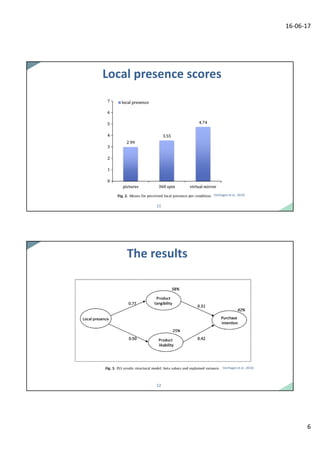
• Can you create local/physical presence by making	use of	emerging
online	product	presentation technology?
• Does	this lead	to a	situation where products are	perceived as	more	
tangible and likable,	leading to more	rational and impulsive purchases?
• Focus:	(new)	local presence &	tangibility
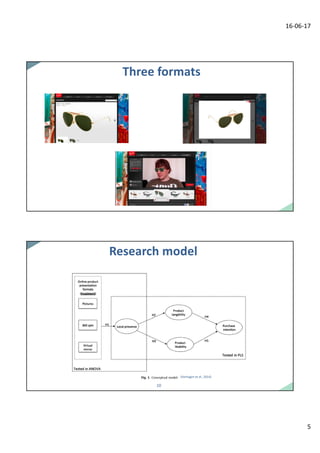
• Three	online	product	presentation formats
• Three	studies
88
16-06-17
5
99
Three	formats
1010
Research	model
(Verhagen	et	al.,	2014)
16-06-17
6
1111
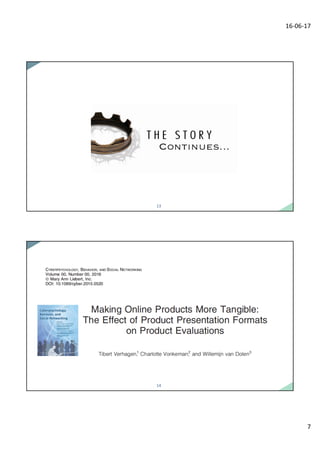
Local	presence	scores
(Verhagen	et	al.,	2014)
1212
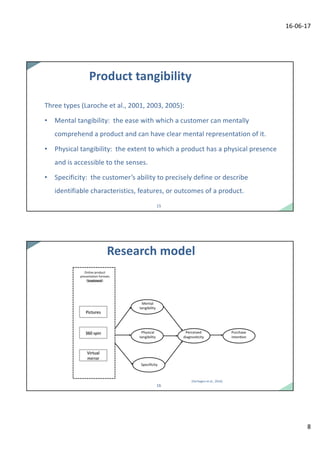
The	results
(Verhagen	et	al.,	2014)
16-06-17
7
1313
1414
16-06-17
8
1515
Product	tangibility
Three	types	(Laroche et	al.,	2001,	2003,	2005):
• Mental tangibility:	 the ease with which a	customer	can mentally
comprehend a	product	and can have	clear mental representation of	it.
• Physical tangibility:	 the extent to which a	product	has	a	physical presence
and is	accessible to the senses.
• Specificity:	 the customer’s ability to precisely define or	describe
identifiable characteristics,	features,	or	outcomes of	a	product.
1616
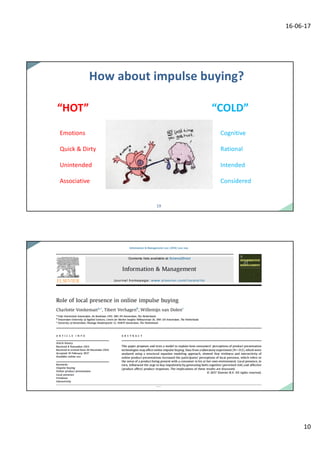
(Verhagen	et	al.,	2016)
Research	model
16-06-17
9
1717
(Verhagen	et	al.,	2016)
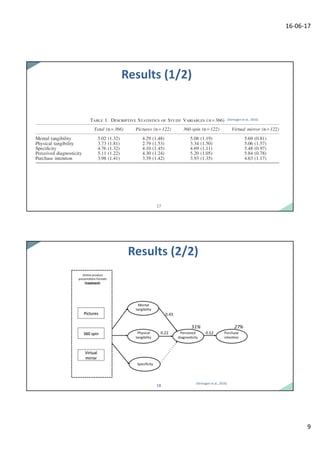
Results (1/2)
1818
(Verhagen	et	al.,	2016)
Results (2/2)
16-06-17
10
1919
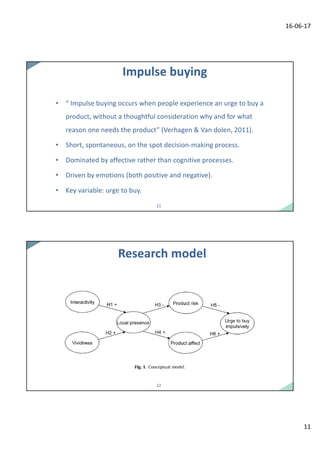
“HOT” “COLD”
Cognitive
Rational
Intended
Considered
How	about impulse buying?
Emotions
Quick	&	Dirty
Unintended
Associative
2020
16-06-17
11
2121
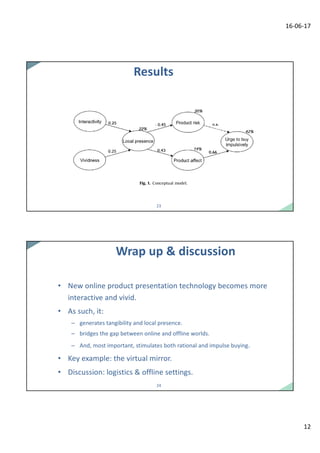
Impulse	buying
• “	Impulse	buying	occurs	when	people	experience	an	urge	to	buy	a	
product,	without	a	thoughtful	consideration	why	and	for	what	
reason	one	needs	the	product”	(Verhagen &	Van	dolen,	2011).
• Short,	spontaneous,	on	the	spot	decision-making	process.
• Dominated	by	affective	rather	than	cognitive	processes.
• Driven	by	emotions	(both	positive	and	negative).
• Key	variable:	urge	to	buy.
2222
Research	model
16-06-17
12
2323
Results
2424
Wrap up	&	discussion
• New	online	product	presentation	technology	becomes	more	
interactive	and	vivid.
• As	such,	it:
– generates	tangibility	and	local	presence.	
– bridges	the	gap	between	online	and	offline	worlds.
– And,	most	important,	stimulates	both	rational	and	impulse	buying.
• Key	example:	the	virtual	mirror.
• Discussion:	logistics	&	offline	settings.
16-06-17
13
2525
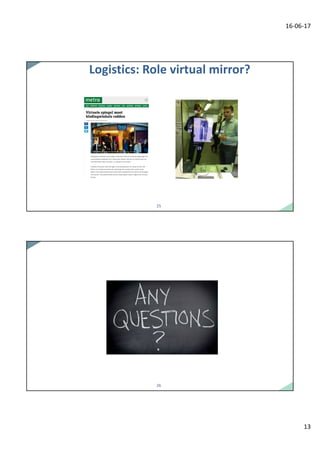
Logistics:	Role virtual	mirror?
2626
16-06-17
14
2727
Thank you for your attention!
Dr.	Tibert	Verhagen
Associate	professor	E-business
t.verhagen@hva.nl
@TibertVerhagen
2828
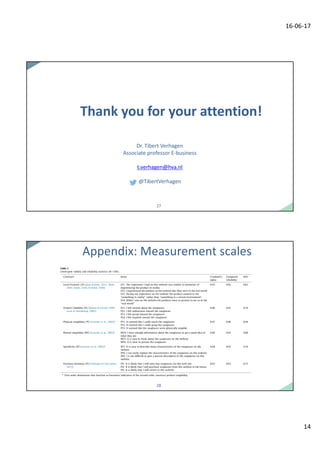
Appendix:	Measurement scales

Hogeschool van amsterdam