Submitted By:
Ravi ShankarTiwari
Roll: 47307
PRN : 24020141207
Marketing, B
The Future of AR/VR Technology in
Immersive Marketing
Digital Marketing
Experiential Learning
Assignment
Submitted To:
Prof. Nitin Kulkarni
Faculty of Digital Marketing
SIBM Pune
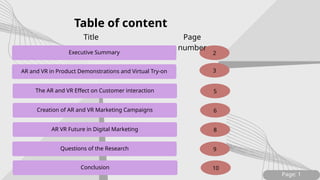
2.
Page: 1
Executive Summary2
Table of content
Title Page
number
AR and VR in Product Demonstrations and Virtual Try-on 3
The AR and VR Effect on Customer interaction 5
Creation of AR and VR Marketing Campaigns 6
AR VR Future in Digital Marketing 8
Questions of the Research 9
Conclusion 10
3.
Page: 2
Digital marketinghas been evolving speedily to be no longer as a static content but more of an interactive and
personalized customer experiences. The second jump is the immersive marketing, which is driven by Augmented
Reality (AR) and Virtual Reality (VR). The technologies bring the constraints on a two-dimensional advertising to the
brands by giving the customers the opportunity to engage with products and experiences in realistic, interactive
manners.
AR superimposes the digital content in the real environment with the help of smartphones, tablets, or AR glasses,
whereas VR builds entirely simulated space that makes the user engage in another reality. The combination of them
offers a chance to show products, narrate, engage with brands, and have unforgettable experiences.
This white paper discusses the role of AR and VR in changing the way products are demonstrated, interacting with
customers, developing a marketing campaign and the future of digital marketing in general. It also covers the main
research questions concerning the improvement of the customer experience and the adoption problems.
Executive
Summary
4.
Page: 3
1.1 ProductVisualization using AR.
AR also gives the customer the opportunity to see the products in the actual surroundings and then buy them. The
customers are able to see a 3D interactive model in lieu of flat product images.
Retail & Fashion: Sephora, Nykaa, and Warby Parker are retail brands that feature AR filters and apps that enable the
customer to virtually apply makeup or put on sunglasses or clothes. This eradicates indecisiveness in buying behaviour.
• Furniture and Home Decoration: IKEA AR application, which it calls IKEA Place allows customers to place virtual IKEA
furniture in their rooms. They are able to observe the compatibility of the product with the space, color scheme and
size.
This aspect greatly minimizes the returns and enhances the purchase confidence since customers believe that they are
making informed choices.
AR and VR in Product Demonstrations and Virtual Try-on
5.
Page: 4
1.2 VirtualReality to be used in demonstrations.
VR involves the development of complete product experiences, whereby, customers need to be able to find out more in
a realistic setting.
As an example of a VR-powered industry, we can consider the automotive industry: VR car showrooms are designed to
provide customers with an opportunity to test-drive vehicles, to customize car components (upholstery or paint color)
or to simulate driving. Audi and BMW have also embraced the use of VR showrooms to minimize the use of brick-and-
mortar stores.
• Real Estate: VR tours of property enable the potential buyers to stroll around a flat, house or a business premise
remotely. They will be able to look at layouts, room sizes, and finishes in detail - even without having to physically
attend the site.
1.3 Advantages of AR/VR Demonstrations.
• Less product returns: Before purchasing the products, customers have achievable expectations.
• Makes it more personal: It is possible to make experiences more personal to the customer (e.g., selecting colors,
styles).
• Gains customer loyalty: Open representation of products builds more trust in the customers towards their choice.
• Saves time and saves money: Decreases to visit the premises or a huge physical display of inventory.
AR and VR in Product Demonstrations and Virtual Try-on
6.
Page: 5
2.1 EnhancedInteractivity
AR/VR experiences are not passive, as opposed to digital ads. The customers are turned into co-creators, rather than spectators, of their experiences.
To illustrate, Snapchat AR effects prompt users to interact with brands and also share on social media, which has an increased reach.
2.2 Emotional Connection
VR specifically is very effective in storytelling. The degree of emotion is very high as it throws customers into an environment compared to the
traditional advertising.
Example: TOMS Shoes VR campaign took customers to Peru where they were able to view their social impact of their purchases in real-time. This
further emotional involvement in the mission of the brand.
2.3 Data-Driven Engagement
AR and VR can offer data that is not available in other platforms. For instance:
Eye-tracking VR reveals the most attention-gaining features to customers.
Interaction logs: These logs capture the duration taken by the users to interact with every product.
Heatmaps are capable of showing areas of interest during virtual tours.
Such data-driven insights enable the marketer to optimize campaigns, personalize customer journeys, as well as quantify return on investment (ROI).
2.4 Impact Metrics
• Engagement: It has been found that AR campaigns get twice the engagement as traditional banner advertisements.
• Brand Recall: VR advertisements are more likely to be remembered up to 70 percent since immersive conditions generate an unforgettable
experience.
• Conversion Rates: Sales of AR-based brands that offer try-on options have grown by a considerable margin, with the reluctance to buy decreased.
The AR and VR Effect on Customer interaction
7.
Page: 6
3.1 Thecampaign development strategic framework will be outlined in the following section (3.1).
1. Define Objectives:
• Awareness: create brand awareness in distinctive AR experiences.
• Consideration: Have in-depth product demos to help in decision-making.
• Conversion: AR try-ons will help increase purchase confidence.
• Loyalty: Game customer experience to foster repeat.
2. Choose the Technology:
• AR is more available (phone based). It is perfect in terms of mass-scale adoption.
• VR involves the use of headsets, but it is more immersive. It is effective with the high-pricing products (real estate,
luxury vehicles).
3. Content Creation:
• 3D modeling, gamification, and story-driven aspects are involved.
Brands usually cooperate with expert AR/VR developers, to develop experiences.
4. Integration:
• Integrate AR into apps (e.g. AR try-on in shopping apps).
• Apply social media AR filters (Instagram, Snapchat).
• develop VR experiences that can be used at events or within the stores through headsets.
Creation of AR and VR Marketing
Campaigns
8.
Page: 7
3.2 RealCampaign Examples
• Pepsi Max AR Bus Shelter Campaign (UK): Transformed an ordinary bus shelter into an AR experience that allowed
people who crossed by the bus shelter to see flying sauces and tigers. This has gone viral on social media which has
enhanced the visibility of the brand.
• Nike AR Sneaker Try-On: The shopper could use phone cameras to review how the sneakers would fit his or her feet,
making it easier to shop online.
• Samsung VR Experience: Visited on launch events in order to show the strength of new smartphone displays and
cameras.
3.3 Campaign Success Factors.
• Accessibility: The campaign should work with devices that are prevalent.
• Simplicity: The design should be easy to use so that the customers do not drop out.
• Scalability: The campaigns are supposed to be applicable in other geographies and platforms.
• Shareability: It can be integrated with social media and make experiences go viral.
Creation of AR and VR Marketing
Campaigns
9.
4.1 The combinationwith AI and the Metaverse is 4.1.
• Personalization with the help of AI: AR/VR experiences will be hyper-personalized and they will present customers
with recommendations and suggestions based on preferences and prior engagements.
• Making the virtual world more real: The companies such as Meta (Facebook) are dreaming of complete digital worlds,
where they can invite customers to branded events, to virtual malls, or interact with products as avatars.
4.2 Growth in other industries.
• Healthcare VR is being employed by Pharma companies to simulate a treatment or demonstrate medical equipment.
• Tourism: Travel agencies have been utilizing AR to give people a preview of where they are going or VR to allow
people to do a virtual walk through of a city before they book.
• Education & Training: AR/VR training modules are sponsored by companies and indirectly promote their products
(e.g. a sportswear brand in fitness training modules).
4.3 Growth and Opportunities Projections.
Market: The AR/VR is projected to reach a new high of 94 billion in marketing by 2030.
The establishment of 5G networks will make the implementation of AR applications much smoother and real-time.
• Hardware, including AR glasses (Will Apple Vision Pro, Meta Quest) will be cheaper, which will increase the number of
users.
Page: 8
AR VR Future in Digital
Marketing
10.
Q) What arethe ways in which AR and VR can be used to optimize customer experience in digital marketing?
•
➡️ Immersive Interactions: Customers experience products in realistic experiences, and they develop confidence.
• Emotional Storytelling: Forms more powerful customer-brand relationship.
• Get-To-Know: Virtual try-ons lessen the remorse of buying a product.
• Personalization and Convenience: It is customized and can be accessed everywhere all the time.
Q) What are the issues of applying AR and VR in marketing strategies?
•
➡️ Large Development Costs: The development of realistic 3D content and campaigns takes money.
• Barriers to a device: Not every consumer possesses a VR headset or device that is compatible with AR.
• User Adoption: There is a possibility of some audiences being unwilling to accept the new technologies because of
unfamiliarity.
• Privacy Issues: It is possible to violate ethical and legal expectations when it comes to monitoring user interactions.
• Scalability: It can be complicated to campaign in global markets in a tailored way.
Page: 9
Questions of the
Research.
11.
AR and VRare not just an experimental device, but it is also finding its way into the
future of digital marketing. They enable the brands to develop an immersive
experience, which increases the level of engagement, boosts the purchase
confidence and fosters the emotional attachment towards the consumers.
Although the obstacles in the form of cost, accessibility, and data privacy persist, first
movers are already enjoying competitive advantages. With these technologies
coming together with AI, 5G, and the Metaverse, marketers who strategically invest
in AR and VR will have the ability to provide customers with memorable and
personalized, interactive experiences that redefine expectations in the digital age.
Page: 10
Conclusion