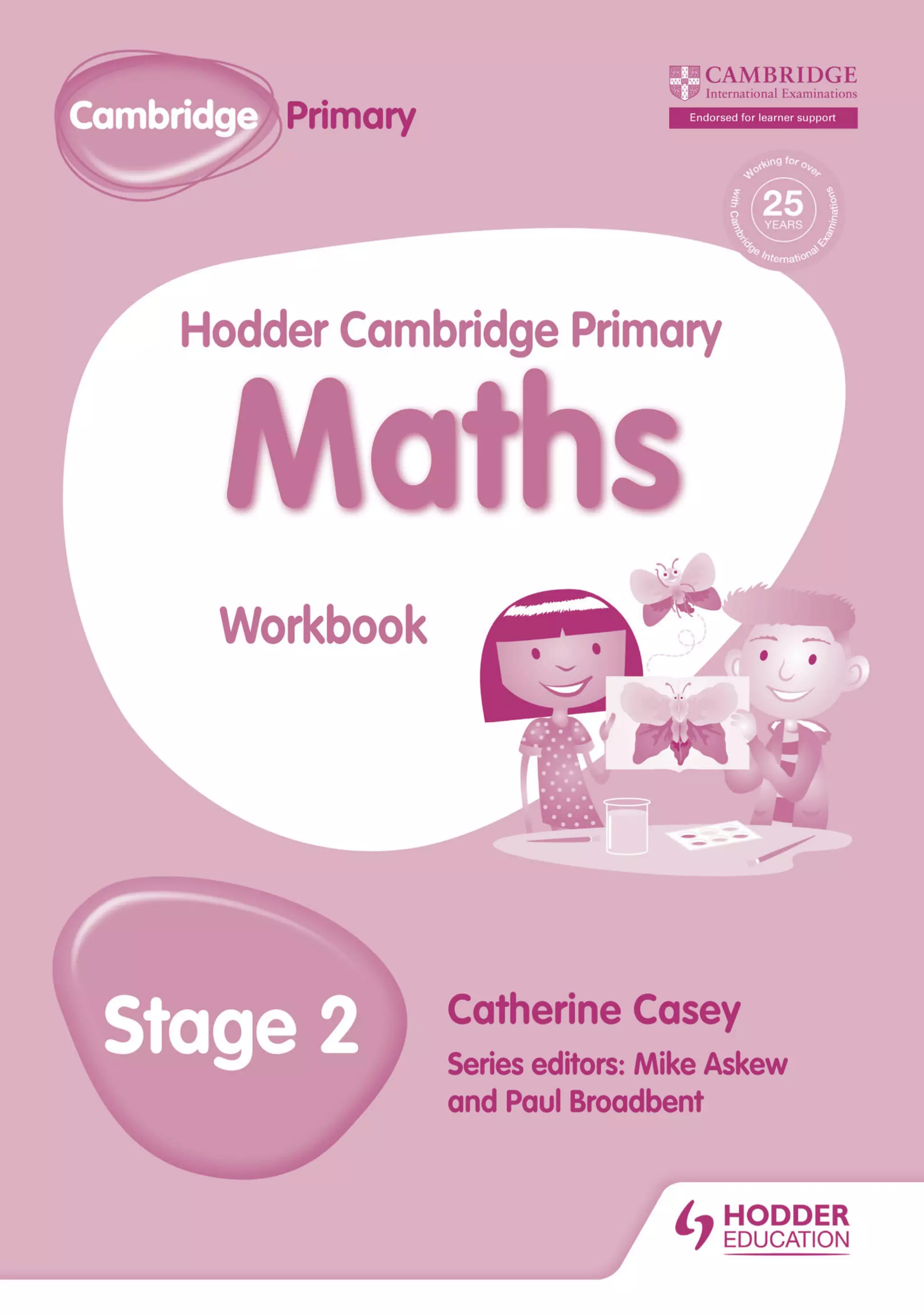
Catherine Casey
Series editors: Mike Askew
and Paul Broadbent
Stage 2
Workbook
Hodder Cambridge Primary
Maths
Cambridge Primary
884597_MATHS_WORKBOOK_S2_TP.indd 1 28/02/2017 11:44
884597_MATH_WORKBOOK_S2.indb 1 2017/05/03 6:27 PM
Acknowledgements
With warm thanks to Jennifer Peek for her help in shaping and developing this title.
The Publisher is extremely grateful to the following schools for their comments and feedback during
the development of this series:
Avalon Heights World Private School, Ajman
The Oxford School, Dubai
Al Amana Private School, Sharjah
British International School, Ajman
Wesgreen International School, Sharjah
As Seeb International School, Al Khoud.
Every effort has been made to trace all copyright holders, but if any have been inadvertently
overlooked the Publishers will be pleased to make the necessary arrangements at the first
opportunity.
Although every effort has been made to ensure that website addresses are correct at time of going to
press, Hodder Education cannot be held responsible for the content of any website mentioned in this
book. It is sometimes possible to find a relocated web page by typing in the address of the home page
for a website in the URL window of your browser.
Hachette UK’s policy is to use papers that are natural, renewable and recyclable products and made
from wood grown in sustainable forests. The logging and manufacturing processes are expected to
conform to the environmental regulations of the country of origin.
Orders: please contact Bookpoint Ltd, 130 Milton Park, Abingdon, Oxon OX14 4SB. Telephone:
(44) 01235 827720. Fax: (44) 01235 400454. Lines are open from 9.00–5.00, Monday to Saturday,
with a 24-hour message answering service. You can also order through our website
www.hoddereducation.com
© Catherine Casey 2017
Published by Hodder Education
An Hachette UK Company
Carmelite House, 50 Victoria Embankment, London EC4Y 0DZ
Impression number	 1 2 3 4 5
Year		 2021 2020 2019 2018 2017
All rights reserved. Apart from any use permitted under UK copyright law, no part of this publication
may be reproduced or transmitted in any form or by any means, electronic or mechanical, including
photocopying and recording, or held within any information storage and retrieval system, without
permission in writing from the publisher or under licence from the Copyright Licensing Agency
Limited. Further details of such licences (for reprographic reproduction) may be obtained from the
Copyright Licensing Agency Limited, Saffron House, 6–10 Kirby Street, London EC1N 8TS.
Cover illustration by Steve Evans
Illustrations by Karen Ahlschläger, Jeanne du Plessis and Anna-Marie Brink
Typeset in FS Albert 17/19 by DTP Impressions
Printed in Great Britain by Hobbs the Printers Ltd, Totton, Hampshire SO40 3WX
A catalogue record for this title is available from the British Library
9781471884597
884597_MATH_WORKBOOK_S2.indb 2 2017/05/03 6:27 PM
Contents
Unit 1 Number and problem solving	 4
Unit 2 Geometry and problem solving	 11
Unit 3 Number and problem solving	 18
Unit 4 Measure and problem solving	 25
Term 1
Unit 6 Number and problem solving	 32
Unit 7 Handling data and problem solving	 39
Unit 8 Number and problem solving	 45
Unit 9 Measure and problem solving	 51
Term 2
Unit 11 Number and problem solving	 57
Unit 12 Geometry and problem solving	 63
Unit 13 Number and problem solving	 69
Unit 14 Measure and problem solving	 75
Term 3
884597_MATH_WORKBOOK_S2.indb 3 2017/05/03 6:27 PM
4
Can you remember?
a One less than 6 is .	 b Ten less than 32 is .
c One more than 14 is .	 d Ten more than 8 is .
Numbers to 100
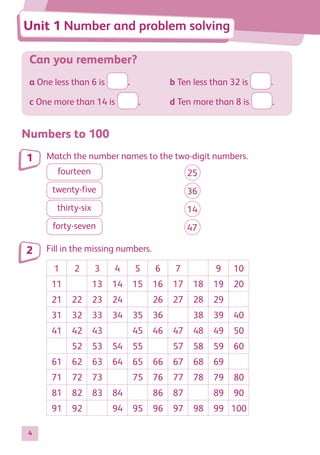
Match the number names to the two-digit numbers.
fourteen
	 25
twenty-five
	 36
thirty-six
	 14
forty-seven
	 47
Fill in the missing numbers.
1 2 3 4 5 6 7 9 10
11 13 14 15 16 17 18 19 20
21 22 23 24 26 27 28 29
31 32 33 34 35 36 38 39 40
41 42 43 45 46 47 48 49 50
52 53 54 55 57 58 59 60
61 62 63 64 65 66 67 68 69
71 72 73 75 76 77 78 79 80
81 82 83 84 86 87 89 90
91 92 94 95 96 97 98 99 100
1
2
Unit 1 Number and problem solving
884597_MATH_WORKBOOK_S2.indb 4 2017/05/03 6:27 PM
Unit 1 Number and problem solving
5
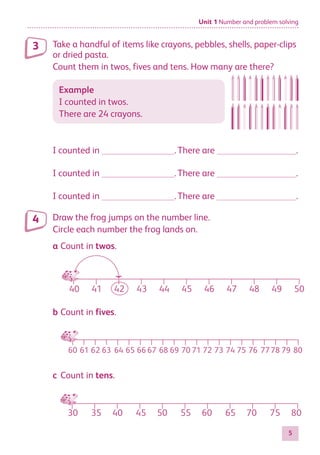
Take a handful of items like crayons, pebbles, shells, paper-clips
or dried pasta.
Count them in twos, fives and tens. How many are there?
Example
I counted in twos.
There are 24 crayons.
I counted in 	 .	There are 	 .
Draw the frog jumps on the number line.
Circle each number the frog lands on.
a	Count in twos.
40 42 44 46 48 50
30 40 50 60 70 80
75
65
55
45
35
60 62
61 63 64 65 71 80
79
7778
76
75
74
73
41 43 45 47 49
66 67 68 69 70 72
b	Count in fives.
40 42 44 46 48 50
30 40 50 60 70 80
75
65
55
45
35
60 62
61 63 64 65 71 80
79
7778
76
75
74
73
41 43 45 47 49
66 67 68 69 70 72
c	Count in tens.
40 42 44 46 48 50
30 40 50 60 70 80
75
65
55
45
35
41 43 45 47 49
3
4
884597_MATH_WORKBOOK_S2.indb 5 2017/05/03 6:27 PM
Unit 1 Number and problem solving
6
Comparing numbers
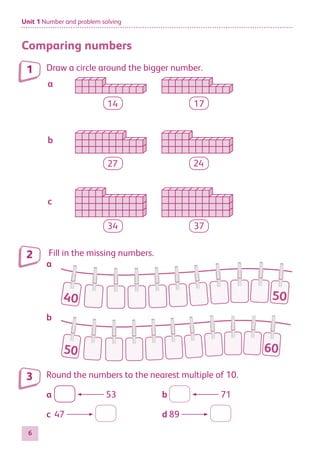
Draw a circle around the bigger number.
14 17
27 24
34 37
a
b
c
Fill in the missing numbers.
a
40 50
b
50 60
Round the numbers to the nearest multiple of 10.
a	 53	 b	 71
c	47 	 d	89
1
2
3
884597_MATH_WORKBOOK_S2.indb 6 2017/05/03 6:27 PM
Unit 1 Number and problem solving
7
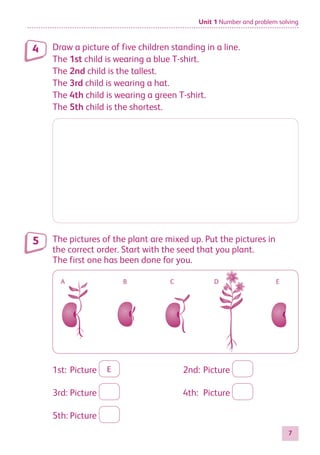
Draw a picture of five children standing in a line.
The 1st child is wearing a blue T-shirt.
The 2nd child is the tallest.
The 3rd child is wearing a hat.
The 4th child is wearing a green T-shirt.
The 5th child is the shortest.
The pictures of the plant are mixed up. Put the pictures in
the correct order. Start with the seed that you plant.
The first one has been done for you.
A B C D E
1st:	Picture E 	 2nd:	Picture
3rd:	Picture 	 4th:	Picture
5th:	Picture
4
5
884597_MATH_WORKBOOK_S2.indb 7 2017/05/03 6:27 PM
Unit 1 Number and problem solving
8
Number and place value
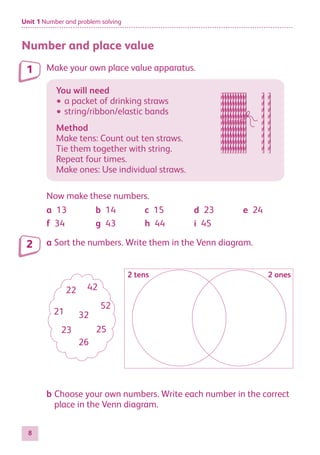
Make your own place value apparatus.
You will need
• a packet of drinking straws
• string/ribbon/elastic bands
Method
Make tens: Count out ten straws.
Tie them together with string.
Repeat four times.
Make ones: Use individual straws.
Now make these numbers.
a  13 b  14 c  15 d  23 e  24
f  34 g  43 h  44 i  45
a	Sort the numbers. Write them in the Venn diagram.
21
22
23
32
42
25
52
26
2 tens 2 ones
b	Choose your own numbers. Write each number in the correct
place in the Venn diagram.
1
2
884597_MATH_WORKBOOK_S2.indb 8 2017/05/03 6:27 PM
Unit 1 Number and problem solving
9
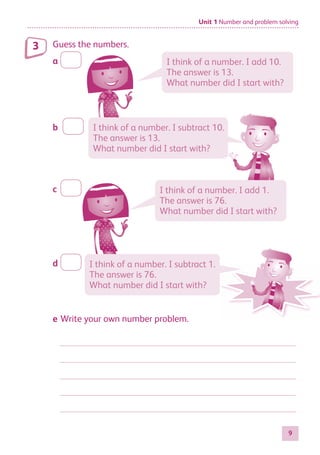
Guess the numbers.
a
b
c
d
e Write your own number problem.
3
I think of a number. I add 10.
The answer is 13.
What number did I start with?
I think of a number. I add 1.
The answer is 76.
What number did I start with?
I think of a number. I subtract 10.
The answer is 13.
What number did I start with?
I think of a number. I subtract 1.
The answer is 76.
What number did I start with?
884597_MATH_WORKBOOK_S2.indb 9 2017/05/03 6:27 PM
10
Unit 1 Number and problem solving
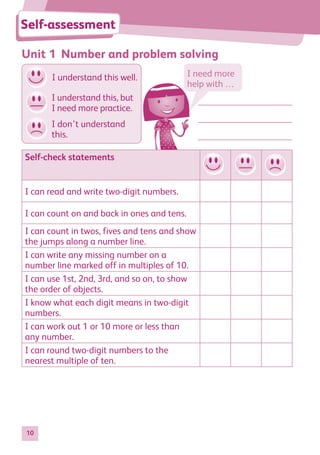
Self-assessment
Self-check statements
I can read and write two-digit numbers.
I can count on and back in ones and tens.
I can count in twos, fives and tens and show
the jumps along a number line.
I can write any missing number on a
number line marked off in multiples of 10.
I can use 1st, 2nd, 3rd, and so on, to show
the order of objects.
I know what each digit means in two-digit
numbers.
I can work out 1 or 10 more or less than
any number.
I can round two-digit numbers to the
nearest multiple of ten.
I need more
help with …
I don’t understand
this.
I understand this well.
I understand this, but
I need more practice.
884597_MATH_WORKBOOK_S2.indb 10 2017/05/03 6:27 PM
11
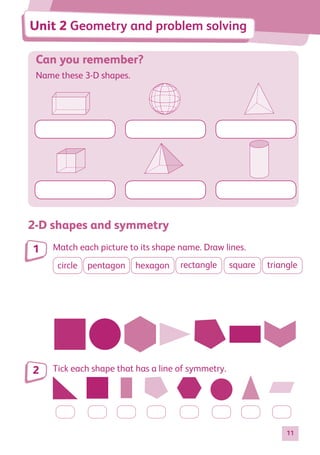
Can you remember?
Name these 3-D shapes.
2-D shapes and symmetry
Match each picture to its shape name. Draw lines.
circle pentagon hexagon rectangle square triangle
Tick each shape that has a line of symmetry.
1
2
Unit 2 Geometry and problem solving
884597_MATH_WORKBOOK_S2.indb 11 2017/05/03 6:27 PM
Unit 2 Geometry and problem solving
12
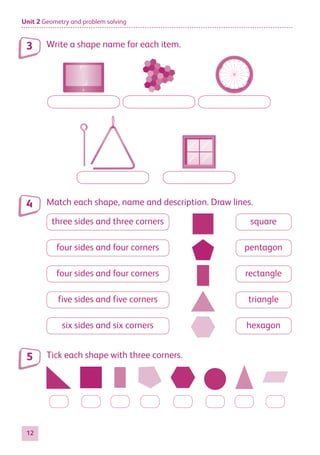
Write a shape name for each item.
Match each shape, name and description. Draw lines.
three sides and three corners
four sides and four corners
five sides and five corners
six sides and six corners
square
pentagon
rectangle
triangle
hexagon
Tick each shape with three corners.
3
4
5
884597_MATH_WORKBOOK_S2.indb 12 2017/05/03 6:27 PM
Unit 2 Geometry and problem solving
13
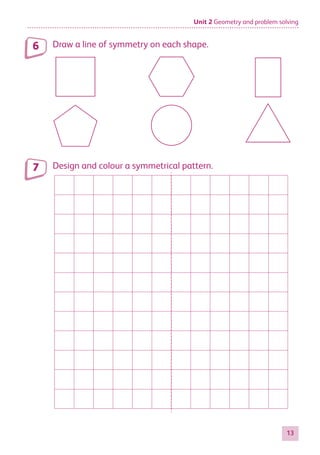
Draw a line of symmetry on each shape.
Design and colour a symmetrical pattern.
6
7
884597_MATH_WORKBOOK_S2.indb 13 2017/05/03 6:27 PM
Unit 2 Geometry and problem solving
14
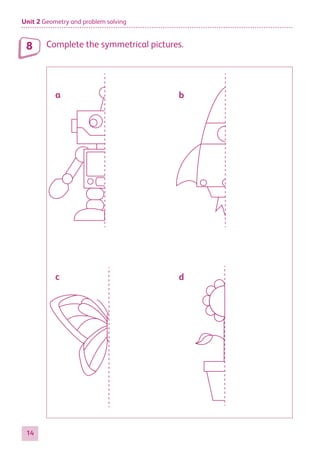
Complete the symmetrical pictures.
8
a b
c d
884597_MATH_WORKBOOK_S2.indb 14 2017/05/03 6:27 PM
Unit 2 Geometry and problem solving
15
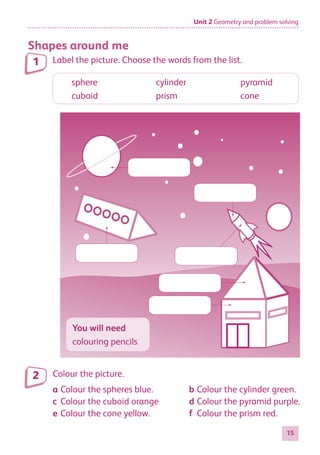
Shapes around me
Label the picture. Choose the words from the list.
sphere	 cylinder	pyramid
cuboid	prism	 cone
You will need
colouring pencils
Colour the picture.
1
2
a	Colour the spheres blue.
c	Colour the cuboid orange
e	Colour the cone yellow.
b	Colour the cylinder green.
d	Colour the pyramid purple.
f	 Colour the prism red.
884597_MATH_WORKBOOK_S2.indb 15 2017/05/03 6:27 PM
Unit 2 Geometry and problem solving
16
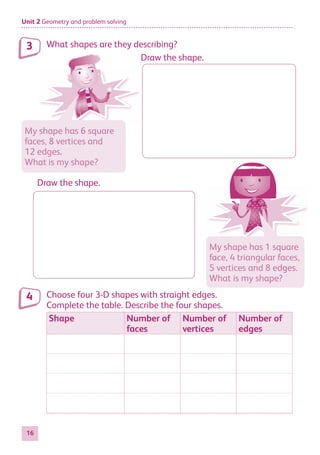
What shapes are they describing?
Choose four 3-D shapes with straight edges.
Complete the table. Describe the four shapes.
Shape Number of
faces
Number of
vertices
Number of
edges
3
4
My shape has 6 square
faces, 8 vertices and
12 edges.
What is my shape?
My shape has 1 square
face, 4 triangular faces,
5 vertices and 8 edges.
What is my shape?
Draw the shape.
Draw the shape.
884597_MATH_WORKBOOK_S2.indb 16 2017/05/03 6:27 PM
17
Unit 2 Geometry and problem solving
Self-assessment
Self-check statements
I can look at pictures of 2-D shapes and
name them.
I can sort sets of 2-D shapes in different
ways.
I can describe different shapes and talk
about their properties.
I can draw a line of symmetry on a shape.
I can complete a symmetrical picture by
drawing the ‘other half’.
I can name 3-D shapes.
I can find and describe shapes around me.
I can describe the 2-D shapes on the faces
of 3-D shapes.
I need more
help with …
I don’t understand
this.
I understand this well.
I understand this, but
I need more practice.
884597_MATH_WORKBOOK_S2.indb 17 2017/05/03 6:27 PM
18
Can you remember?
6 + = 20 5 + = 20 4 + = 20
20 – = 15 20 – = 14 20 – = 13
Number facts
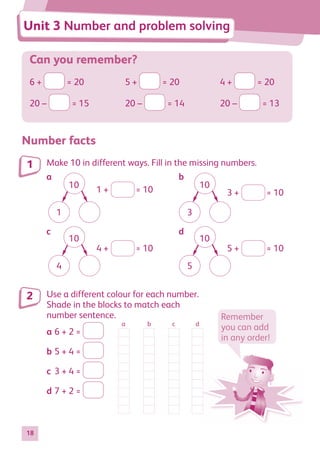
Make 10 in different ways. Fill in the missing numbers.
10
1
10
4
10
3
10
5
1 + = 10 3 + = 10
4 + = 10 5 + = 10
Use a different colour for each number.
Shade in the blocks to match each
number sentence.
a 6 + 2 =
b 5 + 4 =
c 3 + 4 =
d 7 + 2 =
1
2
a b c d
Remember
you can add
in any order!
Unit 3 Number and problem solving
a b
c d
884597_MATH_WORKBOOK_S2.indb 18 2017/05/03 6:27 PM
Unit 3 Number and problem solving
19
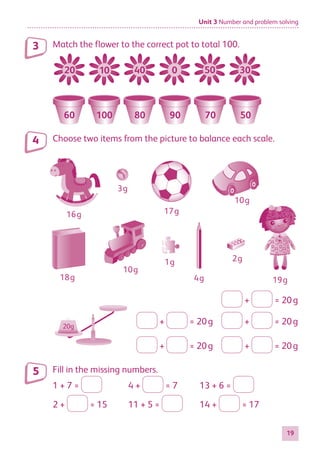
Match the flower to the correct pot to total 100.
10 0
20 30
40 50
100 80 90 70 50
60
Choose two items from the picture to balance each scale.
3g
18g
16g
10g
1g
17g
4g 19g
10g
2g
20g
+ = 20g
+ = 20g + = 20g
+ = 20g + = 20g
Fill in the missing numbers.
1 + 7 = 4 + = 7 13 + 6 =
2 + = 15 11 + 5 = 14 + = 17
3
4
5
884597_MATH_WORKBOOK_S2.indb 19 2017/05/03 6:27 PM
Unit 3 Number and problem solving
20
Addition and subtraction
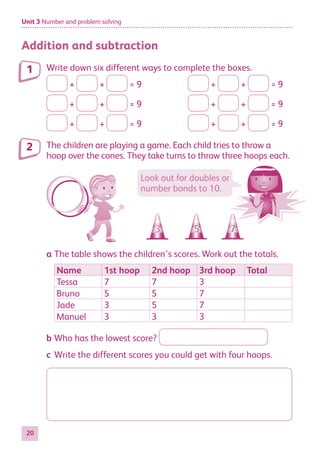
Write down six different ways to complete the boxes.
+ + = 9 + + = 9
+ + = 9 + + = 9
+ + = 9 + + = 9
The children are playing a game. Each child tries to throw a
hoop over the cones. They take turns to throw three hoops each.
7
3 5
a The table shows the children’s scores. Work out the totals.
Name 1st hoop 2nd hoop 3rd hoop Total
Tessa 7 7 3
Bruno 5 5 7
Jade 3 5 7
Manuel 3 3 3
b Who has the lowest score?
c Write the different scores you could get with four hoops.
1
2
7
Look out for doubles or
number bonds to 10.
884597_MATH_WORKBOOK_S2.indb 20 2017/05/03 6:27 PM
Unit 3 Number and problem solving
21
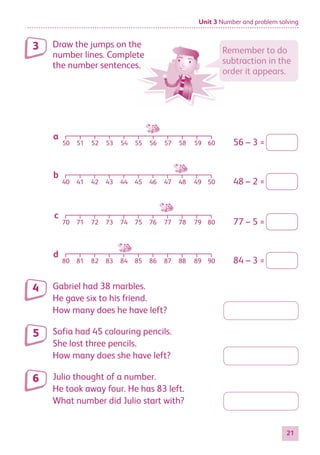
Draw the jumps on the
number lines. Complete
the number sentences.
number lines. Complete
the number sentences.
Remember to do
subtraction in the
order it appears.
70 72 74 76 78
71 73 75 77 80
79
c
77 – 5 =
80
d
82 84 86 88
81 83 85 87 90
89 84 – 3 =
50 52 54 56 58
51 53 55 57 60
59
a
56 – 3 =
40 42 44 46 48
41 43 45 47 50
49
b
48 – 2 =
Gabriel had 38 marbles.
He gave six to his friend.
How many does he have left?
Sofia had 45 colouring pencils.
She lost three pencils.
How many does she have left?
Julio thought of a number.
He took away four. He has 83 left.
What number did Julio start with?
3
4
5
6
884597_MATH_WORKBOOK_S2.indb 21 2017/05/03 6:27 PM
Unit 3 Number and problem solving
22
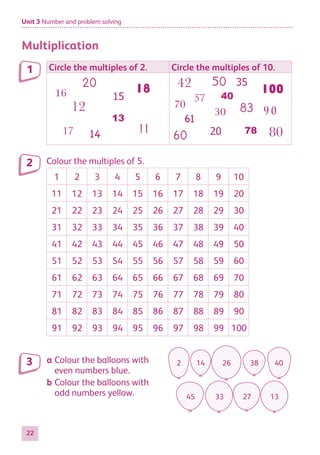
Multiplication
Circle the multiples of 2. Circle the multiples of 10.
20 18
12
16
17
15
11
13
14
83
50
60
100
42
80
70
30
57
20
35
90
40
78
61
Colour the multiples of 5.
1 2 3 4 5 6 7 8 9 10
11 12 13 14 15 16 17 18 19 20
21 22 23 24 25 26 27 28 29 30
31 32 33 34 35 36 37 38 39 40
41 42 43 44 45 46 47 48 49 50
51 52 53 54 55 56 57 58 59 60
61 62 63 64 65 66 67 68 69 70
71 72 73 74 75 76 77 78 79 80
81 82 83 84 85 86 87 88 89 90
91 92 93 94 95 96 97 98 99 100
a	Colour the balloons with
even numbers blue.
b	Colour the balloons with
odd numbers yellow.
1
2
2 14 26
45
40
38
33 27 13
3
884597_MATH_WORKBOOK_S2.indb 22 2017/05/03 6:27 PM
Unit 3 Number and problem solving
23
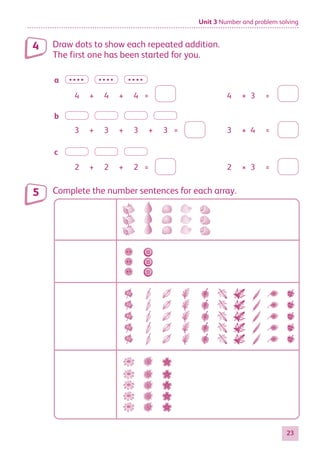
Draw dots to show each repeated addition.
The first one has been started for you.
a • • • • • • • • • • • •
4 + 4 + 4 4 × 3 =
b
3 + 3 + 3 + 3 3 × 4 =
c
2 + 2 + 2 2 × 3 =
Complete the number sentences for each array.
4
5
=
=
=
884597_MATH_WORKBOOK_S2.indb 23 2017/05/03 6:27 PM
24
Unit 3 Number and problem solving
Self-assessment
Self-check statements
I know the number bonds to 10.
I can use number bonds to 10 to find
multiples of 10 that total 100.
I can work out the addition and subtraction
facts for all numbers to 20.
I can add sets of small numbers together.
I can use the +, – and = signs when I add
and subtract.
I can add small numbers to any number up
to 100.
I can show that multiplication is the same
as repeated addition.
I can use an array to show a multiplication.
I can recognise some multiples of 2, 5
and 10.
I can recognise odd and even numbers.
I need more
help with …
I don’t understand
this.
I understand this well.
I understand this, but
I need more practice.
884597_MATH_WORKBOOK_S2.indb 24 2017/05/03 6:27 PM
25
Can you remember?
months in a year	
	 days in a week
minutes in an hour	 seconds in a minute
Money
Match each purse or hand to the correct amount of money.
The first one has been done for you.
7c $6
$3
21c
35c $11
a b c
d e f
c
Tick three coins to make each total.
a
c
e
7c
25c
35c
16c
31c
45c
b
d
f
1
2
Unit 4 Measure and problem solving
884597_MATH_WORKBOOK_S2.indb 25 2017/05/03 6:27 PM
Unit 4 Measure and problem solving
26
How much do you pay for stationery?
$11
$1
$3
$4
Glue
$6
$2
Items bought Work out the total
cost
Draw notes and
coins to make the
amount
Glue $2 + $6 = $8 5
Glue
How much change do you get from $20?
Glue
3
4
a	b
c	d
884597_MATH_WORKBOOK_S2.indb 26 2017/05/03 6:27 PM
Unit 4 Measure and problem solving
27
Measuring length
a Estimate the length of each line.
b Use a ruler to measure the length of
each line in centimetres.
A
B
C
D
E
F
G
H
Line Estimate Measurement
A
B
C
D
E
F
G
H
a Which is the shortest line?
b Which is the longest line?
c Write the line lengths in order from shortest to longest.
You will need
a ruler
1
2
Remember to
place the ruler
with the 0cm at
the beginning of
the line you are
measuring.
884597_MATH_WORKBOOK_S2.indb 27 2017/05/03 6:27 PM
Unit 4 Measure and problem solving
28
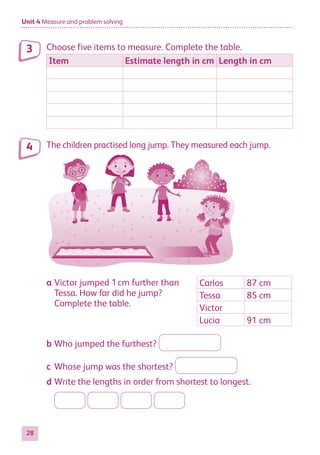
Choose five items to measure. Complete the table.
Item Estimate length in cm Length in cm
The children practised long jump. They measured each jump.
a Victor jumped 1cm further than
Tessa. How far did he jump?
Complete the table.
Carlos 87 cm
Tessa 85 cm
Victor
Lucia 91 cm
b Who jumped the furthest?
c Whose jump was the shortest?
d Write the lengths in order from shortest to longest.
3
4
884597_MATH_WORKBOOK_S2.indb 28 2017/05/03 6:27 PM
Unit 4 Measure and problem solving
29
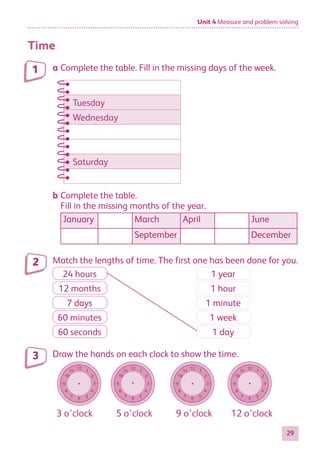
Time
a Complete the table. Fill in the missing days of the week.
Tuesday
Wednesday
Saturday
T
T
W
W
W
Satu
Satu
Satu
b Complete the table.
Fill in the missing months of the year.
January March April June
September December
Match the lengths of time. The first one has been done for you.
24 hours 1 year
12 months 1 hour
7 days 1 minute
60 minutes 1 week
60 seconds 1 day
Draw the hands on each clock to show the time.
12
6
11
5
10
4
9 3
8
2
7
1
12
6
11
5
10
4
9 3
8
2
7
1
12
6
11
5
10
4
9 3
8
2
7
1
12
6
11
5
10
4
9 3
8
2
7
1
3 o’clock 5 o’clock 9 o’clock 12 o’clock
1
2
3
884597_MATH_WORKBOOK_S2.indb 29 2017/05/03 6:27 PM
Unit 4 Measure and problem solving
30
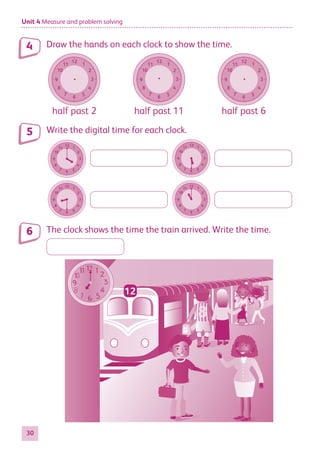
Draw the hands on each clock to show the time.
12
6
11
5
10
4
9 3
8
2
7
1
half past 2
12
6
11
5
10
4
9 3
8
2
7
1
half past 11
12
6
11
5
10
4
9 3
8
2
7
1
half past 6
Write the digital time for each clock.
12
6
11
5
10
4
9 3
8
2
7
1
12
6
11
5
10
4
9 3
8
2
7
1
12
6
11
5
10
4
9 3
8
2
7
1
12
6
11
5
10
4
9 3
8
2
7
1
12
6
11
5
10
4
9 3
8
2
7
1
12
6
11
5
10
4
9 3
8
2
7
1
12
6
11
5
10
4
9 3
8
2
7
1
12
6
11
5
10
4
9 3
8
2
7
1
12
6
11
5
10
4
9 3
8
2
7
1
12
6
11
5
10
4
9 3
8
2
7
1
12
6
11
5
10
4
9 3
8
2
7
1
12
6
11
5
10
4
9 3
8
2
7
1
12
6
11
5
10
4
9 3
8
2
7
1
12
6
11
5
10
4
9 3
8
2
7
1
12
6
11
5
10
4
9 3
8
2
7
1
12
6
11
5
10
4
9 3
8
2
7
1
12
6
11
5
10
4
9 3
8
2
7
1
12
6
11
5
10
4
9 3
8
2
7
1
12
6
11
5
10
4
9 3
8
2
7
1
12
6
11
5
10
4
9 3
8
2
7
1
The clock shows the time the train arrived. Write the time.
12
4
5
6
884597_MATH_WORKBOOK_S2.indb 30 2017/05/03 6:27 PM
31
Unit 4 Measure and problem solving
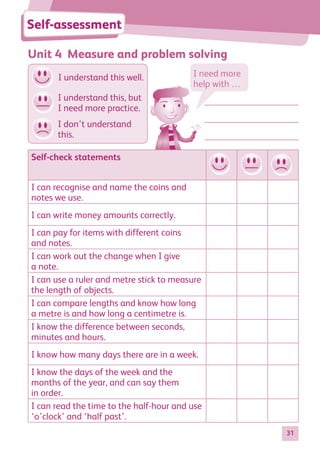
Self-assessment
Self-check statements
I can recognise and name the coins and
notes we use.
I can write money amounts correctly.
I can pay for items with different coins
and notes.
I can work out the change when I give
a note.
I can use a ruler and metre stick to measure
the length of objects.
I can compare lengths and know how long
a metre is and how long a centimetre is.
I know the difference between seconds,
minutes and hours.
I know how many days there are in a week.
I know the days of the week and the
months of the year, and can say them
in order.
I can read the time to the half-hour and use
‘o’clock’ and ‘half past’.
I need more
help with …
I don’t understand
this.
I understand this well.
I understand this, but
I need more practice.
884597_MATH_WORKBOOK_S2.indb 31 2017/05/03 6:27 PM
32
Can you remember?
26, 36, 46, , 66, ,
98, , 78, , 58, 48,
33, 34, , , , 38,
Counting patterns
a	Count on in tens.
	 44, , , , ,
	 45, , , , ,
b	Count back in tens.
	 87, , , , ,
	 86, , , , ,
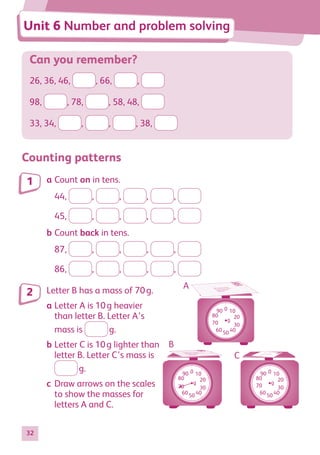
Letter B has a mass of 70 g.
a	Letter A is 10 g heavier
than letter B. Letter A’s
	 mass is  g.
b	Letter C is 10 g lighter than
letter B. Letter C’s mass is
	  g.
c	Draw arrows on the scales
to show the masses for
letters A and C.
1
2
50
100
150
200
250
300
50
100
150
200
250
300
50
100
150
200
250
300
A
B
C
Unit 6 Number and problem solving
50
100
150
200
250
300
50
100
150
200
250
300
50
100
150
200
250
300
A
B
C
50
100
150
200
250
300
50
100
150
200
250
300
50
100
150
200
250
300
A
B
C
g
0 10
20
30
40
50
60
70
80
90
g
0 10
20
30
40
50
60
70
80
90
g
0 10
20
30
40
50
60
80
90
70
884597_MATH_WORKBOOK_S2.indb 32 2017/05/03 6:27 PM
Unit 6 Number and problem solving
33
FISH
FOOD FISH
FOOD
FISH
FOOD
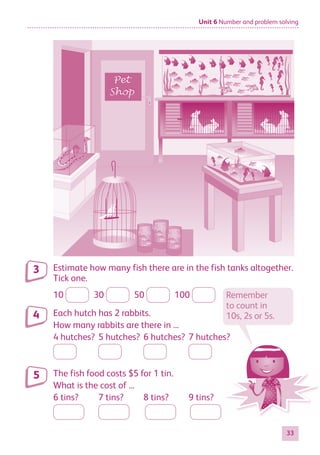
Estimate how many fish there are in the fish tanks altogether.
Tick one.
10 30 50 100
Each hutch has 2 rabbits.
How many rabbits are there in ...
4 hutches? 5 hutches? 6 hutches? 7 hutches?
The fish food costs $5 for 1 tin.
What is the cost of ...
6 tins? 7 tins? 8 tins? 9 tins?
3
4
5
Remember
to count in
10s, 2s or 5s.
884597_MATH_WORKBOOK_S2.indb 33 2017/05/03 6:27 PM
Unit 6 Number and problem solving
34
Comparing, ordering and estimating
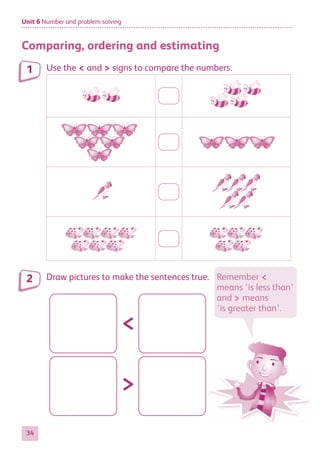
Use the < and > signs to compare the numbers.
Draw pictures to make the sentences true.
<
>
1
2 Remember <
means ‘is less than’
and > means
‘is greater than’.
884597_MATH_WORKBOOK_S2.indb 34 2017/05/03 6:27 PM
Unit 6 Number and problem solving
35
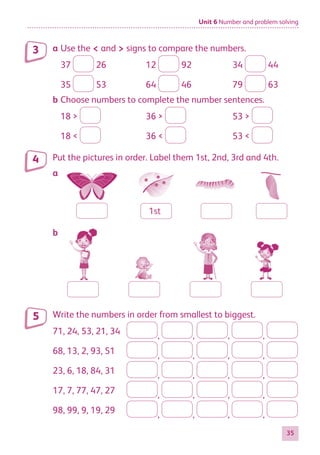
a Use the < and > signs to compare the numbers.
37 26 12 92 34 44
35 53 64 46 79 63
b Choose numbers to complete the number sentences.
18 > 36 > 53 >
18 < 36 < 53 <
Put the pictures in order. Label them 1st, 2nd, 3rd and 4th.
a
1st
b
Write the numbers in order from smallest to biggest.
71, 24, 53, 21, 34 , , , ,
68, 13, 2, 93, 51 , , , ,
23, 6, 18, 84, 31 , , , ,
17, 7, 77, 47, 27 , , , ,
98, 99, 9, 19, 29 , , , ,
3
4
5
884597_MATH_WORKBOOK_S2.indb 35 2017/05/03 6:27 PM
Unit 6 Number and problem solving
36
Number and place value
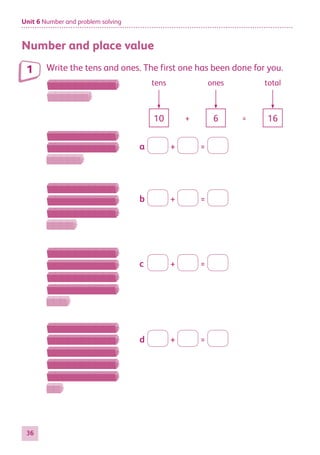
Write the tens and ones. The first one has been done for you.
tens ones total
10 + 6 = 16
a	 + =
b	 + =
c	 + =
d	 + =
1
884597_MATH_WORKBOOK_S2.indb 36 2017/05/03 6:27 PM
Unit 6 Number and problem solving
37
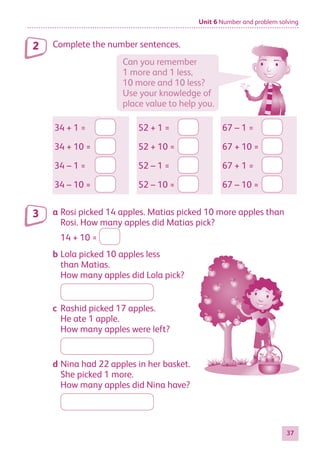
Complete the number sentences.
34 + 1 =
34 + 10 =
34 – 1 =
34 – 10 =
52 + 1 =
52 + 10 =
52 – 1 =
52 – 10 =
67 – 1 =
67 + 10 =
67 + 1 =
67 – 10 =
a Rosi picked 14 apples. Matias picked 10 more apples than
Rosi. How many apples did Matias pick?
14 + 10 =
b Lola picked 10 apples less
than Matias.
How many apples did Lola pick?
c Rashid picked 17 apples.
He ate 1 apple.
How many apples were left?
d Nina had 22 apples in her basket.
She picked 1 more.
How many apples did Nina have?
2
3
Can you remember
1 more and 1 less,
10 more and 10 less?
Use your knowledge of
place value to help you.
884597_MATH_WORKBOOK_S2.indb 37 2017/05/03 6:27 PM
38
Unit 6 Number and problem solving
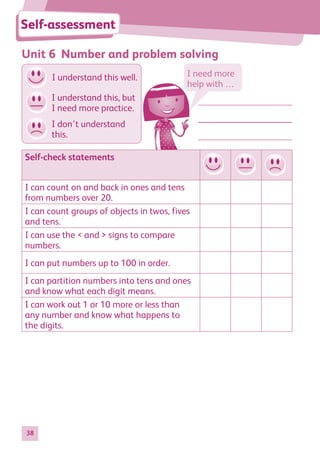
Self-assessment
Self-check statements
I can count on and back in ones and tens
from numbers over 20.
I can count groups of objects in twos, fives
and tens.
I can use the < and > signs to compare
numbers.
I can put numbers up to 100 in order.
I can partition numbers into tens and ones
and know what each digit means.
I can work out 1 or 10 more or less than
any number and know what happens to
the digits.
I need more
help with …
I don’t understand
this.
I understand this well.
I understand this, but
I need more practice.
884597_MATH_WORKBOOK_S2.indb 38 2017/05/03 6:27 PM
39
Can you remember?
Draw a table to show how many items there are.
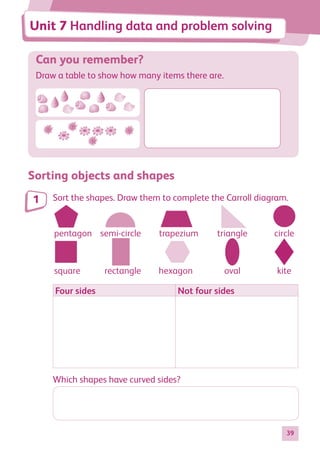
Sorting objects and shapes
Sort the shapes. Draw them to complete the Carroll diagram.
pentagon trapezium triangle circle
square rectangle hexagon oval kite
semi-circle
Four sides Not four sides
Which shapes have curved sides?
1
Unit 7 Handling data and problem solving
884597_MATH_WORKBOOK_S2.indb 39 2017/05/03 6:27 PM
Unit 7 Handling data and problem solving
40
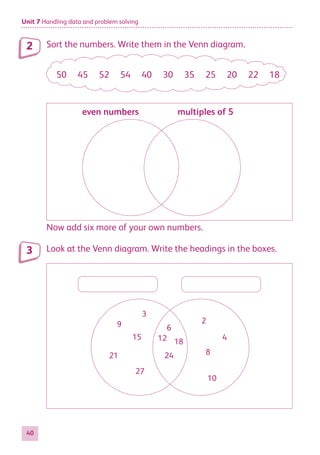
Sort the numbers. Write them in the Venn diagram.
50 45 52 54 40 30 35 25 20 22 18
even numbers multiples of 5
Now add six more of your own numbers.
Look at the Venn diagram. Write the headings in the boxes.
6
12 18
24
9
3
15
21
27
2
4
8
10
2
3
884597_MATH_WORKBOOK_S2.indb 40 2017/05/03 6:27 PM
Unit 7 Handling data and problem solving
41
Block graphs and pictograms
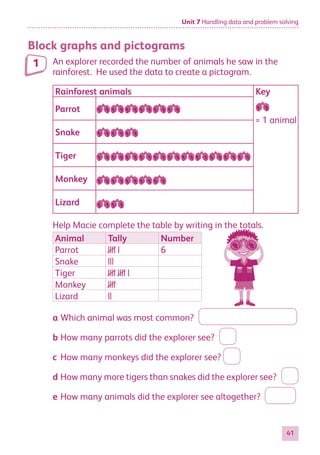
An explorer recorded the number of animals he saw in the
rainforest. He used the data to create a pictogram.
Rainforest animals Key
Parrot
Snake
Tiger
Monkey
Lizard
Help Macie complete the table by writing in the totals.
Animal Tally Number
Parrot |||| | 6
Snake |||
Tiger |||| |||| |
Monkey ||||
Lizard ||
a	Which animal was most common? 
b	How many parrots did the explorer see? 
c	How many monkeys did the explorer see?
d	How many more tigers than snakes did the explorer see? 
e	How many animals did the explorer see altogether?	
1
= 1 animal
884597_MATH_WORKBOOK_S2.indb 41 2017/05/03 6:27 PM
Unit 7 Handling data and problem solving
42
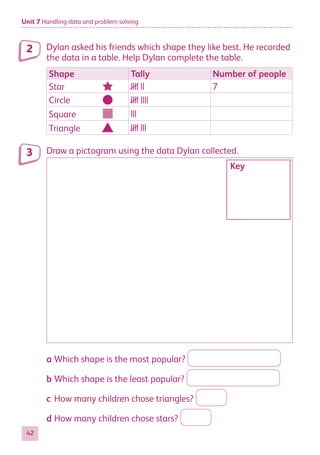
Dylan asked his friends which shape they like best. He recorded
the data in a table. Help Dylan complete the table.
Shape Tally Number of people
Star	 |||| || 7
Circle	 |||| ||||
Square	 |||
Triangle	 |||| |||
Draw a pictogram using the data Dylan collected.
a	Which shape is the most popular?
b	Which shape is the least popular?
c	How many children chose triangles?
d	How many children chose stars?
2
3
Key
884597_MATH_WORKBOOK_S2.indb 42 2017/05/03 6:27 PM
Unit 7 Handling data and problem solving
43
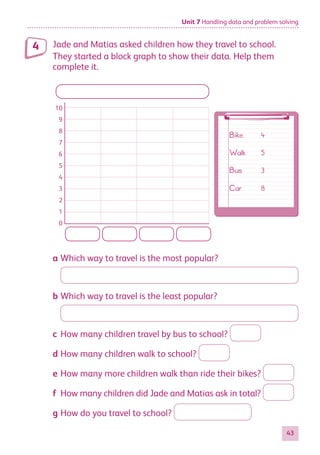
Jade and Matias asked children how they travel to school.
They started a block graph to show their data. Help them
complete it.
0
1
2
3
4
5
6
7
8
9
10
a Which way to travel is the most popular?
b Which way to travel is the least popular?
c How many children travel by bus to school?
d How many children walk to school?
e How many more children walk than ride their bikes?
f How many children did Jade and Matias ask in total?
g How do you travel to school?
Bike 4
Walk 5
Bus 3
Car 8
4
884597_MATH_WORKBOOK_S2.indb 43 2017/05/03 6:27 PM
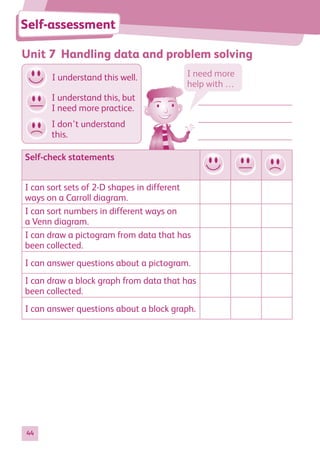
44
Unit 7 Handling data and problem solving
Self-assessment
Self-check statements
I can sort sets of 2-D shapes in different
ways on a Carroll diagram.
I can sort numbers in different ways on
a Venn diagram.
I can draw a pictogram from data that has
been collected.
I can answer questions about a pictogram.
I can draw a block graph from data that has
been collected.
I can answer questions about a block graph.
I need more
help with …
I don’t understand
this.
I understand this well.
I understand this, but
I need more practice.
884597_MATH_WORKBOOK_S2.indb 44 2017/05/03 6:27 PM
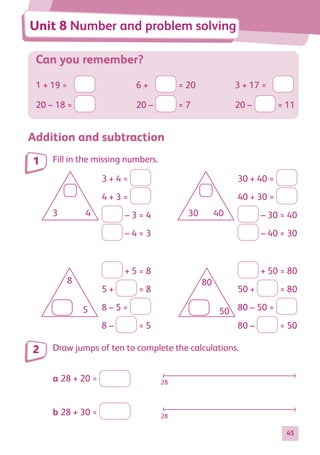
45
Can you remember?
1 + 19 =	 	 6 +	 = 20	 3 + 17 =	
20 – 18 = 	 20 –	 = 7	 20 –	 = 11
Addition and subtraction
Fill in the missing numbers.
8 80
50
30
5
3 4 40
3 + 4 =
4 + 3 =
– 3 = 4
– 4 = 3
8 80
50
30
5
3 4 40
30 + 40 =
40 + 30 =
– 30 = 40
– 40 = 30
8 80
50
30
5
3 4 40
+ 5 = 8
5 + = 8
8 – 5 =
8 – = 5
8 80
50
30
5
3 4 40
+ 50 = 80
50 + = 80
80 – 50 =
80 – = 50
Draw jumps of ten to complete the calculations.
a	28 + 20 =  28
b	28 + 30 =  28
1
2
Unit 8 Number and problem solving
884597_MATH_WORKBOOK_S2.indb 45 2017/05/03 6:27 PM
Unit 8 Number and problem solving
46
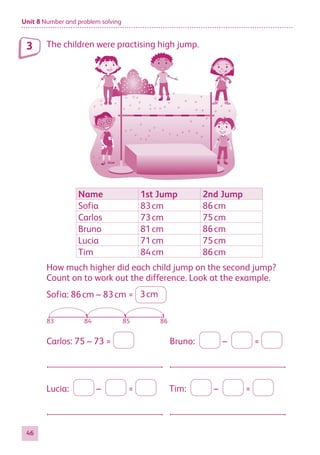
The children were practising high jump.
Name 1st Jump 2nd Jump
Sofia 83cm 86cm
Carlos 73cm 75cm
Bruno 81cm 86cm
Lucia 71cm 75cm
Tim 84cm 86cm
How much higher did each child jump on the second jump?
Count on to work out the difference. Look at the example.
Sofia: 86cm – 83cm = 3cm
83 84 85 86
Carlos: 75 – 73 = Bruno: – =
83 84 85 86 83 84 85 86
Lucia: – = Tim: – =
83 84 85 86 83 84 85 86
3
884597_MATH_WORKBOOK_S2.indb 46 2017/05/03 6:27 PM
Unit 8 Number and problem solving
47
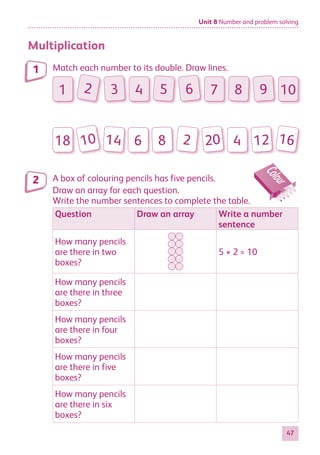
Multiplication
Match each number to its double. Draw lines.
1 2 3 4 5 6 7 8 9 10
18 10 14 6 8 2 20 4 12 16
A box of colouring pencils has five pencils.
Draw an array for each question.
Write the number sentences to complete the table.
Question Draw an array Write a number
sentence
How many pencils
are there in two
boxes?
5 × 2 = 10
How many pencils
are there in three
boxes?
How many pencils
are there in four
boxes?
How many pencils
are there in five
boxes?
How many pencils
are there in six
boxes?
1
2
884597_MATH_WORKBOOK_S2.indb 47 2017/05/03 6:28 PM
Unit 8 Number and problem solving
48
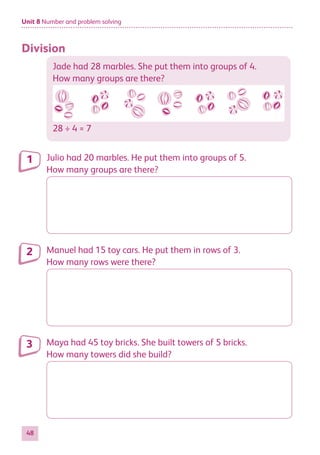
Division
Jade had 28 marbles. She put them into groups of 4.
How many groups are there?
28 ÷ 4 = 7
Julio had 20 marbles. He put them into groups of 5.
How many groups are there?
Manuel had 15 toy cars. He put them in rows of 3.
How many rows were there?
Maya had 45 toy bricks. She built towers of 5 bricks.
How many towers did she build?
1
2
3
884597_MATH_WORKBOOK_S2.indb 48 2017/05/03 6:28 PM
Unit 8 Number and problem solving
49
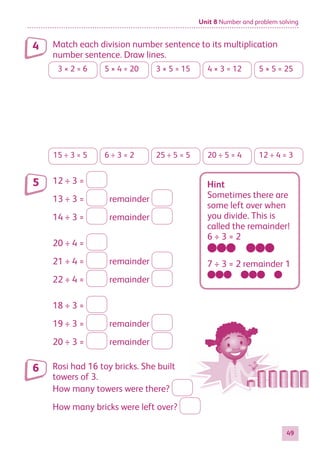
Match each division number sentence to its multiplication
number sentence. Draw lines.
3 × 2 = 6 5 × 4 = 20 3 × 5 = 15 4 × 3 = 12 5 × 5 = 25
15 ÷ 3 = 5 6 ÷ 3 = 2 25 ÷ 5 = 5 20 ÷ 5 = 4 12 ÷ 4 = 3
12 ÷ 3 =
13 ÷ 3 = remainder
14 ÷ 3 = remainder
20 ÷ 4 =
21 ÷ 4 = remainder
22 ÷ 4 = remainder
18 ÷ 3 =
19 ÷ 3 = remainder
20 ÷ 3 = remainder
Rosi had 16 toy bricks. She built
towers of 3.
How many towers were there?
How many bricks were left over?
4
5 Hint
Sometimes there are
some left over when
you divide. This is
called the remainder!
6 ÷ 3 = 2
7 ÷ 3 = 2 remainder 1
6
884597_MATH_WORKBOOK_S2.indb 49 2017/05/03 6:28 PM
50
Unit 8 Number and problem solving
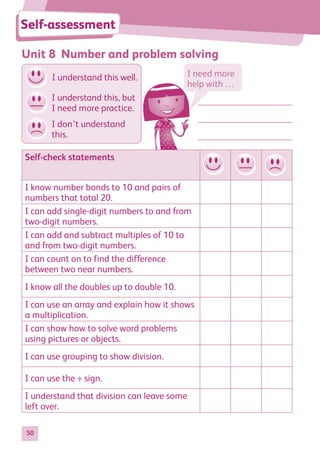
Self-assessment
Self-check statements
I know number bonds to 10 and pairs of
numbers that total 20.
I can add single-digit numbers to and from
two-digit numbers.
I can add and subtract multiples of 10 to
and from two-digit numbers.
I can count on to find the difference
between two near numbers.
I know all the doubles up to double 10.
I can use an array and explain how it shows
a multiplication.
I can show how to solve word problems
using pictures or objects.
I can use grouping to show division.
I can use the ÷ sign.
I understand that division can leave some
left over.
I need more
help with …
I don’t understand
this.
I understand this well.
I understand this, but
I need more practice.
884597_MATH_WORKBOOK_S2.indb 50 2017/05/03 6:28 PM
51
Can you remember?
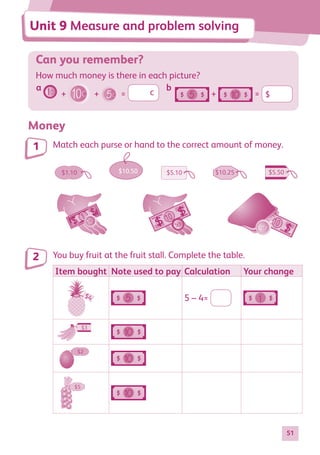
How much money is there in each picture?
+ + = c + = $
Money
Match each purse or hand to the correct amount of money.
1 10 10
$1.10 $10.25 $5.50
$5.10
$10.50
You buy fruit at the fruit stall. Complete the table.
Item bought Note used to pay Calculation Your change
$4 5 – 4=
5
1
10
10
$3
$2
$5
5
1
10
10
$3
$2
$5
5
1
10
10
$3
$2
$5
1
2
Unit 9 Measure and problem solving
a b
884597_MATH_WORKBOOK_S2.indb 51 2017/05/03 6:28 PM
Unit 9 Measure and problem solving
52
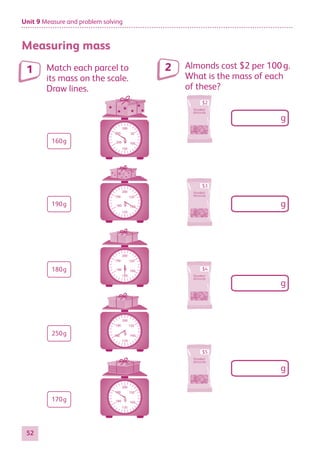
Measuring mass
Match each parcel to
its mass on the scale.
Draw lines.
g
g
g
g
g
160g
180g
250g
170g
190g
150
160
170
190
200
150
160
170
190
200
150
160
180
190
200
150
170
180
190
200
g
50
100
150
200
300
250
160
170
180
180
Almonds cost $2 per 100 g.
What is the mass of each
of these?
$2
g
g
g
g
$3
$4
$5
1 2
884597_MATH_WORKBOOK_S2.indb 52 2017/05/03 6:28 PM
Unit 9 Measure and problem solving
53
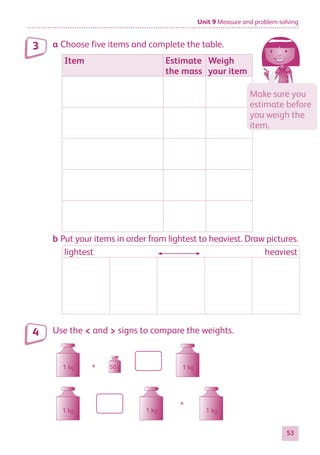
a	Choose five items and complete the table.
Item Estimate
the mass
Weigh
your item
b	Put your items in order from lightest to heaviest. Draw pictures.
lightest heaviest
Use the  and  signs to compare the weights.
1 kg
10g
1 kg 1 kg
50 g
+
10g
1 kg
1 kg
50 g
+ +
1 kg 1 kg 1 kg
+
3
4
Make sure you
estimate before
you weigh the
item.
884597_MATH_WORKBOOK_S2.indb 53 2017/05/03 6:28 PM
Unit 9 Measure and problem solving
54
Time
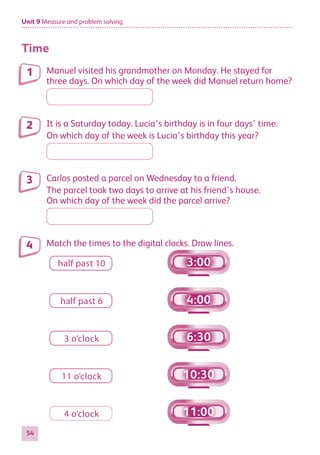
Manuel visited his grandmother on Monday. He stayed for
three days. On which day of the week did Manuel return home?
It is a Saturday today. Lucia’s birthday is in four days’ time.
On which day of the week is Lucia’s birthday this year?
Carlos posted a parcel on Wednesday to a friend.
The parcel took two days to arrive at his friend’s house.
On which day of the week did the parcel arrive?
Match the times to the digital clocks. Draw lines.
3:00
4:00
6:30
10:30
11:00
half past 10
half past 6
3 o’clock
11 o’clock
4 o’clock
1
2
3
4
884597_MATH_WORKBOOK_S2.indb 54 2017/05/03 6:28 PM
Unit 9 Measure and problem solving
55
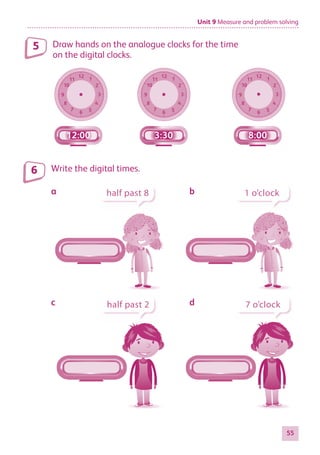
Draw hands on the analogue clocks for the time
on the digital clocks.
12
6
11
5
10
4
9 3
8
2
7
1
12
6
11
5
10
4
9 3
8
2
7
1
12
6
11
5
10
4
9 3
8
2
7
1
12
6
11
5
10
4
9 3
8
2
7
1
12:00 3:30
1:30
8:00
Write the digital times.
5
6
half past 8
half past 2
1 o’clock
7 o’clock
a b
c d
884597_MATH_WORKBOOK_S2.indb 55 2017/05/03 6:28 PM
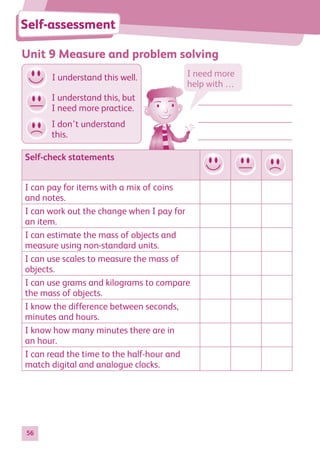
56
Unit 9 Measure and problem solving
Self-assessment
Self-check statements
I can pay for items with a mix of coins
and notes.
I can work out the change when I pay for
an item.
I can estimate the mass of objects and
measure using non-standard units.
I can use scales to measure the mass of
objects.
I can use grams and kilograms to compare
the mass of objects.
I know the difference between seconds,
minutes and hours.
I know how many minutes there are in
an hour.
I can read the time to the half-hour and
match digital and analogue clocks.
I need more
help with …
I don’t understand
this.
I understand this well.
I understand this, but
I need more practice.
884597_MATH_WORKBOOK_S2.indb 56 2017/05/03 6:28 PM
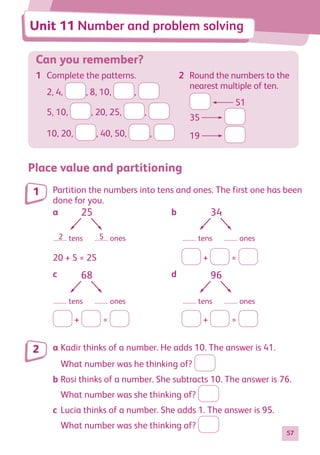
57
Can you remember?
1	 Complete the patterns.
2, 4, , 8, 10, ,
5, 10, , 20, 25, ,
10, 20, , 40, 50, ,
2	 Round the numbers to the
nearest multiple of ten.
51
35
19
Place value and partitioning
Partition the numbers into tens and ones. The first one has been
done for you.
25
tens
2 5 ones
34
tens ones
68
tens ones
96
tens ones
20 + 5 = 25	 + =
25
tens
2 5 ones
34
tens ones
68
tens ones
96
tens ones
+ = 	 + =
a	Kadir thinks of a number. He adds 10. The answer is 41.
	 What number was he thinking of?
b	Rosi thinks of a number. She subtracts 10. The answer is 76.
	 What number was she thinking of?
c	Lucia thinks of a number. She adds 1. The answer is 95.
	 What number was she thinking of?
1
2
Unit 11 Number and problem solving
a						b
c						d
884597_MATH_WORKBOOK_S2.indb 57 2017/05/03 6:28 PM
Unit 11 Number and problem solving
58
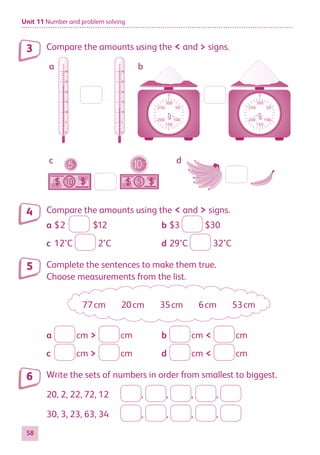
Compare the amounts using the  and  signs.
-
-
-
-
-
-
-
-
-
-
-
-
-
-
-
-
-
-
-
-
-
-
-
-
-
-
-
-
-
-
-
-
-
-
-
-
-
-
-
-
-
-
-
-
-
-
-
-
-
-
-
-
-
-
-
-
-
-
-
-
-
-
0
50
100
150
200
250
300
g
0
50
100
150
200
250
300
g
5
10
a b
c d
0
5
10
15
20
25
30
0
5
10
15
20
25
30
Compare the amounts using the  and  signs.
a	$2 $12	 b	$3 $30
c	12°C 2°C	 d	29°C 32°C
Complete the sentences to make them true.
Choose measurements from the list.
77 cm 20 cm 35 cm 6 cm 53 cm
a	  cm   cm	 b	  cm   cm
c	  cm   cm	 d	  cm   cm
Write the sets of numbers in order from smallest to biggest.
20, 2, 22, 72, 12	 , , , ,
30, 3, 23, 63, 34	 , , , ,
3
4
5
6
884597_MATH_WORKBOOK_S2.indb 58 2017/05/03 6:28 PM
Unit 11 Number and problem solving
59
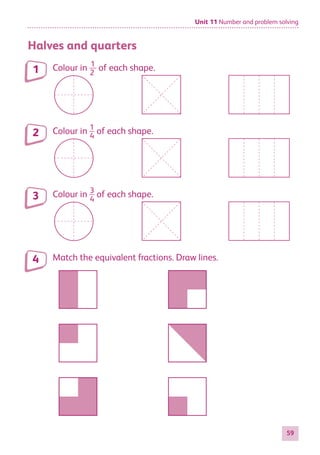
Halves and quarters
Colour in ​​ 1
 
__ 
2
 
​​of each shape.
Colour in ​​ 1
 
__ 
4
 
​​of each shape.
Colour in ​​ 3
 
__ 
4
 
​​of each shape.
Match the equivalent fractions. Draw lines.
1
2
3
4
884597_MATH_WORKBOOK_S2.indb 59 2017/05/03 6:28 PM
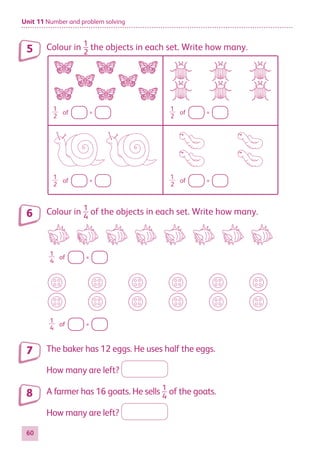
Unit 11 Number and problem solving
60
Colour in ​​ 1
 
__ 
2
 
​​the objects in each set. Write how many.
1
2
of =
1
2
of =
1
2
of =
1
2
of =
Colour in ​​ 1
 
__ 
4
 
​​of the objects in each set. Write how many.
1
4
of =
1
4
of =
The baker has 12 eggs. He uses half the eggs.
How many are left?
A farmer has 16 goats. He sells ​​ 1
 
__ 
4
 ​​of the goats.
How many are left?
5
6
7
8
884597_MATH_WORKBOOK_S2.indb 60 2017/05/03 6:28 PM
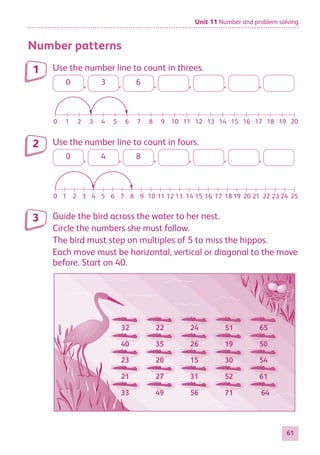
Unit 11 Number and problem solving
61
Number patterns
Use the number line to count in threes.
0 , 3 , 6 , , , ,
0 1 2 3 4 5 6 7 8 9 10 11 12 13 14 15 16 17 18 19 20
0 1 2 3 4 5 6 7 8 9 10 11 12 13 14 15 16 17 21 23 25
24
22
18 20
19
Use the number line to count in fours.
0 , 4 , 8 , , , ,
0 1 2 3 4 5 6 7 8 9 10 11 12 13 14 15 16 17 18 19 20
0 1 2 3 4 5 6 7 8 9 10 11 12 13 14 15 16 17 21 23 25
24
22
18 20
19
Guide the bird across the water to her nest.
Circle the numbers she must follow.
The bird must step on multiples of 5 to miss the hippos.
Each move must be horizontal, vertical or diagonal to the move
before. Start on 40.
32 22 24 51 65
40 35 26 19 50
23 20 15 30 54
21 27 31 52 61
33 49 56 71 64
1
2
3
884597_MATH_WORKBOOK_S2.indb 61 2017/05/03 6:28 PM
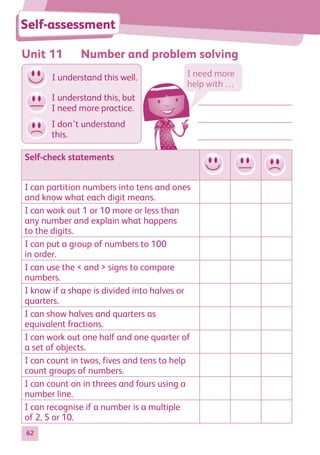
62
Unit 11 Number and problem solving
Self-assessment
Self-check statements
I can partition numbers into tens and ones
and know what each digit means.
I can work out 1 or 10 more or less than
any number and explain what happens
to the digits.
I can put a group of numbers to 100
in order.
I can use the  and  signs to compare
numbers.
I know if a shape is divided into halves or
quarters.
I can show halves and quarters as
equivalent fractions.
I can work out one half and one quarter of
a set of objects.
I can count in twos, fives and tens to help
count groups of numbers.
I can count on in threes and fours using a
number line.
I can recognise if a number is a multiple
of 2, 5 or 10.
I need more
help with …
I don’t understand
this.
I understand this well.
I understand this, but
I need more practice.
884597_MATH_WORKBOOK_S2.indb 62 2017/05/03 6:28 PM
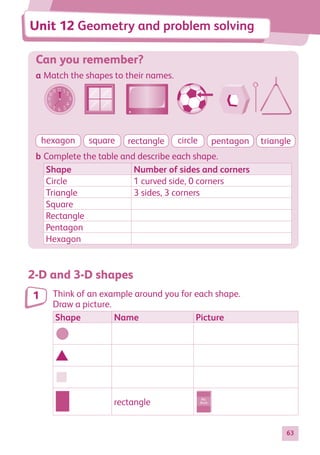
63
Can you remember?
a Match the shapes to their names.
hexagon square rectangle circle pentagon triangle
b Complete the table and describe each shape.
Shape Number of sides and corners
Circle 1 curved side, 0 corners
Triangle 3 sides, 3 corners
Square
Rectangle
Pentagon
Hexagon
2-D and 3-D shapes
Think of an example around you for each shape.
Draw a picture.
Shape Name Picture
My
Book
My
Book
My
Book
My
Book
rectangle My
Book
1
Unit 12 Geometry and problem solving
884597_MATH_WORKBOOK_S2.indb 63 2017/05/03 6:28 PM
Unit 12 Geometry and problem solving
64
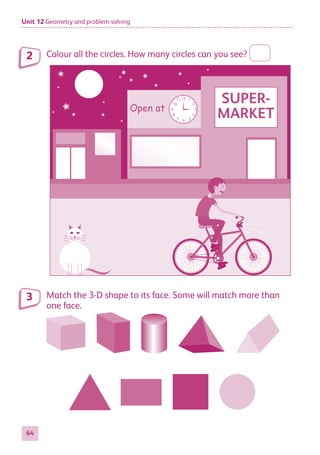
Colour all the circles. How many circles can you see?
Open at
12 1
2
3
5
4
6
7
8
9
10
11 SUPER-
MARKET
Match the 3-D shape to its face. Some will match more than
one face.
2
3
884597_MATH_WORKBOOK_S2.indb 64 2017/05/03 6:28 PM
Unit 12 Geometry and problem solving
65
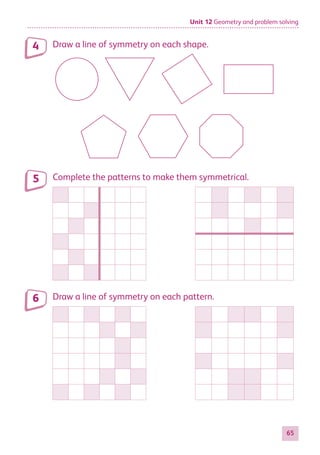
Draw a line of symmetry on each shape.
Complete the patterns to make them symmetrical.
Draw a line of symmetry on each pattern.
4
5
6
884597_MATH_WORKBOOK_S2.indb 65 2017/05/03 6:28 PM
Unit 12 Geometry and problem solving
66
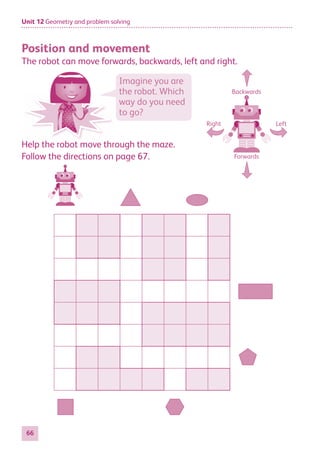
Position and movement
The robot can move forwards, backwards, left and right.
Imagine you are
the robot. Which
way do you need
to go?
Help the robot move through the maze.
Follow the directions on page 67.
Right Left
Forwards
Backwards
884597_MATH_WORKBOOK_S2.indb 66 2017/05/03 6:28 PM
Unit 12 Geometry and problem solving
67
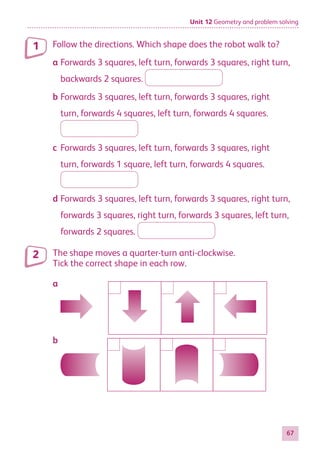
Follow the directions. Which shape does the robot walk to?
a	Forwards 3 squares, left turn, forwards 3 squares, right turn,
backwards 2 squares.
b	Forwards 3 squares, left turn, forwards 3 squares, right
turn, forwards 4 squares, left turn, forwards 4 squares.
c	Forwards 3 squares, left turn, forwards 3 squares, right
turn, forwards 1 square, left turn, forwards 4 squares.
d	Forwards 3 squares, left turn, forwards 3 squares, right turn,
forwards 3 squares, right turn, forwards 3 squares, left turn,
forwards 2 squares.
The shape moves a quarter-turn anti-clockwise.
Tick the correct shape in each row.
a
b
1
2
884597_MATH_WORKBOOK_S2.indb 67 2017/05/03 6:28 PM
68
Unit 12 Geometry and problem solving
Self-assessment
Self-check statements
I can look at pictures of 2-D shapes and
name them.
I can sort sets of 2-D shapes in different
ways.
I can describe different shapes and talk
about their properties.
I can draw a line of symmetry on a shape.
I can complete a symmetrical picture by
drawing the ‘other half’.
I can name 3-D shapes.
I can find and describe shapes around me.
I can describe the 2-D shapes on the faces
of 3-D shapes.
I need more
help with …
I don’t understand
this.
I understand this well.
I understand this, but
I need more practice.
884597_MATH_WORKBOOK_S2.indb 68 2017/05/03 6:28 PM
69
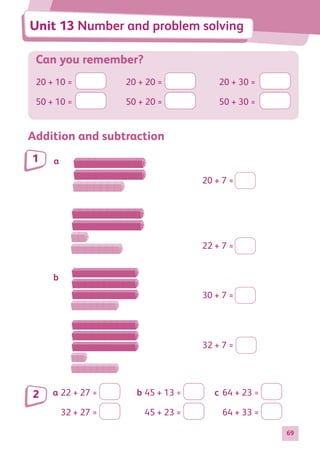
Can you remember?
20 + 10 =	 	 20 + 20 =	 	 20 + 30 =	
50 + 10 =	 	 50 + 20 =	 	 50 + 30 =	
Addition and subtraction
a
b
30 + 7 =
22 + 7 =
32 + 7 =
20 + 7 =
a	22 + 27 = 	 b	45 + 13 = 	 c	 64 + 23 =
	 32 + 27 = 		 45 + 23 = 		 64 + 33 =
1
2
Unit 13 Number and problem solving
884597_MATH_WORKBOOK_S2.indb 69 2017/05/03 6:28 PM
Unit 13 Number and problem solving
70
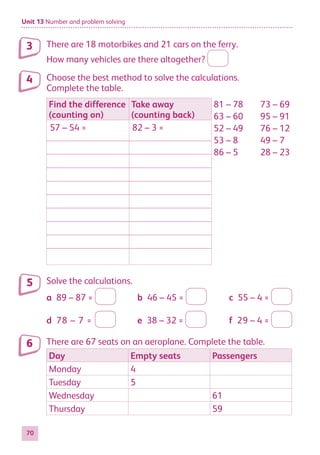
There are 18 motorbikes and 21 cars on the ferry.
How many vehicles are there altogether?
Choose the best method to solve the calculations.
Complete the table.
Find the difference
(counting on)
Take away
(counting back)
81 – 78 	 73 – 69
63 – 60 	 95 – 91
52 – 49	 76 – 12
53 – 8 	 49 – 7
86 – 5 	 28 – 23
57 – 54 = 82 – 3 =
Solve the calculations.
a  89 – 87 = 	 b  46 – 45 = 	 c  55 – 4 =
d  78 – 7 = 	 e  38 – 32 = 	 f  29 – 4 =
There are 67 seats on an aeroplane. Complete the table.
Day Empty seats Passengers
Monday 4
Tuesday 5
Wednesday 61
Thursday 59
3
4
5
6
884597_MATH_WORKBOOK_S2.indb 70 2017/05/03 6:28 PM
Unit 13 Number and problem solving
71
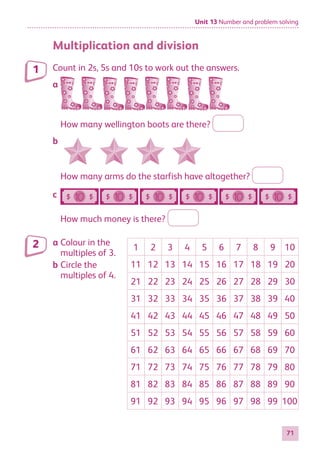
Multiplication and division
Count in 2s, 5s and 10s to work out the answers.
a
How many wellington boots are there?
b
How many arms do the starfish have altogether?
c
How much money is there?
a Colour in the
multiples of 3.
b Circle the
multiples of 4.
1 2 3 4 5 6 7 8 9 10
11 12 13 14 15 16 17 18 19 20
21 22 23 24 25 26 27 28 29 30
31 32 33 34 35 36 37 38 39 40
41 42 43 44 45 46 47 48 49 50
51 52 53 54 55 56 57 58 59 60
61 62 63 64 65 66 67 68 69 70
71 72 73 74 75 76 77 78 79 80
81 82 83 84 85 86 87 88 89 90
91 92 93 94 95 96 97 98 99 100
1
2
884597_MATH_WORKBOOK_S2.indb 71 2017/05/03 6:28 PM
Unit 13 Number and problem solving
72
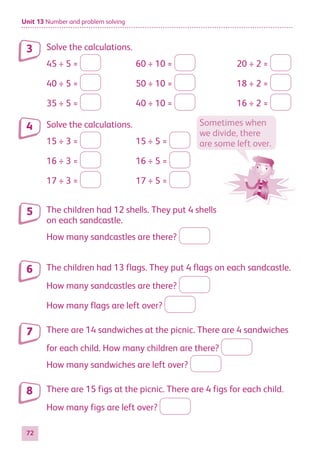
Solve the calculations.
45 ÷ 5 = 60 ÷ 10 = 20 ÷ 2 =
40 ÷ 5 = 50 ÷ 10 = 18 ÷ 2 =
35 ÷ 5 = 40 ÷ 10 = 16 ÷ 2 =
Solve the calculations.
15 ÷ 3 = 15 ÷ 5 =
16 ÷ 3 = 16 ÷ 5 =
17 ÷ 3 = 17 ÷ 5 =
The children had 12 shells. They put 4 shells
on each sandcastle.
How many sandcastles are there?
The children had 13 flags. They put 4 flags on each sandcastle.
How many sandcastles are there?
How many flags are left over?
There are 14 sandwiches at the picnic. There are 4 sandwiches
for each child. How many children are there?
How many sandwiches are left over?
There are 15 figs at the picnic. There are 4 figs for each child.
How many figs are left over?
3
4 Sometimes when
we divide, there
are some left over.
5
6
7
8
884597_MATH_WORKBOOK_S2.indb 72 2017/05/03 6:28 PM
Unit 13 Number and problem solving
73
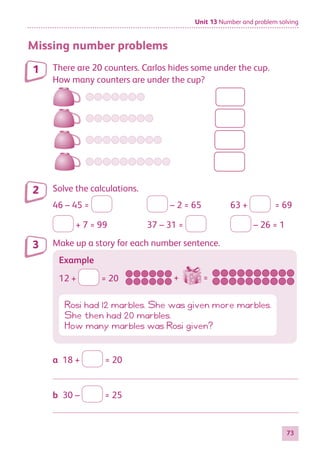
Missing number problems
There are 20 counters. Carlos hides some under the cup.
How many counters are under the cup?
Solve the calculations.
46 – 45 = 	 – 2 = 65	 63 + = 69
+ 7 = 99	 37 – 31 = 	 – 26 = 1
Make up a story for each number sentence.
Example
12 + = 20
Rosi had 12 marbles. She was given more marbles.
She then had 20 marbles.
How many marbles was Rosi given?
a  18 + = 20

b  30 – = 25

1
2
3
+ =
884597_MATH_WORKBOOK_S2.indb 73 2017/05/03 6:28 PM
74
Unit 13 Number and problem solving
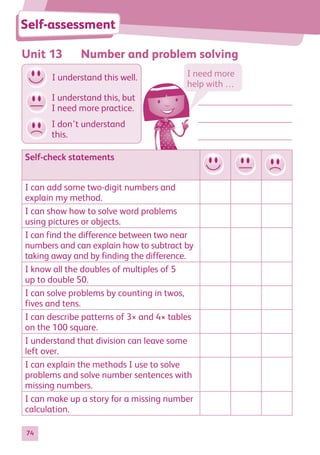
Self-assessment
Self-check statements
I can add some two-digit numbers and
explain my method.
I can show how to solve word problems
using pictures or objects.
I can find the difference between two near
numbers and can explain how to subtract by
taking away and by finding the difference.
I know all the doubles of multiples of 5
up to double 50.
I can solve problems by counting in twos,
fives and tens.
I can describe patterns of 3× and 4× tables
on the 100 square.
I understand that division can leave some
left over.
I can explain the methods I use to solve
problems and solve number sentences with
missing numbers.
I can make up a story for a missing number
calculation.
I need more
help with …
I don’t understand
this.
I understand this well.
I understand this, but
I need more practice.
884597_MATH_WORKBOOK_S2.indb 74 2017/05/03 6:28 PM
75
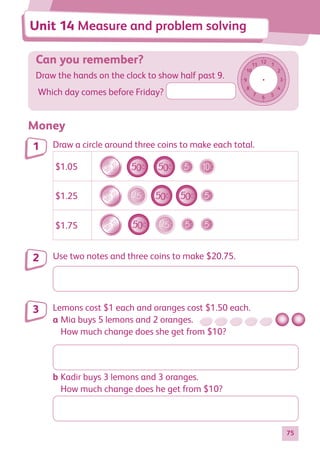
Can you remember?
Draw the hands on the clock to show half past 9.
Which day comes before Friday?
12
6
11
5
10
4
9 3
8
2
7
1
Money
Draw a circle around three coins to make each total.
$1.05
$1.05
$1.25
$1.75
$1.25
$1.05
$1.25
$1.75
$1.75
$1.05
$1.25
$1.75
Use two notes and three coins to make $20.75.
Lemons cost $1 each and oranges cost $1.50 each.
a Mia buys 5 lemons and 2 oranges.
How much change does she get from $10?
b Kadir buys 3 lemons and 3 oranges.
How much change does he get from $10?
1
2
3
Unit 14 Measure and problem solving
884597_MATH_WORKBOOK_S2.indb 75 2017/05/03 6:28 PM
Unit 14 Measure and problem solving
76
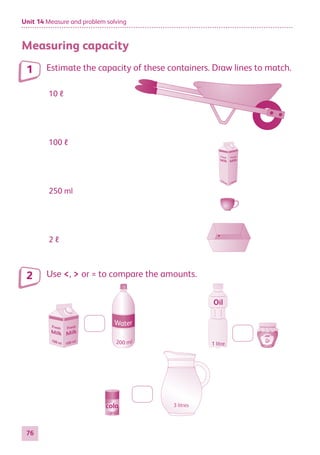
Measuring capacity
Estimate the capacity of these containers. Draw lines to match.
10 ℓ
100 ℓ
250 ml
2 ℓ
Use ,  or = to compare the amounts.
250 ml
Oil
1 litre
3 litres
cola
250 ml
1
2
884597_MATH_WORKBOOK_S2.indb 76 2017/05/03 6:28 PM
Unit 14 Measure and problem solving
77
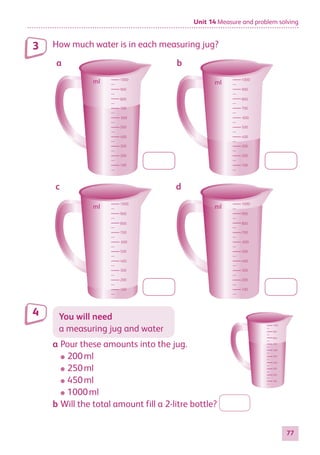
How much water is in each measuring jug?
1000
900
800
700
600
500
400
300
200
100
1000
900
800
700
600
500
400
300
200
100
1000
900
800
700
600
500
400
300
200
100
1000
900
800
700
600
500
400
300
200
100
a b
c d
ml ml
ml ml
You will need
a measuring jug and water
a	Pour these amounts into the jug.
●
● 200 ml
●
● 250 ml
●
● 450 ml
●
● 1000 ml
b	Will the total amount fill a 2-litre bottle?
3
4
1000
900
800
700
600
500
400
300
200
100
884597_MATH_WORKBOOK_S2.indb 77 2017/05/03 6:28 PM
Unit 14 Measure and problem solving
78
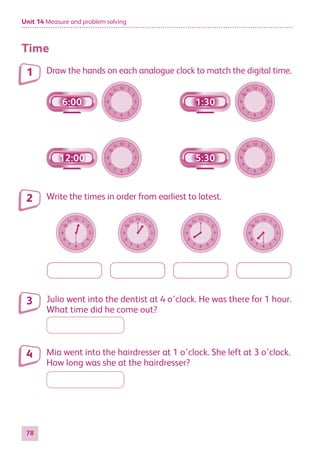
Time
Draw the hands on each analogue clock to match the digital time.
12
6
11
5
10
4
9 3
8
2
7
1
6:00
12
6
11
5
10
4
9 3
8
2
7
1
12:00
12
6
11
5
10
4
9 3
8
2
7
1
1:30
12
6
11
5
10
4
9 3
8
2
7
1
5:30
Write the times in order from earliest to latest.
12
6
11
5
10
4
9 3
8
2
7
1 12
6
11
5
10
4
9 3
8
2
7
1
12
6
11
5
10
4
9 3
8
2
7
1
12
6
11
5
10
4
9 3
8
2
7
1
Julio went into the dentist at 4 o’clock. He was there for 1 hour.
What time did he come out?
Mia went into the hairdresser at 1 o’clock. She left at 3 o’clock.
How long was she at the hairdresser?
1
2
3
4
884597_MATH_WORKBOOK_S2.indb 78 2017/05/03 6:28 PM
Unit 14 Measure and problem solving
79
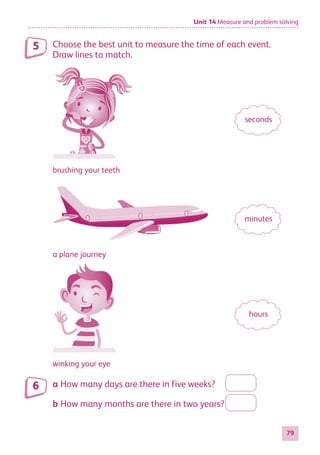
Choose the best unit to measure the time of each event.
Draw lines to match.
brushing your teeth
seconds
a plane journey
minutes
winking your eye
hours
a How many days are there in five weeks?
b How many months are there in two years?
5
6
884597_MATH_WORKBOOK_S2.indb 79 2017/05/03 6:28 PM
80
Unit 14 Measure and problem solving
Self-assessment
Self-check statements
I can pay for items with a mix of coins
and notes.
I can work out the change when I pay for
an item.
I can compare the capacity of containers.
I can use measuring jugs to find the
capacity of different containers.
I can read the time to the half-hour on
digital and analogue clocks.
I know the different units we use to
measure time.
I know how many days there are in a week
and how many months there are in a year.
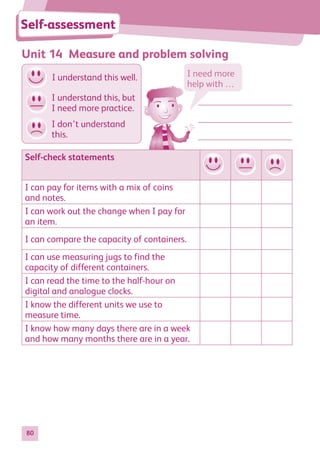
I need more
help with …
I don’t understand
this.
I understand this well.
I understand this, but
I need more practice.
884597_MATH_WORKBOOK_S2.indb 80 2017/05/03 6:28 PM

Hodder cambridge primary_maths_workbook_2

  • 2.
    Catherine Casey Series editors:Mike Askew and Paul Broadbent Stage 2 Workbook Hodder Cambridge Primary Maths Cambridge Primary 884597_MATHS_WORKBOOK_S2_TP.indd 1 28/02/2017 11:44 884597_MATH_WORKBOOK_S2.indb 1 2017/05/03 6:27 PM
  • 3.
    Acknowledgements With warm thanksto Jennifer Peek for her help in shaping and developing this title. The Publisher is extremely grateful to the following schools for their comments and feedback during the development of this series: Avalon Heights World Private School, Ajman The Oxford School, Dubai Al Amana Private School, Sharjah British International School, Ajman Wesgreen International School, Sharjah As Seeb International School, Al Khoud. Every effort has been made to trace all copyright holders, but if any have been inadvertently overlooked the Publishers will be pleased to make the necessary arrangements at the first opportunity. Although every effort has been made to ensure that website addresses are correct at time of going to press, Hodder Education cannot be held responsible for the content of any website mentioned in this book. It is sometimes possible to find a relocated web page by typing in the address of the home page for a website in the URL window of your browser. Hachette UK’s policy is to use papers that are natural, renewable and recyclable products and made from wood grown in sustainable forests. The logging and manufacturing processes are expected to conform to the environmental regulations of the country of origin. Orders: please contact Bookpoint Ltd, 130 Milton Park, Abingdon, Oxon OX14 4SB. Telephone: (44) 01235 827720. Fax: (44) 01235 400454. Lines are open from 9.00–5.00, Monday to Saturday, with a 24-hour message answering service. You can also order through our website www.hoddereducation.com © Catherine Casey 2017 Published by Hodder Education An Hachette UK Company Carmelite House, 50 Victoria Embankment, London EC4Y 0DZ Impression number 1 2 3 4 5 Year 2021 2020 2019 2018 2017 All rights reserved. Apart from any use permitted under UK copyright law, no part of this publication may be reproduced or transmitted in any form or by any means, electronic or mechanical, including photocopying and recording, or held within any information storage and retrieval system, without permission in writing from the publisher or under licence from the Copyright Licensing Agency Limited. Further details of such licences (for reprographic reproduction) may be obtained from the Copyright Licensing Agency Limited, Saffron House, 6–10 Kirby Street, London EC1N 8TS. Cover illustration by Steve Evans Illustrations by Karen Ahlschläger, Jeanne du Plessis and Anna-Marie Brink Typeset in FS Albert 17/19 by DTP Impressions Printed in Great Britain by Hobbs the Printers Ltd, Totton, Hampshire SO40 3WX A catalogue record for this title is available from the British Library 9781471884597 884597_MATH_WORKBOOK_S2.indb 2 2017/05/03 6:27 PM
  • 4.
    Contents Unit 1 Numberand problem solving 4 Unit 2 Geometry and problem solving 11 Unit 3 Number and problem solving 18 Unit 4 Measure and problem solving 25 Term 1 Unit 6 Number and problem solving 32 Unit 7 Handling data and problem solving 39 Unit 8 Number and problem solving 45 Unit 9 Measure and problem solving 51 Term 2 Unit 11 Number and problem solving 57 Unit 12 Geometry and problem solving 63 Unit 13 Number and problem solving 69 Unit 14 Measure and problem solving 75 Term 3 884597_MATH_WORKBOOK_S2.indb 3 2017/05/03 6:27 PM
  • 5.
    4 Can you remember? aOne less than 6 is . b Ten less than 32 is . c One more than 14 is . d Ten more than 8 is . Numbers to 100 Match the number names to the two-digit numbers. fourteen 25 twenty-five 36 thirty-six 14 forty-seven 47 Fill in the missing numbers. 1 2 3 4 5 6 7 9 10 11 13 14 15 16 17 18 19 20 21 22 23 24 26 27 28 29 31 32 33 34 35 36 38 39 40 41 42 43 45 46 47 48 49 50 52 53 54 55 57 58 59 60 61 62 63 64 65 66 67 68 69 71 72 73 75 76 77 78 79 80 81 82 83 84 86 87 89 90 91 92 94 95 96 97 98 99 100 1 2 Unit 1 Number and problem solving 884597_MATH_WORKBOOK_S2.indb 4 2017/05/03 6:27 PM
  • 6.
    Unit 1 Numberand problem solving 5 Take a handful of items like crayons, pebbles, shells, paper-clips or dried pasta. Count them in twos, fives and tens. How many are there? Example I counted in twos. There are 24 crayons. I counted in . There are . I counted in . There are . I counted in . There are . Draw the frog jumps on the number line. Circle each number the frog lands on. a Count in twos. 40 42 44 46 48 50 30 40 50 60 70 80 75 65 55 45 35 60 62 61 63 64 65 71 80 79 7778 76 75 74 73 41 43 45 47 49 66 67 68 69 70 72 b Count in fives. 40 42 44 46 48 50 30 40 50 60 70 80 75 65 55 45 35 60 62 61 63 64 65 71 80 79 7778 76 75 74 73 41 43 45 47 49 66 67 68 69 70 72 c Count in tens. 40 42 44 46 48 50 30 40 50 60 70 80 75 65 55 45 35 41 43 45 47 49 3 4 884597_MATH_WORKBOOK_S2.indb 5 2017/05/03 6:27 PM
  • 7.
    Unit 1 Numberand problem solving 6 Comparing numbers Draw a circle around the bigger number. 14 17 27 24 34 37 a b c Fill in the missing numbers. a 40 50 b 50 60 Round the numbers to the nearest multiple of 10. a 53 b 71 c 47 d 89 1 2 3 884597_MATH_WORKBOOK_S2.indb 6 2017/05/03 6:27 PM
  • 8.
    Unit 1 Numberand problem solving 7 Draw a picture of five children standing in a line. The 1st child is wearing a blue T-shirt. The 2nd child is the tallest. The 3rd child is wearing a hat. The 4th child is wearing a green T-shirt. The 5th child is the shortest. The pictures of the plant are mixed up. Put the pictures in the correct order. Start with the seed that you plant. The first one has been done for you. A B C D E 1st: Picture E 2nd: Picture 3rd: Picture 4th: Picture 5th: Picture 4 5 884597_MATH_WORKBOOK_S2.indb 7 2017/05/03 6:27 PM
  • 9.
    Unit 1 Numberand problem solving 8 Number and place value Make your own place value apparatus. You will need • a packet of drinking straws • string/ribbon/elastic bands Method Make tens: Count out ten straws. Tie them together with string. Repeat four times. Make ones: Use individual straws. Now make these numbers. a  13 b  14 c  15 d  23 e  24 f  34 g  43 h  44 i  45 a Sort the numbers. Write them in the Venn diagram. 21 22 23 32 42 25 52 26 2 tens 2 ones b Choose your own numbers. Write each number in the correct place in the Venn diagram. 1 2 884597_MATH_WORKBOOK_S2.indb 8 2017/05/03 6:27 PM
  • 10.
    Unit 1 Numberand problem solving 9 Guess the numbers. a b c d e Write your own number problem. 3 I think of a number. I add 10. The answer is 13. What number did I start with? I think of a number. I add 1. The answer is 76. What number did I start with? I think of a number. I subtract 10. The answer is 13. What number did I start with? I think of a number. I subtract 1. The answer is 76. What number did I start with? 884597_MATH_WORKBOOK_S2.indb 9 2017/05/03 6:27 PM
  • 11.
    10 Unit 1 Numberand problem solving Self-assessment Self-check statements I can read and write two-digit numbers. I can count on and back in ones and tens. I can count in twos, fives and tens and show the jumps along a number line. I can write any missing number on a number line marked off in multiples of 10. I can use 1st, 2nd, 3rd, and so on, to show the order of objects. I know what each digit means in two-digit numbers. I can work out 1 or 10 more or less than any number. I can round two-digit numbers to the nearest multiple of ten. I need more help with … I don’t understand this. I understand this well. I understand this, but I need more practice. 884597_MATH_WORKBOOK_S2.indb 10 2017/05/03 6:27 PM
  • 12.
    11 Can you remember? Namethese 3-D shapes. 2-D shapes and symmetry Match each picture to its shape name. Draw lines. circle pentagon hexagon rectangle square triangle Tick each shape that has a line of symmetry. 1 2 Unit 2 Geometry and problem solving 884597_MATH_WORKBOOK_S2.indb 11 2017/05/03 6:27 PM
  • 13.
    Unit 2 Geometryand problem solving 12 Write a shape name for each item. Match each shape, name and description. Draw lines. three sides and three corners four sides and four corners four sides and four corners five sides and five corners six sides and six corners square pentagon rectangle triangle hexagon Tick each shape with three corners. 3 4 5 884597_MATH_WORKBOOK_S2.indb 12 2017/05/03 6:27 PM
  • 14.
    Unit 2 Geometryand problem solving 13 Draw a line of symmetry on each shape. Design and colour a symmetrical pattern. 6 7 884597_MATH_WORKBOOK_S2.indb 13 2017/05/03 6:27 PM
  • 15.
    Unit 2 Geometryand problem solving 14 Complete the symmetrical pictures. 8 a b c d 884597_MATH_WORKBOOK_S2.indb 14 2017/05/03 6:27 PM
  • 16.
    Unit 2 Geometryand problem solving 15 Shapes around me Label the picture. Choose the words from the list. sphere cylinder pyramid cuboid prism cone You will need colouring pencils Colour the picture. 1 2 a Colour the spheres blue. c Colour the cuboid orange e Colour the cone yellow. b Colour the cylinder green. d Colour the pyramid purple. f Colour the prism red. 884597_MATH_WORKBOOK_S2.indb 15 2017/05/03 6:27 PM
  • 17.
    Unit 2 Geometryand problem solving 16 What shapes are they describing? Choose four 3-D shapes with straight edges. Complete the table. Describe the four shapes. Shape Number of faces Number of vertices Number of edges 3 4 My shape has 6 square faces, 8 vertices and 12 edges. What is my shape? My shape has 1 square face, 4 triangular faces, 5 vertices and 8 edges. What is my shape? Draw the shape. Draw the shape. 884597_MATH_WORKBOOK_S2.indb 16 2017/05/03 6:27 PM
  • 18.
    17 Unit 2 Geometryand problem solving Self-assessment Self-check statements I can look at pictures of 2-D shapes and name them. I can sort sets of 2-D shapes in different ways. I can describe different shapes and talk about their properties. I can draw a line of symmetry on a shape. I can complete a symmetrical picture by drawing the ‘other half’. I can name 3-D shapes. I can find and describe shapes around me. I can describe the 2-D shapes on the faces of 3-D shapes. I need more help with … I don’t understand this. I understand this well. I understand this, but I need more practice. 884597_MATH_WORKBOOK_S2.indb 17 2017/05/03 6:27 PM
  • 19.
    18 Can you remember? 6+ = 20 5 + = 20 4 + = 20 20 – = 15 20 – = 14 20 – = 13 Number facts Make 10 in different ways. Fill in the missing numbers. 10 1 10 4 10 3 10 5 1 + = 10 3 + = 10 4 + = 10 5 + = 10 Use a different colour for each number. Shade in the blocks to match each number sentence. a 6 + 2 = b 5 + 4 = c 3 + 4 = d 7 + 2 = 1 2 a b c d Remember you can add in any order! Unit 3 Number and problem solving a b c d 884597_MATH_WORKBOOK_S2.indb 18 2017/05/03 6:27 PM
  • 20.
    Unit 3 Numberand problem solving 19 Match the flower to the correct pot to total 100. 10 0 20 30 40 50 100 80 90 70 50 60 Choose two items from the picture to balance each scale. 3g 18g 16g 10g 1g 17g 4g 19g 10g 2g 20g + = 20g + = 20g + = 20g + = 20g + = 20g Fill in the missing numbers. 1 + 7 = 4 + = 7 13 + 6 = 2 + = 15 11 + 5 = 14 + = 17 3 4 5 884597_MATH_WORKBOOK_S2.indb 19 2017/05/03 6:27 PM
  • 21.
    Unit 3 Numberand problem solving 20 Addition and subtraction Write down six different ways to complete the boxes. + + = 9 + + = 9 + + = 9 + + = 9 + + = 9 + + = 9 The children are playing a game. Each child tries to throw a hoop over the cones. They take turns to throw three hoops each. 7 3 5 a The table shows the children’s scores. Work out the totals. Name 1st hoop 2nd hoop 3rd hoop Total Tessa 7 7 3 Bruno 5 5 7 Jade 3 5 7 Manuel 3 3 3 b Who has the lowest score? c Write the different scores you could get with four hoops. 1 2 7 Look out for doubles or number bonds to 10. 884597_MATH_WORKBOOK_S2.indb 20 2017/05/03 6:27 PM
  • 22.
    Unit 3 Numberand problem solving 21 Draw the jumps on the number lines. Complete the number sentences. number lines. Complete the number sentences. Remember to do subtraction in the order it appears. 70 72 74 76 78 71 73 75 77 80 79 c 77 – 5 = 80 d 82 84 86 88 81 83 85 87 90 89 84 – 3 = 50 52 54 56 58 51 53 55 57 60 59 a 56 – 3 = 40 42 44 46 48 41 43 45 47 50 49 b 48 – 2 = Gabriel had 38 marbles. He gave six to his friend. How many does he have left? Sofia had 45 colouring pencils. She lost three pencils. How many does she have left? Julio thought of a number. He took away four. He has 83 left. What number did Julio start with? 3 4 5 6 884597_MATH_WORKBOOK_S2.indb 21 2017/05/03 6:27 PM
  • 23.
    Unit 3 Numberand problem solving 22 Multiplication Circle the multiples of 2. Circle the multiples of 10. 20 18 12 16 17 15 11 13 14 83 50 60 100 42 80 70 30 57 20 35 90 40 78 61 Colour the multiples of 5. 1 2 3 4 5 6 7 8 9 10 11 12 13 14 15 16 17 18 19 20 21 22 23 24 25 26 27 28 29 30 31 32 33 34 35 36 37 38 39 40 41 42 43 44 45 46 47 48 49 50 51 52 53 54 55 56 57 58 59 60 61 62 63 64 65 66 67 68 69 70 71 72 73 74 75 76 77 78 79 80 81 82 83 84 85 86 87 88 89 90 91 92 93 94 95 96 97 98 99 100 a Colour the balloons with even numbers blue. b Colour the balloons with odd numbers yellow. 1 2 2 14 26 45 40 38 33 27 13 3 884597_MATH_WORKBOOK_S2.indb 22 2017/05/03 6:27 PM
  • 24.
    Unit 3 Numberand problem solving 23 Draw dots to show each repeated addition. The first one has been started for you. a • • • • • • • • • • • • 4 + 4 + 4 4 × 3 = b 3 + 3 + 3 + 3 3 × 4 = c 2 + 2 + 2 2 × 3 = Complete the number sentences for each array. 4 5 = = = 884597_MATH_WORKBOOK_S2.indb 23 2017/05/03 6:27 PM
  • 25.
    24 Unit 3 Numberand problem solving Self-assessment Self-check statements I know the number bonds to 10. I can use number bonds to 10 to find multiples of 10 that total 100. I can work out the addition and subtraction facts for all numbers to 20. I can add sets of small numbers together. I can use the +, – and = signs when I add and subtract. I can add small numbers to any number up to 100. I can show that multiplication is the same as repeated addition. I can use an array to show a multiplication. I can recognise some multiples of 2, 5 and 10. I can recognise odd and even numbers. I need more help with … I don’t understand this. I understand this well. I understand this, but I need more practice. 884597_MATH_WORKBOOK_S2.indb 24 2017/05/03 6:27 PM
  • 26.
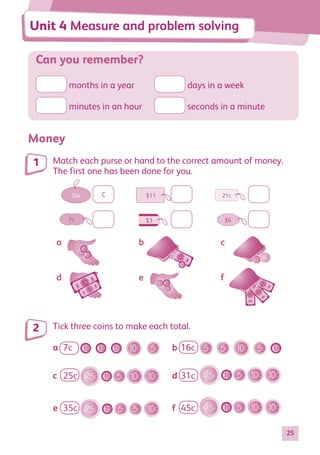
    25 Can you remember? monthsin a year days in a week minutes in an hour seconds in a minute Money Match each purse or hand to the correct amount of money. The first one has been done for you. 7c $6 $3 21c 35c $11 a b c d e f c Tick three coins to make each total. a c e 7c 25c 35c 16c 31c 45c b d f 1 2 Unit 4 Measure and problem solving 884597_MATH_WORKBOOK_S2.indb 25 2017/05/03 6:27 PM
  • 27.
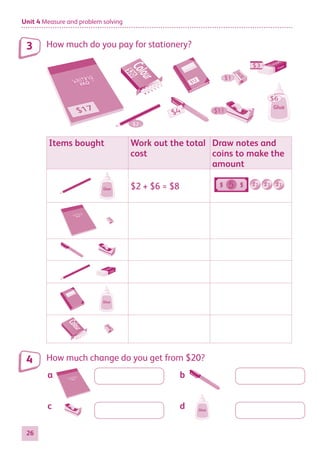
    Unit 4 Measureand problem solving 26 How much do you pay for stationery? $11 $1 $3 $4 Glue $6 $2 Items bought Work out the total cost Draw notes and coins to make the amount Glue $2 + $6 = $8 5 Glue How much change do you get from $20? Glue 3 4 a b c d 884597_MATH_WORKBOOK_S2.indb 26 2017/05/03 6:27 PM
  • 28.
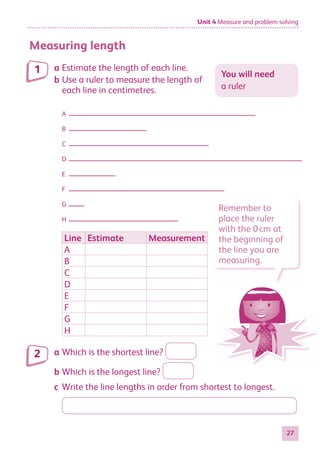
    Unit 4 Measureand problem solving 27 Measuring length a Estimate the length of each line. b Use a ruler to measure the length of each line in centimetres. A B C D E F G H Line Estimate Measurement A B C D E F G H a Which is the shortest line? b Which is the longest line? c Write the line lengths in order from shortest to longest. You will need a ruler 1 2 Remember to place the ruler with the 0cm at the beginning of the line you are measuring. 884597_MATH_WORKBOOK_S2.indb 27 2017/05/03 6:27 PM
  • 29.
    Unit 4 Measureand problem solving 28 Choose five items to measure. Complete the table. Item Estimate length in cm Length in cm The children practised long jump. They measured each jump. a Victor jumped 1cm further than Tessa. How far did he jump? Complete the table. Carlos 87 cm Tessa 85 cm Victor Lucia 91 cm b Who jumped the furthest? c Whose jump was the shortest? d Write the lengths in order from shortest to longest. 3 4 884597_MATH_WORKBOOK_S2.indb 28 2017/05/03 6:27 PM
  • 30.
    Unit 4 Measureand problem solving 29 Time a Complete the table. Fill in the missing days of the week. Tuesday Wednesday Saturday T T W W W Satu Satu Satu b Complete the table. Fill in the missing months of the year. January March April June September December Match the lengths of time. The first one has been done for you. 24 hours 1 year 12 months 1 hour 7 days 1 minute 60 minutes 1 week 60 seconds 1 day Draw the hands on each clock to show the time. 12 6 11 5 10 4 9 3 8 2 7 1 12 6 11 5 10 4 9 3 8 2 7 1 12 6 11 5 10 4 9 3 8 2 7 1 12 6 11 5 10 4 9 3 8 2 7 1 3 o’clock 5 o’clock 9 o’clock 12 o’clock 1 2 3 884597_MATH_WORKBOOK_S2.indb 29 2017/05/03 6:27 PM
  • 31.
    Unit 4 Measureand problem solving 30 Draw the hands on each clock to show the time. 12 6 11 5 10 4 9 3 8 2 7 1 half past 2 12 6 11 5 10 4 9 3 8 2 7 1 half past 11 12 6 11 5 10 4 9 3 8 2 7 1 half past 6 Write the digital time for each clock. 12 6 11 5 10 4 9 3 8 2 7 1 12 6 11 5 10 4 9 3 8 2 7 1 12 6 11 5 10 4 9 3 8 2 7 1 12 6 11 5 10 4 9 3 8 2 7 1 12 6 11 5 10 4 9 3 8 2 7 1 12 6 11 5 10 4 9 3 8 2 7 1 12 6 11 5 10 4 9 3 8 2 7 1 12 6 11 5 10 4 9 3 8 2 7 1 12 6 11 5 10 4 9 3 8 2 7 1 12 6 11 5 10 4 9 3 8 2 7 1 12 6 11 5 10 4 9 3 8 2 7 1 12 6 11 5 10 4 9 3 8 2 7 1 12 6 11 5 10 4 9 3 8 2 7 1 12 6 11 5 10 4 9 3 8 2 7 1 12 6 11 5 10 4 9 3 8 2 7 1 12 6 11 5 10 4 9 3 8 2 7 1 12 6 11 5 10 4 9 3 8 2 7 1 12 6 11 5 10 4 9 3 8 2 7 1 12 6 11 5 10 4 9 3 8 2 7 1 12 6 11 5 10 4 9 3 8 2 7 1 The clock shows the time the train arrived. Write the time. 12 4 5 6 884597_MATH_WORKBOOK_S2.indb 30 2017/05/03 6:27 PM
  • 32.
    31 Unit 4 Measureand problem solving Self-assessment Self-check statements I can recognise and name the coins and notes we use. I can write money amounts correctly. I can pay for items with different coins and notes. I can work out the change when I give a note. I can use a ruler and metre stick to measure the length of objects. I can compare lengths and know how long a metre is and how long a centimetre is. I know the difference between seconds, minutes and hours. I know how many days there are in a week. I know the days of the week and the months of the year, and can say them in order. I can read the time to the half-hour and use ‘o’clock’ and ‘half past’. I need more help with … I don’t understand this. I understand this well. I understand this, but I need more practice. 884597_MATH_WORKBOOK_S2.indb 31 2017/05/03 6:27 PM
  • 33.
    32 Can you remember? 26,36, 46, , 66, , 98, , 78, , 58, 48, 33, 34, , , , 38, Counting patterns a Count on in tens. 44, , , , , 45, , , , , b Count back in tens. 87, , , , , 86, , , , , Letter B has a mass of 70 g. a Letter A is 10 g heavier than letter B. Letter A’s mass is  g. b Letter C is 10 g lighter than letter B. Letter C’s mass is  g. c Draw arrows on the scales to show the masses for letters A and C. 1 2 50 100 150 200 250 300 50 100 150 200 250 300 50 100 150 200 250 300 A B C Unit 6 Number and problem solving 50 100 150 200 250 300 50 100 150 200 250 300 50 100 150 200 250 300 A B C 50 100 150 200 250 300 50 100 150 200 250 300 50 100 150 200 250 300 A B C g 0 10 20 30 40 50 60 70 80 90 g 0 10 20 30 40 50 60 70 80 90 g 0 10 20 30 40 50 60 80 90 70 884597_MATH_WORKBOOK_S2.indb 32 2017/05/03 6:27 PM
  • 34.
    Unit 6 Numberand problem solving 33 FISH FOOD FISH FOOD FISH FOOD Estimate how many fish there are in the fish tanks altogether. Tick one. 10 30 50 100 Each hutch has 2 rabbits. How many rabbits are there in ... 4 hutches? 5 hutches? 6 hutches? 7 hutches? The fish food costs $5 for 1 tin. What is the cost of ... 6 tins? 7 tins? 8 tins? 9 tins? 3 4 5 Remember to count in 10s, 2s or 5s. 884597_MATH_WORKBOOK_S2.indb 33 2017/05/03 6:27 PM
  • 35.
    Unit 6 Numberand problem solving 34 Comparing, ordering and estimating Use the < and > signs to compare the numbers. Draw pictures to make the sentences true. < > 1 2 Remember < means ‘is less than’ and > means ‘is greater than’. 884597_MATH_WORKBOOK_S2.indb 34 2017/05/03 6:27 PM
  • 36.
    Unit 6 Numberand problem solving 35 a Use the < and > signs to compare the numbers. 37 26 12 92 34 44 35 53 64 46 79 63 b Choose numbers to complete the number sentences. 18 > 36 > 53 > 18 < 36 < 53 < Put the pictures in order. Label them 1st, 2nd, 3rd and 4th. a 1st b Write the numbers in order from smallest to biggest. 71, 24, 53, 21, 34 , , , , 68, 13, 2, 93, 51 , , , , 23, 6, 18, 84, 31 , , , , 17, 7, 77, 47, 27 , , , , 98, 99, 9, 19, 29 , , , , 3 4 5 884597_MATH_WORKBOOK_S2.indb 35 2017/05/03 6:27 PM
  • 37.
    Unit 6 Numberand problem solving 36 Number and place value Write the tens and ones. The first one has been done for you. tens ones total 10 + 6 = 16 a + = b + = c + = d + = 1 884597_MATH_WORKBOOK_S2.indb 36 2017/05/03 6:27 PM
  • 38.
    Unit 6 Numberand problem solving 37 Complete the number sentences. 34 + 1 = 34 + 10 = 34 – 1 = 34 – 10 = 52 + 1 = 52 + 10 = 52 – 1 = 52 – 10 = 67 – 1 = 67 + 10 = 67 + 1 = 67 – 10 = a Rosi picked 14 apples. Matias picked 10 more apples than Rosi. How many apples did Matias pick? 14 + 10 = b Lola picked 10 apples less than Matias. How many apples did Lola pick? c Rashid picked 17 apples. He ate 1 apple. How many apples were left? d Nina had 22 apples in her basket. She picked 1 more. How many apples did Nina have? 2 3 Can you remember 1 more and 1 less, 10 more and 10 less? Use your knowledge of place value to help you. 884597_MATH_WORKBOOK_S2.indb 37 2017/05/03 6:27 PM
  • 39.
    38 Unit 6 Numberand problem solving Self-assessment Self-check statements I can count on and back in ones and tens from numbers over 20. I can count groups of objects in twos, fives and tens. I can use the < and > signs to compare numbers. I can put numbers up to 100 in order. I can partition numbers into tens and ones and know what each digit means. I can work out 1 or 10 more or less than any number and know what happens to the digits. I need more help with … I don’t understand this. I understand this well. I understand this, but I need more practice. 884597_MATH_WORKBOOK_S2.indb 38 2017/05/03 6:27 PM
  • 40.
    39 Can you remember? Drawa table to show how many items there are. Sorting objects and shapes Sort the shapes. Draw them to complete the Carroll diagram. pentagon trapezium triangle circle square rectangle hexagon oval kite semi-circle Four sides Not four sides Which shapes have curved sides? 1 Unit 7 Handling data and problem solving 884597_MATH_WORKBOOK_S2.indb 39 2017/05/03 6:27 PM
  • 41.
    Unit 7 Handlingdata and problem solving 40 Sort the numbers. Write them in the Venn diagram. 50 45 52 54 40 30 35 25 20 22 18 even numbers multiples of 5 Now add six more of your own numbers. Look at the Venn diagram. Write the headings in the boxes. 6 12 18 24 9 3 15 21 27 2 4 8 10 2 3 884597_MATH_WORKBOOK_S2.indb 40 2017/05/03 6:27 PM
  • 42.
    Unit 7 Handlingdata and problem solving 41 Block graphs and pictograms An explorer recorded the number of animals he saw in the rainforest. He used the data to create a pictogram. Rainforest animals Key Parrot Snake Tiger Monkey Lizard Help Macie complete the table by writing in the totals. Animal Tally Number Parrot |||| | 6 Snake ||| Tiger |||| |||| | Monkey |||| Lizard || a Which animal was most common?  b How many parrots did the explorer see?  c How many monkeys did the explorer see? d How many more tigers than snakes did the explorer see?  e How many animals did the explorer see altogether? 1 = 1 animal 884597_MATH_WORKBOOK_S2.indb 41 2017/05/03 6:27 PM
  • 43.
    Unit 7 Handlingdata and problem solving 42 Dylan asked his friends which shape they like best. He recorded the data in a table. Help Dylan complete the table. Shape Tally Number of people Star |||| || 7 Circle |||| |||| Square ||| Triangle |||| ||| Draw a pictogram using the data Dylan collected. a Which shape is the most popular? b Which shape is the least popular? c How many children chose triangles? d How many children chose stars? 2 3 Key 884597_MATH_WORKBOOK_S2.indb 42 2017/05/03 6:27 PM
  • 44.
    Unit 7 Handlingdata and problem solving 43 Jade and Matias asked children how they travel to school. They started a block graph to show their data. Help them complete it. 0 1 2 3 4 5 6 7 8 9 10 a Which way to travel is the most popular? b Which way to travel is the least popular? c How many children travel by bus to school? d How many children walk to school? e How many more children walk than ride their bikes? f How many children did Jade and Matias ask in total? g How do you travel to school? Bike 4 Walk 5 Bus 3 Car 8 4 884597_MATH_WORKBOOK_S2.indb 43 2017/05/03 6:27 PM
  • 45.
    44 Unit 7 Handlingdata and problem solving Self-assessment Self-check statements I can sort sets of 2-D shapes in different ways on a Carroll diagram. I can sort numbers in different ways on a Venn diagram. I can draw a pictogram from data that has been collected. I can answer questions about a pictogram. I can draw a block graph from data that has been collected. I can answer questions about a block graph. I need more help with … I don’t understand this. I understand this well. I understand this, but I need more practice. 884597_MATH_WORKBOOK_S2.indb 44 2017/05/03 6:27 PM
  • 46.
    45 Can you remember? 1+ 19 = 6 + = 20 3 + 17 = 20 – 18 = 20 – = 7 20 – = 11 Addition and subtraction Fill in the missing numbers. 8 80 50 30 5 3 4 40 3 + 4 = 4 + 3 = – 3 = 4 – 4 = 3 8 80 50 30 5 3 4 40 30 + 40 = 40 + 30 = – 30 = 40 – 40 = 30 8 80 50 30 5 3 4 40 + 5 = 8 5 + = 8 8 – 5 = 8 – = 5 8 80 50 30 5 3 4 40 + 50 = 80 50 + = 80 80 – 50 = 80 – = 50 Draw jumps of ten to complete the calculations. a 28 + 20 = 28 b 28 + 30 = 28 1 2 Unit 8 Number and problem solving 884597_MATH_WORKBOOK_S2.indb 45 2017/05/03 6:27 PM
  • 47.
    Unit 8 Numberand problem solving 46 The children were practising high jump. Name 1st Jump 2nd Jump Sofia 83cm 86cm Carlos 73cm 75cm Bruno 81cm 86cm Lucia 71cm 75cm Tim 84cm 86cm How much higher did each child jump on the second jump? Count on to work out the difference. Look at the example. Sofia: 86cm – 83cm = 3cm 83 84 85 86 Carlos: 75 – 73 = Bruno: – = 83 84 85 86 83 84 85 86 Lucia: – = Tim: – = 83 84 85 86 83 84 85 86 3 884597_MATH_WORKBOOK_S2.indb 46 2017/05/03 6:27 PM
  • 48.
    Unit 8 Numberand problem solving 47 Multiplication Match each number to its double. Draw lines. 1 2 3 4 5 6 7 8 9 10 18 10 14 6 8 2 20 4 12 16 A box of colouring pencils has five pencils. Draw an array for each question. Write the number sentences to complete the table. Question Draw an array Write a number sentence How many pencils are there in two boxes? 5 × 2 = 10 How many pencils are there in three boxes? How many pencils are there in four boxes? How many pencils are there in five boxes? How many pencils are there in six boxes? 1 2 884597_MATH_WORKBOOK_S2.indb 47 2017/05/03 6:28 PM
  • 49.
    Unit 8 Numberand problem solving 48 Division Jade had 28 marbles. She put them into groups of 4. How many groups are there? 28 ÷ 4 = 7 Julio had 20 marbles. He put them into groups of 5. How many groups are there? Manuel had 15 toy cars. He put them in rows of 3. How many rows were there? Maya had 45 toy bricks. She built towers of 5 bricks. How many towers did she build? 1 2 3 884597_MATH_WORKBOOK_S2.indb 48 2017/05/03 6:28 PM
  • 50.
    Unit 8 Numberand problem solving 49 Match each division number sentence to its multiplication number sentence. Draw lines. 3 × 2 = 6 5 × 4 = 20 3 × 5 = 15 4 × 3 = 12 5 × 5 = 25 15 ÷ 3 = 5 6 ÷ 3 = 2 25 ÷ 5 = 5 20 ÷ 5 = 4 12 ÷ 4 = 3 12 ÷ 3 = 13 ÷ 3 = remainder 14 ÷ 3 = remainder 20 ÷ 4 = 21 ÷ 4 = remainder 22 ÷ 4 = remainder 18 ÷ 3 = 19 ÷ 3 = remainder 20 ÷ 3 = remainder Rosi had 16 toy bricks. She built towers of 3. How many towers were there? How many bricks were left over? 4 5 Hint Sometimes there are some left over when you divide. This is called the remainder! 6 ÷ 3 = 2 7 ÷ 3 = 2 remainder 1 6 884597_MATH_WORKBOOK_S2.indb 49 2017/05/03 6:28 PM
  • 51.
    50 Unit 8 Numberand problem solving Self-assessment Self-check statements I know number bonds to 10 and pairs of numbers that total 20. I can add single-digit numbers to and from two-digit numbers. I can add and subtract multiples of 10 to and from two-digit numbers. I can count on to find the difference between two near numbers. I know all the doubles up to double 10. I can use an array and explain how it shows a multiplication. I can show how to solve word problems using pictures or objects. I can use grouping to show division. I can use the ÷ sign. I understand that division can leave some left over. I need more help with … I don’t understand this. I understand this well. I understand this, but I need more practice. 884597_MATH_WORKBOOK_S2.indb 50 2017/05/03 6:28 PM
  • 52.
    51 Can you remember? Howmuch money is there in each picture? + + = c + = $ Money Match each purse or hand to the correct amount of money. 1 10 10 $1.10 $10.25 $5.50 $5.10 $10.50 You buy fruit at the fruit stall. Complete the table. Item bought Note used to pay Calculation Your change $4 5 – 4= 5 1 10 10 $3 $2 $5 5 1 10 10 $3 $2 $5 5 1 10 10 $3 $2 $5 1 2 Unit 9 Measure and problem solving a b 884597_MATH_WORKBOOK_S2.indb 51 2017/05/03 6:28 PM
  • 53.
    Unit 9 Measureand problem solving 52 Measuring mass Match each parcel to its mass on the scale. Draw lines. g g g g g 160g 180g 250g 170g 190g 150 160 170 190 200 150 160 170 190 200 150 160 180 190 200 150 170 180 190 200 g 50 100 150 200 300 250 160 170 180 180 Almonds cost $2 per 100 g. What is the mass of each of these? $2 g g g g $3 $4 $5 1 2 884597_MATH_WORKBOOK_S2.indb 52 2017/05/03 6:28 PM
  • 54.
    Unit 9 Measureand problem solving 53 a Choose five items and complete the table. Item Estimate the mass Weigh your item b Put your items in order from lightest to heaviest. Draw pictures. lightest heaviest Use the and signs to compare the weights. 1 kg 10g 1 kg 1 kg 50 g + 10g 1 kg 1 kg 50 g + + 1 kg 1 kg 1 kg + 3 4 Make sure you estimate before you weigh the item. 884597_MATH_WORKBOOK_S2.indb 53 2017/05/03 6:28 PM
  • 55.
    Unit 9 Measureand problem solving 54 Time Manuel visited his grandmother on Monday. He stayed for three days. On which day of the week did Manuel return home? It is a Saturday today. Lucia’s birthday is in four days’ time. On which day of the week is Lucia’s birthday this year? Carlos posted a parcel on Wednesday to a friend. The parcel took two days to arrive at his friend’s house. On which day of the week did the parcel arrive? Match the times to the digital clocks. Draw lines. 3:00 4:00 6:30 10:30 11:00 half past 10 half past 6 3 o’clock 11 o’clock 4 o’clock 1 2 3 4 884597_MATH_WORKBOOK_S2.indb 54 2017/05/03 6:28 PM
  • 56.
    Unit 9 Measureand problem solving 55 Draw hands on the analogue clocks for the time on the digital clocks. 12 6 11 5 10 4 9 3 8 2 7 1 12 6 11 5 10 4 9 3 8 2 7 1 12 6 11 5 10 4 9 3 8 2 7 1 12 6 11 5 10 4 9 3 8 2 7 1 12:00 3:30 1:30 8:00 Write the digital times. 5 6 half past 8 half past 2 1 o’clock 7 o’clock a b c d 884597_MATH_WORKBOOK_S2.indb 55 2017/05/03 6:28 PM
  • 57.
    56 Unit 9 Measureand problem solving Self-assessment Self-check statements I can pay for items with a mix of coins and notes. I can work out the change when I pay for an item. I can estimate the mass of objects and measure using non-standard units. I can use scales to measure the mass of objects. I can use grams and kilograms to compare the mass of objects. I know the difference between seconds, minutes and hours. I know how many minutes there are in an hour. I can read the time to the half-hour and match digital and analogue clocks. I need more help with … I don’t understand this. I understand this well. I understand this, but I need more practice. 884597_MATH_WORKBOOK_S2.indb 56 2017/05/03 6:28 PM
  • 58.
    57 Can you remember? 1 Complete the patterns. 2, 4, , 8, 10, , 5, 10, , 20, 25, , 10, 20, , 40, 50, , 2 Round the numbers to the nearest multiple of ten. 51 35 19 Place value and partitioning Partition the numbers into tens and ones. The first one has been done for you. 25 tens 2 5 ones 34 tens ones 68 tens ones 96 tens ones 20 + 5 = 25 + = 25 tens 2 5 ones 34 tens ones 68 tens ones 96 tens ones + = + = a Kadir thinks of a number. He adds 10. The answer is 41. What number was he thinking of? b Rosi thinks of a number. She subtracts 10. The answer is 76. What number was she thinking of? c Lucia thinks of a number. She adds 1. The answer is 95. What number was she thinking of? 1 2 Unit 11 Number and problem solving a b c d 884597_MATH_WORKBOOK_S2.indb 57 2017/05/03 6:28 PM
  • 59.
    Unit 11 Numberand problem solving 58 Compare the amounts using the and signs. - - - - - - - - - - - - - - - - - - - - - - - - - - - - - - - - - - - - - - - - - - - - - - - - - - - - - - - - - - - - - - 0 50 100 150 200 250 300 g 0 50 100 150 200 250 300 g 5 10 a b c d 0 5 10 15 20 25 30 0 5 10 15 20 25 30 Compare the amounts using the and signs. a $2 $12 b $3 $30 c 12°C 2°C d 29°C 32°C Complete the sentences to make them true. Choose measurements from the list. 77 cm 20 cm 35 cm 6 cm 53 cm a  cm  cm b  cm  cm c  cm  cm d  cm  cm Write the sets of numbers in order from smallest to biggest. 20, 2, 22, 72, 12 , , , , 30, 3, 23, 63, 34 , , , , 3 4 5 6 884597_MATH_WORKBOOK_S2.indb 58 2017/05/03 6:28 PM
  • 60.
    Unit 11 Numberand problem solving 59 Halves and quarters Colour in ​​ 1   __  2   ​​of each shape. Colour in ​​ 1   __  4   ​​of each shape. Colour in ​​ 3   __  4   ​​of each shape. Match the equivalent fractions. Draw lines. 1 2 3 4 884597_MATH_WORKBOOK_S2.indb 59 2017/05/03 6:28 PM
  • 61.
    Unit 11 Numberand problem solving 60 Colour in ​​ 1   __  2   ​​the objects in each set. Write how many. 1 2 of = 1 2 of = 1 2 of = 1 2 of = Colour in ​​ 1   __  4   ​​of the objects in each set. Write how many. 1 4 of = 1 4 of = The baker has 12 eggs. He uses half the eggs. How many are left? A farmer has 16 goats. He sells ​​ 1   __  4  ​​of the goats. How many are left? 5 6 7 8 884597_MATH_WORKBOOK_S2.indb 60 2017/05/03 6:28 PM
  • 62.
    Unit 11 Numberand problem solving 61 Number patterns Use the number line to count in threes. 0 , 3 , 6 , , , , 0 1 2 3 4 5 6 7 8 9 10 11 12 13 14 15 16 17 18 19 20 0 1 2 3 4 5 6 7 8 9 10 11 12 13 14 15 16 17 21 23 25 24 22 18 20 19 Use the number line to count in fours. 0 , 4 , 8 , , , , 0 1 2 3 4 5 6 7 8 9 10 11 12 13 14 15 16 17 18 19 20 0 1 2 3 4 5 6 7 8 9 10 11 12 13 14 15 16 17 21 23 25 24 22 18 20 19 Guide the bird across the water to her nest. Circle the numbers she must follow. The bird must step on multiples of 5 to miss the hippos. Each move must be horizontal, vertical or diagonal to the move before. Start on 40. 32 22 24 51 65 40 35 26 19 50 23 20 15 30 54 21 27 31 52 61 33 49 56 71 64 1 2 3 884597_MATH_WORKBOOK_S2.indb 61 2017/05/03 6:28 PM
  • 63.
    62 Unit 11 Numberand problem solving Self-assessment Self-check statements I can partition numbers into tens and ones and know what each digit means. I can work out 1 or 10 more or less than any number and explain what happens to the digits. I can put a group of numbers to 100 in order. I can use the and signs to compare numbers. I know if a shape is divided into halves or quarters. I can show halves and quarters as equivalent fractions. I can work out one half and one quarter of a set of objects. I can count in twos, fives and tens to help count groups of numbers. I can count on in threes and fours using a number line. I can recognise if a number is a multiple of 2, 5 or 10. I need more help with … I don’t understand this. I understand this well. I understand this, but I need more practice. 884597_MATH_WORKBOOK_S2.indb 62 2017/05/03 6:28 PM
  • 64.
    63 Can you remember? aMatch the shapes to their names. hexagon square rectangle circle pentagon triangle b Complete the table and describe each shape. Shape Number of sides and corners Circle 1 curved side, 0 corners Triangle 3 sides, 3 corners Square Rectangle Pentagon Hexagon 2-D and 3-D shapes Think of an example around you for each shape. Draw a picture. Shape Name Picture My Book My Book My Book My Book rectangle My Book 1 Unit 12 Geometry and problem solving 884597_MATH_WORKBOOK_S2.indb 63 2017/05/03 6:28 PM
  • 65.
    Unit 12 Geometryand problem solving 64 Colour all the circles. How many circles can you see? Open at 12 1 2 3 5 4 6 7 8 9 10 11 SUPER- MARKET Match the 3-D shape to its face. Some will match more than one face. 2 3 884597_MATH_WORKBOOK_S2.indb 64 2017/05/03 6:28 PM
  • 66.
    Unit 12 Geometryand problem solving 65 Draw a line of symmetry on each shape. Complete the patterns to make them symmetrical. Draw a line of symmetry on each pattern. 4 5 6 884597_MATH_WORKBOOK_S2.indb 65 2017/05/03 6:28 PM
  • 67.
    Unit 12 Geometryand problem solving 66 Position and movement The robot can move forwards, backwards, left and right. Imagine you are the robot. Which way do you need to go? Help the robot move through the maze. Follow the directions on page 67. Right Left Forwards Backwards 884597_MATH_WORKBOOK_S2.indb 66 2017/05/03 6:28 PM
  • 68.
    Unit 12 Geometryand problem solving 67 Follow the directions. Which shape does the robot walk to? a Forwards 3 squares, left turn, forwards 3 squares, right turn, backwards 2 squares. b Forwards 3 squares, left turn, forwards 3 squares, right turn, forwards 4 squares, left turn, forwards 4 squares. c Forwards 3 squares, left turn, forwards 3 squares, right turn, forwards 1 square, left turn, forwards 4 squares. d Forwards 3 squares, left turn, forwards 3 squares, right turn, forwards 3 squares, right turn, forwards 3 squares, left turn, forwards 2 squares. The shape moves a quarter-turn anti-clockwise. Tick the correct shape in each row. a b 1 2 884597_MATH_WORKBOOK_S2.indb 67 2017/05/03 6:28 PM
  • 69.
    68 Unit 12 Geometryand problem solving Self-assessment Self-check statements I can look at pictures of 2-D shapes and name them. I can sort sets of 2-D shapes in different ways. I can describe different shapes and talk about their properties. I can draw a line of symmetry on a shape. I can complete a symmetrical picture by drawing the ‘other half’. I can name 3-D shapes. I can find and describe shapes around me. I can describe the 2-D shapes on the faces of 3-D shapes. I need more help with … I don’t understand this. I understand this well. I understand this, but I need more practice. 884597_MATH_WORKBOOK_S2.indb 68 2017/05/03 6:28 PM
  • 70.
    69 Can you remember? 20+ 10 = 20 + 20 = 20 + 30 = 50 + 10 = 50 + 20 = 50 + 30 = Addition and subtraction a b 30 + 7 = 22 + 7 = 32 + 7 = 20 + 7 = a 22 + 27 = b 45 + 13 = c 64 + 23 = 32 + 27 = 45 + 23 = 64 + 33 = 1 2 Unit 13 Number and problem solving 884597_MATH_WORKBOOK_S2.indb 69 2017/05/03 6:28 PM
  • 71.
    Unit 13 Numberand problem solving 70 There are 18 motorbikes and 21 cars on the ferry. How many vehicles are there altogether? Choose the best method to solve the calculations. Complete the table. Find the difference (counting on) Take away (counting back) 81 – 78 73 – 69 63 – 60 95 – 91 52 – 49 76 – 12 53 – 8 49 – 7 86 – 5 28 – 23 57 – 54 = 82 – 3 = Solve the calculations. a  89 – 87 = b  46 – 45 = c  55 – 4 = d  78 – 7 = e  38 – 32 = f  29 – 4 = There are 67 seats on an aeroplane. Complete the table. Day Empty seats Passengers Monday 4 Tuesday 5 Wednesday 61 Thursday 59 3 4 5 6 884597_MATH_WORKBOOK_S2.indb 70 2017/05/03 6:28 PM
  • 72.
    Unit 13 Numberand problem solving 71 Multiplication and division Count in 2s, 5s and 10s to work out the answers. a How many wellington boots are there? b How many arms do the starfish have altogether? c How much money is there? a Colour in the multiples of 3. b Circle the multiples of 4. 1 2 3 4 5 6 7 8 9 10 11 12 13 14 15 16 17 18 19 20 21 22 23 24 25 26 27 28 29 30 31 32 33 34 35 36 37 38 39 40 41 42 43 44 45 46 47 48 49 50 51 52 53 54 55 56 57 58 59 60 61 62 63 64 65 66 67 68 69 70 71 72 73 74 75 76 77 78 79 80 81 82 83 84 85 86 87 88 89 90 91 92 93 94 95 96 97 98 99 100 1 2 884597_MATH_WORKBOOK_S2.indb 71 2017/05/03 6:28 PM
  • 73.
    Unit 13 Numberand problem solving 72 Solve the calculations. 45 ÷ 5 = 60 ÷ 10 = 20 ÷ 2 = 40 ÷ 5 = 50 ÷ 10 = 18 ÷ 2 = 35 ÷ 5 = 40 ÷ 10 = 16 ÷ 2 = Solve the calculations. 15 ÷ 3 = 15 ÷ 5 = 16 ÷ 3 = 16 ÷ 5 = 17 ÷ 3 = 17 ÷ 5 = The children had 12 shells. They put 4 shells on each sandcastle. How many sandcastles are there? The children had 13 flags. They put 4 flags on each sandcastle. How many sandcastles are there? How many flags are left over? There are 14 sandwiches at the picnic. There are 4 sandwiches for each child. How many children are there? How many sandwiches are left over? There are 15 figs at the picnic. There are 4 figs for each child. How many figs are left over? 3 4 Sometimes when we divide, there are some left over. 5 6 7 8 884597_MATH_WORKBOOK_S2.indb 72 2017/05/03 6:28 PM
  • 74.
    Unit 13 Numberand problem solving 73 Missing number problems There are 20 counters. Carlos hides some under the cup. How many counters are under the cup? Solve the calculations. 46 – 45 = – 2 = 65 63 + = 69 + 7 = 99 37 – 31 = – 26 = 1 Make up a story for each number sentence. Example 12 + = 20 Rosi had 12 marbles. She was given more marbles. She then had 20 marbles. How many marbles was Rosi given? a  18 + = 20 b  30 – = 25 1 2 3 + = 884597_MATH_WORKBOOK_S2.indb 73 2017/05/03 6:28 PM
  • 75.
    74 Unit 13 Numberand problem solving Self-assessment Self-check statements I can add some two-digit numbers and explain my method. I can show how to solve word problems using pictures or objects. I can find the difference between two near numbers and can explain how to subtract by taking away and by finding the difference. I know all the doubles of multiples of 5 up to double 50. I can solve problems by counting in twos, fives and tens. I can describe patterns of 3× and 4× tables on the 100 square. I understand that division can leave some left over. I can explain the methods I use to solve problems and solve number sentences with missing numbers. I can make up a story for a missing number calculation. I need more help with … I don’t understand this. I understand this well. I understand this, but I need more practice. 884597_MATH_WORKBOOK_S2.indb 74 2017/05/03 6:28 PM
  • 76.
    75 Can you remember? Drawthe hands on the clock to show half past 9. Which day comes before Friday? 12 6 11 5 10 4 9 3 8 2 7 1 Money Draw a circle around three coins to make each total. $1.05 $1.05 $1.25 $1.75 $1.25 $1.05 $1.25 $1.75 $1.75 $1.05 $1.25 $1.75 Use two notes and three coins to make $20.75. Lemons cost $1 each and oranges cost $1.50 each. a Mia buys 5 lemons and 2 oranges. How much change does she get from $10? b Kadir buys 3 lemons and 3 oranges. How much change does he get from $10? 1 2 3 Unit 14 Measure and problem solving 884597_MATH_WORKBOOK_S2.indb 75 2017/05/03 6:28 PM
  • 77.
    Unit 14 Measureand problem solving 76 Measuring capacity Estimate the capacity of these containers. Draw lines to match. 10 ℓ 100 ℓ 250 ml 2 ℓ Use , or = to compare the amounts. 250 ml Oil 1 litre 3 litres cola 250 ml 1 2 884597_MATH_WORKBOOK_S2.indb 76 2017/05/03 6:28 PM
  • 78.
    Unit 14 Measureand problem solving 77 How much water is in each measuring jug? 1000 900 800 700 600 500 400 300 200 100 1000 900 800 700 600 500 400 300 200 100 1000 900 800 700 600 500 400 300 200 100 1000 900 800 700 600 500 400 300 200 100 a b c d ml ml ml ml You will need a measuring jug and water a Pour these amounts into the jug. ● ● 200 ml ● ● 250 ml ● ● 450 ml ● ● 1000 ml b Will the total amount fill a 2-litre bottle? 3 4 1000 900 800 700 600 500 400 300 200 100 884597_MATH_WORKBOOK_S2.indb 77 2017/05/03 6:28 PM
  • 79.
    Unit 14 Measureand problem solving 78 Time Draw the hands on each analogue clock to match the digital time. 12 6 11 5 10 4 9 3 8 2 7 1 6:00 12 6 11 5 10 4 9 3 8 2 7 1 12:00 12 6 11 5 10 4 9 3 8 2 7 1 1:30 12 6 11 5 10 4 9 3 8 2 7 1 5:30 Write the times in order from earliest to latest. 12 6 11 5 10 4 9 3 8 2 7 1 12 6 11 5 10 4 9 3 8 2 7 1 12 6 11 5 10 4 9 3 8 2 7 1 12 6 11 5 10 4 9 3 8 2 7 1 Julio went into the dentist at 4 o’clock. He was there for 1 hour. What time did he come out? Mia went into the hairdresser at 1 o’clock. She left at 3 o’clock. How long was she at the hairdresser? 1 2 3 4 884597_MATH_WORKBOOK_S2.indb 78 2017/05/03 6:28 PM
  • 80.
    Unit 14 Measureand problem solving 79 Choose the best unit to measure the time of each event. Draw lines to match. brushing your teeth seconds a plane journey minutes winking your eye hours a How many days are there in five weeks? b How many months are there in two years? 5 6 884597_MATH_WORKBOOK_S2.indb 79 2017/05/03 6:28 PM
  • 81.
    80 Unit 14 Measureand problem solving Self-assessment Self-check statements I can pay for items with a mix of coins and notes. I can work out the change when I pay for an item. I can compare the capacity of containers. I can use measuring jugs to find the capacity of different containers. I can read the time to the half-hour on digital and analogue clocks. I know the different units we use to measure time. I know how many days there are in a week and how many months there are in a year. I need more help with … I don’t understand this. I understand this well. I understand this, but I need more practice. 884597_MATH_WORKBOOK_S2.indb 80 2017/05/03 6:28 PM