The Impact of Leaders
on the Creation of
Communities of Practice
Marla J Hetzel
November 19, 2013
Leading From Behind
Creating a context for communities of practice
2
What words and phrases
resonate with you?
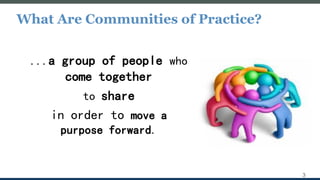
What Are Communities of Practice?
...a group of people who
come together
to share
in order to move a
purpose forward.
3
Current Leadership Practices
Current leadership practices are not a fit for creating communities of
practice
• It is about more than communities of practice
• It is about working differently
 Learn
 Experiment
 Innovate
• Represents significant change
4
Current Leadership Practices
5
“In today’s world, the executive’s job is no
longer to command and control but to cultivate
and coordinate the actions of others at all
levels of the organization.”
Ancona et al.
Learning to Lead Again
As leaders, we are learning new skills to put into practice
“We now accept the fact that learning is a lifelong
process of keeping abreast of change. And the most
pressing task is to teach people how to learn.”
Peter F. Drucker
6
Through the Lens of the Follower
Three ways leaders can meet the needs of followers when creating
communities of practice
• Give a #$%^&
• Check the Ego
• Do Your Job
7
Background on Case Study
Communities of practice to facilitate change: a story of leaders and
followers
8
• CEO calling for change
• Communities of practice established to support change
mandate
• Leaders
 Individuals in positions of authority
• Chairpersons
 Volunteered to help create the communities of practice
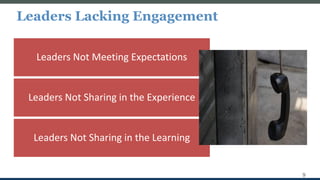
Leaders Lacking Engagement
9
Leaders Not Meeting Expectations
Leaders Not Sharing in the Experience
Leaders Not Sharing in the Learning
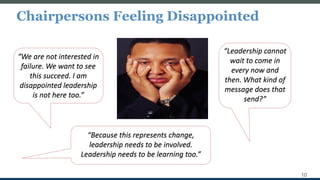
Chairpersons Feeling Disappointed
10
“We are not interested in
failure. We want to see
this succeed. I am
disappointed leadership
is not here too.”
“Because this represents change,
leadership needs to be involved.
Leadership needs to be learning too.”
“Leadership cannot
wait to come in
every now and
then. What kind of
message does that
send?”
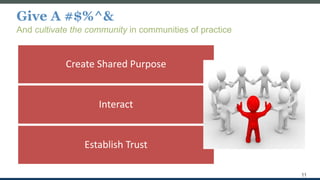
Give A #$%^&
And cultivate the community in communities of practice
11
Create Shared Purpose
Interact
Establish Trust
Give A #$%^&
12
“The way to start rebuilding community is to stop the
practices that undermine it ... the organization has
to shed much of its individualistic behavior and many of
its short-term measures in favor of practices that
promote trust, engagement, and spontaneous
collaboration aimed at sustainability.”
Henry Mintzberg
Give A #$%^&
13
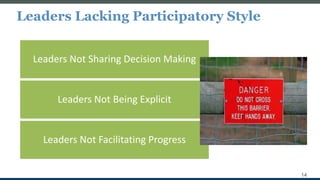
Leaders Lacking Participatory Style
14
Leaders Not Sharing Decision Making
Leaders Not Being Explicit
Leaders Not Facilitating Progress
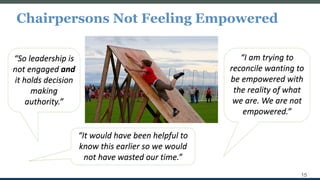
Chairpersons Not Feeling Empowered
15
“So leadership is
not engaged and
it holds decision
making
authority.”
“It would have been helpful to
know this earlier so we would
not have wasted our time.”
“I am trying to
reconcile wanting to
be empowered with
the reality of what
we are. We are not
empowered.”
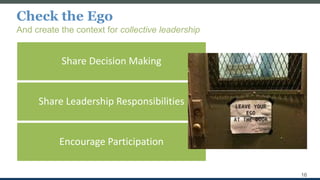
Check the Ego
And create the context for collective leadership
16
Share Decision Making
Share Leadership Responsibilities
Encourage Participation
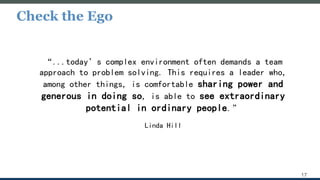
Check the Ego
17
“...today’s complex environment often demands a team
approach to problem solving. This requires a leader who,
among other things, is comfortable sharing power and
generous in doing so, is able to see extraordinary
potential in ordinary people.”
Linda Hill
Check the Ego
18
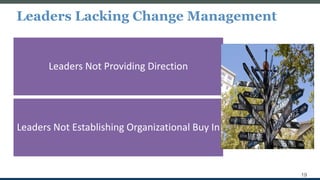
Leaders Lacking Change Management
19
Leaders Not Providing Direction
Leaders Not Establishing Organizational Buy In
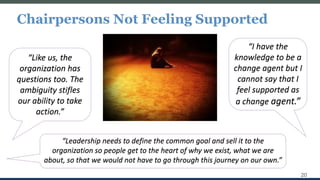
Chairpersons Not Feeling Supported
20
“Like us, the
organization has
questions too. The
ambiguity stifles
our ability to take
action.”
“Leadership needs to define the common goal and sell it to the
organization so people get to the heart of why we exist, what we are
about, so that we would not have to go through this journey on our own.”
“I have the
knowledge to be a
change agent but I
cannot say that I
feel supported as
a change agent.”
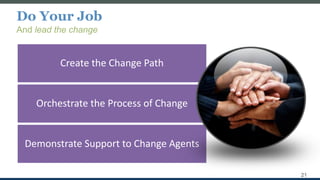
Do Your Job
And lead the change
21
Create the Change Path
Orchestrate the Process of Change
Demonstrate Support to Change Agents
Do Your Job
22
“Of course, diffusing such groups across the
organization requires the support of leadership.
Without it, efforts in communityship seldom get far.”
Henry Mintzberg
Do Your Job
23
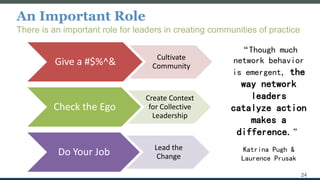
An Important Role
There is an important role for leaders in creating communities of practice
24
Give a #$%^& Cultivate
Community
Check the Ego
Create Context
for Collective
Leadership
Do Your Job Lead the
Change
“Though much
network behavior
is emergent, the
way network
leaders
catalyze action
makes a
difference.”
Katrina Pugh &
Laurence Prusak
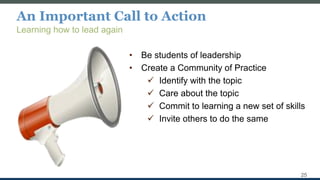
An Important Call to Action
Learning how to lead again
• Be students of leadership
• Create a Community of Practice
 Identify with the topic
 Care about the topic
 Commit to learning a new set of skills
 Invite others to do the same
25
Good Reading!
26
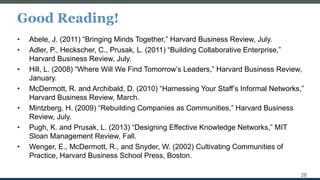
• Abele, J. (2011) “Bringing Minds Together,” Harvard Business Review, July.
• Adler, P., Heckscher, C., Prusak, L. (2011) “Building Collaborative Enterprise,”
Harvard Business Review, July.
• Hill, L. (2008) “Where Will We Find Tomorrow’s Leaders,” Harvard Business Review,
January.
• McDermott, R. and Archibald, D. (2010) “Harnessing Your Staff’s Informal Networks,”
Harvard Business Review, March.
• Mintzberg, H. (2009) “Rebuilding Companies as Communities,” Harvard Business
Review, July.
• Pugh, K. and Prusak, L. (2013) “Designing Effective Knowledge Networks,” MIT
Sloan Management Review, Fall.
• Wenger, E., McDermott, R., and Snyder, W. (2002) Cultivating Communities of
Practice, Harvard Business School Press, Boston.
Thank You!
27

Hci slides m hetzel 11.4.2013 final

  • 1.
    The Impact ofLeaders on the Creation of Communities of Practice Marla J Hetzel November 19, 2013
  • 2.
    Leading From Behind Creatinga context for communities of practice 2 What words and phrases resonate with you?
  • 3.
    What Are Communitiesof Practice? ...a group of people who come together to share in order to move a purpose forward. 3
  • 4.
    Current Leadership Practices Currentleadership practices are not a fit for creating communities of practice • It is about more than communities of practice • It is about working differently  Learn  Experiment  Innovate • Represents significant change 4
  • 5.
    Current Leadership Practices 5 “Intoday’s world, the executive’s job is no longer to command and control but to cultivate and coordinate the actions of others at all levels of the organization.” Ancona et al.
  • 6.
    Learning to LeadAgain As leaders, we are learning new skills to put into practice “We now accept the fact that learning is a lifelong process of keeping abreast of change. And the most pressing task is to teach people how to learn.” Peter F. Drucker 6
  • 7.
    Through the Lensof the Follower Three ways leaders can meet the needs of followers when creating communities of practice • Give a #$%^& • Check the Ego • Do Your Job 7
  • 8.
    Background on CaseStudy Communities of practice to facilitate change: a story of leaders and followers 8 • CEO calling for change • Communities of practice established to support change mandate • Leaders  Individuals in positions of authority • Chairpersons  Volunteered to help create the communities of practice
  • 9.
    Leaders Lacking Engagement 9 LeadersNot Meeting Expectations Leaders Not Sharing in the Experience Leaders Not Sharing in the Learning
  • 10.
    Chairpersons Feeling Disappointed 10 “Weare not interested in failure. We want to see this succeed. I am disappointed leadership is not here too.” “Because this represents change, leadership needs to be involved. Leadership needs to be learning too.” “Leadership cannot wait to come in every now and then. What kind of message does that send?”
  • 11.
    Give A #$%^& Andcultivate the community in communities of practice 11 Create Shared Purpose Interact Establish Trust
  • 12.
    Give A #$%^& 12 “Theway to start rebuilding community is to stop the practices that undermine it ... the organization has to shed much of its individualistic behavior and many of its short-term measures in favor of practices that promote trust, engagement, and spontaneous collaboration aimed at sustainability.” Henry Mintzberg
  • 13.
  • 14.
    Leaders Lacking ParticipatoryStyle 14 Leaders Not Sharing Decision Making Leaders Not Being Explicit Leaders Not Facilitating Progress
  • 15.
    Chairpersons Not FeelingEmpowered 15 “So leadership is not engaged and it holds decision making authority.” “It would have been helpful to know this earlier so we would not have wasted our time.” “I am trying to reconcile wanting to be empowered with the reality of what we are. We are not empowered.”
  • 16.
    Check the Ego Andcreate the context for collective leadership 16 Share Decision Making Share Leadership Responsibilities Encourage Participation
  • 17.
    Check the Ego 17 “...today’scomplex environment often demands a team approach to problem solving. This requires a leader who, among other things, is comfortable sharing power and generous in doing so, is able to see extraordinary potential in ordinary people.” Linda Hill
  • 18.
  • 19.
    Leaders Lacking ChangeManagement 19 Leaders Not Providing Direction Leaders Not Establishing Organizational Buy In
  • 20.
    Chairpersons Not FeelingSupported 20 “Like us, the organization has questions too. The ambiguity stifles our ability to take action.” “Leadership needs to define the common goal and sell it to the organization so people get to the heart of why we exist, what we are about, so that we would not have to go through this journey on our own.” “I have the knowledge to be a change agent but I cannot say that I feel supported as a change agent.”
  • 21.
    Do Your Job Andlead the change 21 Create the Change Path Orchestrate the Process of Change Demonstrate Support to Change Agents
  • 22.
    Do Your Job 22 “Ofcourse, diffusing such groups across the organization requires the support of leadership. Without it, efforts in communityship seldom get far.” Henry Mintzberg
  • 23.
  • 24.
    An Important Role Thereis an important role for leaders in creating communities of practice 24 Give a #$%^& Cultivate Community Check the Ego Create Context for Collective Leadership Do Your Job Lead the Change “Though much network behavior is emergent, the way network leaders catalyze action makes a difference.” Katrina Pugh & Laurence Prusak
  • 25.
    An Important Callto Action Learning how to lead again • Be students of leadership • Create a Community of Practice  Identify with the topic  Care about the topic  Commit to learning a new set of skills  Invite others to do the same 25
  • 26.
    Good Reading! 26 • Abele,J. (2011) “Bringing Minds Together,” Harvard Business Review, July. • Adler, P., Heckscher, C., Prusak, L. (2011) “Building Collaborative Enterprise,” Harvard Business Review, July. • Hill, L. (2008) “Where Will We Find Tomorrow’s Leaders,” Harvard Business Review, January. • McDermott, R. and Archibald, D. (2010) “Harnessing Your Staff’s Informal Networks,” Harvard Business Review, March. • Mintzberg, H. (2009) “Rebuilding Companies as Communities,” Harvard Business Review, July. • Pugh, K. and Prusak, L. (2013) “Designing Effective Knowledge Networks,” MIT Sloan Management Review, Fall. • Wenger, E., McDermott, R., and Snyder, W. (2002) Cultivating Communities of Practice, Harvard Business School Press, Boston.
  • 27.