Epidemiology Update
Disparities in the HIV Continuum of Care
Kathleen A. Brady, MD
Philadelphia Department of Public Health
AIDS Activities Coordinating Office
February 9, 2018
Overview
1 HIV Continuum of Care
2 Priority Populations
3 Trends in Disparities
4 Geographic Disparities
5 Conclusions
HIV Continuum of Care
Why a Continuum?
• For individuals living with HIV to fully benefit from antiretroviral
therapy, they need to:
• Know that they are HIV positive
• Be engaged in regular HIV care
• Receive and adhere to effective ART
• Various obstacles, or barriers, contribute to gaps in testing and
care
• An individual’s care status can fluctuate, moving forwards or
backwards
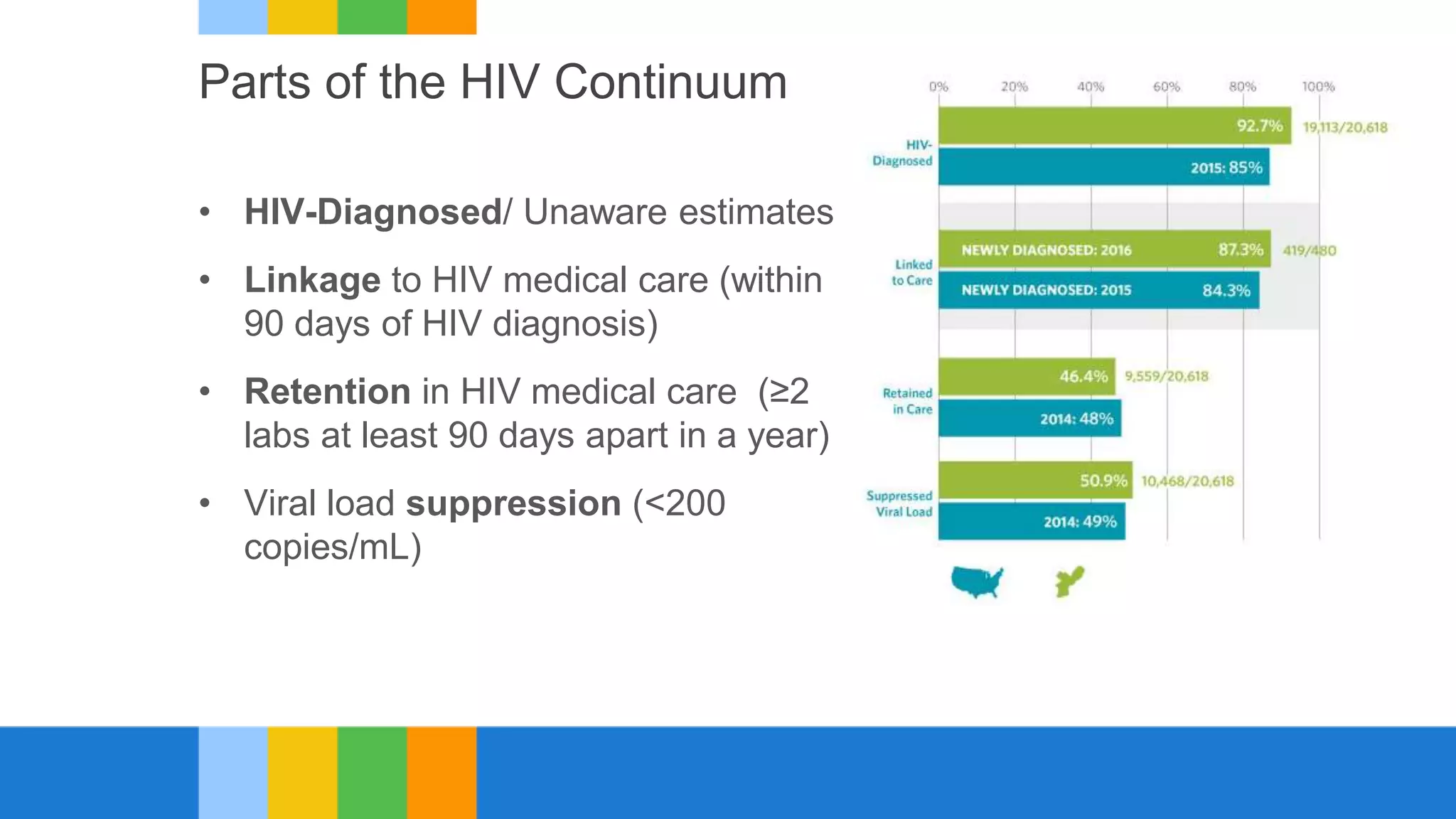
Parts of the HIV Continuum
• HIV-Diagnosed/ Unaware estimates
• Linkage to HIV medical care (within
90 days of HIV diagnosis)
• Retention in HIV medical care (≥2
labs at least 90 days apart in a year)
• Viral load suppression (<200
copies/mL)
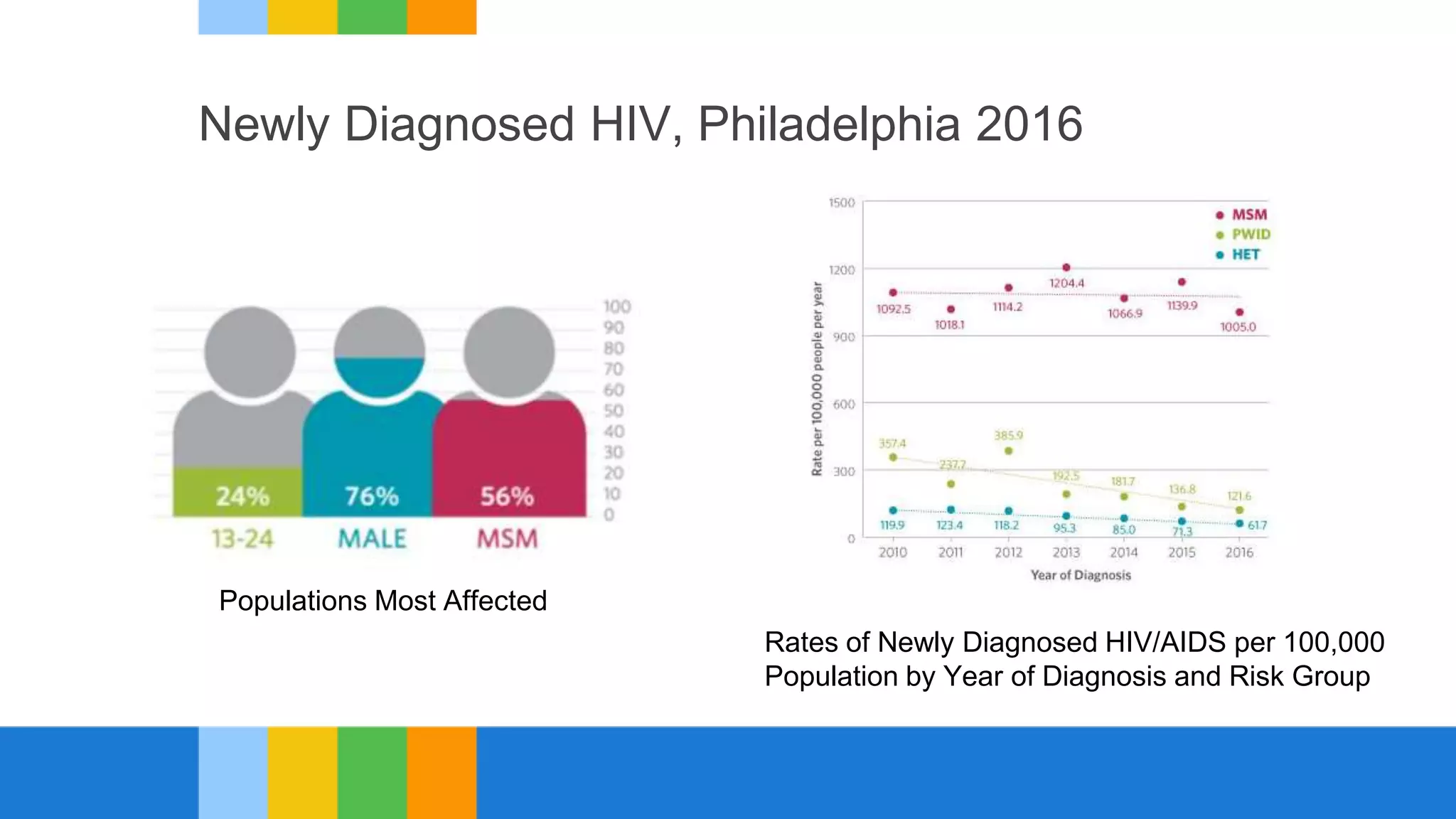
Newly Diagnosed HIV, Philadelphia 2016
Populations Most Affected
Rates of Newly Diagnosed HIV/AIDS per 100,000
Population by Year of Diagnosis and Risk Group
Priority Populations
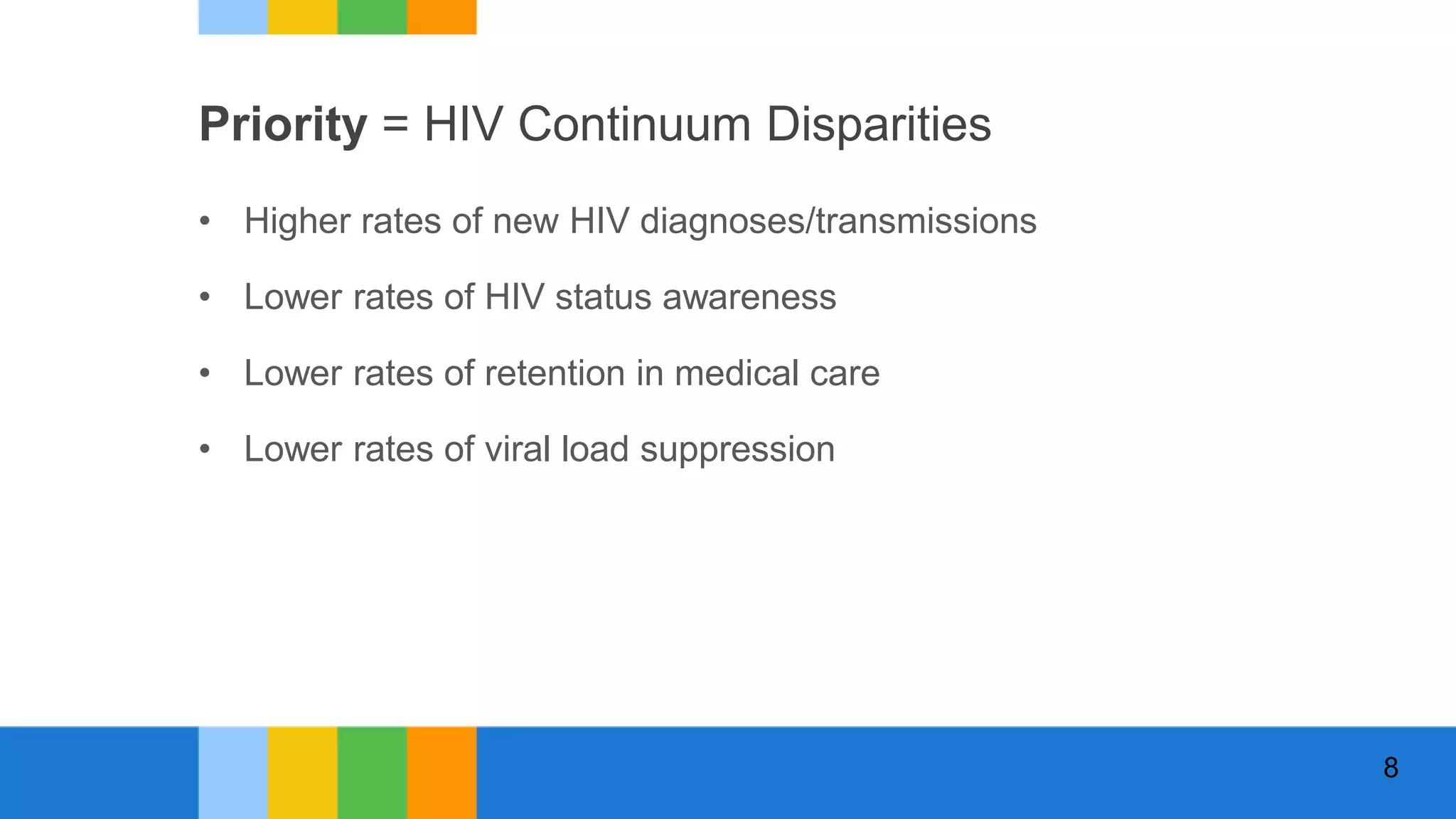
Priority = HIV Continuum Disparities
• Higher rates of new HIV diagnoses/transmissions
• Lower rates of HIV status awareness
• Lower rates of retention in medical care
• Lower rates of viral load suppression
8
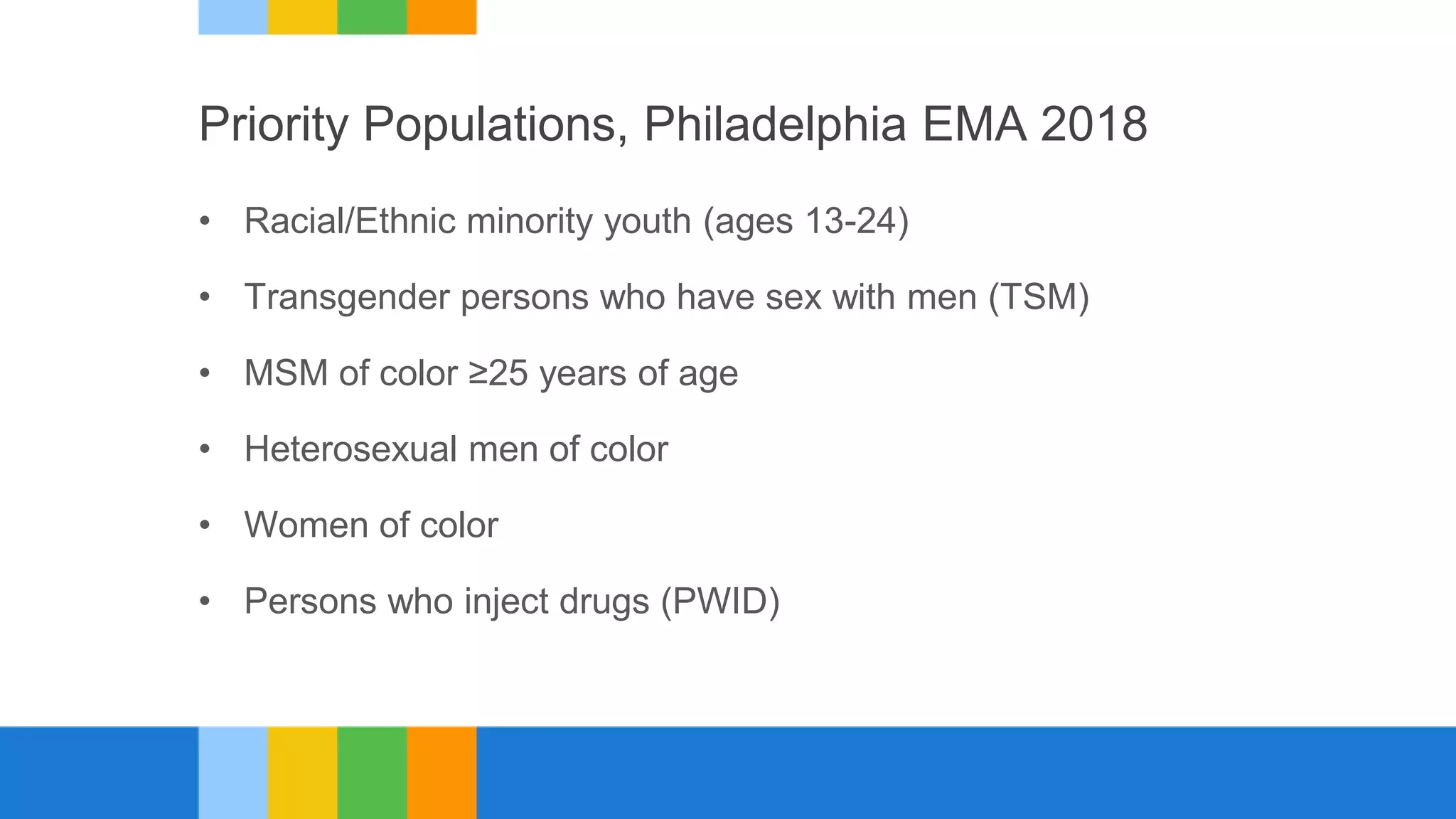
Priority Populations, Philadelphia EMA 2018
• Racial/Ethnic minority youth (ages 13-24)
• Transgender persons who have sex with men (TSM)
• MSM of color ≥25 years of age
• Heterosexual men of color
• Women of color
• Persons who inject drugs (PWID)
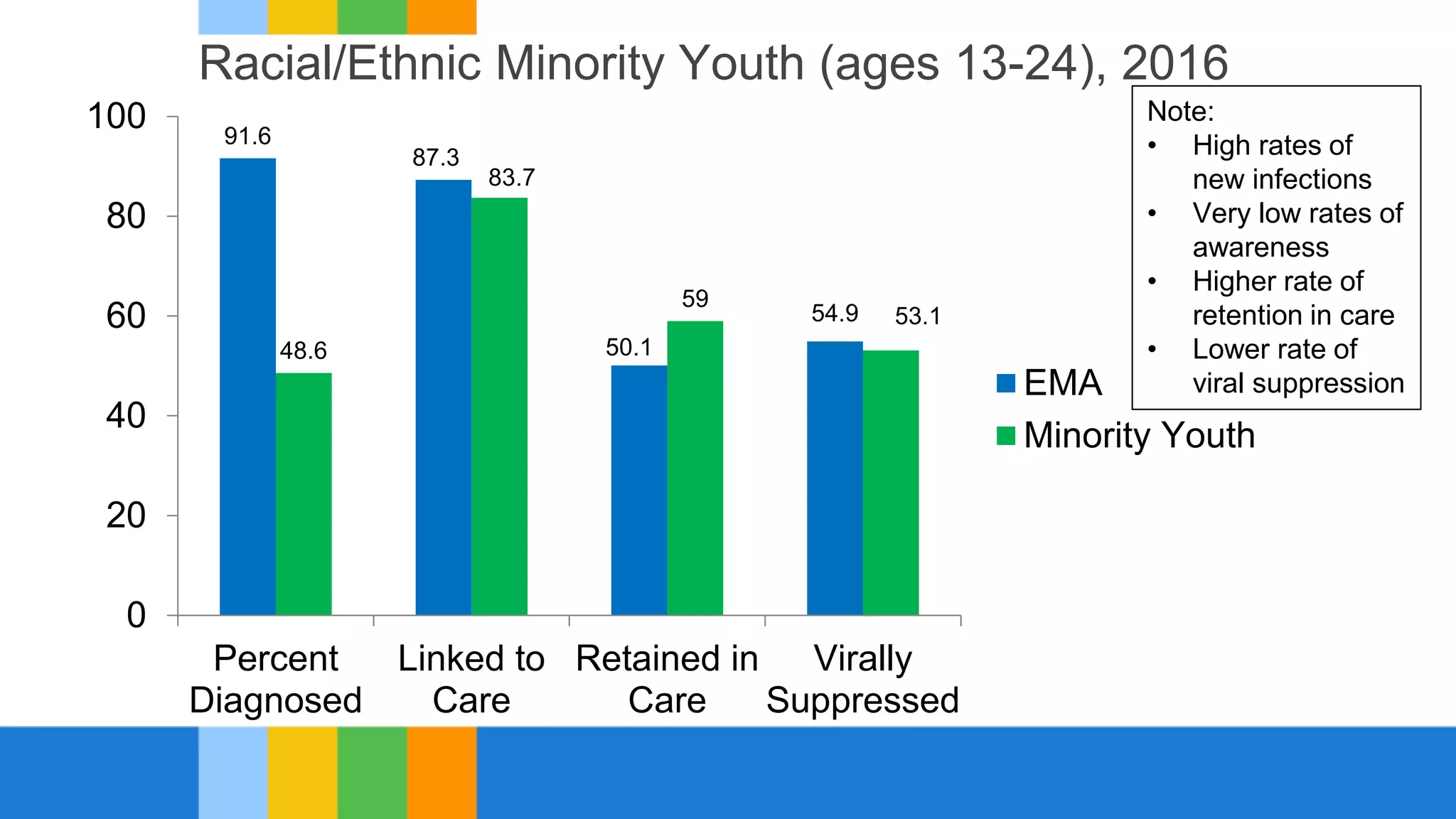
Racial/Ethnic Minority Youth (ages 13-24), 2016
91.6
87.3
50.1
54.9
48.6
83.7
59
53.1
0
20
40
60
80
100
Percent
Diagnosed
Linked to
Care
Retained in
Care
Virally
Suppressed
EMA
Minority Youth
Note:
• High rates of
new infections
• Very low rates of
awareness
• Higher rate of
retention in care
• Lower rate of
viral suppression
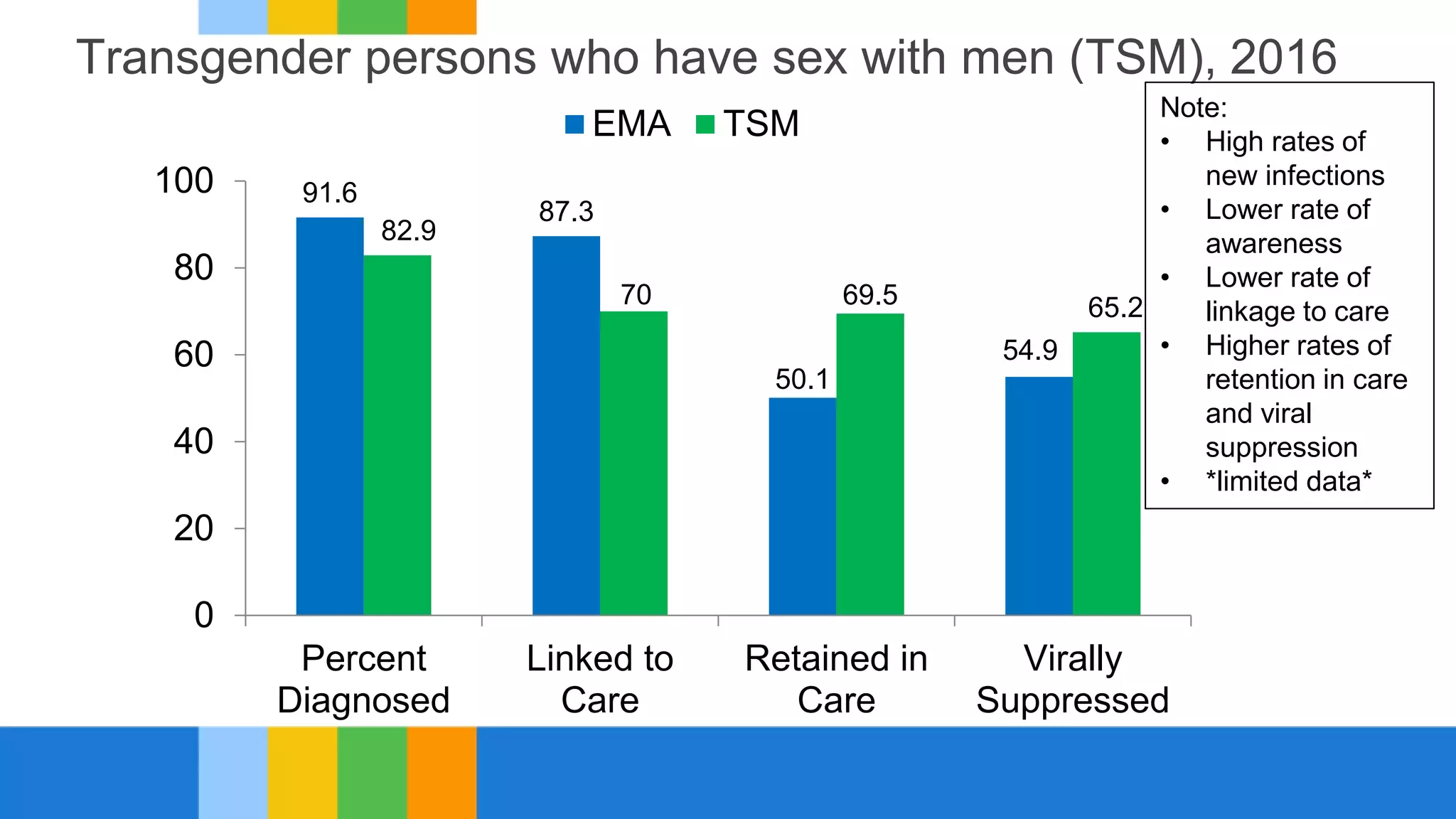
Transgender persons who have sex with men (TSM), 2016
91.6
87.3
50.1
54.9
82.9
70 69.5 65.2
0
20
40
60
80
100
Percent
Diagnosed
Linked to
Care
Retained in
Care
Virally
Suppressed
EMA TSM
Note:
• High rates of
new infections
• Lower rate of
awareness
• Lower rate of
linkage to care
• Higher rates of
retention in care
and viral
suppression
• *limited data*
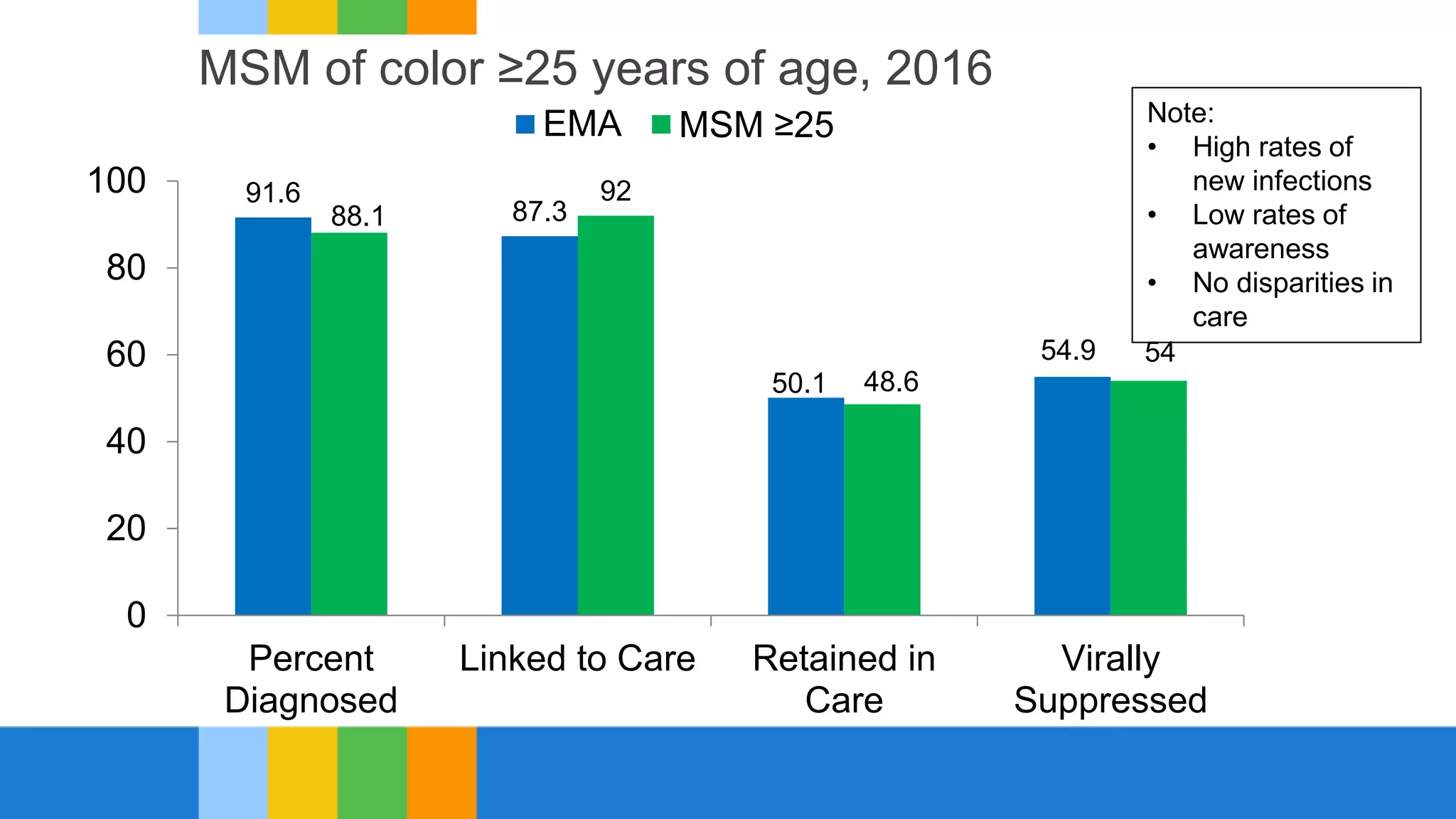
MSM of color ≥25 years of age, 2016
91.6
87.3
50.1
54.9
88.1
92
48.6
54
0
20
40
60
80
100
Percent
Diagnosed
Linked to Care Retained in
Care
Virally
Suppressed
EMA MSM ≥25 Note:
• High rates of
new infections
• Low rates of
awareness
• No disparities in
care
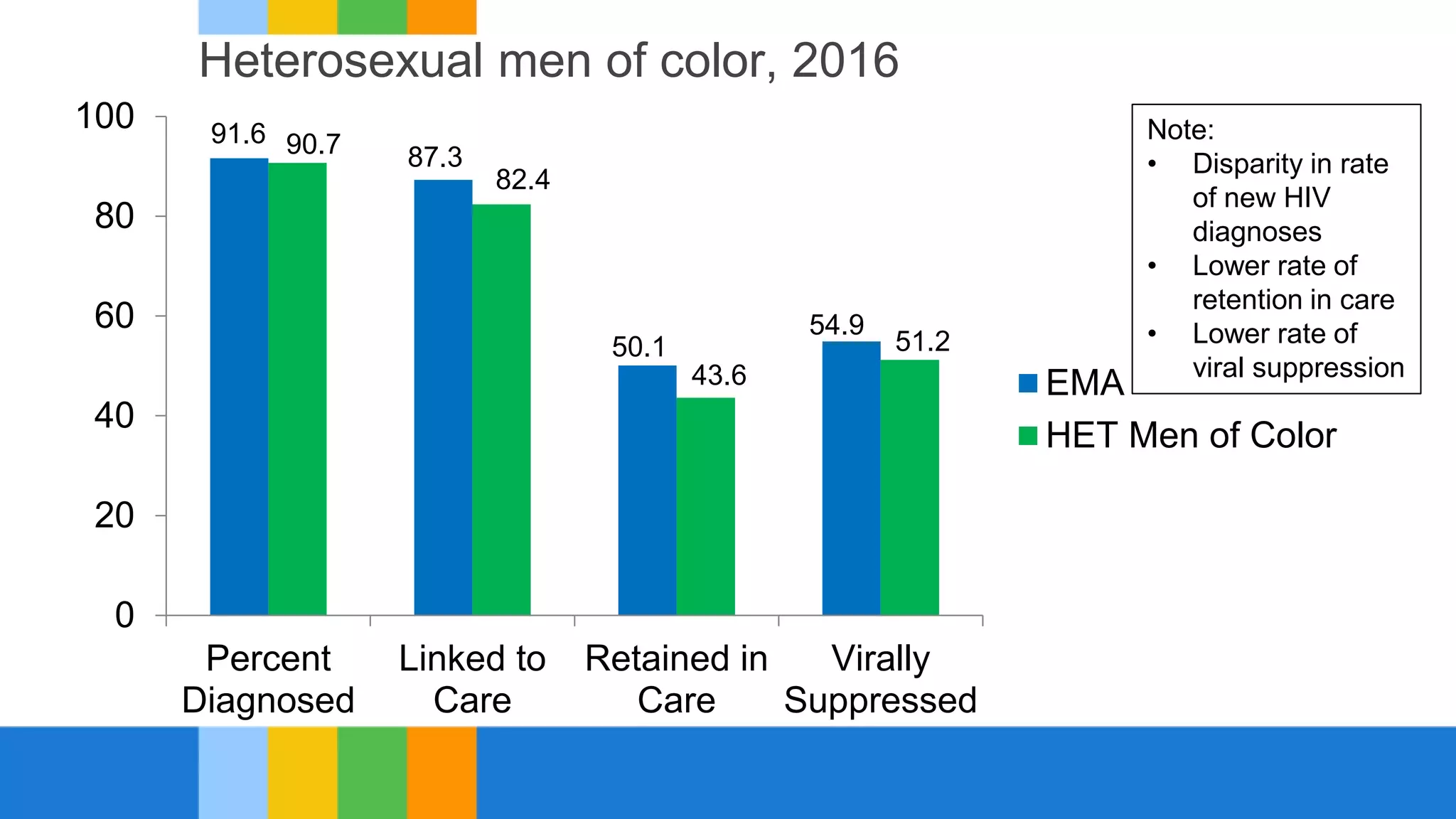
Heterosexual men of color, 2016
91.6
87.3
50.1
54.9
90.7
82.4
43.6
51.2
0
20
40
60
80
100
Percent
Diagnosed
Linked to
Care
Retained in
Care
Virally
Suppressed
EMA
HET Men of Color
Note:
• Disparity in rate
of new HIV
diagnoses
• Lower rate of
retention in care
• Lower rate of
viral suppression
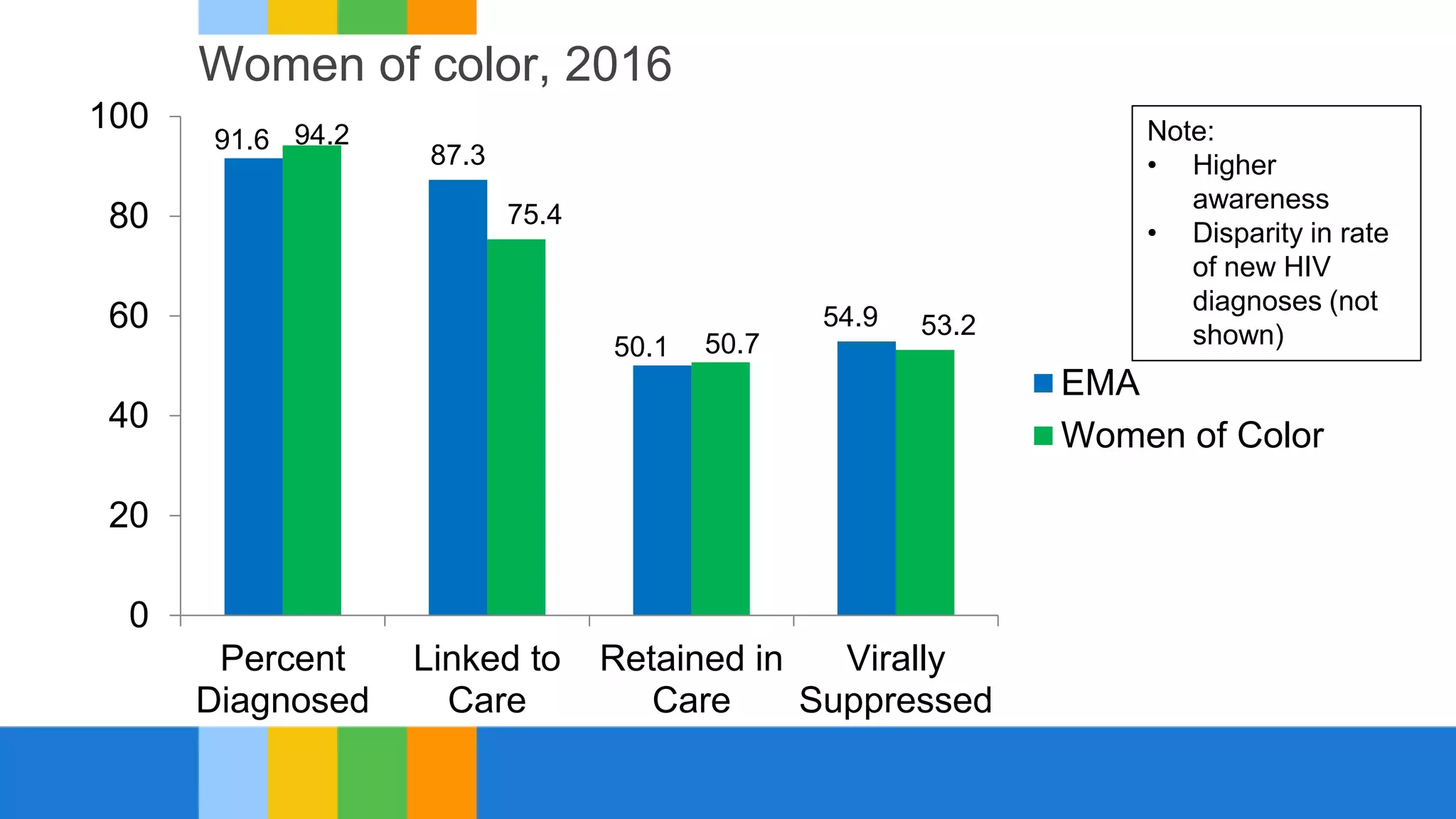
Women of color, 2016
91.6
87.3
50.1
54.9
94.2
75.4
50.7
53.2
0
20
40
60
80
100
Percent
Diagnosed
Linked to
Care
Retained in
Care
Virally
Suppressed
EMA
Women of Color
Note:
• Higher
awareness
• Disparity in rate
of new HIV
diagnoses (not
shown)
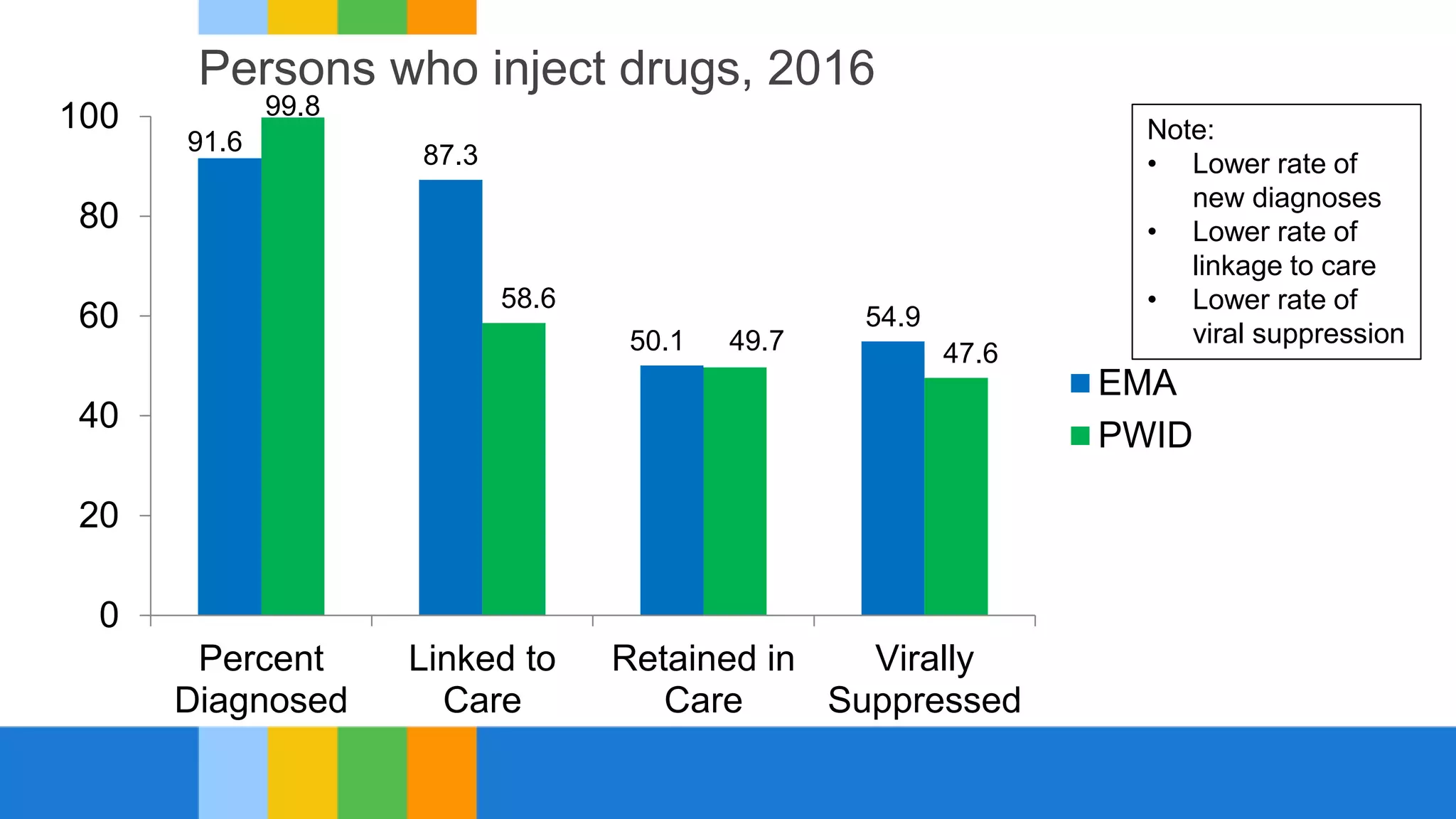
Persons who inject drugs, 2016
91.6 87.3
50.1
54.9
99.8
58.6
49.7 47.6
0
20
40
60
80
100
Percent
Diagnosed
Linked to
Care
Retained in
Care
Virally
Suppressed
EMA
PWID
Note:
• Lower rate of
new diagnoses
• Lower rate of
linkage to care
• Lower rate of
viral suppression
Trends in Disparities
Philadelphia
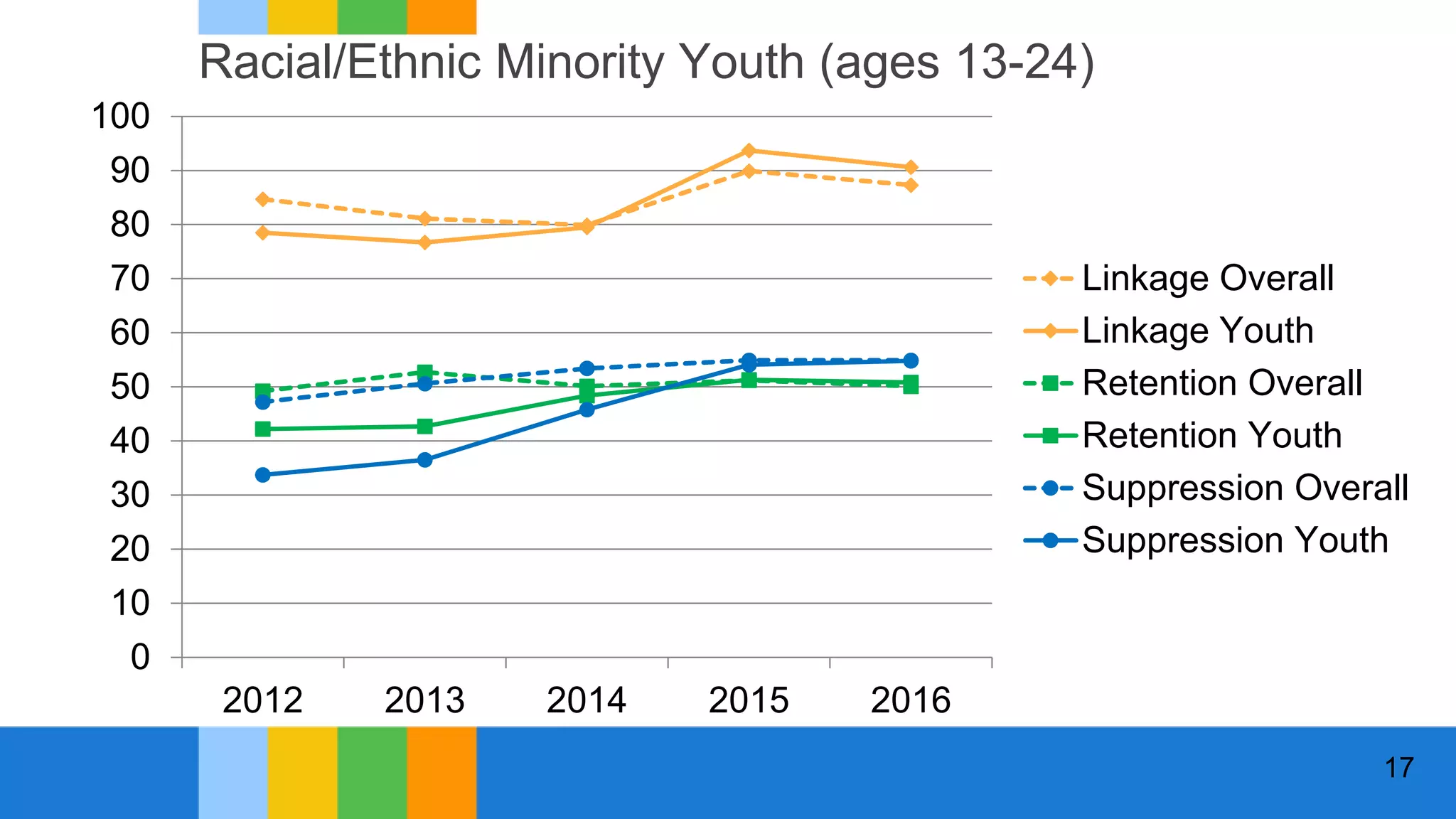
Racial/Ethnic Minority Youth (ages 13-24)
17
0
10
20
30
40
50
60
70
80
90
100
2012 2013 2014 2015 2016
Linkage Overall
Linkage Youth
Retention Overall
Retention Youth
Suppression Overall
Suppression Youth
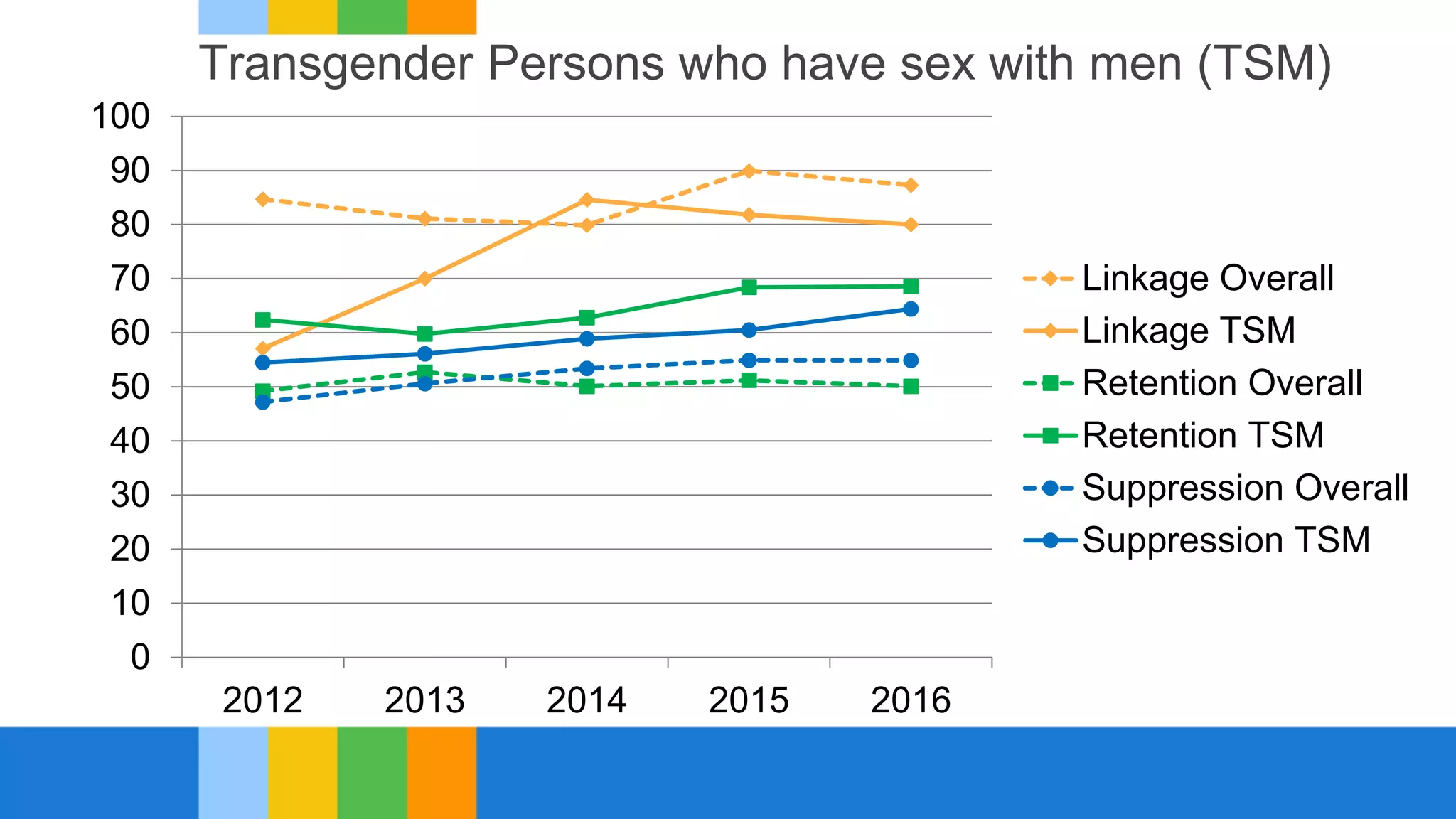
Transgender Persons who have sex with men (TSM)
0
10
20
30
40
50
60
70
80
90
100
2012 2013 2014 2015 2016
Linkage Overall
Linkage TSM
Retention Overall
Retention TSM
Suppression Overall
Suppression TSM
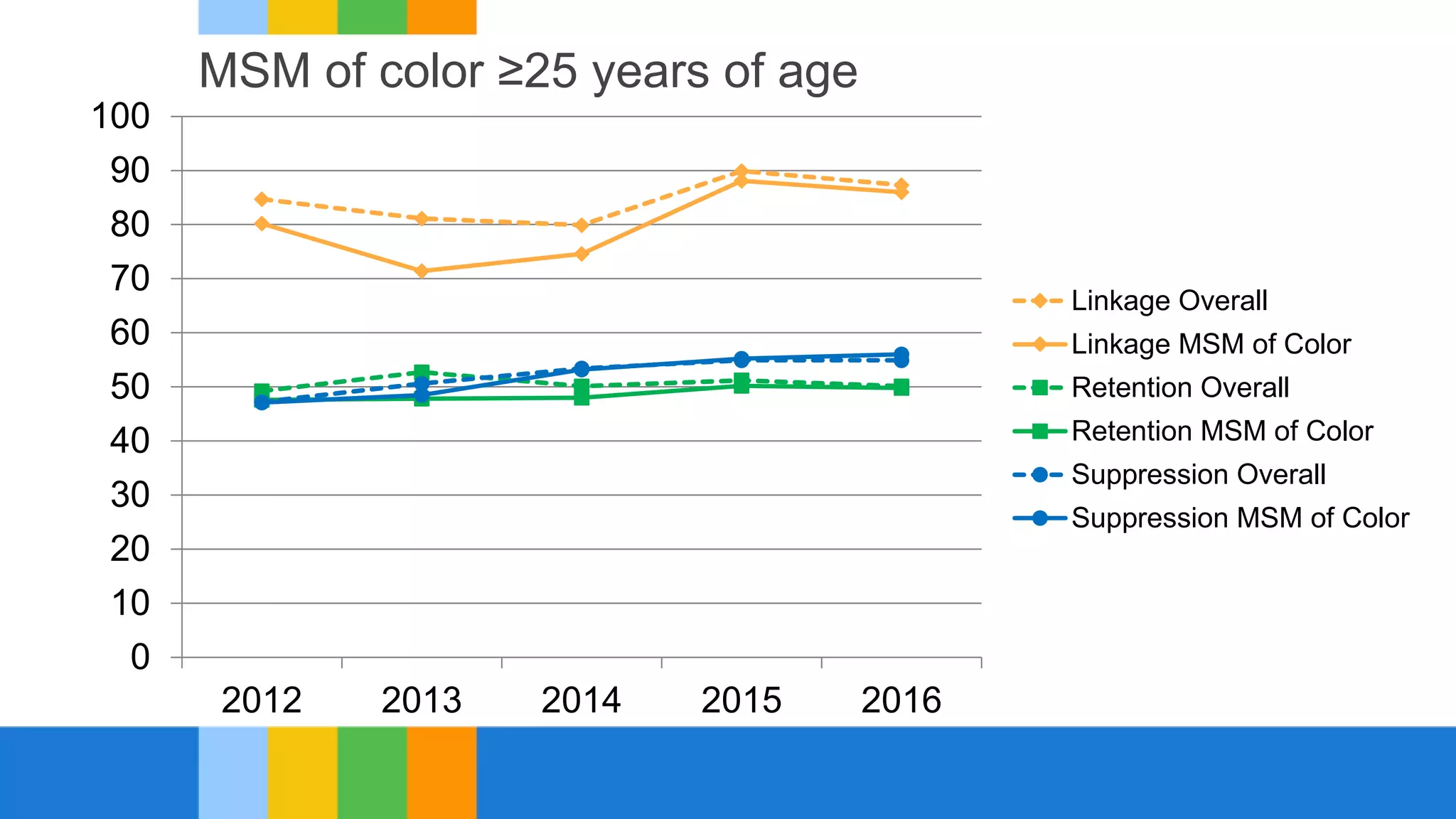
MSM of color ≥25 years of age
0
10
20
30
40
50
60
70
80
90
100
2012 2013 2014 2015 2016
Linkage Overall
Linkage MSM of Color
Retention Overall
Retention MSM of Color
Suppression Overall
Suppression MSM of Color
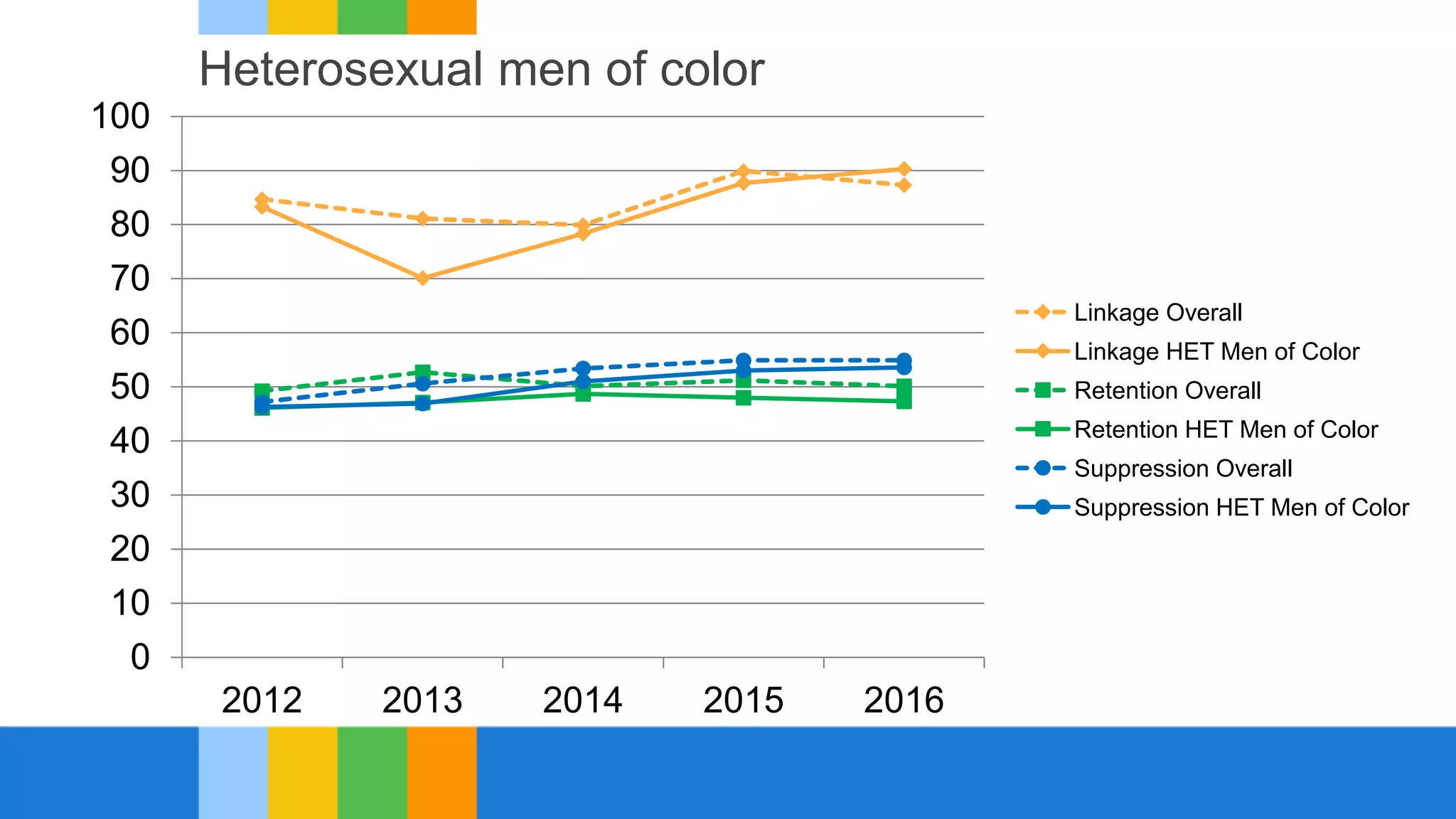
Heterosexual men of color
0
10
20
30
40
50
60
70
80
90
100
2012 2013 2014 2015 2016
Linkage Overall
Linkage HET Men of Color
Retention Overall
Retention HET Men of Color
Suppression Overall
Suppression HET Men of Color
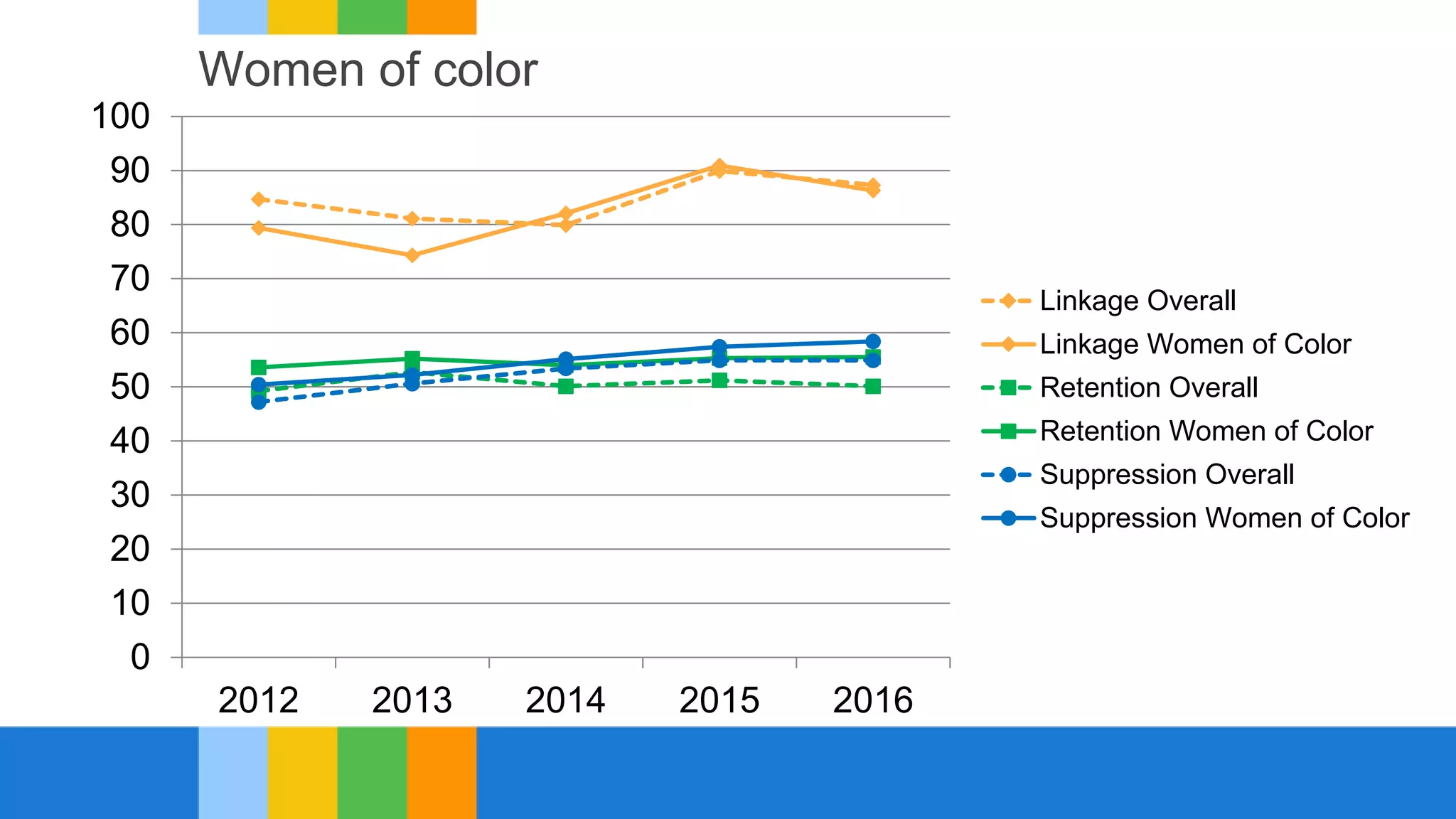
Women of color
0
10
20
30
40
50
60
70
80
90
100
2012 2013 2014 2015 2016
Linkage Overall
Linkage Women of Color
Retention Overall
Retention Women of Color
Suppression Overall
Suppression Women of Color
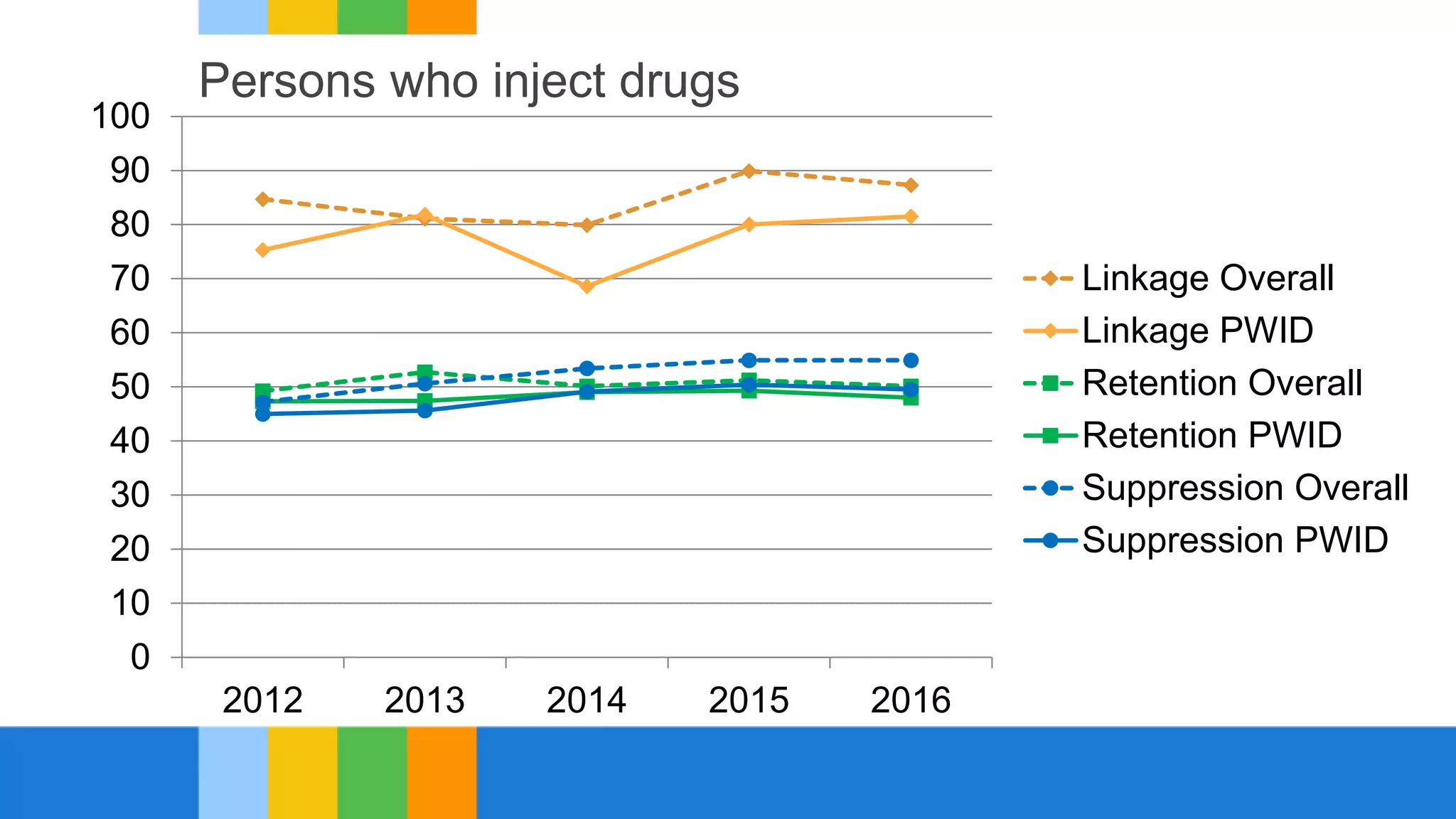
Persons who inject drugs
0
10
20
30
40
50
60
70
80
90
100
2012 2013 2014 2015 2016
Linkage Overall
Linkage PWID
Retention Overall
Retention PWID
Suppression Overall
Suppression PWID
Geographic Disparities
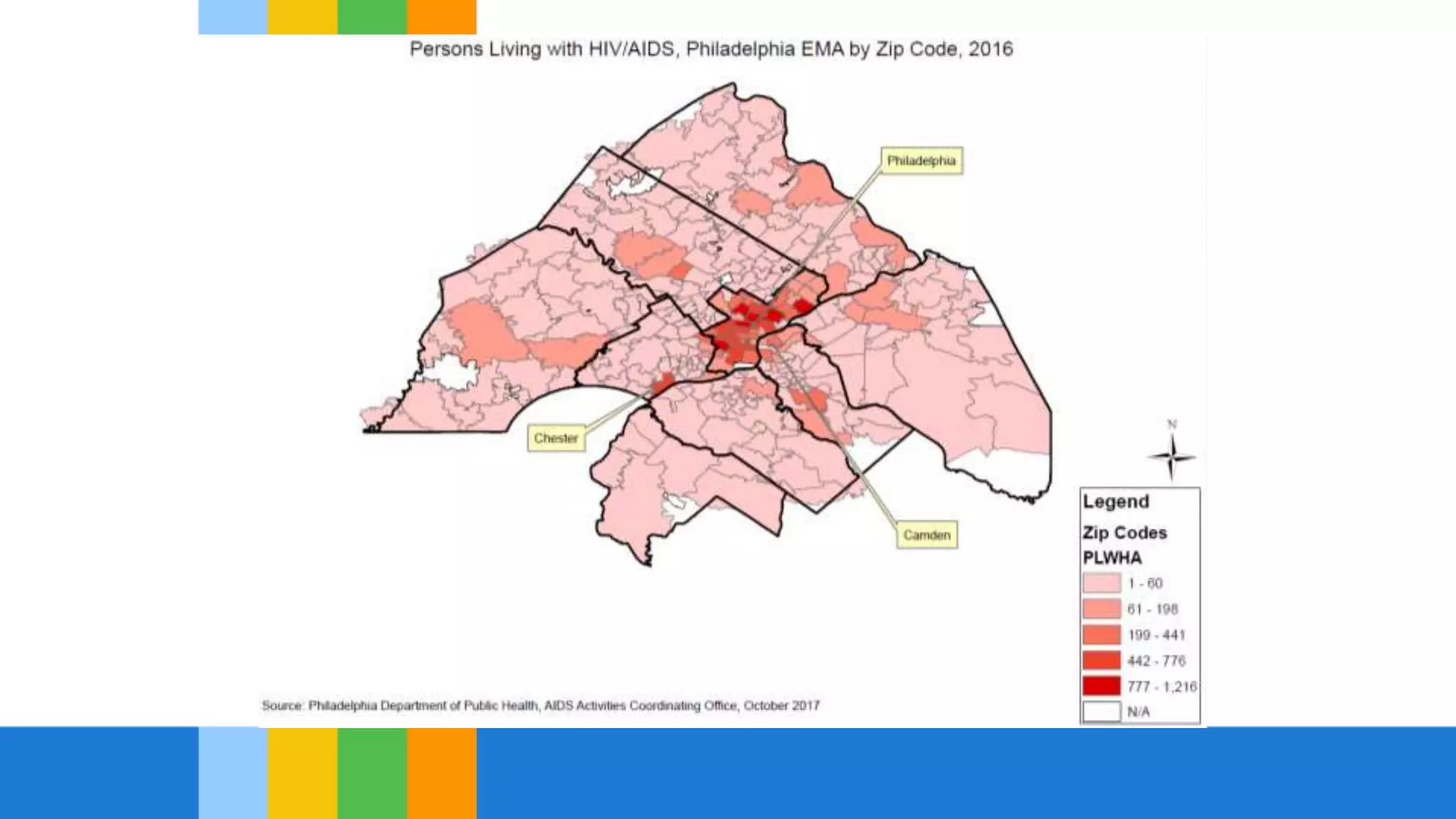
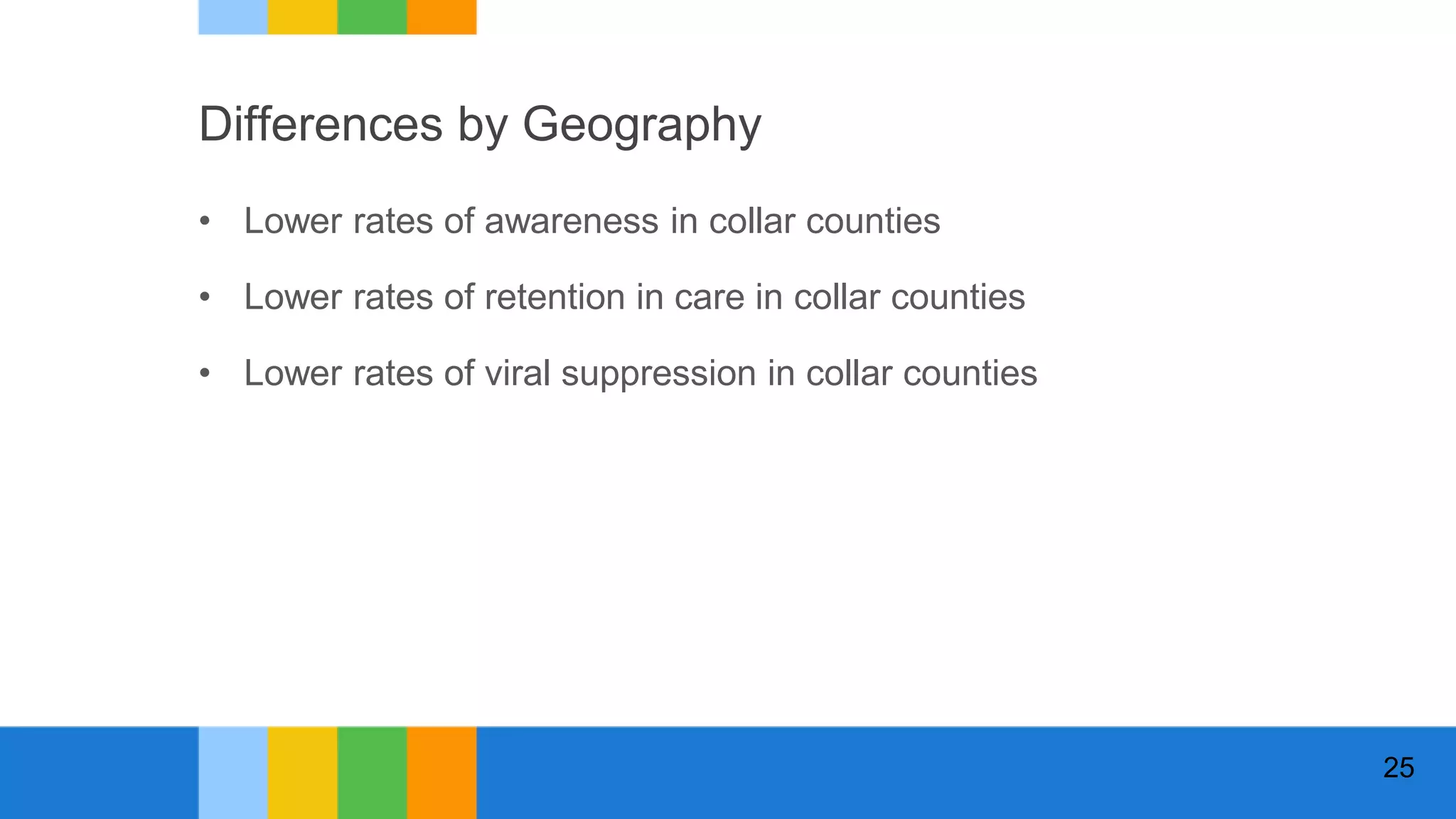
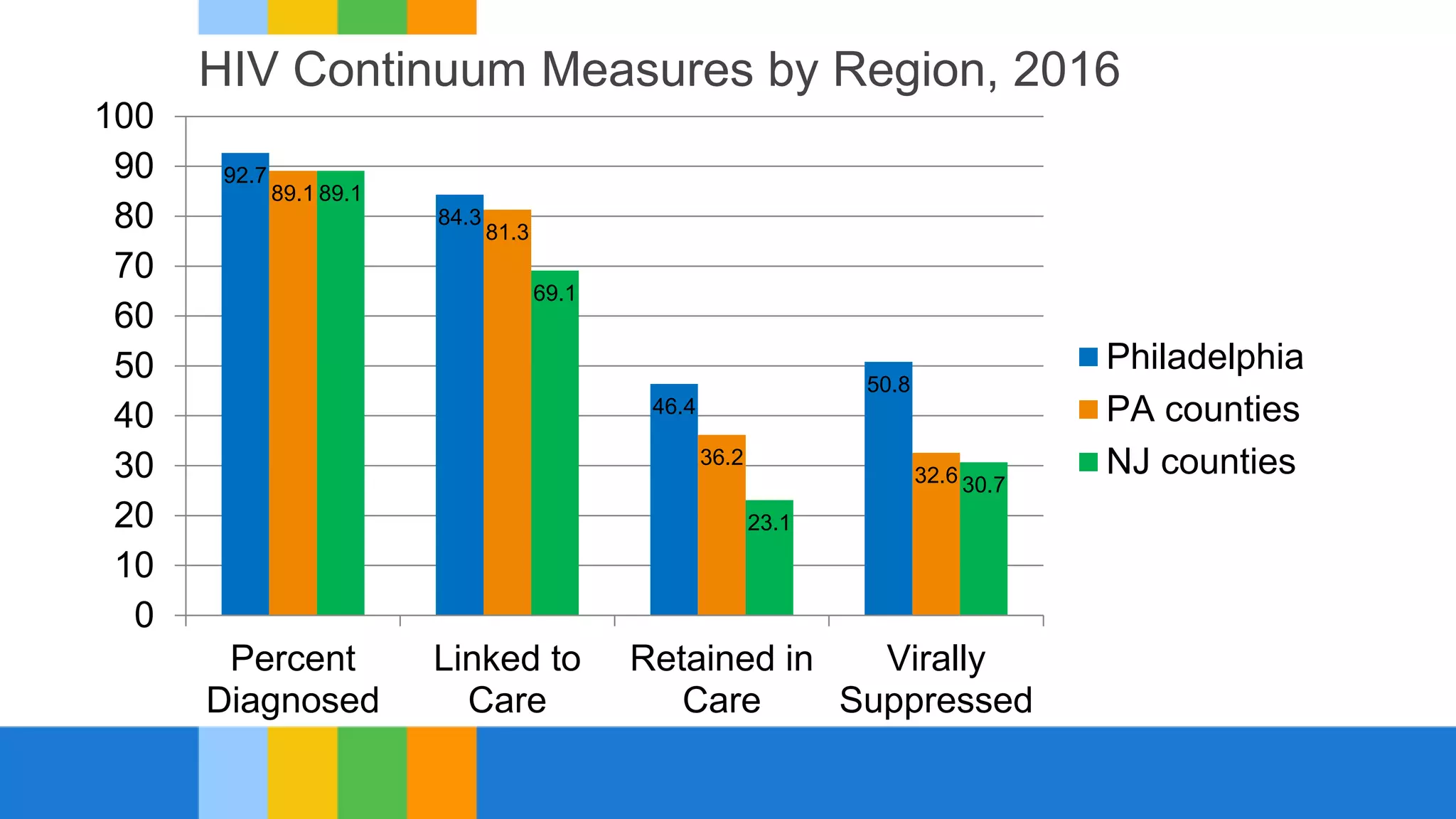
Differences by Geography
• Lower rates of awareness in collar counties
• Lower rates of retention in care in collar counties
• Lower rates of viral suppression in collar counties
25
HIV Continuum Measures by Region, 2016
92.7
84.3
46.4
50.8
89.1
81.3
36.2
32.6
89.1
69.1
23.1
30.7
0
10
20
30
40
50
60
70
80
90
100
Percent
Diagnosed
Linked to
Care
Retained in
Care
Virally
Suppressed
Philadelphia
PA counties
NJ counties
Conclusions
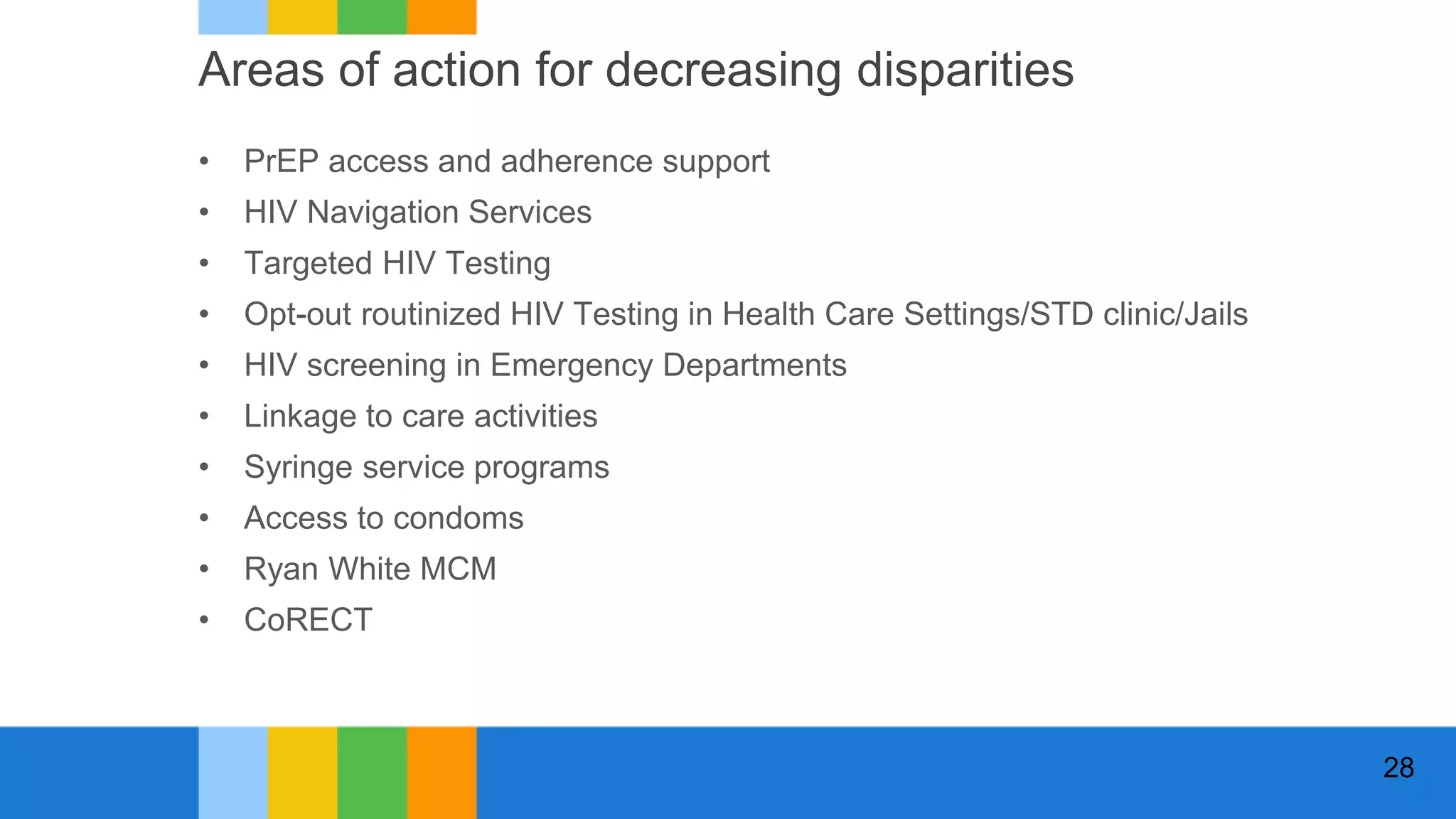
Areas of action for decreasing disparities
• PrEP access and adherence support
• HIV Navigation Services
• Targeted HIV Testing
• Opt-out routinized HIV Testing in Health Care Settings/STD clinic/Jails
• HIV screening in Emergency Departments
• Linkage to care activities
• Syringe service programs
• Access to condoms
• Ryan White MCM
• CoRECT
28
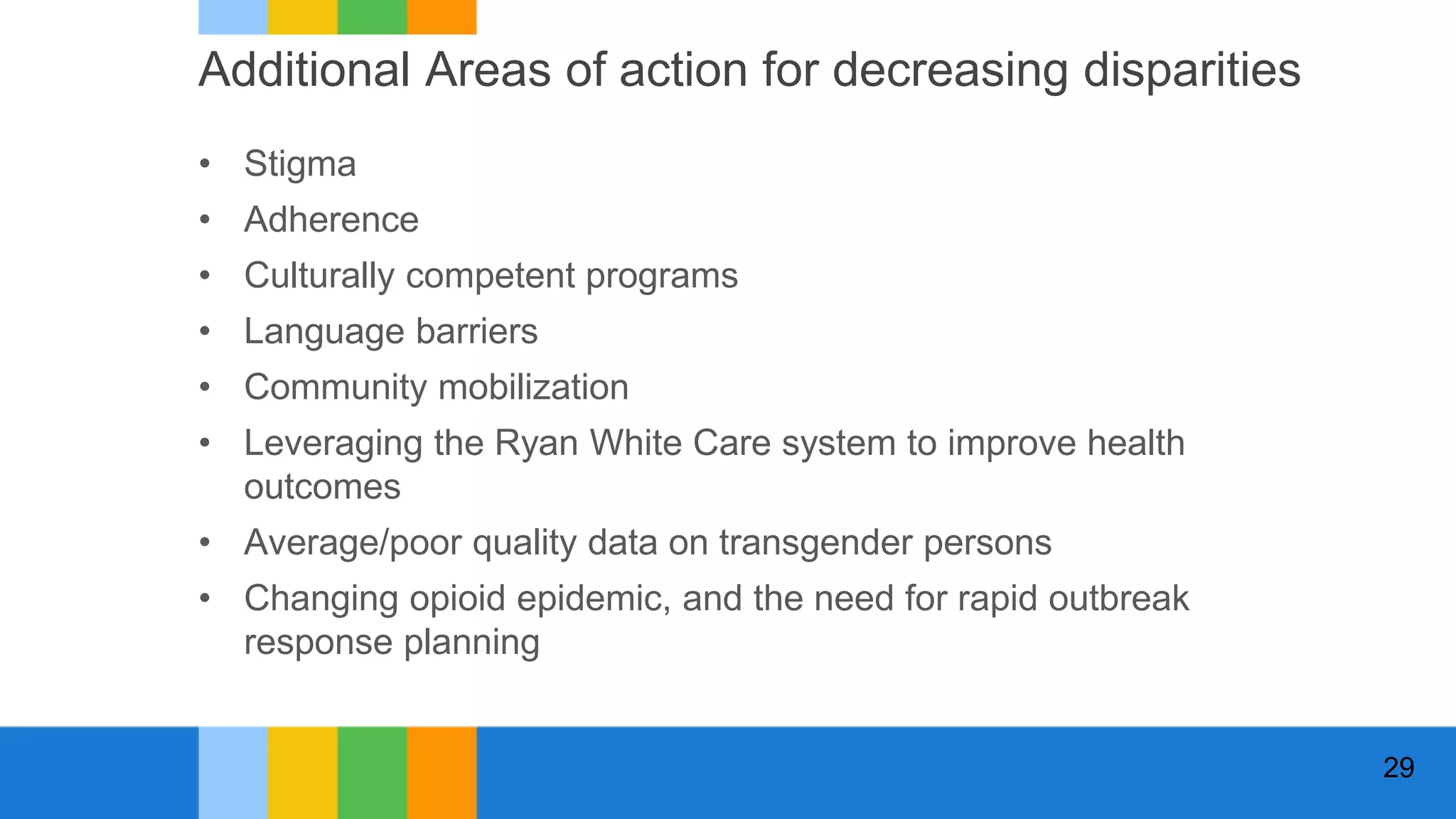
Additional Areas of action for decreasing disparities
• Stigma
• Adherence
• Culturally competent programs
• Language barriers
• Community mobilization
• Leveraging the Ryan White Care system to improve health
outcomes
• Average/poor quality data on transgender persons
• Changing opioid epidemic, and the need for rapid outbreak
response planning
29
Next steps
• Implementation of activities under CDC Prevention/Surveillance
grant (18-1802)
• Expand CoRECT (Data to care activities)
• Restructuring of MCM in EMA
• Further research on interventions to improve viral suppression
once patients engaged in HIV care
Thank You!
Kathleen A. Brady, MD
Medical Director/Medical Epidemiologist
AIDS Activities Coordinating Office
Philadelphia Department of Public Health
E-Mail: kathleen.a.brady@phila.gov
Phone: (215)-685-4778

Epidemiology Update: Disparities in the HIV Continuum of Care

  • 1.
    Epidemiology Update Disparities inthe HIV Continuum of Care Kathleen A. Brady, MD Philadelphia Department of Public Health AIDS Activities Coordinating Office February 9, 2018
  • 2.
    Overview 1 HIV Continuumof Care 2 Priority Populations 3 Trends in Disparities 4 Geographic Disparities 5 Conclusions
  • 3.
  • 4.
    Why a Continuum? •For individuals living with HIV to fully benefit from antiretroviral therapy, they need to: • Know that they are HIV positive • Be engaged in regular HIV care • Receive and adhere to effective ART • Various obstacles, or barriers, contribute to gaps in testing and care • An individual’s care status can fluctuate, moving forwards or backwards
  • 5.
    Parts of theHIV Continuum • HIV-Diagnosed/ Unaware estimates • Linkage to HIV medical care (within 90 days of HIV diagnosis) • Retention in HIV medical care (≥2 labs at least 90 days apart in a year) • Viral load suppression (<200 copies/mL)
  • 6.
    Newly Diagnosed HIV,Philadelphia 2016 Populations Most Affected Rates of Newly Diagnosed HIV/AIDS per 100,000 Population by Year of Diagnosis and Risk Group
  • 7.
  • 8.
    Priority = HIVContinuum Disparities • Higher rates of new HIV diagnoses/transmissions • Lower rates of HIV status awareness • Lower rates of retention in medical care • Lower rates of viral load suppression 8
  • 9.
    Priority Populations, PhiladelphiaEMA 2018 • Racial/Ethnic minority youth (ages 13-24) • Transgender persons who have sex with men (TSM) • MSM of color ≥25 years of age • Heterosexual men of color • Women of color • Persons who inject drugs (PWID)
  • 10.
    Racial/Ethnic Minority Youth(ages 13-24), 2016 91.6 87.3 50.1 54.9 48.6 83.7 59 53.1 0 20 40 60 80 100 Percent Diagnosed Linked to Care Retained in Care Virally Suppressed EMA Minority Youth Note: • High rates of new infections • Very low rates of awareness • Higher rate of retention in care • Lower rate of viral suppression
  • 11.
    Transgender persons whohave sex with men (TSM), 2016 91.6 87.3 50.1 54.9 82.9 70 69.5 65.2 0 20 40 60 80 100 Percent Diagnosed Linked to Care Retained in Care Virally Suppressed EMA TSM Note: • High rates of new infections • Lower rate of awareness • Lower rate of linkage to care • Higher rates of retention in care and viral suppression • *limited data*
  • 12.
    MSM of color≥25 years of age, 2016 91.6 87.3 50.1 54.9 88.1 92 48.6 54 0 20 40 60 80 100 Percent Diagnosed Linked to Care Retained in Care Virally Suppressed EMA MSM ≥25 Note: • High rates of new infections • Low rates of awareness • No disparities in care
  • 13.
    Heterosexual men ofcolor, 2016 91.6 87.3 50.1 54.9 90.7 82.4 43.6 51.2 0 20 40 60 80 100 Percent Diagnosed Linked to Care Retained in Care Virally Suppressed EMA HET Men of Color Note: • Disparity in rate of new HIV diagnoses • Lower rate of retention in care • Lower rate of viral suppression
  • 14.
    Women of color,2016 91.6 87.3 50.1 54.9 94.2 75.4 50.7 53.2 0 20 40 60 80 100 Percent Diagnosed Linked to Care Retained in Care Virally Suppressed EMA Women of Color Note: • Higher awareness • Disparity in rate of new HIV diagnoses (not shown)
  • 15.
    Persons who injectdrugs, 2016 91.6 87.3 50.1 54.9 99.8 58.6 49.7 47.6 0 20 40 60 80 100 Percent Diagnosed Linked to Care Retained in Care Virally Suppressed EMA PWID Note: • Lower rate of new diagnoses • Lower rate of linkage to care • Lower rate of viral suppression
  • 16.
  • 17.
    Racial/Ethnic Minority Youth(ages 13-24) 17 0 10 20 30 40 50 60 70 80 90 100 2012 2013 2014 2015 2016 Linkage Overall Linkage Youth Retention Overall Retention Youth Suppression Overall Suppression Youth
  • 18.
    Transgender Persons whohave sex with men (TSM) 0 10 20 30 40 50 60 70 80 90 100 2012 2013 2014 2015 2016 Linkage Overall Linkage TSM Retention Overall Retention TSM Suppression Overall Suppression TSM
  • 19.
    MSM of color≥25 years of age 0 10 20 30 40 50 60 70 80 90 100 2012 2013 2014 2015 2016 Linkage Overall Linkage MSM of Color Retention Overall Retention MSM of Color Suppression Overall Suppression MSM of Color
  • 20.
    Heterosexual men ofcolor 0 10 20 30 40 50 60 70 80 90 100 2012 2013 2014 2015 2016 Linkage Overall Linkage HET Men of Color Retention Overall Retention HET Men of Color Suppression Overall Suppression HET Men of Color
  • 21.
    Women of color 0 10 20 30 40 50 60 70 80 90 100 20122013 2014 2015 2016 Linkage Overall Linkage Women of Color Retention Overall Retention Women of Color Suppression Overall Suppression Women of Color
  • 22.
    Persons who injectdrugs 0 10 20 30 40 50 60 70 80 90 100 2012 2013 2014 2015 2016 Linkage Overall Linkage PWID Retention Overall Retention PWID Suppression Overall Suppression PWID
  • 23.
  • 25.
    Differences by Geography •Lower rates of awareness in collar counties • Lower rates of retention in care in collar counties • Lower rates of viral suppression in collar counties 25
  • 26.
    HIV Continuum Measuresby Region, 2016 92.7 84.3 46.4 50.8 89.1 81.3 36.2 32.6 89.1 69.1 23.1 30.7 0 10 20 30 40 50 60 70 80 90 100 Percent Diagnosed Linked to Care Retained in Care Virally Suppressed Philadelphia PA counties NJ counties
  • 27.
  • 28.
    Areas of actionfor decreasing disparities • PrEP access and adherence support • HIV Navigation Services • Targeted HIV Testing • Opt-out routinized HIV Testing in Health Care Settings/STD clinic/Jails • HIV screening in Emergency Departments • Linkage to care activities • Syringe service programs • Access to condoms • Ryan White MCM • CoRECT 28
  • 29.
    Additional Areas ofaction for decreasing disparities • Stigma • Adherence • Culturally competent programs • Language barriers • Community mobilization • Leveraging the Ryan White Care system to improve health outcomes • Average/poor quality data on transgender persons • Changing opioid epidemic, and the need for rapid outbreak response planning 29
  • 30.
    Next steps • Implementationof activities under CDC Prevention/Surveillance grant (18-1802) • Expand CoRECT (Data to care activities) • Restructuring of MCM in EMA • Further research on interventions to improve viral suppression once patients engaged in HIV care
  • 31.
    Thank You! Kathleen A.Brady, MD Medical Director/Medical Epidemiologist AIDS Activities Coordinating Office Philadelphia Department of Public Health E-Mail: kathleen.a.brady@phila.gov Phone: (215)-685-4778