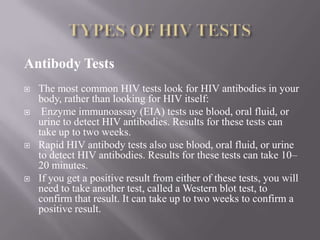

Antibody Tests
   The most common HIV tests look for HIV antibodies in your
    body, rather than looking for HIV itself:
    Enzyme immunoassay (EIA) tests use blood, oral fluid, or
    urine to detect HIV antibodies. Results for these tests can
    take up to two weeks.
   Rapid HIV antibody tests also use blood, oral fluid, or urine
    to detect HIV antibodies. Results for these tests can take 10–
    20 minutes.
   If you get a positive result from either of these tests, you will
    need to take another test, called a Western blot test, to
    confirm that result. It can take up to two weeks to confirm a
    positive result.
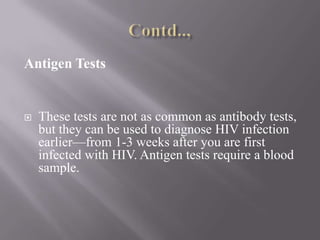
Antigen Tests


   These tests are not as common as antibody tests,
    but they can be used to diagnose HIV infection
    earlier—from 1-3 weeks after you are first
    infected with HIV. Antigen tests require a blood
    sample.
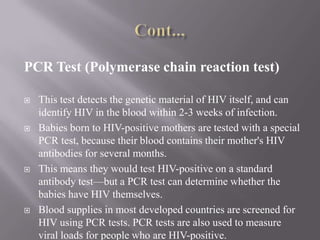
PCR Test (Polymerase chain reaction test)

   This test detects the genetic material of HIV itself, and can
    identify HIV in the blood within 2-3 weeks of infection.
   Babies born to HIV-positive mothers are tested with a special
    PCR test, because their blood contains their mother's HIV
    antibodies for several months.
   This means they would test HIV-positive on a standard
    antibody test—but a PCR test can determine whether the
    babies have HIV themselves.
   Blood supplies in most developed countries are screened for
    HIV using PCR tests. PCR tests are also used to measure
    viral loads for people who are HIV-positive.
Hiv testing

Hiv testing

  • 2.
    Antibody Tests  The most common HIV tests look for HIV antibodies in your body, rather than looking for HIV itself:  Enzyme immunoassay (EIA) tests use blood, oral fluid, or urine to detect HIV antibodies. Results for these tests can take up to two weeks.  Rapid HIV antibody tests also use blood, oral fluid, or urine to detect HIV antibodies. Results for these tests can take 10– 20 minutes.  If you get a positive result from either of these tests, you will need to take another test, called a Western blot test, to confirm that result. It can take up to two weeks to confirm a positive result.
  • 3.
    Antigen Tests  These tests are not as common as antibody tests, but they can be used to diagnose HIV infection earlier—from 1-3 weeks after you are first infected with HIV. Antigen tests require a blood sample.
  • 4.
    PCR Test (Polymerasechain reaction test)  This test detects the genetic material of HIV itself, and can identify HIV in the blood within 2-3 weeks of infection.  Babies born to HIV-positive mothers are tested with a special PCR test, because their blood contains their mother's HIV antibodies for several months.  This means they would test HIV-positive on a standard antibody test—but a PCR test can determine whether the babies have HIV themselves.  Blood supplies in most developed countries are screened for HIV using PCR tests. PCR tests are also used to measure viral loads for people who are HIV-positive.