WELCOME
Overview of HIV infection
Outline of Presentation
 What is HIV/STD ?
 Difference between HIV & Aids.
 Aids : An introduction &history.
 Consequences & threat of aids.
 Sign & symptoms.
 Transmission.
 The virus.
 Preventive measures , myths & misconceptions.
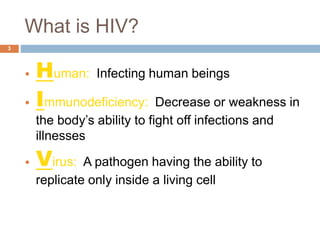
What is HIV?
3
• Human: Infecting human beings
• Immunodeficiency: Decrease or weakness in
the body’s ability to fight off infections and
illnesses
• Virus: A pathogen having the ability to
replicate only inside a living cell
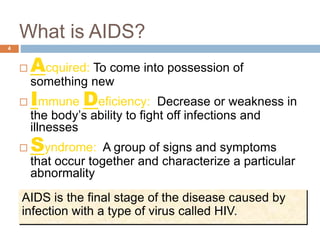
What is AIDS?
4
 Acquired: To come into possession of
something new
 Immune Deficiency: Decrease or weakness in
the body’s ability to fight off infections and
illnesses
 Syndrome: A group of signs and symptoms
that occur together and characterize a particular
abnormality
AIDS is the final stage of the disease caused by
infection with a type of virus called HIV.
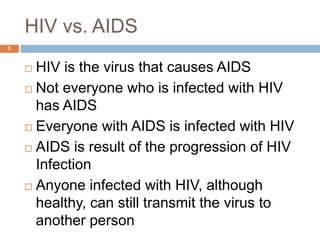
HIV vs. AIDS
5
 HIV is the virus that causes AIDS
 Not everyone who is infected with HIV
has AIDS
 Everyone with AIDS is infected with HIV
 AIDS is result of the progression of HIV
Infection
 Anyone infected with HIV, although
healthy, can still transmit the virus to
another person
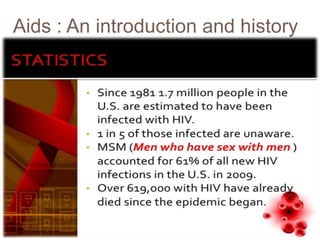
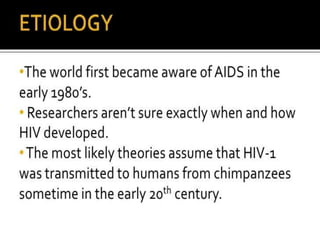
Aids : An introduction and history
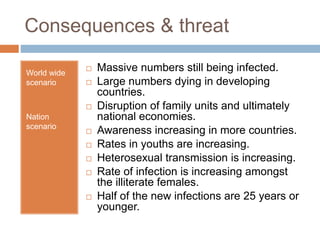
Consequences & threat
World wide
scenario
Nation
scenario
 Massive numbers still being infected.
 Large numbers dying in developing
countries.
 Disruption of family units and ultimately
national economies.
 Awareness increasing in more countries.
 Rates in youths are increasing.
 Heterosexual transmission is increasing.
 Rate of infection is increasing amongst
the illiterate females.
 Half of the new infections are 25 years or
younger.
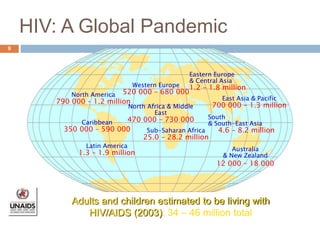
HIV: A Global Pandemic
9
Adults and children estimated to be living with
HIV/AIDS (2003): 34 – 46 million total
Western Europe
520 000 – 680 000
North Africa & Middle
East
470 000 – 730 000
Sub-Saharan Africa
25.0 – 28.2 million
Eastern Europe
& Central Asia
1.2 – 1.8 million
South
& South-East Asia
4.6 – 8.2 million
Australia
& New Zealand
12 000 – 18 000
North America
790 000 – 1.2 million
Caribbean
350 000 – 590 000
Latin America
1.3 – 1.9 million
East Asia & Pacific
700 000 – 1.3 million
KUMAR HARSH
00003-E-1 – December 2004
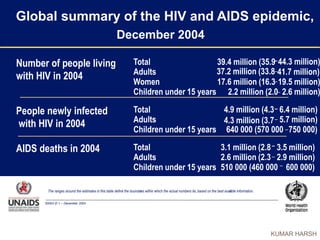
Global summary of the HIV and AIDS epidemic,
December 2004
The ranges around the estimates in this table define the boundaries within which the actual numbers lie, based on the best available information.
Number of people living
with HIV in 2004
Total 39.4 million (35.9–44.3 million)
Adults 37.2 million (33.8–41.7 million)
Women 17.6 million (16.3–19.5 million)
Children under 15 years 2.2 million (2.0– 2.6 million)
People newly infected
with HIV in 2004
Total 4.9 million (4.3– 6.4 million)
Adults 4.3 million (3.7– 5.7 million)
Children under 15 years 640 000 (570 000 –750 000)
AIDS deaths in 2004 Total 3.1 million (2.8– 3.5 million)
Adults 2.6 million (2.3– 2.9 million)
Children under 15 years 510 000 (460 000 – 600 000)
KUMAR HARSH
00003-E-10 – December 2004
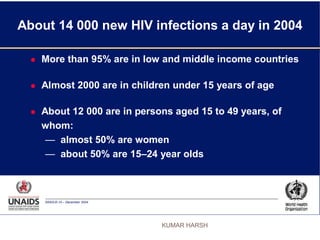
About 14 000 new HIV infections a day in 2004
 More than 95% are in low and middle income countries
 Almost 2000 are in children under 15 years of age
 About 12 000 are in persons aged 15 to 49 years, of
whom:
— almost 50% are women
— about 50% are 15–24 year olds
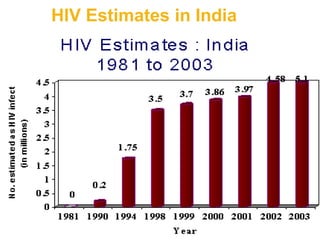
HIV Estimates in India
DR. S.K CHATURVEDI
DR. S.K CHATURVEDI
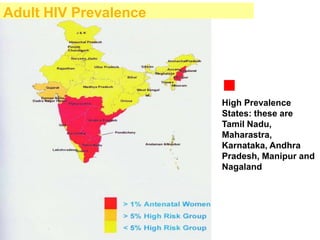
Adult HIV Prevalence
High Prevalence
States: these are
Tamil Nadu,
Maharastra,
Karnataka, Andhra
Pradesh, Manipur and
Nagaland
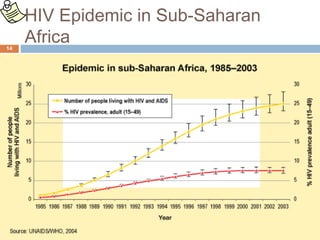
HIV Epidemic in Sub-Saharan
Africa14
Transmission of HIV
KUMAR HARSH
HIV is transmitted by
• Direct contact with infected blood
• Sexual contact: oral, anal, or vaginal
• Direct contact with semen or vaginal and
cervical secretions
• HIV-infected mothers to infants during
pregnancy, delivery, or breastfeeding
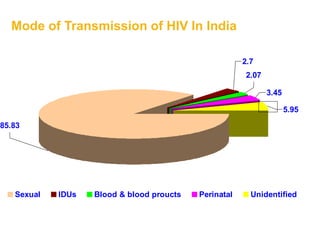
Mode of Transmission of HIV In India
5.95
3.45
2.07
2.7
85.83
Sexual IDUs Blood & blood proucts Perinatal Unidentified
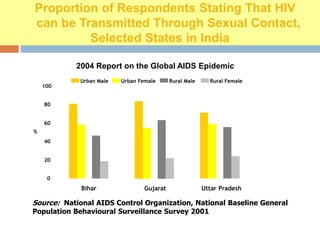
0
20
40
60
80
100
Bihar Gujarat Uttar Pradesh
Urban Male Urban Female Rural Male Rural Female
%
Source: National AIDS Control Organization, National Baseline General
Population Behavioural Surveillance Survey 2001
Proportion of Respondents Stating That HIV
can be Transmitted Through Sexual Contact,
Selected States in India
2004 Report on the Global AIDS Epidemic
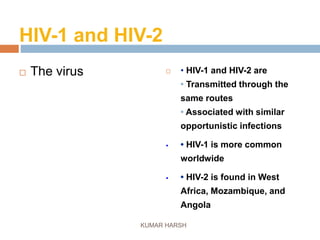
HIV-1 and HIV-2
 The virus  • HIV-1 and HIV-2 are
• Transmitted through the
same routes
• Associated with similar
opportunistic infections
 • HIV-1 is more common
worldwide
 • HIV-2 is found in West
Africa, Mozambique, and
Angola
KUMAR HARSH
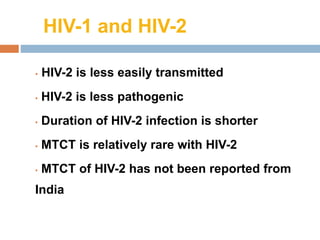
HIV-1 and HIV-2
• HIV-2 is less easily transmitted
• HIV-2 is less pathogenic
• Duration of HIV-2 infection is shorter
• MTCT is relatively rare with HIV-2
• MTCT of HIV-2 has not been reported from
India
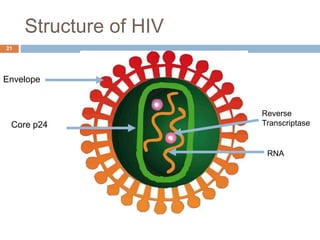
Structure of HIV
21
Envelope
Core p24
RNA
Reverse
Transcriptase
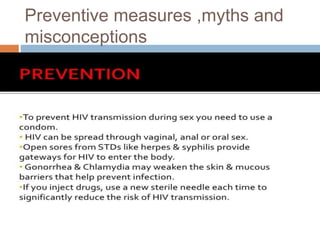
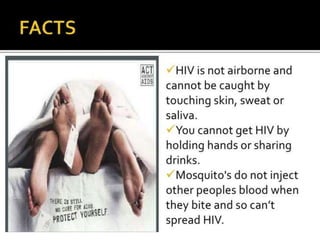
Preventive measures ,myths and
misconceptions
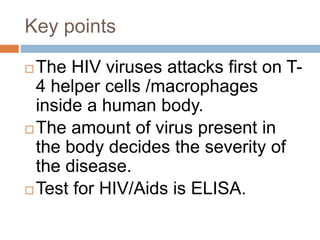
Key points
 The HIV viruses attacks first on T-
4 helper cells /macrophages
inside a human body.
 The amount of virus present in
the body decides the severity of
the disease.
 Test for HIV/Aids is ELISA.
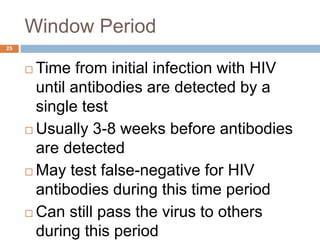
Window Period
25
 Time from initial infection with HIV
until antibodies are detected by a
single test
 Usually 3-8 weeks before antibodies
are detected
 May test false-negative for HIV
antibodies during this time period
 Can still pass the virus to others
during this period
Do you have
Any Questions ?
Prep. By – H .
THANK YOU

Hiv

  • 1.
  • 2.
    Outline of Presentation What is HIV/STD ?  Difference between HIV & Aids.  Aids : An introduction &history.  Consequences & threat of aids.  Sign & symptoms.  Transmission.  The virus.  Preventive measures , myths & misconceptions.
  • 3.
    What is HIV? 3 •Human: Infecting human beings • Immunodeficiency: Decrease or weakness in the body’s ability to fight off infections and illnesses • Virus: A pathogen having the ability to replicate only inside a living cell
  • 4.
    What is AIDS? 4 Acquired: To come into possession of something new  Immune Deficiency: Decrease or weakness in the body’s ability to fight off infections and illnesses  Syndrome: A group of signs and symptoms that occur together and characterize a particular abnormality AIDS is the final stage of the disease caused by infection with a type of virus called HIV.
  • 5.
    HIV vs. AIDS 5 HIV is the virus that causes AIDS  Not everyone who is infected with HIV has AIDS  Everyone with AIDS is infected with HIV  AIDS is result of the progression of HIV Infection  Anyone infected with HIV, although healthy, can still transmit the virus to another person
  • 6.
    Aids : Anintroduction and history
  • 8.
    Consequences & threat Worldwide scenario Nation scenario  Massive numbers still being infected.  Large numbers dying in developing countries.  Disruption of family units and ultimately national economies.  Awareness increasing in more countries.  Rates in youths are increasing.  Heterosexual transmission is increasing.  Rate of infection is increasing amongst the illiterate females.  Half of the new infections are 25 years or younger.
  • 9.
    HIV: A GlobalPandemic 9 Adults and children estimated to be living with HIV/AIDS (2003): 34 – 46 million total Western Europe 520 000 – 680 000 North Africa & Middle East 470 000 – 730 000 Sub-Saharan Africa 25.0 – 28.2 million Eastern Europe & Central Asia 1.2 – 1.8 million South & South-East Asia 4.6 – 8.2 million Australia & New Zealand 12 000 – 18 000 North America 790 000 – 1.2 million Caribbean 350 000 – 590 000 Latin America 1.3 – 1.9 million East Asia & Pacific 700 000 – 1.3 million
  • 10.
    KUMAR HARSH 00003-E-1 –December 2004 Global summary of the HIV and AIDS epidemic, December 2004 The ranges around the estimates in this table define the boundaries within which the actual numbers lie, based on the best available information. Number of people living with HIV in 2004 Total 39.4 million (35.9–44.3 million) Adults 37.2 million (33.8–41.7 million) Women 17.6 million (16.3–19.5 million) Children under 15 years 2.2 million (2.0– 2.6 million) People newly infected with HIV in 2004 Total 4.9 million (4.3– 6.4 million) Adults 4.3 million (3.7– 5.7 million) Children under 15 years 640 000 (570 000 –750 000) AIDS deaths in 2004 Total 3.1 million (2.8– 3.5 million) Adults 2.6 million (2.3– 2.9 million) Children under 15 years 510 000 (460 000 – 600 000)
  • 11.
    KUMAR HARSH 00003-E-10 –December 2004 About 14 000 new HIV infections a day in 2004  More than 95% are in low and middle income countries  Almost 2000 are in children under 15 years of age  About 12 000 are in persons aged 15 to 49 years, of whom: — almost 50% are women — about 50% are 15–24 year olds
  • 12.
    HIV Estimates inIndia DR. S.K CHATURVEDI
  • 13.
    DR. S.K CHATURVEDI AdultHIV Prevalence High Prevalence States: these are Tamil Nadu, Maharastra, Karnataka, Andhra Pradesh, Manipur and Nagaland
  • 14.
    HIV Epidemic inSub-Saharan Africa14
  • 16.
    Transmission of HIV KUMARHARSH HIV is transmitted by • Direct contact with infected blood • Sexual contact: oral, anal, or vaginal • Direct contact with semen or vaginal and cervical secretions • HIV-infected mothers to infants during pregnancy, delivery, or breastfeeding
  • 17.
    Mode of Transmissionof HIV In India 5.95 3.45 2.07 2.7 85.83 Sexual IDUs Blood & blood proucts Perinatal Unidentified
  • 18.
    0 20 40 60 80 100 Bihar Gujarat UttarPradesh Urban Male Urban Female Rural Male Rural Female % Source: National AIDS Control Organization, National Baseline General Population Behavioural Surveillance Survey 2001 Proportion of Respondents Stating That HIV can be Transmitted Through Sexual Contact, Selected States in India 2004 Report on the Global AIDS Epidemic
  • 19.
    HIV-1 and HIV-2 The virus  • HIV-1 and HIV-2 are • Transmitted through the same routes • Associated with similar opportunistic infections  • HIV-1 is more common worldwide  • HIV-2 is found in West Africa, Mozambique, and Angola KUMAR HARSH
  • 20.
    HIV-1 and HIV-2 •HIV-2 is less easily transmitted • HIV-2 is less pathogenic • Duration of HIV-2 infection is shorter • MTCT is relatively rare with HIV-2 • MTCT of HIV-2 has not been reported from India
  • 21.
    Structure of HIV 21 Envelope Corep24 RNA Reverse Transcriptase
  • 22.
    Preventive measures ,mythsand misconceptions
  • 24.
    Key points  TheHIV viruses attacks first on T- 4 helper cells /macrophages inside a human body.  The amount of virus present in the body decides the severity of the disease.  Test for HIV/Aids is ELISA.
  • 25.
    Window Period 25  Timefrom initial infection with HIV until antibodies are detected by a single test  Usually 3-8 weeks before antibodies are detected  May test false-negative for HIV antibodies during this time period  Can still pass the virus to others during this period
  • 26.
    Do you have AnyQuestions ? Prep. By – H . THANK YOU