HIV/AIDS: Basic Concept
and Prevention
Dr. Rahat Iqbal Chowdhury
Medical Officer
Civil Surgeon Office, Sylhet.
WHAT IS HIV
H-Human
I- Immuno Deficiency
V-Virus
Human Immuno Deficiency Virus
What is AIDS
AIDS
A - Acquired
I - Immuno
D - Deficiency
S - Syndrome
HIV/AIDS: Basic Concept
Acquired immuno-deficiency syndrome is a
fatal disease caused by the human immuno-
deficiency virus (a retro virus)
Sometimes it is called Slim disease
Termed as modern pandemic
No effective treatment & vaccine is available
To combat HIV/AIDS is a MDG (MDG-6)
Regarded as social & developmental problem
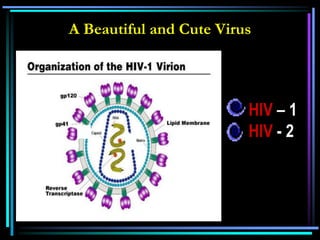
A Beautiful and Cute Virus
HIV – 1
HIV - 2
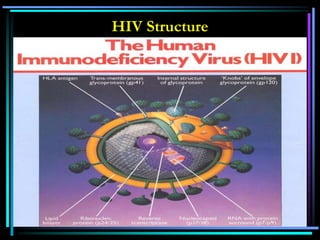
HIV Structure
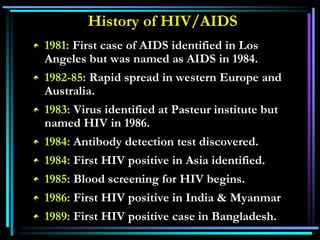
History of HIV/AIDS
1981: First case of AIDS identified in Los
Angeles but was named as AIDS in 1984.
1982-85: Rapid spread in western Europe and
Australia.
1983: Virus identified at Pasteur institute but
named HIV in 1986.
1984: Antibody detection test discovered.
1984: First HIV positive in Asia identified.
1985: Blood screening for HIV begins.
1986: First HIV positive in India & Myanmar
1989: First HIV positive case in Bangladesh.
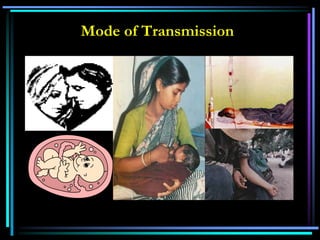
Mode of Transmission
Injecting drug use
Unprotected heterosexual act
Unprotected penetrative sex between men
Unsafe blood transfusion & injection
Vertical transmission
Modes of HIV Transmission
Promiscuity: Through unprotected Sex with
HIV infected
Per-enteral: Through infected Blood/blood
products (tissues and organs transplantation)
Per-enteral: Through contaminated needles,
syringes, medical utensils and other piercing
instruments
Peri-natal: From Mother-to-child (During
pregnancy, delivery & lactation)
Modes of Transmission: 3 ‘P’s
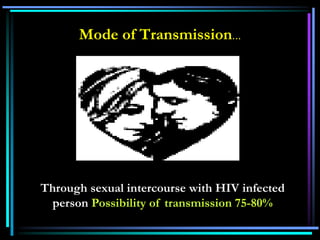
Mode of Transmission…
Through sexual intercourse with HIV infected
person Possibility of transmission 75-80%
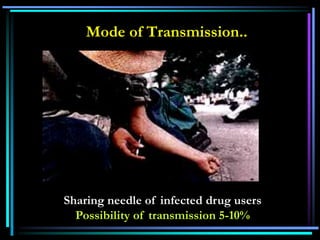
Mode of Transmission..
Sharing needle of infected drug users
Possibility of transmission 5-10%
Mode of Transmission..
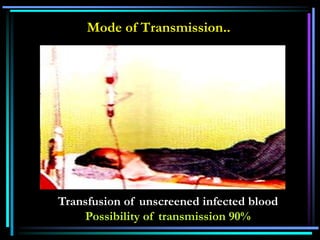
Transfusion of unscreened infected blood
Possibility of transmission 90%
Mode of Transmission..
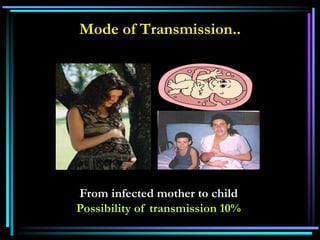
From infected mother to child
Possibility of transmission 10%
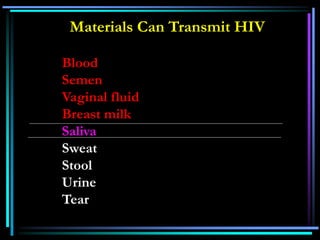
Materials Can Transmit HIV
Blood
Semen
Vaginal fluid
Breast milk
Saliva
Sweat
Stool
Urine
Tear
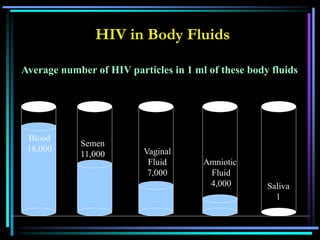
HIV in Body Fluids
Semen
11,000 Vaginal
Fluid
7,000
Blood
18,000
Amniotic
Fluid
4,000 Saliva
1
Average number of HIV particles in 1 ml of these body fluids
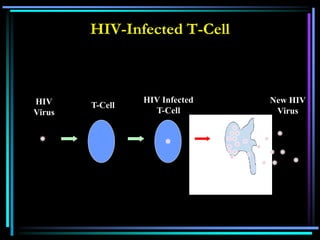
HIV-Infected T-Cell
HIV
Virus
T-Cell
HIV Infected
T-Cell
New HIV
Virus
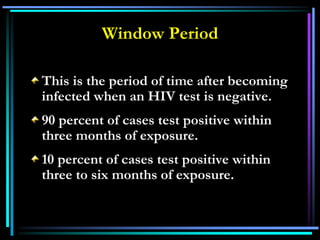
Window Period
This is the period of time after becoming
infected when an HIV test is negative.
90 percent of cases test positive within
three months of exposure.
10 percent of cases test positive within
three to six months of exposure.
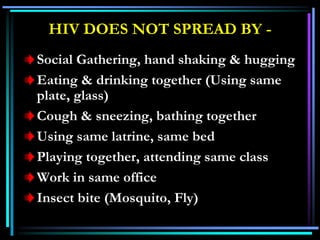
HIV DOES NOT SPREAD BY -
Social Gathering, hand shaking & hugging
Eating & drinking together (Using same
plate, glass)
Cough & sneezing, bathing together
Using same latrine, same bed
Playing together, attending same class
Work in same office
Insect bite (Mosquito, Fly)
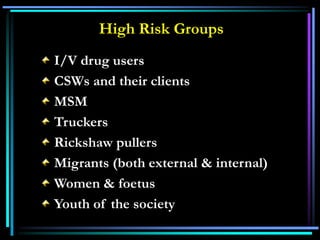
I/V drug users
CSWs and their clients
MSM
Truckers
Rickshaw pullers
Migrants (both external & internal)
Women & foetus
Youth of the society
High Risk Groups
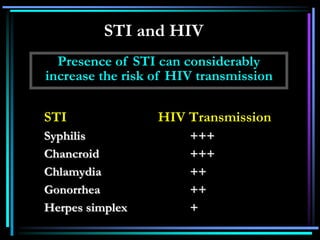
STI and HIV
STI HIV Transmission
Syphilis +++
Chancroid +++
Chlamydia ++
Gonorrhea ++
Herpes simplex +
Presence of STI can considerably
increase the risk of HIV transmission
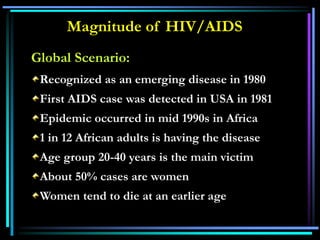
Magnitude of HIV/AIDS
Global Scenario:
Recognized as an emerging disease in 1980
First AIDS case was detected in USA in 1981
Epidemic occurred in mid 1990s in Africa
1 in 12 African adults is having the disease
Age group 20-40 years is the main victim
About 50% cases are women
Women tend to die at an earlier age
Total 33.2 million [30.6 –
36.1million] Adults 30.8 million [28.2 –
33.6million] Women 15.4 million [13.9 –
16.6million] Children under 15
years 2.5 million [2.2 – 2.6
million]Total 2.5 million [1.8 – 4.1
million]
Adults 2.1 million [1.4 – 3.6 million]
Children under 15 years 420 000 [350 000 – 540000]
Total 2.1 million [1.9 – 2.4
million]
Adults 1.7 million [1.6 – 2.1 million]
Children under 15 years 330 000 [310 000 – 380000]
Number of people
living with HIV in 2009
People newly
infected
with HIV in 2009
AIDS deaths
in 2009
Global AIDS Epidemic, December 2009
Global Scenario Continued
 More than 60 million peoples are the
victims of HIV/AIDS globally.
 Around 33.2 million people are living with
HIV.
 Over 25 millions have died & about 41
millions are alive.
 Africa is home to 2/3rd of world’s peoples
living with HIV/AIDS.
 Around 4.5 million new infection in 2009.
 Over 7000/day new cases occurred in 2008.
Total: 33.2 (30.6 – 36.1) million
Western &
Central Europe
760 000
Middle East & North
Africa
380 000
]
Sub-Saharan Africa
22.5 million
Eastern Europe
& Central Asia
1.6 million
South & South-East
Asia
4.0 million
Oceania
75 000
North America
1.3 million
Latin America
1.6 million
East Asia
800 000
Caribbean
230 000
]
Adults and Children estimated to be
living with HIV
Estimated number of Adults and Children
newly infected with HIV
Western &
Central Europe
31 000
Middle East & North
Africa
35 000
Sub-Saharan Africa
1.7 million
Eastern Europe
& Central Asia
150 000
South & South-East
Asia
340 000
Oceania
14 000
North America
46 000
Latin America
100 000
East Asia
92 000
Caribbean
17 000]
Total: 2.5 (1.8 – 4.1) million
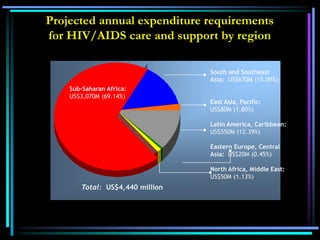
Projected annual expenditure requirements
for HIV/AIDS care and support by region
Sub-Saharan Africa:
US$3,070M (69.14%)
Total: US$4,440 million
South and Southeast
Asia: US$670M (15.09%)
East Asia, Pacific:
US$80M (1.80%)
Latin America, Caribbean:
US$550M (12.39%)
Eastern Europe, Central
Asia: US$20M (0.45%)
North Africa, Middle East:
US$50M (1.13%)
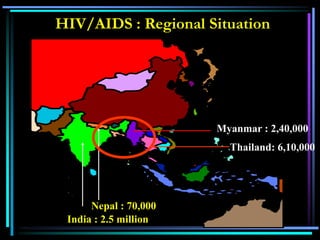
HIV/AIDS : Regional Situation
India : 2.5 million
Myanmar : 2,40,000
Thailand: 6,10,000
Nepal : 70,000
Epidemic Trend in Asia
Generalized HIV epidemic:
– Cambodia, parts of India, Myanmar, and Thailand
Concentrated HIV epidemic:
– Parts of China, Indonesia, Malaysia, Nepal and
Vietnam
Low HIV epidemic:
– Bangladesh, Bhutan, Laos, Maldives, Philippines,
– Republic of Korea, Sri Lanka
Regional Scenario
1984: First AIDS case was reported in Thailand.
About 8.5 million have been HIV infected & 5
million alive in Asia region.
O.4 millions have died in 2008 in Asia.
1.7 million newly HIV infected in 2008.
20% more new HIV infection in 2008 in East
Asia than in 2001.
HIV prevalence is highest in SEAR.
India is next to South Africa by number of HIV
infected peoples.
Regional Scenario Contd..
About 5.5 million peoples are HIV infected in
India.
HIV infection is more common among IDUs
About 50% pregnant women found HIV infected
during ANC in Monipur of India.
Around 3.5% of adult population in Thailand are
HIV infected.
1 in 30 pregnant mothers, 1 in 16 soldiers, 1 in 2
CSWs found HIV infected in Combodia.
0.4% of CSWs, 60% of IDUs and 2.2% pregnant
women found HIV infected in Thailand
Bangladesh Context
Bangladesh is a low prevalent but high risk
country
First HIV infection was detected in 1989
Total HIV infected-3241, Total AIDS
patients-1299,Total death-472 (NASP 2013)
According to UNAIDS, it is >13000
370 new HIV infection, 95 newAIDS
patients & 82 deaths in 2013 (NASP 2013)
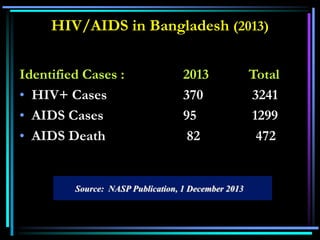
HIV/AIDS in Bangladesh (2013)
Identified Cases : 2013 Total
• HIV+ Cases 370 3241
• AIDS Cases 95 1299
• AIDS Death 82 472
Source: NASP Publication, 1 December 2013
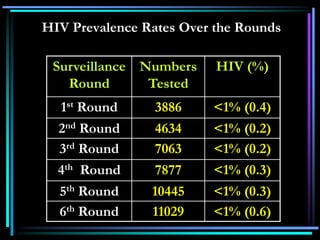
HIV Prevalence Rates Over the Rounds
Surveillance
Round
Numbers
Tested
HIV (%)
1st Round 3886 <1% (0.4)
2nd Round 4634 <1% (0.2)
3rd Round 7063 <1% (0.2)
4th Round 7877 <1% (0.3)
5th Round 10445 <1% (0.3)
6th Round 11029 <1% (0.6)
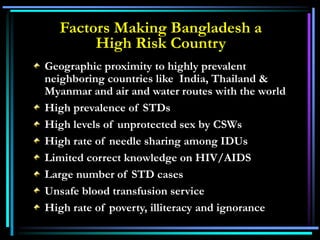
Geographic proximity to highly prevalent
neighboring countries like India, Thailand &
Myanmar and air and water routes with the world
High prevalence of STDs
High levels of unprotected sex by CSWs
High rate of needle sharing among IDUs
Limited correct knowledge on HIV/AIDS
Large number of STD cases
Unsafe blood transfusion service
High rate of poverty, illiteracy and ignorance
Factors Making Bangladesh a
High Risk Country
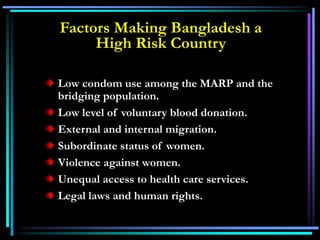
Low condom use among the MARP and the
bridging population.
Low level of voluntary blood donation.
External and internal migration.
Subordinate status of women.
Violence against women.
Unequal access to health care services.
Legal laws and human rights.
Factors Making Bangladesh a
High Risk Country
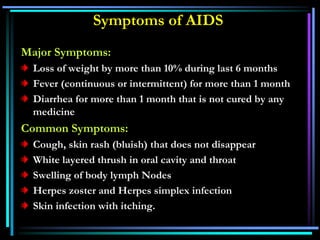
Symptoms of AIDS
Major Symptoms:
Loss of weight by more than 10% during last 6 months
Fever (continuous or intermittent) for more than 1 month
Diarrhea for more than 1 month that is not cured by any
medicine
Common Symptoms:
Cough, skin rash (bluish) that does not disappear
White layered thrush in oral cavity and throat
Swelling of body lymph Nodes
Herpes zoster and Herpes simplex infection
Skin infection with itching.
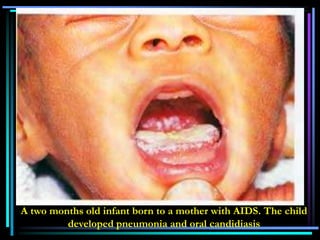
A two months old infant born to a mother with AIDS. The child
developed pneumonia and oral candidiasis
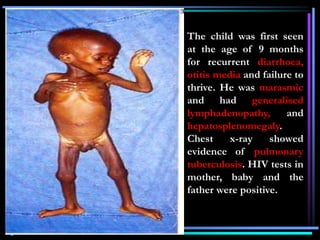
The child was first seen
at the age of 9 months
for recurrent diarrhoea,
otitis media and failure to
thrive. He was marasmic
and had generalised
lymphadenopathy, and
hepatosplenomegaly.
Chest x-ray showed
evidence of pulmonary
tuberculosis. HIV tests in
mother, baby and the
father were positive.
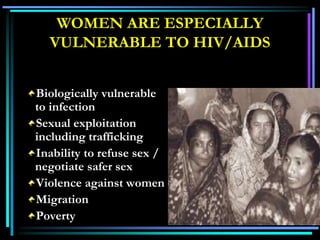
WOMEN ARE ESPECIALLY
VULNERABLE TO HIV/AIDS
Biologically vulnerable
to infection
Sexual exploitation
including trafficking
Inability to refuse sex /
negotiate safer sex
Violence against women
Migration
Poverty
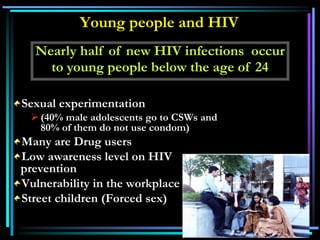
Young people and HIV
Sexual experimentation
(40% male adolescents go to CSWs and
80% of them do not use condom)
Many are Drug users
Low awareness level on HIV
prevention
Vulnerability in the workplace
Street children (Forced sex)
Nearly half of new HIV infections occur
to young people below the age of 24
Key National Responses of GOB…
 1985: National AIDS Committee(NAC) was
formed.
 Formation of TC of NAC & 2 sub-committees:
Monitoring sub-committee (MSC) & Motivation
cum Publicity sub-Committee (MPSC).
 1987: GOB started AIDS Prevention activities.
 1988: 5 HIV diagnostic laboratory established.
 1989: 3-year Medium Term Plan was formulated.
 1990: HIV Prevention activities were carried out.
 1994-1996: UNDP supported the HIV/AIDS
Intervention.
 1997: The National Policy on HIV/AIDS and
STD Related Issues was approved by the
cabinet.
 1997: A five-year National Strategy (1997-
2002) adopted in NAC for effective launching
of HIV/AIDS Interventions.
 1998-2005: Six Behavioral and Serological
Surveillance BSS on HIV and Syphilis was
completed.
Key National Responses of
GOB…
 1998:NASP management structure outlined,
activities being carried out by three main
functionaries : the NAC, MOHFW & DGHS.
 1998-2000: UNDP supported Multi-sectoral
AIDS Prevention Project (MAPP).
 2002: Laws on blood safety passed by the
parliament (98 blood screening centers
established; screening HIV, Syphilis,
Malaria, HBV & HCV).
 2004-2010: A National Strategic Plan on
HIV/AIDS formulated & implemented.
Key National Responses of
GOB…
NASP has developed
National ART guideline.
National STI management Guideline.
National harm reduction strategy for IDUs.
Safer sex promotion strategy in work place.
Guideline for clinical management.
Safe blood transfusion program.
National Sero & Behavioral Surveillance.
Mutisectoral involvement of NGOs, Donor, Civil society.
Human Rights issues for PLWHA.
Stigma & discrimination prevention.
Contribution of NASP
Levels of Prevention of HIV/AIDS
It needs all levels of prevention
Primordial Prevention
Primary Prevention
Secondary Prevention
Tertiary Prevention
Primordial Prevention
It includes
 Avoidance of exposure to risk factors
in very early life.
 Health education is the vital strategy.
Primary Prevention
It includes
Building and increasing awareness
by health education
Health promotion
Specific protection by vaccination
Primary Prevention..
4 ‘S’ should be followed
Safe sex to practice (ABC)
Safe blood to transfuse
Safe injection to use
Safe Pregnancy to ensure
Vaccination
 First clinical trial of Phase I of HIV
vaccination took place in 1987 in USA.
 Phase II trial took place in Africa.
 One large scale of Phase III trial is
currently undergoing in Thailand.
 Scientists all over the world are trying
very hard for it.
Secondary Prevention
It includes proper management by
Early diagnosis and
Prompt treatment
No cure is possible
Diagnosis of HIV/AIDS
Diagnosis is done by:
History
Clinical feature (major & minor) and
Specific laboratory investigations
HIV enzyme immunoassay
Western blot assay, detect HIV
antibodies in serum, plasma, oral fluid,
dried blood spot or urine of patient
Treatment
 Antiretrovirals are not a permanent cure,
but it reduces the viral load and extends
the life of people living with HIV.
 UNAIDS declared the lack of treatment
in low and middle income countries is a
global public health emergency.
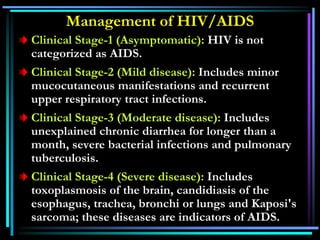
Management of HIV/AIDS
Clinical Stage-1 (Asymptomatic): HIV is not
categorized as AIDS.
Clinical Stage-2 (Mild disease): Includes minor
mucocutaneous manifestations and recurrent
upper respiratory tract infections.
Clinical Stage-3 (Moderate disease): Includes
unexplained chronic diarrhea for longer than a
month, severe bacterial infections and pulmonary
tuberculosis.
Clinical Stage-4 (Severe disease): Includes
toxoplasmosis of the brain, candidiasis of the
esophagus, trachea, bronchi or lungs and Kaposi's
sarcoma; these diseases are indicators of AIDS.
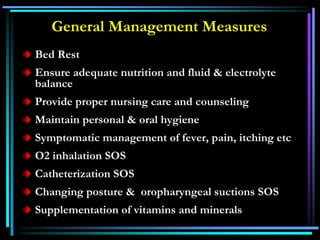
General Management Measures
Bed Rest
Ensure adequate nutrition and fluid & electrolyte
balance
Provide proper nursing care and counseling
Maintain personal & oral hygiene
Symptomatic management of fever, pain, itching etc
O2 inhalation SOS
Catheterization SOS
Changing posture & oropharyngeal suctions SOS
Supplementation of vitamins and minerals
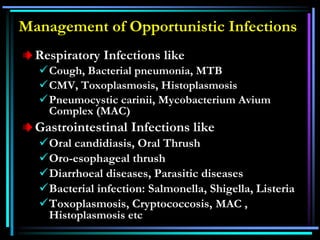
Management of Opportunistic Infections
Respiratory Infections like
Cough, Bacterial pneumonia, MTB
CMV, Toxoplasmosis, Histoplasmosis
Pneumocystic carinii, Mycobacterium Avium
Complex (MAC)
Gastrointestinal Infections like
Oral candidiasis, Oral Thrush
Oro-esophageal thrush
Diarrhoeal diseases, Parasitic diseases
Bacterial infection: Salmonella, Shigella, Listeria
Toxoplasmosis, Cryptococcosis, MAC ,
Histoplasmosis etc
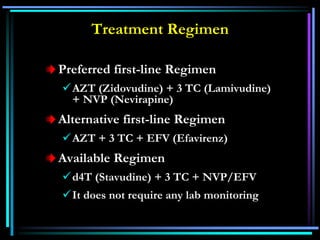
Treatment Regimen
Preferred first-line Regimen
AZT (Zidovudine) + 3 TC (Lamivudine)
+ NVP (Nevirapine)
Alternative first-line Regimen
AZT + 3 TC + EFV (Efavirenz)
Available Regimen
d4T (Stavudine) + 3 TC + NVP/EFV
It does not require any lab monitoring
Tertiary Prevention
Disability Limitation: Cannot limit the
disease properly as It is a progressive
disease.
Rehabilitation: It is a social crisis till
today.
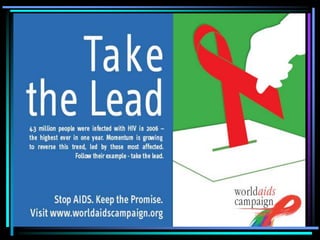
World AIDS Campaign
Brings diverse global voices on HIV/AIDS
together through a collaborative approach.
Holds world leaders & governments to
account for their promises on AIDS.
Share global actions and awareness on
HIV/AIDS.
“Stop AIDS Keep The Promise” (2006).
Universal Access and Human Rights (2010).
Why Leadership?
All our efforts are not delivering at the
speed & scale required.
Promises are not being kept due to
Lack of leadership at all level.
Despite efforts to hold leaders
accountable, progress in halting HIV is
still falling far short of targets.
Why Leadership?
 It acts as a vehicle for uniting efforts within a
common global message.
 To maximize national, regional and
international visibility of global campaigning
efforts on AIDS.
 It can promote a wide range of AIDS issues
globally.
 It brings media, governments, businesses
and a range of institutions locally and
globally to embrace common issues on
HIV/AIDS.
Message for All
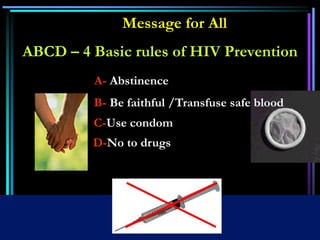
ABCD – 4 Basic rules of HIV Prevention
D-No to drugs
C-Use condom
B- Be faithful /Transfuse safe blood
A- Abstinence
Recommendations
Prevention of sexual transmission
Prevention of mother-to child transmission
Prevention of transmission through injecting
drug use, including harm-reduction measures
Ensure safety of blood supply
Prevention of transmission in health facilities
Promote greater access to voluntary HIV
counseling and testing while principles of
confidentiality and consent are followed
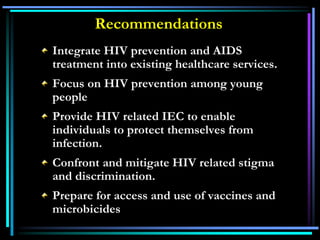
Integrate HIV prevention and AIDS
treatment into existing healthcare services.
Focus on HIV prevention among young
people
Provide HIV related IEC to enable
individuals to protect themselves from
infection.
Confront and mitigate HIV related stigma
and discrimination.
Prepare for access and use of vaccines and
microbicides
Recommendations
Firstly, Formulating the national
HIV/AIDS communication strategy.
Secondly, concentrating on groups
most vulnerable to the infection.
Thirdly, working with the general
population (community mobilization
and community participation).
Fourthly, care and support to those
already infected and affected by
HIV/AIDS (voluntary counseling).
Recommendations
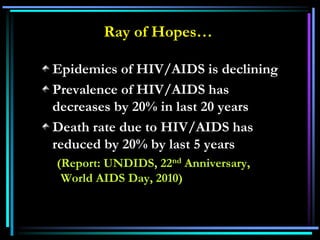
Ray of Hopes…
Epidemics of HIV/AIDS is declining
Prevalence of HIV/AIDS has
decreases by 20% in last 20 years
Death rate due to HIV/AIDS has
reduced by 20% by last 5 years
(Report: UNDIDS, 22nd Anniversary,
World AIDS Day, 2010)
Ensure Universal access and human rights
in terms of prevention, promotion, health
care, access to opportunities, employment
and social affairs.
Use effective leadership at all levels both
nationally and globally to make Bangladesh
HIV/AIDS free.
Conclusion
THANK YOU
Together We Can Protect Our
Country From HIV/AIDS

HIV AIDS

  • 1.
    HIV/AIDS: Basic Concept andPrevention Dr. Rahat Iqbal Chowdhury Medical Officer Civil Surgeon Office, Sylhet.
  • 3.
    WHAT IS HIV H-Human I-Immuno Deficiency V-Virus Human Immuno Deficiency Virus
  • 4.
    What is AIDS AIDS A- Acquired I - Immuno D - Deficiency S - Syndrome
  • 5.
    HIV/AIDS: Basic Concept Acquiredimmuno-deficiency syndrome is a fatal disease caused by the human immuno- deficiency virus (a retro virus) Sometimes it is called Slim disease Termed as modern pandemic No effective treatment & vaccine is available To combat HIV/AIDS is a MDG (MDG-6) Regarded as social & developmental problem
  • 6.
    A Beautiful andCute Virus HIV – 1 HIV - 2
  • 7.
  • 8.
    History of HIV/AIDS 1981:First case of AIDS identified in Los Angeles but was named as AIDS in 1984. 1982-85: Rapid spread in western Europe and Australia. 1983: Virus identified at Pasteur institute but named HIV in 1986. 1984: Antibody detection test discovered. 1984: First HIV positive in Asia identified. 1985: Blood screening for HIV begins. 1986: First HIV positive in India & Myanmar 1989: First HIV positive case in Bangladesh.
  • 9.
  • 10.
    Injecting drug use Unprotectedheterosexual act Unprotected penetrative sex between men Unsafe blood transfusion & injection Vertical transmission Modes of HIV Transmission
  • 11.
    Promiscuity: Through unprotectedSex with HIV infected Per-enteral: Through infected Blood/blood products (tissues and organs transplantation) Per-enteral: Through contaminated needles, syringes, medical utensils and other piercing instruments Peri-natal: From Mother-to-child (During pregnancy, delivery & lactation) Modes of Transmission: 3 ‘P’s
  • 12.
    Mode of Transmission… Throughsexual intercourse with HIV infected person Possibility of transmission 75-80%
  • 13.
    Mode of Transmission.. Sharingneedle of infected drug users Possibility of transmission 5-10%
  • 14.
    Mode of Transmission.. Transfusionof unscreened infected blood Possibility of transmission 90%
  • 15.
    Mode of Transmission.. Frominfected mother to child Possibility of transmission 10%
  • 16.
    Materials Can TransmitHIV Blood Semen Vaginal fluid Breast milk Saliva Sweat Stool Urine Tear
  • 17.
    HIV in BodyFluids Semen 11,000 Vaginal Fluid 7,000 Blood 18,000 Amniotic Fluid 4,000 Saliva 1 Average number of HIV particles in 1 ml of these body fluids
  • 18.
  • 19.
    Window Period This isthe period of time after becoming infected when an HIV test is negative. 90 percent of cases test positive within three months of exposure. 10 percent of cases test positive within three to six months of exposure.
  • 20.
    HIV DOES NOTSPREAD BY - Social Gathering, hand shaking & hugging Eating & drinking together (Using same plate, glass) Cough & sneezing, bathing together Using same latrine, same bed Playing together, attending same class Work in same office Insect bite (Mosquito, Fly)
  • 21.
    I/V drug users CSWsand their clients MSM Truckers Rickshaw pullers Migrants (both external & internal) Women & foetus Youth of the society High Risk Groups
  • 22.
    STI and HIV STIHIV Transmission Syphilis +++ Chancroid +++ Chlamydia ++ Gonorrhea ++ Herpes simplex + Presence of STI can considerably increase the risk of HIV transmission
  • 23.
    Magnitude of HIV/AIDS GlobalScenario: Recognized as an emerging disease in 1980 First AIDS case was detected in USA in 1981 Epidemic occurred in mid 1990s in Africa 1 in 12 African adults is having the disease Age group 20-40 years is the main victim About 50% cases are women Women tend to die at an earlier age
  • 24.
    Total 33.2 million[30.6 – 36.1million] Adults 30.8 million [28.2 – 33.6million] Women 15.4 million [13.9 – 16.6million] Children under 15 years 2.5 million [2.2 – 2.6 million]Total 2.5 million [1.8 – 4.1 million] Adults 2.1 million [1.4 – 3.6 million] Children under 15 years 420 000 [350 000 – 540000] Total 2.1 million [1.9 – 2.4 million] Adults 1.7 million [1.6 – 2.1 million] Children under 15 years 330 000 [310 000 – 380000] Number of people living with HIV in 2009 People newly infected with HIV in 2009 AIDS deaths in 2009 Global AIDS Epidemic, December 2009
  • 25.
    Global Scenario Continued More than 60 million peoples are the victims of HIV/AIDS globally.  Around 33.2 million people are living with HIV.  Over 25 millions have died & about 41 millions are alive.  Africa is home to 2/3rd of world’s peoples living with HIV/AIDS.  Around 4.5 million new infection in 2009.  Over 7000/day new cases occurred in 2008.
  • 26.
    Total: 33.2 (30.6– 36.1) million Western & Central Europe 760 000 Middle East & North Africa 380 000 ] Sub-Saharan Africa 22.5 million Eastern Europe & Central Asia 1.6 million South & South-East Asia 4.0 million Oceania 75 000 North America 1.3 million Latin America 1.6 million East Asia 800 000 Caribbean 230 000 ] Adults and Children estimated to be living with HIV
  • 27.
    Estimated number ofAdults and Children newly infected with HIV Western & Central Europe 31 000 Middle East & North Africa 35 000 Sub-Saharan Africa 1.7 million Eastern Europe & Central Asia 150 000 South & South-East Asia 340 000 Oceania 14 000 North America 46 000 Latin America 100 000 East Asia 92 000 Caribbean 17 000] Total: 2.5 (1.8 – 4.1) million
  • 28.
    Projected annual expenditurerequirements for HIV/AIDS care and support by region Sub-Saharan Africa: US$3,070M (69.14%) Total: US$4,440 million South and Southeast Asia: US$670M (15.09%) East Asia, Pacific: US$80M (1.80%) Latin America, Caribbean: US$550M (12.39%) Eastern Europe, Central Asia: US$20M (0.45%) North Africa, Middle East: US$50M (1.13%)
  • 29.
    HIV/AIDS : RegionalSituation India : 2.5 million Myanmar : 2,40,000 Thailand: 6,10,000 Nepal : 70,000
  • 30.
    Epidemic Trend inAsia Generalized HIV epidemic: – Cambodia, parts of India, Myanmar, and Thailand Concentrated HIV epidemic: – Parts of China, Indonesia, Malaysia, Nepal and Vietnam Low HIV epidemic: – Bangladesh, Bhutan, Laos, Maldives, Philippines, – Republic of Korea, Sri Lanka
  • 31.
    Regional Scenario 1984: FirstAIDS case was reported in Thailand. About 8.5 million have been HIV infected & 5 million alive in Asia region. O.4 millions have died in 2008 in Asia. 1.7 million newly HIV infected in 2008. 20% more new HIV infection in 2008 in East Asia than in 2001. HIV prevalence is highest in SEAR. India is next to South Africa by number of HIV infected peoples.
  • 32.
    Regional Scenario Contd.. About5.5 million peoples are HIV infected in India. HIV infection is more common among IDUs About 50% pregnant women found HIV infected during ANC in Monipur of India. Around 3.5% of adult population in Thailand are HIV infected. 1 in 30 pregnant mothers, 1 in 16 soldiers, 1 in 2 CSWs found HIV infected in Combodia. 0.4% of CSWs, 60% of IDUs and 2.2% pregnant women found HIV infected in Thailand
  • 33.
    Bangladesh Context Bangladesh isa low prevalent but high risk country First HIV infection was detected in 1989 Total HIV infected-3241, Total AIDS patients-1299,Total death-472 (NASP 2013) According to UNAIDS, it is >13000 370 new HIV infection, 95 newAIDS patients & 82 deaths in 2013 (NASP 2013)
  • 34.
    HIV/AIDS in Bangladesh(2013) Identified Cases : 2013 Total • HIV+ Cases 370 3241 • AIDS Cases 95 1299 • AIDS Death 82 472 Source: NASP Publication, 1 December 2013
  • 35.
    HIV Prevalence RatesOver the Rounds Surveillance Round Numbers Tested HIV (%) 1st Round 3886 <1% (0.4) 2nd Round 4634 <1% (0.2) 3rd Round 7063 <1% (0.2) 4th Round 7877 <1% (0.3) 5th Round 10445 <1% (0.3) 6th Round 11029 <1% (0.6)
  • 36.
    Geographic proximity tohighly prevalent neighboring countries like India, Thailand & Myanmar and air and water routes with the world High prevalence of STDs High levels of unprotected sex by CSWs High rate of needle sharing among IDUs Limited correct knowledge on HIV/AIDS Large number of STD cases Unsafe blood transfusion service High rate of poverty, illiteracy and ignorance Factors Making Bangladesh a High Risk Country
  • 37.
    Low condom useamong the MARP and the bridging population. Low level of voluntary blood donation. External and internal migration. Subordinate status of women. Violence against women. Unequal access to health care services. Legal laws and human rights. Factors Making Bangladesh a High Risk Country
  • 38.
    Symptoms of AIDS MajorSymptoms: Loss of weight by more than 10% during last 6 months Fever (continuous or intermittent) for more than 1 month Diarrhea for more than 1 month that is not cured by any medicine Common Symptoms: Cough, skin rash (bluish) that does not disappear White layered thrush in oral cavity and throat Swelling of body lymph Nodes Herpes zoster and Herpes simplex infection Skin infection with itching.
  • 39.
    A two monthsold infant born to a mother with AIDS. The child developed pneumonia and oral candidiasis
  • 40.
    The child wasfirst seen at the age of 9 months for recurrent diarrhoea, otitis media and failure to thrive. He was marasmic and had generalised lymphadenopathy, and hepatosplenomegaly. Chest x-ray showed evidence of pulmonary tuberculosis. HIV tests in mother, baby and the father were positive.
  • 41.
    WOMEN ARE ESPECIALLY VULNERABLETO HIV/AIDS Biologically vulnerable to infection Sexual exploitation including trafficking Inability to refuse sex / negotiate safer sex Violence against women Migration Poverty
  • 42.
    Young people andHIV Sexual experimentation (40% male adolescents go to CSWs and 80% of them do not use condom) Many are Drug users Low awareness level on HIV prevention Vulnerability in the workplace Street children (Forced sex) Nearly half of new HIV infections occur to young people below the age of 24
  • 43.
    Key National Responsesof GOB…  1985: National AIDS Committee(NAC) was formed.  Formation of TC of NAC & 2 sub-committees: Monitoring sub-committee (MSC) & Motivation cum Publicity sub-Committee (MPSC).  1987: GOB started AIDS Prevention activities.  1988: 5 HIV diagnostic laboratory established.  1989: 3-year Medium Term Plan was formulated.  1990: HIV Prevention activities were carried out.
  • 44.
     1994-1996: UNDPsupported the HIV/AIDS Intervention.  1997: The National Policy on HIV/AIDS and STD Related Issues was approved by the cabinet.  1997: A five-year National Strategy (1997- 2002) adopted in NAC for effective launching of HIV/AIDS Interventions.  1998-2005: Six Behavioral and Serological Surveillance BSS on HIV and Syphilis was completed. Key National Responses of GOB…
  • 45.
     1998:NASP managementstructure outlined, activities being carried out by three main functionaries : the NAC, MOHFW & DGHS.  1998-2000: UNDP supported Multi-sectoral AIDS Prevention Project (MAPP).  2002: Laws on blood safety passed by the parliament (98 blood screening centers established; screening HIV, Syphilis, Malaria, HBV & HCV).  2004-2010: A National Strategic Plan on HIV/AIDS formulated & implemented. Key National Responses of GOB…
  • 46.
    NASP has developed NationalART guideline. National STI management Guideline. National harm reduction strategy for IDUs. Safer sex promotion strategy in work place. Guideline for clinical management. Safe blood transfusion program. National Sero & Behavioral Surveillance. Mutisectoral involvement of NGOs, Donor, Civil society. Human Rights issues for PLWHA. Stigma & discrimination prevention. Contribution of NASP
  • 47.
    Levels of Preventionof HIV/AIDS It needs all levels of prevention Primordial Prevention Primary Prevention Secondary Prevention Tertiary Prevention
  • 48.
    Primordial Prevention It includes Avoidance of exposure to risk factors in very early life.  Health education is the vital strategy.
  • 49.
    Primary Prevention It includes Buildingand increasing awareness by health education Health promotion Specific protection by vaccination
  • 50.
    Primary Prevention.. 4 ‘S’should be followed Safe sex to practice (ABC) Safe blood to transfuse Safe injection to use Safe Pregnancy to ensure
  • 51.
    Vaccination  First clinicaltrial of Phase I of HIV vaccination took place in 1987 in USA.  Phase II trial took place in Africa.  One large scale of Phase III trial is currently undergoing in Thailand.  Scientists all over the world are trying very hard for it.
  • 52.
    Secondary Prevention It includesproper management by Early diagnosis and Prompt treatment No cure is possible
  • 53.
    Diagnosis of HIV/AIDS Diagnosisis done by: History Clinical feature (major & minor) and Specific laboratory investigations HIV enzyme immunoassay Western blot assay, detect HIV antibodies in serum, plasma, oral fluid, dried blood spot or urine of patient
  • 54.
    Treatment  Antiretrovirals arenot a permanent cure, but it reduces the viral load and extends the life of people living with HIV.  UNAIDS declared the lack of treatment in low and middle income countries is a global public health emergency.
  • 55.
    Management of HIV/AIDS ClinicalStage-1 (Asymptomatic): HIV is not categorized as AIDS. Clinical Stage-2 (Mild disease): Includes minor mucocutaneous manifestations and recurrent upper respiratory tract infections. Clinical Stage-3 (Moderate disease): Includes unexplained chronic diarrhea for longer than a month, severe bacterial infections and pulmonary tuberculosis. Clinical Stage-4 (Severe disease): Includes toxoplasmosis of the brain, candidiasis of the esophagus, trachea, bronchi or lungs and Kaposi's sarcoma; these diseases are indicators of AIDS.
  • 56.
    General Management Measures BedRest Ensure adequate nutrition and fluid & electrolyte balance Provide proper nursing care and counseling Maintain personal & oral hygiene Symptomatic management of fever, pain, itching etc O2 inhalation SOS Catheterization SOS Changing posture & oropharyngeal suctions SOS Supplementation of vitamins and minerals
  • 57.
    Management of OpportunisticInfections Respiratory Infections like Cough, Bacterial pneumonia, MTB CMV, Toxoplasmosis, Histoplasmosis Pneumocystic carinii, Mycobacterium Avium Complex (MAC) Gastrointestinal Infections like Oral candidiasis, Oral Thrush Oro-esophageal thrush Diarrhoeal diseases, Parasitic diseases Bacterial infection: Salmonella, Shigella, Listeria Toxoplasmosis, Cryptococcosis, MAC , Histoplasmosis etc
  • 58.
    Treatment Regimen Preferred first-lineRegimen AZT (Zidovudine) + 3 TC (Lamivudine) + NVP (Nevirapine) Alternative first-line Regimen AZT + 3 TC + EFV (Efavirenz) Available Regimen d4T (Stavudine) + 3 TC + NVP/EFV It does not require any lab monitoring
  • 59.
    Tertiary Prevention Disability Limitation:Cannot limit the disease properly as It is a progressive disease. Rehabilitation: It is a social crisis till today.
  • 60.
    World AIDS Campaign Bringsdiverse global voices on HIV/AIDS together through a collaborative approach. Holds world leaders & governments to account for their promises on AIDS. Share global actions and awareness on HIV/AIDS. “Stop AIDS Keep The Promise” (2006). Universal Access and Human Rights (2010).
  • 62.
    Why Leadership? All ourefforts are not delivering at the speed & scale required. Promises are not being kept due to Lack of leadership at all level. Despite efforts to hold leaders accountable, progress in halting HIV is still falling far short of targets.
  • 63.
    Why Leadership?  Itacts as a vehicle for uniting efforts within a common global message.  To maximize national, regional and international visibility of global campaigning efforts on AIDS.  It can promote a wide range of AIDS issues globally.  It brings media, governments, businesses and a range of institutions locally and globally to embrace common issues on HIV/AIDS.
  • 64.
    Message for All ABCD– 4 Basic rules of HIV Prevention D-No to drugs C-Use condom B- Be faithful /Transfuse safe blood A- Abstinence
  • 65.
    Recommendations Prevention of sexualtransmission Prevention of mother-to child transmission Prevention of transmission through injecting drug use, including harm-reduction measures Ensure safety of blood supply Prevention of transmission in health facilities Promote greater access to voluntary HIV counseling and testing while principles of confidentiality and consent are followed
  • 66.
    Integrate HIV preventionand AIDS treatment into existing healthcare services. Focus on HIV prevention among young people Provide HIV related IEC to enable individuals to protect themselves from infection. Confront and mitigate HIV related stigma and discrimination. Prepare for access and use of vaccines and microbicides Recommendations
  • 67.
    Firstly, Formulating thenational HIV/AIDS communication strategy. Secondly, concentrating on groups most vulnerable to the infection. Thirdly, working with the general population (community mobilization and community participation). Fourthly, care and support to those already infected and affected by HIV/AIDS (voluntary counseling). Recommendations
  • 68.
    Ray of Hopes… Epidemicsof HIV/AIDS is declining Prevalence of HIV/AIDS has decreases by 20% in last 20 years Death rate due to HIV/AIDS has reduced by 20% by last 5 years (Report: UNDIDS, 22nd Anniversary, World AIDS Day, 2010)
  • 69.
    Ensure Universal accessand human rights in terms of prevention, promotion, health care, access to opportunities, employment and social affairs. Use effective leadership at all levels both nationally and globally to make Bangladesh HIV/AIDS free. Conclusion
  • 70.
    THANK YOU Together WeCan Protect Our Country From HIV/AIDS