INSTRUMENT USED FOR
COMMON USE
Dr. PrabhatDr. Prabhat
VaghamshiVaghamshi@ Dr.Prabhat Vaghamshi
@ Dr.Prabhat Vaghamshi
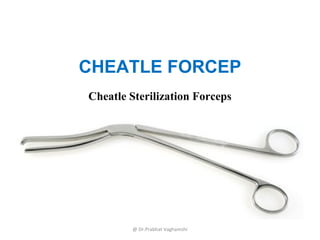
CHEATLE FORCEP
Cheatle Sterilization Forceps
@ Dr.Prabhat Vaghamshi
Use :
A versatile utility instrument most commonly used for
placing and removing instruments within a sterilization
container.
Parts :
This product has a non-ratcheted finger ring handle for
easy control of the instrument.
The overall length of this product is 11 inches.
Sterilization:
The forceps are placed in a container of
methylated spirits when not in use.
Cheatle Sterilization Forceps
INSTRUMENT USED FOR
DISSECTION
@ Dr.Prabhat Vaghamshi
VARIETIES AVILABLE
Two Varieties:
1.Toothed
# Allis’ tissue forceps
# Lane’s tissue forceps
# Moynihan’s tissue forceps
# Lahey’s tissue forceps
# volsellum forceps
2. Un-toothed
# Babcock’s tissue forceps
@ Dr.Prabhat Vaghamshi
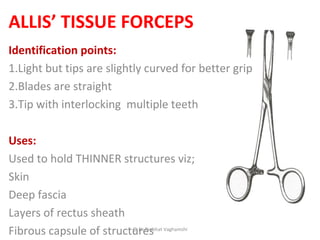
ALLIS’ TISSUE FORCEPS
Identification points:
1.Light but tips are slightly curved for better grip
2.Blades are straight
3.Tip with interlocking multiple teeth
Uses:
Used to hold THINNER structures viz;
Skin
Deep fascia
Layers of rectus sheath
Fibrous capsule of structures@ Dr.Prabhat Vaghamshi
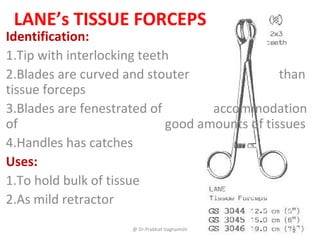
LANE’s TISSUE FORCEPS
Identification:
1.Tip with interlocking teeth
2.Blades are curved and stouter than
tissue forceps
3.Blades are fenestrated of accommodation
of good amounts of tissues
4.Handles has catches
Uses:
1.To hold bulk of tissue
2.As mild retractor
@ Dr.Prabhat Vaghamshi
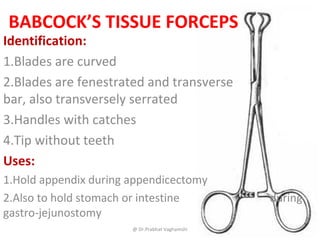
BABCOCK’S TISSUE FORCEPS
Identification:
1.Blades are curved
2.Blades are fenestrated and transverse
bar, also transversely serrated
3.Handles with catches
4.Tip without teeth
Uses:
1.Hold appendix during appendicectomy
2.Also to hold stomach or intestine during
gastro-jejunostomy
@ Dr.Prabhat Vaghamshi
DISSECTING FORCEPS
DISSECTING FORCEPS
TWO TYPES:
1. Non-tooth or Plain
2. Toothed
Also named after their designers, e.g…
Lane’s
Victor Bonney’s
Millin’s
Gillies’
@ Dr.Prabhat Vaghamshi
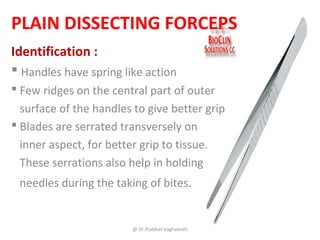
PLAIN DISSECTING FORCEPS
Identification :
 Handles have spring like action
 Few ridges on the central part of outer
surface of the handles to give better grip
 Blades are serrated transversely on
inner aspect, for better grip to tissue.
These serrations also help in holding
needles during the taking of bites.
@ Dr.Prabhat Vaghamshi
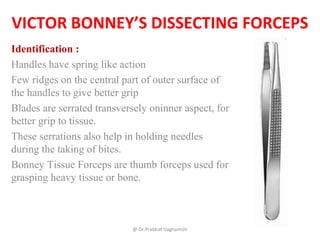
VICTOR BONNEY’S DISSECTING FORCEPS
Identification :
Handles have spring like action
Few ridges on the central part of outer surface of
the handles to give better grip
Blades are serrated transversely oninner aspect, for
better grip to tissue.
These serrations also help in holding needles
during the taking of bites.
Bonney Tissue Forceps are thumb forceps used for
grasping heavy tissue or bone.
@ Dr.Prabhat Vaghamshi
VICTOR BONNEY DISSECTING FORCEPS
RETRACTORSTYPES:
1.Plain Retractors
2.Self Retracting Retractor
These are of the following types:
oSingle bladed
oDouble bladed
# Both blades are on same sided
# The blades are oppositely placed
@ Dr.Prabhat Vaghamshi
USES:
Act as key instruments for
obtaining exposure.
Better exposure helps one to see
the operation field in a better way
and curb out damage to adjacent
tissues.
@ Dr.Prabhat Vaghamshi
RETRACTORS
@ Dr.Prabhat Vaghamshi
PILES HOLDING FORCEPS
Pile Forceps is ideally used to grasp hemorrhoids.
The jaws are slightly curved and contain blunt
tips to provide minimal trauma to the area being
grasped.
For greater grasping ability, one of the jaws
contains grooved serrations and fits perfectly into
the other jaw when clamped.
The forceps also contains a ratchet on the ring-
handles to help keep the instrument in place if
needed.
@ Dr.Prabhat Vaghamshi
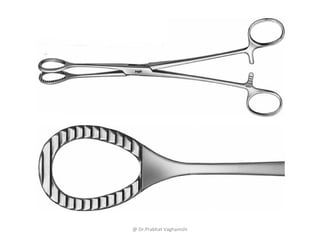
SPONGE HOLDING FORCEP
Sponge Forceps are a ratcheted, finger ring instrument used to
grasp tissue or hold sponges.
The instrument is used to hold gauze or cotton that is precisely
wrapped around the tips and the ratcheted is locked to secure a firm
grip.
This creates a sponge stick that can be used in any type of
procedure to absorb blood and excess fluids from the surgical site
and surrounding areas.
This product is straight with fenestrated, serrated tips and a length
of 7 inches.
@ Dr.Prabhat Vaghamshi
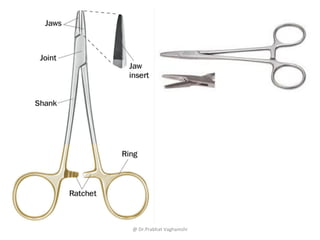
Needle Holder is handcrafted from German stainless steel
and tungsten carbide inserts that provides control, precision
and a dependable non-slip crosshatched surface.
The Mayo-Hegar is one of the most commonly used types
of needle holders in operating rooms, and is offered in both
right and left-handed variants and multiple lengths.
The serrated jaws and gold-plated ratcheting handles are
available in a variety of lengths as well as several left
handed models.
BLALOCK’S NEEDLE HOLDER
@ Dr.Prabhat Vaghamshi
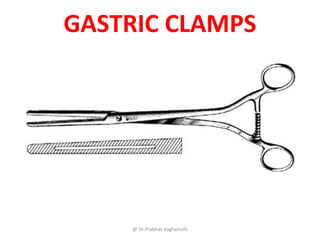
GASTRIC CLAMPS
A lumbar puncture (or LP, and colloquially
known as a spinal tap) is a diagnostic and at
times therapeutic procedure that is performed
in order to collect a sample of cerebrospinal
fluid (CSF) for biochemical, microbiological,
and cytological analysis, or very rarely as a
treatment ("therapeutic lumbar puncture") to
relieve increased intracranial pressure.
@ Dr.Prabhat Vaghamshi
Lumber puncture needle
@ Dr.Prabhat Vaghamshi
• The most common purpose for a lumbar puncture is to collect
cerebrospinal fluid in a case of suspected meningitis.
• Young infants commonly require lumbar puncture as a part of
the routine workup for fever without a source, as they have a
much higher risk of meningitis than older persons and do not
reliably show signs of meningeal irritation (meningismus).
• In any age group, subarachnoid hemorrhage, hydrocephalus,
benign intracranial hypertension and many other diagnoses
may be supported or excluded with this test.
• Lumbar punctures may also be done to inject medications
into the cerebrospinal fluid ("intrathecally"), particularly for
spinal anesthesia or chemotherapy. It may also be used to
detect the presence of malignant cells in the CSF, as in
carcinomatous meningitis or medulloblastoma.
@ Dr.Prabhat Vaghamshi
Contraindications• Lumbar puncture should not be performed in the following situations
• Idiopathic (unidentified cause) increased intracranial pressure (ICP)
– Rationale: lumbar puncture in the presence of increased ICP may cause uncal herniation
– Exception: therapeutic use of lumbar puncture to reduce ICP
– Precaution
• CT brain is advocated by some, especially in the following situations
– Age >65
– Reduced GCS or conscious state
– Recent history of seizure
– Focal neurological signs
• Ophthalmoscopy for papilledema
• Bleeding diathesis
– Coagulopathy
– Decreased platelet count (<50 x 109
/L)
• Infections
– Skin infection at puncture site
– Sepsis
• Abnormal respiratory pattern
• Hypertension with bradycardia and deteriorating consciousness
• Vertebral deformities (scoliosis or kyphosis), in hands of an unexperienced
physician or physician assistant.[
@ Dr.Prabhat Vaghamshi
DOYEN’S SHORT CROSS-ACTION TOWEL CLIPDOYEN’S SHORT CROSS-ACTION TOWEL CLIP
@ Dr.Prabhat Vaghamshi
Towel clips/clamps have handles which have a
lock in them.
The tip of the clip can either be pointed or
curved and some even have teeth to provide a
good grip.
Towel clip is a kind of towel clip and it is used
to secure draping and towels which are used
while a medical procedure is being conducted.
PROCTOSCOPE
A proctoscope is a short,
straight, rigid, hollow
metal tube, and usually
has a small light bulb
mounted at the end. It is
approximately 5 inches
or 15 cm long,
while a rectoscope is
approximately 10 inches
or 25 cm long.
.
@ Dr.Prabhat Vaghamshi
Proctoscopy is a common medical procedure in
which an instrument called a proctoscope (also
known as a rectoscope, although the latter
may be a bit longer) is used to examine the
anal cavity, rectum or sigmoid colon.
During proctoscopy, the proctoscope is
lubricated and inserted into the rectum, and
then the obturator is removed, allowing an
unobstructed view of the interior of the rectal
cavity.
@ Dr.Prabhat Vaghamshi
PROCTOSCOPE….
This procedure is normally done to inspect for,
hemorrhoids or
rectal polyps.
Modern fibre-optic proctoscopes allow more
extensive observation with less discomfort
@ Dr.Prabhat Vaghamshi
Short Textbook Of Surgery (A Core
Text Inc. Long & Short cases,
Operative Sur. & Viva Orth. &
Fractures: With Focus on Clinical
Skills
By Himansu Roy
First Handbook of Medical
Instruments
By
Bhowmik
http://www.elitemedical.com.au/
http://www.sklarcorp.com/
@ Dr.Prabhat Vaghamshi

Instrument used for Dissection

  • 1.
    INSTRUMENT USED FOR COMMONUSE Dr. PrabhatDr. Prabhat VaghamshiVaghamshi@ Dr.Prabhat Vaghamshi
  • 2.
    @ Dr.Prabhat Vaghamshi CHEATLEFORCEP Cheatle Sterilization Forceps
  • 3.
    @ Dr.Prabhat Vaghamshi Use: A versatile utility instrument most commonly used for placing and removing instruments within a sterilization container. Parts : This product has a non-ratcheted finger ring handle for easy control of the instrument. The overall length of this product is 11 inches. Sterilization: The forceps are placed in a container of methylated spirits when not in use. Cheatle Sterilization Forceps
  • 4.
  • 5.
    VARIETIES AVILABLE Two Varieties: 1.Toothed #Allis’ tissue forceps # Lane’s tissue forceps # Moynihan’s tissue forceps # Lahey’s tissue forceps # volsellum forceps 2. Un-toothed # Babcock’s tissue forceps @ Dr.Prabhat Vaghamshi
  • 6.
    ALLIS’ TISSUE FORCEPS Identificationpoints: 1.Light but tips are slightly curved for better grip 2.Blades are straight 3.Tip with interlocking multiple teeth Uses: Used to hold THINNER structures viz; Skin Deep fascia Layers of rectus sheath Fibrous capsule of structures@ Dr.Prabhat Vaghamshi
  • 7.
    LANE’s TISSUE FORCEPS Identification: 1.Tipwith interlocking teeth 2.Blades are curved and stouter than tissue forceps 3.Blades are fenestrated of accommodation of good amounts of tissues 4.Handles has catches Uses: 1.To hold bulk of tissue 2.As mild retractor @ Dr.Prabhat Vaghamshi
  • 8.
    BABCOCK’S TISSUE FORCEPS Identification: 1.Bladesare curved 2.Blades are fenestrated and transverse bar, also transversely serrated 3.Handles with catches 4.Tip without teeth Uses: 1.Hold appendix during appendicectomy 2.Also to hold stomach or intestine during gastro-jejunostomy @ Dr.Prabhat Vaghamshi
  • 9.
  • 10.
    DISSECTING FORCEPS TWO TYPES: 1.Non-tooth or Plain 2. Toothed Also named after their designers, e.g… Lane’s Victor Bonney’s Millin’s Gillies’ @ Dr.Prabhat Vaghamshi
  • 11.
    PLAIN DISSECTING FORCEPS Identification:  Handles have spring like action  Few ridges on the central part of outer surface of the handles to give better grip  Blades are serrated transversely on inner aspect, for better grip to tissue. These serrations also help in holding needles during the taking of bites. @ Dr.Prabhat Vaghamshi
  • 12.
    VICTOR BONNEY’S DISSECTINGFORCEPS Identification : Handles have spring like action Few ridges on the central part of outer surface of the handles to give better grip Blades are serrated transversely oninner aspect, for better grip to tissue. These serrations also help in holding needles during the taking of bites. Bonney Tissue Forceps are thumb forceps used for grasping heavy tissue or bone. @ Dr.Prabhat Vaghamshi
  • 13.
    @ Dr.Prabhat Vaghamshi VICTORBONNEY DISSECTING FORCEPS
  • 14.
    RETRACTORSTYPES: 1.Plain Retractors 2.Self RetractingRetractor These are of the following types: oSingle bladed oDouble bladed # Both blades are on same sided # The blades are oppositely placed @ Dr.Prabhat Vaghamshi
  • 15.
    USES: Act as keyinstruments for obtaining exposure. Better exposure helps one to see the operation field in a better way and curb out damage to adjacent tissues. @ Dr.Prabhat Vaghamshi
  • 16.
  • 17.
  • 18.
  • 19.
    @ Dr.Prabhat Vaghamshi PILESHOLDING FORCEPS Pile Forceps is ideally used to grasp hemorrhoids. The jaws are slightly curved and contain blunt tips to provide minimal trauma to the area being grasped. For greater grasping ability, one of the jaws contains grooved serrations and fits perfectly into the other jaw when clamped. The forceps also contains a ratchet on the ring- handles to help keep the instrument in place if needed.
  • 20.
  • 21.
    @ Dr.Prabhat Vaghamshi SPONGEHOLDING FORCEP Sponge Forceps are a ratcheted, finger ring instrument used to grasp tissue or hold sponges. The instrument is used to hold gauze or cotton that is precisely wrapped around the tips and the ratcheted is locked to secure a firm grip. This creates a sponge stick that can be used in any type of procedure to absorb blood and excess fluids from the surgical site and surrounding areas. This product is straight with fenestrated, serrated tips and a length of 7 inches.
  • 22.
  • 23.
    @ Dr.Prabhat Vaghamshi NeedleHolder is handcrafted from German stainless steel and tungsten carbide inserts that provides control, precision and a dependable non-slip crosshatched surface. The Mayo-Hegar is one of the most commonly used types of needle holders in operating rooms, and is offered in both right and left-handed variants and multiple lengths. The serrated jaws and gold-plated ratcheting handles are available in a variety of lengths as well as several left handed models. BLALOCK’S NEEDLE HOLDER
  • 24.
  • 25.
  • 26.
    A lumbar puncture(or LP, and colloquially known as a spinal tap) is a diagnostic and at times therapeutic procedure that is performed in order to collect a sample of cerebrospinal fluid (CSF) for biochemical, microbiological, and cytological analysis, or very rarely as a treatment ("therapeutic lumbar puncture") to relieve increased intracranial pressure. @ Dr.Prabhat Vaghamshi Lumber puncture needle
  • 27.
  • 28.
    • The mostcommon purpose for a lumbar puncture is to collect cerebrospinal fluid in a case of suspected meningitis. • Young infants commonly require lumbar puncture as a part of the routine workup for fever without a source, as they have a much higher risk of meningitis than older persons and do not reliably show signs of meningeal irritation (meningismus). • In any age group, subarachnoid hemorrhage, hydrocephalus, benign intracranial hypertension and many other diagnoses may be supported or excluded with this test. • Lumbar punctures may also be done to inject medications into the cerebrospinal fluid ("intrathecally"), particularly for spinal anesthesia or chemotherapy. It may also be used to detect the presence of malignant cells in the CSF, as in carcinomatous meningitis or medulloblastoma. @ Dr.Prabhat Vaghamshi
  • 29.
    Contraindications• Lumbar punctureshould not be performed in the following situations • Idiopathic (unidentified cause) increased intracranial pressure (ICP) – Rationale: lumbar puncture in the presence of increased ICP may cause uncal herniation – Exception: therapeutic use of lumbar puncture to reduce ICP – Precaution • CT brain is advocated by some, especially in the following situations – Age >65 – Reduced GCS or conscious state – Recent history of seizure – Focal neurological signs • Ophthalmoscopy for papilledema • Bleeding diathesis – Coagulopathy – Decreased platelet count (<50 x 109 /L) • Infections – Skin infection at puncture site – Sepsis • Abnormal respiratory pattern • Hypertension with bradycardia and deteriorating consciousness • Vertebral deformities (scoliosis or kyphosis), in hands of an unexperienced physician or physician assistant.[ @ Dr.Prabhat Vaghamshi
  • 30.
    DOYEN’S SHORT CROSS-ACTIONTOWEL CLIPDOYEN’S SHORT CROSS-ACTION TOWEL CLIP @ Dr.Prabhat Vaghamshi Towel clips/clamps have handles which have a lock in them. The tip of the clip can either be pointed or curved and some even have teeth to provide a good grip. Towel clip is a kind of towel clip and it is used to secure draping and towels which are used while a medical procedure is being conducted.
  • 31.
    PROCTOSCOPE A proctoscope isa short, straight, rigid, hollow metal tube, and usually has a small light bulb mounted at the end. It is approximately 5 inches or 15 cm long, while a rectoscope is approximately 10 inches or 25 cm long. . @ Dr.Prabhat Vaghamshi
  • 32.
    Proctoscopy is acommon medical procedure in which an instrument called a proctoscope (also known as a rectoscope, although the latter may be a bit longer) is used to examine the anal cavity, rectum or sigmoid colon. During proctoscopy, the proctoscope is lubricated and inserted into the rectum, and then the obturator is removed, allowing an unobstructed view of the interior of the rectal cavity. @ Dr.Prabhat Vaghamshi
  • 33.
    PROCTOSCOPE…. This procedure isnormally done to inspect for, hemorrhoids or rectal polyps. Modern fibre-optic proctoscopes allow more extensive observation with less discomfort @ Dr.Prabhat Vaghamshi
  • 34.
  • 35.
    @ Dr.Prabhat Vaghamshi ShortTextbook Of Surgery (A Core Text Inc. Long & Short cases, Operative Sur. & Viva Orth. & Fractures: With Focus on Clinical Skills By Himansu Roy First Handbook of Medical Instruments By Bhowmik http://www.elitemedical.com.au/ http://www.sklarcorp.com/
  • 36.