TAKING A HISTORY
Prepared by Ms Nguyen Thi Thanh Hong, PhD
Calling the Patient Into the Office
• “Ms Jones—Please come into room 5.”
Greeting the Patient
(importance of first impressions: welcoming & comfortable
environment; respect & interest in the patient; verbal &
nonverbal behavior: stand up to greet/shake hands/smile/eye
contact)
• “Hello, I’m Dr Suzuki. Please sit down. It’s Mary
• Jones, isn’t it?”
• “Come and sit down. I’m Dr Suzuki. Can I just confirm that
you’re Mary Jones?”
• “Good morning, Mrs Jones. Take a seat. I’m Dr Suzuki.”
• “Come in and sit down. Am I right in thinking that we
haven’t met before? I’m Dr Suzuki. What would you prefer
me to call you?”
• “Hello, Mary. Good to see you.”
History structure
The basic structure of the history is as
follows:
• Presenting complaint (PC)
• History of presenting complaint (HPC)
• Past medical history (PMHx)
• Drug/Medication history (DHx)
• Family history (FHx)
• Social history (SHx)
• Systems review (SR)
• Ideas, concerns, expectations (ICE)
Presenting complaint
The PC should be a single sentence that describes the reason why a patient
has sought help.
An example of a typical PC would be abdominal pain or headache.
The PC should capture key information about the patient that helps to
focus the history including age, sex and timing of the complaint. This
information helps to focus the potential list of causes. For example;
“88 year old female presenting with a 1 month history of abdominal pain”
“23 year old male student presenting with a 12 hour history of headache
and fever”
“56 year old male heavy smoker presenting with a single episode of
coughing up blood (haemoptysis)”
Asking About the Chief Complaint (CC)
(patient-centered; attentive listening to ensure accurate and
efficient information gathering with facilitative responses:
‘uh-huh,’ ‘Go on,’ ‘I see’)
• Opening question
- What’s brought you along today?
- What problems have brought you here today?
- “What’s brought you to the hospital today?”
- “What’s been troubling you?”
- “How can I help you?”
- “What can I do for you?
- “What problems have you been having?”
- “What’s been troubling you?”
- “How can I help you?”
Follow-up question “I see that you have backache. Please tell
me more about it.”
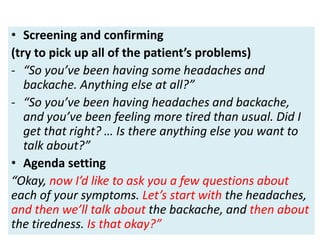
• Screening and confirming
(try to pick up all of the patient’s problems)
- “So you’ve been having some headaches and
backache. Anything else at all?”
- “So you’ve been having headaches and backache,
and you’ve been feeling more tired than usual. Did I
get that right? … Is there anything else you want to
talk about?”
• Agenda setting
“Okay, now I’d like to ask you a few questions about
each of your symptoms. Let’s start with the headaches,
and then we’ll talk about the backache, and then about
the tiredness. Is that okay?”
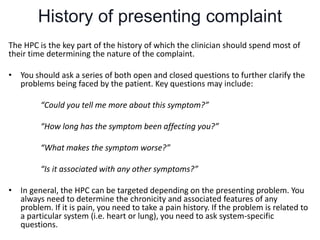
History of presenting complaint
The HPC is the key part of the history of which the clinician should spend most of
their time determining the nature of the complaint.
• You should ask a series of both open and closed questions to further clarify the
problems being faced by the patient. Key questions may include:
“Could you tell me more about this symptom?”
“How long has the symptom been affecting you?”
“What makes the symptom worse?”
“Is it associated with any other symptoms?”
• In general, the HPC can be targeted depending on the presenting problem. You
always need to determine the chronicity and associated features of any
problem. If it is pain, you need to take a pain history. If the problem is related to
a particular system (i.e. heart or lung), you need to ask system-specific
questions.
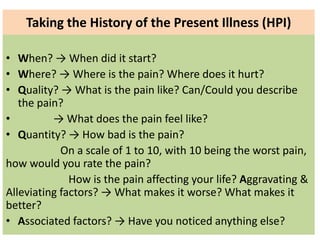
Taking the History of the Present Illness (HPI)
• When? → When did it start?
• Where? → Where is the pain? Where does it hurt?
• Quality? → What is the pain like? Can/Could you describe
the pain?
• → What does the pain feel like?
• Quantity? → How bad is the pain?
On a scale of 1 to 10, with 10 being the worst pain,
how would you rate the pain?
How is the pain affecting your life? Aggravating &
Alleviating factors? → What makes it worse? What makes it
better?
• Associated factors? → Have you noticed anything else?
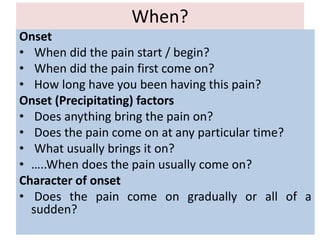
When?
Onset
• When did the pain start / begin?
• When did the pain first come on?
• How long have you been having this pain?
Onset (Precipitating) factors
• Does anything bring the pain on?
• Does the pain come on at any particular time?
• What usually brings it on?
• …..When does the pain usually come on?
Character of onset
• Does the pain come on gradually or all of a
sudden?
Duration
• How long does the pain usually last?
Frequency
• How often do you have the pain?
• How often have you had the pain?
• How many times have you had the pain?
Course
• Is the pain getting better or worse?
• Does the pain come and go?
• Is the pain constant, or does it come and go?
Where?
• Where does it hurt?/Where is it sore?
• Show me where it hurts.
• Please point to where it hurts.
• Which part of your back is affected?
• (radiation) Does the pain spread /move /travel
anywhere else?
Quality?
• What is the pain like?
• What does the pain feel like?
• Can/Could you describe the pain?
• What do you mean by ‘weird’ pain?
Quantity?
• How bad is the pain?
• On a scale of 1 to 10, with 10 being the worst
pain, how would you rate the pain?
• How is the pain affecting your life?
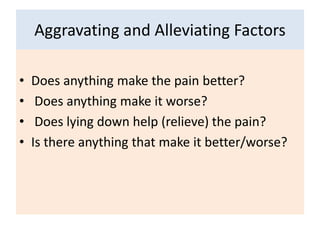
Aggravating and Alleviating Factors
• Does anything make the pain better?
• Does anything make it worse?
• Does lying down help (relieve) the pain?
• Is there anything that make it better/worse?
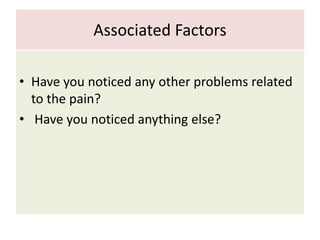
Associated Factors
• Have you noticed any other problems related
to the pain?
• Have you noticed anything else?
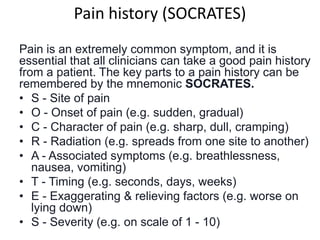
Pain history (SOCRATES)
Pain is an extremely common symptom, and it is
essential that all clinicians can take a good pain history
from a patient. The key parts to a pain history can be
remembered by the mnemonic SOCRATES.
• S - Site of pain
• O - Onset of pain (e.g. sudden, gradual)
• C - Character of pain (e.g. sharp, dull, cramping)
• R - Radiation (e.g. spreads from one site to another)
• A - Associated symptoms (e.g. breathlessness,
nausea, vomiting)
• T - Timing (e.g. seconds, days, weeks)
• E - Exaggerating & relieving factors (e.g. worse on
lying down)
• S - Severity (e.g. on scale of 1 - 10)
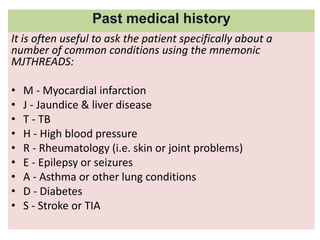
Past medical history
It is often useful to ask the patient specifically about a
number of common conditions using the mnemonic
MJTHREADS:
• M - Myocardial infarction
• J - Jaundice & liver disease
• T - TB
• H - High blood pressure
• R - Rheumatology (i.e. skin or joint problems)
• E - Epilepsy or seizures
• A - Asthma or other lung conditions
• D - Diabetes
• S - Stroke or TIA
• Now I’m going to ask you about your health in
general / in the past.
• Have you had anything like this before?
• Have you ever had a major illness?
• Have you ever had a major injury?
• Have you ever had major surgery / a major
operation?
• Do you have any allergies? / Are you allergic to
anything?
Medication history
- The medication history is used to establish what the patient
is taking including both prescribed and over-the-counter (i.e
non-prescribed) medications.
- For all medications you need to establish
the name, dose (i.e. mg/mls/mcg), frequency (i.e. once a day,
once a week), and route (oral, intramuscular, intravenous).
- The four things to ask about:
1. Prescribed medications
2. Over-the-counter medications
3. Herbal remedies
4. Recreational drugs (i.e. cocaine, ecstasy)
Always establish concordance (i.e. is the patient actually
taking their medications), any side-effects and any recent
changes (e.g. medications that have stopped or been started
or dosing changes).
Questions used to ask medication history
• Are you taking any medications at the
moment? / Are you on any medications?
• Have you taken anything for it?
• Do you take any over-the-counter drugs?
• How about any Kampo medicines or Chinese
herbal medicines?
• Do you take any vitamins or other
supplements?
(asking for detail) What do you take?
(Could you spell that for me?)
What do you take it for?
(dose) How many times a day do you take it?
(compliance) Do you always remember to take it?
(side effects) Do you have any side effects?
→ What kind?
(allergies) Do you know if you have any drug
allergies?
→Which drug are you allergic to?
→What symptoms do you get?
Family history
• Taking a family history is essential to determine
illnesses that run within the family or may be inherited.
• When gathering a family history, you need to find
out the condition affected by the relative, the age
at which it was diagnosed and the relationship to
the patient. A family tree can be used to help
represent this information.
Examples:
1. Mother (first-degree relative), lung cancer,
diagnosed at 45
2. Maternal aunt (second-degree relative), breast
cancer, diagnosed 32
3. Father (first-degree relative), hypertension,
diagnosed 65
Questions used to ask family history
• Now, I’d like to ask about your family’s health.
• Are your parents alive and well?
• Are all your close relatives fit and well?
• Does anyone in your family have a serious
illness?
• How old was he when he died?
• What did he die of? / Do you know the cause
of death?
Social history
- The social history is one of the most important components of the
medical history.
- The purpose of a social history is two-fold. First, you need to
find out relevant information about home and domestic
activity, job and financial security, travel, smoking and alcohol
consumption. Second, you need to consider the effects of their
medical conditions on these social issues (i.e. poor mobility due
to heart failure, need carers due to dementia).
- The key parts of the social history can be remembered using
the mnemonic LOLAS DIET:
• L - life- who does the patient live with?
• O - occupation
• L - living - activities of daily living
• A - alcohol consumption
• S - smoking history
• Di - diet
• E - exercise
• T - travel
Questions used to ask social history
• Now, I’m going to ask you some personal
questions. Everything we talk about is confidential.
• Do you have a partner?
• Do you have any children?
• Who do you live with?
• Is there any stress at home?
• Do you work?
• Do you have any troubles at work? / Is there any
stress at work?
• …..Do you smoke?
→ How many do you smoke a day? → Have
you tried to give up?
• Do you use recreational drugs?
• Do you drink?
→Wine, beer, spirits?
→How much do you usually drink in a week?
→ Can you give up drinking when you want?
• Do you have any hobbies or interests?
Systems review
• The systems enquiry is a way of screening for any other symptoms
related to major systems within the body.
• The systems review can be completed at any point during the
consultation but is usually completed at the end or following the
history of presenting complaint. It is important to ask brief, closed
questions, to ensure you cover the major symptoms in a timely
fashion. However, a positive response should be further
investigated fully like in the history of presenting complaint.
• The best way to approach the systems review is to start by asking
four general questions, and then ask short closed questions from
head-to-toe. The four general questions are useful to screen for
malignancy or chronic infections.
The four general questions include:
• Weight loss - Have you had any significant weight loss?
• Fever - Have you had any fevers or night sweats?
• Energy - Have you had a reduction in your energy levels?
• Appetite - Has your appetite changed?
• The short, closed questions, from head-to-toe may be as follows:
• Headaches
• Visual changes
• Hearing problems
• Swallowing problems
• Chest pain
• Shortness of breath
• Abdominal pain
• Urinary symptoms
• Bowel symptoms
• Skin rashes
• Joint pain
Questions used for system review
• Now, I’m just going to ask you a few more questions, but
it’s important that I haven’t missed anything.
• How have you been feeling in general?
• What’s your appetite like? / How’s your appetite? / Has
there been any change in your appetite?
• Have you had any loss or gain in weight?
→How many kilos did you lose (gain)?
→ Was the weight loss (gain) intentional? / Were you on a
diet?
• Are your periods regular?
• Do you have any ……………………………. night sweats?
• Have you noticed any ………………………. headaches?
• Any ………………………………………………… problems with vision?
• What about any …………….. dizziness? ringing in the ears?
nosebleeds? sore throat?
coughing? coughing up blood?
wheezing? shortness of breath?
chest pain? palpitations?
swelling of the ankles? blackouts? / fainting?
nausea? vomiting?
heartburn? indigestion?
abdominal pain? constipation?
diarrhea? blood in your stool? / urine?
problems urinating? loss of bladder control?
pain in your muscles or joints?
rashes? itching?
problems sleeping? changes in mood?
Patient’s Ideas, Concerns, Expectations (ICE)
- ideas
What do you think might have brought this on?
What do you know about this illness?
What do you think this will happen?
- Concerns
What are your worries about this?
How does this affect your family?
- expectations
How were you hoping I could help you today?
What you expect from me?
What were you hoping we could do for you?
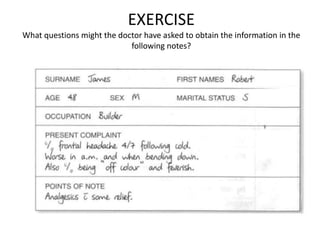
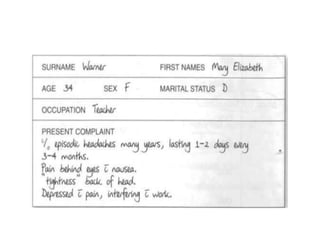
EXERCISE
What questions might the doctor have asked to obtain the information in the
following notes?
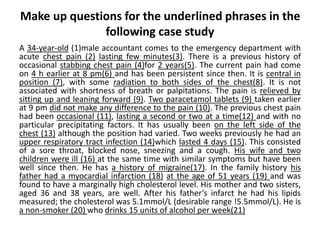
Make up questions for the underlined phrases in the
following case study
A 34-year-old (1)male accountant comes to the emergency department with
acute chest pain (2) lasting few minutes(3). There is a previous history of
occasional stabbing chest pain (4)for 2 years(5). The current pain had come
on 4 h earlier at 8 pm(6) and has been persistent since then. It is central in
position (7), with some radiation to both sides of the chest(8). It is not
associated with shortness of breath or palpitations. The pain is relieved by
sitting up and leaning forward (9). Two paracetamol tablets (9) taken earlier
at 9 pm did not make any difference to the pain (10). The previous chest pain
had been occasional (11), lasting a second or two at a time(12) and with no
particular precipitating factors. It has usually been on the left side of the
chest (13) although the position had varied. Two weeks previously he had an
upper respiratory tract infection (14)which lasted 4 days (15). This consisted
of a sore throat, blocked nose, sneezing and a cough. His wife and two
children were ill (16) at the same time with similar symptoms but have been
well since then. He has a history of migraine(17). In the family history his
father had a myocardial infarction (18) at the age of 51 years (19) and was
found to have a marginally high cholesterol level. His mother and two sisters,
aged 36 and 38 years, are well. After his father’s infarct he had his lipids
measured; the cholesterol was 5.1mmol/L (desirable range !5.5mmol/L). He is
a non-smoker (20) who drinks 15 units of alcohol per week(21)

UNIT 5- STs Taking A History Guide .pptx

  • 1.
    TAKING A HISTORY Preparedby Ms Nguyen Thi Thanh Hong, PhD
  • 2.
    Calling the PatientInto the Office • “Ms Jones—Please come into room 5.” Greeting the Patient (importance of first impressions: welcoming & comfortable environment; respect & interest in the patient; verbal & nonverbal behavior: stand up to greet/shake hands/smile/eye contact) • “Hello, I’m Dr Suzuki. Please sit down. It’s Mary • Jones, isn’t it?” • “Come and sit down. I’m Dr Suzuki. Can I just confirm that you’re Mary Jones?” • “Good morning, Mrs Jones. Take a seat. I’m Dr Suzuki.” • “Come in and sit down. Am I right in thinking that we haven’t met before? I’m Dr Suzuki. What would you prefer me to call you?” • “Hello, Mary. Good to see you.”
  • 3.
    History structure The basicstructure of the history is as follows: • Presenting complaint (PC) • History of presenting complaint (HPC) • Past medical history (PMHx) • Drug/Medication history (DHx) • Family history (FHx) • Social history (SHx) • Systems review (SR) • Ideas, concerns, expectations (ICE)
  • 4.
    Presenting complaint The PCshould be a single sentence that describes the reason why a patient has sought help. An example of a typical PC would be abdominal pain or headache. The PC should capture key information about the patient that helps to focus the history including age, sex and timing of the complaint. This information helps to focus the potential list of causes. For example; “88 year old female presenting with a 1 month history of abdominal pain” “23 year old male student presenting with a 12 hour history of headache and fever” “56 year old male heavy smoker presenting with a single episode of coughing up blood (haemoptysis)”
  • 5.
    Asking About theChief Complaint (CC) (patient-centered; attentive listening to ensure accurate and efficient information gathering with facilitative responses: ‘uh-huh,’ ‘Go on,’ ‘I see’) • Opening question - What’s brought you along today? - What problems have brought you here today? - “What’s brought you to the hospital today?” - “What’s been troubling you?” - “How can I help you?” - “What can I do for you? - “What problems have you been having?” - “What’s been troubling you?” - “How can I help you?” Follow-up question “I see that you have backache. Please tell me more about it.”
  • 6.
    • Screening andconfirming (try to pick up all of the patient’s problems) - “So you’ve been having some headaches and backache. Anything else at all?” - “So you’ve been having headaches and backache, and you’ve been feeling more tired than usual. Did I get that right? … Is there anything else you want to talk about?” • Agenda setting “Okay, now I’d like to ask you a few questions about each of your symptoms. Let’s start with the headaches, and then we’ll talk about the backache, and then about the tiredness. Is that okay?”
  • 7.
    History of presentingcomplaint The HPC is the key part of the history of which the clinician should spend most of their time determining the nature of the complaint. • You should ask a series of both open and closed questions to further clarify the problems being faced by the patient. Key questions may include: “Could you tell me more about this symptom?” “How long has the symptom been affecting you?” “What makes the symptom worse?” “Is it associated with any other symptoms?” • In general, the HPC can be targeted depending on the presenting problem. You always need to determine the chronicity and associated features of any problem. If it is pain, you need to take a pain history. If the problem is related to a particular system (i.e. heart or lung), you need to ask system-specific questions.
  • 8.
    Taking the Historyof the Present Illness (HPI) • When? → When did it start? • Where? → Where is the pain? Where does it hurt? • Quality? → What is the pain like? Can/Could you describe the pain? • → What does the pain feel like? • Quantity? → How bad is the pain? On a scale of 1 to 10, with 10 being the worst pain, how would you rate the pain? How is the pain affecting your life? Aggravating & Alleviating factors? → What makes it worse? What makes it better? • Associated factors? → Have you noticed anything else?
  • 9.
    When? Onset • When didthe pain start / begin? • When did the pain first come on? • How long have you been having this pain? Onset (Precipitating) factors • Does anything bring the pain on? • Does the pain come on at any particular time? • What usually brings it on? • …..When does the pain usually come on? Character of onset • Does the pain come on gradually or all of a sudden?
  • 10.
    Duration • How longdoes the pain usually last? Frequency • How often do you have the pain? • How often have you had the pain? • How many times have you had the pain? Course • Is the pain getting better or worse? • Does the pain come and go? • Is the pain constant, or does it come and go?
  • 11.
    Where? • Where doesit hurt?/Where is it sore? • Show me where it hurts. • Please point to where it hurts. • Which part of your back is affected? • (radiation) Does the pain spread /move /travel anywhere else?
  • 12.
    Quality? • What isthe pain like? • What does the pain feel like? • Can/Could you describe the pain? • What do you mean by ‘weird’ pain?
  • 13.
    Quantity? • How badis the pain? • On a scale of 1 to 10, with 10 being the worst pain, how would you rate the pain? • How is the pain affecting your life?
  • 14.
    Aggravating and AlleviatingFactors • Does anything make the pain better? • Does anything make it worse? • Does lying down help (relieve) the pain? • Is there anything that make it better/worse?
  • 15.
    Associated Factors • Haveyou noticed any other problems related to the pain? • Have you noticed anything else?
  • 16.
    Pain history (SOCRATES) Painis an extremely common symptom, and it is essential that all clinicians can take a good pain history from a patient. The key parts to a pain history can be remembered by the mnemonic SOCRATES. • S - Site of pain • O - Onset of pain (e.g. sudden, gradual) • C - Character of pain (e.g. sharp, dull, cramping) • R - Radiation (e.g. spreads from one site to another) • A - Associated symptoms (e.g. breathlessness, nausea, vomiting) • T - Timing (e.g. seconds, days, weeks) • E - Exaggerating & relieving factors (e.g. worse on lying down) • S - Severity (e.g. on scale of 1 - 10)
  • 17.
    Past medical history Itis often useful to ask the patient specifically about a number of common conditions using the mnemonic MJTHREADS: • M - Myocardial infarction • J - Jaundice & liver disease • T - TB • H - High blood pressure • R - Rheumatology (i.e. skin or joint problems) • E - Epilepsy or seizures • A - Asthma or other lung conditions • D - Diabetes • S - Stroke or TIA
  • 18.
    • Now I’mgoing to ask you about your health in general / in the past. • Have you had anything like this before? • Have you ever had a major illness? • Have you ever had a major injury? • Have you ever had major surgery / a major operation? • Do you have any allergies? / Are you allergic to anything?
  • 19.
    Medication history - Themedication history is used to establish what the patient is taking including both prescribed and over-the-counter (i.e non-prescribed) medications. - For all medications you need to establish the name, dose (i.e. mg/mls/mcg), frequency (i.e. once a day, once a week), and route (oral, intramuscular, intravenous). - The four things to ask about: 1. Prescribed medications 2. Over-the-counter medications 3. Herbal remedies 4. Recreational drugs (i.e. cocaine, ecstasy) Always establish concordance (i.e. is the patient actually taking their medications), any side-effects and any recent changes (e.g. medications that have stopped or been started or dosing changes).
  • 20.
    Questions used toask medication history • Are you taking any medications at the moment? / Are you on any medications? • Have you taken anything for it? • Do you take any over-the-counter drugs? • How about any Kampo medicines or Chinese herbal medicines? • Do you take any vitamins or other supplements? (asking for detail) What do you take? (Could you spell that for me?) What do you take it for?
  • 21.
    (dose) How manytimes a day do you take it? (compliance) Do you always remember to take it? (side effects) Do you have any side effects? → What kind? (allergies) Do you know if you have any drug allergies? →Which drug are you allergic to? →What symptoms do you get?
  • 22.
    Family history • Takinga family history is essential to determine illnesses that run within the family or may be inherited. • When gathering a family history, you need to find out the condition affected by the relative, the age at which it was diagnosed and the relationship to the patient. A family tree can be used to help represent this information. Examples: 1. Mother (first-degree relative), lung cancer, diagnosed at 45 2. Maternal aunt (second-degree relative), breast cancer, diagnosed 32 3. Father (first-degree relative), hypertension, diagnosed 65
  • 23.
    Questions used toask family history • Now, I’d like to ask about your family’s health. • Are your parents alive and well? • Are all your close relatives fit and well? • Does anyone in your family have a serious illness? • How old was he when he died? • What did he die of? / Do you know the cause of death?
  • 24.
    Social history - Thesocial history is one of the most important components of the medical history. - The purpose of a social history is two-fold. First, you need to find out relevant information about home and domestic activity, job and financial security, travel, smoking and alcohol consumption. Second, you need to consider the effects of their medical conditions on these social issues (i.e. poor mobility due to heart failure, need carers due to dementia). - The key parts of the social history can be remembered using the mnemonic LOLAS DIET: • L - life- who does the patient live with? • O - occupation • L - living - activities of daily living • A - alcohol consumption • S - smoking history • Di - diet • E - exercise • T - travel
  • 25.
    Questions used toask social history • Now, I’m going to ask you some personal questions. Everything we talk about is confidential. • Do you have a partner? • Do you have any children? • Who do you live with? • Is there any stress at home? • Do you work? • Do you have any troubles at work? / Is there any stress at work?
  • 26.
    • …..Do yousmoke? → How many do you smoke a day? → Have you tried to give up? • Do you use recreational drugs? • Do you drink? →Wine, beer, spirits? →How much do you usually drink in a week? → Can you give up drinking when you want? • Do you have any hobbies or interests?
  • 27.
    Systems review • Thesystems enquiry is a way of screening for any other symptoms related to major systems within the body. • The systems review can be completed at any point during the consultation but is usually completed at the end or following the history of presenting complaint. It is important to ask brief, closed questions, to ensure you cover the major symptoms in a timely fashion. However, a positive response should be further investigated fully like in the history of presenting complaint. • The best way to approach the systems review is to start by asking four general questions, and then ask short closed questions from head-to-toe. The four general questions are useful to screen for malignancy or chronic infections.
  • 28.
    The four generalquestions include: • Weight loss - Have you had any significant weight loss? • Fever - Have you had any fevers or night sweats? • Energy - Have you had a reduction in your energy levels? • Appetite - Has your appetite changed? • The short, closed questions, from head-to-toe may be as follows: • Headaches • Visual changes • Hearing problems • Swallowing problems • Chest pain • Shortness of breath • Abdominal pain • Urinary symptoms • Bowel symptoms • Skin rashes • Joint pain
  • 29.
    Questions used forsystem review • Now, I’m just going to ask you a few more questions, but it’s important that I haven’t missed anything. • How have you been feeling in general? • What’s your appetite like? / How’s your appetite? / Has there been any change in your appetite? • Have you had any loss or gain in weight? →How many kilos did you lose (gain)? → Was the weight loss (gain) intentional? / Were you on a diet? • Are your periods regular? • Do you have any ……………………………. night sweats? • Have you noticed any ………………………. headaches? • Any ………………………………………………… problems with vision?
  • 30.
    • What aboutany …………….. dizziness? ringing in the ears? nosebleeds? sore throat? coughing? coughing up blood? wheezing? shortness of breath? chest pain? palpitations? swelling of the ankles? blackouts? / fainting? nausea? vomiting? heartburn? indigestion? abdominal pain? constipation? diarrhea? blood in your stool? / urine? problems urinating? loss of bladder control? pain in your muscles or joints? rashes? itching? problems sleeping? changes in mood?
  • 31.
    Patient’s Ideas, Concerns,Expectations (ICE) - ideas What do you think might have brought this on? What do you know about this illness? What do you think this will happen? - Concerns What are your worries about this? How does this affect your family? - expectations How were you hoping I could help you today? What you expect from me? What were you hoping we could do for you?
  • 32.
    EXERCISE What questions mightthe doctor have asked to obtain the information in the following notes?
  • 34.
    Make up questionsfor the underlined phrases in the following case study A 34-year-old (1)male accountant comes to the emergency department with acute chest pain (2) lasting few minutes(3). There is a previous history of occasional stabbing chest pain (4)for 2 years(5). The current pain had come on 4 h earlier at 8 pm(6) and has been persistent since then. It is central in position (7), with some radiation to both sides of the chest(8). It is not associated with shortness of breath or palpitations. The pain is relieved by sitting up and leaning forward (9). Two paracetamol tablets (9) taken earlier at 9 pm did not make any difference to the pain (10). The previous chest pain had been occasional (11), lasting a second or two at a time(12) and with no particular precipitating factors. It has usually been on the left side of the chest (13) although the position had varied. Two weeks previously he had an upper respiratory tract infection (14)which lasted 4 days (15). This consisted of a sore throat, blocked nose, sneezing and a cough. His wife and two children were ill (16) at the same time with similar symptoms but have been well since then. He has a history of migraine(17). In the family history his father had a myocardial infarction (18) at the age of 51 years (19) and was found to have a marginally high cholesterol level. His mother and two sisters, aged 36 and 38 years, are well. After his father’s infarct he had his lipids measured; the cholesterol was 5.1mmol/L (desirable range !5.5mmol/L). He is a non-smoker (20) who drinks 15 units of alcohol per week(21)