
DYEING WORKSHOP
COURSE C0-ORDINATOR: PROF. PARESH CHATTERJEE
PRESENTATION BY: PRIYAL THAKKAR
presentation by:- Priyal Thakkar 1
presentation by:- Priyal Thakkar 2
HISTORY AND ORIGIN
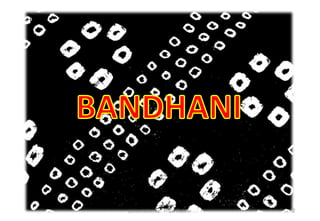
• Bandhani is a type of tie-dye textile performed by plucking the cloth (material
used) by finger nails or by putting pulses bead or tiny pebbles and tying the
area around with a polyester thread.
• Today most Bandhini making centers are situatied in Gujarat, Rajasthan, Sindh,
Punjab regionand in Tamil Nadu where it's known as Chungidi.
• Earliest evidence of Bandhani dates back to Indus Valley Civilization where
dyeing was done as early as 4000 B.C.
• Bandhani is also known as Bandhej, Bandhni, Piliya, and Chungidi in Tamil as
per the regional delicate.
• Leheria or leheriya derives from the word lahar, meaning wave is also another
unique form of tie dye technique used in Rajasthan.
• Other tying techniques include Mothra, Ekdali and Shikari depending on the
manner in which the cloth is tied.
• The final products are known with various names like Khombi, Ghar Chola,
Patori and also Chandrokhani etc.
presentation by:- Priyal Thakkar 3
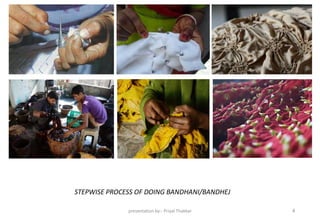
STEPWISE PROCESS OF DOING BANDHANI/BANDHEJ
presentation by:- Priyal Thakkar 4
PROCESS
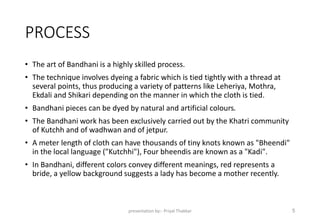
• The art of Bandhani is a highly skilled process.
• The technique involves dyeing a fabric which is tied tightly with a thread at
several points, thus producing a variety of patterns like Leheriya, Mothra,
Ekdali and Shikari depending on the manner in which the cloth is tied.
• Bandhani pieces can be dyed by natural and artificial colours.
• The Bandhani work has been exclusively carried out by the Khatri community
of Kutchh and of wadhwan and of jetpur.
• A meter length of cloth can have thousands of tiny knots known as "Bheendi"
in the local language ("Kutchhi"), Four bheendis are known as a "Kadi".
• In Bandhani, different colors convey different meanings, red represents a
bride, a yellow background suggests a lady has become a mother recently.
presentation by:- Priyal Thakkar 5
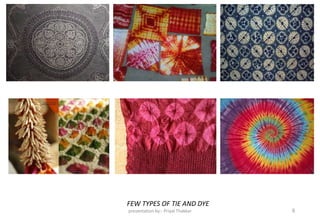
FEW TYPES OF TIE AND DYE
presentation by:- Priyal Thakkar 6
LOCATION
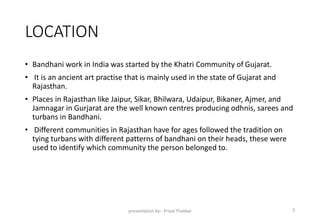
• Bandhani work in India was started by the Khatri Community of Gujarat.
• It is an ancient art practise that is mainly used in the state of Gujarat and
Rajasthan.
• Places in Rajasthan like Jaipur, Sikar, Bhilwara, Udaipur, Bikaner, Ajmer, and
Jamnagar in Gurjarat are the well known centres producing odhnis, sarees and
turbans in Bandhani.
• Different communities in Rajasthan have for ages followed the tradition on
tying turbans with different patterns of bandhani on their heads, these were
used to identify which community the person belonged to.
presentation by:- Priyal Thakkar 7
presentation by:- Priyal Thakkar 8
HISTORY AND ORIGIN
• In Japan, the earliest known example of cloth dyed with a shibori technique
dates from the 8th century.
• The main fabrics were silk and hemp, and later cotton. The main dye was
indigo and, to a lesser extent, madder and purple root.
presentation by:- Priyal Thakkar 9
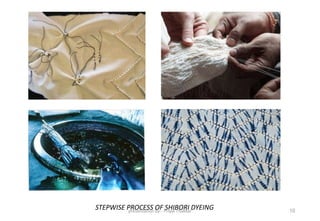
STEPWISE PROCESS OF SHIBORI DYEINGpresentation by:- Priyal Thakkar 10
PROCESS
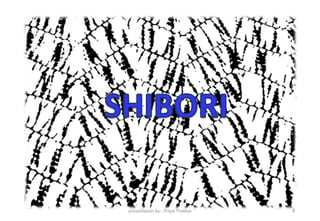
• There are an infinite number of ways one can bind, stitch, fold, twist, or
compress cloth for shibori, and each way results in very different patterns.
• Each method is used to achieve a certain result, but each method is also used
to work in harmony with the type of cloth used.
• Therefore, the technique used in shibori depends not only on the desired
pattern, but the characteristics of the cloth being dyed.
• Also, different techniques can be used in conjunction with one another to
achieve even more elaborate results.
presentation by:- Priyal Thakkar 11
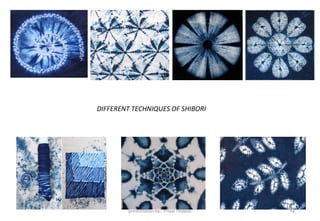
DIFFERENT TECHNIQUES OF SHIBORI
presentation by:- Priyal Thakkar 12
presentation by:- Priyal Thakkar 13
PROCESS
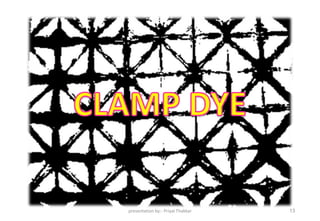
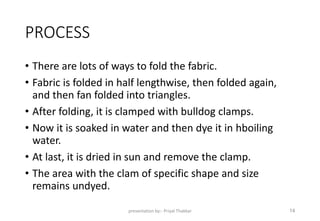
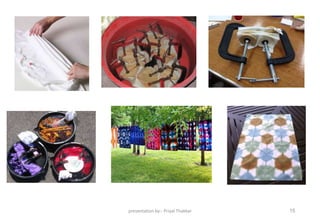
• There are lots of ways to fold the fabric.
• Fabric is folded in half lengthwise, then folded again,
and then fan folded into triangles.
• After folding, it is clamped with bulldog clamps.
• Now it is soaked in water and then dye it in hboiling
water.
• At last, it is dried in sun and remove the clamp.
• The area with the clam of specific shape and size
remains undyed.
presentation by:- Priyal Thakkar 14
presentation by:- Priyal Thakkar 15
DIFFERENT
TYPES OF
CLAMP
DYEING
presentation by:- Priyal Thakkar 16
presentation by:- Priyal Thakkar 17
HISTORY AND ORIGIN
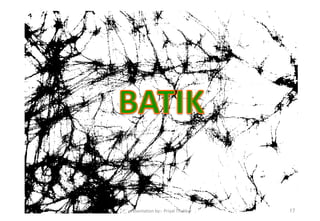
• Batik is a technique of wax-resist dyeing applied to whole cloth, or cloth made using
this technique.
• Batik is made either by drawing dots and lines of the resist with a spouted tool called a
canting or by printing the resist with a copper stamp called a cap .
• The applied wax resists dyes and therefore allows the artisan to colour selectively by
soaking the cloth in one colour, removing the wax with boiling water, and repeating if
multiple colours are desired.
• It already existed in Egypt in the 4th century BC, where it was used to wrap mummies;
linen was soaked in wax, and scratched using a stylus.
• In Asia, the technique was practised in China during the Tang Dynasty (618-907 AD),
and in India and Japan during the Nara Period (645-794 AD).
• In Africa it was originally practised by the Yoruba tribe in Nigeria, Soninke and Wolof in
Senegal.
presentation by:- Priyal Thakkar 18
PROCESS
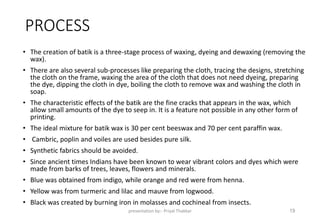
• The creation of batik is a three-stage process of waxing, dyeing and dewaxing (removing the
wax).
• There are also several sub-processes like preparing the cloth, tracing the designs, stretching
the cloth on the frame, waxing the area of the cloth that does not need dyeing, preparing
the dye, dipping the cloth in dye, boiling the cloth to remove wax and washing the cloth in
soap.
• The characteristic effects of the batik are the fine cracks that appears in the wax, which
allow small amounts of the dye to seep in. It is a feature not possible in any other form of
printing.
• The ideal mixture for batik wax is 30 per cent beeswax and 70 per cent paraffin wax.
• Cambric, poplin and voiles are used besides pure silk.
• Synthetic fabrics should be avoided.
• Since ancient times Indians have been known to wear vibrant colors and dyes which were
made from barks of trees, leaves, flowers and minerals.
• Blue was obtained from indigo, while orange and red were from henna.
• Yellow was from turmeric and lilac and mauve from logwood.
• Black was created by burning iron in molasses and cochineal from insects.
presentation by:- Priyal Thakkar 19
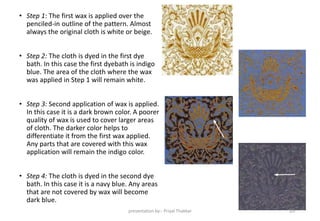
• Step 1: The first wax is applied over the
penciled-in outline of the pattern. Almost
always the original cloth is white or beige.
• Step 2: The cloth is dyed in the first dye
bath. In this case the first dyebath is indigo
blue. The area of the cloth where the wax
was applied in Step 1 will remain white.
• Step 3: Second application of wax is applied.
In this case it is a dark brown color. A poorer
quality of wax is used to cover larger areas
of cloth. The darker color helps to
differentiate it from the first wax applied.
Any parts that are covered with this wax
application will remain the indigo color.
• Step 4: The cloth is dyed in the second dye
bath. In this case it is a navy blue. Any areas
that are not covered by wax will become
dark blue.
presentation by:- Priyal Thakkar 20
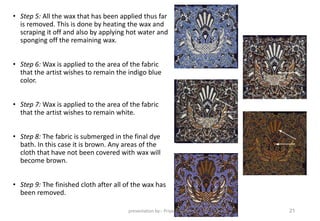
• Step 5: All the wax that has been applied thus far
is removed. This is done by heating the wax and
scraping it off and also by applying hot water and
sponging off the remaining wax.
• Step 6: Wax is applied to the area of the fabric
that the artist wishes to remain the indigo blue
color.
• Step 7: Wax is applied to the area of the fabric
that the artist wishes to remain white.
• Step 8: The fabric is submerged in the final dye
bath. In this case it is brown. Any areas of the
cloth that have not been covered with wax will
become brown.
• Step 9: The finished cloth after all of the wax has
been removed.
presentation by:- Priyal Thakkar 21
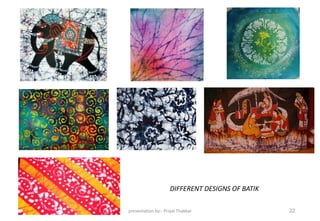
DIFFERENT DESIGNS OF BATIK
presentation by:- Priyal Thakkar 22
LOCATION
• The revival of batik in India began in the 20th century when it was introduced as a subject
at the famous university of Shantiniketan in Calcutta.
• In the South near Madras, the well-known artist's village of Chola-Mandal is where batik
gets an artistic touch.
• Batik that is produced in Madras is known for its original and vibrant designs.
• Indonesia however is considered the cradle of batik with its many designs, which are
restricted for different wearers and occasions.
• Indonesian batik has characters of mystic and ritualistic connection. Objects like flowers,
trees, birds have a significant meaning.
• The Sawat in Javanese batik has its origins in Hindu mythology, as it is the decorative form
of Garuda, Lord Vishnu's bird. 'Sidomukti' is another Hindu influence in batik. 'Mukti'
means happiness and prosperity in the Hindu mythology.
• While Indonesia, Malaysia and Thailand are known for their block printing (tjab) method
to create batik on a large scale, in Sri Lanka batik is still made by hand.
• Sri Lankan batik is less intricate and more suited to modern times.
presentation by:- Priyal Thakkar 23
presentation by:- Priyal Thakkar 24

Dyeing and printing techniques in India

  • 1.
    DYEING WORKSHOP COURSE C0-ORDINATOR:PROF. PARESH CHATTERJEE PRESENTATION BY: PRIYAL THAKKAR presentation by:- Priyal Thakkar 1
  • 2.
  • 3.
    HISTORY AND ORIGIN •Bandhani is a type of tie-dye textile performed by plucking the cloth (material used) by finger nails or by putting pulses bead or tiny pebbles and tying the area around with a polyester thread. • Today most Bandhini making centers are situatied in Gujarat, Rajasthan, Sindh, Punjab regionand in Tamil Nadu where it's known as Chungidi. • Earliest evidence of Bandhani dates back to Indus Valley Civilization where dyeing was done as early as 4000 B.C. • Bandhani is also known as Bandhej, Bandhni, Piliya, and Chungidi in Tamil as per the regional delicate. • Leheria or leheriya derives from the word lahar, meaning wave is also another unique form of tie dye technique used in Rajasthan. • Other tying techniques include Mothra, Ekdali and Shikari depending on the manner in which the cloth is tied. • The final products are known with various names like Khombi, Ghar Chola, Patori and also Chandrokhani etc. presentation by:- Priyal Thakkar 3
  • 4.
    STEPWISE PROCESS OFDOING BANDHANI/BANDHEJ presentation by:- Priyal Thakkar 4
  • 5.
    PROCESS • The artof Bandhani is a highly skilled process. • The technique involves dyeing a fabric which is tied tightly with a thread at several points, thus producing a variety of patterns like Leheriya, Mothra, Ekdali and Shikari depending on the manner in which the cloth is tied. • Bandhani pieces can be dyed by natural and artificial colours. • The Bandhani work has been exclusively carried out by the Khatri community of Kutchh and of wadhwan and of jetpur. • A meter length of cloth can have thousands of tiny knots known as "Bheendi" in the local language ("Kutchhi"), Four bheendis are known as a "Kadi". • In Bandhani, different colors convey different meanings, red represents a bride, a yellow background suggests a lady has become a mother recently. presentation by:- Priyal Thakkar 5
  • 6.
    FEW TYPES OFTIE AND DYE presentation by:- Priyal Thakkar 6
  • 7.
    LOCATION • Bandhani workin India was started by the Khatri Community of Gujarat. • It is an ancient art practise that is mainly used in the state of Gujarat and Rajasthan. • Places in Rajasthan like Jaipur, Sikar, Bhilwara, Udaipur, Bikaner, Ajmer, and Jamnagar in Gurjarat are the well known centres producing odhnis, sarees and turbans in Bandhani. • Different communities in Rajasthan have for ages followed the tradition on tying turbans with different patterns of bandhani on their heads, these were used to identify which community the person belonged to. presentation by:- Priyal Thakkar 7
  • 8.
  • 9.
    HISTORY AND ORIGIN •In Japan, the earliest known example of cloth dyed with a shibori technique dates from the 8th century. • The main fabrics were silk and hemp, and later cotton. The main dye was indigo and, to a lesser extent, madder and purple root. presentation by:- Priyal Thakkar 9
  • 10.
    STEPWISE PROCESS OFSHIBORI DYEINGpresentation by:- Priyal Thakkar 10
  • 11.
    PROCESS • There arean infinite number of ways one can bind, stitch, fold, twist, or compress cloth for shibori, and each way results in very different patterns. • Each method is used to achieve a certain result, but each method is also used to work in harmony with the type of cloth used. • Therefore, the technique used in shibori depends not only on the desired pattern, but the characteristics of the cloth being dyed. • Also, different techniques can be used in conjunction with one another to achieve even more elaborate results. presentation by:- Priyal Thakkar 11
  • 12.
    DIFFERENT TECHNIQUES OFSHIBORI presentation by:- Priyal Thakkar 12
  • 13.
  • 14.
    PROCESS • There arelots of ways to fold the fabric. • Fabric is folded in half lengthwise, then folded again, and then fan folded into triangles. • After folding, it is clamped with bulldog clamps. • Now it is soaked in water and then dye it in hboiling water. • At last, it is dried in sun and remove the clamp. • The area with the clam of specific shape and size remains undyed. presentation by:- Priyal Thakkar 14
  • 15.
  • 16.
  • 17.
  • 18.
    HISTORY AND ORIGIN •Batik is a technique of wax-resist dyeing applied to whole cloth, or cloth made using this technique. • Batik is made either by drawing dots and lines of the resist with a spouted tool called a canting or by printing the resist with a copper stamp called a cap . • The applied wax resists dyes and therefore allows the artisan to colour selectively by soaking the cloth in one colour, removing the wax with boiling water, and repeating if multiple colours are desired. • It already existed in Egypt in the 4th century BC, where it was used to wrap mummies; linen was soaked in wax, and scratched using a stylus. • In Asia, the technique was practised in China during the Tang Dynasty (618-907 AD), and in India and Japan during the Nara Period (645-794 AD). • In Africa it was originally practised by the Yoruba tribe in Nigeria, Soninke and Wolof in Senegal. presentation by:- Priyal Thakkar 18
  • 19.
    PROCESS • The creationof batik is a three-stage process of waxing, dyeing and dewaxing (removing the wax). • There are also several sub-processes like preparing the cloth, tracing the designs, stretching the cloth on the frame, waxing the area of the cloth that does not need dyeing, preparing the dye, dipping the cloth in dye, boiling the cloth to remove wax and washing the cloth in soap. • The characteristic effects of the batik are the fine cracks that appears in the wax, which allow small amounts of the dye to seep in. It is a feature not possible in any other form of printing. • The ideal mixture for batik wax is 30 per cent beeswax and 70 per cent paraffin wax. • Cambric, poplin and voiles are used besides pure silk. • Synthetic fabrics should be avoided. • Since ancient times Indians have been known to wear vibrant colors and dyes which were made from barks of trees, leaves, flowers and minerals. • Blue was obtained from indigo, while orange and red were from henna. • Yellow was from turmeric and lilac and mauve from logwood. • Black was created by burning iron in molasses and cochineal from insects. presentation by:- Priyal Thakkar 19
  • 20.
    • Step 1:The first wax is applied over the penciled-in outline of the pattern. Almost always the original cloth is white or beige. • Step 2: The cloth is dyed in the first dye bath. In this case the first dyebath is indigo blue. The area of the cloth where the wax was applied in Step 1 will remain white. • Step 3: Second application of wax is applied. In this case it is a dark brown color. A poorer quality of wax is used to cover larger areas of cloth. The darker color helps to differentiate it from the first wax applied. Any parts that are covered with this wax application will remain the indigo color. • Step 4: The cloth is dyed in the second dye bath. In this case it is a navy blue. Any areas that are not covered by wax will become dark blue. presentation by:- Priyal Thakkar 20
  • 21.
    • Step 5:All the wax that has been applied thus far is removed. This is done by heating the wax and scraping it off and also by applying hot water and sponging off the remaining wax. • Step 6: Wax is applied to the area of the fabric that the artist wishes to remain the indigo blue color. • Step 7: Wax is applied to the area of the fabric that the artist wishes to remain white. • Step 8: The fabric is submerged in the final dye bath. In this case it is brown. Any areas of the cloth that have not been covered with wax will become brown. • Step 9: The finished cloth after all of the wax has been removed. presentation by:- Priyal Thakkar 21
  • 22.
    DIFFERENT DESIGNS OFBATIK presentation by:- Priyal Thakkar 22
  • 23.
    LOCATION • The revivalof batik in India began in the 20th century when it was introduced as a subject at the famous university of Shantiniketan in Calcutta. • In the South near Madras, the well-known artist's village of Chola-Mandal is where batik gets an artistic touch. • Batik that is produced in Madras is known for its original and vibrant designs. • Indonesia however is considered the cradle of batik with its many designs, which are restricted for different wearers and occasions. • Indonesian batik has characters of mystic and ritualistic connection. Objects like flowers, trees, birds have a significant meaning. • The Sawat in Javanese batik has its origins in Hindu mythology, as it is the decorative form of Garuda, Lord Vishnu's bird. 'Sidomukti' is another Hindu influence in batik. 'Mukti' means happiness and prosperity in the Hindu mythology. • While Indonesia, Malaysia and Thailand are known for their block printing (tjab) method to create batik on a large scale, in Sri Lanka batik is still made by hand. • Sri Lankan batik is less intricate and more suited to modern times. presentation by:- Priyal Thakkar 23
  • 24.