MIRROR WORK OF RAJASTHAN
INTRODUCTION
 Mirror work is also known as shisha, is one of the most captivating
characteristics of traditional Indian handicrafts.
 An early form of mirror work was introduced to India during the reign
of the Mughal Empire.
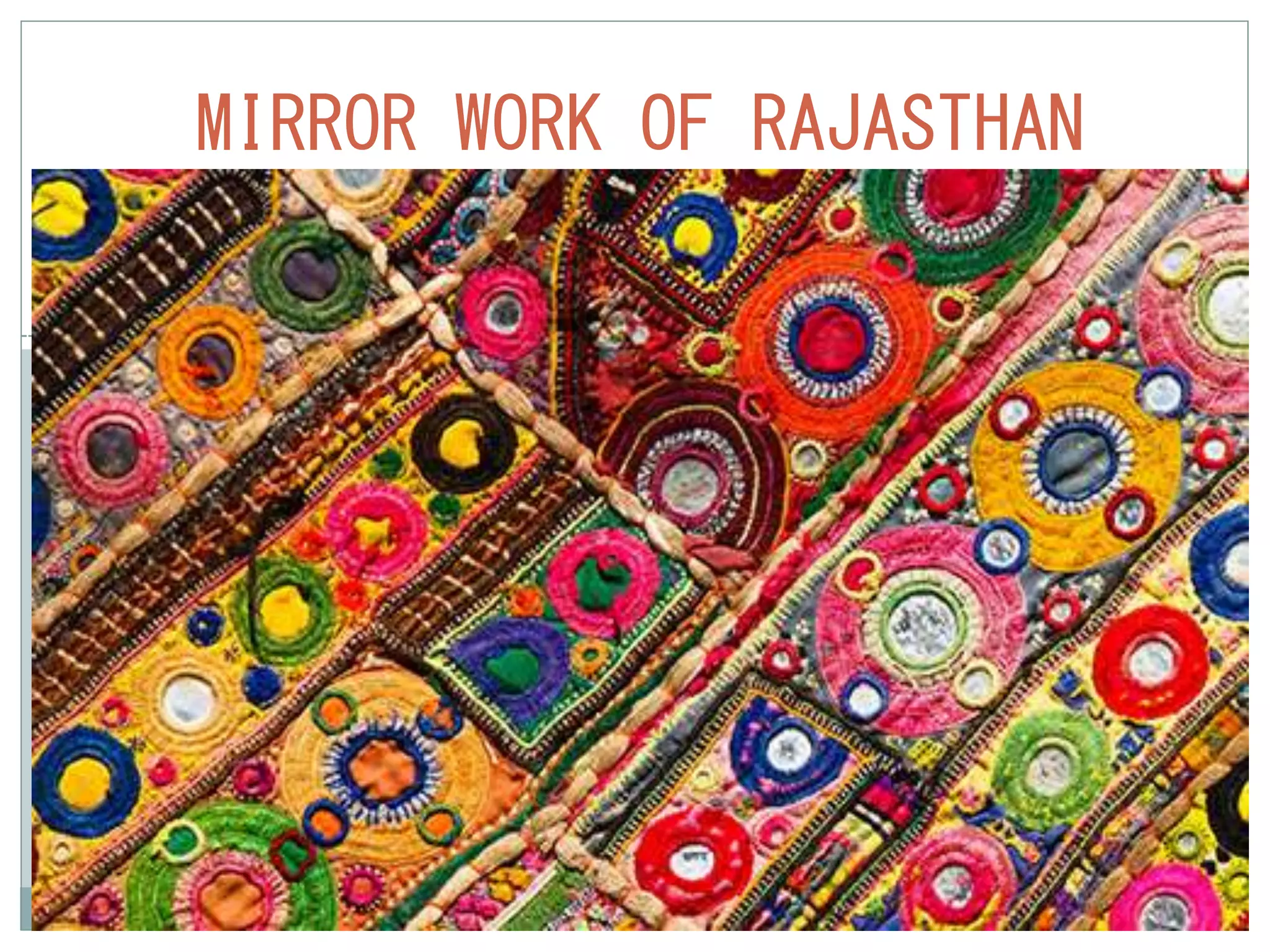
 Small pieces of mirror of various shapes and sizes, including circular,
square, triangular and decoratively stitched into place on the base
fabric.
 In earlier times, mica, a type of sheet silicate mineral, was used in
mirror work instead of mirrors.
 There are three common types of embellishments used in mirror work.
1) Hand blown glass shisha
2) Machine cut glass shisha
3) Shisha embroidery.
HISTORY
 Mirror work, can be traced back to 13th century Persia.
 Tradesmen and travellers brought the handicraft to India in the same
century, during the Mughal era.
 Due to this, the use of mirrors and the crafts of mirror work stem from
traditional Islamic beliefs: the mirror help to trap or blind the evil eye,
reflecting bad luck and evil spirit away from the wearer.
 In Indian mirror work, the use of mirrors widely represents the
breathtaking landscapes and nature of India.
 Traditional Rajasthani clothes are adorned with mirror work
embroidery.
Motifs and colours
 Mirror work that hails from Rajasthan, Gujarat, Haryana and Odisha,
each state produces mirror work with its own unique style.
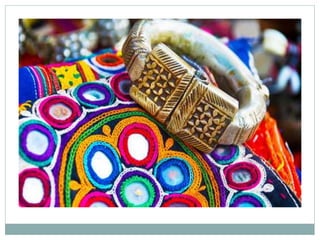
 Mirror work is commonly heavily encrusted with white, red, orange,
saffron, green and blue stitches.
 Mirror embellishments are often found in a wide variety of shapes and
sizes and represent shapes found in nature, such as flower petals, leaves
and animals is still employed in today’s mirror work.
 These small piece of mirrors are stitched onto the base fabric by means
of a chain stitch or buttonhole stitch.
 The latter form of stitching is commonly used to embellish small, round
objects onto fabric.
Mirror work of rajasthan

Mirror work of rajasthan

  • 1.
    MIRROR WORK OFRAJASTHAN
  • 2.
    INTRODUCTION  Mirror workis also known as shisha, is one of the most captivating characteristics of traditional Indian handicrafts.  An early form of mirror work was introduced to India during the reign of the Mughal Empire.  Small pieces of mirror of various shapes and sizes, including circular, square, triangular and decoratively stitched into place on the base fabric.  In earlier times, mica, a type of sheet silicate mineral, was used in mirror work instead of mirrors.  There are three common types of embellishments used in mirror work. 1) Hand blown glass shisha 2) Machine cut glass shisha 3) Shisha embroidery.
  • 3.
    HISTORY  Mirror work,can be traced back to 13th century Persia.  Tradesmen and travellers brought the handicraft to India in the same century, during the Mughal era.  Due to this, the use of mirrors and the crafts of mirror work stem from traditional Islamic beliefs: the mirror help to trap or blind the evil eye, reflecting bad luck and evil spirit away from the wearer.  In Indian mirror work, the use of mirrors widely represents the breathtaking landscapes and nature of India.  Traditional Rajasthani clothes are adorned with mirror work embroidery.
  • 4.
    Motifs and colours Mirror work that hails from Rajasthan, Gujarat, Haryana and Odisha, each state produces mirror work with its own unique style.  Mirror work is commonly heavily encrusted with white, red, orange, saffron, green and blue stitches.  Mirror embellishments are often found in a wide variety of shapes and sizes and represent shapes found in nature, such as flower petals, leaves and animals is still employed in today’s mirror work.  These small piece of mirrors are stitched onto the base fabric by means of a chain stitch or buttonhole stitch.  The latter form of stitching is commonly used to embellish small, round objects onto fabric.