Three Part Objective (TPO) Students will continue to  learn and discuss  the  history of computers  and be able to  identify  the 5 generations of computing through a  PowerPoint presentation, interactive handout, and class discussion .
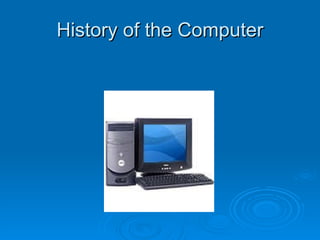
History of the Computer
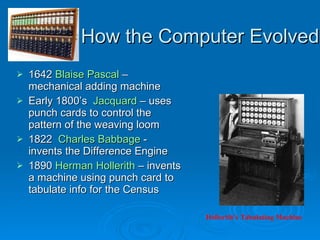
How the Computer Evolved 1642  Blaise Pascal  – mechanical adding machine Early 1800’s  Jacquard  – uses punch cards to control the pattern of the weaving loom 1822  Charles Babbage  - invents the Difference Engine 1890  Herman Hollerith  – invents a machine using punch card to tabulate info for the Census Hollerith’s Tabulating Machine
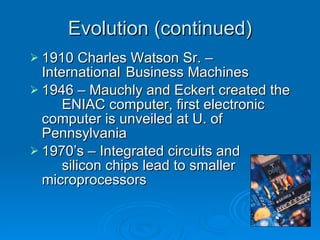
Evolution (continued) 1910 Charles Watson Sr. – International  Business Machines 1946 – Mauchly and Eckert created the  ENIAC computer, first electronic  computer is unveiled at U. of  Pennsylvania 1970’s – Integrated circuits and  silicon chips lead to smaller  microprocessors                                                   
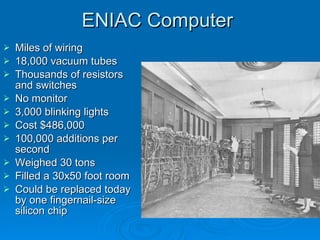
ENIAC Computer Miles of wiring 18,000 vacuum tubes Thousands of resistors and switches No monitor 3,000 blinking lights Cost $486,000 100,000 additions per second Weighed 30 tons Filled a 30x50 foot room Could be replaced today by one fingernail-size silicon chip
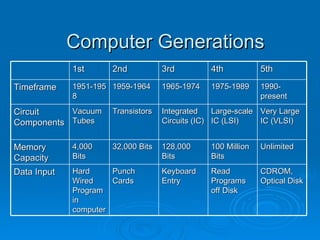
Computer Generations 1st 2nd 3rd 4th 5th Timeframe 1951-1958 1959-1964 1965-1974 1975-1989 1990-present Circuit Components Vacuum Tubes Transistors Integrated Circuits (IC) Large-scale IC (LSI) Very Large IC (VLSI) Memory Capacity 4,000 Bits 32,000 Bits 128,000 Bits 100 Million Bits Unlimited Data Input Hard Wired Program in computer Punch Cards Keyboard Entry Read Programs off Disk CDROM, Optical Disk
Computers Are Everywhere Laptop Computers Appliances Cars Medical Equipment Running Shoes Printers Game Consoles
Reflection How have computers/microelectronics changed our lives? Communicate Cook Entertainment Work

History of the Computer

  • 1.
    Three Part Objective(TPO) Students will continue to learn and discuss the history of computers and be able to identify the 5 generations of computing through a PowerPoint presentation, interactive handout, and class discussion .
  • 2.
  • 3.
    How the ComputerEvolved 1642 Blaise Pascal – mechanical adding machine Early 1800’s Jacquard – uses punch cards to control the pattern of the weaving loom 1822 Charles Babbage - invents the Difference Engine 1890 Herman Hollerith – invents a machine using punch card to tabulate info for the Census Hollerith’s Tabulating Machine
  • 4.
    Evolution (continued) 1910Charles Watson Sr. – International Business Machines 1946 – Mauchly and Eckert created the ENIAC computer, first electronic computer is unveiled at U. of Pennsylvania 1970’s – Integrated circuits and silicon chips lead to smaller microprocessors                                                   
  • 5.
    ENIAC Computer Milesof wiring 18,000 vacuum tubes Thousands of resistors and switches No monitor 3,000 blinking lights Cost $486,000 100,000 additions per second Weighed 30 tons Filled a 30x50 foot room Could be replaced today by one fingernail-size silicon chip
  • 6.
    Computer Generations 1st2nd 3rd 4th 5th Timeframe 1951-1958 1959-1964 1965-1974 1975-1989 1990-present Circuit Components Vacuum Tubes Transistors Integrated Circuits (IC) Large-scale IC (LSI) Very Large IC (VLSI) Memory Capacity 4,000 Bits 32,000 Bits 128,000 Bits 100 Million Bits Unlimited Data Input Hard Wired Program in computer Punch Cards Keyboard Entry Read Programs off Disk CDROM, Optical Disk
  • 7.
    Computers Are EverywhereLaptop Computers Appliances Cars Medical Equipment Running Shoes Printers Game Consoles
  • 8.
    Reflection How havecomputers/microelectronics changed our lives? Communicate Cook Entertainment Work