COC 1: Install and Configure Computer System
History of Computers
Non – Mechanical Computers
Mechanical Computers
Electro – Mechanical Computers
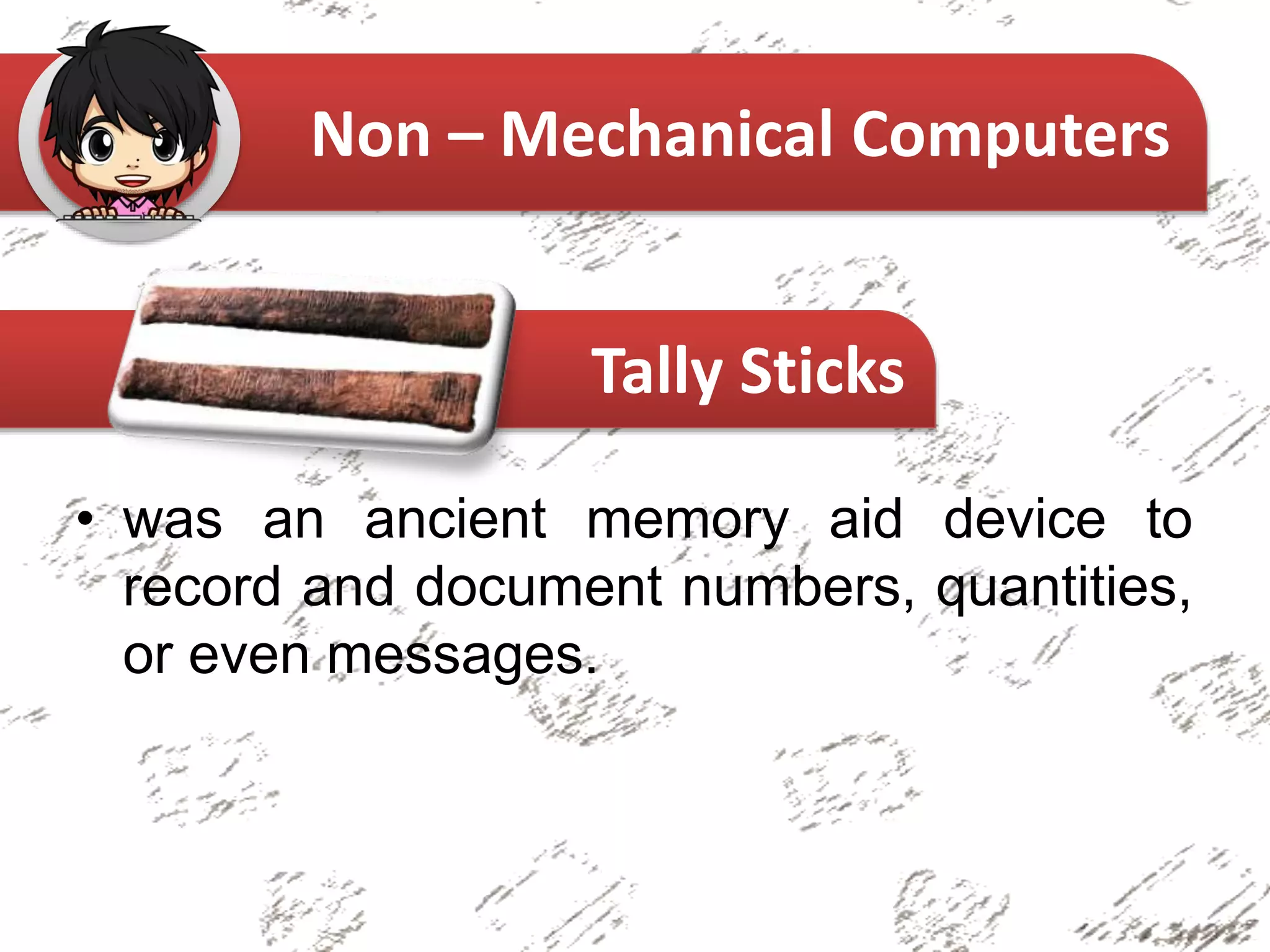
• was an ancient memory aid device to
record and document numbers, quantities,
or even messages.
Non – Mechanical Computers
Tally Sticks
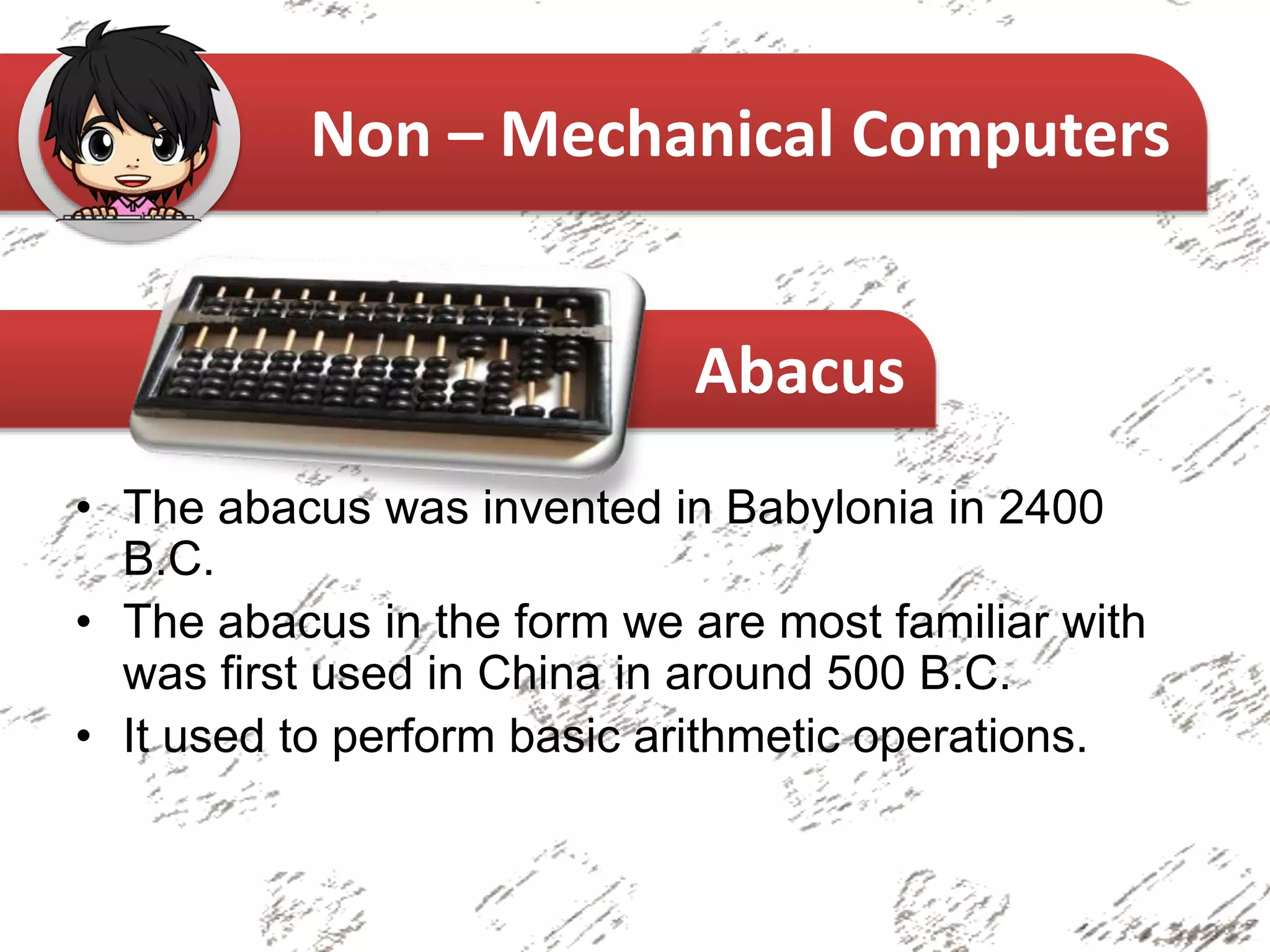
• The abacus was invented in Babylonia in 2400
B.C.
• The abacus in the form we are most familiar with
was first used in China in around 500 B.C.
• It used to perform basic arithmetic operations.
Non – Mechanical Computers
Abacus
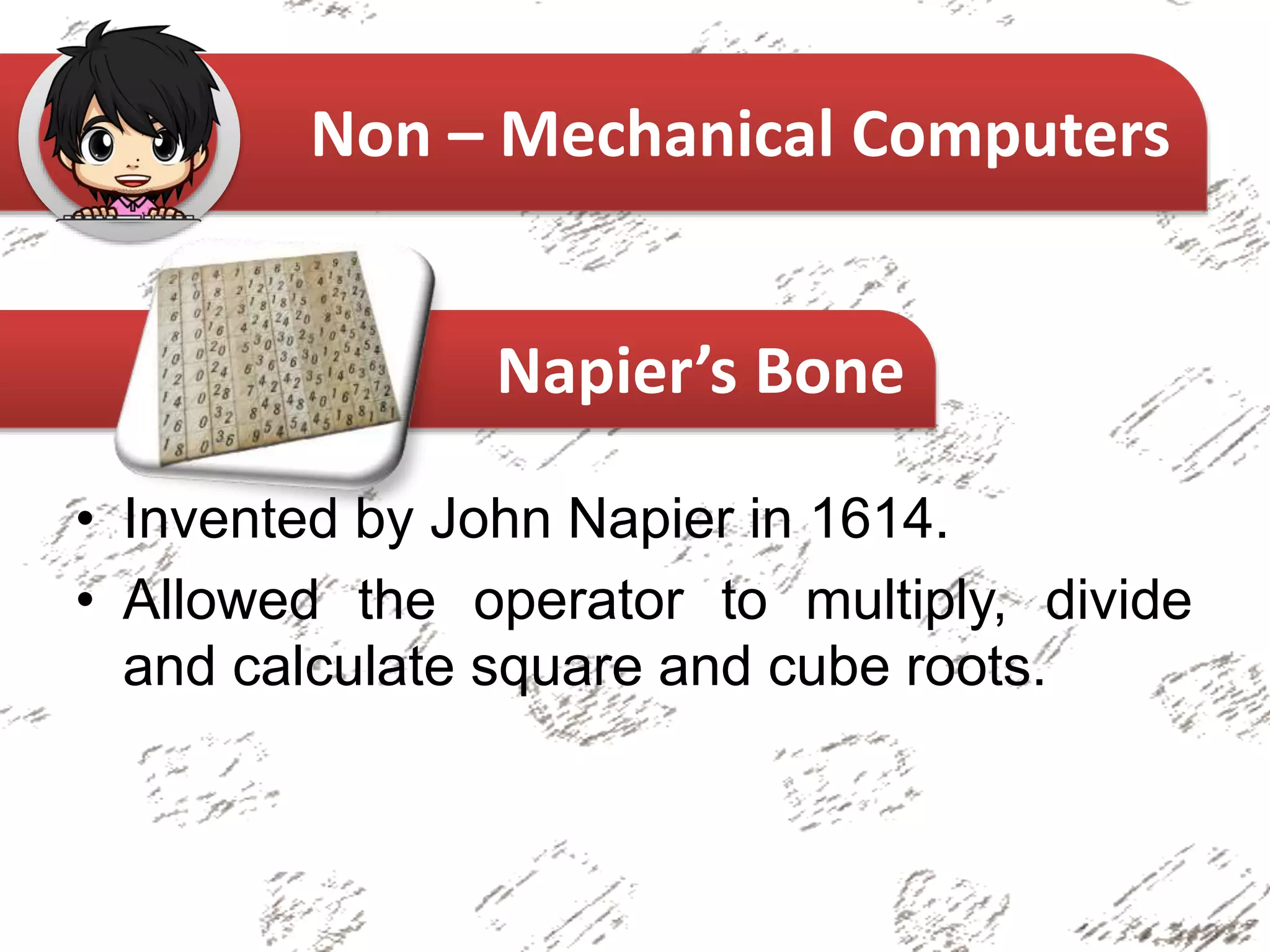
• Invented by John Napier in 1614.
• Allowed the operator to multiply, divide
and calculate square and cube roots.
Non – Mechanical Computers
Napier’s Bone
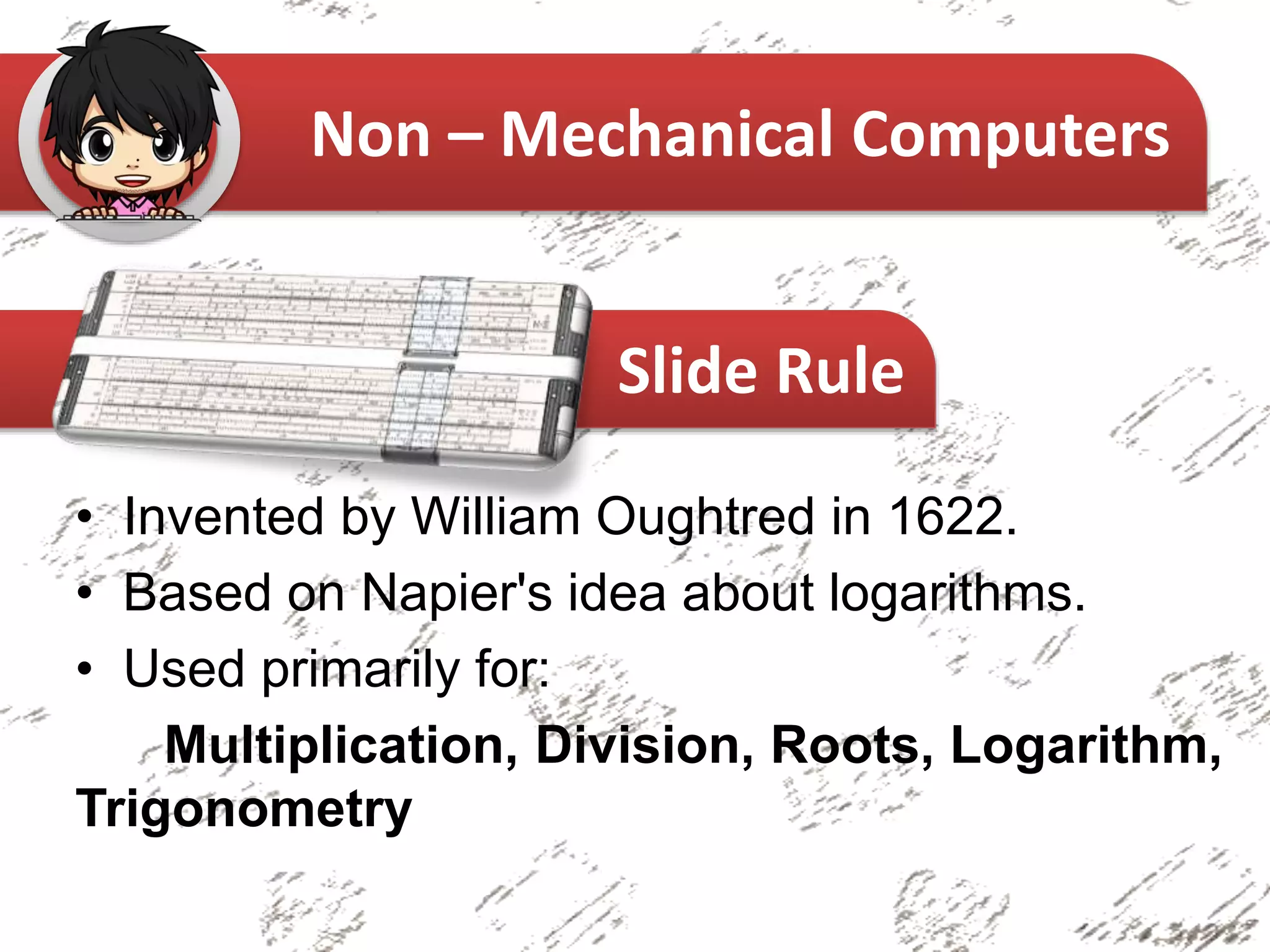
• Invented by William Oughtred in 1622.
• Based on Napier's idea about logarithms.
• Used primarily for:
Multiplication, Division, Roots, Logarithm,
Trigonometry
Non – Mechanical Computers
Slide Rule
Tally Sticks
Abacus
Napier’s Bone
Non – Mechanical Computers
Slide Rule
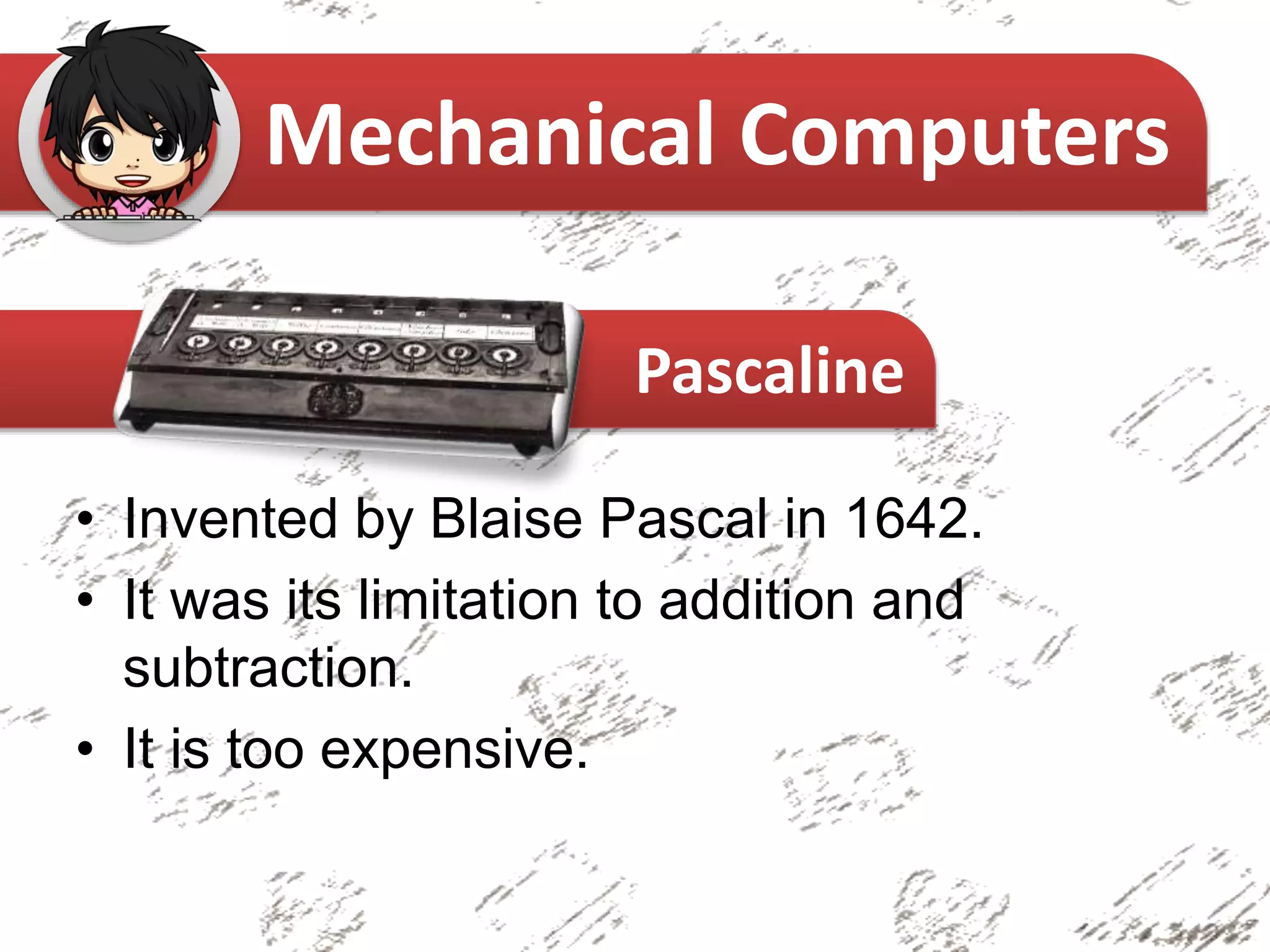
• Invented by Blaise Pascal in 1642.
• It was its limitation to addition and
subtraction.
• It is too expensive.
Mechanical Computers
Pascaline
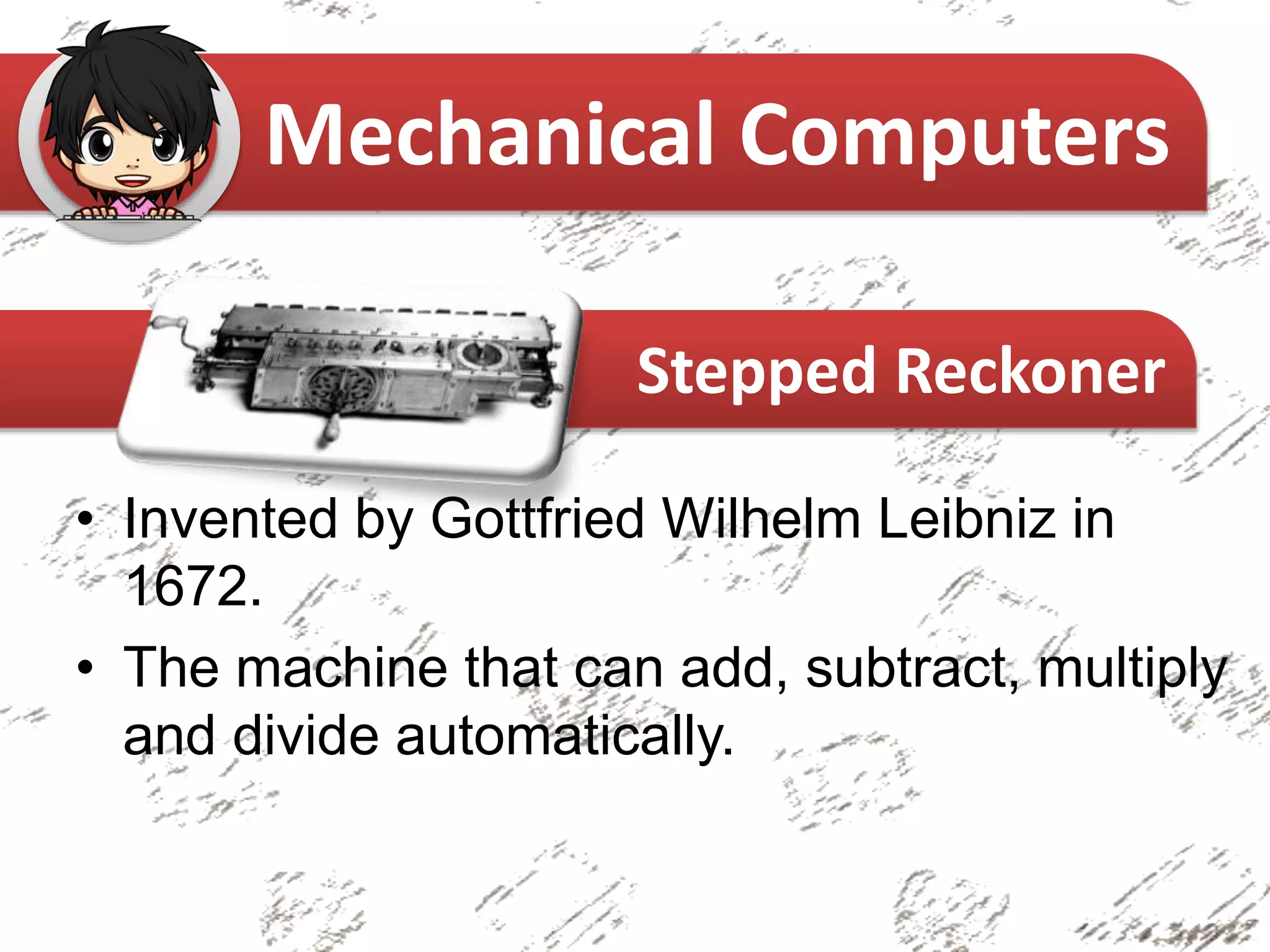
• Invented by Gottfried Wilhelm Leibniz in
1672.
• The machine that can add, subtract, multiply
and divide automatically.
Mechanical Computers
Stepped Reckoner
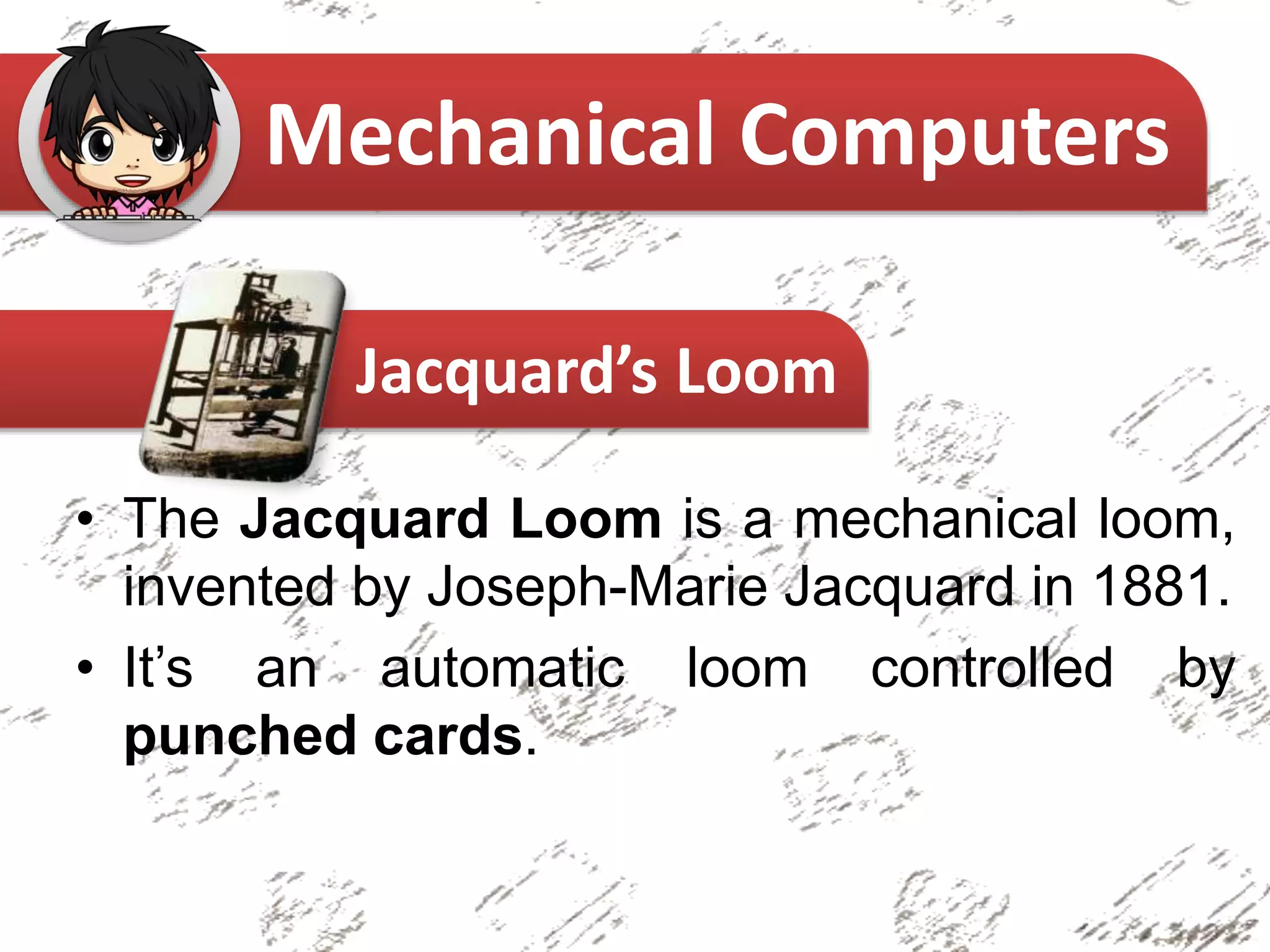
• The Jacquard Loom is a mechanical loom,
invented by Joseph-Marie Jacquard in 1881.
• It’s an automatic loom controlled by
punched cards.
Mechanical Computers
Jacquard’s Loom
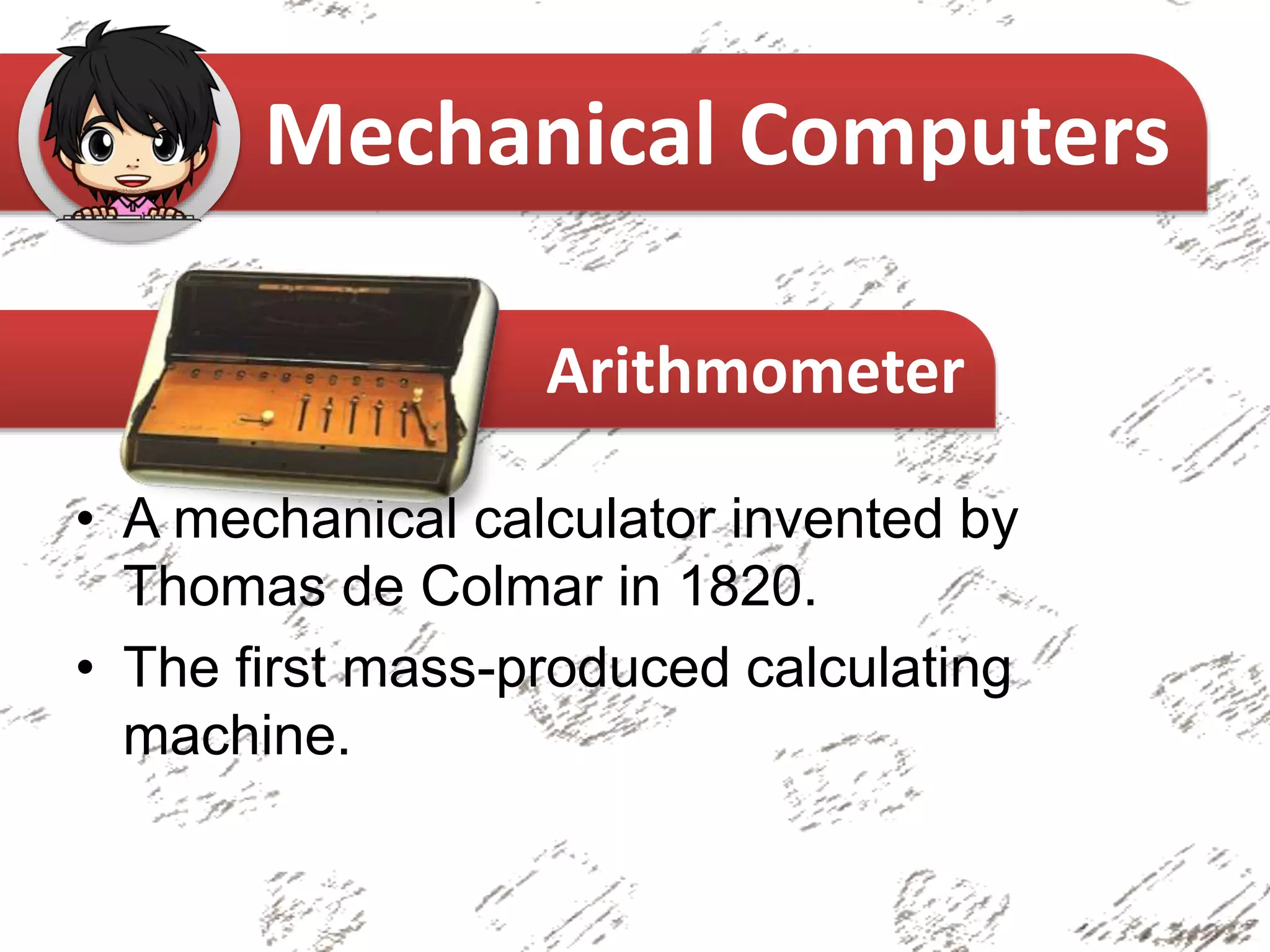
• A mechanical calculator invented by
Thomas de Colmar in 1820.
• The first mass-produced calculating
machine.
Mechanical Computers
Arithmometer
Pascaline
Stepped Reckoner
Jacquard’ Loom
Mechanical Computers
Arithmometer
• Invented by Charles Babbage (Father of
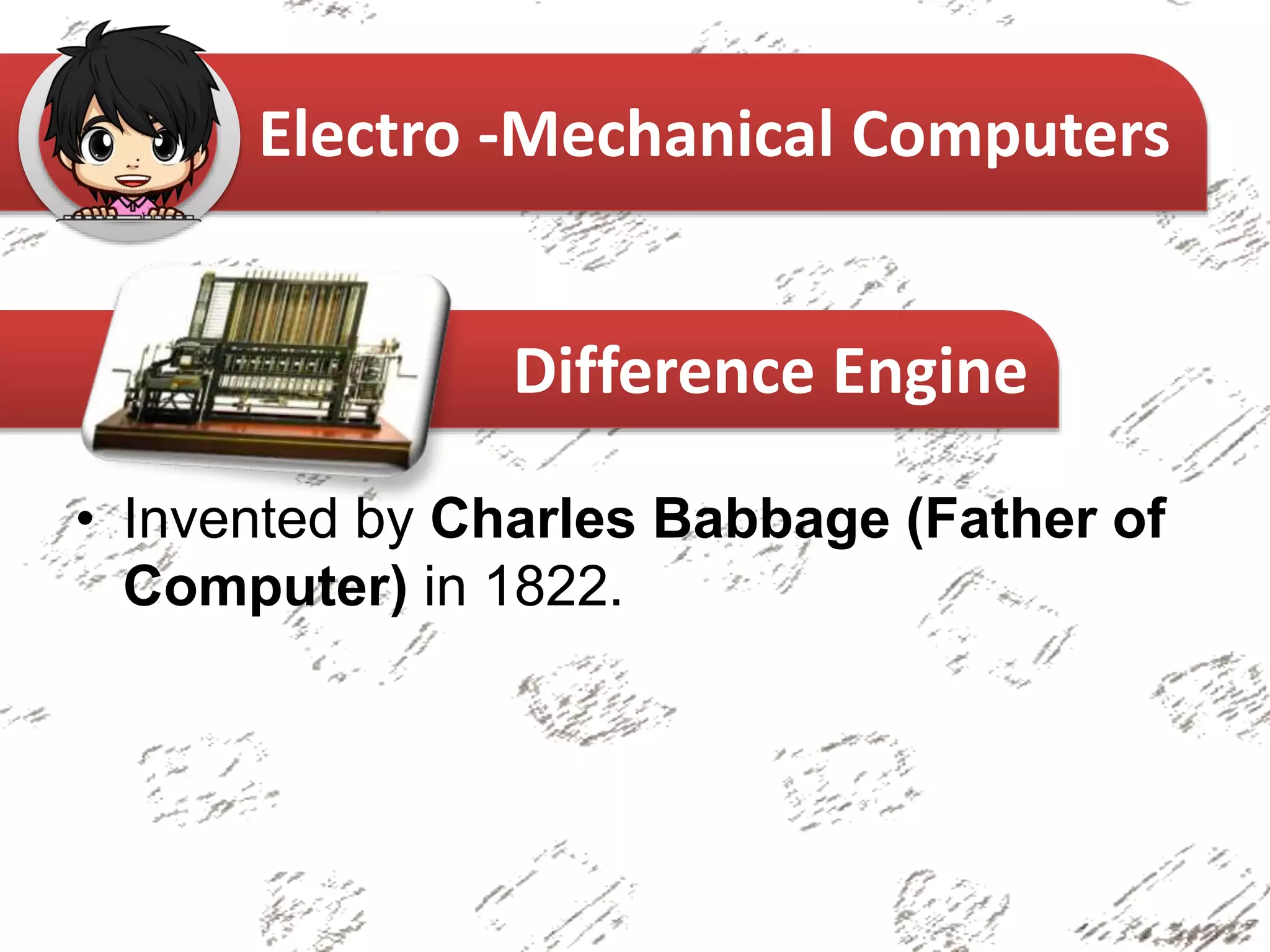
Computer) in 1822.
Electro -Mechanical Computers
Difference Engine
• Invented by Charles Babbage (Father of
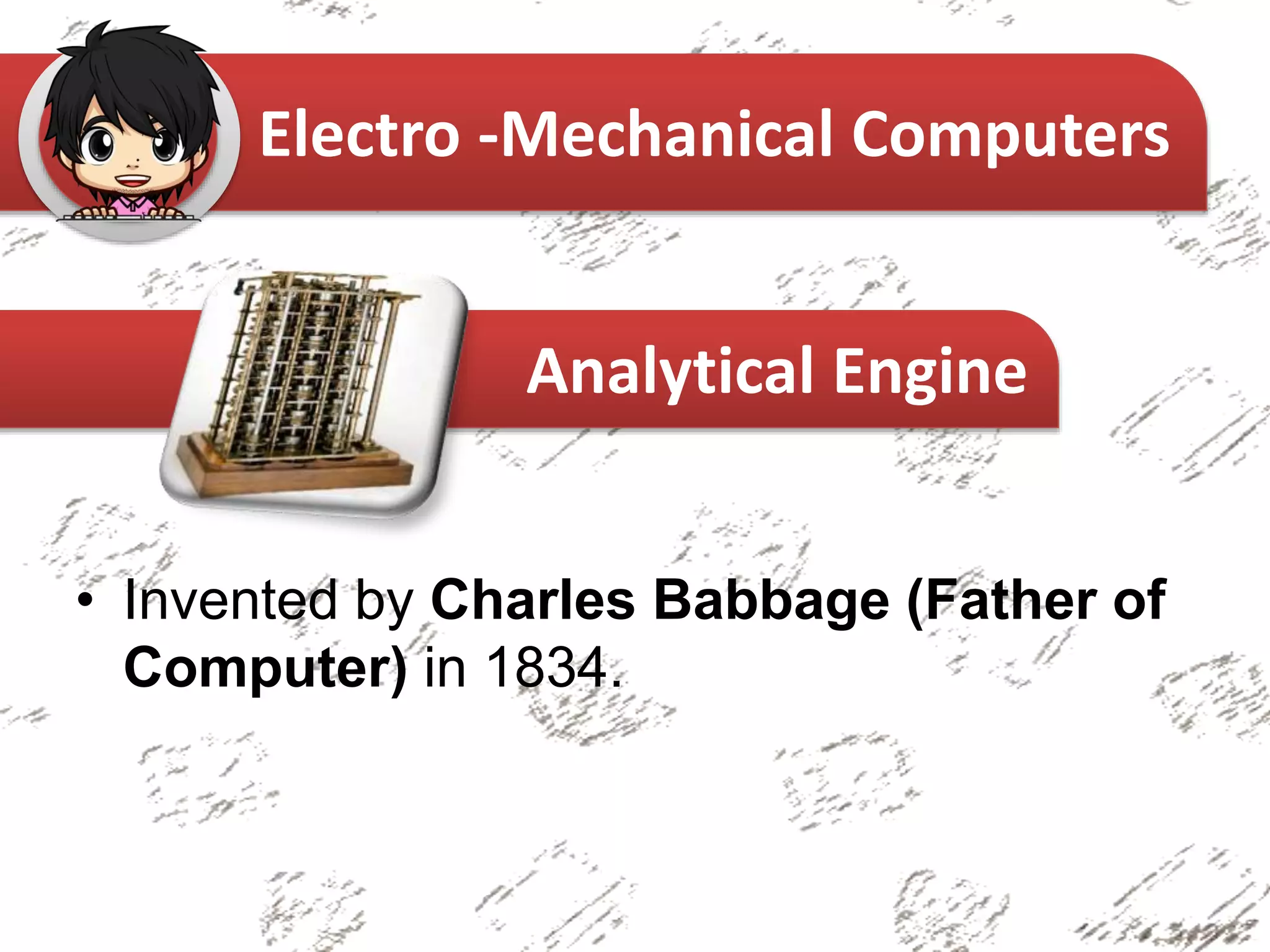
Computer) in 1834.
Electro -Mechanical Computers
Analytical Engine
• Lady Ada Augusta Byron Lovelace
• “The Enchantress of Numbers”
Electro -Mechanical Computers
First Programmer
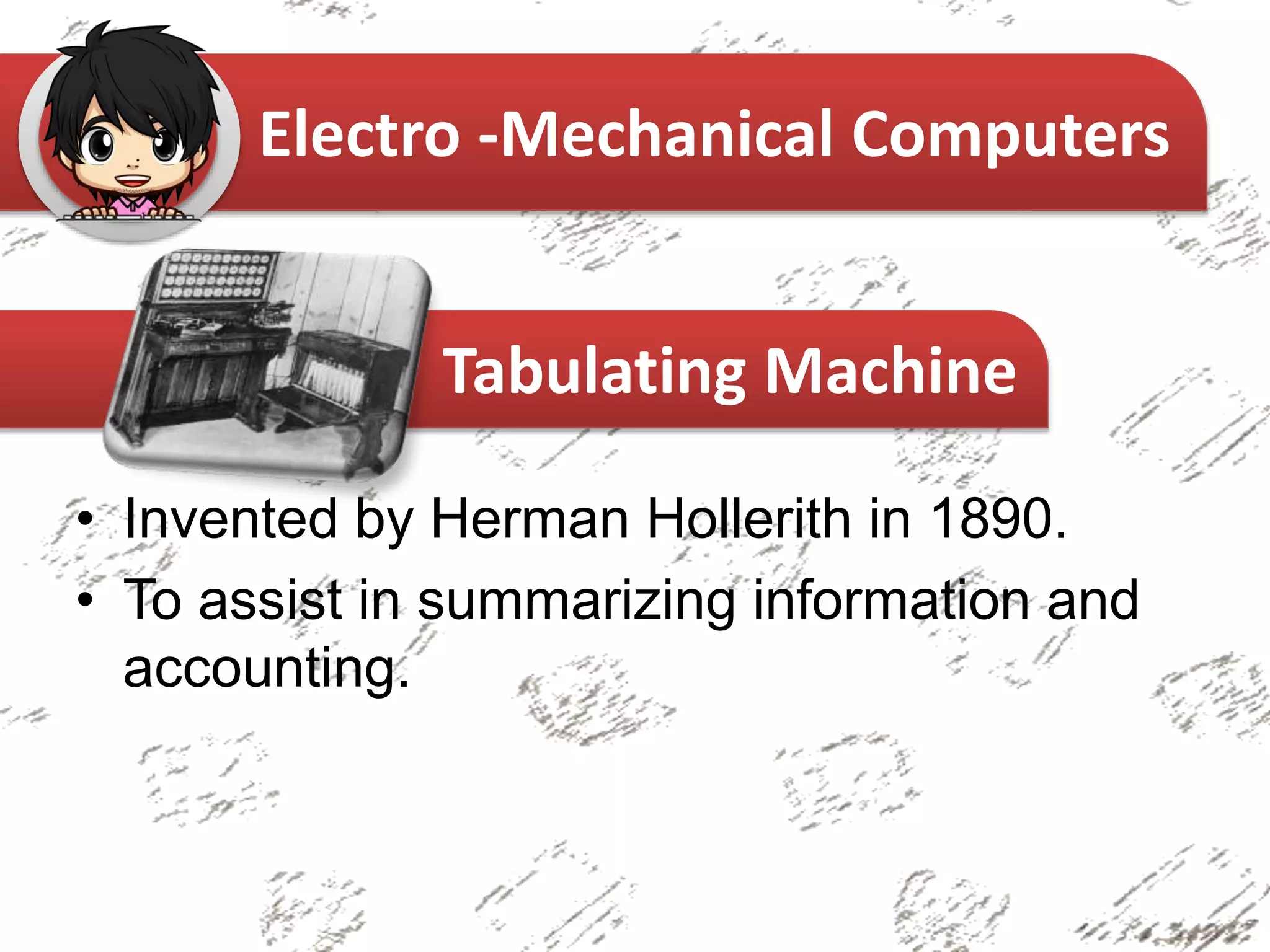
• Invented by Herman Hollerith in 1890.
• To assist in summarizing information and
accounting.
Electro -Mechanical Computers
Tabulating Machine
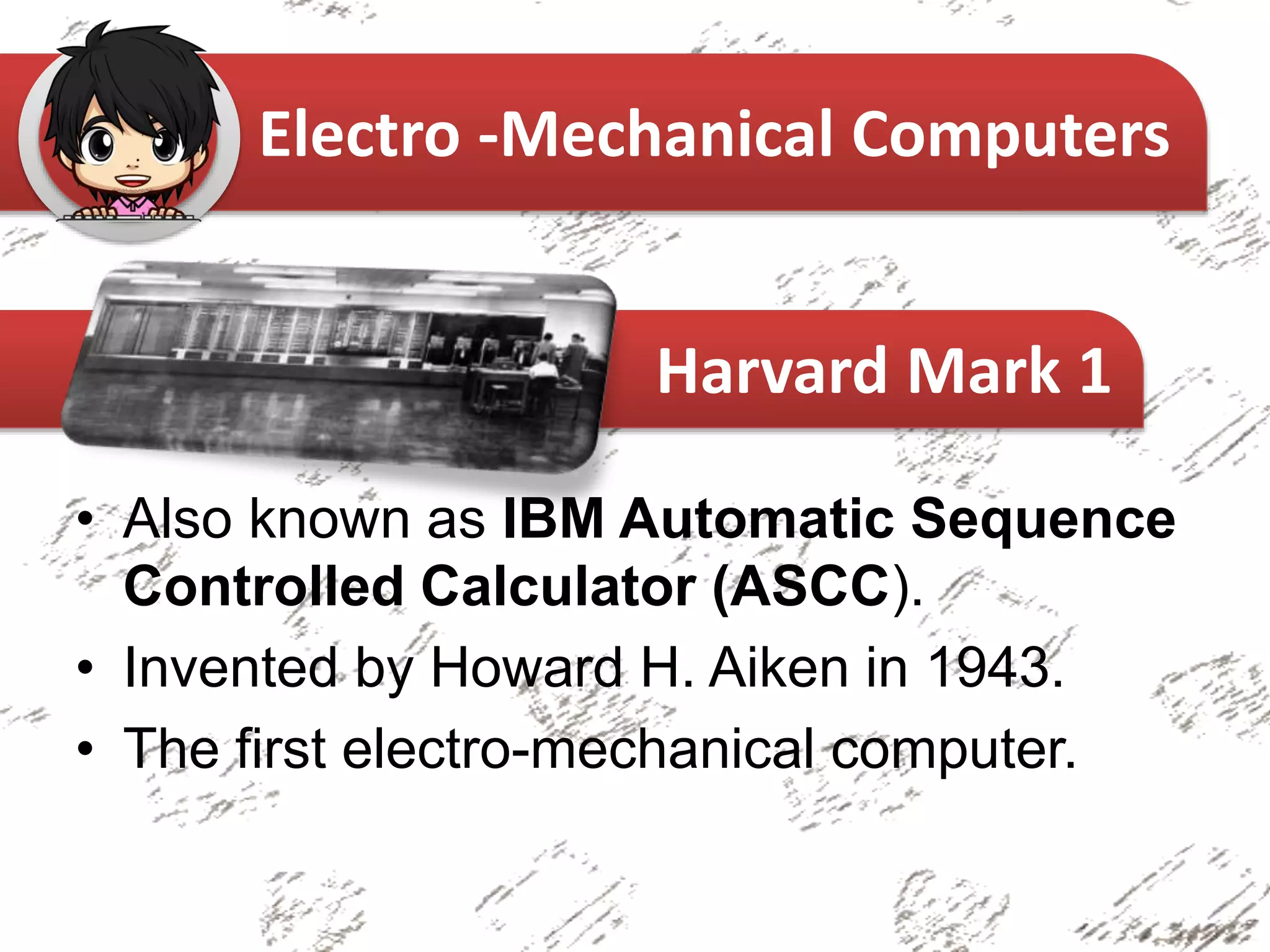
• Also known as IBM Automatic Sequence
Controlled Calculator (ASCC).
• Invented by Howard H. Aiken in 1943.
• The first electro-mechanical computer.
Electro -Mechanical Computers
Harvard Mark 1
Difference Engine
Analytical Engine
Tabulating Machine
Electro -Mechanical Computers
Harvard Mark 1
ASTI Mulanay CSS Facilitator

History of computers

  • 1.
    COC 1: Installand Configure Computer System
  • 2.
    History of Computers Non– Mechanical Computers Mechanical Computers Electro – Mechanical Computers
  • 3.
    • was anancient memory aid device to record and document numbers, quantities, or even messages. Non – Mechanical Computers Tally Sticks
  • 4.
    • The abacuswas invented in Babylonia in 2400 B.C. • The abacus in the form we are most familiar with was first used in China in around 500 B.C. • It used to perform basic arithmetic operations. Non – Mechanical Computers Abacus
  • 5.
    • Invented byJohn Napier in 1614. • Allowed the operator to multiply, divide and calculate square and cube roots. Non – Mechanical Computers Napier’s Bone
  • 6.
    • Invented byWilliam Oughtred in 1622. • Based on Napier's idea about logarithms. • Used primarily for: Multiplication, Division, Roots, Logarithm, Trigonometry Non – Mechanical Computers Slide Rule
  • 7.
    Tally Sticks Abacus Napier’s Bone Non– Mechanical Computers Slide Rule
  • 8.
    • Invented byBlaise Pascal in 1642. • It was its limitation to addition and subtraction. • It is too expensive. Mechanical Computers Pascaline
  • 9.
    • Invented byGottfried Wilhelm Leibniz in 1672. • The machine that can add, subtract, multiply and divide automatically. Mechanical Computers Stepped Reckoner
  • 10.
    • The JacquardLoom is a mechanical loom, invented by Joseph-Marie Jacquard in 1881. • It’s an automatic loom controlled by punched cards. Mechanical Computers Jacquard’s Loom
  • 11.
    • A mechanicalcalculator invented by Thomas de Colmar in 1820. • The first mass-produced calculating machine. Mechanical Computers Arithmometer
  • 12.
  • 13.
    • Invented byCharles Babbage (Father of Computer) in 1822. Electro -Mechanical Computers Difference Engine
  • 14.
    • Invented byCharles Babbage (Father of Computer) in 1834. Electro -Mechanical Computers Analytical Engine
  • 15.
    • Lady AdaAugusta Byron Lovelace • “The Enchantress of Numbers” Electro -Mechanical Computers First Programmer
  • 16.
    • Invented byHerman Hollerith in 1890. • To assist in summarizing information and accounting. Electro -Mechanical Computers Tabulating Machine
  • 17.
    • Also knownas IBM Automatic Sequence Controlled Calculator (ASCC). • Invented by Howard H. Aiken in 1943. • The first electro-mechanical computer. Electro -Mechanical Computers Harvard Mark 1
  • 18.
    Difference Engine Analytical Engine TabulatingMachine Electro -Mechanical Computers Harvard Mark 1
  • 19.
    ASTI Mulanay CSSFacilitator