


PSYCHOLOGY
What is psychology ?
History of psychology
◦ The late 19th century marked the start of psychology as a
scientific enterprise. Psychology as a self-conscious field of
experimental study began in 1879, when German scientist
Wilhelm Wundt founded the first laboratory dedicated
exclusively to psychological research in Leipzig.
Who is the founder of psychology?
◦ Wilhelm Wundt
◦ Wilhelm Wundt. Wilhelm Wundt opened the Institute for
Experimental Psychology at the University of Leipzig in
Germany in 1879. This was the first laboratory dedicated to
psychology, and its opening is usually thought of as the
beginning of modern psychology. Indeed, Wundt is often
regarded as the father of psychology.
When was psychiatrist invented?
◦ The term "psychiatry" was first coined by the German
physician Johann Christian Reil in 1808 and literally means
the 'medical treatment of the soul' (psych- "soul" from
Ancient Greek psykhē "soul"; -iatry "medical treatment" from
Gk. iātrikos "medical" from iāsthai "to heal").
Who was the first psychologist?
◦ Wilhelm Wundt
◦ Wilhelm Wundt opens first experimental laboratory in
psychology at the University of Leipzig, Germany. Credited
with establishing psychology as an academic discipline,
Wundt's students include Emil Kraepelin, James McKeen
Cattell, and G. Stanley Hall.
Who wrote the first book on
psychology?
◦ William James
◦ This is the same year that William James would set up a
similar lab at Harvard. We can celebrate that year as the
founding of experimental psychology! In 1879, Wundt
assisted his first graduate student at true psychological
research -- another milestone. In 1881, he started the journal
Philosophize Studied.
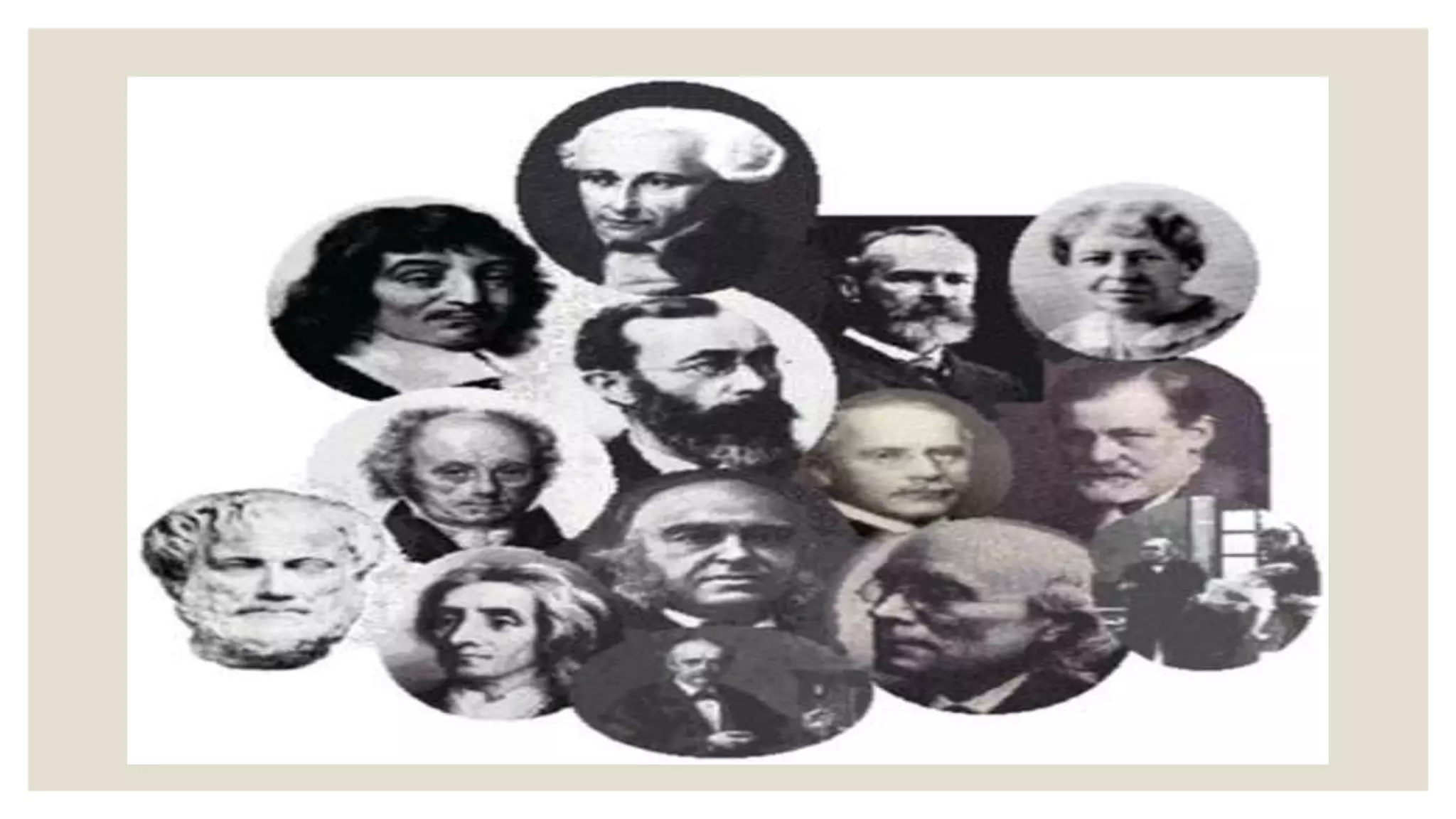
Who are the four fathers of psychology?
◦ Wilhelm Wundt. - he was interested in consciousness,
because it can't be observed. ...
◦ William James. - also studied consciousness, but believed that
by breaking it down into diffrerent parts it miss-represented
the "wholeness" of consciousness. ...
◦ Sigmund Freud. ...
◦ John Watson. ...
◦ Carl Rogers.

History and Background Of Psychology - Basic Introduction

  • 1.
  • 3.
    History of psychology ◦The late 19th century marked the start of psychology as a scientific enterprise. Psychology as a self-conscious field of experimental study began in 1879, when German scientist Wilhelm Wundt founded the first laboratory dedicated exclusively to psychological research in Leipzig.
  • 5.
    Who is thefounder of psychology? ◦ Wilhelm Wundt ◦ Wilhelm Wundt. Wilhelm Wundt opened the Institute for Experimental Psychology at the University of Leipzig in Germany in 1879. This was the first laboratory dedicated to psychology, and its opening is usually thought of as the beginning of modern psychology. Indeed, Wundt is often regarded as the father of psychology.
  • 7.
    When was psychiatristinvented? ◦ The term "psychiatry" was first coined by the German physician Johann Christian Reil in 1808 and literally means the 'medical treatment of the soul' (psych- "soul" from Ancient Greek psykhē "soul"; -iatry "medical treatment" from Gk. iātrikos "medical" from iāsthai "to heal").
  • 9.
    Who was thefirst psychologist? ◦ Wilhelm Wundt ◦ Wilhelm Wundt opens first experimental laboratory in psychology at the University of Leipzig, Germany. Credited with establishing psychology as an academic discipline, Wundt's students include Emil Kraepelin, James McKeen Cattell, and G. Stanley Hall.
  • 10.
    Who wrote thefirst book on psychology? ◦ William James ◦ This is the same year that William James would set up a similar lab at Harvard. We can celebrate that year as the founding of experimental psychology! In 1879, Wundt assisted his first graduate student at true psychological research -- another milestone. In 1881, he started the journal Philosophize Studied.
  • 12.
    Who are thefour fathers of psychology? ◦ Wilhelm Wundt. - he was interested in consciousness, because it can't be observed. ... ◦ William James. - also studied consciousness, but believed that by breaking it down into diffrerent parts it miss-represented the "wholeness" of consciousness. ... ◦ Sigmund Freud. ... ◦ John Watson. ... ◦ Carl Rogers.