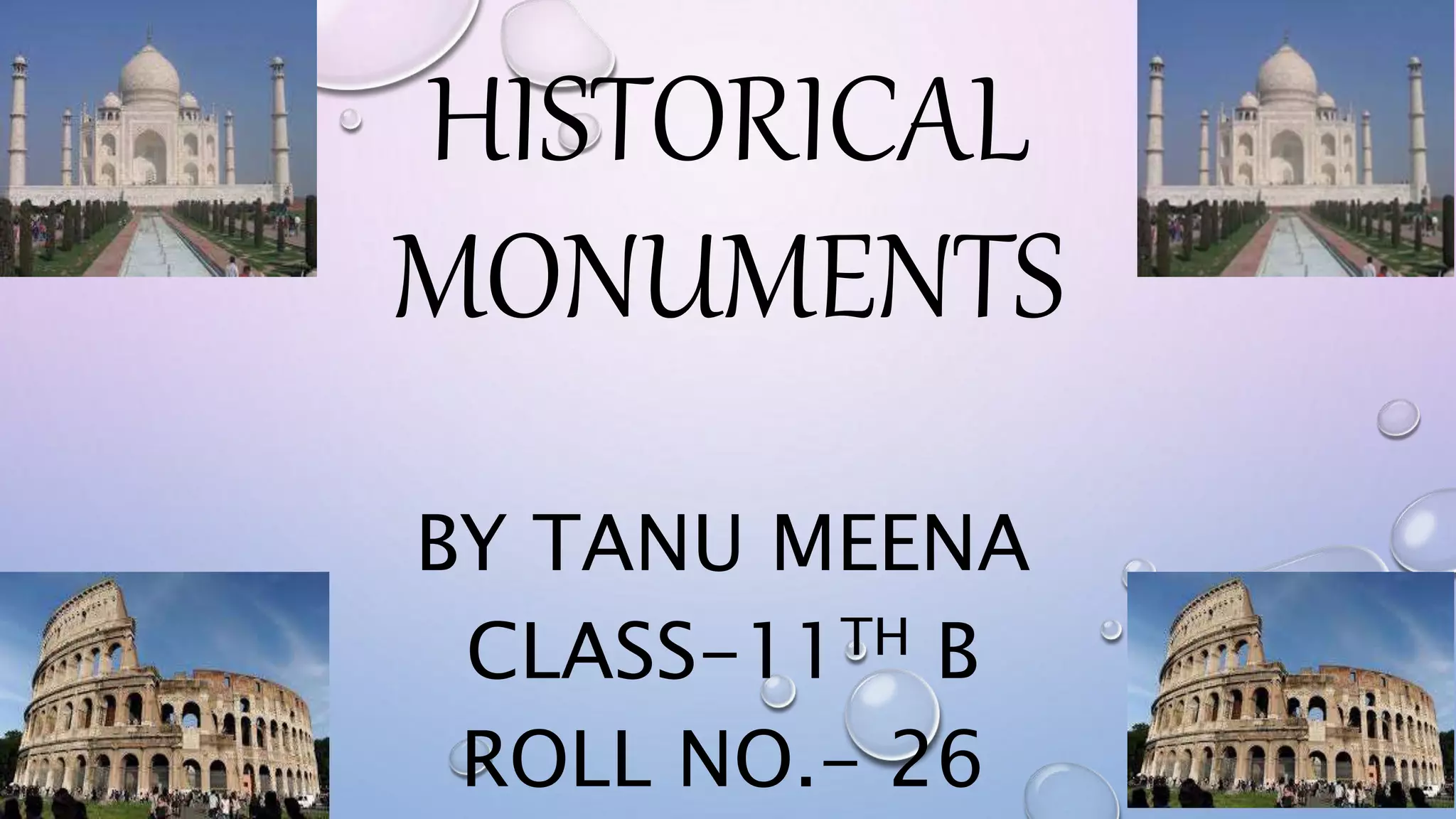
HISTORICAL
MONUMENTS
BY TANU MEENA
CLASS-11TH B
ROLL NO.- 26
ACKNOWLEDGMENT
IWOULD LIKETOTHANK MY HISTORY
TEACHER MR.BKTONDAN SIR FORTHEIR
KIND SUPPORT IN COMPLETING MY PROJECT
ONTHETOPIC HISTORICAL MONUMENTS. I
AMVERYTHANKFULTO HIM I REALLY ENJOY
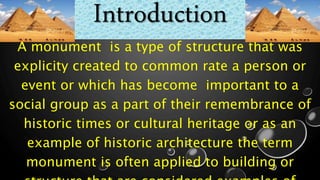
Introduction
A monument is a type of structure that was
explicity created to common rate a person or
event or which has become important to a
social group as a part of their remembrance of
historic times or cultural heritage or as an
example of historic architecture the term
monument is often applied to building or
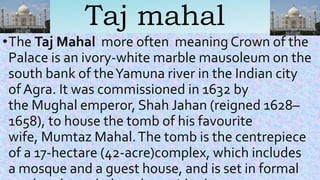
Taj mahal
•The Taj Mahal more often meaning Crown of the
Palace is an ivory-white marble mausoleum on the
south bank of theYamuna river in the Indian city
of Agra. It was commissioned in 1632 by
the Mughal emperor, Shah Jahan (reigned 1628–
1658), to house the tomb of his favourite
wife, Mumtaz Mahal.The tomb is the centrepiece
of a 17-hectare (42-acre)complex, which includes
a mosque and a guest house, and is set in formal
Tomb
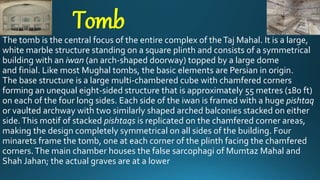
The tomb is the central focus of the entire complex of theTaj Mahal. It is a large,
white marble structure standing on a square plinth and consists of a symmetrical
building with an iwan (an arch-shaped doorway) topped by a large dome
and finial. Like most Mughal tombs, the basic elements are Persian in origin.
The base structure is a large multi-chambered cube with chamfered corners
forming an unequal eight-sided structure that is approximately 55 metres (180 ft)
on each of the four long sides. Each side of the iwan is framed with a huge pishtaq
or vaulted archway with two similarly shaped arched balconies stacked on either
side.This motif of stacked pishtaqs is replicated on the chamfered corner areas,
making the design completely symmetrical on all sides of the building. Four
minarets frame the tomb, one at each corner of the plinth facing the chamfered
corners.The main chamber houses the false sarcophagi of Mumtaz Mahal and
Shah Jahan; the actual graves are at a lower
PETRA
• By 2010 BC, some of the earliest recorded farmers had settled in Beidha, a pre-pottery
settlement just north of Petra.[12] Petra is listed in Egyptian campaign accounts and
the Amarna letters as Pel, Sela or Seir. Though the city was founded relatively late, a
sanctuary has existed there since very ancient times. The Jewish
historian, Josephus (ca. 37–100), describes the region as inhabited by the Madianite
nation as early as 1340 BC, and that the nation was governed by five kings, whom he
names: "Rekem; the city which bears his name ranks highest in the land of the Arabs
and to this day is called by the whole Arabian nation, after the name of its royal
founder, Rekeme: called Petra by the Greeks."[13] The famed architecture of Petra, and
other Nabataean sites, was built during indigenous rule in early antiquity.
• The Semitic name of the city, if not Sela, remains unknown. The passage in Diodorus
Siculus (xix. 94–97) which describes the expeditions which Antigonus sent against the
Nabataeans in 312 BC is understood to throw some light upon the history of Petra,
but the "petra" (rock) referred to as a natural fortress and place of refuge cannot be a
proper name and the description implies that the metropolis was not yet in existence,
COLOSSEUM
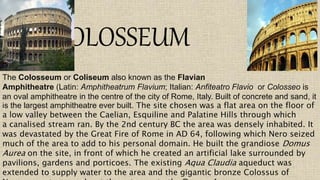
The Colosseum or Coliseum also known as the Flavian
Amphitheatre (Latin: Amphitheatrum Flavium; Italian: Anfiteatro Flavio or Colosseo is
an oval amphitheatre in the centre of the city of Rome, Italy. Built of concrete and sand, it
is the largest amphitheatre ever built. The site chosen was a flat area on the floor of
a low valley between the Caelian, Esquiline and Palatine Hills through which
a canalised stream ran. By the 2nd century BC the area was densely inhabited. It
was devastated by the Great Fire of Rome in AD 64, following which Nero seized
much of the area to add to his personal domain. He built the grandiose Domus
Aurea on the site, in front of which he created an artificial lake surrounded by
pavilions, gardens and porticoes. The existing Aqua Claudia aqueduct was
extended to supply water to the area and the gigantic bronze Colossus of
Great pyramid of giza
 The Great Pyramid of Giza (also known as the Pyramid of Khufu or
the Pyramid of Cheops) is the oldest and largest of the three pyramids in
the Giza pyramid complex bordering what is now El Giza, Egypt. It is the
oldest of the Seven Wonders of the Ancient World, and the only one to remain
largely intact. It is believed the pyramid was built as a tomb for Fourth
Dynasty Egyptian pharaoh Khufu (often Hellenicised as "Cheops") and was
constructed over a 20-year period. Khufu's vizier, Hemon, or Hemiunu, is
believed by some to be the architect of the Great Pyramid.[2] It is thought that,
at construction, the Great Pyramid was originally 280 Egyptian cubits tall
(146.5 metres (480.6 ft)), but with erosion and absence of its pyramidion, its
present height is 138.8 metres (455.4 ft). Each base side was 440 cubits,
230.4 metres (755.9 ft) long. The mass of the pyramid is estimated at
5.9 million tonnes. The volume, including an internal hillock, is roughly
2,500,000 cubic metres
MOAI
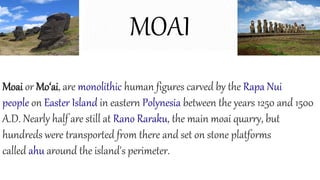
Moai or Mo‘ai, are monolithic human figures carved by the Rapa Nui
people on Easter Island in eastern Polynesia between the years 1250 and 1500
A.D. Nearly half are still at Rano Raraku, the main moai quarry, but
hundreds were transported from there and set on stone platforms
called ahu around the island's perimeter.
HISTORY OF PETRA• THE STATUES WERE CARVED BY THE POLYNESIAN COLONIZERS OF THE ISLAND,
MOSTLY BETWEEN CIRCA 1250 A.D. AND 1500 A.D. IN ADDITION TO
REPRESENTING DECEASED ANCESTORS, THE MOAI, ONCE THEY WERE ERECTED
ON AHU, MAY ALSO HAVE BEEN REGARDED AS THE EMBODIMENT OF POWERFUL
LIVING OR FORMER CHIEFS AND IMPORTANT LINEAGE STATUS SYMBOLS. EACH
MOAI PRESENTED A STATUS: “THE LARGER THE STATUE PLACED UPON AN AHU,
THE MORE MANA THE CHIEF WHO COMMISSIONED IT HAD."[14] THE
COMPETITION FOR GRANDEST STATUE WAS EVER PREVALENT IN THE CULTURE
OF THE EASTER ISLANDERS. THE PROOF STEMS FROM THE VARYING SIZES OF
MOAI.[14]
Completed statues were moved to ahu mostly on the coast, then
erected, sometimes with red stone cylinders (pukao) on their heads.
Moai must have been extremely expensive to craft and transport; not
only would the actual carving of each statue require effort and
resources, but the finished product was then hauled to its final
Haghia Sophia
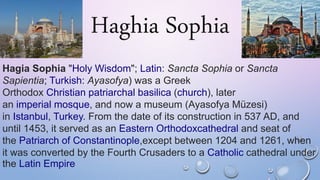
Hagia Sophia "Holy Wisdom"; Latin: Sancta Sophia or Sancta
Sapientia; Turkish: Ayasofya) was a Greek
Orthodox Christian patriarchal basilica (church), later
an imperial mosque, and now a museum (Ayasofya Müzesi)
in Istanbul, Turkey. From the date of its construction in 537 AD, and
until 1453, it served as an Eastern Orthodoxcathedral and seat of
the Patriarch of Constantinople,except between 1204 and 1261, when
it was converted by the Fourth Crusaders to a Catholic cathedral under
the Latin Empire
HISTORY OF HAGIA SOPHIA
• THE FIRST CHURCH ON THE SITE WAS KNOWN AS THE OR
LATIN "MAGNA ECCLESIA", BECAUSE OF ITS LARGER DIMENSIONS IN
COMA SECOND CHURCH ON THE SITE WAS ORDERED
BY THEODOSIUS II, WHO INAUGURATED IT ON 10 OCTOBER 415. THE
BASILICA WITH A WOODEN ROOF WAS BUILT BY ARCHITECT
RUFINUS. A FIRE STARTED DURING THE TUMULT OF THE NIKA
REVOLT AND BURNED THE SECOND HAGIA SOPHIA TO THE GROUND
ON 13–14 JANUARY 532.PARISON TO THE CONTEMPORARY
CHURCHES IN THE CITY.
ANGKOR WAT
Angkor Wat is a temple complex in Cambodia and the largest religious
monument in the world, with the site measuring 162.6 hectares
(1,626,000 m2; 402 acres). It was originally constructed as
a Hindu temple of god Vishnu for the Khmer Empire, gradually
transforming into a Buddhist temple toward the end of the 12th
century. It was built by the Khmer King Suryavarman in the early
12th century in Yaśodharapura the capital of the Khmer Empire, as his
state temple and eventual mausoleum. Breaking from
the Shaiva tradition of previous kings, Angkor Wat was instead
dedicated to Vishnu. Angkor Wat lies 5.5 kilometres (3.4 mi) north of
the modern town of Siem Reap, and a short distance south and
slightly east of the previous capital, which was centred at Baphuon.
In an area of Cambodia where there is an important group of ancient
structures, it is the southernmost of Angkor's main sites
Machu picchu
Machu Picchu is a 15th-century Inca citadel situated on a
mountain ridge 2,430 metres above sea level. It is located in
the Cusco Region, Urubamba Province, Machupicchu
District in Peru above the Sacred Valley, which is 80 kilometres
(50 mi) northwest of Cuzco and through which the Urubamba
River flows. Machu Picchu was built around 1450, at the height
of the Inca. Its construction appears to date to the period of the
two great Inca rulers, Pachacutec Inca Yupanqui (1438–71)
and Túpac Inca Yupanqui (1472–93). It was abandoned just
over 100 years later, in 1572, as a belated result of the Spanish
Chichen itza
– Chichen Itza Spanish: Chichén Itzá, tchee-TCHEN eet-SA, often with the emphasis
reversed in English to was a large pre-Columbian city built by the Maya people of the
Terminal Classic period. The archaeological site is located in Tinúm MunicipaThe layout
of Chichen Itza site core developed during its earlier phase of occupation, between 750
and 900 AD. Its final layout was developed after 900 AD, and the 10th century saw the
rise of the city as a regional capital controlling the area from central Yucatán to the
north coast, with its power extending down the east and west coasts of the
peninsula. The earliest hieroglyphic date discovered at Chichen Itza is equivalent to 832
AD, while the last known date was recorded in the Osario temple in 998lity, Yucatán
State, Mexico
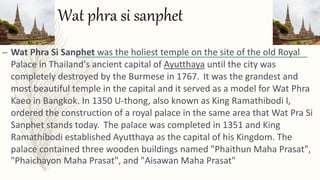
Wat phra si sanphet
– Wat Phra Si Sanphet was the holiest temple on the site of the old Royal
Palace in Thailand's ancient capital of Ayutthaya until the city was
completely destroyed by the Burmese in 1767. It was the grandest and
most beautiful temple in the capital and it served as a model for Wat Phra
Kaeo in Bangkok. In 1350 U-thong, also known as King Ramathibodi I,
ordered the construction of a royal palace in the same area that Wat Pra Si
Sanphet stands today. The palace was completed in 1351 and King
Ramathibodi established Ayutthaya as the capital of his Kingdom. The
palace contained three wooden buildings named "Phaithun Maha Prasat",
"Phaichayon Maha Prasat", and "Aisawan Maha Prasat"
Historical monuments [ full information about world historical monuments]

Historical monuments [ full information about world historical monuments]

  • 1.
  • 2.
    ACKNOWLEDGMENT IWOULD LIKETOTHANK MYHISTORY TEACHER MR.BKTONDAN SIR FORTHEIR KIND SUPPORT IN COMPLETING MY PROJECT ONTHETOPIC HISTORICAL MONUMENTS. I AMVERYTHANKFULTO HIM I REALLY ENJOY
  • 3.
    Introduction A monument isa type of structure that was explicity created to common rate a person or event or which has become important to a social group as a part of their remembrance of historic times or cultural heritage or as an example of historic architecture the term monument is often applied to building or
  • 4.
    Taj mahal •The TajMahal more often meaning Crown of the Palace is an ivory-white marble mausoleum on the south bank of theYamuna river in the Indian city of Agra. It was commissioned in 1632 by the Mughal emperor, Shah Jahan (reigned 1628– 1658), to house the tomb of his favourite wife, Mumtaz Mahal.The tomb is the centrepiece of a 17-hectare (42-acre)complex, which includes a mosque and a guest house, and is set in formal
  • 5.
    Tomb The tomb isthe central focus of the entire complex of theTaj Mahal. It is a large, white marble structure standing on a square plinth and consists of a symmetrical building with an iwan (an arch-shaped doorway) topped by a large dome and finial. Like most Mughal tombs, the basic elements are Persian in origin. The base structure is a large multi-chambered cube with chamfered corners forming an unequal eight-sided structure that is approximately 55 metres (180 ft) on each of the four long sides. Each side of the iwan is framed with a huge pishtaq or vaulted archway with two similarly shaped arched balconies stacked on either side.This motif of stacked pishtaqs is replicated on the chamfered corner areas, making the design completely symmetrical on all sides of the building. Four minarets frame the tomb, one at each corner of the plinth facing the chamfered corners.The main chamber houses the false sarcophagi of Mumtaz Mahal and Shah Jahan; the actual graves are at a lower
  • 6.
    PETRA • By 2010BC, some of the earliest recorded farmers had settled in Beidha, a pre-pottery settlement just north of Petra.[12] Petra is listed in Egyptian campaign accounts and the Amarna letters as Pel, Sela or Seir. Though the city was founded relatively late, a sanctuary has existed there since very ancient times. The Jewish historian, Josephus (ca. 37–100), describes the region as inhabited by the Madianite nation as early as 1340 BC, and that the nation was governed by five kings, whom he names: "Rekem; the city which bears his name ranks highest in the land of the Arabs and to this day is called by the whole Arabian nation, after the name of its royal founder, Rekeme: called Petra by the Greeks."[13] The famed architecture of Petra, and other Nabataean sites, was built during indigenous rule in early antiquity. • The Semitic name of the city, if not Sela, remains unknown. The passage in Diodorus Siculus (xix. 94–97) which describes the expeditions which Antigonus sent against the Nabataeans in 312 BC is understood to throw some light upon the history of Petra, but the "petra" (rock) referred to as a natural fortress and place of refuge cannot be a proper name and the description implies that the metropolis was not yet in existence,
  • 7.
    COLOSSEUM The Colosseum orColiseum also known as the Flavian Amphitheatre (Latin: Amphitheatrum Flavium; Italian: Anfiteatro Flavio or Colosseo is an oval amphitheatre in the centre of the city of Rome, Italy. Built of concrete and sand, it is the largest amphitheatre ever built. The site chosen was a flat area on the floor of a low valley between the Caelian, Esquiline and Palatine Hills through which a canalised stream ran. By the 2nd century BC the area was densely inhabited. It was devastated by the Great Fire of Rome in AD 64, following which Nero seized much of the area to add to his personal domain. He built the grandiose Domus Aurea on the site, in front of which he created an artificial lake surrounded by pavilions, gardens and porticoes. The existing Aqua Claudia aqueduct was extended to supply water to the area and the gigantic bronze Colossus of
  • 8.
    Great pyramid ofgiza  The Great Pyramid of Giza (also known as the Pyramid of Khufu or the Pyramid of Cheops) is the oldest and largest of the three pyramids in the Giza pyramid complex bordering what is now El Giza, Egypt. It is the oldest of the Seven Wonders of the Ancient World, and the only one to remain largely intact. It is believed the pyramid was built as a tomb for Fourth Dynasty Egyptian pharaoh Khufu (often Hellenicised as "Cheops") and was constructed over a 20-year period. Khufu's vizier, Hemon, or Hemiunu, is believed by some to be the architect of the Great Pyramid.[2] It is thought that, at construction, the Great Pyramid was originally 280 Egyptian cubits tall (146.5 metres (480.6 ft)), but with erosion and absence of its pyramidion, its present height is 138.8 metres (455.4 ft). Each base side was 440 cubits, 230.4 metres (755.9 ft) long. The mass of the pyramid is estimated at 5.9 million tonnes. The volume, including an internal hillock, is roughly 2,500,000 cubic metres
  • 9.
    MOAI Moai or Mo‘ai,are monolithic human figures carved by the Rapa Nui people on Easter Island in eastern Polynesia between the years 1250 and 1500 A.D. Nearly half are still at Rano Raraku, the main moai quarry, but hundreds were transported from there and set on stone platforms called ahu around the island's perimeter.
  • 10.
    HISTORY OF PETRA•THE STATUES WERE CARVED BY THE POLYNESIAN COLONIZERS OF THE ISLAND, MOSTLY BETWEEN CIRCA 1250 A.D. AND 1500 A.D. IN ADDITION TO REPRESENTING DECEASED ANCESTORS, THE MOAI, ONCE THEY WERE ERECTED ON AHU, MAY ALSO HAVE BEEN REGARDED AS THE EMBODIMENT OF POWERFUL LIVING OR FORMER CHIEFS AND IMPORTANT LINEAGE STATUS SYMBOLS. EACH MOAI PRESENTED A STATUS: “THE LARGER THE STATUE PLACED UPON AN AHU, THE MORE MANA THE CHIEF WHO COMMISSIONED IT HAD."[14] THE COMPETITION FOR GRANDEST STATUE WAS EVER PREVALENT IN THE CULTURE OF THE EASTER ISLANDERS. THE PROOF STEMS FROM THE VARYING SIZES OF MOAI.[14] Completed statues were moved to ahu mostly on the coast, then erected, sometimes with red stone cylinders (pukao) on their heads. Moai must have been extremely expensive to craft and transport; not only would the actual carving of each statue require effort and resources, but the finished product was then hauled to its final
  • 11.
    Haghia Sophia Hagia Sophia"Holy Wisdom"; Latin: Sancta Sophia or Sancta Sapientia; Turkish: Ayasofya) was a Greek Orthodox Christian patriarchal basilica (church), later an imperial mosque, and now a museum (Ayasofya Müzesi) in Istanbul, Turkey. From the date of its construction in 537 AD, and until 1453, it served as an Eastern Orthodoxcathedral and seat of the Patriarch of Constantinople,except between 1204 and 1261, when it was converted by the Fourth Crusaders to a Catholic cathedral under the Latin Empire
  • 12.
    HISTORY OF HAGIASOPHIA • THE FIRST CHURCH ON THE SITE WAS KNOWN AS THE OR LATIN "MAGNA ECCLESIA", BECAUSE OF ITS LARGER DIMENSIONS IN COMA SECOND CHURCH ON THE SITE WAS ORDERED BY THEODOSIUS II, WHO INAUGURATED IT ON 10 OCTOBER 415. THE BASILICA WITH A WOODEN ROOF WAS BUILT BY ARCHITECT RUFINUS. A FIRE STARTED DURING THE TUMULT OF THE NIKA REVOLT AND BURNED THE SECOND HAGIA SOPHIA TO THE GROUND ON 13–14 JANUARY 532.PARISON TO THE CONTEMPORARY CHURCHES IN THE CITY.
  • 13.
    ANGKOR WAT Angkor Watis a temple complex in Cambodia and the largest religious monument in the world, with the site measuring 162.6 hectares (1,626,000 m2; 402 acres). It was originally constructed as a Hindu temple of god Vishnu for the Khmer Empire, gradually transforming into a Buddhist temple toward the end of the 12th century. It was built by the Khmer King Suryavarman in the early 12th century in Yaśodharapura the capital of the Khmer Empire, as his state temple and eventual mausoleum. Breaking from the Shaiva tradition of previous kings, Angkor Wat was instead dedicated to Vishnu. Angkor Wat lies 5.5 kilometres (3.4 mi) north of the modern town of Siem Reap, and a short distance south and slightly east of the previous capital, which was centred at Baphuon. In an area of Cambodia where there is an important group of ancient structures, it is the southernmost of Angkor's main sites
  • 14.
    Machu picchu Machu Picchuis a 15th-century Inca citadel situated on a mountain ridge 2,430 metres above sea level. It is located in the Cusco Region, Urubamba Province, Machupicchu District in Peru above the Sacred Valley, which is 80 kilometres (50 mi) northwest of Cuzco and through which the Urubamba River flows. Machu Picchu was built around 1450, at the height of the Inca. Its construction appears to date to the period of the two great Inca rulers, Pachacutec Inca Yupanqui (1438–71) and Túpac Inca Yupanqui (1472–93). It was abandoned just over 100 years later, in 1572, as a belated result of the Spanish
  • 15.
    Chichen itza – ChichenItza Spanish: Chichén Itzá, tchee-TCHEN eet-SA, often with the emphasis reversed in English to was a large pre-Columbian city built by the Maya people of the Terminal Classic period. The archaeological site is located in Tinúm MunicipaThe layout of Chichen Itza site core developed during its earlier phase of occupation, between 750 and 900 AD. Its final layout was developed after 900 AD, and the 10th century saw the rise of the city as a regional capital controlling the area from central Yucatán to the north coast, with its power extending down the east and west coasts of the peninsula. The earliest hieroglyphic date discovered at Chichen Itza is equivalent to 832 AD, while the last known date was recorded in the Osario temple in 998lity, Yucatán State, Mexico
  • 16.
    Wat phra sisanphet – Wat Phra Si Sanphet was the holiest temple on the site of the old Royal Palace in Thailand's ancient capital of Ayutthaya until the city was completely destroyed by the Burmese in 1767. It was the grandest and most beautiful temple in the capital and it served as a model for Wat Phra Kaeo in Bangkok. In 1350 U-thong, also known as King Ramathibodi I, ordered the construction of a royal palace in the same area that Wat Pra Si Sanphet stands today. The palace was completed in 1351 and King Ramathibodi established Ayutthaya as the capital of his Kingdom. The palace contained three wooden buildings named "Phaithun Maha Prasat", "Phaichayon Maha Prasat", and "Aisawan Maha Prasat"