Mental Health Nursing
   Historical Beliefs
     Demonology requiring exorcism, beating, torture
     Middle Ages associated mental illness with witchery
     Asylums emerged in the 1800s – institutionalized

   Evolution of Nursing
     Linda Richards – First psychiatric nurse
     Est’b psychiatric hospitals and schools of nursing
      (asylums)

   Contemporary Approach
     Mid 1900s – shift to community care, psychiatric nursing
      added to nursing curricula
     National Mental Health Act – post WWII
 American    Psychiatric Association
  A state of being that is relative rather than
   absolute
  Shown by productive activities, fulfilling
   relationships, ability to adapt to change and
   cope with adversity

 Lisa   Robinson (Psychiatric Nursing Expert)
  Dynamic state in which thought, feeling, and
   behavior is age appropriate and congruent with
   local and cultural norms
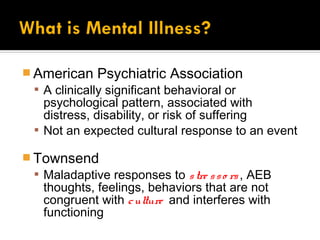
 American Psychiatric Association
   A clinically significant behavioral or
    psychological pattern, associated with
    distress, disability, or risk of suffering
   Not an expected cultural response to an event

 Townsend
   Maladaptive responses to s tre s s o rs , AEB
    thoughts, feelings, behaviors that are not
    congruent with c ulture and interferes with
    functioning
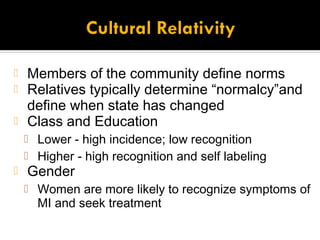
 Members of the community define norms
 Relatives typically determine “normalcy”and
  define when state has changed
 Class and Education
     Lower - high incidence; low recognition
     Higher - high recognition and self labeling
   Gender
     Women are more likely to recognize symptoms of
      MI and seek treatment
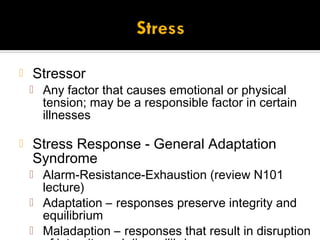
   Stressor
     Any factor that causes emotional or physical
      tension; may be a responsible factor in certain
      illnesses

   Stress Response - General Adaptation
    Syndrome
     Alarm-Resistance-Exhaustion (review N101
      lecture)
     Adaptation – responses preserve integrity and
      equilibrium
     Maladaption – responses that result in disruption
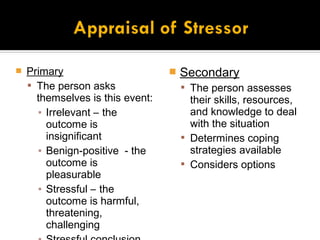
   Primary                          Secondary
     The person asks                  The person assesses
      themselves is this event:         their skills, resources,
      ▪ Irrelevant – the                and knowledge to deal
        outcome is                      with the situation
        insignificant                  Determines coping
      ▪ Benign-positive - the           strategies available
        outcome is                     Considers options
        pleasurable
      ▪ Stressful – the
        outcome is harmful,
        threatening,
        challenging
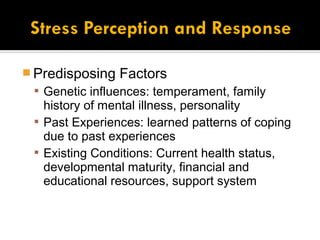
 Predisposing   Factors
  Genetic influences: temperament, family
   history of mental illness, personality
  Past Experiences: learned patterns of coping
   due to past experiences
  Existing Conditions: Current health status,
   developmental maturity, financial and
   educational resources, support system
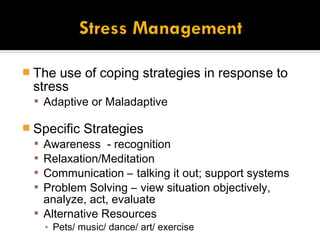
 The  use of coping strategies in response to
  stress
   Adaptive or Maladaptive

 Specific Strategies
   Awareness - recognition
   Relaxation/Meditation
   Communication – talking it out; support systems
   Problem Solving – view situation objectively,
    analyze, act, evaluate
   Alternative Resources
    ▪ Pets/ music/ dance/ art/ exercise
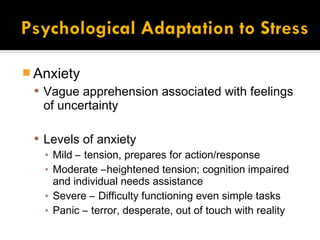
 Anxiety
  Vague apprehension associated with feelings
   of uncertainty

  Levels of anxiety
   ▪ Mild – tension, prepares for action/response
   ▪ Moderate –heightened tension; cognition impaired
     and individual needs assistance
   ▪ Severe – Difficulty functioning even simple tasks
   ▪ Panic – terror, desperate, out of touch with reality
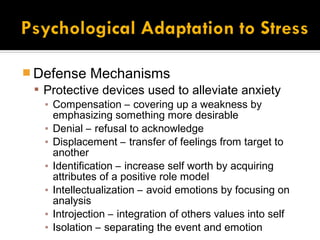
 Defense Mechanisms
   Protective devices used to alleviate anxiety
    ▪ Compensation – covering up a weakness by
      emphasizing something more desirable
    ▪ Denial – refusal to acknowledge
    ▪ Displacement – transfer of feelings from target to
      another
    ▪ Identification – increase self worth by acquiring
      attributes of a positive role model
    ▪ Intellectualization – avoid emotions by focusing on
      analysis
    ▪ Introjection – integration of others values into self
    ▪ Isolation – separating the event and emotion
 Defense    Mechanisms con’t
   ▪ Projection – attributing unacceptable self-feelings to
     another
   ▪ Rationalization – making excuses
   ▪ Reaction – avoids thoughts, feelings by expressing
     opposite
   ▪ Repression – blocking unpleasant feelings
   ▪ Sublimation – direct impulses into constructive activities
   ▪ Suppression – avoiding unpleasant thoughts, feelings
   ▪ Undoing – symbolically cancels out an unpleasant
     experience
   Dia g no s tic a nd Sta tis tic a l M nua l o f M nta l
                                         a           e
    Dis o rd e rs – Fo urth Ed itio n – Te x t Re v is io n
   This is a tool provides guidelines and diagnostics
    criteria for mental illness
   It is a multi-axial system
     Axis 1: All psychiatric disorders except personality d/o and
        MR
       Axis 2: Personality disorders and MR
       Axis 3: Medical conditions
       Axis 4: Environmental issues or psychosocial problems that
        may impede treatment
       Axis 5: Global Functioning Scale – Townsend, page 26

Historical and theoretical concepts rf order 1

  • 1.
  • 2.
    Historical Beliefs  Demonology requiring exorcism, beating, torture  Middle Ages associated mental illness with witchery  Asylums emerged in the 1800s – institutionalized  Evolution of Nursing  Linda Richards – First psychiatric nurse  Est’b psychiatric hospitals and schools of nursing (asylums)  Contemporary Approach  Mid 1900s – shift to community care, psychiatric nursing added to nursing curricula  National Mental Health Act – post WWII
  • 3.
     American Psychiatric Association  A state of being that is relative rather than absolute  Shown by productive activities, fulfilling relationships, ability to adapt to change and cope with adversity  Lisa Robinson (Psychiatric Nursing Expert)  Dynamic state in which thought, feeling, and behavior is age appropriate and congruent with local and cultural norms
  • 4.
     American PsychiatricAssociation  A clinically significant behavioral or psychological pattern, associated with distress, disability, or risk of suffering  Not an expected cultural response to an event  Townsend  Maladaptive responses to s tre s s o rs , AEB thoughts, feelings, behaviors that are not congruent with c ulture and interferes with functioning
  • 5.
     Members ofthe community define norms  Relatives typically determine “normalcy”and define when state has changed  Class and Education  Lower - high incidence; low recognition  Higher - high recognition and self labeling  Gender  Women are more likely to recognize symptoms of MI and seek treatment
  • 6.
    Stressor  Any factor that causes emotional or physical tension; may be a responsible factor in certain illnesses  Stress Response - General Adaptation Syndrome  Alarm-Resistance-Exhaustion (review N101 lecture)  Adaptation – responses preserve integrity and equilibrium  Maladaption – responses that result in disruption
  • 7.
    Primary  Secondary  The person asks  The person assesses themselves is this event: their skills, resources, ▪ Irrelevant – the and knowledge to deal outcome is with the situation insignificant  Determines coping ▪ Benign-positive - the strategies available outcome is  Considers options pleasurable ▪ Stressful – the outcome is harmful, threatening, challenging
  • 8.
     Predisposing Factors  Genetic influences: temperament, family history of mental illness, personality  Past Experiences: learned patterns of coping due to past experiences  Existing Conditions: Current health status, developmental maturity, financial and educational resources, support system
  • 9.
     The use of coping strategies in response to stress  Adaptive or Maladaptive  Specific Strategies  Awareness - recognition  Relaxation/Meditation  Communication – talking it out; support systems  Problem Solving – view situation objectively, analyze, act, evaluate  Alternative Resources ▪ Pets/ music/ dance/ art/ exercise
  • 10.
     Anxiety Vague apprehension associated with feelings of uncertainty  Levels of anxiety ▪ Mild – tension, prepares for action/response ▪ Moderate –heightened tension; cognition impaired and individual needs assistance ▪ Severe – Difficulty functioning even simple tasks ▪ Panic – terror, desperate, out of touch with reality
  • 11.
     Defense Mechanisms  Protective devices used to alleviate anxiety ▪ Compensation – covering up a weakness by emphasizing something more desirable ▪ Denial – refusal to acknowledge ▪ Displacement – transfer of feelings from target to another ▪ Identification – increase self worth by acquiring attributes of a positive role model ▪ Intellectualization – avoid emotions by focusing on analysis ▪ Introjection – integration of others values into self ▪ Isolation – separating the event and emotion
  • 12.
     Defense Mechanisms con’t ▪ Projection – attributing unacceptable self-feelings to another ▪ Rationalization – making excuses ▪ Reaction – avoids thoughts, feelings by expressing opposite ▪ Repression – blocking unpleasant feelings ▪ Sublimation – direct impulses into constructive activities ▪ Suppression – avoiding unpleasant thoughts, feelings ▪ Undoing – symbolically cancels out an unpleasant experience
  • 13.
    Dia g no s tic a nd Sta tis tic a l M nua l o f M nta l a e Dis o rd e rs – Fo urth Ed itio n – Te x t Re v is io n  This is a tool provides guidelines and diagnostics criteria for mental illness  It is a multi-axial system  Axis 1: All psychiatric disorders except personality d/o and MR  Axis 2: Personality disorders and MR  Axis 3: Medical conditions  Axis 4: Environmental issues or psychosocial problems that may impede treatment  Axis 5: Global Functioning Scale – Townsend, page 26