Pre Class Which Hindu concepts/beliefs do you remember from the film last week??
Holy COW! What is the moral of the children’s story about the cow? What Indian values are evident in this story? What arguments do Westerners give in support of Indians using the cow? How do Hindus respond to these arguments? What do Hindus believe is the relationship between man and cow?  Describe 3 ways that Indians DO make use of the cow. Do you think the Indian attitude toward the cow will change in the future?  Why or why not?
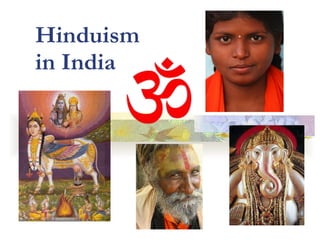
Hinduism in India
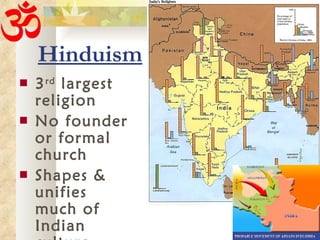
Hinduism 3 rd  largest religion No founder or formal church Shapes & unifies much of Indian culture
Brahman Ultimate Reality, supreme force Monism – belief in one unifying force Few people can truly understand Brahman “ Maya” (material world) clouds understanding
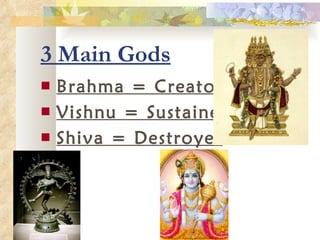
3 Main Gods Brahma = Creator Vishnu = Sustainer Shiva = Destroyer
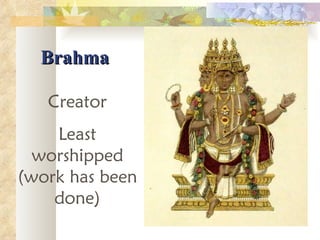
Brahma Creator Least worshipped (work has been done)
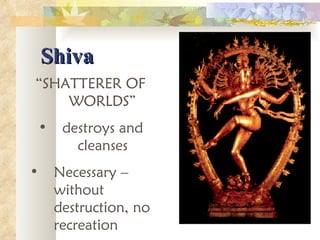
Shiva “ SHATTERER OF WORLDS” destroys and cleanses Necessary – without destruction, no recreation
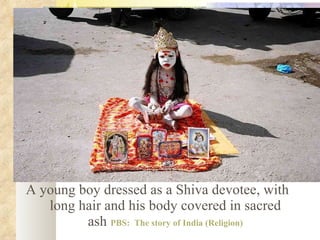
A young boy dressed as a Shiva devotee, with long hair and his body covered in sacred ash  PBS:  The story of India (Religion)
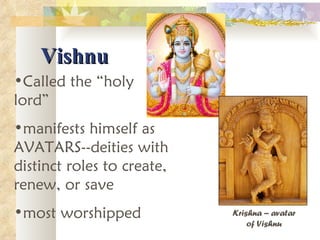
Vishnu Called the “holy lord”  manifests himself as AVATARS--deities with distinct roles to create, renew, or save most worshipped Krishna – avatar of Vishnu
 
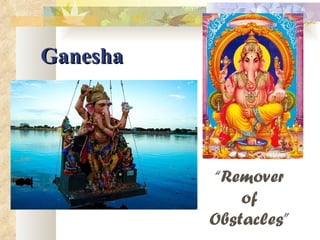
Ganesha “ Remover of Obstacles”
Hindu Concepts
Atman  Essential self Part of a  universal soul  Transcendentalism :  every Atman is Brahman so everyone is divine Know  yourself  to know Brahman
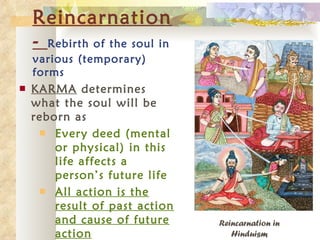
KARMA  determines what the soul will be reborn as Every deed (mental or physical) in this life affects a person’s future life  All action is the result of past action and cause of future action Reincarnation -  Rebirth of the soul in various (temporary) forms  Reincarnation in Hinduism
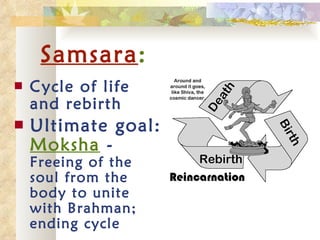
Samsara : Cycle of life and rebirth Ultimate goal:  Moksha  -  Freeing of the soul from the body to unite with Brahman; ending cycle
RECAP ULTIMATE GOAL ( MOKSHA ) IS TO FREE THE SOUL FROM THE BODY TO UNITE WITH BRAHMAN.  FREE FROM  SAMSARA  (THE CYCLE OF LIFE AND REBIRTH!) NO MORE  REINCARNATION ! ONE WITH  BRAHMAN !
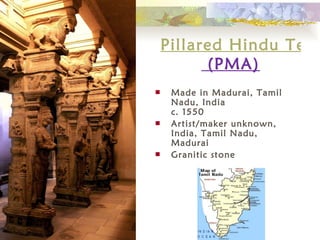
Pillared Hindu Temple  (PMA) Made in Madurai, Tamil Nadu, India c. 1550 Artist/maker unknown, India, Tamil Nadu, Madurai Granitic stone
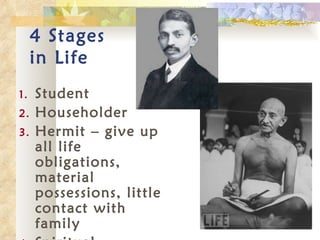
4 Stages in Life Student Householder Hermit – give up all life obligations, material possessions, little contact with family Spiritual Pilgrimage
The Caste System: Religious Doctrine or Social Construct? Caste  =  Stratified : UNCHANGEABLE social org. originally an Arian racial code (“ varna ” = color) determined by previous life ( karma ) shows status in  Samsara  and progress toward  Moksha Dharma  – duty, obey caste rules & moral laws; mobility
Pre Class  Draw a picture OR write a paragraph that explains the basic principles of Hinduism using/depicting most of the words below. Reincarnation Maya Brahman Caste  Dharma Karma Samsara Moksha
 
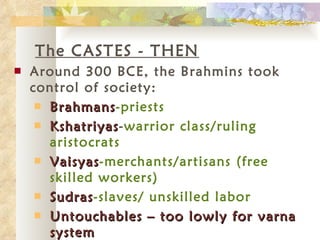
The CASTES - THEN Around 300 BCE, the Brahmins took control of society: Brahmans -priests Kshatriyas - warrior class/ruling aristocrats Vaisyas -merchants/artisans (free skilled workers) Sudras -slaves/ unskilled labor Untouchables – too lowly for varna system
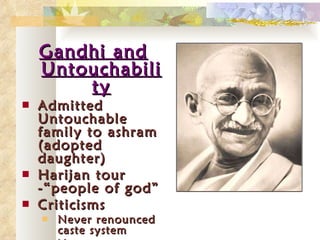
Gandhi and Untouchability Admitted Untouchable family to ashram (adopted daughter) Harijan tour -“people of god” Criticisms  Never renounced caste system No concrete results Prefer Dalit –”oppressed”
THE CASTES - NOW India today = democratic and  secular Castes persist ( Urban areas less strict than rural) “ Jati” (1000s of divisions) Indian constitution BANS Untouchability; discrimination based on caste Positive discrimination – reserve govt. jobs/positions in schools for % of “backwards classes”)
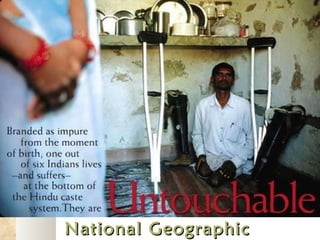
National Geographic
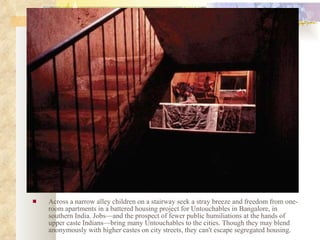
Across a narrow alley children on a stairway seek a stray breeze and freedom from one-room apartments in a battered housing project for Untouchables in Bangalore, in southern India. Jobs—and the prospect of fewer public humiliations at the hands of upper caste Indians—bring many Untouchables to the cities. Though they may blend anonymously with higher castes on city streets, they can't escape segregated housing.
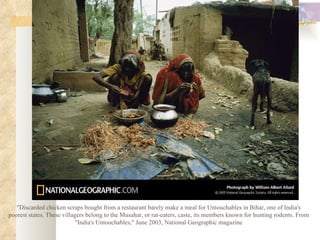
"Discarded chicken scraps bought from a restaurant barely make a meal for Untouchables in Bihar, one of India's poorest states. These villagers belong to the Musahar, or rat-eaters, caste, its members known for hunting rodents. From "India's Untouchables," June 2003, National Geographic magazine
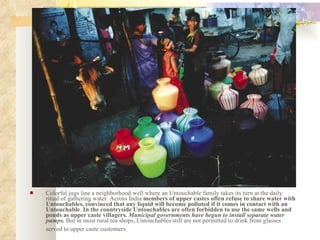
Colorful jugs line a neighborhood well where an Untouchable family takes its turn at the daily ritual of gathering water. Across India  members of upper castes often refuse to share water with Untouchables, convinced that any liquid will become polluted if it comes in contact with an Untouchable .  In the countryside Untouchables are often forbidden to use the same wells and ponds as upper caste villagers.  Municipal governments have begun to install separate water pumps.  But in most rural tea shops, Untouchables still are not permitted to drink from glasses served to upper caste customers.
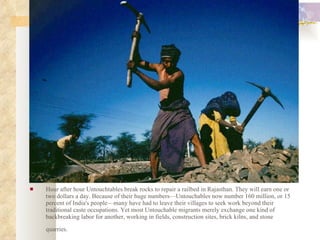
Hour after hour Untouchtables break rocks to repair a railbed in Rajasthan. They will earn one or two dollars a day. Because of their huge numbers—Untouchables now number 160 million, or 15 percent of India's people—many have had to leave their villages to seek work beyond their traditional caste occupations. Yet most Untouchable migrants merely exchange one kind of backbreaking labor for another, working in fields, construction sites, brick kilns, and stone quarries.
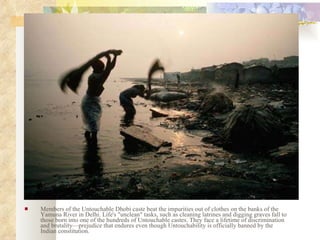
Members of the Untouchable Dhobi caste beat the impurities out of clothes on the banks of the Yamuna River in Delhi. Life's "unclean" tasks, such as cleaning latrines and digging graves fall to those born into one of the hundreds of Untouchable castes. They face a lifetime of discrimination and brutality—prejudice that endures even though Untouchability is officially banned by the Indian constitution.
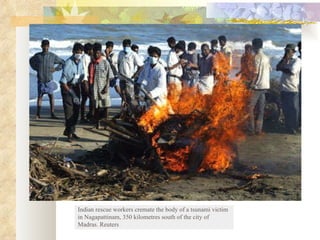
Indian rescue workers cremate the body of a tsunami victim in Nagapattinam, 350 kilometres south of the city of Madras. Reuters
"Undisguised hatred of Untouchables [members of the lowest Hindu castes] incites members of a private army in a Bihar village. Outraged by the wage and land-reform demands of Untouchables, the Ranvir Sena, a militia led by landowners, has been implicated in the massacres of more than 500 Untouchables. The attackers have gone largely unpunished. Activists fear that the recent surge in violent incidents across India will only intensify as more Untouchables try to break the chains of caste."
Sources of Wisdom Vedas Eternal truths (poems,  hymns) Upanishads Answers to questions on Life/Death BHAGAVAD GITA Most important source of spiritual teachings
Discussion Questions Why is a secular (non-religious) constitution important to the stability of India?  Do you think that Indian stability would have been threatened with a religion-based government?  Why or why not?
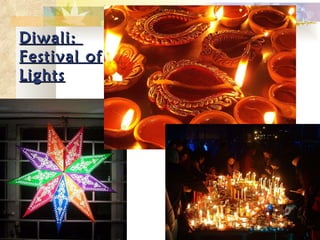
Diwali:  Festival of Lights
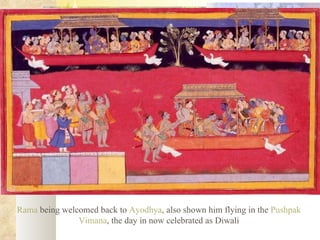
Rama  being welcomed back to  Ayodhya , also shown him flying in the  Pushpak   Vimana , the day in now celebrated as Diwali
Reciting the  Ramayana  is a religious activity A GUIDE FOR HINDU LIVING Ideal Conduct for Men & Women Paradigm to Emulate RAMA:  Self-Control, Honor, Respect SITA:  Love, Honor, Serve

Hinduism

  • 1.
    Pre Class WhichHindu concepts/beliefs do you remember from the film last week??
  • 2.
    Holy COW! Whatis the moral of the children’s story about the cow? What Indian values are evident in this story? What arguments do Westerners give in support of Indians using the cow? How do Hindus respond to these arguments? What do Hindus believe is the relationship between man and cow? Describe 3 ways that Indians DO make use of the cow. Do you think the Indian attitude toward the cow will change in the future? Why or why not?
  • 3.
  • 4.
    Hinduism 3 rd largest religion No founder or formal church Shapes & unifies much of Indian culture
  • 5.
    Brahman Ultimate Reality,supreme force Monism – belief in one unifying force Few people can truly understand Brahman “ Maya” (material world) clouds understanding
  • 6.
    3 Main GodsBrahma = Creator Vishnu = Sustainer Shiva = Destroyer
  • 7.
    Brahma Creator Leastworshipped (work has been done)
  • 8.
    Shiva “ SHATTEREROF WORLDS” destroys and cleanses Necessary – without destruction, no recreation
  • 9.
    A young boydressed as a Shiva devotee, with long hair and his body covered in sacred ash PBS: The story of India (Religion)
  • 10.
    Vishnu Called the“holy lord” manifests himself as AVATARS--deities with distinct roles to create, renew, or save most worshipped Krishna – avatar of Vishnu
  • 11.
  • 12.
    Ganesha “ Removerof Obstacles”
  • 13.
  • 14.
    Atman Essentialself Part of a universal soul Transcendentalism : every Atman is Brahman so everyone is divine Know yourself to know Brahman
  • 15.
    KARMA determineswhat the soul will be reborn as Every deed (mental or physical) in this life affects a person’s future life All action is the result of past action and cause of future action Reincarnation - Rebirth of the soul in various (temporary) forms Reincarnation in Hinduism
  • 16.
    Samsara : Cycleof life and rebirth Ultimate goal: Moksha - Freeing of the soul from the body to unite with Brahman; ending cycle
  • 17.
    RECAP ULTIMATE GOAL( MOKSHA ) IS TO FREE THE SOUL FROM THE BODY TO UNITE WITH BRAHMAN. FREE FROM SAMSARA (THE CYCLE OF LIFE AND REBIRTH!) NO MORE REINCARNATION ! ONE WITH BRAHMAN !
  • 18.
    Pillared Hindu Temple (PMA) Made in Madurai, Tamil Nadu, India c. 1550 Artist/maker unknown, India, Tamil Nadu, Madurai Granitic stone
  • 19.
    4 Stages inLife Student Householder Hermit – give up all life obligations, material possessions, little contact with family Spiritual Pilgrimage
  • 20.
    The Caste System:Religious Doctrine or Social Construct? Caste = Stratified : UNCHANGEABLE social org. originally an Arian racial code (“ varna ” = color) determined by previous life ( karma ) shows status in Samsara and progress toward Moksha Dharma – duty, obey caste rules & moral laws; mobility
  • 21.
    Pre Class Draw a picture OR write a paragraph that explains the basic principles of Hinduism using/depicting most of the words below. Reincarnation Maya Brahman Caste Dharma Karma Samsara Moksha
  • 22.
  • 23.
    The CASTES -THEN Around 300 BCE, the Brahmins took control of society: Brahmans -priests Kshatriyas - warrior class/ruling aristocrats Vaisyas -merchants/artisans (free skilled workers) Sudras -slaves/ unskilled labor Untouchables – too lowly for varna system
  • 24.
    Gandhi and UntouchabilityAdmitted Untouchable family to ashram (adopted daughter) Harijan tour -“people of god” Criticisms Never renounced caste system No concrete results Prefer Dalit –”oppressed”
  • 25.
    THE CASTES -NOW India today = democratic and secular Castes persist ( Urban areas less strict than rural) “ Jati” (1000s of divisions) Indian constitution BANS Untouchability; discrimination based on caste Positive discrimination – reserve govt. jobs/positions in schools for % of “backwards classes”)
  • 26.
  • 27.
    Across a narrowalley children on a stairway seek a stray breeze and freedom from one-room apartments in a battered housing project for Untouchables in Bangalore, in southern India. Jobs—and the prospect of fewer public humiliations at the hands of upper caste Indians—bring many Untouchables to the cities. Though they may blend anonymously with higher castes on city streets, they can't escape segregated housing.
  • 28.
    "Discarded chicken scrapsbought from a restaurant barely make a meal for Untouchables in Bihar, one of India's poorest states. These villagers belong to the Musahar, or rat-eaters, caste, its members known for hunting rodents. From "India's Untouchables," June 2003, National Geographic magazine
  • 29.
    Colorful jugs linea neighborhood well where an Untouchable family takes its turn at the daily ritual of gathering water. Across India members of upper castes often refuse to share water with Untouchables, convinced that any liquid will become polluted if it comes in contact with an Untouchable . In the countryside Untouchables are often forbidden to use the same wells and ponds as upper caste villagers. Municipal governments have begun to install separate water pumps. But in most rural tea shops, Untouchables still are not permitted to drink from glasses served to upper caste customers.
  • 30.
    Hour after hourUntouchtables break rocks to repair a railbed in Rajasthan. They will earn one or two dollars a day. Because of their huge numbers—Untouchables now number 160 million, or 15 percent of India's people—many have had to leave their villages to seek work beyond their traditional caste occupations. Yet most Untouchable migrants merely exchange one kind of backbreaking labor for another, working in fields, construction sites, brick kilns, and stone quarries.
  • 31.
    Members of theUntouchable Dhobi caste beat the impurities out of clothes on the banks of the Yamuna River in Delhi. Life's "unclean" tasks, such as cleaning latrines and digging graves fall to those born into one of the hundreds of Untouchable castes. They face a lifetime of discrimination and brutality—prejudice that endures even though Untouchability is officially banned by the Indian constitution.
  • 32.
    Indian rescue workerscremate the body of a tsunami victim in Nagapattinam, 350 kilometres south of the city of Madras. Reuters
  • 33.
    "Undisguised hatred ofUntouchables [members of the lowest Hindu castes] incites members of a private army in a Bihar village. Outraged by the wage and land-reform demands of Untouchables, the Ranvir Sena, a militia led by landowners, has been implicated in the massacres of more than 500 Untouchables. The attackers have gone largely unpunished. Activists fear that the recent surge in violent incidents across India will only intensify as more Untouchables try to break the chains of caste."
  • 34.
    Sources of WisdomVedas Eternal truths (poems, hymns) Upanishads Answers to questions on Life/Death BHAGAVAD GITA Most important source of spiritual teachings
  • 35.
    Discussion Questions Whyis a secular (non-religious) constitution important to the stability of India? Do you think that Indian stability would have been threatened with a religion-based government? Why or why not?
  • 36.
  • 37.
    Rama beingwelcomed back to Ayodhya , also shown him flying in the Pushpak Vimana , the day in now celebrated as Diwali
  • 38.
    Reciting the Ramayana is a religious activity A GUIDE FOR HINDU LIVING Ideal Conduct for Men & Women Paradigm to Emulate RAMA: Self-Control, Honor, Respect SITA: Love, Honor, Serve

Editor's Notes

  • #4 tilak,  Sanskrit tilaka (“mark”), in Hinduism, a mark, generally made on the forehead, indicating a person’s sectarian affiliation. The marks are made by hand or with a metal stamp, using ash from a sacrificial fire, sandalwood paste, turmeric, cow dung, clay, charcoal, or red lead . Among some sects the mark is made on 2, 5, 12, or 32 parts of the body as well as on the forehead. Among Shaivas (followers of Shiva ), the tilak usually takes the form of three horizontal parallel lines across the forehead, with or without a red dot. Sometimes a crescent moon or trident denotes a Shaiva. Among Vaishnavas (followers of Vishnu ), the many tilak variations follow a general pattern of two or more vertical lines resembling the letter U and representing the foot of Vishnu, with or without a central line or dot. Marks worn by women on the forehead (most commonly a red dot for unwidowed women) may indicate sect affiliation, but more frequently they vary according to the fashion prevailing in a particular part of India.
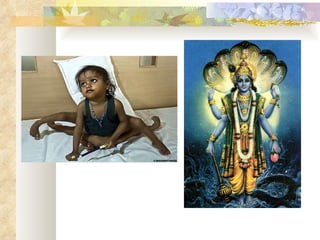
  • #12 http://www.thisislondon.co.uk/news/article-23419627-toddler-with-eight-limbs-branded-reincarnation-of-hindu-god-to-undergo-life-saving-operation.do
  • #13 Ganesha has been represented with the head of an elephant since the early stages of his appearance in Indian art. [43] Puranic myths provide many explanations for how he got his elephant head. [44] One of his popular forms, Heramba-Ganapati , has five elephant heads, and other less-common variations in the number of heads are known. [45] While some texts say that Ganesha was born with an elephant head, in most stories he acquires the head later. [46] The most recurrent motif in these stories is that Ganesha was born with a human head and body and that Shiva beheaded him when Ganesha came between Shiva and Parvati . Shiva then replaced Ganesha's original head with that of an elephant. [47] Details of the battle and where the replacement head came from vary according to different sources. [48] In another story, when Ganesha was born, his mother, Parvati, showed off her new baby to the other gods. Unfortunately, the god Shani (Saturn), who is said to have the evil eye , looked at him, causing the baby's head to be burned to ashes. The god Vishnu came to the rescue and replaced the missing head with that of an elephant. [49] Another story says that Ganesha was created directly by Shiva's laughter. Because Shiva considered Ganesha too alluring, he gave him the head of an elephant and a protruding belly. [50]
  • #20 http://hinduism.about.com/od/basics/p/fourstages.htm
  • #25 Incident w/ Ambekar/electorate – criticism???