HINDUISM
      -a presentation by
What is Hinduism?
• Etymology
      Hinduism, from the Persian hindu
literally "river." Means "of the Indus
Valley" or simply "Indian." Hindus call
their religion sanatama dharma or "eternal
truth."
What is Hinduism?
• is the predominant religion of the
  Indian subcontinent.
• is a mass of miscellaneous things of
  religious, philosophical, and cultural
  ideas and practices.
Hinduism differs from
 monotheistic religions
because it does NOT have:
•   a single founder,
•   a single concept of deity,
•   a single holy text,
•   a central religious authority,
•   the concept of a prophet.
Is it Polytheistic?
   Some say Hinduism is polytheistic
because of the large number of
representations of the divine - devas and
devis (gods and goddesses). The Vedas say
330 million. For Hindus the number is not
important since ‘all gods lead to God as all
rivers lead to the sea’. What is important is
that people discover the divine in ways that
are appropriate to them.
The Vedas
• These are the most ancient religious texts which
  define truth for Hindus.
• They got their present form between 1200-200
  BCE and were introduced to India by the Aryans.
• Hindus believe that the texts were received by
  scholars direct from God and passed on to the
  next generations by word of mouth.
• Vedic texts are sometimes called shruti, which
  means hearing. For hundreds, maybe even
  thousands of years, the texts were passed on
  orally.
WHO STARTED IT?
      It was believed to be Brahman but others say
that there is no single founder of Hinduism as
Hinduism was not founded as a religion. It was a
culture basically flourished in India, which later took
the form of a great religion. It would be easy to
understand who is the founder of Hinduism if you
know what Hinduism actually is.
H
I
N
D
U
I
S
M
• Hinduism had its roots over 3,500
  years (1500 B.C) ago in a wave of
  migration that brought Aryan
  people down from the northwest
  into the Indus Valley, now located
  mainly in India and Pakistan.
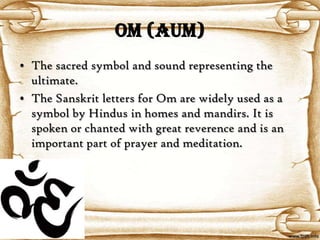
OM (AUM)
• The sacred symbol and sound representing the
  ultimate.
• The Sanskrit letters for Om are widely used as a
  symbol by Hindus in homes and mandirs. It is
  spoken or chanted with great reverence and is an
  important part of prayer and meditation.
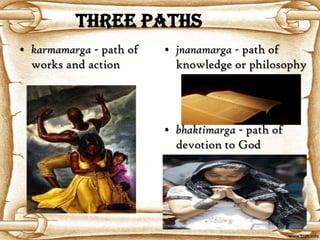
THREE PATHS
• karmamarga - path of   • jnanamarga - path of
  works and action         knowledge or philosophy


                         • bhaktimarga - path of
                           devotion to God
Four aims of LIFE:
   KAMA
(PLEASURE)
                  DHARMA
                (MORAL DUTY)
   ARTHA
(PROSPERITY)
                    MOKSHA
               (ENLIGHTENMENT)
SOME COMMON
CELEBRATIONS
Diwali
• it is the beginning of a new year (new beginnings,
  making a fresh start, anticipation)
• It is concerned with the triumph of light over
  darkness, of good actions over evil ones, of
  knowledge over ignorance, based around the story
  of the return of Rama and Sita from exile, the story
  of which is told in the Ramayana. It is also known
  as the ‘festival of lights’.
Holi
• A very exuberant festival, with dancing,
  singing, and throwing of paint.
• Bonfires are lit during Holi, and food
  offerings are roasted.
• The festival is officially celebrated on the day
  after full moon during the month of
  Phalunga, which falls in February-March.
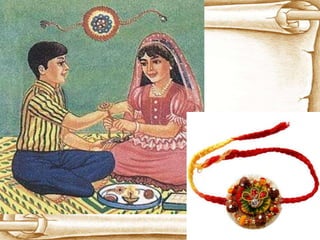
Raksha Bandhan

• This festival strengthens family ties, especially
  those between sisters and brothers.
• Raksha means ‘protection’ and brandhan is a verb
  meaning ‘to tie’.
• is celebrated on Purnima or full moon day in the
  month of Shravan (popularly known as Saawan)
Karma and Samsara
KARMA
• Karma is a Sanskrit word whose literal
  meaning is 'action'.
• It refers to the law that every action has an
  equal reaction either immediately or at
  some point in the future.
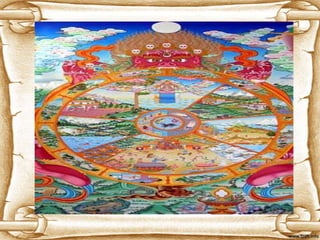
SAMSARA
• The process of reincarnation is called samsara, a
  continuous cycle in which the soul is reborn over
  and over again according to the law of action and
  reaction.
TEN COMMITMENTS
1. Ahimsa - Do no harm anyone.
2. Satya - Do not lie.
3. Asteya - Do not steal.
4. Brahmacharya - Do not overindulge.
5. Aparigraha - Do not be greedy.
6. Saucha - Be clean.
7. Santosha - Be content.
8. Tapas - Be self-disciplined.
9. Svadhyaya – Study.
10. Ishvara Pranidhana - Surrender to God.
Hindu
Dieties
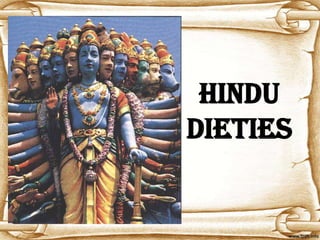
HINDU TRINITY
• BRAHMA, the Creator
• VISHNU, the Protector
• SHIVA, the Destroyer
The Hindu God Ganesh
• refers to the "lord of the hosts,"
• is the first born son of Shiva and Parvati,
• Ganesh is worshipped as the lord of new
  beginnings, they believe he can take
  problems away.
• considered the master of intellect and
  wisdom.
What do Hindus believe about
            God?

• Many Hindus believe in a ‘universal spirit’ or
  ‘God’ called Brahman.
• Brahman takes on many forms as different
  devis and devas (gods and goddesses).
Estimated No. of Followers
• 950 MILLION- making it the third largest
  religion after Christianity and Islam.
• We can find most of the followers in India
  and Nepal.
THIS PRESENTATION IS presented TO
YOU BY:
Bernardez, Arianne Cariza
Compelio, Andrelyn Heidi
Moltio, Miraclene
Torafing, Yanni
Hinduism

Hinduism

  • 1.
    HINDUISM -a presentation by
  • 2.
    What is Hinduism? •Etymology Hinduism, from the Persian hindu literally "river." Means "of the Indus Valley" or simply "Indian." Hindus call their religion sanatama dharma or "eternal truth."
  • 3.
    What is Hinduism? •is the predominant religion of the Indian subcontinent. • is a mass of miscellaneous things of religious, philosophical, and cultural ideas and practices.
  • 4.
    Hinduism differs from monotheistic religions because it does NOT have: • a single founder, • a single concept of deity, • a single holy text, • a central religious authority, • the concept of a prophet.
  • 5.
    Is it Polytheistic? Some say Hinduism is polytheistic because of the large number of representations of the divine - devas and devis (gods and goddesses). The Vedas say 330 million. For Hindus the number is not important since ‘all gods lead to God as all rivers lead to the sea’. What is important is that people discover the divine in ways that are appropriate to them.
  • 6.
    The Vedas • Theseare the most ancient religious texts which define truth for Hindus. • They got their present form between 1200-200 BCE and were introduced to India by the Aryans. • Hindus believe that the texts were received by scholars direct from God and passed on to the next generations by word of mouth. • Vedic texts are sometimes called shruti, which means hearing. For hundreds, maybe even thousands of years, the texts were passed on orally.
  • 7.
    WHO STARTED IT? It was believed to be Brahman but others say that there is no single founder of Hinduism as Hinduism was not founded as a religion. It was a culture basically flourished in India, which later took the form of a great religion. It would be easy to understand who is the founder of Hinduism if you know what Hinduism actually is.
  • 8.
  • 9.
    • Hinduism hadits roots over 3,500 years (1500 B.C) ago in a wave of migration that brought Aryan people down from the northwest into the Indus Valley, now located mainly in India and Pakistan.
  • 10.
    OM (AUM) • Thesacred symbol and sound representing the ultimate. • The Sanskrit letters for Om are widely used as a symbol by Hindus in homes and mandirs. It is spoken or chanted with great reverence and is an important part of prayer and meditation.
  • 11.
    THREE PATHS • karmamarga- path of • jnanamarga - path of works and action knowledge or philosophy • bhaktimarga - path of devotion to God
  • 12.
    Four aims ofLIFE: KAMA (PLEASURE) DHARMA (MORAL DUTY) ARTHA (PROSPERITY) MOKSHA (ENLIGHTENMENT)
  • 13.
  • 14.
    Diwali • it isthe beginning of a new year (new beginnings, making a fresh start, anticipation) • It is concerned with the triumph of light over darkness, of good actions over evil ones, of knowledge over ignorance, based around the story of the return of Rama and Sita from exile, the story of which is told in the Ramayana. It is also known as the ‘festival of lights’.
  • 15.
    Holi • A veryexuberant festival, with dancing, singing, and throwing of paint. • Bonfires are lit during Holi, and food offerings are roasted. • The festival is officially celebrated on the day after full moon during the month of Phalunga, which falls in February-March.
  • 16.
    Raksha Bandhan • Thisfestival strengthens family ties, especially those between sisters and brothers. • Raksha means ‘protection’ and brandhan is a verb meaning ‘to tie’. • is celebrated on Purnima or full moon day in the month of Shravan (popularly known as Saawan)
  • 17.
  • 18.
    KARMA • Karma isa Sanskrit word whose literal meaning is 'action'. • It refers to the law that every action has an equal reaction either immediately or at some point in the future.
  • 19.
    SAMSARA • The processof reincarnation is called samsara, a continuous cycle in which the soul is reborn over and over again according to the law of action and reaction.
  • 21.
    TEN COMMITMENTS 1. Ahimsa- Do no harm anyone. 2. Satya - Do not lie. 3. Asteya - Do not steal. 4. Brahmacharya - Do not overindulge. 5. Aparigraha - Do not be greedy. 6. Saucha - Be clean. 7. Santosha - Be content. 8. Tapas - Be self-disciplined. 9. Svadhyaya – Study. 10. Ishvara Pranidhana - Surrender to God.
  • 22.
  • 23.
    HINDU TRINITY • BRAHMA,the Creator • VISHNU, the Protector • SHIVA, the Destroyer
  • 24.
    The Hindu GodGanesh • refers to the "lord of the hosts," • is the first born son of Shiva and Parvati, • Ganesh is worshipped as the lord of new beginnings, they believe he can take problems away. • considered the master of intellect and wisdom.
  • 25.
    What do Hindusbelieve about God? • Many Hindus believe in a ‘universal spirit’ or ‘God’ called Brahman. • Brahman takes on many forms as different devis and devas (gods and goddesses).
  • 26.
    Estimated No. ofFollowers • 950 MILLION- making it the third largest religion after Christianity and Islam. • We can find most of the followers in India and Nepal.
  • 27.
    THIS PRESENTATION ISpresented TO YOU BY: Bernardez, Arianne Cariza Compelio, Andrelyn Heidi Moltio, Miraclene Torafing, Yanni