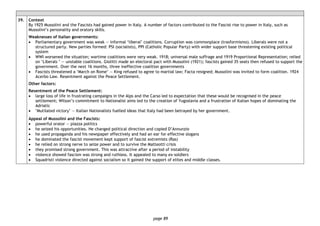
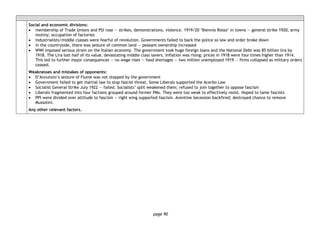
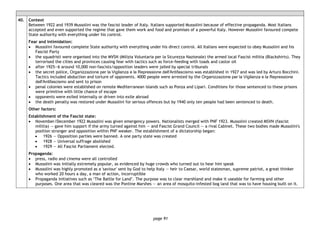
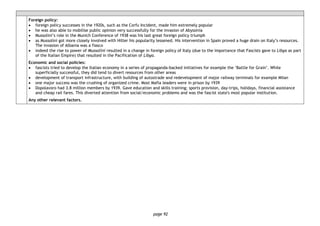
National
Qualifications
X837/76/11 History
British, European and World History
Marking Instructions
Please note that these marking instructions have not been standardised based on candidate
responses. You may therefore need to agree within your centre how to consistently mark an item
if a candidate response is not covered by the marking instructions.
©
page 02
General marking principles for Higher History — British, European and World History
Always apply these general principles. Use them in conjunction with the detailed marking
instructions, which identify the key features required in candidates’ responses.
(a) Always use positive marking. This means candidates accumulate marks for the demonstration of
relevant skills, knowledge and understanding; marks are not deducted for errors or omissions.
(b) If a candidate response does not seem to be covered by either the principles or detailed marking
instructions, and you are uncertain how to assess it, you must seek guidance from your team
leader.
(c) Where the candidate is instructed to choose one part in a section but instead answers two parts,
mark both responses and record the better mark.
(d) Marking must be consistent. Never make a hasty judgement on a response based on length,
quality of handwriting or a confused start.
(e) Use the full range of marks available for each question.
(f) The detailed marking instructions are not an exhaustive list. Award marks for other relevant
points.
(g) The question stems used in this paper are
• How important . . . ?
• To what extent . . . ?
• Quote . . . How valid is this view . . . ?
Marking principles for each question type
Essay questions (22 marks)
Historical context
Award 3 marks where candidates provide two points of background to the issue and identify relevant
factors. These should be connected to the line of argument.
Conclusion
Award 3 marks where candidates provide a relative overall judgement of the factors, which are
connected to the evidence presented, and which provide reasons for their overall judgement.
For example This factor was clearly more significant in bringing about the event than any other
factor because . . .
Use of knowledge
Award 6 marks where candidates give evidence which is detailed and which is used to support a
viewpoint, factor or area of impact.
Award knowledge and understanding marks where points are:
• relevant to the issue in the question
• developed (by providing additional detail, exemplification, reasons or evidence)
• used to respond to the demands of the question (for example explain, analyse).
page 03
Analysis
Award up to 6 marks for analytical comments.
Analysis involves identifying parts, the relationship between them, and their relationship with the
whole. It can also involve drawing out and relating implications.
Award an analysis mark where candidates use their knowledge and understanding to identify relevant
factors (for example political, social, economic, or religious — although they do not need to use this
terminology), or aspects within a factor (for example success versus failure; different groups, such as
elderly versus youth; or different social classes), and clearly show at least one of the following:
• links between different components
• links between component(s) and the whole
• links between component(s) and related concepts
• similarities and consistency
• contradictions and inconsistency
• different views and/or interpretations
• the relative importance of components
• understanding of underlying order or structure.
Examples of relationships between identified factors could include:
• Establishing contradictions or inconsistencies within factors.
For example While they were successful in that way, they were limited in this way . . .
• Establishing contradictions or inconsistencies between factors.
For example While there were political motives for doing this, the economic factors were against
doing this.
• Establishing similarities and consistencies between factors.
For example In much the same way as this group were affected by this development, this group
were also affected in this way.
• Establishing links between factors.
For example This factor led to that factor.
OR
At the same time there was also . . .
• Exploring different interpretations of these factors.
For example While some people have viewed the evidence as showing this, others have seen it as
showing . . .
OR
While we used to think that this was the case, we now think that it was really . . .
page 04
Evaluation
Award up to 4 marks.
Evaluation involves making a judgement based on criteria.
Candidates make reasoned evaluative comments relating to, for example:
• The extent to which the factor is supported by the evidence.
For example This evidence shows that X was a very significant area of impact.
• The relative importance of factors.
For example This evidence shows that X was a more significant area of impact than Y.
• Counter-arguments including possible alternative interpretations.
For example One factor was . . . However, this may not be the case because . . .
OR
However, more recent research tends to show that . . .
• The overall impact and/or significance of the factors when taken together.
For example While each factor may have had little effect on its own, when we take them together
they became hugely important.
• The importance of factors in relation to the context.
For example Given the situation which they inherited, these actions were more successful than
they might appear.
Award marks where candidates develop a line of argument which makes a judgement on the issue,
explaining the basis on which the judgement is made. Candidates should present the argument in a
balanced way, making evaluative comments which show their judgement on the individual factors,
and may use counter-arguments or alternative interpretations to build their case.
page 05
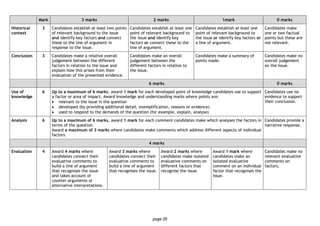
Mark 3 marks 2 marks 1mark 0 marks
Historical
context
3 Candidates establish at least two points
of relevant background to the issue
and identify key factors and connect
these to the line of argument in
response to the issue.
Candidates establish at least one
point of relevant background to
the issue and identify key
factors or connect these to the
line of argument.
Candidates establish at least one
point of relevant background to
the issue or identify key factors or
a line of argument.
Candidates make
one or two factual
points but these are
not relevant.
Conclusion 3 Candidates make a relative overall
judgement between the different
factors in relation to the issue and
explain how this arises from their
evaluation of the presented evidence.
Candidates make an overall
judgement between the
different factors in relation to
the issue.
Candidates make a summary of
points made.
Candidates make no
overall judgement
on the issue.
6 marks 0 marks
Use of
knowledge
6 Up to a maximum of 6 marks, award 1 mark for each developed point of knowledge candidates use to support
a factor or area of impact. Award knowledge and understanding marks where points are:
• relevant to the issue in the question
• developed (by providing additional detail, exemplification, reasons or evidence)
• used to respond to the demands of the question (for example, explain, analyse)
Candidates use no
evidence to support
their conclusion.
Analysis 6 Up to a maximum of 6 marks, award 1 mark for each comment candidates make which analyses the factors in
terms of the question.
Award a maximum of 3 marks where candidates make comments which address different aspects of individual
factors.
Candidates provide a
narrative response.
4 marks
Evaluation 4 Award 4 marks where
candidates connect their
evaluative comments to
build a line of argument
that recognises the issue
and takes account of
counter-arguments or
alternative interpretations.
Award 3 marks where
candidates connect their
evaluative comments to
build a line of argument
that recognises the issue.
Award 2 marks where
candidates make isolated
evaluative comments on
different factors that
recognise the issue.
Award 1 mark where
candidates make an
isolated evaluative
comment on an individual
factor that recognises the
issue.
Candidates make no
relevant evaluative
comments on
factors.
page 06
Marking instructions for each question
SECTION 1 — British
PART A — Church, state and feudal society, 1066―1406
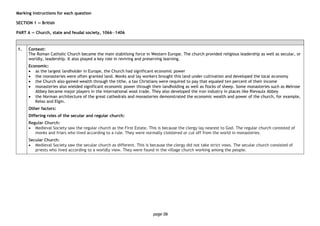
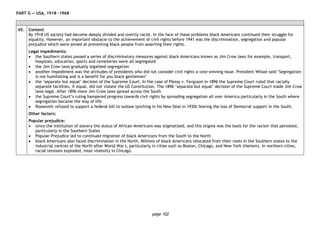
1. Context:
The Roman Catholic Church became the main stabilising force in Western Europe. The church provided religious leadership as well as secular, or
worldly, leadership. It also played a key role in reviving and preserving learning.
Economic:
• as the largest landholder in Europe, the Church had significant economic power
• the monasteries were often granted land. Monks and lay workers brought this land under cultivation and developed the local economy
• the Church also gained wealth through the tithe, a tax Christians were required to pay that equaled ten percent of their income
• monasteries also wielded significant economic power through their landholding as well as flocks of sheep. Some monasteries such as Melrose
Abbey became major players in the international wool trade. They also developed the iron industry in places like Rievaulx Abbey
• the Norman architecture of the great cathedrals and monasteries demonstrated the economic wealth and power of the church, for example,
Kelso and Elgin.
Other factors:
Differing roles of the secular and regular church:
Regular Church:
• Medieval Society saw the regular church as the First Estate. This is because the clergy lay nearest to God. The regular church consisted of
monks and friars who lived according to a rule. They were normally cloistered or cut off from the world in monasteries.
Secular Church:
• Medieval Society saw the secular church as different. This is because the clergy did not take strict vows. The secular church consisted of
priests who lived according to a worldly view. They were found in the village church working among the people.
page 07
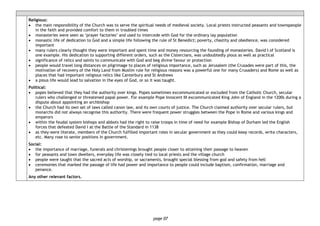
Religious:
• the main responsibility of the Church was to serve the spiritual needs of medieval society. Local priests instructed peasants and townspeople
in the faith and provided comfort to them in troubled times
• monasteries were seen as ‘prayer factories’ and used to intercede with God for the ordinary lay population
• monastic life of dedication to God and a simple life following the rule of St Benedict; poverty, chastity and obedience, was considered
important
• many rulers clearly thought they were important and spent time and money resourcing the founding of monasteries. David I of Scotland is
one example. His dedication to supporting different orders, such as the Cistercians, was undoubtedly pious as well as practical
• significance of relics and saints to communicate with God and beg divine favour or protection
• people would travel long distances on pilgrimage to places of religious importance, such as Jerusalem (the Crusades were part of this, the
motivation of recovery of the Holy Land from Muslim rule for religious reasons was a powerful one for many Crusaders) and Rome as well as
places that had important religious relics like Canterbury and St Andrews
• a pious life would lead to salvation in the eyes of God, or so it was taught.
Political:
• popes believed that they had the authority over kings. Popes sometimes excommunicated or excluded from the Catholic Church, secular
rulers who challenged or threatened papal power. For example Pope Innocent III excommunicated King John of England in the 1200s during a
dispute about appointing an archbishop
• the Church had its own set of laws called canon law, and its own courts of justice. The Church claimed authority over secular rulers, but
monarchs did not always recognise this authority. There were frequent power struggles between the Pope in Rome and various kings and
emperors
• within the feudal system bishops and abbots had the right to raise troops in time of need for example Bishop of Durham led the English
forces that defeated David I at the Battle of the Standard in 1138
• as they were literate, members of the Church fulfilled important roles in secular government as they could keep records, write characters,
etc. Many rose to senior positions in government.
Social:
• the importance of marriage, funerals and christenings brought people closer to attaining their passage to heaven
• for peasants and town dwellers, everyday life was closely tied to local priests and the village church
• people were taught that the sacred acts of worship, or sacraments, brought special blessing from god and safety from hell
• ceremonies that marked the passage of life had power and importance to people could include baptism, confirmation, marriage and
penance.
Any other relevant factors.
page 08
2. Context:
Henry was the son of Geoffrey of Anjou and Matilda, daughter of Henry I of England. Matilda was involved in a dispute with Stephen of Blois over
who should rule England. On Stephen’s death, Henry became Henry II of England. Henry’s aims were to preserve the Angevin dominions, strengthen
royal authority and extend the King’s justice.
Law and order:
• Henry favoured the extension of royal jurisdiction, partly for its contribution to the domestic peace and partly for its financial rewards to
the crown, but also to extend control over his tenants-in-chief
• there was a general need to rationalise law and marry the Anglo Saxon with the Norman practices in order to simplify the system and stop
people playing the system. Change was gradual throughout Henry’s reign and did not conform to some grand plan, but royal power did
increase as a result of this
• Henry believed that too few offenders were put on trial or caught. He reasserted royal jurisdiction over major crimes and sought to improve
the efficiency of the legal process
• the Assizes of Clarendon of 1166, modified by the Assize of Northampton (1176) for example, widened the scope of royal justice, now
including indictment and prosecution of local criminals
• regional inquest juries should meet periodically under the royal eye to identify and denounce neighbourhood criminals
• extension of the king’s justice into land disputes, which had once been dominated by the baronial courts, through the Assize of Novel
Disseisin and Grand Assize. These rationalised a mass of local laws and customs into a uniform royal law — a ‘common law’ by which all
subjects were ruled. They speeded up the judicial process, but also placed decisions in the hands of the king’s own justices-in-eyre, going
over the heads of the powerful local tenants-in-chief.
Other Factors:
Nobility:
• changes in taxes were also needed to firm up revenue, but also to formalise Henry’s relationship with his main tenants-in-chief
• many of his actions were to re-establish the authority of the king after the chaos of the Civil War and that meant action against those who had
used the war as an opportunity to extend their own power
• Henry vigorously pursued the destruction of illegally built castles and the recovery of former royal strongholds that were now in baronial hands.
For example, he acted against William of Aumale who refused to surrender Scarborough Castle
• Henry’s introduction of scutage allowed him to get around the problem of 40 days’ knight service
• many lesser nobles were employed as his royal administration expanded.
page 09
Cost of warfare:
• in part, royal government developed in order to fund warfare, which had become increasingly expensive in the 12th century
• Henry had various military needs, to defend his lands across the Angevin Empire, to recover lost territories, to keep vassals abroad in check
and to crush uprisings across the extensive Angevin Empire. The baronial rebellion of 1173-74 also shook him. In short, he needed an army at
times and that had to be paid for
• for example, previously direct taxation had been on landed property, but to get money for crusades Henry ordered a tax on moveable
property and in 1188, a Saladin tithe (one tenth of the value of rents)
• by the end of the period there was a soundly organised field army with the administration to produce the money for this
• fortifications were also repaired and by the end of the period, for example all Norman castles were part of a general defence plan
• this increased organisation can be seen in the Assize of Arms of 1181 — a survey of resources.
Need to develop the economy:
• in general, Henry oversaw a more settled age in England, which encouraged trade as did Henry’s acquisitions abroad. This in turn helped Henry
with revenue, but also stimulated Henry’s position in the international world. for example, his acquisition of Guienne stimulated the west-
country ports
• the industrial centres of Flanders depended on English wool and welcomed grain from fertile East Anglian and Kentish fields
• there was a European demand for English metals
• Henry’s England was at the centre of the Angevin Empire and French speaking world
• the period saw an increase in literacy, for example all his sons had some education.
Effects of foreign influence
• Henry reigned for 34 and a half years, but he spent 21 years away from England
• the Angevin Empire ranged from the border with Scotland to the border with Spain and was united on only one sense, loyalty to Henry II
• arguably, the demands of holding this disparate group of lands together led to the need for taxation and a capable army
• foreign influence in England, especially from the Norman Lords who had extensive landholdings in both Normandy and England
• some unity of government was necessary, however and can be seen with the use of the Exchequer system throughout the Empire, for
example
• use of the Seneschal’s court — use of same legal procedure and interpretation of laws.
Impact of the Civil War:
• Civil War had developed between Stephen and Matilda on the death of Henry I
• bulk of the fighting was in Wiltshire, Gloucestershire and nearby private wars developed
• there was some devastation of land due to the Civil War for example 1143-44 Geoffrey de Mandeville laid waste to the Fens and in 1147,
Coventry and surroundings was laid waste by the king
• in financing the Civil War Stephen began with a full treasury, however, the Exchequer was disorganised and yields from land were low.
During the Civil War, barons and sheriffs had become increasingly lax in paying their taxes. The economy was weakened by the Civil War
• the development of the royal administration during Henry II’s reign is due, in part to the need to put the Royal finances back on an even
keel. For example, this led to changes to the Exchequer, which improved the methods for receiving his revenues, as well as development of
the Chamber and use of sheriffs.
Any other relevant factors.
page 10
3. Context:
King John was the youngest, and favourite, son of Henry II and Eleanor of Aquitaine. On the death of his elder brother Richard, he became King
of England despite the claims of his nephew, Arthur. He struggled to hold the widespread Angevin Empire together in the face of the challenges
of the Capetian monarch of France and his own barons.
Impact of the loss of Normandy:
• had an impact on the royal finances as it reduced John’s income
• the recovery of the royal lands north of the Loire became the focus of John’s foreign policy and led to policies which eventually led to
challenges to his authority
• the need to fund warfare to recover Normandy led to the frequent use of scutage to raise cash. It was used much more frequently than
under Henry II and Richard I, levied 11 times in 17 years.
Taxation:
• John was more efficient in collecting taxes
• he used wardships to raise cash
• John introduced new taxes: for example 1207 tax on income and moveable goods
• he improved the quality of silver coinage.
John’s personality:
• he could be generous, had a coarse sense of humour and was intelligent
• however, he could also be suspicious and cruel: vicious in his treatment of prisoners and nobles
• Arthur, his nephew, died in mysterious circumstances
• powerful lords like William de Braose fell from favour and were persecuted. William’s wife and son were imprisoned and died. He died in
exile in France.
Relations with the nobility:
• nobles refused to fight in France. This was especially true of the northern barons who had little stake in France
• nobles felt their status was reduced by use of mercenaries
• John became increasingly suspicious of the nobles
• high cost of titles led to nobles becoming overly indebted
• John took hostages to ensure nobles behaved. He showed he was prepared to execute children if their father opposed him.
page 11
Relations with the church:
• John fell out with Pope Innocent III over the appointment of the Archbishop of Canterbury. Innocent insisted on the appointment of Langton
which John opposed
• papal interdict laid on England and Wales for 6 years
• Pope Innocent excommunicated John in 1209
• in 1213 John made England a fief of the papacy
• Noble uprising led by Archbishop of Canterbury.
Any other relevant factors.
page 12
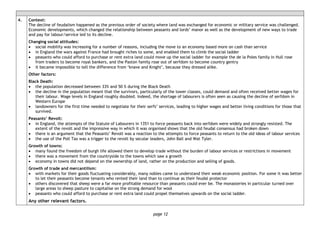
4. Context:
The decline of feudalism happened as the previous order of society where land was exchanged for economic or military service was challenged.
Economic developments, which changed the relationship between peasants and lords’ manor as well as the development of new ways to trade
and pay for labour/service led to its decline.
Changing social attitudes:
• social mobility was increasing for a number of reasons, including the move to an economy based more on cash than service
• in England the wars against France had brought riches to some, and enabled them to climb the social ladder
• peasants who could afford to purchase or rent extra land could move up the social ladder for example the de la Poles family in Hull rose
from traders to become royal bankers, and the Paston family rose out of serfdom to become country gentry
• it became impossible to tell the difference from ‘knave and Knight’, because they dressed alike.
Other factors:
Black Death:
• the population decreased between 33% and 50 % during the Black Death
• the decline in the population meant that the survivors, particularly of the lower classes, could demand and often received better wages for
their labour. Wage levels in England roughly doubled. Indeed, the shortage of labourers is often seen as causing the decline of serfdom in
Western Europe
• landowners for the first time needed to negotiate for their serfs’ services, leading to higher wages and better living conditions for those that
survived.
Peasants’ Revolt:
• in England, the attempts of the Statute of Labourers in 1351 to force peasants back into serfdom were widely and strongly resisted. The
extent of the revolt and the impressive way in which it was organised shows that the old feudal consensus had broken down
• there is an argument that the Peasants’ Revolt was a reaction to the attempts to force peasants to return to the old ideas of labour services
• the use of the Poll Tax was a trigger to the revolt by secular leaders, John Ball and Wat Tyler.
Growth of towns:
• many found the freedom of burgh life allowed them to develop trade without the burden of labour services or restrictions in movement
• there was a movement from the countryside to the towns which saw a growth
• economy in towns did not depend on the ownership of land, rather on the production and selling of goods.
Growth of trade and mercantilism:
• with markets for their goods fluctuating considerably, many nobles came to understand their weak economic position. For some it was better
to let their peasants become tenants who rented their land than to continue as their feudal protector
• others discovered that sheep were a far more profitable resource than peasants could ever be. The monasteries in particular turned over
large areas to sheep pasture to capitalise on the strong demand for wool
• peasants who could afford to purchase or rent extra land could propel themselves upwards on the social ladder.
Any other relevant factors.
page 13
PART B — The century of revolutions, 1603―1702
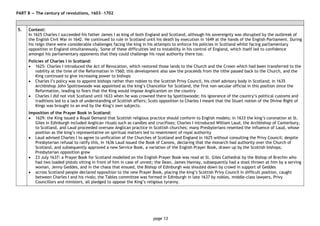
5. Context:
In 1625 Charles I succeeded his father James I as king of both England and Scotland, although his sovereignty was disrupted by the outbreak of
the English Civil War in 1642. He continued to rule in Scotland until his death by execution in 1649 at the hands of the English Parliament. During
his reign there were considerable challenges facing the king in his attempts to enforce his policies in Scotland whilst facing parliamentary
opposition in England simultaneously. Some of these difficulties led to instability in his control of England, which itself led to confidence
amongst his parliamentary opponents that they could challenge his royal authority there too.
Policies of Charles I in Scotland:
• 1625: Charles I introduced the Act of Revocation, which restored those lands to the Church and the Crown which had been transferred to the
nobility at the time of the Reformation in 1560; this development also saw the proceeds from the tithe passed back to the Church, and the
King continued to give increasing power to bishops
• Charles I’s policy was to appoint bishops rather than nobles to the Scottish Privy Council, his chief advisory body in Scotland; in 1635
Archbishop John Spottiswoode was appointed as the king’s Chancellor for Scotland, the first non-secular official in this position since the
Reformation, leading to fears that the King would impose Anglicanism on the country
• Charles I did not visit Scotland until 1633 when he was crowned there by Spottiswoode; his ignorance of the country’s political customs and
traditions led to a lack of understanding of Scottish affairs; Scots opposition to Charles I meant that the Stuart notion of the Divine Right of
Kings was brought to an end by the King’s own subjects.
Imposition of the Prayer Book in Scotland:
• 1629: the King issued a Royal Demand that Scottish religious practice should conform to English models; in 1633 the king’s coronation at St.
Giles in Edinburgh included Anglican rituals such as candles and crucifixes; Charles I introduced William Laud, the Archbishop of Canterbury,
to Scotland, and Laud proceeded oversaw Anglican practice in Scottish churches; many Presbyterians resented the influence of Laud, whose
position as the king’s representative on spiritual matters led to resentment of royal authority
• Laud advised Charles I to agree to unification of the Churches of Scotland and England in 1625 without consulting the Privy Council; despite
Presbyterian refusal to ratify this, in 1636 Laud issued the Book of Canons, declaring that the monarch had authority over the Church of
Scotland, and subsequently approved a new Service Book, a variation of the English Prayer Book, drawn up by the Scottish bishops;
Presbyterian opposition grew
• 23 July 1637: a Prayer Book for Scotland modelled on the English Prayer Book was read at St. Giles Cathedral by the Bishop of Brechin who
had two loaded pistols sitting in front of him in case of unrest; the Dean, James Hannay, subsequently had a stool thrown at him by a serving
woman, Jenny Geddes, and in the chaos that ensued, the Bishop of Edinburgh was shouted down by crowd in support of Geddes
• across Scotland people declared opposition to the new Prayer Book, placing the king’s Scottish Privy Council in difficult position, caught
between Charles I and his rivals; the Tables committee was formed in Edinburgh in late 1637 by nobles, middle-class lawyers, Privy
Councillors and ministers, all pledged to oppose the King’s religious tyranny.
page 14
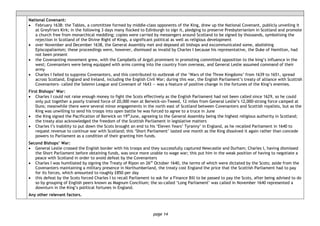
National Covenant:
• February 1638: the Tables, a committee formed by middle-class opponents of the King, drew up the National Covenant, publicly unveiling it
at Greyfriars Kirk; in the following 3 days many flocked to Edinburgh to sign it, pledging to preserve Presbyterianism in Scotland and promote
a church free from monarchical meddling; copies were carried by messengers around Scotland to be signed by thousands, symbolising the
rejection in Scotland of the Divine Right of Kings, a significant political as well as religious development
• over November and December 1638, the General Assembly met and deposed all bishops and excommunicated some, abolishing
Episcopalianism; these proceedings were, however, dismissed as invalid by Charles I because his representative, the Duke of Hamilton, had
not been present
• the Covenanting movement grew, with the Campbells of Argyll prominent in promoting committed opposition to the king’s influence in the
west; Covenanters were being equipped with arms coming into the country from overseas, and General Leslie assumed command of their
army
• Charles I failed to suppress Covenanters, and this contributed to outbreak of the ‘Wars of the Three Kingdoms’ from 1639 to 1651, spread
across Scotland, England and Ireland, including the English Civil War; during this war, the English Parliament’s treaty of alliance with Scottish
Covenanters- called the Solemn League and Covenant of 1643 — was a feature of positive change in the fortunes of the King’s enemies.
First Bishops’ War:
• Charles I could not raise enough money to fight the Scots effectively as the English Parliament had not been called since 1629, so he could
only put together a poorly trained force of 20,000 men at Berwick-on-Tweed, 12 miles from General Leslie’s 12,000-strong force camped at
Duns; meanwhile there were several minor engagements in the north east of Scotland between Covenanters and Scottish royalists, but as the
King was unwilling to send his troops into open battle he was forced to agree to a truce in June
• the King signed the Pacification of Berwick on 19th
June, agreeing to the General Assembly being the highest religious authority in Scotland;
the treaty also acknowledged the freedom of the Scottish Parliament in legislative matters
• Charles I’s inability to put down the Scots brought an end to his ‘Eleven Years’ Tyranny’ in England, as he recalled Parliament in 1640 to
request revenue to continue war with Scotland; this ‘Short Parliament’ lasted one month as the King dissolved it again rather than concede
powers to Parliament as a condition of their granting him funds.
Second Bishops’ War:
• General Leslie crossed the English border with his troops and they successfully captured Newcastle and Durham; Charles I, having dismissed
the Short Parliament before obtaining funds, was once more unable to wage war; this put him in the weak position of having to negotiate a
peace with Scotland in order to avoid defeat by the Covenanters
• Charles I was humiliated by signing the Treaty of Ripon on 26th
October 1640, the terms of which were dictated by the Scots; aside from the
Covenanters maintaining a military presence in Northumberland, the treaty cost England the price that the Scottish Parliament had to pay
for its forces, which amounted to roughly £850 per day
• this defeat by the Scots forced Charles I to recall Parliament to ask for a Finance Bill to be passed to pay the Scots, after being advised to do
so by grouping of English peers known as Magnum Concilium; the so-called ‘Long Parliament’ was called in November 1640 represented a
downturn in the King’s political fortunes in England.
Any other relevant factors.
page 15
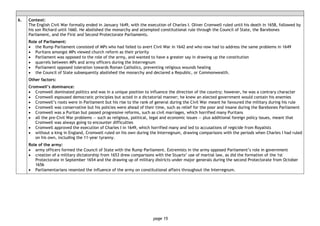
6. Context:
The English Civil War formally ended in January 1649, with the execution of Charles I. Oliver Cromwell ruled until his death in 1658, followed by
his son Richard until 1660. He abolished the monarchy and attempted constitutional rule through the Council of State, the Barebones
Parliament, and the First and Second Protectorate Parliaments.
Role of Parliament:
• the Rump Parliament consisted of MPs who had failed to avert Civil War in 1642 and who now had to address the same problems in 1649
• Puritans amongst MPs viewed church reform as their priority
• Parliament was opposed to the role of the army, and wanted to have a greater say in drawing up the constitution
• quarrels between MPs and army officers during the Interregnum
• Parliament opposed toleration towards Roman Catholics, preventing religious wounds healing
• the Council of State subsequently abolished the monarchy and declared a Republic, or Commonwealth.
Other factors:
Cromwell’s dominance:
• Cromwell dominated politics and was in a unique position to influence the direction of the country; however, he was a contrary character
• Cromwell espoused democratic principles but acted in a dictatorial manner; he knew an elected government would contain his enemies
• Cromwell’s roots were in Parliament but his rise to the rank of general during the Civil War meant he favoured the military during his rule
• Cromwell was conservative but his policies were ahead of their time, such as relief for the poor and insane during the Barebones Parliament
• Cromwell was a Puritan but passed progressive reforms, such as civil marriages, which horrified many Puritans
• all the pre-Civil War problems — such as religious, political, legal and economic issues — plus additional foreign policy issues, meant that
Cromwell was always going to encounter difficulties
• Cromwell approved the execution of Charles I in 1649, which horrified many and led to accusations of regicide from Royalists
• without a king in England, Cromwell ruled on his own during the Interregnum, drawing comparisons with the periods when Charles I had ruled
on his own, including the 11-year tyranny.
Role of the army:
• army officers formed the Council of State with the Rump Parliament. Extremists in the army opposed Parliament’s role in government
• creation of a military dictatorship from 1653 drew comparisons with the Stuarts’ use of martial law, as did the formation of the 1st
Protectorate in September 1654 and the drawing up of military districts under major generals during the second Protectorate from October
1656
• Parliamentarians resented the influence of the army on constitutional affairs throughout the Interregnum.
page 16
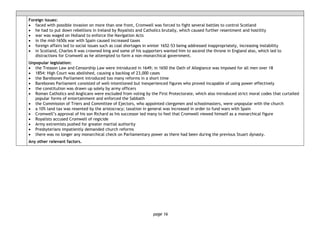
Foreign issues:
• faced with possible invasion on more than one front, Cromwell was forced to fight several battles to control Scotland
• he had to put down rebellions in Ireland by Royalists and Catholics brutally, which caused further resentment and hostility
• war was waged on Holland to enforce the Navigation Acts
• in the mid-1650s war with Spain caused increased taxes
• foreign affairs led to social issues such as coal shortages in winter 1652-53 being addressed inappropriately, increasing instability
• in Scotland, Charles II was crowned king and some of his supporters wanted him to ascend the throne in England also, which led to
distractions for Cromwell as he attempted to form a non-monarchical government.
Unpopular legislation:
• the Treason Law and Censorship Law were introduced in 1649; in 1650 the Oath of Allegiance was imposed for all men over 18
• 1854: High Court was abolished, causing a backlog of 23,000 cases
• the Barebones Parliament introduced too many reforms in a short time
• Barebones Parliament consisted of well-intentioned but inexperienced figures who proved incapable of using power effectively
• the constitution was drawn up solely by army officers
• Roman Catholics and Anglicans were excluded from voting by the First Protectorate, which also introduced strict moral codes that curtailed
popular forms of entertainment and enforced the Sabbath
• the Commission of Triers and Committee of Ejectors, who appointed clergymen and schoolmasters, were unpopular with the church
• a 10% land tax was resented by the aristocracy; taxation in general was increased in order to fund wars with Spain
• Cromwell’s approval of his son Richard as his successor led many to feel that Cromwell viewed himself as a monarchical figure
• Royalists accused Cromwell of regicide
• Army extremists pushed for greater martial authority
• Presbyterians impatiently demanded church reforms
• there was no longer any monarchical check on Parliamentary power as there had been during the previous Stuart dynasty.
Any other relevant factors.
page 17
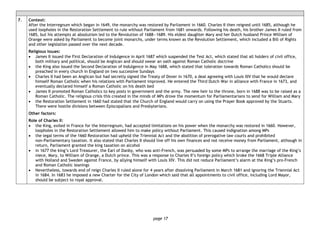
7. Context:
After the Interregnum which began in 1649, the monarchy was restored by Parliament in 1660. Charles II then reigned until 1685, although he
used loopholes in the Restoration Settlement to rule without Parliament from 1681 onwards. Following his death, his brother James II ruled from
1685, but his attempts at absolutism led to the Revolution of 1688―1689. His eldest daughter Mary and her Dutch husband Prince William of
Orange were asked by Parliament to become joint monarchs, under terms known as the Revolution Settlement, which included a Bill of Rights
and other legislation passed over the next decade.
Religious issues:
• James II issued the First Declaration of Indulgence in April 1687 which suspended the Test Act, which stated that all holders of civil office,
both military and political, should be Anglican and should swear an oath against Roman Catholic doctrine
• the King also issued the Second Declaration of Indulgence in May 1688, which stated that toleration towards Roman Catholics should be
preached in every church in England on two successive Sundays
• Charles II had been an Anglican but had secretly signed the Treaty of Dover in 1670, a deal agreeing with Louis XIV that he would declare
himself Roman Catholic when his relations with Parliament improved. He entered the Third Dutch War in alliance with France in 1673, and
eventually declared himself a Roman Catholic on his death bed
• James II promoted Roman Catholics to key posts in government and the army. The new heir to the throne, born in 1688 was to be raised as a
Roman Catholic. The religious crisis this created in the minds of MPs drove the momentum for Parliamentarians to send for William and Mary
• the Restoration Settlement in 1660 had stated that the Church of England would carry on using the Prayer Book approved by the Stuarts.
There were hostile divisions between Episcopalians and Presbyterians.
Other factors:
Role of Charles II:
• the King, exiled in France for the Interregnum, had accepted limitations on his power when the monarchy was restored in 1660. However,
loopholes in the Restoration Settlement allowed him to make policy without Parliament. This caused indignation among MPs
• the legal terms of the 1660 Restoration had upheld the Triennial Act and the abolition of prerogative law courts and prohibited
non-Parliamentary taxation. It also stated that Charles II should live off his own finances and not receive money from Parliament, although in
return, Parliament granted the king taxation on alcohol
• in 1677 the king’s Lord Treasurer, the Earl of Danby, who was anti-French, was persuaded by some MPs to arrange the marriage of the King’s
niece, Mary, to William of Orange, a Dutch prince. This was a response to Charles II’s foreign policy which broke the 1668 Triple Alliance
with Holland and Sweden against France, by allying himself with Louis XIV. This did not reduce Parliament’s alarm at the King’s pro-French
and Roman Catholic leanings
• Nevertheless, towards end of reign Charles II ruled alone for 4 years after dissolving Parliament in March 1681 and ignoring the Triennial Act
in 1684. In 1683 he imposed a new Charter for the City of London which said that all appointments to civil office, including Lord Mayor,
should be subject to royal approval.
page 18
Role of James VII/II:
• the King, a Roman Catholic, ruled absolutely by dismissing Parliament in November 1685 before it could condemn Louis XIV’s persecution of
Huguenots, French Protestants. He then stationed a 16,000-strong army, including Roman Catholic officers, outside London
• James II imposed his will on the judicial system, re-establishing Prerogative Courts in 1686. In 1687, used the monarch’s Suspending Powers
to suspend laws against Roman Catholics, and used the Dispensing Powers later that year to dismiss these laws from the statute books
• James II replaced Anglican advisors and office holders with Roman Catholic ones, including making the Earl of Tyrconnell the Lord Lieutenant
of Ireland and Sir Roger Strickland the Admiral of the Royal Navy. He appointed Roman Catholics to important posts at Oxford and Cambridge
Universities
• in late 1688 as MPs made clear their determination to invite the King’s Protestant daughter Mary to become queen, he tried to use the
Stuarts’ links with Louis XIV to appeal for military and financial assistance. However, the French king offered little more than vocal support.
Political issues:
• James II’s use of the Suspending and Dispensing Powers in 1687, although not illegal, was seen by Parliament as a misuse of royal privilege.
Questions had also been raised by MPs over monarchical control of the army after the King called troops to London in 1685, which was
perceived as another abuse of power
• as in the pre-Civil War era, both post-Restoration Stuart monarchs advocated Divine Right and practised absolutism. Charles II’s dismissal of
Parliament in 1681 and James II’s dissolution in 1685 resembled Charles I’s conduct at the start of his ‘Eleven Year Tyranny’ in 1629
• Charles II’s Lord Chancellor, the Earl of Clarendon, had been unpopular due to his mishandling of the Second Dutch War between 1665 and
1667, and was even blamed for the Great Plague of 1665 and the Fire of London in 1666. MPs opposed his influence at court and impeached
him in 1667, forcing him into exile
• so, in June 1688 as crisis approached, James II hastily promised to recall Parliament by November and announced that Roman Catholics
would be ineligible to sit in it. He also replaced Roman Catholic advisors, as well as those in the high ranks of the army and navy, with
Protestant ones.
Role of Parliament:
• Parliament resented James II’s abuses of power but took comfort from thought that he would be succeeded by his Protestant daughter Mary.
However, the king’s wife had a son, James Edward, in June 1688, to be raised as Roman Catholic. This led to Parliament writing to Mary, by
now married to the Dutch Prince William of Orange, offering her the Crown
• William and Mary arrived at Torbay in November with an army of 15,000, and after many in the House of Lords declared their support for
William, on Christmas Day James II fled to France. Parliament had also persuaded the king’s younger daughter Anne, as well as leading
generals, to declare their support for Mary. Subsequent to these events, William and Mary became joint sovereigns on 13th
February 1689
• with no document resembling a Bill of Rights that would formalise the powers held by monarch and Parliament, some MPs felt that a
settlement involving William and Mary would have to include one. Without one, future monarchs, including William and Mary, could preach
notions of Divine Right, absolutism and passive obedience. This meant that Parliament wanted limitations on the power of the monarchy to
be written into law
page 19
• in February 1689, therefore, Parliament drew up a Declaration of Right, which legalised a new relationship between crown and Parliament in
matters such as finance, law, the succession and religion. This became the Bill of Rights in December that year and had to be signed by
William and Mary as a condition of their remaining on the throne. The importance of the Bill of Rights confirms the view that the blurred
lines between monarchs and Parliament had been a problem in the past.
Any other relevant factors.
page 20
8. Context:
After the reign of Charles II, James II ruled between 1685 and 1688, but his actions persuaded parliament that he was intent on establishing an
absolutist monarchy. After a series of negotiations, the King’s own daughters gave assurances that they would support a change in monarch,
which led to the Revolution of 1688―9. Parliament invited the king’s eldest daughter Mary and her Dutch husband, Prince William of Orange, to
become joint monarchs. A series of agreements made between 1689 and 1701, legalising the division of power between Parliament and the
crown, became known as the Revolution Settlement. This included the Bill of Rights which limited the power of the monarch in relation the
status held by the crown at the start of the seventeenth century.
Religious power:
• Parliament passed the Toleration Act of 1689: toleration of all Protestants except Unitarians, those who did not acknowledge the Holy
Trinity, and Roman Catholics. Parliament ensured Roman Catholicism could no longer be accepted
• although Non-Conformist Protestants could now worship freely, the new law maintained an Exclusion from Public Office clause, so they could
not obtain teaching positions at universities or elected posts in towns or the House of Commons
• the Toleration Act insisted that Non-Conformists take the Oath of Allegiance and Supremacy as a condition of their religious freedom
• Toleration Act stated the king was supreme Head of the Church of England. 400 Non-Jurors — priests and bishops refusing to acknowledge
William III — were expelled from their posts by Parliament
• however, the King, as head of the church, now had the power to appoint bishops and archbishops.
Legal powers of Crown and Parliament:
• 1689 Bill of Rights stated monarchs could no longer require excessive bail to be demanded from defendants nor ask judges to impose cruel
punishments
• ministers impeached by the House of Commons could not be pardoned by the crown
• in 1695 the Treason Act was altered to give defendants the rights to be told the indictment against them, to be defended by Counsel, to call
witnesses in their defence, and to demand that there be two witnesses against them to prove a case instead of the previous one
• Act of Settlement 1701 stated judges could only be removed from their positions if Parliament demanded this
• however, monarchs could still appoint judges.
Political issues:
• William and Mary agreed to the Bill of Rights in December 1689, legalising new relationship between Crown and Parliament
• Bill of Rights made it clear monarchs could no longer use royal prerogative to suspend or dispense with laws passed by Parliament, and could
not interfere in Parliamentary elections
• Bill of Rights also stated from now on MPs and peers could not be punished for exercising Parliamentary freedom of speech
• Licensing Act was repealed in 1695, removing restrictions on freedom of the press to report Parliamentary criticism of Crown
• Revolution Settlement provided for a Triennial Act passed in 1694. This was intended to keep MPs more closely in touch with public opinion.
Parliament was now more relevant to voters than ever before, although voters were still the landed classes
• however, the Revolution Settlement still allowed monarchs executive power, so they could dismiss Parliament at will and also rule alone for
up to three years and could still appoint peers.
page 21
Financial settlement:
• Parliament granted William III and Mary III £1,200,000 for court expenses in 1689, including £700,000 to pay civilians working for the state;
these became fixed annual amount in the Civil List Act of 1697
• a Procedure of Audit was established for MPs to check royal expenditure; crown financial independence was no longer possible
• the 1689 Bill of Rights stated the monarch could no longer levy taxes without Parliamentary consent; House of Commons now agreed an
annual Budget proposed by the Chancellor of the Exchequer, who between 1690 and 1694 was Richard Hampden; fiscal power now lay in the
hands of Parliament rather than the crown
• however, the monarch benefited from no longer having to resort to unpopular methods of raising revenue; from now on it would be
Parliament that incurred the wrath of citizens for increasing taxation.
Loopholes in the Settlement:
• the crown still greatly influenced Scotland by appointing ministers who would not challenge English policy
• successive monarchs would be able to control legislation in Scotland as well as interfere in Scotland’s external affairs, especially in relation
to trade with England’s enemies
• William and Mary were able to break promises made to Roman Catholics in Ireland, imprisoning Irish rebels who had previously been
guaranteed safe passage to Ireland in the wake of William’s 1690 campaign to enforce his sovereignty in Ireland
• William held sway over many MPs who voted to impose the Penal Laws of 1693―94, excluding Roman Catholics in Ireland from the learned
professions and elected public office
• the monarch still exerted control over English foreign policy, having the final say on the decision to send the army to war or to sign peace
treaties
• King William used his patronage to appoint officers in both the army and navy, maintaining favour with those who owed him their promoted
positions
• the Hanoverian Succession was desired by William anyway, and so the crown was getting its own way
• the Bill of Rights had declared James II’s removal from the English throne as an act of abdication, which accorded the monarch, and future
monarchs, a status which Parliament could not challenge.
Any other relevant factors.
page 22
PART C — The Atlantic slave trade
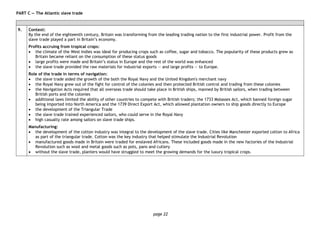
9. Context:
By the end of the eighteenth century, Britain was transforming from the leading trading nation to the first industrial power. Profit from the
slave trade played a part in Britain’s economy.
Profits accruing from tropical crops:
• the climate of the West Indies was ideal for producing crops such as coffee, sugar and tobacco. The popularity of these products grew as
Britain became reliant on the consumption of these status goods
• large profits were made and Britain’s status in Europe and the rest of the world was enhanced
• the slave trade provided the raw materials for industrial exports — and large profits — to Europe.
Role of the trade in terms of navigation:
• the slave trade aided the growth of the both the Royal Navy and the United Kingdom's merchant navy
• the Royal Navy grew out of the fight for control of the colonies and then protected British control and trading from these colonies
• the Navigation Acts required that all overseas trade should take place in British ships, manned by British sailors, when trading between
British ports and the colonies
• additional laws limited the ability of other countries to compete with British traders; the 1733 Molasses Act, which banned foreign sugar
being imported into North America and the 1739 Direct Export Act, which allowed plantation owners to ship goods directly to Europe
• the development of the Triangular Trade
• the slave trade trained experienced sailors, who could serve in the Royal Navy
• high casualty rate among sailors on slave trade ships.
Manufacturing:
• the development of the cotton industry was integral to the development of the slave trade. Cities like Manchester exported cotton to Africa
as part of the triangular trade. Cotton was the key industry that helped stimulate the Industrial Revolution
• manufactured goods made in Britain were traded for enslaved Africans. These included goods made in the new factories of the Industrial
Revolution such as wool and metal goods such as pots, pans and cutlery
• without the slave trade, planters would have struggled to meet the growing demands for the luxury tropical crops.
page 23
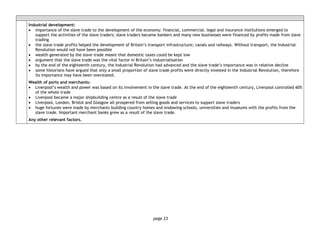
Industrial development:
• importance of the slave trade to the development of the economy: financial, commercial, legal and insurance institutions emerged to
support the activities of the slave traders; slave traders became bankers and many new businesses were financed by profits made from slave
trading
• the slave trade profits helped the development of Britain’s transport infrastructure; canals and railways. Without transport, the Industrial
Revolution would not have been possible
• wealth generated by the slave trade meant that domestic taxes could be kept low
• argument that the slave trade was the vital factor in Britain’s industrialisation
• by the end of the eighteenth century, the Industrial Revolution had advanced and the slave trade’s importance was in relative decline
• some historians have argued that only a small proportion of slave trade profits were directly invested in the Industrial Revolution, therefore
its importance may have been overstated.
Wealth of ports and merchants:
• Liverpool’s wealth and power was based on its involvement in the slave trade. At the end of the eighteenth century, Liverpool controlled 60%
of the whole trade
• Liverpool became a major shipbuilding centre as a result of the slave trade
• Liverpool, London, Bristol and Glasgow all prospered from selling goods and services to support slave traders
• huge fortunes were made by merchants building country homes and endowing schools, universities and museums with the profits from the
slave trade. Important merchant banks grew as a result of the slave trade.
Any other relevant factors.
page 24
10. Context:
The Atlantic slave trade changed the lives of millions of Africans who were forcibly transported to the North American continent and West Indies
during the eighteenth century. The impact of such population loss on Africa itself was profound, culturally and economically. Individual slaves
were exploited for the benefit of wealthy European traders and businessmen, and powerful Africans.
Slave sellers and European ‘factories’ on the West African coast:
• Europeans seldom ventured inland to capture the millions of people who were transported from Africa as captives. African ‘middlemen’
usually sold slaves to European factors who collected the slaves on the coast. In the areas where slavery was not practised, such as among
the Xhosa people of southern Africa, European slave ship captains were unable to buy African captives
• European ‘factories’ were developed on the coast to control the slave trade. These ‘factories’ or forts held slaves until the arrival of slave
ships.
Development of slave-based states and economies:
• Africans could be taken into slavery as punishment for a crime, as payment for a family debt, or most commonly of all, by being captured as
prisoners of war. With the arrival of European and American ships offering trading goods in exchange for captives, Africans had an added
incentive to enslave each other
• some societies preyed on others to obtain captives in exchange for European firearms, in the belief that if they did not acquire firearms in
this way to protect themselves, they would be attacked and captured by their rivals and enemies who did possess such weapons. At the
height of the Atlantic Slave Trade, only those states equipped with guns could withstand attacks from their neighbours. The acquisition of
guns gave rulers an advantage over rivals and gave them greater incentive to capture and sell slaves. This led to the growth of kingdoms such
as Dahomey whose key purpose was the slave trade. The mass importation of guns for slaves affected the balance of power between
kingdoms
• as the Atlantic Slave Trade developed, more African societies became involved in the trade of slaves.
Destruction of societies:
• rich and powerful Africans were able to demand a variety of consumer goods, such as textiles, glassware, pottery, ironmongery and in some
places, even gold for captives, who may have been acquired through warfare or by other means, initially without massive disruption to
African societies
• by the end of 17th
century, European demand for African captives, particularly for the sugar plantations in the Americas, became so great
that they could only be acquired through initiating raiding and warfare; large areas of Africa were devastated and societies disintegrated. As
the temptation to go to war increased, existing systems of rule based on kinship and consent were destroyed
• it is estimated that over 12 million people were transported from Africa over the eighteenth century. In addition, many more Africans died
during the journey from the interior to the coast — a journey which could take weeks. This was a huge drain on the most productive and
economically active sections of the population, and this led to economic dislocation and falls in production of food and other goods
• Europeans also brought diseases which contributed to the decline in population of African societies.
page 25
Development of foreign colonies:
• West Africa was impoverished by its relationship with Europe while the human and other resources that were taken from Africa contributed
to the economic development and wealth of Europe and the European colonies in the New World
• the transatlantic trade also created the conditions for the subsequent colonial conquest of Africa by the European powers.
Roles played by leaders of African societies in continuing the trade:
• African slave sellers grew wealthy by selling African captives to European traders on the coast. They were able to deal on equal terms with
European traders who built ‘factories’ on the West African coast to house captives before selling them onto the slave ship captains who in
turn transported the captives to the colonies of the New World
• on the African side, the slave trade was generally the business of rulers or wealthy and powerful merchants, concerned with their own selfish
or narrow interests, rather than those of the continent. At that time, there was no concept of being African — identity and loyalty were
based on kinship or membership of a specific kingdom or society, rather than to the African continent
• states based on slavery, particularly Dahomey, grew in power and influence. The Asante (Ashanti) people who traded in gold and in slaves
dominated the area known as the Gold Coast (Ghana).
Any other relevant factors.
page 26
11. Context:
The early progress of the abolitionist campaign was slow owing to a range of vested interests. However, by the 1790s the abolitionists were
winning the moral argument.
Attitudes of British governments:
• successive governments were more concerned with maintaining revenue and the rights of property of their wealthiest citizens rather than
those of black slaves who had no political stake or influence in Britain
• slave merchants from London, Liverpool and Bristol ensured that their MPs influenced successive governments to help maintain/protect the
slave trade. They either bought votes or put pressure on others
• the nature of politics at this time meant that there were not distinct political parties but various interest groups. Parliament was dominated
by the West India lobby, which for a long time was the most powerful group in the Commons. The Duke of Clarence, one of George III’s sons,
was a member of the West India interest group
• Governments were often coalitions of different interest groups, often pro-slavery. This ensured that opposition to the slave trade did not
gather government support
• many absentee plantation owners or merchants held high political office or were MPs themselves, thus influencing the attitude of British
governments for example William Beckford, owner of an estate in Jamaica, was twice Mayor of London. In the later 18th
century, over 50 MPs
represented the slave plantations
• MPs used delaying tactics to slow down or prevent legislation for example Henry Dundas, the unofficial ‘King of Scotland’, Secretary of State
for War and First Lord of the Admiralty used his position to protect the interests of slave owners and merchants. In 1792, he effectively
‘killed’ Wilberforce’s Bill banning the slave trade by proposing a compromise that any abolition would take place over several years, which
Dundas knew Wilberforce could not accept
• attitudes were influenced by direct pressure from slave merchants on the government for example in 1775, a petition was sent from Bristol
urging support for the slave trade.
Other factors:
Slave rebellion in St Domingue:
• pro-slavery groups pointed to this rebellion as an example of what would happen if slaves were freed. The revolt began in 1791 and
continued until 1804. An independent country calling itself Haiti was set up under the leadership of Toussaint L’Ouverture. It is estimated
that as many as 200,000 people died. The general fear of slave revolt was increased as a result
• unsuccessful attempts by colonial French troop to regain control shocked the British Government. There were fears that the rebellion could
spread to neighbouring British islands such as Jamaica. Any attempts to abolish the slave trade were thwarted because it was claimed that
the West Indies could be become unsafe and unstable
• the British were humiliated when their attempts to regain control of Haiti were also unsuccessful.
page 27
Effects of the French Revolution:
• sympathy for the French Revolution disappeared with the execution of Louis XVI. Wealthy people reacted with horror to idea that similar
society upheaval could happen in Britain. Many wealthy people associated abolitionism with the dangerous radicalism in France
• the abolitionist cause was associated with revolutionary ideas for example Clarkson openly supported the French Revolution
• general fears about law and order led to laws limiting the right of assembly and protest. Even abolition campaigners like William Wilberforce
supported these laws. The laws limited the growth of abolition societies
• after Napoleon came to power in France, Britain became involved in the French Revolutionary Wars leading to a decrease in support for
abolition
• supporters of the slave trade argued that it was necessary to pay for Britain’s involvement in the French Revolutionary Wars; it seemed
unpatriotic not the support the slave trade
• radicals used similar tactics as abolitionists to win public support — associations, petitions, cheap publications, public lectures, public
meetings, pressure on Parliament. This linked abolitionism with political radicalism in peoples’ minds, which during the French Revolutionary
Wars, they felt pressure to oppose.
Importance of the trade to the British economy:
• the slave trade generated money — West Indian colonies were an important source of valuable exports to European neighbours
• British people became reliant on cheaper sugar and tobacco from the plantations and British cotton mills depended on the cotton crops
raised by slaves
• British shipbuilding benefited from the slave trade as did associated industries
• British industry received a boost from trading with Africa
• alternative funds would have to be raised in order to compensate for the loss of trade and revenue; more taxes
• Britain’s finance and insurance industry prospered on the back of the slave trade. Many individual fortunes were made
• abolition would help foreign rivals such as France as other nations would fill the gap left by Britain.
Anti-abolition propaganda:
• lobbyists like the West Indies lobby conducted a powerful propaganda campaign to counter that of the abolitionists, producing countless
letters and articles for newspapers
• pro-slavery campaigners produced books and plays supporting the slave trade for example, in 1788 William Beckford wrote a book on:
‘Remarks Upon the Situation of Negroes in Jamaica’; Thomas Bellamy wrote a play in 1789 called ‘The Benevolent Planters’ telling the story
of black slaves separated in Africa, but reunited by their owners
• slave owners and their supporters argued abolition of the slave trade was not legal because it would undermine a central tenet of British
law; the right to private property. They successfully discouraged the Government from contemplating abolition without compensation
because of the massive legal battle that would ensue.
Any other relevant factors.
page 28
12. Context:
At the end of the eighteenth century, even as slave owning remained profitable, there were growing demands for abolition of the trade and
slavery itself. Successful slave rebellions increased fear of slave revolts.
Effects of slave resistance:
• successful slave rebellions like in Saint-Domingue (Haiti) increased the general fear of slave revolts
• abolition of the slave trade would mean slave conditions would have to improve because slaves would become more valuable. There were
concerns that unless conditions improved, more slave revolts would follow
• on Jamaica a substantial number of runaways lived outside the control of the authorities in the mountains. Successive attempts to bring
escaped slaves under control had failed, which made it harder to maintain slavery without changes.
Other factors:
Decline in economic importance of slavery:
• impact of wars with France — as a result the slave trade declined by two-thirds
• the Industrial Revolution had increased the importance of manufactured British goods and agriculture; Britain became less dependent on
trading goods
• the slave trade became less important in economic terms — less demand for large numbers of slaves to be imported to the British colonies
• there was a world over-supply of sugar and British merchants had difficulties re-exporting it
• growing competition from parts of the Empire like India, who were producing crops like sugar on a larger scale and more cheaply.
Military factors:
• the abolition of the trade would undermine Napoleon’s effort to restore French control in the Caribbean; the abolition campaign helped
British interests
• the 1806 Act banning any slave trade between British merchants and foreign colonies was aimed at attacking French interests by limiting
their ability to engage in a lucrative trade.
page 29
Campaign of the Anti-Slavery Society:
• Thomas Clarkson toured ports and cities connected with the slave trade to obtain witnesses for the Parliamentary investigations of the slave
trade which provided Wilberforce with convincing evidence for his speeches
• the Society for the Abolition of the Slave Trade published books and pamphlets for example eyewitness accounts from former slaves such as
Olaudah Equiano
• ran campaigns to boycott goods produced by slaves in the West Indies such as sugar and rum. Supported the selling of products like sugar,
which had not been produced by slave labour
• public meetings and lecture tours involving those with experience of slave trade for example John Newton; churches and theatres used for
abolitionist propaganda
• organised petitions and subscription lists supporting the abolition of slavery, also artefacts and illustrations for example Wedgwood pottery
• lobbying of MPs to get promises that they would oppose the slave trade
• effective moderate political and religious leadership among the abolitionists influenced major figures such as Pitt and Fox to support their
cause; abolitionists gave evidence to Parliamentary Commissions
• the religious revival of the late eighteenth century was at the heart of the anti-slavery movement. Many of the early leaders came from non-
Conformist churches such as Quakers and Methodists or Presbyterians and Baptists.
Role of Wilberforce:
• Wilberforce spent eighteen years putting forward the arguments of the Society for the Abolition of the slave trade in Parliament
• Wilberforce’s speeches in Parliament were effective in drawing attention to the cause
• Wilberforce was well connected politically; he was friends with William Pitt the Younger who was Prime Minister, for example
• Wilberforce’s Christian faith had led him to become interested in social reform. He linked the need to reform factory conditions in Britain
with the need to abolish slavery and the slave trade within the British Empire
• Wilberforce collaborated with other abolitionists to achieve his aims, including the Quakers, Thomas Clarkson and Olaudah Equiano.
Any other relevant factors.
page 30
PART D — Britain, 1851−1951
13. Context:
Political change in Britain was an evolutionary, rather than revolutionary, process. These slow changes tended to see people given access to the
political system in the 19th century because they had proven themselves worthy of the vote. By the 20th century, developments tended to be
bout the rights of citizens and their equality in the political system.
Widening of the franchise:
• in 1867 most skilled working class men in towns got the vote
• in 1884 many more men in the countryside were given the vote
• in 1918 most men over 21 and some women over 30 gained the vote
• finally in 1928 all men and women over 21 were given the vote.
Distribution of seats:
• re-distribution of seats in 1867, 1885 and 1918 all helped create a fairer system of voting. Scotland more fully represented by 1928
• the effectiveness of these varied; they were less effective in areas where the electorate was small, or where a landowner or employer was
dominant in an area, for example Norwich.
Corruption and intimidation:
• Secret Ballot Act 1872 freed voters from intimidation
• Corrupt and Illegal Practices Act 1883 limited the amount spent campaigning.
Widening membership of the House of Commons:
• the property qualification to be MP was abolished 1858. Payment for MPs began in 1911 enabling working class men to sit
• by 1928 Parliament was much more fully representative of the British people.
Role of the House of Lords:
• from 1911 Lords could only delay bills from the House of Commons for two years rather than veto them
• the Lords had no control over money bills.
Choice:
• although the working class electorate increased by 1880s there was no national party to express their interests. The Liberals and
Conservatives promoted middle, even upper class capitalist values
• the spread of socialist ideas and trade unionism led to the creation of the prototype Labour Party — the LRC — by 1900 thereby offering a
wider choice to the electorate.
Access to information:
• Education — in the later 19th
Century there was a great increase in literacy and hence access to information on which to base choice. Also
railways spread information nationally and were important to the growth of democracy.
page 31
National Party Organisation:
• As the size of the electorate grew individual political parties had to make sure their ‘message’ got across to electorate for example
development of National Liberal Federation, Conservative Central Office, Primrose League.
Any other relevant factors.
page 32
14. Context:
Attitudes towards poverty in the 19th century were laissez-faire. The Liberals had not been elected on a social reform ticket in 1906. However,
the overwhelming evidence regarding the scale of poverty, as well as developing concerns about the health of the nation (as an Empire Britain
could ill afford to let her economic lead slip), led to a series of limited social reforms that were initiated by the Liberal Party. This was in part
due to the reports of Booth and Rowntree.
Social surveys of Booth and Rowntree:
• the reports of Charles Booth in London and Seebohm Rowntree in York demonstrated that poverty had causes such as low pay,
unemployment, sickness and old age. Rather than a problem of character these were largely out with the control of the individual
• they provided the statistical evidence detailing the scale of poverty that was difficult for the government to ignore
• the extent of poverty revealed in the surveys was also a shock. Booth’s initial survey was confined to the east end of London, but his later
volumes covering the rest of London revealed that almost one third of the capital’s population lived in poverty. York was a relatively
prosperous small town, but even there, poverty was deep-rooted with a similar percentage of the population living in poverty
• Rowntree identified primary and secondary poverty
• Rowntree identified a cycle of poverty.
Other Factors:
Municipal socialism:
• by the end of the century, some Liberal-controlled local authorities had become involved in programmes of social welfare. The shocked
reaction to the reports on poverty was a pressure for further reform
• in Birmingham particularly, but also in other large industrial cities, local authorities had taken the lead in providing social welfare schemes.
These served as an example for further reforms
• Joseph Chamberlain was mayor of Birmingham between 1873 and 1875. Under his leadership gas and water supplies came under public
ownership. He also oversaw the clearing of slums and the development of parks
• Glasgow’s local authority also supported Municipal Socialism and controlled the water supply and provided gas street lighting to improve
people’s lives.
Fears over national security:
• the government became alarmed when almost 25% of the volunteers to fight in the Boer War were rejected because they were physically
unfit to serve in the armed forces
• there was concern whether Britain could survive a war or protect its empire against a far stronger enemy in the future if the nation’s
‘fighting stock’ of young men was so unhealthy
• link between national security concerns and national efficiency concerns; financial or economic security
• by the end of the 19th
century, Britain was facing serious competition from new industrial nations such as Germany. It was believed that if
the health and educational standards of Britain’s workers got worse, then Britain’s position as a strong industrial power would be
threatened.
page 33
New Liberalism:
• New Liberals argued that state intervention was necessary to liberate people from social problems over which they had no control. New
Liberal ideas were not important issues in the general election of 1906. Only when ‘old liberal’ Prime Minister Campbell Bannerman died in
1908, was the door opened for new ‘interventionist’ ideas
• leading New Liberals like David Lloyd George and Winston Churchill were important in initiating reform
• New Liberalism provided the rationale for increased state intervention in people’s lives. This was limited however.
Rise of Labour:
• by 1906, the newly formed Labour Party was competing for the same votes as the Liberals. It can be argued that the reforms happened for
the very selfish reason of retaining working-class vote
• the Liberals recognised the electoral threat of the Labour Representation Committee (Labour Party from 1906) and in 1903 negotiated a
Liberal-Labour electoral pact which allowed Labour to run unopposed by the Liberals in seats where there was a large working-class vote. By
1910, Labour had 42 seats. To prevent a further decline in Liberal support before the 1910 election, Winston Churchill established the Labour
Exchange Act, and Lloyd George’s famous, ‘Peoples Budget’ of 1909 which taxed the rich for the poor
• Liberals such as Lloyd George saw social reform as a way to ‘stop this electoral rot’ as Liberals lost seats in the 1910 elections to Labour.
Any other relevant factors.
page 34
15. Context:
Attitudes towards poverty in the 19th
century were laissez-faire. Although the Liberals had not been elected on a social reform ticket in 1906,
the overwhelming evidence regarding the scale of poverty, as well as developing concerns about the health of the nation (as an Empire Britain
could ill afford to let her economic lead slip), led to a series of limited social reforms that were introduced by the Liberal Party.
The young:
• children were thought to be the victims of poverty and unable to escape through their own efforts. In this way they were seen as ‘the
deserving poor’. Child neglect and abuse were seen as problems associated with poverty
• the Provision of School Meals Act allowed local authorities to raise money to pay for school meals but the law did not force local authorities
to provide school meals
• medical inspections were made compulsory for children after 1907 but no treatment of illnesses or infections found was provided until 1912
• the Children’s Charter of 1908 banned children under 16 from smoking, drinking alcohol, or begging. New juvenile courts were set up for
children accused of committing crimes, as were borstals for children convicted of breaking the law
• probation officers were employed to help former offenders in an attempt to avoid reoffending
• the time taken to enforce all the legislation meant the Children’s Charter only helped improve conditions for some children during the
period.
The old:
• Rowntree had identified old age as the time when most people dropped below his poverty line. Old age was inescapable and so was clearly
associated with the problem of poverty
• Old Age Pensions Act (1908) gave people over 70 up to 5 shillings a week. Once a person over 70 had income above 12 shillings a week, their
entitlement to a pension stopped. Married couples were given 7 shillings and 6 pence
• the level of benefit was low. Few of the elderly poor would live until their 70th birthday. Some of the old were excluded from claiming
pensions because they failed to meet the qualification rules.
The sick:
• illness can be seen as both a cause and consequence of poverty
• part 1 of the National Insurance Act 1911 applied to workers earning less than £160 a year. Each insured worker got 9 pence in contributions
from an outlay of 4 pence — ‘ninepence for fourpence’. As a result, workers received 10s a week if they could not go to work because they
were too sick
• only the insured worker got free medical treatment from a doctor. Other family members did not benefit from the scheme. The weekly
contribution was in effect a wage cut which might simply have made poverty worse in many families.
The unemployed:
• unemployment was certainly a cause of poverty
• the National Insurance Act (Part 2) only covered unemployment for some workers in some industries and like Part 1 of the Act, required
contributions from workers, employers and the government (7s 6d for 15 weeks 2 1/2d per week from the worker and 2 1/2d from the
government)
• for most workers, no unemployment insurance scheme existed
• Labour Exchanges Act 1909. To help the unemployed find employment.
page 35
The employed:
• in 1906 a Workman’s Compensation Act covered a further six million workers who could now claim compensation for injuries and diseases
which were the result of working conditions
• in 1909, the Trade Boards Act tried to protect workers in the sweated trades like tailoring and lace making by setting up trade boards to fix
minimum wages
• the Mines Act 1912 and the Shops Act 1911 improved conditions.
Any other relevant factors.
page 36
16. Context:
In his report in 1942, William Beveridge identified 5 giants of poverty: Want, Disease, Ignorance, Squalor and Idleness. In the aftermath of the
Second World War there was a desire to build a better Britain for all. Reforms based on Beveridge’s report were passed by the new Labour
government.
Want:
• 1946 the first step was made: The National Insurance Act: consisted of comprehensive insurance sickness and unemployment benefits and
cover for most eventualities
• it was said to support people from the ‘cradle to the grave’ which was significant as it meant people had protection against falling into
poverty throughout their lives
• the Industrial Injuries Act 1946 was very effective as it meant that if the breadwinner of the family was injured then the family was less
likely to fall further into the poverty trap, as was common before. However, this act can be criticised for its failure to go far enough
• benefits were only granted to those who made 156 weekly contributions
• in 1948 the National Assistance Board was set up in order to cover those for whom insurance did not do enough
• this was important as it acted as a safety net to protect these people
• this was vital as the problem of people not being aided by the insurance benefits was becoming a severe issue as time passed. Yet, some
criticised this as many citizens still remained below subsistence level showing the problem of want had not completely been addressed.
Disease:
• the establishment of the NHS in 1948 dealt effectively with the spread of disease
• the NHS was the first comprehensive universal system of health in Britain
• offered vaccination and immunisation against disease, almost totally eradicating some of Britain's most deadly illnesses
• it also offered helpful services to Britain's public, such as child care, the introduction of prescriptions, health visiting and provision for the
elderly, providing a safety net across the whole country: the fact that the public did not have to pay for their health meant that everyone,
regardless of their financial situation, was entitled to equal opportunities of health care they had previously not experienced
• NHS could be regarded as almost too successful. The demand from the public was overwhelming, as the estimated amount of patients
treated by them almost doubled. Introduction of charges for prescriptions, etc.
page 37
Squalor:
• after the war there was a great shortage of housing as the war had destroyed and damaged thousands of homes; and the slum clearing
programmes of the 1930s had done little to rectify the situation which was leading to a number of other problems for the government
• tackling the housing shortage and amending the disastrous results of the war fell upon Bevan's Ministry of Health
• Labour’s target for housing was to build 200,000 new homes a year. 157,000 pre-fabricated homes were built to a good standard, however
this number would not suffice and the target was never met
• Bevan encouraged the building of council houses rather than privately funded construction
• the New Towns Act of 1946, aimed to target overcrowding in the increasingly built up older cities. By 1950, the government had designed 12
new communities
• in an attempt to eradicate slums the Town and Country Planning Act provided local communities more power in regards to building
developments and new housing
• by the time Labour left government office in 1951 there was still a huge shortfall in British housing.
Ignorance:
• reform started by the wartime government: The 1944 Education Act raised the age at which people could leave school to 15 as part of a
drive to create more skilled workers which Britain lacked at the time. Introduction of school milk, etc
• Labour introduced a three-tiered secondary schooling whereby pupils were split at the age of 11 (12 in Scotland) depending on their ability.
The pupils who passed the ‘11+ exam’ went to grammar, secondary moderns and technical schools
• those who went to grammar schools were expected to stay on past the age of 15 and this created a group of people who would take senior
jobs in the country thus solving the skills shortages. Whilst this separation of ability in theory meant that children of even poor background
could get equal opportunities in life, in practice the system actually created a bigger division between the poor and the rich. In many cases,
the already existing inequalities between the classes was exacerbated rather than narrowed
• Labour expanded university education: introduction of grants so all could attend in theory.
Idleness
• unemployment was basically non-existent so the government had little to do to tackle idleness
• the few changes they did make were effective in increasing the likelihood of being able to find work, because they increased direct
government funding for the universities which led to a 60% increase in student numbers between 1945―46 and 1950―51, which helped to
meet the manpower requirements of post-war society. This provided more skilled workers and allowed people from less advantaged
backgrounds to pursue a higher education, aiming to keep unemployment rates down
• Labour government also nationalised 20 percent of industry — the railways, mines, gas and electricity. This therefore meant that the
government were directly involved with people employed in these huge industries which were increasing in size dramatically
• this tackled idleness by the government having control which meant that employees were less likely to lose their job through industries going
bankrupt and people were working directly to benefit society.
Any other relevant factors.
page 38
PART E — Britain and Ireland, 1900―1985
17. Context:
Initially World War I brought prosperity to Ireland. The demands on manufacturing and farming brought low unemployment thus improving
relations between Britain and Ireland. However, Sinn Fèin, the Easter Rising and the Protestant reaction were to change this along increasingly
sectarian lines.
Irish Attitudes to World War I:
• propaganda — powerful Germany invading helpless and small Catholic Belgium so Ireland initially supported Britain
• Ulster very supportive of Britain to ensure favourable treatment at the end of the war
• Nationalists and Redmond backed war to get Home Rule, urging Irish men to enlist
• press gave support to the war effort
• Irish Volunteers gave support to help Home Rule be passed after the war
• recruitment was successful in the south as almost 1/4 million men join up
• opposition to war very much a minority in 1914 but supported by Sinn Fèin and Arthur Griffith (not powerful at this time), as well as Pearse,
Connolly and their supporters and also a section of the Irish Volunteers. This damaged relations with Britain.
Impact of the Easter Rising:
• rebels saw war as chance to rid Ireland of British by force
• felt it was opportunity to gain independence by force as Britain had their troops away fighting the Germans in World War I. This greatly
strained relations between Britain and Ireland
• Britain had to use force to suppress rebellion, such as using the gunboat Helga’ to sail up the River Liffey and fire on the rebels in the GPO,
thus distracting Britain’s attention and resources away from the war effort, thus straining relations
• strong criticism of Rising initially from the public, politicians, churchmen, as well as press for unnecessary death and destruction. 450 dead,
2500 wounded, cost £2½ million, showing that majority still sided with Britain therefore indicating that there was not too much damage to
relations between the two countries
• initial hostility by majority of Irish people to Rising by small group of rebels, majority of people supported Redmond and the Nationalists
Party
• strong hostility and criticism by Dubliners to rebels for destruction of city centre
• the secret court martial and execution of the leaders of the Easter Rising over 10 days as well as imprisonment without trial and at least one
execution without a trial saw the rebels gain a lot of sympathy from the Irish public, turning them against British rule.
Anti-conscription campaign:
• Irish opposed conscription and pushed people in protest to Sinn Fèin who openly opposed it
• caused the Nationalists to withdraw from Westminster
• Sinn Fèin and Nationalists organised campaign for example General Strike 23 April 1918
• Catholic Church, Mayor of Dublin drew up the National Pledge opposing conscription
• conscription was not applied to Ireland which Sinn Fèin was given credit for
• conscription campaign drove Sinn Fèin underground which improved their organisation.
page 39
Decline of the Nationalist Party:
• opposition to war was very much a minority in 1914 but supported by Sinn Fèin and Arthur Griffith (not powerful at this time), as well as
Pearse, Connolly and their supporters and also a section of the Irish Volunteers. This damaged relations with Britain
• Redmond was further weakened in 1914 in the formation by Sinn Féin members of the militaristic Irish Volunteers. His enthusiastic support
for the British war effort alienated many Catholics
• when the situation worsened in WWI, a new Conservative-Liberal coalition government was formed in May 1915. Redmond was offered a seat
in its cabinet, which he declined. This was welcomed in Ireland but greatly weakened his position after his rival, unionist leader Carson
accepted a cabinet post
• the Easter Rising in April 1916 began the decline of constitutional nationalism as represented by the Nationalists and the ascent of a more
radical separatist form of Irish nationalism.
Rise of Sinn Fèin:
• these political developments meant a growth of sympathy and compassion for rebels who were seen as martyrs and replaced the initial
condemnation of the Rising
• Sinn Fèin initially blamed for the Rising saw a subsequent rise in support for them
• Catholic Church and business community became more sympathetic to the cause of independence.
Any other relevant factors.
page 40
18. Context:
The Civil War was a direct consequence of the Anglo-Irish Treaty which was itself the result of the Irish War of Independence. Those who had
signed the Treaty, headed by Michael Collins and Arthur Griffith formed a Provisional Government to oversee the handover of power from the
British to the new Irish state. However, what brought about the civil war was the split in ranks of the IRA.
Role of Collins:
• Collins and Griffiths led a young and relatively inexperienced group to negotiate the Treaty with the British politicians Lloyd George, Winston
Churchill and Austen Chamberlain, but was pressured to sign it under a threat of escalation of the conflict
• Collins defended the Treaty as he claimed it gave Ireland ‘freedom to achieve freedom’
• Collins and Griffiths started informal negotiations with the British side and hammered out the details of the treaty
• he claimed Ireland had its own elected government, so Britain was no longer the enemy
• he recognised that the war was unwinnable, both for the IRA and the UK government.
Other Factors:
Anglo-Irish Treaty:
• Ireland was to be the ‘Irish Free State’, governing itself, making its own laws but remaining in the Empire
• a Governor-General was to represent the king: Britain was to remove its forces but keep the use of its naval bases
• trade relations were settled
• Lloyd George threatened the Irish delegation with war if they did not sign
• Government of Ireland Act split Ireland in two, with six counties in the North and 26 in the South. In Northern Ireland, Unionists won 40 of
the 52 seats available. A third of the Ulster population was Catholic and wanted to be united with the South
• the 26 counties in the South had a separate parliament in Dublin. The Council of Ireland was set up. The IRA refused to recognise the new
parliament and kept up its violence. Sectarian violence increased in Ulster; without partition, this could have been much worse
• in the South, the Government of Ireland Act was ignored. Sinn Fèin won 124 seats unopposed. Partition was a highly emotive issue, and it
alone would have caused discord.
Role of the British government:
• in July 1921, a truce was arranged between the British and Irish Republican forces. Negotiations were opened and ended in the signing of the
Treaty on 6 December 1921
• the Treaty gave the 26 southern counties of Ireland a considerable degree of independence, the same within the British commonwealth as
Australia and Canada
• under this agreement, Ireland became a Dominion of the British Empire, rather than being completely independent of Britain. Under
Dominion status, the new Irish State had three important things to adhere to: the elected representatives of the people were to take an oath
of allegiance to the British Crown; the Crown was to be represented by a Governor General; appeals in certain legal cases could be taken to
the Privy Council in London
• this aspect of the Treaty was repugnant to many Irish people, not just Republicans
• the British military garrison was to be withdrawn and the RIC police disbanded.
page 41
Divisions in the republican movement:
• the Treaty was hotly debated in the Dáil. Collins and much of the IRA supported the Treaty, as Ireland now had an elected government. De
Valera opposed it and felt it should be resisted even if it meant Civil War. They represented the two wings of the Republican movement
• also influential were the widows and other relatives of those who had died; they were vocal in their opposition to the Treaty
• the Treaty was particularly disappointing to left-wing Republicans who had hopes of establishing a socialist republic
• the Treaty was accepted by 64 votes to 57 by the Dáil Eíreann on 7 January 1922
• Collins and De Valera tried to reach a compromise to avoid war, but none was reached. Some of the IRA units supported the Treaty, whilst
others opposed it
• some of the anti-Treaty IRA took over some important buildings in Dublin for example Four Courts
• this division, crystallised by the murder of Sir Henry Wilson (security adviser for the Northern Ireland government), forced Michael Collins to
call on the official IRA to suppress the ‘Irregular IRA’.
Role of De Valera:
• De Valera was President of the Irish Republic showing his opposition to any sort of deal whereby Irish status was linked to the British
Commonwealth. As President De Valera had instructed his negotiating team to refer back to his cabinet on any question which created
difficulties. When the Treaty was signed it had not been referred back to the Irish cabinet
• De Valera refused to accept the terms of the Treaty as they were in ‘violent conflict with the wishes of the majority of the nation’. De
Valera claimed that the Treaty meant partition of Ireland and abandonment of sovereignty. De Valera felt he should have been consulted
before the Treaty was signed
• De Valera voted against the Treaty and resigned as President to be replaced by Griffith and Collins became Head of the Irish Free
Government.
Any other relevant factors.
page 42
19. Context:
By the early 1960s Northern Ireland was relatively stable. However, the Northern Ireland Nationalists were discriminated against in terms of
housing, employment and electorally. In 1964 a peaceful civil rights campaign started to end the discrimination against Catholics in Northern
Ireland.
Economic issues:
• Northern Ireland was left relatively prosperous by World War II, with the boom continuing into the 1950s. But by the 1960s, as elsewhere in
Britain, these industries were in decline for example Harland and Wolff profitable ‘til early’60s, but government help in 1966. Largely
Protestant workforce protected as a result
• Catholic areas received less government investment than their Protestant neighbours. Catholics were more likely to be unemployed or in
low-paid jobs than Protestants in Northern Ireland. Catholic applicants also routinely excluded from public service appointments
• the incomes of mainly Protestant landowners were supported by the British system of ‘deficiency payments’ which gave Northern Ireland
farmers an advantage over farmers from the Irish Republic
• Brookeborough’s failure to address the worsening economic situation saw him forced to resign as Prime Minister. His successor, Terence
O’Neill set out to reform the economy. His social and economic policies saw growing discontent and divisions within his unionist party.
Other factors:
Unionist political ascendancy in Northern Ireland:
• population of Northern Ireland divided: two-thirds Protestant and one-third Catholic: it was the minority who were discriminated against in
employment and housing
• in 1963, the Prime Minister of Northern Ireland, Viscount Brookeborough, stepped down after 20 years in office. His long tenure was a
product of the Ulster Unionist domination of politics in Northern Ireland since partition in 1921
• Unionist ascendancy: Before 1969, elections not held on a ‘one person, one vote’ basis: gerrymandering used to secure unionist majorities on
local councils. Local government electoral boundaries favoured unionist candidates, even in mainly Catholic areas like Derry/Londonderry.
Also, right to vote in local elections restricted to ratepayers, favouring Protestants, with those holding or renting properties in more than
one ward receiving more than one vote, up to a maximum of six. This bias was preserved by unequal allocation of council houses to
Protestant families
• challenges as Prime Minister O’Neill expressed desire to improve community relations in Northern Ireland and create a better relationship
with the government in Dublin, hoping that this would address the sense of alienation felt by Catholics towards the political system in
Northern Ireland
• post-war Britain’s Labour government introduced the welfare state to Northern Ireland, and it was implemented with few concessions to
traditional sectarian divisions. Catholic children in the 1950s and 1960s shared in the benefits of further and higher education for the first
time. This exposed them to a world of new ideas and created a generation unwilling to tolerate the status quo
• many Catholics impatient with pace of reform and remained unconvinced of Prime Minister O’Neill’s sincerity. Founding of the Northern
Ireland Civil Rights Association (NICRA) in 1967. NICRA did not challenge partition, though membership mainly Catholic. Instead, it called for
the end to seven ‘injustices’, ranging from council house allocations to the ‘weighted’ voting system.
page 43
Cultural and political differences between communities:
• the Catholic minority politically marginalised since the 1920s, but retained its distinct identity through its own institutions such as the
Catholic Church, separate Catholic schools, and various cultural associations, as well as the hostility of the Protestant majority
• Catholic political representatives in parliament refused to recognise partition and this only increased the community’s sense of alienation
and difference from the Unionist majority in Northern Ireland
• Nationalists on average 10―12 in Northern Ireland Parliament compared to average 40 Unionists. In Westminster 10―12 Unionists to 2
Nationalists
• as the Republic’s constitution laid claim to the whole island of Ireland, O’Neill’s meeting with his Dublin counterpart, Seán Lemass, in 1965,
provoked attacks from within unionism, for example the Reverend Ian Paisley
• violence erupted between the two communities in 1966 following the twin 50th
. anniversaries of the Battle of the Somme and the Easter
Rising. Both events were key cultural touchstones for the Protestant and Catholic communities.
Role of the IRA:
• rioting and disorder in 1966 was followed by the murders of two Catholics and a Protestant by a ‘loyalist’ terror group called the Ulster
Volunteer Force, who were immediately banned by O’Neill
• peaceful civil rights marches descended into violence in October 1968 when marchers in Derry defied the Royal Ulster Constabulary and were
dispersed with heavy-handed tactics. The RUC response only served to inflame further the Catholic community and foster the establishment
of the Provisional IRA by 1970 as the IRA split into Official and Provisional factions
• the Provisional IRA’s strategy was to use force to cause the collapse of the Northern Ireland administration and to inflict casualties on the
British forces such that the British government be forced by public opinion to withdraw from Ireland
• Provisional IRA were seen to defend Catholic areas from Loyalist attacks in the summer of 1970.
Issue of civil rights:
• from the autumn of 1968 onwards, a wide range of activists marched behind the civil rights banner, adopting civil disobedience in an
attempt to secure their goals. Housing activists, socialists, Nationalists, unionists, republicans, students, trade unionists and political
representatives came together across Northern Ireland to demand civil rights for Catholics in Northern Ireland
• the demand for basic civil rights from the Northern Ireland government was an effort to move the traditional fault-lines away from the
familiar Catholic-Protestant, nationalist-unionist divides by demanding basic rights for all citizens of Britain
• civil rights encouraged by television coverage of civil rights protest in USA and student protests in Europe. Widening TV ownership; in 1954,
10,000 licences, by 1962 there were 200,000. This led to increased Catholic awareness of the issues that affected them
• as the Civil Rights campaign gained momentum, so too did unionist opposition. Sectarian tension rose: was difficult to control, and civil
disobedience descended into occasions of civil disorder.
Any other relevant factors.
page 44
20. Context:
The civil rights movement of the mid to late 1960s saw a backlash against it from elements of the unionist community, including the largely
Protestant RUC. The Provisional IRA emerged as ‘protector’ of the Northern Ireland Nationalist community. The two sides: Nationalist and
Unionist, were increasingly polarised through the period with communities dividing, socially and politically, along sectarian lines. The
deployment of British troops in Northern Ireland and imposition of Direct Rule saw the conflict widen.
British government policies:
• new Prime Minister Brian Faulkner reintroduced internment that is detention of suspects without trial, in 1971 in response to unrest. The
policy was a disaster, both in its failure to capture any significant members of the Provisional IRA and in its sectarian focus on Nationalist
rather than loyalist suspects. The reaction was predictable, even if the ferocity of the violence was not. Deaths in the final months of 1971
reached over 150
• a number of reforms had followed on from the Downing Street Declaration, that is on allocation of council housing, investigate the recent
cycle of violence and review policing, such as the disbanding of the hated 'B Specials' auxiliaries
• the British government, now led by Prime Minister Edward Heath, decided to remove control of security from the government of Northern
Ireland and appointed a secretary of state for the province which lead to the resignation of Stormont government. Direct rule imposed
• despite attempts to introduce some sort of self-rule, such as the Sunningdale agreement of 1973, it failed in the face of implacable unionist
opposition and led to the reintroduction of direct rule. It would last for another 25 years.
Other factors:
Religious and communal differences:
• the Protestant majority in Northern Ireland belonged to churches that represented the full range of reformed Christianity, while the Catholic
minority was united in its membership of a Church that dominated life in the Republic and much of Europe. These religious divisions made it
very difficult for both communities to come together
• these divisions further enhanced by traditions embraced by both communities, such as the ‘marching season’, which became a flashpoint for
sectarian violence. Also differences in sport and language
• many Catholic political representatives refused to recognise partition and their views only heightened the Nationalist community's sense of
alienation and fostered unionist hostility towards the Catholic minority
• the speeches and actions of unionist and Nationalist leaders such as Reverend Ian Paisley and Gerry Adams polarised views in the province,
and emphasised the divisions between both communities.
page 45
Role of terrorism:
• paramilitary groups began to operate on both sides of the sectarian divide, while civil rights marches became increasingly prone to
confrontation
• the more militant Provisional IRA broke away from the so-called 'Official' IRA. Provisional IRA was prepared to pursue unification in defiance
of Britain and would use violence to achieve its aims
• Unionist paramilitaries also organised. The Ulster Volunteer Force was joined by the Ulster Defence Association, created in 1971
• examples of terrorist activity: by the end of 1972 sectarian violence had escalated to such an extent that nearly 500 lives were lost in a
single year
• Provisional IRA prisoners protest at loss of special status prisoners leading to hunger strikes. Second hunger strike in 1981, led by Bobby
Sands. Sands was put forward for a vacant Westminster seat and won. Sands and nine other hunger strikers died before the hunger strikes
called off in October 1981
• anti H Block won the by-election following Sands’ death. Electoral successes raised the possibility that Sinn Fèin could replace the more
moderate SDLP as the political voice of the Catholic minority in Northern Ireland
• indiscriminate terrorism meant Eire public opinion turned against Provisional IRA
• in 1985 the violence of Northern Ireland's paramilitary groups still had more than a decade to run and the sectarian divide remained as wide
as it had ever been.
Role of the British Army:
• the so-called 'Battle of Bogside' in 1969 only ended with the arrival of a small force of British troops at the request of Chichester Clark. An
acknowledgement that the government of Northern Ireland had lost its grip on the province’s security
• by 1971 policing the province was fast becoming an impossible task, and the British Army adopted increasingly aggressive policies on the
ground
• on 30 January 1972, the army deployed the Parachute Regiment to suppress rioting at a civil rights march in Derry. Thirteen demonstrators
were shot and killed by troops, with another victim dying later of wounds. Appalling images of ‘Bloody Sunday’ led to increased recruitment
by Provisional IRA
• the British Army’s various attempts to control the Provisional IRA , such as house-to-house searches and the imposition of a limited curfew,
only served to drive more recruits into the ranks of the paramilitaries.
Role of the Irish government:
• Irish government’s role in The Anglo-Irish Agreement, signed in November 1985, confirmed that Northern Ireland would remain independent
of the Republic as long as that was the will of the majority in the north. Also gave the Republic a say in the running of the province for the
first time
• the agreement also stated that power could not be devolved back to Northern Ireland unless it enshrined the principle of power sharing.
Any other relevant factors.
page 46
SECTION 2 — EUROPEAN AND WORLD
PART A — The crusades, 1071―1204
21. Context:
Inspired by the chance of prestige and honour, thousands of people across Europe took vows to go on Crusade. For many there were other
attractions; the promise of land, fame and great riches. However, there was also the need to escape an overcrowded Western Europe.
Overpopulation and famine:
• a motive of many may have been a desire to escape the hardships of life at the time. Northern Europe was experiencing rising population,
constant food shortages, petty wars and lawlessness. Many craved a better life, in this world as well as the next
• several years of drought and poor harvests in the 1090s led to a widespread outbreak of a deadly disease called ergotism, caused by eating
bread made from fungus-infected cereal. Against this background, a long and dangerous journey to a distant land in the east from which they
might never return must have seemed a risk worth taking
• many were forced to leave because of the lack of available farmland in an already overcrowded Europe.
Other factors:
Religious motives:
• a key factor motivating people to take the cross was the belief that the Crusade was a spiritual war which would purify their souls of sin.
Pope Urban took an unprecedented step of offering to those who pledged their soul to the Crusade a ticket directly to heaven
• the Remission of Sins offered by Pope Urban was an attractive solution to the dilemma of knights. A Crusader now had the blessing of God to
ignore the 6th
Commandment — thou shalt not kill — as long as the Crusading knight was killing an Infidel
• Urban resolved the need to protect Christianity from the Muslim threat and the general desire to re-establish the pilgrimage routes to the
Holy Lands. Urban drew on the ancient tradition of pilgrimage. For centuries, people had journeyed to Jerusalem and the holy sites as well
as Rome as a form of penance and to gain remission for their sins
• Raymond of Toulouse, is often held up as an example of a knight riding to the defence of the Holy Lands. Deeply religious, Raymond was the
first Prince to agree to join the Crusade. He sold all his lands and wanted to die in the Holy Land. However, his decision to take Tripoli in
1100 casts a shadow over this interpretation of his motives
• the appeal of the People’s Crusade shows the power of the belief that they were doing good and helping God
• in the First Crusade, recruitment was strongest in areas which had supported Pope Gregory VII’s reform movement and among families with a
tradition of pilgrimage and from areas of France that Pope Urban had visited in person
• such omens as showers of meteorites and heavy rains after years of drought were regarded as prophesies, signs of intervention by the Hand
of God. Witnesses to these signs believed they were predestined to join the soldiers of Christ
• evidence from the charters reveal Crusaders did indeed want to free Jerusalem and win forgiveness for their sins although it should be noted
that most charters were written by clergy who may have recorded the Church’s official view.
page 47
Desire to acquire territory in the Holy Land:
• Urban promised that those who went on Crusade would keep possession of any lands they conquered. This motivated many of the great
magnates who intended to acquire new estates for themselves
• the prospect of gaining land said to flow with ‘milk and honey’ was tempting for a younger son who would not inherit his father’s lands in
Western Europe
• examples of Crusaders motivated by the desire to acquire land include Bohemond and Baldwin who showed little zeal in carrying on with the
Crusade once they had acquired Antioch and Edessa respectively. Bohemond of Taranto had not inherited his father’s lands in Italy and was
eager to gain land elsewhere
• the promise of land was an incentive to some although the traditional historians’ view of land hunger being a motivation is questioned by the
huge financial cost of going on Crusade. The cost of chain mail, armour, horses and weapons amounted to several years’ income for most
knights.
Seeking of fame and riches:
• not all Crusaders were motivated purely by religion and many had mixed motives and agendas which included the prospect of financial gain
and glory seeking
• young knights like Tancred may have been partly motivated by the desire to use their military skills in the East
• the idea of Crusading was popular with Norman knights who saw the chance of becoming rich and powerful
• the lure of unimaginable wealth may have motivated some. It was known that there was a lot of wealth in the East. It was the centre of
trade
• some were attracted by the prospect of booty and plunder
• the desire for financial gain motivated the Italian cities of Pisa, Genoa and Venice who supported the Crusades in the hope of gaining bases
for their trading ships
• the seeking of riches per se was relatively uncommon. For many lesser knights, going on Crusade meant risking financial ruin. They were
more likely to lose money than make money since many had to sell or mortgage their lands on poor terms. In addition, land was the real
source of wealth and power.
Sense of adventure:
• going on Crusade was exciting and engendered a sense of adventure, especially for young men
• the idea of an armed pilgrimage was very appealing and it was also a chance to see the Holy Land
• a sense of adventure offered a way out for many serfs from their lives in bondage.
Any other relevant factors.
page 48
22. Context:
In July 1187, the Muslim leader, Saladin wiped out the Crusader army at the Battle of Hattin, in Syria. Weeks later the Holy City of Jerusalem
surrendered to the Islamic forces. Contributing to the fall of Jerusalem was a continual shortage of men and a lack of support from the West, as
well as the divisions among the Crusaders after the death of Baldwin.
Christian defeat at Hattin:
• King Guy led the armies of Jerusalem to save Count Tiberius’s wife as Saladin’s forces had surrounded her castle. Tiberius himself had few
worries about the safety of his wife. His fortress could have withstood a siege. Saladin’s forces lacked the required siege engines to make a
successful attack. Additionally, Saladin could not keep his disparate forces in the field for any length of time. Tiberius’ advice to Guy was to
hold his forces back to protect Jerusalem
• however, figures such as Reynald had persuaded Guy that to leave the Countess of Tripoli besieged would be un-chivalric and that Guy would
lose support if he did not ride out
• the army could find little water to sustain them in the desert. Their only option was to make for Hattin and the oasis there. This was an
obvious trap; Saladin surrounded them with burning brushwood and dry grass. Trapped on the Horns of Hattin the Christian army suffered
badly from the sun and lack of water
• eventually they were forced to attack before they lacked the strength to do so. The Christian horses were too weak for a prolonged struggle
and their infantry was surrounded by Saladin’s horse archers and cut off
• Saladin ordered the slaughter of all members of the militant orders, but Guy and many of his followers were allowed to surrender and enter
captivity.
Other Factors:
Death of Baldwin IV:
• Baldwin IV was king of Jerusalem from 1174 until his death in 1185. He had to deal with the growing threat of Muslim re-conquest of the Holy
Land by Saladin
• Baldwin was a brave knight and effective leader. He used a variety of military and diplomatic initiatives to hold Saladin at bay. He had
relatively successful military operations against the forces of Saladin, with a notable victory at the Battle of Montgisard
• Baldwin was a leper. He died in March 1185, taking his strategy towards Saladin with him. He was replaced for a short time by his nephew,
Baldwin V with Raymond of Tripoli as Regent
• Baldwin IV was succeeded by his sickly nine-year-old nephew Baldwin V, ‘the Child King’. Baldwin V died within a year, and the kingdom
spiralled into a bitter, factional, succession crisis
• Queen Sybil further inflamed the situation when she crowned her new husband, Guy de Lusignan, who became the last king of Jerusalem.
Saladin’s invasion of Galilee came in 1187, two years after Baldwin IV’s death, resulting in the Fall of Jerusalem and the contraction of the
kingdom to a foothold around the port of Tyre.
page 49
Divisions among the Crusaders:
• two factions had struggled for power within Baldwin IV’s court, those of Guy de Lusignan and Baldwin’s close advisor Raymond III of Tripoli.
In 1180 Guy married Sibylla, Baldwin’s sister. Guy tended to favour an aggressive policy
• the activities of Reynald of Chatillon helped to destabilise the fragile peace treaty between Baldwin IV and Saladin
• the Knights Templar, unlike the Hospitallers, were firmly in the camp of the hawks (warmongers). They wanted nothing more than to carry
on with the crusading ideal and rid the Holy Lands of Muslims. Treaties and compromise were unacceptable to them.
Lack of resources of the Christian states:
• there was a lack of support from the Byzantine Empire. The Crusader states had been strengthened by a closer relationship with the
Byzantine Empire during the reign of Manuel I. In 1180, the Byzantine Emperor died and the new Emperor Andronicus I showed little interest
in supporting the Latin rulers of the Near East. After 1184, Saladin made a treaty with Byzantium, leaving the Holy City without Byzantine
support
• European monarchs showed similar disinterest in the Crusader states. In 1184 three of the most important men in the Crusader states — the
Patriarch of Jerusalem and the masters of the Hospitallers and Templars — were sent to Europe seeking support, but neither Philip II of
France nor Henry II of England felt able to lead a new Crusade to the Holy Land
• the Crusaders sought to redress their military inferiority by constructing powerful fortifications. However, without the army to protect the
kingdom even the massive fortifications could not withstand Saladin’s forces
• even the combined armies of the Crusader States were not strong enough to successfully win a war, especially in the long run. It is arguable
that it was inevitable for the Crusader States to fall to a united Islamic state.
Unification of Islamic states under Saladin:
• in 1171 Saladin secured his control over Egypt
• Saladin then began to establish his control over Syria through patient diplomacy. Following Nur-ad-Din’s death, Saladin wrote to Nur-ad-Din’s
son, al-Salih, expressing his loyalty. Saladin gained further legitimacy by marrying Nur-ad-Din’s widow. In the first years of Saladin’s rule, he
established his authority over other Muslims in the name of al-Salih
• Saladin began to unite the Muslim Near East by occupying Damascus
• by 1174, several of Syria’s warlords had switched their support to Saladin
• in 1183, Saladin finally brought Aleppo under his control
• Saladin had managed to successfully unite the Muslims of Syria and Egypt behind his leadership. This effectively surrounded Jerusalem and
left them with a very weak military position
• after years of fighting Muslims as a precondition of waging jihad and after a severe illness in 1185-86, Saladin became more determined to
recapture Jerusalem and successfully used the idea of a religious war against the Christians to hold the separate Islamic groups together
• by way of balance, Saladin himself had his critics within the Muslim ranks, saying he was more interested in maintaining his position than
defeating the Christians. It was seen by many that his stance on the Kingdom of Jerusalem was weak. After Guy assumed the throne and
Reynald continued his attacks the pressure on Saladin to respond grew. This encouraged him to act aggressively.
Any other relevant factors.
page 50
23. Context:
The Third Crusade was viewed as the greatest ever Crusade in Europe to be launched against the Muslim East. Both heroic military leadership
and diplomatic negotiations were features of the Third Crusade. Despite defeating Saladin in battle and forcing Saladin to a peace treaty,
Richard ultimately failed to recapture Jerusalem.
Saladin’s use of diplomacy:
• during the siege of Acre and alongside the military skirmishes as the Crusaders set out on their march to Jerusalem, Saladin and Richard were
engaged in diplomacy. Both sides were willing to find areas of agreement at the same time as engaging in brutal combat
• following Richard’s victory at Jaffa, Saladin knew he could not maintain such a level of military struggle indefinitely. He recognised the need
to make a truce with Richard. On 2 September 1192, the Treaty of Jaffa was agreed which partitioned Palestine in return for a 3-year truce
• while Saladin was to retain control of Jerusalem, the Crusaders were allowed to keep the conquests of Acre and Jaffa and the coastal strip
between the two towns. Christian pilgrims were also allowed access to the Church of the Holy Sepulchre in Jerusalem
• Saladin faced increasing discontent from his Muslim allies
• Saladin negotiated a 5-year truce over Jerusalem despite his strong position.
Other factors:
Saladin’s military role:
• Saladin counter-attacked at Acre. Saladin’s troops launched fierce attacks on the Crusaders at given signals from the Muslim defenders and
launched volley after volley of Greek fire, putting Richard on the defensive as all three of his giant siege towers went up in flames. Saladin
also sent a huge supply ship with 650 fighting men in an attempt to break into Acre’s harbour. After destroying a number of English vessels,
it scuttled itself rather than have its cargo fall into Christian hands
• on the march south to Jaffa, Saladin’s army unleashed a relentless series of forays and inflicted constant bombardment, tempting the
Christians to break ranks. Saladin’s skilled horsemen made lightning strikes on the crusaders showering the men and their horses with arrows
and crossbow bolts. The Crusaders lost a large number of horses and the Crusaders themselves resembled pincushions with as many as 10
arrows or crossbow bolts protruding from their chain mail
• Saladin massed his forces from Egypt and all across Syria and launched an intense bombardment on the Crusaders which tested the Crusader
knights’ discipline and patience not to react to the absolute limits
• at the Battle of Arsuf, despite the devastating impact of the Crusader charge, Saladin’s own elite Mamluk units rallied and offered fierce
resistance
• to prevent the Crusaders taking Ascalon, Saladin made the decision to pull down Ascalon’s walls and sacrifice the city
• while the Crusaders remained in Jaffa and strengthened its fortifications, Saladin took the opportunity to destroy the networks of Crusader
castles and fortifications between Jaffa and Jerusalem
• in October 1191 as the Crusaders set out from Jaffa and began the work of rebuilding the Crusader forts along the route to Jerusalem, they
were repeatedly attacked by Saladin’s troops
• at the end of July Saladin decided to take advantage of the Crusaders’ retreat from Jerusalem by launching a lightning attack on Jaffa in an
attempt to break the Christian stranglehold on the coast. In just 4 days the Muslim sappers and stone throwers destroyed sections of Jaffa’s
walls which left only a small Christian garrison trapped in the citadel. Saladin’s forces blocked help coming from overland which meant that
relief could only arrive by sea
page 51
• arguably Saladin’s greatest military achievement was to gather and hold together (despite divisions) a broad coalition of Muslims in the face
of setbacks at Acre, Arsuf and Jaffa. Although the consensus is that Saladin was not a great battlefield general (it could be argued that his
triumph at Hattin was down more to the mistakes of the Crusaders than his own skill), Saladin was still able to inspire his troops and fight
back. Saladin’s continued resistance had ensured that Jerusalem remained in Muslim hands
• Saladin found it increasingly difficult to keep his large army in the field for the whole year round. In contrast to the Crusading army, many of
his men were needed back on their farms or were only expected to provide a certain number of days’ service
• Saladin’s authority was ignored when the garrison at Acre struck a deal with Conrad of Montferrat to surrender. Saladin lost control of his
men at Jaffa
• the stalemate at Jaffa showed that Saladin was incapable of driving the Crusaders out of southern Palestine.
Richard’s use of diplomacy:
• during the siege of Acre and despite his illness, Richard opened negotiations with Saladin showing his willingness to use diplomacy
• that Richard was skilled in the art of diplomacy was shown in his negotiations with Saladin’s brother, Al-Adil. A bond was forged between
them and Richard even offered his sister Joan to be one of Al-Adil’s wives as part of a deal to divide Palestine between the Crusaders and
the Muslims. Richard’s connection with Al-Adil was enough of an incentive for Saladin to agree to a truce with Richard
• Richard negotiated a 5-year truce over Jerusalem
• Richard showed poor diplomacy towards his allies. After the victory at Acre, Richard’s men pulled down the banner of Count Leopold of
Austria, claiming his status did not entitle him to fly his colours alongside the king of England, even though Leopold had been fighting at Acre
for almost 2 years. This resulted in Leopold leaving Outremer in a rage, taking his German knights with him (18 months later he imprisoned
Richard after the king was captured returning through Austria)
• Richard also failed to show subtlety in his dealings with King Philip. Richard’s inability to share the spoils taken during this attack on Cyprus
with Philip helped persuade the ill king of France that he was needed at home. The one thing Richard had wished to do was keep Philip with
him on the Crusade; now he had to worry about French incursions into his Angevin Empire.
Richard’s military role:
• despite Muslims and Christians having fought an on−off battle over Acre over 2 years, Richard’s leadership and expertise broke the deadlock
and forced the surrender of Acre after 5 weeks of bombardment, mining and repeated assaults
• Richard’s arrival in June 1191 with money and the advantage of western military technology in the form of enormous siege engines which
terrified opponents, enabled him to seize control of the battle and to intensify the bombardment
• Richard switched tactics at Acre after the destruction of his war machines. He offered his soldiers four gold coins for every stone they could
remove from the base of one of the towers, putting so much effort on the one point that a breach in the wall was created
• further evidence of Richard’s leadership skills at Acre were shown when, despite falling ill with ‘arnaldia’, he ordered himself to be carried
to the walls in a silken quilt and there, protected by a screen, fired his crossbow at the city which further inspired his troops
• the capture of Acre was a major boost for the crusaders and brought the unimpeded rise of Saladin to a halt
• Richard demonstrated firm, if brutal, leadership in August 1191 when he took the decision to massacre the 2,700 Muslim prisoners taken at
Acre when Saladin failed to meet the ransom payment. Richard knew feeding and guarding the prisoners would be a considerable burden and
suspecting that Saladin was deliberately using delaying tactics to pin him down, Richard resolved the situation quickly and effectively in
order to carry on his momentum and capitalise on his victory at Acre
page 52
• Richard demonstrated that he was a great military strategist on the march from Acre down the coast to Jaffa. Under Richard’s leadership,
the Crusader army of 12,000 men set out along the coast in immaculate formation. Inland were the foot soldiers with their vital role of
protecting the heavy cavalry. The cavalry were lined up with the Templars at the front and the Hospitallers at the back — the strongest men
to protect the most vulnerable parts of the march. Between the cavalry and the sea was the baggage train — the weakest, slowest and most
difficult part to defend. Finally, out to sea was the Crusader fleet to provide the well-defended columns with essential supplies
• Richard’s military leadership was crucial to the survival of the crusaders on the march to Jaffa. Forced to face terrible conditions, Richard
allowed the soldiers rest days and prevented fights over the meat of dead horses. Despite the constant attacks, Richard showed discipline as
he kept his troops marching even as they were being attacked by arrows. Richard was insistent that no Crusader should respond and break
formation, denying Saladin the chance to defeat the Crusader forces. Richard wanted to charge on his own terms, discipline which showed
him to be a military genius
• at the battle of Arsuf, Richard reacted immediately to the breaking of the Crusader ranks and personally led the attack which eventually
defeated the Muslims. Richard turned his whole army on the Muslims and fought off two fierce Muslim counter-attacks. Led by Richard, the
Crusaders charged into Saladin’s army forcing them to retreat. Richard’s planning and attention to detail allowed his personal bravery to
stand out. The victory of Richard’s army over Saladin’s forces at the Battle of Arsuf, and the success of the Crusaders in reaching Jaffa, was
an important turning point in the Third Crusade, breaching Saladin’s success
• at the battle of Jaffa, Richard displayed inspired military leadership and personal bravery. When he heard that Saladin had stormed the port
of Jaffa in July 1192, he responded by rushing south from Acre with a tiny force of only 55 knights and crossbowmen at the head of a
seaborne counter-attack. Despite being heavily outnumbered, Richard ordered his men to attack and was one of the first to wade ashore at
the head of his small army. The surprise of his attack turned the battle around and gave the Crusaders an improbable and dramatic victory.
The Muslim troops were overawed by Richard’s courage and nerve. Richard’s highly disciplined and organised army had again proved too
much for Saladin’s men and they retreated
• Richard’s ability as a military tactician was shown by his caution on the march to Jerusalem. To ensure his advance on Jerusalem could be
properly sustained, Richard carefully rebuilt several fortresses along the route
• Richard also demonstrated his strategic competence when he withdrew twice from Jerusalem, realising that once recaptured, Jerusalem
would be impossible to defend due to insufficient manpower and the possibility that their supply lines to the coast could be cut off by the
Muslims. Despite his personal desire to march on Jerusalem, Richard was a general and his military sense told him that his depleted force of
12,000 men and lack of resources couldn’t hold Jerusalem against Saladin’s vast army drawn from across the Muslim world
• that Richard was a strong military strategist was also demonstrated on his journey to the Holy Land when he captured Cyprus and sold part of
it to the Templars. Richard recognised the long-term importance of Cyprus as a base for Crusading armies to use when supplying and
reinforcing expeditions to the Holy Land
• Richard also realised that Egypt was the key to Saladin’s wealth and resources. Ever the military strategist, Richard wanted to take the
mighty fortress of Ascalon which would threaten Saladin’s communications with Egypt. Richard was aware that in order to keep Jerusalem
after it was captured, Egypt would need to be conquered first. The Crusader army was not interested and wanted to proceed to Jerusalem
• although the Third Crusade failed in its ultimate aim of the recovery of Jerusalem, Richard’s leadership played a crucial role in providing the
crusaders with a firm hold on the coastline which would provide a series of bridgeheads for future crusades. Compared to the situation in
1187, the position of the Crusaders had been transformed
• Richard also failed to draw Saladin into battle and inflict a decisive defeat. He failed to comprehensively defeat Saladin.
page 53
Rivalry between the Crusader leaders:
• against advice, Richard backed Guy de Lusignan to become King of Jerusalem, against the popular Conrad of Montferrat, perhaps because he
was the favourite of King Philip. This continued support of Guy resulted in a compromise that nobody liked
• the assassination of Conrad was suggested by some to be Richard’s fault. The end result was the withdrawal of the support of Conrad’s forces
and those of the Duke of Burgundy’s remaining French knights.
Any other relevant factors.
page 54
24. Context:
At Clermont in 1095, Pope Urban II preached a holy war to recover Jerusalem from Muslim rule. However, material motivations and the use of
the Crusaders against Venice’s political enemies in the Fourth Crusade showed just how far the ideals of the Crusade and the religious zeal of
the Crusaders had declined by 1204.
Coexistence of Muslim and Christian states:
• there were many attempts at peace between Muslim and the Crusading States during the reign of Baldwin IV, before his death and the fall of
Jerusalem
• other examples include the Treaty of Mutual Protection signed between King Amalric of Jerusalem and the Emir of Damascus.
Corruption of the crusading movement by the church and the nobles:
• there are many examples of nobles using the Crusade for their own ends. Examples include Bohemond and Baldwin in the First Crusade and
arguably Richard in the Third Crusade. The greed of many nobles on the Fourth Crusade was a far cry from the religious ideals of the early
Crusaders
• at the end of the Fourth Crusade, the Pope accepted half of the spoils from the Crusaders despite his earlier excommunication of them.
Effects of trade:
• trade links directly into the Fourth Crusade and the influence of Venice
• the Italian city-states (Genoa, Pisa and Venice) continued to trade with various Muslim powers throughout the Crusading period
• Pisa and Genoa both had a lot of influence in events during the Third Crusade; they both had favoured candidates for the vacant throne of
Jerusalem for example and used trade rights as a bargaining chip to get what they wanted.
Fourth Crusade:
• the initial inspiration of the Fourth Crusade had a strong Crusading ideology behind it. Pope Innocent III was a highly effective pope. He had
managed to settle the problem of the Investiture Contest with Germany, and hoped to sort out the issue of the Holy Lands as well. Innocent
believed that the inclusion of medieval monarchs had caused the previous two Crusades to fail, unlike the First Crusade that was nominally
under the command of Bishop Adhemar. This Crusade would fall under the command of six papal legates. These men would hold true to the
ideal of the Crusade and not be bound by earthy greed of politics
• however, the Fourth Crusade has also been described as the low point of the Crusading ideal. Hijacked by the Venetians, the Crusade instead
became a tool for their growing political and economic ambitions
• while attacking Zara, Alexius, son of the deposed emperor of Byzantium, arrived with a new proposal for the Crusaders. He asked them to
reinstate his father, who had been imprisoned by his brother, and if they agreed they would be handsomely rewarded. He also promised to
return control of the Byzantine Church to Rome. The Church was against such an attack on another Christian city, but the prospect of wealth
and fame led the Crusade to Constantinople
• when the Crusaders discovered that Alexius and his father could not, or would not, meet the payment as agreed, the Crusaders stormed the
city. The murder, looting and rape continued for three days, after which the Crusading army had a great thanksgiving ceremony
• the amount of booty taken from Constantinople was huge: gold, silver, works of art and holy relics were taken back to Europe, mostly to
Venice. Most Crusaders returned home with their newly acquired wealth. Those that stayed dividing up the land amongst themselves,
effectively creating several Latin Crusader States where Byzantium had once stood.
page 55
Role of Venice:
• by 1123 the city of Venice had come to dominate maritime trade in the Middle East. They made several secret trade agreements with Egypt
and North African emirs, as well as enjoying concessions and trade agreements within the Kingdom of Jerusalem. Byzantium however,
remained a constant rival for this dominance of trade and in 1183 Venice was cut off from the lucrative trading centres of the empire
• Venice’s participation in the Crusade was only secured when the Pope agreed to pay huge sums of money to Venice for the use of its ships,
and supplies as well as half of everything captured during the Crusade on land and sea
• Venice’s leader, the Doge Enrico Dandolo, had sold the Crusaders three times as much supplies and equipment as required for the Crusade.
The Crusading leader, Boniface of Montferrat, found that he was unable to raise enough money to pay, and the Crusaders were all but
imprisoned on an island near Venice. Dandolo’s proposal to pay off the Crusaders’ debt involved attacking Zara, a Christian city that had
once belonged to Venice but was now under the control of the King of Hungary, a Christian monarch. Thus the Crusade had become a tool of
the Venetians
• the Fourth Crusade’s intended target, Egypt, was totally unsuitable from a Venetian perspective. Thus when the Pope’s representative
approached the Venetians in 1201 they agreed to help transport the Crusaders, hoping to divert the Crusade to a more useful target for the
Venetians. The final target for the Fourth Crusade was therefore determined by politics and economics.
Any other relevant factors.
page 56
PART B — The American Revolution, 1763―1787
25. Context:
Since the 1600s, the thirteen colonies of North America had been part of the British Empire. During the mid-1700s the once harmonious
relationship between Mother Country and the colonies grew more hostile. George III’s attempts to impose British authority firmly after 1760
caused a political movement in America. By 4 July 1776 the Continental Congress met in Freedom Hall, Philadelphia and issued the Declaration
of Independence. This historic event, the turning point in the American Revolution, came after over ten years of vocal opposition by colonists to
British rule. The action by the delegates in Philadelphia led to the American War of Independence.
Rejection of Olive Branch Petition:
• the 2nd
Continental Congress had written an appeal to the King in June 1775, known as the Olive Branch Petition
• the Olive Branch Petition, whilst pledging colonists’ allegiance to the crown, expressed bitterness towards Parliament, the Prime Minister
Lord North and the King’s ministers
• congress requested Constitutional Union, which would allow the colonies to legislate for themselves and raise their own taxes
• colonists expressed a willingness to remain within the British Empire under royal authority
• this last hope of compromise fell on deaf ears as George III rejected the petition in October, declaring the colonists to be in rebellion
• the rejection of the Olive Branch Petition led several colonist politicians to consider that independence was the only way of bringing about
change in their relationship with Britain, as British intransigence seemed steadfast
• in less than a year, Congress met to sign the Declaration of Independence, which had been drafted by Jefferson and Franklin to state that
‘all men are created equal’, and they have ‘inalienable rights’ amongst which are ‘life, liberty and the pursuit of happiness’. It expressed
the ‘right of the people’ to abolish their own government if they so desire. Lord North immediately ordered more troops to America in
preparation for war.
Other factors:
Disputes over taxation:
• indirect taxation appeared in 1764 with the Sugar Act which controlled the export of sugar and other items which could now only be sold to
Britain; this was to be enforced through greater smuggling controls; colonist merchants protested on the grounds of their reduced income
and the idea that there should be no taxation of colonists who had no representation in the British Parliament
• also, the Stamp Act, passed by Grenville’s administration in 1765, was the first direct taxation on colonists. It stated that an official stamp
had to be bought to go on printed matter such as letters, legal documents, newspapers, licences pamphlets and leases. Many colonists
subsequently refused to pay the tax, with James Otis of Boston arguing that ‘taxation without representation is tyranny’
• while the British argued that taxation would contribute to the costs of Seven Years War and pay for the continued presence of British Army in
America, colonists claimed that they already paid financial dues to British through the Navigation Acts and other trading restrictions, and
also that they had their own militia and did not need the British Army to protect them
• the slogan ‘No Taxation without Representation’ was a familiar protest during this time, and due to inability to enforce the Stamp Act, Prime
Minister Rockingham oversaw its repeal in March 1766. At the same time, he passed the Declaratory Act, supporting any future taxation of
the colonies. To underline opposition to any taxation by Britain, the secret organisation Sons of Liberty was founded in February 1766 by
colonist like John Adams and Patrick Henry, who proclaimed loyalty to the king but opposition to Parliament
page 57
• in 1767, new Prime Minister William Pitt proposed indirect taxation in the form of duties against imports into the colonies. Chancellor of the
Exchequer Lord Townshend introduced taxes on glass, tea, paper and lead. These were opposed by those such as Boston merchant John
Hancock whose ships, including the ‘Liberty’, were regularly raided by Customs Board officials acting on behalf of new Prime Minister
Grafton, and there were riots across Massachusetts
• in 1773, tea duties in the colonies were reduced by the Tea Act, designed by the Lord North’s government to give the British East India
Company a monopoly in North America to help ease it out of financial difficulty. Although this also benefited colonist tea merchants, many
felt not only that Britain may extend this monopoly to other commodities. The key effect of the act was to lead many to suggest that
accepting the cheap tea symbolised acceptance of Britain’s right to tax America
• in Boston, crowds of colonists organised blockages of loading bays to prevent the unloading of tea cargoes. On 16th
December 1773, in what
became known as the Boston Tea Party, hundreds of people, co-ordinated by Samuel Adams, boarded three British East India Company ships
and threw £10,000 worth of tea into the harbour. This destruction of British government property was an expression of colonist frustration at
policies.
Boston Massacre:
• on 5 March 1770, during a riot in Boston in opposition to the Townshend Duties, forces sent by General Gage, the British Commander-in-Chief
in North America, to quell resistance opened fire on a crowd on the orders of Captain Preston, killing three people instantly, injuring eleven
others, and fatally wounding two more. Preston and four soldiers were charged with murder. Many Bostonians were horrified at what they
perceived as the brutal actions of the British Army
• Committees of Correspondence, which had been established during the 1760s, quickly spread news of the massacre around the thirteen
colonies, and Paul Revere, a Boston silversmith, depicted the event in an engraving which shocked colonists viewing prints of it. The soldiers
were represented at the trial in October by John Adams after he volunteered to ensure there was a fair hearing, and the result was the
acquittal of all defendants. This outcome outraged colonists as it suggested that British soldiers had a free hand to kill Americans
• Committees of Correspondence would later prove effective after the Gaspee incident in summer of 1772, when a Royal Navy schooner was
captured off Rhode Island and burned by smugglers who resented its enforcement of the Navigation Acts. Britain resolved to transport any
culprits to England for trial. Subsequently, all thirteen colonies’ Committees worked together to investigate the legality of all British actions
towards them from now onwards.
Punishment of Massachusetts:
• the British response to the Boston Tea Party, was a series of measures between March and June 1774, known to colonists as the Intolerable
Acts and the British as the Coercive Acts — the Port of Boston Act closed the port, denying valuable revenue to the city, the constitution of
the Massachusetts Assembly was altered reducing its powers, the Quartering Act billeted British troops in colonial homes, and trial by jury
was suspended. In addition, the Quebec Act, passed in June, allowed French-speaking Catholics to settle in the Ohio valley with local law-
making powers that were now being denied to Massachusetts. These legislative measures enraged colonists such as Thomas Jefferson of
Virginia who proclaimed that ‘the British have a deliberate plan of reducing us to slavery’
• the Virginia Assembly was now motivated to call for unity amongst the thirteen colonies to discuss the current crisis and the 1st
Continental
Congress, with delegates from all colonies except Georgia, met on 5th
September in Philadelphia. There it issued the Declaration of Rights
and Grievances which, although proclaiming loyalty to George III, dismissed the Coercive Acts as null and void and rejected the supremacy of
the British Parliament.
page 58
Military events of 1775:
• on 19 April 1775 British troops encountered colonial militia at Lexington Green in Massachusetts after General Gage sent a force of 700 men
to Concord to seize a store of military supplies held by local militia, and were intercepted on the way by Lexington’s ‘minutemen’. Eight
colonists were killed, and reports of the skirmish raised issues about the conduct of British officers, as there were questions about warnings
not being given before firing. This incident was significant because it was the first blood spilled in a military engagement between colonist
and British in the developing conflict in America, and led to a series of attacks by various New England militia groups on British forts
• the Battle of Bunker Hill over 16―17 June 1775 saw the British defeat 1,200 militia on high ground overlooking Boston, but although the
colonists suffered over 400 casualties, the British sustained over 1,000, including 200 dead. This was an important development as colonists
took heart and attacked more British posts in New England and even Canada, and the 2nd
Continental Congress, which had met on 10 May,
decided in June to form the Continental Army in June with George Washington of Virginia appointed as its Commander
• Congress’s Trade Declaration stated that the colonies would no longer obey the Navigation Acts. In response, General Gage requested further
military support in the colonies, including the hiring of foreign troops, but thousands of German mercenaries in place of regular soldiers
offended colonist sensibilities as Britain was underestimating the Continental Army
• in November 1775, Governor Dunmore of Virginia formed a regiment of black soldiers in the South, promising freedom to slaves, and this
brought many indignant Southerners, previously reluctant to become involved in the conflict, on board the movement towards independence
• in January 1776 the British republican writer Thomas Paine produced his pamphlet ‘Common Sense’ which advocated war in order for the
colonies to free themselves from British rule. This sold 100,000 copies and influences many middle-class, educated colonists.
Any other relevant factors.
page 59
26. Context:
After the Declaration of Independence in 1776, Britain and the 13 American colonies went to war for five years on land and another two at sea.
Amongst the countries which became involved in the conflict (directly or indirectly) were France, Holland, Spain, Russia, Sweden, Denmark,
Portugal, Austria, Prussia and Turkey. British troops surrendered at Yorktown in 1781, and Britain recognised American independence in 1783.
Franco-American Alliance:
• France entered the war and took the conflict to Europe
• Britain was forced to re-assign its military resources to defend itself and the Empire
• French contribution to the colonists’ cause took many forms — men, ammunition, training, supplies, and uniforms, fighting Britain around
the world
• however, France was not persuaded until February 1778 to make its alliance with America, by which time the Continental Army was already
starting to make progress in the war in the colonies.
Dutch intervention:
• the Dutch went to war with Britain in November 1780
• Britain’s navy was stretched even further and it became increasingly difficult to focus on the war in the colonies
• European nations were now competing for parts of Britain’s empire around the world
• Dutch forces in Ceylon attacked British interests in India
• however, the war between Britain and the colonists on land was not directly affected by Dutch involvement.
Spanish intervention:
• Spain declared war on Britain in June 1779
• Britain was forced to pull troops and naval forces back from the American continent
• the Spanish Armada now threatened British shores as well as challenging the Royal Navy around the world
• Spanish troops came from Mexico to the Mississippi area to challenge the British army.
League of Armed Neutrality:
• this grouping of Russia, Sweden and Denmark gave extra cause for concern to Britain, as they were willing to fire on any Royal Navy ships
which interfered with their merchant fleets
• however, the League was not actively involved in the war, merely endeavouring to protect its own shipping
• Portugal, Austria, Prussia and Turkey all later joined.
Control of the seas:
• the battle for control of the sea drew massively on the resources of all countries involved and significantly drained Britain’s finances
• however, the war at sea continued after the surrender at Yorktown, and the British recognised the Treaty of Versailles despite regaining
control of the sea, suggesting the war on land was more significant to the outcome for the colonists.
German mercenaries:
• Britain used over 7,000 of these in the colonies
• Prussian soldiers represented the only continental European involvement in the war on Britain’s side.
Any other relevant factors.
page 60
27. Context:
The American War of Independence took place between 1776 and 1781, between Britain and its thirteen colonies of North America. For many
colonists, this was a revolutionary conflict fought by people fighting for freedom against a mother country that imposed tyranny, wielded
monarchical power as a political weapon and created a real threat of enslavement. The war was fought not only on American soil, but also at
sea, and across the world once other European Powers became involved. The war ended on land in 1781 and the Treaty of Versailles formally
ended hostilities in 1783, when Britain officially recognised the United States of America.
Role of George Washington:
• Washington was aware that the British forces would hold the advantage in open battle, so he fought using guerrilla warfare effectively, for
example at the significant crossing of the Delaware River in December 1776
• this was part of a surprise raid on British posts which resulted in Washington’s small bands of men crossing the river back to their positions in
Pennsylvania with captured supplies and arms. Guerrilla warfare, therefore, was an effective weapon in Washington’s armoury
• in addition, Washington taught his troops to fire accurately from distance on those occasions when they were engaged in open battle,
particularly in the fight to control the New Jersey area in the first half of the war
• during the attack on Princeton in January 1777 and the Battle of Monmouth in June 1778, Washington’s forces successfully drove the British
from the battlefield
• Washington’s ‘scorched earth’ campaign during the summer of 1779 was aimed at Iroquois settlements in New York in revenge for their co-
operation with the British early in the war
• this policy deterred further collaboration between Native Americans and the British Army. Although brutal, this strategy increased colonists’
chances of winning the war on land
• moreover, Washington had experience of serving with British Army during Seven Years War, and had been a leading figure in the British
capture of Pittsburgh in 1758. He was aware of British military practice and the weaknesses in the chains of communication between London
and North America
• he was a self-made Virginian who had become a successful tobacco planter in the 1760s and involved himself in local politics as a member of
the Virginia legislature
• as a military hero from the Seven Years War, his choice as Commander of the Continental Army in 1775 gave heart to many. So Washington’s
business and political reputation were key features of his authority during the war
• his personal qualities included the ability to give speeches to his troops, emphasising the incentive of independence if they won the war.
Washington was aware of the political aspect of the conflict, and turned military defeats, of which he suffered many, into opportunities to
inspire his forces to fight on
• Washington’s leadership at Valley Forge during the winter of 1777-8 saw him preserve the morale of his 10,000-strong army in terrible
conditions, particularly by his allowing soldiers’ families, known as camp followers, to remain with the troops.
• his appointment of celebrated Prussian drill sergeant Baron Friedrich von Steuben to maintain discipline meant firearms skills stayed of a
high quality
• his promotion of Nathanael Greene through the ranks from Private to Quartermaster-General meant regular food for the soldiers as well as
adequate supplies of ammunition and uniforms, including boots
• the trust he showed in the French General Lafayette led to Congress commissioning Lafayette into the Continental Army before the French
entered the war, allowing him an important role in strategic planning.
page 61
Other factors:
British military inefficiency:
• on several occasions British generals did not act appropriately to instructions, such as when Lord George Germain, the British Secretary of
State for America, hatched a plan to separate the New England colonies from the others in mid-1777. This involved General Howe moving his
forces north from New York, but Howe misinterpreted his orders and moved south during August, rendering the plan futile
• meanwhile, General Burgoyne, commander of British forces in Canada, had received orders to march south into the Hudson valley towards
Ticonderoga in early 1777. Burgoyne, however, was left isolated in the Hudson valley after capturing Ticonderoga because Howe had gone
south and General Clinton was too slow to move north in place of Howe, and so, confronted by large American forces, Burgoyne was forced
to surrender his 3,500 men and equipment at Saratoga in October 1777
• furthermore, changes in personnel hindered operations, as politicians such as Lord North and Lord Germain promoted or appointed officers
frequently, causing inconsistency and lack of stability at command level
• petty jealousies amongst military leaders also obstructed progress, so that even after military campaigns had been waged successfully or
battles had been won, there was no co-operation, leading to the British losing land gained, particularly after French entry in 1778.
Importance of French entry:
• the Franco-American Treaty of Alliance was signed by delegates of Franklin and Louis XVI at Versailles in February 1778. This formalised
French recognition of the United States, the first international acknowledgement of American independence
• from this period onward, the French guaranteed the colonists abundant military support in the form of troops sent to fight on land and a
naval contribution on the Eastern seaboard, around Britain and across the world
• in addition, France provided the Continental Army with ammunition, uniforms, expertise, training and supplies
• importantly, the forces under the command of Count Rochambeau who landed at Rhode Island in 1780 hampered the British army’s attempts
to dislodge colonist strongholds in Virginia throughout 1780 and 1781
• Rochambeau’s co-operation with the colonist General Lafayette and the clear lines of communication he established between himself and de
Grasse led to the trapping of Cornwallis at Yorktown and the French navy’s arrival in Chesapeake Bay.
Control of the seas:
• the strength of the French Navy meant Britain had to spread its forces worldwide, particularly as France attacked British colonies in the
Caribbean Sea and Indian Ocean. In addition, there were attempts to raid Portsmouth and Plymouth in order to land soldiers on the British
mainland
• Admiral d’Orvilliers defeated the Royal Navy in the Battle of Ushant in the English Channel in July 1778, weakening British defences in
preparation for further attacks on the south-coast of England
• Admiral de Grasse successfully deceived British fleets in the Atlantic to arrive at Chesapeake Bay in September 1781 prior to the Yorktown
surrender
• the unsuccessful command of Admiral Howe led to him leaving his post, and a 1779 parliamentary investigation into his conduct proved
inconclusive
• the entry of France into the conflict encouraged Spain and Holland to follow suit
• French action against the Royal Navy gave these European Powers confidence to attack British interests in India and the southern colonies
• Spain entered into the war in June 1779, intent on mounting an attack on the British mainland
page 62
• Dutch entry into war came in December 1780, providing another threat of invasion
• these European Powers stretched British resources even further and made British less effective in its overall military effort
• the Armed League of Neutrality was formed in December 1780. The involvement of Russia, Denmark and Sweden in an agreement to fire on
the Royal Navy, if provoked, placed extra pressure on Britain
• the war at sea was a vital feature of Britain’s weaknesses. British concentration was diverted from maintaining control of the colonies on
land towards keeping control of maritime access to its wider Empire. Ultimately, with the surrender at Yorktown, it was loss of control of
the seas, which led to the eventual British defeat.
Role of local knowledge and people:
• the main theatre of the land war was on American soil, with the main battles being fought out in Massachusetts, the Middle Colonies and
Virginia. Even if the British gained ground, the revolutionary forces knew the terrain well enough to find ways of re-occupying lost territory
• key colonist victories such as the Battle of Princeton on 3 January 1777, the Battle of King Mountain on 7 October 1780, and the Battle of
Yorktown between September and October 1781 were in no small part due to colonist forces’ ability to utilise local geography to advantage
• British forces constantly found themselves having to react to the movement of the Continental Army
• furthermore, as witnessed in British victories such as the Battle of New York City between August and October 1776, the Battle of Fort
Ticonderoga on 6 July 1777, and the Battle of Brandywine on 11th
September 1777, colonist troops had intimate knowledge of the
surrounding areas and were able to avoid capture, and so withdrew to safety in order to fight another day
• on occasions, such as during the Saratoga campaign, local people burned their crops rather than let them fall into British hands. The distance
between Britain and the colonies already meant that supplies were slow in arriving at the front.
Any other relevant factors.
page 63
28. Context:
The American Constitution was written in 1787 and signed by members of the United States Congress the same year. It entered United States
legislation in 1789. The constitution was drafted by colonist politicians and lawyers in the years following the American War of Independence
which took place between 1776 and 1783, between Britain and its thirteen colonies of North America. For many colonists, this was a
revolutionary conflict fought by people fighting for freedom against tyranny, monarchy and the threat of enslavement. The war was fought not
only on American soil, but on the high seas and across the world once other European Powers became involved. The American Constitution was
an attempt to move away from the type of government which had been imposed by Britain.
Americans’ reflection of their experience under British rule:
• as part of the British Empire, colonists had been ruled by the King and the British Parliament, who together made key policy decisions, set
laws and taxes, and enforced the law. As a result, there had been no checks and balances on executive, legislative and judicial processes
• the notion of ‘No Taxation without Representation’ had been a source of much of the original resentment towards British colonial policy
• during their experience of being ruled by Britain, colonists had learned to be suspicious of all forms of government, and they feared the
potentially tyrannical power of a monarch
• they designed the Constitution to thwart any future attempts of American heads of state to act in a similar manner as George III.
Significance of the Constitution:
• the colonists built in a separation of powers to the Constitution, providing a system of checks and balances
• this was driven through by Alexander Hamilton and James Madison who had disapproved of the too-powerful Continental Congress
• the separation of powers is considered to be the most revolutionary aspect of the Constitution
• no branch of government should ever be subordinate to any other — the Executive, Legislature and Judiciary had to remain apart
• each strand of government acted independently of each other
• the Bill of Rights was drawn up in 1791 as the first ten amendments to the Constitution, after several states refused to ratify the Constitution
as it stood
• these states’ delegates at Philadelphia wanted greater protections for citizens against the federal government. Therefore, the Bill of Rights
became an important document that set out the limitations of the power of Congress
• the Bill of Rights established liberty for individual citizens in states within a federal union of all states, and set out clear lines of authority
between federal government and individual states
• the Articles of Confederation had been written in 1776, signed in 1781, and acknowledged in 1787, to declare that states would retain
individual sovereignty and provided for state representatives to Continental Congress
• the Constitution stated that ‘all men are created equal’ and that everyone was entitled to ‘life, liberty and the pursuit of happiness’
• from now on, people would be asked to ratify many of the stages within democratic processes at state and national level
• however, women and blacks were excluded from the franchise, and in reality only one-fifth of eligible voters turned out for national
elections
• in relation to religion, the church was separated from the state in order to ensure equality was extended to include freedom of belief for
everyone
• regarding the question of slavery, in northern states measures were taken for the practice, already declining, to be gradually abolished,
although pro-slavery sentiment in south intensified simultaneously.
page 64
Roles of Presidency:
• executive power was vested in the elected President, and his Vice-President and Cabinet
• the first President, George Washington, was elected in February 1789, and could make all key decisions and establish policy
• members of the Executive, including the President, or Thomas Jefferson, who became the U.S.A.’s first Secretary of State, could be removed
from office by the electorate in four-yearly elections
• the Philadelphia Convention introduced an elitist system of electors in Presidential elections voting for an electoral college. The electoral
college consisted of educated men who would vote for the President, a system which still exists today
• the President could not take a seat in Congress.
Congress and Supreme Court:
• the Senate was set up with each state equally represented and the House of Representatives was set up with states represented
proportionately to size and population
• in addition, Congress was given responsibility for international trade, war and foreign relations
• the newly formed Supreme Court of Justice, consisting of nine judges, would hold judicial power in the United States
• the Supreme Court was formed in order to prevent legal matters becoming entwined with political ones
• Supreme Court judges were nominated by the President upon advice from his Cabinet and political staff. New appointments had to be
ratified by Congress after a rigorous vetting process
• Congressmen could not be part of the Supreme Court, and members of the Supreme Court could only be appointed by an agreed confirmation
between President and Congress.
Legislature and judiciary:
• legislative power lay in the hands of an elected Congress which was divided into two Houses, the Senate and Representatives
• the job of Congress was to pass laws and raise taxes
• the Supreme Court could be called upon to debate the legality of new laws enacted by Congress. It also acted as the highest court of appeal
in the United States.
Bill of Rights:
• central government controlled matters of national importance, and state assemblies were to be responsible for local government and
administration
• the Bill of Rights stated that neither Congress nor the government could pass laws which established religion as a part of state institutions,
for example within the education system. School prayer was, therefore, prohibited
• the Bill of Rights protected the freedom of the press, freedom of speech, and the right to peaceable assembly. Also it set out the rights of
citizens who were under investigation or being tried for criminal offences; for example no-one could be compelled to give evidence which
might incriminate them
• any powers which had not been written into the Constitution as being delegated to the federal government would be delegated to state
governments.
Any other relevant factors.
page 65
PART C — The French Revolution, to 1799
29. Context:
The outbreak of the French Revolution in 1789 saw the collapse of royal authority, the downfall of the Ancien Regime, the end of absolutism and
the eventual abolition of the French monarchy. The revolution led to a decade of terror and war for French people, and stability was only
brought about by the establishment of a dictatorial consulate under Napoleon Bonaparte in 1799. The Ancien Regime, a system of government
dating back three hundred years, had been weakened gradually over several decades before a combination of political, economic and social
factors contributed to revolution.
Effects of the American Revolution:
• French involvement in the war in the colonies contributed to the massive financial problems of the Regime, with the total cost being an
estimated 1.2 billion livres (pounds)
• taxes went up in France as a result of the country’s involvement in the America Revolution, which brought the national debt up to over 3.5
billion livres
• the Controller, General Calonne wished to tax nobles in order to pay off national debt, but their resistance at court to this idea and the
king’s siding with them created resentment amongst the educated bourgeoisie who would have to bear the cost themselves.
• news from America also reinforced amongst the educated middle-classes the principles of ‘no taxation without representation’ and liberty
from centralised authority
• links between America and France had been strengthened by Benjamin Franklin’s visit to Paris in 1776
• the Franco-American Alliance of February 1778 was the first official recognition of the legitimacy of the United States by a European Power
• the watchwords of the American Revolution ― liberty, equality, brotherhood, democracy — republicanism were recognised by educated
French citizens as values they themselves held dear
• French soldiers and sailors returning from America brought with them these ideas which many of the lower nobility and bourgeoisie
embraced in the years before 1789
• the roles of great generals such as Lafayette and Rochambeau gave French people a pride in having helped bring about American
independence
• the American experience acted as an inspiration to French political leaders.
page 66
Other factors:
Financial problems of the Ancien Regime:
• the cost of the Seven Years War and France’s financing of the American War of Independence had added considerably to the debt incurred
by the wars fought by Louis XIV earlier in the century
• much of this was financed by loans so that by the 1780s about half of France’s national income was going on payment of debt
• the nobility and the clergy were almost wholly exempt from the payment of taxes. Attempts to raise taxation revenue from these social
groups were opposed at every turn. When short-term loans to finance the American wars had to be repaid from 1786 onwards there could be
no more large-scale borrowing since investors were losing faith in the state’s ability to repay
• anticipated tax revenues were projected to fall, making matters worse. There had to be changes to the system of taxation if the Regime was
to survive
• taxation had to be extended to the previously exempt nobility and clergy since the rest of society (the Third Estate) could bear no further
burden of taxation. Finance Minister Calonne’s attempts to introduce a land tax foundered on the opposition of the nobles and the Assembly
of Notables in 1787.
Influence of the Enlightenment:
• while not advocates of revolution, these 18 th
century philosophers had challenged many of the social, political and economic assumptions of
the Ancien Regime and their ideas fostered principles of social, political and economic liberty, which increasingly undermined it
• Rousseau had advocated direct democracy and government by the ‘General Will’
• Montesquieu had advocated a constitutional monarchy with powers based on the British model
• Diderot had written an Encyclopaedia which was meant to be a history of France but which instead became a diatribe against the Ancien
Regime
• Voltaire had written satirical plays that criticised the monarchy, nobility and church
• the philosophers had all died before 1789 so their influence has been questioned as being limited.
Crisis of 1788―89:
• Peasant unrest intensified as a result of bad harvests and severe grain shortages also caused disquiet in the major cities such as Paris
• the Paris mob consisted of hungry and resentful members of the working class looking for food and shelter
• this added to the revolutionary atmosphere and increased the pressure on the monarchy and the system of government
• the convocation of the Estates-General brought social divisions between First, Second and Third Estates to a head
• the hopes which would be raised by Louis XVI created a mood of optimism amongst the Third Estate who would soon be disillusioned when
these hopes were dashed
• the Cahiers des Doleances revealed deep disquiet over a range of inequalities such as feudal dues and the unfairness of the taxation system
and put immense pressure on the Ancien Regime
• the politically motivated bourgeoisie were able to understand the works of the philosophers and use them as inspiration for ideas as to how
France could be transformed during this time of turbulence.
page 67
Actions of Louis XVI:
• the King’s tax concessions to the First Estate meant that the church was resented by the peasantry who paid the tithe to their local parishes,
creating further social division; even within the church the hierarchy that was allowed to exist was resented by the lower clergy; parish
priests often sided with the peasants in their locality but the upper clergy viewed peasants with contempt and merely as a source of taxation
• the King’s dismissal of Calonne ended any hopes of significant tax reform
• the King’s favouring of the traditional nobility (noblesse d’epee, ‘nobility of the sword’) — bestowing upon them the responsibilities of key
positions of the state, the army and the church — created tension amongst the newly ennobled nobility (noblesse de robe, ‘nobility of the
robe’)
• the King recalled the Estates-General in 1789; this marked the beginning of the end for the Ancien Regime as the King would have to signal
his intention to make concessions towards the Third Estate
• the King’s refusal to give increased representation to the Third Estate did little to dampen revolutionary feelings amongst the Third Estate
which was becoming increasingly discontented with the disproportionate burden of taxation which fell on them.
Any other relevant factors.
page 68
30. Context:
The ‘Reign of Terror’ was a period of bloody violence that took place during the French Revolution, 1793-94. During this time, Maximilien de
Robespierre, a French lawyer and politician, became one of the best known and most influential figures in the French Revolution. It is generally
believed that the growing threat of counter-revolution after the execution of Louis XVI was a key factor in the imposition of the Terror.
Role of Robespierre:
• Robespierre believed that the ‘general will’ of the sovereign people both created and sanctioned policy-making within the nation. The will of
the people could only prevail within a republic
• any individual who sought to oppose this was, by implication, guilty of treason against the nation itself. In such circumstances death — the
ultimate weapon of Terror — was entirely appropriate
• hence Robespierre’s belief that ‘terror is virtue’ — that to create and maintain a ‘virtuous’ nation which enshrined the revolutionary
principles of liberty and equality, it was necessary to expunge any counter-revolutionary activity violently
• Robespierre became a member of the Committee in July 1793 and came to control its operations. Until his own execution in July 1794, the
Committee became the main instrument for the application of terror in defence of Robespierre’s ideal of a ‘Republic of Virtue’. During this
period Robespierre sanctioned the use of terror against: the monarchy and émigré opponents of the Republic, for example Marie Antoinette
executed ― provincial counter-revolutionaries, particularly in the Vendée ― Hebertists, whose anti-Christian stance Robespierre found both
distasteful and dangerous ― Dantonists who challenged the authority of Robespierre and who were therefore (since Robespierre’s
government represented the ‘general will’) guilty of treason
• with the imposition of the infamous Law of 22nd Prairial (June 1794), Robespierre was given virtually unlimited powers to eliminate
opponents of his Republic of Virtue and during the period of the Great Terror in June and July 1794, over 1,500 were executed
• had Robespierre lived beyond Thermidor, there is no doubt the death toll would have risen even higher. However, while Robespierre must
bear responsibility for the intensification of the Terror during 1793-94, the use of Terror as an instrument of state policy was by no means
confined to Robespierre.
Other Factors:
Outbreak of war:
• European powers were horrified by the Revolution and the treatment of the Royal Family. The declaration of Pillnitz threatened
consequences if the French royal family were harmed
• France declared war on Austria and Prussia in the spring of 1792. Prussia and Austria invaded, but were stopped at the Battle of Valmy
• War radicalised the revolution to the point where the position of the monarchy was threatened
• the Revolution was radicalised to the point where the position of the monarchy became impossible because of the king’s identification with
the enemy
• partly, as was said above, this was Louis’ own fault but it should be remembered that France declared war on Austria in April 1792
• however, radical anti-monarchists believed that a successful war against Austria would bring them increased support at home and prove a
decisive blow to the monarchy
• the final overthrow of the monarchy in August 1792 had become inevitable under the pressures exerted by the war
• the external dangers France faced radicalised the revolution
page 69
• war was the occasion for a witch hunt for ‘enemies within’
• the war led to the concept of the ‘nation in crisis’
• this had to be enforced, violently if necessary
• the Terror was a means of controlling public conduct at a time when war made France vulnerable.
Threat of counter-revolution:
• the Convention’s major concerns at the start of 1793 were two-fold: to eliminate counter-revolutionary activity which intensified,
particularly in the provinces, after Louis’ execution (21 January 1793); to execute the war against the Republic’s émigré and foreign
opponents as ruthlessly and as effectively as possible. At this point the Convention was still controlled by the relatively moderate Girondins
• however, the Convention sanctioned a range of counter-revolutionary legislation: the creation of the Committee of Public Safety ― the
Committee of General Security ― revolutionary tribunals to try opponents of the Republic and impose the death penalty if required ―
surveillance committees established in local areas to identify counterrevolutionary activity
• thus, most agree that most of the essential institutions of the Terror were in place before the Jacobins — and Robespierre — came to power.
The moderates in the Convention had set up the structure of the Terror by the spring of 1793.
Political rivalries:
• the Girondins came from the right-wing of the Jacobins and were defenders of the rights of man and popular sovereignty against a
centralised state governed from Paris. They played a central role in the fall of the monarchy. Faced by the rise of The Mountain, the
Girondins showed increasingly royalist tendencies and were overthrown by the Montagnard insurrection in 1793 and their leaders were
guillotined
• the Mountain or the Montagnards were from the left-wing and sought to establish a radical-democratic republic. From June 1793 until July
1794, the Montagnards dominated French politics
• Society of Jacobins would become increasingly dominated by Maximilien Robespierre, particularly from July 1793 until July 1794, where he
used it as his powerbase for the Reign of Terror.
Committee of Public Safety:
• In the weeks after the execution of the king, the internal and external wars in France continued to grow. The Girondin-led National
Convention started to panic
• in an effort to restore peace and order, the convention created the Committee of Public Safety on 6 April 1793, to maintain order within
France and protect the country from external threats
• many of the killings were carried out under the orders of Robespierre, who dominated the draconian Committee of Public Safety, until his
own execution in 1794
• Terror was perceived as a legitimate method of government control. This was more to do with the exigencies of the foreign and civil wars
which were threatening the Republic at this point than with Robespierre’s philosophising over the nature of the Republic and the role of
Terror within it.
Any other relevant factors.
page 70
31. Context:
The French Revolution of 1789 brought the end of the Ancient Regime which had lasted for three centuries before then. After a failure to
establish a constitutional monarchy between 1789 and 1792, the monarchy was abolished, and the king and queen were later executed. The
period of Terror then took place until 1794, at the end of which the new Directory was created, but this was brought to an end with the creation
of the Consulate by Napoleon Bonaparte and others in 1799. The Consulate became a dictatorship which resulted in Napoleon’s coronation as
Emperor in 1804.
Political instability:
• in the late summer of 1794 France was emerging from two years of increasing radicalisation in the wake of a revolution whose leaders had
mixed motivations
• growing bitterness between opposing factions within the country, particularly as the Terror developed and leading figures became divided as
revolutionaries and counter-revolutionaries, with an atmosphere of distrust and fear across the nation
• the Jacobins, under Robespierre, had been overthrown and a ‘White Terror’ was soon to sweep the country in revenge for the excesses of
the radical left during the Terror
• France had been torn apart by civil war, with suspicions existing within communities in both urban and rural areas
• the country was threatened by foreign armies egged on by émigré nobles seeking to overthrow the Revolution
• France was riven by religious conflict occasioned by the State’s opposition to the primacy of the Catholic Church.
Other factors:
Constitution of 1795:
• policy-makers framed a new constitution which sought to reconcile the bitterness of the preceding years by imposing checks and balances
against the emergence of one dominant individual, group or faction. In so doing, many historians argue that the new constitution was a
recipe for instability in the years which followed
• a bicameral legislature was established wherein each chamber counter-balanced the power of the other. By so doing it inhibited strong and
decisive government
• to ensure continuity, the new Convention was to include two-thirds of the outgoing deputies from the old. This enraged sections of the right
who felt that the forces of left-wing radicalism still prevailed in government
• the resulting mass protests in October 1795 were put down by the army under Bonaparte. The principle of using extra-parliamentary forces
to control the State had been established with Bonaparte right at the heart of it. It was to prove a dangerous precedent
• annual elections worked against consistent and continuous policy-making
• so did the appointment of an Executive — the Directory — one of whose members rotated on an annual basis
• again, the counter-balance between the legislature and the executive may have been commendable but it was to prove inherently unstable
in practice.
page 71
Increasing intervention of the army in politics:
• even before the 1795 constitution was ratified the army had been used to quell sans-culottes insurgents who sought to invade the Convention
and to repel an émigré invasion at Quiberon
• Napoleon’s use of a ‘whiff of grapeshot’ to put down the disturbances in October merely underlined the parlous nature of politics at the time
• the army was deployed in May 1796 to put down the left-wing Babeuf Conspiracy
• the Directory reacted with the Coup of Fructidor in September 1797 when the first ‘free’ Convention elections returned a royalist majority.
Role of Sieyès:
• Abbe Sieyès, a clergyman and champion of the Third Estate during the revolution, was afraid that France would descend into anarchy as a
result of the on-going political conflict and deemed the 1795 constitution unworkable
• Sieyès had always objected to privilege and patronage — he had voted in favour of the execution of the King in January 1793 and wanted to
avoid their continuation under a different guise once the revolution settled
• Sieyès enlisted the aid of Bonaparte in mounting a coup against the constitution
• the Convention, the Directory and the legislative councils had run their course and few, if any, mourned their passing.
Role of Bonaparte:
• following participation in warfare in Europe and the Middle East, Bonaparte returned in October 1799
• public perception was of Bonaparte as a hero, someone who could restore France to its former glory after years of revolutionary chaos and
confusion
• Bonaparte himself had political ambitions and planned to support Sieyès in the dissolution of the Directory and then seize power himself
• Bonaparte cited the Coup of Fructidor to the Council of Five Hundred as evidence of their own culpability in the imminent downfall of the
Directory
• Bonaparte led the army in deposing the Directory in November 1799
• Bonaparte’s use of the military gave him greater authority in later dealings with Sieyès.
Any other relevant factors.
page 72
32. Context:
The French Revolution took place in 1789 and within the space of ten years it eradicated the Ancien Regime which had existed in power for over
three centuries. This event is widely considered to be one of the most important historical events in human history, signaling the beginning of
the period of modern history. The revolution’s effects within France were profound and lasting. In particular, the devastating impact on the
French aristocracy and clergy was long lasting as was the enduring French liking for Republicanism. Despite the revolutionary values of ‘liberté,
egalité, fraternité’ which were meant to extend to all in French society, liberty, equality and fraternity reached the educated middle-class
bourgeoisie more so than the oppressed peasantry and urban workers who gained little in comparison.
Peasants:
• in contrast to the Catholic Church and the nobility the position of the peasantry was in many ways strengthened by the Revolution
• the ending of feudalism in August 1789 removed many of the legal and financial burdens which had formed the basis of peasant grievances in
the Cahiers des Doleances presented to the Estates-General in 1789
• the revolutionary land settlement, instigated by the nationalisation of church lands in November 1789, transferred land from the nobility and
the clergy to the peasantry to their obvious advantage
• however, not all peasants benefited equally from this — only the well-off peasants could afford to purchase the Church lands, which had
been seized by the National Assembly.
Urban workers:
• at key points throughout the Revolution overt demonstrations of discontent by the urban masses — particularly in Paris — impacted on key
events as successive regimes framed policy with an eye to appeasing the mob
• however, any modest gains by the urban poor were short-lived. A decade of almost continuous wars in the 1790s had created shortages and
inflation which hit the urban poor particularly hard
• the passing of the Chapelier Law in June 1791, by a bourgeois-dominated National Assembly protecting the interests of industrialists,
effectively banned the formation of trade unions
• the Revolution brought few tangible economic or political gains for urban workers.
Bourgeoisie:
• the Revolution instigated a fundamental shift in political and economic power from the First and Second Estates to the bourgeoisie
• the ending of feudalism in August 1789 heralded profound social and economic change (for example facilitating the development of
capitalism)
• the Declaration of the Rights of Man and the Citizen later in the month did the same for political life. In both cases the main beneficiaries
were the bourgeoisie
• successive constitutions and legislative reforms throughout the 1790s favoured the bourgeoisie above all other social groups by emphasising
the notion of a property-owning democracy with voting rights framed within property qualifications
• the ending of trade restrictions and monopolies favoured an expanding business and merchant class
• France had moved from a position of privileged estates to one where increasingly merit was what counted
• the educated bourgeoisie were best placed to benefit from the profound change taking place within French society.
page 73
Nobility:
• the aristocracy had enjoyed privileges and tax exemptions under the Ancien Régime, such as advancement in key positions of State, Army
and Church, promotions to which depended more often on birth than merit
• the traditional nobility had monopolised these key positions and sought at all times to defend its favoured position. The Revolution swept
away aristocratic privilege more so even than that of the clergy
• the ending of feudalism in August 1789 marked the prelude to a decade when the status of the nobility in France effectively collapsed. In
1790 outward displays of ‘nobility’ such as titles and coats of arms were forbidden by law and in 1797, after election results suggested a pro-
royalist resurgence, the Convention imposed alien status on nobles and stripped them of French citizenship
• the Revolution brought in a regime where careers were open to talent regardless of birth or inheritance and the traditional aristocracy
simply ceased to exist. Having said that, some nobles simply transformed themselves into untitled landlords in the countryside and continued
to exercise significant economic and political power.
Clergy:
• the Catholic Church had been a key pillar of the Ancien Régime, with the Upper Clergy (drawn from the ranks of the traditional nobility)
enjoying considerable wealth and status based on a raft of privileges and tax exemptions
• the clergy’s privileges and exemptions were swept away by the Revolution and the position of the Catholic Church within France by 1799 was
far less assured than it had been under the Ancien Régime
• the Civil Constitution of the Clergy (July 1790) polarised attitudes towards the place of the Catholic Church within French society and
promoted conflict between opposing factions through the rest of the period to 1799
• in November 1789 Church lands were nationalised, stripping the Church of much of its wealth. The net result of all of this was that the
Church never regained its primacy within the French state and can be seen to have lost far more than it gained.
Any other relevant factors.
page 74
PART D — Germany, 1815−1939
33. Context:
Chancellor Metternich of Austria had a deep mistrust of nationalism and used the German Confederation to clamp down on any attempt to
create a united Germany. Despite the problems however the emotional appeal of nationalism was experienced by increasing numbers of
Germans by 1850.
Supporters of nationalism:
Educated middle class:
• Nationalist sentiment was strongest among middle-class Germans who, as a result of industrialisation, were growing in economic and social
power
• it was the educated middle classes, who were most influenced by German writers and poets, who encouraged Nationalist feelings by
promoting the idea of a German identity and culture. Fichte described ‘Germany’ as the Fatherland where all people spoke the same
language and sang the same songs and German poets like Goethe and authors, such as the Grimm brothers, and composers such as
Beethoven, encouraged feelings of national pride in the German states
• Nationalist feelings were expressed in the universities. During the Napoleonic Wars, Nationalist student societies had emerged called
Burschenschaften. There was further student activity in 1832 at the Hambach Festival where the red, gold and black colours were used to
symbolise German nationalism. Their Nationalist enthusiasm however tended to be of the romantic kind with no clear ideas of how their aims
might be achieved
• Nationalist sentiment was further demonstrated in 1840, when Germans were roused to the defence of the fatherland when France
threatened to extend its frontier to the Rhine
• books and newspapers supporting the idea of national unity also began to influence public opinion.
Liberals:
• there was undoubtedly also a growth in Liberal ideas by the 1840s
• the economic co-operation between the German states as a result of the Zollverein also provided encouragement to Liberals and
Nationalists whose dreams of a politically united Germany seemed more attainable
• some Liberals believed a united Germany should have a Liberal constitution that would guarantee the rights of citizens however others
envisaged a federation of states under a constitutional monarch. Some Liberals were also suspicious of full democracy and wanted to limit
the vote to the prosperous and well educated. Most Liberals were concerned with developments in their own states, not in the situation
across Germany as a whole. Small in number and far from unified, they were also isolated from the mass of the people.
page 75
Opponents of nationalism:
• the person most opposed to German nationalism was the Austrian Chancellor Metternich. One fifth of the population of the Austrian Empire
were German thus the Austrian Emperor feared nationalism would encourage them to break away and join Germany. This would leave
Austria weaker and cause other national groups in the Empire to demand their independence
• the Carlsbad Decrees (1819) introduced by Mettternich greatly restricted the opportunity for nationalism to grow for a considerable period of
time. The decrees disbanded student societies, ordered the appointment of inspectors to keep order in the universities, and introduced
censorship of newspapers
• there was another blow to Nationalists the following year when representatives of Austria, Prussia and Russia met at Troppau and agreed to
suppress any Nationalist uprisings which might threaten the power of the monarchs
• the particularism of the various German states also limited the spread of nationalism
• there was a great deal of political apathy amongst the mass of the German people. Only small numbers of workers in towns were beginning
to take an interest in politics. Most Germans had little desire to see a united Germany. France and Russia feared that a strong, united
Germany would be a political, economic and military rival to them.
Political turmoil in the 1840s:
• trade depression, unemployment and high food prices because of bad harvests led to revolutions throughout Europe. In the German states a
shortage of food, high prices and widespread unemployment led to demands for change by workers and peasants. There were however no
demands for liberalism or nationalism only demands for an improvement in their conditions
• there was also unrest amongst the middle classes who resented the lack of job opportunities. Unlike the workers and peasants, middle class
demands included the creation of a united Germany
• in the German Confederation, Nationalists and Liberals saw that change was a real possibility. There were calls from several German states
for meetings to tackle the issue of German unity. A national Constituent Assembly was elected known as the Frankfurt Parliament.
Frankfurt Parliament:
• the Frankfurt Parliament was the first serious attempt to challenge Austria’s political power in Germany, and Austrian opposition to the
Liberals and Nationalists, but without clear aims, decisive leadership and an armed force to enforce its decisions, the Frankfurt Parliament
failed in its revolutionary aims
• Nationalists could not agree on the size of a new united Germany. Supporters of Grossdeutschl and believed that Germany should include
Austria but Kleindeutschl and supporters wanted a united Germany without Austria or its empire
• progress towards nationalism was hampered by divisions and distrust between the Protestants of the North and Southern Catholics. There
were also cultural differences between the more industrialised and Liberal west and the agrarian, autocratic east.
page 76
Collapse of revolution in Germany, 1848 ― 1849:
• the failure of the 1848―1849 revolutions was a serious blow to Nationalists. The events of 1848 and 1849 appeared to show that German
nationalism was too weak and divided to achieve its aims of German unity
• hopes for a united Germany were dashed when King Frederick William of Prussia withdrew his support for the Frankfurt Parliament. His
rejection of the crown of a united Germany signalled the end of revolutionary activity
• the Frankfurt Parliament failed to satisfy the needs of the starving workers who had helped create the revolution. The Frankfurt Parliament
also had to rely on the Prussian army to crush the disturbances which had begun occurring throughout the German states
• the rulers of the German states saw few advantages for themselves in a united Germany. The self-interest of the German rulers led to
opposition to the actions at Frankfurt
• at Olmutz in 1850, it was agreed to return to the constitution of 1815 which signalled the triumph of Austria and the humiliation of Prussia.
The ideals of nationalism appeared to be a spent force.
Any other relevant factors.
page 77
34. Context:
On 18 January 1871, in the Hall of Mirrors in the Palace of Versailles, Bismarck had the honour of proclaiming the birth of the German Empire. In
the minds of both Germans and the French, the founding of the empire would be associated with a military triumph for Germany and a
humiliating defeat for France. A factor leading to the unification of Germany was Prussian military strength.
Prussian military strength:
• German unification was the immediate result of three short wars — against Denmark (1864), Austria (1866) and France (1870–1)
• the Prussian army made Germany a reality. The fighting capacity of the Prussian army improved immensely in the early 1860s due to the
efforts and ability of War Minister General Roon and General von Moltke, chief of the General Staff
• General Roon ensured that Prussian forces were increased, better trained and well-armed
• Under Moltke, the General Staff became the brains of the Prussian army, laying plans for mobilisation and military operations. In particular,
Prussian military chiefs were quick to see the potential of railways for the rapid movement of troops.
Other Factors:
Prussian economic strength:
• by the middle of the 19 th
century Prussia was developing into a major industrial power due to a rapidly increasing population, the discovery
of raw materials in the Rhine and the Saarland and a good railway network. These developments also enabled Prussia to equip the Prussian
army and to mobilise the army at speed
• the emergence of Prussia as a leading economic power is closely connected to the creation of the Zollverein. By 1836, 25 of the 39 German
states were members of this Prussian-dominated free-trade area. The smaller German states benefited from the increased trade with Prussia
and across the German Confederation. The Zollverein encouraged supporters of German nationalism, who hoped to see economic union lead
on to full political unification. On the other hand, some German states supported Austria as they resented Prussian economic dominance
• Prussian economic growth in the 1850s and 1860s out-stripped that of Austria and France.
The decline of Austria:
• there was decline in Austrian power and influence during the 1850s in particular, at the same time as there was a growth in Prussian strength
• the Austrian economy was largely agricultural with pockets of industry confined largely to the western regions. Austria was never a member
of the Zollverein which held back her economic growth
• Austria was distracted by problems in her large multi-ethnic empire and by commitments in Italy. Defeat in the Italian Independence War of
1859 was a serious blow to Austrian prestige
• Austria was increasingly isolated diplomatically in Europe, especially after failing to support Russia in the Crimean war.
page 78
Role of Bismarck:
• Bismarck’s aim was to make Prussia the dominant German state
• Bismarck took advantage of increasing Prussian strength and had the diplomatic skills to take advantage of circumstances as they arose
• Bismarck took the initiative, as opposed to Austria, in the war against Denmark in 1864
• Bismarck skilfully manipulated events leading up to the war with Austria in 1866 which included the establishment of friendships with
potential allies of Austria beforehand
• Bismarck showed wisdom in the Treaty of Prague in 1866
• Bismarck’s manipulated the Ems Telegram to instigate a war with France in 1870
• Bismarck’s exploited the weaknesses of European statesmen and rulers, for example, Napoleon III
• Bismarck used diplomacy to isolate his intended targets.
Role of other countries:
• in the 1860s Britain was increasingly preoccupied with her Empire, particularly India and generally welcomed Prussia’s dominant position in
central Europe, regarding it as a welcome counter-weight to both France and Russia. Russia was pleased that it had a reliable partner against
Austria
• Russia, concerned with reform at home, also showed little interest in central Europe. Its sympathies lay with Prussia. Russia had still not
forgiven Austria for its policy during the Crimean War
• Austria, absorbed with the problem of dealing with its various subject nationalities, especially the Hungarians, was not in a position to mount
a war of revenge.
Role of Napoleon III:
• Napoleon III wanted France to remain Europe’s greatest power. He was however no match for Bismarck. His hopes of territorial gain as a
result of French neutrality in the Austrian-Prussian War were dashed by Prussia’s swift victory. The outcome of the Luxembourg question also
deprived France of territorial gain
• Napoleon overreacted over the Hohenzollern candidature. Viewing Leopold’s candidature as totally unacceptable, Napoleon instructed the
French ambassador in Berlin, to go to the spa town at Ems, to put the French case that Leopold’s candidacy was a danger to France and to
advise William I to stop Leopold leaving for Spain if he wanted to avoid war. Despite the fact that the affair appeared to have been settled in
France’s favour, Napoleon overplayed his hand by demanding an official renunciation from William I on behalf of Leopold, which gave
Bismarck the opportunity to doctor the Ems Telegram and provoke war
• Napoleon III’s military leadership in the Franco-Prussian War was poor and fatal mistakes were made. He allowed himself to be surrounded
and captured at Sedan, effectively ending the war.
Any other relevant factors.
page 79
35. Context:
In 1933, Hitler became Chancellor of Germany. A number of factors contributed to Hitler and the Nazi rise to power, which was in part due to
economic difficulties caused in part by the hyperinflation crisis of 1923, the Wall Street Crash of 1929 and the Great Depression.
Economic difficulties:
• over-reliance on foreign loans left the Weimar economy subject to the fluctuations of the international economy
• 1923 hyperinflation — severe effects on the middle classes, the natural supporters of the Republic; outrage and despair at their ruination
• the 1929 Wall Street Crash led to the Great Depression — arguably without this the Republic might have survived. Germany’s dependence on
American loans showed how fragile the recovery of the late 1920s was. The pauperisation of millions again reduced Germans to despair
• unemployment rose from 1.6 million in October 1929 to 6.12 million in February 1932. Around 1/3 of the workforce were unemployed
• the Depression also polarised politics in Germany — the drift to extremes led to a fear of communism, which grew quickly with the growth of
support for the Nazis.
Other factors:
Weaknesses of the Weimar Republic:
• ‘A Republic without Republicans’/‘a Republic nobody wanted’ — there was a lack of popular support for the new form of government after
1918
• ‘Peasants in a palace’ — commentary on Weimar politicians
• divisions among those groups and individuals who appeared to be supporters of the new form of government, for example the socialists
• alliance of the new government and the old imperial army against the Spartacists. There was a lack of cooperation between socialist groups
— petty squabbling was rife
• the Constitution/Article 48 (‘suicide clause’) — arguably Germany too was democratic. ‘The world’s most perfect democracy — on paper’
• lack of real, outstanding Weimar politicians who could strengthen the Republic, with the exception of Stresemann
• inability (or unwillingness) of the Republic to deal effectively with problems in German society
• lukewarm support from the German Army and the Civil Service.
Resentment towards the Treaty of Versailles:
• the Treaty of Versailles: acceptance by Republic of hated terms
• land loss and accepting blame for the War especially hated
• led to growth of criticism; ‘November Criminals’, ‘Stab in the back’ myth.
page 80
Appeal of Hitler and the Nazis after 1928:
• Nazi Party had attractive qualities for the increasingly disillusioned voting population: they were anti-Versailles, anti-communist (the SA took
on the Red Front in the streets), promised to restore German pride, give the people jobs
• the Nazis put their message across well with the skillful use of propaganda under the leadership of Josef Goebbels
• propaganda posters with legends such as ‘Hitler — our only hope . . . ’ struck a chord with many
• the SA were used to break up opponents’ meetings and give the appearance of discipline and order
• gave scapegoats for the population to blame, from the Jews to the Communists
• Hitler was perceived as a young, dynamic leader, who campaigned using modern methods and was a charismatic speaker
• he offered attractive policies which gave simple targets for blame and tapped into popular prejudice.
Weaknesses and mistakes of opponents:
• splits in the left after suppression of Spartacist Revolt made joint action in the 1930s very unlikely
• roles of von Schleicher and von Papen. Underestimation of Hitler
• weakness and indecision of Hindenburg.
Any other relevant factors.
page 81
36. Context:
The Nazis used a variety of methods to stay in power. These ranged from social policies that pleased the German people to the development of
State terror.
Fear and state terrorism:
• violence and terror was important in Hitler’s rise to power and continued throughout the time of the Nazi regime and played a vital role in
strengthening the Nazi dictatorship
• the SS, the state’s internal security service and the Gestapo, the Secret State Police, expanded in power and their brutal acts of repression
ensured there was an atmosphere of fear that the Nazis used to control the people
• the SS defended the Nazi dictatorship from enemies of the state and took over responsibility for running the concentration camps
• the Gestapo, the Secret State Police, were feared due to their reputation for the use of torture to gain confessions from suspects. The
Gestapo’s greatest weapon was the fear that it created. The use of informants was vital to maintain this fear.
Other factors:
Establishment of a totalitarian state:
• following the Reichstag Fire, the Decree of the Reich President for the Protection of the Nation and the State (28th
February 1933) suspended
constitutional civil rights
• the Enabling Act (23 March 1933) passed under pressure by the Reichstag gave Hitler dictatorial powers for four years
• the Law for the Reconstruction of the State (30 January 1934) abolished state (local) governments and Nazi Gauleiters (leaders of local
branches of the Nazi Party) were appointed to run states
• when Hindenburg died (2 August 1934) Hitler combined the posts of Chancellor and President which secured Hitler’s grip on power
• within eighteen months of being appointed Chancellor, Hitler had established a legal dictatorship.
Propaganda:
• Nazi propaganda was important in maintaining control, spreading Nazi beliefs and in persuading people to support the regime
• a Ministry of Propaganda headed by Josef Goebbels, an expert in propaganda, was created and took complete control of all aspects of the
media
• newspapers were censored and used to spread Nazi government news
• radio became one of the most important tools for indoctrination and was used to broadcast Hitler’s key speeches. The sale of cheap radios to
the German population encouraged this
• mass rallies, for example the spectacular Nuremburg Rallies, strengthened commitment to the Nazi regime and created feelings of wishing to
belong to the Nazi movement
• newsreels were used as propaganda in cinemas and films, such as ‘Triumph of the Will’ were made to encourage involvement in the regime
although most films were pure entertainment to maintain support for the Nazi regime by diverting people’s attention away from unpopular
policies
• Goebbels and the Ministry of Propaganda developed the Hitler Myth in which Hitler was portrayed as Germany’s all powerful Führer which
contributed to Hitler’s personal popularity.
page 82
Economic policies:
• the immediate aims of Nazi economic policy were to tackle the Depression and to restore Germany to full employment. The other priority
was to prepare Germany for war
• under Hjalmar Schacht as Minister of Economics, the Nazi government increased government spending and invested in a massive programme
of public works which included the construction of the motorway network, the Autobahnen. Increased employment and a small rise in living
conditions helped to gain the support of workers
• despite economic recovery being underway in 1932, Hitler was given the credit for drastically reducing unemployment which helped to win
popular support
• to maintain workers’ loyalty, the Nazis set up organisations such as Strength through Joy (designed to reward loyal workers with rewards
such as cruises and vacations at Nazi holiday camps) and Beauty of Work (designed to persuade employers to improve working conditions)
• from 1936 rearmament and conscription helped to create almost full employment which was popular with the army and big business
• Hitler attempted to maintain the support of the Mittelstand (shop keepers and skilled craftsmen) by banning the opening of new department
stores as part of the Nazi belief in ‘Blood and Soil’ a number of measures were introduced to help farmers
• the Nazis increased tariffs on imported food and attempts were made to cancel farmers’ debts. The Reich Entailed Farm Law prohibited the
sale of small farms. The Reich Food Estate was created to run the rural economy, fix wages and prices, establishing food quotas
• Goering’s Four Year Plan (1936) stressed autarky (self-sufficiency) and rearmament, which created tension between the demand for guns or
butter. By 1936 workers were becoming increasingly discontented and in addition the promises to lower middle class groups remained
unfulfilled.
Social policies:
• the Nazis attempted to create a Volksgemeinschaft (national community) in which the German people would act together and support the
Nazi regime
• the Nazi vision of a Volksgemeinschaft also involved the exclusion of ‘outsiders’. Nazi propaganda won people over to the persecution of
Jews and other minority groups viewed by the Nazis as a threat to the regime
• to indoctrinate the young, Nazi youth organisations were set up, for example the Hitler Youth to prepare boys for military service and the
League of German Girls to prepare young women for motherhood
• also with the aim of controlling Germany’s youth, the Nazis made changes to the education system. Anti-Nazi teachers were removed and
the school curriculum was redesigned with stress put on physical exercise and subjects such as History and Biology used to promote
nationalism and racism. New Nazi schools, NAPOLA to train future leaders were set up and run by the SS
• the Nazi view of women could be summed up in the slogan Kinder, Kirche, Kuche (children, church, kitchen). Nazi policies towards women
including marriage loans, increased welfare services and the setting up of women’s organisations were viewed positively by many women
• although many Germans were not committed Nazis, they accepted the Nazi regime as for many, life was better than under the Weimar
Republic.
Any other relevant factors.
page 83
PART E — Italy, 1815―1939
37. Context:
Despite the Vienna Settlement returning Italy to a system of separate states, each under its own ruler and system of government, there is
evidence to suggest that nationalism was steadily growing in Italy during the period 1815 to 1850. By 1850 however the balance of power
between Austrian strength and the forces of nationalism remained unchanged with Austrian control firmly re-established.
Supporters of nationalism:
• new political ideas did begin to spread among educated middle classes after 1815 as a result of the experiences of a more unified and
representative government in the Napoleonic period
• there was a growth in the idea of Risorgimento of the Italian nation which implied that a ‘reborn’ unified Italy might once again become
great and powerful
• the Risorgimento saw ‘patriotic literature’ from novelists such as Silvio Pellico whose work stirred up anti-Austrian feeling and poets such as
Giacoma Leopardi whose poems encouraged nostalgia for Italy’s past. These inspired the educated middle class
• an influential writer was Abbe Gioberti who wrote the Primato in 1843. He believed that the Pope and the Catholic Church should lead the
Italian national revival. Although Gioberti’s ideas attracted a fair amount of support, the reputation of the Papal States and the Church as
oppressive stood in the way of his ideas
• Cesare Balbo and Giuseppi Mazzini promoted their ideas for a national state which inspired nationalism amongst the middle classes. National
unity however was not widely considered before the 1840s
• those of sufficient education and wealth to seek change were relatively small in number and were drawn from a narrow circle of the middle
classes, mainly from the north of Italy. For some, their motives owed more to the desire for advancement rather than a real commitment to
nationalism
• among some Liberals and business classes there was a growing interest in social and economic reform after 1830. The Riformisti (‘the
Reformers’) believed that economic and social reform was the key to Italy’s future. These Liberals were inspired by the changes introduced
by Napoleon Bonaparte. They believed that Italy would flourish if freed from Austria’s restrictive influence. Their ideas stressed the
importance of industrial growth to the future of Italy and put forward plans for banks, schools and a common currency across several states.
In the 1830s, this progressive message was spreading among Liberals in Italy
• French revolutionary ideals had inspired popular sentiment for a national Italian state. The idea of being a citizen of an Italian nation with its
own flag and language appealed to many people. The changes introduced under Napoleon also helped to make Italians think of themselves as
Italians rather than as citizens of a state. On the other hand, many resented French rule which reminded them that if they were disunited
they were easy to conquer. One reaction to the French was the formation of secret societies
• the Nationalist message was spread by Giuseppe Mazzini and his movement ‘Young Italy’, a youth movement, committed to nationalism
whose motto was ‘thought and action’. Mazzini argued that true liberty would only be possible when Italy was united as a single nation. He
hoped to increase patriotism so that Italians could expel the Austrians and bring about the unification of Italy. Although his planned risings
were unsuccessful, Mazzini provided an inspiration to Nationalists across the whole of Italy and abroad. Many students joined Young Italy
which was also supported by the educated middle classes although it was never very successful with the peasantry
page 84
• developments in literature, music, poetry and painting encouraged feelings of unity, a pride in being Italian and a hostility to the idea of
separate regional states. Romantic novels such as I Promessi Sposi (‘The Betrothed’) by Alessandro Manzoni, were popular among the reading
classes. Based on past glories they encouraged patriotic feeling. Music was also used as a vehicle for patriotic themes such as Gioacchino
Rossini’s ‘William Tell’ and the Giuseppe Verdi opera ‘The Lombards of the First Crusade’, which inspired growing feelings of patriotism.
Painters depicted great battles which encouraged a pride in being Italian
• the use of Tuscan as a ‘national’ language by Alfieri and Manzoni spread ideas of nationalism. However, it was not until the 1840s that the
Italians shared a national language
• Liberal and Nationalist ideas were spread through a number of secret societies. The Carbonari represented around 5% of the adult male
population of Naples and also gained membership in the Papal States and Piedmont-Sardinia. Members were willing to revolt and die for their
beliefs which included desire for a national state. Their impact was limited however as there was little co-ordination between the different
groups and their aims were never clearly defined
• the unrest throughout Italy in the first half of the nineteenth century was also gradually converting the masses to nationalism. By 1848 there
were many prepared to fight for the Italian cause. However, the revolts were not all inspired by Nationalist motives. Traditions of local
allegiance remained.
Opponents of nationalism:
• Austrian influence in Italy was maintained through its network of family alliances and military dependence. The Dukes of Tuscany and
Modena and the King of Piedmont-Sardinia were all cousins of the Emperor
• the foreign correspondence of the Italian states had to pass through Austria and was thus subject to Austrian control
• Metternich’s highly organised police system and the Austrian spy network ensured widespread surveillance of the Italian states. Metternich
maintained an Austrian minister at each court, with agents and informers reporting private conversations and gossip, as well as infiltrating
suspected revolutionary groups. On the other hand, resentment against Austrian influence in the Italian peninsula and their use of spies and
censorship, helped increase support for the Nationalist cause
• Austrians never left Italian soil. The Carbonari inspired revolts of 1820―21 and of 1831 were crushed by Austrian troops thus destroying any
progress made by Nationalists
• twice, in 1848 and 1849, Austria had defeated Italian forces which led Nationalists to believe that only when Austria was defeated could
Italians unite.
Italian rulers:
• the Vienna Settlement largely restored the individual rulers of the different states. These rulers were concerned with maintaining and
increasing their own power and were therefore opposed to nationalism
• some rulers were excessively oppressive. Ferdinand, ruler of the Kingdom of the Two Sicilies set himself up as an absolute ruler and in the
Papal States torture was used to extract confessions from any whose ideas were viewed as subversive
• in the Central Duchies, a number of duchies were ruled with the help of an extensive secret police network modelled on that of Austrian
censorship and surveillance imposed by the rulers curtailed freedom of speech and limited the progress of Nationalist ideas
• some rulers were under Austrian control or depended on Austrian strength demonstrated by the crushing of the revolts in the 1820s and
1830s and in 1848―49.
page 85
Position of the Papacy:
• the Roman Catholic Church regained its influence after 1815 particularly in the Kingdom of the Two Sicilies, Piedmont-Sardinia and the Papal
States. Preaching a message of conservatism and acceptance, the teachings of the Church reached far more ears than the words of the
Liberal reformers
• the Pope looked to Austria for support, as it was the most important of the Catholic states of Europe
• Nationalists had high hopes when a new Pope, Pius IX was elected. Pius IX had a reputation as a Liberal and a mood of expectation was
created when he introduced a programme of reform and modernisation in government and education. However Nationalist hopes were
dashed when Pope Pius IX denounced the war against Austria, in 1848. Pope Pius’ decision to oppose Italian unity was a bitter blow to
Nationalists.
The failures of the revolutions of 1848:
• Charles Albert, the King of Piedmont, abdicated after two military defeats by Austria, at Custoza (July 1848) and Novara (March 1849)
• the revolutions in the other states across Italy all failed. Their monarchs were restored with the help of troops from Austria or France. The
Roman Republic led by Mazzini and Garibaldi was defeated by the French in June 1849 and the Republic declared in Venice under the
leadership of Daniele Manin fell to the Austrians in August 1849. The ideas of the Nationalists had been discredited and the lack of
agreement and cooperation between the different Nationalist groups highlighted
• much of northern Italy was more firmly than ever under the control of Austria.
Any other relevant factors.
page 86
38. Context:
By 1870 Italian unification, the bringing together of the different states of the Italian peninsula under one government, was complete.
Piedmont, the independent Italian state, was the natural leader of the unification movement.
Rise of Piedmont:
• Piedmont was the most powerful and liberal of the independent Italian states making her the natural leader of the unification movement
• Piedmont was also the most economically advanced of the Italian states. Development of infrastructure as well as commercial activity such
as cotton and silk working led to an increase in trade of 300% in the 1850s. Industry developed around Turin and a railway network was built
• a growing economy meant workers from across Italy came to Piedmont to find work and other states wanted to be part of its success
• the army of Piedmont was advanced by Italian standards.
Other Factors:
Role of Cavour:
• Cavour played a vital role in the modernisation of Piedmont. His reforms brought about economic improvements and led to the development
of Piedmont’s trading links with other countries. Cavour’s reforms to the way that Piedmont raised money in taxation allowed them to
increase spending on the army
• Cavour showed great skill as a diplomat and as a political pragmatist. His diplomatic skills especially in the critical years 1859 and 1860 were
of fundamental importance in shaping the Italian nation
• Cavour used Italy’s involvement in the Crimean War as an opportunity to point out to Britain and France at the Paris Peace talks that Austria
had too much power in Italy
• Cavour came to an agreement with Napoleon III at Plombieres in 1858 which secured French support against Austria and he successfully
goaded the Austrians to declare war on Piedmont
• when rebellions broke out in Tuscany, Parma, Modena, and Romagna in 1859 Cavour used his diplomatic skills to persuade Napoleon to allow
a plebiscite
• Cavour made a secret agreement to help Prussia in the war against Austria 1866. Prussia’s war against France gave the Italians the chance to
take Rome
• Cavour’s diplomacy was also shown during Garibaldi’s expedition. Through his actions to stop Garibaldi creating trouble in the Papal States,
he unintentionally played a role in promoting the unification of Italy.
Role of Garibaldi:
• Garibaldi with just over a thousand volunteers won a series of victories conquering first Sicily and then the Neapolitan mainland
• by September 1860 it looked as if Garibaldi might invade the Papal States. However, at Teano in October 1860 Garibaldi handed over his
conquests to the King, Victor Emmanuel II
• Garibaldi’s achievements imposed the idea of wider unification on Cavour and hastened the creation of a united Italian state as previously
envisaged by Italian nationalists.
page 87
Decline of Austria:
• Austria’s position was in decline in economic and military terms, particularly in regard to Prussia. Italy’s relative weakness was redressed by
her understanding with Prussia
• Austria’s diplomatic position also declined in the 1850s, and she was increasingly isolated
• from 1856 Austria could no longer rely on Russian help due to her lack of support during the Crimean War
• Prussia was also beginning to challenge Austria’s dominant position across the states of Germany.
Attitudes and actions of foreign powers:
• French troops were vital in the War of Liberation of 1859. Due to problems with supplies the Piedmontese army arrived too late to take part
in the first major battle of the war, at Magenta on 4th June and although Piedmontese forces fought side by side with the French at Solferino
on 24th June French help was crucial to victory. At Villafranca Austria handed Lombardy to France who gave it to Piedmont
• Britain offered moral support since a united Italy would act as a counter balance to Austria in Europe. By 1859 the British government led by
Prime Minister Palmerston, was open to the idea of French military strength being used to force Austria out of Italy as long as this led to an
enlarged Piedmont and not to an increase in French power. In October 1860 Britain published a diplomatic document stating the British
Governments view that the people of Italy should decide her fate, which was intended to stop Austria or French destroying what Garibaldi
had achieved in the south
• Britain demonstrated sympathy to Garibaldi’s expedition by refusing to take part in a joint naval blockade with France to stop Garibaldi
crossing the Straits of Messina. Instead the presence of the British Royal Navy helped Garibaldi’s crossing and was crucial for Garibaldi's
success
• Britain was the first power to officially recognise the Kingdom of Italy.
Role of Napoleon III:
• in Napoleon III, Cavour and Piedmont had a useful ally. Napoleon had shown enthusiasm and support for the notion of Italian liberty by taking
part in the uprising in Rome in 1831
• Napoleon III wanted to increase the power of France and to remain popular with the French people. A successful foreign policy which
reduced Austrian dominance in Europe was a way of achieving both aims
• Napoleon exploited Piedmont’s embarrassment over the Orsini Plot to negotiate an alliance with Piedmont in France’s favour. Napoleon saw
an opportunity to make a move against Austria. In July 1858 Napoleon attended a secret meeting with Cavour at Plombieres in France during
which Napoleon and Cavour plotted to provoke a war with Austria
• the French and Pietmontese successfully provoked Austria into war in 1859
• the difficulty in removing Austria from its fortified positions and the threat of the Prussians intervening on Austria’s side, led Napoleon to
negotiate with Austria and sign the Treaty of Villafranca in August 1859 which ended the war
• when Napoleon realised the treaty would not be implemented he realised he had to make concessions to Piedmont to ensure France gained
for the sacrifices made in the war. A new deal was negotiated in the Treaty of Turin which saw Piedmont gain the Central Duchies and the
northern Papal States. Piedmont and France’s alliance in a war against Austria was the first major stage in the creation of a unified kingdom
of Italy
page 88
• Napoleon III did not intervene over Garibaldi's expedition and instead supported Cavour in the background. He made a secret agreement
accepting Cavour’s proposed invasion of the Papal States to stop Garibaldi reaching Rome. This allowed the Piedmontese to defeat the Papal
Army, taking The Marches and Umbria. In 1866 Austria handed Venetia to France who gave it to Italy
• the Italians took Rome in 1870 after the defeat of Napoleon III in the Franco-Prussian War. French troops were withdrawn from Rome which
allowed Italian soldiers to capture the city.
Role of Victor Emmanuel II:
• like Cavour, the King was most interested in Pietmontese expansion. The King was therefore supportive of Cavour and looked for
opportunities to win glory for Piedmont and himself. Both Victor Emmanuel and Cavour realised foreign help would be needed to drive the
Austrians from Italy. In practice, this meant getting French support
• on 26th October 1860, Garibaldi and Victor Emmanuel met at the head of two armies at Teano. A triumphal entry of Naples was stage-
managed, and Garibaldi formally handed over his conquests to the King. The King and Cavour had ensured that Garibaldi was politically
isolated
• in 1866 the King encouraged Garibaldi to make another attempt on Rome but then would not commit to an invasion due to the risk of Italian
forces potentially having to fight the French garrison in Rome. Despite his own scheming, Victor Emmanuel managed to prevent a diplomatic
crisis.
Any other relevant factors.
page 89
39. Context
By 1925 Mussolini and the Fascists had gained power in Italy. A number of factors contributed to the Fascist rise to power in Italy, such as
Mussolini’s personality and oratory skills.
Weaknesses of Italian governments:
• Parliamentary government was weak — informal ‘liberal’ coalitions. Corruption was commonplace (trasformismo). Liberals were not a
structured party. New parties formed: PSI (socialists), PPI (Catholic Popular Party) with wider support base threatening existing political
system
• WWI worsened the situation; wartime coalitions were very weak. 1918; universal male suffrage and 1919 Proportional Representation; relied
on ‘Liberals ’ — unstable coalitions. Giolitti made an electoral pact with Mussolini (1921); fascists gained 35 seats then refused to support the
government. Over the next 16 months, three ineffective coalition governments
• Fascists threatened a ‘March on Rome’ — King refused to agree to martial law; Facta resigned; Mussolini was invited to form coalition. 1924
Acerbo Law. Resentment against the Peace Settlement.
Other factors:
Resentment of the Peace Settlement:
• large loss of life in frustrating campaigns in the Alps and the Carso led to expectation that these would be recognised in the peace
settlement; Wilson’s commitment to Nationalist aims led to the creation of Yugoslavia and a frustration of Italian hopes of dominating the
Adriatic
• ‘Mutilated victory’ — Italian Nationalists fuelled ideas that Italy had been betrayed by her government.
Appeal of Mussolini and the Fascists:
• powerful orator — piazza politics
• he seized his opportunities. He changed political direction and copied D’Annunzio
• he used propaganda and his newspaper effectively and had an ear for effective slogans
• he dominated the fascist movement kept support of fascist extremists (Ras)
• he relied on strong nerve to seize power and to survive the Matteotti crisis
• they promised strong government. This was attractive after a period of instability
• violence showed fascism was strong and ruthless. It appealed to many ex-soldiers
• Squadristi violence directed against socialism so it gained the support of elites and middle classes.
page 90
Social and economic divisions:
• membership of Trade Unions and PSI rose — strikes, demonstrations, violence. 1919/20 ‘Biennio Rosso’ in towns — general strike 1920; army
mutiny; occupation of factories
• industrialists/middle classes were fearful of revolution. Governments failed to back the police so law and order broke down
• in the countryside, there was seizure of common land — peasant ownership increased
• WWI imposed serious strain on the Italian economy. The government took huge foreign loans and the National Debt was 85 billion lira by
1918. The Lira lost half of its value, devastating middle class savers. Inflation was rising; prices in 1918 were four times higher than 1914.
This led to further major consequences — no wage rises — food shortages — two million unemployed 1919 — firms collapsed as military orders
ceased.
Weaknesses and mistakes of opponents:
• D’Annunzio’s seizure of Fiume was not stopped by the government
• Government failed to get martial law to stop fascist threat. Some Liberals supported the Acerbo Law
• Socialist General Strike July 1922 — failed. Socialists’ split weakened them; refused to join together to oppose fascism
• Liberals fragmented into four factions grouped around former PMs. They were too weak to effectively resist. Hoped to tame fascists
• PPI were divided over attitude to fascism — right wing supported fascism. Aventine Secession backfired; destroyed chance to remove
Mussolini.
Any other relevant factors.
page 91
40. Context
Between 1922 and 1939 Mussolini was the fascist leader of Italy. Italians supported Mussolini because of effective propaganda. Most Italians
accepted and even supported the regime that gave them work and food and promises of a powerful Italy. However Mussolini favoured compete
State authority with everything under his control.
Fear and intimidation:
• Mussolini favoured complete State authority with everything under his direct control. All Italians were expected to obey Mussolini and his
Fascist Party
• the squadristi were organised into the MVSN (Milizia Voluntaria per la Sicurezza Nazionale) the armed local Fascist militia (Blackshirts). They
terrorised the cities and provinces causing fear with tactics such as force-feeding with toads and castor oil
• after 1925―6 around 10,000 non-fascists/opposition leaders were jailed by special tribunals
• the secret police, Organizzazione per la Vigilanza e la Repressione dell'Antifascismo was established in 1927 and was led by Arturo Bocchini.
Tactics included abduction and torture of opponents. 4000 people were arrested by the Organizzazione per la Vigilanza e la Repressione
dell'Antifascismo and sent to prison
• penal colonies were established on remote Mediterranean islands such as Ponza and Lipari. Conditions for those sentenced to these prisons
were primitive with little chance of escape
• opponents were exiled internally or driven into exile abroad
• the death penalty was restored under Mussolini for serious offences but by 1940 only ten people had been sentenced to death.
Other factors:
Establishment of the Fascist state:
• November/December 1922 Mussolini was given emergency powers. Nationalists merged with PNF 1923. Mussolini created MSVN (fascist
militia) — gave him support if the army turned against him — and Fascist Grand Council — a rival Cabinet. These two bodies made Mussolini's
position stronger and opposition within PNF weaker. The establishment of a dictatorship began:
• 1926 — Opposition parties were banned. A one party state was created
• 1928 — Universal suffrage abolished
• 1929 — All Fascist Parliament elected.
Propaganda:
• press, radio and cinema were all controlled
• Mussolini was initially extremely popular, as evidenced by huge crowds who turned out to hear him speak
• Mussolini was highly promoted as a 'saviour' sent by God to help Italy — heir to Caesar, world statesman, supreme patriot, a great thinker
who worked 20 hours a day, a man of action, incorruptible
• Propaganda initiatives such as ‘The Battle for Land’. The purpose was to clear marshland and make it useable for farming and other
purposes. One area that was cleared was the Pontine Marshes — an area of mosquito-infested bog land that was to have housing built on it.
page 92
Foreign policy:
• foreign policy successes in the 1920s, such as the Corfu Incident, made him extremely popular
• he was also able to mobilise public opinion very successfully for the invasion of Abyssinia
• Mussolini’s role in the Munich Conference of 1938 was his last great foreign policy triumph
• as Mussolini got more closely involved with Hitler his popularity lessened. His intervention in Spain proved a huge drain on Italy’s resources.
The invasion of Albania was a fiasco
• indeed the rise to power of Mussolini resulted in a change in foreign policy of Italy (due to the importance that Fascists gave to Libya as part
of the Italian Empire) that resulted in the Pacification of Libya.
Economic and social policies:
• fascists tried to develop the Italian economy in a series of propaganda-backed initiatives for example the ‘Battle for Grain’. While
superficially successful, they did tend to divert resources from other areas
• development of transport infrastructure, with building of autostrade and redevelopment of major railway terminals for example Milan
• one major success was the crushing of organized crime. Most Mafia leaders were in prison by 1939
• Dopolavoro had 3.8 million members by 1939. Gave education and skills training; sports provision, day-trips, holidays, financial assistance
and cheap rail fares. This diverted attention from social/economic problems and was the fascist state's most popular institution.
Any other relevant factors.
page 93
PART F — Russia, 1881―1921
41. Context
When he ascended to the throne in 1894, Tsar Nicholas II was determined to maintain the power of the Romanov dynasty. He dismissed growing
demands for more popular participation in government as ‘senseless dreams.’ Imperial ambitions over Manchuria and Korea caused the war
between Japan and Russia.
Military defeat in the war against Japan:
• the war with Japan was a failure and humiliation for the country, which was made worse by the heavy losses suffered by the Russian army
and navy
• the incompetence of the government during the war made social unrest worse
• troops complained of poor pay and conditions. There were mutinies of troops waiting to return from the war and on the Trans-Siberian
Railway
• in June 1905, the battleship Potemkin mutiny in Odessa took place, although the planned general mutiny did not follow. The mutiny itself
was prompted as much by poor conditions for the sailors on board as political discontent
• most of the troops stayed loyal to the Tsarist regime, unlike in 1917.
Other factors:
Working class discontent:
• Russia was undergoing massive economic expansion: there was an average of 8 percent growth per annum thanks to the economic policies of
Sergei Witte. The rate of expansion put more strain on the living and working conditions of the factory workers
• there were periodic downturns in which workers were made unemployed. At the start of the 1900s there was industrial recession which
caused a lot of hardship for the working classes
• working class complaints were about long hours, low pay, poor conditions, desire for a constitutional government and an end to the war with
Japan
• there was a wave of strikes in January 1905 with nearly half a million people on strike — ten times the number who had participated in the
previous decade.
page 94
Discontent among the peasantry:
• the massive economic growth had been paid for largely by grain exports, which often led to starvation in the countryside. Worsening
economic conditions had caused famines in 1897, 1898 and 1901
• the peasants had several grievances such as high redemption payments, high taxes, land hunger and poverty
• there was a wave of unrest in 1902 and 1903, which gradually increased by 1905.There were various protests such as timber cutting, seizure
of lords’ land — sometimes whole estates were seized and divided up, labour and rent strikes, as well as attacks on landlords’ grain stocks
• political opposition groups encouraged peasants to boycott paying taxes and redemption payments and refuse to be conscripted into the
army.
Political problems:
• although reluctant to rule when he came to the throne in 1894, Nicholas II was determined to maintain autocratic rule. He was, however,
remote from his people
• Nicholas was a family man, dominated by his wife and preoccupied with his son’s haemophilia. He appointed all his ministers and based his
decisions on the censored reports they sent to him
• the middle classes were aggrieved at having no participation in government, and angry at the incompetence of the government during the
war with Japan
• there was propaganda from middle-class groups. Zemstvas [local councils] called for change and the Radical Union of Unions was formed to
combine professional groups
• the gentry tried to convince the Tsar to make minor concessions
• national minorities harboured the desire for independence and began to assert themselves. Georgia, for example declared its independence.
Bloody Sunday:
• on 9/22 January 1905, Father Gapon, an Orthodox priest, attempted to lead a peaceful march of workers and their families to the Winter
Palace to deliver a petition asking the Tsar to improve the conditions of the workers. Marchers were fired on and killed by troops
• many people saw this as a brutal massacre by the Tsar and his troops. Bloody Sunday greatly damaged the traditional image of the Tsar as
the ‘Little Father’, the Guardian of the Russian people
• reaction to Bloody Sunday was strong. There was nationwide disorder; strikes in urban areas and terrorism against government officials and
landlords, much of which was organised by the Social Revolutionaries.
Any other relevant factors.
page 95
42. Context
By February 1917, the people of Russia were weary of failure in war and had grown disillusioned with the leadership of Nicholas II. The working
classes lived and worked in poor conditions. In early 1917 they began to organise strikes, demonstrations and protests.
Discontent among the working class:
• the growing working class worked and lived in poor conditions, with long hours and poor wages as well as overcrowded accommodation
• there had been a wave of strikes by the workers in Petrograd towards the end of 1916 which the government had suppressed, Discontent
among the urban workers only got worse. Even a police report in January 1917 shows sympathy with them as it talked of the despair of the
workers who are ‘reduced to the level of cattle only fit to serve as cannon-fodder’
• due to their poor working and living conditions, the industrial working class were receptive to the new socialist ideas that were around
• real trouble began in the middle of February when stocks of flour and fuel in Petrograd and Moscow fell to their lowest level ever and there
were rumours that bread rationing was to be introduced. It was colder than average that winter and people had to queue for hours on end,
even all night for a single loaf. The police reports from the time identify growing anger and frustration among the women who had to spend
so much of their time queueing for food
• the working class began to organise a series of strikes and demonstrations in 1917. Many of the working class were hungry as grain was being
given to the soldiers and much of it was not reaching the cities as the trains were requisitioned for the use of the army
• there was a lack of food made worse by the transport problems and the loss of agricultural land to the Germans and as a result, in the cities
there were long queues and bread riots culminating in International Women’s Day protest in Petrograd.
Other Factors:
Role of Tsar Nicholas II:
• Nicholas II struggled to rule such a vast Empire with its varied nationalities. He pursued unpopular policies such as Russification
• he failed to implement any significant social and political change demanded by economic developments
• the concentration of power lay in the hands of one person: therefore their character mattered
• he faced difficulties in managing change, especially political change demanded by economic developments
• Nicholas was easily influenced by the Tsarina, Rasputin and his Ministers. At times, the Tsar appeared to be more interested in his family
than in issues facing Russia
• he was stubborn as he ignored advice and warnings from Rodzianko and the Progressive Bloc. He failed to understand the severity of events
in February 1917
• in September 1915, the Tsar took personal control of the armed forces (Commander-in-chief), which left him personally responsible for any
defeats
• by February 1917, the Tsar had lost control of the armed forces as well as the support and loyalty of the Russian people, which contributed
to the February 1917 Revolution.
page 96
Role of Tsarina Alexandra:
• in September 1915, the Tsar left the Tsarina in charge, which was not welcomed in Russia as she was German
• Alexandra was never happy with court life and appeared aloof. She was unpopular with the ruling elite as a result
• the Tsarina also failed to tell the Tsar of the extent of protests that had occurred in Petrograd during the previous months
• her relationship with Rasputin was viewed with suspicion
• Rasputin’s disreputable behaviour tainted the royal family
• Rasputin’s increasing political role led to opposition from within the ruling elite. Ministers were appointed due to their compliance rather
than competence to run the war effort
• Rasputin influenced the choice of Ministers leading to many changes which did not help the war effort.
Peasant discontent:
• peasant discontent over the land issue increased during the war years. When order began to break down, land seizures by peasants became
common
• the war put extra strains on the peasantry with requisitioning of horses and conscription of men. This hit output
• the horror of Russia’s huge casualties was felt most among the peasants. This added further misery to their already poor lives.
Impact of the First World War:
• the war did not go well for the Russian armed forces and they suffered many defeats (for example Tannenberg and Masurian Lakes in 1914;
Galicia — 1915). Russia also lost control of Poland in 1915, which was a severe blow to Russian pride
• the Russian army lacked vital resources, including adequate medical care, and this led to high fatality and casualty rates
• there were claims of defeats caused by incompetent officers who refused to cooperate with each other as well as communication
difficulties. This led to low morale and desertions
• the Tsar began to lose control and support of the armed forces
• the generals forced his abdication at a railroad siding in the city of Pskov
• the war was costing 17 million roubles a day and Russia had to get loans from Britain and France
• economic problems such as heavy taxes, high inflation and price rises meant that many were living in poverty
• the people had expected the war to be won by Christmas 1914, so they were war weary by 1917 and suffering from grief, anxiety and low
morale. They wanted the war to end but they knew the Tsar would not agree to that and they became so unhappy and frustrated. They
protested and went on strike which led to the February Revolution as the army sympathised with them and consequently sided with them
against the Tsarist system
• war exacerbated existing economic problems and showed the frailty of the Russian economy in dealing with a modern, industrial conflict.
page 97
Revolutionary movements:
• the propaganda of the Revolutionary parties helped undermine the loyalty to the regime amongst the soldiers and workers. Not a huge
reason, but contributory
• revolutionary parties frightened the government into repressive measures which encouraged revolution in 1917
• failure to allow growing middle-class a meaningful political voice and role in decision making.
Discontent among the bourgeoisie:
• there was a growth of the middle class and they were becoming increasingly critical of the Tsarist regime. They were unhappy with the
Tsar’s failure to commit to sharing power despite promises in the October Manifesto. The Dumas lacked real authority and when they
challenged, the Tsar reacted by dissolving them. The Tsar’s handling of the war and openness to the views of Rasputin
• the development of the professions, commerce and industry resulted in a growing desire for change and modernisation of the Russian
political system
• spread of education meant people were becoming more politically aware and encouraged spread of propaganda.
Any other relevant factors.
page 98
43. Context
The abdication of the Tsar in February 1917 had led to a largely middle — and upper-class provisional government being formed. However, the
working class, isolated from political power, was represented by the revolutionary parties. The decision to continue the war was to prove a
major contributing factor to the October Revolution.
Decision to continue the war:
• the Provisional Government decided to continue to pursue victory in the First World War. This was largely due to the social make-up of the
Provisional Government — middle and upper classes had supported the fall of the Tsar because they believed it was the only way to achieve
victory for Russia in the war
• there was also pressure from Russia’s allies to continue and Russia’s dependence on foreign loans which would be withdrawn if Russia did not
continue to fight
• in April 1917, Pavel Miliukov sent a note to Russia’s allies assuring them that Russia would continue to fight. Publication of this note led to
widespread protests and loss of support for the Provisional Government
• the war continued to go badly with the failure of the July Offensive and a disastrous defeat at Tarnopol
• mutiny and desertion increased as military failures continued. The continuation of the war caused further misery for the people of Russia.
Other factors:
Dual power:
• Dual Power describes the division of authority between the Provisional Government and the Petrograd Soviet of Workers’ and Soldiers’
Deputies after the collapse of the Tsarist government in February 1917
• the Provisional Government held formal authority in the Russian Empire even though it was a self-appointed body made up from the
remnants of the Tsarist Duma, which had been elected on a highly restrictive franchise. It was not representative of public opinion
• the Provisional Government was weak and as its name suggests was never intended to be a permanent authority, which undermined its
credibility
• acts such as the eight-point programme which included an amnesty for all political offences, freedom of speech and elections for a
Constituent Assembly were counter-productive as revolutionaries freed from jail were able to work against the Provisional Government
• the Petrograd Soviet reconvened during the February Revolution. This was an organisation built up from the grass roots as each factory and
soldier’s unit formed their own Soviets and sent delegates to the city Soviet. This gave the Petrograd Soviet a popular mandate and political
authority
• the Petrograd Soviet issued Order No 1 in March 1917, which stated that soldiers should only obey orders that were acceptable to the
Petrograd Soviet
• in September 1917, the Bolsheviks won majorities in both the Petrograd and Moscow soviets with Trotsky becoming chairman of the
Petrograd Soviet
• the weakness of the Provisional Government can be seen in the Kornilov, Revolt as Kerensky had to ask the Soviets and Red Guards to help
defend Petrograd when the Supreme Commander of the Russian army sent troops back to Petrograd after falling out with Kerensky. The
Bolsheviks were able to act as protectors of Petrograd. They did not return their weapons to the Provisional Government after the revolt
failed.
page 99
Political discontent:
• sailors and workers attempted to set up a Soviet-style government at the naval base outside Petrograd. This event triggered the confused
political uprising of the July Days
• the July Days were strikes and demonstrations in Petrograd inspired by, but not led by, the Bolsheviks. The uprising was put down by troops
loyal to the Provisional Government
• the Kornilov Affair showed the disillusionment of Liberal and conservative opinion with the Revolution. One consequence of the failure of the
affair was the army officer cadre refused to defend Kerensky during the Bolshevik coup
• Trotsky was arrested, and Lenin forced to flee to Finland in disgrace. Kerensky was able to brand the Bolsheviks as traitors.
Land issue:
• all over Russia peasants seized nobles land and wanted the Provisional Government to legitimise this
• the failure of the Provisional Government to recognise the peasants’ claims eroded the confidence in the Provisional Government
• food shortages caused discontent, and they were caught up by revolutionary slogans such as ‘Peace, Land and Bread’
Appeal of Lenin and the Bolsheviks:
• leadership of Lenin: Lenin’s return in April 1917 immediately broke the initial co-operation of the Bolsheviks with the other revolutionary
parties after the February Revolution. He called for a second socialist revolution
• Lenin’s April Theses quickly became Bolshevik policy with persuasive slogans such as ‘Peace, Land and Bread’ and ‘All Power to the Soviets’
• Lenin foresaw that the Bolsheviks could achieve power through the Soviets: Bolshevik power in the Soviets would be followed by Bolshevik
takeover of the state. The Bolsheviks kept attending the Petrograd Soviet when most of the other stopped doing so and this gave them
control of the Soviet, which they could then use against the Provisional Government
• in Trotsky, Lenin found an energetic and motivational organiser who laid the plans for the October Revolution
• Bolsheviks were the only party calling for an end to the war, which had become near universally unpopular by the late summer of 1917.
Any other relevant factors.
page 100
44. Context
The Bolsheviks managed to cling on to power after the October Revolution. However, after the signing of the peace treaty with the Germans at
Brest-Litovsk in April 1918, growing opposition led to Civil War.
Effects of foreign intervention:
• the British, French, Japanese among other countries all sent forces in 1918 supposedly to help the Whites fight against the Reds. However,
the calibre of the soldiers was not high. The Japanese never left Siberia and the British and French headed for areas which contained
industrial assets lost in the October Revolution for example the British headed for Baku, centre of the Russian oil industry. Few foreign
troops directly engaged with the Reds
• the supplies and number of soldiers given by the Allies was not enough to make a significant difference to the outcome of the war
• foreign intervention was a propaganda coup for the Bolsheviks, who were able to claim that the foreign ‘invaders’ were imperialists trying to
overthrow the revolution and invade Russia.
Other factors:
Strengths of the Reds:
• the Reds were in control of a concentrated area of western Russia, which they could successfully defend due to the maintenance of their
communication and supply lines
• once the Reds had established defence of their lines they could repel and exhaust the attacks by the Whites until they scattered or
surrendered
• the Reds controlled the major industrial centres in Russia (Moscow and Petrograd), so the Reds had access to factories to weapons. The Reds
could supply their armies due to their control of the railways. Control of the railways meant they could transport troops and supplies quickly
and efficiently and in large numbers to the critical areas of defence or attack
• the decisive battles between the Reds and Whites were near railheads
• having the two major cities of Moscow and Petrograd in their possession meant that the Reds controlled the administrative centres of
government.
Disunity among the Whites:
• the Whites were an uncoordinated series of groups whose morale was low
• the Whites were a collection of socialists, Liberals , moderates etc. who all wanted different things and often fought amongst themselves
due to their political differences. All of the Whites shared a hatred of Communism but other than this they lacked a common purpose
• there were at least three important White leaders; Kolchak, Yudenich and Denikin, but no overall commander-in-chief or clear chain of
command
• no White leader of any measure emerged to unite and lead the White forces whereas the Reds had Trotsky and Lenin
• Whites were too spread out geographically to coordinate attacks at put consistent pressure on the Reds. As a result, Reds were able to fight
one attacking force at a time
• Whites were not as well supplied and fed as the Reds because they did not have easy access to supplies or credit.
page 101
Leadership of Lenin:
• Leadership of Lenin, skilled delegator and ruthless political operator
• imposition by Lenin of War Communism; relaxation of strict Communist economic policies to improve industrial and agricultural production.
Peasants were forced to sell their grain to the Reds, so the Communists were able to ensure that their troops were well supplied
• development of cult of Lenin; cult of personality praising all actions and pronouncements.
Role of Trotsky:
• Trotsky supervised the formation of the Red Army, which became a formidable fighting force of three million men
• he recruited ex-Tsarist army officers for their military expertise, but had them and their families monitored by political commissars to
ensure their loyalty
• Trotsky’s headquarters was a heavily armed train, which he used to ceaselessly travel around the country
• he used conscription to gain troops and deserters would be shot
• Trotsky helped provide an army with great belief in what it was fighting for, which the Whites did not have. Although there were widespread
desertions.
Use of terror:
• the Cheka was set up to prevent opposition to the Reds and fight counter revolution
• Chekist agents could act as they pleased; there was no need for proof of guilt for punishment to be exacted
• there was persecution of individual people who opposed the Reds as well as whole groups of people, which helped to reduce opposition due
to fear
• the Cheka often brutally murdered their victims for example packing the lungs and mouths of victims with mud
• some of the first victims of the Cheka were leaders of other political parties
• in 1921, Lenin gave the Cheka more latitude in how they operated. Estimates vary on the number of victims of the Cheka during the Civil
War; up to 250,000.
Propaganda:
• revolutionary slogans of the Reds were more persuasive than the Whites, who offered a return to the old Tsarist regime. Many ordinary
Russians preferred to support the Reds as they offered at least the possibility of improvement. Peasants were especially fearful of the loss of
their land
• Whites were unable to take advantage of the brutality of the Reds to win support as they often carried out similar atrocities.
Any other relevant factors.
page 102
PART G — USA, 1918―1968
45. Context
By 1918 US society had become deeply divided and overtly racist. In the face of these problems black Americans continued their struggle for
equality. However, an important obstacle to the achievement of civil rights before 1941 was the discrimination, segregation and popular
prejudice which were aimed at preventing black people from asserting their rights.
Legal impediments:
• the Southern states passed a series of discriminatory measures against black Americans known as Jim Crow laws for example, transport,
hospitals, education, sports and cemeteries were all segregated
• the Jim Crow laws gradually legalised segregation
• another impediment was the attitudes of presidents who did not consider civil rights a vote winning issue. President Wilson said ‘Segregation
is not humiliating and is a benefit for you black gentlemen’
• the ‘separate but equal’ decision of the Supreme Court. In the case of Plessy v. Ferguson in 1896 the Supreme Court ruled that racially
separate facilities, if equal, did not violate the US Constitution. The 1896 ‘separate but equal’ decision of the Supreme Court made Jim Crow
laws legal. After 1896 more Jim Crow laws spread across the South
• the Supreme Court’s ruling hampered progress towards civil rights by spreading segregation all over America particularly in the South where
segregation became the way of life
• Roosevelt refused to support a federal bill to outlaw lynching in his New Deal in 1930s fearing the loss of Democrat support in the South.
Other factors:
Popular prejudice:
• since the institution of slavery the status of African-Americans was stigmatized, and this stigma was the basis for the racism that persisted,
particularly in the Southern States
• Popular Prejudice led to continued migration of black Americans from the South to the North
• black Americans also faced discrimination in the North. Millions of black Americans relocated from their roots in the Southern states to the
industrial centres of the North after World War I, particularly in cities such as Boston, Chicago, and New York (Harlem). In northern cities,
racial tensions exploded, most violently in Chicago.
page 103
Activities of the Ku Klux Klan:
• the Ku Klux Klan was a secret terrorist organisation formed to prevent former slaves achieving equal rights
• in the South, the KKK used fear to stop black Americans registering to vote. Dressed in sinister white robes and hoods and riding out in the
night, they intimidated, beat, mutilated and murdered black Americans who tried to assert their rights. Their calling card was a burning,
fiery cross
• black Americans were afraid to resist these attacks as they wanted to be seen to be living in a law abiding way. They preferred to leave their
homes and hide in wooded areas to avoid attack
• the violent atrocities committed by the KKK were unprecedented and were directed not only against black people, but also at anyone who
supported them or furthered their cause. Hence, politicians and any white men who furthered the cause of equality for black Americans felt
the full force of their hatred and prejudice. Anyone involved in helping black people were attacked
• the KKK had the support of rich and powerful individuals, including the police, judges and politicians. The atrocities were carried out by
poor, young white people and lawyers, doctors and dentists
• the fear instilled by incidents of lynching prevented black people from fighting for their rights. Mobs carried out executions which included
burning alive as well as hanging
• the KKK was suppressed by 1872, but re-emerged in the 1920s. By 1925 it had three million members. The ‘second’ Klan grew most rapidly in
urbanising cities which had high growth rates between 1910 and 1930, such as Detroit, Memphis, Dayton, Atlanta, Dallas, and Houston.
Lack of political influence:
• in the 1890s, loopholes in the interpretation of the Fifteenth Amendment were exploited so that states could impose voting qualifications.
For example payment of the poll tax, residency and literacy qualifications. Many Southern states created such voting qualifications that
made it difficult for black Americans to vote
• the 1898 case of Mississippi v Williams ruled that voters must understand the American Constitution. This rule applied only to black voters
and led to a significant drop in the number of registered black voters since many black people in the South were illiterate
• ‘Grandfather’ clauses were used by some states. These stated that black Americans could have the right to vote provided that this right had
been in the family for at least two generations which excluded all who had been freed from slavery. This was a significant impediment to
black people voting which meant that they could not elect anyone to oppose segregation and discrimination
• some states identified ownership of property as a voting qualification which was an obstacle to voting as most black people in the South
were sharecroppers and did not own land
• by 1915, almost every Southern state had introduced voting qualifications.
page 104
Divisions in the black community:
• before 1941 there were several organisations working to improve the lives of black Americans. The three main organisations however had
different aims and methods which weakened the campaign for civil rights
• Booker T. Washington adopted an accommodationist philosophy arguing that black people could only achieve an equal place in a mixed
society if they were first educated. He was regarded as an ‘Uncle Tom’ by many
• in contrast W. E. B Du Bois founded the National Association for the Advancement of Coloured People (NAACP) — a national organisation
whose main aim was to oppose discrimination through legal action. In 1919 he launched a campaign against lynching, but it failed to attract
most black people and was dominated by white people and well off black people
• Marcus Garvey founded the Universal Negro Improvement Association (UNIA). Garvey urged black Americans to be proud of their black
identity. The UNIA aimed to get black Americans to ‘take Africa, organise it, develop it, arm it, and make it the defender of Negroes the
world over’.
Any other relevant factors.
page 105
46. Context
The Depression was a shattering and demoralising experience. The new Democrat President Franklin D. Roosevelt believed the government
should be actively responsible for helping struggling US citizens caught up in the Depression and so introduced the New Deal which aimed to
provide Relief, Recovery and Reform. The New Deal had considerable success in achieving its three main aims.
Role of Roosevelt and ‘confidence-building’:
• during his first 100 days as President, Roosevelt set up over 100 government or federal agencies. The agencies became known by their initials
and were collectively known as the ‘Alphabet Agencies’
• 15 major laws were passed through Congress which met Roosevelt’s promise for ‘Action and Action Now!’
• Roosevelt’s priority was to restore confidence in the US banking system
• Roosevelt gave ‘fireside chats’: over 30 from March 1933. The fireside chats were brilliant pieces of public relations using the latest mass
communication device, the radio
• Roosevelt declared that ‘the only thing we have to fear is fear itself’ and his fireside chats on the radio, a great novelty, did a great deal to
help restore the nation’s confidence.
Banking:
• a number of confidence-building measures were introduced. The Emergency Banking Relief Act (1933) allowed the closing and checking of
banks for four days, to ensure they were well-run and credit-worthy. Only ‘sound’ banks were allowed to reopen. It was hoped these
measures would restore public confidence in the banks and stop people from withdrawing all their savings
• by the end of 1933, many small banks had closed or were merged
• most depositors regained much of their money
• by restoring public confidence with a Federal guarantee in the banks, it was hoped that it would not only dissuade further large withdrawals
of funds but that it would actually encourage people to reinvest their savings in the banks once again
• the Banking Act (1935) established the Federal Bank Deposit Insurance Corporation that insured deposits up to $5,000, and later, $10,000.
Agriculture:
• the Agricultural Adjustment Act (AAA) helped farmers by keeping prices steady and limiting overproduction
• as a result of the attempts to limit overproduction, prices did go up and farmers’ incomes doubled between 1933 and 1939
• in the USA 30% of the workforce were employed in agriculture. Increasing their income allowed farm workers to spend more
• the unpopular prohibition was ended to raise revenue and to boost grain production
• the Farm Credit Union (FCA) helped farmers by providing low-interest loans and as a result many farmers did not lose their farms.
Industry:
• the Tennessee Valley Authority (TVA) aimed to build dams and power plants to provide electric power to rural areas along the Tennessee
River in seven states
• the Public Works Administration (PWA) also provided work through the building of hospitals, dams, bridges and schools
• the National Labour Relations Act (‘Wagner Act’) (1935) protected the rights of workers to collectively bargain with employers. Employers
were prevented from discriminating against workers who joined trade unions
page 106
• the WPA (Works Progress Administration) (1935) launched a programme of public works across America. By 1938 it provided employment for
three million men and some women, building roads, schools and tunnels, for example
• the Rural Electrification Act (1936) provided loans to provide electricity to rural areas of America.
Society:
• the Federal Emergency Relief Administration (FERA) which aimed to help the poor by setting up soup kitchens and providing money for
clothes and school costs
• the Economy Act cut wages of state employees by 15%. It also cut the budgets of government departments by 25%, in order to balance the
budget economic prudence was shown by spending the savings on relief programmes
• the Social Security Act (1935) provided a state pension scheme for old people and widows, as well as help for the disabled and poor children
• the Second New Deal introduced reforms to improve living and working conditions for many Americans through legislation
• the WPA (Works Progress Administration) (1935) launched a programme of public works across America. By 1938 it provided employment for
three million men and some women, building roads, schools and tunnels, for example.
Role of the Federal government:
• the First New Deal 1933-34. The Second New Deal 1935-37
• the New Deal increased the role of the Federal government in American society and the economy
• the Federal government played a role in strengthening the power of organised labour
• the Federal government also played a role as regulator between business, labour and agriculture
• there were however challenges in the Supreme Court to the Federal government’s increased intervention
• there was also opposition from State governments, especially in the South who believed the Federal government was becoming too powerful
and was taking away individual states’ rights to run their own affairs. Employers groups who formed the Liberty League opposed the New
Deal. Some groups believed the New Deal was ‘un-American’.
Economic effects of the New Deal:
• the economic effects in terms of relief and recovery have been debated. The New Deal certainly helped in terms of providing basic relief
• Roosevelt’s first term in office saw one of the fastest periods of GDP growth in US history. However, a downturn in 1937–38 raised questions
about just how successful the policies were
• although it never reached the heights of before the Depression, the New Deal did see a couple of positive results economically. From 1933 to
1939, GDP increased by 60% from $55 billion to $85 billion. The amount of consumer products bought increased by 40% while private
investment in industry increased five times in just six years
• however, unemployment continued to be a problem, never running at less than 14% of the working population
• the importance of re-armament in reducing unemployment and revitalising the American economy was considerable, particularly after the
mini-slump of 1937.
Any other relevant factors.
page 107
47. Context
Despite modest progress in black Americans’ civil rights, a number of events highlighted the continuing problem of prejudice and discrimination
in post-war America. While these events publicised the full horrors of segregation, they also demonstrated that segregation could be challenged
and changed which was a significant factor in the development of a more organised mass movement for civil rights in the 1950s and 1960s.
Experience of black servicemen in the Second World War:
• despite the US Army being segregated, black servicemen in Europe had freedoms they had never experienced in America. Even in prisoner of
war camps, black airmen were treated as officers regardless of their colour
• as a result, black soldiers, sailors and airmen supported the ‘Double-V’ campaign: victory against the enemy abroad in the war and victory
for civil rights at home in America
• A. Philip Randolph is credited with highlighting the problems faced by black Americans during World War II which planted the seeds that
grew into the civil rights movement of the 1950s and 1960s. A. Philip Randolph was the president of the Brotherhood of Sleeping Car Porters,
a mainly black union. The porters, who travelled on long-distance overnight trains, could carry news between black communities in the rural
south and those in northern cities during the Second World War. A. Philip Randolph threatened a mass protest march in Washington unless
discrimination in defence industry jobs and in the armed forces was ended. In 1941 Randolph and other black leaders met President
Roosevelt with three demands: an end to segregation and discrimination in federal government jobs, an end to segregation of the armed
forces, and government support for an end to discrimination and segregation in all jobs in the USA
• as the USA was fighting against Hitler’s racist policies in Europe and unwilling to highlight the USA’s own racism, Roosevelt gave in to some of
Randolph’s demands and issued Executive Order 8802 which stated that there would be no discrimination in the employment of workers in
defence industries and in government on the basis of race, colour or religious beliefs
• Roosevelt also established the Fair Employment Practices Committee to investigate incidents of discrimination
• not all Randolph’s demands were met. Segregation in the armed forces and in jobs in the USA continued
• a positive outcome of the Double-V campaign was the creation of the Congress of Racial Equality (CORE) in 1942 which was the beginning of
a mass movement for civil rights. CORE was to play a large part in the civil rights protests of the 1950s and 1960s.
Other factors:
Prejudice and discrimination:
• continuing racial discrimination pushed many black Americans to demand civil rights. The experience of war emphasised freedom,
democracy and human rights yet in the USA Jim Crow laws still existed and lynching went unpunished
• the continuing problem of prejudice and discrimination was highlighted when Emmett Till, a 14-year-old black boy from Chicago, was
murdered in Mississippi. The Emmett Till case had a big effect on the development of the civil rights movement due to the publicity of the
trial. Despite being virtually unrecognisable due to being beaten up so badly, Emmett’s mother insisted on showing her son’s corpse in an
open coffin which shocked both local people and the nation
• the US Supreme Court’s 1954 decision to end segregation in schools (Brown versus the Topeka Board of Education) followed by the protest at
Little Rock High School, Arkansas in 1957, encouraged civil rights campaigners. The sight of Elizabeth Eckford being bullied and threatened
for attending a white school made national and world news headlines
• the bus boycott in Montgomery, Alabama (over the arrest of Rosa Parks, who refused to give up her seat on a segregated bus) was one of the
first successful protests and showed the effectiveness of united peaceful, non-violent protest.
page 108
Role of black civil rights organisations:
• in 1960 a group of black and white college students created the Student Non-violent Coordinating Committee (SNCC) to help coordinate,
support and publicise the sit-in campaign. Their first target was segregated lunch counters and their use of non-violent protest in the face of
provocation gained the civil rights movement support across the country
• the SNCC joined with young people from the Southern Christian Leadership Conference (SCLC), Congress of Racial Equality (CORE) and the
National Association for the Advancement of Colored People (NAACP) in boycotts, marches and freedom rides. TV news coverage of attacks
on the Freedom Riders, for example shocked the American public
• the combined actions of these organisations breathed new life into the civil rights movement and ended discrimination in many public places
including restaurants, hotels, and theatres. These successes further encouraged the development of the civil rights campaign to demand
more.
Role of Martin Luther King:
• Martin Luther King was an inspirational speaker and leader who was prepared to be arrested, criticised and even put his own life at risk for
the cause of civil rights
• Martin Luther King believed that non-violent, peaceful civil disobedience was the best weapon in the fight for civil rights. King felt that if a
law was wrong then the citizens of a country had both the right and responsibility to protest about it. He believed in endless protests to
wear down the resistance of white racists
• Martin Luther King presented a non-threatening image of black protest to the US television audience
• in 1960 King became president of the Southern Christian Leadership Conference (SCLC) formed in 1957 to coordinate the work of the civil
rights groups. King became more involved and well known for his use of non-violent civil disobedience in the campaign for civil rights
• King led many demonstrations in the south which encouraged the development of the civil rights movement. During the Montgomery Bus
Boycott 1955, King’s leadership inspired the black population of Montgomery to keep up the pressure for civil rights
• through the effective use of the media, King became famous and publicised the civil rights movement throughout the world in 1964 with the
hugely influential ‘I Have a Dream’ speech
• King urged African Americans to use peaceful methods in the campaign for civil rights. King won international recognition for the civil rights
campaign when he won the Nobel Peace Prize, also in 1964.
Emergence of effective black leaders:
• the civil rights campaign was also inspired by the ideas of the black activist, Malcolm X. Malcolm X was an articulate although
confrontational speaker who became a preacher for the Nation of Islam and spoke against King’s belief in non-violence. Malcolm X believed
non-violence meant being defenceless and stated that black people had to work out their own futures without relying on white help. Malcolm
X was one of the first black civil rights activists to draw attention to the problems of crime, and unemployment in the ghettos of American
cities
• many young black Americans living in the ghettos were attracted to the more extreme ideas of Stokely Carmichael and ‘Black Power’ — a
direct ideas descendant of Marcus Garvey and his ‘Back to Africa’ movement. Many black Americans no longer believed that non-violence
was the way forward
page 109
• the Black Panthers attracted attention and headline news contributing to the civil rights campaign. The Black Panther Party for Self-Defense
was founded in 1966 by Huey P. Newton and Bobby Seale. The Black Panthers represented the opposite of Martin Luther King’s ideas and
supported the anti-white, black separatist ideas of Stokely Carmichael and Malcolm X. The Black Panthers became very popular among young
black Americans in the big cities and gained a lot of publicity. On the other hand, even at the height of their popularity, membership was
relatively low and they lost support due to their confrontational tactics
• the civil rights leaders were all effective in attracting media coverage and large followings although other leaders and organisations were
eclipsed by media focus on the main personalities
• the black radicals attracted support for the civil rights campaign but also divided opinion across the USA.
Any other relevant factors.
page 110
48. Context
With the passing of the Civil Rights Act in 1964 followed by a Voting Rights Act a year later it appeared that the Civil Rights Movement had
achieved its aims. However, for many black Americans forced to live in the ghetto areas in the cities in the north, social and economic hardships
and inequalities remained.
Roles of NAACP, CORE, SCLC:
Role of NAACP:
• NAACP (National Association for the Advancement of Coloured People) were involved in the court case ‘Brown v Topeka Board of
Education’,1954 which decided that segregated schools were unequal and that schools should be desegregated
• NAACP was also involved in the Montgomery Bus Boycott, 1955 which successfully pressured the bus company into desegregating the buses.
Role of CORE:
• CORE (Congress of Racial Equality) organised sit-ins and during 1961 members of CORE organised the Freedom Rides, which aimed to ensure
that segregation really had ended on interstate highways
• CORE helped organise the March on Washington in August 1963
• CORE helped established Freedom Schools, temporary free schools for black Americans, in towns throughout Mississippi.
Role of SCLC:
• in 1957 Martin Luther King was instrumental in forming the SCLC (Southern Christian Leadership Conference) which supported Martin Luther
King’s beliefs in peaceful, non-violent protest
• SCLC staged a huge demonstration in Birmingham, Alabama, 1963. The negative publicity and hostility from white Americans forced Kennedy
to order an end to segregation in Birmingham.
Role of Martin Luther King:
• Martin Luther King rose to prominence during the Montgomery Bus Boycott. In 1957, King was instrumental in forming the SCLC
• Martin Luther King’s involvement in the events at Little Rock, Arkansas. The national publicity influenced the introduction of the Civil Rights
Act in 1957
• Martin Luther King believed in peaceful, non-violent protest as exemplified by the Sit-ins and Freedom Rides
• in 1963 Martin Luther King (and the SCLC) staged a huge demonstration in Birmingham, Alabama. The demonstrators, including children and
students, were subjected to extreme police violence. The police chief, ‘Bull’ Connor used water cannons and dogs to attack the peaceful
protesters. The bad publicity and hostility from white Americans forced Kennedy to order an end to segregation in Birmingham
• Martin Luther King with other civil rights leaders organised a march on Washington, to gain publicity and support for a new Civil Rights Law.
Martin Luther King gave his now famous ‘I Have a Dream’ speech
• Martin Luther King believed that the Civil Rights Act of 1964 ‘gave Negroes some part of their rightful dignity, but without the vote it was
dignity without strength’. King believed that it was vital that black Americans were also able to vote freely
• in March 1965, King led a march from Selma to Montgomery to publicise the way in which the authorities made it difficult for black
Americans to vote easily. Once more, scenes of police attacking marchers shocked TV audiences across the USA. In August 1965, Congress
passed the Voting Rights Act, which removed a number of barriers to voting.
page 111
Changes in federal policy:
• Truman used Executive Orders to make black appointments and order equality of treatment in the armed services. Kennedy signed the 1962
Executive Order outlawing racial discrimination in public housing
• Eisenhower sent in federal troops and National Guardsmen to protect nine African American students enrolled in Central High School, Little
Rock. Kennedy sent troops to Oxford, Mississippi to protect black student James Meredith
• the 1964 Civil Rights Act passed during Johnson’s presidency made racial discrimination and segregation illegal. The Voting Rights Act of 1965
made it easier for black Americans to vote. By end of 1965 over 250,000 Black Americans newly registered to vote.
Social, economic and political changes:
• the Civil Rights Act of 1964 and the Voting Rights Act of 1965 resulted in big changes in the South but were mostly irrelevant to the cities of
the North where segregation and discrimination had never been the main problems. The Civil Rights Movement split due to disagreements
regarding the movement’s next steps. The main goals to end segregation and discrimination in the South had been met. Some black
Americans no longer supported Martin Luther King’s methods and aims and became disillusioned by the failure of the southern-based Civil
Rights campaign to improve conditions in the cities of the North
• economic issues, unemployment, poor housing, high rents and poverty, were more important in the North
• the problems facing black Americans in urban ghettos resulted in violent riots in Watts, Los Angeles in 1964. Other race related riots across
urban America
• Martin Luther King attempted to help with the problems of Chicago. In 1966 King and the SCLC proposed the Chicago Plan, a non-violent
action plan to improve the Chicago area. Martin Luther King’s failure to prevent the riots, which broke out, however suggested that his
methods were irrelevant to black Americans in the late 1960s
• Martin Luther King was criticised by many people due to the failure of his campaign to make any real difference to life in the ghettos in the
main cites of the North and West. Urban poverty and de facto segregation were still common.
Rise of black radical movements
• in 1966 a new leader emerged within the SNCC — Stokely Carmichael who called for a campaign to achieve Black Power as an alternative to
King’s non-violent protest methods. According to Stokely Carmichael ‘Black Power’ involved black Americans taking control of their political
and economic future without relying on white support to ‘give’ black Americans their civil rights
• another radical group who rejected white help were the Black Panthers who supported the anti-White, Black separatist ideas of Stokely
Carmichael and Malcolm X. The Panthers gained a reputation for violence due to supporting the use of guns and gunfights with the police
• the Black Panthers were involved in self-help projects in the ghettos to help black communities out of poverty
• Malcolm X, a leader of the Nation of Islam, also known as the Black Muslims, publicised the increasing urban problems within the ghettos of
America
• in 1968, President Johnson set up an investigation into the urban riots called the Kerner Commission. Its findings that US society remained
divided with one white society and one black society — one rich and one poor, shocked people across the USA.
Any other relevant factors.
page 112
PART H — Appeasement and the road to war, to 1939
49. Context
In seeking to achieve their aims the fascist powers used a variety of methods ranging from military threat to aggressive diplomacy.
Diplomacy:
• aims can be generally accepted as destruction of Versailles, the weakening of democracies, the expansion of fascist powers and countering
communism
• diplomacy and the protestation of 'peaceful' intentions and 'reasonable' demands was a frequent method. For example, before the
re-militarisation of the Rhineland Hitler made offer of 25 year peace promise. Diplomacy used to distract and delay reaction to Nazi action
• also, after reoccupying the Rhineland the Nazis made reasonable offers to create a demilitarised zone on both sides of the Franco-German
border, knowing full well that the French would not agree
• appeals to sense of international equality and fairness and the righting of past wrongs for example, Versailles was an unfair treaty, etc.
• withdrawal from League and Disarmament Conference in 1933. Hitler had demanded parity with the French in terms of armaments. They did
not agree so Hitler withdrew from the Conference and League, claiming that they existed to keep Germany down
• Anglo-German Naval Agreement 1935 — Germany allowed to expand navy. Versailles was ignored in favour of bi-lateral agreements. A gain
for Germany
• series of negotiations over Sudetenland, Czechoslovakia
• the Italian role Stresa Front 1935, Munich Agreement in 1938.
Other factors:
Military action:
• Italy’s naval ambitions in the Mediterranean — ‘Mare Nostrum’
• Italian invasion of Abyssinia — the Italian army used dubious methods including poison gas and took a comparatively long time to defeat their
poorly equipped enemy
• Italian invasion of Albania — relatively easy annexation of a client state
• Spanish Civil War — both Italy and Germany provided aid to Franco’s Nationalists, testing weapons and tactics, aerial bombing of Guernica.
Spain became a fascist country and Italy gained naval bases in the Spanish Balearic Islands
• Anschluss — there had been an attempted Nazi coup in Austria in 1934, but it had failed after Italian opposition. By 1938 conditions were
more favourable as Mussolini no longer opposed German interest in Austria. The Austrian chancellor Schuschnigg was bullied and eventually
removed by pro-Nazi forces. German military forces marched into Austria and it was incorporated into the German Reich
• Military occupation of Czech provinces Bohemia and Moravia, March 1939
• Poland — in 1939 Hitler turned his attention to Poland using familiar methods of threat, escalating demands, provocation and eventual
invasion, but by this time Britain and France were willing to call Hitler’s bluff.
page 113
Military threat:
• Rearmament of Germany under the Nazis. Expansion of army and development of Luftwaffe all in contravention of the Treaty of Versailles
gave Hitler the means to threaten and act
• the extent to which it was the threat of military force which was used rather than military force itself — for example Czechoslovakia in 1938;
and the extent to which military force itself was effective and/or relied on an element of bluff — for example Rhineland
• German remilitarization of Rhineland — Hitler’s claimed provocation by the Franco-Soviet Mutual Assistance Treaty and moved troops into
the demilitarized Rhineland, which bordered France. His generals had warned Hitler that the army was not strong enough, but the Allies
were unprepared and failed to act, increasing Hitler’s confidence
• Czechoslovakia — Hitler turned his attention to Czechoslovakia in 1938. He claimed the German minority in Czechoslovakia was being
persecuted. Hitler threatened to take action to protect fellow Germans. German military maneuvers on the border by 750,000 German
troops were part of the pressure Hitler brought to bear on the Czechs. Germany was given the Sudetenland as a result of the Munich
agreement
• Unification of Italian colonies of Cyreniaca and Tripolitania into Italian North Africa in 1934.
Pacts and alliances:
• the German-Polish Non-Aggression Pact between Nazi Germany and Poland signed on 26 January 1934 — normalised relations between Poland
and Germany, and promised peace for 10 years. Germany gained respectability and calmed international fears
• 18 June, 1935 Britain and Germany signed the Anglo-German Naval Agreement which allowed Germany parity in the air and to build up its
naval forces to a level that was 35% of Britain’s. Germany was also allowed to build submarines to a level equal of Britain’s. Britain did not
consult her allies before coming to this agreement
• Rome-Berlin axis — treaty of friendship signed between Italy and Germany on 25 October 1936
• Pact of Steel an agreement between Italy and Germany signed on 22 May 1939 for immediate aid and military support in the event of war
• Anti-Comintern Pact between Nazi Germany and Japan on 25 November 1936. The pact directed against the Communist International
(Comintern) but was specifically directed against the Soviet Union. In 1937 Italy joined the Pact
• Munich Agreement — negotiations led to Hitler gaining Sudetenland and weakening Czechoslovakia
• Nazi Soviet Non-Aggression Pact August 1939. Hitler and Stalin bought time for themselves. For Hitler it seemed war in Europe over Poland
unlikely. Poland was doomed. Britain had lost the possibility of alliance with Russia.
Role of Hitler and Mussolini:
• Hitler’s foreign policy had an ideological role as seen in Mein Kampf. The desire to avenge the Treaty of Versailles, ‘reunite’ Germanic
people and gain Lebensraum for a growing German population all motivated foreign policy in the 1930s
• Mussolini wanted to re-establish the greatness of the Roman Empire and saw military action as the sign of a great power. Also the desire that
the Mediterranean be ‘Our Sea’ [Mare Nostrum] helped dictate Italian actions over Corfu, Fiume and Libya.
Any other relevant factors.
page 114
50. Context
Britain’s foremost foreign policy aim was the maintenance of peace in Europe. Up to March 1938, this was only partly achieved due to conflicts
in Abyssinia and Spain.
Abyssinia:
• Mussolini’s plans for a new Roman Empire in the Adriatic, the Mediterranean and North Africa were a blow to British foreign policy in hoping
to convert Mussolini into an ally
• Stresa Front (1935) initially seemed successful in binding Mussolini to the democracies
• Italian invasion of Abyssinia (modern day Ethiopia) in 1935
• Mussolini’s Italy had broken the rules of the League of Nations by using aggression and invading one of the only independent African nations
and deserved to be punished under League rules
• however, the British and French wanted to keep Mussolini friendly so attempted to contain Italy by offering concessions and land in Africa
• the British Foreign Secretary Sir Samuel Hoare and French Foreign Minister, Pierre Laval, came up with a plan to effectively try to buy off the
Italians by offering them some of Abyssinia’s land from the south of the country
• public revulsion to Franco-British connivance at Italian aggression led to Hoare’s resignation
• the imposition of limited economic sanctions on Italy alienated Mussolini, thereby driving him closer to Hitler, yet failing to save Abyssinia.
Rhineland:
• the Rhineland had been demilitarised as part of the Treaty of Versailles. No military installations were permitted there
• 22,000 German troops marched into the Rhineland on 7 March, 1936
• remilitarisation broke the Peace Treaty of 1919, yet no action was taken by Britain or France due to differing attitudes towards Hitler’s
actions. France was polarised politically and would not act without British support. Britain denounced the action, but there was also
considerable sympathy of Hitler’s actions. The Rhineland was part of Germany and why should she not have armed forces there?
• no war occurred as a result of the Rhineland crisis, but the lesson Hitler learned was that the democracies were divided. He took this to
mean weakness.
Naval Agreement:
• the Anglo German Naval Agreement (1935) successfully limited German naval strength to 35% of British, however, it also allowed for the
construction of submarines, up to British strength. This can be seen as a success for British foreign policy in the sense that they felt they
were managing Germany’s demands. However, it can also be seen as weakness as yet again the terms of the Treaty of Versailles had been
broken.
page 115
Non-intervention:
• the Spanish Civil War took place between 1936 and 1939 between forces that defended the democratically elected Republic and forces that
opposed it called Nationalists
• the policy of non-intervention was sponsored by Britain and France through the Non-intervention Committee; it also guaranteed that Britain
would be on good terms with the victors
• the policy was openly breached by Germany and Italy who sent significant military aid to Franco’s Nationalist forces, and to a lesser extent
the Soviet Union who sent help to the Republic
• there was also intervention by volunteers of the International Brigades who fought for the Republic, but withdrew towards the end of 1938
• attacks on non-Spanish shipping ended after the British and French navies were ordered to destroy attacking foreign submarines and aircraft
• the Spanish Civil War did not turn into a wider European conflict. In this the policy of non-intervention was successful, but at some cost as
the dictators tested the weaponry and tactics that would be so successful in 1940.
Anschluss of March 1938:
• the joining together of German speaking Austria and Germany was banned by the Treaty of Versailles
• Anschluss: failure of attempted Nazi coup in 1934 due to Italian opposition, but there was growing German influence over Austria from 1936
when they agreed to consult each other over foreign policy
• the Austrian chancellor Schuschnigg met with Hitler in 1938. Hitler seized the opportunity demanding jobs for Austrian Nazis in the
Government
• when Schuschnigg proposed putting this to a vote of the Austrian people Hitler acted, demanding his resignation and replacement with the
Austrian Nazi, Seyss-Inquart
• German troops and tanks then rolled into Austria on 12 March, 1938
• the invasion itself was chaotic and inefficient from military point of view
• war did not break out as a result of the Anschluss. Britain was sympathetic to German actions to a large extent and the enthusiastic welcome
given to the German troops by the Austrians seemed to confirm it was a genuinely popular action
• Hitler gained resources and again had got away with aggressive actions. He now turned his attention to Czechoslovakia.
Relations with Germany:
• rearmament: Hitler was successful in reintroducing conscription and rearming from 1935, but there were significant economic restraints and
by the late 1930s, Germany’s potential enemies were rearming at a faster rate. However, by 1939 Germany had significant military assets,
even if they were exaggerated by the Germans and over-estimated by the British and French.
Any other relevant factors.
page 116
51. Context
Czechoslovakia contained 3 million German speakers in the Sudetenland. Hitler had demanded that these fellow ‘Germans’ be returned to the
Reich in the face of Czech ‘persecution.’ The ensuing crisis was managed by the British Prime Minister through a series of meetings with Hitler.
This culminated in the Munich Agreement which gave the Sudetenland to Germany. The Czechs were not consulted on this agreement.
Czechoslovakia:
• Czechoslovakian defences on their border with Germany were formidable but had been outflanked following the Anschluss between
Germany and Austria
• Munich was a betrayal of Czechoslovakia and democracy. The Czechs did not participate in the discussions over their country and were not
even consulted over the eventual Munich Agreement. The Czechs were forced to give up significant resources and their border defences
when they surrendered the Sudetenland
• Czechoslovakia was now wide open to further German aggression as happened in March 1939, when the Germans occupied the Czech part of
Czechoslovakia.
Britain:
• British public opinion was reluctant to risk war over mainly German-speaking Sudetenland. This seemed to be true from public reaction to
the agreement. Chamberlain was mobbed on his return and spoke to cheering crowds outside 10 Downing Street. He received gifts and
thousands of letters of support
• Britain was military unprepared for a wider war. Her navy was large and air force growing, but her army was small and poorly equipped.
Britain could not practically intervene on mainland Europe even if she wanted to
• Munich bought another year for rearmament which Britain put to good use
• much of the British media was supportive of Chamberlain’s actions. There was support from abroad as well with some foreign commentators
saying Chamberlain should receive the Nobel Prize for Peace
• public opposition was greater than was reported at the time. For example 15,000 demonstrated in Trafalgar Square against the Agreement
• there was political opposition to the Munich Agreement from Labour leader Attlee, Liberal leader Archibald Sinclair and Conservatives like
Winston Churchill
• Cartoonists such as David Low made pointed comment about Chamberlain and were highly critical of the Munich Agreement.
Germany:
• after the success of the Anschluss Hitler’s attention was drawn to the Germans living in the Sudetenland territory within Czechoslovakia
• the acquisition of the Sudetenland allowed for the further augmentation of German manpower and resources. Germany now controlled the
important Skoda works as well as significant coal deposits and other industries
• furtherance of Hitler’s influence and ambitions in Eastern Europe, which only encouraged him in aggressive actions although he did claim it
was his last territorial demand in Europe.
page 117
France:
• French doubts over their treaty commitments to Czechoslovakia through the French-Czechoslovak Mutual Assistance Treaty
• practical difficulties of France being able to help Czechoslovakia given its geographical position
• France wished to avoid war and took its lead from the British Prime Minister Neville Chamberlain
• to his surprise, the French Premier, Edouard Daladier, was mobbed by enthusiastic supporters of the Munich Agreement on his return.
International context:
• failure of League of Nations in earlier crises so there was no alternative to discussion
• US isolationism meant that no help could be expected from the Americans if conflict broke out
• attitudes of Poland and Hungary who were willing to benefit from the dismemberment of Czechoslovakia
• further alienation of Soviet Union from the Allies. The Soviets were very suspicious of British and French motives and saw Appeasement as
giving into Germany. The lesson learned by the Soviets was that the western powers could not be trusted. This would have repercussions in
1939 and arguably helped lead to the Nazi Soviet Pact, which was the context to the invasion of Poland
• it was Mussolini who arranged the meeting in Munich. He used his influence with Hitler to avoid war. Italy not ready for a war with the
Allies. Britain also urged Mussolini to intervene.
Any other relevant factors.
page 118
52. Context
The Nazi occupation of the Sudetenland could be justified in the eyes of appeasers as Hitler was absorbing fellow Germans into Greater
Germany. However, subsequent actions by the Nazis could not be supported in this way and any illusion of justified grievances evaporated as
Hitler made demands on powers such as Poland, which eventually led to war.
Nazi-Soviet Pact:
• Pact — diplomatic, economic, military co-operation; division of Poland
• unexpected — Hitler and Stalin’s motives
• put an end to Anglo-French talks with Russia on guarantees to Poland
• Hitler was freed from the threat of Soviet intervention and war on two fronts
• Hitler’s belief that Britain and France would not go to war over Poland without Russian assistance
• Hitler now felt free to attack Poland
• given Hitler’s consistent, long-term foreign policy aims on the destruction of the Versailles settlement and lebensraum in the east, the Nazi-
Soviet Pact could be seen more as a factor influencing the timing of the outbreak of war rather than as one of its underlying causes
• Hitler’s long-term aims for destruction of the Soviet state and conquest of Russian resources — lebensraum
• Hitler’s need for new territory and resources to sustain Germany’s militarised economy
• Hitler’s belief that British and French were ‘worms’ who would not turn from previous policy of appeasement and avoidance of war at all
costs
• Hitler’s belief that the longer war was delayed the more the balance of military and economic advantage would shift against Germany.
Other factors:
Changing British attitudes towards appeasement:
• events in Bohemia and Moravia consolidated growing concerns in Britain
• Czechoslovakia did not concern most people until the middle of September 1938, when they began to object to a small democratic state
being bullied. However, most press and population went along with it, although level of popular opposition often underestimated
• German annexation of Memel [largely German population, but in Lithuania] further showed Hitler’s bad faith
• actions convinced British government of growing German threat in south-eastern Europe
• Guarantees to Poland and promised action in the event of threats to Polish independence
• Military Service Act (April 1939) called up all men 20―22 for military training.
Occupation of Bohemia and the collapse of Czechoslovakia:
• British and French realisation, after Hitler’s breaking of Munich Agreement and invasion of Czechoslovakia in March 1939, that Hitler’s word
was worthless and that his aims went beyond the incorporation of ex-German territories and ethnic Germans within the Reich
• promises of support to Poland and Romania
• British public acceptance that all attempts to maintain peace had been exhausted
• Prime Minister Neville Chamberlain felt betrayed by the Nazi seizure of Czechoslovakia, realised his policy of appeasement towards Hitler
had failed, and began to take a much harder line against the Nazis.
page 119
British diplomacy and relations with the Soviet Union:
• Stalin knew that Hitler’s ultimate aim was to attack Russia
• Lord Halifax, the British Foreign Secretary, was invited by Stalin to go to Russia to discuss an alliance against Germany
• Britain refused as they feared Russian Communism, and they believed that the Russian Army was too weak to be of any use against Hitler
• in August 1939, with war in Poland looming, the British and French eventually sent a military mission to discuss an alliance with Russia.
Owing to travel difficulties it took five days to reach Leningrad
• the Russians asked if they could send troops into Poland if Hitler invaded. The British refused, knowing that the Poles would not want this.
The talks broke down
• this merely confirmed Stalin’s suspicions regarding the British. He felt they could not be trusted, especially after the Munich agreement, and
they would leave Russia to fight Germany alone. This led directly to opening talks with the Nazis who seemed to be taking the Germans
seriously by sending Foreign Minister von Ribbentrop and offering peace and land.
Invasion of Poland:
• Hitler’s long-term aims for the destruction of Versailles, including regaining of Danzig and Polish Corridor
• British and French decision to stick to their guarantees to Poland
• on 1st
September 1939, Hitler and the Nazis faked a Polish attack on a minor German radio station in order to justify a German invasion of
Poland. An hour later Hitler declared war on Poland stating one of his reasons for the invasion was because of ‘the attack by regular Polish
troops on the Gleiwitz transmitter’
• France and Britain had a defensive pact with Poland. This forced France and Britain to declare war on Germany, which they did on
3 September.
Any other relevant factors.
page 120
PART I — The Cold War, 1945―1989
53. Context
Although Soviet motives in creating a buffer zone of states with sympathetic pro-Stalinist governments made sense to the Russians many of those
in the satellite states did not see it that way. Resentment within the satellite states grew.
Khrushchev’s policies of de-Stalinisation:
• 1955 — emergence of Nikita Khrushchev as leader on death of Stalin. He encouraged criticism of Stalin and seemed to offer hope for greater
political and economic freedom across the Eastern European satellite states
• speech to 20th
Party Congress, February 1956: Khrushchev attacked Stalin for promoting a cult of personality and for his use of purges and
persecution to reinforce his dictatorship. Policy of de-Stalinisation
• development of policy of peaceful co-existence to appeal to the West
• development of policy of ‘different roads to Socialism’ to appeal to satellite states in Eastern Europe who were becoming restless.
Soviet reactions to events in: Poland (1956):
• riots sparked off by economic grievances developed into demands for political change in Poland
• on the death of Stalinist leader Boleslaw Bierut in 1956 he was replaced by Wladyslaw Gromulka, a former victim of Stalinism which initially
worried the Soviets
• Poles announced their own road to Socialism and introduced reforms
• release of political prisoners (incl. Cardinal Wyszynski, Archbishop of Warsaw); collective farms broken up into private holdings; private
shops allowed to open, greater freedom given to factory managers
• relatively free elections held in 1957 which returned a Communist majority of 19
• no Soviet intervention despite concerns
• Gromulka pushed change only so far. Poland remained in the Warsaw Pact as a part of the important 'buffer zone'
• political freedoms were still very limited indeed and communism remained.
Soviet reaction to events in: Hungary (1956):
• Hungarians complained of: lack of political freedom, economic problems and poor standard of living
• encouraged by Polish success, criticism of the Stalinist regime of Mátyás Rákosi grew and he was removed by Khrushchev
• popular upsurge of support for change in Budapest led to a new Hungarian government led by Imre Nagy, who promised genuine reform and
change
• Nagy government planned multi-party elections, political freedoms, the withdrawal of Hungary from the Warsaw Pact and demands for the
withdrawal of Soviet forces
• Nagy went too far. The Soviet Union could not see this challenge to the political supremacy of the Communist Party and the break-up of their
carefully constructed buffer zone. They intervened and crushed the rising brutally
• successful intervention Soviet action in that the buffer zone was maintained the communism was not challenged
• resentment from mass of Hungarian people
• some economic flexibility allowed the new regime of Janos Kadar to improve economic performance and living standards.
page 121
Soviet reaction to events in: Berlin (1961):
• problem of Berlin — a divided city in a divided nation
• lack of formal boundaries in Berlin allowed East Berliners and East Germans to freely enter the West which they did owing to the lack of
political freedom, economic development and poor living standards in the East
• many of those fleeing (2.8 million between 1949 and 1961) were skilled and young, just the people the communist East needed to retain.
This was embarrassing for the East as it showed that Communism was not the superior system it was claimed to be
• concerns of Ulbricht and Khrushchev: attempts to encourage the Western forces to leave Berlin by bluster and threat from 1958 failed
• Kennedy of America spoke about not letting the Communists drive them out of Berlin. Resultant increase in tension could not be allowed to
continue
• building of barriers: barbed wire then stone in August 1961 to stem the flood from East to West. The building of the Berlin Wall
• success in that it reduced the threat of war and the exodus to the West from the East to a trickle
• to an extent events suited the West as well as they did not like the obvious threat of potential conflict and escalation that Berlin
represented
• frustration of many in East Germany. Propaganda gift for the US and allies, though Soviets had controlled the direct challenge to communist
authority.
Any other relevant factors.
page 122
54. Context
The policy of containment and a belief in the so-called domino theory led to increased American military involvement in Vietnam, in order to
stop the growth of communism. The Americans faced a variety of problems that eventually led to their withdrawing from Vietnam.
Difficulties faced by US military:
• terrain did not suit US military strengths of airpower and firepower
• difficulties dealing with the conditions and knowing which Vietnamese were the enemy led to stress and confusion. Many Americans were
addicted to drugs
• short commissions for officers and rotation of troops led to loss of expertise in the field
• soldiers brave, but a minority did not believe in the war. Many were also reluctant conscripts
• mass bombing had no real effect according to the Jason Study by MIT in 1966, owing to the agricultural nature of North Vietnam and the
widespread jungle cover
• tactics on the ground — US technological superiority in heavy weapons negated by the terrain
• widespread use of helicopter gunships — inflicted heavy casualties, but were a blunt weapon. Many civilian deaths which did not help win
‘hearts and minds’
• use of defoliants like Agent Orange: US (and their South Vietnamese allies) lost the battle for hearts and minds, despite inflicting c.2,000,000
casualties for the loss of one tenth of those.
Other Factors:
Strengths of North Vietnam:
• North Vietnam: a hard peasant life bred determined soldiers. Viet Cong enlisted for years unlike American troops who signed up for a year.
Belief in their cause of communism also a factor. Great determination: for example the Ho Chi Minh trail was kept open despite American
bombers continually bombing it
• the North Vietnamese were well-led with an inspirational leader in Ho Chi Minh though he was ageing his health was failing by the mid 60s
• the role and determination of Le Duan is also of importance. He was behind the policy of active attacks on American and South Vietnamese
forces, to demoralise the enemy. Also important in the Tet offensive
• Viet Cong knew the jungle, survived in atrocious conditions, developed effective tactics and were more effective in winning the ‘hearts and
minds’ of civilians than the Americans. Military objectives were realistic: General Giap aimed to break the will of the American Government
• support of Chinese and Soviet aid from 1965 of importance. For example, their help enabled the Vietnamese to develop a sophisticated air
defence system which led to significant American losses.
page 123
Weaknesses of South Vietnam:
• corruption and decay of South Vietnamese government, especially in Saigon. A Catholic elite controlled the population. Persecution of the
Buddhist population was frequent and led to considerable unease from the American supporters of the South. America constantly sought
greater tolerance from the South Vietnamese government
• the rule of Diem was corrupt; he promoted his family and was unwilling to compromise. His removal and assassination by South Vietnamese
Army officers in 1963 was known about by the CIA
• America constantly sought greater tolerance from the South Vietnamese government
• lack of political and social cohesion in South Vietnam led to divisions and turmoil which filtered through to their armed forces. Low morale
and corruption
• even the Americans thought the South Vietnam leadership of Ky and Thieu were ‘bottom of the barrel individuals’.
Changing public opinion in the USA:
• public opposition supported by the press was probably the main reason for withdrawal. Vietnam a media war, images showed the public the
brutality of war e.g. South Viet police chief executing a Viet Cong in Saigon during the Tet Offensive of ’68, Mai Lai massacre. Such images
damaged American claims to be the ‘good guys’
• extent of the opposition is debated. Probably a minority in ’65, growing by the time of crucial Tet offensive in ’68. Oct 1969 largest anti-war
protest in US History. Protestors in every major city in America. Opposition of Black Power Groups. Protest could be violent: May 1970
protest at Kent State University, Ohio led to four students being shot
• unpopularity of the draft
• USA was a democracy: public pressure and perception mattered. Nixon noted extent of opposition: withdrawal of 60,000 troops in 1969,
policy of Vietnamisation. Economic cost of the war: US deficit of $1.6 billion in 1965 increased to $25.3 billion in 1968. Tax increases
unpopular. Congress only got involved in limiting money and action in late 60s and early 70s
• divisions within administrations: for example LBJ had Rusk advising to continue the struggle in South-East Asia, compared to Senator
Fulbright arguing for de-escalation.
International isolation of the USA:
• the media war showing the horrors of the Vietnam conflict turned international opinion against the US
• major US allies had had misgivings about US military intervention; Harold Wilson’s major achievement in keeping UK out of the war, despite
dependence on US support for the British economy
• no NATO countries offered physical military support
• feeling that Vietnam was handing huge propaganda bonuses to the enemies and rivals of the US
• even allies who had supported the USA, such as Australia, reacted to the demands of their own population and began to withdraw their own
forces.
Any other relevant factors.
page 124
55. Context
Once the threat of nuclear confrontation became real both sides in the Cold War sought ways to reduce that risk. There were times of great
tension, but a variety of political and technological developments led to a number of important compromises.
Economic cost of arms race:
• developments in technology raised the costs of the Arms Race
• by the 1960s, the cost of funding the Cold War had a particular impact on the Soviet Union where 15% of GDP was spent on armaments
production and at least that was spent on weapons research. In contrast America was spending approximately 7-8% of its GDP on weapons.
This led Khrushchev to seek to realign the Soviet economy so that more was spent on consumer products and less on armaments production.
This led to the desire for more peaceful relations with the West
• the development of Anti-Ballistic Missile technology and costs of war led to SALT 1, and the ABM treaty
• limiting MIRV and intermediate missile technology led to SALT 2
• Khrushchev's desire for better relations between the superpowers was prompted in part, about freeing up resources for economic
development in the USSR. He hoped this would show the superiority of the Soviet system.
Other factors:
Danger of Mutually Assured Destruction:
• the development of vast arsenals of nuclear weapons from 1945 by both superpowers was a deterrent to the other side; a military attack
would result in horrific retaliation
• so many nuclear weapons were built to ensure that not all were destroyed even after a first-strike, and this led to a stalemate known as MAD
• the Arms Race was built on fear of what would happen in the event of nuclear war.
Dangers of military conflict as seen in the Cuban Missile Crisis:
• the threat of nuclear war seemed very close on the discovery that nuclear missile sites were being built on Cuba in 1962. Before the missile
crisis was resolved nuclear war threatened
• the crisis amply illustrated the lack of formal contact between the superpowers to defuse potential conflicts
• introduction of a 'hot-line’ between the Kremlin and White House in order to improve communication between the superpowers
• Khrushchev and Kennedy also signed the Limited Nuclear Test Ban Treaty, the first international agreement on nuclear weapons.
Development of surveillance technology:
• American development of surveillance technology (U2 aircraft and satellites) meant that nuclear weapons could be identified and
agreements verified
• example of U2 flight over Cuba where Anderson photographed nuclear sites
• U2 and satellite verification could be used to ensure that proposed action limiting missile development and deployment was happening on
the ground
• some historians think Arms Control would never have taken root, but for the ability of the sides to verify what the other was doing.
page 125
Development of détente:
• policies of co-existence and détente developed to defuse tensions and even encourage trade due to pressures in both of the superpowers
• the Soviet Union were concerned about developing ideological tension, which did break into open conflict with China and therefore wished
to diffuse the possibility of conflict with the USA. They did not want the threat of a war on two fronts
• the USA was concerned with the war in Vietnam and internal issues such as developing racial tension. They sought the aid of the Soviets in
helping to end the Vietnam War by putting pressure on the leaders of North Vietnam
• role of others like Willi Brandt in West Germany in defusing tension through their policies of Ostpolitik with the East. Many East European
states, such as East Germany, also sought accommodations with the West in order to access Western Technology in order to facilitate
economic growth
• the European NATO members had considerable influence in developing NATO policy, which advocated strength, but also compromise and
engagement as a way of managing relations with the Soviet bloc.
Any other relevant factors.
page 126
56. Context
When Mikhail Gorbachev became General Secretary in 1985 he was the first leader of the Soviet Union who had not directly experienced the
Second World War. He was also aware of the economic stagnation in the USSR. He sought reform at home which led to engagement with the
West. Gorbachev’s attempts to reform Communism, however, unleashed forces that he could not control.
Role of Gorbachev:
• Gorbachev saw that the USSR could not afford a new arms race. The Soviet economy was at breaking point. Commitments to the arms race
and propping up allied regimes meant consumer goods and other things such as housing, which mattered to Russian people, were neglected
• Gorbachev implemented policies of Perestroika and Glasnost which aimed to reform the Soviet economy and liberalise its political system
• Gorbachev worked to improve relations with the USA. He took ideology out of his foreign policy, as exemplified by arms agreements to allow
the USSR to concentrate on internal matters: Intermediate Nuclear Forces Treaty, December 1987, Nuclear Weapons Reduction Treaty, 1989
• Gorbachev told leaders of the satellite East European states in March 1989 that the Soviet army would no longer help them to stay in power.
Other factors:
Defeat of the Soviet Union in Afghanistan:
• the Afghan War illustrated the economic and political problems of the Soviet Union
• Soviet forces intervened in Afghanistan in December 1979 to support the pro-Soviet regime there, which was in conflict with the Mujaheddin.
Russian army morale crumbled when over 20,000 Soviet soldiers died, as did support at home
• the conflict showed the weaknesses of the Soviet economy. War led to a slump in living standards for ordinary Russians
• Russians began to question the actions of their own government in the prosecution of the war. It also undermined the Red Army which had
previously been the glue which held the Soviet Union together. Its military prowess was now challenged. Gorbachev withdrew troops in 1988.
Failure of Communism in Eastern Europe:
• strong Polish identity and history of hostility with Russia. By 1970s, Poland in economic slump. Emergence of opposition around Gdansk in
1980: industrial workers strike led by Lech Walesa, who argued for the creation of an independent trade union. Solidarity grew to nine
million members in a matter of months. Movement suppressed in 1981 by General Jaruzelski’s government
• multiparty elections in Poland, after Soviet troops left, victory for Solidarity
• Czechoslovakia, political prisoners released in November 1989 and by the end of the month, the communist government had gone. No Soviet
intervention
• opening of the Berlin Wall: division of Germany finally came to an end
• Soviet domination ended
• Perestroika and Glasnost and end of Communist rule in USSR.
Economic differences between East and West:
• Western European economies outstripped the Communist economies in terms of growth and innovation
• the wealth created allowed America to embark on the Star Wars weapons programme
• perception of the affluent West through television and consumer goods undermined Communist claims of the superiority of their economic
system.
page 127
Role of Reagan:
• unlike many in the US administration Reagan actively sought to challenge Soviet weakness and strengthen the West in order to defeat
Communism. In 1983 he denounced the Soviet Union as an ‘Evil Empire’
• under Reagan the US began a massive military upgrade to improve their armed forces. This included developing intermediate nuclear
weapons such as the Pershing and Cruise missiles as well as the proposed Strategic Defence Initiative missile programme which challenged
the belief in MAD
• Reagan was very charming when he met Gorbachev and visited Soviet Union. He saw the opportunity for compromise in dealing with the new
Soviet leader and acted to push arms control as a result.
Any other relevant factors.
[END OF MARKING INSTRUCTIONS]
National
Qualifications
X837/76/12 History
Scottish History
Marking Instructions
Please note that these marking instructions have not been standardised based on candidate
responses. You may therefore need to agree within your centre how to consistently mark
an item if a candidate response is not covered by the marking instructions.
©
©
page 02
General marking principles for Higher History — Scottish History
Always apply these general principles. Use them in conjunction with the detailed marking
instructions, which identify the key features required in candidates’ responses.
(a) Always use positive marking. This means candidates accumulate marks for the demonstration of
relevant skills, knowledge and understanding; marks are not deducted for errors or omissions.
(b) If a candidate response does not seem to be covered by either the principles or detailed
marking instructions, and you are uncertain how to assess it, you must seek guidance from your
team leader.
(c) Where a candidate does not comply with the rubric of the paper and answers two parts in one
section, mark both responses and record the better mark.
(d) Marking must be consistent. Never make a hasty judgement on a response based on length,
quality of handwriting or a confused start.
(e) Use the full range of marks available for each question.
(f) The detailed marking instructions are not an exhaustive list. Award marks for other relevant
points.
(g) (i) To gain marks, points must relate to the question asked. Where candidates give points of
knowledge without specifying the context, award up to 1 mark unless it is clear that they
do not refer to the context of the question.
For example, Piper Laidlaw was awarded the Victoria Cross at the Battle of Loos for
leading Scottish soldiers into battle. (1 mark for knowledge)
(ii) To gain marks for the use of knowledge, candidates must develop each point of knowledge,
for example, by providing additional detail, examples or evidence.
Marking principles for each question type
There are four types of question used in this paper
A evaluate the usefulness of Source . . .
B how much do Sources . . . reveal about differing interpretations of . . .
C how fully does Source . . .
D explain the reasons . . .
For each question type, the following provides an overview of marking principles.
A For questions that ask candidates to Evaluate the usefulness of a given source (8 marks),
they must evaluate the extent to which a source is useful by commenting on evidence such as
the author, type of source, purpose, timing, content and significant omission.
B For questions that ask How much do Sources . . . reveal about differing interpretations of
(10 marks), candidates must interpret the view of each source and use recalled knowledge to
assess what the sources reveal about differing interpretations of a historical issue.
C For questions that ask How fully does a given source explain . . . (10 marks), candidates
must make a judgement about the extent to which the source provides a full explanation of a
given event or development.
D For questions that ask candidates to Explain the reasons . . . (8 marks), they must make a
number of points that make the issue plain or clear, for example by showing connections
between factors or causal relationships between events or ideas. These should be key reasons
and may include theoretical ideas. They do not need to evaluate or prioritise these reasons.
page 03
Marking instructions for each question
PART A — The Wars of Independence, 1249−1328
1. Candidates can gain up to a maximum of 8 marks.
Award 1 mark for each accurate relevant reason given.
Possible reasons:
Key point Explanation
Death of King Alexander III of Scotland 1286. Alexander III left no male heir to succeed him.
Alexander III’s children Margaret, Alexander and David died before
1286.
There was no direct descendant to Alexander III.
The only surviving heir to Alexander III was Margaret Maid of Norway,
his granddaughter.
There was no precedent in Scotland for a queen ruling in her own
right. The succession of a female, even as an adult, posed potential
difficulties.
Election of six Guardians in a Parliament at Scone. The seriousness of the situation after the death of Alexander III
required the Scottish nobles to carry on the government of the
country.
There was growing tension between the Bruce and Comyn factions. The growing tension in Scotland led to a fear of civil war.
The Treaty of Birgham of 1290, the marriage of Margaret, Maid of
Norway and King Edward I’s son, Edward, Prince of Wales, appeared
to offer a secure relationship with England.
There were concerns to maintain the independence of Scotland.
The Guardians, however, were concerned to keep Scotland’s
separate customs and laws.
A problem arose over the succession after Margaret’s death on her
way to Scotland in 1290.
Her death left no obvious heir to the Kingdom of Scotland.
Bishop William Fraser wrote to Edward I asking for help to avoid the
threat of civil war.
The Guardians compromised the independence of Scotland by
asking Edward I for advice and protection.
Edward I insisted that the Scottish nobles meet him at his parliament
at Norham 1291.
Following the invitation to be arbiter in the issue of Scottish
succession, Edward I showed his authority over the Scottish
leaders.
The Guardians and other leading Scots eventually took an oath of
fealty to Edward I.
The Scottish nobility were pressurised into recognising Edward I as
overlord leading to fears regarding the independence of Scotland.
page 04
Key point Explanation
The task of choosing a new king, known as the Great Cause, was
a long drawn out process, lasting over 15 months from August
1291 until November 1292.
Thirteen claimants, not including Edward I himself, presented
themselves although only three, John Balliol, Robert Bruce and John
Hastings, had a strong legal claim.
Edward I’s decision in favour of John Balliol in 1292. Edward I continued to exercise his overlordship over Scotland. Balliol
had the strongest legal claim, based on primogeniture, being a
descendent of the eldest daughter of Earl David.
Any other valid point of explanation that meets the criteria described in the general marking instructions for this kind of question.
page 05
2. Candidates can gain marks in a number of ways up to a maximum of 8 marks.
Award a maximum of 4 marks for evaluative comments relating to author, type of source, purpose and timing.
Award a maximum of 2 marks for evaluative comments relating to the content of the source.
Award a maximum of 3 marks for evaluative comments relating to points of significant omission.
Examples of aspects of the source and possible comments:
Aspect of the source Possible comment
Author: King John of Scotland. Useful as the King spoke on behalf of the Scottish realm therefore, he was speaking with authority.
Type of source: Letter. Useful as the letter was a prepared and considered response by the Scottish King.
Purpose: To resign his kingdom. Useful as King John’s letter was acknowledging offences against Edward I, King of England, and resigning
the kingdom to him.
It would have been considered an official response however the statement was made under duress.
Timing: 2 July 1296. Useful as the date confirms the surrender of the Kingdom of Scotland to the English.
Content Possible comment
We made an alliance against lord Edward, with the king of
France, who then was, and still is, his enemy, to harass our lord
Edward, and hold the king of France, with all our power, in war
and by other means but now we have been made to renounce
this alliance.
Useful as it states that King John and the Guardians made a treaty with
the French to invade England if necessary, but the Scots were made to
withdraw from the alliance.
We defied our lord the king of England and withdrew ourselves
from his homage and fealty but now we must apologise for
renouncing that homage.
Useful as it tells us that King John was forced to apologise for breaking
his oath of loyalty to Edward I.
For all these reasons we accept that due to our rebellion, our
lord the king of England entered the realm of Scotland by force.
Useful as it shows King John rebelled against the English and Edward I
invaded Scotland.
page 06
Possible points of significant omission include:
• in rebellion against Edward I’s treatment of John and the Scottish kingdom, the Scots assembled in the Borders in March 1296 and attacked
villages around Carlisle before retreating back to Scotland
• the surrender of the town of Berwick March 1296. The siege by King Edward I’s army lasted only a few hours, the sack which followed its
capture took three days
• defeat of the Scottish Army at the Battle of Dunbar April 1296 by Edward I’s English Army
• Edward and his army advanced north, marching as far as Elgin taking Scotland’s towns and castles
• John entered into negotiations with Anthony Bek but was ultimately made to endure a number of humiliations. He was forced to confess
his rebellion; on 7th
July at Stracathro he was made to formally renounce the treaty with France; finally, on 8th
July at Montrose John was
made to publically resign his kingdom to Edward I
• King John was brought before Edward I and ceremoniously stripped of his royal regalia. The royal coat-of-arms embroidered on his tabard
was torn off (Toom Tabard) and his crown, sceptre, sword and ring removed
• King John was taken to England by ship and imprisoned in the Tower of London
• in 1296 the Ragman Rolls were signed by Scotland’s nobles and clergy paying homage and fealty to Edward I.
Any other valid point that meets the criteria described in the general marking instructions for this kind of question.
page 07
3. Candidates can be credited in a number of ways up to a maximum of 10 marks.
Award up to 6 marks (3 marks per source) for their interpretation of the viewpoints from the sources (including establishing the overall
viewpoint of each source).
Award up to 6 marks for recalled knowledge. Candidates can develop points from the sources and/or identify relevant points of significant
omission.
Point identified in Source B
Possible comment which shows the candidate has interpreted
the significant view(s)
Seeing their enemies divided by the river, Wallace and Andrew
Murray led the attack on the English at Stirling Bridge, killing the
English Treasurer Cressingham in a savage fight, while Earl Warenne
and the rest of his army fled.
William Wallace (not Scotland’s natural leader) and Andrew Murray
led the Scots to victory at Stirling.
The Scottish magnates, Steward and his neighbour, the earl of
Lennox, who had been in the English force, changed sides late in the
battle and led the pursuit.
Wallace had some support among the nobility who were prepared
to support the side favourable to their own self-interests.
Wallace certainly had the support of some nobles, from the Steward,
Lennox and Strathearn amongst others, but it was not universal,
clearly there was some reluctance to accept his leadership.
Wallace was unable to gain the support of all nobles in Scotland.
This was in part due to Wallace’s social standing.
Overall viewpoint — Stirling Bridge was a clear victory to Wallace and the Scots but there remained questions about the future leadership
of Scotland.
page 08
Point identified in Source C
Possible comment which shows the candidate has interpreted
the significant view(s)
The Scots victory at Stirling Bridge was decisive and the Scottish
losses were negligible except in one important respect: Andrew
Murray received a severe wound from which he died several weeks
later.
Despite Scots victory at Stirling the death of Andrew Murray before
the end of 1297 was a huge loss to Scotland.
Wallace’s defeat of Earl Warenne did not put an end to English
designs on Scotland — far from it — the humiliation of the English was
something that King Edward now addressed himself towards
avenging.
Despite the humiliating defeat of the English under the leadership
of Warenne at Stirling it was clear Edward I would look to reverse
Wallace’s victory.
Wallace’s star was in the ascendant. If his role in securing the
Scottish victory has been debated, there is no doubt that the leader
who had so dramatically been catapulted into the role of Guardian
was very much the man of the hour.
Although it is recognised that Wallace was not solely responsible
for victory at Stirling Bridge, Wallace was now recognised as
Scotland’s leader.
Overall viewpoint — Victory at Stirling Bridge secured Wallace’s leadership but there remained uncertainty over the future of Scotland.
Possible points of significant omission include:
• the Scottish nobles, the traditional leaders of the political community in Scotland, did not provide military leadership at the Battle of
Stirling Bridge
• Murray and Wallace used guerrilla tactics at Stirling, outmanoeuvring the combined forces of John de Warenne, Earl of Surrey and Hugh de
Cressingham
• despite the overwhelming odds at the Battle of Stirling Bridge, 11th
September 1297, Wallace (and Murray) defeated a superior English
army
• recovery of Scottish castles across central and southern Scotland by Wallace
• Wallace led an attack into northern England, taking plunder and blackmail from the English
• Wallace and Murray used the Lubeck Letter as part of their political diplomacy
• due to the untimely death of Murray, William Wallace assumed sole responsibility as guardian (acting in the name of King John) in
recognition of his successful military victory against the English at Stirling
• divisions among the nobility remained from the succession problems. This weakened Wallace’s position.
Any other valid point of explanation that meets the criteria described in the general marking instructions for this kind of question.
page 09
4. Candidates can gain marks in a number of ways up to a maximum of 10 marks.
Award a maximum of 4 marks for identifying points from the source that support their judgement; they must interpret each point from the
source rather than simply copying from the source.
Award a maximum of 7 marks for identifying points of significant omission, based on their own knowledge, that support their judgement.
Award a maximum of 2 marks for answers in which candidates have made no judgement.
Point identified in Source D
Possible comment which shows the candidate has interpreted
the key point(s)
Over the next 12 months, Robert’s success against his Scottish
opponents testified to his inspiring physical courage.
Bruce won a number of victories against his enemies in Scotland
which was evidence of his military leadership.
Bruce marched north through the Great Glen, a remarkable
succession of royal and pro-Comyn castles would be taken and razed
by spring 1308.
Bruce’s Scottish opponents were weakened by the destruction of
their castles.
This run of military victories had surely caused the Bruce ranks to
swell.
Bruce’s army grew in size throughout his military campaign.
A sustained guerrilla campaign of rapid movement in all weathers,
living off northern lands while harrying nonetheless numerous foes,
reaped its rewards.
Bruce used hit-and-run tactics to defeat his opponents in the
North.
Possible points of significant omission include:
• ambition of Robert Bruce and his claim to the Kingship in March 1306 (after the murder of John Comyn in February 1306 in Greyfriars Kirk)
• Bruce was fortunate in the timing of the death of Edward I in July 1307. His son Edward II was inadequate as a military leader compared to
his father
• Bruce was increasingly able to leave much of the conduct of the war to his lieutenants, Edward Bruce, James Douglas and Thomas
Randolph
• defeat of his Scottish opponents 1307-1309 in particular Bruce’s decisive victory over the Earl of Buchan in the Battle of Inverurie and the
destruction of Comyn lands in the ‘Herschip of Buchan’ removed the threat from the powerful Comyn family
• in the Declaration of the Clergy in 1310, Scotland’s bishops declared their support for Bruce as the legitimate King of Scotland
• defeat of his English opponents 1310―1314 by conducting a successful campaign against English-held castles, for example, Perth,
Linlithgow, Roxburgh and Edinburgh
• Bruce’s triumph over an English army at the Battle of Bannockburn in 1314 completed his military control of Scotland and secured his
position as King of Scots
• at a parliament held at Cambuskenneth Abbey in 1314, Bruce gave the nobles the opportunity to pledge their allegiance and keep their
Scottish lands while disinheriting those who chose to side with England
page 10
• the treaties of Edinburgh/Northampton 1328 officially recognised Bruce as King and recognised the independence of the realm of
Scotland.
Any other valid point of explanation that meets the criteria described in the general marking instructions for this kind of question.
page 11
PART B — The age of the Reformation, 1542−1603
5. Candidates can gain up to a maximum of 8 marks.
Award 1 mark for each accurate relevant reason given.
Possible reasons:
Key point Explanation
Pluralism. Some churchmen held several church posts at the same
time taking the income from each and paying other, often
unqualified, men to do the jobs day-to-day.
This practise drew criticism from reformers who argued churchmen
were serving their own interests and not those of the people.
The wealth of the Catholic Church [as contrasted with the poverty of
most of the people]. The Catholic Church was even richer than the
monarchy.
Reformers argued that the Church spent too much time
accumulating wealth which was not then used to supply the needs
of the people through the provision of well-trained priests, well
maintained church buildings, education and help for the poor.
Indulgences drew particular criticism from reformers. This drew criticism from reformers because they argued that
indulgences exploited people and people’s credulity.
The lifestyles of many churchmen. By the 1540s many priests and
monks and bishops had relationships and often children.
Reformers argued that far too many churchmen were hypocritical
as they were meant to be celibate.
The failure of Catholic reform 1542―1560. Reforming councils were too little, too late and did nothing to stem
the flow of criticism.
The growth of printing. Printing presses produced Protestant literature in the form of
books, cheap pamphlets and Bibles in English.
The ‘Rough Wooing’ (1544―1547). English invasions led to the destruction of the infrastructure of the
Church.
The death of Cardinal Beaton. It removed from the Scottish scene the leading figure in the
Catholic Church and one who had opposed Protestantism and
internal reform.
The persecution and martyrdom of Protestants. The effect of this was to galvanise support for Protestants because
the martyrs were seen as heroic figures.
page 12
Key point Explanation
The Lords of the Congregation, an influential group of nobles who
declared their support for a Protestant revolution.
The nobles helped the monarch govern the country by running their
own domains and also by sitting on agencies of government such as
the Privy Council.
England had been Protestant from the 1530s. This meant that it was now much easier for Protestant ideas,
Protestant literature and Protestant personnel to cross back and
forth over the Border.
The Scots invited France for help against England in the winter of
1547―1548.
Scots Protestants were able to point to French influence as an
attempt to make Scotland a province of France and tied to
Catholicism.
Any other valid point of explanation that meets the criteria described in the general marking instructions for this kind of question.
page 13
6. Candidates can gain marks in a number of ways up to a maximum of 8 marks.
Award a maximum of 4 marks for evaluative comments relating to author, type of source, purpose and timing.
Award a maximum of 2 marks for evaluative comments relating to the content of the source.
Award a maximum of 3 marks for evaluative comments relating to points of significant omission.
Examples of aspects of the source and possible comments:
Aspect of the source Possible comment
Author: issued in the name of Mary, Queen of Scots. Useful because since it is from the queen, it sets out what her
position as a Catholic monarch is going to be with regard to the
Reformation of 1560.
Type of source: Royal Proclamation. Useful because it is a declaration of what her policy is with regard
to the religion of the realm.
Purpose: to give reassurance that there will be no attempt to reverse
the Reformation Parliament of 1560.
Useful because it highlights the fact Mary’s religious policy was
unclear and confusing.
Timing: 25 August 1561. Useful because the proclamation was issued six days after her
return to Scotland indicating the pressure she was under from
Protestants to accept the Reformation.
Content Possible comment
Neither Lords nor anyone else, either privately or publicly, should, for
the moment, attempt to bring in any new or sudden changes to the
religious settlement [of 1560] publicly and universally standing at Her
Majesty’s arrival in Scotland.
Useful because it highlights Mary’s decision to accept the religious
settlement established by the 1560 parliament.
Her Majesty further wishes it to be known that anyone who seeks to
upset the existing religious settlement shall be viewed as a rebellious
subject and a troublemaker and shall be punished accordingly.
Useful because it highlights Mary’s attempts to discourage Catholics
from seeking to overturn the Protestant settlement arrived at in
1560.
page 14
Content Possible comment
Her Lords refrain from troubling any members of her domestic
household brought from France, on religious or any other matters
whatsoever.
Useful because it indicates that Mary’s religious policy was unclear,
because she is demanding that her household should be allowed to
remain Catholic.
Possible points of significant omission include:
• Mary had stayed on in France, which meant that Protestant lords were allowed to set up a government of Scotland and push through the
Reformation. Mary thus did nothing about the illegal parliament of 1560 that abolished the power of the Pope, and banned the Mass
• Mary refused to ratify the acts of the 1560 parliament, but she did not overturn them either, which pleased Protestants but perplexed
Catholics
• Mary heard Mass in private but upheld the ban on the Mass that applied to all other Catholics in her realm. Catholics were dismayed and
Protestants suspicious
• Mary appointed a Privy Council dominated by the Protestants lords who had ruled Scotland in 1560. She only appointed one person to the
council during 1562―1567, the hard-line Protestant, Lord Ruthven. This did nothing to engender support for Mary among Catholic nobles
• in February 1562 Mary agreed to a 33% ‘tax’ on the incomes (the Thirds of Benefices) of bishops and abbots and the money raised was to
be spent on the new reformed churches and ministers
• also, in 1562 Mary crushed a rebellion by the Catholic Earl of Huntly. While this suggested to Protestants that Mary would not tolerate
dissent from anyone Catholic or not, to Catholics it suggested that she was not supportive of Catholicism
• the Pope sent Nicholas de Gouda to meet with Mary in 1562, but she kept him waiting and when she did finally meet him she refused to
give any promise to restore Catholicism in Scotland
• during 1561—1563 Mary explored the possibility of marriage to a foreign Catholic such as Charles IX of France or Don Carlos of Spain
• in 1563 parliament passed a variety of acts favouring Protestants and Protestantism and included absolving Protestant rebels from any
crimes committed during 1559—1561
• also, in 1565 Mary wrote to the Pope declaring that she would restore Catholicism and she told the Kirk that she would never ratify the
decisions of the 1560 parliament
• in December 1566 Mary gave £10 000 to the Kirk as a gift.
Any other valid point that meets the criteria described in the general marking instructions for this kind of question.
page 15
7. Candidates can be credited in a number of ways up to a maximum of 10 marks.
Award up to 6 marks (3 marks per source) for their interpretation of the viewpoints from the sources (including establishing the overall
viewpoint of each source).
Award up to 6 marks for recalled knowledge. Candidates can develop points from the sources and/or identify relevant points of significant
omission.
Point identified in Source B
Possible comment which shows the candidate has interpreted the
significant view(s)
James’s practical measures to consolidate his kingdom and subject
everyone in it to his own rule were supported by his belief in the
Divine Right of Kings.
James’s view that he should control all people and all institutions in
his realm was rooted in his belief that he had been appointed by God
and therefore he was accountable to God alone and had authority to
rule over the kingdom in its entirety — State and Church.
James believed in ‘one kingdom’ that included both the Church and
the State with Christ as its Head but with Christ’s rule carried out
through the king and bishops chosen by the king.
James argued that of course no one could be above Christ but that
the Church should be controlled by the monarch.
In practical terms this meant a contest between the General
Assembly on one side and the King on the other.
James’s views that he should control the Kirk via bishops was
directly at odds with the Presbyterian position which was that the
Kirk should be controlled by the General Assembly.
Overall viewpoint — Source B sets out James’s view that the King should control the Kirk through bishops — Episcopalianism.
Point identified in Source C
Possible comment which shows the candidate has interpreted the
significant view(s)
His opposition rested on the grounds that a system of bishops
effectively meant that the Kirk was ruled by the King because
bishops were appointed by the Crown.
Andrew Melville, leader of the Presbyterians, thought that bishops
should be abolished forever because the office was not scriptural.
For him all ministers were equal and answerable to the Church
through the church courts, with the General Assembly as the
highest and supreme governing body of the Kirk, not the king.
Rather than bishops controlling the Kirk and thus the monarch,
Melville wanted the General Assembly to be its supreme governing
body.
Famously, Melville informed James VI that there were two kingdoms
in Scotland. In one of which, the Kirk, Christ Jesus was King. In that
kingdom, James VI was a member not a lord and not its head either.
Melville was pointing out to James that he the King had no authority
in or over the Kirk.
Overall viewpoint — Source C sets out the position that the Kirk should be free of Crown control and should govern itself —
Presbyterianism.
page 16
Possible points of significant omission include:
• the King’s position was set out in two books: The Trew Law of Free Monarchies (1598) and Basilikon Doron (1599)
• by contrast, the Presbyterian position had been set out in a manual of Presbyterianism written between 1576 and 1578, The Second Book
of Discipline
• 1581: plans to establish 13 presbyteries appeared to challenge royal authority
• 1582: the ‘Ruthven Raid’. An attempt to impose Protestant government on Scotland by kidnapping King James
• 1584: The ‘Black Acts’. A reassertion of Crown authority and control via the abolition of Presbyteries
• 1592: The ‘Golden Act’. Accepted the restoration of Presbyteries but maintained bishops too. James also maintained his right to say when
and where the General Assembly should meet
• James retained his view of the role of the Crown and attempted to reassert it by making bishops moderators (chairperson) of the
presbyteries and by choosing Perth or Aberdeen for the General Assembly to meet because he had more support in these areas
• 1596: minister-led riots in Edinburgh were in effect an attempt by Presbyterians to reassert their view that the Kirk should control its own
affairs
• James used 1596 to make an even more determined effort to assert his view of the respective roles of the Crown and of the Kirk in
governing the Kirk
• James called two General Assemblies in 1597. At these meetings James asserted his authority by choosing pro-Crown ministers to lead the
General Assembly
• James attended every General Assembly from 1597 until he left for England in 1603
• hardline opponents of Crown control such as Andrew Melville were excluded from the General Assembly
• the General Assemblies from 1598 were all dominated by moderate Protestants who were willing to let James take the lead.
Any other valid point of explanation that meets the criteria described in the general marking instructions for this kind of question.
page 17
8. Candidates can gain marks in a number of ways up to a maximum of 10 marks.
Award a maximum of 4 marks for identifying points from the source that support their judgement; they must interpret each point from the
source rather than simply copying from the source.
Award a maximum of 7 marks for identifying points of significant omission, based on their own knowledge, that support their judgement.
Award a maximum of 2 marks for answers in which candidates have made no judgement.
Point identified in Source D
Possible comment which shows the candidate has interpreted
the key point(s)
The reformers had complained about the Church’s failure to
instruct the people in the fundamentals of the faith so the new Kirk
made strenuous efforts to ensure that the fundamentals were
taught to all children in Sunday afternoon classes.
In the reformed Kirk, Christian education of the people and the
ministers was considered an essential requirement.
Moreover, the Kirk’s emphasis was on positive teaching of the Bible
in Scots so everyone could understand.
This allowed ordinary people to read the Bible for themselves
rather than a few priests.
Before 1560 devotion was often encouraged by means of plays, but
the new Kirk put a stop to that.
Plays were viewed as pretence and a distraction from what was
really needed: preaching and understanding the Bible.
And the insides of churches were cleared of statues of saints and
images of Mary and other decoration that was deemed to be a
distraction from the teaching of the Bible.
Before the Reformation worship was more visual. Reformers argued
that this form of worship was a distraction from Bible teaching.
Possible points of significant omission include:
• the Crown benefited in some ways. For example, it took a share of income from lands previously owned by the Church
• however, in other ways the Crown lost out. For example, one side effect of the Reformation and then the overthrow of Mary, Queen of
Scots, was that the Crown lost its annual subsidy from France
• the new Kirk was poorer than the old Catholic Church and so had less money to spend on commissioning works of art (which it was
suspicious of anyway) and architecture
• works of art were removed from churches and the walls were whitewashed so the insides of churches became austere with the pulpit
often moved to a central position
• one reason for the new Kirk’s lack of money was the fact that many of the old Church’s lands were seized by the nobility. For example,
the Kerr family took control of all the estates belonging to Newbattle Abbey. The new Kirk never got them back
• song schools which had existed before the Reformation continued but instead of learning Latin hymns singers were now taught
unaccompanied singing of the Psalms
• kirk sessions became a major instrument for enforcing discipline in the parishes so acting as instruments of social control by regulating
behaviour and changing attitudes
• kirk sessions also regulated poor relief and developed the idea of the ‘deserving poor’ and the ‘undeserving poor’
page 18
• the importance of kirk sessions also led to increasing prominence of ministers in the parishes and in time ministers formed a new, highly
educated ecclesiastical elite
• the new Kirk was committed to education. There was a marked expansion of schools in the Lowlands, less so in the Highlands
• the number of universities increased from three, St Andrews (1411), Glasgow (1451) and Aberdeen (1495), to five with the addition of
Edinburgh’s Town College (1583) and Marischal College, Aberdeen (1593)
• as Principal of St Mary’s College, St Andrews University, Andrew Melville, an outstanding scholar and educationalist, turned it into a
Divinity School and one of the leading theological schools of Protestant Europe
• trade links became more developed with Protestant countries such as the United Provinces (Holland), Denmark and England
• abolition of Christmas and Easter reflected fear of Catholic custom
• kirk sessions were preoccupied with keeping wedding and other celebrations under control. Even though the Kirk decided to remove all
organs from places of worship, there is evidence that in some areas music during services survived.
Any other valid point of explanation that meets the criteria described in the general marking instructions for this kind of question.
page 19
PART C — The Treaty of Union, 1689–1740
9. Candidates can gain up to a maximum of 8 marks.
Award 1 mark for each accurate relevant reason given.
Possible reasons:
Key point Explanation
At the Massacre of Glencoe, the Campbell clan killed 38 MacDonalds. The Scottish parliament resented what it termed a ‘murder’ of
Scots on the King’s orders.
The economy ground to a halt as merchants had to buy grain from
abroad. People spoke of ‘William’s Ill Years’.
Scots resented the English government’s unwillingness to support
Scotland during this time.
Trade had been badly affected by England’s wars, preventing the
import of French wine and liquor.
Scottish merchants resented the role of the English Navy in
boarding Scottish ships and obstructing trade.
The Darien Scheme to establish a colony in Panama was not
sufficiently funded.
Less than half of the original investments were returned to
investors who withdrew their interests, which resulted in ill-feeling
amongst Scottish investors.
The Darien Scheme did not have enough resources to send a large
fleet to Panama.
King William was blamed for using his influence to persuade Dutch
shipbuilders to withdraw from contracts with Scotland.
The English Act of Settlement stated that Queen Anne would be
succeeded by Sophia of Hanover.
The Scottish parliament were angered by the fact that it had not
been consulted about the Hanoverian Succession.
The Scottish Act of Security stated that the Scottish parliament
would make its own decision about the succession in Scotland.
The English parliament was resentful of Scotland’s defiance of their
Act of Settlement.
Scotland passed the Act anent Peace and War, passing the right to
declare war from the monarch to parliament.
This was viewed as an act of defiance by the English parliament
which deferred this right to the monarch.
Scotland’s Wool Act ensured that trade in textiles with France would
continue during England’s war with France.
English MPs were annoyed at what they saw as an act of disloyalty
towards the monarch.
The Wine Act legislated for Scottish trade in liquor to be maintained
during England’s wars with any European nation.
England resented this as it was felt that Scotland should support
England in its conflicts with European rivals.
page 20
Key point Explanation
The English Aliens Act threatened to remove Scottish landowning
rights in England unless Scotland accepted the Hanoverian
Succession.
Wealthy Scots were resentful about this threat to their financial
interests which was politically motivated.
King William appointed officials in the Scottish government who
would be favourable to his wishes.
Scots resented this as it meant that favour was constantly shown to
England.
Any other valid point of explanation that meets the criteria described in the general marking instructions for this kind of question.
page 21
10. Candidates can gain marks in a number of ways up to a maximum of 8 marks.
Award a maximum of 4 marks for evaluative comments relating to author, type of source, purpose and timing.
Award a maximum of 2 marks for evaluative comments relating to the content of the source.
Award a maximum of 3 marks for evaluative comments relating to points of significant omission.
Examples of aspects of the source and possible comments:
Aspect of the source Possible comment
Author: Lord Belhaven. Useful as he was a member of the Scottish parliament and would be
expected to take an informed opinion in relation to union.
Type of source: speech in parliament. Useful as it reveals strength of feeling among some MPs about union.
Purpose: to explain the consequences of union. Useful as the source explains the possible negative effects of union in
order to dissuade MPs from voting for it.
Timing: November 1706. Useful as it was near the end of the debates in parliament when feelings
about union were running high.
Content Possible comment
Shall we, in just a single half hour of debate, surrender and give
up what our ancestors won and defended with their lives for
centuries?
Useful as it shows that Scotland would be giving up the independence
which previous generations of Scots had fought for.
I can see Scotland — our own ancient mother Caledonia —
watching us inflict a fatal wound upon her, causing her to take
her last breath.
Useful as it shows that union with England would be forever killing off any
notion of an independent Scotland.
This treaty will mean that we are forced to pay long-standing
English debts, through increased taxes and customs duties.
Useful as it shows that Scotland would be disadvantaged by having
increased taxation once union was established.
page 22
Possible points of significant omission include:
Attitudes against Union:
• British Parliament would favour English trade over Scottish
• fear of loss of European trade such as Holland, Spain and France
• Royal Burghs would be deprived of rights for example, extracting a toll from people wishing to sell goods in their markets
• manufacturing industries in Scotland may be ruined in the face of English competition for example, shoe making, linen
• English currency, weights and measures to be introduced
• public opinion against Union for example, Anti-Union riots in Glasgow and Edinburgh
• Protestants feared a British Parliament dominated by Anglican Episcopalian church with bishops’ seats in the House of Lords
• reduction in status of Scottish nobility in British parliament
• Scots Episcopalians opposed union and Hanoverian Succession — only Stuart dynasty might restore Episcopacy to Scottish church
• the creation of ‘Scotlandshire’ was a genuine fear for opponents of union
• 45 Scots MPs in the House of Commons was felt to be under-representation.
Attitudes for Union:
• economic benefits from being in union with the most powerful country in the world
• for trading purposes Scotland would be able to compete with similar sized European countries such as Holland, Spain and France
• political union would bring greater security to Scotland through protection from the Royal Navy
• there would be advantages at court because Scottish advisors would be posted in London rather than Edinburgh
• union with England would make the Hanoverian Succession secure in Scotland, pleasing some Scottish Protestants
• property in the Scottish countryside would be more secure if farmers were able to invest in land improvement after union.
Any other valid point that meets the criteria described in the general marking instructions for this kind of question.
page 23
11. Candidates can be credited in a number of ways up to a maximum of 10 marks.
Award up to 6 marks (3 marks per source) for their interpretation of the viewpoints from the sources (including establishing the overall
viewpoint of each source).
Award up to 6 marks for recalled knowledge. Candidates can develop points from the sources and/or identify relevant points of significant
omission.
Point identified in Source B
Possible comment which shows the candidate has interpreted the
significant view(s)
Scottish lawyers were promised that the Scottish legal system would
continue, with Scots Law to remain intact.
This reassured some MPs who feared the impact of English Law on
the Scottish judicial system.
There was also the guarantee of free trade with the colony
plantations in America and the Caribbean.
This persuaded MPs who believed in the financial benefit of union.
Members from the burghs, however, were persuaded by the fact
that royal burgh rights would not be affected by union.
This argument meant that the threat of the removal of rights was no
longer an argument against voting for the Treaty.
Overall viewpoint - Source B interprets the passing of the Act of Union as being brought about by concessions made by England to limit
Scottish fears.
Point identified in Source C
Possible comment which shows the candidate has interpreted the
significant view(s)
The Duke of Argyll was bribed to vote for union by the promise of
military promotion and a position in the House of Lords.
This type of individual bribery increased the number of MPs who
voted for union despite being indifferent to it.
The earl of Glasgow was given £20,000 from English funds to be
divided amongst those who would support union.
Glasgow’s distribution of these funds meant more MPs were
recruited to the ranks of pro-union parliamentarians.
MPs in this group were ‘bought off’ by the guarantee of an
Equivalent fund which remarkably matched the amount of money
lost in the Darien Scheme.
This compensated MPs who had invested in the scheme and then lost
their life savings.
Overall viewpoint - Source C interprets the passing of the Act of Union as being brought about by bribery and corruption on the part of the
English government and willing Scottish politicians.
Possible points of significant omission include:
• other assurances given to the Scots during negotiations, such as over the phased introduction of certain taxes, on malt, salt
• divisions amongst opponents of union meant no concerted attempts to bring the Treaty down
• role of the Squadrone Volante in holding the balance of power in all parliamentary votes
page 24
• political management of Court Party ensured members attended all votes
• role of Hamilton as an ineffective leader of the Country Party, for example failing to lead a planned walkout from Parliament, citing
toothache as an excuse and sending his mother to deliver this excuse
• economic assurances about the future of Scotland as part of a trading power within Europe
• trade incentives brought about by the protection of the Royal Navy for merchant ships in the future
• the Equivalent was promised even to those who had not invested in the Darien Scheme, such as members of the Squadrone Volante
• incentives for Scottish nobles such as continued immunity from arrest for bankruptcy or drunkenness in public
• the role of the English agent Daniel Defoe who informed English government officials about Scottish MPs’ feelings about the Treaty
• the role of Lord Goldolphin, the English Lord Treasurer, who ensured last minute concessions could be made
• knowledge of the future stability and security of Scotland won many MPs over
• military argument — threat of union by force after an English invasion which was feared if union was not passed.
Any other valid point of explanation that meets the criteria described in the general marking instructions for this kind of question.
page 25
12. Candidates can gain marks in a number of ways up to a maximum of 10 marks.
Award a maximum of 4 marks for identifying points from the source that support their judgement; they must interpret each point from the
source rather than simply copying from the source.
Award a maximum of 7 marks for identifying points of significant omission, based on their own knowledge, that support their judgement.
Award a maximum of 2 marks for answers in which candidates have made no judgement.
Point identified in Source D
Possible comment which shows the candidate has interpreted the key
point(s)
Scottish MPs objected to increased duties, particularly the
attempt to impose new taxes.
Taxes did go up, as a result of England’s greater national debt caused by
the cost of maintaining the Empire.
This led to some Scots in parliament proposing a reversal of
union in 1713.
This motion was proposed, showing opposition to the Union still existed.
Colonies in the West Indies became a new market for Scottish
merchants in the early 1700s.
Scots merchants benefitted from trade with the English colonies.
Therefore, union led to a change in the Scottish balance of
trade, with an increase in profits entering into the country via
ships arriving in Glasgow from the Caribbean.
Trade from the West Indies was bringing a significant amount of money
into Scotland.
Possible points of significant omission include:
• the textile and paper industries both suffered from the immediate effect of competition from England
• Scottish linen manufacturers lost out to English wool in trade rivalry
• Scots objected to the Salt Tax, Soap Act and Malt Tax
• Scots found jobs in the East India Company
• the black cattle trade prospered due to the popularity of its meat in England
• improvements in agriculture and industry were brought about due to observing English practice
• the development of towns took place as a result of trade between the Highlands and England, for example, Crieff, Falkirk
• the Royal Bank of Scotland was founded to encourage sound Scottish financial practice on English models
• growing professional classes with the increased amounts of Scottish businessmen and lawyers
• opposition to union from Episcopalians in the Highlands continued
• desire for restoration of Stuart dynasty amongst those who opposed the Hanoverian Succession.
Any other valid point of explanation that meets the criteria described in the general marking instructions for this kind of question.
page 26
PART D — Migration and empire, 1830–1939
13. Candidates can gain up to a maximum of 8 marks.
Award 1 mark for each accurate relevant reason given.
Possible reasons:
Key point Explanation
Highland Clearances. Many tenants were forced off their land to make way for sheep, which
were more profitable than crofting.
The Highland problem. Over-crowding, sub-division of land into crofts led to each successive
generation leading to insufficient land/food to support families.
Highland potato famine. People migrated to escape starvation.
‘Balmoralism’ and the tourist income potential. Royal approval encouraged tourists to travel to the Highlands to take part
in deer hunting and grouse shooting which offered more profit for
landowners, forcing Highlanders off the land.
Failure of the kelp and herring industries. Failure in these areas created economic problems for Highlanders, which
forced many to migrate in search of employment.
Agricultural Revolution in Scotland. The introduction of machinery meant there was a reduction in the number
of farm workers required, leading to unemployment, which forced
migration to towns and cities for opportunities elsewhere.
In the 19th
century a network of emigration agencies
developed across Scotland.
Agencies worked in Scotland to attract emigrants — New Zealand and
Australian authorities’ work was widespread, offering free passages and
other inducements.
Many Scots were attracted by the promise of free/cheap land. Many were attracted to emigrate by the promise of becoming landowners
or the offer of free land in Canada.
Many Scots moved to urban areas. The attractions of city life caused many to move to towns and cities.
Letters from relatives. Scots who had already emigrated wrote letters to encourage relatives to
follow due to better opportunities.
page 27
Key point Explanation
Discovery of gold in Australia. The chance to become rich encouraged many Scots to emigrate to
Australia.
Improvements in transport such as railways and steam ships. Scots migrated as it was quicker and cheaper to travel.
Any other valid point of explanation that meets the criteria described in the general marking instructions for this kind of question.
page 28
14. Candidates can gain marks in a number of ways up to a maximum of 8 marks.
Award a maximum of 4 marks for evaluative comments relating to author, type of source, purpose and timing.
Award a maximum of 2 marks for evaluative comments relating to the content of the source.
Award a maximum of 3 marks for evaluative comments relating to points of significant omission.
Examples of aspects of the source and possible comments:
Aspect of the source Possible comment
Author: Joe Smith (Cesaikas), a first-generation Scot. Useful as it is the view of a Scot born to Lithuanian parents who has
personal insight into the experience of Lithuanian immigrants.
Type of source: memoir. Useful as it provides a personal account of Lithuanian immigrants in
Scotland. May be less guarded, so source may be more useful.
Purpose: to record his own experiences and that of his parents. Useful as it provides understanding of the lives of Lithuanian immigrants
in Scotland.
Timing: 1933. Useful as he is looking back on his personal experiences when Lithuanians
had a more significant presence in Scotland.
Content Possible comment
I think my worst time was at the school, before my father
changed our name when I was bullied and asked, time after
time, ‘What’s your name? Tell us your name. Go home to your
own country.’
Useful as many Lithuanians had experienced bullying.
We lived in the Long Row where housing conditions were poor. Useful as it explains that Lithuanians often experienced poor living
conditions.
It was also good for my parents as they had a close-knit
Lithuanian community who kept to their own traditions in food,
religion and music away from any discrimination.
Useful as it explains that Lithuanians often stayed in their own
communities.
page 29
Possible points of significant omission include:
• Lithuanians benefitted from employment in the coal and steel industries
• immigrants from Lithuania were met with hostility as it was believed that foreigners had been brought into the Ayrshire coalfields to break
strikes and dilute the power of the unions
• friction further intensified after 1900 as depression in the coal trade caused successive reductions in miners’ wages while Lithuanians
continued to enter the labour market
• to enhance their economic advantage Lithuanians gave a convincing display of loyalty to the Trade Union, which improved relations with
Scots
• some Scottish miners expressed concern about the risks of working in dangerous conditions alongside Lithuanians who did not speak English
• mine managers went out of their way to provide Lithuanian translations of Health and Safety regulations
• due to their smaller numbers the Lithuanians were not viewed as a threat to the Scottish way of life
• Lithuanians retained many of their traditions through their language and community activities
• Lithuanians often married within their own community group
• Scots complained about the Lithuanians being dirty and immoral
• when the First World War broke out, many Lithuanian men went back to Russia to fight
• after the First World War, the British Government encouraged families of soldiers still in Russia to return to Lithuania.
Any other valid point that meets the criteria described in the general marking instructions for this kind of question.
page 30
15. Candidates can be credited in a number of ways up to a maximum of 10 marks.
Award up to 6 marks (3 marks per source) for their interpretation of the viewpoints from the sources (including establishing the overall
viewpoint of each source).
Award up to 6 marks for recalled knowledge. Candidates can develop points from the sources and/or identify relevant points of significant
omission.
Point identified in Source B
Possible comment which shows the candidate has interpreted the
significant view(s)
I first of all took employment with the Bank of Toronto as Scots
were very prominent in this field of business and I had family
connections who had vouched for my suitability.
Scots helped develop the banking sector in Canada.
Soon my sense of adventure took over and in 1864, I moved to
join fellow Scots at the Hudson Bay Company in Montreal as a
second officer and accountant.
Scots had an important role in businesses such as the Hudson Bay
Company.
We set up a successful and profitable lumber business and had a
much greater quality of life than had we stayed in Nairn.
Scots successfully set up profitable businesses which contributed to the
growth of the Canadian economy.
Overall viewpoint — Scots emigrants helped to develop the economy which had a positive impact on Canada.
Point identified in Source C
Possible comment which shows the candidate has interpreted the
significant view(s)
The Gaelic language isolated Hebridean emigrants from their
more experienced Scots neighbours who did not speak the
language resulting in them being offered less employment in a
foreign land than English-speaking Scots.
Not all Scots prospered, those who did not speak English found it more
difficult to find work and make a positive impact.
In a stinging verbal attack against the Hebridean Scots of Nova
Scotia, fellow Scots immigrants depicted them as an ‘oat-eating,
money-griping tribe of second-hand Scots, not even fit for
domestic servants.’
Hebridean immigrants faced discrimination from other Scottish
immigrants making it difficult to find even low paid jobs, preventing
them from making any contribution to the Canadian economy.
Further west, in Killarney, the observation of Sunday as a day of
worship and rest by the Hebridean emigrants irritated their less
religious Scottish neighbours who believed in ‘working, when
worked needed done’ leading to further tensions and less
opportunities than Scots from other parts of Scotland.
The hostility faced by later emigrants due to their strict religious
observance restricted their opportunities which prevented them from
making a positive contribution to Canada.
Overall viewpoint — Not all Scots emigrants had a positive impact on Canada.
page 31
Possible points of significant omission include:
• the Scots’ early arrival enabled them to make full use of their obvious entrepreneurial talents, no more so than in the fur trade
• Scots also transferred their enthusiasm for education and reading resulting in the development of universities such as McGill University
• the recreational life of Canada was also influenced by the Scots with their introduction of curling
• the greatest influence was that of John A Macdonald who emigrated from Scotland as a boy and rose to become Canada’s first Prime
Minster shaping Canada and contributing immeasurably to its character
• Donald Smith was one of the founders of the Canadian Pacific Railway which linked Canada. The completion point was named
Craigellachie, in memory of where Smith was born in Scotland
• Scots had a major impact on the development of transport systems in Canada for example, in the Canadian Pacific Railway, George
Stephen at the Bank of Montreal helped finance it and Sanford Fleming was the main engineer
• Scots contributed to the religious development of Canada through the Church of Scotland
• Toronto Globe was founded and ruled by Scotsman George Brown
• the extent of the role of Scots in the growth of Canada can be questioned since it was London that ultimately decided the fate of the
British Empire. It was English laws and civil institutions that the Scots had to uphold and live by
• Scots emigrants were involved in taking land from native peoples, for example, Scots settlers farming the land, Scots involvement in the
timber trade which caused problems for native peoples who used the forests for their survival and the role of John MacDonald in the
building of the Canadian Pacific railway when treaties with native peoples were ignored
• Scots fur traders used whisky and rum to trade for pelts. This had a negative impact on the native peoples through alcoholism
• native peoples objected to Scots missionaries trying to convert them to Christianity. There was anger at criticism of their religious beliefs
and attempts at conversion
• Scots were involved in residential schools where native children were given a European style education. Children were forbidden from
speaking their native language.
Any other valid point of explanation that meets the criteria described in the general marking instructions for this kind of question.
page 32
16. Candidates can gain marks in a number of ways up to a maximum of 10 marks.
Award a maximum of 4 marks for identifying points from the source that support their judgement; they must interpret each point from the
source rather than simply copying from the source.
Award a maximum of 7 marks for identifying points of significant omission, based on their own knowledge, that support their judgement.
Award a maximum of 2 marks for answers in which candidates have made no judgement.
Point identified in Source D
Possible comment which shows the candidate has interpreted
the key point(s)
The continued development of the canal system was one of the major
projects which required the tenacity and muscle power of the Glasgow
Irish.
The labour contribution of Irish navvies made an impact on the
Scottish economy developing the inland waterways.
Yet, the greatest and most hazardous project on which the Glasgow Irish
navvies worked was the Forth Rail Bridge, one of the biggest
construction projects ever carried out in Britain.
The labour contribution of Irish navvies made an impact on the
Scottish economy as the construction of the Forth Rail Bridge
improved rail transport.
Some projects were closer to home such as the building of the quayside
of Broomielaw on the Clyde, which improved access for shipping right
into the heart of Glasgow.
The labour contribution of Irish navvies improved access for
ships into Scotland’s major ports improving trade in Scotland.
The tunnelling skills were also essential in the building of the new
Glasgow subway system where there was an oozing flow of mud above
the navvies 60 feet thick, as like moles they shovelled their way under
the river Clyde.
The labour contribution of Irish navvies made an impact on the
Scottish people as their contribution was essential in the
building of the Glasgow subway, improving transport in the city.
Possible points of significant omission include:
• Empire created a market for Scottish goods. Heavy industries of Scotland exported a high proportion of their products. American grain
might well be taken in sacks made in Dundee, by locomotives manufactured in Springburn near Glasgow (which produced one-quarter of
the world’s locomotives in 1914), to be loaded onto ships built on the Clyde
• Empire provided raw materials for Scottish factories such as jute. The jute trade was closely associated with the Empire: the raw material
came from the Indian province of Bengal. The textile manufactured from the raw material was subsequently exported all over the world.
Dundee textile firms became internationally known
• Empire enabled some firms and individuals to make great commercial fortunes. Examples include Scottish businessmen such as Sir Charles
Tenant (chemicals), Sir James and Peter Coats (cotton), William Weir (coal and iron), James Finlay and Co involved in both textile mills
and tea, and Thomas Lipton was also involved in the tea industry
page 33
• many wealthy Scots invested their profits at home by building mansions in the suburbs. Broughty Ferry near Dundee is an example of the
display of wealth created by the jute industry
• Empire provided many middle-class Scots with successful careers, especially in India, as civil servants, doctors and as soldiers for example,
Lord Clyde (Colin Campbell)
• Empire encouraged Scottish martial tradition. Scottish soldiers, often from the Highlands, were used to protect the Empire and helped
create the identity and reputation of the Scots as brave soldiers
• Empire provided a destination for large numbers of Scottish emigrants
• Empire also had negative effects on Scotland. The low-wage economy encouraged in Scotland by the export market led to considerable
poverty for many
• Empire left Scotland vulnerable to international trade slumps due to the importance of commerce with the Empire. Due to an
overdependence on exports, Scotland was adversely affected after the First World War due to the world economic downturn
• Empire created competition for Scottish goods. Other countries in the Empire came to produce goods more cheaply. Examples of industries
where this happened were sheep farming in Australia and New Zealand, and the linen and jute industry in India
• Empire created investment opportunities. By the 1880s 40% of all Australian borrowing was from Scotland
• the Scots also invested in India: investment was a double-edged sword as Scottish industrial magnates sometimes used their profits to
finance projects abroad which meant capital left Scotland
• Italian immigration had an impact on Scottish society. Italian families contributed to the growing leisure industry. In 1903 there were 89
cafés in Glasgow, growing to 336 by 1905
• Italian families settled in many towns on the coast and in the main towns. The Nardini family developed what was to become the largest
café in Britain. Small seaside towns also had their own Italian cafés
• in the late 1920s the College of Italian Hairdressers was set up in Glasgow
• Jewish immigrants helped to develop the commercial life of Scotland. Jews settled in central Glasgow, typically setting up small
businesses
• Jewish immigrants were also important in the tobacco industry. Cigarette making was a common job for the Jewish immigrants to Scotland
as there was no local workforce that could produce cigarettes
• Jewish immigrants made an important contribution to the tailoring trade in Scotland and helped produce affordable, quality clothing,
especially men’s suits
• Lithuanian immigration contributed to the economic development of Scotland mainly through employment in the coal industry
• Lithuanians joined the Scottish miners in bringing about improved working conditions through trade union activity
• Lithuanian immigrants also contributed a distinctive culture to Scotland through their language and community activities
• Irish immigration had a lasting cultural impact on Scottish society, reflected in the creation of separate Catholic schools across most major
urban centres in Scotland
• migration had an impact on Scottish sporting life — Edinburgh Hibernian was founded in 1875 by Irishmen living in the Cowgate area of
Edinburgh. Glasgow Celtic was founded in 1887 by Brother Walfrid, a Catholic priest. A Catholic team in Dundee called Dundee Harp also
existed for a short time. Dundee United was founded in 1909 and was originally called Dundee Hibernian
page 34
• Irish immigrants also contributed to the culture of Scotland through the Protestant Orange Lodge Order
• Irish immigrants and their descendants had an impact on Scottish politics. The Irish were important in the Scottish Trade Union movement
and the development of the Labour Party in Scotland. The Irish community produced important political leaders like John Wheatley and
James Connolly
• a negative effect of Irish immigration was the presence of sectarian rivalries.
Any other valid point of explanation that meets the criteria described in the general marking instructions for this kind of question.
page 35
PART E — The impact of the Great War, 1914−1928
17. Candidates can gain up to a maximum of 8 marks.
Award 1 mark for each accurate relevant reason given.
Possible reasons:
Key point Explanation
Scots’ volunteered in large numbers. Scots made a significant contribution to the numbers on the Western
Front.
Scots’ enthusiasm for joining saw the emergence of units based
around workplace/Scottish institutions.
This led to the formation of locally raised battalions, especially in
Glasgow and Edinburgh, serving together on the Western Front.
Scots were often used as ‘shock troops’ when assaulting German
trenches.
Scots soldiers were effective troops, building on the martial tradition
that they had built up over the previous century in expanding and
defending the British Empire.
35,000 Scots troops took part in the Battle of Loos in 1915. Scots role at the Battle of Loos in 1915 was significant in terms of
numbers.
Scots role at the Battle of Loos was important militarily. Scots were involved in successes, such as the 15th
[Scottish]
division’s involvement in the taking of Loos itself.
Scots won 5 Victoria Crosses during the battle with actions such as
that of Piper Daniel Laidlaw becoming legendary.
Scots were important in reinforcing the message of heroism and
determination of Scots troops.
One third of casualties at Loos were Scots. Scots suffered disproportionate casualties at Loos showing their
importance.
Fifty-one Scottish battalions took part at the Battle of the Somme in
1916.
Scots played in important part in the battle in terms of numbers.
Forty-four Scottish battalions took part in the battle on the first day
at the Battle of Arras in 1917.
Scots played an important role at Arras. If we include the seven
Canadian-Scottish units then it was the largest concentration of
Scottish soldiers ever to have fought together.
Scots born General Haig was Commander-in-Chief from late 1915. Haig ordered the Somme offensive but was criticised for the scale of
losses.
page 36
Key point Explanation
Haig was willing to use new technology such as tanks. The role of Haig using new technology had a pivotal role in defeating
German armed forces.
Scots casualty rates were high, making up 13% of British casualties,
with 26% of those who had joined either injured or killed.
The commitment and trust put in Scottish military units can be seen
in the high casualty figures.
Any other valid point of explanation that meets the criteria described in the general marking instructions for this kind of question.
page 37
18. Candidates can gain marks in a number of ways up to a maximum of 8 marks.
Award a maximum of 4 marks for evaluative comments relating to author, type of source, purpose and timing.
Award a maximum of 2 marks for evaluative comments relating to the content of the source.
Award a maximum of 3 marks for evaluative comments relating to points of significant omission.
Examples of aspects of the source and possible comments:
Aspect of the source Possible comment
Author: journalist. Useful as a journalist would be an eyewitness to the actions of the
Rent Strike protestors and would be well informed about events in
Glasgow.
Type of source: newspaper. Useful because a newspaper’s coverage is of a local event focussing on
the actions of women in Glasgow.
Purpose: to inform readers of events in the Glasgow area. It is useful as the article highlights the ways in which local women
were taking a leading role in stopping the Rent Strike evictions.
Timing: October 1915. It is useful as it is a contemporary account of people and events
towards the end of the Rent Strike period.
Content Possible comment
While Mrs Barbour, of the Glasgow Women’s Housing Association,
was addressing those who had assembled, two sheriff officers
arrived and endeavoured to gain admission to the house.
Useful as it tells us about one of the main leaders of the Rent Strike
movement: Mary Barbour.
As soon as it was known that it was proposed to eject the tenant
the demonstrators determined to resist. Most of them were women
and they attacked the officers and their assistants with flour and
fish.
Useful as it illustrates the tactics used by the Rent Strike protestors
against those sent to execute the eviction notices.
A woman was arrested on a charge of assaulting one of the officers,
but later released from Govan police station with no charge.
Useful as it shows the consequences of protesting for women
illustrating their commitment to the cause.
page 38
Possible points of significant omission include:
• many other women were politicised by events during the war. Role of others like Helen Crawfurd, Agnes Dollan and Jessie Stephen in the
Rent Strikes
• women also involved in anti-war activities such as Helen Crawfurd and the Women’s Peace Crusade
• many women entered the workplace, particularly in the heavy industries of Scotland, where the numbers working in the munitions industry
alone rose to 31,500 by October 1918
• dilution of labour in Clydeside engineering works allowed women to become a vital part of the war effort
• Gretna munitions factories opened up, providing new job opportunities for women. Over 9,000 women were employed there at the height
of production
• munitions work was dangerous, but also offered relatively high pay of 30 shillings a week offering a degree of economic and social freedom
to women in Scotland
• range of jobs for women opened up as a result of labour shortages so women had very visible roles at banks, on the trams and even as
police; there were 150 policewomen of the Women’s Police service operating in Gretna, for example, women were involved in jobs such as
nursing, with Scottish examples such as Mairi Chisholm
• role of Dr Elsie Inglis in setting up four Scottish Women’s Hospitals in France and the Balkans.
Any other valid point that meets the criteria described in the general marking instructions for this kind of question.
page 39
19. Candidates can be credited in a number of ways up to a maximum of 10 marks.
Award up to 6 marks (3 marks per source) for their interpretation of the viewpoints from the sources (including establishing the overall
viewpoint of each source).
Award up to 6 marks for recalled knowledge. Candidates can develop points from the sources and/or identify relevant points of significant
omission.
Point identified in Source B
Possible comment which shows the candidate has interpreted the
significant view(s)
Economic depression had a huge impact on struggling heavy
industry leading to rising levels of unemployment.
Shows that the slow down of the Scottish economy was an important
reason for emigration.
This was compounded by low wages and a flat farming sector, all
of which made Scotland a less attractive place to stay.
Shows that poor income made Scotland an unattractive place to live.
One other factor was Government assistance to help ex-soldiers
migrate, in the form of the Empire Settlement Act of 1922.
Shows that many Scots took advantage of British Government
assistance to escape post-war decline.
Overall viewpoint — Post-war difficulties at home made Scots want to leave.
Point identified in Source C
Possible comment which shows the candidate has interpreted the
significant view(s)
This scheme was initiated by the Reverend Father McDonnell and is
being carried out by arrangement with the Canadian Pacific
Railway Company.
Illustrates that as the Canadian economy was growing, businesses
were active in attracting emigrants.
Their ship, the Marloch, will sail early this afternoon from
Greenock with about 700 Scottish emigrants, many of them of the
skilled tradesmen class who are in demand in Canada.
Shows that emigrants frequently had skills that were desirable abroad.
Others who are going out are to take up the opportunity offered to
work on the land.
Shows that as skilled farmers Scots were in demand abroad.
Overall Viewpoint — After the Great War many Scots found emigration offered better opportunities than those found at home.
Possible points of significant omission include:
• unemployment in Scotland hit industries like shipbuilding as foreign competition from abroad increased and domestic demand declined.
Between 1921 and 1923 the tonnage of shipping built on the Clyde dropped from 510,000 tons to 170,000
• industries like jute also suffered as declining orders and foreign competition impacted on production leading to lay-off of workers in
Dundee
page 40
• post-war decline in fishing due to loss of herring markets and loss of boat stock added to unemployment in the Scottish fishing industry
• coal production suffered due to cost of Scottish coal extraction compared to emerging producers in Eastern Europe which contributed to
rise in unemployment
• by the 1920s full time agents to encourage emigration to Canada had offices in both Glasgow and Inverness
• role of the Salvation Army in encouraging emigration from Scotland as it provided assisted passages and employment advice for single
women, unemployed men and young people
• role of Quarriers Orphan Homes of Scotland in arranging the migration of children to Ontario in Canada as part of its programme of rescue
and rehabilitation.
Any other valid point of explanation that meets the criteria described in the general marking instructions for this kind of question.
page 41
20. Candidates can gain marks in a number of ways up to a maximum of 10 marks.
Award a maximum of 4 marks for identifying points from the source that support their judgement; they must interpret each point from the
source rather than simply copying from the source.
Award a maximum of 7 marks for identifying points of significant omission, based on their own knowledge, that support their judgement.
Award a maximum of 2 marks for answers in which candidates have made no judgement.
Point identified in Source D
Possible comment which shows the candidate has interpreted the
key point(s)
For most of the Great War, opinion in Scotland was strongly
committed to victory which naturally boosted the Tories who were
wholeheartedly in favour of the war unlike the Liberals, or Labour.
As the political party most associated with supporting the war, the
Conservatives became more popular.
Many of the Conservative party workers were known for
encouraging recruitment — a factor which strengthened their
credibility after the war.
Conservative involvement in such things as recruiting further added to
positive views of the Party and was a factor in them gaining support.
In the 1918 election, a very large difference between the Tories
and the other two parties was that the Conservatives put up many
candidates with military titles, 46% had a military rank compared
to none for the Labour Party.
The association with the successful military was exploited by the
Conservatives. As many Conservative candidates were ex-military men
this had an impact on voting intentions.
In Fife East, the heroism of the Tory candidate in the war, Colonel
Sir Alexander Sprot, was one factor in unseating the ex-Liberal
Prime Minister, Henry Herbert Asquith.
Success of the association between the Conservatives and the war can
be seen in the surprising defeat of Henry Herbert Asquith.
Possible points of significant omission include:
• some Scottish newspapers switched their allegiance from the Liberals to the Conservatives after the war
• Conservatives also benefited from support from key national organisations: the Church of Scotland, the legal and educational
establishment and the press
• Conservative Party were well organised in Scotland with many female candidates and an active junior section
• Liberal Party in Scotland was split by attitudes to the war with some splitting to form the anti-war Union of Democratic Control
• split between Lloyd George supporting Liberals and Asquith supporting Liberals also of importance. In Scotland many were Asquith Liberals
• Liberal Party organisation in Scotland, and elsewhere, suffered as a result of splits, neglect and lack of resources. The local organisation in
Stirling, for example, saw huge disagreements
• after 1918 the Irish vote in Scotland moved away from the Liberals to the Labour Party
• Labour Party in Scotland grew with 29 MPs in the 1922 elections, 10 of which were in Glasgow alone
• association of the Labour Party with the more radical Independent Labour Party, especially in the West of Scotland
page 42
• Radicalism grew and is associated with Red Clydeside and the role of the Shop Stewards Movement, strikes during the war, and the
Independent Labour Party
• George Square riots in 1919 and perception of a Bolshevik threat led to government intervention
• success of Independent Labour in getting people elected, for example John Wheatley, who was prominent during the war campaigning
against conscription and rent increases, was elected on to Glasgow City Council then became a MP in the 1922 General Election. Others
elected included David Kirkwood and James Maxton
• role of the socialist John McLean during and after the war
• role of women politically due to events during the war and franchise reform: Mary Barbour, Agnes Dollan, etc
• formation of National Party of Scotland by John MacCormick and Roland Muirhead with support from intellectuals like Hugh MacDiarmid. It
had little electoral impact in this period.
Any other valid point of explanation that meets the criteria described in the general marking instructions for this kind of question.
[END OF MARKING INSTRUCTIONS]

Higher History exam - 2021 (marking instructions)

  • 1.
    National Qualifications X837/76/11 History British, Europeanand World History Marking Instructions Please note that these marking instructions have not been standardised based on candidate responses. You may therefore need to agree within your centre how to consistently mark an item if a candidate response is not covered by the marking instructions. ©
  • 2.
    page 02 General markingprinciples for Higher History — British, European and World History Always apply these general principles. Use them in conjunction with the detailed marking instructions, which identify the key features required in candidates’ responses. (a) Always use positive marking. This means candidates accumulate marks for the demonstration of relevant skills, knowledge and understanding; marks are not deducted for errors or omissions. (b) If a candidate response does not seem to be covered by either the principles or detailed marking instructions, and you are uncertain how to assess it, you must seek guidance from your team leader. (c) Where the candidate is instructed to choose one part in a section but instead answers two parts, mark both responses and record the better mark. (d) Marking must be consistent. Never make a hasty judgement on a response based on length, quality of handwriting or a confused start. (e) Use the full range of marks available for each question. (f) The detailed marking instructions are not an exhaustive list. Award marks for other relevant points. (g) The question stems used in this paper are • How important . . . ? • To what extent . . . ? • Quote . . . How valid is this view . . . ? Marking principles for each question type Essay questions (22 marks) Historical context Award 3 marks where candidates provide two points of background to the issue and identify relevant factors. These should be connected to the line of argument. Conclusion Award 3 marks where candidates provide a relative overall judgement of the factors, which are connected to the evidence presented, and which provide reasons for their overall judgement. For example This factor was clearly more significant in bringing about the event than any other factor because . . . Use of knowledge Award 6 marks where candidates give evidence which is detailed and which is used to support a viewpoint, factor or area of impact. Award knowledge and understanding marks where points are: • relevant to the issue in the question • developed (by providing additional detail, exemplification, reasons or evidence) • used to respond to the demands of the question (for example explain, analyse).
  • 3.
    page 03 Analysis Award upto 6 marks for analytical comments. Analysis involves identifying parts, the relationship between them, and their relationship with the whole. It can also involve drawing out and relating implications. Award an analysis mark where candidates use their knowledge and understanding to identify relevant factors (for example political, social, economic, or religious — although they do not need to use this terminology), or aspects within a factor (for example success versus failure; different groups, such as elderly versus youth; or different social classes), and clearly show at least one of the following: • links between different components • links between component(s) and the whole • links between component(s) and related concepts • similarities and consistency • contradictions and inconsistency • different views and/or interpretations • the relative importance of components • understanding of underlying order or structure. Examples of relationships between identified factors could include: • Establishing contradictions or inconsistencies within factors. For example While they were successful in that way, they were limited in this way . . . • Establishing contradictions or inconsistencies between factors. For example While there were political motives for doing this, the economic factors were against doing this. • Establishing similarities and consistencies between factors. For example In much the same way as this group were affected by this development, this group were also affected in this way. • Establishing links between factors. For example This factor led to that factor. OR At the same time there was also . . . • Exploring different interpretations of these factors. For example While some people have viewed the evidence as showing this, others have seen it as showing . . . OR While we used to think that this was the case, we now think that it was really . . .
  • 4.
    page 04 Evaluation Award upto 4 marks. Evaluation involves making a judgement based on criteria. Candidates make reasoned evaluative comments relating to, for example: • The extent to which the factor is supported by the evidence. For example This evidence shows that X was a very significant area of impact. • The relative importance of factors. For example This evidence shows that X was a more significant area of impact than Y. • Counter-arguments including possible alternative interpretations. For example One factor was . . . However, this may not be the case because . . . OR However, more recent research tends to show that . . . • The overall impact and/or significance of the factors when taken together. For example While each factor may have had little effect on its own, when we take them together they became hugely important. • The importance of factors in relation to the context. For example Given the situation which they inherited, these actions were more successful than they might appear. Award marks where candidates develop a line of argument which makes a judgement on the issue, explaining the basis on which the judgement is made. Candidates should present the argument in a balanced way, making evaluative comments which show their judgement on the individual factors, and may use counter-arguments or alternative interpretations to build their case.
  • 5.
    page 05 Mark 3marks 2 marks 1mark 0 marks Historical context 3 Candidates establish at least two points of relevant background to the issue and identify key factors and connect these to the line of argument in response to the issue. Candidates establish at least one point of relevant background to the issue and identify key factors or connect these to the line of argument. Candidates establish at least one point of relevant background to the issue or identify key factors or a line of argument. Candidates make one or two factual points but these are not relevant. Conclusion 3 Candidates make a relative overall judgement between the different factors in relation to the issue and explain how this arises from their evaluation of the presented evidence. Candidates make an overall judgement between the different factors in relation to the issue. Candidates make a summary of points made. Candidates make no overall judgement on the issue. 6 marks 0 marks Use of knowledge 6 Up to a maximum of 6 marks, award 1 mark for each developed point of knowledge candidates use to support a factor or area of impact. Award knowledge and understanding marks where points are: • relevant to the issue in the question • developed (by providing additional detail, exemplification, reasons or evidence) • used to respond to the demands of the question (for example, explain, analyse) Candidates use no evidence to support their conclusion. Analysis 6 Up to a maximum of 6 marks, award 1 mark for each comment candidates make which analyses the factors in terms of the question. Award a maximum of 3 marks where candidates make comments which address different aspects of individual factors. Candidates provide a narrative response. 4 marks Evaluation 4 Award 4 marks where candidates connect their evaluative comments to build a line of argument that recognises the issue and takes account of counter-arguments or alternative interpretations. Award 3 marks where candidates connect their evaluative comments to build a line of argument that recognises the issue. Award 2 marks where candidates make isolated evaluative comments on different factors that recognise the issue. Award 1 mark where candidates make an isolated evaluative comment on an individual factor that recognises the issue. Candidates make no relevant evaluative comments on factors.
  • 6.
    page 06 Marking instructionsfor each question SECTION 1 — British PART A — Church, state and feudal society, 1066―1406 1. Context: The Roman Catholic Church became the main stabilising force in Western Europe. The church provided religious leadership as well as secular, or worldly, leadership. It also played a key role in reviving and preserving learning. Economic: • as the largest landholder in Europe, the Church had significant economic power • the monasteries were often granted land. Monks and lay workers brought this land under cultivation and developed the local economy • the Church also gained wealth through the tithe, a tax Christians were required to pay that equaled ten percent of their income • monasteries also wielded significant economic power through their landholding as well as flocks of sheep. Some monasteries such as Melrose Abbey became major players in the international wool trade. They also developed the iron industry in places like Rievaulx Abbey • the Norman architecture of the great cathedrals and monasteries demonstrated the economic wealth and power of the church, for example, Kelso and Elgin. Other factors: Differing roles of the secular and regular church: Regular Church: • Medieval Society saw the regular church as the First Estate. This is because the clergy lay nearest to God. The regular church consisted of monks and friars who lived according to a rule. They were normally cloistered or cut off from the world in monasteries. Secular Church: • Medieval Society saw the secular church as different. This is because the clergy did not take strict vows. The secular church consisted of priests who lived according to a worldly view. They were found in the village church working among the people.
  • 7.
    page 07 Religious: • themain responsibility of the Church was to serve the spiritual needs of medieval society. Local priests instructed peasants and townspeople in the faith and provided comfort to them in troubled times • monasteries were seen as ‘prayer factories’ and used to intercede with God for the ordinary lay population • monastic life of dedication to God and a simple life following the rule of St Benedict; poverty, chastity and obedience, was considered important • many rulers clearly thought they were important and spent time and money resourcing the founding of monasteries. David I of Scotland is one example. His dedication to supporting different orders, such as the Cistercians, was undoubtedly pious as well as practical • significance of relics and saints to communicate with God and beg divine favour or protection • people would travel long distances on pilgrimage to places of religious importance, such as Jerusalem (the Crusades were part of this, the motivation of recovery of the Holy Land from Muslim rule for religious reasons was a powerful one for many Crusaders) and Rome as well as places that had important religious relics like Canterbury and St Andrews • a pious life would lead to salvation in the eyes of God, or so it was taught. Political: • popes believed that they had the authority over kings. Popes sometimes excommunicated or excluded from the Catholic Church, secular rulers who challenged or threatened papal power. For example Pope Innocent III excommunicated King John of England in the 1200s during a dispute about appointing an archbishop • the Church had its own set of laws called canon law, and its own courts of justice. The Church claimed authority over secular rulers, but monarchs did not always recognise this authority. There were frequent power struggles between the Pope in Rome and various kings and emperors • within the feudal system bishops and abbots had the right to raise troops in time of need for example Bishop of Durham led the English forces that defeated David I at the Battle of the Standard in 1138 • as they were literate, members of the Church fulfilled important roles in secular government as they could keep records, write characters, etc. Many rose to senior positions in government. Social: • the importance of marriage, funerals and christenings brought people closer to attaining their passage to heaven • for peasants and town dwellers, everyday life was closely tied to local priests and the village church • people were taught that the sacred acts of worship, or sacraments, brought special blessing from god and safety from hell • ceremonies that marked the passage of life had power and importance to people could include baptism, confirmation, marriage and penance. Any other relevant factors.
  • 8.
    page 08 2. Context: Henrywas the son of Geoffrey of Anjou and Matilda, daughter of Henry I of England. Matilda was involved in a dispute with Stephen of Blois over who should rule England. On Stephen’s death, Henry became Henry II of England. Henry’s aims were to preserve the Angevin dominions, strengthen royal authority and extend the King’s justice. Law and order: • Henry favoured the extension of royal jurisdiction, partly for its contribution to the domestic peace and partly for its financial rewards to the crown, but also to extend control over his tenants-in-chief • there was a general need to rationalise law and marry the Anglo Saxon with the Norman practices in order to simplify the system and stop people playing the system. Change was gradual throughout Henry’s reign and did not conform to some grand plan, but royal power did increase as a result of this • Henry believed that too few offenders were put on trial or caught. He reasserted royal jurisdiction over major crimes and sought to improve the efficiency of the legal process • the Assizes of Clarendon of 1166, modified by the Assize of Northampton (1176) for example, widened the scope of royal justice, now including indictment and prosecution of local criminals • regional inquest juries should meet periodically under the royal eye to identify and denounce neighbourhood criminals • extension of the king’s justice into land disputes, which had once been dominated by the baronial courts, through the Assize of Novel Disseisin and Grand Assize. These rationalised a mass of local laws and customs into a uniform royal law — a ‘common law’ by which all subjects were ruled. They speeded up the judicial process, but also placed decisions in the hands of the king’s own justices-in-eyre, going over the heads of the powerful local tenants-in-chief. Other Factors: Nobility: • changes in taxes were also needed to firm up revenue, but also to formalise Henry’s relationship with his main tenants-in-chief • many of his actions were to re-establish the authority of the king after the chaos of the Civil War and that meant action against those who had used the war as an opportunity to extend their own power • Henry vigorously pursued the destruction of illegally built castles and the recovery of former royal strongholds that were now in baronial hands. For example, he acted against William of Aumale who refused to surrender Scarborough Castle • Henry’s introduction of scutage allowed him to get around the problem of 40 days’ knight service • many lesser nobles were employed as his royal administration expanded.
  • 9.
    page 09 Cost ofwarfare: • in part, royal government developed in order to fund warfare, which had become increasingly expensive in the 12th century • Henry had various military needs, to defend his lands across the Angevin Empire, to recover lost territories, to keep vassals abroad in check and to crush uprisings across the extensive Angevin Empire. The baronial rebellion of 1173-74 also shook him. In short, he needed an army at times and that had to be paid for • for example, previously direct taxation had been on landed property, but to get money for crusades Henry ordered a tax on moveable property and in 1188, a Saladin tithe (one tenth of the value of rents) • by the end of the period there was a soundly organised field army with the administration to produce the money for this • fortifications were also repaired and by the end of the period, for example all Norman castles were part of a general defence plan • this increased organisation can be seen in the Assize of Arms of 1181 — a survey of resources. Need to develop the economy: • in general, Henry oversaw a more settled age in England, which encouraged trade as did Henry’s acquisitions abroad. This in turn helped Henry with revenue, but also stimulated Henry’s position in the international world. for example, his acquisition of Guienne stimulated the west- country ports • the industrial centres of Flanders depended on English wool and welcomed grain from fertile East Anglian and Kentish fields • there was a European demand for English metals • Henry’s England was at the centre of the Angevin Empire and French speaking world • the period saw an increase in literacy, for example all his sons had some education. Effects of foreign influence • Henry reigned for 34 and a half years, but he spent 21 years away from England • the Angevin Empire ranged from the border with Scotland to the border with Spain and was united on only one sense, loyalty to Henry II • arguably, the demands of holding this disparate group of lands together led to the need for taxation and a capable army • foreign influence in England, especially from the Norman Lords who had extensive landholdings in both Normandy and England • some unity of government was necessary, however and can be seen with the use of the Exchequer system throughout the Empire, for example • use of the Seneschal’s court — use of same legal procedure and interpretation of laws. Impact of the Civil War: • Civil War had developed between Stephen and Matilda on the death of Henry I • bulk of the fighting was in Wiltshire, Gloucestershire and nearby private wars developed • there was some devastation of land due to the Civil War for example 1143-44 Geoffrey de Mandeville laid waste to the Fens and in 1147, Coventry and surroundings was laid waste by the king • in financing the Civil War Stephen began with a full treasury, however, the Exchequer was disorganised and yields from land were low. During the Civil War, barons and sheriffs had become increasingly lax in paying their taxes. The economy was weakened by the Civil War • the development of the royal administration during Henry II’s reign is due, in part to the need to put the Royal finances back on an even keel. For example, this led to changes to the Exchequer, which improved the methods for receiving his revenues, as well as development of the Chamber and use of sheriffs. Any other relevant factors.
  • 10.
    page 10 3. Context: KingJohn was the youngest, and favourite, son of Henry II and Eleanor of Aquitaine. On the death of his elder brother Richard, he became King of England despite the claims of his nephew, Arthur. He struggled to hold the widespread Angevin Empire together in the face of the challenges of the Capetian monarch of France and his own barons. Impact of the loss of Normandy: • had an impact on the royal finances as it reduced John’s income • the recovery of the royal lands north of the Loire became the focus of John’s foreign policy and led to policies which eventually led to challenges to his authority • the need to fund warfare to recover Normandy led to the frequent use of scutage to raise cash. It was used much more frequently than under Henry II and Richard I, levied 11 times in 17 years. Taxation: • John was more efficient in collecting taxes • he used wardships to raise cash • John introduced new taxes: for example 1207 tax on income and moveable goods • he improved the quality of silver coinage. John’s personality: • he could be generous, had a coarse sense of humour and was intelligent • however, he could also be suspicious and cruel: vicious in his treatment of prisoners and nobles • Arthur, his nephew, died in mysterious circumstances • powerful lords like William de Braose fell from favour and were persecuted. William’s wife and son were imprisoned and died. He died in exile in France. Relations with the nobility: • nobles refused to fight in France. This was especially true of the northern barons who had little stake in France • nobles felt their status was reduced by use of mercenaries • John became increasingly suspicious of the nobles • high cost of titles led to nobles becoming overly indebted • John took hostages to ensure nobles behaved. He showed he was prepared to execute children if their father opposed him.
  • 11.
    page 11 Relations withthe church: • John fell out with Pope Innocent III over the appointment of the Archbishop of Canterbury. Innocent insisted on the appointment of Langton which John opposed • papal interdict laid on England and Wales for 6 years • Pope Innocent excommunicated John in 1209 • in 1213 John made England a fief of the papacy • Noble uprising led by Archbishop of Canterbury. Any other relevant factors.
  • 12.
    page 12 4. Context: Thedecline of feudalism happened as the previous order of society where land was exchanged for economic or military service was challenged. Economic developments, which changed the relationship between peasants and lords’ manor as well as the development of new ways to trade and pay for labour/service led to its decline. Changing social attitudes: • social mobility was increasing for a number of reasons, including the move to an economy based more on cash than service • in England the wars against France had brought riches to some, and enabled them to climb the social ladder • peasants who could afford to purchase or rent extra land could move up the social ladder for example the de la Poles family in Hull rose from traders to become royal bankers, and the Paston family rose out of serfdom to become country gentry • it became impossible to tell the difference from ‘knave and Knight’, because they dressed alike. Other factors: Black Death: • the population decreased between 33% and 50 % during the Black Death • the decline in the population meant that the survivors, particularly of the lower classes, could demand and often received better wages for their labour. Wage levels in England roughly doubled. Indeed, the shortage of labourers is often seen as causing the decline of serfdom in Western Europe • landowners for the first time needed to negotiate for their serfs’ services, leading to higher wages and better living conditions for those that survived. Peasants’ Revolt: • in England, the attempts of the Statute of Labourers in 1351 to force peasants back into serfdom were widely and strongly resisted. The extent of the revolt and the impressive way in which it was organised shows that the old feudal consensus had broken down • there is an argument that the Peasants’ Revolt was a reaction to the attempts to force peasants to return to the old ideas of labour services • the use of the Poll Tax was a trigger to the revolt by secular leaders, John Ball and Wat Tyler. Growth of towns: • many found the freedom of burgh life allowed them to develop trade without the burden of labour services or restrictions in movement • there was a movement from the countryside to the towns which saw a growth • economy in towns did not depend on the ownership of land, rather on the production and selling of goods. Growth of trade and mercantilism: • with markets for their goods fluctuating considerably, many nobles came to understand their weak economic position. For some it was better to let their peasants become tenants who rented their land than to continue as their feudal protector • others discovered that sheep were a far more profitable resource than peasants could ever be. The monasteries in particular turned over large areas to sheep pasture to capitalise on the strong demand for wool • peasants who could afford to purchase or rent extra land could propel themselves upwards on the social ladder. Any other relevant factors.
  • 13.
    page 13 PART B— The century of revolutions, 1603―1702 5. Context: In 1625 Charles I succeeded his father James I as king of both England and Scotland, although his sovereignty was disrupted by the outbreak of the English Civil War in 1642. He continued to rule in Scotland until his death by execution in 1649 at the hands of the English Parliament. During his reign there were considerable challenges facing the king in his attempts to enforce his policies in Scotland whilst facing parliamentary opposition in England simultaneously. Some of these difficulties led to instability in his control of England, which itself led to confidence amongst his parliamentary opponents that they could challenge his royal authority there too. Policies of Charles I in Scotland: • 1625: Charles I introduced the Act of Revocation, which restored those lands to the Church and the Crown which had been transferred to the nobility at the time of the Reformation in 1560; this development also saw the proceeds from the tithe passed back to the Church, and the King continued to give increasing power to bishops • Charles I’s policy was to appoint bishops rather than nobles to the Scottish Privy Council, his chief advisory body in Scotland; in 1635 Archbishop John Spottiswoode was appointed as the king’s Chancellor for Scotland, the first non-secular official in this position since the Reformation, leading to fears that the King would impose Anglicanism on the country • Charles I did not visit Scotland until 1633 when he was crowned there by Spottiswoode; his ignorance of the country’s political customs and traditions led to a lack of understanding of Scottish affairs; Scots opposition to Charles I meant that the Stuart notion of the Divine Right of Kings was brought to an end by the King’s own subjects. Imposition of the Prayer Book in Scotland: • 1629: the King issued a Royal Demand that Scottish religious practice should conform to English models; in 1633 the king’s coronation at St. Giles in Edinburgh included Anglican rituals such as candles and crucifixes; Charles I introduced William Laud, the Archbishop of Canterbury, to Scotland, and Laud proceeded oversaw Anglican practice in Scottish churches; many Presbyterians resented the influence of Laud, whose position as the king’s representative on spiritual matters led to resentment of royal authority • Laud advised Charles I to agree to unification of the Churches of Scotland and England in 1625 without consulting the Privy Council; despite Presbyterian refusal to ratify this, in 1636 Laud issued the Book of Canons, declaring that the monarch had authority over the Church of Scotland, and subsequently approved a new Service Book, a variation of the English Prayer Book, drawn up by the Scottish bishops; Presbyterian opposition grew • 23 July 1637: a Prayer Book for Scotland modelled on the English Prayer Book was read at St. Giles Cathedral by the Bishop of Brechin who had two loaded pistols sitting in front of him in case of unrest; the Dean, James Hannay, subsequently had a stool thrown at him by a serving woman, Jenny Geddes, and in the chaos that ensued, the Bishop of Edinburgh was shouted down by crowd in support of Geddes • across Scotland people declared opposition to the new Prayer Book, placing the king’s Scottish Privy Council in difficult position, caught between Charles I and his rivals; the Tables committee was formed in Edinburgh in late 1637 by nobles, middle-class lawyers, Privy Councillors and ministers, all pledged to oppose the King’s religious tyranny.
  • 14.
    page 14 National Covenant: •February 1638: the Tables, a committee formed by middle-class opponents of the King, drew up the National Covenant, publicly unveiling it at Greyfriars Kirk; in the following 3 days many flocked to Edinburgh to sign it, pledging to preserve Presbyterianism in Scotland and promote a church free from monarchical meddling; copies were carried by messengers around Scotland to be signed by thousands, symbolising the rejection in Scotland of the Divine Right of Kings, a significant political as well as religious development • over November and December 1638, the General Assembly met and deposed all bishops and excommunicated some, abolishing Episcopalianism; these proceedings were, however, dismissed as invalid by Charles I because his representative, the Duke of Hamilton, had not been present • the Covenanting movement grew, with the Campbells of Argyll prominent in promoting committed opposition to the king’s influence in the west; Covenanters were being equipped with arms coming into the country from overseas, and General Leslie assumed command of their army • Charles I failed to suppress Covenanters, and this contributed to outbreak of the ‘Wars of the Three Kingdoms’ from 1639 to 1651, spread across Scotland, England and Ireland, including the English Civil War; during this war, the English Parliament’s treaty of alliance with Scottish Covenanters- called the Solemn League and Covenant of 1643 — was a feature of positive change in the fortunes of the King’s enemies. First Bishops’ War: • Charles I could not raise enough money to fight the Scots effectively as the English Parliament had not been called since 1629, so he could only put together a poorly trained force of 20,000 men at Berwick-on-Tweed, 12 miles from General Leslie’s 12,000-strong force camped at Duns; meanwhile there were several minor engagements in the north east of Scotland between Covenanters and Scottish royalists, but as the King was unwilling to send his troops into open battle he was forced to agree to a truce in June • the King signed the Pacification of Berwick on 19th June, agreeing to the General Assembly being the highest religious authority in Scotland; the treaty also acknowledged the freedom of the Scottish Parliament in legislative matters • Charles I’s inability to put down the Scots brought an end to his ‘Eleven Years’ Tyranny’ in England, as he recalled Parliament in 1640 to request revenue to continue war with Scotland; this ‘Short Parliament’ lasted one month as the King dissolved it again rather than concede powers to Parliament as a condition of their granting him funds. Second Bishops’ War: • General Leslie crossed the English border with his troops and they successfully captured Newcastle and Durham; Charles I, having dismissed the Short Parliament before obtaining funds, was once more unable to wage war; this put him in the weak position of having to negotiate a peace with Scotland in order to avoid defeat by the Covenanters • Charles I was humiliated by signing the Treaty of Ripon on 26th October 1640, the terms of which were dictated by the Scots; aside from the Covenanters maintaining a military presence in Northumberland, the treaty cost England the price that the Scottish Parliament had to pay for its forces, which amounted to roughly £850 per day • this defeat by the Scots forced Charles I to recall Parliament to ask for a Finance Bill to be passed to pay the Scots, after being advised to do so by grouping of English peers known as Magnum Concilium; the so-called ‘Long Parliament’ was called in November 1640 represented a downturn in the King’s political fortunes in England. Any other relevant factors.
  • 15.
    page 15 6. Context: TheEnglish Civil War formally ended in January 1649, with the execution of Charles I. Oliver Cromwell ruled until his death in 1658, followed by his son Richard until 1660. He abolished the monarchy and attempted constitutional rule through the Council of State, the Barebones Parliament, and the First and Second Protectorate Parliaments. Role of Parliament: • the Rump Parliament consisted of MPs who had failed to avert Civil War in 1642 and who now had to address the same problems in 1649 • Puritans amongst MPs viewed church reform as their priority • Parliament was opposed to the role of the army, and wanted to have a greater say in drawing up the constitution • quarrels between MPs and army officers during the Interregnum • Parliament opposed toleration towards Roman Catholics, preventing religious wounds healing • the Council of State subsequently abolished the monarchy and declared a Republic, or Commonwealth. Other factors: Cromwell’s dominance: • Cromwell dominated politics and was in a unique position to influence the direction of the country; however, he was a contrary character • Cromwell espoused democratic principles but acted in a dictatorial manner; he knew an elected government would contain his enemies • Cromwell’s roots were in Parliament but his rise to the rank of general during the Civil War meant he favoured the military during his rule • Cromwell was conservative but his policies were ahead of their time, such as relief for the poor and insane during the Barebones Parliament • Cromwell was a Puritan but passed progressive reforms, such as civil marriages, which horrified many Puritans • all the pre-Civil War problems — such as religious, political, legal and economic issues — plus additional foreign policy issues, meant that Cromwell was always going to encounter difficulties • Cromwell approved the execution of Charles I in 1649, which horrified many and led to accusations of regicide from Royalists • without a king in England, Cromwell ruled on his own during the Interregnum, drawing comparisons with the periods when Charles I had ruled on his own, including the 11-year tyranny. Role of the army: • army officers formed the Council of State with the Rump Parliament. Extremists in the army opposed Parliament’s role in government • creation of a military dictatorship from 1653 drew comparisons with the Stuarts’ use of martial law, as did the formation of the 1st Protectorate in September 1654 and the drawing up of military districts under major generals during the second Protectorate from October 1656 • Parliamentarians resented the influence of the army on constitutional affairs throughout the Interregnum.
  • 16.
    page 16 Foreign issues: •faced with possible invasion on more than one front, Cromwell was forced to fight several battles to control Scotland • he had to put down rebellions in Ireland by Royalists and Catholics brutally, which caused further resentment and hostility • war was waged on Holland to enforce the Navigation Acts • in the mid-1650s war with Spain caused increased taxes • foreign affairs led to social issues such as coal shortages in winter 1652-53 being addressed inappropriately, increasing instability • in Scotland, Charles II was crowned king and some of his supporters wanted him to ascend the throne in England also, which led to distractions for Cromwell as he attempted to form a non-monarchical government. Unpopular legislation: • the Treason Law and Censorship Law were introduced in 1649; in 1650 the Oath of Allegiance was imposed for all men over 18 • 1854: High Court was abolished, causing a backlog of 23,000 cases • the Barebones Parliament introduced too many reforms in a short time • Barebones Parliament consisted of well-intentioned but inexperienced figures who proved incapable of using power effectively • the constitution was drawn up solely by army officers • Roman Catholics and Anglicans were excluded from voting by the First Protectorate, which also introduced strict moral codes that curtailed popular forms of entertainment and enforced the Sabbath • the Commission of Triers and Committee of Ejectors, who appointed clergymen and schoolmasters, were unpopular with the church • a 10% land tax was resented by the aristocracy; taxation in general was increased in order to fund wars with Spain • Cromwell’s approval of his son Richard as his successor led many to feel that Cromwell viewed himself as a monarchical figure • Royalists accused Cromwell of regicide • Army extremists pushed for greater martial authority • Presbyterians impatiently demanded church reforms • there was no longer any monarchical check on Parliamentary power as there had been during the previous Stuart dynasty. Any other relevant factors.
  • 17.
    page 17 7. Context: Afterthe Interregnum which began in 1649, the monarchy was restored by Parliament in 1660. Charles II then reigned until 1685, although he used loopholes in the Restoration Settlement to rule without Parliament from 1681 onwards. Following his death, his brother James II ruled from 1685, but his attempts at absolutism led to the Revolution of 1688―1689. His eldest daughter Mary and her Dutch husband Prince William of Orange were asked by Parliament to become joint monarchs, under terms known as the Revolution Settlement, which included a Bill of Rights and other legislation passed over the next decade. Religious issues: • James II issued the First Declaration of Indulgence in April 1687 which suspended the Test Act, which stated that all holders of civil office, both military and political, should be Anglican and should swear an oath against Roman Catholic doctrine • the King also issued the Second Declaration of Indulgence in May 1688, which stated that toleration towards Roman Catholics should be preached in every church in England on two successive Sundays • Charles II had been an Anglican but had secretly signed the Treaty of Dover in 1670, a deal agreeing with Louis XIV that he would declare himself Roman Catholic when his relations with Parliament improved. He entered the Third Dutch War in alliance with France in 1673, and eventually declared himself a Roman Catholic on his death bed • James II promoted Roman Catholics to key posts in government and the army. The new heir to the throne, born in 1688 was to be raised as a Roman Catholic. The religious crisis this created in the minds of MPs drove the momentum for Parliamentarians to send for William and Mary • the Restoration Settlement in 1660 had stated that the Church of England would carry on using the Prayer Book approved by the Stuarts. There were hostile divisions between Episcopalians and Presbyterians. Other factors: Role of Charles II: • the King, exiled in France for the Interregnum, had accepted limitations on his power when the monarchy was restored in 1660. However, loopholes in the Restoration Settlement allowed him to make policy without Parliament. This caused indignation among MPs • the legal terms of the 1660 Restoration had upheld the Triennial Act and the abolition of prerogative law courts and prohibited non-Parliamentary taxation. It also stated that Charles II should live off his own finances and not receive money from Parliament, although in return, Parliament granted the king taxation on alcohol • in 1677 the king’s Lord Treasurer, the Earl of Danby, who was anti-French, was persuaded by some MPs to arrange the marriage of the King’s niece, Mary, to William of Orange, a Dutch prince. This was a response to Charles II’s foreign policy which broke the 1668 Triple Alliance with Holland and Sweden against France, by allying himself with Louis XIV. This did not reduce Parliament’s alarm at the King’s pro-French and Roman Catholic leanings • Nevertheless, towards end of reign Charles II ruled alone for 4 years after dissolving Parliament in March 1681 and ignoring the Triennial Act in 1684. In 1683 he imposed a new Charter for the City of London which said that all appointments to civil office, including Lord Mayor, should be subject to royal approval.
  • 18.
    page 18 Role ofJames VII/II: • the King, a Roman Catholic, ruled absolutely by dismissing Parliament in November 1685 before it could condemn Louis XIV’s persecution of Huguenots, French Protestants. He then stationed a 16,000-strong army, including Roman Catholic officers, outside London • James II imposed his will on the judicial system, re-establishing Prerogative Courts in 1686. In 1687, used the monarch’s Suspending Powers to suspend laws against Roman Catholics, and used the Dispensing Powers later that year to dismiss these laws from the statute books • James II replaced Anglican advisors and office holders with Roman Catholic ones, including making the Earl of Tyrconnell the Lord Lieutenant of Ireland and Sir Roger Strickland the Admiral of the Royal Navy. He appointed Roman Catholics to important posts at Oxford and Cambridge Universities • in late 1688 as MPs made clear their determination to invite the King’s Protestant daughter Mary to become queen, he tried to use the Stuarts’ links with Louis XIV to appeal for military and financial assistance. However, the French king offered little more than vocal support. Political issues: • James II’s use of the Suspending and Dispensing Powers in 1687, although not illegal, was seen by Parliament as a misuse of royal privilege. Questions had also been raised by MPs over monarchical control of the army after the King called troops to London in 1685, which was perceived as another abuse of power • as in the pre-Civil War era, both post-Restoration Stuart monarchs advocated Divine Right and practised absolutism. Charles II’s dismissal of Parliament in 1681 and James II’s dissolution in 1685 resembled Charles I’s conduct at the start of his ‘Eleven Year Tyranny’ in 1629 • Charles II’s Lord Chancellor, the Earl of Clarendon, had been unpopular due to his mishandling of the Second Dutch War between 1665 and 1667, and was even blamed for the Great Plague of 1665 and the Fire of London in 1666. MPs opposed his influence at court and impeached him in 1667, forcing him into exile • so, in June 1688 as crisis approached, James II hastily promised to recall Parliament by November and announced that Roman Catholics would be ineligible to sit in it. He also replaced Roman Catholic advisors, as well as those in the high ranks of the army and navy, with Protestant ones. Role of Parliament: • Parliament resented James II’s abuses of power but took comfort from thought that he would be succeeded by his Protestant daughter Mary. However, the king’s wife had a son, James Edward, in June 1688, to be raised as Roman Catholic. This led to Parliament writing to Mary, by now married to the Dutch Prince William of Orange, offering her the Crown • William and Mary arrived at Torbay in November with an army of 15,000, and after many in the House of Lords declared their support for William, on Christmas Day James II fled to France. Parliament had also persuaded the king’s younger daughter Anne, as well as leading generals, to declare their support for Mary. Subsequent to these events, William and Mary became joint sovereigns on 13th February 1689 • with no document resembling a Bill of Rights that would formalise the powers held by monarch and Parliament, some MPs felt that a settlement involving William and Mary would have to include one. Without one, future monarchs, including William and Mary, could preach notions of Divine Right, absolutism and passive obedience. This meant that Parliament wanted limitations on the power of the monarchy to be written into law
  • 19.
    page 19 • inFebruary 1689, therefore, Parliament drew up a Declaration of Right, which legalised a new relationship between crown and Parliament in matters such as finance, law, the succession and religion. This became the Bill of Rights in December that year and had to be signed by William and Mary as a condition of their remaining on the throne. The importance of the Bill of Rights confirms the view that the blurred lines between monarchs and Parliament had been a problem in the past. Any other relevant factors.
  • 20.
    page 20 8. Context: Afterthe reign of Charles II, James II ruled between 1685 and 1688, but his actions persuaded parliament that he was intent on establishing an absolutist monarchy. After a series of negotiations, the King’s own daughters gave assurances that they would support a change in monarch, which led to the Revolution of 1688―9. Parliament invited the king’s eldest daughter Mary and her Dutch husband, Prince William of Orange, to become joint monarchs. A series of agreements made between 1689 and 1701, legalising the division of power between Parliament and the crown, became known as the Revolution Settlement. This included the Bill of Rights which limited the power of the monarch in relation the status held by the crown at the start of the seventeenth century. Religious power: • Parliament passed the Toleration Act of 1689: toleration of all Protestants except Unitarians, those who did not acknowledge the Holy Trinity, and Roman Catholics. Parliament ensured Roman Catholicism could no longer be accepted • although Non-Conformist Protestants could now worship freely, the new law maintained an Exclusion from Public Office clause, so they could not obtain teaching positions at universities or elected posts in towns or the House of Commons • the Toleration Act insisted that Non-Conformists take the Oath of Allegiance and Supremacy as a condition of their religious freedom • Toleration Act stated the king was supreme Head of the Church of England. 400 Non-Jurors — priests and bishops refusing to acknowledge William III — were expelled from their posts by Parliament • however, the King, as head of the church, now had the power to appoint bishops and archbishops. Legal powers of Crown and Parliament: • 1689 Bill of Rights stated monarchs could no longer require excessive bail to be demanded from defendants nor ask judges to impose cruel punishments • ministers impeached by the House of Commons could not be pardoned by the crown • in 1695 the Treason Act was altered to give defendants the rights to be told the indictment against them, to be defended by Counsel, to call witnesses in their defence, and to demand that there be two witnesses against them to prove a case instead of the previous one • Act of Settlement 1701 stated judges could only be removed from their positions if Parliament demanded this • however, monarchs could still appoint judges. Political issues: • William and Mary agreed to the Bill of Rights in December 1689, legalising new relationship between Crown and Parliament • Bill of Rights made it clear monarchs could no longer use royal prerogative to suspend or dispense with laws passed by Parliament, and could not interfere in Parliamentary elections • Bill of Rights also stated from now on MPs and peers could not be punished for exercising Parliamentary freedom of speech • Licensing Act was repealed in 1695, removing restrictions on freedom of the press to report Parliamentary criticism of Crown • Revolution Settlement provided for a Triennial Act passed in 1694. This was intended to keep MPs more closely in touch with public opinion. Parliament was now more relevant to voters than ever before, although voters were still the landed classes • however, the Revolution Settlement still allowed monarchs executive power, so they could dismiss Parliament at will and also rule alone for up to three years and could still appoint peers.
  • 21.
    page 21 Financial settlement: •Parliament granted William III and Mary III £1,200,000 for court expenses in 1689, including £700,000 to pay civilians working for the state; these became fixed annual amount in the Civil List Act of 1697 • a Procedure of Audit was established for MPs to check royal expenditure; crown financial independence was no longer possible • the 1689 Bill of Rights stated the monarch could no longer levy taxes without Parliamentary consent; House of Commons now agreed an annual Budget proposed by the Chancellor of the Exchequer, who between 1690 and 1694 was Richard Hampden; fiscal power now lay in the hands of Parliament rather than the crown • however, the monarch benefited from no longer having to resort to unpopular methods of raising revenue; from now on it would be Parliament that incurred the wrath of citizens for increasing taxation. Loopholes in the Settlement: • the crown still greatly influenced Scotland by appointing ministers who would not challenge English policy • successive monarchs would be able to control legislation in Scotland as well as interfere in Scotland’s external affairs, especially in relation to trade with England’s enemies • William and Mary were able to break promises made to Roman Catholics in Ireland, imprisoning Irish rebels who had previously been guaranteed safe passage to Ireland in the wake of William’s 1690 campaign to enforce his sovereignty in Ireland • William held sway over many MPs who voted to impose the Penal Laws of 1693―94, excluding Roman Catholics in Ireland from the learned professions and elected public office • the monarch still exerted control over English foreign policy, having the final say on the decision to send the army to war or to sign peace treaties • King William used his patronage to appoint officers in both the army and navy, maintaining favour with those who owed him their promoted positions • the Hanoverian Succession was desired by William anyway, and so the crown was getting its own way • the Bill of Rights had declared James II’s removal from the English throne as an act of abdication, which accorded the monarch, and future monarchs, a status which Parliament could not challenge. Any other relevant factors.
  • 22.
    page 22 PART C— The Atlantic slave trade 9. Context: By the end of the eighteenth century, Britain was transforming from the leading trading nation to the first industrial power. Profit from the slave trade played a part in Britain’s economy. Profits accruing from tropical crops: • the climate of the West Indies was ideal for producing crops such as coffee, sugar and tobacco. The popularity of these products grew as Britain became reliant on the consumption of these status goods • large profits were made and Britain’s status in Europe and the rest of the world was enhanced • the slave trade provided the raw materials for industrial exports — and large profits — to Europe. Role of the trade in terms of navigation: • the slave trade aided the growth of the both the Royal Navy and the United Kingdom's merchant navy • the Royal Navy grew out of the fight for control of the colonies and then protected British control and trading from these colonies • the Navigation Acts required that all overseas trade should take place in British ships, manned by British sailors, when trading between British ports and the colonies • additional laws limited the ability of other countries to compete with British traders; the 1733 Molasses Act, which banned foreign sugar being imported into North America and the 1739 Direct Export Act, which allowed plantation owners to ship goods directly to Europe • the development of the Triangular Trade • the slave trade trained experienced sailors, who could serve in the Royal Navy • high casualty rate among sailors on slave trade ships. Manufacturing: • the development of the cotton industry was integral to the development of the slave trade. Cities like Manchester exported cotton to Africa as part of the triangular trade. Cotton was the key industry that helped stimulate the Industrial Revolution • manufactured goods made in Britain were traded for enslaved Africans. These included goods made in the new factories of the Industrial Revolution such as wool and metal goods such as pots, pans and cutlery • without the slave trade, planters would have struggled to meet the growing demands for the luxury tropical crops.
  • 23.
    page 23 Industrial development: •importance of the slave trade to the development of the economy: financial, commercial, legal and insurance institutions emerged to support the activities of the slave traders; slave traders became bankers and many new businesses were financed by profits made from slave trading • the slave trade profits helped the development of Britain’s transport infrastructure; canals and railways. Without transport, the Industrial Revolution would not have been possible • wealth generated by the slave trade meant that domestic taxes could be kept low • argument that the slave trade was the vital factor in Britain’s industrialisation • by the end of the eighteenth century, the Industrial Revolution had advanced and the slave trade’s importance was in relative decline • some historians have argued that only a small proportion of slave trade profits were directly invested in the Industrial Revolution, therefore its importance may have been overstated. Wealth of ports and merchants: • Liverpool’s wealth and power was based on its involvement in the slave trade. At the end of the eighteenth century, Liverpool controlled 60% of the whole trade • Liverpool became a major shipbuilding centre as a result of the slave trade • Liverpool, London, Bristol and Glasgow all prospered from selling goods and services to support slave traders • huge fortunes were made by merchants building country homes and endowing schools, universities and museums with the profits from the slave trade. Important merchant banks grew as a result of the slave trade. Any other relevant factors.
  • 24.
    page 24 10. Context: TheAtlantic slave trade changed the lives of millions of Africans who were forcibly transported to the North American continent and West Indies during the eighteenth century. The impact of such population loss on Africa itself was profound, culturally and economically. Individual slaves were exploited for the benefit of wealthy European traders and businessmen, and powerful Africans. Slave sellers and European ‘factories’ on the West African coast: • Europeans seldom ventured inland to capture the millions of people who were transported from Africa as captives. African ‘middlemen’ usually sold slaves to European factors who collected the slaves on the coast. In the areas where slavery was not practised, such as among the Xhosa people of southern Africa, European slave ship captains were unable to buy African captives • European ‘factories’ were developed on the coast to control the slave trade. These ‘factories’ or forts held slaves until the arrival of slave ships. Development of slave-based states and economies: • Africans could be taken into slavery as punishment for a crime, as payment for a family debt, or most commonly of all, by being captured as prisoners of war. With the arrival of European and American ships offering trading goods in exchange for captives, Africans had an added incentive to enslave each other • some societies preyed on others to obtain captives in exchange for European firearms, in the belief that if they did not acquire firearms in this way to protect themselves, they would be attacked and captured by their rivals and enemies who did possess such weapons. At the height of the Atlantic Slave Trade, only those states equipped with guns could withstand attacks from their neighbours. The acquisition of guns gave rulers an advantage over rivals and gave them greater incentive to capture and sell slaves. This led to the growth of kingdoms such as Dahomey whose key purpose was the slave trade. The mass importation of guns for slaves affected the balance of power between kingdoms • as the Atlantic Slave Trade developed, more African societies became involved in the trade of slaves. Destruction of societies: • rich and powerful Africans were able to demand a variety of consumer goods, such as textiles, glassware, pottery, ironmongery and in some places, even gold for captives, who may have been acquired through warfare or by other means, initially without massive disruption to African societies • by the end of 17th century, European demand for African captives, particularly for the sugar plantations in the Americas, became so great that they could only be acquired through initiating raiding and warfare; large areas of Africa were devastated and societies disintegrated. As the temptation to go to war increased, existing systems of rule based on kinship and consent were destroyed • it is estimated that over 12 million people were transported from Africa over the eighteenth century. In addition, many more Africans died during the journey from the interior to the coast — a journey which could take weeks. This was a huge drain on the most productive and economically active sections of the population, and this led to economic dislocation and falls in production of food and other goods • Europeans also brought diseases which contributed to the decline in population of African societies.
  • 25.
    page 25 Development offoreign colonies: • West Africa was impoverished by its relationship with Europe while the human and other resources that were taken from Africa contributed to the economic development and wealth of Europe and the European colonies in the New World • the transatlantic trade also created the conditions for the subsequent colonial conquest of Africa by the European powers. Roles played by leaders of African societies in continuing the trade: • African slave sellers grew wealthy by selling African captives to European traders on the coast. They were able to deal on equal terms with European traders who built ‘factories’ on the West African coast to house captives before selling them onto the slave ship captains who in turn transported the captives to the colonies of the New World • on the African side, the slave trade was generally the business of rulers or wealthy and powerful merchants, concerned with their own selfish or narrow interests, rather than those of the continent. At that time, there was no concept of being African — identity and loyalty were based on kinship or membership of a specific kingdom or society, rather than to the African continent • states based on slavery, particularly Dahomey, grew in power and influence. The Asante (Ashanti) people who traded in gold and in slaves dominated the area known as the Gold Coast (Ghana). Any other relevant factors.
  • 26.
    page 26 11. Context: Theearly progress of the abolitionist campaign was slow owing to a range of vested interests. However, by the 1790s the abolitionists were winning the moral argument. Attitudes of British governments: • successive governments were more concerned with maintaining revenue and the rights of property of their wealthiest citizens rather than those of black slaves who had no political stake or influence in Britain • slave merchants from London, Liverpool and Bristol ensured that their MPs influenced successive governments to help maintain/protect the slave trade. They either bought votes or put pressure on others • the nature of politics at this time meant that there were not distinct political parties but various interest groups. Parliament was dominated by the West India lobby, which for a long time was the most powerful group in the Commons. The Duke of Clarence, one of George III’s sons, was a member of the West India interest group • Governments were often coalitions of different interest groups, often pro-slavery. This ensured that opposition to the slave trade did not gather government support • many absentee plantation owners or merchants held high political office or were MPs themselves, thus influencing the attitude of British governments for example William Beckford, owner of an estate in Jamaica, was twice Mayor of London. In the later 18th century, over 50 MPs represented the slave plantations • MPs used delaying tactics to slow down or prevent legislation for example Henry Dundas, the unofficial ‘King of Scotland’, Secretary of State for War and First Lord of the Admiralty used his position to protect the interests of slave owners and merchants. In 1792, he effectively ‘killed’ Wilberforce’s Bill banning the slave trade by proposing a compromise that any abolition would take place over several years, which Dundas knew Wilberforce could not accept • attitudes were influenced by direct pressure from slave merchants on the government for example in 1775, a petition was sent from Bristol urging support for the slave trade. Other factors: Slave rebellion in St Domingue: • pro-slavery groups pointed to this rebellion as an example of what would happen if slaves were freed. The revolt began in 1791 and continued until 1804. An independent country calling itself Haiti was set up under the leadership of Toussaint L’Ouverture. It is estimated that as many as 200,000 people died. The general fear of slave revolt was increased as a result • unsuccessful attempts by colonial French troop to regain control shocked the British Government. There were fears that the rebellion could spread to neighbouring British islands such as Jamaica. Any attempts to abolish the slave trade were thwarted because it was claimed that the West Indies could be become unsafe and unstable • the British were humiliated when their attempts to regain control of Haiti were also unsuccessful.
  • 27.
    page 27 Effects ofthe French Revolution: • sympathy for the French Revolution disappeared with the execution of Louis XVI. Wealthy people reacted with horror to idea that similar society upheaval could happen in Britain. Many wealthy people associated abolitionism with the dangerous radicalism in France • the abolitionist cause was associated with revolutionary ideas for example Clarkson openly supported the French Revolution • general fears about law and order led to laws limiting the right of assembly and protest. Even abolition campaigners like William Wilberforce supported these laws. The laws limited the growth of abolition societies • after Napoleon came to power in France, Britain became involved in the French Revolutionary Wars leading to a decrease in support for abolition • supporters of the slave trade argued that it was necessary to pay for Britain’s involvement in the French Revolutionary Wars; it seemed unpatriotic not the support the slave trade • radicals used similar tactics as abolitionists to win public support — associations, petitions, cheap publications, public lectures, public meetings, pressure on Parliament. This linked abolitionism with political radicalism in peoples’ minds, which during the French Revolutionary Wars, they felt pressure to oppose. Importance of the trade to the British economy: • the slave trade generated money — West Indian colonies were an important source of valuable exports to European neighbours • British people became reliant on cheaper sugar and tobacco from the plantations and British cotton mills depended on the cotton crops raised by slaves • British shipbuilding benefited from the slave trade as did associated industries • British industry received a boost from trading with Africa • alternative funds would have to be raised in order to compensate for the loss of trade and revenue; more taxes • Britain’s finance and insurance industry prospered on the back of the slave trade. Many individual fortunes were made • abolition would help foreign rivals such as France as other nations would fill the gap left by Britain. Anti-abolition propaganda: • lobbyists like the West Indies lobby conducted a powerful propaganda campaign to counter that of the abolitionists, producing countless letters and articles for newspapers • pro-slavery campaigners produced books and plays supporting the slave trade for example, in 1788 William Beckford wrote a book on: ‘Remarks Upon the Situation of Negroes in Jamaica’; Thomas Bellamy wrote a play in 1789 called ‘The Benevolent Planters’ telling the story of black slaves separated in Africa, but reunited by their owners • slave owners and their supporters argued abolition of the slave trade was not legal because it would undermine a central tenet of British law; the right to private property. They successfully discouraged the Government from contemplating abolition without compensation because of the massive legal battle that would ensue. Any other relevant factors.
  • 28.
    page 28 12. Context: Atthe end of the eighteenth century, even as slave owning remained profitable, there were growing demands for abolition of the trade and slavery itself. Successful slave rebellions increased fear of slave revolts. Effects of slave resistance: • successful slave rebellions like in Saint-Domingue (Haiti) increased the general fear of slave revolts • abolition of the slave trade would mean slave conditions would have to improve because slaves would become more valuable. There were concerns that unless conditions improved, more slave revolts would follow • on Jamaica a substantial number of runaways lived outside the control of the authorities in the mountains. Successive attempts to bring escaped slaves under control had failed, which made it harder to maintain slavery without changes. Other factors: Decline in economic importance of slavery: • impact of wars with France — as a result the slave trade declined by two-thirds • the Industrial Revolution had increased the importance of manufactured British goods and agriculture; Britain became less dependent on trading goods • the slave trade became less important in economic terms — less demand for large numbers of slaves to be imported to the British colonies • there was a world over-supply of sugar and British merchants had difficulties re-exporting it • growing competition from parts of the Empire like India, who were producing crops like sugar on a larger scale and more cheaply. Military factors: • the abolition of the trade would undermine Napoleon’s effort to restore French control in the Caribbean; the abolition campaign helped British interests • the 1806 Act banning any slave trade between British merchants and foreign colonies was aimed at attacking French interests by limiting their ability to engage in a lucrative trade.
  • 29.
    page 29 Campaign ofthe Anti-Slavery Society: • Thomas Clarkson toured ports and cities connected with the slave trade to obtain witnesses for the Parliamentary investigations of the slave trade which provided Wilberforce with convincing evidence for his speeches • the Society for the Abolition of the Slave Trade published books and pamphlets for example eyewitness accounts from former slaves such as Olaudah Equiano • ran campaigns to boycott goods produced by slaves in the West Indies such as sugar and rum. Supported the selling of products like sugar, which had not been produced by slave labour • public meetings and lecture tours involving those with experience of slave trade for example John Newton; churches and theatres used for abolitionist propaganda • organised petitions and subscription lists supporting the abolition of slavery, also artefacts and illustrations for example Wedgwood pottery • lobbying of MPs to get promises that they would oppose the slave trade • effective moderate political and religious leadership among the abolitionists influenced major figures such as Pitt and Fox to support their cause; abolitionists gave evidence to Parliamentary Commissions • the religious revival of the late eighteenth century was at the heart of the anti-slavery movement. Many of the early leaders came from non- Conformist churches such as Quakers and Methodists or Presbyterians and Baptists. Role of Wilberforce: • Wilberforce spent eighteen years putting forward the arguments of the Society for the Abolition of the slave trade in Parliament • Wilberforce’s speeches in Parliament were effective in drawing attention to the cause • Wilberforce was well connected politically; he was friends with William Pitt the Younger who was Prime Minister, for example • Wilberforce’s Christian faith had led him to become interested in social reform. He linked the need to reform factory conditions in Britain with the need to abolish slavery and the slave trade within the British Empire • Wilberforce collaborated with other abolitionists to achieve his aims, including the Quakers, Thomas Clarkson and Olaudah Equiano. Any other relevant factors.
  • 30.
    page 30 PART D— Britain, 1851−1951 13. Context: Political change in Britain was an evolutionary, rather than revolutionary, process. These slow changes tended to see people given access to the political system in the 19th century because they had proven themselves worthy of the vote. By the 20th century, developments tended to be bout the rights of citizens and their equality in the political system. Widening of the franchise: • in 1867 most skilled working class men in towns got the vote • in 1884 many more men in the countryside were given the vote • in 1918 most men over 21 and some women over 30 gained the vote • finally in 1928 all men and women over 21 were given the vote. Distribution of seats: • re-distribution of seats in 1867, 1885 and 1918 all helped create a fairer system of voting. Scotland more fully represented by 1928 • the effectiveness of these varied; they were less effective in areas where the electorate was small, or where a landowner or employer was dominant in an area, for example Norwich. Corruption and intimidation: • Secret Ballot Act 1872 freed voters from intimidation • Corrupt and Illegal Practices Act 1883 limited the amount spent campaigning. Widening membership of the House of Commons: • the property qualification to be MP was abolished 1858. Payment for MPs began in 1911 enabling working class men to sit • by 1928 Parliament was much more fully representative of the British people. Role of the House of Lords: • from 1911 Lords could only delay bills from the House of Commons for two years rather than veto them • the Lords had no control over money bills. Choice: • although the working class electorate increased by 1880s there was no national party to express their interests. The Liberals and Conservatives promoted middle, even upper class capitalist values • the spread of socialist ideas and trade unionism led to the creation of the prototype Labour Party — the LRC — by 1900 thereby offering a wider choice to the electorate. Access to information: • Education — in the later 19th Century there was a great increase in literacy and hence access to information on which to base choice. Also railways spread information nationally and were important to the growth of democracy.
  • 31.
    page 31 National PartyOrganisation: • As the size of the electorate grew individual political parties had to make sure their ‘message’ got across to electorate for example development of National Liberal Federation, Conservative Central Office, Primrose League. Any other relevant factors.
  • 32.
    page 32 14. Context: Attitudestowards poverty in the 19th century were laissez-faire. The Liberals had not been elected on a social reform ticket in 1906. However, the overwhelming evidence regarding the scale of poverty, as well as developing concerns about the health of the nation (as an Empire Britain could ill afford to let her economic lead slip), led to a series of limited social reforms that were initiated by the Liberal Party. This was in part due to the reports of Booth and Rowntree. Social surveys of Booth and Rowntree: • the reports of Charles Booth in London and Seebohm Rowntree in York demonstrated that poverty had causes such as low pay, unemployment, sickness and old age. Rather than a problem of character these were largely out with the control of the individual • they provided the statistical evidence detailing the scale of poverty that was difficult for the government to ignore • the extent of poverty revealed in the surveys was also a shock. Booth’s initial survey was confined to the east end of London, but his later volumes covering the rest of London revealed that almost one third of the capital’s population lived in poverty. York was a relatively prosperous small town, but even there, poverty was deep-rooted with a similar percentage of the population living in poverty • Rowntree identified primary and secondary poverty • Rowntree identified a cycle of poverty. Other Factors: Municipal socialism: • by the end of the century, some Liberal-controlled local authorities had become involved in programmes of social welfare. The shocked reaction to the reports on poverty was a pressure for further reform • in Birmingham particularly, but also in other large industrial cities, local authorities had taken the lead in providing social welfare schemes. These served as an example for further reforms • Joseph Chamberlain was mayor of Birmingham between 1873 and 1875. Under his leadership gas and water supplies came under public ownership. He also oversaw the clearing of slums and the development of parks • Glasgow’s local authority also supported Municipal Socialism and controlled the water supply and provided gas street lighting to improve people’s lives. Fears over national security: • the government became alarmed when almost 25% of the volunteers to fight in the Boer War were rejected because they were physically unfit to serve in the armed forces • there was concern whether Britain could survive a war or protect its empire against a far stronger enemy in the future if the nation’s ‘fighting stock’ of young men was so unhealthy • link between national security concerns and national efficiency concerns; financial or economic security • by the end of the 19th century, Britain was facing serious competition from new industrial nations such as Germany. It was believed that if the health and educational standards of Britain’s workers got worse, then Britain’s position as a strong industrial power would be threatened.
  • 33.
    page 33 New Liberalism: •New Liberals argued that state intervention was necessary to liberate people from social problems over which they had no control. New Liberal ideas were not important issues in the general election of 1906. Only when ‘old liberal’ Prime Minister Campbell Bannerman died in 1908, was the door opened for new ‘interventionist’ ideas • leading New Liberals like David Lloyd George and Winston Churchill were important in initiating reform • New Liberalism provided the rationale for increased state intervention in people’s lives. This was limited however. Rise of Labour: • by 1906, the newly formed Labour Party was competing for the same votes as the Liberals. It can be argued that the reforms happened for the very selfish reason of retaining working-class vote • the Liberals recognised the electoral threat of the Labour Representation Committee (Labour Party from 1906) and in 1903 negotiated a Liberal-Labour electoral pact which allowed Labour to run unopposed by the Liberals in seats where there was a large working-class vote. By 1910, Labour had 42 seats. To prevent a further decline in Liberal support before the 1910 election, Winston Churchill established the Labour Exchange Act, and Lloyd George’s famous, ‘Peoples Budget’ of 1909 which taxed the rich for the poor • Liberals such as Lloyd George saw social reform as a way to ‘stop this electoral rot’ as Liberals lost seats in the 1910 elections to Labour. Any other relevant factors.
  • 34.
    page 34 15. Context: Attitudestowards poverty in the 19th century were laissez-faire. Although the Liberals had not been elected on a social reform ticket in 1906, the overwhelming evidence regarding the scale of poverty, as well as developing concerns about the health of the nation (as an Empire Britain could ill afford to let her economic lead slip), led to a series of limited social reforms that were introduced by the Liberal Party. The young: • children were thought to be the victims of poverty and unable to escape through their own efforts. In this way they were seen as ‘the deserving poor’. Child neglect and abuse were seen as problems associated with poverty • the Provision of School Meals Act allowed local authorities to raise money to pay for school meals but the law did not force local authorities to provide school meals • medical inspections were made compulsory for children after 1907 but no treatment of illnesses or infections found was provided until 1912 • the Children’s Charter of 1908 banned children under 16 from smoking, drinking alcohol, or begging. New juvenile courts were set up for children accused of committing crimes, as were borstals for children convicted of breaking the law • probation officers were employed to help former offenders in an attempt to avoid reoffending • the time taken to enforce all the legislation meant the Children’s Charter only helped improve conditions for some children during the period. The old: • Rowntree had identified old age as the time when most people dropped below his poverty line. Old age was inescapable and so was clearly associated with the problem of poverty • Old Age Pensions Act (1908) gave people over 70 up to 5 shillings a week. Once a person over 70 had income above 12 shillings a week, their entitlement to a pension stopped. Married couples were given 7 shillings and 6 pence • the level of benefit was low. Few of the elderly poor would live until their 70th birthday. Some of the old were excluded from claiming pensions because they failed to meet the qualification rules. The sick: • illness can be seen as both a cause and consequence of poverty • part 1 of the National Insurance Act 1911 applied to workers earning less than £160 a year. Each insured worker got 9 pence in contributions from an outlay of 4 pence — ‘ninepence for fourpence’. As a result, workers received 10s a week if they could not go to work because they were too sick • only the insured worker got free medical treatment from a doctor. Other family members did not benefit from the scheme. The weekly contribution was in effect a wage cut which might simply have made poverty worse in many families. The unemployed: • unemployment was certainly a cause of poverty • the National Insurance Act (Part 2) only covered unemployment for some workers in some industries and like Part 1 of the Act, required contributions from workers, employers and the government (7s 6d for 15 weeks 2 1/2d per week from the worker and 2 1/2d from the government) • for most workers, no unemployment insurance scheme existed • Labour Exchanges Act 1909. To help the unemployed find employment.
  • 35.
    page 35 The employed: •in 1906 a Workman’s Compensation Act covered a further six million workers who could now claim compensation for injuries and diseases which were the result of working conditions • in 1909, the Trade Boards Act tried to protect workers in the sweated trades like tailoring and lace making by setting up trade boards to fix minimum wages • the Mines Act 1912 and the Shops Act 1911 improved conditions. Any other relevant factors.
  • 36.
    page 36 16. Context: Inhis report in 1942, William Beveridge identified 5 giants of poverty: Want, Disease, Ignorance, Squalor and Idleness. In the aftermath of the Second World War there was a desire to build a better Britain for all. Reforms based on Beveridge’s report were passed by the new Labour government. Want: • 1946 the first step was made: The National Insurance Act: consisted of comprehensive insurance sickness and unemployment benefits and cover for most eventualities • it was said to support people from the ‘cradle to the grave’ which was significant as it meant people had protection against falling into poverty throughout their lives • the Industrial Injuries Act 1946 was very effective as it meant that if the breadwinner of the family was injured then the family was less likely to fall further into the poverty trap, as was common before. However, this act can be criticised for its failure to go far enough • benefits were only granted to those who made 156 weekly contributions • in 1948 the National Assistance Board was set up in order to cover those for whom insurance did not do enough • this was important as it acted as a safety net to protect these people • this was vital as the problem of people not being aided by the insurance benefits was becoming a severe issue as time passed. Yet, some criticised this as many citizens still remained below subsistence level showing the problem of want had not completely been addressed. Disease: • the establishment of the NHS in 1948 dealt effectively with the spread of disease • the NHS was the first comprehensive universal system of health in Britain • offered vaccination and immunisation against disease, almost totally eradicating some of Britain's most deadly illnesses • it also offered helpful services to Britain's public, such as child care, the introduction of prescriptions, health visiting and provision for the elderly, providing a safety net across the whole country: the fact that the public did not have to pay for their health meant that everyone, regardless of their financial situation, was entitled to equal opportunities of health care they had previously not experienced • NHS could be regarded as almost too successful. The demand from the public was overwhelming, as the estimated amount of patients treated by them almost doubled. Introduction of charges for prescriptions, etc.
  • 37.
    page 37 Squalor: • afterthe war there was a great shortage of housing as the war had destroyed and damaged thousands of homes; and the slum clearing programmes of the 1930s had done little to rectify the situation which was leading to a number of other problems for the government • tackling the housing shortage and amending the disastrous results of the war fell upon Bevan's Ministry of Health • Labour’s target for housing was to build 200,000 new homes a year. 157,000 pre-fabricated homes were built to a good standard, however this number would not suffice and the target was never met • Bevan encouraged the building of council houses rather than privately funded construction • the New Towns Act of 1946, aimed to target overcrowding in the increasingly built up older cities. By 1950, the government had designed 12 new communities • in an attempt to eradicate slums the Town and Country Planning Act provided local communities more power in regards to building developments and new housing • by the time Labour left government office in 1951 there was still a huge shortfall in British housing. Ignorance: • reform started by the wartime government: The 1944 Education Act raised the age at which people could leave school to 15 as part of a drive to create more skilled workers which Britain lacked at the time. Introduction of school milk, etc • Labour introduced a three-tiered secondary schooling whereby pupils were split at the age of 11 (12 in Scotland) depending on their ability. The pupils who passed the ‘11+ exam’ went to grammar, secondary moderns and technical schools • those who went to grammar schools were expected to stay on past the age of 15 and this created a group of people who would take senior jobs in the country thus solving the skills shortages. Whilst this separation of ability in theory meant that children of even poor background could get equal opportunities in life, in practice the system actually created a bigger division between the poor and the rich. In many cases, the already existing inequalities between the classes was exacerbated rather than narrowed • Labour expanded university education: introduction of grants so all could attend in theory. Idleness • unemployment was basically non-existent so the government had little to do to tackle idleness • the few changes they did make were effective in increasing the likelihood of being able to find work, because they increased direct government funding for the universities which led to a 60% increase in student numbers between 1945―46 and 1950―51, which helped to meet the manpower requirements of post-war society. This provided more skilled workers and allowed people from less advantaged backgrounds to pursue a higher education, aiming to keep unemployment rates down • Labour government also nationalised 20 percent of industry — the railways, mines, gas and electricity. This therefore meant that the government were directly involved with people employed in these huge industries which were increasing in size dramatically • this tackled idleness by the government having control which meant that employees were less likely to lose their job through industries going bankrupt and people were working directly to benefit society. Any other relevant factors.
  • 38.
    page 38 PART E— Britain and Ireland, 1900―1985 17. Context: Initially World War I brought prosperity to Ireland. The demands on manufacturing and farming brought low unemployment thus improving relations between Britain and Ireland. However, Sinn Fèin, the Easter Rising and the Protestant reaction were to change this along increasingly sectarian lines. Irish Attitudes to World War I: • propaganda — powerful Germany invading helpless and small Catholic Belgium so Ireland initially supported Britain • Ulster very supportive of Britain to ensure favourable treatment at the end of the war • Nationalists and Redmond backed war to get Home Rule, urging Irish men to enlist • press gave support to the war effort • Irish Volunteers gave support to help Home Rule be passed after the war • recruitment was successful in the south as almost 1/4 million men join up • opposition to war very much a minority in 1914 but supported by Sinn Fèin and Arthur Griffith (not powerful at this time), as well as Pearse, Connolly and their supporters and also a section of the Irish Volunteers. This damaged relations with Britain. Impact of the Easter Rising: • rebels saw war as chance to rid Ireland of British by force • felt it was opportunity to gain independence by force as Britain had their troops away fighting the Germans in World War I. This greatly strained relations between Britain and Ireland • Britain had to use force to suppress rebellion, such as using the gunboat Helga’ to sail up the River Liffey and fire on the rebels in the GPO, thus distracting Britain’s attention and resources away from the war effort, thus straining relations • strong criticism of Rising initially from the public, politicians, churchmen, as well as press for unnecessary death and destruction. 450 dead, 2500 wounded, cost £2½ million, showing that majority still sided with Britain therefore indicating that there was not too much damage to relations between the two countries • initial hostility by majority of Irish people to Rising by small group of rebels, majority of people supported Redmond and the Nationalists Party • strong hostility and criticism by Dubliners to rebels for destruction of city centre • the secret court martial and execution of the leaders of the Easter Rising over 10 days as well as imprisonment without trial and at least one execution without a trial saw the rebels gain a lot of sympathy from the Irish public, turning them against British rule. Anti-conscription campaign: • Irish opposed conscription and pushed people in protest to Sinn Fèin who openly opposed it • caused the Nationalists to withdraw from Westminster • Sinn Fèin and Nationalists organised campaign for example General Strike 23 April 1918 • Catholic Church, Mayor of Dublin drew up the National Pledge opposing conscription • conscription was not applied to Ireland which Sinn Fèin was given credit for • conscription campaign drove Sinn Fèin underground which improved their organisation.
  • 39.
    page 39 Decline ofthe Nationalist Party: • opposition to war was very much a minority in 1914 but supported by Sinn Fèin and Arthur Griffith (not powerful at this time), as well as Pearse, Connolly and their supporters and also a section of the Irish Volunteers. This damaged relations with Britain • Redmond was further weakened in 1914 in the formation by Sinn Féin members of the militaristic Irish Volunteers. His enthusiastic support for the British war effort alienated many Catholics • when the situation worsened in WWI, a new Conservative-Liberal coalition government was formed in May 1915. Redmond was offered a seat in its cabinet, which he declined. This was welcomed in Ireland but greatly weakened his position after his rival, unionist leader Carson accepted a cabinet post • the Easter Rising in April 1916 began the decline of constitutional nationalism as represented by the Nationalists and the ascent of a more radical separatist form of Irish nationalism. Rise of Sinn Fèin: • these political developments meant a growth of sympathy and compassion for rebels who were seen as martyrs and replaced the initial condemnation of the Rising • Sinn Fèin initially blamed for the Rising saw a subsequent rise in support for them • Catholic Church and business community became more sympathetic to the cause of independence. Any other relevant factors.
  • 40.
    page 40 18. Context: TheCivil War was a direct consequence of the Anglo-Irish Treaty which was itself the result of the Irish War of Independence. Those who had signed the Treaty, headed by Michael Collins and Arthur Griffith formed a Provisional Government to oversee the handover of power from the British to the new Irish state. However, what brought about the civil war was the split in ranks of the IRA. Role of Collins: • Collins and Griffiths led a young and relatively inexperienced group to negotiate the Treaty with the British politicians Lloyd George, Winston Churchill and Austen Chamberlain, but was pressured to sign it under a threat of escalation of the conflict • Collins defended the Treaty as he claimed it gave Ireland ‘freedom to achieve freedom’ • Collins and Griffiths started informal negotiations with the British side and hammered out the details of the treaty • he claimed Ireland had its own elected government, so Britain was no longer the enemy • he recognised that the war was unwinnable, both for the IRA and the UK government. Other Factors: Anglo-Irish Treaty: • Ireland was to be the ‘Irish Free State’, governing itself, making its own laws but remaining in the Empire • a Governor-General was to represent the king: Britain was to remove its forces but keep the use of its naval bases • trade relations were settled • Lloyd George threatened the Irish delegation with war if they did not sign • Government of Ireland Act split Ireland in two, with six counties in the North and 26 in the South. In Northern Ireland, Unionists won 40 of the 52 seats available. A third of the Ulster population was Catholic and wanted to be united with the South • the 26 counties in the South had a separate parliament in Dublin. The Council of Ireland was set up. The IRA refused to recognise the new parliament and kept up its violence. Sectarian violence increased in Ulster; without partition, this could have been much worse • in the South, the Government of Ireland Act was ignored. Sinn Fèin won 124 seats unopposed. Partition was a highly emotive issue, and it alone would have caused discord. Role of the British government: • in July 1921, a truce was arranged between the British and Irish Republican forces. Negotiations were opened and ended in the signing of the Treaty on 6 December 1921 • the Treaty gave the 26 southern counties of Ireland a considerable degree of independence, the same within the British commonwealth as Australia and Canada • under this agreement, Ireland became a Dominion of the British Empire, rather than being completely independent of Britain. Under Dominion status, the new Irish State had three important things to adhere to: the elected representatives of the people were to take an oath of allegiance to the British Crown; the Crown was to be represented by a Governor General; appeals in certain legal cases could be taken to the Privy Council in London • this aspect of the Treaty was repugnant to many Irish people, not just Republicans • the British military garrison was to be withdrawn and the RIC police disbanded.
  • 41.
    page 41 Divisions inthe republican movement: • the Treaty was hotly debated in the Dáil. Collins and much of the IRA supported the Treaty, as Ireland now had an elected government. De Valera opposed it and felt it should be resisted even if it meant Civil War. They represented the two wings of the Republican movement • also influential were the widows and other relatives of those who had died; they were vocal in their opposition to the Treaty • the Treaty was particularly disappointing to left-wing Republicans who had hopes of establishing a socialist republic • the Treaty was accepted by 64 votes to 57 by the Dáil Eíreann on 7 January 1922 • Collins and De Valera tried to reach a compromise to avoid war, but none was reached. Some of the IRA units supported the Treaty, whilst others opposed it • some of the anti-Treaty IRA took over some important buildings in Dublin for example Four Courts • this division, crystallised by the murder of Sir Henry Wilson (security adviser for the Northern Ireland government), forced Michael Collins to call on the official IRA to suppress the ‘Irregular IRA’. Role of De Valera: • De Valera was President of the Irish Republic showing his opposition to any sort of deal whereby Irish status was linked to the British Commonwealth. As President De Valera had instructed his negotiating team to refer back to his cabinet on any question which created difficulties. When the Treaty was signed it had not been referred back to the Irish cabinet • De Valera refused to accept the terms of the Treaty as they were in ‘violent conflict with the wishes of the majority of the nation’. De Valera claimed that the Treaty meant partition of Ireland and abandonment of sovereignty. De Valera felt he should have been consulted before the Treaty was signed • De Valera voted against the Treaty and resigned as President to be replaced by Griffith and Collins became Head of the Irish Free Government. Any other relevant factors.
  • 42.
    page 42 19. Context: Bythe early 1960s Northern Ireland was relatively stable. However, the Northern Ireland Nationalists were discriminated against in terms of housing, employment and electorally. In 1964 a peaceful civil rights campaign started to end the discrimination against Catholics in Northern Ireland. Economic issues: • Northern Ireland was left relatively prosperous by World War II, with the boom continuing into the 1950s. But by the 1960s, as elsewhere in Britain, these industries were in decline for example Harland and Wolff profitable ‘til early’60s, but government help in 1966. Largely Protestant workforce protected as a result • Catholic areas received less government investment than their Protestant neighbours. Catholics were more likely to be unemployed or in low-paid jobs than Protestants in Northern Ireland. Catholic applicants also routinely excluded from public service appointments • the incomes of mainly Protestant landowners were supported by the British system of ‘deficiency payments’ which gave Northern Ireland farmers an advantage over farmers from the Irish Republic • Brookeborough’s failure to address the worsening economic situation saw him forced to resign as Prime Minister. His successor, Terence O’Neill set out to reform the economy. His social and economic policies saw growing discontent and divisions within his unionist party. Other factors: Unionist political ascendancy in Northern Ireland: • population of Northern Ireland divided: two-thirds Protestant and one-third Catholic: it was the minority who were discriminated against in employment and housing • in 1963, the Prime Minister of Northern Ireland, Viscount Brookeborough, stepped down after 20 years in office. His long tenure was a product of the Ulster Unionist domination of politics in Northern Ireland since partition in 1921 • Unionist ascendancy: Before 1969, elections not held on a ‘one person, one vote’ basis: gerrymandering used to secure unionist majorities on local councils. Local government electoral boundaries favoured unionist candidates, even in mainly Catholic areas like Derry/Londonderry. Also, right to vote in local elections restricted to ratepayers, favouring Protestants, with those holding or renting properties in more than one ward receiving more than one vote, up to a maximum of six. This bias was preserved by unequal allocation of council houses to Protestant families • challenges as Prime Minister O’Neill expressed desire to improve community relations in Northern Ireland and create a better relationship with the government in Dublin, hoping that this would address the sense of alienation felt by Catholics towards the political system in Northern Ireland • post-war Britain’s Labour government introduced the welfare state to Northern Ireland, and it was implemented with few concessions to traditional sectarian divisions. Catholic children in the 1950s and 1960s shared in the benefits of further and higher education for the first time. This exposed them to a world of new ideas and created a generation unwilling to tolerate the status quo • many Catholics impatient with pace of reform and remained unconvinced of Prime Minister O’Neill’s sincerity. Founding of the Northern Ireland Civil Rights Association (NICRA) in 1967. NICRA did not challenge partition, though membership mainly Catholic. Instead, it called for the end to seven ‘injustices’, ranging from council house allocations to the ‘weighted’ voting system.
  • 43.
    page 43 Cultural andpolitical differences between communities: • the Catholic minority politically marginalised since the 1920s, but retained its distinct identity through its own institutions such as the Catholic Church, separate Catholic schools, and various cultural associations, as well as the hostility of the Protestant majority • Catholic political representatives in parliament refused to recognise partition and this only increased the community’s sense of alienation and difference from the Unionist majority in Northern Ireland • Nationalists on average 10―12 in Northern Ireland Parliament compared to average 40 Unionists. In Westminster 10―12 Unionists to 2 Nationalists • as the Republic’s constitution laid claim to the whole island of Ireland, O’Neill’s meeting with his Dublin counterpart, Seán Lemass, in 1965, provoked attacks from within unionism, for example the Reverend Ian Paisley • violence erupted between the two communities in 1966 following the twin 50th . anniversaries of the Battle of the Somme and the Easter Rising. Both events were key cultural touchstones for the Protestant and Catholic communities. Role of the IRA: • rioting and disorder in 1966 was followed by the murders of two Catholics and a Protestant by a ‘loyalist’ terror group called the Ulster Volunteer Force, who were immediately banned by O’Neill • peaceful civil rights marches descended into violence in October 1968 when marchers in Derry defied the Royal Ulster Constabulary and were dispersed with heavy-handed tactics. The RUC response only served to inflame further the Catholic community and foster the establishment of the Provisional IRA by 1970 as the IRA split into Official and Provisional factions • the Provisional IRA’s strategy was to use force to cause the collapse of the Northern Ireland administration and to inflict casualties on the British forces such that the British government be forced by public opinion to withdraw from Ireland • Provisional IRA were seen to defend Catholic areas from Loyalist attacks in the summer of 1970. Issue of civil rights: • from the autumn of 1968 onwards, a wide range of activists marched behind the civil rights banner, adopting civil disobedience in an attempt to secure their goals. Housing activists, socialists, Nationalists, unionists, republicans, students, trade unionists and political representatives came together across Northern Ireland to demand civil rights for Catholics in Northern Ireland • the demand for basic civil rights from the Northern Ireland government was an effort to move the traditional fault-lines away from the familiar Catholic-Protestant, nationalist-unionist divides by demanding basic rights for all citizens of Britain • civil rights encouraged by television coverage of civil rights protest in USA and student protests in Europe. Widening TV ownership; in 1954, 10,000 licences, by 1962 there were 200,000. This led to increased Catholic awareness of the issues that affected them • as the Civil Rights campaign gained momentum, so too did unionist opposition. Sectarian tension rose: was difficult to control, and civil disobedience descended into occasions of civil disorder. Any other relevant factors.
  • 44.
    page 44 20. Context: Thecivil rights movement of the mid to late 1960s saw a backlash against it from elements of the unionist community, including the largely Protestant RUC. The Provisional IRA emerged as ‘protector’ of the Northern Ireland Nationalist community. The two sides: Nationalist and Unionist, were increasingly polarised through the period with communities dividing, socially and politically, along sectarian lines. The deployment of British troops in Northern Ireland and imposition of Direct Rule saw the conflict widen. British government policies: • new Prime Minister Brian Faulkner reintroduced internment that is detention of suspects without trial, in 1971 in response to unrest. The policy was a disaster, both in its failure to capture any significant members of the Provisional IRA and in its sectarian focus on Nationalist rather than loyalist suspects. The reaction was predictable, even if the ferocity of the violence was not. Deaths in the final months of 1971 reached over 150 • a number of reforms had followed on from the Downing Street Declaration, that is on allocation of council housing, investigate the recent cycle of violence and review policing, such as the disbanding of the hated 'B Specials' auxiliaries • the British government, now led by Prime Minister Edward Heath, decided to remove control of security from the government of Northern Ireland and appointed a secretary of state for the province which lead to the resignation of Stormont government. Direct rule imposed • despite attempts to introduce some sort of self-rule, such as the Sunningdale agreement of 1973, it failed in the face of implacable unionist opposition and led to the reintroduction of direct rule. It would last for another 25 years. Other factors: Religious and communal differences: • the Protestant majority in Northern Ireland belonged to churches that represented the full range of reformed Christianity, while the Catholic minority was united in its membership of a Church that dominated life in the Republic and much of Europe. These religious divisions made it very difficult for both communities to come together • these divisions further enhanced by traditions embraced by both communities, such as the ‘marching season’, which became a flashpoint for sectarian violence. Also differences in sport and language • many Catholic political representatives refused to recognise partition and their views only heightened the Nationalist community's sense of alienation and fostered unionist hostility towards the Catholic minority • the speeches and actions of unionist and Nationalist leaders such as Reverend Ian Paisley and Gerry Adams polarised views in the province, and emphasised the divisions between both communities.
  • 45.
    page 45 Role ofterrorism: • paramilitary groups began to operate on both sides of the sectarian divide, while civil rights marches became increasingly prone to confrontation • the more militant Provisional IRA broke away from the so-called 'Official' IRA. Provisional IRA was prepared to pursue unification in defiance of Britain and would use violence to achieve its aims • Unionist paramilitaries also organised. The Ulster Volunteer Force was joined by the Ulster Defence Association, created in 1971 • examples of terrorist activity: by the end of 1972 sectarian violence had escalated to such an extent that nearly 500 lives were lost in a single year • Provisional IRA prisoners protest at loss of special status prisoners leading to hunger strikes. Second hunger strike in 1981, led by Bobby Sands. Sands was put forward for a vacant Westminster seat and won. Sands and nine other hunger strikers died before the hunger strikes called off in October 1981 • anti H Block won the by-election following Sands’ death. Electoral successes raised the possibility that Sinn Fèin could replace the more moderate SDLP as the political voice of the Catholic minority in Northern Ireland • indiscriminate terrorism meant Eire public opinion turned against Provisional IRA • in 1985 the violence of Northern Ireland's paramilitary groups still had more than a decade to run and the sectarian divide remained as wide as it had ever been. Role of the British Army: • the so-called 'Battle of Bogside' in 1969 only ended with the arrival of a small force of British troops at the request of Chichester Clark. An acknowledgement that the government of Northern Ireland had lost its grip on the province’s security • by 1971 policing the province was fast becoming an impossible task, and the British Army adopted increasingly aggressive policies on the ground • on 30 January 1972, the army deployed the Parachute Regiment to suppress rioting at a civil rights march in Derry. Thirteen demonstrators were shot and killed by troops, with another victim dying later of wounds. Appalling images of ‘Bloody Sunday’ led to increased recruitment by Provisional IRA • the British Army’s various attempts to control the Provisional IRA , such as house-to-house searches and the imposition of a limited curfew, only served to drive more recruits into the ranks of the paramilitaries. Role of the Irish government: • Irish government’s role in The Anglo-Irish Agreement, signed in November 1985, confirmed that Northern Ireland would remain independent of the Republic as long as that was the will of the majority in the north. Also gave the Republic a say in the running of the province for the first time • the agreement also stated that power could not be devolved back to Northern Ireland unless it enshrined the principle of power sharing. Any other relevant factors.
  • 46.
    page 46 SECTION 2— EUROPEAN AND WORLD PART A — The crusades, 1071―1204 21. Context: Inspired by the chance of prestige and honour, thousands of people across Europe took vows to go on Crusade. For many there were other attractions; the promise of land, fame and great riches. However, there was also the need to escape an overcrowded Western Europe. Overpopulation and famine: • a motive of many may have been a desire to escape the hardships of life at the time. Northern Europe was experiencing rising population, constant food shortages, petty wars and lawlessness. Many craved a better life, in this world as well as the next • several years of drought and poor harvests in the 1090s led to a widespread outbreak of a deadly disease called ergotism, caused by eating bread made from fungus-infected cereal. Against this background, a long and dangerous journey to a distant land in the east from which they might never return must have seemed a risk worth taking • many were forced to leave because of the lack of available farmland in an already overcrowded Europe. Other factors: Religious motives: • a key factor motivating people to take the cross was the belief that the Crusade was a spiritual war which would purify their souls of sin. Pope Urban took an unprecedented step of offering to those who pledged their soul to the Crusade a ticket directly to heaven • the Remission of Sins offered by Pope Urban was an attractive solution to the dilemma of knights. A Crusader now had the blessing of God to ignore the 6th Commandment — thou shalt not kill — as long as the Crusading knight was killing an Infidel • Urban resolved the need to protect Christianity from the Muslim threat and the general desire to re-establish the pilgrimage routes to the Holy Lands. Urban drew on the ancient tradition of pilgrimage. For centuries, people had journeyed to Jerusalem and the holy sites as well as Rome as a form of penance and to gain remission for their sins • Raymond of Toulouse, is often held up as an example of a knight riding to the defence of the Holy Lands. Deeply religious, Raymond was the first Prince to agree to join the Crusade. He sold all his lands and wanted to die in the Holy Land. However, his decision to take Tripoli in 1100 casts a shadow over this interpretation of his motives • the appeal of the People’s Crusade shows the power of the belief that they were doing good and helping God • in the First Crusade, recruitment was strongest in areas which had supported Pope Gregory VII’s reform movement and among families with a tradition of pilgrimage and from areas of France that Pope Urban had visited in person • such omens as showers of meteorites and heavy rains after years of drought were regarded as prophesies, signs of intervention by the Hand of God. Witnesses to these signs believed they were predestined to join the soldiers of Christ • evidence from the charters reveal Crusaders did indeed want to free Jerusalem and win forgiveness for their sins although it should be noted that most charters were written by clergy who may have recorded the Church’s official view.
  • 47.
    page 47 Desire toacquire territory in the Holy Land: • Urban promised that those who went on Crusade would keep possession of any lands they conquered. This motivated many of the great magnates who intended to acquire new estates for themselves • the prospect of gaining land said to flow with ‘milk and honey’ was tempting for a younger son who would not inherit his father’s lands in Western Europe • examples of Crusaders motivated by the desire to acquire land include Bohemond and Baldwin who showed little zeal in carrying on with the Crusade once they had acquired Antioch and Edessa respectively. Bohemond of Taranto had not inherited his father’s lands in Italy and was eager to gain land elsewhere • the promise of land was an incentive to some although the traditional historians’ view of land hunger being a motivation is questioned by the huge financial cost of going on Crusade. The cost of chain mail, armour, horses and weapons amounted to several years’ income for most knights. Seeking of fame and riches: • not all Crusaders were motivated purely by religion and many had mixed motives and agendas which included the prospect of financial gain and glory seeking • young knights like Tancred may have been partly motivated by the desire to use their military skills in the East • the idea of Crusading was popular with Norman knights who saw the chance of becoming rich and powerful • the lure of unimaginable wealth may have motivated some. It was known that there was a lot of wealth in the East. It was the centre of trade • some were attracted by the prospect of booty and plunder • the desire for financial gain motivated the Italian cities of Pisa, Genoa and Venice who supported the Crusades in the hope of gaining bases for their trading ships • the seeking of riches per se was relatively uncommon. For many lesser knights, going on Crusade meant risking financial ruin. They were more likely to lose money than make money since many had to sell or mortgage their lands on poor terms. In addition, land was the real source of wealth and power. Sense of adventure: • going on Crusade was exciting and engendered a sense of adventure, especially for young men • the idea of an armed pilgrimage was very appealing and it was also a chance to see the Holy Land • a sense of adventure offered a way out for many serfs from their lives in bondage. Any other relevant factors.
  • 48.
    page 48 22. Context: InJuly 1187, the Muslim leader, Saladin wiped out the Crusader army at the Battle of Hattin, in Syria. Weeks later the Holy City of Jerusalem surrendered to the Islamic forces. Contributing to the fall of Jerusalem was a continual shortage of men and a lack of support from the West, as well as the divisions among the Crusaders after the death of Baldwin. Christian defeat at Hattin: • King Guy led the armies of Jerusalem to save Count Tiberius’s wife as Saladin’s forces had surrounded her castle. Tiberius himself had few worries about the safety of his wife. His fortress could have withstood a siege. Saladin’s forces lacked the required siege engines to make a successful attack. Additionally, Saladin could not keep his disparate forces in the field for any length of time. Tiberius’ advice to Guy was to hold his forces back to protect Jerusalem • however, figures such as Reynald had persuaded Guy that to leave the Countess of Tripoli besieged would be un-chivalric and that Guy would lose support if he did not ride out • the army could find little water to sustain them in the desert. Their only option was to make for Hattin and the oasis there. This was an obvious trap; Saladin surrounded them with burning brushwood and dry grass. Trapped on the Horns of Hattin the Christian army suffered badly from the sun and lack of water • eventually they were forced to attack before they lacked the strength to do so. The Christian horses were too weak for a prolonged struggle and their infantry was surrounded by Saladin’s horse archers and cut off • Saladin ordered the slaughter of all members of the militant orders, but Guy and many of his followers were allowed to surrender and enter captivity. Other Factors: Death of Baldwin IV: • Baldwin IV was king of Jerusalem from 1174 until his death in 1185. He had to deal with the growing threat of Muslim re-conquest of the Holy Land by Saladin • Baldwin was a brave knight and effective leader. He used a variety of military and diplomatic initiatives to hold Saladin at bay. He had relatively successful military operations against the forces of Saladin, with a notable victory at the Battle of Montgisard • Baldwin was a leper. He died in March 1185, taking his strategy towards Saladin with him. He was replaced for a short time by his nephew, Baldwin V with Raymond of Tripoli as Regent • Baldwin IV was succeeded by his sickly nine-year-old nephew Baldwin V, ‘the Child King’. Baldwin V died within a year, and the kingdom spiralled into a bitter, factional, succession crisis • Queen Sybil further inflamed the situation when she crowned her new husband, Guy de Lusignan, who became the last king of Jerusalem. Saladin’s invasion of Galilee came in 1187, two years after Baldwin IV’s death, resulting in the Fall of Jerusalem and the contraction of the kingdom to a foothold around the port of Tyre.
  • 49.
    page 49 Divisions amongthe Crusaders: • two factions had struggled for power within Baldwin IV’s court, those of Guy de Lusignan and Baldwin’s close advisor Raymond III of Tripoli. In 1180 Guy married Sibylla, Baldwin’s sister. Guy tended to favour an aggressive policy • the activities of Reynald of Chatillon helped to destabilise the fragile peace treaty between Baldwin IV and Saladin • the Knights Templar, unlike the Hospitallers, were firmly in the camp of the hawks (warmongers). They wanted nothing more than to carry on with the crusading ideal and rid the Holy Lands of Muslims. Treaties and compromise were unacceptable to them. Lack of resources of the Christian states: • there was a lack of support from the Byzantine Empire. The Crusader states had been strengthened by a closer relationship with the Byzantine Empire during the reign of Manuel I. In 1180, the Byzantine Emperor died and the new Emperor Andronicus I showed little interest in supporting the Latin rulers of the Near East. After 1184, Saladin made a treaty with Byzantium, leaving the Holy City without Byzantine support • European monarchs showed similar disinterest in the Crusader states. In 1184 three of the most important men in the Crusader states — the Patriarch of Jerusalem and the masters of the Hospitallers and Templars — were sent to Europe seeking support, but neither Philip II of France nor Henry II of England felt able to lead a new Crusade to the Holy Land • the Crusaders sought to redress their military inferiority by constructing powerful fortifications. However, without the army to protect the kingdom even the massive fortifications could not withstand Saladin’s forces • even the combined armies of the Crusader States were not strong enough to successfully win a war, especially in the long run. It is arguable that it was inevitable for the Crusader States to fall to a united Islamic state. Unification of Islamic states under Saladin: • in 1171 Saladin secured his control over Egypt • Saladin then began to establish his control over Syria through patient diplomacy. Following Nur-ad-Din’s death, Saladin wrote to Nur-ad-Din’s son, al-Salih, expressing his loyalty. Saladin gained further legitimacy by marrying Nur-ad-Din’s widow. In the first years of Saladin’s rule, he established his authority over other Muslims in the name of al-Salih • Saladin began to unite the Muslim Near East by occupying Damascus • by 1174, several of Syria’s warlords had switched their support to Saladin • in 1183, Saladin finally brought Aleppo under his control • Saladin had managed to successfully unite the Muslims of Syria and Egypt behind his leadership. This effectively surrounded Jerusalem and left them with a very weak military position • after years of fighting Muslims as a precondition of waging jihad and after a severe illness in 1185-86, Saladin became more determined to recapture Jerusalem and successfully used the idea of a religious war against the Christians to hold the separate Islamic groups together • by way of balance, Saladin himself had his critics within the Muslim ranks, saying he was more interested in maintaining his position than defeating the Christians. It was seen by many that his stance on the Kingdom of Jerusalem was weak. After Guy assumed the throne and Reynald continued his attacks the pressure on Saladin to respond grew. This encouraged him to act aggressively. Any other relevant factors.
  • 50.
    page 50 23. Context: TheThird Crusade was viewed as the greatest ever Crusade in Europe to be launched against the Muslim East. Both heroic military leadership and diplomatic negotiations were features of the Third Crusade. Despite defeating Saladin in battle and forcing Saladin to a peace treaty, Richard ultimately failed to recapture Jerusalem. Saladin’s use of diplomacy: • during the siege of Acre and alongside the military skirmishes as the Crusaders set out on their march to Jerusalem, Saladin and Richard were engaged in diplomacy. Both sides were willing to find areas of agreement at the same time as engaging in brutal combat • following Richard’s victory at Jaffa, Saladin knew he could not maintain such a level of military struggle indefinitely. He recognised the need to make a truce with Richard. On 2 September 1192, the Treaty of Jaffa was agreed which partitioned Palestine in return for a 3-year truce • while Saladin was to retain control of Jerusalem, the Crusaders were allowed to keep the conquests of Acre and Jaffa and the coastal strip between the two towns. Christian pilgrims were also allowed access to the Church of the Holy Sepulchre in Jerusalem • Saladin faced increasing discontent from his Muslim allies • Saladin negotiated a 5-year truce over Jerusalem despite his strong position. Other factors: Saladin’s military role: • Saladin counter-attacked at Acre. Saladin’s troops launched fierce attacks on the Crusaders at given signals from the Muslim defenders and launched volley after volley of Greek fire, putting Richard on the defensive as all three of his giant siege towers went up in flames. Saladin also sent a huge supply ship with 650 fighting men in an attempt to break into Acre’s harbour. After destroying a number of English vessels, it scuttled itself rather than have its cargo fall into Christian hands • on the march south to Jaffa, Saladin’s army unleashed a relentless series of forays and inflicted constant bombardment, tempting the Christians to break ranks. Saladin’s skilled horsemen made lightning strikes on the crusaders showering the men and their horses with arrows and crossbow bolts. The Crusaders lost a large number of horses and the Crusaders themselves resembled pincushions with as many as 10 arrows or crossbow bolts protruding from their chain mail • Saladin massed his forces from Egypt and all across Syria and launched an intense bombardment on the Crusaders which tested the Crusader knights’ discipline and patience not to react to the absolute limits • at the Battle of Arsuf, despite the devastating impact of the Crusader charge, Saladin’s own elite Mamluk units rallied and offered fierce resistance • to prevent the Crusaders taking Ascalon, Saladin made the decision to pull down Ascalon’s walls and sacrifice the city • while the Crusaders remained in Jaffa and strengthened its fortifications, Saladin took the opportunity to destroy the networks of Crusader castles and fortifications between Jaffa and Jerusalem • in October 1191 as the Crusaders set out from Jaffa and began the work of rebuilding the Crusader forts along the route to Jerusalem, they were repeatedly attacked by Saladin’s troops • at the end of July Saladin decided to take advantage of the Crusaders’ retreat from Jerusalem by launching a lightning attack on Jaffa in an attempt to break the Christian stranglehold on the coast. In just 4 days the Muslim sappers and stone throwers destroyed sections of Jaffa’s walls which left only a small Christian garrison trapped in the citadel. Saladin’s forces blocked help coming from overland which meant that relief could only arrive by sea
  • 51.
    page 51 • arguablySaladin’s greatest military achievement was to gather and hold together (despite divisions) a broad coalition of Muslims in the face of setbacks at Acre, Arsuf and Jaffa. Although the consensus is that Saladin was not a great battlefield general (it could be argued that his triumph at Hattin was down more to the mistakes of the Crusaders than his own skill), Saladin was still able to inspire his troops and fight back. Saladin’s continued resistance had ensured that Jerusalem remained in Muslim hands • Saladin found it increasingly difficult to keep his large army in the field for the whole year round. In contrast to the Crusading army, many of his men were needed back on their farms or were only expected to provide a certain number of days’ service • Saladin’s authority was ignored when the garrison at Acre struck a deal with Conrad of Montferrat to surrender. Saladin lost control of his men at Jaffa • the stalemate at Jaffa showed that Saladin was incapable of driving the Crusaders out of southern Palestine. Richard’s use of diplomacy: • during the siege of Acre and despite his illness, Richard opened negotiations with Saladin showing his willingness to use diplomacy • that Richard was skilled in the art of diplomacy was shown in his negotiations with Saladin’s brother, Al-Adil. A bond was forged between them and Richard even offered his sister Joan to be one of Al-Adil’s wives as part of a deal to divide Palestine between the Crusaders and the Muslims. Richard’s connection with Al-Adil was enough of an incentive for Saladin to agree to a truce with Richard • Richard negotiated a 5-year truce over Jerusalem • Richard showed poor diplomacy towards his allies. After the victory at Acre, Richard’s men pulled down the banner of Count Leopold of Austria, claiming his status did not entitle him to fly his colours alongside the king of England, even though Leopold had been fighting at Acre for almost 2 years. This resulted in Leopold leaving Outremer in a rage, taking his German knights with him (18 months later he imprisoned Richard after the king was captured returning through Austria) • Richard also failed to show subtlety in his dealings with King Philip. Richard’s inability to share the spoils taken during this attack on Cyprus with Philip helped persuade the ill king of France that he was needed at home. The one thing Richard had wished to do was keep Philip with him on the Crusade; now he had to worry about French incursions into his Angevin Empire. Richard’s military role: • despite Muslims and Christians having fought an on−off battle over Acre over 2 years, Richard’s leadership and expertise broke the deadlock and forced the surrender of Acre after 5 weeks of bombardment, mining and repeated assaults • Richard’s arrival in June 1191 with money and the advantage of western military technology in the form of enormous siege engines which terrified opponents, enabled him to seize control of the battle and to intensify the bombardment • Richard switched tactics at Acre after the destruction of his war machines. He offered his soldiers four gold coins for every stone they could remove from the base of one of the towers, putting so much effort on the one point that a breach in the wall was created • further evidence of Richard’s leadership skills at Acre were shown when, despite falling ill with ‘arnaldia’, he ordered himself to be carried to the walls in a silken quilt and there, protected by a screen, fired his crossbow at the city which further inspired his troops • the capture of Acre was a major boost for the crusaders and brought the unimpeded rise of Saladin to a halt • Richard demonstrated firm, if brutal, leadership in August 1191 when he took the decision to massacre the 2,700 Muslim prisoners taken at Acre when Saladin failed to meet the ransom payment. Richard knew feeding and guarding the prisoners would be a considerable burden and suspecting that Saladin was deliberately using delaying tactics to pin him down, Richard resolved the situation quickly and effectively in order to carry on his momentum and capitalise on his victory at Acre
  • 52.
    page 52 • Richarddemonstrated that he was a great military strategist on the march from Acre down the coast to Jaffa. Under Richard’s leadership, the Crusader army of 12,000 men set out along the coast in immaculate formation. Inland were the foot soldiers with their vital role of protecting the heavy cavalry. The cavalry were lined up with the Templars at the front and the Hospitallers at the back — the strongest men to protect the most vulnerable parts of the march. Between the cavalry and the sea was the baggage train — the weakest, slowest and most difficult part to defend. Finally, out to sea was the Crusader fleet to provide the well-defended columns with essential supplies • Richard’s military leadership was crucial to the survival of the crusaders on the march to Jaffa. Forced to face terrible conditions, Richard allowed the soldiers rest days and prevented fights over the meat of dead horses. Despite the constant attacks, Richard showed discipline as he kept his troops marching even as they were being attacked by arrows. Richard was insistent that no Crusader should respond and break formation, denying Saladin the chance to defeat the Crusader forces. Richard wanted to charge on his own terms, discipline which showed him to be a military genius • at the battle of Arsuf, Richard reacted immediately to the breaking of the Crusader ranks and personally led the attack which eventually defeated the Muslims. Richard turned his whole army on the Muslims and fought off two fierce Muslim counter-attacks. Led by Richard, the Crusaders charged into Saladin’s army forcing them to retreat. Richard’s planning and attention to detail allowed his personal bravery to stand out. The victory of Richard’s army over Saladin’s forces at the Battle of Arsuf, and the success of the Crusaders in reaching Jaffa, was an important turning point in the Third Crusade, breaching Saladin’s success • at the battle of Jaffa, Richard displayed inspired military leadership and personal bravery. When he heard that Saladin had stormed the port of Jaffa in July 1192, he responded by rushing south from Acre with a tiny force of only 55 knights and crossbowmen at the head of a seaborne counter-attack. Despite being heavily outnumbered, Richard ordered his men to attack and was one of the first to wade ashore at the head of his small army. The surprise of his attack turned the battle around and gave the Crusaders an improbable and dramatic victory. The Muslim troops were overawed by Richard’s courage and nerve. Richard’s highly disciplined and organised army had again proved too much for Saladin’s men and they retreated • Richard’s ability as a military tactician was shown by his caution on the march to Jerusalem. To ensure his advance on Jerusalem could be properly sustained, Richard carefully rebuilt several fortresses along the route • Richard also demonstrated his strategic competence when he withdrew twice from Jerusalem, realising that once recaptured, Jerusalem would be impossible to defend due to insufficient manpower and the possibility that their supply lines to the coast could be cut off by the Muslims. Despite his personal desire to march on Jerusalem, Richard was a general and his military sense told him that his depleted force of 12,000 men and lack of resources couldn’t hold Jerusalem against Saladin’s vast army drawn from across the Muslim world • that Richard was a strong military strategist was also demonstrated on his journey to the Holy Land when he captured Cyprus and sold part of it to the Templars. Richard recognised the long-term importance of Cyprus as a base for Crusading armies to use when supplying and reinforcing expeditions to the Holy Land • Richard also realised that Egypt was the key to Saladin’s wealth and resources. Ever the military strategist, Richard wanted to take the mighty fortress of Ascalon which would threaten Saladin’s communications with Egypt. Richard was aware that in order to keep Jerusalem after it was captured, Egypt would need to be conquered first. The Crusader army was not interested and wanted to proceed to Jerusalem • although the Third Crusade failed in its ultimate aim of the recovery of Jerusalem, Richard’s leadership played a crucial role in providing the crusaders with a firm hold on the coastline which would provide a series of bridgeheads for future crusades. Compared to the situation in 1187, the position of the Crusaders had been transformed • Richard also failed to draw Saladin into battle and inflict a decisive defeat. He failed to comprehensively defeat Saladin.
  • 53.
    page 53 Rivalry betweenthe Crusader leaders: • against advice, Richard backed Guy de Lusignan to become King of Jerusalem, against the popular Conrad of Montferrat, perhaps because he was the favourite of King Philip. This continued support of Guy resulted in a compromise that nobody liked • the assassination of Conrad was suggested by some to be Richard’s fault. The end result was the withdrawal of the support of Conrad’s forces and those of the Duke of Burgundy’s remaining French knights. Any other relevant factors.
  • 54.
    page 54 24. Context: AtClermont in 1095, Pope Urban II preached a holy war to recover Jerusalem from Muslim rule. However, material motivations and the use of the Crusaders against Venice’s political enemies in the Fourth Crusade showed just how far the ideals of the Crusade and the religious zeal of the Crusaders had declined by 1204. Coexistence of Muslim and Christian states: • there were many attempts at peace between Muslim and the Crusading States during the reign of Baldwin IV, before his death and the fall of Jerusalem • other examples include the Treaty of Mutual Protection signed between King Amalric of Jerusalem and the Emir of Damascus. Corruption of the crusading movement by the church and the nobles: • there are many examples of nobles using the Crusade for their own ends. Examples include Bohemond and Baldwin in the First Crusade and arguably Richard in the Third Crusade. The greed of many nobles on the Fourth Crusade was a far cry from the religious ideals of the early Crusaders • at the end of the Fourth Crusade, the Pope accepted half of the spoils from the Crusaders despite his earlier excommunication of them. Effects of trade: • trade links directly into the Fourth Crusade and the influence of Venice • the Italian city-states (Genoa, Pisa and Venice) continued to trade with various Muslim powers throughout the Crusading period • Pisa and Genoa both had a lot of influence in events during the Third Crusade; they both had favoured candidates for the vacant throne of Jerusalem for example and used trade rights as a bargaining chip to get what they wanted. Fourth Crusade: • the initial inspiration of the Fourth Crusade had a strong Crusading ideology behind it. Pope Innocent III was a highly effective pope. He had managed to settle the problem of the Investiture Contest with Germany, and hoped to sort out the issue of the Holy Lands as well. Innocent believed that the inclusion of medieval monarchs had caused the previous two Crusades to fail, unlike the First Crusade that was nominally under the command of Bishop Adhemar. This Crusade would fall under the command of six papal legates. These men would hold true to the ideal of the Crusade and not be bound by earthy greed of politics • however, the Fourth Crusade has also been described as the low point of the Crusading ideal. Hijacked by the Venetians, the Crusade instead became a tool for their growing political and economic ambitions • while attacking Zara, Alexius, son of the deposed emperor of Byzantium, arrived with a new proposal for the Crusaders. He asked them to reinstate his father, who had been imprisoned by his brother, and if they agreed they would be handsomely rewarded. He also promised to return control of the Byzantine Church to Rome. The Church was against such an attack on another Christian city, but the prospect of wealth and fame led the Crusade to Constantinople • when the Crusaders discovered that Alexius and his father could not, or would not, meet the payment as agreed, the Crusaders stormed the city. The murder, looting and rape continued for three days, after which the Crusading army had a great thanksgiving ceremony • the amount of booty taken from Constantinople was huge: gold, silver, works of art and holy relics were taken back to Europe, mostly to Venice. Most Crusaders returned home with their newly acquired wealth. Those that stayed dividing up the land amongst themselves, effectively creating several Latin Crusader States where Byzantium had once stood.
  • 55.
    page 55 Role ofVenice: • by 1123 the city of Venice had come to dominate maritime trade in the Middle East. They made several secret trade agreements with Egypt and North African emirs, as well as enjoying concessions and trade agreements within the Kingdom of Jerusalem. Byzantium however, remained a constant rival for this dominance of trade and in 1183 Venice was cut off from the lucrative trading centres of the empire • Venice’s participation in the Crusade was only secured when the Pope agreed to pay huge sums of money to Venice for the use of its ships, and supplies as well as half of everything captured during the Crusade on land and sea • Venice’s leader, the Doge Enrico Dandolo, had sold the Crusaders three times as much supplies and equipment as required for the Crusade. The Crusading leader, Boniface of Montferrat, found that he was unable to raise enough money to pay, and the Crusaders were all but imprisoned on an island near Venice. Dandolo’s proposal to pay off the Crusaders’ debt involved attacking Zara, a Christian city that had once belonged to Venice but was now under the control of the King of Hungary, a Christian monarch. Thus the Crusade had become a tool of the Venetians • the Fourth Crusade’s intended target, Egypt, was totally unsuitable from a Venetian perspective. Thus when the Pope’s representative approached the Venetians in 1201 they agreed to help transport the Crusaders, hoping to divert the Crusade to a more useful target for the Venetians. The final target for the Fourth Crusade was therefore determined by politics and economics. Any other relevant factors.
  • 56.
    page 56 PART B— The American Revolution, 1763―1787 25. Context: Since the 1600s, the thirteen colonies of North America had been part of the British Empire. During the mid-1700s the once harmonious relationship between Mother Country and the colonies grew more hostile. George III’s attempts to impose British authority firmly after 1760 caused a political movement in America. By 4 July 1776 the Continental Congress met in Freedom Hall, Philadelphia and issued the Declaration of Independence. This historic event, the turning point in the American Revolution, came after over ten years of vocal opposition by colonists to British rule. The action by the delegates in Philadelphia led to the American War of Independence. Rejection of Olive Branch Petition: • the 2nd Continental Congress had written an appeal to the King in June 1775, known as the Olive Branch Petition • the Olive Branch Petition, whilst pledging colonists’ allegiance to the crown, expressed bitterness towards Parliament, the Prime Minister Lord North and the King’s ministers • congress requested Constitutional Union, which would allow the colonies to legislate for themselves and raise their own taxes • colonists expressed a willingness to remain within the British Empire under royal authority • this last hope of compromise fell on deaf ears as George III rejected the petition in October, declaring the colonists to be in rebellion • the rejection of the Olive Branch Petition led several colonist politicians to consider that independence was the only way of bringing about change in their relationship with Britain, as British intransigence seemed steadfast • in less than a year, Congress met to sign the Declaration of Independence, which had been drafted by Jefferson and Franklin to state that ‘all men are created equal’, and they have ‘inalienable rights’ amongst which are ‘life, liberty and the pursuit of happiness’. It expressed the ‘right of the people’ to abolish their own government if they so desire. Lord North immediately ordered more troops to America in preparation for war. Other factors: Disputes over taxation: • indirect taxation appeared in 1764 with the Sugar Act which controlled the export of sugar and other items which could now only be sold to Britain; this was to be enforced through greater smuggling controls; colonist merchants protested on the grounds of their reduced income and the idea that there should be no taxation of colonists who had no representation in the British Parliament • also, the Stamp Act, passed by Grenville’s administration in 1765, was the first direct taxation on colonists. It stated that an official stamp had to be bought to go on printed matter such as letters, legal documents, newspapers, licences pamphlets and leases. Many colonists subsequently refused to pay the tax, with James Otis of Boston arguing that ‘taxation without representation is tyranny’ • while the British argued that taxation would contribute to the costs of Seven Years War and pay for the continued presence of British Army in America, colonists claimed that they already paid financial dues to British through the Navigation Acts and other trading restrictions, and also that they had their own militia and did not need the British Army to protect them • the slogan ‘No Taxation without Representation’ was a familiar protest during this time, and due to inability to enforce the Stamp Act, Prime Minister Rockingham oversaw its repeal in March 1766. At the same time, he passed the Declaratory Act, supporting any future taxation of the colonies. To underline opposition to any taxation by Britain, the secret organisation Sons of Liberty was founded in February 1766 by colonist like John Adams and Patrick Henry, who proclaimed loyalty to the king but opposition to Parliament
  • 57.
    page 57 • in1767, new Prime Minister William Pitt proposed indirect taxation in the form of duties against imports into the colonies. Chancellor of the Exchequer Lord Townshend introduced taxes on glass, tea, paper and lead. These were opposed by those such as Boston merchant John Hancock whose ships, including the ‘Liberty’, were regularly raided by Customs Board officials acting on behalf of new Prime Minister Grafton, and there were riots across Massachusetts • in 1773, tea duties in the colonies were reduced by the Tea Act, designed by the Lord North’s government to give the British East India Company a monopoly in North America to help ease it out of financial difficulty. Although this also benefited colonist tea merchants, many felt not only that Britain may extend this monopoly to other commodities. The key effect of the act was to lead many to suggest that accepting the cheap tea symbolised acceptance of Britain’s right to tax America • in Boston, crowds of colonists organised blockages of loading bays to prevent the unloading of tea cargoes. On 16th December 1773, in what became known as the Boston Tea Party, hundreds of people, co-ordinated by Samuel Adams, boarded three British East India Company ships and threw £10,000 worth of tea into the harbour. This destruction of British government property was an expression of colonist frustration at policies. Boston Massacre: • on 5 March 1770, during a riot in Boston in opposition to the Townshend Duties, forces sent by General Gage, the British Commander-in-Chief in North America, to quell resistance opened fire on a crowd on the orders of Captain Preston, killing three people instantly, injuring eleven others, and fatally wounding two more. Preston and four soldiers were charged with murder. Many Bostonians were horrified at what they perceived as the brutal actions of the British Army • Committees of Correspondence, which had been established during the 1760s, quickly spread news of the massacre around the thirteen colonies, and Paul Revere, a Boston silversmith, depicted the event in an engraving which shocked colonists viewing prints of it. The soldiers were represented at the trial in October by John Adams after he volunteered to ensure there was a fair hearing, and the result was the acquittal of all defendants. This outcome outraged colonists as it suggested that British soldiers had a free hand to kill Americans • Committees of Correspondence would later prove effective after the Gaspee incident in summer of 1772, when a Royal Navy schooner was captured off Rhode Island and burned by smugglers who resented its enforcement of the Navigation Acts. Britain resolved to transport any culprits to England for trial. Subsequently, all thirteen colonies’ Committees worked together to investigate the legality of all British actions towards them from now onwards. Punishment of Massachusetts: • the British response to the Boston Tea Party, was a series of measures between March and June 1774, known to colonists as the Intolerable Acts and the British as the Coercive Acts — the Port of Boston Act closed the port, denying valuable revenue to the city, the constitution of the Massachusetts Assembly was altered reducing its powers, the Quartering Act billeted British troops in colonial homes, and trial by jury was suspended. In addition, the Quebec Act, passed in June, allowed French-speaking Catholics to settle in the Ohio valley with local law- making powers that were now being denied to Massachusetts. These legislative measures enraged colonists such as Thomas Jefferson of Virginia who proclaimed that ‘the British have a deliberate plan of reducing us to slavery’ • the Virginia Assembly was now motivated to call for unity amongst the thirteen colonies to discuss the current crisis and the 1st Continental Congress, with delegates from all colonies except Georgia, met on 5th September in Philadelphia. There it issued the Declaration of Rights and Grievances which, although proclaiming loyalty to George III, dismissed the Coercive Acts as null and void and rejected the supremacy of the British Parliament.
  • 58.
    page 58 Military eventsof 1775: • on 19 April 1775 British troops encountered colonial militia at Lexington Green in Massachusetts after General Gage sent a force of 700 men to Concord to seize a store of military supplies held by local militia, and were intercepted on the way by Lexington’s ‘minutemen’. Eight colonists were killed, and reports of the skirmish raised issues about the conduct of British officers, as there were questions about warnings not being given before firing. This incident was significant because it was the first blood spilled in a military engagement between colonist and British in the developing conflict in America, and led to a series of attacks by various New England militia groups on British forts • the Battle of Bunker Hill over 16―17 June 1775 saw the British defeat 1,200 militia on high ground overlooking Boston, but although the colonists suffered over 400 casualties, the British sustained over 1,000, including 200 dead. This was an important development as colonists took heart and attacked more British posts in New England and even Canada, and the 2nd Continental Congress, which had met on 10 May, decided in June to form the Continental Army in June with George Washington of Virginia appointed as its Commander • Congress’s Trade Declaration stated that the colonies would no longer obey the Navigation Acts. In response, General Gage requested further military support in the colonies, including the hiring of foreign troops, but thousands of German mercenaries in place of regular soldiers offended colonist sensibilities as Britain was underestimating the Continental Army • in November 1775, Governor Dunmore of Virginia formed a regiment of black soldiers in the South, promising freedom to slaves, and this brought many indignant Southerners, previously reluctant to become involved in the conflict, on board the movement towards independence • in January 1776 the British republican writer Thomas Paine produced his pamphlet ‘Common Sense’ which advocated war in order for the colonies to free themselves from British rule. This sold 100,000 copies and influences many middle-class, educated colonists. Any other relevant factors.
  • 59.
    page 59 26. Context: Afterthe Declaration of Independence in 1776, Britain and the 13 American colonies went to war for five years on land and another two at sea. Amongst the countries which became involved in the conflict (directly or indirectly) were France, Holland, Spain, Russia, Sweden, Denmark, Portugal, Austria, Prussia and Turkey. British troops surrendered at Yorktown in 1781, and Britain recognised American independence in 1783. Franco-American Alliance: • France entered the war and took the conflict to Europe • Britain was forced to re-assign its military resources to defend itself and the Empire • French contribution to the colonists’ cause took many forms — men, ammunition, training, supplies, and uniforms, fighting Britain around the world • however, France was not persuaded until February 1778 to make its alliance with America, by which time the Continental Army was already starting to make progress in the war in the colonies. Dutch intervention: • the Dutch went to war with Britain in November 1780 • Britain’s navy was stretched even further and it became increasingly difficult to focus on the war in the colonies • European nations were now competing for parts of Britain’s empire around the world • Dutch forces in Ceylon attacked British interests in India • however, the war between Britain and the colonists on land was not directly affected by Dutch involvement. Spanish intervention: • Spain declared war on Britain in June 1779 • Britain was forced to pull troops and naval forces back from the American continent • the Spanish Armada now threatened British shores as well as challenging the Royal Navy around the world • Spanish troops came from Mexico to the Mississippi area to challenge the British army. League of Armed Neutrality: • this grouping of Russia, Sweden and Denmark gave extra cause for concern to Britain, as they were willing to fire on any Royal Navy ships which interfered with their merchant fleets • however, the League was not actively involved in the war, merely endeavouring to protect its own shipping • Portugal, Austria, Prussia and Turkey all later joined. Control of the seas: • the battle for control of the sea drew massively on the resources of all countries involved and significantly drained Britain’s finances • however, the war at sea continued after the surrender at Yorktown, and the British recognised the Treaty of Versailles despite regaining control of the sea, suggesting the war on land was more significant to the outcome for the colonists. German mercenaries: • Britain used over 7,000 of these in the colonies • Prussian soldiers represented the only continental European involvement in the war on Britain’s side. Any other relevant factors.
  • 60.
    page 60 27. Context: TheAmerican War of Independence took place between 1776 and 1781, between Britain and its thirteen colonies of North America. For many colonists, this was a revolutionary conflict fought by people fighting for freedom against a mother country that imposed tyranny, wielded monarchical power as a political weapon and created a real threat of enslavement. The war was fought not only on American soil, but also at sea, and across the world once other European Powers became involved. The war ended on land in 1781 and the Treaty of Versailles formally ended hostilities in 1783, when Britain officially recognised the United States of America. Role of George Washington: • Washington was aware that the British forces would hold the advantage in open battle, so he fought using guerrilla warfare effectively, for example at the significant crossing of the Delaware River in December 1776 • this was part of a surprise raid on British posts which resulted in Washington’s small bands of men crossing the river back to their positions in Pennsylvania with captured supplies and arms. Guerrilla warfare, therefore, was an effective weapon in Washington’s armoury • in addition, Washington taught his troops to fire accurately from distance on those occasions when they were engaged in open battle, particularly in the fight to control the New Jersey area in the first half of the war • during the attack on Princeton in January 1777 and the Battle of Monmouth in June 1778, Washington’s forces successfully drove the British from the battlefield • Washington’s ‘scorched earth’ campaign during the summer of 1779 was aimed at Iroquois settlements in New York in revenge for their co- operation with the British early in the war • this policy deterred further collaboration between Native Americans and the British Army. Although brutal, this strategy increased colonists’ chances of winning the war on land • moreover, Washington had experience of serving with British Army during Seven Years War, and had been a leading figure in the British capture of Pittsburgh in 1758. He was aware of British military practice and the weaknesses in the chains of communication between London and North America • he was a self-made Virginian who had become a successful tobacco planter in the 1760s and involved himself in local politics as a member of the Virginia legislature • as a military hero from the Seven Years War, his choice as Commander of the Continental Army in 1775 gave heart to many. So Washington’s business and political reputation were key features of his authority during the war • his personal qualities included the ability to give speeches to his troops, emphasising the incentive of independence if they won the war. Washington was aware of the political aspect of the conflict, and turned military defeats, of which he suffered many, into opportunities to inspire his forces to fight on • Washington’s leadership at Valley Forge during the winter of 1777-8 saw him preserve the morale of his 10,000-strong army in terrible conditions, particularly by his allowing soldiers’ families, known as camp followers, to remain with the troops. • his appointment of celebrated Prussian drill sergeant Baron Friedrich von Steuben to maintain discipline meant firearms skills stayed of a high quality • his promotion of Nathanael Greene through the ranks from Private to Quartermaster-General meant regular food for the soldiers as well as adequate supplies of ammunition and uniforms, including boots • the trust he showed in the French General Lafayette led to Congress commissioning Lafayette into the Continental Army before the French entered the war, allowing him an important role in strategic planning.
  • 61.
    page 61 Other factors: Britishmilitary inefficiency: • on several occasions British generals did not act appropriately to instructions, such as when Lord George Germain, the British Secretary of State for America, hatched a plan to separate the New England colonies from the others in mid-1777. This involved General Howe moving his forces north from New York, but Howe misinterpreted his orders and moved south during August, rendering the plan futile • meanwhile, General Burgoyne, commander of British forces in Canada, had received orders to march south into the Hudson valley towards Ticonderoga in early 1777. Burgoyne, however, was left isolated in the Hudson valley after capturing Ticonderoga because Howe had gone south and General Clinton was too slow to move north in place of Howe, and so, confronted by large American forces, Burgoyne was forced to surrender his 3,500 men and equipment at Saratoga in October 1777 • furthermore, changes in personnel hindered operations, as politicians such as Lord North and Lord Germain promoted or appointed officers frequently, causing inconsistency and lack of stability at command level • petty jealousies amongst military leaders also obstructed progress, so that even after military campaigns had been waged successfully or battles had been won, there was no co-operation, leading to the British losing land gained, particularly after French entry in 1778. Importance of French entry: • the Franco-American Treaty of Alliance was signed by delegates of Franklin and Louis XVI at Versailles in February 1778. This formalised French recognition of the United States, the first international acknowledgement of American independence • from this period onward, the French guaranteed the colonists abundant military support in the form of troops sent to fight on land and a naval contribution on the Eastern seaboard, around Britain and across the world • in addition, France provided the Continental Army with ammunition, uniforms, expertise, training and supplies • importantly, the forces under the command of Count Rochambeau who landed at Rhode Island in 1780 hampered the British army’s attempts to dislodge colonist strongholds in Virginia throughout 1780 and 1781 • Rochambeau’s co-operation with the colonist General Lafayette and the clear lines of communication he established between himself and de Grasse led to the trapping of Cornwallis at Yorktown and the French navy’s arrival in Chesapeake Bay. Control of the seas: • the strength of the French Navy meant Britain had to spread its forces worldwide, particularly as France attacked British colonies in the Caribbean Sea and Indian Ocean. In addition, there were attempts to raid Portsmouth and Plymouth in order to land soldiers on the British mainland • Admiral d’Orvilliers defeated the Royal Navy in the Battle of Ushant in the English Channel in July 1778, weakening British defences in preparation for further attacks on the south-coast of England • Admiral de Grasse successfully deceived British fleets in the Atlantic to arrive at Chesapeake Bay in September 1781 prior to the Yorktown surrender • the unsuccessful command of Admiral Howe led to him leaving his post, and a 1779 parliamentary investigation into his conduct proved inconclusive • the entry of France into the conflict encouraged Spain and Holland to follow suit • French action against the Royal Navy gave these European Powers confidence to attack British interests in India and the southern colonies • Spain entered into the war in June 1779, intent on mounting an attack on the British mainland
  • 62.
    page 62 • Dutchentry into war came in December 1780, providing another threat of invasion • these European Powers stretched British resources even further and made British less effective in its overall military effort • the Armed League of Neutrality was formed in December 1780. The involvement of Russia, Denmark and Sweden in an agreement to fire on the Royal Navy, if provoked, placed extra pressure on Britain • the war at sea was a vital feature of Britain’s weaknesses. British concentration was diverted from maintaining control of the colonies on land towards keeping control of maritime access to its wider Empire. Ultimately, with the surrender at Yorktown, it was loss of control of the seas, which led to the eventual British defeat. Role of local knowledge and people: • the main theatre of the land war was on American soil, with the main battles being fought out in Massachusetts, the Middle Colonies and Virginia. Even if the British gained ground, the revolutionary forces knew the terrain well enough to find ways of re-occupying lost territory • key colonist victories such as the Battle of Princeton on 3 January 1777, the Battle of King Mountain on 7 October 1780, and the Battle of Yorktown between September and October 1781 were in no small part due to colonist forces’ ability to utilise local geography to advantage • British forces constantly found themselves having to react to the movement of the Continental Army • furthermore, as witnessed in British victories such as the Battle of New York City between August and October 1776, the Battle of Fort Ticonderoga on 6 July 1777, and the Battle of Brandywine on 11th September 1777, colonist troops had intimate knowledge of the surrounding areas and were able to avoid capture, and so withdrew to safety in order to fight another day • on occasions, such as during the Saratoga campaign, local people burned their crops rather than let them fall into British hands. The distance between Britain and the colonies already meant that supplies were slow in arriving at the front. Any other relevant factors.
  • 63.
    page 63 28. Context: TheAmerican Constitution was written in 1787 and signed by members of the United States Congress the same year. It entered United States legislation in 1789. The constitution was drafted by colonist politicians and lawyers in the years following the American War of Independence which took place between 1776 and 1783, between Britain and its thirteen colonies of North America. For many colonists, this was a revolutionary conflict fought by people fighting for freedom against tyranny, monarchy and the threat of enslavement. The war was fought not only on American soil, but on the high seas and across the world once other European Powers became involved. The American Constitution was an attempt to move away from the type of government which had been imposed by Britain. Americans’ reflection of their experience under British rule: • as part of the British Empire, colonists had been ruled by the King and the British Parliament, who together made key policy decisions, set laws and taxes, and enforced the law. As a result, there had been no checks and balances on executive, legislative and judicial processes • the notion of ‘No Taxation without Representation’ had been a source of much of the original resentment towards British colonial policy • during their experience of being ruled by Britain, colonists had learned to be suspicious of all forms of government, and they feared the potentially tyrannical power of a monarch • they designed the Constitution to thwart any future attempts of American heads of state to act in a similar manner as George III. Significance of the Constitution: • the colonists built in a separation of powers to the Constitution, providing a system of checks and balances • this was driven through by Alexander Hamilton and James Madison who had disapproved of the too-powerful Continental Congress • the separation of powers is considered to be the most revolutionary aspect of the Constitution • no branch of government should ever be subordinate to any other — the Executive, Legislature and Judiciary had to remain apart • each strand of government acted independently of each other • the Bill of Rights was drawn up in 1791 as the first ten amendments to the Constitution, after several states refused to ratify the Constitution as it stood • these states’ delegates at Philadelphia wanted greater protections for citizens against the federal government. Therefore, the Bill of Rights became an important document that set out the limitations of the power of Congress • the Bill of Rights established liberty for individual citizens in states within a federal union of all states, and set out clear lines of authority between federal government and individual states • the Articles of Confederation had been written in 1776, signed in 1781, and acknowledged in 1787, to declare that states would retain individual sovereignty and provided for state representatives to Continental Congress • the Constitution stated that ‘all men are created equal’ and that everyone was entitled to ‘life, liberty and the pursuit of happiness’ • from now on, people would be asked to ratify many of the stages within democratic processes at state and national level • however, women and blacks were excluded from the franchise, and in reality only one-fifth of eligible voters turned out for national elections • in relation to religion, the church was separated from the state in order to ensure equality was extended to include freedom of belief for everyone • regarding the question of slavery, in northern states measures were taken for the practice, already declining, to be gradually abolished, although pro-slavery sentiment in south intensified simultaneously.
  • 64.
    page 64 Roles ofPresidency: • executive power was vested in the elected President, and his Vice-President and Cabinet • the first President, George Washington, was elected in February 1789, and could make all key decisions and establish policy • members of the Executive, including the President, or Thomas Jefferson, who became the U.S.A.’s first Secretary of State, could be removed from office by the electorate in four-yearly elections • the Philadelphia Convention introduced an elitist system of electors in Presidential elections voting for an electoral college. The electoral college consisted of educated men who would vote for the President, a system which still exists today • the President could not take a seat in Congress. Congress and Supreme Court: • the Senate was set up with each state equally represented and the House of Representatives was set up with states represented proportionately to size and population • in addition, Congress was given responsibility for international trade, war and foreign relations • the newly formed Supreme Court of Justice, consisting of nine judges, would hold judicial power in the United States • the Supreme Court was formed in order to prevent legal matters becoming entwined with political ones • Supreme Court judges were nominated by the President upon advice from his Cabinet and political staff. New appointments had to be ratified by Congress after a rigorous vetting process • Congressmen could not be part of the Supreme Court, and members of the Supreme Court could only be appointed by an agreed confirmation between President and Congress. Legislature and judiciary: • legislative power lay in the hands of an elected Congress which was divided into two Houses, the Senate and Representatives • the job of Congress was to pass laws and raise taxes • the Supreme Court could be called upon to debate the legality of new laws enacted by Congress. It also acted as the highest court of appeal in the United States. Bill of Rights: • central government controlled matters of national importance, and state assemblies were to be responsible for local government and administration • the Bill of Rights stated that neither Congress nor the government could pass laws which established religion as a part of state institutions, for example within the education system. School prayer was, therefore, prohibited • the Bill of Rights protected the freedom of the press, freedom of speech, and the right to peaceable assembly. Also it set out the rights of citizens who were under investigation or being tried for criminal offences; for example no-one could be compelled to give evidence which might incriminate them • any powers which had not been written into the Constitution as being delegated to the federal government would be delegated to state governments. Any other relevant factors.
  • 65.
    page 65 PART C— The French Revolution, to 1799 29. Context: The outbreak of the French Revolution in 1789 saw the collapse of royal authority, the downfall of the Ancien Regime, the end of absolutism and the eventual abolition of the French monarchy. The revolution led to a decade of terror and war for French people, and stability was only brought about by the establishment of a dictatorial consulate under Napoleon Bonaparte in 1799. The Ancien Regime, a system of government dating back three hundred years, had been weakened gradually over several decades before a combination of political, economic and social factors contributed to revolution. Effects of the American Revolution: • French involvement in the war in the colonies contributed to the massive financial problems of the Regime, with the total cost being an estimated 1.2 billion livres (pounds) • taxes went up in France as a result of the country’s involvement in the America Revolution, which brought the national debt up to over 3.5 billion livres • the Controller, General Calonne wished to tax nobles in order to pay off national debt, but their resistance at court to this idea and the king’s siding with them created resentment amongst the educated bourgeoisie who would have to bear the cost themselves. • news from America also reinforced amongst the educated middle-classes the principles of ‘no taxation without representation’ and liberty from centralised authority • links between America and France had been strengthened by Benjamin Franklin’s visit to Paris in 1776 • the Franco-American Alliance of February 1778 was the first official recognition of the legitimacy of the United States by a European Power • the watchwords of the American Revolution ― liberty, equality, brotherhood, democracy — republicanism were recognised by educated French citizens as values they themselves held dear • French soldiers and sailors returning from America brought with them these ideas which many of the lower nobility and bourgeoisie embraced in the years before 1789 • the roles of great generals such as Lafayette and Rochambeau gave French people a pride in having helped bring about American independence • the American experience acted as an inspiration to French political leaders.
  • 66.
    page 66 Other factors: Financialproblems of the Ancien Regime: • the cost of the Seven Years War and France’s financing of the American War of Independence had added considerably to the debt incurred by the wars fought by Louis XIV earlier in the century • much of this was financed by loans so that by the 1780s about half of France’s national income was going on payment of debt • the nobility and the clergy were almost wholly exempt from the payment of taxes. Attempts to raise taxation revenue from these social groups were opposed at every turn. When short-term loans to finance the American wars had to be repaid from 1786 onwards there could be no more large-scale borrowing since investors were losing faith in the state’s ability to repay • anticipated tax revenues were projected to fall, making matters worse. There had to be changes to the system of taxation if the Regime was to survive • taxation had to be extended to the previously exempt nobility and clergy since the rest of society (the Third Estate) could bear no further burden of taxation. Finance Minister Calonne’s attempts to introduce a land tax foundered on the opposition of the nobles and the Assembly of Notables in 1787. Influence of the Enlightenment: • while not advocates of revolution, these 18 th century philosophers had challenged many of the social, political and economic assumptions of the Ancien Regime and their ideas fostered principles of social, political and economic liberty, which increasingly undermined it • Rousseau had advocated direct democracy and government by the ‘General Will’ • Montesquieu had advocated a constitutional monarchy with powers based on the British model • Diderot had written an Encyclopaedia which was meant to be a history of France but which instead became a diatribe against the Ancien Regime • Voltaire had written satirical plays that criticised the monarchy, nobility and church • the philosophers had all died before 1789 so their influence has been questioned as being limited. Crisis of 1788―89: • Peasant unrest intensified as a result of bad harvests and severe grain shortages also caused disquiet in the major cities such as Paris • the Paris mob consisted of hungry and resentful members of the working class looking for food and shelter • this added to the revolutionary atmosphere and increased the pressure on the monarchy and the system of government • the convocation of the Estates-General brought social divisions between First, Second and Third Estates to a head • the hopes which would be raised by Louis XVI created a mood of optimism amongst the Third Estate who would soon be disillusioned when these hopes were dashed • the Cahiers des Doleances revealed deep disquiet over a range of inequalities such as feudal dues and the unfairness of the taxation system and put immense pressure on the Ancien Regime • the politically motivated bourgeoisie were able to understand the works of the philosophers and use them as inspiration for ideas as to how France could be transformed during this time of turbulence.
  • 67.
    page 67 Actions ofLouis XVI: • the King’s tax concessions to the First Estate meant that the church was resented by the peasantry who paid the tithe to their local parishes, creating further social division; even within the church the hierarchy that was allowed to exist was resented by the lower clergy; parish priests often sided with the peasants in their locality but the upper clergy viewed peasants with contempt and merely as a source of taxation • the King’s dismissal of Calonne ended any hopes of significant tax reform • the King’s favouring of the traditional nobility (noblesse d’epee, ‘nobility of the sword’) — bestowing upon them the responsibilities of key positions of the state, the army and the church — created tension amongst the newly ennobled nobility (noblesse de robe, ‘nobility of the robe’) • the King recalled the Estates-General in 1789; this marked the beginning of the end for the Ancien Regime as the King would have to signal his intention to make concessions towards the Third Estate • the King’s refusal to give increased representation to the Third Estate did little to dampen revolutionary feelings amongst the Third Estate which was becoming increasingly discontented with the disproportionate burden of taxation which fell on them. Any other relevant factors.
  • 68.
    page 68 30. Context: The‘Reign of Terror’ was a period of bloody violence that took place during the French Revolution, 1793-94. During this time, Maximilien de Robespierre, a French lawyer and politician, became one of the best known and most influential figures in the French Revolution. It is generally believed that the growing threat of counter-revolution after the execution of Louis XVI was a key factor in the imposition of the Terror. Role of Robespierre: • Robespierre believed that the ‘general will’ of the sovereign people both created and sanctioned policy-making within the nation. The will of the people could only prevail within a republic • any individual who sought to oppose this was, by implication, guilty of treason against the nation itself. In such circumstances death — the ultimate weapon of Terror — was entirely appropriate • hence Robespierre’s belief that ‘terror is virtue’ — that to create and maintain a ‘virtuous’ nation which enshrined the revolutionary principles of liberty and equality, it was necessary to expunge any counter-revolutionary activity violently • Robespierre became a member of the Committee in July 1793 and came to control its operations. Until his own execution in July 1794, the Committee became the main instrument for the application of terror in defence of Robespierre’s ideal of a ‘Republic of Virtue’. During this period Robespierre sanctioned the use of terror against: the monarchy and émigré opponents of the Republic, for example Marie Antoinette executed ― provincial counter-revolutionaries, particularly in the Vendée ― Hebertists, whose anti-Christian stance Robespierre found both distasteful and dangerous ― Dantonists who challenged the authority of Robespierre and who were therefore (since Robespierre’s government represented the ‘general will’) guilty of treason • with the imposition of the infamous Law of 22nd Prairial (June 1794), Robespierre was given virtually unlimited powers to eliminate opponents of his Republic of Virtue and during the period of the Great Terror in June and July 1794, over 1,500 were executed • had Robespierre lived beyond Thermidor, there is no doubt the death toll would have risen even higher. However, while Robespierre must bear responsibility for the intensification of the Terror during 1793-94, the use of Terror as an instrument of state policy was by no means confined to Robespierre. Other Factors: Outbreak of war: • European powers were horrified by the Revolution and the treatment of the Royal Family. The declaration of Pillnitz threatened consequences if the French royal family were harmed • France declared war on Austria and Prussia in the spring of 1792. Prussia and Austria invaded, but were stopped at the Battle of Valmy • War radicalised the revolution to the point where the position of the monarchy was threatened • the Revolution was radicalised to the point where the position of the monarchy became impossible because of the king’s identification with the enemy • partly, as was said above, this was Louis’ own fault but it should be remembered that France declared war on Austria in April 1792 • however, radical anti-monarchists believed that a successful war against Austria would bring them increased support at home and prove a decisive blow to the monarchy • the final overthrow of the monarchy in August 1792 had become inevitable under the pressures exerted by the war • the external dangers France faced radicalised the revolution
  • 69.
    page 69 • warwas the occasion for a witch hunt for ‘enemies within’ • the war led to the concept of the ‘nation in crisis’ • this had to be enforced, violently if necessary • the Terror was a means of controlling public conduct at a time when war made France vulnerable. Threat of counter-revolution: • the Convention’s major concerns at the start of 1793 were two-fold: to eliminate counter-revolutionary activity which intensified, particularly in the provinces, after Louis’ execution (21 January 1793); to execute the war against the Republic’s émigré and foreign opponents as ruthlessly and as effectively as possible. At this point the Convention was still controlled by the relatively moderate Girondins • however, the Convention sanctioned a range of counter-revolutionary legislation: the creation of the Committee of Public Safety ― the Committee of General Security ― revolutionary tribunals to try opponents of the Republic and impose the death penalty if required ― surveillance committees established in local areas to identify counterrevolutionary activity • thus, most agree that most of the essential institutions of the Terror were in place before the Jacobins — and Robespierre — came to power. The moderates in the Convention had set up the structure of the Terror by the spring of 1793. Political rivalries: • the Girondins came from the right-wing of the Jacobins and were defenders of the rights of man and popular sovereignty against a centralised state governed from Paris. They played a central role in the fall of the monarchy. Faced by the rise of The Mountain, the Girondins showed increasingly royalist tendencies and were overthrown by the Montagnard insurrection in 1793 and their leaders were guillotined • the Mountain or the Montagnards were from the left-wing and sought to establish a radical-democratic republic. From June 1793 until July 1794, the Montagnards dominated French politics • Society of Jacobins would become increasingly dominated by Maximilien Robespierre, particularly from July 1793 until July 1794, where he used it as his powerbase for the Reign of Terror. Committee of Public Safety: • In the weeks after the execution of the king, the internal and external wars in France continued to grow. The Girondin-led National Convention started to panic • in an effort to restore peace and order, the convention created the Committee of Public Safety on 6 April 1793, to maintain order within France and protect the country from external threats • many of the killings were carried out under the orders of Robespierre, who dominated the draconian Committee of Public Safety, until his own execution in 1794 • Terror was perceived as a legitimate method of government control. This was more to do with the exigencies of the foreign and civil wars which were threatening the Republic at this point than with Robespierre’s philosophising over the nature of the Republic and the role of Terror within it. Any other relevant factors.
  • 70.
    page 70 31. Context: TheFrench Revolution of 1789 brought the end of the Ancient Regime which had lasted for three centuries before then. After a failure to establish a constitutional monarchy between 1789 and 1792, the monarchy was abolished, and the king and queen were later executed. The period of Terror then took place until 1794, at the end of which the new Directory was created, but this was brought to an end with the creation of the Consulate by Napoleon Bonaparte and others in 1799. The Consulate became a dictatorship which resulted in Napoleon’s coronation as Emperor in 1804. Political instability: • in the late summer of 1794 France was emerging from two years of increasing radicalisation in the wake of a revolution whose leaders had mixed motivations • growing bitterness between opposing factions within the country, particularly as the Terror developed and leading figures became divided as revolutionaries and counter-revolutionaries, with an atmosphere of distrust and fear across the nation • the Jacobins, under Robespierre, had been overthrown and a ‘White Terror’ was soon to sweep the country in revenge for the excesses of the radical left during the Terror • France had been torn apart by civil war, with suspicions existing within communities in both urban and rural areas • the country was threatened by foreign armies egged on by émigré nobles seeking to overthrow the Revolution • France was riven by religious conflict occasioned by the State’s opposition to the primacy of the Catholic Church. Other factors: Constitution of 1795: • policy-makers framed a new constitution which sought to reconcile the bitterness of the preceding years by imposing checks and balances against the emergence of one dominant individual, group or faction. In so doing, many historians argue that the new constitution was a recipe for instability in the years which followed • a bicameral legislature was established wherein each chamber counter-balanced the power of the other. By so doing it inhibited strong and decisive government • to ensure continuity, the new Convention was to include two-thirds of the outgoing deputies from the old. This enraged sections of the right who felt that the forces of left-wing radicalism still prevailed in government • the resulting mass protests in October 1795 were put down by the army under Bonaparte. The principle of using extra-parliamentary forces to control the State had been established with Bonaparte right at the heart of it. It was to prove a dangerous precedent • annual elections worked against consistent and continuous policy-making • so did the appointment of an Executive — the Directory — one of whose members rotated on an annual basis • again, the counter-balance between the legislature and the executive may have been commendable but it was to prove inherently unstable in practice.
  • 71.
    page 71 Increasing interventionof the army in politics: • even before the 1795 constitution was ratified the army had been used to quell sans-culottes insurgents who sought to invade the Convention and to repel an émigré invasion at Quiberon • Napoleon’s use of a ‘whiff of grapeshot’ to put down the disturbances in October merely underlined the parlous nature of politics at the time • the army was deployed in May 1796 to put down the left-wing Babeuf Conspiracy • the Directory reacted with the Coup of Fructidor in September 1797 when the first ‘free’ Convention elections returned a royalist majority. Role of Sieyès: • Abbe Sieyès, a clergyman and champion of the Third Estate during the revolution, was afraid that France would descend into anarchy as a result of the on-going political conflict and deemed the 1795 constitution unworkable • Sieyès had always objected to privilege and patronage — he had voted in favour of the execution of the King in January 1793 and wanted to avoid their continuation under a different guise once the revolution settled • Sieyès enlisted the aid of Bonaparte in mounting a coup against the constitution • the Convention, the Directory and the legislative councils had run their course and few, if any, mourned their passing. Role of Bonaparte: • following participation in warfare in Europe and the Middle East, Bonaparte returned in October 1799 • public perception was of Bonaparte as a hero, someone who could restore France to its former glory after years of revolutionary chaos and confusion • Bonaparte himself had political ambitions and planned to support Sieyès in the dissolution of the Directory and then seize power himself • Bonaparte cited the Coup of Fructidor to the Council of Five Hundred as evidence of their own culpability in the imminent downfall of the Directory • Bonaparte led the army in deposing the Directory in November 1799 • Bonaparte’s use of the military gave him greater authority in later dealings with Sieyès. Any other relevant factors.
  • 72.
    page 72 32. Context: TheFrench Revolution took place in 1789 and within the space of ten years it eradicated the Ancien Regime which had existed in power for over three centuries. This event is widely considered to be one of the most important historical events in human history, signaling the beginning of the period of modern history. The revolution’s effects within France were profound and lasting. In particular, the devastating impact on the French aristocracy and clergy was long lasting as was the enduring French liking for Republicanism. Despite the revolutionary values of ‘liberté, egalité, fraternité’ which were meant to extend to all in French society, liberty, equality and fraternity reached the educated middle-class bourgeoisie more so than the oppressed peasantry and urban workers who gained little in comparison. Peasants: • in contrast to the Catholic Church and the nobility the position of the peasantry was in many ways strengthened by the Revolution • the ending of feudalism in August 1789 removed many of the legal and financial burdens which had formed the basis of peasant grievances in the Cahiers des Doleances presented to the Estates-General in 1789 • the revolutionary land settlement, instigated by the nationalisation of church lands in November 1789, transferred land from the nobility and the clergy to the peasantry to their obvious advantage • however, not all peasants benefited equally from this — only the well-off peasants could afford to purchase the Church lands, which had been seized by the National Assembly. Urban workers: • at key points throughout the Revolution overt demonstrations of discontent by the urban masses — particularly in Paris — impacted on key events as successive regimes framed policy with an eye to appeasing the mob • however, any modest gains by the urban poor were short-lived. A decade of almost continuous wars in the 1790s had created shortages and inflation which hit the urban poor particularly hard • the passing of the Chapelier Law in June 1791, by a bourgeois-dominated National Assembly protecting the interests of industrialists, effectively banned the formation of trade unions • the Revolution brought few tangible economic or political gains for urban workers. Bourgeoisie: • the Revolution instigated a fundamental shift in political and economic power from the First and Second Estates to the bourgeoisie • the ending of feudalism in August 1789 heralded profound social and economic change (for example facilitating the development of capitalism) • the Declaration of the Rights of Man and the Citizen later in the month did the same for political life. In both cases the main beneficiaries were the bourgeoisie • successive constitutions and legislative reforms throughout the 1790s favoured the bourgeoisie above all other social groups by emphasising the notion of a property-owning democracy with voting rights framed within property qualifications • the ending of trade restrictions and monopolies favoured an expanding business and merchant class • France had moved from a position of privileged estates to one where increasingly merit was what counted • the educated bourgeoisie were best placed to benefit from the profound change taking place within French society.
  • 73.
    page 73 Nobility: • thearistocracy had enjoyed privileges and tax exemptions under the Ancien Régime, such as advancement in key positions of State, Army and Church, promotions to which depended more often on birth than merit • the traditional nobility had monopolised these key positions and sought at all times to defend its favoured position. The Revolution swept away aristocratic privilege more so even than that of the clergy • the ending of feudalism in August 1789 marked the prelude to a decade when the status of the nobility in France effectively collapsed. In 1790 outward displays of ‘nobility’ such as titles and coats of arms were forbidden by law and in 1797, after election results suggested a pro- royalist resurgence, the Convention imposed alien status on nobles and stripped them of French citizenship • the Revolution brought in a regime where careers were open to talent regardless of birth or inheritance and the traditional aristocracy simply ceased to exist. Having said that, some nobles simply transformed themselves into untitled landlords in the countryside and continued to exercise significant economic and political power. Clergy: • the Catholic Church had been a key pillar of the Ancien Régime, with the Upper Clergy (drawn from the ranks of the traditional nobility) enjoying considerable wealth and status based on a raft of privileges and tax exemptions • the clergy’s privileges and exemptions were swept away by the Revolution and the position of the Catholic Church within France by 1799 was far less assured than it had been under the Ancien Régime • the Civil Constitution of the Clergy (July 1790) polarised attitudes towards the place of the Catholic Church within French society and promoted conflict between opposing factions through the rest of the period to 1799 • in November 1789 Church lands were nationalised, stripping the Church of much of its wealth. The net result of all of this was that the Church never regained its primacy within the French state and can be seen to have lost far more than it gained. Any other relevant factors.
  • 74.
    page 74 PART D— Germany, 1815−1939 33. Context: Chancellor Metternich of Austria had a deep mistrust of nationalism and used the German Confederation to clamp down on any attempt to create a united Germany. Despite the problems however the emotional appeal of nationalism was experienced by increasing numbers of Germans by 1850. Supporters of nationalism: Educated middle class: • Nationalist sentiment was strongest among middle-class Germans who, as a result of industrialisation, were growing in economic and social power • it was the educated middle classes, who were most influenced by German writers and poets, who encouraged Nationalist feelings by promoting the idea of a German identity and culture. Fichte described ‘Germany’ as the Fatherland where all people spoke the same language and sang the same songs and German poets like Goethe and authors, such as the Grimm brothers, and composers such as Beethoven, encouraged feelings of national pride in the German states • Nationalist feelings were expressed in the universities. During the Napoleonic Wars, Nationalist student societies had emerged called Burschenschaften. There was further student activity in 1832 at the Hambach Festival where the red, gold and black colours were used to symbolise German nationalism. Their Nationalist enthusiasm however tended to be of the romantic kind with no clear ideas of how their aims might be achieved • Nationalist sentiment was further demonstrated in 1840, when Germans were roused to the defence of the fatherland when France threatened to extend its frontier to the Rhine • books and newspapers supporting the idea of national unity also began to influence public opinion. Liberals: • there was undoubtedly also a growth in Liberal ideas by the 1840s • the economic co-operation between the German states as a result of the Zollverein also provided encouragement to Liberals and Nationalists whose dreams of a politically united Germany seemed more attainable • some Liberals believed a united Germany should have a Liberal constitution that would guarantee the rights of citizens however others envisaged a federation of states under a constitutional monarch. Some Liberals were also suspicious of full democracy and wanted to limit the vote to the prosperous and well educated. Most Liberals were concerned with developments in their own states, not in the situation across Germany as a whole. Small in number and far from unified, they were also isolated from the mass of the people.
  • 75.
    page 75 Opponents ofnationalism: • the person most opposed to German nationalism was the Austrian Chancellor Metternich. One fifth of the population of the Austrian Empire were German thus the Austrian Emperor feared nationalism would encourage them to break away and join Germany. This would leave Austria weaker and cause other national groups in the Empire to demand their independence • the Carlsbad Decrees (1819) introduced by Mettternich greatly restricted the opportunity for nationalism to grow for a considerable period of time. The decrees disbanded student societies, ordered the appointment of inspectors to keep order in the universities, and introduced censorship of newspapers • there was another blow to Nationalists the following year when representatives of Austria, Prussia and Russia met at Troppau and agreed to suppress any Nationalist uprisings which might threaten the power of the monarchs • the particularism of the various German states also limited the spread of nationalism • there was a great deal of political apathy amongst the mass of the German people. Only small numbers of workers in towns were beginning to take an interest in politics. Most Germans had little desire to see a united Germany. France and Russia feared that a strong, united Germany would be a political, economic and military rival to them. Political turmoil in the 1840s: • trade depression, unemployment and high food prices because of bad harvests led to revolutions throughout Europe. In the German states a shortage of food, high prices and widespread unemployment led to demands for change by workers and peasants. There were however no demands for liberalism or nationalism only demands for an improvement in their conditions • there was also unrest amongst the middle classes who resented the lack of job opportunities. Unlike the workers and peasants, middle class demands included the creation of a united Germany • in the German Confederation, Nationalists and Liberals saw that change was a real possibility. There were calls from several German states for meetings to tackle the issue of German unity. A national Constituent Assembly was elected known as the Frankfurt Parliament. Frankfurt Parliament: • the Frankfurt Parliament was the first serious attempt to challenge Austria’s political power in Germany, and Austrian opposition to the Liberals and Nationalists, but without clear aims, decisive leadership and an armed force to enforce its decisions, the Frankfurt Parliament failed in its revolutionary aims • Nationalists could not agree on the size of a new united Germany. Supporters of Grossdeutschl and believed that Germany should include Austria but Kleindeutschl and supporters wanted a united Germany without Austria or its empire • progress towards nationalism was hampered by divisions and distrust between the Protestants of the North and Southern Catholics. There were also cultural differences between the more industrialised and Liberal west and the agrarian, autocratic east.
  • 76.
    page 76 Collapse ofrevolution in Germany, 1848 ― 1849: • the failure of the 1848―1849 revolutions was a serious blow to Nationalists. The events of 1848 and 1849 appeared to show that German nationalism was too weak and divided to achieve its aims of German unity • hopes for a united Germany were dashed when King Frederick William of Prussia withdrew his support for the Frankfurt Parliament. His rejection of the crown of a united Germany signalled the end of revolutionary activity • the Frankfurt Parliament failed to satisfy the needs of the starving workers who had helped create the revolution. The Frankfurt Parliament also had to rely on the Prussian army to crush the disturbances which had begun occurring throughout the German states • the rulers of the German states saw few advantages for themselves in a united Germany. The self-interest of the German rulers led to opposition to the actions at Frankfurt • at Olmutz in 1850, it was agreed to return to the constitution of 1815 which signalled the triumph of Austria and the humiliation of Prussia. The ideals of nationalism appeared to be a spent force. Any other relevant factors.
  • 77.
    page 77 34. Context: On18 January 1871, in the Hall of Mirrors in the Palace of Versailles, Bismarck had the honour of proclaiming the birth of the German Empire. In the minds of both Germans and the French, the founding of the empire would be associated with a military triumph for Germany and a humiliating defeat for France. A factor leading to the unification of Germany was Prussian military strength. Prussian military strength: • German unification was the immediate result of three short wars — against Denmark (1864), Austria (1866) and France (1870–1) • the Prussian army made Germany a reality. The fighting capacity of the Prussian army improved immensely in the early 1860s due to the efforts and ability of War Minister General Roon and General von Moltke, chief of the General Staff • General Roon ensured that Prussian forces were increased, better trained and well-armed • Under Moltke, the General Staff became the brains of the Prussian army, laying plans for mobilisation and military operations. In particular, Prussian military chiefs were quick to see the potential of railways for the rapid movement of troops. Other Factors: Prussian economic strength: • by the middle of the 19 th century Prussia was developing into a major industrial power due to a rapidly increasing population, the discovery of raw materials in the Rhine and the Saarland and a good railway network. These developments also enabled Prussia to equip the Prussian army and to mobilise the army at speed • the emergence of Prussia as a leading economic power is closely connected to the creation of the Zollverein. By 1836, 25 of the 39 German states were members of this Prussian-dominated free-trade area. The smaller German states benefited from the increased trade with Prussia and across the German Confederation. The Zollverein encouraged supporters of German nationalism, who hoped to see economic union lead on to full political unification. On the other hand, some German states supported Austria as they resented Prussian economic dominance • Prussian economic growth in the 1850s and 1860s out-stripped that of Austria and France. The decline of Austria: • there was decline in Austrian power and influence during the 1850s in particular, at the same time as there was a growth in Prussian strength • the Austrian economy was largely agricultural with pockets of industry confined largely to the western regions. Austria was never a member of the Zollverein which held back her economic growth • Austria was distracted by problems in her large multi-ethnic empire and by commitments in Italy. Defeat in the Italian Independence War of 1859 was a serious blow to Austrian prestige • Austria was increasingly isolated diplomatically in Europe, especially after failing to support Russia in the Crimean war.
  • 78.
    page 78 Role ofBismarck: • Bismarck’s aim was to make Prussia the dominant German state • Bismarck took advantage of increasing Prussian strength and had the diplomatic skills to take advantage of circumstances as they arose • Bismarck took the initiative, as opposed to Austria, in the war against Denmark in 1864 • Bismarck skilfully manipulated events leading up to the war with Austria in 1866 which included the establishment of friendships with potential allies of Austria beforehand • Bismarck showed wisdom in the Treaty of Prague in 1866 • Bismarck’s manipulated the Ems Telegram to instigate a war with France in 1870 • Bismarck’s exploited the weaknesses of European statesmen and rulers, for example, Napoleon III • Bismarck used diplomacy to isolate his intended targets. Role of other countries: • in the 1860s Britain was increasingly preoccupied with her Empire, particularly India and generally welcomed Prussia’s dominant position in central Europe, regarding it as a welcome counter-weight to both France and Russia. Russia was pleased that it had a reliable partner against Austria • Russia, concerned with reform at home, also showed little interest in central Europe. Its sympathies lay with Prussia. Russia had still not forgiven Austria for its policy during the Crimean War • Austria, absorbed with the problem of dealing with its various subject nationalities, especially the Hungarians, was not in a position to mount a war of revenge. Role of Napoleon III: • Napoleon III wanted France to remain Europe’s greatest power. He was however no match for Bismarck. His hopes of territorial gain as a result of French neutrality in the Austrian-Prussian War were dashed by Prussia’s swift victory. The outcome of the Luxembourg question also deprived France of territorial gain • Napoleon overreacted over the Hohenzollern candidature. Viewing Leopold’s candidature as totally unacceptable, Napoleon instructed the French ambassador in Berlin, to go to the spa town at Ems, to put the French case that Leopold’s candidacy was a danger to France and to advise William I to stop Leopold leaving for Spain if he wanted to avoid war. Despite the fact that the affair appeared to have been settled in France’s favour, Napoleon overplayed his hand by demanding an official renunciation from William I on behalf of Leopold, which gave Bismarck the opportunity to doctor the Ems Telegram and provoke war • Napoleon III’s military leadership in the Franco-Prussian War was poor and fatal mistakes were made. He allowed himself to be surrounded and captured at Sedan, effectively ending the war. Any other relevant factors.
  • 79.
    page 79 35. Context: In1933, Hitler became Chancellor of Germany. A number of factors contributed to Hitler and the Nazi rise to power, which was in part due to economic difficulties caused in part by the hyperinflation crisis of 1923, the Wall Street Crash of 1929 and the Great Depression. Economic difficulties: • over-reliance on foreign loans left the Weimar economy subject to the fluctuations of the international economy • 1923 hyperinflation — severe effects on the middle classes, the natural supporters of the Republic; outrage and despair at their ruination • the 1929 Wall Street Crash led to the Great Depression — arguably without this the Republic might have survived. Germany’s dependence on American loans showed how fragile the recovery of the late 1920s was. The pauperisation of millions again reduced Germans to despair • unemployment rose from 1.6 million in October 1929 to 6.12 million in February 1932. Around 1/3 of the workforce were unemployed • the Depression also polarised politics in Germany — the drift to extremes led to a fear of communism, which grew quickly with the growth of support for the Nazis. Other factors: Weaknesses of the Weimar Republic: • ‘A Republic without Republicans’/‘a Republic nobody wanted’ — there was a lack of popular support for the new form of government after 1918 • ‘Peasants in a palace’ — commentary on Weimar politicians • divisions among those groups and individuals who appeared to be supporters of the new form of government, for example the socialists • alliance of the new government and the old imperial army against the Spartacists. There was a lack of cooperation between socialist groups — petty squabbling was rife • the Constitution/Article 48 (‘suicide clause’) — arguably Germany too was democratic. ‘The world’s most perfect democracy — on paper’ • lack of real, outstanding Weimar politicians who could strengthen the Republic, with the exception of Stresemann • inability (or unwillingness) of the Republic to deal effectively with problems in German society • lukewarm support from the German Army and the Civil Service. Resentment towards the Treaty of Versailles: • the Treaty of Versailles: acceptance by Republic of hated terms • land loss and accepting blame for the War especially hated • led to growth of criticism; ‘November Criminals’, ‘Stab in the back’ myth.
  • 80.
    page 80 Appeal ofHitler and the Nazis after 1928: • Nazi Party had attractive qualities for the increasingly disillusioned voting population: they were anti-Versailles, anti-communist (the SA took on the Red Front in the streets), promised to restore German pride, give the people jobs • the Nazis put their message across well with the skillful use of propaganda under the leadership of Josef Goebbels • propaganda posters with legends such as ‘Hitler — our only hope . . . ’ struck a chord with many • the SA were used to break up opponents’ meetings and give the appearance of discipline and order • gave scapegoats for the population to blame, from the Jews to the Communists • Hitler was perceived as a young, dynamic leader, who campaigned using modern methods and was a charismatic speaker • he offered attractive policies which gave simple targets for blame and tapped into popular prejudice. Weaknesses and mistakes of opponents: • splits in the left after suppression of Spartacist Revolt made joint action in the 1930s very unlikely • roles of von Schleicher and von Papen. Underestimation of Hitler • weakness and indecision of Hindenburg. Any other relevant factors.
  • 81.
    page 81 36. Context: TheNazis used a variety of methods to stay in power. These ranged from social policies that pleased the German people to the development of State terror. Fear and state terrorism: • violence and terror was important in Hitler’s rise to power and continued throughout the time of the Nazi regime and played a vital role in strengthening the Nazi dictatorship • the SS, the state’s internal security service and the Gestapo, the Secret State Police, expanded in power and their brutal acts of repression ensured there was an atmosphere of fear that the Nazis used to control the people • the SS defended the Nazi dictatorship from enemies of the state and took over responsibility for running the concentration camps • the Gestapo, the Secret State Police, were feared due to their reputation for the use of torture to gain confessions from suspects. The Gestapo’s greatest weapon was the fear that it created. The use of informants was vital to maintain this fear. Other factors: Establishment of a totalitarian state: • following the Reichstag Fire, the Decree of the Reich President for the Protection of the Nation and the State (28th February 1933) suspended constitutional civil rights • the Enabling Act (23 March 1933) passed under pressure by the Reichstag gave Hitler dictatorial powers for four years • the Law for the Reconstruction of the State (30 January 1934) abolished state (local) governments and Nazi Gauleiters (leaders of local branches of the Nazi Party) were appointed to run states • when Hindenburg died (2 August 1934) Hitler combined the posts of Chancellor and President which secured Hitler’s grip on power • within eighteen months of being appointed Chancellor, Hitler had established a legal dictatorship. Propaganda: • Nazi propaganda was important in maintaining control, spreading Nazi beliefs and in persuading people to support the regime • a Ministry of Propaganda headed by Josef Goebbels, an expert in propaganda, was created and took complete control of all aspects of the media • newspapers were censored and used to spread Nazi government news • radio became one of the most important tools for indoctrination and was used to broadcast Hitler’s key speeches. The sale of cheap radios to the German population encouraged this • mass rallies, for example the spectacular Nuremburg Rallies, strengthened commitment to the Nazi regime and created feelings of wishing to belong to the Nazi movement • newsreels were used as propaganda in cinemas and films, such as ‘Triumph of the Will’ were made to encourage involvement in the regime although most films were pure entertainment to maintain support for the Nazi regime by diverting people’s attention away from unpopular policies • Goebbels and the Ministry of Propaganda developed the Hitler Myth in which Hitler was portrayed as Germany’s all powerful Führer which contributed to Hitler’s personal popularity.
  • 82.
    page 82 Economic policies: •the immediate aims of Nazi economic policy were to tackle the Depression and to restore Germany to full employment. The other priority was to prepare Germany for war • under Hjalmar Schacht as Minister of Economics, the Nazi government increased government spending and invested in a massive programme of public works which included the construction of the motorway network, the Autobahnen. Increased employment and a small rise in living conditions helped to gain the support of workers • despite economic recovery being underway in 1932, Hitler was given the credit for drastically reducing unemployment which helped to win popular support • to maintain workers’ loyalty, the Nazis set up organisations such as Strength through Joy (designed to reward loyal workers with rewards such as cruises and vacations at Nazi holiday camps) and Beauty of Work (designed to persuade employers to improve working conditions) • from 1936 rearmament and conscription helped to create almost full employment which was popular with the army and big business • Hitler attempted to maintain the support of the Mittelstand (shop keepers and skilled craftsmen) by banning the opening of new department stores as part of the Nazi belief in ‘Blood and Soil’ a number of measures were introduced to help farmers • the Nazis increased tariffs on imported food and attempts were made to cancel farmers’ debts. The Reich Entailed Farm Law prohibited the sale of small farms. The Reich Food Estate was created to run the rural economy, fix wages and prices, establishing food quotas • Goering’s Four Year Plan (1936) stressed autarky (self-sufficiency) and rearmament, which created tension between the demand for guns or butter. By 1936 workers were becoming increasingly discontented and in addition the promises to lower middle class groups remained unfulfilled. Social policies: • the Nazis attempted to create a Volksgemeinschaft (national community) in which the German people would act together and support the Nazi regime • the Nazi vision of a Volksgemeinschaft also involved the exclusion of ‘outsiders’. Nazi propaganda won people over to the persecution of Jews and other minority groups viewed by the Nazis as a threat to the regime • to indoctrinate the young, Nazi youth organisations were set up, for example the Hitler Youth to prepare boys for military service and the League of German Girls to prepare young women for motherhood • also with the aim of controlling Germany’s youth, the Nazis made changes to the education system. Anti-Nazi teachers were removed and the school curriculum was redesigned with stress put on physical exercise and subjects such as History and Biology used to promote nationalism and racism. New Nazi schools, NAPOLA to train future leaders were set up and run by the SS • the Nazi view of women could be summed up in the slogan Kinder, Kirche, Kuche (children, church, kitchen). Nazi policies towards women including marriage loans, increased welfare services and the setting up of women’s organisations were viewed positively by many women • although many Germans were not committed Nazis, they accepted the Nazi regime as for many, life was better than under the Weimar Republic. Any other relevant factors.
  • 83.
    page 83 PART E— Italy, 1815―1939 37. Context: Despite the Vienna Settlement returning Italy to a system of separate states, each under its own ruler and system of government, there is evidence to suggest that nationalism was steadily growing in Italy during the period 1815 to 1850. By 1850 however the balance of power between Austrian strength and the forces of nationalism remained unchanged with Austrian control firmly re-established. Supporters of nationalism: • new political ideas did begin to spread among educated middle classes after 1815 as a result of the experiences of a more unified and representative government in the Napoleonic period • there was a growth in the idea of Risorgimento of the Italian nation which implied that a ‘reborn’ unified Italy might once again become great and powerful • the Risorgimento saw ‘patriotic literature’ from novelists such as Silvio Pellico whose work stirred up anti-Austrian feeling and poets such as Giacoma Leopardi whose poems encouraged nostalgia for Italy’s past. These inspired the educated middle class • an influential writer was Abbe Gioberti who wrote the Primato in 1843. He believed that the Pope and the Catholic Church should lead the Italian national revival. Although Gioberti’s ideas attracted a fair amount of support, the reputation of the Papal States and the Church as oppressive stood in the way of his ideas • Cesare Balbo and Giuseppi Mazzini promoted their ideas for a national state which inspired nationalism amongst the middle classes. National unity however was not widely considered before the 1840s • those of sufficient education and wealth to seek change were relatively small in number and were drawn from a narrow circle of the middle classes, mainly from the north of Italy. For some, their motives owed more to the desire for advancement rather than a real commitment to nationalism • among some Liberals and business classes there was a growing interest in social and economic reform after 1830. The Riformisti (‘the Reformers’) believed that economic and social reform was the key to Italy’s future. These Liberals were inspired by the changes introduced by Napoleon Bonaparte. They believed that Italy would flourish if freed from Austria’s restrictive influence. Their ideas stressed the importance of industrial growth to the future of Italy and put forward plans for banks, schools and a common currency across several states. In the 1830s, this progressive message was spreading among Liberals in Italy • French revolutionary ideals had inspired popular sentiment for a national Italian state. The idea of being a citizen of an Italian nation with its own flag and language appealed to many people. The changes introduced under Napoleon also helped to make Italians think of themselves as Italians rather than as citizens of a state. On the other hand, many resented French rule which reminded them that if they were disunited they were easy to conquer. One reaction to the French was the formation of secret societies • the Nationalist message was spread by Giuseppe Mazzini and his movement ‘Young Italy’, a youth movement, committed to nationalism whose motto was ‘thought and action’. Mazzini argued that true liberty would only be possible when Italy was united as a single nation. He hoped to increase patriotism so that Italians could expel the Austrians and bring about the unification of Italy. Although his planned risings were unsuccessful, Mazzini provided an inspiration to Nationalists across the whole of Italy and abroad. Many students joined Young Italy which was also supported by the educated middle classes although it was never very successful with the peasantry
  • 84.
    page 84 • developmentsin literature, music, poetry and painting encouraged feelings of unity, a pride in being Italian and a hostility to the idea of separate regional states. Romantic novels such as I Promessi Sposi (‘The Betrothed’) by Alessandro Manzoni, were popular among the reading classes. Based on past glories they encouraged patriotic feeling. Music was also used as a vehicle for patriotic themes such as Gioacchino Rossini’s ‘William Tell’ and the Giuseppe Verdi opera ‘The Lombards of the First Crusade’, which inspired growing feelings of patriotism. Painters depicted great battles which encouraged a pride in being Italian • the use of Tuscan as a ‘national’ language by Alfieri and Manzoni spread ideas of nationalism. However, it was not until the 1840s that the Italians shared a national language • Liberal and Nationalist ideas were spread through a number of secret societies. The Carbonari represented around 5% of the adult male population of Naples and also gained membership in the Papal States and Piedmont-Sardinia. Members were willing to revolt and die for their beliefs which included desire for a national state. Their impact was limited however as there was little co-ordination between the different groups and their aims were never clearly defined • the unrest throughout Italy in the first half of the nineteenth century was also gradually converting the masses to nationalism. By 1848 there were many prepared to fight for the Italian cause. However, the revolts were not all inspired by Nationalist motives. Traditions of local allegiance remained. Opponents of nationalism: • Austrian influence in Italy was maintained through its network of family alliances and military dependence. The Dukes of Tuscany and Modena and the King of Piedmont-Sardinia were all cousins of the Emperor • the foreign correspondence of the Italian states had to pass through Austria and was thus subject to Austrian control • Metternich’s highly organised police system and the Austrian spy network ensured widespread surveillance of the Italian states. Metternich maintained an Austrian minister at each court, with agents and informers reporting private conversations and gossip, as well as infiltrating suspected revolutionary groups. On the other hand, resentment against Austrian influence in the Italian peninsula and their use of spies and censorship, helped increase support for the Nationalist cause • Austrians never left Italian soil. The Carbonari inspired revolts of 1820―21 and of 1831 were crushed by Austrian troops thus destroying any progress made by Nationalists • twice, in 1848 and 1849, Austria had defeated Italian forces which led Nationalists to believe that only when Austria was defeated could Italians unite. Italian rulers: • the Vienna Settlement largely restored the individual rulers of the different states. These rulers were concerned with maintaining and increasing their own power and were therefore opposed to nationalism • some rulers were excessively oppressive. Ferdinand, ruler of the Kingdom of the Two Sicilies set himself up as an absolute ruler and in the Papal States torture was used to extract confessions from any whose ideas were viewed as subversive • in the Central Duchies, a number of duchies were ruled with the help of an extensive secret police network modelled on that of Austrian censorship and surveillance imposed by the rulers curtailed freedom of speech and limited the progress of Nationalist ideas • some rulers were under Austrian control or depended on Austrian strength demonstrated by the crushing of the revolts in the 1820s and 1830s and in 1848―49.
  • 85.
    page 85 Position ofthe Papacy: • the Roman Catholic Church regained its influence after 1815 particularly in the Kingdom of the Two Sicilies, Piedmont-Sardinia and the Papal States. Preaching a message of conservatism and acceptance, the teachings of the Church reached far more ears than the words of the Liberal reformers • the Pope looked to Austria for support, as it was the most important of the Catholic states of Europe • Nationalists had high hopes when a new Pope, Pius IX was elected. Pius IX had a reputation as a Liberal and a mood of expectation was created when he introduced a programme of reform and modernisation in government and education. However Nationalist hopes were dashed when Pope Pius IX denounced the war against Austria, in 1848. Pope Pius’ decision to oppose Italian unity was a bitter blow to Nationalists. The failures of the revolutions of 1848: • Charles Albert, the King of Piedmont, abdicated after two military defeats by Austria, at Custoza (July 1848) and Novara (March 1849) • the revolutions in the other states across Italy all failed. Their monarchs were restored with the help of troops from Austria or France. The Roman Republic led by Mazzini and Garibaldi was defeated by the French in June 1849 and the Republic declared in Venice under the leadership of Daniele Manin fell to the Austrians in August 1849. The ideas of the Nationalists had been discredited and the lack of agreement and cooperation between the different Nationalist groups highlighted • much of northern Italy was more firmly than ever under the control of Austria. Any other relevant factors.
  • 86.
    page 86 38. Context: By1870 Italian unification, the bringing together of the different states of the Italian peninsula under one government, was complete. Piedmont, the independent Italian state, was the natural leader of the unification movement. Rise of Piedmont: • Piedmont was the most powerful and liberal of the independent Italian states making her the natural leader of the unification movement • Piedmont was also the most economically advanced of the Italian states. Development of infrastructure as well as commercial activity such as cotton and silk working led to an increase in trade of 300% in the 1850s. Industry developed around Turin and a railway network was built • a growing economy meant workers from across Italy came to Piedmont to find work and other states wanted to be part of its success • the army of Piedmont was advanced by Italian standards. Other Factors: Role of Cavour: • Cavour played a vital role in the modernisation of Piedmont. His reforms brought about economic improvements and led to the development of Piedmont’s trading links with other countries. Cavour’s reforms to the way that Piedmont raised money in taxation allowed them to increase spending on the army • Cavour showed great skill as a diplomat and as a political pragmatist. His diplomatic skills especially in the critical years 1859 and 1860 were of fundamental importance in shaping the Italian nation • Cavour used Italy’s involvement in the Crimean War as an opportunity to point out to Britain and France at the Paris Peace talks that Austria had too much power in Italy • Cavour came to an agreement with Napoleon III at Plombieres in 1858 which secured French support against Austria and he successfully goaded the Austrians to declare war on Piedmont • when rebellions broke out in Tuscany, Parma, Modena, and Romagna in 1859 Cavour used his diplomatic skills to persuade Napoleon to allow a plebiscite • Cavour made a secret agreement to help Prussia in the war against Austria 1866. Prussia’s war against France gave the Italians the chance to take Rome • Cavour’s diplomacy was also shown during Garibaldi’s expedition. Through his actions to stop Garibaldi creating trouble in the Papal States, he unintentionally played a role in promoting the unification of Italy. Role of Garibaldi: • Garibaldi with just over a thousand volunteers won a series of victories conquering first Sicily and then the Neapolitan mainland • by September 1860 it looked as if Garibaldi might invade the Papal States. However, at Teano in October 1860 Garibaldi handed over his conquests to the King, Victor Emmanuel II • Garibaldi’s achievements imposed the idea of wider unification on Cavour and hastened the creation of a united Italian state as previously envisaged by Italian nationalists.
  • 87.
    page 87 Decline ofAustria: • Austria’s position was in decline in economic and military terms, particularly in regard to Prussia. Italy’s relative weakness was redressed by her understanding with Prussia • Austria’s diplomatic position also declined in the 1850s, and she was increasingly isolated • from 1856 Austria could no longer rely on Russian help due to her lack of support during the Crimean War • Prussia was also beginning to challenge Austria’s dominant position across the states of Germany. Attitudes and actions of foreign powers: • French troops were vital in the War of Liberation of 1859. Due to problems with supplies the Piedmontese army arrived too late to take part in the first major battle of the war, at Magenta on 4th June and although Piedmontese forces fought side by side with the French at Solferino on 24th June French help was crucial to victory. At Villafranca Austria handed Lombardy to France who gave it to Piedmont • Britain offered moral support since a united Italy would act as a counter balance to Austria in Europe. By 1859 the British government led by Prime Minister Palmerston, was open to the idea of French military strength being used to force Austria out of Italy as long as this led to an enlarged Piedmont and not to an increase in French power. In October 1860 Britain published a diplomatic document stating the British Governments view that the people of Italy should decide her fate, which was intended to stop Austria or French destroying what Garibaldi had achieved in the south • Britain demonstrated sympathy to Garibaldi’s expedition by refusing to take part in a joint naval blockade with France to stop Garibaldi crossing the Straits of Messina. Instead the presence of the British Royal Navy helped Garibaldi’s crossing and was crucial for Garibaldi's success • Britain was the first power to officially recognise the Kingdom of Italy. Role of Napoleon III: • in Napoleon III, Cavour and Piedmont had a useful ally. Napoleon had shown enthusiasm and support for the notion of Italian liberty by taking part in the uprising in Rome in 1831 • Napoleon III wanted to increase the power of France and to remain popular with the French people. A successful foreign policy which reduced Austrian dominance in Europe was a way of achieving both aims • Napoleon exploited Piedmont’s embarrassment over the Orsini Plot to negotiate an alliance with Piedmont in France’s favour. Napoleon saw an opportunity to make a move against Austria. In July 1858 Napoleon attended a secret meeting with Cavour at Plombieres in France during which Napoleon and Cavour plotted to provoke a war with Austria • the French and Pietmontese successfully provoked Austria into war in 1859 • the difficulty in removing Austria from its fortified positions and the threat of the Prussians intervening on Austria’s side, led Napoleon to negotiate with Austria and sign the Treaty of Villafranca in August 1859 which ended the war • when Napoleon realised the treaty would not be implemented he realised he had to make concessions to Piedmont to ensure France gained for the sacrifices made in the war. A new deal was negotiated in the Treaty of Turin which saw Piedmont gain the Central Duchies and the northern Papal States. Piedmont and France’s alliance in a war against Austria was the first major stage in the creation of a unified kingdom of Italy
  • 88.
    page 88 • NapoleonIII did not intervene over Garibaldi's expedition and instead supported Cavour in the background. He made a secret agreement accepting Cavour’s proposed invasion of the Papal States to stop Garibaldi reaching Rome. This allowed the Piedmontese to defeat the Papal Army, taking The Marches and Umbria. In 1866 Austria handed Venetia to France who gave it to Italy • the Italians took Rome in 1870 after the defeat of Napoleon III in the Franco-Prussian War. French troops were withdrawn from Rome which allowed Italian soldiers to capture the city. Role of Victor Emmanuel II: • like Cavour, the King was most interested in Pietmontese expansion. The King was therefore supportive of Cavour and looked for opportunities to win glory for Piedmont and himself. Both Victor Emmanuel and Cavour realised foreign help would be needed to drive the Austrians from Italy. In practice, this meant getting French support • on 26th October 1860, Garibaldi and Victor Emmanuel met at the head of two armies at Teano. A triumphal entry of Naples was stage- managed, and Garibaldi formally handed over his conquests to the King. The King and Cavour had ensured that Garibaldi was politically isolated • in 1866 the King encouraged Garibaldi to make another attempt on Rome but then would not commit to an invasion due to the risk of Italian forces potentially having to fight the French garrison in Rome. Despite his own scheming, Victor Emmanuel managed to prevent a diplomatic crisis. Any other relevant factors.
  • 89.
    page 89 39. Context By1925 Mussolini and the Fascists had gained power in Italy. A number of factors contributed to the Fascist rise to power in Italy, such as Mussolini’s personality and oratory skills. Weaknesses of Italian governments: • Parliamentary government was weak — informal ‘liberal’ coalitions. Corruption was commonplace (trasformismo). Liberals were not a structured party. New parties formed: PSI (socialists), PPI (Catholic Popular Party) with wider support base threatening existing political system • WWI worsened the situation; wartime coalitions were very weak. 1918; universal male suffrage and 1919 Proportional Representation; relied on ‘Liberals ’ — unstable coalitions. Giolitti made an electoral pact with Mussolini (1921); fascists gained 35 seats then refused to support the government. Over the next 16 months, three ineffective coalition governments • Fascists threatened a ‘March on Rome’ — King refused to agree to martial law; Facta resigned; Mussolini was invited to form coalition. 1924 Acerbo Law. Resentment against the Peace Settlement. Other factors: Resentment of the Peace Settlement: • large loss of life in frustrating campaigns in the Alps and the Carso led to expectation that these would be recognised in the peace settlement; Wilson’s commitment to Nationalist aims led to the creation of Yugoslavia and a frustration of Italian hopes of dominating the Adriatic • ‘Mutilated victory’ — Italian Nationalists fuelled ideas that Italy had been betrayed by her government. Appeal of Mussolini and the Fascists: • powerful orator — piazza politics • he seized his opportunities. He changed political direction and copied D’Annunzio • he used propaganda and his newspaper effectively and had an ear for effective slogans • he dominated the fascist movement kept support of fascist extremists (Ras) • he relied on strong nerve to seize power and to survive the Matteotti crisis • they promised strong government. This was attractive after a period of instability • violence showed fascism was strong and ruthless. It appealed to many ex-soldiers • Squadristi violence directed against socialism so it gained the support of elites and middle classes.
  • 90.
    page 90 Social andeconomic divisions: • membership of Trade Unions and PSI rose — strikes, demonstrations, violence. 1919/20 ‘Biennio Rosso’ in towns — general strike 1920; army mutiny; occupation of factories • industrialists/middle classes were fearful of revolution. Governments failed to back the police so law and order broke down • in the countryside, there was seizure of common land — peasant ownership increased • WWI imposed serious strain on the Italian economy. The government took huge foreign loans and the National Debt was 85 billion lira by 1918. The Lira lost half of its value, devastating middle class savers. Inflation was rising; prices in 1918 were four times higher than 1914. This led to further major consequences — no wage rises — food shortages — two million unemployed 1919 — firms collapsed as military orders ceased. Weaknesses and mistakes of opponents: • D’Annunzio’s seizure of Fiume was not stopped by the government • Government failed to get martial law to stop fascist threat. Some Liberals supported the Acerbo Law • Socialist General Strike July 1922 — failed. Socialists’ split weakened them; refused to join together to oppose fascism • Liberals fragmented into four factions grouped around former PMs. They were too weak to effectively resist. Hoped to tame fascists • PPI were divided over attitude to fascism — right wing supported fascism. Aventine Secession backfired; destroyed chance to remove Mussolini. Any other relevant factors.
  • 91.
    page 91 40. Context Between1922 and 1939 Mussolini was the fascist leader of Italy. Italians supported Mussolini because of effective propaganda. Most Italians accepted and even supported the regime that gave them work and food and promises of a powerful Italy. However Mussolini favoured compete State authority with everything under his control. Fear and intimidation: • Mussolini favoured complete State authority with everything under his direct control. All Italians were expected to obey Mussolini and his Fascist Party • the squadristi were organised into the MVSN (Milizia Voluntaria per la Sicurezza Nazionale) the armed local Fascist militia (Blackshirts). They terrorised the cities and provinces causing fear with tactics such as force-feeding with toads and castor oil • after 1925―6 around 10,000 non-fascists/opposition leaders were jailed by special tribunals • the secret police, Organizzazione per la Vigilanza e la Repressione dell'Antifascismo was established in 1927 and was led by Arturo Bocchini. Tactics included abduction and torture of opponents. 4000 people were arrested by the Organizzazione per la Vigilanza e la Repressione dell'Antifascismo and sent to prison • penal colonies were established on remote Mediterranean islands such as Ponza and Lipari. Conditions for those sentenced to these prisons were primitive with little chance of escape • opponents were exiled internally or driven into exile abroad • the death penalty was restored under Mussolini for serious offences but by 1940 only ten people had been sentenced to death. Other factors: Establishment of the Fascist state: • November/December 1922 Mussolini was given emergency powers. Nationalists merged with PNF 1923. Mussolini created MSVN (fascist militia) — gave him support if the army turned against him — and Fascist Grand Council — a rival Cabinet. These two bodies made Mussolini's position stronger and opposition within PNF weaker. The establishment of a dictatorship began: • 1926 — Opposition parties were banned. A one party state was created • 1928 — Universal suffrage abolished • 1929 — All Fascist Parliament elected. Propaganda: • press, radio and cinema were all controlled • Mussolini was initially extremely popular, as evidenced by huge crowds who turned out to hear him speak • Mussolini was highly promoted as a 'saviour' sent by God to help Italy — heir to Caesar, world statesman, supreme patriot, a great thinker who worked 20 hours a day, a man of action, incorruptible • Propaganda initiatives such as ‘The Battle for Land’. The purpose was to clear marshland and make it useable for farming and other purposes. One area that was cleared was the Pontine Marshes — an area of mosquito-infested bog land that was to have housing built on it.
  • 92.
    page 92 Foreign policy: •foreign policy successes in the 1920s, such as the Corfu Incident, made him extremely popular • he was also able to mobilise public opinion very successfully for the invasion of Abyssinia • Mussolini’s role in the Munich Conference of 1938 was his last great foreign policy triumph • as Mussolini got more closely involved with Hitler his popularity lessened. His intervention in Spain proved a huge drain on Italy’s resources. The invasion of Albania was a fiasco • indeed the rise to power of Mussolini resulted in a change in foreign policy of Italy (due to the importance that Fascists gave to Libya as part of the Italian Empire) that resulted in the Pacification of Libya. Economic and social policies: • fascists tried to develop the Italian economy in a series of propaganda-backed initiatives for example the ‘Battle for Grain’. While superficially successful, they did tend to divert resources from other areas • development of transport infrastructure, with building of autostrade and redevelopment of major railway terminals for example Milan • one major success was the crushing of organized crime. Most Mafia leaders were in prison by 1939 • Dopolavoro had 3.8 million members by 1939. Gave education and skills training; sports provision, day-trips, holidays, financial assistance and cheap rail fares. This diverted attention from social/economic problems and was the fascist state's most popular institution. Any other relevant factors.
  • 93.
    page 93 PART F— Russia, 1881―1921 41. Context When he ascended to the throne in 1894, Tsar Nicholas II was determined to maintain the power of the Romanov dynasty. He dismissed growing demands for more popular participation in government as ‘senseless dreams.’ Imperial ambitions over Manchuria and Korea caused the war between Japan and Russia. Military defeat in the war against Japan: • the war with Japan was a failure and humiliation for the country, which was made worse by the heavy losses suffered by the Russian army and navy • the incompetence of the government during the war made social unrest worse • troops complained of poor pay and conditions. There were mutinies of troops waiting to return from the war and on the Trans-Siberian Railway • in June 1905, the battleship Potemkin mutiny in Odessa took place, although the planned general mutiny did not follow. The mutiny itself was prompted as much by poor conditions for the sailors on board as political discontent • most of the troops stayed loyal to the Tsarist regime, unlike in 1917. Other factors: Working class discontent: • Russia was undergoing massive economic expansion: there was an average of 8 percent growth per annum thanks to the economic policies of Sergei Witte. The rate of expansion put more strain on the living and working conditions of the factory workers • there were periodic downturns in which workers were made unemployed. At the start of the 1900s there was industrial recession which caused a lot of hardship for the working classes • working class complaints were about long hours, low pay, poor conditions, desire for a constitutional government and an end to the war with Japan • there was a wave of strikes in January 1905 with nearly half a million people on strike — ten times the number who had participated in the previous decade.
  • 94.
    page 94 Discontent amongthe peasantry: • the massive economic growth had been paid for largely by grain exports, which often led to starvation in the countryside. Worsening economic conditions had caused famines in 1897, 1898 and 1901 • the peasants had several grievances such as high redemption payments, high taxes, land hunger and poverty • there was a wave of unrest in 1902 and 1903, which gradually increased by 1905.There were various protests such as timber cutting, seizure of lords’ land — sometimes whole estates were seized and divided up, labour and rent strikes, as well as attacks on landlords’ grain stocks • political opposition groups encouraged peasants to boycott paying taxes and redemption payments and refuse to be conscripted into the army. Political problems: • although reluctant to rule when he came to the throne in 1894, Nicholas II was determined to maintain autocratic rule. He was, however, remote from his people • Nicholas was a family man, dominated by his wife and preoccupied with his son’s haemophilia. He appointed all his ministers and based his decisions on the censored reports they sent to him • the middle classes were aggrieved at having no participation in government, and angry at the incompetence of the government during the war with Japan • there was propaganda from middle-class groups. Zemstvas [local councils] called for change and the Radical Union of Unions was formed to combine professional groups • the gentry tried to convince the Tsar to make minor concessions • national minorities harboured the desire for independence and began to assert themselves. Georgia, for example declared its independence. Bloody Sunday: • on 9/22 January 1905, Father Gapon, an Orthodox priest, attempted to lead a peaceful march of workers and their families to the Winter Palace to deliver a petition asking the Tsar to improve the conditions of the workers. Marchers were fired on and killed by troops • many people saw this as a brutal massacre by the Tsar and his troops. Bloody Sunday greatly damaged the traditional image of the Tsar as the ‘Little Father’, the Guardian of the Russian people • reaction to Bloody Sunday was strong. There was nationwide disorder; strikes in urban areas and terrorism against government officials and landlords, much of which was organised by the Social Revolutionaries. Any other relevant factors.
  • 95.
    page 95 42. Context ByFebruary 1917, the people of Russia were weary of failure in war and had grown disillusioned with the leadership of Nicholas II. The working classes lived and worked in poor conditions. In early 1917 they began to organise strikes, demonstrations and protests. Discontent among the working class: • the growing working class worked and lived in poor conditions, with long hours and poor wages as well as overcrowded accommodation • there had been a wave of strikes by the workers in Petrograd towards the end of 1916 which the government had suppressed, Discontent among the urban workers only got worse. Even a police report in January 1917 shows sympathy with them as it talked of the despair of the workers who are ‘reduced to the level of cattle only fit to serve as cannon-fodder’ • due to their poor working and living conditions, the industrial working class were receptive to the new socialist ideas that were around • real trouble began in the middle of February when stocks of flour and fuel in Petrograd and Moscow fell to their lowest level ever and there were rumours that bread rationing was to be introduced. It was colder than average that winter and people had to queue for hours on end, even all night for a single loaf. The police reports from the time identify growing anger and frustration among the women who had to spend so much of their time queueing for food • the working class began to organise a series of strikes and demonstrations in 1917. Many of the working class were hungry as grain was being given to the soldiers and much of it was not reaching the cities as the trains were requisitioned for the use of the army • there was a lack of food made worse by the transport problems and the loss of agricultural land to the Germans and as a result, in the cities there were long queues and bread riots culminating in International Women’s Day protest in Petrograd. Other Factors: Role of Tsar Nicholas II: • Nicholas II struggled to rule such a vast Empire with its varied nationalities. He pursued unpopular policies such as Russification • he failed to implement any significant social and political change demanded by economic developments • the concentration of power lay in the hands of one person: therefore their character mattered • he faced difficulties in managing change, especially political change demanded by economic developments • Nicholas was easily influenced by the Tsarina, Rasputin and his Ministers. At times, the Tsar appeared to be more interested in his family than in issues facing Russia • he was stubborn as he ignored advice and warnings from Rodzianko and the Progressive Bloc. He failed to understand the severity of events in February 1917 • in September 1915, the Tsar took personal control of the armed forces (Commander-in-chief), which left him personally responsible for any defeats • by February 1917, the Tsar had lost control of the armed forces as well as the support and loyalty of the Russian people, which contributed to the February 1917 Revolution.
  • 96.
    page 96 Role ofTsarina Alexandra: • in September 1915, the Tsar left the Tsarina in charge, which was not welcomed in Russia as she was German • Alexandra was never happy with court life and appeared aloof. She was unpopular with the ruling elite as a result • the Tsarina also failed to tell the Tsar of the extent of protests that had occurred in Petrograd during the previous months • her relationship with Rasputin was viewed with suspicion • Rasputin’s disreputable behaviour tainted the royal family • Rasputin’s increasing political role led to opposition from within the ruling elite. Ministers were appointed due to their compliance rather than competence to run the war effort • Rasputin influenced the choice of Ministers leading to many changes which did not help the war effort. Peasant discontent: • peasant discontent over the land issue increased during the war years. When order began to break down, land seizures by peasants became common • the war put extra strains on the peasantry with requisitioning of horses and conscription of men. This hit output • the horror of Russia’s huge casualties was felt most among the peasants. This added further misery to their already poor lives. Impact of the First World War: • the war did not go well for the Russian armed forces and they suffered many defeats (for example Tannenberg and Masurian Lakes in 1914; Galicia — 1915). Russia also lost control of Poland in 1915, which was a severe blow to Russian pride • the Russian army lacked vital resources, including adequate medical care, and this led to high fatality and casualty rates • there were claims of defeats caused by incompetent officers who refused to cooperate with each other as well as communication difficulties. This led to low morale and desertions • the Tsar began to lose control and support of the armed forces • the generals forced his abdication at a railroad siding in the city of Pskov • the war was costing 17 million roubles a day and Russia had to get loans from Britain and France • economic problems such as heavy taxes, high inflation and price rises meant that many were living in poverty • the people had expected the war to be won by Christmas 1914, so they were war weary by 1917 and suffering from grief, anxiety and low morale. They wanted the war to end but they knew the Tsar would not agree to that and they became so unhappy and frustrated. They protested and went on strike which led to the February Revolution as the army sympathised with them and consequently sided with them against the Tsarist system • war exacerbated existing economic problems and showed the frailty of the Russian economy in dealing with a modern, industrial conflict.
  • 97.
    page 97 Revolutionary movements: •the propaganda of the Revolutionary parties helped undermine the loyalty to the regime amongst the soldiers and workers. Not a huge reason, but contributory • revolutionary parties frightened the government into repressive measures which encouraged revolution in 1917 • failure to allow growing middle-class a meaningful political voice and role in decision making. Discontent among the bourgeoisie: • there was a growth of the middle class and they were becoming increasingly critical of the Tsarist regime. They were unhappy with the Tsar’s failure to commit to sharing power despite promises in the October Manifesto. The Dumas lacked real authority and when they challenged, the Tsar reacted by dissolving them. The Tsar’s handling of the war and openness to the views of Rasputin • the development of the professions, commerce and industry resulted in a growing desire for change and modernisation of the Russian political system • spread of education meant people were becoming more politically aware and encouraged spread of propaganda. Any other relevant factors.
  • 98.
    page 98 43. Context Theabdication of the Tsar in February 1917 had led to a largely middle — and upper-class provisional government being formed. However, the working class, isolated from political power, was represented by the revolutionary parties. The decision to continue the war was to prove a major contributing factor to the October Revolution. Decision to continue the war: • the Provisional Government decided to continue to pursue victory in the First World War. This was largely due to the social make-up of the Provisional Government — middle and upper classes had supported the fall of the Tsar because they believed it was the only way to achieve victory for Russia in the war • there was also pressure from Russia’s allies to continue and Russia’s dependence on foreign loans which would be withdrawn if Russia did not continue to fight • in April 1917, Pavel Miliukov sent a note to Russia’s allies assuring them that Russia would continue to fight. Publication of this note led to widespread protests and loss of support for the Provisional Government • the war continued to go badly with the failure of the July Offensive and a disastrous defeat at Tarnopol • mutiny and desertion increased as military failures continued. The continuation of the war caused further misery for the people of Russia. Other factors: Dual power: • Dual Power describes the division of authority between the Provisional Government and the Petrograd Soviet of Workers’ and Soldiers’ Deputies after the collapse of the Tsarist government in February 1917 • the Provisional Government held formal authority in the Russian Empire even though it was a self-appointed body made up from the remnants of the Tsarist Duma, which had been elected on a highly restrictive franchise. It was not representative of public opinion • the Provisional Government was weak and as its name suggests was never intended to be a permanent authority, which undermined its credibility • acts such as the eight-point programme which included an amnesty for all political offences, freedom of speech and elections for a Constituent Assembly were counter-productive as revolutionaries freed from jail were able to work against the Provisional Government • the Petrograd Soviet reconvened during the February Revolution. This was an organisation built up from the grass roots as each factory and soldier’s unit formed their own Soviets and sent delegates to the city Soviet. This gave the Petrograd Soviet a popular mandate and political authority • the Petrograd Soviet issued Order No 1 in March 1917, which stated that soldiers should only obey orders that were acceptable to the Petrograd Soviet • in September 1917, the Bolsheviks won majorities in both the Petrograd and Moscow soviets with Trotsky becoming chairman of the Petrograd Soviet • the weakness of the Provisional Government can be seen in the Kornilov, Revolt as Kerensky had to ask the Soviets and Red Guards to help defend Petrograd when the Supreme Commander of the Russian army sent troops back to Petrograd after falling out with Kerensky. The Bolsheviks were able to act as protectors of Petrograd. They did not return their weapons to the Provisional Government after the revolt failed.
  • 99.
    page 99 Political discontent: •sailors and workers attempted to set up a Soviet-style government at the naval base outside Petrograd. This event triggered the confused political uprising of the July Days • the July Days were strikes and demonstrations in Petrograd inspired by, but not led by, the Bolsheviks. The uprising was put down by troops loyal to the Provisional Government • the Kornilov Affair showed the disillusionment of Liberal and conservative opinion with the Revolution. One consequence of the failure of the affair was the army officer cadre refused to defend Kerensky during the Bolshevik coup • Trotsky was arrested, and Lenin forced to flee to Finland in disgrace. Kerensky was able to brand the Bolsheviks as traitors. Land issue: • all over Russia peasants seized nobles land and wanted the Provisional Government to legitimise this • the failure of the Provisional Government to recognise the peasants’ claims eroded the confidence in the Provisional Government • food shortages caused discontent, and they were caught up by revolutionary slogans such as ‘Peace, Land and Bread’ Appeal of Lenin and the Bolsheviks: • leadership of Lenin: Lenin’s return in April 1917 immediately broke the initial co-operation of the Bolsheviks with the other revolutionary parties after the February Revolution. He called for a second socialist revolution • Lenin’s April Theses quickly became Bolshevik policy with persuasive slogans such as ‘Peace, Land and Bread’ and ‘All Power to the Soviets’ • Lenin foresaw that the Bolsheviks could achieve power through the Soviets: Bolshevik power in the Soviets would be followed by Bolshevik takeover of the state. The Bolsheviks kept attending the Petrograd Soviet when most of the other stopped doing so and this gave them control of the Soviet, which they could then use against the Provisional Government • in Trotsky, Lenin found an energetic and motivational organiser who laid the plans for the October Revolution • Bolsheviks were the only party calling for an end to the war, which had become near universally unpopular by the late summer of 1917. Any other relevant factors.
  • 100.
    page 100 44. Context TheBolsheviks managed to cling on to power after the October Revolution. However, after the signing of the peace treaty with the Germans at Brest-Litovsk in April 1918, growing opposition led to Civil War. Effects of foreign intervention: • the British, French, Japanese among other countries all sent forces in 1918 supposedly to help the Whites fight against the Reds. However, the calibre of the soldiers was not high. The Japanese never left Siberia and the British and French headed for areas which contained industrial assets lost in the October Revolution for example the British headed for Baku, centre of the Russian oil industry. Few foreign troops directly engaged with the Reds • the supplies and number of soldiers given by the Allies was not enough to make a significant difference to the outcome of the war • foreign intervention was a propaganda coup for the Bolsheviks, who were able to claim that the foreign ‘invaders’ were imperialists trying to overthrow the revolution and invade Russia. Other factors: Strengths of the Reds: • the Reds were in control of a concentrated area of western Russia, which they could successfully defend due to the maintenance of their communication and supply lines • once the Reds had established defence of their lines they could repel and exhaust the attacks by the Whites until they scattered or surrendered • the Reds controlled the major industrial centres in Russia (Moscow and Petrograd), so the Reds had access to factories to weapons. The Reds could supply their armies due to their control of the railways. Control of the railways meant they could transport troops and supplies quickly and efficiently and in large numbers to the critical areas of defence or attack • the decisive battles between the Reds and Whites were near railheads • having the two major cities of Moscow and Petrograd in their possession meant that the Reds controlled the administrative centres of government. Disunity among the Whites: • the Whites were an uncoordinated series of groups whose morale was low • the Whites were a collection of socialists, Liberals , moderates etc. who all wanted different things and often fought amongst themselves due to their political differences. All of the Whites shared a hatred of Communism but other than this they lacked a common purpose • there were at least three important White leaders; Kolchak, Yudenich and Denikin, but no overall commander-in-chief or clear chain of command • no White leader of any measure emerged to unite and lead the White forces whereas the Reds had Trotsky and Lenin • Whites were too spread out geographically to coordinate attacks at put consistent pressure on the Reds. As a result, Reds were able to fight one attacking force at a time • Whites were not as well supplied and fed as the Reds because they did not have easy access to supplies or credit.
  • 101.
    page 101 Leadership ofLenin: • Leadership of Lenin, skilled delegator and ruthless political operator • imposition by Lenin of War Communism; relaxation of strict Communist economic policies to improve industrial and agricultural production. Peasants were forced to sell their grain to the Reds, so the Communists were able to ensure that their troops were well supplied • development of cult of Lenin; cult of personality praising all actions and pronouncements. Role of Trotsky: • Trotsky supervised the formation of the Red Army, which became a formidable fighting force of three million men • he recruited ex-Tsarist army officers for their military expertise, but had them and their families monitored by political commissars to ensure their loyalty • Trotsky’s headquarters was a heavily armed train, which he used to ceaselessly travel around the country • he used conscription to gain troops and deserters would be shot • Trotsky helped provide an army with great belief in what it was fighting for, which the Whites did not have. Although there were widespread desertions. Use of terror: • the Cheka was set up to prevent opposition to the Reds and fight counter revolution • Chekist agents could act as they pleased; there was no need for proof of guilt for punishment to be exacted • there was persecution of individual people who opposed the Reds as well as whole groups of people, which helped to reduce opposition due to fear • the Cheka often brutally murdered their victims for example packing the lungs and mouths of victims with mud • some of the first victims of the Cheka were leaders of other political parties • in 1921, Lenin gave the Cheka more latitude in how they operated. Estimates vary on the number of victims of the Cheka during the Civil War; up to 250,000. Propaganda: • revolutionary slogans of the Reds were more persuasive than the Whites, who offered a return to the old Tsarist regime. Many ordinary Russians preferred to support the Reds as they offered at least the possibility of improvement. Peasants were especially fearful of the loss of their land • Whites were unable to take advantage of the brutality of the Reds to win support as they often carried out similar atrocities. Any other relevant factors.
  • 102.
    page 102 PART G— USA, 1918―1968 45. Context By 1918 US society had become deeply divided and overtly racist. In the face of these problems black Americans continued their struggle for equality. However, an important obstacle to the achievement of civil rights before 1941 was the discrimination, segregation and popular prejudice which were aimed at preventing black people from asserting their rights. Legal impediments: • the Southern states passed a series of discriminatory measures against black Americans known as Jim Crow laws for example, transport, hospitals, education, sports and cemeteries were all segregated • the Jim Crow laws gradually legalised segregation • another impediment was the attitudes of presidents who did not consider civil rights a vote winning issue. President Wilson said ‘Segregation is not humiliating and is a benefit for you black gentlemen’ • the ‘separate but equal’ decision of the Supreme Court. In the case of Plessy v. Ferguson in 1896 the Supreme Court ruled that racially separate facilities, if equal, did not violate the US Constitution. The 1896 ‘separate but equal’ decision of the Supreme Court made Jim Crow laws legal. After 1896 more Jim Crow laws spread across the South • the Supreme Court’s ruling hampered progress towards civil rights by spreading segregation all over America particularly in the South where segregation became the way of life • Roosevelt refused to support a federal bill to outlaw lynching in his New Deal in 1930s fearing the loss of Democrat support in the South. Other factors: Popular prejudice: • since the institution of slavery the status of African-Americans was stigmatized, and this stigma was the basis for the racism that persisted, particularly in the Southern States • Popular Prejudice led to continued migration of black Americans from the South to the North • black Americans also faced discrimination in the North. Millions of black Americans relocated from their roots in the Southern states to the industrial centres of the North after World War I, particularly in cities such as Boston, Chicago, and New York (Harlem). In northern cities, racial tensions exploded, most violently in Chicago.
  • 103.
    page 103 Activities ofthe Ku Klux Klan: • the Ku Klux Klan was a secret terrorist organisation formed to prevent former slaves achieving equal rights • in the South, the KKK used fear to stop black Americans registering to vote. Dressed in sinister white robes and hoods and riding out in the night, they intimidated, beat, mutilated and murdered black Americans who tried to assert their rights. Their calling card was a burning, fiery cross • black Americans were afraid to resist these attacks as they wanted to be seen to be living in a law abiding way. They preferred to leave their homes and hide in wooded areas to avoid attack • the violent atrocities committed by the KKK were unprecedented and were directed not only against black people, but also at anyone who supported them or furthered their cause. Hence, politicians and any white men who furthered the cause of equality for black Americans felt the full force of their hatred and prejudice. Anyone involved in helping black people were attacked • the KKK had the support of rich and powerful individuals, including the police, judges and politicians. The atrocities were carried out by poor, young white people and lawyers, doctors and dentists • the fear instilled by incidents of lynching prevented black people from fighting for their rights. Mobs carried out executions which included burning alive as well as hanging • the KKK was suppressed by 1872, but re-emerged in the 1920s. By 1925 it had three million members. The ‘second’ Klan grew most rapidly in urbanising cities which had high growth rates between 1910 and 1930, such as Detroit, Memphis, Dayton, Atlanta, Dallas, and Houston. Lack of political influence: • in the 1890s, loopholes in the interpretation of the Fifteenth Amendment were exploited so that states could impose voting qualifications. For example payment of the poll tax, residency and literacy qualifications. Many Southern states created such voting qualifications that made it difficult for black Americans to vote • the 1898 case of Mississippi v Williams ruled that voters must understand the American Constitution. This rule applied only to black voters and led to a significant drop in the number of registered black voters since many black people in the South were illiterate • ‘Grandfather’ clauses were used by some states. These stated that black Americans could have the right to vote provided that this right had been in the family for at least two generations which excluded all who had been freed from slavery. This was a significant impediment to black people voting which meant that they could not elect anyone to oppose segregation and discrimination • some states identified ownership of property as a voting qualification which was an obstacle to voting as most black people in the South were sharecroppers and did not own land • by 1915, almost every Southern state had introduced voting qualifications.
  • 104.
    page 104 Divisions inthe black community: • before 1941 there were several organisations working to improve the lives of black Americans. The three main organisations however had different aims and methods which weakened the campaign for civil rights • Booker T. Washington adopted an accommodationist philosophy arguing that black people could only achieve an equal place in a mixed society if they were first educated. He was regarded as an ‘Uncle Tom’ by many • in contrast W. E. B Du Bois founded the National Association for the Advancement of Coloured People (NAACP) — a national organisation whose main aim was to oppose discrimination through legal action. In 1919 he launched a campaign against lynching, but it failed to attract most black people and was dominated by white people and well off black people • Marcus Garvey founded the Universal Negro Improvement Association (UNIA). Garvey urged black Americans to be proud of their black identity. The UNIA aimed to get black Americans to ‘take Africa, organise it, develop it, arm it, and make it the defender of Negroes the world over’. Any other relevant factors.
  • 105.
    page 105 46. Context TheDepression was a shattering and demoralising experience. The new Democrat President Franklin D. Roosevelt believed the government should be actively responsible for helping struggling US citizens caught up in the Depression and so introduced the New Deal which aimed to provide Relief, Recovery and Reform. The New Deal had considerable success in achieving its three main aims. Role of Roosevelt and ‘confidence-building’: • during his first 100 days as President, Roosevelt set up over 100 government or federal agencies. The agencies became known by their initials and were collectively known as the ‘Alphabet Agencies’ • 15 major laws were passed through Congress which met Roosevelt’s promise for ‘Action and Action Now!’ • Roosevelt’s priority was to restore confidence in the US banking system • Roosevelt gave ‘fireside chats’: over 30 from March 1933. The fireside chats were brilliant pieces of public relations using the latest mass communication device, the radio • Roosevelt declared that ‘the only thing we have to fear is fear itself’ and his fireside chats on the radio, a great novelty, did a great deal to help restore the nation’s confidence. Banking: • a number of confidence-building measures were introduced. The Emergency Banking Relief Act (1933) allowed the closing and checking of banks for four days, to ensure they were well-run and credit-worthy. Only ‘sound’ banks were allowed to reopen. It was hoped these measures would restore public confidence in the banks and stop people from withdrawing all their savings • by the end of 1933, many small banks had closed or were merged • most depositors regained much of their money • by restoring public confidence with a Federal guarantee in the banks, it was hoped that it would not only dissuade further large withdrawals of funds but that it would actually encourage people to reinvest their savings in the banks once again • the Banking Act (1935) established the Federal Bank Deposit Insurance Corporation that insured deposits up to $5,000, and later, $10,000. Agriculture: • the Agricultural Adjustment Act (AAA) helped farmers by keeping prices steady and limiting overproduction • as a result of the attempts to limit overproduction, prices did go up and farmers’ incomes doubled between 1933 and 1939 • in the USA 30% of the workforce were employed in agriculture. Increasing their income allowed farm workers to spend more • the unpopular prohibition was ended to raise revenue and to boost grain production • the Farm Credit Union (FCA) helped farmers by providing low-interest loans and as a result many farmers did not lose their farms. Industry: • the Tennessee Valley Authority (TVA) aimed to build dams and power plants to provide electric power to rural areas along the Tennessee River in seven states • the Public Works Administration (PWA) also provided work through the building of hospitals, dams, bridges and schools • the National Labour Relations Act (‘Wagner Act’) (1935) protected the rights of workers to collectively bargain with employers. Employers were prevented from discriminating against workers who joined trade unions
  • 106.
    page 106 • theWPA (Works Progress Administration) (1935) launched a programme of public works across America. By 1938 it provided employment for three million men and some women, building roads, schools and tunnels, for example • the Rural Electrification Act (1936) provided loans to provide electricity to rural areas of America. Society: • the Federal Emergency Relief Administration (FERA) which aimed to help the poor by setting up soup kitchens and providing money for clothes and school costs • the Economy Act cut wages of state employees by 15%. It also cut the budgets of government departments by 25%, in order to balance the budget economic prudence was shown by spending the savings on relief programmes • the Social Security Act (1935) provided a state pension scheme for old people and widows, as well as help for the disabled and poor children • the Second New Deal introduced reforms to improve living and working conditions for many Americans through legislation • the WPA (Works Progress Administration) (1935) launched a programme of public works across America. By 1938 it provided employment for three million men and some women, building roads, schools and tunnels, for example. Role of the Federal government: • the First New Deal 1933-34. The Second New Deal 1935-37 • the New Deal increased the role of the Federal government in American society and the economy • the Federal government played a role in strengthening the power of organised labour • the Federal government also played a role as regulator between business, labour and agriculture • there were however challenges in the Supreme Court to the Federal government’s increased intervention • there was also opposition from State governments, especially in the South who believed the Federal government was becoming too powerful and was taking away individual states’ rights to run their own affairs. Employers groups who formed the Liberty League opposed the New Deal. Some groups believed the New Deal was ‘un-American’. Economic effects of the New Deal: • the economic effects in terms of relief and recovery have been debated. The New Deal certainly helped in terms of providing basic relief • Roosevelt’s first term in office saw one of the fastest periods of GDP growth in US history. However, a downturn in 1937–38 raised questions about just how successful the policies were • although it never reached the heights of before the Depression, the New Deal did see a couple of positive results economically. From 1933 to 1939, GDP increased by 60% from $55 billion to $85 billion. The amount of consumer products bought increased by 40% while private investment in industry increased five times in just six years • however, unemployment continued to be a problem, never running at less than 14% of the working population • the importance of re-armament in reducing unemployment and revitalising the American economy was considerable, particularly after the mini-slump of 1937. Any other relevant factors.
  • 107.
    page 107 47. Context Despitemodest progress in black Americans’ civil rights, a number of events highlighted the continuing problem of prejudice and discrimination in post-war America. While these events publicised the full horrors of segregation, they also demonstrated that segregation could be challenged and changed which was a significant factor in the development of a more organised mass movement for civil rights in the 1950s and 1960s. Experience of black servicemen in the Second World War: • despite the US Army being segregated, black servicemen in Europe had freedoms they had never experienced in America. Even in prisoner of war camps, black airmen were treated as officers regardless of their colour • as a result, black soldiers, sailors and airmen supported the ‘Double-V’ campaign: victory against the enemy abroad in the war and victory for civil rights at home in America • A. Philip Randolph is credited with highlighting the problems faced by black Americans during World War II which planted the seeds that grew into the civil rights movement of the 1950s and 1960s. A. Philip Randolph was the president of the Brotherhood of Sleeping Car Porters, a mainly black union. The porters, who travelled on long-distance overnight trains, could carry news between black communities in the rural south and those in northern cities during the Second World War. A. Philip Randolph threatened a mass protest march in Washington unless discrimination in defence industry jobs and in the armed forces was ended. In 1941 Randolph and other black leaders met President Roosevelt with three demands: an end to segregation and discrimination in federal government jobs, an end to segregation of the armed forces, and government support for an end to discrimination and segregation in all jobs in the USA • as the USA was fighting against Hitler’s racist policies in Europe and unwilling to highlight the USA’s own racism, Roosevelt gave in to some of Randolph’s demands and issued Executive Order 8802 which stated that there would be no discrimination in the employment of workers in defence industries and in government on the basis of race, colour or religious beliefs • Roosevelt also established the Fair Employment Practices Committee to investigate incidents of discrimination • not all Randolph’s demands were met. Segregation in the armed forces and in jobs in the USA continued • a positive outcome of the Double-V campaign was the creation of the Congress of Racial Equality (CORE) in 1942 which was the beginning of a mass movement for civil rights. CORE was to play a large part in the civil rights protests of the 1950s and 1960s. Other factors: Prejudice and discrimination: • continuing racial discrimination pushed many black Americans to demand civil rights. The experience of war emphasised freedom, democracy and human rights yet in the USA Jim Crow laws still existed and lynching went unpunished • the continuing problem of prejudice and discrimination was highlighted when Emmett Till, a 14-year-old black boy from Chicago, was murdered in Mississippi. The Emmett Till case had a big effect on the development of the civil rights movement due to the publicity of the trial. Despite being virtually unrecognisable due to being beaten up so badly, Emmett’s mother insisted on showing her son’s corpse in an open coffin which shocked both local people and the nation • the US Supreme Court’s 1954 decision to end segregation in schools (Brown versus the Topeka Board of Education) followed by the protest at Little Rock High School, Arkansas in 1957, encouraged civil rights campaigners. The sight of Elizabeth Eckford being bullied and threatened for attending a white school made national and world news headlines • the bus boycott in Montgomery, Alabama (over the arrest of Rosa Parks, who refused to give up her seat on a segregated bus) was one of the first successful protests and showed the effectiveness of united peaceful, non-violent protest.
  • 108.
    page 108 Role ofblack civil rights organisations: • in 1960 a group of black and white college students created the Student Non-violent Coordinating Committee (SNCC) to help coordinate, support and publicise the sit-in campaign. Their first target was segregated lunch counters and their use of non-violent protest in the face of provocation gained the civil rights movement support across the country • the SNCC joined with young people from the Southern Christian Leadership Conference (SCLC), Congress of Racial Equality (CORE) and the National Association for the Advancement of Colored People (NAACP) in boycotts, marches and freedom rides. TV news coverage of attacks on the Freedom Riders, for example shocked the American public • the combined actions of these organisations breathed new life into the civil rights movement and ended discrimination in many public places including restaurants, hotels, and theatres. These successes further encouraged the development of the civil rights campaign to demand more. Role of Martin Luther King: • Martin Luther King was an inspirational speaker and leader who was prepared to be arrested, criticised and even put his own life at risk for the cause of civil rights • Martin Luther King believed that non-violent, peaceful civil disobedience was the best weapon in the fight for civil rights. King felt that if a law was wrong then the citizens of a country had both the right and responsibility to protest about it. He believed in endless protests to wear down the resistance of white racists • Martin Luther King presented a non-threatening image of black protest to the US television audience • in 1960 King became president of the Southern Christian Leadership Conference (SCLC) formed in 1957 to coordinate the work of the civil rights groups. King became more involved and well known for his use of non-violent civil disobedience in the campaign for civil rights • King led many demonstrations in the south which encouraged the development of the civil rights movement. During the Montgomery Bus Boycott 1955, King’s leadership inspired the black population of Montgomery to keep up the pressure for civil rights • through the effective use of the media, King became famous and publicised the civil rights movement throughout the world in 1964 with the hugely influential ‘I Have a Dream’ speech • King urged African Americans to use peaceful methods in the campaign for civil rights. King won international recognition for the civil rights campaign when he won the Nobel Peace Prize, also in 1964. Emergence of effective black leaders: • the civil rights campaign was also inspired by the ideas of the black activist, Malcolm X. Malcolm X was an articulate although confrontational speaker who became a preacher for the Nation of Islam and spoke against King’s belief in non-violence. Malcolm X believed non-violence meant being defenceless and stated that black people had to work out their own futures without relying on white help. Malcolm X was one of the first black civil rights activists to draw attention to the problems of crime, and unemployment in the ghettos of American cities • many young black Americans living in the ghettos were attracted to the more extreme ideas of Stokely Carmichael and ‘Black Power’ — a direct ideas descendant of Marcus Garvey and his ‘Back to Africa’ movement. Many black Americans no longer believed that non-violence was the way forward
  • 109.
    page 109 • theBlack Panthers attracted attention and headline news contributing to the civil rights campaign. The Black Panther Party for Self-Defense was founded in 1966 by Huey P. Newton and Bobby Seale. The Black Panthers represented the opposite of Martin Luther King’s ideas and supported the anti-white, black separatist ideas of Stokely Carmichael and Malcolm X. The Black Panthers became very popular among young black Americans in the big cities and gained a lot of publicity. On the other hand, even at the height of their popularity, membership was relatively low and they lost support due to their confrontational tactics • the civil rights leaders were all effective in attracting media coverage and large followings although other leaders and organisations were eclipsed by media focus on the main personalities • the black radicals attracted support for the civil rights campaign but also divided opinion across the USA. Any other relevant factors.
  • 110.
    page 110 48. Context Withthe passing of the Civil Rights Act in 1964 followed by a Voting Rights Act a year later it appeared that the Civil Rights Movement had achieved its aims. However, for many black Americans forced to live in the ghetto areas in the cities in the north, social and economic hardships and inequalities remained. Roles of NAACP, CORE, SCLC: Role of NAACP: • NAACP (National Association for the Advancement of Coloured People) were involved in the court case ‘Brown v Topeka Board of Education’,1954 which decided that segregated schools were unequal and that schools should be desegregated • NAACP was also involved in the Montgomery Bus Boycott, 1955 which successfully pressured the bus company into desegregating the buses. Role of CORE: • CORE (Congress of Racial Equality) organised sit-ins and during 1961 members of CORE organised the Freedom Rides, which aimed to ensure that segregation really had ended on interstate highways • CORE helped organise the March on Washington in August 1963 • CORE helped established Freedom Schools, temporary free schools for black Americans, in towns throughout Mississippi. Role of SCLC: • in 1957 Martin Luther King was instrumental in forming the SCLC (Southern Christian Leadership Conference) which supported Martin Luther King’s beliefs in peaceful, non-violent protest • SCLC staged a huge demonstration in Birmingham, Alabama, 1963. The negative publicity and hostility from white Americans forced Kennedy to order an end to segregation in Birmingham. Role of Martin Luther King: • Martin Luther King rose to prominence during the Montgomery Bus Boycott. In 1957, King was instrumental in forming the SCLC • Martin Luther King’s involvement in the events at Little Rock, Arkansas. The national publicity influenced the introduction of the Civil Rights Act in 1957 • Martin Luther King believed in peaceful, non-violent protest as exemplified by the Sit-ins and Freedom Rides • in 1963 Martin Luther King (and the SCLC) staged a huge demonstration in Birmingham, Alabama. The demonstrators, including children and students, were subjected to extreme police violence. The police chief, ‘Bull’ Connor used water cannons and dogs to attack the peaceful protesters. The bad publicity and hostility from white Americans forced Kennedy to order an end to segregation in Birmingham • Martin Luther King with other civil rights leaders organised a march on Washington, to gain publicity and support for a new Civil Rights Law. Martin Luther King gave his now famous ‘I Have a Dream’ speech • Martin Luther King believed that the Civil Rights Act of 1964 ‘gave Negroes some part of their rightful dignity, but without the vote it was dignity without strength’. King believed that it was vital that black Americans were also able to vote freely • in March 1965, King led a march from Selma to Montgomery to publicise the way in which the authorities made it difficult for black Americans to vote easily. Once more, scenes of police attacking marchers shocked TV audiences across the USA. In August 1965, Congress passed the Voting Rights Act, which removed a number of barriers to voting.
  • 111.
    page 111 Changes infederal policy: • Truman used Executive Orders to make black appointments and order equality of treatment in the armed services. Kennedy signed the 1962 Executive Order outlawing racial discrimination in public housing • Eisenhower sent in federal troops and National Guardsmen to protect nine African American students enrolled in Central High School, Little Rock. Kennedy sent troops to Oxford, Mississippi to protect black student James Meredith • the 1964 Civil Rights Act passed during Johnson’s presidency made racial discrimination and segregation illegal. The Voting Rights Act of 1965 made it easier for black Americans to vote. By end of 1965 over 250,000 Black Americans newly registered to vote. Social, economic and political changes: • the Civil Rights Act of 1964 and the Voting Rights Act of 1965 resulted in big changes in the South but were mostly irrelevant to the cities of the North where segregation and discrimination had never been the main problems. The Civil Rights Movement split due to disagreements regarding the movement’s next steps. The main goals to end segregation and discrimination in the South had been met. Some black Americans no longer supported Martin Luther King’s methods and aims and became disillusioned by the failure of the southern-based Civil Rights campaign to improve conditions in the cities of the North • economic issues, unemployment, poor housing, high rents and poverty, were more important in the North • the problems facing black Americans in urban ghettos resulted in violent riots in Watts, Los Angeles in 1964. Other race related riots across urban America • Martin Luther King attempted to help with the problems of Chicago. In 1966 King and the SCLC proposed the Chicago Plan, a non-violent action plan to improve the Chicago area. Martin Luther King’s failure to prevent the riots, which broke out, however suggested that his methods were irrelevant to black Americans in the late 1960s • Martin Luther King was criticised by many people due to the failure of his campaign to make any real difference to life in the ghettos in the main cites of the North and West. Urban poverty and de facto segregation were still common. Rise of black radical movements • in 1966 a new leader emerged within the SNCC — Stokely Carmichael who called for a campaign to achieve Black Power as an alternative to King’s non-violent protest methods. According to Stokely Carmichael ‘Black Power’ involved black Americans taking control of their political and economic future without relying on white support to ‘give’ black Americans their civil rights • another radical group who rejected white help were the Black Panthers who supported the anti-White, Black separatist ideas of Stokely Carmichael and Malcolm X. The Panthers gained a reputation for violence due to supporting the use of guns and gunfights with the police • the Black Panthers were involved in self-help projects in the ghettos to help black communities out of poverty • Malcolm X, a leader of the Nation of Islam, also known as the Black Muslims, publicised the increasing urban problems within the ghettos of America • in 1968, President Johnson set up an investigation into the urban riots called the Kerner Commission. Its findings that US society remained divided with one white society and one black society — one rich and one poor, shocked people across the USA. Any other relevant factors.
  • 112.
    page 112 PART H— Appeasement and the road to war, to 1939 49. Context In seeking to achieve their aims the fascist powers used a variety of methods ranging from military threat to aggressive diplomacy. Diplomacy: • aims can be generally accepted as destruction of Versailles, the weakening of democracies, the expansion of fascist powers and countering communism • diplomacy and the protestation of 'peaceful' intentions and 'reasonable' demands was a frequent method. For example, before the re-militarisation of the Rhineland Hitler made offer of 25 year peace promise. Diplomacy used to distract and delay reaction to Nazi action • also, after reoccupying the Rhineland the Nazis made reasonable offers to create a demilitarised zone on both sides of the Franco-German border, knowing full well that the French would not agree • appeals to sense of international equality and fairness and the righting of past wrongs for example, Versailles was an unfair treaty, etc. • withdrawal from League and Disarmament Conference in 1933. Hitler had demanded parity with the French in terms of armaments. They did not agree so Hitler withdrew from the Conference and League, claiming that they existed to keep Germany down • Anglo-German Naval Agreement 1935 — Germany allowed to expand navy. Versailles was ignored in favour of bi-lateral agreements. A gain for Germany • series of negotiations over Sudetenland, Czechoslovakia • the Italian role Stresa Front 1935, Munich Agreement in 1938. Other factors: Military action: • Italy’s naval ambitions in the Mediterranean — ‘Mare Nostrum’ • Italian invasion of Abyssinia — the Italian army used dubious methods including poison gas and took a comparatively long time to defeat their poorly equipped enemy • Italian invasion of Albania — relatively easy annexation of a client state • Spanish Civil War — both Italy and Germany provided aid to Franco’s Nationalists, testing weapons and tactics, aerial bombing of Guernica. Spain became a fascist country and Italy gained naval bases in the Spanish Balearic Islands • Anschluss — there had been an attempted Nazi coup in Austria in 1934, but it had failed after Italian opposition. By 1938 conditions were more favourable as Mussolini no longer opposed German interest in Austria. The Austrian chancellor Schuschnigg was bullied and eventually removed by pro-Nazi forces. German military forces marched into Austria and it was incorporated into the German Reich • Military occupation of Czech provinces Bohemia and Moravia, March 1939 • Poland — in 1939 Hitler turned his attention to Poland using familiar methods of threat, escalating demands, provocation and eventual invasion, but by this time Britain and France were willing to call Hitler’s bluff.
  • 113.
    page 113 Military threat: •Rearmament of Germany under the Nazis. Expansion of army and development of Luftwaffe all in contravention of the Treaty of Versailles gave Hitler the means to threaten and act • the extent to which it was the threat of military force which was used rather than military force itself — for example Czechoslovakia in 1938; and the extent to which military force itself was effective and/or relied on an element of bluff — for example Rhineland • German remilitarization of Rhineland — Hitler’s claimed provocation by the Franco-Soviet Mutual Assistance Treaty and moved troops into the demilitarized Rhineland, which bordered France. His generals had warned Hitler that the army was not strong enough, but the Allies were unprepared and failed to act, increasing Hitler’s confidence • Czechoslovakia — Hitler turned his attention to Czechoslovakia in 1938. He claimed the German minority in Czechoslovakia was being persecuted. Hitler threatened to take action to protect fellow Germans. German military maneuvers on the border by 750,000 German troops were part of the pressure Hitler brought to bear on the Czechs. Germany was given the Sudetenland as a result of the Munich agreement • Unification of Italian colonies of Cyreniaca and Tripolitania into Italian North Africa in 1934. Pacts and alliances: • the German-Polish Non-Aggression Pact between Nazi Germany and Poland signed on 26 January 1934 — normalised relations between Poland and Germany, and promised peace for 10 years. Germany gained respectability and calmed international fears • 18 June, 1935 Britain and Germany signed the Anglo-German Naval Agreement which allowed Germany parity in the air and to build up its naval forces to a level that was 35% of Britain’s. Germany was also allowed to build submarines to a level equal of Britain’s. Britain did not consult her allies before coming to this agreement • Rome-Berlin axis — treaty of friendship signed between Italy and Germany on 25 October 1936 • Pact of Steel an agreement between Italy and Germany signed on 22 May 1939 for immediate aid and military support in the event of war • Anti-Comintern Pact between Nazi Germany and Japan on 25 November 1936. The pact directed against the Communist International (Comintern) but was specifically directed against the Soviet Union. In 1937 Italy joined the Pact • Munich Agreement — negotiations led to Hitler gaining Sudetenland and weakening Czechoslovakia • Nazi Soviet Non-Aggression Pact August 1939. Hitler and Stalin bought time for themselves. For Hitler it seemed war in Europe over Poland unlikely. Poland was doomed. Britain had lost the possibility of alliance with Russia. Role of Hitler and Mussolini: • Hitler’s foreign policy had an ideological role as seen in Mein Kampf. The desire to avenge the Treaty of Versailles, ‘reunite’ Germanic people and gain Lebensraum for a growing German population all motivated foreign policy in the 1930s • Mussolini wanted to re-establish the greatness of the Roman Empire and saw military action as the sign of a great power. Also the desire that the Mediterranean be ‘Our Sea’ [Mare Nostrum] helped dictate Italian actions over Corfu, Fiume and Libya. Any other relevant factors.
  • 114.
    page 114 50. Context Britain’sforemost foreign policy aim was the maintenance of peace in Europe. Up to March 1938, this was only partly achieved due to conflicts in Abyssinia and Spain. Abyssinia: • Mussolini’s plans for a new Roman Empire in the Adriatic, the Mediterranean and North Africa were a blow to British foreign policy in hoping to convert Mussolini into an ally • Stresa Front (1935) initially seemed successful in binding Mussolini to the democracies • Italian invasion of Abyssinia (modern day Ethiopia) in 1935 • Mussolini’s Italy had broken the rules of the League of Nations by using aggression and invading one of the only independent African nations and deserved to be punished under League rules • however, the British and French wanted to keep Mussolini friendly so attempted to contain Italy by offering concessions and land in Africa • the British Foreign Secretary Sir Samuel Hoare and French Foreign Minister, Pierre Laval, came up with a plan to effectively try to buy off the Italians by offering them some of Abyssinia’s land from the south of the country • public revulsion to Franco-British connivance at Italian aggression led to Hoare’s resignation • the imposition of limited economic sanctions on Italy alienated Mussolini, thereby driving him closer to Hitler, yet failing to save Abyssinia. Rhineland: • the Rhineland had been demilitarised as part of the Treaty of Versailles. No military installations were permitted there • 22,000 German troops marched into the Rhineland on 7 March, 1936 • remilitarisation broke the Peace Treaty of 1919, yet no action was taken by Britain or France due to differing attitudes towards Hitler’s actions. France was polarised politically and would not act without British support. Britain denounced the action, but there was also considerable sympathy of Hitler’s actions. The Rhineland was part of Germany and why should she not have armed forces there? • no war occurred as a result of the Rhineland crisis, but the lesson Hitler learned was that the democracies were divided. He took this to mean weakness. Naval Agreement: • the Anglo German Naval Agreement (1935) successfully limited German naval strength to 35% of British, however, it also allowed for the construction of submarines, up to British strength. This can be seen as a success for British foreign policy in the sense that they felt they were managing Germany’s demands. However, it can also be seen as weakness as yet again the terms of the Treaty of Versailles had been broken.
  • 115.
    page 115 Non-intervention: • theSpanish Civil War took place between 1936 and 1939 between forces that defended the democratically elected Republic and forces that opposed it called Nationalists • the policy of non-intervention was sponsored by Britain and France through the Non-intervention Committee; it also guaranteed that Britain would be on good terms with the victors • the policy was openly breached by Germany and Italy who sent significant military aid to Franco’s Nationalist forces, and to a lesser extent the Soviet Union who sent help to the Republic • there was also intervention by volunteers of the International Brigades who fought for the Republic, but withdrew towards the end of 1938 • attacks on non-Spanish shipping ended after the British and French navies were ordered to destroy attacking foreign submarines and aircraft • the Spanish Civil War did not turn into a wider European conflict. In this the policy of non-intervention was successful, but at some cost as the dictators tested the weaponry and tactics that would be so successful in 1940. Anschluss of March 1938: • the joining together of German speaking Austria and Germany was banned by the Treaty of Versailles • Anschluss: failure of attempted Nazi coup in 1934 due to Italian opposition, but there was growing German influence over Austria from 1936 when they agreed to consult each other over foreign policy • the Austrian chancellor Schuschnigg met with Hitler in 1938. Hitler seized the opportunity demanding jobs for Austrian Nazis in the Government • when Schuschnigg proposed putting this to a vote of the Austrian people Hitler acted, demanding his resignation and replacement with the Austrian Nazi, Seyss-Inquart • German troops and tanks then rolled into Austria on 12 March, 1938 • the invasion itself was chaotic and inefficient from military point of view • war did not break out as a result of the Anschluss. Britain was sympathetic to German actions to a large extent and the enthusiastic welcome given to the German troops by the Austrians seemed to confirm it was a genuinely popular action • Hitler gained resources and again had got away with aggressive actions. He now turned his attention to Czechoslovakia. Relations with Germany: • rearmament: Hitler was successful in reintroducing conscription and rearming from 1935, but there were significant economic restraints and by the late 1930s, Germany’s potential enemies were rearming at a faster rate. However, by 1939 Germany had significant military assets, even if they were exaggerated by the Germans and over-estimated by the British and French. Any other relevant factors.
  • 116.
    page 116 51. Context Czechoslovakiacontained 3 million German speakers in the Sudetenland. Hitler had demanded that these fellow ‘Germans’ be returned to the Reich in the face of Czech ‘persecution.’ The ensuing crisis was managed by the British Prime Minister through a series of meetings with Hitler. This culminated in the Munich Agreement which gave the Sudetenland to Germany. The Czechs were not consulted on this agreement. Czechoslovakia: • Czechoslovakian defences on their border with Germany were formidable but had been outflanked following the Anschluss between Germany and Austria • Munich was a betrayal of Czechoslovakia and democracy. The Czechs did not participate in the discussions over their country and were not even consulted over the eventual Munich Agreement. The Czechs were forced to give up significant resources and their border defences when they surrendered the Sudetenland • Czechoslovakia was now wide open to further German aggression as happened in March 1939, when the Germans occupied the Czech part of Czechoslovakia. Britain: • British public opinion was reluctant to risk war over mainly German-speaking Sudetenland. This seemed to be true from public reaction to the agreement. Chamberlain was mobbed on his return and spoke to cheering crowds outside 10 Downing Street. He received gifts and thousands of letters of support • Britain was military unprepared for a wider war. Her navy was large and air force growing, but her army was small and poorly equipped. Britain could not practically intervene on mainland Europe even if she wanted to • Munich bought another year for rearmament which Britain put to good use • much of the British media was supportive of Chamberlain’s actions. There was support from abroad as well with some foreign commentators saying Chamberlain should receive the Nobel Prize for Peace • public opposition was greater than was reported at the time. For example 15,000 demonstrated in Trafalgar Square against the Agreement • there was political opposition to the Munich Agreement from Labour leader Attlee, Liberal leader Archibald Sinclair and Conservatives like Winston Churchill • Cartoonists such as David Low made pointed comment about Chamberlain and were highly critical of the Munich Agreement. Germany: • after the success of the Anschluss Hitler’s attention was drawn to the Germans living in the Sudetenland territory within Czechoslovakia • the acquisition of the Sudetenland allowed for the further augmentation of German manpower and resources. Germany now controlled the important Skoda works as well as significant coal deposits and other industries • furtherance of Hitler’s influence and ambitions in Eastern Europe, which only encouraged him in aggressive actions although he did claim it was his last territorial demand in Europe.
  • 117.
    page 117 France: • Frenchdoubts over their treaty commitments to Czechoslovakia through the French-Czechoslovak Mutual Assistance Treaty • practical difficulties of France being able to help Czechoslovakia given its geographical position • France wished to avoid war and took its lead from the British Prime Minister Neville Chamberlain • to his surprise, the French Premier, Edouard Daladier, was mobbed by enthusiastic supporters of the Munich Agreement on his return. International context: • failure of League of Nations in earlier crises so there was no alternative to discussion • US isolationism meant that no help could be expected from the Americans if conflict broke out • attitudes of Poland and Hungary who were willing to benefit from the dismemberment of Czechoslovakia • further alienation of Soviet Union from the Allies. The Soviets were very suspicious of British and French motives and saw Appeasement as giving into Germany. The lesson learned by the Soviets was that the western powers could not be trusted. This would have repercussions in 1939 and arguably helped lead to the Nazi Soviet Pact, which was the context to the invasion of Poland • it was Mussolini who arranged the meeting in Munich. He used his influence with Hitler to avoid war. Italy not ready for a war with the Allies. Britain also urged Mussolini to intervene. Any other relevant factors.
  • 118.
    page 118 52. Context TheNazi occupation of the Sudetenland could be justified in the eyes of appeasers as Hitler was absorbing fellow Germans into Greater Germany. However, subsequent actions by the Nazis could not be supported in this way and any illusion of justified grievances evaporated as Hitler made demands on powers such as Poland, which eventually led to war. Nazi-Soviet Pact: • Pact — diplomatic, economic, military co-operation; division of Poland • unexpected — Hitler and Stalin’s motives • put an end to Anglo-French talks with Russia on guarantees to Poland • Hitler was freed from the threat of Soviet intervention and war on two fronts • Hitler’s belief that Britain and France would not go to war over Poland without Russian assistance • Hitler now felt free to attack Poland • given Hitler’s consistent, long-term foreign policy aims on the destruction of the Versailles settlement and lebensraum in the east, the Nazi- Soviet Pact could be seen more as a factor influencing the timing of the outbreak of war rather than as one of its underlying causes • Hitler’s long-term aims for destruction of the Soviet state and conquest of Russian resources — lebensraum • Hitler’s need for new territory and resources to sustain Germany’s militarised economy • Hitler’s belief that British and French were ‘worms’ who would not turn from previous policy of appeasement and avoidance of war at all costs • Hitler’s belief that the longer war was delayed the more the balance of military and economic advantage would shift against Germany. Other factors: Changing British attitudes towards appeasement: • events in Bohemia and Moravia consolidated growing concerns in Britain • Czechoslovakia did not concern most people until the middle of September 1938, when they began to object to a small democratic state being bullied. However, most press and population went along with it, although level of popular opposition often underestimated • German annexation of Memel [largely German population, but in Lithuania] further showed Hitler’s bad faith • actions convinced British government of growing German threat in south-eastern Europe • Guarantees to Poland and promised action in the event of threats to Polish independence • Military Service Act (April 1939) called up all men 20―22 for military training. Occupation of Bohemia and the collapse of Czechoslovakia: • British and French realisation, after Hitler’s breaking of Munich Agreement and invasion of Czechoslovakia in March 1939, that Hitler’s word was worthless and that his aims went beyond the incorporation of ex-German territories and ethnic Germans within the Reich • promises of support to Poland and Romania • British public acceptance that all attempts to maintain peace had been exhausted • Prime Minister Neville Chamberlain felt betrayed by the Nazi seizure of Czechoslovakia, realised his policy of appeasement towards Hitler had failed, and began to take a much harder line against the Nazis.
  • 119.
    page 119 British diplomacyand relations with the Soviet Union: • Stalin knew that Hitler’s ultimate aim was to attack Russia • Lord Halifax, the British Foreign Secretary, was invited by Stalin to go to Russia to discuss an alliance against Germany • Britain refused as they feared Russian Communism, and they believed that the Russian Army was too weak to be of any use against Hitler • in August 1939, with war in Poland looming, the British and French eventually sent a military mission to discuss an alliance with Russia. Owing to travel difficulties it took five days to reach Leningrad • the Russians asked if they could send troops into Poland if Hitler invaded. The British refused, knowing that the Poles would not want this. The talks broke down • this merely confirmed Stalin’s suspicions regarding the British. He felt they could not be trusted, especially after the Munich agreement, and they would leave Russia to fight Germany alone. This led directly to opening talks with the Nazis who seemed to be taking the Germans seriously by sending Foreign Minister von Ribbentrop and offering peace and land. Invasion of Poland: • Hitler’s long-term aims for the destruction of Versailles, including regaining of Danzig and Polish Corridor • British and French decision to stick to their guarantees to Poland • on 1st September 1939, Hitler and the Nazis faked a Polish attack on a minor German radio station in order to justify a German invasion of Poland. An hour later Hitler declared war on Poland stating one of his reasons for the invasion was because of ‘the attack by regular Polish troops on the Gleiwitz transmitter’ • France and Britain had a defensive pact with Poland. This forced France and Britain to declare war on Germany, which they did on 3 September. Any other relevant factors.
  • 120.
    page 120 PART I— The Cold War, 1945―1989 53. Context Although Soviet motives in creating a buffer zone of states with sympathetic pro-Stalinist governments made sense to the Russians many of those in the satellite states did not see it that way. Resentment within the satellite states grew. Khrushchev’s policies of de-Stalinisation: • 1955 — emergence of Nikita Khrushchev as leader on death of Stalin. He encouraged criticism of Stalin and seemed to offer hope for greater political and economic freedom across the Eastern European satellite states • speech to 20th Party Congress, February 1956: Khrushchev attacked Stalin for promoting a cult of personality and for his use of purges and persecution to reinforce his dictatorship. Policy of de-Stalinisation • development of policy of peaceful co-existence to appeal to the West • development of policy of ‘different roads to Socialism’ to appeal to satellite states in Eastern Europe who were becoming restless. Soviet reactions to events in: Poland (1956): • riots sparked off by economic grievances developed into demands for political change in Poland • on the death of Stalinist leader Boleslaw Bierut in 1956 he was replaced by Wladyslaw Gromulka, a former victim of Stalinism which initially worried the Soviets • Poles announced their own road to Socialism and introduced reforms • release of political prisoners (incl. Cardinal Wyszynski, Archbishop of Warsaw); collective farms broken up into private holdings; private shops allowed to open, greater freedom given to factory managers • relatively free elections held in 1957 which returned a Communist majority of 19 • no Soviet intervention despite concerns • Gromulka pushed change only so far. Poland remained in the Warsaw Pact as a part of the important 'buffer zone' • political freedoms were still very limited indeed and communism remained. Soviet reaction to events in: Hungary (1956): • Hungarians complained of: lack of political freedom, economic problems and poor standard of living • encouraged by Polish success, criticism of the Stalinist regime of Mátyás Rákosi grew and he was removed by Khrushchev • popular upsurge of support for change in Budapest led to a new Hungarian government led by Imre Nagy, who promised genuine reform and change • Nagy government planned multi-party elections, political freedoms, the withdrawal of Hungary from the Warsaw Pact and demands for the withdrawal of Soviet forces • Nagy went too far. The Soviet Union could not see this challenge to the political supremacy of the Communist Party and the break-up of their carefully constructed buffer zone. They intervened and crushed the rising brutally • successful intervention Soviet action in that the buffer zone was maintained the communism was not challenged • resentment from mass of Hungarian people • some economic flexibility allowed the new regime of Janos Kadar to improve economic performance and living standards.
  • 121.
    page 121 Soviet reactionto events in: Berlin (1961): • problem of Berlin — a divided city in a divided nation • lack of formal boundaries in Berlin allowed East Berliners and East Germans to freely enter the West which they did owing to the lack of political freedom, economic development and poor living standards in the East • many of those fleeing (2.8 million between 1949 and 1961) were skilled and young, just the people the communist East needed to retain. This was embarrassing for the East as it showed that Communism was not the superior system it was claimed to be • concerns of Ulbricht and Khrushchev: attempts to encourage the Western forces to leave Berlin by bluster and threat from 1958 failed • Kennedy of America spoke about not letting the Communists drive them out of Berlin. Resultant increase in tension could not be allowed to continue • building of barriers: barbed wire then stone in August 1961 to stem the flood from East to West. The building of the Berlin Wall • success in that it reduced the threat of war and the exodus to the West from the East to a trickle • to an extent events suited the West as well as they did not like the obvious threat of potential conflict and escalation that Berlin represented • frustration of many in East Germany. Propaganda gift for the US and allies, though Soviets had controlled the direct challenge to communist authority. Any other relevant factors.
  • 122.
    page 122 54. Context Thepolicy of containment and a belief in the so-called domino theory led to increased American military involvement in Vietnam, in order to stop the growth of communism. The Americans faced a variety of problems that eventually led to their withdrawing from Vietnam. Difficulties faced by US military: • terrain did not suit US military strengths of airpower and firepower • difficulties dealing with the conditions and knowing which Vietnamese were the enemy led to stress and confusion. Many Americans were addicted to drugs • short commissions for officers and rotation of troops led to loss of expertise in the field • soldiers brave, but a minority did not believe in the war. Many were also reluctant conscripts • mass bombing had no real effect according to the Jason Study by MIT in 1966, owing to the agricultural nature of North Vietnam and the widespread jungle cover • tactics on the ground — US technological superiority in heavy weapons negated by the terrain • widespread use of helicopter gunships — inflicted heavy casualties, but were a blunt weapon. Many civilian deaths which did not help win ‘hearts and minds’ • use of defoliants like Agent Orange: US (and their South Vietnamese allies) lost the battle for hearts and minds, despite inflicting c.2,000,000 casualties for the loss of one tenth of those. Other Factors: Strengths of North Vietnam: • North Vietnam: a hard peasant life bred determined soldiers. Viet Cong enlisted for years unlike American troops who signed up for a year. Belief in their cause of communism also a factor. Great determination: for example the Ho Chi Minh trail was kept open despite American bombers continually bombing it • the North Vietnamese were well-led with an inspirational leader in Ho Chi Minh though he was ageing his health was failing by the mid 60s • the role and determination of Le Duan is also of importance. He was behind the policy of active attacks on American and South Vietnamese forces, to demoralise the enemy. Also important in the Tet offensive • Viet Cong knew the jungle, survived in atrocious conditions, developed effective tactics and were more effective in winning the ‘hearts and minds’ of civilians than the Americans. Military objectives were realistic: General Giap aimed to break the will of the American Government • support of Chinese and Soviet aid from 1965 of importance. For example, their help enabled the Vietnamese to develop a sophisticated air defence system which led to significant American losses.
  • 123.
    page 123 Weaknesses ofSouth Vietnam: • corruption and decay of South Vietnamese government, especially in Saigon. A Catholic elite controlled the population. Persecution of the Buddhist population was frequent and led to considerable unease from the American supporters of the South. America constantly sought greater tolerance from the South Vietnamese government • the rule of Diem was corrupt; he promoted his family and was unwilling to compromise. His removal and assassination by South Vietnamese Army officers in 1963 was known about by the CIA • America constantly sought greater tolerance from the South Vietnamese government • lack of political and social cohesion in South Vietnam led to divisions and turmoil which filtered through to their armed forces. Low morale and corruption • even the Americans thought the South Vietnam leadership of Ky and Thieu were ‘bottom of the barrel individuals’. Changing public opinion in the USA: • public opposition supported by the press was probably the main reason for withdrawal. Vietnam a media war, images showed the public the brutality of war e.g. South Viet police chief executing a Viet Cong in Saigon during the Tet Offensive of ’68, Mai Lai massacre. Such images damaged American claims to be the ‘good guys’ • extent of the opposition is debated. Probably a minority in ’65, growing by the time of crucial Tet offensive in ’68. Oct 1969 largest anti-war protest in US History. Protestors in every major city in America. Opposition of Black Power Groups. Protest could be violent: May 1970 protest at Kent State University, Ohio led to four students being shot • unpopularity of the draft • USA was a democracy: public pressure and perception mattered. Nixon noted extent of opposition: withdrawal of 60,000 troops in 1969, policy of Vietnamisation. Economic cost of the war: US deficit of $1.6 billion in 1965 increased to $25.3 billion in 1968. Tax increases unpopular. Congress only got involved in limiting money and action in late 60s and early 70s • divisions within administrations: for example LBJ had Rusk advising to continue the struggle in South-East Asia, compared to Senator Fulbright arguing for de-escalation. International isolation of the USA: • the media war showing the horrors of the Vietnam conflict turned international opinion against the US • major US allies had had misgivings about US military intervention; Harold Wilson’s major achievement in keeping UK out of the war, despite dependence on US support for the British economy • no NATO countries offered physical military support • feeling that Vietnam was handing huge propaganda bonuses to the enemies and rivals of the US • even allies who had supported the USA, such as Australia, reacted to the demands of their own population and began to withdraw their own forces. Any other relevant factors.
  • 124.
    page 124 55. Context Oncethe threat of nuclear confrontation became real both sides in the Cold War sought ways to reduce that risk. There were times of great tension, but a variety of political and technological developments led to a number of important compromises. Economic cost of arms race: • developments in technology raised the costs of the Arms Race • by the 1960s, the cost of funding the Cold War had a particular impact on the Soviet Union where 15% of GDP was spent on armaments production and at least that was spent on weapons research. In contrast America was spending approximately 7-8% of its GDP on weapons. This led Khrushchev to seek to realign the Soviet economy so that more was spent on consumer products and less on armaments production. This led to the desire for more peaceful relations with the West • the development of Anti-Ballistic Missile technology and costs of war led to SALT 1, and the ABM treaty • limiting MIRV and intermediate missile technology led to SALT 2 • Khrushchev's desire for better relations between the superpowers was prompted in part, about freeing up resources for economic development in the USSR. He hoped this would show the superiority of the Soviet system. Other factors: Danger of Mutually Assured Destruction: • the development of vast arsenals of nuclear weapons from 1945 by both superpowers was a deterrent to the other side; a military attack would result in horrific retaliation • so many nuclear weapons were built to ensure that not all were destroyed even after a first-strike, and this led to a stalemate known as MAD • the Arms Race was built on fear of what would happen in the event of nuclear war. Dangers of military conflict as seen in the Cuban Missile Crisis: • the threat of nuclear war seemed very close on the discovery that nuclear missile sites were being built on Cuba in 1962. Before the missile crisis was resolved nuclear war threatened • the crisis amply illustrated the lack of formal contact between the superpowers to defuse potential conflicts • introduction of a 'hot-line’ between the Kremlin and White House in order to improve communication between the superpowers • Khrushchev and Kennedy also signed the Limited Nuclear Test Ban Treaty, the first international agreement on nuclear weapons. Development of surveillance technology: • American development of surveillance technology (U2 aircraft and satellites) meant that nuclear weapons could be identified and agreements verified • example of U2 flight over Cuba where Anderson photographed nuclear sites • U2 and satellite verification could be used to ensure that proposed action limiting missile development and deployment was happening on the ground • some historians think Arms Control would never have taken root, but for the ability of the sides to verify what the other was doing.
  • 125.
    page 125 Development ofdétente: • policies of co-existence and détente developed to defuse tensions and even encourage trade due to pressures in both of the superpowers • the Soviet Union were concerned about developing ideological tension, which did break into open conflict with China and therefore wished to diffuse the possibility of conflict with the USA. They did not want the threat of a war on two fronts • the USA was concerned with the war in Vietnam and internal issues such as developing racial tension. They sought the aid of the Soviets in helping to end the Vietnam War by putting pressure on the leaders of North Vietnam • role of others like Willi Brandt in West Germany in defusing tension through their policies of Ostpolitik with the East. Many East European states, such as East Germany, also sought accommodations with the West in order to access Western Technology in order to facilitate economic growth • the European NATO members had considerable influence in developing NATO policy, which advocated strength, but also compromise and engagement as a way of managing relations with the Soviet bloc. Any other relevant factors.
  • 126.
    page 126 56. Context WhenMikhail Gorbachev became General Secretary in 1985 he was the first leader of the Soviet Union who had not directly experienced the Second World War. He was also aware of the economic stagnation in the USSR. He sought reform at home which led to engagement with the West. Gorbachev’s attempts to reform Communism, however, unleashed forces that he could not control. Role of Gorbachev: • Gorbachev saw that the USSR could not afford a new arms race. The Soviet economy was at breaking point. Commitments to the arms race and propping up allied regimes meant consumer goods and other things such as housing, which mattered to Russian people, were neglected • Gorbachev implemented policies of Perestroika and Glasnost which aimed to reform the Soviet economy and liberalise its political system • Gorbachev worked to improve relations with the USA. He took ideology out of his foreign policy, as exemplified by arms agreements to allow the USSR to concentrate on internal matters: Intermediate Nuclear Forces Treaty, December 1987, Nuclear Weapons Reduction Treaty, 1989 • Gorbachev told leaders of the satellite East European states in March 1989 that the Soviet army would no longer help them to stay in power. Other factors: Defeat of the Soviet Union in Afghanistan: • the Afghan War illustrated the economic and political problems of the Soviet Union • Soviet forces intervened in Afghanistan in December 1979 to support the pro-Soviet regime there, which was in conflict with the Mujaheddin. Russian army morale crumbled when over 20,000 Soviet soldiers died, as did support at home • the conflict showed the weaknesses of the Soviet economy. War led to a slump in living standards for ordinary Russians • Russians began to question the actions of their own government in the prosecution of the war. It also undermined the Red Army which had previously been the glue which held the Soviet Union together. Its military prowess was now challenged. Gorbachev withdrew troops in 1988. Failure of Communism in Eastern Europe: • strong Polish identity and history of hostility with Russia. By 1970s, Poland in economic slump. Emergence of opposition around Gdansk in 1980: industrial workers strike led by Lech Walesa, who argued for the creation of an independent trade union. Solidarity grew to nine million members in a matter of months. Movement suppressed in 1981 by General Jaruzelski’s government • multiparty elections in Poland, after Soviet troops left, victory for Solidarity • Czechoslovakia, political prisoners released in November 1989 and by the end of the month, the communist government had gone. No Soviet intervention • opening of the Berlin Wall: division of Germany finally came to an end • Soviet domination ended • Perestroika and Glasnost and end of Communist rule in USSR. Economic differences between East and West: • Western European economies outstripped the Communist economies in terms of growth and innovation • the wealth created allowed America to embark on the Star Wars weapons programme • perception of the affluent West through television and consumer goods undermined Communist claims of the superiority of their economic system.
  • 127.
    page 127 Role ofReagan: • unlike many in the US administration Reagan actively sought to challenge Soviet weakness and strengthen the West in order to defeat Communism. In 1983 he denounced the Soviet Union as an ‘Evil Empire’ • under Reagan the US began a massive military upgrade to improve their armed forces. This included developing intermediate nuclear weapons such as the Pershing and Cruise missiles as well as the proposed Strategic Defence Initiative missile programme which challenged the belief in MAD • Reagan was very charming when he met Gorbachev and visited Soviet Union. He saw the opportunity for compromise in dealing with the new Soviet leader and acted to push arms control as a result. Any other relevant factors. [END OF MARKING INSTRUCTIONS]
  • 128.
    National Qualifications X837/76/12 History Scottish History MarkingInstructions Please note that these marking instructions have not been standardised based on candidate responses. You may therefore need to agree within your centre how to consistently mark an item if a candidate response is not covered by the marking instructions. © ©
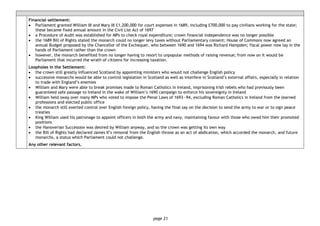
  • 129.
    page 02 General markingprinciples for Higher History — Scottish History Always apply these general principles. Use them in conjunction with the detailed marking instructions, which identify the key features required in candidates’ responses. (a) Always use positive marking. This means candidates accumulate marks for the demonstration of relevant skills, knowledge and understanding; marks are not deducted for errors or omissions. (b) If a candidate response does not seem to be covered by either the principles or detailed marking instructions, and you are uncertain how to assess it, you must seek guidance from your team leader. (c) Where a candidate does not comply with the rubric of the paper and answers two parts in one section, mark both responses and record the better mark. (d) Marking must be consistent. Never make a hasty judgement on a response based on length, quality of handwriting or a confused start. (e) Use the full range of marks available for each question. (f) The detailed marking instructions are not an exhaustive list. Award marks for other relevant points. (g) (i) To gain marks, points must relate to the question asked. Where candidates give points of knowledge without specifying the context, award up to 1 mark unless it is clear that they do not refer to the context of the question. For example, Piper Laidlaw was awarded the Victoria Cross at the Battle of Loos for leading Scottish soldiers into battle. (1 mark for knowledge) (ii) To gain marks for the use of knowledge, candidates must develop each point of knowledge, for example, by providing additional detail, examples or evidence. Marking principles for each question type There are four types of question used in this paper A evaluate the usefulness of Source . . . B how much do Sources . . . reveal about differing interpretations of . . . C how fully does Source . . . D explain the reasons . . . For each question type, the following provides an overview of marking principles. A For questions that ask candidates to Evaluate the usefulness of a given source (8 marks), they must evaluate the extent to which a source is useful by commenting on evidence such as the author, type of source, purpose, timing, content and significant omission. B For questions that ask How much do Sources . . . reveal about differing interpretations of (10 marks), candidates must interpret the view of each source and use recalled knowledge to assess what the sources reveal about differing interpretations of a historical issue. C For questions that ask How fully does a given source explain . . . (10 marks), candidates must make a judgement about the extent to which the source provides a full explanation of a given event or development. D For questions that ask candidates to Explain the reasons . . . (8 marks), they must make a number of points that make the issue plain or clear, for example by showing connections between factors or causal relationships between events or ideas. These should be key reasons and may include theoretical ideas. They do not need to evaluate or prioritise these reasons.
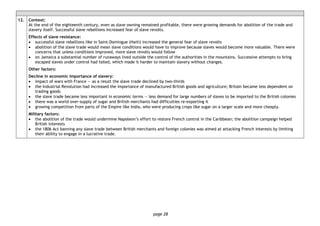
  • 130.
    page 03 Marking instructionsfor each question PART A — The Wars of Independence, 1249−1328 1. Candidates can gain up to a maximum of 8 marks. Award 1 mark for each accurate relevant reason given. Possible reasons: Key point Explanation Death of King Alexander III of Scotland 1286. Alexander III left no male heir to succeed him. Alexander III’s children Margaret, Alexander and David died before 1286. There was no direct descendant to Alexander III. The only surviving heir to Alexander III was Margaret Maid of Norway, his granddaughter. There was no precedent in Scotland for a queen ruling in her own right. The succession of a female, even as an adult, posed potential difficulties. Election of six Guardians in a Parliament at Scone. The seriousness of the situation after the death of Alexander III required the Scottish nobles to carry on the government of the country. There was growing tension between the Bruce and Comyn factions. The growing tension in Scotland led to a fear of civil war. The Treaty of Birgham of 1290, the marriage of Margaret, Maid of Norway and King Edward I’s son, Edward, Prince of Wales, appeared to offer a secure relationship with England. There were concerns to maintain the independence of Scotland. The Guardians, however, were concerned to keep Scotland’s separate customs and laws. A problem arose over the succession after Margaret’s death on her way to Scotland in 1290. Her death left no obvious heir to the Kingdom of Scotland. Bishop William Fraser wrote to Edward I asking for help to avoid the threat of civil war. The Guardians compromised the independence of Scotland by asking Edward I for advice and protection. Edward I insisted that the Scottish nobles meet him at his parliament at Norham 1291. Following the invitation to be arbiter in the issue of Scottish succession, Edward I showed his authority over the Scottish leaders. The Guardians and other leading Scots eventually took an oath of fealty to Edward I. The Scottish nobility were pressurised into recognising Edward I as overlord leading to fears regarding the independence of Scotland.
  • 131.
    page 04 Key pointExplanation The task of choosing a new king, known as the Great Cause, was a long drawn out process, lasting over 15 months from August 1291 until November 1292. Thirteen claimants, not including Edward I himself, presented themselves although only three, John Balliol, Robert Bruce and John Hastings, had a strong legal claim. Edward I’s decision in favour of John Balliol in 1292. Edward I continued to exercise his overlordship over Scotland. Balliol had the strongest legal claim, based on primogeniture, being a descendent of the eldest daughter of Earl David. Any other valid point of explanation that meets the criteria described in the general marking instructions for this kind of question.
  • 132.
    page 05 2. Candidatescan gain marks in a number of ways up to a maximum of 8 marks. Award a maximum of 4 marks for evaluative comments relating to author, type of source, purpose and timing. Award a maximum of 2 marks for evaluative comments relating to the content of the source. Award a maximum of 3 marks for evaluative comments relating to points of significant omission. Examples of aspects of the source and possible comments: Aspect of the source Possible comment Author: King John of Scotland. Useful as the King spoke on behalf of the Scottish realm therefore, he was speaking with authority. Type of source: Letter. Useful as the letter was a prepared and considered response by the Scottish King. Purpose: To resign his kingdom. Useful as King John’s letter was acknowledging offences against Edward I, King of England, and resigning the kingdom to him. It would have been considered an official response however the statement was made under duress. Timing: 2 July 1296. Useful as the date confirms the surrender of the Kingdom of Scotland to the English. Content Possible comment We made an alliance against lord Edward, with the king of France, who then was, and still is, his enemy, to harass our lord Edward, and hold the king of France, with all our power, in war and by other means but now we have been made to renounce this alliance. Useful as it states that King John and the Guardians made a treaty with the French to invade England if necessary, but the Scots were made to withdraw from the alliance. We defied our lord the king of England and withdrew ourselves from his homage and fealty but now we must apologise for renouncing that homage. Useful as it tells us that King John was forced to apologise for breaking his oath of loyalty to Edward I. For all these reasons we accept that due to our rebellion, our lord the king of England entered the realm of Scotland by force. Useful as it shows King John rebelled against the English and Edward I invaded Scotland.
  • 133.
    page 06 Possible pointsof significant omission include: • in rebellion against Edward I’s treatment of John and the Scottish kingdom, the Scots assembled in the Borders in March 1296 and attacked villages around Carlisle before retreating back to Scotland • the surrender of the town of Berwick March 1296. The siege by King Edward I’s army lasted only a few hours, the sack which followed its capture took three days • defeat of the Scottish Army at the Battle of Dunbar April 1296 by Edward I’s English Army • Edward and his army advanced north, marching as far as Elgin taking Scotland’s towns and castles • John entered into negotiations with Anthony Bek but was ultimately made to endure a number of humiliations. He was forced to confess his rebellion; on 7th July at Stracathro he was made to formally renounce the treaty with France; finally, on 8th July at Montrose John was made to publically resign his kingdom to Edward I • King John was brought before Edward I and ceremoniously stripped of his royal regalia. The royal coat-of-arms embroidered on his tabard was torn off (Toom Tabard) and his crown, sceptre, sword and ring removed • King John was taken to England by ship and imprisoned in the Tower of London • in 1296 the Ragman Rolls were signed by Scotland’s nobles and clergy paying homage and fealty to Edward I. Any other valid point that meets the criteria described in the general marking instructions for this kind of question.
  • 134.
    page 07 3. Candidatescan be credited in a number of ways up to a maximum of 10 marks. Award up to 6 marks (3 marks per source) for their interpretation of the viewpoints from the sources (including establishing the overall viewpoint of each source). Award up to 6 marks for recalled knowledge. Candidates can develop points from the sources and/or identify relevant points of significant omission. Point identified in Source B Possible comment which shows the candidate has interpreted the significant view(s) Seeing their enemies divided by the river, Wallace and Andrew Murray led the attack on the English at Stirling Bridge, killing the English Treasurer Cressingham in a savage fight, while Earl Warenne and the rest of his army fled. William Wallace (not Scotland’s natural leader) and Andrew Murray led the Scots to victory at Stirling. The Scottish magnates, Steward and his neighbour, the earl of Lennox, who had been in the English force, changed sides late in the battle and led the pursuit. Wallace had some support among the nobility who were prepared to support the side favourable to their own self-interests. Wallace certainly had the support of some nobles, from the Steward, Lennox and Strathearn amongst others, but it was not universal, clearly there was some reluctance to accept his leadership. Wallace was unable to gain the support of all nobles in Scotland. This was in part due to Wallace’s social standing. Overall viewpoint — Stirling Bridge was a clear victory to Wallace and the Scots but there remained questions about the future leadership of Scotland.
  • 135.
    page 08 Point identifiedin Source C Possible comment which shows the candidate has interpreted the significant view(s) The Scots victory at Stirling Bridge was decisive and the Scottish losses were negligible except in one important respect: Andrew Murray received a severe wound from which he died several weeks later. Despite Scots victory at Stirling the death of Andrew Murray before the end of 1297 was a huge loss to Scotland. Wallace’s defeat of Earl Warenne did not put an end to English designs on Scotland — far from it — the humiliation of the English was something that King Edward now addressed himself towards avenging. Despite the humiliating defeat of the English under the leadership of Warenne at Stirling it was clear Edward I would look to reverse Wallace’s victory. Wallace’s star was in the ascendant. If his role in securing the Scottish victory has been debated, there is no doubt that the leader who had so dramatically been catapulted into the role of Guardian was very much the man of the hour. Although it is recognised that Wallace was not solely responsible for victory at Stirling Bridge, Wallace was now recognised as Scotland’s leader. Overall viewpoint — Victory at Stirling Bridge secured Wallace’s leadership but there remained uncertainty over the future of Scotland. Possible points of significant omission include: • the Scottish nobles, the traditional leaders of the political community in Scotland, did not provide military leadership at the Battle of Stirling Bridge • Murray and Wallace used guerrilla tactics at Stirling, outmanoeuvring the combined forces of John de Warenne, Earl of Surrey and Hugh de Cressingham • despite the overwhelming odds at the Battle of Stirling Bridge, 11th September 1297, Wallace (and Murray) defeated a superior English army • recovery of Scottish castles across central and southern Scotland by Wallace • Wallace led an attack into northern England, taking plunder and blackmail from the English • Wallace and Murray used the Lubeck Letter as part of their political diplomacy • due to the untimely death of Murray, William Wallace assumed sole responsibility as guardian (acting in the name of King John) in recognition of his successful military victory against the English at Stirling • divisions among the nobility remained from the succession problems. This weakened Wallace’s position. Any other valid point of explanation that meets the criteria described in the general marking instructions for this kind of question.
  • 136.
    page 09 4. Candidatescan gain marks in a number of ways up to a maximum of 10 marks. Award a maximum of 4 marks for identifying points from the source that support their judgement; they must interpret each point from the source rather than simply copying from the source. Award a maximum of 7 marks for identifying points of significant omission, based on their own knowledge, that support their judgement. Award a maximum of 2 marks for answers in which candidates have made no judgement. Point identified in Source D Possible comment which shows the candidate has interpreted the key point(s) Over the next 12 months, Robert’s success against his Scottish opponents testified to his inspiring physical courage. Bruce won a number of victories against his enemies in Scotland which was evidence of his military leadership. Bruce marched north through the Great Glen, a remarkable succession of royal and pro-Comyn castles would be taken and razed by spring 1308. Bruce’s Scottish opponents were weakened by the destruction of their castles. This run of military victories had surely caused the Bruce ranks to swell. Bruce’s army grew in size throughout his military campaign. A sustained guerrilla campaign of rapid movement in all weathers, living off northern lands while harrying nonetheless numerous foes, reaped its rewards. Bruce used hit-and-run tactics to defeat his opponents in the North. Possible points of significant omission include: • ambition of Robert Bruce and his claim to the Kingship in March 1306 (after the murder of John Comyn in February 1306 in Greyfriars Kirk) • Bruce was fortunate in the timing of the death of Edward I in July 1307. His son Edward II was inadequate as a military leader compared to his father • Bruce was increasingly able to leave much of the conduct of the war to his lieutenants, Edward Bruce, James Douglas and Thomas Randolph • defeat of his Scottish opponents 1307-1309 in particular Bruce’s decisive victory over the Earl of Buchan in the Battle of Inverurie and the destruction of Comyn lands in the ‘Herschip of Buchan’ removed the threat from the powerful Comyn family • in the Declaration of the Clergy in 1310, Scotland’s bishops declared their support for Bruce as the legitimate King of Scotland • defeat of his English opponents 1310―1314 by conducting a successful campaign against English-held castles, for example, Perth, Linlithgow, Roxburgh and Edinburgh • Bruce’s triumph over an English army at the Battle of Bannockburn in 1314 completed his military control of Scotland and secured his position as King of Scots • at a parliament held at Cambuskenneth Abbey in 1314, Bruce gave the nobles the opportunity to pledge their allegiance and keep their Scottish lands while disinheriting those who chose to side with England
  • 137.
    page 10 • thetreaties of Edinburgh/Northampton 1328 officially recognised Bruce as King and recognised the independence of the realm of Scotland. Any other valid point of explanation that meets the criteria described in the general marking instructions for this kind of question.
  • 138.
    page 11 PART B— The age of the Reformation, 1542−1603 5. Candidates can gain up to a maximum of 8 marks. Award 1 mark for each accurate relevant reason given. Possible reasons: Key point Explanation Pluralism. Some churchmen held several church posts at the same time taking the income from each and paying other, often unqualified, men to do the jobs day-to-day. This practise drew criticism from reformers who argued churchmen were serving their own interests and not those of the people. The wealth of the Catholic Church [as contrasted with the poverty of most of the people]. The Catholic Church was even richer than the monarchy. Reformers argued that the Church spent too much time accumulating wealth which was not then used to supply the needs of the people through the provision of well-trained priests, well maintained church buildings, education and help for the poor. Indulgences drew particular criticism from reformers. This drew criticism from reformers because they argued that indulgences exploited people and people’s credulity. The lifestyles of many churchmen. By the 1540s many priests and monks and bishops had relationships and often children. Reformers argued that far too many churchmen were hypocritical as they were meant to be celibate. The failure of Catholic reform 1542―1560. Reforming councils were too little, too late and did nothing to stem the flow of criticism. The growth of printing. Printing presses produced Protestant literature in the form of books, cheap pamphlets and Bibles in English. The ‘Rough Wooing’ (1544―1547). English invasions led to the destruction of the infrastructure of the Church. The death of Cardinal Beaton. It removed from the Scottish scene the leading figure in the Catholic Church and one who had opposed Protestantism and internal reform. The persecution and martyrdom of Protestants. The effect of this was to galvanise support for Protestants because the martyrs were seen as heroic figures.
  • 139.
    page 12 Key pointExplanation The Lords of the Congregation, an influential group of nobles who declared their support for a Protestant revolution. The nobles helped the monarch govern the country by running their own domains and also by sitting on agencies of government such as the Privy Council. England had been Protestant from the 1530s. This meant that it was now much easier for Protestant ideas, Protestant literature and Protestant personnel to cross back and forth over the Border. The Scots invited France for help against England in the winter of 1547―1548. Scots Protestants were able to point to French influence as an attempt to make Scotland a province of France and tied to Catholicism. Any other valid point of explanation that meets the criteria described in the general marking instructions for this kind of question.
  • 140.
    page 13 6. Candidatescan gain marks in a number of ways up to a maximum of 8 marks. Award a maximum of 4 marks for evaluative comments relating to author, type of source, purpose and timing. Award a maximum of 2 marks for evaluative comments relating to the content of the source. Award a maximum of 3 marks for evaluative comments relating to points of significant omission. Examples of aspects of the source and possible comments: Aspect of the source Possible comment Author: issued in the name of Mary, Queen of Scots. Useful because since it is from the queen, it sets out what her position as a Catholic monarch is going to be with regard to the Reformation of 1560. Type of source: Royal Proclamation. Useful because it is a declaration of what her policy is with regard to the religion of the realm. Purpose: to give reassurance that there will be no attempt to reverse the Reformation Parliament of 1560. Useful because it highlights the fact Mary’s religious policy was unclear and confusing. Timing: 25 August 1561. Useful because the proclamation was issued six days after her return to Scotland indicating the pressure she was under from Protestants to accept the Reformation. Content Possible comment Neither Lords nor anyone else, either privately or publicly, should, for the moment, attempt to bring in any new or sudden changes to the religious settlement [of 1560] publicly and universally standing at Her Majesty’s arrival in Scotland. Useful because it highlights Mary’s decision to accept the religious settlement established by the 1560 parliament. Her Majesty further wishes it to be known that anyone who seeks to upset the existing religious settlement shall be viewed as a rebellious subject and a troublemaker and shall be punished accordingly. Useful because it highlights Mary’s attempts to discourage Catholics from seeking to overturn the Protestant settlement arrived at in 1560.
  • 141.
    page 14 Content Possiblecomment Her Lords refrain from troubling any members of her domestic household brought from France, on religious or any other matters whatsoever. Useful because it indicates that Mary’s religious policy was unclear, because she is demanding that her household should be allowed to remain Catholic. Possible points of significant omission include: • Mary had stayed on in France, which meant that Protestant lords were allowed to set up a government of Scotland and push through the Reformation. Mary thus did nothing about the illegal parliament of 1560 that abolished the power of the Pope, and banned the Mass • Mary refused to ratify the acts of the 1560 parliament, but she did not overturn them either, which pleased Protestants but perplexed Catholics • Mary heard Mass in private but upheld the ban on the Mass that applied to all other Catholics in her realm. Catholics were dismayed and Protestants suspicious • Mary appointed a Privy Council dominated by the Protestants lords who had ruled Scotland in 1560. She only appointed one person to the council during 1562―1567, the hard-line Protestant, Lord Ruthven. This did nothing to engender support for Mary among Catholic nobles • in February 1562 Mary agreed to a 33% ‘tax’ on the incomes (the Thirds of Benefices) of bishops and abbots and the money raised was to be spent on the new reformed churches and ministers • also, in 1562 Mary crushed a rebellion by the Catholic Earl of Huntly. While this suggested to Protestants that Mary would not tolerate dissent from anyone Catholic or not, to Catholics it suggested that she was not supportive of Catholicism • the Pope sent Nicholas de Gouda to meet with Mary in 1562, but she kept him waiting and when she did finally meet him she refused to give any promise to restore Catholicism in Scotland • during 1561—1563 Mary explored the possibility of marriage to a foreign Catholic such as Charles IX of France or Don Carlos of Spain • in 1563 parliament passed a variety of acts favouring Protestants and Protestantism and included absolving Protestant rebels from any crimes committed during 1559—1561 • also, in 1565 Mary wrote to the Pope declaring that she would restore Catholicism and she told the Kirk that she would never ratify the decisions of the 1560 parliament • in December 1566 Mary gave £10 000 to the Kirk as a gift. Any other valid point that meets the criteria described in the general marking instructions for this kind of question.
  • 142.
    page 15 7. Candidatescan be credited in a number of ways up to a maximum of 10 marks. Award up to 6 marks (3 marks per source) for their interpretation of the viewpoints from the sources (including establishing the overall viewpoint of each source). Award up to 6 marks for recalled knowledge. Candidates can develop points from the sources and/or identify relevant points of significant omission. Point identified in Source B Possible comment which shows the candidate has interpreted the significant view(s) James’s practical measures to consolidate his kingdom and subject everyone in it to his own rule were supported by his belief in the Divine Right of Kings. James’s view that he should control all people and all institutions in his realm was rooted in his belief that he had been appointed by God and therefore he was accountable to God alone and had authority to rule over the kingdom in its entirety — State and Church. James believed in ‘one kingdom’ that included both the Church and the State with Christ as its Head but with Christ’s rule carried out through the king and bishops chosen by the king. James argued that of course no one could be above Christ but that the Church should be controlled by the monarch. In practical terms this meant a contest between the General Assembly on one side and the King on the other. James’s views that he should control the Kirk via bishops was directly at odds with the Presbyterian position which was that the Kirk should be controlled by the General Assembly. Overall viewpoint — Source B sets out James’s view that the King should control the Kirk through bishops — Episcopalianism. Point identified in Source C Possible comment which shows the candidate has interpreted the significant view(s) His opposition rested on the grounds that a system of bishops effectively meant that the Kirk was ruled by the King because bishops were appointed by the Crown. Andrew Melville, leader of the Presbyterians, thought that bishops should be abolished forever because the office was not scriptural. For him all ministers were equal and answerable to the Church through the church courts, with the General Assembly as the highest and supreme governing body of the Kirk, not the king. Rather than bishops controlling the Kirk and thus the monarch, Melville wanted the General Assembly to be its supreme governing body. Famously, Melville informed James VI that there were two kingdoms in Scotland. In one of which, the Kirk, Christ Jesus was King. In that kingdom, James VI was a member not a lord and not its head either. Melville was pointing out to James that he the King had no authority in or over the Kirk. Overall viewpoint — Source C sets out the position that the Kirk should be free of Crown control and should govern itself — Presbyterianism.
  • 143.
    page 16 Possible pointsof significant omission include: • the King’s position was set out in two books: The Trew Law of Free Monarchies (1598) and Basilikon Doron (1599) • by contrast, the Presbyterian position had been set out in a manual of Presbyterianism written between 1576 and 1578, The Second Book of Discipline • 1581: plans to establish 13 presbyteries appeared to challenge royal authority • 1582: the ‘Ruthven Raid’. An attempt to impose Protestant government on Scotland by kidnapping King James • 1584: The ‘Black Acts’. A reassertion of Crown authority and control via the abolition of Presbyteries • 1592: The ‘Golden Act’. Accepted the restoration of Presbyteries but maintained bishops too. James also maintained his right to say when and where the General Assembly should meet • James retained his view of the role of the Crown and attempted to reassert it by making bishops moderators (chairperson) of the presbyteries and by choosing Perth or Aberdeen for the General Assembly to meet because he had more support in these areas • 1596: minister-led riots in Edinburgh were in effect an attempt by Presbyterians to reassert their view that the Kirk should control its own affairs • James used 1596 to make an even more determined effort to assert his view of the respective roles of the Crown and of the Kirk in governing the Kirk • James called two General Assemblies in 1597. At these meetings James asserted his authority by choosing pro-Crown ministers to lead the General Assembly • James attended every General Assembly from 1597 until he left for England in 1603 • hardline opponents of Crown control such as Andrew Melville were excluded from the General Assembly • the General Assemblies from 1598 were all dominated by moderate Protestants who were willing to let James take the lead. Any other valid point of explanation that meets the criteria described in the general marking instructions for this kind of question.
  • 144.
    page 17 8. Candidatescan gain marks in a number of ways up to a maximum of 10 marks. Award a maximum of 4 marks for identifying points from the source that support their judgement; they must interpret each point from the source rather than simply copying from the source. Award a maximum of 7 marks for identifying points of significant omission, based on their own knowledge, that support their judgement. Award a maximum of 2 marks for answers in which candidates have made no judgement. Point identified in Source D Possible comment which shows the candidate has interpreted the key point(s) The reformers had complained about the Church’s failure to instruct the people in the fundamentals of the faith so the new Kirk made strenuous efforts to ensure that the fundamentals were taught to all children in Sunday afternoon classes. In the reformed Kirk, Christian education of the people and the ministers was considered an essential requirement. Moreover, the Kirk’s emphasis was on positive teaching of the Bible in Scots so everyone could understand. This allowed ordinary people to read the Bible for themselves rather than a few priests. Before 1560 devotion was often encouraged by means of plays, but the new Kirk put a stop to that. Plays were viewed as pretence and a distraction from what was really needed: preaching and understanding the Bible. And the insides of churches were cleared of statues of saints and images of Mary and other decoration that was deemed to be a distraction from the teaching of the Bible. Before the Reformation worship was more visual. Reformers argued that this form of worship was a distraction from Bible teaching. Possible points of significant omission include: • the Crown benefited in some ways. For example, it took a share of income from lands previously owned by the Church • however, in other ways the Crown lost out. For example, one side effect of the Reformation and then the overthrow of Mary, Queen of Scots, was that the Crown lost its annual subsidy from France • the new Kirk was poorer than the old Catholic Church and so had less money to spend on commissioning works of art (which it was suspicious of anyway) and architecture • works of art were removed from churches and the walls were whitewashed so the insides of churches became austere with the pulpit often moved to a central position • one reason for the new Kirk’s lack of money was the fact that many of the old Church’s lands were seized by the nobility. For example, the Kerr family took control of all the estates belonging to Newbattle Abbey. The new Kirk never got them back • song schools which had existed before the Reformation continued but instead of learning Latin hymns singers were now taught unaccompanied singing of the Psalms • kirk sessions became a major instrument for enforcing discipline in the parishes so acting as instruments of social control by regulating behaviour and changing attitudes • kirk sessions also regulated poor relief and developed the idea of the ‘deserving poor’ and the ‘undeserving poor’
  • 145.
    page 18 • theimportance of kirk sessions also led to increasing prominence of ministers in the parishes and in time ministers formed a new, highly educated ecclesiastical elite • the new Kirk was committed to education. There was a marked expansion of schools in the Lowlands, less so in the Highlands • the number of universities increased from three, St Andrews (1411), Glasgow (1451) and Aberdeen (1495), to five with the addition of Edinburgh’s Town College (1583) and Marischal College, Aberdeen (1593) • as Principal of St Mary’s College, St Andrews University, Andrew Melville, an outstanding scholar and educationalist, turned it into a Divinity School and one of the leading theological schools of Protestant Europe • trade links became more developed with Protestant countries such as the United Provinces (Holland), Denmark and England • abolition of Christmas and Easter reflected fear of Catholic custom • kirk sessions were preoccupied with keeping wedding and other celebrations under control. Even though the Kirk decided to remove all organs from places of worship, there is evidence that in some areas music during services survived. Any other valid point of explanation that meets the criteria described in the general marking instructions for this kind of question.
  • 146.
    page 19 PART C— The Treaty of Union, 1689–1740 9. Candidates can gain up to a maximum of 8 marks. Award 1 mark for each accurate relevant reason given. Possible reasons: Key point Explanation At the Massacre of Glencoe, the Campbell clan killed 38 MacDonalds. The Scottish parliament resented what it termed a ‘murder’ of Scots on the King’s orders. The economy ground to a halt as merchants had to buy grain from abroad. People spoke of ‘William’s Ill Years’. Scots resented the English government’s unwillingness to support Scotland during this time. Trade had been badly affected by England’s wars, preventing the import of French wine and liquor. Scottish merchants resented the role of the English Navy in boarding Scottish ships and obstructing trade. The Darien Scheme to establish a colony in Panama was not sufficiently funded. Less than half of the original investments were returned to investors who withdrew their interests, which resulted in ill-feeling amongst Scottish investors. The Darien Scheme did not have enough resources to send a large fleet to Panama. King William was blamed for using his influence to persuade Dutch shipbuilders to withdraw from contracts with Scotland. The English Act of Settlement stated that Queen Anne would be succeeded by Sophia of Hanover. The Scottish parliament were angered by the fact that it had not been consulted about the Hanoverian Succession. The Scottish Act of Security stated that the Scottish parliament would make its own decision about the succession in Scotland. The English parliament was resentful of Scotland’s defiance of their Act of Settlement. Scotland passed the Act anent Peace and War, passing the right to declare war from the monarch to parliament. This was viewed as an act of defiance by the English parliament which deferred this right to the monarch. Scotland’s Wool Act ensured that trade in textiles with France would continue during England’s war with France. English MPs were annoyed at what they saw as an act of disloyalty towards the monarch. The Wine Act legislated for Scottish trade in liquor to be maintained during England’s wars with any European nation. England resented this as it was felt that Scotland should support England in its conflicts with European rivals.
  • 147.
    page 20 Key pointExplanation The English Aliens Act threatened to remove Scottish landowning rights in England unless Scotland accepted the Hanoverian Succession. Wealthy Scots were resentful about this threat to their financial interests which was politically motivated. King William appointed officials in the Scottish government who would be favourable to his wishes. Scots resented this as it meant that favour was constantly shown to England. Any other valid point of explanation that meets the criteria described in the general marking instructions for this kind of question.
  • 148.
    page 21 10. Candidatescan gain marks in a number of ways up to a maximum of 8 marks. Award a maximum of 4 marks for evaluative comments relating to author, type of source, purpose and timing. Award a maximum of 2 marks for evaluative comments relating to the content of the source. Award a maximum of 3 marks for evaluative comments relating to points of significant omission. Examples of aspects of the source and possible comments: Aspect of the source Possible comment Author: Lord Belhaven. Useful as he was a member of the Scottish parliament and would be expected to take an informed opinion in relation to union. Type of source: speech in parliament. Useful as it reveals strength of feeling among some MPs about union. Purpose: to explain the consequences of union. Useful as the source explains the possible negative effects of union in order to dissuade MPs from voting for it. Timing: November 1706. Useful as it was near the end of the debates in parliament when feelings about union were running high. Content Possible comment Shall we, in just a single half hour of debate, surrender and give up what our ancestors won and defended with their lives for centuries? Useful as it shows that Scotland would be giving up the independence which previous generations of Scots had fought for. I can see Scotland — our own ancient mother Caledonia — watching us inflict a fatal wound upon her, causing her to take her last breath. Useful as it shows that union with England would be forever killing off any notion of an independent Scotland. This treaty will mean that we are forced to pay long-standing English debts, through increased taxes and customs duties. Useful as it shows that Scotland would be disadvantaged by having increased taxation once union was established.
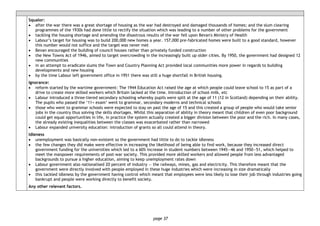
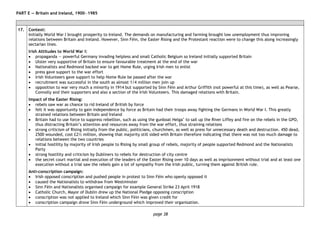
  • 149.
    page 22 Possible pointsof significant omission include: Attitudes against Union: • British Parliament would favour English trade over Scottish • fear of loss of European trade such as Holland, Spain and France • Royal Burghs would be deprived of rights for example, extracting a toll from people wishing to sell goods in their markets • manufacturing industries in Scotland may be ruined in the face of English competition for example, shoe making, linen • English currency, weights and measures to be introduced • public opinion against Union for example, Anti-Union riots in Glasgow and Edinburgh • Protestants feared a British Parliament dominated by Anglican Episcopalian church with bishops’ seats in the House of Lords • reduction in status of Scottish nobility in British parliament • Scots Episcopalians opposed union and Hanoverian Succession — only Stuart dynasty might restore Episcopacy to Scottish church • the creation of ‘Scotlandshire’ was a genuine fear for opponents of union • 45 Scots MPs in the House of Commons was felt to be under-representation. Attitudes for Union: • economic benefits from being in union with the most powerful country in the world • for trading purposes Scotland would be able to compete with similar sized European countries such as Holland, Spain and France • political union would bring greater security to Scotland through protection from the Royal Navy • there would be advantages at court because Scottish advisors would be posted in London rather than Edinburgh • union with England would make the Hanoverian Succession secure in Scotland, pleasing some Scottish Protestants • property in the Scottish countryside would be more secure if farmers were able to invest in land improvement after union. Any other valid point that meets the criteria described in the general marking instructions for this kind of question.
  • 150.
    page 23 11. Candidatescan be credited in a number of ways up to a maximum of 10 marks. Award up to 6 marks (3 marks per source) for their interpretation of the viewpoints from the sources (including establishing the overall viewpoint of each source). Award up to 6 marks for recalled knowledge. Candidates can develop points from the sources and/or identify relevant points of significant omission. Point identified in Source B Possible comment which shows the candidate has interpreted the significant view(s) Scottish lawyers were promised that the Scottish legal system would continue, with Scots Law to remain intact. This reassured some MPs who feared the impact of English Law on the Scottish judicial system. There was also the guarantee of free trade with the colony plantations in America and the Caribbean. This persuaded MPs who believed in the financial benefit of union. Members from the burghs, however, were persuaded by the fact that royal burgh rights would not be affected by union. This argument meant that the threat of the removal of rights was no longer an argument against voting for the Treaty. Overall viewpoint - Source B interprets the passing of the Act of Union as being brought about by concessions made by England to limit Scottish fears. Point identified in Source C Possible comment which shows the candidate has interpreted the significant view(s) The Duke of Argyll was bribed to vote for union by the promise of military promotion and a position in the House of Lords. This type of individual bribery increased the number of MPs who voted for union despite being indifferent to it. The earl of Glasgow was given £20,000 from English funds to be divided amongst those who would support union. Glasgow’s distribution of these funds meant more MPs were recruited to the ranks of pro-union parliamentarians. MPs in this group were ‘bought off’ by the guarantee of an Equivalent fund which remarkably matched the amount of money lost in the Darien Scheme. This compensated MPs who had invested in the scheme and then lost their life savings. Overall viewpoint - Source C interprets the passing of the Act of Union as being brought about by bribery and corruption on the part of the English government and willing Scottish politicians. Possible points of significant omission include: • other assurances given to the Scots during negotiations, such as over the phased introduction of certain taxes, on malt, salt • divisions amongst opponents of union meant no concerted attempts to bring the Treaty down • role of the Squadrone Volante in holding the balance of power in all parliamentary votes
  • 151.
    page 24 • politicalmanagement of Court Party ensured members attended all votes • role of Hamilton as an ineffective leader of the Country Party, for example failing to lead a planned walkout from Parliament, citing toothache as an excuse and sending his mother to deliver this excuse • economic assurances about the future of Scotland as part of a trading power within Europe • trade incentives brought about by the protection of the Royal Navy for merchant ships in the future • the Equivalent was promised even to those who had not invested in the Darien Scheme, such as members of the Squadrone Volante • incentives for Scottish nobles such as continued immunity from arrest for bankruptcy or drunkenness in public • the role of the English agent Daniel Defoe who informed English government officials about Scottish MPs’ feelings about the Treaty • the role of Lord Goldolphin, the English Lord Treasurer, who ensured last minute concessions could be made • knowledge of the future stability and security of Scotland won many MPs over • military argument — threat of union by force after an English invasion which was feared if union was not passed. Any other valid point of explanation that meets the criteria described in the general marking instructions for this kind of question.
  • 152.
    page 25 12. Candidatescan gain marks in a number of ways up to a maximum of 10 marks. Award a maximum of 4 marks for identifying points from the source that support their judgement; they must interpret each point from the source rather than simply copying from the source. Award a maximum of 7 marks for identifying points of significant omission, based on their own knowledge, that support their judgement. Award a maximum of 2 marks for answers in which candidates have made no judgement. Point identified in Source D Possible comment which shows the candidate has interpreted the key point(s) Scottish MPs objected to increased duties, particularly the attempt to impose new taxes. Taxes did go up, as a result of England’s greater national debt caused by the cost of maintaining the Empire. This led to some Scots in parliament proposing a reversal of union in 1713. This motion was proposed, showing opposition to the Union still existed. Colonies in the West Indies became a new market for Scottish merchants in the early 1700s. Scots merchants benefitted from trade with the English colonies. Therefore, union led to a change in the Scottish balance of trade, with an increase in profits entering into the country via ships arriving in Glasgow from the Caribbean. Trade from the West Indies was bringing a significant amount of money into Scotland. Possible points of significant omission include: • the textile and paper industries both suffered from the immediate effect of competition from England • Scottish linen manufacturers lost out to English wool in trade rivalry • Scots objected to the Salt Tax, Soap Act and Malt Tax • Scots found jobs in the East India Company • the black cattle trade prospered due to the popularity of its meat in England • improvements in agriculture and industry were brought about due to observing English practice • the development of towns took place as a result of trade between the Highlands and England, for example, Crieff, Falkirk • the Royal Bank of Scotland was founded to encourage sound Scottish financial practice on English models • growing professional classes with the increased amounts of Scottish businessmen and lawyers • opposition to union from Episcopalians in the Highlands continued • desire for restoration of Stuart dynasty amongst those who opposed the Hanoverian Succession. Any other valid point of explanation that meets the criteria described in the general marking instructions for this kind of question.
  • 153.
    page 26 PART D— Migration and empire, 1830–1939 13. Candidates can gain up to a maximum of 8 marks. Award 1 mark for each accurate relevant reason given. Possible reasons: Key point Explanation Highland Clearances. Many tenants were forced off their land to make way for sheep, which were more profitable than crofting. The Highland problem. Over-crowding, sub-division of land into crofts led to each successive generation leading to insufficient land/food to support families. Highland potato famine. People migrated to escape starvation. ‘Balmoralism’ and the tourist income potential. Royal approval encouraged tourists to travel to the Highlands to take part in deer hunting and grouse shooting which offered more profit for landowners, forcing Highlanders off the land. Failure of the kelp and herring industries. Failure in these areas created economic problems for Highlanders, which forced many to migrate in search of employment. Agricultural Revolution in Scotland. The introduction of machinery meant there was a reduction in the number of farm workers required, leading to unemployment, which forced migration to towns and cities for opportunities elsewhere. In the 19th century a network of emigration agencies developed across Scotland. Agencies worked in Scotland to attract emigrants — New Zealand and Australian authorities’ work was widespread, offering free passages and other inducements. Many Scots were attracted by the promise of free/cheap land. Many were attracted to emigrate by the promise of becoming landowners or the offer of free land in Canada. Many Scots moved to urban areas. The attractions of city life caused many to move to towns and cities. Letters from relatives. Scots who had already emigrated wrote letters to encourage relatives to follow due to better opportunities.
  • 154.
    page 27 Key pointExplanation Discovery of gold in Australia. The chance to become rich encouraged many Scots to emigrate to Australia. Improvements in transport such as railways and steam ships. Scots migrated as it was quicker and cheaper to travel. Any other valid point of explanation that meets the criteria described in the general marking instructions for this kind of question.
  • 155.
    page 28 14. Candidatescan gain marks in a number of ways up to a maximum of 8 marks. Award a maximum of 4 marks for evaluative comments relating to author, type of source, purpose and timing. Award a maximum of 2 marks for evaluative comments relating to the content of the source. Award a maximum of 3 marks for evaluative comments relating to points of significant omission. Examples of aspects of the source and possible comments: Aspect of the source Possible comment Author: Joe Smith (Cesaikas), a first-generation Scot. Useful as it is the view of a Scot born to Lithuanian parents who has personal insight into the experience of Lithuanian immigrants. Type of source: memoir. Useful as it provides a personal account of Lithuanian immigrants in Scotland. May be less guarded, so source may be more useful. Purpose: to record his own experiences and that of his parents. Useful as it provides understanding of the lives of Lithuanian immigrants in Scotland. Timing: 1933. Useful as he is looking back on his personal experiences when Lithuanians had a more significant presence in Scotland. Content Possible comment I think my worst time was at the school, before my father changed our name when I was bullied and asked, time after time, ‘What’s your name? Tell us your name. Go home to your own country.’ Useful as many Lithuanians had experienced bullying. We lived in the Long Row where housing conditions were poor. Useful as it explains that Lithuanians often experienced poor living conditions. It was also good for my parents as they had a close-knit Lithuanian community who kept to their own traditions in food, religion and music away from any discrimination. Useful as it explains that Lithuanians often stayed in their own communities.
  • 156.
    page 29 Possible pointsof significant omission include: • Lithuanians benefitted from employment in the coal and steel industries • immigrants from Lithuania were met with hostility as it was believed that foreigners had been brought into the Ayrshire coalfields to break strikes and dilute the power of the unions • friction further intensified after 1900 as depression in the coal trade caused successive reductions in miners’ wages while Lithuanians continued to enter the labour market • to enhance their economic advantage Lithuanians gave a convincing display of loyalty to the Trade Union, which improved relations with Scots • some Scottish miners expressed concern about the risks of working in dangerous conditions alongside Lithuanians who did not speak English • mine managers went out of their way to provide Lithuanian translations of Health and Safety regulations • due to their smaller numbers the Lithuanians were not viewed as a threat to the Scottish way of life • Lithuanians retained many of their traditions through their language and community activities • Lithuanians often married within their own community group • Scots complained about the Lithuanians being dirty and immoral • when the First World War broke out, many Lithuanian men went back to Russia to fight • after the First World War, the British Government encouraged families of soldiers still in Russia to return to Lithuania. Any other valid point that meets the criteria described in the general marking instructions for this kind of question.
  • 157.
    page 30 15. Candidatescan be credited in a number of ways up to a maximum of 10 marks. Award up to 6 marks (3 marks per source) for their interpretation of the viewpoints from the sources (including establishing the overall viewpoint of each source). Award up to 6 marks for recalled knowledge. Candidates can develop points from the sources and/or identify relevant points of significant omission. Point identified in Source B Possible comment which shows the candidate has interpreted the significant view(s) I first of all took employment with the Bank of Toronto as Scots were very prominent in this field of business and I had family connections who had vouched for my suitability. Scots helped develop the banking sector in Canada. Soon my sense of adventure took over and in 1864, I moved to join fellow Scots at the Hudson Bay Company in Montreal as a second officer and accountant. Scots had an important role in businesses such as the Hudson Bay Company. We set up a successful and profitable lumber business and had a much greater quality of life than had we stayed in Nairn. Scots successfully set up profitable businesses which contributed to the growth of the Canadian economy. Overall viewpoint — Scots emigrants helped to develop the economy which had a positive impact on Canada. Point identified in Source C Possible comment which shows the candidate has interpreted the significant view(s) The Gaelic language isolated Hebridean emigrants from their more experienced Scots neighbours who did not speak the language resulting in them being offered less employment in a foreign land than English-speaking Scots. Not all Scots prospered, those who did not speak English found it more difficult to find work and make a positive impact. In a stinging verbal attack against the Hebridean Scots of Nova Scotia, fellow Scots immigrants depicted them as an ‘oat-eating, money-griping tribe of second-hand Scots, not even fit for domestic servants.’ Hebridean immigrants faced discrimination from other Scottish immigrants making it difficult to find even low paid jobs, preventing them from making any contribution to the Canadian economy. Further west, in Killarney, the observation of Sunday as a day of worship and rest by the Hebridean emigrants irritated their less religious Scottish neighbours who believed in ‘working, when worked needed done’ leading to further tensions and less opportunities than Scots from other parts of Scotland. The hostility faced by later emigrants due to their strict religious observance restricted their opportunities which prevented them from making a positive contribution to Canada. Overall viewpoint — Not all Scots emigrants had a positive impact on Canada.
  • 158.
    page 31 Possible pointsof significant omission include: • the Scots’ early arrival enabled them to make full use of their obvious entrepreneurial talents, no more so than in the fur trade • Scots also transferred their enthusiasm for education and reading resulting in the development of universities such as McGill University • the recreational life of Canada was also influenced by the Scots with their introduction of curling • the greatest influence was that of John A Macdonald who emigrated from Scotland as a boy and rose to become Canada’s first Prime Minster shaping Canada and contributing immeasurably to its character • Donald Smith was one of the founders of the Canadian Pacific Railway which linked Canada. The completion point was named Craigellachie, in memory of where Smith was born in Scotland • Scots had a major impact on the development of transport systems in Canada for example, in the Canadian Pacific Railway, George Stephen at the Bank of Montreal helped finance it and Sanford Fleming was the main engineer • Scots contributed to the religious development of Canada through the Church of Scotland • Toronto Globe was founded and ruled by Scotsman George Brown • the extent of the role of Scots in the growth of Canada can be questioned since it was London that ultimately decided the fate of the British Empire. It was English laws and civil institutions that the Scots had to uphold and live by • Scots emigrants were involved in taking land from native peoples, for example, Scots settlers farming the land, Scots involvement in the timber trade which caused problems for native peoples who used the forests for their survival and the role of John MacDonald in the building of the Canadian Pacific railway when treaties with native peoples were ignored • Scots fur traders used whisky and rum to trade for pelts. This had a negative impact on the native peoples through alcoholism • native peoples objected to Scots missionaries trying to convert them to Christianity. There was anger at criticism of their religious beliefs and attempts at conversion • Scots were involved in residential schools where native children were given a European style education. Children were forbidden from speaking their native language. Any other valid point of explanation that meets the criteria described in the general marking instructions for this kind of question.
  • 159.
    page 32 16. Candidatescan gain marks in a number of ways up to a maximum of 10 marks. Award a maximum of 4 marks for identifying points from the source that support their judgement; they must interpret each point from the source rather than simply copying from the source. Award a maximum of 7 marks for identifying points of significant omission, based on their own knowledge, that support their judgement. Award a maximum of 2 marks for answers in which candidates have made no judgement. Point identified in Source D Possible comment which shows the candidate has interpreted the key point(s) The continued development of the canal system was one of the major projects which required the tenacity and muscle power of the Glasgow Irish. The labour contribution of Irish navvies made an impact on the Scottish economy developing the inland waterways. Yet, the greatest and most hazardous project on which the Glasgow Irish navvies worked was the Forth Rail Bridge, one of the biggest construction projects ever carried out in Britain. The labour contribution of Irish navvies made an impact on the Scottish economy as the construction of the Forth Rail Bridge improved rail transport. Some projects were closer to home such as the building of the quayside of Broomielaw on the Clyde, which improved access for shipping right into the heart of Glasgow. The labour contribution of Irish navvies improved access for ships into Scotland’s major ports improving trade in Scotland. The tunnelling skills were also essential in the building of the new Glasgow subway system where there was an oozing flow of mud above the navvies 60 feet thick, as like moles they shovelled their way under the river Clyde. The labour contribution of Irish navvies made an impact on the Scottish people as their contribution was essential in the building of the Glasgow subway, improving transport in the city. Possible points of significant omission include: • Empire created a market for Scottish goods. Heavy industries of Scotland exported a high proportion of their products. American grain might well be taken in sacks made in Dundee, by locomotives manufactured in Springburn near Glasgow (which produced one-quarter of the world’s locomotives in 1914), to be loaded onto ships built on the Clyde • Empire provided raw materials for Scottish factories such as jute. The jute trade was closely associated with the Empire: the raw material came from the Indian province of Bengal. The textile manufactured from the raw material was subsequently exported all over the world. Dundee textile firms became internationally known • Empire enabled some firms and individuals to make great commercial fortunes. Examples include Scottish businessmen such as Sir Charles Tenant (chemicals), Sir James and Peter Coats (cotton), William Weir (coal and iron), James Finlay and Co involved in both textile mills and tea, and Thomas Lipton was also involved in the tea industry
  • 160.
    page 33 • manywealthy Scots invested their profits at home by building mansions in the suburbs. Broughty Ferry near Dundee is an example of the display of wealth created by the jute industry • Empire provided many middle-class Scots with successful careers, especially in India, as civil servants, doctors and as soldiers for example, Lord Clyde (Colin Campbell) • Empire encouraged Scottish martial tradition. Scottish soldiers, often from the Highlands, were used to protect the Empire and helped create the identity and reputation of the Scots as brave soldiers • Empire provided a destination for large numbers of Scottish emigrants • Empire also had negative effects on Scotland. The low-wage economy encouraged in Scotland by the export market led to considerable poverty for many • Empire left Scotland vulnerable to international trade slumps due to the importance of commerce with the Empire. Due to an overdependence on exports, Scotland was adversely affected after the First World War due to the world economic downturn • Empire created competition for Scottish goods. Other countries in the Empire came to produce goods more cheaply. Examples of industries where this happened were sheep farming in Australia and New Zealand, and the linen and jute industry in India • Empire created investment opportunities. By the 1880s 40% of all Australian borrowing was from Scotland • the Scots also invested in India: investment was a double-edged sword as Scottish industrial magnates sometimes used their profits to finance projects abroad which meant capital left Scotland • Italian immigration had an impact on Scottish society. Italian families contributed to the growing leisure industry. In 1903 there were 89 cafés in Glasgow, growing to 336 by 1905 • Italian families settled in many towns on the coast and in the main towns. The Nardini family developed what was to become the largest café in Britain. Small seaside towns also had their own Italian cafés • in the late 1920s the College of Italian Hairdressers was set up in Glasgow • Jewish immigrants helped to develop the commercial life of Scotland. Jews settled in central Glasgow, typically setting up small businesses • Jewish immigrants were also important in the tobacco industry. Cigarette making was a common job for the Jewish immigrants to Scotland as there was no local workforce that could produce cigarettes • Jewish immigrants made an important contribution to the tailoring trade in Scotland and helped produce affordable, quality clothing, especially men’s suits • Lithuanian immigration contributed to the economic development of Scotland mainly through employment in the coal industry • Lithuanians joined the Scottish miners in bringing about improved working conditions through trade union activity • Lithuanian immigrants also contributed a distinctive culture to Scotland through their language and community activities • Irish immigration had a lasting cultural impact on Scottish society, reflected in the creation of separate Catholic schools across most major urban centres in Scotland • migration had an impact on Scottish sporting life — Edinburgh Hibernian was founded in 1875 by Irishmen living in the Cowgate area of Edinburgh. Glasgow Celtic was founded in 1887 by Brother Walfrid, a Catholic priest. A Catholic team in Dundee called Dundee Harp also existed for a short time. Dundee United was founded in 1909 and was originally called Dundee Hibernian
  • 161.
    page 34 • Irishimmigrants also contributed to the culture of Scotland through the Protestant Orange Lodge Order • Irish immigrants and their descendants had an impact on Scottish politics. The Irish were important in the Scottish Trade Union movement and the development of the Labour Party in Scotland. The Irish community produced important political leaders like John Wheatley and James Connolly • a negative effect of Irish immigration was the presence of sectarian rivalries. Any other valid point of explanation that meets the criteria described in the general marking instructions for this kind of question.
  • 162.
    page 35 PART E— The impact of the Great War, 1914−1928 17. Candidates can gain up to a maximum of 8 marks. Award 1 mark for each accurate relevant reason given. Possible reasons: Key point Explanation Scots’ volunteered in large numbers. Scots made a significant contribution to the numbers on the Western Front. Scots’ enthusiasm for joining saw the emergence of units based around workplace/Scottish institutions. This led to the formation of locally raised battalions, especially in Glasgow and Edinburgh, serving together on the Western Front. Scots were often used as ‘shock troops’ when assaulting German trenches. Scots soldiers were effective troops, building on the martial tradition that they had built up over the previous century in expanding and defending the British Empire. 35,000 Scots troops took part in the Battle of Loos in 1915. Scots role at the Battle of Loos in 1915 was significant in terms of numbers. Scots role at the Battle of Loos was important militarily. Scots were involved in successes, such as the 15th [Scottish] division’s involvement in the taking of Loos itself. Scots won 5 Victoria Crosses during the battle with actions such as that of Piper Daniel Laidlaw becoming legendary. Scots were important in reinforcing the message of heroism and determination of Scots troops. One third of casualties at Loos were Scots. Scots suffered disproportionate casualties at Loos showing their importance. Fifty-one Scottish battalions took part at the Battle of the Somme in 1916. Scots played in important part in the battle in terms of numbers. Forty-four Scottish battalions took part in the battle on the first day at the Battle of Arras in 1917. Scots played an important role at Arras. If we include the seven Canadian-Scottish units then it was the largest concentration of Scottish soldiers ever to have fought together. Scots born General Haig was Commander-in-Chief from late 1915. Haig ordered the Somme offensive but was criticised for the scale of losses.
  • 163.
    page 36 Key pointExplanation Haig was willing to use new technology such as tanks. The role of Haig using new technology had a pivotal role in defeating German armed forces. Scots casualty rates were high, making up 13% of British casualties, with 26% of those who had joined either injured or killed. The commitment and trust put in Scottish military units can be seen in the high casualty figures. Any other valid point of explanation that meets the criteria described in the general marking instructions for this kind of question.
  • 164.
    page 37 18. Candidatescan gain marks in a number of ways up to a maximum of 8 marks. Award a maximum of 4 marks for evaluative comments relating to author, type of source, purpose and timing. Award a maximum of 2 marks for evaluative comments relating to the content of the source. Award a maximum of 3 marks for evaluative comments relating to points of significant omission. Examples of aspects of the source and possible comments: Aspect of the source Possible comment Author: journalist. Useful as a journalist would be an eyewitness to the actions of the Rent Strike protestors and would be well informed about events in Glasgow. Type of source: newspaper. Useful because a newspaper’s coverage is of a local event focussing on the actions of women in Glasgow. Purpose: to inform readers of events in the Glasgow area. It is useful as the article highlights the ways in which local women were taking a leading role in stopping the Rent Strike evictions. Timing: October 1915. It is useful as it is a contemporary account of people and events towards the end of the Rent Strike period. Content Possible comment While Mrs Barbour, of the Glasgow Women’s Housing Association, was addressing those who had assembled, two sheriff officers arrived and endeavoured to gain admission to the house. Useful as it tells us about one of the main leaders of the Rent Strike movement: Mary Barbour. As soon as it was known that it was proposed to eject the tenant the demonstrators determined to resist. Most of them were women and they attacked the officers and their assistants with flour and fish. Useful as it illustrates the tactics used by the Rent Strike protestors against those sent to execute the eviction notices. A woman was arrested on a charge of assaulting one of the officers, but later released from Govan police station with no charge. Useful as it shows the consequences of protesting for women illustrating their commitment to the cause.
  • 165.
    page 38 Possible pointsof significant omission include: • many other women were politicised by events during the war. Role of others like Helen Crawfurd, Agnes Dollan and Jessie Stephen in the Rent Strikes • women also involved in anti-war activities such as Helen Crawfurd and the Women’s Peace Crusade • many women entered the workplace, particularly in the heavy industries of Scotland, where the numbers working in the munitions industry alone rose to 31,500 by October 1918 • dilution of labour in Clydeside engineering works allowed women to become a vital part of the war effort • Gretna munitions factories opened up, providing new job opportunities for women. Over 9,000 women were employed there at the height of production • munitions work was dangerous, but also offered relatively high pay of 30 shillings a week offering a degree of economic and social freedom to women in Scotland • range of jobs for women opened up as a result of labour shortages so women had very visible roles at banks, on the trams and even as police; there were 150 policewomen of the Women’s Police service operating in Gretna, for example, women were involved in jobs such as nursing, with Scottish examples such as Mairi Chisholm • role of Dr Elsie Inglis in setting up four Scottish Women’s Hospitals in France and the Balkans. Any other valid point that meets the criteria described in the general marking instructions for this kind of question.
  • 166.
    page 39 19. Candidatescan be credited in a number of ways up to a maximum of 10 marks. Award up to 6 marks (3 marks per source) for their interpretation of the viewpoints from the sources (including establishing the overall viewpoint of each source). Award up to 6 marks for recalled knowledge. Candidates can develop points from the sources and/or identify relevant points of significant omission. Point identified in Source B Possible comment which shows the candidate has interpreted the significant view(s) Economic depression had a huge impact on struggling heavy industry leading to rising levels of unemployment. Shows that the slow down of the Scottish economy was an important reason for emigration. This was compounded by low wages and a flat farming sector, all of which made Scotland a less attractive place to stay. Shows that poor income made Scotland an unattractive place to live. One other factor was Government assistance to help ex-soldiers migrate, in the form of the Empire Settlement Act of 1922. Shows that many Scots took advantage of British Government assistance to escape post-war decline. Overall viewpoint — Post-war difficulties at home made Scots want to leave. Point identified in Source C Possible comment which shows the candidate has interpreted the significant view(s) This scheme was initiated by the Reverend Father McDonnell and is being carried out by arrangement with the Canadian Pacific Railway Company. Illustrates that as the Canadian economy was growing, businesses were active in attracting emigrants. Their ship, the Marloch, will sail early this afternoon from Greenock with about 700 Scottish emigrants, many of them of the skilled tradesmen class who are in demand in Canada. Shows that emigrants frequently had skills that were desirable abroad. Others who are going out are to take up the opportunity offered to work on the land. Shows that as skilled farmers Scots were in demand abroad. Overall Viewpoint — After the Great War many Scots found emigration offered better opportunities than those found at home. Possible points of significant omission include: • unemployment in Scotland hit industries like shipbuilding as foreign competition from abroad increased and domestic demand declined. Between 1921 and 1923 the tonnage of shipping built on the Clyde dropped from 510,000 tons to 170,000 • industries like jute also suffered as declining orders and foreign competition impacted on production leading to lay-off of workers in Dundee
  • 167.
    page 40 • post-wardecline in fishing due to loss of herring markets and loss of boat stock added to unemployment in the Scottish fishing industry • coal production suffered due to cost of Scottish coal extraction compared to emerging producers in Eastern Europe which contributed to rise in unemployment • by the 1920s full time agents to encourage emigration to Canada had offices in both Glasgow and Inverness • role of the Salvation Army in encouraging emigration from Scotland as it provided assisted passages and employment advice for single women, unemployed men and young people • role of Quarriers Orphan Homes of Scotland in arranging the migration of children to Ontario in Canada as part of its programme of rescue and rehabilitation. Any other valid point of explanation that meets the criteria described in the general marking instructions for this kind of question.
  • 168.
    page 41 20. Candidatescan gain marks in a number of ways up to a maximum of 10 marks. Award a maximum of 4 marks for identifying points from the source that support their judgement; they must interpret each point from the source rather than simply copying from the source. Award a maximum of 7 marks for identifying points of significant omission, based on their own knowledge, that support their judgement. Award a maximum of 2 marks for answers in which candidates have made no judgement. Point identified in Source D Possible comment which shows the candidate has interpreted the key point(s) For most of the Great War, opinion in Scotland was strongly committed to victory which naturally boosted the Tories who were wholeheartedly in favour of the war unlike the Liberals, or Labour. As the political party most associated with supporting the war, the Conservatives became more popular. Many of the Conservative party workers were known for encouraging recruitment — a factor which strengthened their credibility after the war. Conservative involvement in such things as recruiting further added to positive views of the Party and was a factor in them gaining support. In the 1918 election, a very large difference between the Tories and the other two parties was that the Conservatives put up many candidates with military titles, 46% had a military rank compared to none for the Labour Party. The association with the successful military was exploited by the Conservatives. As many Conservative candidates were ex-military men this had an impact on voting intentions. In Fife East, the heroism of the Tory candidate in the war, Colonel Sir Alexander Sprot, was one factor in unseating the ex-Liberal Prime Minister, Henry Herbert Asquith. Success of the association between the Conservatives and the war can be seen in the surprising defeat of Henry Herbert Asquith. Possible points of significant omission include: • some Scottish newspapers switched their allegiance from the Liberals to the Conservatives after the war • Conservatives also benefited from support from key national organisations: the Church of Scotland, the legal and educational establishment and the press • Conservative Party were well organised in Scotland with many female candidates and an active junior section • Liberal Party in Scotland was split by attitudes to the war with some splitting to form the anti-war Union of Democratic Control • split between Lloyd George supporting Liberals and Asquith supporting Liberals also of importance. In Scotland many were Asquith Liberals • Liberal Party organisation in Scotland, and elsewhere, suffered as a result of splits, neglect and lack of resources. The local organisation in Stirling, for example, saw huge disagreements • after 1918 the Irish vote in Scotland moved away from the Liberals to the Labour Party • Labour Party in Scotland grew with 29 MPs in the 1922 elections, 10 of which were in Glasgow alone • association of the Labour Party with the more radical Independent Labour Party, especially in the West of Scotland
  • 169.
    page 42 • Radicalismgrew and is associated with Red Clydeside and the role of the Shop Stewards Movement, strikes during the war, and the Independent Labour Party • George Square riots in 1919 and perception of a Bolshevik threat led to government intervention • success of Independent Labour in getting people elected, for example John Wheatley, who was prominent during the war campaigning against conscription and rent increases, was elected on to Glasgow City Council then became a MP in the 1922 General Election. Others elected included David Kirkwood and James Maxton • role of the socialist John McLean during and after the war • role of women politically due to events during the war and franchise reform: Mary Barbour, Agnes Dollan, etc • formation of National Party of Scotland by John MacCormick and Roland Muirhead with support from intellectuals like Hugh MacDiarmid. It had little electoral impact in this period. Any other valid point of explanation that meets the criteria described in the general marking instructions for this kind of question. [END OF MARKING INSTRUCTIONS]