Version 2
30/05/16
National
Qualifications
2016
X737/75/11 History
Amended Marking Instructions
FRIDAY, 20 MAY

Strictly Confidential
These instructions are strictly confidential and, in common with the scripts you will view and
mark, they must never form the subject of remark of any kind, except to Scottish Qualifications
Authority staff.
©
Version 2 Page 02
General Marking Principles for National 5 History
This information is provided to help you understand the general principles you must apply when
marking candidate responses to questions in this Paper. These principles must be read in
conjunction with the detailed marking instructions, which identify the key features required in
candidate responses.
(a) Marks for each candidate response must always be assigned in line with these General
Marking Principles and the Detailed Marking Instructions for this assessment.
(b) Marking should always be positive. This means that, for each candidate response, marks
are accumulated for the demonstration of relevant skills, knowledge and understanding:
they are not deducted from a maximum on the basis of errors or omissions unless the
candidate has not carried out the correct process.
(c) If a specific candidate response does not seem to be covered by either the principles or
detailed Marking Instructions, and you are uncertain how to assess it, you must seek
guidance from your Team Leader.
(d) i. For credit to be given, points must relate to the question asked. Where candidates
give points of knowledge without specifying the context, these should be rewarded
unless it is clear that they do not refer to the context of the question.
eg Some soldiers on the Western Front suffered from trench foot as they were
unable to keep their feet dry. (1 mark for knowledge, even though this does not
specify that it relates to the Scottish soldiers)
ii. There are six types of question used in this question paper. Each assesses a
particular skill, namely:
A. Describe . . . (KU1)
B. Explain the reasons why . . . (KU2)
C. To what extent or How important or How successful. . . (KU3)
D. Evaluate the usefulness of Source X as evidence of . . . (SH1)
E. Compare the views of Sources X and Y . . . (SH2)
F. How fully does Source X describe/explain . . . (SH3)
iii. For each of the question types (in ii above), the following provides an overview of
marking principles and an example of their application for each question type.
A Questions that ask candidates to Describe . . . (5 marks)
Candidates must make a number of relevant, factual points. These should be key points. The
points do not need to be in any particular order. Candidates may provide a number of
straightforward points or a smaller number of developed points, or a combination of these.
Up to the total mark allocation for this question of 5 marks:
 1 mark should be given for each accurate relevant point
 a second mark should be given for any reason that is developed, as in the following
example
Question: Describe the Liberal Welfare Reforms introduced between 1906 and 1914.
The Liberals brought in a number of welfare reforms that were aimed at helping the poorest
people in society (1 mark for knowledge). They were particularly trying to help children and
the elderly (a second mark for development).
B Questions that ask candidates to Explain the reasons why . . . (5 or 6 marks)
Candidates must make a number of points that make the issue plain or clear, for example by
Version 2 Page 03
showing connections between factors or causal relationships between events or ideas. These
should be key reasons and may include theoretical ideas. There is no need for any evaluation or
prioritising of these reasons. Candidates may provide a number of straightforward reasons or a
smaller number of developed reasons, or a combination of these.
Up to the total mark allocation for this question of 5 or 6 marks:
 1 mark should be given for each accurate relevant reason
 a second mark should be given for any reason that is developed, as in the following
example
Question: Explain the reasons why the Liberals introduced their social welfare reforms between
1906 and 1914.
The Liberals introduced a variety of reforms in order to help the poorest in society as it had
been shown that this group was suffering particular hardships. (1 mark for a reason) Booth
had identified that over 35% of Londoners were living in poverty. (a second mark for
developing a reason)
C Questions that ask To what extent . . . (8 marks)
Candidates must make a judgement about the extent to which different factors contributed to
an event or development, or to its impact. They are required to provide a balanced account of
the influence of different factors and come to a reasoned conclusion based on the evidence
presented.
Up to 5 marks should be given for relevant, factual, key points of knowledge used to support
factors: with 1 mark given for each point. If only one factor is presented, a maximum of 3
marks should be given for relevant points of knowledge.
Up to 3 further marks should be given for presenting the answer in a structured way and coming
to a reasoned conclusion, as follows:
 1 mark for the answer being presented in a structured way, with knowledge being
organised in support of different factors (at least two factors must be assessed)
 1 mark for a valid judgement or overall conclusion
 1 mark for a reason being provided in support of the conclusion
Question: To what extent was genuine concern for the poor the main reason why the Liberals
introduced their welfare reforms between 1906 and 1914?
Some historians think the Liberals passed their welfare reforms to help the poorest people.
The National Insurance Acts helped keep workers out of poverty. (1 mark for knowledge) The
introduction of old age pensions meant that families didn’t have the burden of supporting the
elderly. (1 mark for knowledge)
However, other historians think they were more concerned with fighting off the Labour Party.
(1 mark for balance) Cutting the working day for miners was simply a way of buying their
support. (1 mark for knowledge) The National Insurance Acts were targeted at working men
who might be likely to support the Labour Party if they felt the Liberals didn’t listen.
(1 mark for knowledge)
Others believe it was about national efficiency. Churchill and Lloyd George argued that Britain
needed its people to be fitter to be able to compete. (1 mark for knowledge) They were
shocked by the state of the men who volunteered during the Boer War and wanted to solve this
problem. (1 mark for knowledge)
Overall, the Liberals were more concerned about helping the poor. (1 mark for a judgement)
Version 2 Page 04
Most of their reforms were directed at helping the poor and it is clear from their speeches that
this was what motivated them most. (1 mark for supporting a judgement)
D Questions that ask candidates to Evaluate the usefulness of a given source as evidence of
. . . (5 or 6 marks)
Candidates must evaluate the extent to which a source is useful by making separate evaluative
comments on aspects such as the author, type of source, purpose, timing, content and omission.
Up to the total mark allocation for this question of 5 or 6 marks:
 a maximum of 4 marks can be given for evaluative comments relating to author,
type of source, purpose and timing
 a maximum of 2 marks may be given for evaluative comments relating to the content
of the source
 a maximum of 2 marks may be given for evaluative comments relating to points of
significant omission
Example response:
Source A is useful as it was written in 1910 which was at the time when the Liberals were
introducing their main reforms. (1 mark for timing) It was written by the Prime Minister so it
may be less useful as he has a personal interest in making the reforms sound successful.
(1 mark for authorship) It says “these reforms will make the lives of the poor infinitely
better” which shows evidence of bias and makes it less useful. (1 mark for content) On the
other hand it also says that the National Insurance Act would benefit working men by giving
them unemployment benefits which is accurate so makes the source more useful. (1 mark for
content) But it is less useful as it fails to mention that women would not really be covered by
this Act. (1 mark for omission)
E Questions that ask candidates to Compare the views of two given sources about . . .
(4 marks)
Candidates must interpret evidence and make direct comparisons between sources. Candidates
are expected to compare content directly on a point-by-point basis.
Up to the total mark allocation for this question of 4 marks:
 A simple comparison will indicate what points they agree or disagree about and
should be given 1 mark. A developed comparison will be supported by specific
references to each source and should be given 2 marks.
Example responses:
Sources A and B agree that King Charles I was an ineffective ruler. (1 mark for a simple
comparison)
Source A agrees with Source B where it says “the king failed to maintain control of parliament”
and Source B says “King Charles provoked his own people to rebel”. (a second mark for
developing a comparison)
The sources disagree about how far Charles I created his own problems. (1 mark for a simple
comparison)
The sources disagree about how much Charles I’s problems were his own making, where Source
A thinks Charles was a disaster as king, while Source B feels he was generally not bad but made
some important mistakes. (2 marks for a developed comparison)
F Questions that ask How fully does a given source explain/describe . . .(5 or 6 marks)
Candidates must make a judgement about the extent to which the source provides a full
Version 2 Page 05
description/explanation of a given event or development.
Up to the total mark allocation for this question of 5 or 6 marks:
 candidates should be given up to 3 marks for their identification of points from the
source that support their judgement
 candidates should be given up to 4 marks for their identification of points of
significant omission, based on their own knowledge, that support their judgement
 a maximum of 2 marks may be given for answers in which no judgement has been
made or which refer only to the source
Example response:
Source B explains the reasons why the Liberals introduced their reforms fairly well (evidence
of judgement) as it mentions their growing fear of the Labour party. (1 mark, point from
source) It mentions specifically the Welsh MPs such as Lloyd George who might lose their seats.
(1 mark, point from source) It also deals with the raising of working class expectations which
the new Labour Party might bring. (1 mark, point from source) However, it fails to mention
(evidence of judgement) their genuine concern for the masses which motivated many MPs.
(1 mark, significant omission) The poor state of health among volunteers for the Boer War had
shocked many of them into demanding changes. (1 mark, significant omission) Others, such as
Churchill, felt that poverty was holding back Britain’s competitiveness as a nation and must be
changed. (1 mark, significant omission)
Marking codes to be used for Question Paper
 - indicates a relevant piece of evidence/knowledge has been credited (MI number should also
be used)
DP – indicates a developed point has been credited
R – indicates that recalled knowledge has been credited (useful in SH3)
S – indicates that evidence from the source has been correctly selected/credited (useful in SH3)
X – indicates irrelevance (this section of the answer should be underlined as well)
SE – indicates a serious error (this section of the answer should be underlined as well)
NR – indicates no relevant recalled knowledge has been presented (particularly useful in SH3)
P – indicates that the required process is apparent (useful in KU2)
WP – indicates that the required process is suspect or weak (useful in KU2 and SH1)
NP – indicates that the required process is non-existent (useful in KU2 and SH1)
B – indicates that balance has been provided/different factors have been presented
(useful in KU3)
NB – indicates that no balance has been provided/only one factor has been presented
(useful in KU3)
AUT – indicates an evaluative comment has been made on the authorship of the source
(useful in SH1)
TYP – indicates an evaluative comment has been made on the type of source (useful in SH1)
Version 2 Page 06
PUR – indicates an evaluative comment has been made on the purpose of the source
(useful in SH1)
TIM – indicates an evaluative comment has been made on the origin/timing of the source
(useful in SH1)
CON – indicates an evaluative comment has been made on the content of the source
(useful in SH1)
SOM – indicates a point of significant omission has been made in evaluating the source
(useful in SH1)
SC – indicates a simple comparison has been made (useful in SH2)
DC – indicates a developed comparison has been made (useful in SH2)
OC – indicates an overall comparison has been made (useful in SH2)
NC – indicates that an attempted comparison is not valid (useful in SH2)
J – indicates that the required judgement has been made (useful in KU3 and SH3)
SR1 - indicates that a reason has been provided in support of the required judgement (useful in
KU3)
WJ – indicates that the judgement is suspect or weak (useful in KU3 and SH3)
NJ – indicates that the required judgement has not been made (useful in KU3 and SH3)
OS – indicates that the candidate has just provided an overall summary as a conclusion
(useful in KU3)
REP – indicates that the candidate has repeated a point already made previously in their answer
(useful in every question type)
Version 2 Page 07
Key E-marking Instruction
Practice / Qualification: You must not start marking any of your own script allocation until
you have successfully completed the Practice and Qualification stages.
Record receipt of Packets: As soon as script packets are delivered, you must record their
receipt in RM Assessor, check their contents and set the candidate attendance status as
absent where
 A Candidate’s attendance is recorded as “abs” (or N/S or W/D) and there is no script.
 A script is missing from a packet and the candidate has not been marked absent
You must thoroughly check the packets and record the details accurately in RM Assessor as
these are part of SQA script security measures. You need not record any other attendance
status at this point as when marks have been input this will automatically update the
attendance status to present.
No Response (NR): Where a candidate has not attempted to answer a question/item, use No
Response (NR).
Candidates are advised in the ‘Your Exams’ booklet to cross out any rough work when they
have made a final copy. However, crossed-out work must be marked if the candidate has not
made a second attempt to answer the question. Where a second attempt has been made, the
crossed-out answers should be ignored.
Zero marks should only be applied when a candidate has attempted the question/item and
their response does not gain any marks.
Recording Candidate Marks:
 Item marks must be entered from the script to RM Assessor
 The total mark should be written on the front page of the Candidate script and on the
Mark Sheet (EX6)
Return of Packets: Packets of marked scripts must be returned in two batches within the
marking period.
 All scripts together with the relevant Mark Sheet (EX6) must be put back into their
original packet for return to SQA. Practice and Qualification scripts should also be
returned.
 In RM Assessor record the packets as “returned”.
 Exceptionally, if you require to return any unmarked scripts these should be kept in their
original packet and you should write ‘Special Attention – Unmarked Scripts’ on the
outside of the packet.
 The ‘Record of Despatch to SQA for MFP’ form must be completed to record returned
packets. It should be sent in the pre-paid envelope, at the same time as your last batch
of scripts.
Version 2 Page 08
The following is a list of exceptions which can be raised for this assessment. Please ensure that
you are familiar with these in order that you select the appropriate exception for the issue
encountered, take the Marker Action advised and note that all exceptions must be raised in RM
Assessor before the response is submitted.
Exception Description Action
Offensive content You should raise this exception
when the candidate’s response
contains offensive, obscene or
frivolous material. Examples of
this include vulgarity, racism,
discrimination or swearing.
Click on the Offensive content button
then enter a short report in the
comments box. You should then mark
the script in the normal manner and
write Special Attention (M) on the
outside of the packet. No penalty
should be imposed at this time.
Candidate Welfare
Concern
You should raise this exception
when you have concerns about
the candidate’s well-being or
welfare when marking any
examination script or
coursework, and there is no tick
on the flyleaf to identify these
issues are being or have been
addressed by the centre.
Telephone the Child Welfare Contact
on 0345 213 6587 as early as possible
on the same or next working day for
further instruction.
Click on the Candidate Welfare
Concern button and complete marking
the script and submit the mark as
normal before returning the packet to
SQA. Do not mark the packet for
Special Attention.
Malpractice You should raise this exception
when you suspect plagiarism or
collusion.
Click on the Malpractice concern
button then enter a short report with
the relevant details in the comments
box. You should then mark the script
in the normal manner and write
Special Attention (M) on the outside
of the packet.
PA Referral You should raise this exception
when issues arise during the
marking process that you have
serious doubt or difficulty in
assigning a mark/grade to a
piece of work.
All marking related queries should be
raised in the first instance with your
Team Leader. However if you have
serious doubts or difficulty in
assigning a mark your TL may ask you
to refer it to the PA. You should still
mark the script and enter a
provisional mark. You should then
click on the PA Referral button and
enter a report in the comments box.
Write “PA Referral” on the front of
the script under the For Official Use
grid and also alongside the candidates
name on the Marks Sheet. Write “PA
Referral” on the outside of the packet
and return to SQA in the normal way.
Version 2 Page 09
Any subject specific instructions to markers. These should be added by the Standardisation
Team.
Ref
Ref
Version 2 Page 010
Marking Instructions for each question
Section 1, Context A, The Wars of Independence, 1286-1328
Question General Marking Instructions for this
type of question
Max
Mark
Specific Marking Instructions for this question
1. Explain the reasons why King John
Balliol had problems ruling Scotland
between 1292 and 1296.
Candidates must make a number of
points that make the issue plain or
clear, for example by showing
connections between factors or causal
relationships between events or
ideas. These should be key reasons
and may include theoretical ideas.
There is no need for any evaluation or
prioritising of these reasons.
Candidates may provide a number of
straightforward reasons, a smaller
number of developed reasons, or a
combination of these.
Up to the total mark allocation for
this question:
 1 mark should be given for each
accurate relevant point
 a second mark should be given for
any reason that is developed
6 Candidates can be credited in a number of ways up to a maximum of 6
marks.
Candidates must show a causal relationship between events.
Up to a maximum of 6 marks in total, 1 mark should be given for each
accurate, relevant reason, and a second mark should be given for reasons
that are developed. Candidates may achieve full marks by providing six
straightforward reasons, three developed reasons, or a combination of these.
Possible reasons may include:
1. he was inexperienced in Scottish affairs/he was essentially an English
noble
2. had to accept Edward as Overlord of Scotland/he had paid homage to
Edward which made him unpopular
3. Edward insisted on treating him like an English noble/not as a king
4. Edward undermined him by summoning him to appear at court/before his
parliament
5. Edward undermined his authority by hearing Scottish legal cases
6. Edward forced him to appoint an Englishman as his Chancellor further
humiliating him
7. not supported by the Scottish nobles/the twelve Guardians challenged
his authority
8. made an Alliance with France which provoked Edward and other Scottish
nobles loyal to him
9. the powerful Bruce family resented his kingship and did not support him
10. his army was defeated by Edward at Dunbar
11. he was publicly stripped of his kingship by Edward/taken from Scotland
to the Tower of London as Edward’s prisoner
12. any other valid reason that meets the criteria described in the
Version 2 Page 11
Question General Marking Instructions for this
type of question
Max
Mark
Specific Marking Instructions for this question
general marking instructions for this kind of question (see column to
left).
Version 2 Page 12
Question General Marking Instructions for this
type of question
Max
Mark
Specific Marking Instructions for this question
2. Evaluate the usefulness of Source A
as evidence of Wallace’s leadership.
Candidates must evaluate the extent
to which a source is useful by
commenting on evidence such as the
author, type of source, purpose,
timing, content and omission.
For a mark to be given, the candidate
must identify an aspect of the source
and make a comment which shows
how this aspect makes the source
more or less useful.
Up to the total mark allocation for
this question:
 a maximum of 4 marks can be
given for evaluative comments
relating to author, type of source,
purpose and timing
 a maximum of 2 marks may be
given for evaluative comments
relating to the content of the
source
 a maximum of 2 marks may be
given for points of significant
omission
6 Candidates can be credited in a number of ways up to a maximum of 6
marks.
Candidates must make a judgement about the usefulness of the source and
support this by making evaluative comments on identified aspects of the
source.
1 mark should be given for each relevant comment made, up to a maximum
of 6 marks in total.
 A maximum of 4 marks can be given for evaluative comments relating to
the author, type of source, purpose and timing.
 A maximum of 2 marks may be given for comments relating to the
content of the source.
 A maximum of 2 marks may be given for comments relating to points of
significant omission.
Examples of aspects of the source and relevant comments:
Aspect of the source Possible comment
Author:
Wallace and Murray
(Moray)
Useful as it is a first-hand account
Type of Source:
Letter
Useful as it is an official document
Purpose:
To persuade
Less useful as it exaggerates the level of
stability in Scotland
Timing:
1297
Useful as it is from the time when Wallace was
Guardian
Version 2 Page 13
Question General Marking Instructions for this
type of question
Max
Mark
Specific Marking Instructions for this question
Content Possible comment
The kingdom has been freed by war
from the power of the English
Useful as it accurately states (the
hope that) Scotland is free again
Merchants...may safely trade their
goods to all ports in the kingdom of
Scotland
Useful as it accurately states (the
hope that) Scotland is open for
business again
Our merchants will bring their trade
to you
Useful as it accurately shows Scots
looking out to Europe as they did
before war
Possible points of significant omission may include:
1. Wallace made Guardian because of victory at Stirling Bridge
2. only a temporary respite for Scotland
3. Wallace resigned as Guardian after his defeat at Falkirk
4. Wallace went to Europe to negotiate Balliol’s release
5. Wallace needed to trade for iron for the army
6. any other valid point that meets the criteria described in the general
marking instructions for this kind of question (see column to left).
Version 2 Page 14
Question General Marking Instructions for this
type of question
Max
Mark
Specific Marking Instructions for this question
3. To what extent had Bruce dealt
successfully with opposition by
1314?
Candidates must make a judgement
about the extent to which different
factors contributed to an event or
development, or to its impact. They
are required to provide a balanced
account of the influence of different
factors and come to a reasoned
conclusion based on the evidence
presented.
Up to the total mark allocation for
this question:
 up to 5 marks can be given for
relevant, factual, key points of
knowledge used to support
factors, with 1 mark given for
each point. If only one factor is
presented, a maximum of 3 marks
should be given for relevant points
of knowledge
 a further 3 marks can be given for
providing the answer in a
structured way and coming to a
reasoned conclusion
8 Candidates can be credited in a number of ways up to a maximum of 8
marks.
Candidates must use knowledge to present a balanced assessment of the
influence of different possible factors and come to a reasoned conclusion.
Up to 5 marks are allocated for relevant points of knowledge used to support
factors (but one mark should be deducted if the process is not clear in at
least two factors). 1 mark should be given for each relevant, factual key
point of knowledge used to support a factor. If only one factor is presented,
a maximum of 3 marks should be given for relevant points of knowledge.
Possible factors may
include:
Relevant, factual, key points of knowledge to
support this factor may include:
Defeated Scottish enemies 1. Had killed his main rival – John Comyn
2. Had destroyed the Comyns in the north
3. Had defeated the MacDougalls at the Pass of
Brander
4. He defeated the Earl of Buchan at Inverurie
Defeated English
opponents
5. Successfully used guerrilla tactics to defeat
English forces
6. Defeated English troops at Loudoun Hill
7. Won back control of Scottish castles from
the English
8. Destroyed captured castles to prevent their
use against him in the future
Defeated Edward II 9. Defeated superior English army at
Bannockburn
10. Humiliated Edward II by Bannockburn defeat
and by raiding into Northumbria
Version 2 Page 15
Question General Marking Instructions for this
type of question
Max
Mark
Specific Marking Instructions for this question
Some opposition remained 11. Edward II still would not accept Bruce as
king/still claimed to be overlord
12. Failed to convince the Pope to lift his
excommunication
13. Forced nobles to choose between their
Scottish or English lands/titles – alienated
some nobles by this (eg Edward)
Balliol/Soules - created the ‘Disinherited’
14. English had captured and imprisoned
Bruce’s family
15. Any other valid point.
Up to 3 marks should be given for presenting the answer in a structured
way, leading to a conclusion which addresses the question, as follows:
1 mark for the answer being presented in a structured way, with knowledge
being organised in support of different factors.
1 mark for a conclusion with a valid judgement or overall summary.
1 mark for a reason being provided in support of the judgement.
Version 2 Page 16
Section 1, Context B, Mary Queen of Scots, and the Scottish reformation, 1542-1587
Question General Marking Instructions for this
type of question
Max
Mark
Specific Marking Instructions for this question
4. Explain the reasons why
Protestantism grew in Scotland up
to 1560.
Candidates must make a number of
points that make the issue plain or
clear, for example by showing
connections between factors or casual
relationships between events or
ideas. These should be key reasons
and may include theoretical ideas.
There is no need for any evaluation or
prioritising of these reasons.
Candidates may provide a number of
straightforward reasons, a smaller
number of developed reasons, or a
combination of these.
Up to the total mark allocation for
this question:
 1 mark should be given for each
accurate relevant point
 a second mark should be given for
any reason that is developed
6 Candidates can be credited in a number of ways up to a maximum of 6
marks.
Candidates must show a causal relationship between events.
Up to a maximum of 6 marks in total, 1 mark should be given for each
accurate, relevant reason, and a second mark should be given for reasons
that are developed. Candidates may achieve full marks by providing six
straightforward reasons, three developed reasons, or a combination of these.
Possible reasons may include:
1. some Scots began to question the teachings of the Catholic Church
2. resentment at churchmen who were wealthy while everyone else worked
hard
3. criticisms of the wealth of the Church in Scotland and its concerns with
money (eg Pluralism)
4. shortages of parish priests and poor quality of rest drew criticism
5. criticisms of the lack of spirituality among some members of the Catholic
Church (eg monks and nuns not leading holy lives)
6. criticisms of abuse of responsibilities by some members of the Church (eg
local priests charging money for important ceremonies such as
christenings and funerals/or employing others to perform ceremonies for
them)
7. resentment of French Catholic influence on Scotland/resentment at Mary
of Guise who had persecuted Protestants
8. Protestant Lords of the Congregation used Protestant religion to attack
French influence
9. presence of Protestant preachers from England widespread (eg John Knox)
10. criticism of the severity of treatment of some Protestant preachers (eg
Wishart who was burned at the stake for being a heretic in 1546)
11. Protestantism was appealing to many as the style of worship meant
Version 2 Page 17
Question General Marking Instructions for this
type of question
Max
Mark
Specific Marking Instructions for this question
people could be more involved/congregation allowed to sing psalms and
say prayers
12. English translations of the New Testament were being distributed in
Scotland during the period of the ‘Rough Wooing’/the Good and Godly
Ballads spread Protestant ideas
13. resentment over money spent to decorate Roman Catholic churches
14. any other valid reason that meets the criteria described in the general
marking instructions for this kind of question (see column to left).
Version 2 Page 18
Question General Marking Instructions for this
type of question
Max
Mark
Specific Marking Instructions for this question
5. To what extent did Mary’s marriage
to Darnley play a part in her
downfall in 1567?
Candidates must make a judgement
about the extent to which different
factors contributed to an event or
development, or to its impact. They
are required to provide a balanced
account of the influence of different
factors and come to a reasoned
conclusion based on the evidence
presented.
Up to the total mark allocation for
this question:
 up to 5 marks can be given for
relevant, factual, key points of
knowledge used to support
factors, with 1 mark given for
each point. If only one factor is
presented, a maximum of 3 marks
should be given for relevant points
of knowledge
 a further 3 marks can be given for
providing the answer in a
structured way and coming to a
reasoned conclusion
8 Candidates can be credited in a number of ways up to a maximum of 8
marks.
Candidates must use knowledge to present a balanced assessment of the
influence of different possible factors and come to a reasoned conclusion.
Up to 5 marks are allocated for relevant points of knowledge used to support
factors (but one mark should be deducted if the process is not clear in at
least two factors). 1 mark should be given for each relevant, factual key
point of knowledge used to support a factor. If only one factor is presented,
a maximum of 3 marks should be given for relevant points of knowledge.
Possible factors may
include:
Relevant, factual, key points of knowledge to
support this factor may include:
Mary’s marriage to
Darnley
1. Darnley was unpopular with many Scots/
Mary ignored warnings about him
2. Darnley discredited Mary with his
behaviour (eg excessive drinking/gambling)
3. Darnley insulted James Stewart and most
of the important Scottish nobles which lost
Mary support
4. Most of Mary’s trusted officials resigned
and rebelled against him (Chaseabout
Raid), which weakened her Government
5. Darnley was involved in the murder of
Riccio which reflected badly on Mary
6. Darnley was murdered and Mary was
assumed to be involved/led to Mary’s
imprisonment and abdication
Version 2 Page 19
Question General Marking Instructions for this
type of question
Max
Mark
Specific Marking Instructions for this question
Mary’s relationship with
Bothwell
7. Mary was blamed for having a
relationship with Bothwell before
Darnley’s murder
8. Mary married Bothwell who was
assumed to be Darnley’s murderer which
made her a co-conspirator
9. Mary allowed Bothwell to prevent a fair
inquiry into Darnley’s death
Religious reasons 10. Many Scots did not want to have a
Catholic as a ruler
11. Protestants did not trust her for being
pro-French
12. Attitude of Knox and the Kirk who
criticised Mary
13. Bothwell was a Protestant and the
marriage turned some Catholics against
her
Other factors 14. any other valid point.
Up to 3 marks should be given for presenting the answer in a structured
way, leading to a conclusion which addresses the question, as follows:
1 mark for the answer being presented in a structured way, with knowledge
being organised in support of different factors.
1 mark for a conclusion with a valid judgement or overall summary.
1 mark for a reason being provided in support of the judgement.
Version 2 Page 20
Question General Marking Instructions for this
type of question
Max
Mark
Specific Marking Instructions for this question
6. Evaluate the usefulness of Source A
as evidence of why Mary Queen of
Scots was executed in 1587.
Candidates must evaluate the extent
to which a source is useful by
commenting on evidence such as the
author, type of source, purpose,
timing, content and omission.
For a mark to be given, the candidate
must identify an aspect of the source
and make a comment which shows
how this aspect makes the source
more or less useful.
Up to the total mark allocation for
this question:
 a maximum of 4 marks can be
given for evaluative comments
relating to author, type of source,
purpose and timing
 a maximum of 2 marks may be
given for evaluative comments
relating to the content of the
source
 a maximum of 2 marks may be
given for points of significant
omission
6 Candidates can be credited in a number of ways up to a maximum of 6
marks.
Candidates must make a judgement about the usefulness of the source and
support this by making evaluative comments on identified aspects of the
source.
1 mark should be given for each relevant comment made, up to a maximum
of 6 marks in total.
 A maximum of 4 marks can be given for evaluative comments relating to
the author, type of source, purpose and timing.
 A maximum of 2 marks may be given for comments relating to the
content of the source.
 A maximum of 2 marks may be given for comments relating to points of
significant omission.
Examples of aspects of the source and relevant comments:
Aspect of the source Possible comment
Author:
Mary Queen of Scots
Useful as it is a first-hand account (directly
implicates her as co-operating with the
plotters)
Type of Source:
Letter
Useful as personal/secret communication so
may be less guarded
Purpose:
To persuade
Useful as it shows Mary was directly involved in
plotting to escape
Timing:
1586
Useful as it is from the time leading up to
Mary’s execution
Version 2 Page 21
Question General Marking Instructions for this
type of question
Max
Mark
Specific Marking Instructions for this question
Content Possible comment
When everything is prepared and the
forces are ready both in this country
and abroad, then you must set the
six gentlemen to work
Useful as it accurately shows Mary’s
knowledge of the plot
Give orders that when the act is
done, they get me away from here
Useful as accurately shows Mary
giving orders to be released from her
captivity/may refer to plans to kill
Elizabeth
At the same time get all your forces
into battle order to protect me while
we wait for help from abroad
Useful as accurately indicates Mary’s
intent to seek foreign assistance
Possible points of significant omission may include:
1. Sir Francis Walsingham added an extra section where he forged Mary’s
request for the names of the men who would kill Elizabeth
2. English Parliament had already voted that Mary would be executed should
there be any more plots against Elizabeth discovered
3. Mary was denied legal counsel at her trial
4. any other valid point that meets the criteria described in the general
marking instructions for this kind of question (see column to left).
Version 2 Page 22
Section 1, Context C, The Treaty of Union, 1689-1715
Question General Marking Instructions for this
type of question
Max
Mark
Specific Marking Instructions for this question
7. To what extent was anger over the
Darien Scheme the most important
reason in explaining worsening
relations between Scotland and
England by 1707?
Candidates must make a judgement
about the extent to which different
factors contributed to an event or
development, or to its impact. They
are required to provide a balanced
account of the influence of different
factors and come to a reasoned
conclusion based on the evidence
presented.
Up to the total mark allocation for
this question:
 up to 5 marks can be given for
relevant, factual, key points of
knowledge used to support
factors, with 1 mark given for
each point. If only one factor is
presented, a maximum of 3 marks
should be given for relevant points
of knowledge
 a further 3 marks can be given for
providing the answer in a
structured way and coming to a
reasoned conclusion
8 Candidates can be credited in a number of ways up to a maximum of 8
marks.
Candidates must use knowledge to present a balanced assessment of the
influence of different possible factors and come to a reasoned conclusion.
Up to 5 marks are allocated for relevant points of knowledge used to support
factors (but one mark should be deducted if the process is not clear in at
least two factors). 1 mark should be given for each relevant, factual key
point of knowledge used to support a factor. If only one factor is presented,
a maximum of 3 marks should be given for relevant points of knowledge.
Possible factors may
include:
Relevant, factual, key points of knowledge to
support this factor may include:
Anger over the Darien
Scheme
1. King William wanted to remain on good
terms with the Spanish and so deliberately
sabotaged the colony
2. English officials prevented investment in the
Darien Scheme
3. English colonies, including Jamaica,
Barbados and New York, were forbidden by
William to offer assistance to Scots at
Darien
4. William worried that success for Darien
would encourage independence for the
American colonies
5. A huge number of Scots had invested in the
Darien Scheme
6. many Scots believed that only the
successful establishment of colonies could
make Scotland a prosperous nation
Version 2 Page 23
Question General Marking Instructions for this
type of question
Max
Mark
Specific Marking Instructions for this question
Anger over the poor state
of the Scottish economy
strained relations
7. many in Scotland were angry that the
Navigation Acts prevented Scotland trading
with English colonies
8. there was a feeling that the English had not
done enough to help Scotland during the" ill
years" of the 1690s
9. the Worcester Incident where some of the
English crew were hanged
Many Scots were unhappy
over the operation of the
Union of Crowns
10. belief that since the Union of Crowns
Scotland had been unable to operate
independently
11. William took little interest in Scotland.
12. Darien had shown Scotland had a King who
acted against her interests
13. Anne declared herself to be "entirely
English"
14. Scottish trade had been disrupted by
England’s wars and there was no
recompense in the peace treaties
Problems arose over the
succession
15. Scots were angry that the English
Parliament passed the succession to Sophia
of Hanover without consulting them
16. Scots reacted by passing the Act of Security
which annoyed the English
Other factors 17. any other valid point.
Version 2 Page 24
Question General Marking Instructions for this
type of question
Max
Mark
Specific Marking Instructions for this question
Up to 3 marks should be given for presenting the answer in a structured
way, leading to a conclusion which addresses the question, as follows:
1 mark for the answer being presented in a structured way, with knowledge
being organised in support of different factors.
1 mark for a conclusion with a valid judgement or overall summary.
1 mark for a reason being provided in support of the judgement.
Version 2 Page 25
Question General Marking Instructions for this
type of question
Max
Mark
Specific Marking Instructions for this question
8. Evaluate the usefulness of Source A
as evidence of the arguments used
by Scots against the Union.
Candidates must evaluate the extent
to which a source is useful by
commenting on evidence such as the
author, type of source, purpose,
timing, content and omission.
For a mark to be given, the candidate
must identify an aspect of the source
and make a comment which shows
how this aspect makes the source
more or less useful.
Up to the total mark allocation for
this question:
 a maximum of 4 marks can be
given for evaluative comments
relating to author, type of source,
purpose and timing
 a maximum of 2 marks may be
given for evaluative comments
relating to the content of the
source
 a maximum of 2 marks may be
given for points of significant
omission
6 Candidates can be credited in a number of ways up to a maximum of 6
marks.
Candidates must make a judgement about the usefulness of the source and
support this by making evaluative comments on identified aspects of the
source.
1 mark should be given for each relevant comment made, up to a maximum
of 6 marks in total.
 A maximum of 4 marks can be given for evaluative comments relating to
the author, type of source, purpose and timing.
 A maximum of 2 marks may be given for comments relating to the
content of the source.
 A maximum of 2 marks may be given for comments relating to points of
significant omission.
Examples of aspects of the source and relevant comments:
Aspect of the source Possible comment
Author:
Stirling town council
Useful as it is a first-hand account of the
concerns of a royal burgh/typical of the
concerns of other burghs
Type of Source:
A petition
Useful as it shows that many people opposed
the Union
Purpose:
To persuade
Useful as the majority of petitions were against
the Union
Timing: November 1706 Useful as it is written at the time of Union
Version 2 Page 26
Question General Marking Instructions for this
type of question
Max
Mark
Specific Marking Instructions for this question
Content Possible comment
Union will bring a high burden of
taxation upon this land
Useful as it accurately reflects a
widespread concern
The English may discourage our
trade (if they think it will be in
competition with their own)
Useful as it accurately states a
common view expressed by those
who were anti-Treaty
The Union will ruin our industry,
our religion, laws and liberties
Useful as it accurately states a
common view expressed by those
who were anti-Treaty
Possible points of significant omission may include:
1. Scotland had always been an independent nation and its identity would
be subsumed if there was a new united Parliament/ a dislike of merging
with ‘The Auld Enemy’
2. there were already fears that English foreign policy was operating
against Scottish interests, eg anger in Scotland over failure of English to
consult before entry into Spanish War of Succession.
3. public opinion in Scotland was against a union.
4. some Scots would have preferred a Federal Union.
5. Episcopalians in Scotland opposed union as it would secure the
Hanoverian succession and only a return to the Stuart dynasty could
restore episcopacy to the Scottish church/Union guaranteed the position
of the Presbyterian Church
6. any other valid point that meets the criteria described in the general
marking instructions for this kind of question (see column to left).
Version 2 Page 27
Question General Marking Instructions for this
type of question
Max
Mark
Specific Marking Instructions for this question
9. Explain the reasons why the Scots
Parliament passed the Treaty of
Union.
Candidates must make a number of
points that make the issue plain or
clear, for example by showing
connections between factors or causal
relationships between events or
ideas. These should be key reasons
and may include theoretical ideas.
There is no need for any evaluation or
prioritising of these reasons.
Candidates may provide a number of
straightforward reasons, a smaller
number of developed reasons, or a
combination of these.
Up to the total mark allocation for
this question:
 1 mark should be given for each
accurate relevant point
 a second mark should be given for
any reason that is developed
6 Candidates can be credited in a number of ways up to a maximum of 6
marks.
Candidates must show a causal relationship between events.
Up to a maximum of 6 marks in total, 1 mark should be given for each
accurate, relevant reason, and a second mark should be given for reasons
that are developed. Candidates may achieve full marks by providing six
straightforward reasons, three developed reasons, or a combination of these.
Possible reasons may include:
1. Act of Security for the Kirk was vital in securing Presbyterian support for
Union (in the aftermath of its passage Presbyterian ministers preached in
favour of Union)
2. fear of English invasion if Union was rejected (during the Union
negotiations English troops were stationed on the border with Scotland)
3. opponents of Union were unable to unite because of their differences (eg
Catholics and extreme Presbyterians hated each other)
4. the Duke of Hamilton proved to be a very ineffective leader of the anti-
Union cause
5. many Scots were worried that the Aliens Act would come into effect if
they voted against Union. Scots would have lost land which they owned
in England
6. many Scots were attracted by the possibility of trade with England’s
colonies (the Scots economy had gone through a very bad time in the
1690s and the prospect of full access to England’s colonies seemed too
good an opportunity to miss)
7. many were attracted by the prospect of compensation for Darien
8. the role of the Squadrone Volante was vital in ensuring Union was
accepted (some motivated by their moderate Presbyterianism, others by
belief they would control distribution of the Equivalent)
9. some Scottish nobles were offered English titles (which meant an
automatic seat in the House of Lords) if they voted for Union
Version 2 Page 28
Question General Marking Instructions for this
type of question
Max
Mark
Specific Marking Instructions for this question
10. other inducements (money, trading privileges) were offered to others in
the Scottish Parliament in return for their vote
11. fear of withdrawal of royal favour (and even loss of expenses claims and
salary) if they did not vote for Union
12. any other valid reason that meets the criteria described in the
general marking instructions for this kind of question (see column to
left).
Version 2 Page 29
Section 1, Context D, Migration and Empire, 1830-1939
Question General Marking Instructions for this
type of question
Max
Mark
Specific Marking Instructions for this question
10. To what extent were the Clearances
the most important factor for
people leaving the Highlands?
Candidates must make a judgement
about the extent to which different
factors contributed to an event or
development, or to its impact. They
are required to provide a balanced
account of the influence of different
factors and come to a reasoned
conclusion based on the evidence
presented.
Up to the total mark allocation for
this question:
 up to 5 marks can be given for
relevant, factual, key points of
knowledge used to support
factors, with 1 mark given for
each point. If only one factor is
presented, a maximum of 3 marks
should be given for relevant points
of knowledge
 a further 3 marks can be given for
providing the answer in a
structured way and coming to a
reasoned conclusion
8 Candidates can be credited in a number of ways up to a maximum of 8
marks.
Candidates must use knowledge to present a balanced assessment of the
influence of different possible factors and come to a reasoned conclusion.
Up to 5 marks are allocated for relevant points of knowledge used to support
factors (but one mark should be deducted if the process is not clear in at
least two factors). 1 mark should be given for each relevant, factual key
point of knowledge used to support a factor. If only one factor is presented,
a maximum of 3 marks should be given for relevant points of knowledge.
Possible factors may
include:
Relevant, factual, key points of knowledge to
support this factor may include:
Clearances 1. many landlords no longer lived in the
Highlands and needed additional income to
fund their new lifestyles
2. landlords would make more money letting
land to sheep farmers/creating hunting
estates
3. tenants had no security of tenure so could
easily be evicted/made homeless
4. whole districts were brutally cleared (eg
Strathconon in 1850, South Uist and Barra
in 1851, Knoydart in 1853)
5. some landlords assisted tenants by paying
their passage if they agreed to leave
6. forced clearances ended after Crofters’
Holdings Act 1886
Version 2 Page 30
Question General Marking Instructions for this
type of question
Max
Mark
Specific Marking Instructions for this question
Difficulties of earning a
living
7. collapse of kelp industry/fall in demand for
black cattle
8. overpopulation led to subdivision of
holdings/not enough land to support a
family or pay rent
9. poor stony soils – primitive equipment (cas
chrom)/poor climate – short growing
season
10. failure of potato crop in 1846 – blight and
famine
11. loss of market for herring after Russian
Revolution
12. few employment opportunities for
ambitious young people/limited number of
professional posts for well educated
13. deer forests and shooting estates employed
few people
14. little land made available to returning
servicemen after the war
Poor standard of living 15. 19th
century blackhouses shared with
animals/blackhouses often had no
chimneys/roofs leaked
16. houses often lacked basic amenities (eg
bathrooms/toilets, electricity in 1920s and
30s)
17. limited access to medical care/shops/
entertainment
Pull factors
18. the promise of cheap land
19. employment opportunities/higher wages
20. encouragement from relatives/friends
Other factors 21. any other valid point
Version 2 Page 31
Question General Marking Instructions for this
type of question
Max
Mark
Specific Marking Instructions for this question
Up to 3 marks should be given for presenting the answer in a structured
way, leading to a conclusion which addresses the question, as follows:
1 mark for the answer being presented in a structured way, with knowledge
being organised in support of different factors.
1 mark for a conclusion with a valid judgement or overall summary.
1 mark for a reason being provided in support of the judgement.
Version 2 Page 32
Question General Marking Instructions for this
type of question
Max
Mark
Specific Marking Instructions for this question
11. Explain the reasons why so many
immigrants came to Scotland after
1830.
Candidates must make a number of
points that make the issue plain or
clear, for example by showing
connections between factors or causal
relationships between events or
ideas. These should be key reasons
and may include theoretical ideas.
There is no need for any evaluation or
prioritising of these reasons.
Candidates may provide a number of
straightforward reasons, a smaller
number of developed reasons, or a
combination of these.
Up to the total mark allocation for
this question:
 1 mark should be given for each
accurate relevant point
 a second mark should be given for
any reason that is developed
6 Candidates can be credited in a number of ways up to a maximum of 6
marks.
Candidates must show a causal relationship between events.
Up to a maximum of 6 marks in total, 1 mark should be given for each
accurate, relevant reason, and a second mark should be given for reasons
that are developed. Candidates may achieve full marks by providing six
straightforward reasons, three developed reasons, or a combination of these.
Possible reasons may include:
1. close to Ireland so only a short journey – important for people with little
money to have only a short time when they could not earn
2. fares to Scotland from Ireland were very cheap so it was a more
affordable destination/adverts encouraged immigration
3. Catholic Church offered assistance with finding jobs and housing
4. Scotland was involved early in the Industrial Revolution so there was a
wide range of jobs available (eg coal mines, textile factories, sugar
refineries, construction, railway building etc which used existing skills or
were suitable for unskilled workers)
5. some jobs (eg coal mining, had tied housing available to workers/housing
available in growing towns and cities)
6. wages in Scotland were consistently higher than they were in Ireland
7. it became cheaper for migrants from Europe to sail to America from
Glasgow instead of direct from Europe; many stayed in Scotland rather
than move on
8. there were existing communities of Jews, Irish, Italians which made it
easy for others to settle in/Protestant Irish found it very easy to settle in
Scottish society
9. Italians were able to set up small family businesses such as cafes and fish
and chip shops all over Scotland, as few others were doing this and the
Scots enjoyed the products
10. Scotland did not persecute religious minorities which made it attractive
to Jewish immigrants fleeing from Russia
Version 2 Page 33
Question General Marking Instructions for this
type of question
Max
Mark
Specific Marking Instructions for this question
11. any other valid reason that meets the criteria described in the
general marking instructions for this kind of question (see column to
left)
Version 2 Page 34
Question General Marking Instructions for this
type of question
Max
Mark
Specific Marking Instructions for this question
12. Evaluate the usefulness of Source A
as evidence of how well Scots
settled in their new countries.
Candidates must evaluate the extent
to which a source is useful by
commenting on evidence such as the
author, type of source, purpose,
timing, content and omission.
For a mark to be given, the candidate
must identify an aspect of the source
and make a comment which shows
how this aspect makes the source
more or less useful.
Up to the total mark allocation for
this question:
 a maximum of 4 marks can be
given for evaluative comments
relating to author, type of source,
purpose and timing
 a maximum of 2 marks may be
given for evaluative comments
relating to the content of the
source
 a maximum of 2 marks may be
given for points of significant
omission
6 Candidates can be credited in a number of ways up to a maximum of 6
marks.
Candidates must make a judgement about the usefulness of the source and
support this by making evaluative comments on identified aspects of the
source.
1 mark should be given for each relevant comment made, up to a maximum
of 6 marks in total.
 A maximum of 4 marks can be given for evaluative comments relating to
the author, type of source, purpose and timing.
 A maximum of 2 marks may be given for comments relating to the
content of the source.
 A maximum of 2 marks may be given for comments relating to points of
significant omission.
Examples of aspects of the source and relevant comments:
Aspect of the source Possible comment
Author:
Scottish emigrant
Useful as he experienced emigration for himself
Type of Source:
Song
Less useful as it may be exaggerated for
emotional effect
Purpose:
To inform
Less useful as his feelings may not be
representative of others’ experiences/useful
because many immigrants shared these feelings
Timing:
1920s
Useful as at a time after the war when many
Scots emigrated to Canada
Version 2 Page 35
Question General Marking Instructions for this
type of question
Max
Mark
Specific Marking Instructions for this question
Content Possible comment
I see only bleak empty prairie,
There’s no sound of waves breaking
on the shore/ The winter night is
long for me.
Useful as it accurately states new
physical environment very unfamiliar
for many emigrants/ were unused to
long Canadian winter
In the evening darkness
My spirit sinks with homesickness
Useful as it accurately states many
Scots experienced homesickness
No ceilidh on the prairie Useful as it accurately states what
many immigrants felt or less useful
as may be a purely personal response
to the situation/ feeling of
isolation/loneliness
Possible points of significant omission may include:
1. many Scots successfully formed close-knit communities
2. many Scots were attracted by the grants of prairie land and prospered
there
3. many Scots kept their traditions going with Caledonian societies, Burns
Clubs, Highland dancing, pipe bands etc
4. many Scots became very successful in Canada and other new countries (eg
Andrew Carnegie, John A MacDonald, Robert Dunsmuir)
5. some Scots did not settle and returned to Scotland
6. some Scots prospered and returned wealthy to Scotland
7. any other valid point that meets the criteria described in the general
marking instructions for this kind of question (see column to left).
Version 2 Page 36
Section 1, Context E, The Era of the Great War, 1900-1928
Question General Marking Instructions for this
type of question
Max
Mark
Specific Marking Instructions for this question
13. Explain the reasons why so many
Scots volunteered to fight in the
Great War.
Candidates must make a number of
points that make the issue plain or
clear, for example by showing
connections between factors or causal
relationships between events or
ideas. These should be key reasons
and may include theoretical ideas.
There is no need for any evaluation or
prioritising of these reasons.
Candidates may provide a number of
straightforward reasons, a smaller
number of developed reasons, or a
combination of these.
Up to the total mark allocation for
this question:
 1 mark should be given for each
accurate relevant point
 a second mark should be given for
any reason that is developed
6 Candidates can be credited in a number of ways up to a maximum of 6
marks.
Candidates must show a causal relationship between events.
Up to a maximum of 6 marks in total, 1 mark should be given for each
accurate, relevant reason, and a second mark should be given for reasons
that are developed. Candidates may achieve full marks by providing six
straightforward reasons, three developed reasons, or a combination of these.
Possible reasons may include:
Patriotism/Martial Tradition
1. Patriotic appeal of slogans/people were carried away by a wave of
patriotism
2. Scotland already had a proud military/martial tradition
Xenophobia
3. Scots affected by stories of spies and ‘Belgian Atrocities’ of German Army
Local Loyalties
4. the Cameronians recruited largely from Glasgow and Lanarkshire. The
Royal Scots tended to attract men from Edinburgh
5. after 13 Hearts players signed up, 600 Hearts supporters in six days also
joined the 16th
Royal Scots which became known as McCrae’s Battalion
Adventure
6. opportunity to see new places and countries and perform heroic deeds –
and/or quite possibly to leave behind a boring or difficult job
7. the attraction of setting out on this great adventure with your friends was
possible by the formation of ‘pals’ battalions’
Version 2 Page 37
Question General Marking Instructions for this
type of question
Max
Mark
Specific Marking Instructions for this question
Peer Pressure
8. peer pressure from family, friends and wider society/sense of duty
9. women were encouraged to press men into service eg white feather
campaign
Economic Necessity
10. fear of unemployment was probably an important factor in joining
up/recruitment in high unemployment areas more successful than in low
11. Earl of Wemyss threatened to dismiss any employee who failed to join up
Propaganda
12. Posters/Newspapers/Government propaganda
13. any other valid reason that meets the criteria described in the general
marking instructions for this kind of question (see column to left).
Version 2 Page 38
Question General Marking Instructions for this
type of question
Max
Mark
Specific Marking Instructions for this question
14. To what extent did food shortages
have the biggest impact on Scottish
civilians during the Great War?
Candidates must make a judgement
about the extent to which different
factors contributed to an event or
development, or to its impact. They
are required to provide a balanced
account of the influence of different
factors and come to a reasoned
conclusion based on the evidence
presented.
Up to the total mark allocation for
this question:
 up to 5 marks can be given for
relevant, factual, key points of
knowledge used to support
factors, with 1 mark given for
each point. If only one factor is
presented, a maximum of 3 marks
should be given for relevant points
of knowledge
 a further 3 marks can be given for
providing the answer in a
structured way and coming to a
reasoned conclusion
8 Candidates can be credited in a number of ways up to a maximum of 8
marks.
Candidates must use knowledge to present a balanced assessment of the
influence of different possible factors and come to a reasoned conclusion.
Up to 5 marks are allocated for relevant points of knowledge used to support
factors (but one mark should be deducted if the process is not clear in at
least two factors). 1 mark should be given for each relevant, factual key
point of knowledge used to support a factor. If only one factor is presented,
a maximum of 3 marks should be given for relevant points of knowledge.
Possible factors may
include:
Relevant, factual, key points of knowledge to
support this factor may include:
Food Shortages 1. Voluntary rationing had little impact/
posters discouraged people from wasting
food
2. People started to keep an allotment to
grow food
3. The contribution of the Women’s Land
Army
4. Conscientious Objectors were used to
produce food
5. Parks and tennis courts turned into
vegetable plots
6. Rationing introduced for certain foodstuff
from 1917
7. Substitute foods were used/standard
loaves made using powdered potato flour
and beans
8. Rationing had some health benefits
Version 2 Page 39
Question General Marking Instructions for this
type of question
Max
Mark
Specific Marking Instructions for this question
9. Game such as rabbit was eaten-especially
by country dwellers
10. Black market existed for those who could
afford it
11. People had to queue for some foods/on
occasion food lorries hijacked
DORA 12. Blackouts
13. Restrictions to pub opening hours/watering
down of alcohol
14. Censorship
15. Conscription
Loss of loved ones 16. Mourning huge numbers of soldiers killed
Changing role of women 17. Women became head of household
18. Difficulties experienced balancing work
with looking after the children
19. More women working than ever before
20. Details about Land Army/Munitions
factories/nursing etc
21. Experienced more freedom/equality
Other factors 22. any other valid point (including more
details of DORA restrictions)
Up to 3 marks should be given for presenting the answer in a structured
way, leading to a conclusion which addresses the question, as follows:
1 mark for the answer being presented in a structured way, with knowledge
being organised in support of different factors.
Version 2 Page 40
Question General Marking Instructions for this
type of question
Max
Mark
Specific Marking Instructions for this question
1 mark for a conclusion with a valid judgement or overall summary.
1 mark for a reason being provided in support of the judgement.
Version 2 Page 41
Question General Marking Instructions for this
type of question
Max
Mark
Specific Marking Instructions for this question
15. Evaluate the usefulness of Source A
as evidence of the extension of the
right to vote by 1918.
Candidates must evaluate the extent
to which a source is useful by
commenting on evidence such as the
author, type of source, purpose,
timing, content and omission.
For a mark to be given, the candidate
must identify an aspect of the source
and make a comment which shows
how this aspect makes the source
more or less useful.
Up to the total mark allocation for
this question:
 a maximum of 4 marks can be
given for evaluative comments
relating to author, type of source,
purpose and timing
 a maximum of 2 marks may be
given for evaluative comments
relating to the content of the
source
 a maximum of 2 marks may be
given for points of significant
omission
6 Candidates can be credited in a number of ways up to a maximum of 6
marks.
Candidates must make a judgement about the usefulness of the source and
support this by making evaluative comments on identified aspects of the
source.
1 mark should be given for each relevant comment made, up to a maximum
of 6 marks in total.
 A maximum of 4 marks can be given for evaluative comments relating to
the author, type of source, purpose and timing.
 A maximum of 2 marks may be given for comments relating to the
content of the source.
 A maximum of 2 marks may be given for comments relating to points of
significant omission.
Examples of aspects of the source and relevant comments:
Aspect of the source Possible comment
Author:
Historian John Kerr
Useful as he is a well-informed expert/will
have researched the issue (using a variety of
primary sources)
Type of Source:
Book
Useful because it is a factual viewpoint on the
extension on the right to vote
Purpose:
To inform
Useful as it is balanced/no evidence of
historical bias
Timing:
2010
Useful as it is a secondary source written with
the benefit of hindsight
Version 2 Page 42
Question General Marking Instructions for this
type of question
Max
Mark
Specific Marking Instructions for this question
Content Possible comment
The 1918 Representation of the
People Act gave some women over
30 the vote in national elections
Useful as it accurately states that the
franchise was restricted to “some”
women.
They had to be either: householders
or the wives of householders,
occupiers of property with an annual
rent of £5, graduates of British
universities
Useful as it accurately explains the
qualifications required for women to
get the vote.
The electorate increased to about 21
million, of which 8.4 million were
women
Useful as it accurately gives the
statistical evidence of the increase in
the franchise.
Possible points of significant omission may include:
1. it gave the right to vote to all men over 21
2. women still did not have the vote on the same terms as men
3. 19 if they had been on active service in the armed forces
4. women now made up 40% of the total voters
5. any other valid point that meets the criteria described in the general
marking instructions for this kind of question (see column to left)
Version 2 Page 43
Section 2, Context A, The Creation of the Medieval Kingdoms, 1066-1406
Question General Marking Instructions for this
type of question
Max
Mark
Specific Marking Instructions for this question
16. Explain the reasons why William,
Duke of Normandy, claimed he had
a right to the English throne.
Candidates must make a number of
points that make the issue plain or
clear, for example by showing
connections between factors or causal
relationships between events or
ideas. These should be key reasons
and may include theoretical ideas.
There is no need for any evaluation or
prioritising of these reasons.
Candidates may provide a number of
straightforward reasons, a smaller
number of developed reasons, or a
combination of these.
Up to the total mark allocation for
this question:
 1 mark should be given for each
accurate relevant point
 a second mark should be given for
any reason that is developed
5 Candidates can be credited in a number of ways up to a maximum of 5
marks.
Candidates must show a causal relationship between events.
Up to a maximum of 5 marks in total, 1 mark should be given for each
accurate, relevant reason, and a second mark should be given for reasons
that are developed. Candidates may achieve full marks by providing five
straightforward reasons, three developed reasons, or a combination of these.
Possible reasons may include:
1. William was related to Edward the Confessor through marriage
2. William claimed Edward had promised him the throne
3. William had supported Edward during rebellion in England/had supplied
Edward with soldiers to put down the revolt
4. Harold Godwinson had sworn an oath to accept William as the rightful heir
5. Harold had seized the throne/broken his oath/this made him unworthy to
be king
6. William had also received the support of the Pope before his invasion
7. William felt God was on his side after his victory at Hastings
8. Any other valid reason that meets the criteria described in the general
marking instructions for this kind of question (see column to left).
Version 2 Page 44
Question General Marking Instructions for this
type of question
Max
Mark
Specific Marking Instructions for this question
17. Compare the views of Sources A and
B about how William I dealt with
rebellion.
Candidates must interpret evidence
and make direct comparisons
between sources. Candidates are
expected to compare content directly
on a point-by-point basis. They may
compare the details in the sources
and/or compare the viewpoints
overall.
Up to the total mark allocation for
this question:
 1 mark should be given for each
simple point of comparison
 a second mark should be given to
each developed point of
comparison.
Candidates may achieve full marks by
making four simple comparisons, two
developed comparisons, or by a
combination of these
4 Candidates can be credited in a number of ways up to a maximum of 4
marks.
Candidates must make direct comparisons of the two sources, either overall
or in detail. A simple comparison will indicate what points of detail or overall
viewpoint they agree or disagree about and should be given 1 mark.
A developed comparison of the points of detail or overall viewpoint should be
given 2 marks. Candidates may achieve full marks by making four simple
comparisons, two developed comparisons or by a combination of these.
Possible points of comparison may include:
Overall: The sources agree about the way William dealt with rebellion
Source A Source B
Every home and farmland was burnt
and all livestock destroyed
Crops were set on fire, herds of
animals were slaughtered and
supplies of food ruined
So many people were massacred that
their bodies filled the streets
Hundreds of people were slaughtered
The few who had survived now faced
starvation
Whole families died of hunger
Version 2 Page 45
Question General Marking Instructions for this
type of question
Max
Mark
Specific Marking Instructions for this question
18. Describe the actions taken by Henry
II to increase his power when he
became king in 1154.
Candidates must make a number of
relevant, factual points. These
should be key points. The points do
not need to be in any particular
order.
Candidates may provide a number of
straightforward points or a smaller
number of developed points, or a
combination of these.
Up to the total mark allocation for
this question:
 1 mark should be given for each
accurate relevant point of
knowledge
 a second mark should be given for
any point that is developed
5 Candidates can be credited in a number of ways up to a maximum of 5
marks.
They may take different perspectives on the events and may describe a
variety of different aspects of the events.
1 mark should be given for each accurate relevant key point of knowledge.
A second mark should be given for each point that is developed, up to a
maximum of 5 marks. Candidates may achieve full marks by providing five
straightforward points, by making three developed points, or a combination
of these.
Possible points of knowledge may include:
1. Henry knocked down any castles built illegally by the barons
2. Henry sent the barons’ armies home
3. Henry introduced the exchequer (eg Nigel of Ely)
4. Henry introduced new laws to deal with crime (eg The Assize of
Clarendon/Northampton)
5. Henry introduced new laws to deal with land (eg The Novel Disseisin)
6. Henry introduced the jury system/trial by ordeal
7. Henry sacked corrupt sheriffs
8. Henry prevented barons from becoming sheriffs
9. Henry introduced key officials (eg Justices in Eyre)
10. Henry appointed his sons to control other parts of his kingdom
11. any other relevant factual key point of knowledge that meets the
criteria described in the general marking instructions for this kind of
question (see column to left).
Version 2 Page 46
Question General Marking Instructions for this
type of question
Max
Mark
Specific Marking Instructions for this question
19. How fully does Source C explain why
the Church was important in
medieval times?
Candidates must make a judgement
about the extent to which the source
provides a full description/
explanation of a given event or
development.
Candidates should be given up to 3
marks for their identification of
points from the source which support
their judgement. Candidates should
be given up to 4 marks for their
identification of points of significant
omission, based on their own
knowledge, that support their
judgement.
A maximum of 2 marks may be given
for answers in which no judgement
has been made or which refer only
to the source.
6 Candidates can be credited in a number of ways up to a maximum of 6
marks.
Candidates must make an overall judgement about how fully the source
explains the events. 1 mark may be given for each valid point from the
source or each valid point of significant omission provided.
A maximum of 2 marks may be given for answers in which no judgement
has been made or which refer only to the source.
Possible points which may be identified in the source include:
1. offered support and comfort in difficult times/encouraged people not to
give up
2. taught people how to be good Christians
3. heard confessions/issued penance
4. controlled the way people behaved
Possible points of significant omission may include:
5. carried out key ceremonies (eg baptism/marriage/funeral)
6. performed last rites for the dying
7. kept tithes for villages in case of harvest failure
8. identified holidays
9. educated boys/trained them for a career in the Church
10. was part of the feudal system/owed service to the king
11. was active politically (eg clergy often acted as advisors to the king)
12. employed large number of people from the community
13. any other valid point of explanation that meets the criteria described
in the general marking instructions for this kind of question (see
column to left).
Version 2 Page 47
Section 2, Context B, War of the Three Kingdoms, 1603-1651
Question General Marking Instructions for this
type of question
Max
Mark
Specific Marking Instructions for this question
20. Compare the views of Sources A and
B about the reign of King Charles I.
Candidates must interpret evidence
and make direct comparisons
between sources. Candidates are
expected to compare content directly
on a point-by-point basis. They may
compare the details in the sources
and/or compare the viewpoints
overall.
Up to the total mark allocation for
this question:
 1 mark should be given for each
simple point of comparison
 a second mark should be given to
each developed point of
comparison
Candidates may achieve full marks by
making four simple comparisons, two
developed comparisons, or by a
combination of these.
4 Candidates can be credited in a number of ways up to a maximum of 4
marks.
Candidates must make direct comparisons of the two sources, either overall
or in detail. A simple comparison will indicate what points of detail or overall
viewpoint they agree or disagree about and should be given 1 mark.
A developed comparison of the points of detail or overall viewpoint should be
given 2 marks. Candidates may achieve full marks by making four simple
comparisons, two developed comparisons or by a combination of these.
Possible points of comparison may include:
Overall: The sources agree that the reign of Charles was unpopular
Source A Source B
The reign of Charles I began with an
unpopular friendship with the Duke
of Buckingham/ Buckingham was
assassinated in 1628
Charles also angered many by having
favourites at court, particularly the
Duke of Buckingham/ In 1628
Buckingham was assassinated
There was ongoing tension with
Parliament over money (made worse
by the costs of war abroad)
Charles also angered many with the
methods he used to raise money
Religious tensions led to further
resentment of Charles I as he
preferred Anglican forms of worship
which made Puritans suspicious
Charles I was a very religious man
who enjoyed Anglican church services
full of ritual, and this led to clashes
with Puritans who preferred plain
and simple services
Version 2 Page 48
Question General Marking Instructions for this
type of question
Max
Mark
Specific Marking Instructions for this question
21. Explain the reasons why there was
opposition to the methods used by
Charles I to raise money.
Candidates must make a number of
points that make the issue plain or
clear, for example by showing
connections between factors or causal
relationships between events or
ideas. These should be key reasons
and may include theoretical ideas.
There is no need for any evaluation or
prioritising of these reasons.
Candidates may provide a number of
straightforward reasons, a smaller
number of developed reasons, or a
combination of these.
Up to the total mark allocation for
this question:
 1 mark should be given for each
accurate relevant point
 a second mark should be given for
any reason that is developed
5 Candidates can be credited in a number of ways up to a maximum of 5
marks.
Candidates must show a causal relationship between events.
Up to a maximum of 5 marks in total, 1 mark should be given for each
accurate, relevant reason, and a second mark should be given for reasons
that are developed. Candidates may achieve full marks by providing five
straightforward reasons, three developed reasons, or a combination of these.
Possible reasons may include:
1. ship money – only to be collected in times of war and from coastal areas –
Charles began to collect it from inland areas, in times of peace and on a
yearly basis
2. forest fines imposed on people living in areas that had been forests in the
distant past (14th
century)
3. distraint of Knighthood fines – fining people if they did not accept
knighthoods (Knights had to provide loans to the Crown)
4. nuisances – in London people who had built outside of the original walls
were forced to buy a licence to ‘commit a nuisance’
5. monopolies – reappeared in different forms, the most resented being the
soap monopoly
6. Court of Wards – the much disliked Court of Wards doubled its income (to
£76,000)
7. plantations – 1632 City of London was fined for failing to push forward the
plantation of Ulster (finding Protestant families to take over land in
Ireland)
8. customs Farmers – customs farmers gave the Crown a larger sum in
exchange for the right to collect the customs, these extra dues were
passed on to the merchants to pay
9. many disliked new taxation caused by King and court’s love of luxury (eg
banquets, clothes, foreign dynastic wars)
10.any other valid reason that meets the criteria described in the general
marking instructions for this kind of question (see column to left).
Version 2 Page 49
Question General Marking Instructions for this
type of question
Max
Mark
Specific Marking Instructions for this question
22. Describe the reaction in Scotland to
the introduction of the New Prayer
Book in 1637.
Candidates must make a number of
relevant, factual points. These
should be key points. The points do
not need to be in any particular
order.
Candidates may provide a number of
straightforward points or a smaller
number of developed points, or a
combination of these.
Up to the total mark allocation for
this question:
 1 mark should be given for each
accurate relevant point of
knowledge
 a second mark should be given for
any point that is developed
5 Candidates can be credited in a number of ways up to a maximum of 5
marks.
They may take different perspectives on the events and may describe a
variety of different aspects of the events.
1 mark should be given for each accurate relevant key point of knowledge.
A second mark should be given for each point that is developed, up to a
maximum of 5 marks. Candidates may achieve full marks by providing five
straightforward points, by making three developed points, or a combination
of these.
Possible points of knowledge may include:
1. riot in St. Giles Cathedral saw men and women assault the Dean of St.
Giles whilst reading from the New Prayer Book
2. other potential violence in the north as Bishop of Brechin threatened his
congregation with two loaded pistols as he read from the new service
3. emergency body was formed to organise opposition to the New Prayer
Book – ‘The Tables’ members were chosen from the Scottish Parliament
4. Petitions organised and sent to Charles
5. National Covenant for the Defence of True religion was drawn up in 1638
6. General Assembly of the Kirk banned the New Prayer Book in 1638
7. Charles decided to use force against the Scots in 1638 (First Bishops’
War), caused further opposition
8. any other relevant factual key point of knowledge that meets the
criteria described in the general marking instructions for this kind of
question (see column to left)
Version 2 Page 50
Question General Marking Instructions for this
type of question
Max
Mark
Specific Marking Instructions for this question
23. How fully does Source C describe
the events of the Battle of Edgehill
in 1642?
Candidates must make a judgement
about the extent to which the source
provides a full description/
explanation of a given event or
development.
Candidates should be given up to 3
marks for their identification of
points from the source which support
their judgement. Candidates should
be given up to 4 marks for their
identification of points of significant
omission, based on their own
knowledge, that support their
judgement.
A maximum of 2 marks may be given
for answers in which no judgement
has been made or which refer only
to the source.
6 Candidates can be credited in a number of ways up to a maximum of 6
marks.
Candidates must make an overall judgement about how fully the source
explains the events. 1 mark may be given for each valid point interpreted
from the source or each valid point of significant omission provided
A maximum of 2 marks may be given for answers in which no judgement
has been made or which refer only to the source.
Possible points which may be identified in the source include:
1. the King ordered his army to occupy the high ridge on Edgehill, hoping
that the Parliamentarian army would be forced to attack uphill
2. Parliament arranged their army on flat ground
3. Essex decided to wait for the King to make the first move
4. Essex’s decision to wait forced the King to take action/the King moved his
army down off the ridge and attacked
Possible points of significant omission may include:
5. Royalist cavalry on the right wing charged into Parliamentarian cavalry
causing them to flee
6. Royalist cavalry pursued the Parliamentarians to village of Kineton/3 miles
away
7. Royalist left wing cavalry scattered by right wing of Parliamentarian army
8. Parliamentarians now had the only effective cavalry left on the field
9. Royalist cavalry drifted back from Kineton to find the situation had
altered greatly
10. night came and exhausted soldiers stopped fighting
11. 3000 men had died, many wounded or fled
12. battle ended in a draw – both sides moved towards London the next day
13. Charles’ army was prevented from capturing London
14. any other valid point of explanation that meets the criteria described
in the general marking instructions for this kind of question (see
column to left)
Version 2 Page 51
Section 2, Context C, The Atlantic Slave Trade, 1770-1807
Question General Marking Instructions for this
type of question
Max
Mark
Specific Marking Instructions for this question
24. How fully does Source A describe
the conditions on board ships during
the middle passage?
Candidates must make a judgement
about the extent to which the source
provides a full description/
explanation of a given event or
development.
Candidates should be given up to 3
marks for their identification of
points from the source which support
their judgement. Candidates should
be given up to 4 marks for their
identification of points of significant
omission, based on their own
knowledge, that support their
judgement.
A maximum of 2 marks may be given
for answers in which no judgement
has been made or which refer only
to the source.
6 Candidates can be credited in a number of ways up to a maximum of 6
marks.
Candidates must make an overall judgement about how fully the source
explains the events. 1 mark may be given for each valid point interpreted
from the source or each valid point of significant omission provided.
A maximum of 2 marks may be given for answers in which no judgement
has been made or which refer only to the source.
Possible points which may be identified in the source include:
1. slaves were often tightly packed below deck for the journey across the
Atlantic ocean
2. conditions below deck were horrendous and slaves were denied basic
sanitation
3. disease was common/and many died (from conditions such as dysentery)
4. the food was unfamiliar and many slaves simply refused to eat
Possible points of significant omission may include:
5. slaves were sometimes held below deck using a loose pack system/men
usually kept shackled
6. lack of fresh air – slaves held for long periods below deck/terrible smell
below deck
7. floor in hold became covered in blood, mucus, vomit and faeces
8. some slaves had to be force fed to keep them alive
9. crew were often cruel towards slaves
10. female slaves often suffered sexual abuse from crew
11. slaves taken above deck and whipped to make them exercise/made to
dance
12. any other relevant factual key point of knowledge that meets the
criteria described in the general marking instructions for this kind of
question (see column to left).
Version 2 Page 52
Question General Marking Instructions for this
type of question
Max
Mark
Specific Marking Instructions for this question
25. Explain the reasons why the slave
trade was important to British
cities.
Candidates must make a number of
points that make the issue plain or
clear, for example by showing
connections between factors or causal
relationships between events or
ideas. These should be key reasons
and may include theoretical ideas.
There is no need for any evaluation or
prioritising of these reasons.
Candidates may provide a number of
straightforward reasons, a smaller
number of developed reasons, or a
combination of these.
Up to the total mark allocation for
this question:
 1 mark should be given for each
accurate relevant point
 a second mark should be given for
any reason that is developed
5 Candidates can be credited in a number of ways up to a maximum of 5
marks.
Candidates must show a causal relationship between events.
Up to a maximum of 5 marks in total, 1 mark should be given for each
accurate, relevant reason, and a second mark should be given for reasons
that are developed. Candidates may achieve full marks by providing five
straightforward reasons, three developed reasons, or a combination of these.
Possible reasons may include:
1. the slave trade brought great wealth to British cities
2. the slave trade provided employment for many people (eg jobs for sailors,
dock workers, rope makers)
3. manufactured goods made in Britain were traded in Africa or exported to
the plantations
4. the slave trade provided a boost to shipbuilding/led to expansion of docks
5. the port cities (eg Liverpool or Glasgow) grew in size and power through
its involvement in the transportation of slaves
6. Glasgow made great profits from the trade in tobacco and sugar
7. many great buildings were built from the profits of the slave trade
8. led to the growth of banking and insurance industries (eg in London)
9. Bristol became wealthy through its involvement in the sugar trade
10. British cotton mills relied on supplies of slave produced cotton
11. any other valid reason that meets the criteria described in the general
marking instructions for this kind of question (see column to left).
Version 2 Page 53
Question General Marking Instructions for this
type of question
Max
Mark
Specific Marking Instructions for this question
26. Compare the views of Sources B and
C about resistance on the
plantations.
Candidates must interpret evidence
and make direct comparisons
between sources. Candidates are
expected to compare content directly
on a point-by-point basis. They may
compare the details in the sources
and/or compare the viewpoints
overall.
Up to the total mark allocation for
this question:
 1 mark should be given for each
simple point of comparison
 a second mark should be given to
each developed point of
comparison
Candidates may achieve full marks by
making four simple comparisons, two
developed comparisons, or by a
combination of these.
4 Candidates can be credited in a number of ways up to a maximum of 4
marks.
Candidates must make direct comparisons of the two sources, either overall
or in detail. A simple comparison will indicate what points of detail or overall
viewpoint they agree or disagree about and should be given 1 mark.
A developed comparison of the points of detail or overall viewpoint should be
given 2 marks. Candidates may achieve full marks by making four simple
comparisons, two developed comparisons or by a combination of these.
Possible points of comparison may include:
Source B Source C
Overall: The sources agree about resistance on the plantations.
They sabotaged their owners by
working slowly and inefficiently
The mildest forms of resistance were
doing a job slowly or badly.
They were harshly punished for such
behaviour/whipping, slaves had their
ears, noses and limbs cut off
The punishments for slaves who
resisted were very harsh/
punishments such as hanging,
mutilation or lashing were common
Many slaves attempted to run away Slaves ran away when they saw a
chance
Version 2 Page 54
Question General Marking Instructions for this
type of question
Max
Mark
Specific Marking Instructions for this question
27. Describe the methods used by
abolitionists to try and end the slave
trade.
Candidates must make a number of
points that make the issue plain or
clear, for example by showing
connections between factors or causal
relationships between events or
ideas. These should be key reasons
and may include theoretical ideas.
There is no need for any evaluation or
prioritising of these reasons.
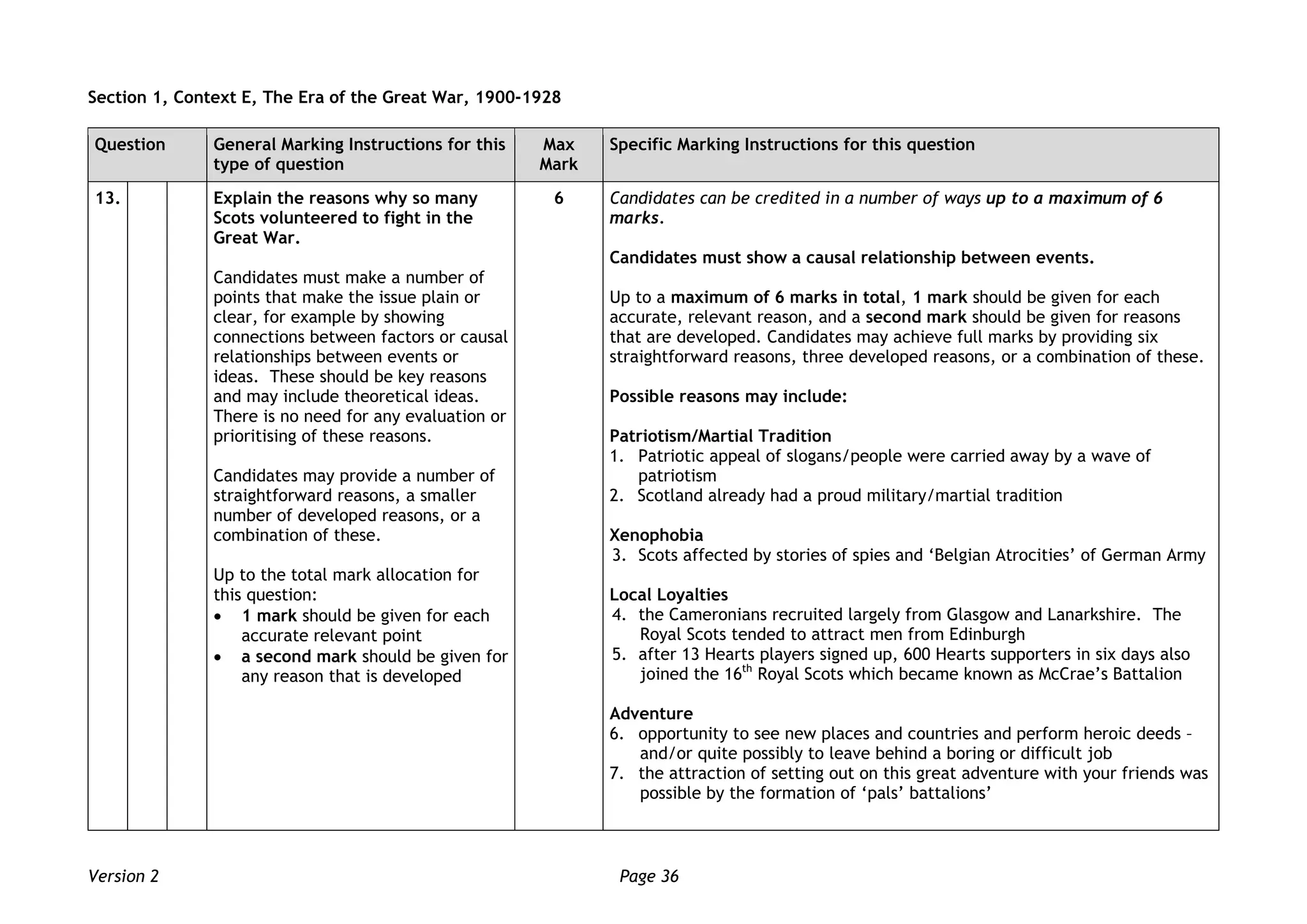
Candidates may provide a number of
straightforward reasons, a smaller
number of developed reasons, or a
combination of these.
Up to the total mark allocation for
this question:
 1 mark should be given for each
accurate relevant point
 a second mark should be given for
any reason that is developed
5 Candidates can be credited in a number of ways up to a maximum of 5
marks.
Candidates must show a causal relationship between events.
Up to a maximum of 5 marks in total, 1 mark should be given for each
accurate, relevant reason, and a second mark should be given for reasons
that are developed. Candidates may achieve full marks by providing five
straightforward reasons, three developed reasons, or a combination of these.
Possible reasons may include:
1. abolitionists formed The Society for the Abolition of the Slave Trade to
campaign against the Slave Trade
2. Thomas Clarkson visited ports such as Liverpool and Bristol to collect
evidence/ collected artefacts such as manacles and thumbscrews to
show people the horrors of the trade
3. Equiano highlighted his experience of slavery
4. a diagram of a slave ship, the Brookes, was also published/other
pamphlets and posters were produced
5. the society produced evidence that hundreds of British seamen involved
in the trade died every year
6. William Wilberforce tried to influence the prime minister and Prince of
Wales to support the abolition of the slave trade/MPs were routinely
petitioned
7. Wilberforce presented a bill to Parliament on numerous occasions to end
the slave trade
8. John Newton, a former slave ship captain, preached against slavery
9. Newton wrote the hymn ‘Amazing Grace’
10. Granville Sharp challenged slavery in the courts
11. anti-slavery petitions were signed
12. Wedgwood produced goods with the slogan ‘Am I not a man and a
brother?’
13. people boycotted goods such as sugar
14. any other valid reason that meets the criteria described in the
general marking instructions for this kind of question (see column to
Version 2 Page 55
Question General Marking Instructions for this
type of question
Max
Mark
Specific Marking Instructions for this question
left).
Version 2 Page 56
Section 2, Context D, Changing Britain, 1760-1914
Question General Marking Instructions for this
type of question
Max
Mark
Specific Marking Instructions for this question
28. Compare the views of Sources A and
B about the events of the Peterloo
massacre in 1819.
Candidates must interpret evidence
and make direct comparisons
between sources. Candidates are
expected to compare content directly
on a point-by-point basis. They may
compare the details in the sources
and/or compare the viewpoints
overall.
Up to the total mark allocation for
this question:
 1 mark should be given for each
simple point of comparison
 a second mark should be given to
each developed point of
comparison
Candidates may achieve full marks by
making four simple comparisons, two
developed comparisons, or by a
combination of these.
4 Candidates can be credited in a number of ways up to a maximum of 4
marks.
Candidates must make direct comparisons of the two sources, either overall
or in detail. A simple comparison will indicate what points of detail or overall
viewpoint they agree or disagree about and should be given 1 mark.
A developed comparison of the points of detail or overall viewpoint should be
given 2 marks. Candidates may achieve full marks by making four simple
comparisons, two developed comparisons or by a combination of these.
Possible points of comparison may include:
Overall: Sources mostly agree about the events of the massacre
Source B Source C
People had gathered from all over
Lancashire in St Peter’s Fields
I saw a large crowd that had
gathered from miles around and was
moving towards St Peter’s Fields
The magistrates wrongly believed
that people had been marching and
drilling like soldiers in preparation
(I laughed at the fears of the
magistrates as) the so-called
‘marching’ protest was actually a
procession of men with their wives,
sisters and children
11 people were killed and hundreds
injured
I could see that many people had
been hurt/I will always be haunted
by the sight of those trampled
bodies.
Version 2 Page 57
Question General Marking Instructions for this
type of question
Max
Mark
Specific Marking Instructions for this question
29. Explain the reasons why working in
mills was harmful to the health of
textile workers.
Candidates must make a number of
points that make the issue plain or
clear, for example by showing
connections between factors or causal
relationships between events or
ideas. These should be key reasons
and may include theoretical ideas.
There is no need for any evaluation or
prioritising of these reasons.
Candidates may provide a number of
straightforward reasons, a smaller
number of developed reasons, or a
combination of these.
Up to the total mark allocation for
this question:
 1 mark should be given for each
accurate relevant point
 a second mark should be given for
any reason that is developed
5 Candidates can be credited in a number of ways up to a maximum of 5
marks.
Candidates must show a causal relationship between events.
Up to a maximum of 5 marks in total, 1 mark should be given for each
accurate, relevant reason, and a second mark should be given for reasons
that are developed. Candidates may achieve full marks by providing five
straightforward reasons, three developed reasons, or a combination of these.
Possible reasons may include:
1. hot temperatures led to exhaustion/poor health/made accidents more
likely
2. long hours (12 to 18 hour days) led to exhaustion/poor health/made
accidents more likely
3. few breaks led to exhaustion/made accidents more likely
4. lack of ventilation made it hard to breathe
5. harmful dust particles and fibres in the air led to a high rate of lung
disease (TB)
6. noise of machinery often damaged hearing
7. open lavatory buckets smelly and unhygienic
8. machines were not fenced, so accidents were frequent
9. workers often had to work and eat during short breaks which led to
accidents being more likely
10. children often had to climb beneath machinery to clean, causing
accidents
11. child workers prone to rickets due to lack of sunlight and poor quality of
food
12. workers became deformed/stomach pains due to long hours bending over
machines
13. varicose veins common from workers spending long hours on feet
14. workers were often badly treated or beaten by overseers
15. before 1830s no laws to regulate working conditions/protect health
16. difficult to enforce laws passed/not enough factory inspectors
Version 2 Page 58
Question General Marking Instructions for this
type of question
Max
Mark
Specific Marking Instructions for this question
17. any other valid reason that meets the criteria described in the general
marking instructions for this kind of question (see column to left).
Version 2 Page 59
Question General Marking Instructions for this
type of question
Max
Mark
Specific Marking Instructions for this question
30. How fully does Source C explain the
benefits brought to Britain by
railways?
Candidates must make a judgement
about the extent to which the source
provides a full description/
explanation of a given event or
development.
Candidates should be given up to 3
marks for their identification of
points from the source which support
their judgement. Candidates should
be given up to 4 marks for their
identification of points of significant
omission, based on their own
knowledge, that support their
judgement.
A maximum of 2 marks may be given
for answers in which no judgement
has been made or which refer only
to the source.
6 Candidates can be credited in a number of ways up to a maximum of 6
marks.
Candidates must make an overall judgement about how fully the source
explains the events. 1 mark may be given for each valid point interpreted
from the source or each valid point of significant omission provided.
A maximum of 2 marks may be given for answers in which no judgement
has been made or which refer only to the source.
Possible points which may be identified in the source include:
1. even the most remote country areas were brought into contact with towns
and cities
2. industries benefited greatly from being able to transport their raw
materials and goods quickly/cheaply
3. farmers were able to sell their fresh produce over greater distances
4. faster travel meant that people could live further from their jobs/towns
spread as suburbs were built
Possible points of significant omission may include:
5. many jobs created (eg to build or run the railways)
6. daily national newspapers now possible
7. improved postal services
8. cheap fares/day trips and holidays for working class possible
9. Parliamentary trains meant railway travel was accessible to all
10. MPs could travel quickly between constituencies and London
11. political parties able to campaign nationwide
12. enabled growth of trade union movement
13. standardised time across Britain (GMT/Railway time)
14. enabled national sporting leagues to develop
15. perishable foods more widely available, so diet improved
16. any other valid point of explanation that meets the criteria described
in the general marking instructions for this kind of question (see
column to left).
Version 2 Page 60
Question General Marking Instructions for this
type of question
Max
Mark
Specific Marking Instructions for this question
31. Describe the changes made to voting
and representation by 1867.
Candidates must make a number of
relevant, factual points. These
should be key points. The points do
not need to be in any particular
order.
Candidates may provide a number of
straightforward points or a smaller
number of developed points, or a
combination of these.
Up to the total mark allocation for
this question:
 1 mark should be given for each
accurate relevant point of
knowledge
 a second mark should be given for
any point that is developed
5 Candidates can be credited in a number of ways up to a maximum of 5
marks.
They may take different perspectives on the events and may describe a
variety of different aspects of the events.
1 mark should be given for each accurate relevant key point of knowledge.
A second mark should be given for each point that is developed, up to a
maximum of 5 marks. Candidates may achieve full marks by providing five
straightforward points, by making three developed points, or a combination
of these.
Possible points of knowledge may include:
1832 Reform Act:
1. seats were distributed more fairly (eg industrial towns gained MPs)
2. pocket/rotten boroughs lost their MPs
3. boroughs with less than 4,000 inhabitants lost one MP each
4. more seats were awarded to the counties
5. Scotland was awarded extra seats/Ireland was given extra seats
6. some people lost the right to vote (eg working men in ‘potwalloper’
burghs)
7. 1 in 6 adult men now had the vote/1 in 8 in Scotland, 1 in 5 in England.
8. electorate increased by about 60%/from 435,000 to 652,000
9. in Scotland the electorate increased from 4,500 to 65,000
10. in burghs the franchise was standardised/all male householders paying
£10 per annum rent got the vote
11. in counties the franchise was extended to 40 shilling (£2)freeholders/
£10 copyholders/£50 tenants
12. this meant that middle-class men now had the vote (eg small
landowners, tenant farmers and shopkeepers)
13. voter registration introduced/duration of polling limited to two days
Version 2 Page 61
Question General Marking Instructions for this
type of question
Max
Mark
Specific Marking Instructions for this question
1867 Reform Act:
14. enfranchised 1.25 million men/effectively doubled the electorate/1 in 3
men now had vote
15. all male householders/lodgers in burghs who paid rent of £10 per annum
got the vote (enfranchised skilled working men in towns)
16. business owners who paid rates of £12 per annum got the vote
17. seats were redistributed from small towns to the growing industrial towns
or counties(eg Liverpool got an extra MP/Edinburgh from two to four MPs)
18. the University of London was also given a seat/two seats given to Scottish
universities
19. any other relevant factual key point of knowledge that meets the
criteria described in the general marking instructions for this kind of
question (see column to left).
Version 2 Page 62
Section 2, Context E, The Making of Modern Britain, 1880-1951
Question General Marking Instructions for this
type of question
Max
Mark
Specific Marking Instructions for this question
32. Describe the problems facing the
poor by the early 1900s.
Candidates must make a number of
relevant, factual points. These should
be key points. The points do not need
to be in any particular order.
Candidates may provide a number of
straightforward points or a smaller
number of developed points, or a
combination of these.
Up to the total mark allocation for
this question:
 1 mark should be given for each
accurate relevant point of
knowledge
 a second mark should be given for
any point that is developed
5 Candidates can be credited in a number of ways up to a maximum of 5
marks.
They may take different perspectives on the events and may describe a
variety of different aspects of the events.
1 mark should be given for each accurate relevant key point of knowledge.
A second mark should be given for each point that is developed, up to a
maximum of 5 marks. Candidates may achieve full marks by providing five
straightforward points, by making three developed points, or a combination
of these.
Possible points of knowledge may include:
1. poor housing (eg dampness, vermin, shared outside toilets)
2. poor health/lack of affordable health-care.
3. overcrowding – often leading to health problems (eg TB)
4. malnutrition led to health problems (eg Rickets)
5. low wages/few benefits
6. Unemployment/employment often cyclical or seasonal
7. dependence on charity/voluntary organisations (eg no pensions until 1908)
8. fear/stigma of workhouse/poorhouse (splitting up of families in
workhouse)
9. destitution/homelessness
10. high death rates – especially of young children/vulnerable people
11. lack of sympathy – due to laissez-faire attitudes
12. lack of education
13. excessive drunkenness/gambling
14. any other relevant factual key point of knowledge that meets the
criteria described in the general marking instructions for this kind of
question (see column to left).
Version 2 Page 63
Question General Marking Instructions for this
type of question
Max
Mark
Specific Marking Instructions for this question
33. How fully does Source A explain the
reasons for changing attitudes to
poverty by the 1900s?
Candidates must make a judgement
about the extent to which the source
provides a full description/
explanation of a given event or
development.
Candidates should be given up to 3
marks for their identification of
points from the source which support
their judgement. Candidates should
be given up to 4 marks for their
identification of points of significant
omission, based on their own
knowledge, that support their
judgement.
A maximum of 2 marks may be given
for answers in which no judgement
has been made or which refer only
to the source.
6 Candidates can be credited in a number of ways up to a maximum of 6
marks.
Candidates must make an overall judgement about how fully the source
explains the events. 1 mark may be given for each valid point interpreted
from the source or each valid point of significant omission provided.
A maximum of 2 marks may be given for answers in which no judgement
has been made or which refer only to the source.
Possible points which may be identified in the source include:
1. other parties were afraid that they might lose votes to Labour if they did
not show that they wanted to help the poor
2. most working class men now had the vote, so it was possible that they
could vote for Labour
3. Trade unions put pressure on the Liberals and Conservatives, to do more
to help the poor
4. society was beginning to accept that some people became poor through
no fault of their own
Possible points of significant omission may include:
5. Booth’s survey revealed high levels of poverty in London.
6. Rowntree’s survey revealed that the problem was not confined to London
– provincial cities like York affected too.
7. concerns over fitness of recruits during Boer War led to desire to improve
health by tackling poverty.
8. concerns over national efficiency/worries about Britain’s future workforce
led to desire to tackle poverty and poor health
9. other countries beginning to challenge Britain’s position (eg Germany and
the USA)
10. ‘New Liberals’ accepted that government had to intervene more in the
lives of the people to help the poor
11. politicians such as David Lloyd George came from a working class
background and had genuine concern for the poor
Version 2 Page 64
Question General Marking Instructions for this
type of question
Max
Mark
Specific Marking Instructions for this question
12. the Germans had introduced some welfare reforms already and the
‘German Model’ was studied and copied by the British/David Lloyd George
had visited Germany for this purpose
13. any other valid reason that meets the criteria described in the general
marking instructions for this kind of question (see column to left).
Version 2 Page 65
Question General Marking Instructions for this
type of question
Max
Mark
Specific Marking Instructions for this question
34. Explain the reasons why the reforms
of the Liberal government of 1906 –
1914 did not fully meet the needs of
the British people.
Candidates must make a number of
points that make the issue plain or
clear, for example by showing
connections between factors or causal
relationships between events or
ideas. These should be key reasons
and may include theoretical ideas.
There is no need for any evaluation or
prioritising of these reasons.
Candidates may provide a number of
straightforward reasons, a smaller
number of developed reasons, or a
combination of these.
Up to the total mark allocation for
this question:
 1 mark should be given for each
accurate relevant point
 a second mark should be given for
any reason that is developed
5 Candidates can be credited in a number of ways up to a maximum of 5
marks.
Candidates must show a causal relationship between events.
Up to a maximum of 5 marks in total, 1 mark should be given for each
accurate, relevant reason, and a second mark should be given for reasons
that are developed. Candidates may achieve full marks by providing five
straightforward reasons, three developed reasons, or a combination of these.
Possible reasons may include:
1. Liberals had no overall plan for social reform
2. reforms were selective/only helped some groups/deserving poor
3. benefit levels were ungenerous/often below subsistence level (eg
pensions)
4. many of the reforms were voluntary/optional/control given to local
authorities (eg school meals only made compulsory in 1914)
5. unemployment benefit only paid for short-term (15 weeks), so did not
tackle long-term unemployment
6. unemployment insurance only for certain trades
7. problems with pensions (eg payable at 70 – well above average life-
expectancy)
8. medical inspections did not provide treatment (until 1912 when school
clinics introduced)
9. health insurance did not cover most hospital treatment
10. families of workers not covered by health insurance
11. housing not tackled at all
12. Education barely tackled (apart from some scholarships in 1907/8
Education Act)
13. any other valid reason that meets the criteria described in the general
marking instructions for this kind of question (see column to left).
Version 2 Page 66
Question General Marking Instructions for this
type of question
Max
Mark
Specific Marking Instructions for this question
35. Compare the views of Sources B and
C about the success of the reforms
of the Labour Government of 1945 –
1951.
Candidates must interpret evidence
and make direct comparisons
between sources. Candidates are
expected to compare content directly
on a point-by-point basis. They may
compare the details in the sources
and/or compare the viewpoints
overall.
Up to the total mark allocation for
this question:
 1 mark should be given for each
simple point of comparison
 a second mark should be given to
each developed point of
comparison
Candidates may achieve full marks by
making four simple comparisons, two
developed comparisons, or by a
combination of these.
4 Candidates can be credited in a number of ways up to a maximum of 4
marks.
Candidates must make direct comparisons of the two sources, either overall
or in detail. A simple comparison will indicate what points of detail or overall
viewpoint they agree or disagree about and should be given 1 mark.
A developed comparison of the points of detail or overall viewpoint should be
given 2 marks. Candidates may achieve full marks by making four simple
comparisons, two developed comparisons or by a combination of these.
Possible points of comparison may include:
Overall: The Sources disagree about the success of the Labour reforms
Source B Source C
Their record of success is difficult to
argue with
Their reputation … is not entirely
deserved
The National Health Service was the
greatest achievement of the Labour
welfare state, giving free medical
and dental treatment to all
By 1951, charges had to be
introduced (for some dental
treatment, spectacles and
prescriptions) meaning that the NHS
was not an entirely free service.
Considerable progress was made in
tackling the housing shortage/
between 1948 and 1951, around
200,000 homes were built per year
Labour’s record on house building is
poor (when compared to that of the
previous governments of the 1930s)
Version 2 Page 67
Section 3, Context A, The Cross and the Crescent; the Crusades, 1071-1192
Question General Marking Instructions for this
type of question
Max
Mark
Specific Marking Instructions for this question
36. Describe the role of a knight in
medieval times.
Candidates must make a number of
relevant, factual points. These should
be key points. The points do not need
to be in any particular order.
Candidates may provide a number of
straightforward points or a smaller
number of developed points, or a
combination of these.
Up to the total mark allocation for
this question:
 1 mark should be given for each
accurate relevant point of
knowledge
 a second mark should be given for
any point that is developed
5 Candidates can be credited in a number of ways up to a maximum of 5
marks.
They may take different perspectives on the events and may describe a
variety of different aspects of the events.
1 mark should be given for each accurate relevant key point of knowledge.
A second mark should be given for each point that is developed, up to a
maximum of 5 marks. Candidates may achieve full marks by providing five
straightforward points, by making three developed points, or a combination
of these.
Possible points of knowledge may include:
1. knights were expected to fight for the king
2. knights were expected to carry out castle guard duty
3. knights were expected to fight for the Church/protect the clergy
4. orders of knights protected pilgrims (eg the Knights Templar)
5. knights were expected to protect the weak and vulnerable in society (eg
elderly, children)
6. knights were part of the feudal system providing land for peasants to
cultivate
7. knights enforced law and order/were members of a jury in some countries
8. knights were expected to be role models/to live by the Code of Chivalry
9. any other relevant factual key point of knowledge that meets the
criteria described in the general marking instructions for this kind of
question (see column to left).
Version 2 Page 68
Question General Marking Instructions for this
type of question
Max
Mark
Specific Marking Instructions for this question
37. Explain the reasons why the
People’s Crusade failed.
Candidates must make a number of
points that make the issue plain or
clear, for example by showing
connections between factors or causal
relationships between events or
ideas. These should be key reasons
and may include theoretical ideas.
There is no need for any evaluation or
prioritising of these reasons.
Candidates may provide a number of
straightforward reasons, a smaller
number of developed reasons, or a
combination of these.
Up to the total mark allocation for
this question:
 1 mark should be given for each
accurate relevant point
 a second mark should be given for
any reason that is developed
5 Candidates can be credited in a number of ways up to a maximum of 5
marks.
Candidates must show a causal relationship between events.
Up to a maximum of 5 marks in total, 1 mark should be given for each
accurate, relevant reason, and a second mark should be given for reasons
that are developed. Candidates may achieve full marks by providing five
straightforward reasons, three developed reasons, or a combination of these.
Possible reasons may include:
1. Peter the Hermit was a poor military leader
2. belief in the righteousness of their cause made them overconfident
3. the peasants were not trained soldiers/accompanied by wives, children,
even the elderly
4. the peasants had few weapons
5. the peasants ran out of supplies/money whilst travelling across Europe
6. the peasants were ill-disciplined on their journey (eg treatment of the
Jews making communities unwilling to help them)
7. the peasants ignored Emperor Alexius’ advice to wait for the main
Crusader army
8. the peasants split into different groups and elected their own
leaders/Peter the Hermit was cast aside
9. peasants were lured into an ambush by spies
10. the peasants were defeated by Muslim forces/most were killed/supplies
lost
11. any other valid reason that meets the criteria described in the general
marking instructions for this kind of question (see column to left).
Version 2 Page 69
Question General Marking Instructions for this
type of question
Max
Mark
Specific Marking Instructions for this question
38. How fully does Source A describe
Muslim disunity during the First
Crusade?
Candidates must make a judgement
about the extent to which the source
provides a full description/
explanation of a given event or
development.
Candidates should be given up to 3
marks for their identification of
points from the source which support
their judgement. Candidates should
be given up to 4 marks for their
identification of points of significant
omission, based on their own
knowledge, that support their
judgement.
A maximum of 2 marks may be given
for answers in which no judgement
has been made or which refer only
to the source.
5 Candidates can be credited in a number of ways up to a maximum of 5
marks.
Candidates must make an overall judgement about how fully the source
explains the events. 1 mark may be given for each valid point interpreted
from the source or each valid point of significant omission provided
A maximum of 2 marks may be given for answers in which no judgement
has been made or which refer only to the source.
Possible points which may be identified in the source include:
1. Muslim communities did not attack Crusaders/gave them money to keep
the peace
2. refused to join together and thought only of their own land
3. Seljuk Turks had been defeated by Egyptian forces and lost the city
4. Egyptians asked for help but no Muslim armies came to their aid
Possible points of significant omission may include:
5. the Crusaders captured Nicaea because Kilij Arslan was away fighting
other Muslims (eg The Danishmends)
6. at Antioch the Crusaders bribed a Muslim who let them into the city eg
Firouz
7. Kerbogha arrived late to Antioch because he spent time trying to protect
his own land first (eg attacked Edessa)
8. Muslim forces refused to attack together at Antioch (eg Ridwan of
Aleppo/Duqaq of Damascus)
9. Kerbogha’s men fled the battlefield at Antioch
10. Turks did not attempt to recapture Jerusalem because they had land
disputes to settle with other Muslim groups elsewhere.
11. any other valid point of explanation that meets the criteria
described in the general marking instructions for this kind of question
(see column to left).
Version 2 Page 70
Question General Marking Instructions for this
type of question
Max
Mark
Specific Marking Instructions for this question
39. Evaluate the usefulness of Source B
as evidence of the Battle of Hattin.
Candidates must evaluate the extent
to which a source is useful by
commenting on evidence such as the
author, type of source, purpose,
timing, content and omission.
For a mark to be given, the candidate
must identify an aspect of the source
and make a comment which shows
how this aspect makes the source
more or less useful.
Up to the total mark allocation for
this question:
 a maximum of 4 marks can be
given for evaluative comments
relating to author, type of source,
purpose and timing
 a maximum of 2 marks may be
given for evaluative comments
relating to the content of the
source
 a maximum of 2 marks may be
given for points of significant
omission
5 Candidates can be credited in a number of ways up to a maximum of 5
marks.
Candidates must make a judgement about the usefulness of the source and
support this by making evaluative comments on identified aspects of the
source.
1 mark should be given for each relevant comment made, up to a maximum
of 5 marks in total.
 A maximum of 4 marks can be given for evaluative comments relating to
the author, type of source, purpose and timing.
 A maximum of 2 marks may be given for comments relating to the
content of the source.
 A maximum of 2 marks may be given for comments relating to points of
significant omission.
Examples of aspects of the source and relevant comments:
Aspect of the source Possible comment
Author:
A Crusader
Useful because he has first-hand
experience/eyewitness
Type of Source:
Chronicle
Useful because it was a well-researched record
of events in the East
Purpose:
To record/blame King Guy
for the defeat
Useful because it provides a detail account of
the battle/less useful as it may be biased
Timing:
1187
Useful because it was written at the time of the
Battle of Hattin
Version 2 Page 71
Question General Marking Instructions for this
type of question
Max
Mark
Specific Marking Instructions for this question
Content Possible comment
Crusaders constantly attacked by
Saladin’s army
Useful because it accurately explains
why the Crusaders tired
King Guy made a terrible mistake
and made camp near Hattin
Useful because it accurately
describes the error made by the
Crusaders
Saladin’s army surrounded the
Crusaders’ camp and slaughtered
nearly all those inside
Useful because it accurately
describes what happened in the
battle.
Possible points of significant omission may include:
1. Saladin’s army set fire to the grass around the Crusaders’ camp
2. not all Crusaders agreed with the march to Tiberias (eg Roland of Tripoli)
3. Saladin’s army captured some Crusaders as prisoners
4. Saladin’s army captured a shard of the True Cross
5. Saladin spared the life of King Guy and some other Christian lords
6. repeated charges by mounted Crusaders against Muslim lines failed
7. any other valid point that meets the criteria described in the general
marking instructions for this kind of question (see column to left).
Version 2 Page 72
Section 3, Context B, “Tea and Freedom,”: the American Revolution, 1774-83
Question General Marking Instructions for this
type of question
Max
Mark
Specific Marking Instructions for this question
40. Explain the reasons why the
colonists had become unhappy with
British rule by the 1770s.
Candidates must make a number of
points that make the issue plain or
clear, for example by showing
connections between factors or causal
relationships between events or
ideas. These should be key reasons
and may include theoretical ideas.
There is no need for any evaluation or
prioritising of these reasons.
Candidates may provide a number of
straightforward reasons, a smaller
number of developed reasons, or a
combination of these.
Up to the total mark allocation for
this question:
 1 mark should be given for each
accurate relevant point
 a second mark should be given for
any reason that is developed
5 Candidates can be credited in a number of ways up to a maximum of 5
marks.
Candidates must show a causal relationship between events.
Up to a maximum of 5 marks in total, 1 mark should be given for each
accurate, relevant reason, and a second mark should be given for reasons
that are developed. Candidates may achieve full marks by providing five
straightforward reasons, three developed reasons, or a combination of these.
Possible reasons may include:
1. the colonists were unhappy with the imposition of laws and taxes which
were seen as unjust (eg the passing of the Stamp Act and Townshend Act
in the 1760s had been very unpopular measures)
2. they resented being taxed without representation in the British
parliament
3. events such as the Boston Tea Party led to an increase in anti-British
feeling among colonists/unhappiness at high-handed actions of British
government
4. the colonists were unhappy with the continuing presence of British
soldiers in the colonies
5. some colonists were frustrated that the British were stopping them from
moving West
6. some colonists felt that the policies of the British government were
damaging trade
7. any other valid reason that meets the criteria described in the
general marking instructions for this kind of question (see column to
left).
Version 2 Page 73
Question General Marking Instructions for this
type of question
Max
Mark
Specific Marking Instructions for this question
41. Describe the events at Bunker Hill in
1775.
Candidates must make a number of
relevant, factual points. These should
be key points. The points do not
need to be in any particular order.
Candidates may provide a number of
straightforward points or a smaller
number of developed points, or a
combination of these.
Up to the total mark allocation for
this question:
 1 mark should be given for each
accurate relevant point of
knowledge
 a second mark should be given for
any point that is developed
5 Candidates can be credited in a number of ways up to a maximum of 5
marks.
They may take different perspectives on the events and may describe a
variety of different aspects of the events.
1 mark should be given for each accurate relevant key point of knowledge.
A second mark should be given for each point that is developed, up to a
maximum of 5 marks. Candidates may achieve full marks by providing five
straightforward points, by making three developed points, or a combination
of these.
Possible points of knowledge may include:
1. Colonists secured high ground at Bunker Hill overlooking British forces
2. British Navy opened fire on the colonists’ position (but shells fell short)
3. Prescott told the colonists, ‘Don’t fire until you see the whites of their
eyes!’ (to save much needed ammunition)
4. British charged the hill three times before the colonists were driven
away/ran out of ammunition
5. British soldiers were exposed to American musket fire as they made their
way up the hill
6. Bright uniforms of British soldiers made them easy targets
7. British suffered around 1,000 casualties (226 killed, 828 wounded)
8. Colonists suffered less than half of British casualties (around 100-400
killed and 300 wounded)
9. British were victorious/Colonists achieved confidence boost for future
battles against British forces
10. any other relevant factual key point of knowledge that meets the
criteria described in the general marking instructions for this kind of
question (see column to left).
Version 2 Page 74
Question General Marking Instructions for this
type of question
Max
Mark
Specific Marking Instructions for this question
42. How fully does Source A describe
the events at Lexington and
Concord in 1775?
Candidates must make a judgement
about the extent to which the source
provides a full description/
explanation of a given event or
development.
Candidates should be given up to 3
marks for their identification of
points from the source which support
their judgement. Candidates should
be given up to 4 marks for their
identification of points of significant
omission, based on their own
knowledge, that support their
judgement.
A maximum of 2 marks may be given
for answers in which no judgement
has been made or which refer only
to the source.
5 Candidates can be credited in a number of ways up to a maximum of 5
marks.
Candidates must make an overall judgement about how fully the source
explains the events. 1 mark may be given for each valid point interpreted
from the source or each valid point of significant omission provided.
A maximum of 2 marks may be given for answers in which no judgement
has been made or which refer only to the source.
Possible points which may be identified in the source include:
1. British soldiers were dispatched to seize the supplies
2. when the British arrived at Lexington they were confronted by a group of
minutemen
3. shots were fired and several colonists were killed
4. the British then marched on to Concord where they destroyed any
remaining supplies.
Possible points of significant omission may include:
5. the Sons of Liberty had discovered that the British were planning to
march on Concord.
6. Paul Revere and other riders sounded the alarm
7. church bells roused the minutemen from their beds.
8. the British soldiers were attacked by angry colonists as they tried to
make their way back to Boston.
9. many British soldiers were killed and injured.
10. Colonists in Massachusetts continued to attack the British forces.
11. any other valid point of explanation that meets the criteria described
in the general marking instructions for this kind of question (see
column to left)
Version 2 Page 75
Question General Marking Instructions for this
type of question
Max
Mark
Specific Marking Instructions for this question
43. Evaluate the usefulness of Source B
as evidence of the condition of the
American army during the winter of
1777.
Candidates must evaluate the extent
to which a source is useful by
commenting on evidence such as the
author, type of source, purpose,
timing, content and omission.
For a mark to be given, the candidate
must identify an aspect of the source
and make a comment which shows
how this aspect makes the source
more or less useful.
Up to the total mark allocation for
this question:
 a maximum of 4 marks can be
given for evaluative comments
relating to author, type of source,
purpose and timing
 a maximum of 2 marks may be
given for evaluative comments
relating to the content of the
source
 a maximum of 2 marks may be
given for points of significant
omission
5 Candidates can be credited in a number of ways up to a maximum of 5
marks.
Candidates must make a judgement about the usefulness of the source and
support this by making evaluative comments on identified aspects of the
source.
1 mark should be given for each relevant comment made, up to a maximum
of 5 marks in total.
 A maximum of 4 marks can be given for evaluative comments relating to
the author, type of source, purpose and timing.
 A maximum of 2 marks may be given for comments relating to the
content of the source.
 A maximum of 2 marks may be given for comments relating to points of
significant omission.
Examples of aspects of the source and relevant comments:
Aspect of the source Possible comment
Author:
American army officer
Useful as he is an eyewitness/first-hand
experience
Type of Source:
Diary entry
Useful as it is more likely to reveal his true
opinion/feelings
Purpose:
To record
Useful as it is a private record and is less likely
to be biased on the poor condition of the
American army
Timing:
1777
Useful because it was written during the Wars
of Independence
Version 2 Page 76
Question General Marking Instructions for this
type of question
Max
Mark
Specific Marking Instructions for this question
Content Possible comment
The army now continues to grow
sickly from the exhaustion they have
suffered in this campaign
Useful as it accurately shows the true
condition of the army
Poor food/cold weather/nasty
clothes/nasty cooking
Useful as it accurately shows the
extent of suffering of the army
The men still show a spirit Useful as it accurately shows that the
morale of the American army
remained high
Possible points of significant omission may include:
1. the American forces had endured a number of military setbacks in 1777
2. the Army was small in number/lacked experienced leadership/few
professional soldiers
3. Washington used the difficult winter of 1777 to train and discipline his
soldiers into a much more effective force.
4. any other valid point that meets the criteria described in the general
marking instructions for this kind of question (see column to left).
Version 2 Page 77
Section 3, Context C, USA 1850-1880
Question General Marking Instructions for this
type of question
Max
Mark
Specific Marking Instructions for this question
44. Describe the problems faced by the
different groups who travelled west
after 1850.
Candidates must make a number of
relevant, factual points. These
should be key points. The points do
not need to be in any particular
order.
Candidates may provide a number of
straightforward points or a smaller
number of developed points, or a
combination of these.
Up to the total mark allocation for
this question:
 1 mark should be given for each
accurate relevant point of
knowledge
 a second mark should be given for
any point that is developed
5 Candidates can be credited in a number of ways up to a maximum of 5
marks.
They may take different perspectives on the events and may describe a
variety of different aspects of the events.
1 mark should be given for each accurate relevant key point of knowledge.
A second mark should be given for each point that is developed, up to a
maximum of 5 marks. Candidates may achieve full marks by providing five
straightforward points, by making three developed points, or a combination
of these.
Possible points of knowledge may include:
1. problems of trying to cross mountains and rivers
2. difficulties with wagons (eg broken wheels)
3. had to be timed to complete journey before winter struck
4. dangers of weather – possibility of being stuck in snow
5. had to cross deserts and plains/lack of water
6. navigating the terrain was challenging
7. problems of supplies lasting for the whole journey/lack of fuel in treeless
plains
8. threats of attack from Native Americans
9. problems of disease (eg cholera killed many)
10. attacks by wild animals
11. any other relevant factual key point of knowledge that meets the
criteria described in the general marking instructions for this kind of
question (see column to left).
Version 2 Page 78
Question General Marking Instructions for this
type of question
Max
Mark
Specific Marking Instructions for this question
45. Explain the reasons why the
Southern States seceded from the
Union in 1861.
Candidates must make a number of
points that make the issue plain or
clear, for example by showing
connections between factors or causal
relationships between events or
ideas. These should be key reasons
and may include theoretical ideas.
There is no need for any evaluation or
prioritising of these reasons.
Candidates may provide a number of
straightforward reasons, a smaller
number of developed reasons, or a
combination of these.
Up to the total mark allocation for
this question:
 1 mark should be given for each
accurate relevant point
 a second mark should be given for
any reason that is developed
5 Candidates can be credited in a number of ways up to a maximum of 5
marks.
Candidates must show a causal relationship between events.
Up to a maximum of 5 marks in total, 1 mark should be given for each
accurate, relevant reason, and a second mark should be given for reasons
that are developed. Candidates may achieve full marks by providing five
straightforward reasons, three developed reasons, or a combination of these.
Possible reasons may include:
1. failure to resolve slavery as an issue between the states
2. failure to resolve disputes over tariffs
3. growth of abolitionism in North
4. Dred Scott Case upset Northern States and abolitionists
5. Kansas – Nebraska Act led to “Bleeding Kansas”
6. growing tension between North and South (eg incidents such as John
Brown/Harpers Ferry)
7. south felt it was being blocked from expansion in new western territories
8. growing industry/wealth and immigrant population of North was at odds
with plantation life of South
9. growth of Republican Party which favoured Northern interests/North
increasingly dominating politics
10. south felt it was being marginalised/losing influence
11. election of Lincoln in 1860 angered Southern states who saw it as an
attack upon them
12. any other valid reason that meets the criteria described in the general
marking instructions for this kind of question (see column to left).
Version 2 Page 79
Question General Marking Instructions for this
type of question
Max
Mark
Specific Marking Instructions for this question
46. Evaluate the usefulness of Source A
as evidence of slave life on
plantations before 1861.
Candidates must evaluate the extent
to which a source is useful by
commenting on evidence such as the
author, type of source, purpose,
timing, content and omission.
For a mark to be given, the candidate
must identify an aspect of the source
and make a comment which shows
how this aspect makes the source
more or less useful.
Up to the total mark allocation for
this question:
 a maximum of 4 marks can be
given for evaluative comments
relating to author, type of source,
purpose and timing
 a maximum of 2 marks may be
given for evaluative comments
relating to the content of the
source
 a maximum of 2 marks may be
given for points of significant
omission
5 Candidates can be credited in a number of ways up to a maximum of 5
marks.
Candidates must make a judgement about the usefulness of the source and
support this by making evaluative comments on identified aspects of the
source.
1 mark should be given for each relevant comment made, up to a maximum
of 5 marks in total.
 A maximum of 4 marks can be given for evaluative comments relating to
the author, type of source, purpose and timing.
 A maximum of 2 marks may be given for comments relating to the
content of the source.
 A maximum of 2 marks may be given for comments relating to points of
significant omission.
Examples of aspects of the source and relevant comments:
Aspect of the source Possible comment
Author:
George Fitzhugh
Useful as he was an eyewitness/first-hand
experience
Type of Source:
Letter
Useful as it gives his own honest opinion
Purpose:
To persuade
Less useful as it presents a biased view of
slavery
Timing:
1857
Useful as it was written at the time when
slavery existed
Version 2 Page 80
Question General Marking Instructions for this
type of question
Max
Mark
Specific Marking Instructions for this question
Content Possible comment
The children, the aged and the sick
do not work at all
Less useful as not true of all
plantations
They have all the comforts and
necessaries of life provided for them
such as food and housing
Less useful as false impression given
is of caring owners
The slave men and boys do not work
more than nine hours a day in good
weather/the slave women do little
hard work
Less useful as slaves worked very
long hours in all weathers
Possible points of significant omission may include:
1. no mention of punishments
2. no mention of particular mistreatment of female slaves
3. no mention of splitting of slave families
4. no mention of slaves as property
5. no mention of slaves running away
6. no mention of Abolitionist viewpoints
7. any other valid point that meets the criteria described in the general
marking instructions for this kind of question (see column to left).
Version 2 Page 81
Question General Marking Instructions for this
type of question
Max
Mark
Specific Marking Instructions for this question
47. How fully does Source B describe
the impact of Reconstruction in the
South after 1865?
Candidates must make a judgement
about the extent to which the source
provides a full description/
explanation of a given event or
development.
Candidates should be given up to 3
marks for their identification of
points from the source which support
their judgement. Candidates should
be given up to 4 marks for their
identification of points of significant
omission, based on their own
knowledge, that support their
judgement.
A maximum of 2 marks may be given
for answers in which no judgement
has been made or which refer only
to the source.
5 Candidates can be credited in a number of ways up to a maximum of 5
marks.
Candidates must make an overall judgement about how fully the source
explains the events. 1 mark may be given for each valid point interpreted
from the source or each valid point of significant omission provided.
A maximum of 2 marks may be given for answers in which no judgement
has been made or which refer only to the source.
Possible points which may be identified in the source include:
1. slaves were made free in 1865
2. the right of citizenship granted in the Fourteenth Amendment is
practically a mockery/is ignored
3. the right to vote, provided for in the Fifteenth Amendment, is under
attack/is ignored
4. the old ruling class is victorious today/the newly freed slaves are little
better off than they were before
Possible points of significant omission may include:
5. Carpetbaggers and Scalawags exploited opportunities in South
6. Freedman’s Bureau helped freed slaves with their needs (eg jobs)
7. Sharecroppers little better off after 1865
8. Black Codes restricted the rights of black Americans eg could not leave
employment without permission
9. KKK and other groups used violence to attack freed slaves
10. Jim Crow Laws began to be passed after 1877 (eg separate facilities)
11. any other valid point of explanation that meets the criteria described
in the general marking instructions for this kind of question (see
column to left).
Version 2 Page 82
Section 3, Context D, Hitler and Nazi Germany, 1919-1939
Question General Marking Instructions for this
type of question
Max
Mark
Specific Marking Instructions for this question
48. Explain the reasons why the German
people were opposed to the Treaty
of Versailles.
Candidates must make a number of
points that make the issue plain or
clear, for example by showing
connections between factors or causal
relationships between events or
ideas. These should be key reasons
and may include theoretical ideas.
There is no need for any evaluation or
prioritising of these reasons.
Candidates may provide a number of
straightforward reasons, a smaller
number of developed reasons, or a
combination of these.
Up to the total mark allocation for
this question:
 1 mark should be given for each
accurate relevant point
 a second mark should be given for
any reason that is developed
5 Candidates can be credited in a number of ways up to a maximum of 5
marks.
Candidates must show a causal relationship between events.
Up to a maximum of 5 marks in total, 1 mark should be given for each
accurate, relevant reason, and a second mark should be given for reasons
that are developed. Candidates may achieve full marks by providing five
straightforward reasons, three developed reasons, or a combination of these.
Possible reasons may include:
1. Germany got no say in the Treaty/called it a “DIKTAT” a dictated peace
2. Germany blamed for starting the war (War Guilt Clause)
3. felt it humiliated Germany/was unacceptable/too harsh
4. Germans resented having to pay reparations
5. with the Kaiser gone Germans did not believe they should be punished
6. not based on Wilson’s 14 points eg no self determination
7. Germany lost land eg people living under foreign rule
8. loss of colonies felt to be unfair
9. Armed forces reduced increasing unemployment/leaving them vulnerable
to attack
10. any other valid reason that meets the criteria described in the general
marking instructions for this kind of question (see column to left).
Version 2 Page 83
Question General Marking Instructions for this
type of question
Max
Mark
Specific Marking Instructions for this question
49. Describe the treatment of the Jews
in Nazi Germany.
Candidates must make a number of
relevant, factual points. These
should be key points. The points do
not need to be in any particular
order.
Candidates may provide a number of
straightforward points or a smaller
number of developed points, or a
combination of these.
Up to the total mark allocation for
this question:
 1 mark should be given for each
accurate relevant point of
knowledge
 a second mark should be given for
any point that is developed
5 Candidates can be credited in a number of ways up to a maximum of 5
marks.
They may take different perspectives on the events and may describe a
variety of different aspects of the events.
1 mark should be given for each accurate relevant key point of knowledge.
A second mark should be given for each point that is developed, up to a
maximum of 5 marks. Candidates may achieve full marks by providing five
straightforward points, by making three developed points, or a combination
of these.
Possible points of knowledge may include:
1. Anti-Jewish propaganda: blamed for World War One/Communism/
economic ruin/contaminating the “Master Race”
2. Jews were often abused or beaten up in the streets
3. Anti-Semitic education: pupils taught to be hostile to Jews: teachers
humiliated Jewish children
4. from 1933 Anti-Jewish Laws/boycott of Jewish shops/doctors/lawyers/
lecturers dismissed
5. Law for the Restoration of the Professional Civil Service banned Jews from
government jobs
6. 1935: Jews forbidden to join the Army; restrictions on opportunities for
employment, education; Civil Liberties restricted; Anti-Jewish signs
displayed in shops/restaurants/cafes
7. 1935 Nuremburg Laws for protection of German blood and honour (eg ban
on marriage between Jews and non-Jews)
8. Sexual relations between Jews and non-Jews outside marriage – criminal
offence
9. 1935 National Law of Citizenship meant Jews lost citizenship − no vote/
rights
10. 1938 Government contracts only for Aryan firms
11. 1938 only Aryan doctors were allowed to treat Aryan patients
12. 1938 all Jews had to take new first name: Israel and Sarah: adding to
signatures/passport stamped with letter ‘J’
Version 2 Page 84
Question General Marking Instructions for this
type of question
Max
Mark
Specific Marking Instructions for this question
13. 1938 Kristallnacht – massive anti-Semitic campaign: Jewish
homes/shops/synagogues destroyed; 100 killed/2000 arrested/
14. Many Jews sent to concentration camps/murdered
15. any other relevant factual key point of knowledge that meets the
criteria described in the general marking instructions for this kind of
question (see column to left).
Version 2 Page 85
Question General Marking Instructions for this
type of question
Max
Mark
Specific Marking Instructions for this question
50. Evaluate the usefulness of Source A
as evidence of the use of
intimidation by the Nazis.
Candidates must evaluate the extent
to which a source is useful by
commenting on evidence such as the
author, type of source, purpose,
timing, content and omission.
For a mark to be given, the candidate
must identify an aspect of the source
and make a comment which shows
how this aspect makes the source
more or less useful.
Up to the total mark allocation for
this question:
 a maximum of 4 marks can be
given for evaluative comments
relating to author, type of source,
purpose and timing
 a maximum of 2 marks may be
given for evaluative comments
relating to the content of the
source
 a maximum of 2 marks may be
given for points of significant
omission
5 Candidates can be credited in a number of ways up to a maximum of 5
marks.
Candidates must make a judgement about the usefulness of the source and
support this by making evaluative comments on identified aspects of the
source.
1 mark should be given for each relevant comment made, up to a maximum
of 5 marks in total.
 A maximum of 4 marks can be given for evaluative comments relating to
the author, type of source, purpose and timing.
 A maximum of 2 marks may be given for comments relating to the
content of the source.
 A maximum of 2 marks may be given for comments relating to points of
significant omission.
Examples of aspects of the source and relevant comments:
Aspect of the source Possible comment
Author:
Ernst Thalmann
Useful as it is from someone who has first-hand
experience of Nazi intimidation
Type of Source:
Diary
Useful as it is an honest personal account
Purpose:
To inform
Useful as it provides a balanced (and detailed)
account of the use of intimidation by the Nazis
Timing:
1933
Useful as it is from the time that the Nazis
were routinely intimidating their opponents
Version 2 Page 86
Question General Marking Instructions for this
type of question
Max
Mark
Specific Marking Instructions for this question
Content Possible comment
Every cruel method of blackmail was
used against me
Useful as it accurately describes how
the Nazis threatened prisoners
families to extract confessions
I was then assaulted and in the
process had four teeth knocked
out/a Gestapo officer with a whip in
his hand then beat me with
measured strokes
Useful as it accurately describes
methods used by Gestapo
They tried hypnosis which was also
ineffective
Useful as it accurately describes
methods used by Gestapo
Possible points of significant omission may include:
1. the SS also very intimidating
2. fear of concentration camps intimidating
3. use of Gestapo informers/other spying systems intimidated people
4. public executions acted as a warning to others
5. any other valid point that meets the criteria described in the general
marking instructions for this kind of question (see column to left).
Version 2 Page 87
Question General Marking Instructions for this
type of question
Max
Mark
Specific Marking Instructions for this question
51. How fully does Source B describe
the activities of the Hitler Youth?
Candidates must make a judgement
about the extent to which the source
provides a full description/
explanation of a given event or
development.
Candidates should be given up to 3
marks for their identification of
points from the source which support
their judgement. Candidates should
be given up to 4 marks for their
identification of points of significant
omission, based on their own
knowledge, that support their
judgement.
A maximum of 2 marks may be given
for answers in which no judgement
has been made or which refer only
to the source.
5 Candidates can be credited in a number of ways up to a maximum of 5
marks.
Candidates must make an overall judgement about how fully the source
explains the events. 1 mark may be given for each valid point interpreted
from the source or each valid point of significant omission provided.
A maximum of 2 marks may be given for answers in which no judgement
has been made or which refer only to the source.
Possible points which may be identified in the source include:
1. boys learned military skills such as practising with weapons
2. to toughen them up, they were taken on cross country hikes and runs
3. boys were also tested on their knowledge of Nazism
4. however they did not all enjoy the endless marching
Possible points of significant omission may include:
5. details on “military athletics” (Wehrsport) (eg bayonet drill, grenade
throwing, trench digging, map reading, gas defence, use of dugouts, how
to get under barbed wire and pistol shooting)
6. compulsory gymnastics/ other sporting activities like football/handball
7. competitive boxing matches (where the rules were not as important as
beating your opponent)
8. camping trips
9. played musical instruments/learned Nazi songs
10. parades/pageants
11. any other valid point that meets the criteria described in the general
marking instructions for this kind of question (see column to left).
Version 2 Page 88
Section 3, Context E, Red Flag: Lenin and the Russian Revolution, 1894-1921
Question General Marking Instructions for this
type of question
Max
Mark
Specific Marking Instructions for this question
52. How fully does Source A describe
the conditions of workers and
peasants in Russia before 1905?
Candidates must make a judgement
about the extent to which the source
provides a full description/
explanation of a given event or
development.
Candidates should be given up to 3
marks for their identification of
points from the source which support
their judgement. Candidates should
be given up to 4 marks for their
identification of points of significant
omission, based on their own
knowledge, that support their
judgement.
A maximum of 2 marks may be given
for answers in which no judgement
has been made.
5 Candidates can be credited in a number of ways up to a maximum of 5
marks.
Candidates must make an overall judgement about how fully the source
explains the events. 1 mark may be given for each valid point interpreted
from the source or each valid point of significant omission provided.
A maximum of 2 marks may be given for answers in which no judgement
has been made or which refer only to the source.
Possible points which may be identified in the source include:
1. police brutality is steadily growing
2. many workers are now imprisoned along with political prisoners
3. millions of peasants…..become poorer every year
4. famine is now normal throughout the country
Possible points of significant omission may include:
5. redemption payments and high taxes meant peasants struggle
6. shortage of land/the majority of land owned by nobility
7. backward agricultural techniques led to poor output
8. poor living conditions for peasants (eg one room huts)
9. workers have poor working conditions/many accidents in factories
10. low pay/rising cost of food and fuel
11. workers have poor living conditions/many live in overcrowded conditions
12. lacked basic freedoms (eg free speech, democratic elections)
13. constant fear of arrest by Okhrana
14. any other valid point that meets the criteria described in the general
marking instructions for this kind of question (see column to left)
Version 2 Page 89
Question General Marking Instructions for this
type of question
Max
Mark
Specific Marking Instructions for this question
53. Describe the reforms which were
introduced in Russia after the 1905
Revolution.
Candidates must make a number of
relevant, factual points. These
should be key points. The points do
not need to be in any particular
order.
Candidates may provide a number of
straightforward points or a smaller
number of developed points, or a
combination of these.
Up to the total mark allocation for
this question:
 1 mark should be given for each
accurate relevant point of
knowledge
 a second mark should be given for
any point that is developed
5 Candidates can be credited in a number of ways up to a maximum of 5
marks.
They may take different perspectives on the events and may describe a
variety of different aspects of the events.
1 mark should be given for each accurate relevant key point of knowledge.
A second mark should be given for each point that is developed, up to a
maximum of 5 marks. Candidates may achieve full marks by providing five
straightforward points, by making three developed points, or a combination
of these.
Possible points of knowledge may include:
1. Stolypin Reforms introduced to improve agriculture
2. ended redemption payments
3. allowed peasant families to leave the commune or Mir
4. encouraging peasants to group their strips of land into larger fields/
changed the rules of inheritance
5. created the Kulak class
6. Duma was set up/the October Manifesto introduced greater freedoms
7. Trade unions legalised
8. National insurance scheme introduced for industrial workers
9. education extended to increase literacy
10. armed forces modernised
11. any other relevant factual key point of knowledge that meets the
criteria described in the general marking instructions for this kind of
question (see column to left).
Version 2 Page 90
Question General Marking Instructions for this
type of question
Max
Mark
Specific Marking Instructions for this question
54. Explain the reasons why the
Bolsheviks were able to seize power
in Petrograd in October 1917.
Candidates must make a number of
points that make the issue plain or
clear, for example by showing
connections between factors or causal
relationships between events or
ideas. These should be key reasons
and may include theoretical ideas.
There is no need for any evaluation or
prioritising of these reasons.
Candidates may provide a number of
straightforward reasons, a smaller
number of developed reasons, or a
combination of these.
Up to the total mark allocation for
this question:
 1 mark should be given for each
accurate relevant point
 a second mark should be given for
any reason that is developed
5 Candidates can be credited in a number of ways up to a maximum of 5
marks.
Candidates must show a causal relationship between events.
Up to a maximum of 5 marks in total, 1 mark should be given for each
accurate, relevant reason, and a second mark should be given for reasons
that are developed. Candidates may achieve full marks by providing five
straightforward reasons, three developed reasons, or a combination of these.
Possible reasons may include:
1. dual power had weakened authority of Provisional Government
2. Provisional Government losing support due to problems caused by war (g
failure to tackle inflation and shortages)
3. Provisional Government losing support due to failure to tackle the land
issue
4. Provisional Government losing support for continuing the war despite
military defeats
5. failure to hold quick elections to the Constituent Assembly made it
unpopular
6. Provisional Government appeared weak due to Kornilov Revolt
7. Kornilov Revolt had resulted in the arming of Bolshevik Red Guards
8. Bolshevik slogan ‘Peace, Bread and Land’ gained popular support
9. Bolsheviks had been gaining control in the Petrograd Soviet/ increasingly
Soviets taking charge
10. leadership of Lenin/Trotsky was decisive
11. Military Revolutionary Council set up by Bolsheviks to control army units
12. only Women’s Battalion of Death and a few others still defending
Government in Winter Palace/seized Winter Palace with little opposition
13. seizure of communication centres prevented help being summoned
14. blocking of transport links prevented help being summoned
15. any other valid reason that meets the criteria described in the
general marking instructions for this kind of question (see column to
left).
Version 2 Page 91
Question General Marking Instructions for this
type of question
Max
Mark
Specific Marking Instructions for this question
55. Evaluate the usefulness of Source B
as evidence of the reasons for the
Bolshevik victory in the Civil War.
Candidates must evaluate the extent
to which a source is useful by
commenting on evidence such as the
author, type of source, purpose,
timing, content and omission.
For a mark to be given, the candidate
must identify an aspect of the source
and make a comment which shows
how this aspect makes the source
more or less useful.
Up to the total mark allocation for
this question:
 a maximum of 4 marks can be
given for evaluative comments
relating to author, type of source,
purpose and timing
 a maximum of 2 marks may be
given for evaluative comments
relating to the content of the
source
 a maximum of 2 marks may be
given for points of significant
omission
5 Candidates can be credited in a number of ways up to a maximum of 5
marks.
Candidates must make a judgement about the usefulness of the source and
support this by making evaluative comments on identified aspects of the
source.
1 mark should be given for each relevant comment made, up to a maximum
of 5 marks in total.
 A maximum of 4 marks can be given for evaluative comments relating to
the author, type of source, purpose and timing.
 A maximum of 2 marks may be given for comments relating to the
content of the source.
 A maximum of 2 marks may be given for comments relating to points of
significant omission.
Examples of aspects of the source and relevant comments:
Aspect of the source Possible comment
Author:
Leon Trotsky
Useful as he had first-hand experience/was the
commander of the Red Army and therefore well
informed
Type of Source:
Diary
Useful as it is an honest personal account
Purpose:
To record
Less useful as may be limited to his perspective
Version 2 Page 92
Question General Marking Instructions for this
type of question
Max
Mark
Specific Marking Instructions for this question
Timing:
1921
Useful as it written at the time of the Civil War
Content Possible comment
Formed an army out of peasants,
workers and refugees
Useful as it accurately describes
groups who supported Bolsheviks
What was needed were good
commanders and a few experienced
fighters
Useful as it accurately describes how
Red Army improved leadership
The mob would fight as long as they
had boots for the barefooted, a
bathhouse, food, underwear,
tobacco/a dozen or so Communists
ready to inspire them
Useful as it accurately describes
some methods used to improve
morale
Possible points of significant omission may include:
1. fear of Cheka
2. Red Terror forced obedience
3. fear of Commissars/using former Tsarist officers by holding families
4. strict discipline within Red Army
5. lack of cooperation between White armies
6. Whites lacked widespread support (eg land issue)
7. Red Army controlled a compact central area/White armies were
scattered
8. Reds controlled key industries/transport
9. unpopularity of foreign intervention/Bolshevik propaganda
10. any other valid point that meets the criteria described in the general
marking instructions for this kind of question (see column to left).
Version 2 Page 93
Section 3, Context F, Mussolini and Fascist Italy, 1919-1939
Question General Marking Instructions for this
type of question
Max
Mark
Specific Marking Instructions for this question
56. Explain the reasons why Mussolini
was able to secure power in Italy by
1925.
Candidates must make a number of
points that make the issue plain or
clear, for example by showing
connections between factors or causal
relationships between events or
ideas. These should be key reasons
and may include theoretical ideas.
There is no need for any evaluation or
prioritising of these reasons.
Candidates may provide a number of
straightforward reasons, a smaller
number of developed reasons, or a
combination of these.
Up to the total mark allocation for
this question:
 1 mark should be given for each
accurate relevant point
 a second mark should be given for
any reason that is developed
5 Candidates can be credited in a number of ways up to a maximum of 5
marks.
Candidates must show a causal relationship between events.
Up to a maximum of 5 marks in total, 1 mark should be given for each
accurate, relevant reason, and a second mark should be given for reasons
that are developed. Candidates may achieve full marks by providing five
straightforward reasons, three developed reasons, or a combination of these.
Possible reasons may include:
1. Mussolini exploited weaknesses of other groups by use of his newspaper ‘Il
Popolo D’Italia’
2. by 1921 – fascism was anti-communist, anti-trade union, anti-socialist and
pro-nationalism and thus became attractive to the middle and upper
classes
3. fascism became pro-conservative, appealed to family values, supported
church and monarchy
4. promised to work within the accepted political system (this made fascism
more respectable and appealing to both the monarchy and the papacy)
5. violence showed fascism was strong and ruthless (it appealed to many ex-
soldiers)
6. middle class frightened by Communism/fascists appeared to be only ones
prepared to stand up to Communists
7. fascists promised strong government. This was attractive after a period of
extreme instability
8. Mussolini attracted many with his powerful oratory. Mussolini
manipulated his image, kept out of violence himself but exploited the
violence of others
9. Parliamentary government was weak – informal ‘liberal’ coalitions.
Corruption was commonplace (transformismo)
10. the Acerbo law was used to secure a Fascist parliamentary majority
Version 2 Page 94
Question General Marking Instructions for this
type of question
Max
Mark
Specific Marking Instructions for this question
11. the King gave in to Fascist pressure during the March on Rome. He failed
to call Mussolini’s bluff
12. after the Aventine Secession the King was unwilling to dismiss Mussolini
13. Mussolini’s’ political opponents were divided and this weakened them
14. Mussolini’s Blackshirts terrorised the cities and provinces causing fear with
tactics such as force-feeding with toads and castor oil
15. destruction of opposition press severely weakened them
16. any other valid reason that meets the criteria described in the general
marking instructions for this kind of question (see column to left)
Version 2 Page 95
Question General Marking Instructions for this
type of question
Max
Mark
Specific Marking Instructions for this question
57. Describe the policies introduced by
Mussolini to try to control the lives
of young Italians.
Candidates must make a number of
relevant, factual points. These
should be key points. The points do
not need to be in any particular
order.
Candidates may provide a number of
straightforward points or a smaller
number of developed points, or a
combination of these.
Up to the total mark allocation for
this question:
 1 mark should be given for each
accurate relevant point of
knowledge
 a second mark should be given for
any point that is developed
5 Candidates can be credited in a number of ways up to a maximum of 5
marks.
They may take different perspectives on the events and may describe a
variety of different aspects of the events.
1 mark should be given for each accurate relevant key point of knowledge.
A second mark should be given for each point that is developed, up to a
maximum of 5 marks. Candidates may achieve full marks by providing five
straightforward points, by making three developed points, or a combination
of these.
Possible points of knowledge may include:
1. from 1925 teachers with suspect political views could be dismissed
2. from 1929 all teachers were required to take an oath of loyalty to the
regime
3. in 1931 a Fascist Teachers Association was set up to regulate the
profession. Membership was compulsory by 1937
4. in schools the cult of personality was heavily promoted (the Duce’s
portrait had to be hung alongside that of the King)
5. teachers were ordered to stress the genius and strength of Mussolini
6. children were taught the importance of obedience in the Fascist state/
Text books were altered
7. in history children were taught that Italy had been the cradle of European
civilisation and that Italians had always been at the forefront of events.
Italy’s role in the First World War was exaggerated
8. The Fascist Youth movement, the Opera Nazionale Balliala (ONB) was set
up to control young people’s leisure activities
9. The Ballila and Avanguardista provided military and ideological training as
well as sports and fitness training for boys
10. in the Piccole Italiane and Giovani Italiane girls were prepared for a
traditional role by being taught sewing and child care
Version 2 Page 96
Question General Marking Instructions for this
type of question
Max
Mark
Specific Marking Instructions for this question
11. at university level the Gruppi Universitari Fascisti (GUF) provided further
sporting and military training/ students had to join to further careers
12. any other relevant factual key point of knowledge that meets the
criteria described in the general marking instructions for this kind of
question (see column to left).
Version 2 Page 97
Question General Marking Instructions for this
type of question
Max
Mark
Specific Marking Instructions for this question
58. How fully does Source A describe
the cult of ‘Il Duce’.
Candidates must make a judgement
about the extent to which the source
provides a full description/
explanation of a given event or
development.
Candidates should be given up to 3
marks for their identification of
points from the source which support
their judgement. Candidates should
be given up to 4 marks for their
identification of points of significant
omission, based on their own
knowledge, that support their
judgement.
A maximum of 2 marks may be given
for answers in which no judgement
has been made or which refer only
to the source.
5 Candidates can be credited in a number of ways up to a maximum of
5marks.
Candidates must make an overall judgement about how fully the source
explains the events. 1 mark may be given for each valid point interpreted
from the source or each valid point of significant omission provided.
A maximum of 2 marks may be given for answers in which no judgement
has been made or which refer only to the source.
Possible points which may be identified in the source include:
1. media played an important role in establishing the cult of "Il Duce."
2. the cult was intended to build popular support for the dictator and to
secure support for the government
3. Benito Mussolini was shown as a man chosen by destiny to save Italy and
its people from Communism and Socialism
4. he was the new Caesar/a man of genius/a man of action
Possible points of significant omission may include:
5. Mussolini started a new calendar with Year 1 beginning in 1922
6. the regime made propagandist feature films
7. the Duce was shown as a great athlete and musician
8. always uniformed to portray strength and aggression
9. the newspapers suggested that Mussolini was infallible
10. an image of youthfulness was portrayed by not referring to Mussolini’s age
or the fact he wore glasses
11. it was said that Mussolini worked 16 hour days. His light was left on after
he had gone to bed to maintain this fiction
12. indoctrination of children into ‘cult’ (eg school textbooks/fascist youth
groups)
13. any other valid point of explanation that meets the criteria described
in the general marking instructions for this kind of question (see
column to left).
Version 2 Page 98
Question General Marking Instructions for this
type of question
Max
Mark
Specific Marking Instructions for this question
59. Evaluate the usefulness of Source B
as evidence of Mussolini’s foreign
policy.
Candidates must evaluate the extent
to which a source is useful by
commenting on evidence such as the
author, type of source, purpose,
timing, content and omission.
For a mark to be given, the candidate
must identify an aspect of the source
and make a comment which shows
how this aspect makes the source
more or less useful.
Up to the total mark allocation for
this question:
 a maximum of 4 marks can be
given for evaluative comments
relating to author, type of source,
purpose and timing
 a maximum of 2 marks may be
given for evaluative comments
relating to the content of the
source
 a maximum of 2 marks may be
given for points of significant
omission
5 Candidates can be credited in a number of ways up to a maximum of 5
marks.
Candidates must make a judgement about the usefulness of the source and
support this by making evaluative comments on identified aspects of the
source.
1 mark should be given for each relevant comment made, up to a maximum
of 5 marks in total.
 A maximum of 4 marks can be given for evaluative comments relating to
the author, type of source, purpose and timing.
 A maximum of 2 marks may be given for comments relating to the
content of the source.
 A maximum of 2 marks may be given for comments relating to points of
significant omission.
Examples of aspects of the source and relevant comments:
Aspect of the source Possible comment
Author:
Mussolini
Useful as he was in charge of Fascist foreign
policy/first-hand experience
Type of Source:
A speech
Less useful as Mussolini might exaggerate as
this is intended for public consumption.
Purpose:
To persuade
Less useful as Mussolini would be keen to justify
military action/offers a one-sided view
Timing:
1922
Useful as Mussolini was in power with
responsibility for Fascist foreign policy
Version 2 Page 99
Question General Marking Instructions for this
type of question
Max
Mark
Specific Marking Instructions for this question
Content Possible comment
Perfect unity in Italy cannot be
spoken of until Fiume and Dalmatia
and other territories have come back
to us
Useful as it is accurate/Mussolini did
target Fiume (which became an
Italian possession in 1924)
Violence may have to be used Useful as it is accurate/Fascist
ideology did glorify the use of
violence
Italy, in order to become a
Mediterranean power, must have
control over the Adriatic sea
Useful as it is accurate/Mussolini was
obsessed with making the
Mediterranean an "Italian lake"
Possible points of significant omission may include:
1. Mussolini aimed to make Italy a great power/new Roman Empire
2. he wanted to expand Italy’s colonial empire in Africa
3. he wanted to increase Italian influence in the Balkans
4. in early years of power he aimed to appear as peaceful statesman (eg
Locarno 1925)
5. he wanted to reverse Italy’s humiliation at Versailles (eg bombardment of
Corfu)
6. wanted to act to stop German expansion after 1933 (eg in Austria/Stresa
Front)
7. he wanted to encourage friendly regimes abroad and discourage
Socialism/Communism, eg in Spain
8. latterly he wanted to adopt a more aggressive foreign policy to distract
public attention away from problems at home
Version 2 Page 100
Question General Marking Instructions for this
type of question
Max
Mark
Specific Marking Instructions for this question
9. Axis/Pact of Steel – Italian foreign policy in conjunction with Germany eg
Munich Conference
10. played crucial role as mediator at Munich Conference Sept 1938/tried to
appear as a moderate
11. any other valid point that meets the criteria described in the general
marking instructions for this kind of question (see column to left).
Version 2 Page 101
Section 3, Context G, Free at Last? Civil Rights in the USA, 1918-1968
Question General Marking Instructions for this
type of question
Max
Mark
Specific Marking Instructions for this question
60. Describe the ways that the Jim Crow
laws segregated black and white
Americans.
Candidates must make a number of
relevant, factual points. These
should be key points. The points do
not need to be in any particular
order.
Candidates may provide a number of
straightforward points or a smaller
number of developed points, or a
combination of these.
Up to the total mark allocation for
this question:
 1 mark should be given for each
accurate relevant point of
knowledge
 a second mark should be given for
any point that is developed
5 Candidates can be credited in a number of ways up to a maximum of 5
marks.
They may take different perspectives on the events and may describe a
variety of different aspects of the events.
1 mark should be given for each accurate relevant key point of knowledge.
A second mark should be given for each point that is developed, up to a
maximum of 5 marks. Candidates may achieve full marks by providing five
straightforward points, by making three developed points, or a combination
of these.
Possible points of knowledge may include:
1. separate restaurants
2. separate schools
3. separate toilets, drinking fountains and restrooms
4. separate carriages on busses/trains
5. separate entrances and wards in hospitals
6. separate graveyards
7. separate leisure and sporting facilities
8. in some states marriage between whites and blacks was forbidden
9. any other relevant factual key point of knowledge that meets the
criteria described in the general marking instructions for this kind of
question (see column to left).
Version 2 Page 102
Question General Marking Instructions for this
type of question
Max
Mark
Specific Marking Instructions for this question
61. Explain the reasons why many
Americans were against immigration
by the 1920s.
Candidates must make a number of
points that make the issue plain or
clear, for example by showing
connections between factors or causal
relationships between events or
ideas. These should be key reasons
and may include theoretical ideas.
There is no need for any evaluation or
prioritising of these reasons.
Candidates may provide a number of
straightforward reasons, a smaller
number of developed reasons, or a
combination of these.
Up to the total mark allocation for
this question:
 1 mark should be given for each
accurate relevant point
 a second mark should be given for
any reason that is developed
5 Candidates can be credited in a number of ways up to a maximum of 5
marks.
Candidates must show a causal relationship between events.
Up to a maximum of 5 marks in total, 1 mark should be given for each
accurate, relevant reason, and a second mark should be given for reasons
that are developed. Candidates may achieve full marks by providing five
straightforward reasons, three developed reasons, or a combination of these.
Possible reasons may include:
1. unemployment increased after the war / immigrants were accused of
taking jobs from Americans
2. concern that immigrant workers were forcing wages down by working for
less
3. concern that immigrants would be used by employers to break strikes
4. WASPs feared ‘inferior’ immigrants from south and east Europe would
threaten their way of life/new immigrants had different religions
5. concern that immigrants would create pressure on scarce housing
6. feeling that new immigrants who were uneducated and illiterate had little
to contribute to American life/spoke different languages
7. immigrants were often blamed for crime, disease, alcoholism and other
social problems in cities
8. new immigrants often settled amongst people from their own countries
leading to a perception that they were unwilling to mix with other
Americans
9. fear of political unrest from communist and socialist immigrants
10. any other valid reason that meets the criteria described in the general
marking instructions for this kind of question (see column to left).
Version 2 Page 103
Question General Marking Instructions for this
type of question
Max
Mark
Specific Marking Instructions for this question
62. How fully does Source A describe
the actions of the Ku Klux Klan in
the 1920s?
Candidates must make a judgement
about the extent to which the source
provides a full description/
explanation of a given event or
development.
Candidates should be given up to 3
marks for their identification of
points from the source which support
their judgement. Candidates should
be given up to 4 marks for their
identification of points of significant
omission, based on their own
knowledge, that support their
judgement.
A maximum of 2 marks may be given
for answers in which no judgement
has been made or which refer only
to the source.
5 Candidates can be credited in a number of ways up to a maximum of 5
marks.
Candidates must make an overall judgement about how fully the source
explains the events. 1 mark may be given for each valid point interpreted
from the source or each valid point of significant omission provided.
A maximum of 2 marks may be given for answers in which no judgement
has been made or which refer only to the source.
Possible points which may be identified in the source include:
1. wearing white robes and pointed hats
2. during elections, the Klan would wait outside the voting place to beat up
blacks if they came near
3. a divorced woman in Texas was tarred and feathered for remarrying
4. a massive march in Washington DC in 1925
Possible points of significant omission may include:
5. the Klan held elaborate ceremonies and used a coded language
6. the Klan were intimidating (eg burned large crosses on hillsides and near
the homes of people they wished to frighten)
7. the Klan brutally assaulted many blacks/ night raids on black households
8. the Klan lynched many blacks
9. the Klan bombed and burned churches, schools and other meeting places
used by black people
10. use of propaganda/advertised to gain larger membership
11. influenced all aspects of local authority (eg courts, police departments)
12. any other valid point of explanation that meets the criteria described
in the general marking instructions for this kind of question (see
column to left).
Version 2 Page 104
Question General Marking Instructions for this
type of question
Max
Mark
Specific Marking Instructions for this question
63. Evaluate the usefulness of Source B
as evidence of the reasons why
Malcolm X was popular amongst
many black Americans.
Candidates must evaluate the extent
to which a source is useful by
commenting on evidence such as the
author, type of source, purpose,
timing, content and omission.
For a mark to be given, the candidate
must identify an aspect of the source
and make a comment which shows
how this aspect makes the source
more or less useful.
Up to the total mark allocation for
this question:
 a maximum of 4 marks can be
given for evaluative comments
relating to author, type of source,
purpose and timing
 a maximum of 2 marks may be
given for evaluative comments
relating to the content of the
source
 a maximum of 2 marks may be
given for points of significant
omission
5 Candidates can be credited in a number of ways up to a maximum of 5
marks.
Candidates must make a judgement about the usefulness of the source and
support this by making evaluative comments on identified aspects of the
source.
1 mark should be given for each relevant comment made, up to a maximum
of 5 marks in total.
 A maximum of 4 marks can be given for evaluative comments relating to
the author, type of source, purpose and timing.
 A maximum of 2 marks may be given for comments relating to the content
of the source.
 A maximum of 2 marks may be given for comments relating to points of
significant omission.
Examples of aspects of the source and relevant comments:
Aspect of the source Possible comment
Author:
A black American taxi
driver
Useful as he eyewitness/first-hand experience
of Malcolm X/a member of the black American
community
Type of Source:
Newspaper interview
Useful as it contains an honest opinion/may be
less useful as possibility of bias
Purpose:
To inform
Useful as the interview provides several reasons
for supporting Malcolm X
Timing:
1961
Useful as it is from the time when Malcolm X
was a leading figure
Version 2 Page 105
Question General Marking Instructions for this
type of question
Max
Mark
Specific Marking Instructions for this question
Content Possible comment
I can believe in a leader who comes
from the street, Malcolm is one of us
Useful as it is accurate/many black
Americans did relate to a leader who
had grown up in a predominantly
black neighbourhood
Malcolm isn’t afraid to stand up to
the FBI and the cops
Useful as it is accurate/police
harassment and brutality was a
common complaint amongst black
Americans
Those black Muslims make more
sense than the NAACP and all of the
rest of them put together, you don’t
see Malcolm tip-toeing around the
whites like he’s scared of them
Useful as it is accurate/many did
support Malcolm X’s belief that
blacks had the right to defend
themselves with the use of violence
Possible points of significant omission may include:
1. Malcolm X was a charismatic figure and speaker who gained support from
his public speeches and his appearances on television
2. many agreed with Malcolm X that white Americans were inherently racist
and blacks could only gain true equality if they separated from white
society
3. Malcolm X encouraged blacks to be proud of the colour of their skin and
their African American culture -this appealed to many
4. any other valid point that meets the criteria described in the general
marking instructions for this kind of question (see column to left).
Version 2 Page 106
Section 3, Context H, Appeasement and the Road to War, 1918-1939
Question General Marking Instructions for this
type of question
Max
Mark
Specific Marking Instructions for this question
64. Describe the ways in which Hitler
rearmed Germany between 1933
and 1935.
Candidates must make a number of
relevant, factual points. These
should be key points. The points do
not need to be in any particular
order.
Candidates may provide a number of
straightforward points or a smaller
number of developed points, or a
combination of these.
Up to the total mark allocation for
this question:
 1 mark should be given for each
accurate relevant point of
knowledge
 a second mark should be given for
any point that is developed
5 Candidates can be credited in a number of ways up to a maximum of 5
marks.
They may take different perspectives on the events and may describe a
variety of different aspects of the events.
1 mark should be given for each accurate relevant key point of knowledge.
A second mark should be given for each point that is developed, up to a
maximum of 5 marks. Candidates may achieve full marks by providing five
straightforward points, by making three developed points, or a combination
of these.
Possible points of knowledge may include:
1. Hitler instructed industry to begin the secret production of new tanks,
aircraft and other weapons
2. by 1934 Hitler had doubled the size of the German army
3. Hitler built up an air force of 2000 planes by the end of 1934
4. Hitler introduced conscription to the German army/greatly expanded the
office corps
5. by the end of 1935 the German army totalled over 500,000 men
6. the Anglo-German Naval agreement was signed giving Germany permission
to build up its navy to a level that was 35% of Britain’s naval strength
7. any other relevant factual key point of knowledge that meets the
criteria described in the general marking instructions for this kind of
question (see column to left).
Version 2 Page 107
Question General Marking Instructions for this
type of question
Max
Mark
Specific Marking Instructions for this question
65. Evaluate the usefulness of Source A
as evidence of the consequences of
the Anschluss.
Candidates must evaluate the extent
to which a source is useful by
commenting on evidence such as the
author, type of source, purpose,
timing, content and omission.
For a mark to be given, the candidate
must identify an aspect of the source
and make a comment which shows
how this aspect makes the source
more or less useful.
Up to the total mark allocation for
this question:
 a maximum of 4 marks can be
given for evaluative comments
relating to author, type of source,
purpose and timing
 a maximum of 2 marks may be
given for evaluative comments
relating to the content of the
source
 a maximum of 2 marks may be
given for points of significant
omission
5 Candidates can be credited in a number of ways up to a maximum of 5
marks.
Candidates must make a judgement about the usefulness of the source and
support this by making evaluative comments on identified aspects of the
source.
1 mark should be given for each relevant comment made, up to a maximum
of 5 marks in total.
 A maximum of 4 marks can be given for evaluative comments relating to
the author, type of source, purpose and timing.
 A maximum of 2 marks may be given for comments relating to the
content of the source.
 A maximum of 2 marks may be given for comments relating to points of
significant omission.
Examples of aspects of the source and relevant comments:
Aspect of the source Possible comment
Author:
Historian
Useful as it is written by a well-informed expert
Type of Source:
Article (from a modern
history journal)
Useful as it will have been well-researched
Purpose:
To inform
Useful as it gives a balanced insight in to the
consequences of the Anschluss
Timing:
2008
Useful as it was written with the benefit of
hindsight
Version 2 Page 108
Question General Marking Instructions for this
type of question
Max
Mark
Specific Marking Instructions for this question
Content Possible comment
It marked the beginning of
Germany’s territorial expansion,
starting a chain of events which
continued with the occupation of the
Sudetenland
Useful as it is accurate/ Germany did
gain control of the Sudetenland by
October 1938
The lack of meaningful opposition
from Britain and France underlined
again for Hitler that he could do as
he pleased
Useful as it is accurate/ Hitler’s
aggressive actions over
Czechoslovakia and Poland did
suggest that he did not believe
Britain and France would take action
against him
The persecution of Jews was greatly
intensified following the Anschluss,
especially in Austria
Useful as it is accurate/persecution
of Jews did start immediately after
German troops entered Austria
Possible points of significant omission may include:
1. Germany added 100,000 Austrian troops to the German army
2. Germany gained useful economic resources such as iron, steel and other
raw materials
3. Czechoslovakia was under threat as it was now surrounded on three fronts
by Germany
4. lack of action against Germany encouraged Hitler further
5. enhanced Hitler’s popularity
6. any other valid point that meets the criteria described in the general
marking instructions for this kind of question (see column to left).
Version 2 Page 109
Question General Marking Instructions for this
type of question
Max
Mark
Specific Marking Instructions for this question
66. How fully does Source B explain the
reasons why Britain followed a
policy of appeasement?
Candidates must make a judgement
about the extent to which the source
provides a full description/
explanation of a given event or
development.
Candidates should be given up to 3
marks for their identification of
points from the source which support
their judgement. Candidates should
be given up to 4 marks for their
identification of points of significant
omission, based on their own
knowledge, that support their
judgement.
A maximum of 2 marks may be given
for answers in which no judgement
has been made or which refer only
to the source.
5 Candidates can be credited in a number of ways up to a maximum of 5
marks.
Candidates must make an overall judgement about how fully the source
explains the events. 1 mark may be given for each valid point interpreted
from the source or each valid point of significant omission provided.
A maximum of 2 marks may be given for answers in which no judgement
has been made or which refer only to the source.
Possible points which may be identified in the source include:
1. a belief that given the harsh treatment of Germany at Versailles, Hitler’s
demands were not unreasonable
2. the British public were still haunted by memories of World War One and
unwilling to back military action
3. Chiefs of the armed forces advised that that the British military was
unprepared for war
4. the Treasury meanwhile warned against the financial consequences of war
Possible points of significant omission may include:
5. Germany had rearmed with a powerful army, navy and air force
6. by appeasing Hitler Britain bought itself time to rearm and strengthen the
military
7. there was fear of war due to the likely destruction caused by bombing
from the air
8. lack of allies – Empire countries unwilling, USA isolationist and France not
trusted
9. Britain wanted a stronger Germany to prevent Communist expansion
10. fear of war and its impact on the British Empire
11. any other valid point of explanation that meets the criteria described
in the general marking instructions for this kind of question (see
column to left).
Version 2 Page 110
Question General Marking Instructions for this
type of question
Max
Mark
Specific Marking Instructions for this question
67. Explain the reasons why Hitler
declared war on Poland in 1939.
Candidates must make a number of
points that make the issue plain or
clear, for example by showing
connections between factors or causal
relationships between events or
ideas. These should be key reasons
and may include theoretical ideas.
There is no need for any evaluation or
prioritising of these reasons.
Candidates may provide a number of
straightforward reasons, a smaller
number of developed reasons, or a
combination of these.
Up to the total mark allocation for
this question:
 1 mark should be given for each
accurate relevant point
 a second mark should be given for
any reason that is developed
5 Candidates can be credited in a number of ways up to a maximum of 5
marks.
Candidates must show a causal relationship between events.
Up to a maximum of 5 marks in total, 1 mark should be given for each
accurate, relevant reason, and a second mark should be given for reasons
that are developed. Candidates may achieve full marks by providing five
straightforward reasons, three developed reasons, or a combination of these.
Possible reasons may include:
1. Germany had a grievance over land lost to Poland at the end of World War
One
2. millions of Germans were forced to live under Polish rule
3. Danzig, a German town and free city under the League, was run to suit
the Poles
4. The ‘Polish Corridor’ divided East Prussia from the rest of Germany
5. A successful invasion of Poland would be popular/ provide land for
Lebensraum
6. Hitler regarded the Poles as inferior (untermenschen)
7. The Nazi-Soviet Pact meant that Russia would not protect Poland
8. The Pact of Steel had assured Germany of Italy’s support
9. Hitler did not believe that Britain would help Poland in the event of war
10. any other valid reason that meets the criteria described in the general
marking instructions for this kind of question (see column to left).
Version 2 Page 111
Section 3, Context I, World War II, 1939-1945
Question General Marking Instructions for this
type of question
Max
Mark
Specific Marking Instructions for this question
68. Explain the reasons why Hitler
launched an attack on Russia in
June 1941.
Candidates must make a number of
points that make the issue plain or
clear, for example by showing
connections between factors or causal
relationships between events or
ideas. These should be key reasons
and may include theoretical ideas.
There is no need for any evaluation or
prioritising of these reasons.
Candidates may provide a number of
straightforward reasons, a smaller
number of developed reasons, or a
combination of these.
Up to the total mark allocation for
this question:
 1 mark should be given for each
accurate relevant point
 a second mark should be given for
any reason that is developed
5 Candidates can be credited in a number of ways up to a maximum of 5
marks.
Candidates must show a causal relationship between events.
Up to a maximum of 5 marks in total, 1 mark should be given for each
accurate, relevant reason, and a second mark should be given for reasons
that are developed. Candidates may achieve full marks by providing five
straightforward reasons, three developed reasons, or a combination of these.
Possible reasons may include:
1. Hitler hated the Communist ideals of the USSR/thought Communism was a
threat to Germany
2. Hitler believed in the expansion rights of the Master Race and wanted
Russian land as Lebensraum (Living space)/declared plans to invade in
Mein Kampf
3. Hitler believed the Russian army would be easily defeated due to Russia’s
failure in the Finnish war/as well as by purge of Red army
4. believed USSR would be an easy target/fall in 6 to 8 weeks
5. Hitler wanted to enslave the Russian people (untermenschen) to work for
the German Master Race
6. Hitler wanted valuable resources contained in Russia eg grain, oil, iron
ore/Germany was running short of vital raw materials by 1940
7. Hitler believed Russia to be a threat to Germany’s interests in the Balkans
and Scandinavia
8. Stalin had resisted joining Germany, Italy and Japan in the Tripartite Pact
of 1940
9. Nazi-Soviet Pact of 1939 was only an alliance of convenience so that Hitler
could successfully invade Poland/Hitler did not trust Stalin
10. conquest of Russia would force Britain to surrender
11. any other valid reason that meets the criteria described in the general
marking instructions for this kind of question (see column to left).
Version 2 Page 112
Question General Marking Instructions for this
type of question
Max
Mark
Specific Marking Instructions for this question
69. Describe the attack on Pearl
Harbour by Japanese forces in
December 1941.
Candidates must make a number of
relevant, factual points. These
should be key points. The points do
not need to be in any particular
order.
Candidates may provide a number of
straightforward points or a smaller
number of developed points, or a
combination of these.
Up to the total mark allocation for
this question:
 1 mark should be given for each
accurate relevant point of
knowledge
 a second mark should be given for
any point that is developed
5 Candidates can be credited in a number of ways up to a maximum of 5
marks.
They may take different perspectives on the events and may describe a
variety of different aspects of the events.
1 mark should be given for each accurate relevant key point of knowledge.
A second mark should be given for each point that is developed, up to a
maximum of 5 marks. Candidates may achieve full marks by providing five
straightforward points, by making three developed points, or a combination
of these.
Possible points of knowledge may include:
1. surprise attack on the morning of December 7th
1941
2. Japanese bombers, fighter and torpedo planes were launched from six
aircraft carriers in the Pacific
3. attack came in two waves and lasted around 2 hours
4. Japanese attacked US battleships and airfields
5. USS Arizona exploded when a bomb hit the ship’s magazine, killing
approximately 1,100 men
6. USS Oklahoma was torpedoed and listed so badly that it turned upside
down
7. Japanese sent in 5 midget subs to aid the air force/Americans sunk 4 of
the midget subs and captured the 5th
8. all battleships stationed at Pearl Harbour were sunk or damaged
9. over 2,400 Americans were dead/21 ships had been sunk or damaged/
over 188 US aircraft destroyed
10. Japanese lost only 29 aircraft and 65 killed
11. Japanese missed main targets as American aircraft carriers at sea
12. any other relevant factual key point of knowledge that meets the
criteria described in the general marking instructions for this kind of
question (see column to left).
Version 2 Page 113
Question General Marking Instructions for this
type of question
Max
Mark
Specific Marking Instructions for this question
70. How fully does Source A describe
the preparations for the Normandy
Landings of June 1944?
Candidates must make a judgement
about the extent to which the source
provides a full description/
explanation of a given event or
development.
Candidates should be given up to 3
marks for their identification of
points from the source which support
their judgement. Candidates should
be given up to 4 marks for their
identification of points of significant
omission, based on their own
knowledge, that support their
judgement.
A maximum of 2 marks may be given
for answers in which no judgement
has been made or which refer only
to the source.
5 Candidates can be credited in a number of ways up to a maximum of 5
marks.
Candidates must make an overall judgement about how fully the source
explains the events. 1 mark may be given for each valid point interpreted
from the source or each valid point of significant omission provided.
A maximum of 2 marks may be given for answers in which no judgement
has been made or which refer only to the source.
Possible points which may be identified in the source include:
1. preparations began in 1943 under the overall command of General
Eisenhower of the United States
2. Normandy was chosen as the site for the landings because of its open
beaches that were not as well defended as those at Calais
3. Normandy was also chosen because it had a fairly large port, Cherbourg
4. it was also opposite the main ports of southern England
Possible points of significant omission may include:
5. deception plans intended to fool Germans into believing an attack would
come at Pas de Calais or Norway/Allies had decoded German messages
which gave the Allies an advantage
6. imaginary army units/rubber tanks/inflatable aircraft were stationed at
areas around the Kent coast (opposite Calais)
7. double agents operated to pass false information to Germans (Garbo)
8. massive drive to manufacture equipment including transport ships, landing
craft, amphibious tanks etc
9. floating harbours constructed on Clydeside (Mulberry Harbours)
10. pipe-line laid under the channel to transport fuel (Pluto)
11. large numbers of soldiers trained in Devon and on Scottish coasts, amongst
other places/mobilised in secret to Southern England
12. prior to invasion Allied air forces targeted the railways and bridges of
northern France to stop any counter-attack
Version 2 Page 114
Question General Marking Instructions for this
type of question
Max
Mark
Specific Marking Instructions for this question
13. coordination with French Resistance
14. any other valid point of explanation that meets the criteria described
in the general marking instructions for this kind of question (see
column to left).
Version 2 Page 115
Question General Marking Instructions for this
type of question
Max
Mark
Specific Marking Instructions for this question
71. Evaluate the usefulness of Source B
as evidence of the use of atomic
bombs against Japan in 1945.
Candidates must evaluate the extent
to which a source is useful by
commenting on evidence such as the
author, type of source, purpose,
timing, content and omission.
For a mark to be given, the candidate
must identify an aspect of the source
and make a comment which shows
how this aspect makes the source
more or less useful.
Up to the total mark allocation for
this question:
 a maximum of 4 marks can be
given for evaluative comments
relating to author, type of source,
purpose and timing
 a maximum of 2 marks may be
given for evaluative comments
relating to the content of the
source
 a maximum of 2 marks may be
given for points of significant
omission
5 Candidates can be credited in a number of ways up to a maximum of 5
marks.
Candidates must make a judgement about the usefulness of the source and
support this by making evaluative comments on identified aspects of the
source.
1 mark should be given for each relevant comment made, up to a maximum
of 5 marks in total.
 A maximum of 4 marks can be given for evaluative comments relating to
the author, type of source, purpose and timing.
 A maximum of 2 marks may be given for comments relating to the
content of the source.
 A maximum of 2 marks may be given for comments relating to points of
significant omission.
Examples of aspects of the source and relevant comments:
Aspect of the source Possible comment
Author:
US Government
Useful as it is a first-hand account
Type of Source:
Leaflet
Less useful as it is a propaganda leaflet
Purpose:
To persuade
Useful as it is an attempt to frighten the
Japanese into surrendering
Timing:
16 August 1945
Useful as this leaflet comes from the time
atomic bombs were dropped over Japan
Version 2 Page 116
Question General Marking Instructions for this
type of question
Max
Mark
Specific Marking Instructions for this question
Content Possible comment
In possession of the most destructive
explosive devised by man
Useful as it is accurate/the US were
first to design the bomb
We have just begun to use this
weapon against your country/ask
what happened to Hiroshima
Useful as it is accurate/the first
bomb had already been dropped on
Hiroshima
Take steps now to surrender.
Otherwise we shall use this bomb
again to promptly and forcefully end
the war
Useful as it is accurate/the US did
threaten to drop a second bomb
unless Japan surrendered
Possible points of significant omission may include:
1. US used atomic bombs to avoid losing men in an invasion of Japan
2. Hiroshima bombed using the uranium bomb ‘Little Boy’
3. bomb killed 70-80,000 people immediately (70,000 were to die of after
effects)
4. Hiroshima chosen to be completely destroyed as an entire city/was not a
military target
5. 3 days after the first bomb on Hiroshima, Nagasaki was attacked with the
second bomb ‘Fat Man’
6. 40% of Nagasaki was destroyed, approximately 70,000 died by the end of
the year
7. effects of bombing: instant vaporisation, severe burns, radiation
poisoning/sickness
8. led to Japan formally surrendering
9. any other valid point that meets the criteria described in the general
marking instructions for this kind of question (see column to left).
Version 2 Page 117
Section 3, Context J, The Cold War, 1945-1989
Question General Marking Instructions for this
type of question
Max
Mark
Specific Marking Instructions for this question
72. Evaluate the usefulness of Source A
as evidence of why the Berlin Wall
was built.
Candidates must evaluate the extent
to which a source is useful by
commenting on evidence such as the
author, type of source, purpose,
timing, content and omission.
For a mark to be given, the candidate
must identify an aspect of the source
and make a comment which shows
how this aspect makes the source
more or less useful.
Up to the total mark allocation for
this question:
 a maximum of 4 marks can be
given for evaluative comments
relating to author, type of source,
purpose and timing
 a maximum of 2 marks may be
given for evaluative comments
relating to the content of the
source
 a maximum of 2 marks may be
given for points of significant
omission
5 Candidates can be credited in a number of ways up to a maximum of 5
marks.
Candidates must make a judgement about the usefulness of the source and
support this by making evaluative comments on identified aspects of the
source.
1 mark should be given for each relevant comment made, up to a maximum
of 5 marks in total.
 A maximum of 4 marks can be given for evaluative comments relating to
the author, type of source, purpose and timing.
 A maximum of 2 marks may be given for comments relating to the
content of the source.
 A maximum of 2 marks may be given for comments relating to points of
significant omission.
Examples of aspects of the source and relevant comments:
Aspect of the source Possible comment
Author:
East German government
Useful as it is a first-hand account
Type of Source:
Leaflet
Useful as it is an attempt to justify the building
of the Berlin Wall
Purpose:
To persuade
Less useful as it is a propaganda leaflet
Timing:
1962
Useful as it is from the time that the Wall was
built
Version 2 Page 118
Question General Marking Instructions for this
type of question
Max
Mark
Specific Marking Instructions for this question
Content Possible comment
We could no longer stand by and see
so many of our doctors, engineers
and skilled workers persuaded by
corrupt methods to work in West
Germany or West Berlin
Useful as it is accurate (East
Germany was concerned about losing
population)
These dirty tricks cost East Germany
annual losses amounting to 3.5
thousand million marks
Useful as it is accurate (East
Germany was concerned about
economic damage)
But we prevented something much
more important with the Wall - West
Berlin could have become the
starting point for military conflict.
Useful as it is accurate (East
Germany was concerned about
military escalation)
Possible points of significant omission may include:
1. West Berlin/Germany was attractive because it was more prosperous than
the East
2. West Berlin/Germany was attractive because it had more democratic
freedoms than the East
3. East Germans feared that open border in Berlin enabled the West to spy
more easily
4. food shortages in 1960 in the East (following enforced collectivisation)
added to the urge to leave
5. departures from the East made Communism look bad.
6. fear of what would happen in other East European states if exodus
continued
7. any other valid point that meets the criteria described in the general
marking instructions for this kind of question (see column to left).
Version 2 Page 119
Question General Marking Instructions for this
type of question
Max
Mark
Specific Marking Instructions for this question
73. How fully does Source B explain the
reasons for the Cuban missile crisis?
Candidates must make a judgement
about the extent to which the source
provides a full description/
explanation of a given event or
development.
Candidates should be given up to 3
marks for their identification of
points from the source which support
their judgement. Candidates should
be given up to 4 marks for their
identification of points of significant
omission, based on their own
knowledge, that support their
judgement.
A maximum of 2 marks may be given
for answers in which no judgement
has been made or which refer only
to the source.
5 Candidates can be credited in a number of ways up to a maximum of 5
marks.
Candidates must make an overall judgement about how fully the source
explains the events. 1 mark may be given for each valid point interpreted
from the source or each valid point of significant omission provided.
A maximum of 2 marks may be given for answers in which no judgement
has been made or which refer only to the source.
Possible points which may be identified in the source include:
1. crisis in Cuba because by the early 1960s the USA and the Soviet Union
were bitter rivals
2. many in the United States believed that the Soviet actions in Cuba
provided proof of a determination to spread Communism all around the
world
3. Cuba was very close to the American mainland and this explains why
Americans were so concerned by events there
4. both sides were afraid to back down in case they lost face
Possible points of significant omission may include:
5. Cuban leader Castro had formed a close alliance with the Soviet Union
which alarmed the USA
6. Castro had angered American businesses by nationalising key industries
7. American spy planes revealed evidence of missile bases being constructed
in Cuba
8. Soviet convoys carrying missiles to Cuba caused alarm
9. American public opinion would not accept the threat posed by Soviet
missiles on the island.
10. fear in America that their country was falling behind in the Cold War
11. Kennedy was looking for an opportunity to take revenge after the failed
Bay of Pigs invasion
12. any other valid point of explanation that meets the criteria described
in the general marking instructions for this kind of question (see
Version 2 Page 120
Question General Marking Instructions for this
type of question
Max
Mark
Specific Marking Instructions for this question
column to left).
Version 2 Page 121
Question General Marking Instructions for this
type of question
Max
Mark
Specific Marking Instructions for this question
74. Describe the differing American
views on the Vietnam war.
Candidates must make a number of
relevant, factual points. These
should be key points. The points do
not need to be in any particular
order.
Candidates may provide a number of
straightforward points or a smaller
number of developed points, or a
combination of these.
Up to the total mark allocation for
this question:
 1 mark should be given for each
accurate relevant point of
knowledge
 a second mark should be given for
any point that is developed
5 Candidates can be credited in a number of ways up to a maximum of 5
marks.
They may take different perspectives on the events and may describe a
variety of different aspects of the events.
1 mark should be given for each accurate relevant key point of knowledge.
A second mark should be given for each point that is developed, up to a
maximum of 5 marks. Candidates may achieve full marks by providing five
straightforward points, by making three developed points, or a combination
of these.
Possible points of knowledge may include:
1. many supported it as they believed America was defending freedom and
democracy
2. many supported it as they believed it was the job of America to fight
Communism
3. many supported it because of fear of the domino theory
4. many supported it as they believed it was a response to North Vietnamese
aggression in the Gulf of Tonkin
5. unpopularity of the draft/the draft was disproportionate in taking poor
Blacks
6. opposition to the war grew because of the media coverage of high
casualties, lack of success etc
7. evidence of atrocities such as the My Lai massacre weakened support
8. anti-war protests and demonstrations grew
9. cost of the war led to growing opposition
10. some were concerned that the war was preventing social progress in
America (eg Martin Luther King)
11. any other relevant factual key point of knowledge that meets the
criteria described in the general marking instructions for this kind of
question (see column to left).
Version 2 Page 122
Question General Marking Instructions for this
type of question
Max
Mark
Specific Marking Instructions for this question
75. Explain the reasons why the USA
and the Soviet Union followed a
policy of detente after 1968.
Candidates must make a number of
points that make the issue plain or
clear, for example by showing
connections between factors or causal
relationships between events or
ideas. These should be key reasons
and may include theoretical ideas.
There is no need for any evaluation or
prioritising of these reasons.
Candidates may provide a number of
straightforward reasons, a smaller
number of developed reasons, or a
combination of these.
Up to the total mark allocation for
this question:
 1 mark should be given for each
accurate relevant point
 a second mark should be given for
any reason that is developed
5 Candidates can be credited in a number of ways up to a maximum of 5
marks.
Candidates must show a causal relationship between events.
Up to a maximum of 5 marks in total, 1 mark should be given for each
accurate, relevant reason, and a second mark should be given for reasons
that are developed. Candidates may achieve full marks by providing five
straightforward reasons, three developed reasons, or a combination of these.
Possible reasons may include:
1. in the 1960s they came to the brink of nuclear war and wanted to avoid
similar crises
2. Brezhnev felt the economic burden of the nuclear arms race was too
great
3. the American economy was in financial trouble as a result of the Vietnam
war/growing social unrest called for a reassessment of spending priorities
4. the Soviets hoped for better relations with Western Europe, perhaps
detaching them from the USA
5. the Soviet leadership was terrified of a possible Sino-American alliance
6. both sides had achieved rough parity in nuclear arms so continuing an
arms race seemed pointless
7. a state of mutually assured destruction (MAD) had been reached
8. both Brezhnev and Nixon thought that it would boost their domestic
popularity
9. Brezhnev was intent on using a period of détente to prepare for Soviet
expansion in the 1980s
10. any other valid reason that meets the criteria described in the general
marking instructions for this kind of question (see column to left).
[END OF MARKING INSTRUCTIONS]

National 5 History exam - 2016 (marking instructions)

  • 1.
    Version 2 30/05/16 National Qualifications 2016 X737/75/11 History AmendedMarking Instructions FRIDAY, 20 MAY  Strictly Confidential These instructions are strictly confidential and, in common with the scripts you will view and mark, they must never form the subject of remark of any kind, except to Scottish Qualifications Authority staff. ©
  • 2.
    Version 2 Page02 General Marking Principles for National 5 History This information is provided to help you understand the general principles you must apply when marking candidate responses to questions in this Paper. These principles must be read in conjunction with the detailed marking instructions, which identify the key features required in candidate responses. (a) Marks for each candidate response must always be assigned in line with these General Marking Principles and the Detailed Marking Instructions for this assessment. (b) Marking should always be positive. This means that, for each candidate response, marks are accumulated for the demonstration of relevant skills, knowledge and understanding: they are not deducted from a maximum on the basis of errors or omissions unless the candidate has not carried out the correct process. (c) If a specific candidate response does not seem to be covered by either the principles or detailed Marking Instructions, and you are uncertain how to assess it, you must seek guidance from your Team Leader. (d) i. For credit to be given, points must relate to the question asked. Where candidates give points of knowledge without specifying the context, these should be rewarded unless it is clear that they do not refer to the context of the question. eg Some soldiers on the Western Front suffered from trench foot as they were unable to keep their feet dry. (1 mark for knowledge, even though this does not specify that it relates to the Scottish soldiers) ii. There are six types of question used in this question paper. Each assesses a particular skill, namely: A. Describe . . . (KU1) B. Explain the reasons why . . . (KU2) C. To what extent or How important or How successful. . . (KU3) D. Evaluate the usefulness of Source X as evidence of . . . (SH1) E. Compare the views of Sources X and Y . . . (SH2) F. How fully does Source X describe/explain . . . (SH3) iii. For each of the question types (in ii above), the following provides an overview of marking principles and an example of their application for each question type. A Questions that ask candidates to Describe . . . (5 marks) Candidates must make a number of relevant, factual points. These should be key points. The points do not need to be in any particular order. Candidates may provide a number of straightforward points or a smaller number of developed points, or a combination of these. Up to the total mark allocation for this question of 5 marks:  1 mark should be given for each accurate relevant point  a second mark should be given for any reason that is developed, as in the following example Question: Describe the Liberal Welfare Reforms introduced between 1906 and 1914. The Liberals brought in a number of welfare reforms that were aimed at helping the poorest people in society (1 mark for knowledge). They were particularly trying to help children and the elderly (a second mark for development). B Questions that ask candidates to Explain the reasons why . . . (5 or 6 marks) Candidates must make a number of points that make the issue plain or clear, for example by
  • 3.
    Version 2 Page03 showing connections between factors or causal relationships between events or ideas. These should be key reasons and may include theoretical ideas. There is no need for any evaluation or prioritising of these reasons. Candidates may provide a number of straightforward reasons or a smaller number of developed reasons, or a combination of these. Up to the total mark allocation for this question of 5 or 6 marks:  1 mark should be given for each accurate relevant reason  a second mark should be given for any reason that is developed, as in the following example Question: Explain the reasons why the Liberals introduced their social welfare reforms between 1906 and 1914. The Liberals introduced a variety of reforms in order to help the poorest in society as it had been shown that this group was suffering particular hardships. (1 mark for a reason) Booth had identified that over 35% of Londoners were living in poverty. (a second mark for developing a reason) C Questions that ask To what extent . . . (8 marks) Candidates must make a judgement about the extent to which different factors contributed to an event or development, or to its impact. They are required to provide a balanced account of the influence of different factors and come to a reasoned conclusion based on the evidence presented. Up to 5 marks should be given for relevant, factual, key points of knowledge used to support factors: with 1 mark given for each point. If only one factor is presented, a maximum of 3 marks should be given for relevant points of knowledge. Up to 3 further marks should be given for presenting the answer in a structured way and coming to a reasoned conclusion, as follows:  1 mark for the answer being presented in a structured way, with knowledge being organised in support of different factors (at least two factors must be assessed)  1 mark for a valid judgement or overall conclusion  1 mark for a reason being provided in support of the conclusion Question: To what extent was genuine concern for the poor the main reason why the Liberals introduced their welfare reforms between 1906 and 1914? Some historians think the Liberals passed their welfare reforms to help the poorest people. The National Insurance Acts helped keep workers out of poverty. (1 mark for knowledge) The introduction of old age pensions meant that families didn’t have the burden of supporting the elderly. (1 mark for knowledge) However, other historians think they were more concerned with fighting off the Labour Party. (1 mark for balance) Cutting the working day for miners was simply a way of buying their support. (1 mark for knowledge) The National Insurance Acts were targeted at working men who might be likely to support the Labour Party if they felt the Liberals didn’t listen. (1 mark for knowledge) Others believe it was about national efficiency. Churchill and Lloyd George argued that Britain needed its people to be fitter to be able to compete. (1 mark for knowledge) They were shocked by the state of the men who volunteered during the Boer War and wanted to solve this problem. (1 mark for knowledge) Overall, the Liberals were more concerned about helping the poor. (1 mark for a judgement)
  • 4.
    Version 2 Page04 Most of their reforms were directed at helping the poor and it is clear from their speeches that this was what motivated them most. (1 mark for supporting a judgement) D Questions that ask candidates to Evaluate the usefulness of a given source as evidence of . . . (5 or 6 marks) Candidates must evaluate the extent to which a source is useful by making separate evaluative comments on aspects such as the author, type of source, purpose, timing, content and omission. Up to the total mark allocation for this question of 5 or 6 marks:  a maximum of 4 marks can be given for evaluative comments relating to author, type of source, purpose and timing  a maximum of 2 marks may be given for evaluative comments relating to the content of the source  a maximum of 2 marks may be given for evaluative comments relating to points of significant omission Example response: Source A is useful as it was written in 1910 which was at the time when the Liberals were introducing their main reforms. (1 mark for timing) It was written by the Prime Minister so it may be less useful as he has a personal interest in making the reforms sound successful. (1 mark for authorship) It says “these reforms will make the lives of the poor infinitely better” which shows evidence of bias and makes it less useful. (1 mark for content) On the other hand it also says that the National Insurance Act would benefit working men by giving them unemployment benefits which is accurate so makes the source more useful. (1 mark for content) But it is less useful as it fails to mention that women would not really be covered by this Act. (1 mark for omission) E Questions that ask candidates to Compare the views of two given sources about . . . (4 marks) Candidates must interpret evidence and make direct comparisons between sources. Candidates are expected to compare content directly on a point-by-point basis. Up to the total mark allocation for this question of 4 marks:  A simple comparison will indicate what points they agree or disagree about and should be given 1 mark. A developed comparison will be supported by specific references to each source and should be given 2 marks. Example responses: Sources A and B agree that King Charles I was an ineffective ruler. (1 mark for a simple comparison) Source A agrees with Source B where it says “the king failed to maintain control of parliament” and Source B says “King Charles provoked his own people to rebel”. (a second mark for developing a comparison) The sources disagree about how far Charles I created his own problems. (1 mark for a simple comparison) The sources disagree about how much Charles I’s problems were his own making, where Source A thinks Charles was a disaster as king, while Source B feels he was generally not bad but made some important mistakes. (2 marks for a developed comparison) F Questions that ask How fully does a given source explain/describe . . .(5 or 6 marks) Candidates must make a judgement about the extent to which the source provides a full
  • 5.
    Version 2 Page05 description/explanation of a given event or development. Up to the total mark allocation for this question of 5 or 6 marks:  candidates should be given up to 3 marks for their identification of points from the source that support their judgement  candidates should be given up to 4 marks for their identification of points of significant omission, based on their own knowledge, that support their judgement  a maximum of 2 marks may be given for answers in which no judgement has been made or which refer only to the source Example response: Source B explains the reasons why the Liberals introduced their reforms fairly well (evidence of judgement) as it mentions their growing fear of the Labour party. (1 mark, point from source) It mentions specifically the Welsh MPs such as Lloyd George who might lose their seats. (1 mark, point from source) It also deals with the raising of working class expectations which the new Labour Party might bring. (1 mark, point from source) However, it fails to mention (evidence of judgement) their genuine concern for the masses which motivated many MPs. (1 mark, significant omission) The poor state of health among volunteers for the Boer War had shocked many of them into demanding changes. (1 mark, significant omission) Others, such as Churchill, felt that poverty was holding back Britain’s competitiveness as a nation and must be changed. (1 mark, significant omission) Marking codes to be used for Question Paper  - indicates a relevant piece of evidence/knowledge has been credited (MI number should also be used) DP – indicates a developed point has been credited R – indicates that recalled knowledge has been credited (useful in SH3) S – indicates that evidence from the source has been correctly selected/credited (useful in SH3) X – indicates irrelevance (this section of the answer should be underlined as well) SE – indicates a serious error (this section of the answer should be underlined as well) NR – indicates no relevant recalled knowledge has been presented (particularly useful in SH3) P – indicates that the required process is apparent (useful in KU2) WP – indicates that the required process is suspect or weak (useful in KU2 and SH1) NP – indicates that the required process is non-existent (useful in KU2 and SH1) B – indicates that balance has been provided/different factors have been presented (useful in KU3) NB – indicates that no balance has been provided/only one factor has been presented (useful in KU3) AUT – indicates an evaluative comment has been made on the authorship of the source (useful in SH1) TYP – indicates an evaluative comment has been made on the type of source (useful in SH1)
  • 6.
    Version 2 Page06 PUR – indicates an evaluative comment has been made on the purpose of the source (useful in SH1) TIM – indicates an evaluative comment has been made on the origin/timing of the source (useful in SH1) CON – indicates an evaluative comment has been made on the content of the source (useful in SH1) SOM – indicates a point of significant omission has been made in evaluating the source (useful in SH1) SC – indicates a simple comparison has been made (useful in SH2) DC – indicates a developed comparison has been made (useful in SH2) OC – indicates an overall comparison has been made (useful in SH2) NC – indicates that an attempted comparison is not valid (useful in SH2) J – indicates that the required judgement has been made (useful in KU3 and SH3) SR1 - indicates that a reason has been provided in support of the required judgement (useful in KU3) WJ – indicates that the judgement is suspect or weak (useful in KU3 and SH3) NJ – indicates that the required judgement has not been made (useful in KU3 and SH3) OS – indicates that the candidate has just provided an overall summary as a conclusion (useful in KU3) REP – indicates that the candidate has repeated a point already made previously in their answer (useful in every question type)
  • 7.
    Version 2 Page07 Key E-marking Instruction Practice / Qualification: You must not start marking any of your own script allocation until you have successfully completed the Practice and Qualification stages. Record receipt of Packets: As soon as script packets are delivered, you must record their receipt in RM Assessor, check their contents and set the candidate attendance status as absent where  A Candidate’s attendance is recorded as “abs” (or N/S or W/D) and there is no script.  A script is missing from a packet and the candidate has not been marked absent You must thoroughly check the packets and record the details accurately in RM Assessor as these are part of SQA script security measures. You need not record any other attendance status at this point as when marks have been input this will automatically update the attendance status to present. No Response (NR): Where a candidate has not attempted to answer a question/item, use No Response (NR). Candidates are advised in the ‘Your Exams’ booklet to cross out any rough work when they have made a final copy. However, crossed-out work must be marked if the candidate has not made a second attempt to answer the question. Where a second attempt has been made, the crossed-out answers should be ignored. Zero marks should only be applied when a candidate has attempted the question/item and their response does not gain any marks. Recording Candidate Marks:  Item marks must be entered from the script to RM Assessor  The total mark should be written on the front page of the Candidate script and on the Mark Sheet (EX6) Return of Packets: Packets of marked scripts must be returned in two batches within the marking period.  All scripts together with the relevant Mark Sheet (EX6) must be put back into their original packet for return to SQA. Practice and Qualification scripts should also be returned.  In RM Assessor record the packets as “returned”.  Exceptionally, if you require to return any unmarked scripts these should be kept in their original packet and you should write ‘Special Attention – Unmarked Scripts’ on the outside of the packet.  The ‘Record of Despatch to SQA for MFP’ form must be completed to record returned packets. It should be sent in the pre-paid envelope, at the same time as your last batch of scripts.
  • 8.
    Version 2 Page08 The following is a list of exceptions which can be raised for this assessment. Please ensure that you are familiar with these in order that you select the appropriate exception for the issue encountered, take the Marker Action advised and note that all exceptions must be raised in RM Assessor before the response is submitted. Exception Description Action Offensive content You should raise this exception when the candidate’s response contains offensive, obscene or frivolous material. Examples of this include vulgarity, racism, discrimination or swearing. Click on the Offensive content button then enter a short report in the comments box. You should then mark the script in the normal manner and write Special Attention (M) on the outside of the packet. No penalty should be imposed at this time. Candidate Welfare Concern You should raise this exception when you have concerns about the candidate’s well-being or welfare when marking any examination script or coursework, and there is no tick on the flyleaf to identify these issues are being or have been addressed by the centre. Telephone the Child Welfare Contact on 0345 213 6587 as early as possible on the same or next working day for further instruction. Click on the Candidate Welfare Concern button and complete marking the script and submit the mark as normal before returning the packet to SQA. Do not mark the packet for Special Attention. Malpractice You should raise this exception when you suspect plagiarism or collusion. Click on the Malpractice concern button then enter a short report with the relevant details in the comments box. You should then mark the script in the normal manner and write Special Attention (M) on the outside of the packet. PA Referral You should raise this exception when issues arise during the marking process that you have serious doubt or difficulty in assigning a mark/grade to a piece of work. All marking related queries should be raised in the first instance with your Team Leader. However if you have serious doubts or difficulty in assigning a mark your TL may ask you to refer it to the PA. You should still mark the script and enter a provisional mark. You should then click on the PA Referral button and enter a report in the comments box. Write “PA Referral” on the front of the script under the For Official Use grid and also alongside the candidates name on the Marks Sheet. Write “PA Referral” on the outside of the packet and return to SQA in the normal way.
  • 9.
    Version 2 Page09 Any subject specific instructions to markers. These should be added by the Standardisation Team. Ref Ref
  • 10.
    Version 2 Page010 Marking Instructions for each question Section 1, Context A, The Wars of Independence, 1286-1328 Question General Marking Instructions for this type of question Max Mark Specific Marking Instructions for this question 1. Explain the reasons why King John Balliol had problems ruling Scotland between 1292 and 1296. Candidates must make a number of points that make the issue plain or clear, for example by showing connections between factors or causal relationships between events or ideas. These should be key reasons and may include theoretical ideas. There is no need for any evaluation or prioritising of these reasons. Candidates may provide a number of straightforward reasons, a smaller number of developed reasons, or a combination of these. Up to the total mark allocation for this question:  1 mark should be given for each accurate relevant point  a second mark should be given for any reason that is developed 6 Candidates can be credited in a number of ways up to a maximum of 6 marks. Candidates must show a causal relationship between events. Up to a maximum of 6 marks in total, 1 mark should be given for each accurate, relevant reason, and a second mark should be given for reasons that are developed. Candidates may achieve full marks by providing six straightforward reasons, three developed reasons, or a combination of these. Possible reasons may include: 1. he was inexperienced in Scottish affairs/he was essentially an English noble 2. had to accept Edward as Overlord of Scotland/he had paid homage to Edward which made him unpopular 3. Edward insisted on treating him like an English noble/not as a king 4. Edward undermined him by summoning him to appear at court/before his parliament 5. Edward undermined his authority by hearing Scottish legal cases 6. Edward forced him to appoint an Englishman as his Chancellor further humiliating him 7. not supported by the Scottish nobles/the twelve Guardians challenged his authority 8. made an Alliance with France which provoked Edward and other Scottish nobles loyal to him 9. the powerful Bruce family resented his kingship and did not support him 10. his army was defeated by Edward at Dunbar 11. he was publicly stripped of his kingship by Edward/taken from Scotland to the Tower of London as Edward’s prisoner 12. any other valid reason that meets the criteria described in the
  • 11.
    Version 2 Page11 Question General Marking Instructions for this type of question Max Mark Specific Marking Instructions for this question general marking instructions for this kind of question (see column to left).
  • 12.
    Version 2 Page12 Question General Marking Instructions for this type of question Max Mark Specific Marking Instructions for this question 2. Evaluate the usefulness of Source A as evidence of Wallace’s leadership. Candidates must evaluate the extent to which a source is useful by commenting on evidence such as the author, type of source, purpose, timing, content and omission. For a mark to be given, the candidate must identify an aspect of the source and make a comment which shows how this aspect makes the source more or less useful. Up to the total mark allocation for this question:  a maximum of 4 marks can be given for evaluative comments relating to author, type of source, purpose and timing  a maximum of 2 marks may be given for evaluative comments relating to the content of the source  a maximum of 2 marks may be given for points of significant omission 6 Candidates can be credited in a number of ways up to a maximum of 6 marks. Candidates must make a judgement about the usefulness of the source and support this by making evaluative comments on identified aspects of the source. 1 mark should be given for each relevant comment made, up to a maximum of 6 marks in total.  A maximum of 4 marks can be given for evaluative comments relating to the author, type of source, purpose and timing.  A maximum of 2 marks may be given for comments relating to the content of the source.  A maximum of 2 marks may be given for comments relating to points of significant omission. Examples of aspects of the source and relevant comments: Aspect of the source Possible comment Author: Wallace and Murray (Moray) Useful as it is a first-hand account Type of Source: Letter Useful as it is an official document Purpose: To persuade Less useful as it exaggerates the level of stability in Scotland Timing: 1297 Useful as it is from the time when Wallace was Guardian
  • 13.
    Version 2 Page13 Question General Marking Instructions for this type of question Max Mark Specific Marking Instructions for this question Content Possible comment The kingdom has been freed by war from the power of the English Useful as it accurately states (the hope that) Scotland is free again Merchants...may safely trade their goods to all ports in the kingdom of Scotland Useful as it accurately states (the hope that) Scotland is open for business again Our merchants will bring their trade to you Useful as it accurately shows Scots looking out to Europe as they did before war Possible points of significant omission may include: 1. Wallace made Guardian because of victory at Stirling Bridge 2. only a temporary respite for Scotland 3. Wallace resigned as Guardian after his defeat at Falkirk 4. Wallace went to Europe to negotiate Balliol’s release 5. Wallace needed to trade for iron for the army 6. any other valid point that meets the criteria described in the general marking instructions for this kind of question (see column to left).
  • 14.
    Version 2 Page14 Question General Marking Instructions for this type of question Max Mark Specific Marking Instructions for this question 3. To what extent had Bruce dealt successfully with opposition by 1314? Candidates must make a judgement about the extent to which different factors contributed to an event or development, or to its impact. They are required to provide a balanced account of the influence of different factors and come to a reasoned conclusion based on the evidence presented. Up to the total mark allocation for this question:  up to 5 marks can be given for relevant, factual, key points of knowledge used to support factors, with 1 mark given for each point. If only one factor is presented, a maximum of 3 marks should be given for relevant points of knowledge  a further 3 marks can be given for providing the answer in a structured way and coming to a reasoned conclusion 8 Candidates can be credited in a number of ways up to a maximum of 8 marks. Candidates must use knowledge to present a balanced assessment of the influence of different possible factors and come to a reasoned conclusion. Up to 5 marks are allocated for relevant points of knowledge used to support factors (but one mark should be deducted if the process is not clear in at least two factors). 1 mark should be given for each relevant, factual key point of knowledge used to support a factor. If only one factor is presented, a maximum of 3 marks should be given for relevant points of knowledge. Possible factors may include: Relevant, factual, key points of knowledge to support this factor may include: Defeated Scottish enemies 1. Had killed his main rival – John Comyn 2. Had destroyed the Comyns in the north 3. Had defeated the MacDougalls at the Pass of Brander 4. He defeated the Earl of Buchan at Inverurie Defeated English opponents 5. Successfully used guerrilla tactics to defeat English forces 6. Defeated English troops at Loudoun Hill 7. Won back control of Scottish castles from the English 8. Destroyed captured castles to prevent their use against him in the future Defeated Edward II 9. Defeated superior English army at Bannockburn 10. Humiliated Edward II by Bannockburn defeat and by raiding into Northumbria
  • 15.
    Version 2 Page15 Question General Marking Instructions for this type of question Max Mark Specific Marking Instructions for this question Some opposition remained 11. Edward II still would not accept Bruce as king/still claimed to be overlord 12. Failed to convince the Pope to lift his excommunication 13. Forced nobles to choose between their Scottish or English lands/titles – alienated some nobles by this (eg Edward) Balliol/Soules - created the ‘Disinherited’ 14. English had captured and imprisoned Bruce’s family 15. Any other valid point. Up to 3 marks should be given for presenting the answer in a structured way, leading to a conclusion which addresses the question, as follows: 1 mark for the answer being presented in a structured way, with knowledge being organised in support of different factors. 1 mark for a conclusion with a valid judgement or overall summary. 1 mark for a reason being provided in support of the judgement.
  • 16.
    Version 2 Page16 Section 1, Context B, Mary Queen of Scots, and the Scottish reformation, 1542-1587 Question General Marking Instructions for this type of question Max Mark Specific Marking Instructions for this question 4. Explain the reasons why Protestantism grew in Scotland up to 1560. Candidates must make a number of points that make the issue plain or clear, for example by showing connections between factors or casual relationships between events or ideas. These should be key reasons and may include theoretical ideas. There is no need for any evaluation or prioritising of these reasons. Candidates may provide a number of straightforward reasons, a smaller number of developed reasons, or a combination of these. Up to the total mark allocation for this question:  1 mark should be given for each accurate relevant point  a second mark should be given for any reason that is developed 6 Candidates can be credited in a number of ways up to a maximum of 6 marks. Candidates must show a causal relationship between events. Up to a maximum of 6 marks in total, 1 mark should be given for each accurate, relevant reason, and a second mark should be given for reasons that are developed. Candidates may achieve full marks by providing six straightforward reasons, three developed reasons, or a combination of these. Possible reasons may include: 1. some Scots began to question the teachings of the Catholic Church 2. resentment at churchmen who were wealthy while everyone else worked hard 3. criticisms of the wealth of the Church in Scotland and its concerns with money (eg Pluralism) 4. shortages of parish priests and poor quality of rest drew criticism 5. criticisms of the lack of spirituality among some members of the Catholic Church (eg monks and nuns not leading holy lives) 6. criticisms of abuse of responsibilities by some members of the Church (eg local priests charging money for important ceremonies such as christenings and funerals/or employing others to perform ceremonies for them) 7. resentment of French Catholic influence on Scotland/resentment at Mary of Guise who had persecuted Protestants 8. Protestant Lords of the Congregation used Protestant religion to attack French influence 9. presence of Protestant preachers from England widespread (eg John Knox) 10. criticism of the severity of treatment of some Protestant preachers (eg Wishart who was burned at the stake for being a heretic in 1546) 11. Protestantism was appealing to many as the style of worship meant
  • 17.
    Version 2 Page17 Question General Marking Instructions for this type of question Max Mark Specific Marking Instructions for this question people could be more involved/congregation allowed to sing psalms and say prayers 12. English translations of the New Testament were being distributed in Scotland during the period of the ‘Rough Wooing’/the Good and Godly Ballads spread Protestant ideas 13. resentment over money spent to decorate Roman Catholic churches 14. any other valid reason that meets the criteria described in the general marking instructions for this kind of question (see column to left).
  • 18.
    Version 2 Page18 Question General Marking Instructions for this type of question Max Mark Specific Marking Instructions for this question 5. To what extent did Mary’s marriage to Darnley play a part in her downfall in 1567? Candidates must make a judgement about the extent to which different factors contributed to an event or development, or to its impact. They are required to provide a balanced account of the influence of different factors and come to a reasoned conclusion based on the evidence presented. Up to the total mark allocation for this question:  up to 5 marks can be given for relevant, factual, key points of knowledge used to support factors, with 1 mark given for each point. If only one factor is presented, a maximum of 3 marks should be given for relevant points of knowledge  a further 3 marks can be given for providing the answer in a structured way and coming to a reasoned conclusion 8 Candidates can be credited in a number of ways up to a maximum of 8 marks. Candidates must use knowledge to present a balanced assessment of the influence of different possible factors and come to a reasoned conclusion. Up to 5 marks are allocated for relevant points of knowledge used to support factors (but one mark should be deducted if the process is not clear in at least two factors). 1 mark should be given for each relevant, factual key point of knowledge used to support a factor. If only one factor is presented, a maximum of 3 marks should be given for relevant points of knowledge. Possible factors may include: Relevant, factual, key points of knowledge to support this factor may include: Mary’s marriage to Darnley 1. Darnley was unpopular with many Scots/ Mary ignored warnings about him 2. Darnley discredited Mary with his behaviour (eg excessive drinking/gambling) 3. Darnley insulted James Stewart and most of the important Scottish nobles which lost Mary support 4. Most of Mary’s trusted officials resigned and rebelled against him (Chaseabout Raid), which weakened her Government 5. Darnley was involved in the murder of Riccio which reflected badly on Mary 6. Darnley was murdered and Mary was assumed to be involved/led to Mary’s imprisonment and abdication
  • 19.
    Version 2 Page19 Question General Marking Instructions for this type of question Max Mark Specific Marking Instructions for this question Mary’s relationship with Bothwell 7. Mary was blamed for having a relationship with Bothwell before Darnley’s murder 8. Mary married Bothwell who was assumed to be Darnley’s murderer which made her a co-conspirator 9. Mary allowed Bothwell to prevent a fair inquiry into Darnley’s death Religious reasons 10. Many Scots did not want to have a Catholic as a ruler 11. Protestants did not trust her for being pro-French 12. Attitude of Knox and the Kirk who criticised Mary 13. Bothwell was a Protestant and the marriage turned some Catholics against her Other factors 14. any other valid point. Up to 3 marks should be given for presenting the answer in a structured way, leading to a conclusion which addresses the question, as follows: 1 mark for the answer being presented in a structured way, with knowledge being organised in support of different factors. 1 mark for a conclusion with a valid judgement or overall summary. 1 mark for a reason being provided in support of the judgement.
  • 20.
    Version 2 Page20 Question General Marking Instructions for this type of question Max Mark Specific Marking Instructions for this question 6. Evaluate the usefulness of Source A as evidence of why Mary Queen of Scots was executed in 1587. Candidates must evaluate the extent to which a source is useful by commenting on evidence such as the author, type of source, purpose, timing, content and omission. For a mark to be given, the candidate must identify an aspect of the source and make a comment which shows how this aspect makes the source more or less useful. Up to the total mark allocation for this question:  a maximum of 4 marks can be given for evaluative comments relating to author, type of source, purpose and timing  a maximum of 2 marks may be given for evaluative comments relating to the content of the source  a maximum of 2 marks may be given for points of significant omission 6 Candidates can be credited in a number of ways up to a maximum of 6 marks. Candidates must make a judgement about the usefulness of the source and support this by making evaluative comments on identified aspects of the source. 1 mark should be given for each relevant comment made, up to a maximum of 6 marks in total.  A maximum of 4 marks can be given for evaluative comments relating to the author, type of source, purpose and timing.  A maximum of 2 marks may be given for comments relating to the content of the source.  A maximum of 2 marks may be given for comments relating to points of significant omission. Examples of aspects of the source and relevant comments: Aspect of the source Possible comment Author: Mary Queen of Scots Useful as it is a first-hand account (directly implicates her as co-operating with the plotters) Type of Source: Letter Useful as personal/secret communication so may be less guarded Purpose: To persuade Useful as it shows Mary was directly involved in plotting to escape Timing: 1586 Useful as it is from the time leading up to Mary’s execution
  • 21.
    Version 2 Page21 Question General Marking Instructions for this type of question Max Mark Specific Marking Instructions for this question Content Possible comment When everything is prepared and the forces are ready both in this country and abroad, then you must set the six gentlemen to work Useful as it accurately shows Mary’s knowledge of the plot Give orders that when the act is done, they get me away from here Useful as accurately shows Mary giving orders to be released from her captivity/may refer to plans to kill Elizabeth At the same time get all your forces into battle order to protect me while we wait for help from abroad Useful as accurately indicates Mary’s intent to seek foreign assistance Possible points of significant omission may include: 1. Sir Francis Walsingham added an extra section where he forged Mary’s request for the names of the men who would kill Elizabeth 2. English Parliament had already voted that Mary would be executed should there be any more plots against Elizabeth discovered 3. Mary was denied legal counsel at her trial 4. any other valid point that meets the criteria described in the general marking instructions for this kind of question (see column to left).
  • 22.
    Version 2 Page22 Section 1, Context C, The Treaty of Union, 1689-1715 Question General Marking Instructions for this type of question Max Mark Specific Marking Instructions for this question 7. To what extent was anger over the Darien Scheme the most important reason in explaining worsening relations between Scotland and England by 1707? Candidates must make a judgement about the extent to which different factors contributed to an event or development, or to its impact. They are required to provide a balanced account of the influence of different factors and come to a reasoned conclusion based on the evidence presented. Up to the total mark allocation for this question:  up to 5 marks can be given for relevant, factual, key points of knowledge used to support factors, with 1 mark given for each point. If only one factor is presented, a maximum of 3 marks should be given for relevant points of knowledge  a further 3 marks can be given for providing the answer in a structured way and coming to a reasoned conclusion 8 Candidates can be credited in a number of ways up to a maximum of 8 marks. Candidates must use knowledge to present a balanced assessment of the influence of different possible factors and come to a reasoned conclusion. Up to 5 marks are allocated for relevant points of knowledge used to support factors (but one mark should be deducted if the process is not clear in at least two factors). 1 mark should be given for each relevant, factual key point of knowledge used to support a factor. If only one factor is presented, a maximum of 3 marks should be given for relevant points of knowledge. Possible factors may include: Relevant, factual, key points of knowledge to support this factor may include: Anger over the Darien Scheme 1. King William wanted to remain on good terms with the Spanish and so deliberately sabotaged the colony 2. English officials prevented investment in the Darien Scheme 3. English colonies, including Jamaica, Barbados and New York, were forbidden by William to offer assistance to Scots at Darien 4. William worried that success for Darien would encourage independence for the American colonies 5. A huge number of Scots had invested in the Darien Scheme 6. many Scots believed that only the successful establishment of colonies could make Scotland a prosperous nation
  • 23.
    Version 2 Page23 Question General Marking Instructions for this type of question Max Mark Specific Marking Instructions for this question Anger over the poor state of the Scottish economy strained relations 7. many in Scotland were angry that the Navigation Acts prevented Scotland trading with English colonies 8. there was a feeling that the English had not done enough to help Scotland during the" ill years" of the 1690s 9. the Worcester Incident where some of the English crew were hanged Many Scots were unhappy over the operation of the Union of Crowns 10. belief that since the Union of Crowns Scotland had been unable to operate independently 11. William took little interest in Scotland. 12. Darien had shown Scotland had a King who acted against her interests 13. Anne declared herself to be "entirely English" 14. Scottish trade had been disrupted by England’s wars and there was no recompense in the peace treaties Problems arose over the succession 15. Scots were angry that the English Parliament passed the succession to Sophia of Hanover without consulting them 16. Scots reacted by passing the Act of Security which annoyed the English Other factors 17. any other valid point.
  • 24.
    Version 2 Page24 Question General Marking Instructions for this type of question Max Mark Specific Marking Instructions for this question Up to 3 marks should be given for presenting the answer in a structured way, leading to a conclusion which addresses the question, as follows: 1 mark for the answer being presented in a structured way, with knowledge being organised in support of different factors. 1 mark for a conclusion with a valid judgement or overall summary. 1 mark for a reason being provided in support of the judgement.
  • 25.
    Version 2 Page25 Question General Marking Instructions for this type of question Max Mark Specific Marking Instructions for this question 8. Evaluate the usefulness of Source A as evidence of the arguments used by Scots against the Union. Candidates must evaluate the extent to which a source is useful by commenting on evidence such as the author, type of source, purpose, timing, content and omission. For a mark to be given, the candidate must identify an aspect of the source and make a comment which shows how this aspect makes the source more or less useful. Up to the total mark allocation for this question:  a maximum of 4 marks can be given for evaluative comments relating to author, type of source, purpose and timing  a maximum of 2 marks may be given for evaluative comments relating to the content of the source  a maximum of 2 marks may be given for points of significant omission 6 Candidates can be credited in a number of ways up to a maximum of 6 marks. Candidates must make a judgement about the usefulness of the source and support this by making evaluative comments on identified aspects of the source. 1 mark should be given for each relevant comment made, up to a maximum of 6 marks in total.  A maximum of 4 marks can be given for evaluative comments relating to the author, type of source, purpose and timing.  A maximum of 2 marks may be given for comments relating to the content of the source.  A maximum of 2 marks may be given for comments relating to points of significant omission. Examples of aspects of the source and relevant comments: Aspect of the source Possible comment Author: Stirling town council Useful as it is a first-hand account of the concerns of a royal burgh/typical of the concerns of other burghs Type of Source: A petition Useful as it shows that many people opposed the Union Purpose: To persuade Useful as the majority of petitions were against the Union Timing: November 1706 Useful as it is written at the time of Union
  • 26.
    Version 2 Page26 Question General Marking Instructions for this type of question Max Mark Specific Marking Instructions for this question Content Possible comment Union will bring a high burden of taxation upon this land Useful as it accurately reflects a widespread concern The English may discourage our trade (if they think it will be in competition with their own) Useful as it accurately states a common view expressed by those who were anti-Treaty The Union will ruin our industry, our religion, laws and liberties Useful as it accurately states a common view expressed by those who were anti-Treaty Possible points of significant omission may include: 1. Scotland had always been an independent nation and its identity would be subsumed if there was a new united Parliament/ a dislike of merging with ‘The Auld Enemy’ 2. there were already fears that English foreign policy was operating against Scottish interests, eg anger in Scotland over failure of English to consult before entry into Spanish War of Succession. 3. public opinion in Scotland was against a union. 4. some Scots would have preferred a Federal Union. 5. Episcopalians in Scotland opposed union as it would secure the Hanoverian succession and only a return to the Stuart dynasty could restore episcopacy to the Scottish church/Union guaranteed the position of the Presbyterian Church 6. any other valid point that meets the criteria described in the general marking instructions for this kind of question (see column to left).
  • 27.
    Version 2 Page27 Question General Marking Instructions for this type of question Max Mark Specific Marking Instructions for this question 9. Explain the reasons why the Scots Parliament passed the Treaty of Union. Candidates must make a number of points that make the issue plain or clear, for example by showing connections between factors or causal relationships between events or ideas. These should be key reasons and may include theoretical ideas. There is no need for any evaluation or prioritising of these reasons. Candidates may provide a number of straightforward reasons, a smaller number of developed reasons, or a combination of these. Up to the total mark allocation for this question:  1 mark should be given for each accurate relevant point  a second mark should be given for any reason that is developed 6 Candidates can be credited in a number of ways up to a maximum of 6 marks. Candidates must show a causal relationship between events. Up to a maximum of 6 marks in total, 1 mark should be given for each accurate, relevant reason, and a second mark should be given for reasons that are developed. Candidates may achieve full marks by providing six straightforward reasons, three developed reasons, or a combination of these. Possible reasons may include: 1. Act of Security for the Kirk was vital in securing Presbyterian support for Union (in the aftermath of its passage Presbyterian ministers preached in favour of Union) 2. fear of English invasion if Union was rejected (during the Union negotiations English troops were stationed on the border with Scotland) 3. opponents of Union were unable to unite because of their differences (eg Catholics and extreme Presbyterians hated each other) 4. the Duke of Hamilton proved to be a very ineffective leader of the anti- Union cause 5. many Scots were worried that the Aliens Act would come into effect if they voted against Union. Scots would have lost land which they owned in England 6. many Scots were attracted by the possibility of trade with England’s colonies (the Scots economy had gone through a very bad time in the 1690s and the prospect of full access to England’s colonies seemed too good an opportunity to miss) 7. many were attracted by the prospect of compensation for Darien 8. the role of the Squadrone Volante was vital in ensuring Union was accepted (some motivated by their moderate Presbyterianism, others by belief they would control distribution of the Equivalent) 9. some Scottish nobles were offered English titles (which meant an automatic seat in the House of Lords) if they voted for Union
  • 28.
    Version 2 Page28 Question General Marking Instructions for this type of question Max Mark Specific Marking Instructions for this question 10. other inducements (money, trading privileges) were offered to others in the Scottish Parliament in return for their vote 11. fear of withdrawal of royal favour (and even loss of expenses claims and salary) if they did not vote for Union 12. any other valid reason that meets the criteria described in the general marking instructions for this kind of question (see column to left).
  • 29.
    Version 2 Page29 Section 1, Context D, Migration and Empire, 1830-1939 Question General Marking Instructions for this type of question Max Mark Specific Marking Instructions for this question 10. To what extent were the Clearances the most important factor for people leaving the Highlands? Candidates must make a judgement about the extent to which different factors contributed to an event or development, or to its impact. They are required to provide a balanced account of the influence of different factors and come to a reasoned conclusion based on the evidence presented. Up to the total mark allocation for this question:  up to 5 marks can be given for relevant, factual, key points of knowledge used to support factors, with 1 mark given for each point. If only one factor is presented, a maximum of 3 marks should be given for relevant points of knowledge  a further 3 marks can be given for providing the answer in a structured way and coming to a reasoned conclusion 8 Candidates can be credited in a number of ways up to a maximum of 8 marks. Candidates must use knowledge to present a balanced assessment of the influence of different possible factors and come to a reasoned conclusion. Up to 5 marks are allocated for relevant points of knowledge used to support factors (but one mark should be deducted if the process is not clear in at least two factors). 1 mark should be given for each relevant, factual key point of knowledge used to support a factor. If only one factor is presented, a maximum of 3 marks should be given for relevant points of knowledge. Possible factors may include: Relevant, factual, key points of knowledge to support this factor may include: Clearances 1. many landlords no longer lived in the Highlands and needed additional income to fund their new lifestyles 2. landlords would make more money letting land to sheep farmers/creating hunting estates 3. tenants had no security of tenure so could easily be evicted/made homeless 4. whole districts were brutally cleared (eg Strathconon in 1850, South Uist and Barra in 1851, Knoydart in 1853) 5. some landlords assisted tenants by paying their passage if they agreed to leave 6. forced clearances ended after Crofters’ Holdings Act 1886
  • 30.
    Version 2 Page30 Question General Marking Instructions for this type of question Max Mark Specific Marking Instructions for this question Difficulties of earning a living 7. collapse of kelp industry/fall in demand for black cattle 8. overpopulation led to subdivision of holdings/not enough land to support a family or pay rent 9. poor stony soils – primitive equipment (cas chrom)/poor climate – short growing season 10. failure of potato crop in 1846 – blight and famine 11. loss of market for herring after Russian Revolution 12. few employment opportunities for ambitious young people/limited number of professional posts for well educated 13. deer forests and shooting estates employed few people 14. little land made available to returning servicemen after the war Poor standard of living 15. 19th century blackhouses shared with animals/blackhouses often had no chimneys/roofs leaked 16. houses often lacked basic amenities (eg bathrooms/toilets, electricity in 1920s and 30s) 17. limited access to medical care/shops/ entertainment Pull factors 18. the promise of cheap land 19. employment opportunities/higher wages 20. encouragement from relatives/friends Other factors 21. any other valid point
  • 31.
    Version 2 Page31 Question General Marking Instructions for this type of question Max Mark Specific Marking Instructions for this question Up to 3 marks should be given for presenting the answer in a structured way, leading to a conclusion which addresses the question, as follows: 1 mark for the answer being presented in a structured way, with knowledge being organised in support of different factors. 1 mark for a conclusion with a valid judgement or overall summary. 1 mark for a reason being provided in support of the judgement.
  • 32.
    Version 2 Page32 Question General Marking Instructions for this type of question Max Mark Specific Marking Instructions for this question 11. Explain the reasons why so many immigrants came to Scotland after 1830. Candidates must make a number of points that make the issue plain or clear, for example by showing connections between factors or causal relationships between events or ideas. These should be key reasons and may include theoretical ideas. There is no need for any evaluation or prioritising of these reasons. Candidates may provide a number of straightforward reasons, a smaller number of developed reasons, or a combination of these. Up to the total mark allocation for this question:  1 mark should be given for each accurate relevant point  a second mark should be given for any reason that is developed 6 Candidates can be credited in a number of ways up to a maximum of 6 marks. Candidates must show a causal relationship between events. Up to a maximum of 6 marks in total, 1 mark should be given for each accurate, relevant reason, and a second mark should be given for reasons that are developed. Candidates may achieve full marks by providing six straightforward reasons, three developed reasons, or a combination of these. Possible reasons may include: 1. close to Ireland so only a short journey – important for people with little money to have only a short time when they could not earn 2. fares to Scotland from Ireland were very cheap so it was a more affordable destination/adverts encouraged immigration 3. Catholic Church offered assistance with finding jobs and housing 4. Scotland was involved early in the Industrial Revolution so there was a wide range of jobs available (eg coal mines, textile factories, sugar refineries, construction, railway building etc which used existing skills or were suitable for unskilled workers) 5. some jobs (eg coal mining, had tied housing available to workers/housing available in growing towns and cities) 6. wages in Scotland were consistently higher than they were in Ireland 7. it became cheaper for migrants from Europe to sail to America from Glasgow instead of direct from Europe; many stayed in Scotland rather than move on 8. there were existing communities of Jews, Irish, Italians which made it easy for others to settle in/Protestant Irish found it very easy to settle in Scottish society 9. Italians were able to set up small family businesses such as cafes and fish and chip shops all over Scotland, as few others were doing this and the Scots enjoyed the products 10. Scotland did not persecute religious minorities which made it attractive to Jewish immigrants fleeing from Russia
  • 33.
    Version 2 Page33 Question General Marking Instructions for this type of question Max Mark Specific Marking Instructions for this question 11. any other valid reason that meets the criteria described in the general marking instructions for this kind of question (see column to left)
  • 34.
    Version 2 Page34 Question General Marking Instructions for this type of question Max Mark Specific Marking Instructions for this question 12. Evaluate the usefulness of Source A as evidence of how well Scots settled in their new countries. Candidates must evaluate the extent to which a source is useful by commenting on evidence such as the author, type of source, purpose, timing, content and omission. For a mark to be given, the candidate must identify an aspect of the source and make a comment which shows how this aspect makes the source more or less useful. Up to the total mark allocation for this question:  a maximum of 4 marks can be given for evaluative comments relating to author, type of source, purpose and timing  a maximum of 2 marks may be given for evaluative comments relating to the content of the source  a maximum of 2 marks may be given for points of significant omission 6 Candidates can be credited in a number of ways up to a maximum of 6 marks. Candidates must make a judgement about the usefulness of the source and support this by making evaluative comments on identified aspects of the source. 1 mark should be given for each relevant comment made, up to a maximum of 6 marks in total.  A maximum of 4 marks can be given for evaluative comments relating to the author, type of source, purpose and timing.  A maximum of 2 marks may be given for comments relating to the content of the source.  A maximum of 2 marks may be given for comments relating to points of significant omission. Examples of aspects of the source and relevant comments: Aspect of the source Possible comment Author: Scottish emigrant Useful as he experienced emigration for himself Type of Source: Song Less useful as it may be exaggerated for emotional effect Purpose: To inform Less useful as his feelings may not be representative of others’ experiences/useful because many immigrants shared these feelings Timing: 1920s Useful as at a time after the war when many Scots emigrated to Canada
  • 35.
    Version 2 Page35 Question General Marking Instructions for this type of question Max Mark Specific Marking Instructions for this question Content Possible comment I see only bleak empty prairie, There’s no sound of waves breaking on the shore/ The winter night is long for me. Useful as it accurately states new physical environment very unfamiliar for many emigrants/ were unused to long Canadian winter In the evening darkness My spirit sinks with homesickness Useful as it accurately states many Scots experienced homesickness No ceilidh on the prairie Useful as it accurately states what many immigrants felt or less useful as may be a purely personal response to the situation/ feeling of isolation/loneliness Possible points of significant omission may include: 1. many Scots successfully formed close-knit communities 2. many Scots were attracted by the grants of prairie land and prospered there 3. many Scots kept their traditions going with Caledonian societies, Burns Clubs, Highland dancing, pipe bands etc 4. many Scots became very successful in Canada and other new countries (eg Andrew Carnegie, John A MacDonald, Robert Dunsmuir) 5. some Scots did not settle and returned to Scotland 6. some Scots prospered and returned wealthy to Scotland 7. any other valid point that meets the criteria described in the general marking instructions for this kind of question (see column to left).
  • 36.
    Version 2 Page36 Section 1, Context E, The Era of the Great War, 1900-1928 Question General Marking Instructions for this type of question Max Mark Specific Marking Instructions for this question 13. Explain the reasons why so many Scots volunteered to fight in the Great War. Candidates must make a number of points that make the issue plain or clear, for example by showing connections between factors or causal relationships between events or ideas. These should be key reasons and may include theoretical ideas. There is no need for any evaluation or prioritising of these reasons. Candidates may provide a number of straightforward reasons, a smaller number of developed reasons, or a combination of these. Up to the total mark allocation for this question:  1 mark should be given for each accurate relevant point  a second mark should be given for any reason that is developed 6 Candidates can be credited in a number of ways up to a maximum of 6 marks. Candidates must show a causal relationship between events. Up to a maximum of 6 marks in total, 1 mark should be given for each accurate, relevant reason, and a second mark should be given for reasons that are developed. Candidates may achieve full marks by providing six straightforward reasons, three developed reasons, or a combination of these. Possible reasons may include: Patriotism/Martial Tradition 1. Patriotic appeal of slogans/people were carried away by a wave of patriotism 2. Scotland already had a proud military/martial tradition Xenophobia 3. Scots affected by stories of spies and ‘Belgian Atrocities’ of German Army Local Loyalties 4. the Cameronians recruited largely from Glasgow and Lanarkshire. The Royal Scots tended to attract men from Edinburgh 5. after 13 Hearts players signed up, 600 Hearts supporters in six days also joined the 16th Royal Scots which became known as McCrae’s Battalion Adventure 6. opportunity to see new places and countries and perform heroic deeds – and/or quite possibly to leave behind a boring or difficult job 7. the attraction of setting out on this great adventure with your friends was possible by the formation of ‘pals’ battalions’
  • 37.
    Version 2 Page37 Question General Marking Instructions for this type of question Max Mark Specific Marking Instructions for this question Peer Pressure 8. peer pressure from family, friends and wider society/sense of duty 9. women were encouraged to press men into service eg white feather campaign Economic Necessity 10. fear of unemployment was probably an important factor in joining up/recruitment in high unemployment areas more successful than in low 11. Earl of Wemyss threatened to dismiss any employee who failed to join up Propaganda 12. Posters/Newspapers/Government propaganda 13. any other valid reason that meets the criteria described in the general marking instructions for this kind of question (see column to left).
  • 38.
    Version 2 Page38 Question General Marking Instructions for this type of question Max Mark Specific Marking Instructions for this question 14. To what extent did food shortages have the biggest impact on Scottish civilians during the Great War? Candidates must make a judgement about the extent to which different factors contributed to an event or development, or to its impact. They are required to provide a balanced account of the influence of different factors and come to a reasoned conclusion based on the evidence presented. Up to the total mark allocation for this question:  up to 5 marks can be given for relevant, factual, key points of knowledge used to support factors, with 1 mark given for each point. If only one factor is presented, a maximum of 3 marks should be given for relevant points of knowledge  a further 3 marks can be given for providing the answer in a structured way and coming to a reasoned conclusion 8 Candidates can be credited in a number of ways up to a maximum of 8 marks. Candidates must use knowledge to present a balanced assessment of the influence of different possible factors and come to a reasoned conclusion. Up to 5 marks are allocated for relevant points of knowledge used to support factors (but one mark should be deducted if the process is not clear in at least two factors). 1 mark should be given for each relevant, factual key point of knowledge used to support a factor. If only one factor is presented, a maximum of 3 marks should be given for relevant points of knowledge. Possible factors may include: Relevant, factual, key points of knowledge to support this factor may include: Food Shortages 1. Voluntary rationing had little impact/ posters discouraged people from wasting food 2. People started to keep an allotment to grow food 3. The contribution of the Women’s Land Army 4. Conscientious Objectors were used to produce food 5. Parks and tennis courts turned into vegetable plots 6. Rationing introduced for certain foodstuff from 1917 7. Substitute foods were used/standard loaves made using powdered potato flour and beans 8. Rationing had some health benefits
  • 39.
    Version 2 Page39 Question General Marking Instructions for this type of question Max Mark Specific Marking Instructions for this question 9. Game such as rabbit was eaten-especially by country dwellers 10. Black market existed for those who could afford it 11. People had to queue for some foods/on occasion food lorries hijacked DORA 12. Blackouts 13. Restrictions to pub opening hours/watering down of alcohol 14. Censorship 15. Conscription Loss of loved ones 16. Mourning huge numbers of soldiers killed Changing role of women 17. Women became head of household 18. Difficulties experienced balancing work with looking after the children 19. More women working than ever before 20. Details about Land Army/Munitions factories/nursing etc 21. Experienced more freedom/equality Other factors 22. any other valid point (including more details of DORA restrictions) Up to 3 marks should be given for presenting the answer in a structured way, leading to a conclusion which addresses the question, as follows: 1 mark for the answer being presented in a structured way, with knowledge being organised in support of different factors.
  • 40.
    Version 2 Page40 Question General Marking Instructions for this type of question Max Mark Specific Marking Instructions for this question 1 mark for a conclusion with a valid judgement or overall summary. 1 mark for a reason being provided in support of the judgement.
  • 41.
    Version 2 Page41 Question General Marking Instructions for this type of question Max Mark Specific Marking Instructions for this question 15. Evaluate the usefulness of Source A as evidence of the extension of the right to vote by 1918. Candidates must evaluate the extent to which a source is useful by commenting on evidence such as the author, type of source, purpose, timing, content and omission. For a mark to be given, the candidate must identify an aspect of the source and make a comment which shows how this aspect makes the source more or less useful. Up to the total mark allocation for this question:  a maximum of 4 marks can be given for evaluative comments relating to author, type of source, purpose and timing  a maximum of 2 marks may be given for evaluative comments relating to the content of the source  a maximum of 2 marks may be given for points of significant omission 6 Candidates can be credited in a number of ways up to a maximum of 6 marks. Candidates must make a judgement about the usefulness of the source and support this by making evaluative comments on identified aspects of the source. 1 mark should be given for each relevant comment made, up to a maximum of 6 marks in total.  A maximum of 4 marks can be given for evaluative comments relating to the author, type of source, purpose and timing.  A maximum of 2 marks may be given for comments relating to the content of the source.  A maximum of 2 marks may be given for comments relating to points of significant omission. Examples of aspects of the source and relevant comments: Aspect of the source Possible comment Author: Historian John Kerr Useful as he is a well-informed expert/will have researched the issue (using a variety of primary sources) Type of Source: Book Useful because it is a factual viewpoint on the extension on the right to vote Purpose: To inform Useful as it is balanced/no evidence of historical bias Timing: 2010 Useful as it is a secondary source written with the benefit of hindsight
  • 42.
    Version 2 Page42 Question General Marking Instructions for this type of question Max Mark Specific Marking Instructions for this question Content Possible comment The 1918 Representation of the People Act gave some women over 30 the vote in national elections Useful as it accurately states that the franchise was restricted to “some” women. They had to be either: householders or the wives of householders, occupiers of property with an annual rent of £5, graduates of British universities Useful as it accurately explains the qualifications required for women to get the vote. The electorate increased to about 21 million, of which 8.4 million were women Useful as it accurately gives the statistical evidence of the increase in the franchise. Possible points of significant omission may include: 1. it gave the right to vote to all men over 21 2. women still did not have the vote on the same terms as men 3. 19 if they had been on active service in the armed forces 4. women now made up 40% of the total voters 5. any other valid point that meets the criteria described in the general marking instructions for this kind of question (see column to left)
  • 43.
    Version 2 Page43 Section 2, Context A, The Creation of the Medieval Kingdoms, 1066-1406 Question General Marking Instructions for this type of question Max Mark Specific Marking Instructions for this question 16. Explain the reasons why William, Duke of Normandy, claimed he had a right to the English throne. Candidates must make a number of points that make the issue plain or clear, for example by showing connections between factors or causal relationships between events or ideas. These should be key reasons and may include theoretical ideas. There is no need for any evaluation or prioritising of these reasons. Candidates may provide a number of straightforward reasons, a smaller number of developed reasons, or a combination of these. Up to the total mark allocation for this question:  1 mark should be given for each accurate relevant point  a second mark should be given for any reason that is developed 5 Candidates can be credited in a number of ways up to a maximum of 5 marks. Candidates must show a causal relationship between events. Up to a maximum of 5 marks in total, 1 mark should be given for each accurate, relevant reason, and a second mark should be given for reasons that are developed. Candidates may achieve full marks by providing five straightforward reasons, three developed reasons, or a combination of these. Possible reasons may include: 1. William was related to Edward the Confessor through marriage 2. William claimed Edward had promised him the throne 3. William had supported Edward during rebellion in England/had supplied Edward with soldiers to put down the revolt 4. Harold Godwinson had sworn an oath to accept William as the rightful heir 5. Harold had seized the throne/broken his oath/this made him unworthy to be king 6. William had also received the support of the Pope before his invasion 7. William felt God was on his side after his victory at Hastings 8. Any other valid reason that meets the criteria described in the general marking instructions for this kind of question (see column to left).
  • 44.
    Version 2 Page44 Question General Marking Instructions for this type of question Max Mark Specific Marking Instructions for this question 17. Compare the views of Sources A and B about how William I dealt with rebellion. Candidates must interpret evidence and make direct comparisons between sources. Candidates are expected to compare content directly on a point-by-point basis. They may compare the details in the sources and/or compare the viewpoints overall. Up to the total mark allocation for this question:  1 mark should be given for each simple point of comparison  a second mark should be given to each developed point of comparison. Candidates may achieve full marks by making four simple comparisons, two developed comparisons, or by a combination of these 4 Candidates can be credited in a number of ways up to a maximum of 4 marks. Candidates must make direct comparisons of the two sources, either overall or in detail. A simple comparison will indicate what points of detail or overall viewpoint they agree or disagree about and should be given 1 mark. A developed comparison of the points of detail or overall viewpoint should be given 2 marks. Candidates may achieve full marks by making four simple comparisons, two developed comparisons or by a combination of these. Possible points of comparison may include: Overall: The sources agree about the way William dealt with rebellion Source A Source B Every home and farmland was burnt and all livestock destroyed Crops were set on fire, herds of animals were slaughtered and supplies of food ruined So many people were massacred that their bodies filled the streets Hundreds of people were slaughtered The few who had survived now faced starvation Whole families died of hunger
  • 45.
    Version 2 Page45 Question General Marking Instructions for this type of question Max Mark Specific Marking Instructions for this question 18. Describe the actions taken by Henry II to increase his power when he became king in 1154. Candidates must make a number of relevant, factual points. These should be key points. The points do not need to be in any particular order. Candidates may provide a number of straightforward points or a smaller number of developed points, or a combination of these. Up to the total mark allocation for this question:  1 mark should be given for each accurate relevant point of knowledge  a second mark should be given for any point that is developed 5 Candidates can be credited in a number of ways up to a maximum of 5 marks. They may take different perspectives on the events and may describe a variety of different aspects of the events. 1 mark should be given for each accurate relevant key point of knowledge. A second mark should be given for each point that is developed, up to a maximum of 5 marks. Candidates may achieve full marks by providing five straightforward points, by making three developed points, or a combination of these. Possible points of knowledge may include: 1. Henry knocked down any castles built illegally by the barons 2. Henry sent the barons’ armies home 3. Henry introduced the exchequer (eg Nigel of Ely) 4. Henry introduced new laws to deal with crime (eg The Assize of Clarendon/Northampton) 5. Henry introduced new laws to deal with land (eg The Novel Disseisin) 6. Henry introduced the jury system/trial by ordeal 7. Henry sacked corrupt sheriffs 8. Henry prevented barons from becoming sheriffs 9. Henry introduced key officials (eg Justices in Eyre) 10. Henry appointed his sons to control other parts of his kingdom 11. any other relevant factual key point of knowledge that meets the criteria described in the general marking instructions for this kind of question (see column to left).
  • 46.
    Version 2 Page46 Question General Marking Instructions for this type of question Max Mark Specific Marking Instructions for this question 19. How fully does Source C explain why the Church was important in medieval times? Candidates must make a judgement about the extent to which the source provides a full description/ explanation of a given event or development. Candidates should be given up to 3 marks for their identification of points from the source which support their judgement. Candidates should be given up to 4 marks for their identification of points of significant omission, based on their own knowledge, that support their judgement. A maximum of 2 marks may be given for answers in which no judgement has been made or which refer only to the source. 6 Candidates can be credited in a number of ways up to a maximum of 6 marks. Candidates must make an overall judgement about how fully the source explains the events. 1 mark may be given for each valid point from the source or each valid point of significant omission provided. A maximum of 2 marks may be given for answers in which no judgement has been made or which refer only to the source. Possible points which may be identified in the source include: 1. offered support and comfort in difficult times/encouraged people not to give up 2. taught people how to be good Christians 3. heard confessions/issued penance 4. controlled the way people behaved Possible points of significant omission may include: 5. carried out key ceremonies (eg baptism/marriage/funeral) 6. performed last rites for the dying 7. kept tithes for villages in case of harvest failure 8. identified holidays 9. educated boys/trained them for a career in the Church 10. was part of the feudal system/owed service to the king 11. was active politically (eg clergy often acted as advisors to the king) 12. employed large number of people from the community 13. any other valid point of explanation that meets the criteria described in the general marking instructions for this kind of question (see column to left).
  • 47.
    Version 2 Page47 Section 2, Context B, War of the Three Kingdoms, 1603-1651 Question General Marking Instructions for this type of question Max Mark Specific Marking Instructions for this question 20. Compare the views of Sources A and B about the reign of King Charles I. Candidates must interpret evidence and make direct comparisons between sources. Candidates are expected to compare content directly on a point-by-point basis. They may compare the details in the sources and/or compare the viewpoints overall. Up to the total mark allocation for this question:  1 mark should be given for each simple point of comparison  a second mark should be given to each developed point of comparison Candidates may achieve full marks by making four simple comparisons, two developed comparisons, or by a combination of these. 4 Candidates can be credited in a number of ways up to a maximum of 4 marks. Candidates must make direct comparisons of the two sources, either overall or in detail. A simple comparison will indicate what points of detail or overall viewpoint they agree or disagree about and should be given 1 mark. A developed comparison of the points of detail or overall viewpoint should be given 2 marks. Candidates may achieve full marks by making four simple comparisons, two developed comparisons or by a combination of these. Possible points of comparison may include: Overall: The sources agree that the reign of Charles was unpopular Source A Source B The reign of Charles I began with an unpopular friendship with the Duke of Buckingham/ Buckingham was assassinated in 1628 Charles also angered many by having favourites at court, particularly the Duke of Buckingham/ In 1628 Buckingham was assassinated There was ongoing tension with Parliament over money (made worse by the costs of war abroad) Charles also angered many with the methods he used to raise money Religious tensions led to further resentment of Charles I as he preferred Anglican forms of worship which made Puritans suspicious Charles I was a very religious man who enjoyed Anglican church services full of ritual, and this led to clashes with Puritans who preferred plain and simple services
  • 48.
    Version 2 Page48 Question General Marking Instructions for this type of question Max Mark Specific Marking Instructions for this question 21. Explain the reasons why there was opposition to the methods used by Charles I to raise money. Candidates must make a number of points that make the issue plain or clear, for example by showing connections between factors or causal relationships between events or ideas. These should be key reasons and may include theoretical ideas. There is no need for any evaluation or prioritising of these reasons. Candidates may provide a number of straightforward reasons, a smaller number of developed reasons, or a combination of these. Up to the total mark allocation for this question:  1 mark should be given for each accurate relevant point  a second mark should be given for any reason that is developed 5 Candidates can be credited in a number of ways up to a maximum of 5 marks. Candidates must show a causal relationship between events. Up to a maximum of 5 marks in total, 1 mark should be given for each accurate, relevant reason, and a second mark should be given for reasons that are developed. Candidates may achieve full marks by providing five straightforward reasons, three developed reasons, or a combination of these. Possible reasons may include: 1. ship money – only to be collected in times of war and from coastal areas – Charles began to collect it from inland areas, in times of peace and on a yearly basis 2. forest fines imposed on people living in areas that had been forests in the distant past (14th century) 3. distraint of Knighthood fines – fining people if they did not accept knighthoods (Knights had to provide loans to the Crown) 4. nuisances – in London people who had built outside of the original walls were forced to buy a licence to ‘commit a nuisance’ 5. monopolies – reappeared in different forms, the most resented being the soap monopoly 6. Court of Wards – the much disliked Court of Wards doubled its income (to £76,000) 7. plantations – 1632 City of London was fined for failing to push forward the plantation of Ulster (finding Protestant families to take over land in Ireland) 8. customs Farmers – customs farmers gave the Crown a larger sum in exchange for the right to collect the customs, these extra dues were passed on to the merchants to pay 9. many disliked new taxation caused by King and court’s love of luxury (eg banquets, clothes, foreign dynastic wars) 10.any other valid reason that meets the criteria described in the general marking instructions for this kind of question (see column to left).
  • 49.
    Version 2 Page49 Question General Marking Instructions for this type of question Max Mark Specific Marking Instructions for this question 22. Describe the reaction in Scotland to the introduction of the New Prayer Book in 1637. Candidates must make a number of relevant, factual points. These should be key points. The points do not need to be in any particular order. Candidates may provide a number of straightforward points or a smaller number of developed points, or a combination of these. Up to the total mark allocation for this question:  1 mark should be given for each accurate relevant point of knowledge  a second mark should be given for any point that is developed 5 Candidates can be credited in a number of ways up to a maximum of 5 marks. They may take different perspectives on the events and may describe a variety of different aspects of the events. 1 mark should be given for each accurate relevant key point of knowledge. A second mark should be given for each point that is developed, up to a maximum of 5 marks. Candidates may achieve full marks by providing five straightforward points, by making three developed points, or a combination of these. Possible points of knowledge may include: 1. riot in St. Giles Cathedral saw men and women assault the Dean of St. Giles whilst reading from the New Prayer Book 2. other potential violence in the north as Bishop of Brechin threatened his congregation with two loaded pistols as he read from the new service 3. emergency body was formed to organise opposition to the New Prayer Book – ‘The Tables’ members were chosen from the Scottish Parliament 4. Petitions organised and sent to Charles 5. National Covenant for the Defence of True religion was drawn up in 1638 6. General Assembly of the Kirk banned the New Prayer Book in 1638 7. Charles decided to use force against the Scots in 1638 (First Bishops’ War), caused further opposition 8. any other relevant factual key point of knowledge that meets the criteria described in the general marking instructions for this kind of question (see column to left)
  • 50.
    Version 2 Page50 Question General Marking Instructions for this type of question Max Mark Specific Marking Instructions for this question 23. How fully does Source C describe the events of the Battle of Edgehill in 1642? Candidates must make a judgement about the extent to which the source provides a full description/ explanation of a given event or development. Candidates should be given up to 3 marks for their identification of points from the source which support their judgement. Candidates should be given up to 4 marks for their identification of points of significant omission, based on their own knowledge, that support their judgement. A maximum of 2 marks may be given for answers in which no judgement has been made or which refer only to the source. 6 Candidates can be credited in a number of ways up to a maximum of 6 marks. Candidates must make an overall judgement about how fully the source explains the events. 1 mark may be given for each valid point interpreted from the source or each valid point of significant omission provided A maximum of 2 marks may be given for answers in which no judgement has been made or which refer only to the source. Possible points which may be identified in the source include: 1. the King ordered his army to occupy the high ridge on Edgehill, hoping that the Parliamentarian army would be forced to attack uphill 2. Parliament arranged their army on flat ground 3. Essex decided to wait for the King to make the first move 4. Essex’s decision to wait forced the King to take action/the King moved his army down off the ridge and attacked Possible points of significant omission may include: 5. Royalist cavalry on the right wing charged into Parliamentarian cavalry causing them to flee 6. Royalist cavalry pursued the Parliamentarians to village of Kineton/3 miles away 7. Royalist left wing cavalry scattered by right wing of Parliamentarian army 8. Parliamentarians now had the only effective cavalry left on the field 9. Royalist cavalry drifted back from Kineton to find the situation had altered greatly 10. night came and exhausted soldiers stopped fighting 11. 3000 men had died, many wounded or fled 12. battle ended in a draw – both sides moved towards London the next day 13. Charles’ army was prevented from capturing London 14. any other valid point of explanation that meets the criteria described in the general marking instructions for this kind of question (see column to left)
  • 51.
    Version 2 Page51 Section 2, Context C, The Atlantic Slave Trade, 1770-1807 Question General Marking Instructions for this type of question Max Mark Specific Marking Instructions for this question 24. How fully does Source A describe the conditions on board ships during the middle passage? Candidates must make a judgement about the extent to which the source provides a full description/ explanation of a given event or development. Candidates should be given up to 3 marks for their identification of points from the source which support their judgement. Candidates should be given up to 4 marks for their identification of points of significant omission, based on their own knowledge, that support their judgement. A maximum of 2 marks may be given for answers in which no judgement has been made or which refer only to the source. 6 Candidates can be credited in a number of ways up to a maximum of 6 marks. Candidates must make an overall judgement about how fully the source explains the events. 1 mark may be given for each valid point interpreted from the source or each valid point of significant omission provided. A maximum of 2 marks may be given for answers in which no judgement has been made or which refer only to the source. Possible points which may be identified in the source include: 1. slaves were often tightly packed below deck for the journey across the Atlantic ocean 2. conditions below deck were horrendous and slaves were denied basic sanitation 3. disease was common/and many died (from conditions such as dysentery) 4. the food was unfamiliar and many slaves simply refused to eat Possible points of significant omission may include: 5. slaves were sometimes held below deck using a loose pack system/men usually kept shackled 6. lack of fresh air – slaves held for long periods below deck/terrible smell below deck 7. floor in hold became covered in blood, mucus, vomit and faeces 8. some slaves had to be force fed to keep them alive 9. crew were often cruel towards slaves 10. female slaves often suffered sexual abuse from crew 11. slaves taken above deck and whipped to make them exercise/made to dance 12. any other relevant factual key point of knowledge that meets the criteria described in the general marking instructions for this kind of question (see column to left).
  • 52.
    Version 2 Page52 Question General Marking Instructions for this type of question Max Mark Specific Marking Instructions for this question 25. Explain the reasons why the slave trade was important to British cities. Candidates must make a number of points that make the issue plain or clear, for example by showing connections between factors or causal relationships between events or ideas. These should be key reasons and may include theoretical ideas. There is no need for any evaluation or prioritising of these reasons. Candidates may provide a number of straightforward reasons, a smaller number of developed reasons, or a combination of these. Up to the total mark allocation for this question:  1 mark should be given for each accurate relevant point  a second mark should be given for any reason that is developed 5 Candidates can be credited in a number of ways up to a maximum of 5 marks. Candidates must show a causal relationship between events. Up to a maximum of 5 marks in total, 1 mark should be given for each accurate, relevant reason, and a second mark should be given for reasons that are developed. Candidates may achieve full marks by providing five straightforward reasons, three developed reasons, or a combination of these. Possible reasons may include: 1. the slave trade brought great wealth to British cities 2. the slave trade provided employment for many people (eg jobs for sailors, dock workers, rope makers) 3. manufactured goods made in Britain were traded in Africa or exported to the plantations 4. the slave trade provided a boost to shipbuilding/led to expansion of docks 5. the port cities (eg Liverpool or Glasgow) grew in size and power through its involvement in the transportation of slaves 6. Glasgow made great profits from the trade in tobacco and sugar 7. many great buildings were built from the profits of the slave trade 8. led to the growth of banking and insurance industries (eg in London) 9. Bristol became wealthy through its involvement in the sugar trade 10. British cotton mills relied on supplies of slave produced cotton 11. any other valid reason that meets the criteria described in the general marking instructions for this kind of question (see column to left).
  • 53.
    Version 2 Page53 Question General Marking Instructions for this type of question Max Mark Specific Marking Instructions for this question 26. Compare the views of Sources B and C about resistance on the plantations. Candidates must interpret evidence and make direct comparisons between sources. Candidates are expected to compare content directly on a point-by-point basis. They may compare the details in the sources and/or compare the viewpoints overall. Up to the total mark allocation for this question:  1 mark should be given for each simple point of comparison  a second mark should be given to each developed point of comparison Candidates may achieve full marks by making four simple comparisons, two developed comparisons, or by a combination of these. 4 Candidates can be credited in a number of ways up to a maximum of 4 marks. Candidates must make direct comparisons of the two sources, either overall or in detail. A simple comparison will indicate what points of detail or overall viewpoint they agree or disagree about and should be given 1 mark. A developed comparison of the points of detail or overall viewpoint should be given 2 marks. Candidates may achieve full marks by making four simple comparisons, two developed comparisons or by a combination of these. Possible points of comparison may include: Source B Source C Overall: The sources agree about resistance on the plantations. They sabotaged their owners by working slowly and inefficiently The mildest forms of resistance were doing a job slowly or badly. They were harshly punished for such behaviour/whipping, slaves had their ears, noses and limbs cut off The punishments for slaves who resisted were very harsh/ punishments such as hanging, mutilation or lashing were common Many slaves attempted to run away Slaves ran away when they saw a chance
  • 54.
    Version 2 Page54 Question General Marking Instructions for this type of question Max Mark Specific Marking Instructions for this question 27. Describe the methods used by abolitionists to try and end the slave trade. Candidates must make a number of points that make the issue plain or clear, for example by showing connections between factors or causal relationships between events or ideas. These should be key reasons and may include theoretical ideas. There is no need for any evaluation or prioritising of these reasons. Candidates may provide a number of straightforward reasons, a smaller number of developed reasons, or a combination of these. Up to the total mark allocation for this question:  1 mark should be given for each accurate relevant point  a second mark should be given for any reason that is developed 5 Candidates can be credited in a number of ways up to a maximum of 5 marks. Candidates must show a causal relationship between events. Up to a maximum of 5 marks in total, 1 mark should be given for each accurate, relevant reason, and a second mark should be given for reasons that are developed. Candidates may achieve full marks by providing five straightforward reasons, three developed reasons, or a combination of these. Possible reasons may include: 1. abolitionists formed The Society for the Abolition of the Slave Trade to campaign against the Slave Trade 2. Thomas Clarkson visited ports such as Liverpool and Bristol to collect evidence/ collected artefacts such as manacles and thumbscrews to show people the horrors of the trade 3. Equiano highlighted his experience of slavery 4. a diagram of a slave ship, the Brookes, was also published/other pamphlets and posters were produced 5. the society produced evidence that hundreds of British seamen involved in the trade died every year 6. William Wilberforce tried to influence the prime minister and Prince of Wales to support the abolition of the slave trade/MPs were routinely petitioned 7. Wilberforce presented a bill to Parliament on numerous occasions to end the slave trade 8. John Newton, a former slave ship captain, preached against slavery 9. Newton wrote the hymn ‘Amazing Grace’ 10. Granville Sharp challenged slavery in the courts 11. anti-slavery petitions were signed 12. Wedgwood produced goods with the slogan ‘Am I not a man and a brother?’ 13. people boycotted goods such as sugar 14. any other valid reason that meets the criteria described in the general marking instructions for this kind of question (see column to
  • 55.
    Version 2 Page55 Question General Marking Instructions for this type of question Max Mark Specific Marking Instructions for this question left).
  • 56.
    Version 2 Page56 Section 2, Context D, Changing Britain, 1760-1914 Question General Marking Instructions for this type of question Max Mark Specific Marking Instructions for this question 28. Compare the views of Sources A and B about the events of the Peterloo massacre in 1819. Candidates must interpret evidence and make direct comparisons between sources. Candidates are expected to compare content directly on a point-by-point basis. They may compare the details in the sources and/or compare the viewpoints overall. Up to the total mark allocation for this question:  1 mark should be given for each simple point of comparison  a second mark should be given to each developed point of comparison Candidates may achieve full marks by making four simple comparisons, two developed comparisons, or by a combination of these. 4 Candidates can be credited in a number of ways up to a maximum of 4 marks. Candidates must make direct comparisons of the two sources, either overall or in detail. A simple comparison will indicate what points of detail or overall viewpoint they agree or disagree about and should be given 1 mark. A developed comparison of the points of detail or overall viewpoint should be given 2 marks. Candidates may achieve full marks by making four simple comparisons, two developed comparisons or by a combination of these. Possible points of comparison may include: Overall: Sources mostly agree about the events of the massacre Source B Source C People had gathered from all over Lancashire in St Peter’s Fields I saw a large crowd that had gathered from miles around and was moving towards St Peter’s Fields The magistrates wrongly believed that people had been marching and drilling like soldiers in preparation (I laughed at the fears of the magistrates as) the so-called ‘marching’ protest was actually a procession of men with their wives, sisters and children 11 people were killed and hundreds injured I could see that many people had been hurt/I will always be haunted by the sight of those trampled bodies.
  • 57.
    Version 2 Page57 Question General Marking Instructions for this type of question Max Mark Specific Marking Instructions for this question 29. Explain the reasons why working in mills was harmful to the health of textile workers. Candidates must make a number of points that make the issue plain or clear, for example by showing connections between factors or causal relationships between events or ideas. These should be key reasons and may include theoretical ideas. There is no need for any evaluation or prioritising of these reasons. Candidates may provide a number of straightforward reasons, a smaller number of developed reasons, or a combination of these. Up to the total mark allocation for this question:  1 mark should be given for each accurate relevant point  a second mark should be given for any reason that is developed 5 Candidates can be credited in a number of ways up to a maximum of 5 marks. Candidates must show a causal relationship between events. Up to a maximum of 5 marks in total, 1 mark should be given for each accurate, relevant reason, and a second mark should be given for reasons that are developed. Candidates may achieve full marks by providing five straightforward reasons, three developed reasons, or a combination of these. Possible reasons may include: 1. hot temperatures led to exhaustion/poor health/made accidents more likely 2. long hours (12 to 18 hour days) led to exhaustion/poor health/made accidents more likely 3. few breaks led to exhaustion/made accidents more likely 4. lack of ventilation made it hard to breathe 5. harmful dust particles and fibres in the air led to a high rate of lung disease (TB) 6. noise of machinery often damaged hearing 7. open lavatory buckets smelly and unhygienic 8. machines were not fenced, so accidents were frequent 9. workers often had to work and eat during short breaks which led to accidents being more likely 10. children often had to climb beneath machinery to clean, causing accidents 11. child workers prone to rickets due to lack of sunlight and poor quality of food 12. workers became deformed/stomach pains due to long hours bending over machines 13. varicose veins common from workers spending long hours on feet 14. workers were often badly treated or beaten by overseers 15. before 1830s no laws to regulate working conditions/protect health 16. difficult to enforce laws passed/not enough factory inspectors
  • 58.
    Version 2 Page58 Question General Marking Instructions for this type of question Max Mark Specific Marking Instructions for this question 17. any other valid reason that meets the criteria described in the general marking instructions for this kind of question (see column to left).
  • 59.
    Version 2 Page59 Question General Marking Instructions for this type of question Max Mark Specific Marking Instructions for this question 30. How fully does Source C explain the benefits brought to Britain by railways? Candidates must make a judgement about the extent to which the source provides a full description/ explanation of a given event or development. Candidates should be given up to 3 marks for their identification of points from the source which support their judgement. Candidates should be given up to 4 marks for their identification of points of significant omission, based on their own knowledge, that support their judgement. A maximum of 2 marks may be given for answers in which no judgement has been made or which refer only to the source. 6 Candidates can be credited in a number of ways up to a maximum of 6 marks. Candidates must make an overall judgement about how fully the source explains the events. 1 mark may be given for each valid point interpreted from the source or each valid point of significant omission provided. A maximum of 2 marks may be given for answers in which no judgement has been made or which refer only to the source. Possible points which may be identified in the source include: 1. even the most remote country areas were brought into contact with towns and cities 2. industries benefited greatly from being able to transport their raw materials and goods quickly/cheaply 3. farmers were able to sell their fresh produce over greater distances 4. faster travel meant that people could live further from their jobs/towns spread as suburbs were built Possible points of significant omission may include: 5. many jobs created (eg to build or run the railways) 6. daily national newspapers now possible 7. improved postal services 8. cheap fares/day trips and holidays for working class possible 9. Parliamentary trains meant railway travel was accessible to all 10. MPs could travel quickly between constituencies and London 11. political parties able to campaign nationwide 12. enabled growth of trade union movement 13. standardised time across Britain (GMT/Railway time) 14. enabled national sporting leagues to develop 15. perishable foods more widely available, so diet improved 16. any other valid point of explanation that meets the criteria described in the general marking instructions for this kind of question (see column to left).
  • 60.
    Version 2 Page60 Question General Marking Instructions for this type of question Max Mark Specific Marking Instructions for this question 31. Describe the changes made to voting and representation by 1867. Candidates must make a number of relevant, factual points. These should be key points. The points do not need to be in any particular order. Candidates may provide a number of straightforward points or a smaller number of developed points, or a combination of these. Up to the total mark allocation for this question:  1 mark should be given for each accurate relevant point of knowledge  a second mark should be given for any point that is developed 5 Candidates can be credited in a number of ways up to a maximum of 5 marks. They may take different perspectives on the events and may describe a variety of different aspects of the events. 1 mark should be given for each accurate relevant key point of knowledge. A second mark should be given for each point that is developed, up to a maximum of 5 marks. Candidates may achieve full marks by providing five straightforward points, by making three developed points, or a combination of these. Possible points of knowledge may include: 1832 Reform Act: 1. seats were distributed more fairly (eg industrial towns gained MPs) 2. pocket/rotten boroughs lost their MPs 3. boroughs with less than 4,000 inhabitants lost one MP each 4. more seats were awarded to the counties 5. Scotland was awarded extra seats/Ireland was given extra seats 6. some people lost the right to vote (eg working men in ‘potwalloper’ burghs) 7. 1 in 6 adult men now had the vote/1 in 8 in Scotland, 1 in 5 in England. 8. electorate increased by about 60%/from 435,000 to 652,000 9. in Scotland the electorate increased from 4,500 to 65,000 10. in burghs the franchise was standardised/all male householders paying £10 per annum rent got the vote 11. in counties the franchise was extended to 40 shilling (£2)freeholders/ £10 copyholders/£50 tenants 12. this meant that middle-class men now had the vote (eg small landowners, tenant farmers and shopkeepers) 13. voter registration introduced/duration of polling limited to two days
  • 61.
    Version 2 Page61 Question General Marking Instructions for this type of question Max Mark Specific Marking Instructions for this question 1867 Reform Act: 14. enfranchised 1.25 million men/effectively doubled the electorate/1 in 3 men now had vote 15. all male householders/lodgers in burghs who paid rent of £10 per annum got the vote (enfranchised skilled working men in towns) 16. business owners who paid rates of £12 per annum got the vote 17. seats were redistributed from small towns to the growing industrial towns or counties(eg Liverpool got an extra MP/Edinburgh from two to four MPs) 18. the University of London was also given a seat/two seats given to Scottish universities 19. any other relevant factual key point of knowledge that meets the criteria described in the general marking instructions for this kind of question (see column to left).
  • 62.
    Version 2 Page62 Section 2, Context E, The Making of Modern Britain, 1880-1951 Question General Marking Instructions for this type of question Max Mark Specific Marking Instructions for this question 32. Describe the problems facing the poor by the early 1900s. Candidates must make a number of relevant, factual points. These should be key points. The points do not need to be in any particular order. Candidates may provide a number of straightforward points or a smaller number of developed points, or a combination of these. Up to the total mark allocation for this question:  1 mark should be given for each accurate relevant point of knowledge  a second mark should be given for any point that is developed 5 Candidates can be credited in a number of ways up to a maximum of 5 marks. They may take different perspectives on the events and may describe a variety of different aspects of the events. 1 mark should be given for each accurate relevant key point of knowledge. A second mark should be given for each point that is developed, up to a maximum of 5 marks. Candidates may achieve full marks by providing five straightforward points, by making three developed points, or a combination of these. Possible points of knowledge may include: 1. poor housing (eg dampness, vermin, shared outside toilets) 2. poor health/lack of affordable health-care. 3. overcrowding – often leading to health problems (eg TB) 4. malnutrition led to health problems (eg Rickets) 5. low wages/few benefits 6. Unemployment/employment often cyclical or seasonal 7. dependence on charity/voluntary organisations (eg no pensions until 1908) 8. fear/stigma of workhouse/poorhouse (splitting up of families in workhouse) 9. destitution/homelessness 10. high death rates – especially of young children/vulnerable people 11. lack of sympathy – due to laissez-faire attitudes 12. lack of education 13. excessive drunkenness/gambling 14. any other relevant factual key point of knowledge that meets the criteria described in the general marking instructions for this kind of question (see column to left).
  • 63.
    Version 2 Page63 Question General Marking Instructions for this type of question Max Mark Specific Marking Instructions for this question 33. How fully does Source A explain the reasons for changing attitudes to poverty by the 1900s? Candidates must make a judgement about the extent to which the source provides a full description/ explanation of a given event or development. Candidates should be given up to 3 marks for their identification of points from the source which support their judgement. Candidates should be given up to 4 marks for their identification of points of significant omission, based on their own knowledge, that support their judgement. A maximum of 2 marks may be given for answers in which no judgement has been made or which refer only to the source. 6 Candidates can be credited in a number of ways up to a maximum of 6 marks. Candidates must make an overall judgement about how fully the source explains the events. 1 mark may be given for each valid point interpreted from the source or each valid point of significant omission provided. A maximum of 2 marks may be given for answers in which no judgement has been made or which refer only to the source. Possible points which may be identified in the source include: 1. other parties were afraid that they might lose votes to Labour if they did not show that they wanted to help the poor 2. most working class men now had the vote, so it was possible that they could vote for Labour 3. Trade unions put pressure on the Liberals and Conservatives, to do more to help the poor 4. society was beginning to accept that some people became poor through no fault of their own Possible points of significant omission may include: 5. Booth’s survey revealed high levels of poverty in London. 6. Rowntree’s survey revealed that the problem was not confined to London – provincial cities like York affected too. 7. concerns over fitness of recruits during Boer War led to desire to improve health by tackling poverty. 8. concerns over national efficiency/worries about Britain’s future workforce led to desire to tackle poverty and poor health 9. other countries beginning to challenge Britain’s position (eg Germany and the USA) 10. ‘New Liberals’ accepted that government had to intervene more in the lives of the people to help the poor 11. politicians such as David Lloyd George came from a working class background and had genuine concern for the poor
  • 64.
    Version 2 Page64 Question General Marking Instructions for this type of question Max Mark Specific Marking Instructions for this question 12. the Germans had introduced some welfare reforms already and the ‘German Model’ was studied and copied by the British/David Lloyd George had visited Germany for this purpose 13. any other valid reason that meets the criteria described in the general marking instructions for this kind of question (see column to left).
  • 65.
    Version 2 Page65 Question General Marking Instructions for this type of question Max Mark Specific Marking Instructions for this question 34. Explain the reasons why the reforms of the Liberal government of 1906 – 1914 did not fully meet the needs of the British people. Candidates must make a number of points that make the issue plain or clear, for example by showing connections between factors or causal relationships between events or ideas. These should be key reasons and may include theoretical ideas. There is no need for any evaluation or prioritising of these reasons. Candidates may provide a number of straightforward reasons, a smaller number of developed reasons, or a combination of these. Up to the total mark allocation for this question:  1 mark should be given for each accurate relevant point  a second mark should be given for any reason that is developed 5 Candidates can be credited in a number of ways up to a maximum of 5 marks. Candidates must show a causal relationship between events. Up to a maximum of 5 marks in total, 1 mark should be given for each accurate, relevant reason, and a second mark should be given for reasons that are developed. Candidates may achieve full marks by providing five straightforward reasons, three developed reasons, or a combination of these. Possible reasons may include: 1. Liberals had no overall plan for social reform 2. reforms were selective/only helped some groups/deserving poor 3. benefit levels were ungenerous/often below subsistence level (eg pensions) 4. many of the reforms were voluntary/optional/control given to local authorities (eg school meals only made compulsory in 1914) 5. unemployment benefit only paid for short-term (15 weeks), so did not tackle long-term unemployment 6. unemployment insurance only for certain trades 7. problems with pensions (eg payable at 70 – well above average life- expectancy) 8. medical inspections did not provide treatment (until 1912 when school clinics introduced) 9. health insurance did not cover most hospital treatment 10. families of workers not covered by health insurance 11. housing not tackled at all 12. Education barely tackled (apart from some scholarships in 1907/8 Education Act) 13. any other valid reason that meets the criteria described in the general marking instructions for this kind of question (see column to left).
  • 66.
    Version 2 Page66 Question General Marking Instructions for this type of question Max Mark Specific Marking Instructions for this question 35. Compare the views of Sources B and C about the success of the reforms of the Labour Government of 1945 – 1951. Candidates must interpret evidence and make direct comparisons between sources. Candidates are expected to compare content directly on a point-by-point basis. They may compare the details in the sources and/or compare the viewpoints overall. Up to the total mark allocation for this question:  1 mark should be given for each simple point of comparison  a second mark should be given to each developed point of comparison Candidates may achieve full marks by making four simple comparisons, two developed comparisons, or by a combination of these. 4 Candidates can be credited in a number of ways up to a maximum of 4 marks. Candidates must make direct comparisons of the two sources, either overall or in detail. A simple comparison will indicate what points of detail or overall viewpoint they agree or disagree about and should be given 1 mark. A developed comparison of the points of detail or overall viewpoint should be given 2 marks. Candidates may achieve full marks by making four simple comparisons, two developed comparisons or by a combination of these. Possible points of comparison may include: Overall: The Sources disagree about the success of the Labour reforms Source B Source C Their record of success is difficult to argue with Their reputation … is not entirely deserved The National Health Service was the greatest achievement of the Labour welfare state, giving free medical and dental treatment to all By 1951, charges had to be introduced (for some dental treatment, spectacles and prescriptions) meaning that the NHS was not an entirely free service. Considerable progress was made in tackling the housing shortage/ between 1948 and 1951, around 200,000 homes were built per year Labour’s record on house building is poor (when compared to that of the previous governments of the 1930s)
  • 67.
    Version 2 Page67 Section 3, Context A, The Cross and the Crescent; the Crusades, 1071-1192 Question General Marking Instructions for this type of question Max Mark Specific Marking Instructions for this question 36. Describe the role of a knight in medieval times. Candidates must make a number of relevant, factual points. These should be key points. The points do not need to be in any particular order. Candidates may provide a number of straightforward points or a smaller number of developed points, or a combination of these. Up to the total mark allocation for this question:  1 mark should be given for each accurate relevant point of knowledge  a second mark should be given for any point that is developed 5 Candidates can be credited in a number of ways up to a maximum of 5 marks. They may take different perspectives on the events and may describe a variety of different aspects of the events. 1 mark should be given for each accurate relevant key point of knowledge. A second mark should be given for each point that is developed, up to a maximum of 5 marks. Candidates may achieve full marks by providing five straightforward points, by making three developed points, or a combination of these. Possible points of knowledge may include: 1. knights were expected to fight for the king 2. knights were expected to carry out castle guard duty 3. knights were expected to fight for the Church/protect the clergy 4. orders of knights protected pilgrims (eg the Knights Templar) 5. knights were expected to protect the weak and vulnerable in society (eg elderly, children) 6. knights were part of the feudal system providing land for peasants to cultivate 7. knights enforced law and order/were members of a jury in some countries 8. knights were expected to be role models/to live by the Code of Chivalry 9. any other relevant factual key point of knowledge that meets the criteria described in the general marking instructions for this kind of question (see column to left).
  • 68.
    Version 2 Page68 Question General Marking Instructions for this type of question Max Mark Specific Marking Instructions for this question 37. Explain the reasons why the People’s Crusade failed. Candidates must make a number of points that make the issue plain or clear, for example by showing connections between factors or causal relationships between events or ideas. These should be key reasons and may include theoretical ideas. There is no need for any evaluation or prioritising of these reasons. Candidates may provide a number of straightforward reasons, a smaller number of developed reasons, or a combination of these. Up to the total mark allocation for this question:  1 mark should be given for each accurate relevant point  a second mark should be given for any reason that is developed 5 Candidates can be credited in a number of ways up to a maximum of 5 marks. Candidates must show a causal relationship between events. Up to a maximum of 5 marks in total, 1 mark should be given for each accurate, relevant reason, and a second mark should be given for reasons that are developed. Candidates may achieve full marks by providing five straightforward reasons, three developed reasons, or a combination of these. Possible reasons may include: 1. Peter the Hermit was a poor military leader 2. belief in the righteousness of their cause made them overconfident 3. the peasants were not trained soldiers/accompanied by wives, children, even the elderly 4. the peasants had few weapons 5. the peasants ran out of supplies/money whilst travelling across Europe 6. the peasants were ill-disciplined on their journey (eg treatment of the Jews making communities unwilling to help them) 7. the peasants ignored Emperor Alexius’ advice to wait for the main Crusader army 8. the peasants split into different groups and elected their own leaders/Peter the Hermit was cast aside 9. peasants were lured into an ambush by spies 10. the peasants were defeated by Muslim forces/most were killed/supplies lost 11. any other valid reason that meets the criteria described in the general marking instructions for this kind of question (see column to left).
  • 69.
    Version 2 Page69 Question General Marking Instructions for this type of question Max Mark Specific Marking Instructions for this question 38. How fully does Source A describe Muslim disunity during the First Crusade? Candidates must make a judgement about the extent to which the source provides a full description/ explanation of a given event or development. Candidates should be given up to 3 marks for their identification of points from the source which support their judgement. Candidates should be given up to 4 marks for their identification of points of significant omission, based on their own knowledge, that support their judgement. A maximum of 2 marks may be given for answers in which no judgement has been made or which refer only to the source. 5 Candidates can be credited in a number of ways up to a maximum of 5 marks. Candidates must make an overall judgement about how fully the source explains the events. 1 mark may be given for each valid point interpreted from the source or each valid point of significant omission provided A maximum of 2 marks may be given for answers in which no judgement has been made or which refer only to the source. Possible points which may be identified in the source include: 1. Muslim communities did not attack Crusaders/gave them money to keep the peace 2. refused to join together and thought only of their own land 3. Seljuk Turks had been defeated by Egyptian forces and lost the city 4. Egyptians asked for help but no Muslim armies came to their aid Possible points of significant omission may include: 5. the Crusaders captured Nicaea because Kilij Arslan was away fighting other Muslims (eg The Danishmends) 6. at Antioch the Crusaders bribed a Muslim who let them into the city eg Firouz 7. Kerbogha arrived late to Antioch because he spent time trying to protect his own land first (eg attacked Edessa) 8. Muslim forces refused to attack together at Antioch (eg Ridwan of Aleppo/Duqaq of Damascus) 9. Kerbogha’s men fled the battlefield at Antioch 10. Turks did not attempt to recapture Jerusalem because they had land disputes to settle with other Muslim groups elsewhere. 11. any other valid point of explanation that meets the criteria described in the general marking instructions for this kind of question (see column to left).
  • 70.
    Version 2 Page70 Question General Marking Instructions for this type of question Max Mark Specific Marking Instructions for this question 39. Evaluate the usefulness of Source B as evidence of the Battle of Hattin. Candidates must evaluate the extent to which a source is useful by commenting on evidence such as the author, type of source, purpose, timing, content and omission. For a mark to be given, the candidate must identify an aspect of the source and make a comment which shows how this aspect makes the source more or less useful. Up to the total mark allocation for this question:  a maximum of 4 marks can be given for evaluative comments relating to author, type of source, purpose and timing  a maximum of 2 marks may be given for evaluative comments relating to the content of the source  a maximum of 2 marks may be given for points of significant omission 5 Candidates can be credited in a number of ways up to a maximum of 5 marks. Candidates must make a judgement about the usefulness of the source and support this by making evaluative comments on identified aspects of the source. 1 mark should be given for each relevant comment made, up to a maximum of 5 marks in total.  A maximum of 4 marks can be given for evaluative comments relating to the author, type of source, purpose and timing.  A maximum of 2 marks may be given for comments relating to the content of the source.  A maximum of 2 marks may be given for comments relating to points of significant omission. Examples of aspects of the source and relevant comments: Aspect of the source Possible comment Author: A Crusader Useful because he has first-hand experience/eyewitness Type of Source: Chronicle Useful because it was a well-researched record of events in the East Purpose: To record/blame King Guy for the defeat Useful because it provides a detail account of the battle/less useful as it may be biased Timing: 1187 Useful because it was written at the time of the Battle of Hattin
  • 71.
    Version 2 Page71 Question General Marking Instructions for this type of question Max Mark Specific Marking Instructions for this question Content Possible comment Crusaders constantly attacked by Saladin’s army Useful because it accurately explains why the Crusaders tired King Guy made a terrible mistake and made camp near Hattin Useful because it accurately describes the error made by the Crusaders Saladin’s army surrounded the Crusaders’ camp and slaughtered nearly all those inside Useful because it accurately describes what happened in the battle. Possible points of significant omission may include: 1. Saladin’s army set fire to the grass around the Crusaders’ camp 2. not all Crusaders agreed with the march to Tiberias (eg Roland of Tripoli) 3. Saladin’s army captured some Crusaders as prisoners 4. Saladin’s army captured a shard of the True Cross 5. Saladin spared the life of King Guy and some other Christian lords 6. repeated charges by mounted Crusaders against Muslim lines failed 7. any other valid point that meets the criteria described in the general marking instructions for this kind of question (see column to left).
  • 72.
    Version 2 Page72 Section 3, Context B, “Tea and Freedom,”: the American Revolution, 1774-83 Question General Marking Instructions for this type of question Max Mark Specific Marking Instructions for this question 40. Explain the reasons why the colonists had become unhappy with British rule by the 1770s. Candidates must make a number of points that make the issue plain or clear, for example by showing connections between factors or causal relationships between events or ideas. These should be key reasons and may include theoretical ideas. There is no need for any evaluation or prioritising of these reasons. Candidates may provide a number of straightforward reasons, a smaller number of developed reasons, or a combination of these. Up to the total mark allocation for this question:  1 mark should be given for each accurate relevant point  a second mark should be given for any reason that is developed 5 Candidates can be credited in a number of ways up to a maximum of 5 marks. Candidates must show a causal relationship between events. Up to a maximum of 5 marks in total, 1 mark should be given for each accurate, relevant reason, and a second mark should be given for reasons that are developed. Candidates may achieve full marks by providing five straightforward reasons, three developed reasons, or a combination of these. Possible reasons may include: 1. the colonists were unhappy with the imposition of laws and taxes which were seen as unjust (eg the passing of the Stamp Act and Townshend Act in the 1760s had been very unpopular measures) 2. they resented being taxed without representation in the British parliament 3. events such as the Boston Tea Party led to an increase in anti-British feeling among colonists/unhappiness at high-handed actions of British government 4. the colonists were unhappy with the continuing presence of British soldiers in the colonies 5. some colonists were frustrated that the British were stopping them from moving West 6. some colonists felt that the policies of the British government were damaging trade 7. any other valid reason that meets the criteria described in the general marking instructions for this kind of question (see column to left).
  • 73.
    Version 2 Page73 Question General Marking Instructions for this type of question Max Mark Specific Marking Instructions for this question 41. Describe the events at Bunker Hill in 1775. Candidates must make a number of relevant, factual points. These should be key points. The points do not need to be in any particular order. Candidates may provide a number of straightforward points or a smaller number of developed points, or a combination of these. Up to the total mark allocation for this question:  1 mark should be given for each accurate relevant point of knowledge  a second mark should be given for any point that is developed 5 Candidates can be credited in a number of ways up to a maximum of 5 marks. They may take different perspectives on the events and may describe a variety of different aspects of the events. 1 mark should be given for each accurate relevant key point of knowledge. A second mark should be given for each point that is developed, up to a maximum of 5 marks. Candidates may achieve full marks by providing five straightforward points, by making three developed points, or a combination of these. Possible points of knowledge may include: 1. Colonists secured high ground at Bunker Hill overlooking British forces 2. British Navy opened fire on the colonists’ position (but shells fell short) 3. Prescott told the colonists, ‘Don’t fire until you see the whites of their eyes!’ (to save much needed ammunition) 4. British charged the hill three times before the colonists were driven away/ran out of ammunition 5. British soldiers were exposed to American musket fire as they made their way up the hill 6. Bright uniforms of British soldiers made them easy targets 7. British suffered around 1,000 casualties (226 killed, 828 wounded) 8. Colonists suffered less than half of British casualties (around 100-400 killed and 300 wounded) 9. British were victorious/Colonists achieved confidence boost for future battles against British forces 10. any other relevant factual key point of knowledge that meets the criteria described in the general marking instructions for this kind of question (see column to left).
  • 74.
    Version 2 Page74 Question General Marking Instructions for this type of question Max Mark Specific Marking Instructions for this question 42. How fully does Source A describe the events at Lexington and Concord in 1775? Candidates must make a judgement about the extent to which the source provides a full description/ explanation of a given event or development. Candidates should be given up to 3 marks for their identification of points from the source which support their judgement. Candidates should be given up to 4 marks for their identification of points of significant omission, based on their own knowledge, that support their judgement. A maximum of 2 marks may be given for answers in which no judgement has been made or which refer only to the source. 5 Candidates can be credited in a number of ways up to a maximum of 5 marks. Candidates must make an overall judgement about how fully the source explains the events. 1 mark may be given for each valid point interpreted from the source or each valid point of significant omission provided. A maximum of 2 marks may be given for answers in which no judgement has been made or which refer only to the source. Possible points which may be identified in the source include: 1. British soldiers were dispatched to seize the supplies 2. when the British arrived at Lexington they were confronted by a group of minutemen 3. shots were fired and several colonists were killed 4. the British then marched on to Concord where they destroyed any remaining supplies. Possible points of significant omission may include: 5. the Sons of Liberty had discovered that the British were planning to march on Concord. 6. Paul Revere and other riders sounded the alarm 7. church bells roused the minutemen from their beds. 8. the British soldiers were attacked by angry colonists as they tried to make their way back to Boston. 9. many British soldiers were killed and injured. 10. Colonists in Massachusetts continued to attack the British forces. 11. any other valid point of explanation that meets the criteria described in the general marking instructions for this kind of question (see column to left)
  • 75.
    Version 2 Page75 Question General Marking Instructions for this type of question Max Mark Specific Marking Instructions for this question 43. Evaluate the usefulness of Source B as evidence of the condition of the American army during the winter of 1777. Candidates must evaluate the extent to which a source is useful by commenting on evidence such as the author, type of source, purpose, timing, content and omission. For a mark to be given, the candidate must identify an aspect of the source and make a comment which shows how this aspect makes the source more or less useful. Up to the total mark allocation for this question:  a maximum of 4 marks can be given for evaluative comments relating to author, type of source, purpose and timing  a maximum of 2 marks may be given for evaluative comments relating to the content of the source  a maximum of 2 marks may be given for points of significant omission 5 Candidates can be credited in a number of ways up to a maximum of 5 marks. Candidates must make a judgement about the usefulness of the source and support this by making evaluative comments on identified aspects of the source. 1 mark should be given for each relevant comment made, up to a maximum of 5 marks in total.  A maximum of 4 marks can be given for evaluative comments relating to the author, type of source, purpose and timing.  A maximum of 2 marks may be given for comments relating to the content of the source.  A maximum of 2 marks may be given for comments relating to points of significant omission. Examples of aspects of the source and relevant comments: Aspect of the source Possible comment Author: American army officer Useful as he is an eyewitness/first-hand experience Type of Source: Diary entry Useful as it is more likely to reveal his true opinion/feelings Purpose: To record Useful as it is a private record and is less likely to be biased on the poor condition of the American army Timing: 1777 Useful because it was written during the Wars of Independence
  • 76.
    Version 2 Page76 Question General Marking Instructions for this type of question Max Mark Specific Marking Instructions for this question Content Possible comment The army now continues to grow sickly from the exhaustion they have suffered in this campaign Useful as it accurately shows the true condition of the army Poor food/cold weather/nasty clothes/nasty cooking Useful as it accurately shows the extent of suffering of the army The men still show a spirit Useful as it accurately shows that the morale of the American army remained high Possible points of significant omission may include: 1. the American forces had endured a number of military setbacks in 1777 2. the Army was small in number/lacked experienced leadership/few professional soldiers 3. Washington used the difficult winter of 1777 to train and discipline his soldiers into a much more effective force. 4. any other valid point that meets the criteria described in the general marking instructions for this kind of question (see column to left).
  • 77.
    Version 2 Page77 Section 3, Context C, USA 1850-1880 Question General Marking Instructions for this type of question Max Mark Specific Marking Instructions for this question 44. Describe the problems faced by the different groups who travelled west after 1850. Candidates must make a number of relevant, factual points. These should be key points. The points do not need to be in any particular order. Candidates may provide a number of straightforward points or a smaller number of developed points, or a combination of these. Up to the total mark allocation for this question:  1 mark should be given for each accurate relevant point of knowledge  a second mark should be given for any point that is developed 5 Candidates can be credited in a number of ways up to a maximum of 5 marks. They may take different perspectives on the events and may describe a variety of different aspects of the events. 1 mark should be given for each accurate relevant key point of knowledge. A second mark should be given for each point that is developed, up to a maximum of 5 marks. Candidates may achieve full marks by providing five straightforward points, by making three developed points, or a combination of these. Possible points of knowledge may include: 1. problems of trying to cross mountains and rivers 2. difficulties with wagons (eg broken wheels) 3. had to be timed to complete journey before winter struck 4. dangers of weather – possibility of being stuck in snow 5. had to cross deserts and plains/lack of water 6. navigating the terrain was challenging 7. problems of supplies lasting for the whole journey/lack of fuel in treeless plains 8. threats of attack from Native Americans 9. problems of disease (eg cholera killed many) 10. attacks by wild animals 11. any other relevant factual key point of knowledge that meets the criteria described in the general marking instructions for this kind of question (see column to left).
  • 78.
    Version 2 Page78 Question General Marking Instructions for this type of question Max Mark Specific Marking Instructions for this question 45. Explain the reasons why the Southern States seceded from the Union in 1861. Candidates must make a number of points that make the issue plain or clear, for example by showing connections between factors or causal relationships between events or ideas. These should be key reasons and may include theoretical ideas. There is no need for any evaluation or prioritising of these reasons. Candidates may provide a number of straightforward reasons, a smaller number of developed reasons, or a combination of these. Up to the total mark allocation for this question:  1 mark should be given for each accurate relevant point  a second mark should be given for any reason that is developed 5 Candidates can be credited in a number of ways up to a maximum of 5 marks. Candidates must show a causal relationship between events. Up to a maximum of 5 marks in total, 1 mark should be given for each accurate, relevant reason, and a second mark should be given for reasons that are developed. Candidates may achieve full marks by providing five straightforward reasons, three developed reasons, or a combination of these. Possible reasons may include: 1. failure to resolve slavery as an issue between the states 2. failure to resolve disputes over tariffs 3. growth of abolitionism in North 4. Dred Scott Case upset Northern States and abolitionists 5. Kansas – Nebraska Act led to “Bleeding Kansas” 6. growing tension between North and South (eg incidents such as John Brown/Harpers Ferry) 7. south felt it was being blocked from expansion in new western territories 8. growing industry/wealth and immigrant population of North was at odds with plantation life of South 9. growth of Republican Party which favoured Northern interests/North increasingly dominating politics 10. south felt it was being marginalised/losing influence 11. election of Lincoln in 1860 angered Southern states who saw it as an attack upon them 12. any other valid reason that meets the criteria described in the general marking instructions for this kind of question (see column to left).
  • 79.
    Version 2 Page79 Question General Marking Instructions for this type of question Max Mark Specific Marking Instructions for this question 46. Evaluate the usefulness of Source A as evidence of slave life on plantations before 1861. Candidates must evaluate the extent to which a source is useful by commenting on evidence such as the author, type of source, purpose, timing, content and omission. For a mark to be given, the candidate must identify an aspect of the source and make a comment which shows how this aspect makes the source more or less useful. Up to the total mark allocation for this question:  a maximum of 4 marks can be given for evaluative comments relating to author, type of source, purpose and timing  a maximum of 2 marks may be given for evaluative comments relating to the content of the source  a maximum of 2 marks may be given for points of significant omission 5 Candidates can be credited in a number of ways up to a maximum of 5 marks. Candidates must make a judgement about the usefulness of the source and support this by making evaluative comments on identified aspects of the source. 1 mark should be given for each relevant comment made, up to a maximum of 5 marks in total.  A maximum of 4 marks can be given for evaluative comments relating to the author, type of source, purpose and timing.  A maximum of 2 marks may be given for comments relating to the content of the source.  A maximum of 2 marks may be given for comments relating to points of significant omission. Examples of aspects of the source and relevant comments: Aspect of the source Possible comment Author: George Fitzhugh Useful as he was an eyewitness/first-hand experience Type of Source: Letter Useful as it gives his own honest opinion Purpose: To persuade Less useful as it presents a biased view of slavery Timing: 1857 Useful as it was written at the time when slavery existed
  • 80.
    Version 2 Page80 Question General Marking Instructions for this type of question Max Mark Specific Marking Instructions for this question Content Possible comment The children, the aged and the sick do not work at all Less useful as not true of all plantations They have all the comforts and necessaries of life provided for them such as food and housing Less useful as false impression given is of caring owners The slave men and boys do not work more than nine hours a day in good weather/the slave women do little hard work Less useful as slaves worked very long hours in all weathers Possible points of significant omission may include: 1. no mention of punishments 2. no mention of particular mistreatment of female slaves 3. no mention of splitting of slave families 4. no mention of slaves as property 5. no mention of slaves running away 6. no mention of Abolitionist viewpoints 7. any other valid point that meets the criteria described in the general marking instructions for this kind of question (see column to left).
  • 81.
    Version 2 Page81 Question General Marking Instructions for this type of question Max Mark Specific Marking Instructions for this question 47. How fully does Source B describe the impact of Reconstruction in the South after 1865? Candidates must make a judgement about the extent to which the source provides a full description/ explanation of a given event or development. Candidates should be given up to 3 marks for their identification of points from the source which support their judgement. Candidates should be given up to 4 marks for their identification of points of significant omission, based on their own knowledge, that support their judgement. A maximum of 2 marks may be given for answers in which no judgement has been made or which refer only to the source. 5 Candidates can be credited in a number of ways up to a maximum of 5 marks. Candidates must make an overall judgement about how fully the source explains the events. 1 mark may be given for each valid point interpreted from the source or each valid point of significant omission provided. A maximum of 2 marks may be given for answers in which no judgement has been made or which refer only to the source. Possible points which may be identified in the source include: 1. slaves were made free in 1865 2. the right of citizenship granted in the Fourteenth Amendment is practically a mockery/is ignored 3. the right to vote, provided for in the Fifteenth Amendment, is under attack/is ignored 4. the old ruling class is victorious today/the newly freed slaves are little better off than they were before Possible points of significant omission may include: 5. Carpetbaggers and Scalawags exploited opportunities in South 6. Freedman’s Bureau helped freed slaves with their needs (eg jobs) 7. Sharecroppers little better off after 1865 8. Black Codes restricted the rights of black Americans eg could not leave employment without permission 9. KKK and other groups used violence to attack freed slaves 10. Jim Crow Laws began to be passed after 1877 (eg separate facilities) 11. any other valid point of explanation that meets the criteria described in the general marking instructions for this kind of question (see column to left).
  • 82.
    Version 2 Page82 Section 3, Context D, Hitler and Nazi Germany, 1919-1939 Question General Marking Instructions for this type of question Max Mark Specific Marking Instructions for this question 48. Explain the reasons why the German people were opposed to the Treaty of Versailles. Candidates must make a number of points that make the issue plain or clear, for example by showing connections between factors or causal relationships between events or ideas. These should be key reasons and may include theoretical ideas. There is no need for any evaluation or prioritising of these reasons. Candidates may provide a number of straightforward reasons, a smaller number of developed reasons, or a combination of these. Up to the total mark allocation for this question:  1 mark should be given for each accurate relevant point  a second mark should be given for any reason that is developed 5 Candidates can be credited in a number of ways up to a maximum of 5 marks. Candidates must show a causal relationship between events. Up to a maximum of 5 marks in total, 1 mark should be given for each accurate, relevant reason, and a second mark should be given for reasons that are developed. Candidates may achieve full marks by providing five straightforward reasons, three developed reasons, or a combination of these. Possible reasons may include: 1. Germany got no say in the Treaty/called it a “DIKTAT” a dictated peace 2. Germany blamed for starting the war (War Guilt Clause) 3. felt it humiliated Germany/was unacceptable/too harsh 4. Germans resented having to pay reparations 5. with the Kaiser gone Germans did not believe they should be punished 6. not based on Wilson’s 14 points eg no self determination 7. Germany lost land eg people living under foreign rule 8. loss of colonies felt to be unfair 9. Armed forces reduced increasing unemployment/leaving them vulnerable to attack 10. any other valid reason that meets the criteria described in the general marking instructions for this kind of question (see column to left).
  • 83.
    Version 2 Page83 Question General Marking Instructions for this type of question Max Mark Specific Marking Instructions for this question 49. Describe the treatment of the Jews in Nazi Germany. Candidates must make a number of relevant, factual points. These should be key points. The points do not need to be in any particular order. Candidates may provide a number of straightforward points or a smaller number of developed points, or a combination of these. Up to the total mark allocation for this question:  1 mark should be given for each accurate relevant point of knowledge  a second mark should be given for any point that is developed 5 Candidates can be credited in a number of ways up to a maximum of 5 marks. They may take different perspectives on the events and may describe a variety of different aspects of the events. 1 mark should be given for each accurate relevant key point of knowledge. A second mark should be given for each point that is developed, up to a maximum of 5 marks. Candidates may achieve full marks by providing five straightforward points, by making three developed points, or a combination of these. Possible points of knowledge may include: 1. Anti-Jewish propaganda: blamed for World War One/Communism/ economic ruin/contaminating the “Master Race” 2. Jews were often abused or beaten up in the streets 3. Anti-Semitic education: pupils taught to be hostile to Jews: teachers humiliated Jewish children 4. from 1933 Anti-Jewish Laws/boycott of Jewish shops/doctors/lawyers/ lecturers dismissed 5. Law for the Restoration of the Professional Civil Service banned Jews from government jobs 6. 1935: Jews forbidden to join the Army; restrictions on opportunities for employment, education; Civil Liberties restricted; Anti-Jewish signs displayed in shops/restaurants/cafes 7. 1935 Nuremburg Laws for protection of German blood and honour (eg ban on marriage between Jews and non-Jews) 8. Sexual relations between Jews and non-Jews outside marriage – criminal offence 9. 1935 National Law of Citizenship meant Jews lost citizenship − no vote/ rights 10. 1938 Government contracts only for Aryan firms 11. 1938 only Aryan doctors were allowed to treat Aryan patients 12. 1938 all Jews had to take new first name: Israel and Sarah: adding to signatures/passport stamped with letter ‘J’
  • 84.
    Version 2 Page84 Question General Marking Instructions for this type of question Max Mark Specific Marking Instructions for this question 13. 1938 Kristallnacht – massive anti-Semitic campaign: Jewish homes/shops/synagogues destroyed; 100 killed/2000 arrested/ 14. Many Jews sent to concentration camps/murdered 15. any other relevant factual key point of knowledge that meets the criteria described in the general marking instructions for this kind of question (see column to left).
  • 85.
    Version 2 Page85 Question General Marking Instructions for this type of question Max Mark Specific Marking Instructions for this question 50. Evaluate the usefulness of Source A as evidence of the use of intimidation by the Nazis. Candidates must evaluate the extent to which a source is useful by commenting on evidence such as the author, type of source, purpose, timing, content and omission. For a mark to be given, the candidate must identify an aspect of the source and make a comment which shows how this aspect makes the source more or less useful. Up to the total mark allocation for this question:  a maximum of 4 marks can be given for evaluative comments relating to author, type of source, purpose and timing  a maximum of 2 marks may be given for evaluative comments relating to the content of the source  a maximum of 2 marks may be given for points of significant omission 5 Candidates can be credited in a number of ways up to a maximum of 5 marks. Candidates must make a judgement about the usefulness of the source and support this by making evaluative comments on identified aspects of the source. 1 mark should be given for each relevant comment made, up to a maximum of 5 marks in total.  A maximum of 4 marks can be given for evaluative comments relating to the author, type of source, purpose and timing.  A maximum of 2 marks may be given for comments relating to the content of the source.  A maximum of 2 marks may be given for comments relating to points of significant omission. Examples of aspects of the source and relevant comments: Aspect of the source Possible comment Author: Ernst Thalmann Useful as it is from someone who has first-hand experience of Nazi intimidation Type of Source: Diary Useful as it is an honest personal account Purpose: To inform Useful as it provides a balanced (and detailed) account of the use of intimidation by the Nazis Timing: 1933 Useful as it is from the time that the Nazis were routinely intimidating their opponents
  • 86.
    Version 2 Page86 Question General Marking Instructions for this type of question Max Mark Specific Marking Instructions for this question Content Possible comment Every cruel method of blackmail was used against me Useful as it accurately describes how the Nazis threatened prisoners families to extract confessions I was then assaulted and in the process had four teeth knocked out/a Gestapo officer with a whip in his hand then beat me with measured strokes Useful as it accurately describes methods used by Gestapo They tried hypnosis which was also ineffective Useful as it accurately describes methods used by Gestapo Possible points of significant omission may include: 1. the SS also very intimidating 2. fear of concentration camps intimidating 3. use of Gestapo informers/other spying systems intimidated people 4. public executions acted as a warning to others 5. any other valid point that meets the criteria described in the general marking instructions for this kind of question (see column to left).
  • 87.
    Version 2 Page87 Question General Marking Instructions for this type of question Max Mark Specific Marking Instructions for this question 51. How fully does Source B describe the activities of the Hitler Youth? Candidates must make a judgement about the extent to which the source provides a full description/ explanation of a given event or development. Candidates should be given up to 3 marks for their identification of points from the source which support their judgement. Candidates should be given up to 4 marks for their identification of points of significant omission, based on their own knowledge, that support their judgement. A maximum of 2 marks may be given for answers in which no judgement has been made or which refer only to the source. 5 Candidates can be credited in a number of ways up to a maximum of 5 marks. Candidates must make an overall judgement about how fully the source explains the events. 1 mark may be given for each valid point interpreted from the source or each valid point of significant omission provided. A maximum of 2 marks may be given for answers in which no judgement has been made or which refer only to the source. Possible points which may be identified in the source include: 1. boys learned military skills such as practising with weapons 2. to toughen them up, they were taken on cross country hikes and runs 3. boys were also tested on their knowledge of Nazism 4. however they did not all enjoy the endless marching Possible points of significant omission may include: 5. details on “military athletics” (Wehrsport) (eg bayonet drill, grenade throwing, trench digging, map reading, gas defence, use of dugouts, how to get under barbed wire and pistol shooting) 6. compulsory gymnastics/ other sporting activities like football/handball 7. competitive boxing matches (where the rules were not as important as beating your opponent) 8. camping trips 9. played musical instruments/learned Nazi songs 10. parades/pageants 11. any other valid point that meets the criteria described in the general marking instructions for this kind of question (see column to left).
  • 88.
    Version 2 Page88 Section 3, Context E, Red Flag: Lenin and the Russian Revolution, 1894-1921 Question General Marking Instructions for this type of question Max Mark Specific Marking Instructions for this question 52. How fully does Source A describe the conditions of workers and peasants in Russia before 1905? Candidates must make a judgement about the extent to which the source provides a full description/ explanation of a given event or development. Candidates should be given up to 3 marks for their identification of points from the source which support their judgement. Candidates should be given up to 4 marks for their identification of points of significant omission, based on their own knowledge, that support their judgement. A maximum of 2 marks may be given for answers in which no judgement has been made. 5 Candidates can be credited in a number of ways up to a maximum of 5 marks. Candidates must make an overall judgement about how fully the source explains the events. 1 mark may be given for each valid point interpreted from the source or each valid point of significant omission provided. A maximum of 2 marks may be given for answers in which no judgement has been made or which refer only to the source. Possible points which may be identified in the source include: 1. police brutality is steadily growing 2. many workers are now imprisoned along with political prisoners 3. millions of peasants…..become poorer every year 4. famine is now normal throughout the country Possible points of significant omission may include: 5. redemption payments and high taxes meant peasants struggle 6. shortage of land/the majority of land owned by nobility 7. backward agricultural techniques led to poor output 8. poor living conditions for peasants (eg one room huts) 9. workers have poor working conditions/many accidents in factories 10. low pay/rising cost of food and fuel 11. workers have poor living conditions/many live in overcrowded conditions 12. lacked basic freedoms (eg free speech, democratic elections) 13. constant fear of arrest by Okhrana 14. any other valid point that meets the criteria described in the general marking instructions for this kind of question (see column to left)
  • 89.
    Version 2 Page89 Question General Marking Instructions for this type of question Max Mark Specific Marking Instructions for this question 53. Describe the reforms which were introduced in Russia after the 1905 Revolution. Candidates must make a number of relevant, factual points. These should be key points. The points do not need to be in any particular order. Candidates may provide a number of straightforward points or a smaller number of developed points, or a combination of these. Up to the total mark allocation for this question:  1 mark should be given for each accurate relevant point of knowledge  a second mark should be given for any point that is developed 5 Candidates can be credited in a number of ways up to a maximum of 5 marks. They may take different perspectives on the events and may describe a variety of different aspects of the events. 1 mark should be given for each accurate relevant key point of knowledge. A second mark should be given for each point that is developed, up to a maximum of 5 marks. Candidates may achieve full marks by providing five straightforward points, by making three developed points, or a combination of these. Possible points of knowledge may include: 1. Stolypin Reforms introduced to improve agriculture 2. ended redemption payments 3. allowed peasant families to leave the commune or Mir 4. encouraging peasants to group their strips of land into larger fields/ changed the rules of inheritance 5. created the Kulak class 6. Duma was set up/the October Manifesto introduced greater freedoms 7. Trade unions legalised 8. National insurance scheme introduced for industrial workers 9. education extended to increase literacy 10. armed forces modernised 11. any other relevant factual key point of knowledge that meets the criteria described in the general marking instructions for this kind of question (see column to left).
  • 90.
    Version 2 Page90 Question General Marking Instructions for this type of question Max Mark Specific Marking Instructions for this question 54. Explain the reasons why the Bolsheviks were able to seize power in Petrograd in October 1917. Candidates must make a number of points that make the issue plain or clear, for example by showing connections between factors or causal relationships between events or ideas. These should be key reasons and may include theoretical ideas. There is no need for any evaluation or prioritising of these reasons. Candidates may provide a number of straightforward reasons, a smaller number of developed reasons, or a combination of these. Up to the total mark allocation for this question:  1 mark should be given for each accurate relevant point  a second mark should be given for any reason that is developed 5 Candidates can be credited in a number of ways up to a maximum of 5 marks. Candidates must show a causal relationship between events. Up to a maximum of 5 marks in total, 1 mark should be given for each accurate, relevant reason, and a second mark should be given for reasons that are developed. Candidates may achieve full marks by providing five straightforward reasons, three developed reasons, or a combination of these. Possible reasons may include: 1. dual power had weakened authority of Provisional Government 2. Provisional Government losing support due to problems caused by war (g failure to tackle inflation and shortages) 3. Provisional Government losing support due to failure to tackle the land issue 4. Provisional Government losing support for continuing the war despite military defeats 5. failure to hold quick elections to the Constituent Assembly made it unpopular 6. Provisional Government appeared weak due to Kornilov Revolt 7. Kornilov Revolt had resulted in the arming of Bolshevik Red Guards 8. Bolshevik slogan ‘Peace, Bread and Land’ gained popular support 9. Bolsheviks had been gaining control in the Petrograd Soviet/ increasingly Soviets taking charge 10. leadership of Lenin/Trotsky was decisive 11. Military Revolutionary Council set up by Bolsheviks to control army units 12. only Women’s Battalion of Death and a few others still defending Government in Winter Palace/seized Winter Palace with little opposition 13. seizure of communication centres prevented help being summoned 14. blocking of transport links prevented help being summoned 15. any other valid reason that meets the criteria described in the general marking instructions for this kind of question (see column to left).
  • 91.
    Version 2 Page91 Question General Marking Instructions for this type of question Max Mark Specific Marking Instructions for this question 55. Evaluate the usefulness of Source B as evidence of the reasons for the Bolshevik victory in the Civil War. Candidates must evaluate the extent to which a source is useful by commenting on evidence such as the author, type of source, purpose, timing, content and omission. For a mark to be given, the candidate must identify an aspect of the source and make a comment which shows how this aspect makes the source more or less useful. Up to the total mark allocation for this question:  a maximum of 4 marks can be given for evaluative comments relating to author, type of source, purpose and timing  a maximum of 2 marks may be given for evaluative comments relating to the content of the source  a maximum of 2 marks may be given for points of significant omission 5 Candidates can be credited in a number of ways up to a maximum of 5 marks. Candidates must make a judgement about the usefulness of the source and support this by making evaluative comments on identified aspects of the source. 1 mark should be given for each relevant comment made, up to a maximum of 5 marks in total.  A maximum of 4 marks can be given for evaluative comments relating to the author, type of source, purpose and timing.  A maximum of 2 marks may be given for comments relating to the content of the source.  A maximum of 2 marks may be given for comments relating to points of significant omission. Examples of aspects of the source and relevant comments: Aspect of the source Possible comment Author: Leon Trotsky Useful as he had first-hand experience/was the commander of the Red Army and therefore well informed Type of Source: Diary Useful as it is an honest personal account Purpose: To record Less useful as may be limited to his perspective
  • 92.
    Version 2 Page92 Question General Marking Instructions for this type of question Max Mark Specific Marking Instructions for this question Timing: 1921 Useful as it written at the time of the Civil War Content Possible comment Formed an army out of peasants, workers and refugees Useful as it accurately describes groups who supported Bolsheviks What was needed were good commanders and a few experienced fighters Useful as it accurately describes how Red Army improved leadership The mob would fight as long as they had boots for the barefooted, a bathhouse, food, underwear, tobacco/a dozen or so Communists ready to inspire them Useful as it accurately describes some methods used to improve morale Possible points of significant omission may include: 1. fear of Cheka 2. Red Terror forced obedience 3. fear of Commissars/using former Tsarist officers by holding families 4. strict discipline within Red Army 5. lack of cooperation between White armies 6. Whites lacked widespread support (eg land issue) 7. Red Army controlled a compact central area/White armies were scattered 8. Reds controlled key industries/transport 9. unpopularity of foreign intervention/Bolshevik propaganda 10. any other valid point that meets the criteria described in the general marking instructions for this kind of question (see column to left).
  • 93.
    Version 2 Page93 Section 3, Context F, Mussolini and Fascist Italy, 1919-1939 Question General Marking Instructions for this type of question Max Mark Specific Marking Instructions for this question 56. Explain the reasons why Mussolini was able to secure power in Italy by 1925. Candidates must make a number of points that make the issue plain or clear, for example by showing connections between factors or causal relationships between events or ideas. These should be key reasons and may include theoretical ideas. There is no need for any evaluation or prioritising of these reasons. Candidates may provide a number of straightforward reasons, a smaller number of developed reasons, or a combination of these. Up to the total mark allocation for this question:  1 mark should be given for each accurate relevant point  a second mark should be given for any reason that is developed 5 Candidates can be credited in a number of ways up to a maximum of 5 marks. Candidates must show a causal relationship between events. Up to a maximum of 5 marks in total, 1 mark should be given for each accurate, relevant reason, and a second mark should be given for reasons that are developed. Candidates may achieve full marks by providing five straightforward reasons, three developed reasons, or a combination of these. Possible reasons may include: 1. Mussolini exploited weaknesses of other groups by use of his newspaper ‘Il Popolo D’Italia’ 2. by 1921 – fascism was anti-communist, anti-trade union, anti-socialist and pro-nationalism and thus became attractive to the middle and upper classes 3. fascism became pro-conservative, appealed to family values, supported church and monarchy 4. promised to work within the accepted political system (this made fascism more respectable and appealing to both the monarchy and the papacy) 5. violence showed fascism was strong and ruthless (it appealed to many ex- soldiers) 6. middle class frightened by Communism/fascists appeared to be only ones prepared to stand up to Communists 7. fascists promised strong government. This was attractive after a period of extreme instability 8. Mussolini attracted many with his powerful oratory. Mussolini manipulated his image, kept out of violence himself but exploited the violence of others 9. Parliamentary government was weak – informal ‘liberal’ coalitions. Corruption was commonplace (transformismo) 10. the Acerbo law was used to secure a Fascist parliamentary majority
  • 94.
    Version 2 Page94 Question General Marking Instructions for this type of question Max Mark Specific Marking Instructions for this question 11. the King gave in to Fascist pressure during the March on Rome. He failed to call Mussolini’s bluff 12. after the Aventine Secession the King was unwilling to dismiss Mussolini 13. Mussolini’s’ political opponents were divided and this weakened them 14. Mussolini’s Blackshirts terrorised the cities and provinces causing fear with tactics such as force-feeding with toads and castor oil 15. destruction of opposition press severely weakened them 16. any other valid reason that meets the criteria described in the general marking instructions for this kind of question (see column to left)
  • 95.
    Version 2 Page95 Question General Marking Instructions for this type of question Max Mark Specific Marking Instructions for this question 57. Describe the policies introduced by Mussolini to try to control the lives of young Italians. Candidates must make a number of relevant, factual points. These should be key points. The points do not need to be in any particular order. Candidates may provide a number of straightforward points or a smaller number of developed points, or a combination of these. Up to the total mark allocation for this question:  1 mark should be given for each accurate relevant point of knowledge  a second mark should be given for any point that is developed 5 Candidates can be credited in a number of ways up to a maximum of 5 marks. They may take different perspectives on the events and may describe a variety of different aspects of the events. 1 mark should be given for each accurate relevant key point of knowledge. A second mark should be given for each point that is developed, up to a maximum of 5 marks. Candidates may achieve full marks by providing five straightforward points, by making three developed points, or a combination of these. Possible points of knowledge may include: 1. from 1925 teachers with suspect political views could be dismissed 2. from 1929 all teachers were required to take an oath of loyalty to the regime 3. in 1931 a Fascist Teachers Association was set up to regulate the profession. Membership was compulsory by 1937 4. in schools the cult of personality was heavily promoted (the Duce’s portrait had to be hung alongside that of the King) 5. teachers were ordered to stress the genius and strength of Mussolini 6. children were taught the importance of obedience in the Fascist state/ Text books were altered 7. in history children were taught that Italy had been the cradle of European civilisation and that Italians had always been at the forefront of events. Italy’s role in the First World War was exaggerated 8. The Fascist Youth movement, the Opera Nazionale Balliala (ONB) was set up to control young people’s leisure activities 9. The Ballila and Avanguardista provided military and ideological training as well as sports and fitness training for boys 10. in the Piccole Italiane and Giovani Italiane girls were prepared for a traditional role by being taught sewing and child care
  • 96.
    Version 2 Page96 Question General Marking Instructions for this type of question Max Mark Specific Marking Instructions for this question 11. at university level the Gruppi Universitari Fascisti (GUF) provided further sporting and military training/ students had to join to further careers 12. any other relevant factual key point of knowledge that meets the criteria described in the general marking instructions for this kind of question (see column to left).
  • 97.
    Version 2 Page97 Question General Marking Instructions for this type of question Max Mark Specific Marking Instructions for this question 58. How fully does Source A describe the cult of ‘Il Duce’. Candidates must make a judgement about the extent to which the source provides a full description/ explanation of a given event or development. Candidates should be given up to 3 marks for their identification of points from the source which support their judgement. Candidates should be given up to 4 marks for their identification of points of significant omission, based on their own knowledge, that support their judgement. A maximum of 2 marks may be given for answers in which no judgement has been made or which refer only to the source. 5 Candidates can be credited in a number of ways up to a maximum of 5marks. Candidates must make an overall judgement about how fully the source explains the events. 1 mark may be given for each valid point interpreted from the source or each valid point of significant omission provided. A maximum of 2 marks may be given for answers in which no judgement has been made or which refer only to the source. Possible points which may be identified in the source include: 1. media played an important role in establishing the cult of "Il Duce." 2. the cult was intended to build popular support for the dictator and to secure support for the government 3. Benito Mussolini was shown as a man chosen by destiny to save Italy and its people from Communism and Socialism 4. he was the new Caesar/a man of genius/a man of action Possible points of significant omission may include: 5. Mussolini started a new calendar with Year 1 beginning in 1922 6. the regime made propagandist feature films 7. the Duce was shown as a great athlete and musician 8. always uniformed to portray strength and aggression 9. the newspapers suggested that Mussolini was infallible 10. an image of youthfulness was portrayed by not referring to Mussolini’s age or the fact he wore glasses 11. it was said that Mussolini worked 16 hour days. His light was left on after he had gone to bed to maintain this fiction 12. indoctrination of children into ‘cult’ (eg school textbooks/fascist youth groups) 13. any other valid point of explanation that meets the criteria described in the general marking instructions for this kind of question (see column to left).
  • 98.
    Version 2 Page98 Question General Marking Instructions for this type of question Max Mark Specific Marking Instructions for this question 59. Evaluate the usefulness of Source B as evidence of Mussolini’s foreign policy. Candidates must evaluate the extent to which a source is useful by commenting on evidence such as the author, type of source, purpose, timing, content and omission. For a mark to be given, the candidate must identify an aspect of the source and make a comment which shows how this aspect makes the source more or less useful. Up to the total mark allocation for this question:  a maximum of 4 marks can be given for evaluative comments relating to author, type of source, purpose and timing  a maximum of 2 marks may be given for evaluative comments relating to the content of the source  a maximum of 2 marks may be given for points of significant omission 5 Candidates can be credited in a number of ways up to a maximum of 5 marks. Candidates must make a judgement about the usefulness of the source and support this by making evaluative comments on identified aspects of the source. 1 mark should be given for each relevant comment made, up to a maximum of 5 marks in total.  A maximum of 4 marks can be given for evaluative comments relating to the author, type of source, purpose and timing.  A maximum of 2 marks may be given for comments relating to the content of the source.  A maximum of 2 marks may be given for comments relating to points of significant omission. Examples of aspects of the source and relevant comments: Aspect of the source Possible comment Author: Mussolini Useful as he was in charge of Fascist foreign policy/first-hand experience Type of Source: A speech Less useful as Mussolini might exaggerate as this is intended for public consumption. Purpose: To persuade Less useful as Mussolini would be keen to justify military action/offers a one-sided view Timing: 1922 Useful as Mussolini was in power with responsibility for Fascist foreign policy
  • 99.
    Version 2 Page99 Question General Marking Instructions for this type of question Max Mark Specific Marking Instructions for this question Content Possible comment Perfect unity in Italy cannot be spoken of until Fiume and Dalmatia and other territories have come back to us Useful as it is accurate/Mussolini did target Fiume (which became an Italian possession in 1924) Violence may have to be used Useful as it is accurate/Fascist ideology did glorify the use of violence Italy, in order to become a Mediterranean power, must have control over the Adriatic sea Useful as it is accurate/Mussolini was obsessed with making the Mediterranean an "Italian lake" Possible points of significant omission may include: 1. Mussolini aimed to make Italy a great power/new Roman Empire 2. he wanted to expand Italy’s colonial empire in Africa 3. he wanted to increase Italian influence in the Balkans 4. in early years of power he aimed to appear as peaceful statesman (eg Locarno 1925) 5. he wanted to reverse Italy’s humiliation at Versailles (eg bombardment of Corfu) 6. wanted to act to stop German expansion after 1933 (eg in Austria/Stresa Front) 7. he wanted to encourage friendly regimes abroad and discourage Socialism/Communism, eg in Spain 8. latterly he wanted to adopt a more aggressive foreign policy to distract public attention away from problems at home
  • 100.
    Version 2 Page100 Question General Marking Instructions for this type of question Max Mark Specific Marking Instructions for this question 9. Axis/Pact of Steel – Italian foreign policy in conjunction with Germany eg Munich Conference 10. played crucial role as mediator at Munich Conference Sept 1938/tried to appear as a moderate 11. any other valid point that meets the criteria described in the general marking instructions for this kind of question (see column to left).
  • 101.
    Version 2 Page101 Section 3, Context G, Free at Last? Civil Rights in the USA, 1918-1968 Question General Marking Instructions for this type of question Max Mark Specific Marking Instructions for this question 60. Describe the ways that the Jim Crow laws segregated black and white Americans. Candidates must make a number of relevant, factual points. These should be key points. The points do not need to be in any particular order. Candidates may provide a number of straightforward points or a smaller number of developed points, or a combination of these. Up to the total mark allocation for this question:  1 mark should be given for each accurate relevant point of knowledge  a second mark should be given for any point that is developed 5 Candidates can be credited in a number of ways up to a maximum of 5 marks. They may take different perspectives on the events and may describe a variety of different aspects of the events. 1 mark should be given for each accurate relevant key point of knowledge. A second mark should be given for each point that is developed, up to a maximum of 5 marks. Candidates may achieve full marks by providing five straightforward points, by making three developed points, or a combination of these. Possible points of knowledge may include: 1. separate restaurants 2. separate schools 3. separate toilets, drinking fountains and restrooms 4. separate carriages on busses/trains 5. separate entrances and wards in hospitals 6. separate graveyards 7. separate leisure and sporting facilities 8. in some states marriage between whites and blacks was forbidden 9. any other relevant factual key point of knowledge that meets the criteria described in the general marking instructions for this kind of question (see column to left).
  • 102.
    Version 2 Page102 Question General Marking Instructions for this type of question Max Mark Specific Marking Instructions for this question 61. Explain the reasons why many Americans were against immigration by the 1920s. Candidates must make a number of points that make the issue plain or clear, for example by showing connections between factors or causal relationships between events or ideas. These should be key reasons and may include theoretical ideas. There is no need for any evaluation or prioritising of these reasons. Candidates may provide a number of straightforward reasons, a smaller number of developed reasons, or a combination of these. Up to the total mark allocation for this question:  1 mark should be given for each accurate relevant point  a second mark should be given for any reason that is developed 5 Candidates can be credited in a number of ways up to a maximum of 5 marks. Candidates must show a causal relationship between events. Up to a maximum of 5 marks in total, 1 mark should be given for each accurate, relevant reason, and a second mark should be given for reasons that are developed. Candidates may achieve full marks by providing five straightforward reasons, three developed reasons, or a combination of these. Possible reasons may include: 1. unemployment increased after the war / immigrants were accused of taking jobs from Americans 2. concern that immigrant workers were forcing wages down by working for less 3. concern that immigrants would be used by employers to break strikes 4. WASPs feared ‘inferior’ immigrants from south and east Europe would threaten their way of life/new immigrants had different religions 5. concern that immigrants would create pressure on scarce housing 6. feeling that new immigrants who were uneducated and illiterate had little to contribute to American life/spoke different languages 7. immigrants were often blamed for crime, disease, alcoholism and other social problems in cities 8. new immigrants often settled amongst people from their own countries leading to a perception that they were unwilling to mix with other Americans 9. fear of political unrest from communist and socialist immigrants 10. any other valid reason that meets the criteria described in the general marking instructions for this kind of question (see column to left).
  • 103.
    Version 2 Page103 Question General Marking Instructions for this type of question Max Mark Specific Marking Instructions for this question 62. How fully does Source A describe the actions of the Ku Klux Klan in the 1920s? Candidates must make a judgement about the extent to which the source provides a full description/ explanation of a given event or development. Candidates should be given up to 3 marks for their identification of points from the source which support their judgement. Candidates should be given up to 4 marks for their identification of points of significant omission, based on their own knowledge, that support their judgement. A maximum of 2 marks may be given for answers in which no judgement has been made or which refer only to the source. 5 Candidates can be credited in a number of ways up to a maximum of 5 marks. Candidates must make an overall judgement about how fully the source explains the events. 1 mark may be given for each valid point interpreted from the source or each valid point of significant omission provided. A maximum of 2 marks may be given for answers in which no judgement has been made or which refer only to the source. Possible points which may be identified in the source include: 1. wearing white robes and pointed hats 2. during elections, the Klan would wait outside the voting place to beat up blacks if they came near 3. a divorced woman in Texas was tarred and feathered for remarrying 4. a massive march in Washington DC in 1925 Possible points of significant omission may include: 5. the Klan held elaborate ceremonies and used a coded language 6. the Klan were intimidating (eg burned large crosses on hillsides and near the homes of people they wished to frighten) 7. the Klan brutally assaulted many blacks/ night raids on black households 8. the Klan lynched many blacks 9. the Klan bombed and burned churches, schools and other meeting places used by black people 10. use of propaganda/advertised to gain larger membership 11. influenced all aspects of local authority (eg courts, police departments) 12. any other valid point of explanation that meets the criteria described in the general marking instructions for this kind of question (see column to left).
  • 104.
    Version 2 Page104 Question General Marking Instructions for this type of question Max Mark Specific Marking Instructions for this question 63. Evaluate the usefulness of Source B as evidence of the reasons why Malcolm X was popular amongst many black Americans. Candidates must evaluate the extent to which a source is useful by commenting on evidence such as the author, type of source, purpose, timing, content and omission. For a mark to be given, the candidate must identify an aspect of the source and make a comment which shows how this aspect makes the source more or less useful. Up to the total mark allocation for this question:  a maximum of 4 marks can be given for evaluative comments relating to author, type of source, purpose and timing  a maximum of 2 marks may be given for evaluative comments relating to the content of the source  a maximum of 2 marks may be given for points of significant omission 5 Candidates can be credited in a number of ways up to a maximum of 5 marks. Candidates must make a judgement about the usefulness of the source and support this by making evaluative comments on identified aspects of the source. 1 mark should be given for each relevant comment made, up to a maximum of 5 marks in total.  A maximum of 4 marks can be given for evaluative comments relating to the author, type of source, purpose and timing.  A maximum of 2 marks may be given for comments relating to the content of the source.  A maximum of 2 marks may be given for comments relating to points of significant omission. Examples of aspects of the source and relevant comments: Aspect of the source Possible comment Author: A black American taxi driver Useful as he eyewitness/first-hand experience of Malcolm X/a member of the black American community Type of Source: Newspaper interview Useful as it contains an honest opinion/may be less useful as possibility of bias Purpose: To inform Useful as the interview provides several reasons for supporting Malcolm X Timing: 1961 Useful as it is from the time when Malcolm X was a leading figure
  • 105.
    Version 2 Page105 Question General Marking Instructions for this type of question Max Mark Specific Marking Instructions for this question Content Possible comment I can believe in a leader who comes from the street, Malcolm is one of us Useful as it is accurate/many black Americans did relate to a leader who had grown up in a predominantly black neighbourhood Malcolm isn’t afraid to stand up to the FBI and the cops Useful as it is accurate/police harassment and brutality was a common complaint amongst black Americans Those black Muslims make more sense than the NAACP and all of the rest of them put together, you don’t see Malcolm tip-toeing around the whites like he’s scared of them Useful as it is accurate/many did support Malcolm X’s belief that blacks had the right to defend themselves with the use of violence Possible points of significant omission may include: 1. Malcolm X was a charismatic figure and speaker who gained support from his public speeches and his appearances on television 2. many agreed with Malcolm X that white Americans were inherently racist and blacks could only gain true equality if they separated from white society 3. Malcolm X encouraged blacks to be proud of the colour of their skin and their African American culture -this appealed to many 4. any other valid point that meets the criteria described in the general marking instructions for this kind of question (see column to left).
  • 106.
    Version 2 Page106 Section 3, Context H, Appeasement and the Road to War, 1918-1939 Question General Marking Instructions for this type of question Max Mark Specific Marking Instructions for this question 64. Describe the ways in which Hitler rearmed Germany between 1933 and 1935. Candidates must make a number of relevant, factual points. These should be key points. The points do not need to be in any particular order. Candidates may provide a number of straightforward points or a smaller number of developed points, or a combination of these. Up to the total mark allocation for this question:  1 mark should be given for each accurate relevant point of knowledge  a second mark should be given for any point that is developed 5 Candidates can be credited in a number of ways up to a maximum of 5 marks. They may take different perspectives on the events and may describe a variety of different aspects of the events. 1 mark should be given for each accurate relevant key point of knowledge. A second mark should be given for each point that is developed, up to a maximum of 5 marks. Candidates may achieve full marks by providing five straightforward points, by making three developed points, or a combination of these. Possible points of knowledge may include: 1. Hitler instructed industry to begin the secret production of new tanks, aircraft and other weapons 2. by 1934 Hitler had doubled the size of the German army 3. Hitler built up an air force of 2000 planes by the end of 1934 4. Hitler introduced conscription to the German army/greatly expanded the office corps 5. by the end of 1935 the German army totalled over 500,000 men 6. the Anglo-German Naval agreement was signed giving Germany permission to build up its navy to a level that was 35% of Britain’s naval strength 7. any other relevant factual key point of knowledge that meets the criteria described in the general marking instructions for this kind of question (see column to left).
  • 107.
    Version 2 Page107 Question General Marking Instructions for this type of question Max Mark Specific Marking Instructions for this question 65. Evaluate the usefulness of Source A as evidence of the consequences of the Anschluss. Candidates must evaluate the extent to which a source is useful by commenting on evidence such as the author, type of source, purpose, timing, content and omission. For a mark to be given, the candidate must identify an aspect of the source and make a comment which shows how this aspect makes the source more or less useful. Up to the total mark allocation for this question:  a maximum of 4 marks can be given for evaluative comments relating to author, type of source, purpose and timing  a maximum of 2 marks may be given for evaluative comments relating to the content of the source  a maximum of 2 marks may be given for points of significant omission 5 Candidates can be credited in a number of ways up to a maximum of 5 marks. Candidates must make a judgement about the usefulness of the source and support this by making evaluative comments on identified aspects of the source. 1 mark should be given for each relevant comment made, up to a maximum of 5 marks in total.  A maximum of 4 marks can be given for evaluative comments relating to the author, type of source, purpose and timing.  A maximum of 2 marks may be given for comments relating to the content of the source.  A maximum of 2 marks may be given for comments relating to points of significant omission. Examples of aspects of the source and relevant comments: Aspect of the source Possible comment Author: Historian Useful as it is written by a well-informed expert Type of Source: Article (from a modern history journal) Useful as it will have been well-researched Purpose: To inform Useful as it gives a balanced insight in to the consequences of the Anschluss Timing: 2008 Useful as it was written with the benefit of hindsight
  • 108.
    Version 2 Page108 Question General Marking Instructions for this type of question Max Mark Specific Marking Instructions for this question Content Possible comment It marked the beginning of Germany’s territorial expansion, starting a chain of events which continued with the occupation of the Sudetenland Useful as it is accurate/ Germany did gain control of the Sudetenland by October 1938 The lack of meaningful opposition from Britain and France underlined again for Hitler that he could do as he pleased Useful as it is accurate/ Hitler’s aggressive actions over Czechoslovakia and Poland did suggest that he did not believe Britain and France would take action against him The persecution of Jews was greatly intensified following the Anschluss, especially in Austria Useful as it is accurate/persecution of Jews did start immediately after German troops entered Austria Possible points of significant omission may include: 1. Germany added 100,000 Austrian troops to the German army 2. Germany gained useful economic resources such as iron, steel and other raw materials 3. Czechoslovakia was under threat as it was now surrounded on three fronts by Germany 4. lack of action against Germany encouraged Hitler further 5. enhanced Hitler’s popularity 6. any other valid point that meets the criteria described in the general marking instructions for this kind of question (see column to left).
  • 109.
    Version 2 Page109 Question General Marking Instructions for this type of question Max Mark Specific Marking Instructions for this question 66. How fully does Source B explain the reasons why Britain followed a policy of appeasement? Candidates must make a judgement about the extent to which the source provides a full description/ explanation of a given event or development. Candidates should be given up to 3 marks for their identification of points from the source which support their judgement. Candidates should be given up to 4 marks for their identification of points of significant omission, based on their own knowledge, that support their judgement. A maximum of 2 marks may be given for answers in which no judgement has been made or which refer only to the source. 5 Candidates can be credited in a number of ways up to a maximum of 5 marks. Candidates must make an overall judgement about how fully the source explains the events. 1 mark may be given for each valid point interpreted from the source or each valid point of significant omission provided. A maximum of 2 marks may be given for answers in which no judgement has been made or which refer only to the source. Possible points which may be identified in the source include: 1. a belief that given the harsh treatment of Germany at Versailles, Hitler’s demands were not unreasonable 2. the British public were still haunted by memories of World War One and unwilling to back military action 3. Chiefs of the armed forces advised that that the British military was unprepared for war 4. the Treasury meanwhile warned against the financial consequences of war Possible points of significant omission may include: 5. Germany had rearmed with a powerful army, navy and air force 6. by appeasing Hitler Britain bought itself time to rearm and strengthen the military 7. there was fear of war due to the likely destruction caused by bombing from the air 8. lack of allies – Empire countries unwilling, USA isolationist and France not trusted 9. Britain wanted a stronger Germany to prevent Communist expansion 10. fear of war and its impact on the British Empire 11. any other valid point of explanation that meets the criteria described in the general marking instructions for this kind of question (see column to left).
  • 110.
    Version 2 Page110 Question General Marking Instructions for this type of question Max Mark Specific Marking Instructions for this question 67. Explain the reasons why Hitler declared war on Poland in 1939. Candidates must make a number of points that make the issue plain or clear, for example by showing connections between factors or causal relationships between events or ideas. These should be key reasons and may include theoretical ideas. There is no need for any evaluation or prioritising of these reasons. Candidates may provide a number of straightforward reasons, a smaller number of developed reasons, or a combination of these. Up to the total mark allocation for this question:  1 mark should be given for each accurate relevant point  a second mark should be given for any reason that is developed 5 Candidates can be credited in a number of ways up to a maximum of 5 marks. Candidates must show a causal relationship between events. Up to a maximum of 5 marks in total, 1 mark should be given for each accurate, relevant reason, and a second mark should be given for reasons that are developed. Candidates may achieve full marks by providing five straightforward reasons, three developed reasons, or a combination of these. Possible reasons may include: 1. Germany had a grievance over land lost to Poland at the end of World War One 2. millions of Germans were forced to live under Polish rule 3. Danzig, a German town and free city under the League, was run to suit the Poles 4. The ‘Polish Corridor’ divided East Prussia from the rest of Germany 5. A successful invasion of Poland would be popular/ provide land for Lebensraum 6. Hitler regarded the Poles as inferior (untermenschen) 7. The Nazi-Soviet Pact meant that Russia would not protect Poland 8. The Pact of Steel had assured Germany of Italy’s support 9. Hitler did not believe that Britain would help Poland in the event of war 10. any other valid reason that meets the criteria described in the general marking instructions for this kind of question (see column to left).
  • 111.
    Version 2 Page111 Section 3, Context I, World War II, 1939-1945 Question General Marking Instructions for this type of question Max Mark Specific Marking Instructions for this question 68. Explain the reasons why Hitler launched an attack on Russia in June 1941. Candidates must make a number of points that make the issue plain or clear, for example by showing connections between factors or causal relationships between events or ideas. These should be key reasons and may include theoretical ideas. There is no need for any evaluation or prioritising of these reasons. Candidates may provide a number of straightforward reasons, a smaller number of developed reasons, or a combination of these. Up to the total mark allocation for this question:  1 mark should be given for each accurate relevant point  a second mark should be given for any reason that is developed 5 Candidates can be credited in a number of ways up to a maximum of 5 marks. Candidates must show a causal relationship between events. Up to a maximum of 5 marks in total, 1 mark should be given for each accurate, relevant reason, and a second mark should be given for reasons that are developed. Candidates may achieve full marks by providing five straightforward reasons, three developed reasons, or a combination of these. Possible reasons may include: 1. Hitler hated the Communist ideals of the USSR/thought Communism was a threat to Germany 2. Hitler believed in the expansion rights of the Master Race and wanted Russian land as Lebensraum (Living space)/declared plans to invade in Mein Kampf 3. Hitler believed the Russian army would be easily defeated due to Russia’s failure in the Finnish war/as well as by purge of Red army 4. believed USSR would be an easy target/fall in 6 to 8 weeks 5. Hitler wanted to enslave the Russian people (untermenschen) to work for the German Master Race 6. Hitler wanted valuable resources contained in Russia eg grain, oil, iron ore/Germany was running short of vital raw materials by 1940 7. Hitler believed Russia to be a threat to Germany’s interests in the Balkans and Scandinavia 8. Stalin had resisted joining Germany, Italy and Japan in the Tripartite Pact of 1940 9. Nazi-Soviet Pact of 1939 was only an alliance of convenience so that Hitler could successfully invade Poland/Hitler did not trust Stalin 10. conquest of Russia would force Britain to surrender 11. any other valid reason that meets the criteria described in the general marking instructions for this kind of question (see column to left).
  • 112.
    Version 2 Page112 Question General Marking Instructions for this type of question Max Mark Specific Marking Instructions for this question 69. Describe the attack on Pearl Harbour by Japanese forces in December 1941. Candidates must make a number of relevant, factual points. These should be key points. The points do not need to be in any particular order. Candidates may provide a number of straightforward points or a smaller number of developed points, or a combination of these. Up to the total mark allocation for this question:  1 mark should be given for each accurate relevant point of knowledge  a second mark should be given for any point that is developed 5 Candidates can be credited in a number of ways up to a maximum of 5 marks. They may take different perspectives on the events and may describe a variety of different aspects of the events. 1 mark should be given for each accurate relevant key point of knowledge. A second mark should be given for each point that is developed, up to a maximum of 5 marks. Candidates may achieve full marks by providing five straightforward points, by making three developed points, or a combination of these. Possible points of knowledge may include: 1. surprise attack on the morning of December 7th 1941 2. Japanese bombers, fighter and torpedo planes were launched from six aircraft carriers in the Pacific 3. attack came in two waves and lasted around 2 hours 4. Japanese attacked US battleships and airfields 5. USS Arizona exploded when a bomb hit the ship’s magazine, killing approximately 1,100 men 6. USS Oklahoma was torpedoed and listed so badly that it turned upside down 7. Japanese sent in 5 midget subs to aid the air force/Americans sunk 4 of the midget subs and captured the 5th 8. all battleships stationed at Pearl Harbour were sunk or damaged 9. over 2,400 Americans were dead/21 ships had been sunk or damaged/ over 188 US aircraft destroyed 10. Japanese lost only 29 aircraft and 65 killed 11. Japanese missed main targets as American aircraft carriers at sea 12. any other relevant factual key point of knowledge that meets the criteria described in the general marking instructions for this kind of question (see column to left).
  • 113.
    Version 2 Page113 Question General Marking Instructions for this type of question Max Mark Specific Marking Instructions for this question 70. How fully does Source A describe the preparations for the Normandy Landings of June 1944? Candidates must make a judgement about the extent to which the source provides a full description/ explanation of a given event or development. Candidates should be given up to 3 marks for their identification of points from the source which support their judgement. Candidates should be given up to 4 marks for their identification of points of significant omission, based on their own knowledge, that support their judgement. A maximum of 2 marks may be given for answers in which no judgement has been made or which refer only to the source. 5 Candidates can be credited in a number of ways up to a maximum of 5 marks. Candidates must make an overall judgement about how fully the source explains the events. 1 mark may be given for each valid point interpreted from the source or each valid point of significant omission provided. A maximum of 2 marks may be given for answers in which no judgement has been made or which refer only to the source. Possible points which may be identified in the source include: 1. preparations began in 1943 under the overall command of General Eisenhower of the United States 2. Normandy was chosen as the site for the landings because of its open beaches that were not as well defended as those at Calais 3. Normandy was also chosen because it had a fairly large port, Cherbourg 4. it was also opposite the main ports of southern England Possible points of significant omission may include: 5. deception plans intended to fool Germans into believing an attack would come at Pas de Calais or Norway/Allies had decoded German messages which gave the Allies an advantage 6. imaginary army units/rubber tanks/inflatable aircraft were stationed at areas around the Kent coast (opposite Calais) 7. double agents operated to pass false information to Germans (Garbo) 8. massive drive to manufacture equipment including transport ships, landing craft, amphibious tanks etc 9. floating harbours constructed on Clydeside (Mulberry Harbours) 10. pipe-line laid under the channel to transport fuel (Pluto) 11. large numbers of soldiers trained in Devon and on Scottish coasts, amongst other places/mobilised in secret to Southern England 12. prior to invasion Allied air forces targeted the railways and bridges of northern France to stop any counter-attack
  • 114.
    Version 2 Page114 Question General Marking Instructions for this type of question Max Mark Specific Marking Instructions for this question 13. coordination with French Resistance 14. any other valid point of explanation that meets the criteria described in the general marking instructions for this kind of question (see column to left).
  • 115.
    Version 2 Page115 Question General Marking Instructions for this type of question Max Mark Specific Marking Instructions for this question 71. Evaluate the usefulness of Source B as evidence of the use of atomic bombs against Japan in 1945. Candidates must evaluate the extent to which a source is useful by commenting on evidence such as the author, type of source, purpose, timing, content and omission. For a mark to be given, the candidate must identify an aspect of the source and make a comment which shows how this aspect makes the source more or less useful. Up to the total mark allocation for this question:  a maximum of 4 marks can be given for evaluative comments relating to author, type of source, purpose and timing  a maximum of 2 marks may be given for evaluative comments relating to the content of the source  a maximum of 2 marks may be given for points of significant omission 5 Candidates can be credited in a number of ways up to a maximum of 5 marks. Candidates must make a judgement about the usefulness of the source and support this by making evaluative comments on identified aspects of the source. 1 mark should be given for each relevant comment made, up to a maximum of 5 marks in total.  A maximum of 4 marks can be given for evaluative comments relating to the author, type of source, purpose and timing.  A maximum of 2 marks may be given for comments relating to the content of the source.  A maximum of 2 marks may be given for comments relating to points of significant omission. Examples of aspects of the source and relevant comments: Aspect of the source Possible comment Author: US Government Useful as it is a first-hand account Type of Source: Leaflet Less useful as it is a propaganda leaflet Purpose: To persuade Useful as it is an attempt to frighten the Japanese into surrendering Timing: 16 August 1945 Useful as this leaflet comes from the time atomic bombs were dropped over Japan
  • 116.
    Version 2 Page116 Question General Marking Instructions for this type of question Max Mark Specific Marking Instructions for this question Content Possible comment In possession of the most destructive explosive devised by man Useful as it is accurate/the US were first to design the bomb We have just begun to use this weapon against your country/ask what happened to Hiroshima Useful as it is accurate/the first bomb had already been dropped on Hiroshima Take steps now to surrender. Otherwise we shall use this bomb again to promptly and forcefully end the war Useful as it is accurate/the US did threaten to drop a second bomb unless Japan surrendered Possible points of significant omission may include: 1. US used atomic bombs to avoid losing men in an invasion of Japan 2. Hiroshima bombed using the uranium bomb ‘Little Boy’ 3. bomb killed 70-80,000 people immediately (70,000 were to die of after effects) 4. Hiroshima chosen to be completely destroyed as an entire city/was not a military target 5. 3 days after the first bomb on Hiroshima, Nagasaki was attacked with the second bomb ‘Fat Man’ 6. 40% of Nagasaki was destroyed, approximately 70,000 died by the end of the year 7. effects of bombing: instant vaporisation, severe burns, radiation poisoning/sickness 8. led to Japan formally surrendering 9. any other valid point that meets the criteria described in the general marking instructions for this kind of question (see column to left).
  • 117.
    Version 2 Page117 Section 3, Context J, The Cold War, 1945-1989 Question General Marking Instructions for this type of question Max Mark Specific Marking Instructions for this question 72. Evaluate the usefulness of Source A as evidence of why the Berlin Wall was built. Candidates must evaluate the extent to which a source is useful by commenting on evidence such as the author, type of source, purpose, timing, content and omission. For a mark to be given, the candidate must identify an aspect of the source and make a comment which shows how this aspect makes the source more or less useful. Up to the total mark allocation for this question:  a maximum of 4 marks can be given for evaluative comments relating to author, type of source, purpose and timing  a maximum of 2 marks may be given for evaluative comments relating to the content of the source  a maximum of 2 marks may be given for points of significant omission 5 Candidates can be credited in a number of ways up to a maximum of 5 marks. Candidates must make a judgement about the usefulness of the source and support this by making evaluative comments on identified aspects of the source. 1 mark should be given for each relevant comment made, up to a maximum of 5 marks in total.  A maximum of 4 marks can be given for evaluative comments relating to the author, type of source, purpose and timing.  A maximum of 2 marks may be given for comments relating to the content of the source.  A maximum of 2 marks may be given for comments relating to points of significant omission. Examples of aspects of the source and relevant comments: Aspect of the source Possible comment Author: East German government Useful as it is a first-hand account Type of Source: Leaflet Useful as it is an attempt to justify the building of the Berlin Wall Purpose: To persuade Less useful as it is a propaganda leaflet Timing: 1962 Useful as it is from the time that the Wall was built
  • 118.
    Version 2 Page118 Question General Marking Instructions for this type of question Max Mark Specific Marking Instructions for this question Content Possible comment We could no longer stand by and see so many of our doctors, engineers and skilled workers persuaded by corrupt methods to work in West Germany or West Berlin Useful as it is accurate (East Germany was concerned about losing population) These dirty tricks cost East Germany annual losses amounting to 3.5 thousand million marks Useful as it is accurate (East Germany was concerned about economic damage) But we prevented something much more important with the Wall - West Berlin could have become the starting point for military conflict. Useful as it is accurate (East Germany was concerned about military escalation) Possible points of significant omission may include: 1. West Berlin/Germany was attractive because it was more prosperous than the East 2. West Berlin/Germany was attractive because it had more democratic freedoms than the East 3. East Germans feared that open border in Berlin enabled the West to spy more easily 4. food shortages in 1960 in the East (following enforced collectivisation) added to the urge to leave 5. departures from the East made Communism look bad. 6. fear of what would happen in other East European states if exodus continued 7. any other valid point that meets the criteria described in the general marking instructions for this kind of question (see column to left).
  • 119.
    Version 2 Page119 Question General Marking Instructions for this type of question Max Mark Specific Marking Instructions for this question 73. How fully does Source B explain the reasons for the Cuban missile crisis? Candidates must make a judgement about the extent to which the source provides a full description/ explanation of a given event or development. Candidates should be given up to 3 marks for their identification of points from the source which support their judgement. Candidates should be given up to 4 marks for their identification of points of significant omission, based on their own knowledge, that support their judgement. A maximum of 2 marks may be given for answers in which no judgement has been made or which refer only to the source. 5 Candidates can be credited in a number of ways up to a maximum of 5 marks. Candidates must make an overall judgement about how fully the source explains the events. 1 mark may be given for each valid point interpreted from the source or each valid point of significant omission provided. A maximum of 2 marks may be given for answers in which no judgement has been made or which refer only to the source. Possible points which may be identified in the source include: 1. crisis in Cuba because by the early 1960s the USA and the Soviet Union were bitter rivals 2. many in the United States believed that the Soviet actions in Cuba provided proof of a determination to spread Communism all around the world 3. Cuba was very close to the American mainland and this explains why Americans were so concerned by events there 4. both sides were afraid to back down in case they lost face Possible points of significant omission may include: 5. Cuban leader Castro had formed a close alliance with the Soviet Union which alarmed the USA 6. Castro had angered American businesses by nationalising key industries 7. American spy planes revealed evidence of missile bases being constructed in Cuba 8. Soviet convoys carrying missiles to Cuba caused alarm 9. American public opinion would not accept the threat posed by Soviet missiles on the island. 10. fear in America that their country was falling behind in the Cold War 11. Kennedy was looking for an opportunity to take revenge after the failed Bay of Pigs invasion 12. any other valid point of explanation that meets the criteria described in the general marking instructions for this kind of question (see
  • 120.
    Version 2 Page120 Question General Marking Instructions for this type of question Max Mark Specific Marking Instructions for this question column to left).
  • 121.
    Version 2 Page121 Question General Marking Instructions for this type of question Max Mark Specific Marking Instructions for this question 74. Describe the differing American views on the Vietnam war. Candidates must make a number of relevant, factual points. These should be key points. The points do not need to be in any particular order. Candidates may provide a number of straightforward points or a smaller number of developed points, or a combination of these. Up to the total mark allocation for this question:  1 mark should be given for each accurate relevant point of knowledge  a second mark should be given for any point that is developed 5 Candidates can be credited in a number of ways up to a maximum of 5 marks. They may take different perspectives on the events and may describe a variety of different aspects of the events. 1 mark should be given for each accurate relevant key point of knowledge. A second mark should be given for each point that is developed, up to a maximum of 5 marks. Candidates may achieve full marks by providing five straightforward points, by making three developed points, or a combination of these. Possible points of knowledge may include: 1. many supported it as they believed America was defending freedom and democracy 2. many supported it as they believed it was the job of America to fight Communism 3. many supported it because of fear of the domino theory 4. many supported it as they believed it was a response to North Vietnamese aggression in the Gulf of Tonkin 5. unpopularity of the draft/the draft was disproportionate in taking poor Blacks 6. opposition to the war grew because of the media coverage of high casualties, lack of success etc 7. evidence of atrocities such as the My Lai massacre weakened support 8. anti-war protests and demonstrations grew 9. cost of the war led to growing opposition 10. some were concerned that the war was preventing social progress in America (eg Martin Luther King) 11. any other relevant factual key point of knowledge that meets the criteria described in the general marking instructions for this kind of question (see column to left).
  • 122.
    Version 2 Page122 Question General Marking Instructions for this type of question Max Mark Specific Marking Instructions for this question 75. Explain the reasons why the USA and the Soviet Union followed a policy of detente after 1968. Candidates must make a number of points that make the issue plain or clear, for example by showing connections between factors or causal relationships between events or ideas. These should be key reasons and may include theoretical ideas. There is no need for any evaluation or prioritising of these reasons. Candidates may provide a number of straightforward reasons, a smaller number of developed reasons, or a combination of these. Up to the total mark allocation for this question:  1 mark should be given for each accurate relevant point  a second mark should be given for any reason that is developed 5 Candidates can be credited in a number of ways up to a maximum of 5 marks. Candidates must show a causal relationship between events. Up to a maximum of 5 marks in total, 1 mark should be given for each accurate, relevant reason, and a second mark should be given for reasons that are developed. Candidates may achieve full marks by providing five straightforward reasons, three developed reasons, or a combination of these. Possible reasons may include: 1. in the 1960s they came to the brink of nuclear war and wanted to avoid similar crises 2. Brezhnev felt the economic burden of the nuclear arms race was too great 3. the American economy was in financial trouble as a result of the Vietnam war/growing social unrest called for a reassessment of spending priorities 4. the Soviets hoped for better relations with Western Europe, perhaps detaching them from the USA 5. the Soviet leadership was terrified of a possible Sino-American alliance 6. both sides had achieved rough parity in nuclear arms so continuing an arms race seemed pointless 7. a state of mutually assured destruction (MAD) had been reached 8. both Brezhnev and Nixon thought that it would boost their domestic popularity 9. Brezhnev was intent on using a period of détente to prepare for Soviet expansion in the 1980s 10. any other valid reason that meets the criteria described in the general marking instructions for this kind of question (see column to left). [END OF MARKING INSTRUCTIONS]