Family Allowances Act
In 1946 the Family
Allowances Act came into law.
This was to help tackle ‘want’.
The Act gave weekly payments
to all mothers with two or more
children. The payment was 5
shillings per week for each
child (except the oldest).
Family Allowances Act
The Family Allowances Act
was a huge help to families
where the husband had been
killed during the war.
Also as it was paid directly to
the mother it was felt that this
would make it more likely to
be spent on household items.
Family Allowance Act
The F.A.A. was hugely
helpful to many – but it did
not help families with only
one child.
Also, the payment stopped
at 18 which often forced
the young person to work,
rather than continue with
their education.
National Insurance Act
The 1946 National Insurance
Act built on the work started
by the original Act in 1911.
All working age people had to
pay money to the government
each week, which led to them
being given help when they
needed it.
National Insurance Act
People could get sickness
and unemployment benefit,
an old age pension (women
at 60, men at 65) and other
benefits such as maternity
and death grants.
This was a far more generous
type of welfare cover than
ever before.
National Insurance Act
Weekly contributions were
around 5% of earnings, a lot
to the very poorest people.
People were only entitled to
all benefits after paying
national insurance for ten
years, so some people
missed out.
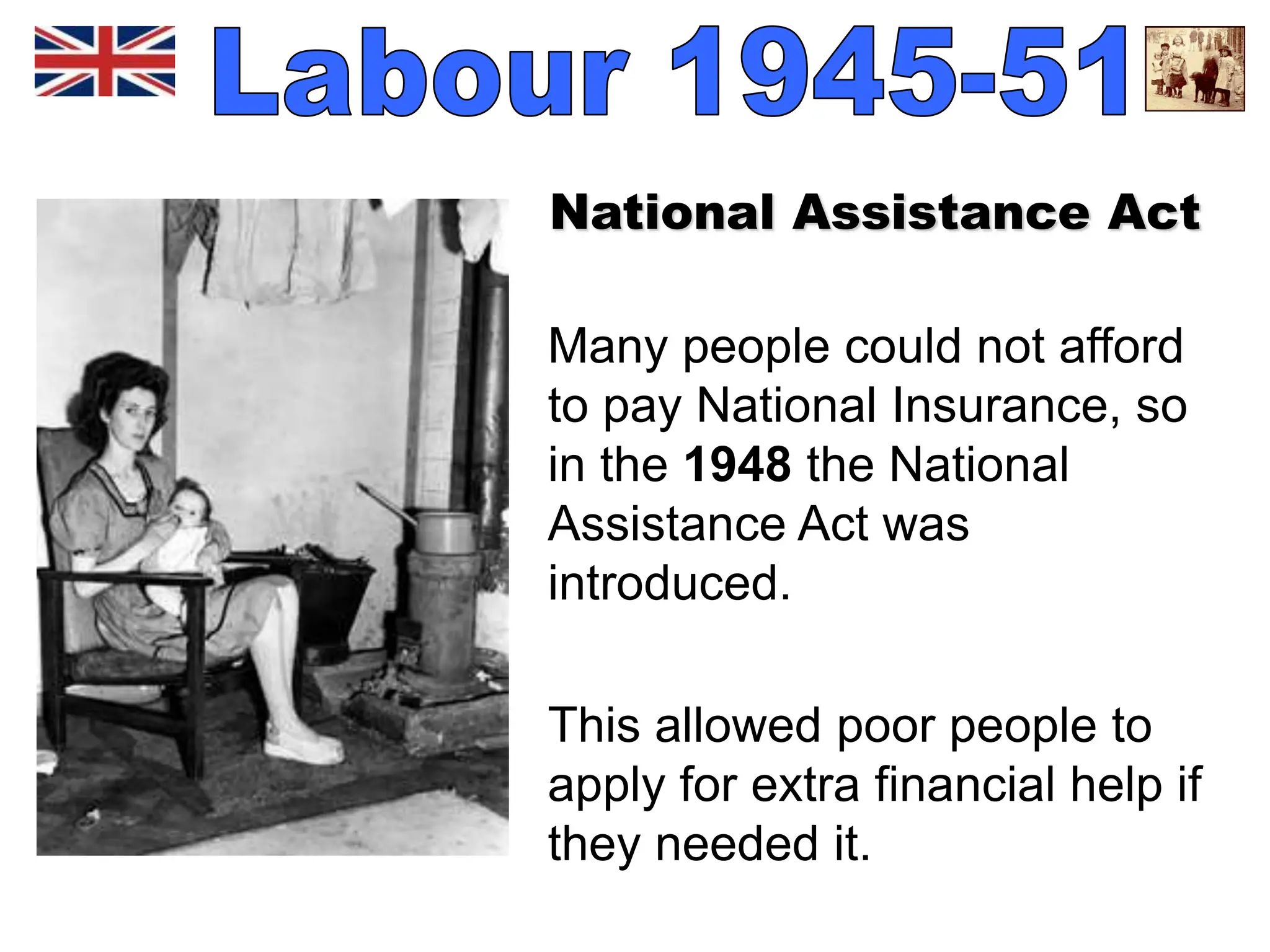
National Assistance Act
Many people could not afford
to pay National Insurance, so
in the 1948 the National
Assistance Act was
introduced.
This allowed poor people to
apply for extra financial help if
they needed it.
National Assistance Act
This Act meant that the very
poorest – who would have
missed out on help – were
given assistance e.g. £2 per
week for married couples.
This was especially helpful
for elderly people that did not
qualify for a pension.
National Assistance Act
Government benefits did not
take account of inflation, and
so lost value over time,
helping people less.
Also, it was means-tested
and not universal, which
many felt went against the
spirit of the welfare state.
Poverty
Seebohm Rowntree
carried out other poverty
studies in York in 1936
and 1950.
He found that average
poverty levels in 1936
were around 36%, falling
to only 2% by 1950.
* LINKS *
Improving the education
system was meant to
allow poorer children to
get a better education –
and then escape poverty.
Better housing tackled
poverty by improving
living conditions.

Labour social reforms 1945-51 - Poverty

  • 2.
    Family Allowances Act In1946 the Family Allowances Act came into law. This was to help tackle ‘want’. The Act gave weekly payments to all mothers with two or more children. The payment was 5 shillings per week for each child (except the oldest).
  • 3.
    Family Allowances Act TheFamily Allowances Act was a huge help to families where the husband had been killed during the war. Also as it was paid directly to the mother it was felt that this would make it more likely to be spent on household items.
  • 4.
    Family Allowance Act TheF.A.A. was hugely helpful to many – but it did not help families with only one child. Also, the payment stopped at 18 which often forced the young person to work, rather than continue with their education.
  • 5.
    National Insurance Act The1946 National Insurance Act built on the work started by the original Act in 1911. All working age people had to pay money to the government each week, which led to them being given help when they needed it.
  • 6.
    National Insurance Act Peoplecould get sickness and unemployment benefit, an old age pension (women at 60, men at 65) and other benefits such as maternity and death grants. This was a far more generous type of welfare cover than ever before.
  • 7.
    National Insurance Act Weeklycontributions were around 5% of earnings, a lot to the very poorest people. People were only entitled to all benefits after paying national insurance for ten years, so some people missed out.
  • 8.
    National Assistance Act Manypeople could not afford to pay National Insurance, so in the 1948 the National Assistance Act was introduced. This allowed poor people to apply for extra financial help if they needed it.
  • 9.
    National Assistance Act ThisAct meant that the very poorest – who would have missed out on help – were given assistance e.g. £2 per week for married couples. This was especially helpful for elderly people that did not qualify for a pension.
  • 10.
    National Assistance Act Governmentbenefits did not take account of inflation, and so lost value over time, helping people less. Also, it was means-tested and not universal, which many felt went against the spirit of the welfare state.
  • 11.
    Poverty Seebohm Rowntree carried outother poverty studies in York in 1936 and 1950. He found that average poverty levels in 1936 were around 36%, falling to only 2% by 1950.
  • 12.
    * LINKS * Improvingthe education system was meant to allow poorer children to get a better education – and then escape poverty. Better housing tackled poverty by improving living conditions.