BENCHMARKING INSTITUTIONAL READINESS
FOR TECHNOLOGY ENHANCED LEARNING
Helen Carter (@HCatME)
President, ACode
leading technology enhanced
learning and teaching
INTRODUCTION
How can we ‘prove the quality’ or ‘improve the quality’
of technology enhanced learning (TEL)?
How do we support institutional readiness for change?
One approach that has helped many institutions do
this is through the regular use of benchmarking.
More particularly using the Australasian Council on
Open, Distance and E-Learning (ACODE)
Benchmarks.
WHAT IS BENCHMARKING?
“A structured, collaborative, learning process
for comparing practices, processes or
performance outcomes. Benchmarking can be
used to prove quality or improve quality and is
evidence-based.”
TEQSA Benchmarking Guide
WHAT IS QUALITY?
“Quality of education is inherently a political
construct; when considering e-learning quality,
institutional leaders need to balance the various
externalities with technical and organisational
realities to see how the nature of the e-learning
experience systematically supports the
outcomes desired by the organisation.”
Stephen Marshall, Victoria University of Wellington
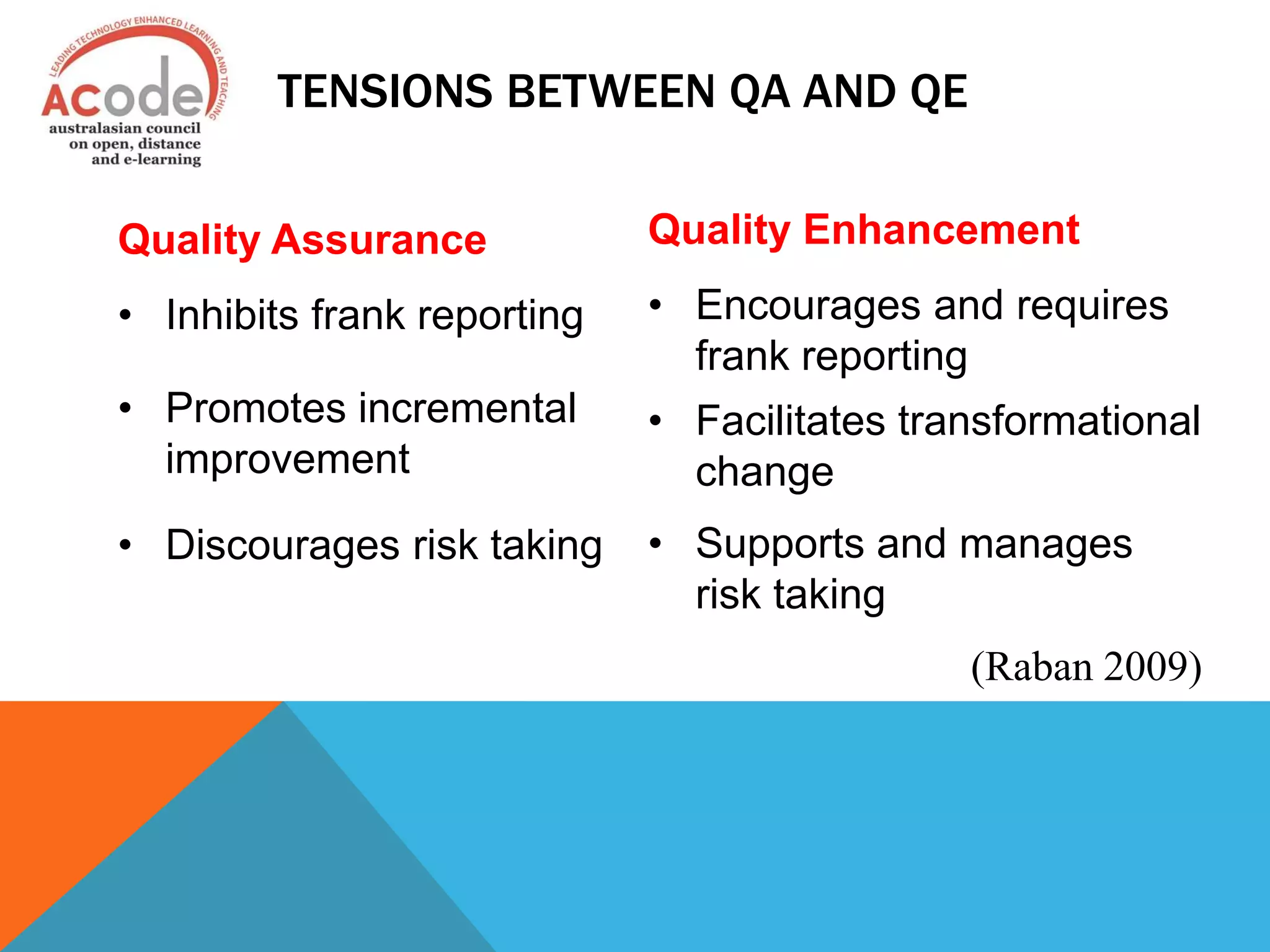
TENSIONS BETWEEN QA AND QE
Quality Assurance
• Inhibits frank reporting
• Promotes incremental
improvement
• Discourages risk taking
Quality Enhancement
• Encourages and requires
frank reporting
• Facilitates transformational
change
• Supports and manages
risk taking
(Raban 2009)
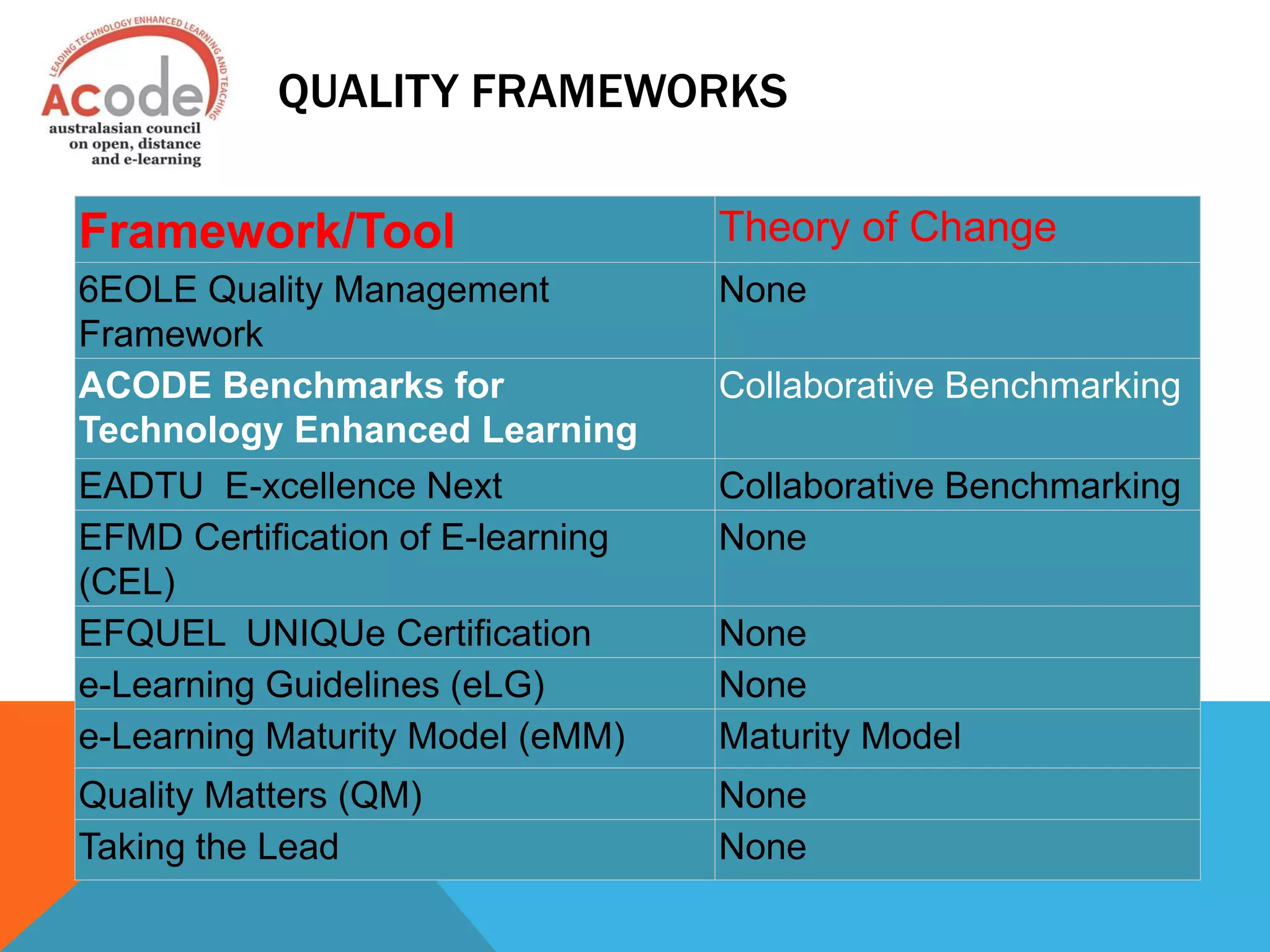
QUALITY FRAMEWORKS
Framework/Tool Theory of Change
6EOLE Quality Management
Framework
None
ACODE Benchmarks for
Technology Enhanced Learning
Collaborative Benchmarking
EADTU E-xcellence Next Collaborative Benchmarking
EFMD Certification of E-learning
(CEL)
None
EFQUEL UNIQUe Certification None
e-Learning Guidelines (eLG) None
e-Learning Maturity Model (eMM) Maturity Model
Quality Matters (QM) None
Taking the Lead None
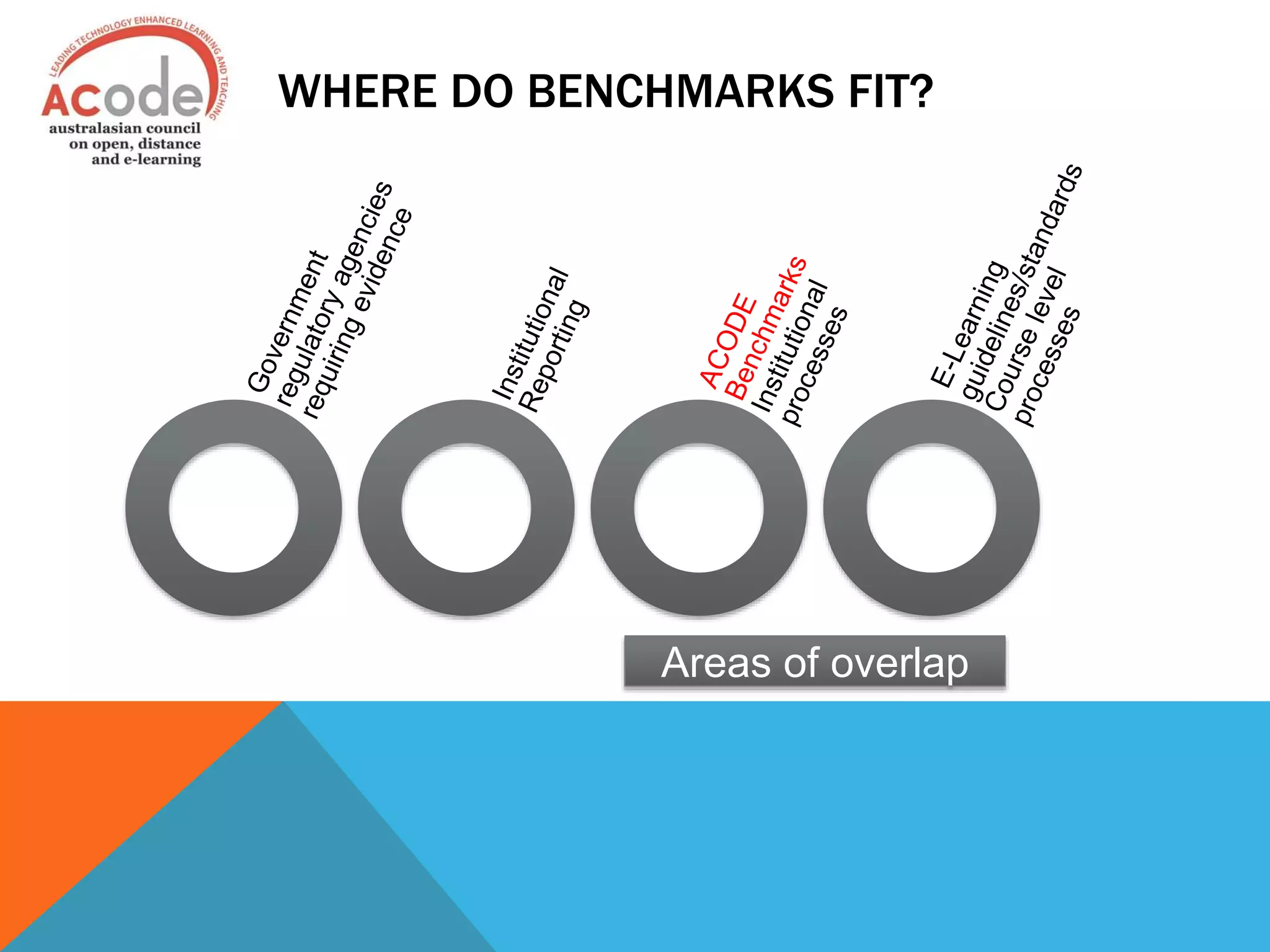
WHERE DO BENCHMARKS FIT?
Areas of overlap
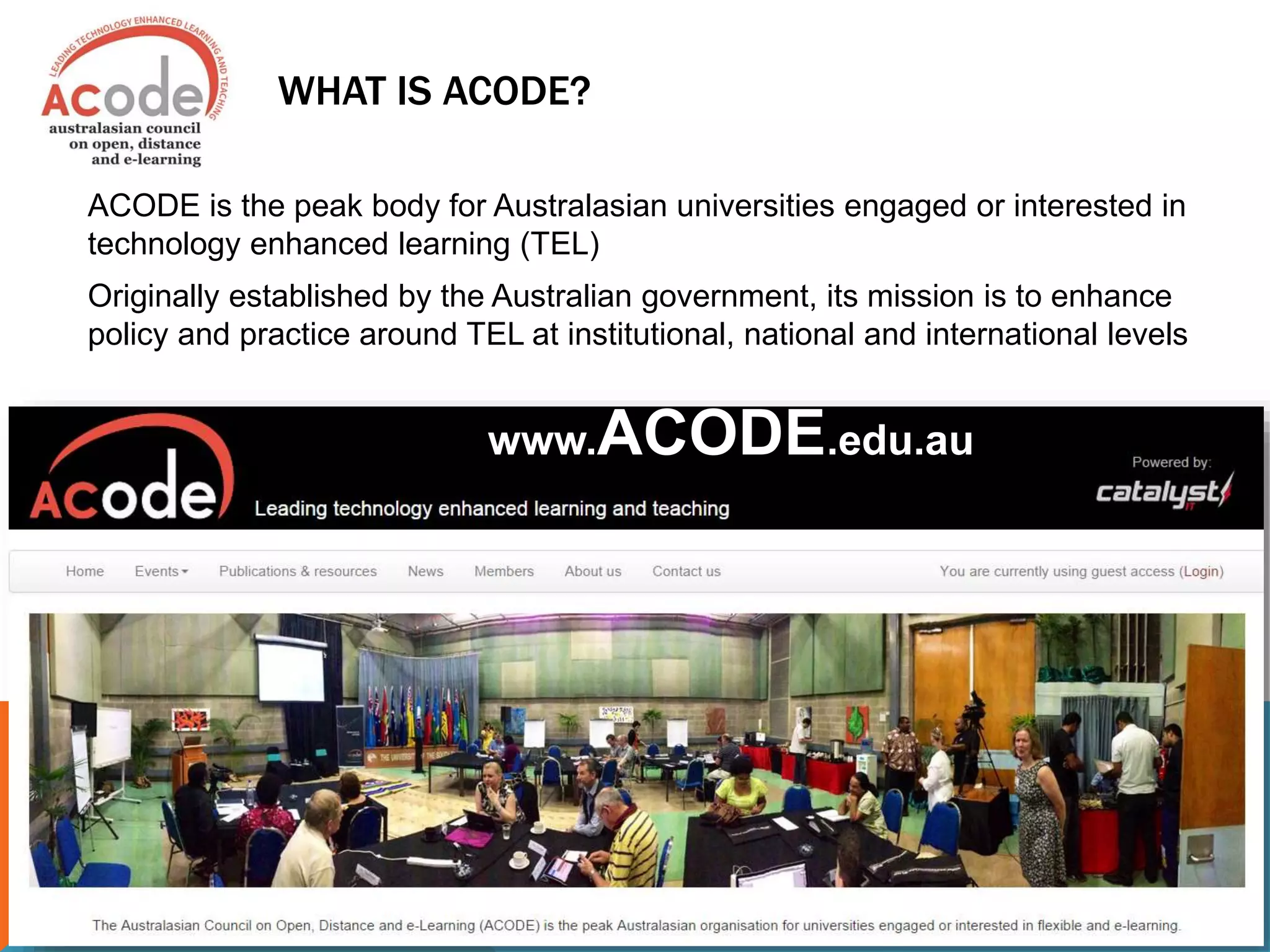
WHAT IS ACODE?
ACODE is the peak body for Australasian universities engaged or interested in
technology enhanced learning (TEL)
Originally established by the Australian government, its mission is to enhance
policy and practice around TEL at institutional, national and international levels
www.ACODE.edu.au
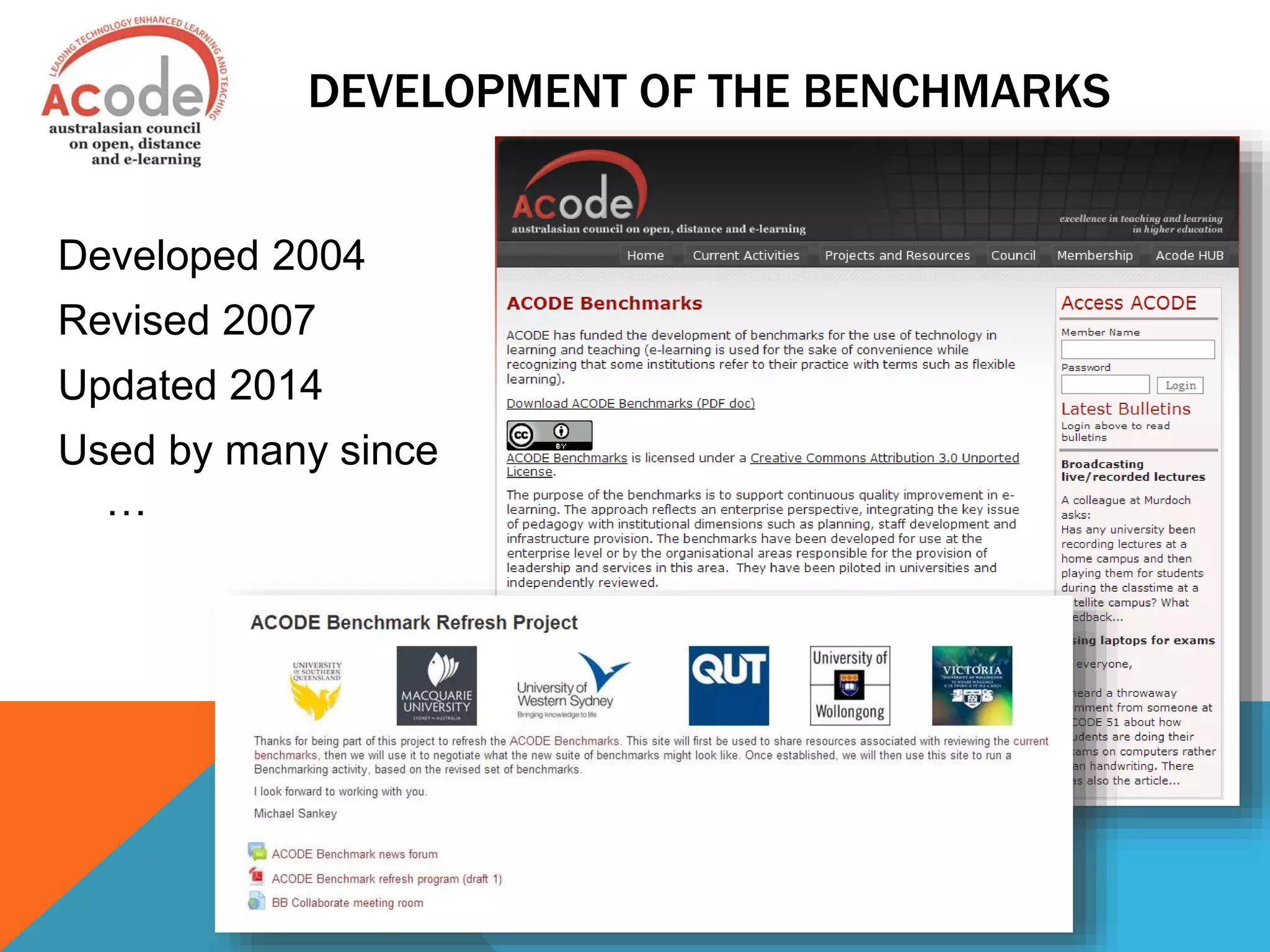
Developed 2004
Revised 2007
Updated 2014
Used by many since
…
DEVELOPMENT OF THE BENCHMARKS
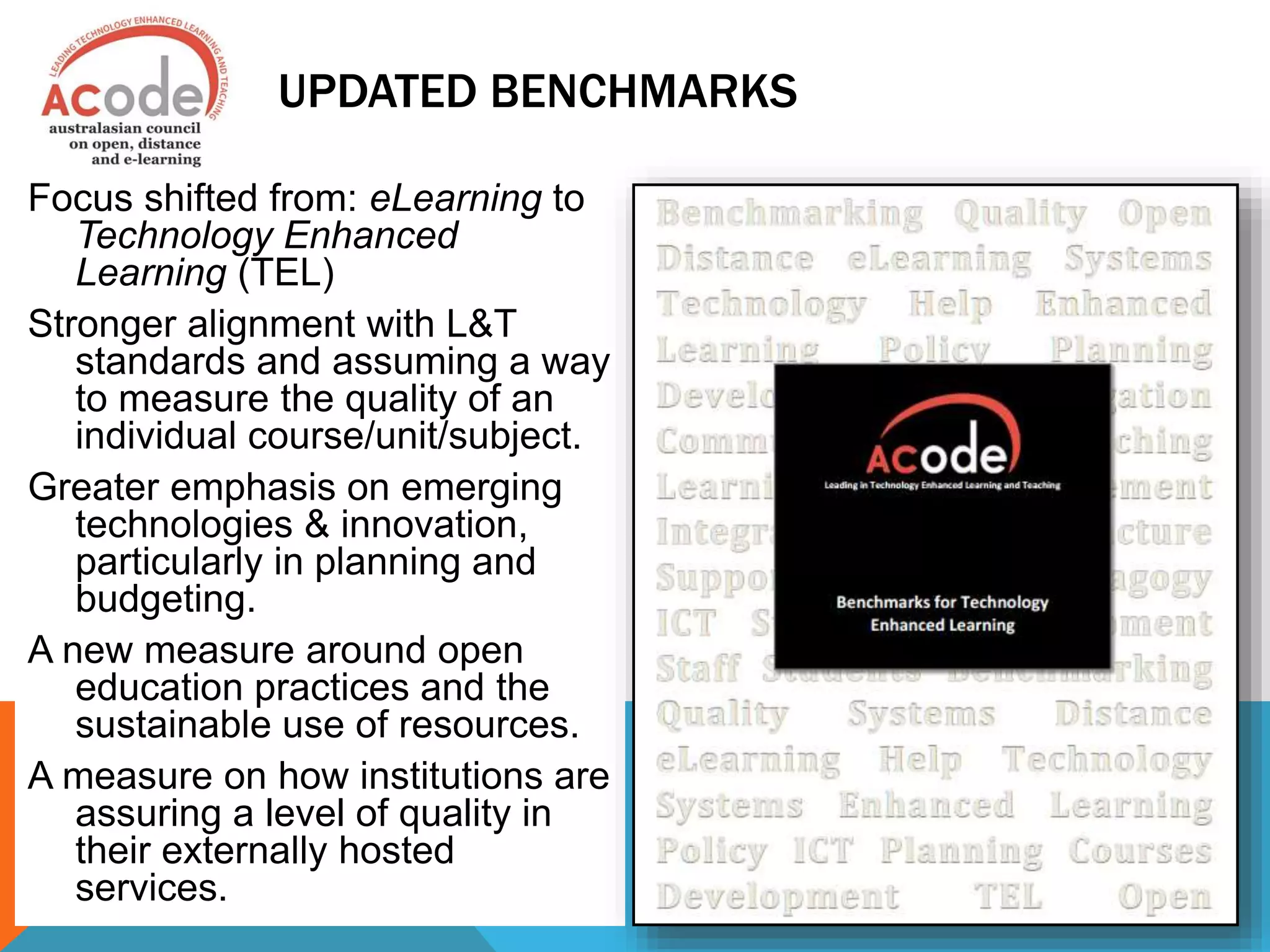
UPDATED BENCHMARKS
Focus shifted from: eLearning to
Technology Enhanced
Learning (TEL)
Stronger alignment with L&T
standards and assuming a way
to measure the quality of an
individual course/unit/subject.
Greater emphasis on emerging
technologies & innovation,
particularly in planning and
budgeting.
A new measure around open
education practices and the
sustainable use of resources.
A measure on how institutions are
assuring a level of quality in
their externally hosted
services.
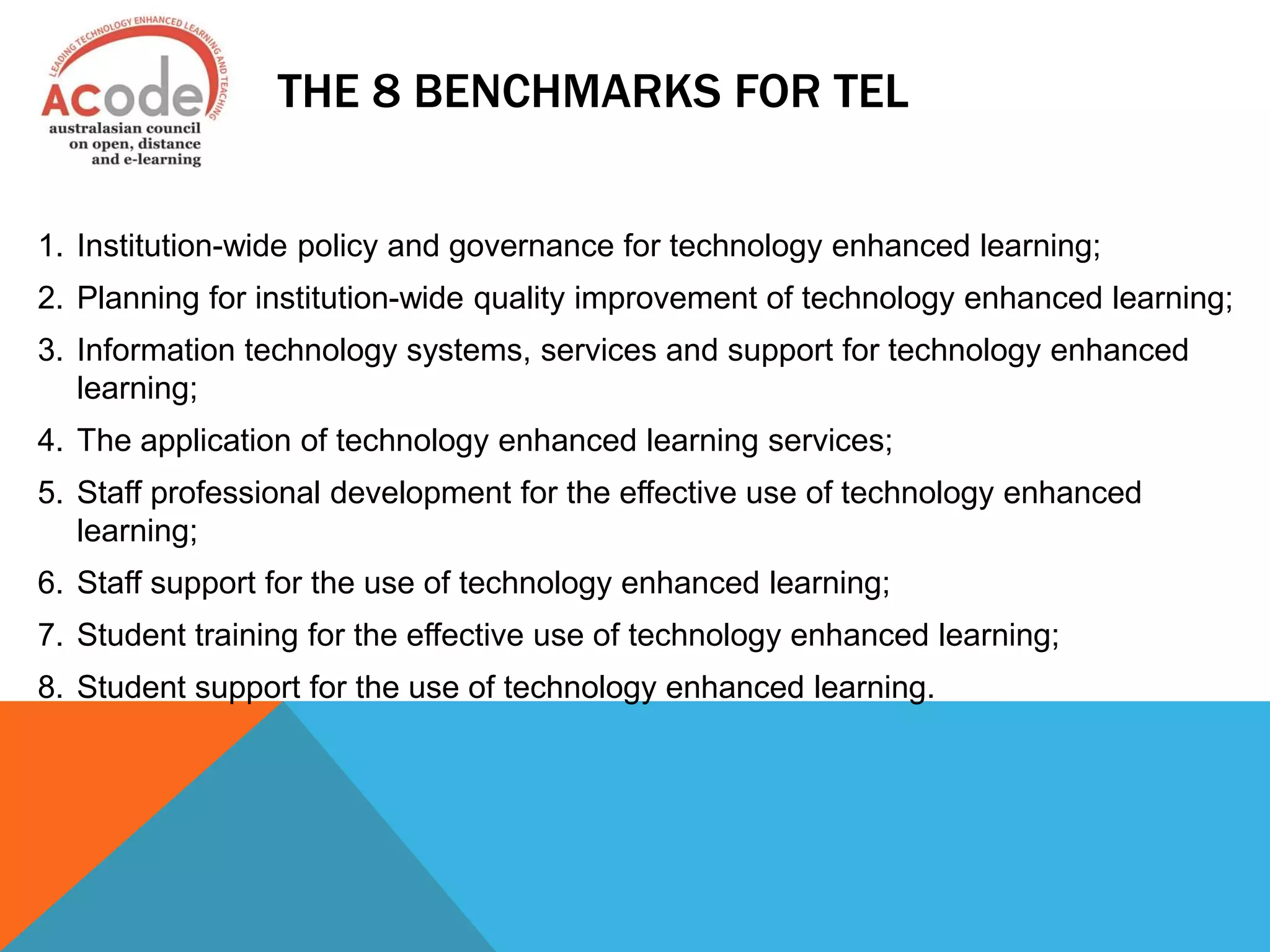
THE 8 BENCHMARKS FOR TEL
1. Institution-wide policy and governance for technology enhanced learning;
2. Planning for institution-wide quality improvement of technology enhanced learning;
3. Information technology systems, services and support for technology enhanced
learning;
4. The application of technology enhanced learning services;
5. Staff professional development for the effective use of technology enhanced
learning;
6. Staff support for the use of technology enhanced learning;
7. Student training for the effective use of technology enhanced learning;
8. Student support for the use of technology enhanced learning.
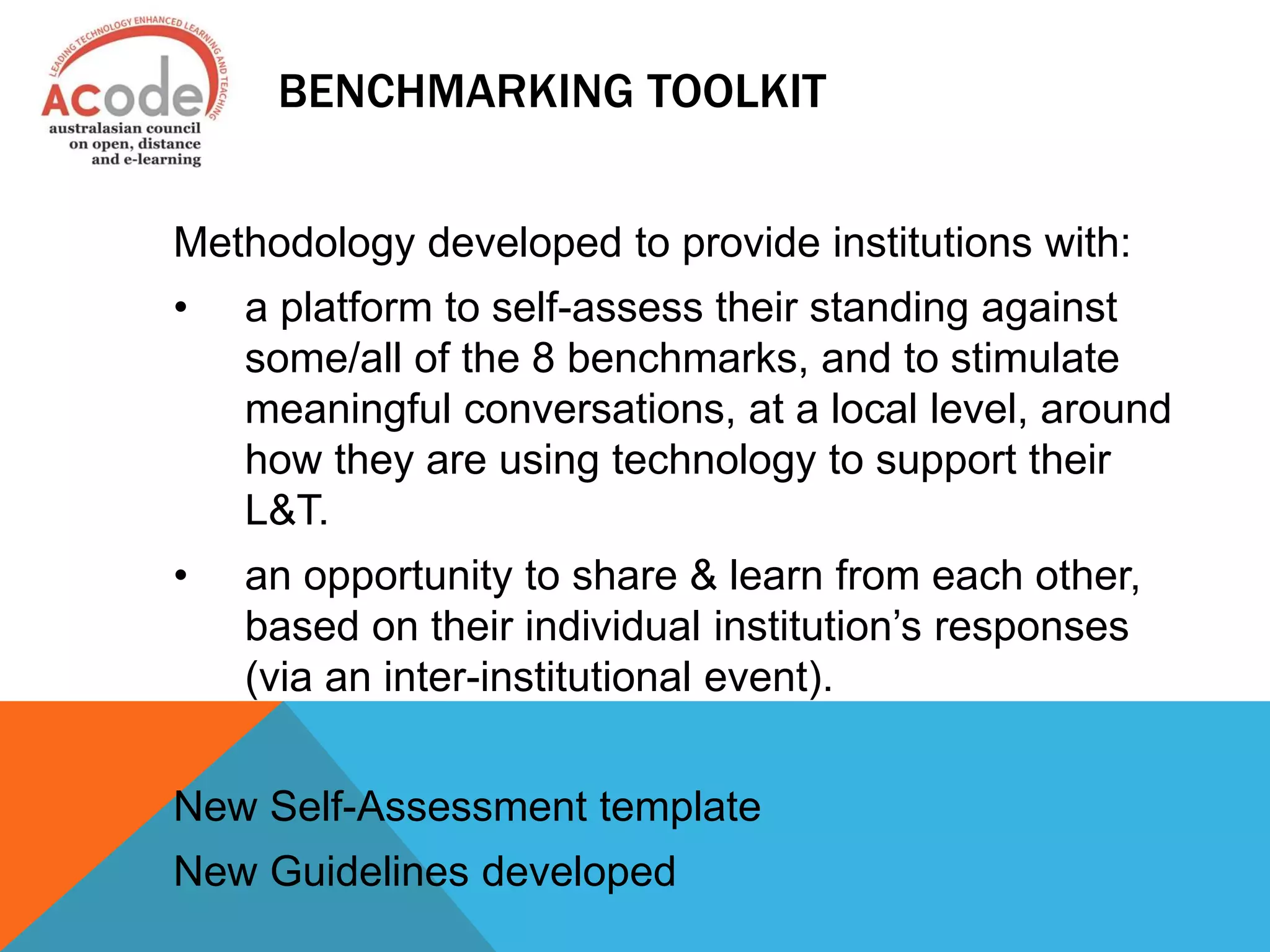
BENCHMARKING TOOLKIT
Methodology developed to provide institutions with:
• a platform to self-assess their standing against
some/all of the 8 benchmarks, and to stimulate
meaningful conversations, at a local level, around
how they are using technology to support their
L&T.
• an opportunity to share & learn from each other,
based on their individual institution’s responses
(via an inter-institutional event).
New Self-Assessment template
New Guidelines developed
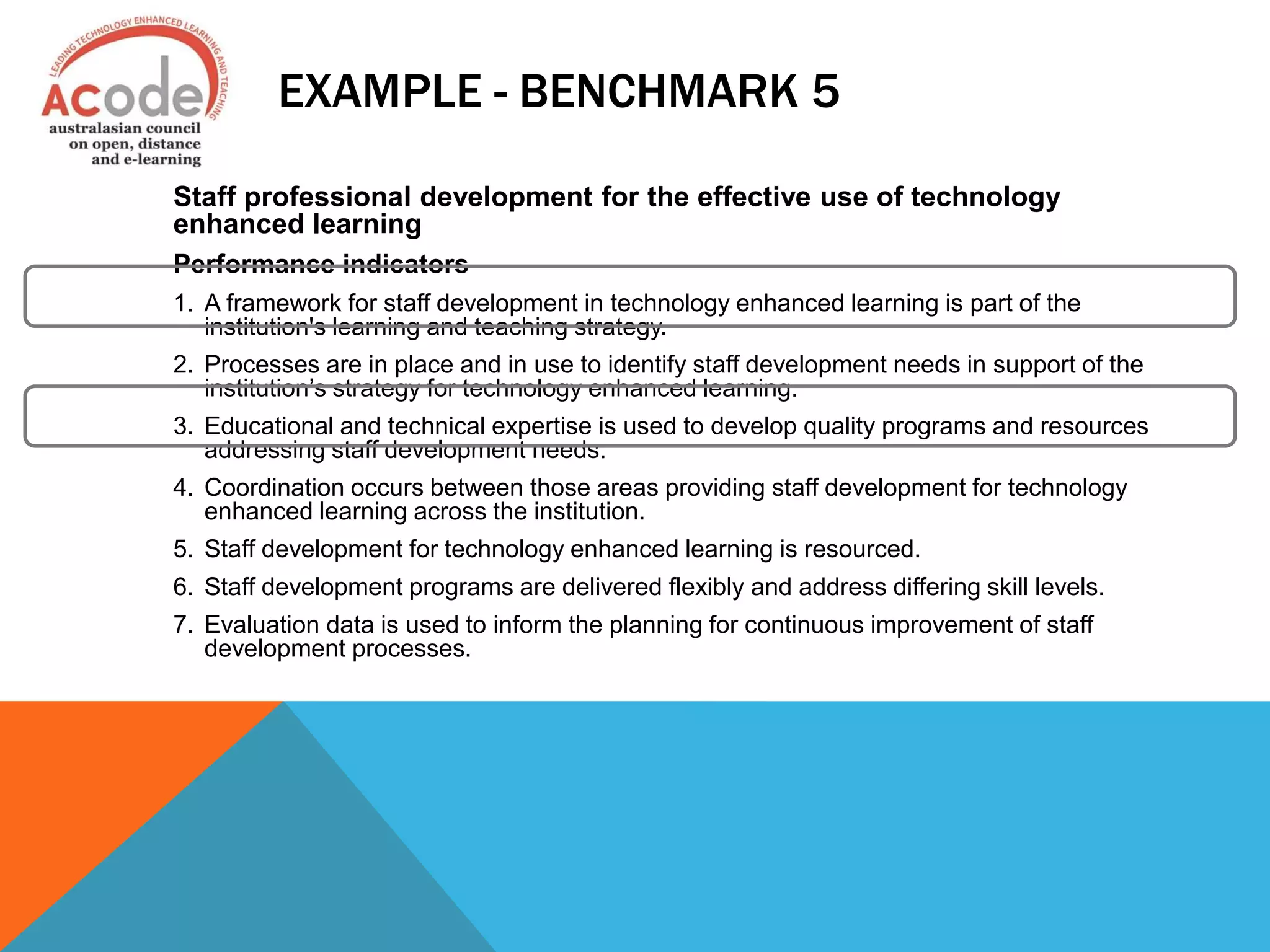
EXAMPLE - BENCHMARK 5
Staff professional development for the effective use of technology
enhanced learning
Scoping Statement
The key focus is on developing teaching staff to make effective use of a range of approaches to technology
enhanced learning (TEL). Staff development activities encompass individual and group delivery, face-to-
face, as well as online.
Self-directed learning activities and resources are also included. Some professional development will be
designed and delivered to meet the strategic needs of the organisation, whilst other activities will be
provided to meet the demands of teaching staff as they arise.
Good Practice Statement
Quality learning and teaching is brought about where people are confident, enthusiastic, skilled and well
supported, and learning experiences are designed to engage the learner and employ a variety of
approaches.
Engagement in professional development should not be limited by factors of physical location, equity or
technological skills. This means that staff development is offered flexibly, accommodates a range of
entry points, is evaluated and is informed by the work of related units.
A good practice approach to the use of technology enhanced learning reflects an understanding of learners’
characteristics and needs as required by different discipline contexts.
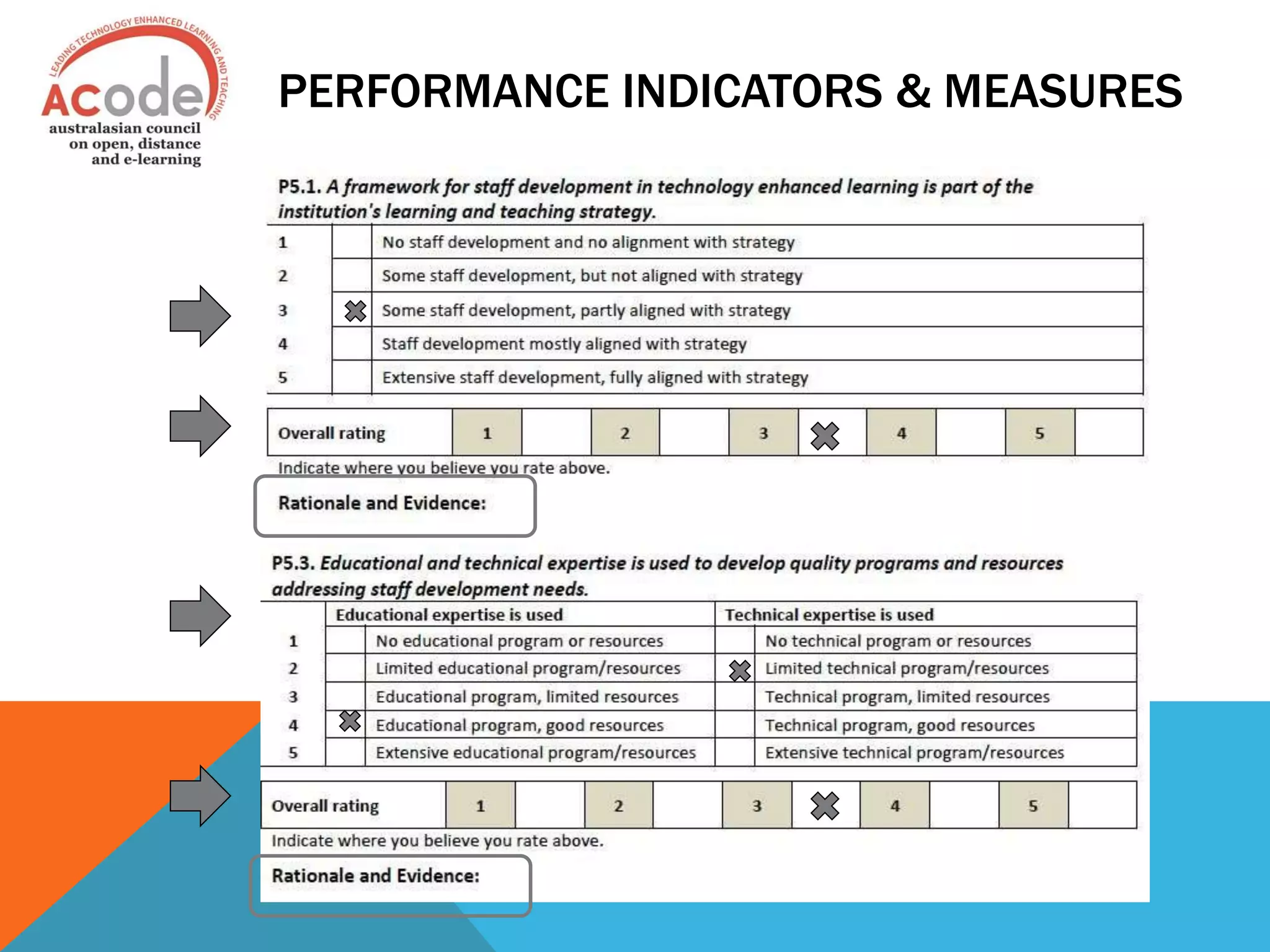
EXAMPLE - BENCHMARK 5
Staff professional development for the effective use of technology
enhanced learning
Performance indicators
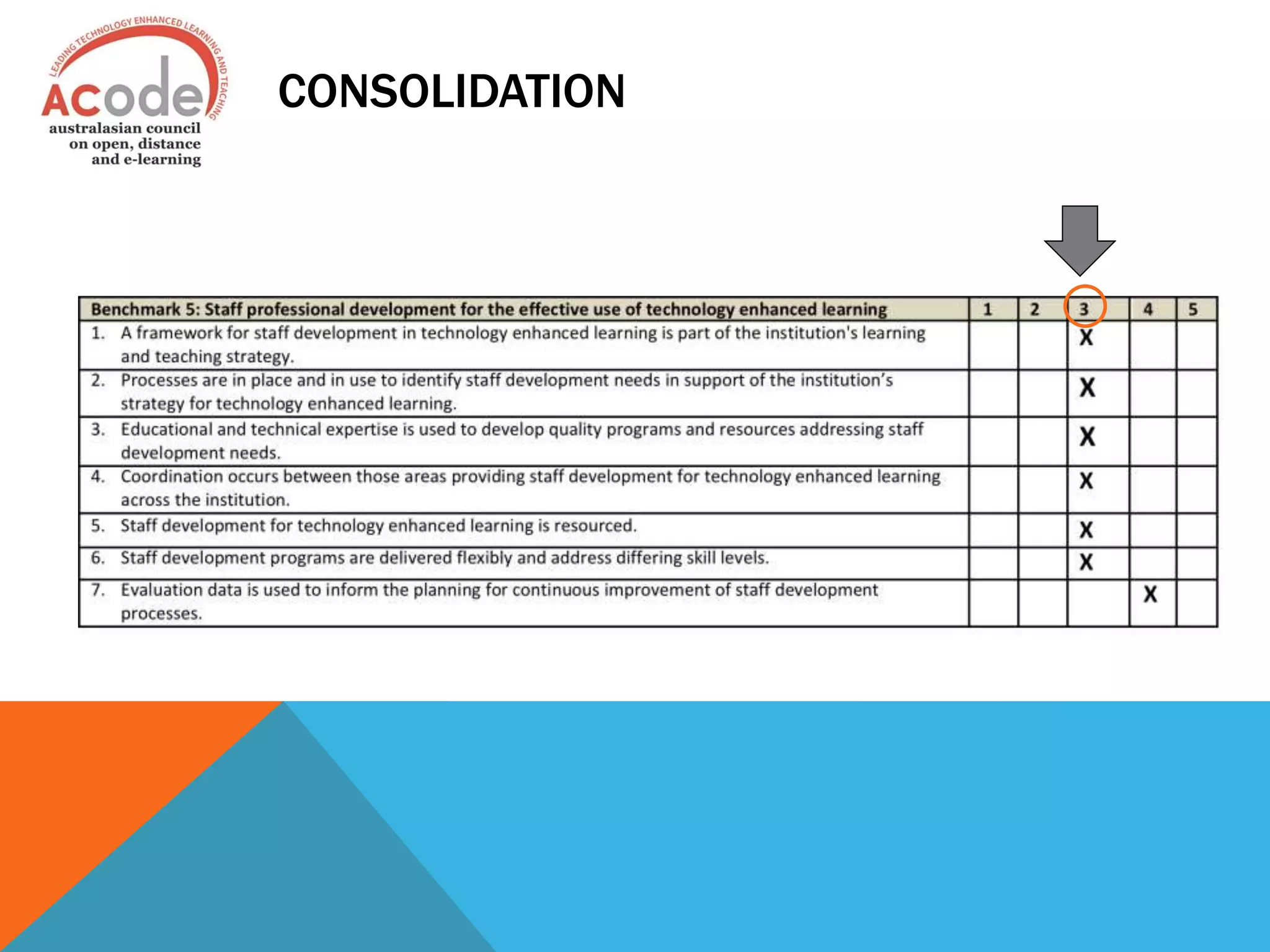
1. A framework for staff development in technology enhanced learning is part of the
institution's learning and teaching strategy.
2. Processes are in place and in use to identify staff development needs in support of the
institution’s strategy for technology enhanced learning.
3. Educational and technical expertise is used to develop quality programs and resources
addressing staff development needs.
4. Coordination occurs between those areas providing staff development for technology
enhanced learning across the institution.
5. Staff development for technology enhanced learning is resourced.
6. Staff development programs are delivered flexibly and address differing skill levels.
7. Evaluation data is used to inform the planning for continuous improvement of staff
development processes.
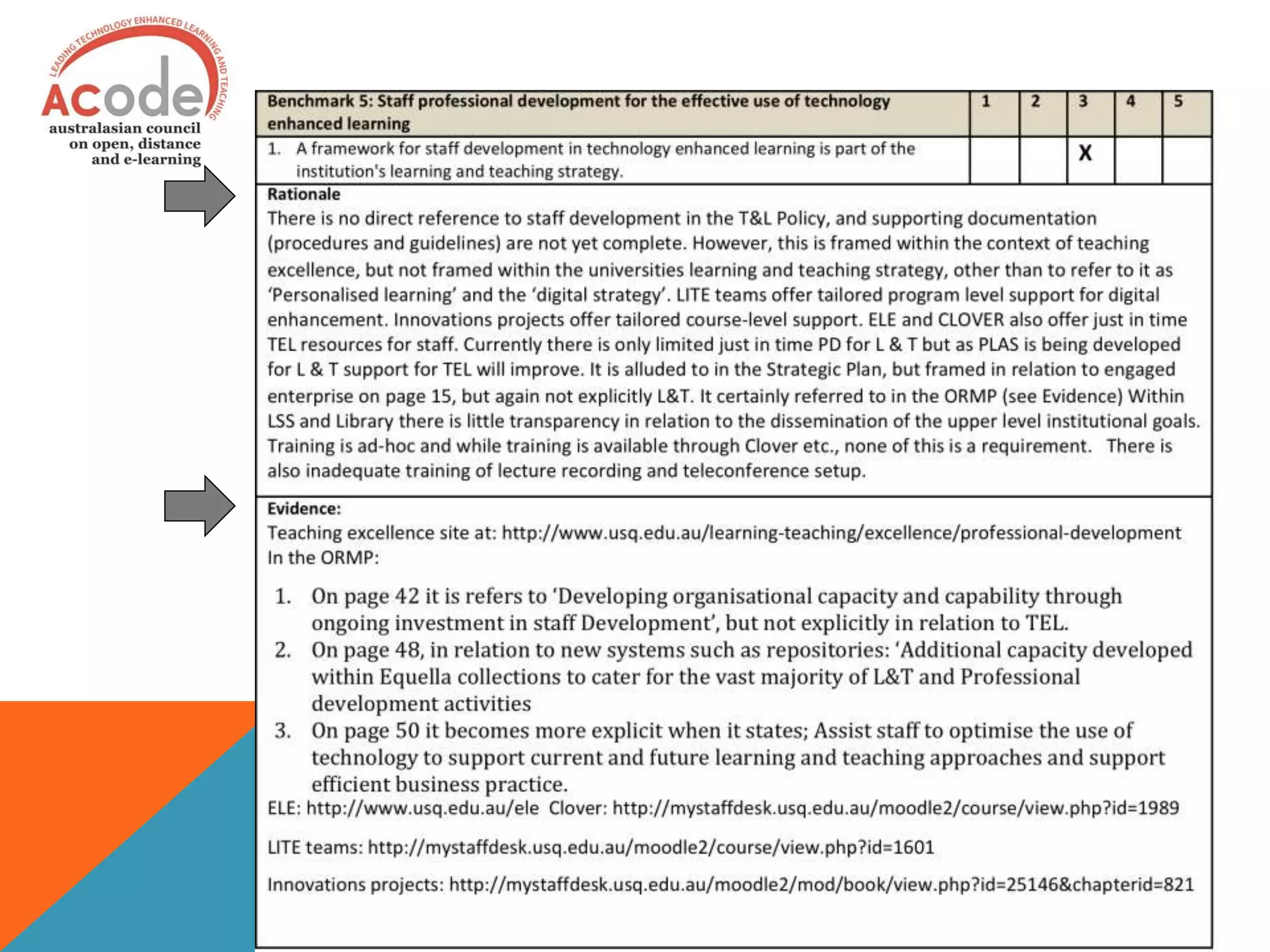
PERFORMANCE INDICATORS & MEASURES
CONSOLIDATION
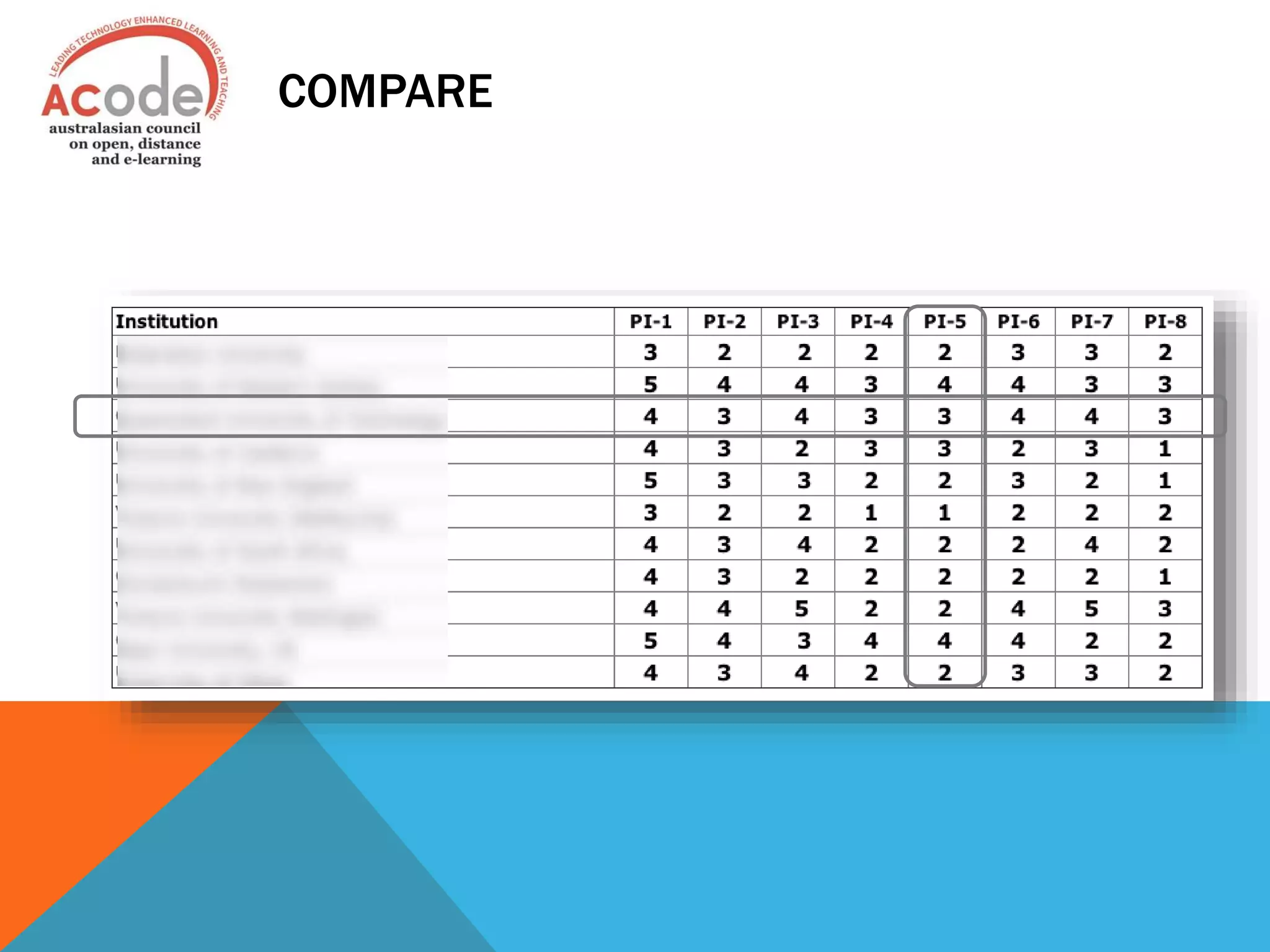
COMPARE
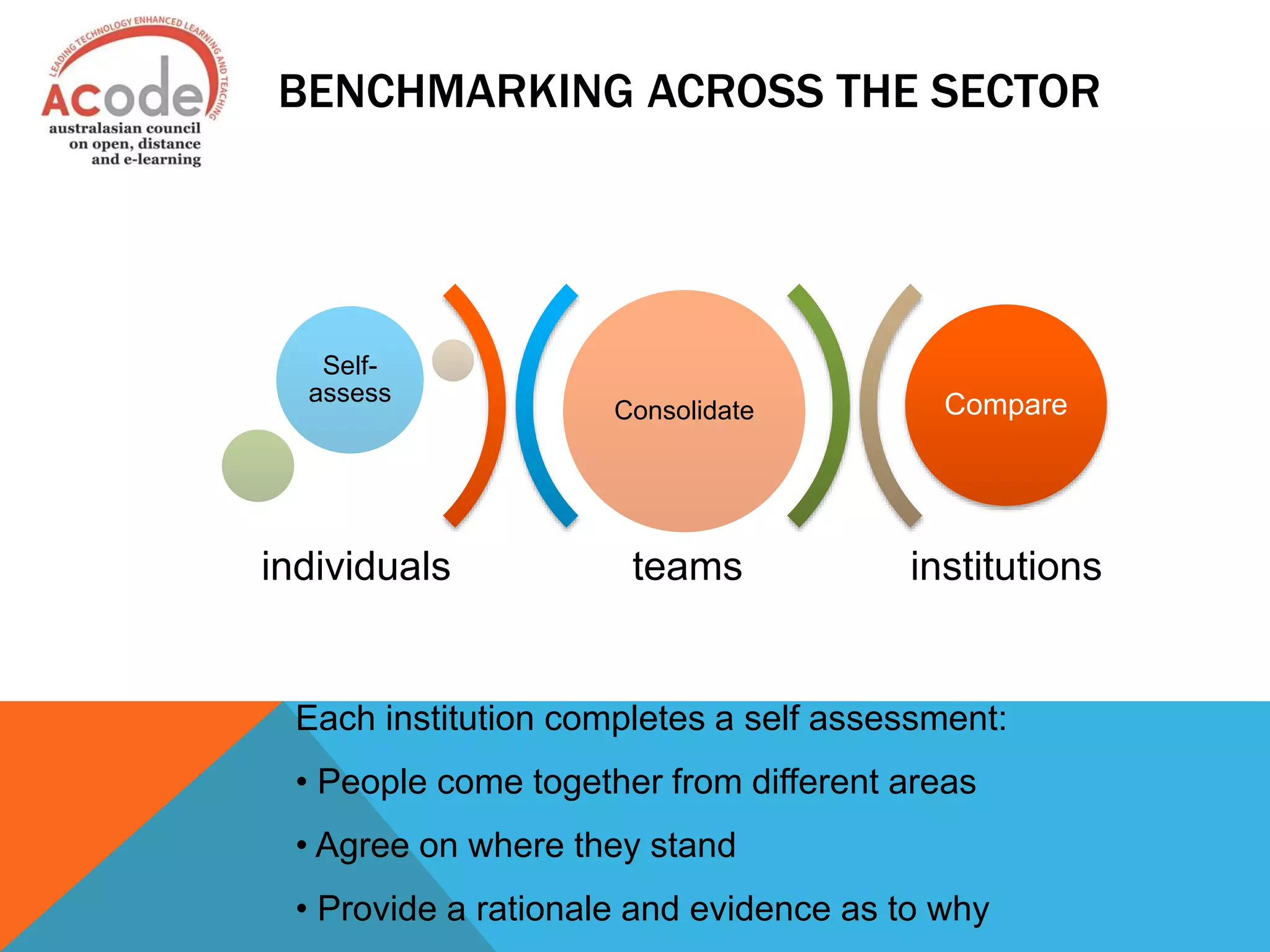
BENCHMARKING ACROSS THE SECTOR
teams institutions
Consolidate
Self-
assess Compare
individuals
Each institution completes a self assessment:
• People come together from different areas
• Agree on where they stand
• Provide a rationale and evidence as to why
BENCHMARKING SUMMIT
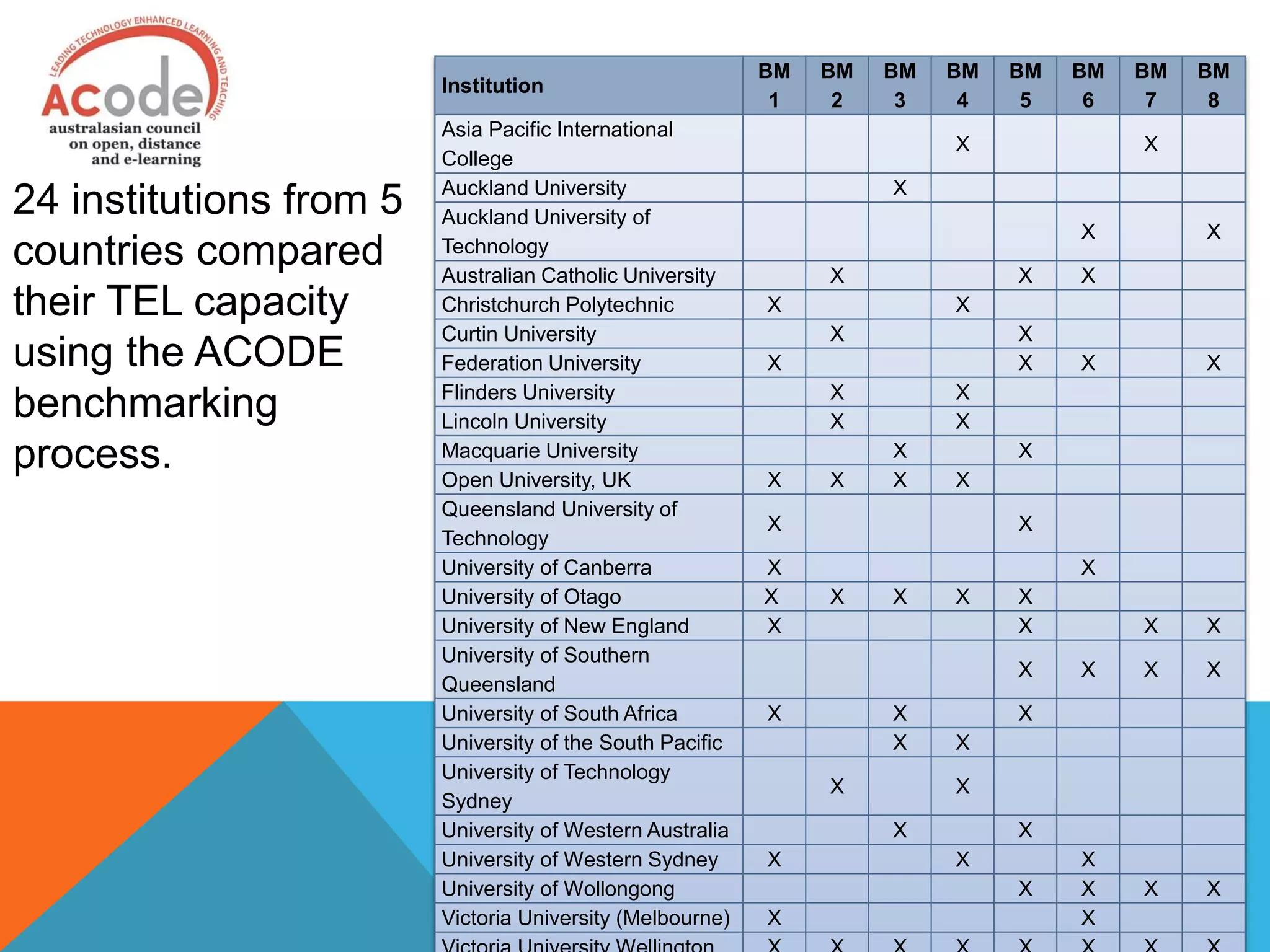
Major trial of the Benchmarks conducted in Sydney in June 2014
24 institutions from 5
countries compared
their TEL capacity
using the ACODE
benchmarking
process.
Institution
BM
1
BM
2
BM
3
BM
4
BM
5
BM
6
BM
7
BM
8
Asia Pacific International
College
X X
Auckland University X
Auckland University of
Technology
X X
Australian Catholic University X X X
Christchurch Polytechnic X X
Curtin University X X
Federation University X X X X
Flinders University X X
Lincoln University X X
Macquarie University X X
Open University, UK X X X X
Queensland University of
Technology
X X
University of Canberra X X
University of Otago X X X X X
University of New England X X X X
University of Southern
Queensland
X X X X
University of South Africa X X X
University of the South Pacific X X
University of Technology
Sydney
X X
University of Western Australia X X
University of Western Sydney X X X
University of Wollongong X X X X
Victoria University (Melbourne) X X
HAVING THE CONVERSATION
Assoc. Prof. Michael
Sankey
convening the inaugural
Benchmarking Summit
at Macquarie University
VALUE OF BENCHMARKING
The ACODE Benchmarks allows institutions to:
Self-assess their capacity in TEL
Share this with other like-minded institutions
Incorporate this into their ongoing QA/QE processes
Develop an enterprise-level perspective
VALUE OF BENCHMARKING
The beauty of benchmarking is not around which tool
or set of standards you are using, it's more about
the dialogue that emerges and the sharing of
practice that is the real winner for all concerned.
It opens the door for further collaboration.
It serves as a mechanism to facilitate discussion at
senior leadership level.
BENCHMARKING SUMMIT
“Great opportunity to meet and share where everyone
is at. The benchmarking exercise is a great self
reflective practice that is reinforced through the
feedback and deliberation from other institutions”
“I really enjoyed this Benchmarking Summit, I have
learned a lot from the inter-institutional activity and will
definitely be sharing and pushing for these
benchmarks to be accepted at our institution”
CONCLUSION
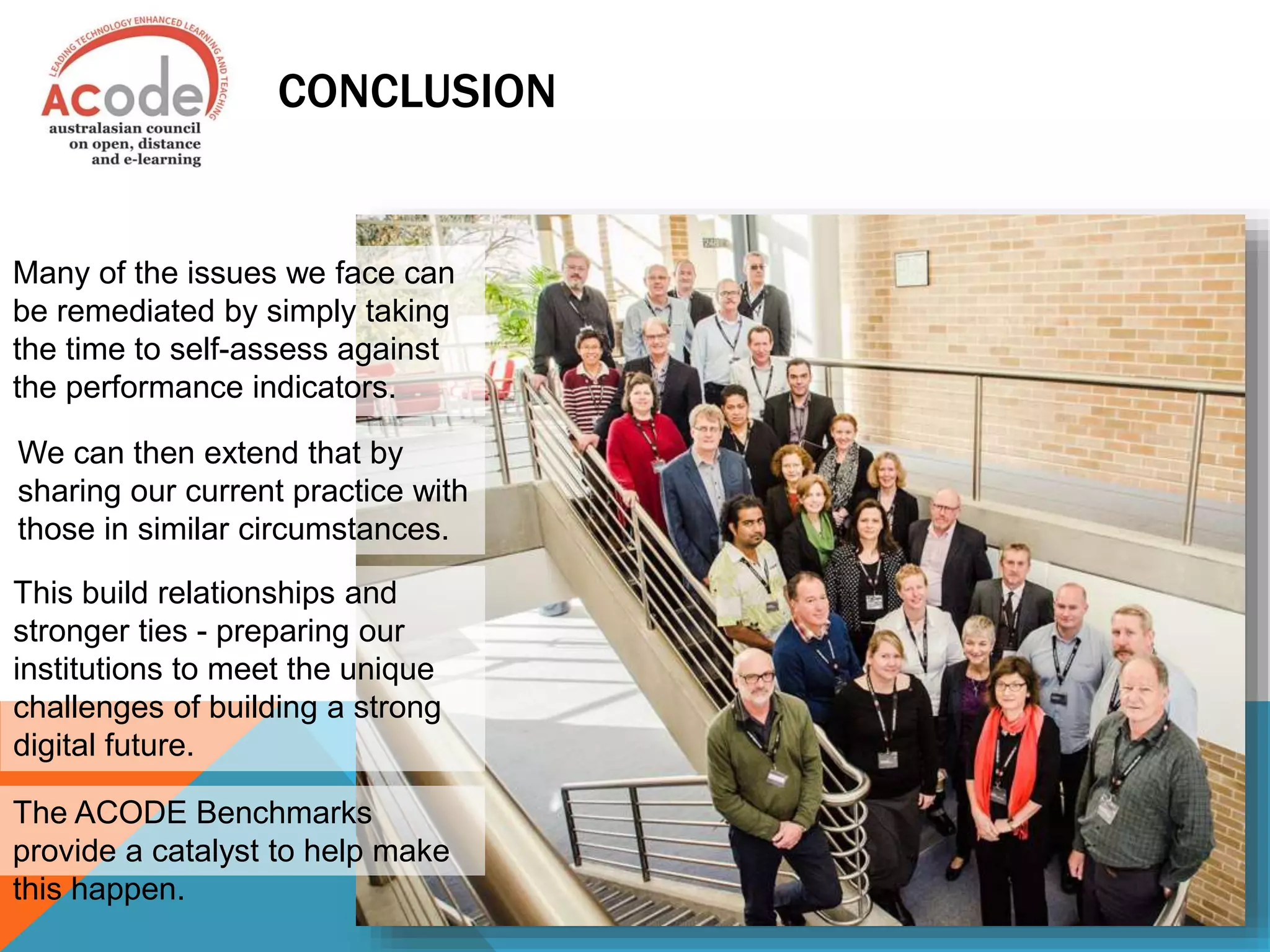
Many of the issues we face can
be remediated by simply taking
the time to self-assess against
the performance indicators.
We can then extend that by
sharing our current practice with
those in similar circumstances.
This build relationships and
stronger ties - preparing our
institutions to meet the unique
challenges of building a strong
digital future.
The ACODE Benchmarks
provide a catalyst to help make
this happen.
FURTHER INFORMATION
ACODE Benchmarking Summit – June 2016
University of Canberra
Email secretariat@acode.edu.au to register your interest
To download the ACODE Benchmarks:
Go to http://www.acode.edu.au
and look under Publications

Benchmarking Institutional Readiness for Technology Enhanced Learning

  • 1.
    BENCHMARKING INSTITUTIONAL READINESS FORTECHNOLOGY ENHANCED LEARNING Helen Carter (@HCatME) President, ACode leading technology enhanced learning and teaching
  • 2.
    INTRODUCTION How can we‘prove the quality’ or ‘improve the quality’ of technology enhanced learning (TEL)? How do we support institutional readiness for change? One approach that has helped many institutions do this is through the regular use of benchmarking. More particularly using the Australasian Council on Open, Distance and E-Learning (ACODE) Benchmarks.
  • 3.
    WHAT IS BENCHMARKING? “Astructured, collaborative, learning process for comparing practices, processes or performance outcomes. Benchmarking can be used to prove quality or improve quality and is evidence-based.” TEQSA Benchmarking Guide
  • 4.
    WHAT IS QUALITY? “Qualityof education is inherently a political construct; when considering e-learning quality, institutional leaders need to balance the various externalities with technical and organisational realities to see how the nature of the e-learning experience systematically supports the outcomes desired by the organisation.” Stephen Marshall, Victoria University of Wellington
  • 5.
    TENSIONS BETWEEN QAAND QE Quality Assurance • Inhibits frank reporting • Promotes incremental improvement • Discourages risk taking Quality Enhancement • Encourages and requires frank reporting • Facilitates transformational change • Supports and manages risk taking (Raban 2009)
  • 6.
    QUALITY FRAMEWORKS Framework/Tool Theoryof Change 6EOLE Quality Management Framework None ACODE Benchmarks for Technology Enhanced Learning Collaborative Benchmarking EADTU E-xcellence Next Collaborative Benchmarking EFMD Certification of E-learning (CEL) None EFQUEL UNIQUe Certification None e-Learning Guidelines (eLG) None e-Learning Maturity Model (eMM) Maturity Model Quality Matters (QM) None Taking the Lead None
  • 7.
    WHERE DO BENCHMARKSFIT? Areas of overlap
  • 8.
    WHAT IS ACODE? ACODEis the peak body for Australasian universities engaged or interested in technology enhanced learning (TEL) Originally established by the Australian government, its mission is to enhance policy and practice around TEL at institutional, national and international levels www.ACODE.edu.au
  • 9.
    Developed 2004 Revised 2007 Updated2014 Used by many since … DEVELOPMENT OF THE BENCHMARKS
  • 10.
    UPDATED BENCHMARKS Focus shiftedfrom: eLearning to Technology Enhanced Learning (TEL) Stronger alignment with L&T standards and assuming a way to measure the quality of an individual course/unit/subject. Greater emphasis on emerging technologies & innovation, particularly in planning and budgeting. A new measure around open education practices and the sustainable use of resources. A measure on how institutions are assuring a level of quality in their externally hosted services.
  • 11.
    THE 8 BENCHMARKSFOR TEL 1. Institution-wide policy and governance for technology enhanced learning; 2. Planning for institution-wide quality improvement of technology enhanced learning; 3. Information technology systems, services and support for technology enhanced learning; 4. The application of technology enhanced learning services; 5. Staff professional development for the effective use of technology enhanced learning; 6. Staff support for the use of technology enhanced learning; 7. Student training for the effective use of technology enhanced learning; 8. Student support for the use of technology enhanced learning.
  • 12.
    BENCHMARKING TOOLKIT Methodology developedto provide institutions with: • a platform to self-assess their standing against some/all of the 8 benchmarks, and to stimulate meaningful conversations, at a local level, around how they are using technology to support their L&T. • an opportunity to share & learn from each other, based on their individual institution’s responses (via an inter-institutional event). New Self-Assessment template New Guidelines developed
  • 13.
    EXAMPLE - BENCHMARK5 Staff professional development for the effective use of technology enhanced learning Scoping Statement The key focus is on developing teaching staff to make effective use of a range of approaches to technology enhanced learning (TEL). Staff development activities encompass individual and group delivery, face-to- face, as well as online. Self-directed learning activities and resources are also included. Some professional development will be designed and delivered to meet the strategic needs of the organisation, whilst other activities will be provided to meet the demands of teaching staff as they arise. Good Practice Statement Quality learning and teaching is brought about where people are confident, enthusiastic, skilled and well supported, and learning experiences are designed to engage the learner and employ a variety of approaches. Engagement in professional development should not be limited by factors of physical location, equity or technological skills. This means that staff development is offered flexibly, accommodates a range of entry points, is evaluated and is informed by the work of related units. A good practice approach to the use of technology enhanced learning reflects an understanding of learners’ characteristics and needs as required by different discipline contexts.
  • 14.
    EXAMPLE - BENCHMARK5 Staff professional development for the effective use of technology enhanced learning Performance indicators 1. A framework for staff development in technology enhanced learning is part of the institution's learning and teaching strategy. 2. Processes are in place and in use to identify staff development needs in support of the institution’s strategy for technology enhanced learning. 3. Educational and technical expertise is used to develop quality programs and resources addressing staff development needs. 4. Coordination occurs between those areas providing staff development for technology enhanced learning across the institution. 5. Staff development for technology enhanced learning is resourced. 6. Staff development programs are delivered flexibly and address differing skill levels. 7. Evaluation data is used to inform the planning for continuous improvement of staff development processes.
  • 15.
  • 17.
  • 18.
  • 19.
    BENCHMARKING ACROSS THESECTOR teams institutions Consolidate Self- assess Compare individuals Each institution completes a self assessment: • People come together from different areas • Agree on where they stand • Provide a rationale and evidence as to why
  • 20.
    BENCHMARKING SUMMIT Major trialof the Benchmarks conducted in Sydney in June 2014
  • 21.
    24 institutions from5 countries compared their TEL capacity using the ACODE benchmarking process. Institution BM 1 BM 2 BM 3 BM 4 BM 5 BM 6 BM 7 BM 8 Asia Pacific International College X X Auckland University X Auckland University of Technology X X Australian Catholic University X X X Christchurch Polytechnic X X Curtin University X X Federation University X X X X Flinders University X X Lincoln University X X Macquarie University X X Open University, UK X X X X Queensland University of Technology X X University of Canberra X X University of Otago X X X X X University of New England X X X X University of Southern Queensland X X X X University of South Africa X X X University of the South Pacific X X University of Technology Sydney X X University of Western Australia X X University of Western Sydney X X X University of Wollongong X X X X Victoria University (Melbourne) X X
  • 22.
    HAVING THE CONVERSATION Assoc.Prof. Michael Sankey convening the inaugural Benchmarking Summit at Macquarie University
  • 23.
    VALUE OF BENCHMARKING TheACODE Benchmarks allows institutions to: Self-assess their capacity in TEL Share this with other like-minded institutions Incorporate this into their ongoing QA/QE processes Develop an enterprise-level perspective
  • 24.
    VALUE OF BENCHMARKING Thebeauty of benchmarking is not around which tool or set of standards you are using, it's more about the dialogue that emerges and the sharing of practice that is the real winner for all concerned. It opens the door for further collaboration. It serves as a mechanism to facilitate discussion at senior leadership level.
  • 25.
    BENCHMARKING SUMMIT “Great opportunityto meet and share where everyone is at. The benchmarking exercise is a great self reflective practice that is reinforced through the feedback and deliberation from other institutions” “I really enjoyed this Benchmarking Summit, I have learned a lot from the inter-institutional activity and will definitely be sharing and pushing for these benchmarks to be accepted at our institution”
  • 26.
    CONCLUSION Many of theissues we face can be remediated by simply taking the time to self-assess against the performance indicators. We can then extend that by sharing our current practice with those in similar circumstances. This build relationships and stronger ties - preparing our institutions to meet the unique challenges of building a strong digital future. The ACODE Benchmarks provide a catalyst to help make this happen.
  • 27.
    FURTHER INFORMATION ACODE BenchmarkingSummit – June 2016 University of Canberra Email secretariat@acode.edu.au to register your interest To download the ACODE Benchmarks: Go to http://www.acode.edu.au and look under Publications

Editor's Notes

  • #3 For all higher education institutions, technology enhanced learning is now mission critical to the quality delivery of courses and programs. Benchmarking supports continuous quality improvement in technology enhanced learning. It provides an enterprise-level perspective: integrating pedagogy with institutional dimensions such as planning, staff and student development and infrastructure provision The ACODE benchmarks have been developed to assist institutions in their practice of delivering a quality technology enhanced learning experience for students and staff. Institutional readiness for change requires a critical level of understanding across a large enough proportion of of managers, teaching staff and quality administrators about the needed direction of change, and then gaining an understanding of the implications for practice.
  • #5 Marshall, S. (2011). Change, Technology and Higher Education: Are Universities Capable of Organisational Change?. Journal of Asynchronous Learning Networks, 15(4), 22-34.
  • #6 Raban, C. (2009) Enhancement and Assurance: uneasy bedfellows. Presentation at QA-QE SIG meeting 27 Feb 2009, London Knowledge lab. Available from: www.lkl.ac.uk/ltu/files/seminar/qaqe/qaqe_enhancement-and-assurance.ppt [26 April 2009].
  • #7 Online Learning Environment (6EOLE) Quality Management Framework (http://dro.deakin.edu.au/view/DU:30060798) - 2014 ALTC Project EADTU (European Association of Distance Teaching Universities)- http://e-xcellencelabel.eadtu.eu/ European EFMD teChnology-Enhanced Learning accreditation (CEL) - https://www.efmd.org/accreditation-main/cel EFQUEL is the European Foundation for Quality in E-Learning - See more at: http://efquel.org/aboutus/#sthash.RLKNd5hD.dpuf An Ako Aotearoa-funded project led by New Zealand Tertiary College developed as a guide to designing, implementing and enhancing eLearning for the tertiary sector. (http://elg.ac.nz/) The E-Learning Maturity Model (eMM) provides a means by which institutions can assess and compare their capability to sustainably develop, deploy and support e-learning (http://www.cad.vuw.ac.nz/research/emm/) Quality Matters in Online Learning - https://www.qualitymatters.org/ Taking the lead: Strategic management for e-Learning - https://akoaotearoa.ac.nz/takingthelead (series of case studies)]
  • #9 ACODE's mission is to enhance policy and practice in Australasian higher education around technology enhanced learning and teaching at institutional, national and international levels through: disseminating and sharing knowledge and expertise; supporting professional development and providing networking opportunities; investigating, developing and evaluating new approaches; advising and influencing key bodies in higher education; and promoting best practice.
  • #11 The boundaries around e-Learning have blurred. Previously mostly used by the main DE institutions. F2F institutions, entering late into the use of the LMS, have now seen the business drivers behind providing many of their offerings more flexibly. Many of the hallmarks of the first major wave of online learning have shifted, e.g. the advent of MOOCS, open source softwares, open educational resources, app-based online interaction, the rise in cloud-based hosting of major institutional systems. We have complex mash-ups of internally/externally hosted environments, to meet the demand.
  • #21 Major trial of the Benchmarks conducted in Sydney in June 2014, where 24 institutions where involved in an Inter-institutional benchmarking activity. This activity not only proved the validity of the Benchmarks. As a further consequence, all the institutions involved in this activity expressed an interest in using the benchmarks in some ongoing way to ensure that their technology enhanced learning practice was undergoing rigorous and ongoing quality assurance.
  • #24 Some of the benefits found from use of the ACODE benchmarks include: • Identification of strengths and weaknesses – for planning and priority setting • An improved understanding of strategic and operational requirements • A framework for quality assurance purposes • Recognition of areas of achievement • Generation of ideas and a reinvigoration of practice, for example the development of strategies for improvement in areas of need • Facilitation of collaboration to develop better understanding across areas within the institution and with partners • Development of communities of practice to provide opportunities for staff professional development, project work, staff exchanges and secondments.