Dr.N.Sasikumar
Assistant Professor
Department of Education
Alagappa University
Karaikudi-630003
Agencies in distance education
 Distance education council(DEC)
 Role of UGC in distance education
 Indira Gandhi National Open University(IGNOU)
 Tamilnadu open university(TNOU)
 Role of learning centres in distance education
DISTANCEEDUCATIONCOUNCIL(DEC):
 Distance Education Council (DEC) was an organization based in New
Delhi.
 India responsible for the promotion and coordination of the Open
University and distance education system and for determination of its
standards in India.
 The Council was constituted under the Indira Gandhi National Open
University Act (1985).
 Educational pattern of the country and for the coordination and
determination of standards of teaching, evaluation & research in such
systems
 In pursuance of the objects of the University to encourage greater
flexibility, diversity, accessibility, mobility and innovation in education at
the University level by making full use of the latest scientific knowledge
and new educational technology, and to further cooperation between the
existing Universities.
 The Distance Education Council (DEC) is an apex body for the Open and
Distance Learning (ODL) system in the country. It is empowered, under
Statute 28 of the IGNOU Act, to act as an apex body for the ODL system.
 The Vice Chancellor of IGNOU is the ex officio Chairperson of DEC.
 The UGC has constituted a Committee to examine the pending proposals
of programme-wise recognition to the institutions.
rolesandfunctionsof distanceeducationcouncil:
 The DEC develops a network of open universities/distance education
institutions in India in consultation with the state governments,
universities, and other concerned agencies.
 promote an innovative system of University level
education
 flexible and open methods and pace of learning,
 combination of courses, eligibility for enrolment and age of entry.
 The DEC helps in coordinating and sharing the instructional materials
prepared by different open universities/distance education institutions and
the student support systems. It makes sure that there is no duplication of
efforts.
 The DEC also establishes a broad framework for the pattern and structure
of the distance education courses and programmes.
 It sets the norms, procedures and practices for admission, evaluation,
completion of course requirements, transfer of credits, etc. of students
admitted to the programmes of the open university/distance education
network and for the award of certificates, diplomas and degrees to them.
 The DEC also develops guidelines for the organization of student support
services for the open university/distance education programmes.
 It also collects, compiles and circulates information relating to the courses
and programmes offered by various open universities/distance education
institutions.
Indira Gandhi National Open University:(ignou)
 Indira Gandhi National Open University known as IGNOU, is a distance learning
national university located in Maidan Garhi, New Delhi, India.
 Named after former Prime Minister of India Indira Gandhi, the university was
established in 1985 with a budget of ₹20 million, after the Parliament of India
passed the Indira Gandhi National Open University Act, 1985 (IGNOU Act 1985).
 IGNOU is run by the central government of India, and with total active enrollment
of over 4 million students, claims to be the largest university in the world.
 To build an inclusive knowledge society through inclusive education.
 It has tried to increase the Gross Enrollment Ratio (GER) by offering high-quality
teaching through the Open and Distance Learning (ODL) mode.
 IGNOU has started a decentralization process by setting up five zones; north,
south, east, west and north east.
 The first of the regional headquarters, catering to four southern states, Pondicherry,
Andaman and Nicobar and Lakshadweep, is being set up in the outskirts of
Thiruvananthapuram in Kerala.
 The Ministry of HRD has entrusted the responsibility of developing Draft Policy on
Open and Distance Learning and Online Courses to IGNOU.
 In 1989, the first Convocation was held and more than 1,000 students graduated and
were awarded their diplomas.
 IGNOU audio-video courses were first broadcast by radio and television in 1990 and
IGNOU awarded degrees received full recognition by the University Grants
Commission in 1992 as being equivalent to those of other universities in the country.
 In 1999, IGNOU launched the first virtual campus in India, beginning with the delivery
of Computer and Information Sciences courses via the Internet.
 As of 2011 IGNOU has served over 3 million students in India and 40 other countries
abroad.
 These are UAE, UK,Kuwait, Oman, Bahrain, Saudi Arabia, Maldives,,
Kenya, Myanmar, Vietnam, Singapore, Indonesia, Malaysia, China, Nepal,
Sri Lanka, Afghanistan, France.
Schools:
 IGNOU has 21 schools and a network of 67 regional centres, 2667 study
centres, and 29 overseas centres (in 15 countries). Approximately 20% of
all students enrolled in higher education in India are enrolled with
IGNOU.IGNOU offers 226 academic programs comprising courses at
certificate, diploma and degree levels.
 School of Humanities
 School of Social Sciences
 School of Sciences
 School of Education
 School of Continuing Education
 School of Engineering & Technology
 School of Management Studies
 School of Health Sciences
 School of Computer & Information Sciences
 School of Agriculture
 School of Law
 School of Journalism and New Media Studies
 School of Gender & Development Studies
 School of Tourism Hospitality Service Management
 School of Interdisciplinary & Trans-disciplinary Studies
 School of Social Work
 School of Vocational Education and Training
 School of Extension & Development Studies
 School of Foreign Languages
 School of Translation Studies and Training
 School of Performing & Visual Arts
Research Unit:
 The Research Unit has been established at the Indira Gandhi National
Open University vide notification dated 6 October 2008.
 To register and monitor all full-time and part-time MPhil and PhD
candidates.
 To engage Research Teaching Assistants under IGNOU-DEC RTA Scheme
for conduct of research and teaching.
 To conduct workshops/seminars on research methodology for full-time and
part-time research candidates.
 To facilitate systemic/discipline based research in the University.
Functions:
Academic:
 Establishment of Study Centers, Programme
Study Centers, Special Study Centers, and Vocational Training Centers.
 Identification and launching of need-based programmes through distance
and face-to-face learning mode.
 Organizing academic conferences and seminars in NER
 Translation of Self Learning Materials in regional languages.
 Maintenance of Academic Database
 Organizing workshops for promotion and publicity of IGNOU
programmes.
 Providing academic support to Regional Centres, Institutes and Centers
Administrative
 Administration of Regional Centres and Learner Support Centres in NER
 Processing proposals of Regional Centers and Institutes for conduct of
training programmes, workshops conferences and seminars.
 Maintenance of Gyan Vani FM Radio Station and Edusat Networking in
the region
Financial
 Budgeting and finance of Regional Centers and Institutes of the region.
 Release of quarterly grants to Regional Centers and Institutes..
 Finance of translational work in local languages
 Monitoring monthly Expenditure- Statements of Regional Centres,
Institutes and Centres
TAMILNADUOPENUNIVERSITY(TNOU):
 Tamil Nadu Open University (TNOU) is an Indian institution for open and distance
learning established by the government of Tamil Nadu, India. It was founded in
2002 and is based in Chennai.
 The university was established by the Legislative Assembly of the government of
Tamil Nadu in Act 27 of 2002 to provide access to higher education for those who
had been previously unable to pursue it.
 It opened in 2003, was recognized by the University Grants Commission in
September 2015,and is one of five universities approved to offer distance learning
outside its state of establishment.
 As of January 2016 it was one of 14 state open universities in India, which also has
one national open university, Indira Gandhi National Open University;as of April
2017 it was one of 111 distance learning institutions in the country.
 As of December 2017 it offers 113 programmes of study at levels from
certificate to post graduate and has 13 academic schools, five support
divisions, a media centre and more than 600 learner support centres across
Tamil Nadu.
 Students are admitted under two admission cycles, calendar year (January
to June) and academic year (July to December).
 They include those living in remote and rural areas, working people,
handicapped students, housewives and retirees such as a 67-year-old
woman who later completed an MA in history with Madras University, and
prisoners.
Functions:
 To ensure running of existing academic
Programmes as per the University calendar through student registration.
 To ensure monitoring of proposals for launching new Programmes by
coordinating through various sections of the University.
 To ensure the conduct of term-end examinations as per the schedule,
coordinate all the activities pertaining to continuous evaluation through
assignment evaluation.
 To ensure certification of the successful students’ performance through
arranging award of Degrees, Diplomas and Certificates.
Role of learning centres in distance education:
 Distance Education is a new, global technology-based education to
facilitate easy, immediate learning and interaction for communicators,
teachers, and students in education programs.
 Distance Education can provide mass-education for everyone. It leads
people to learn individually and shifts responsibility.
 To be effective, distance education programs need to redefine the roles of
teachers and students in the learning-teaching process.
 1.Students: In distance education, students have role to learn. In that
process, student has difficult and different roles according to traditional
learning process.
 2.Teacher: The main role of the teacher is the design of the course and
setting the needs of students. Teacher has role to guide the students.
 Designer Groups: These persons determine goals, content,
delivery systems, interaction, and evaluation. Usually it is a team of
subject matter experts, educators, instructional designers, and
production personnel. They design the cyber and digital
environment for the effective teaching and learning.
 Directors: In the all institutes, there are people who direct
planning, implementation, and evaluation of the education process.
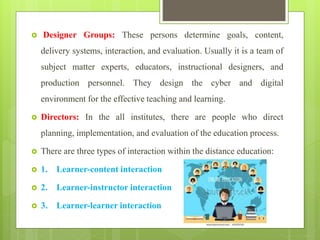
 There are three types of interaction within the distance education:
 1. Learner-content interaction
 2. Learner-instructor interaction
 3. Learner-learner interaction
Moore and Kearsley have enumerated design
considerations for distance education:
 Good structure
 Clear objectives
 Small units
 Planned participation
 Completeness
 Repetition
 Synthesis
 Stimulation
 Variety
 Open-ended
 Feedback
 Continuous Evaluation
Distance_Unit_V.pptx

Distance_Unit_V.pptx

  • 1.
    Dr.N.Sasikumar Assistant Professor Department ofEducation Alagappa University Karaikudi-630003
  • 2.
    Agencies in distanceeducation  Distance education council(DEC)  Role of UGC in distance education  Indira Gandhi National Open University(IGNOU)  Tamilnadu open university(TNOU)  Role of learning centres in distance education
  • 3.
    DISTANCEEDUCATIONCOUNCIL(DEC):  Distance EducationCouncil (DEC) was an organization based in New Delhi.  India responsible for the promotion and coordination of the Open University and distance education system and for determination of its standards in India.  The Council was constituted under the Indira Gandhi National Open University Act (1985).  Educational pattern of the country and for the coordination and determination of standards of teaching, evaluation & research in such systems
  • 4.
     In pursuanceof the objects of the University to encourage greater flexibility, diversity, accessibility, mobility and innovation in education at the University level by making full use of the latest scientific knowledge and new educational technology, and to further cooperation between the existing Universities.  The Distance Education Council (DEC) is an apex body for the Open and Distance Learning (ODL) system in the country. It is empowered, under Statute 28 of the IGNOU Act, to act as an apex body for the ODL system.  The Vice Chancellor of IGNOU is the ex officio Chairperson of DEC.  The UGC has constituted a Committee to examine the pending proposals of programme-wise recognition to the institutions.
  • 5.
    rolesandfunctionsof distanceeducationcouncil:  TheDEC develops a network of open universities/distance education institutions in India in consultation with the state governments, universities, and other concerned agencies.  promote an innovative system of University level education  flexible and open methods and pace of learning,  combination of courses, eligibility for enrolment and age of entry.  The DEC helps in coordinating and sharing the instructional materials prepared by different open universities/distance education institutions and the student support systems. It makes sure that there is no duplication of efforts.
  • 6.
     The DECalso establishes a broad framework for the pattern and structure of the distance education courses and programmes.  It sets the norms, procedures and practices for admission, evaluation, completion of course requirements, transfer of credits, etc. of students admitted to the programmes of the open university/distance education network and for the award of certificates, diplomas and degrees to them.  The DEC also develops guidelines for the organization of student support services for the open university/distance education programmes.  It also collects, compiles and circulates information relating to the courses and programmes offered by various open universities/distance education institutions.
  • 7.
    Indira Gandhi NationalOpen University:(ignou)  Indira Gandhi National Open University known as IGNOU, is a distance learning national university located in Maidan Garhi, New Delhi, India.  Named after former Prime Minister of India Indira Gandhi, the university was established in 1985 with a budget of ₹20 million, after the Parliament of India passed the Indira Gandhi National Open University Act, 1985 (IGNOU Act 1985).  IGNOU is run by the central government of India, and with total active enrollment of over 4 million students, claims to be the largest university in the world.  To build an inclusive knowledge society through inclusive education.  It has tried to increase the Gross Enrollment Ratio (GER) by offering high-quality teaching through the Open and Distance Learning (ODL) mode.  IGNOU has started a decentralization process by setting up five zones; north, south, east, west and north east.
  • 8.
     The firstof the regional headquarters, catering to four southern states, Pondicherry, Andaman and Nicobar and Lakshadweep, is being set up in the outskirts of Thiruvananthapuram in Kerala.  The Ministry of HRD has entrusted the responsibility of developing Draft Policy on Open and Distance Learning and Online Courses to IGNOU.  In 1989, the first Convocation was held and more than 1,000 students graduated and were awarded their diplomas.  IGNOU audio-video courses were first broadcast by radio and television in 1990 and IGNOU awarded degrees received full recognition by the University Grants Commission in 1992 as being equivalent to those of other universities in the country.  In 1999, IGNOU launched the first virtual campus in India, beginning with the delivery of Computer and Information Sciences courses via the Internet.  As of 2011 IGNOU has served over 3 million students in India and 40 other countries abroad.
  • 9.
     These areUAE, UK,Kuwait, Oman, Bahrain, Saudi Arabia, Maldives,, Kenya, Myanmar, Vietnam, Singapore, Indonesia, Malaysia, China, Nepal, Sri Lanka, Afghanistan, France. Schools:  IGNOU has 21 schools and a network of 67 regional centres, 2667 study centres, and 29 overseas centres (in 15 countries). Approximately 20% of all students enrolled in higher education in India are enrolled with IGNOU.IGNOU offers 226 academic programs comprising courses at certificate, diploma and degree levels.
  • 10.
     School ofHumanities  School of Social Sciences  School of Sciences  School of Education  School of Continuing Education  School of Engineering & Technology  School of Management Studies  School of Health Sciences  School of Computer & Information Sciences  School of Agriculture  School of Law  School of Journalism and New Media Studies  School of Gender & Development Studies  School of Tourism Hospitality Service Management  School of Interdisciplinary & Trans-disciplinary Studies  School of Social Work  School of Vocational Education and Training  School of Extension & Development Studies  School of Foreign Languages  School of Translation Studies and Training  School of Performing & Visual Arts
  • 11.
    Research Unit:  TheResearch Unit has been established at the Indira Gandhi National Open University vide notification dated 6 October 2008.  To register and monitor all full-time and part-time MPhil and PhD candidates.  To engage Research Teaching Assistants under IGNOU-DEC RTA Scheme for conduct of research and teaching.  To conduct workshops/seminars on research methodology for full-time and part-time research candidates.  To facilitate systemic/discipline based research in the University.
  • 12.
    Functions: Academic:  Establishment ofStudy Centers, Programme Study Centers, Special Study Centers, and Vocational Training Centers.  Identification and launching of need-based programmes through distance and face-to-face learning mode.  Organizing academic conferences and seminars in NER  Translation of Self Learning Materials in regional languages.  Maintenance of Academic Database  Organizing workshops for promotion and publicity of IGNOU programmes.  Providing academic support to Regional Centres, Institutes and Centers
  • 13.
    Administrative  Administration ofRegional Centres and Learner Support Centres in NER  Processing proposals of Regional Centers and Institutes for conduct of training programmes, workshops conferences and seminars.  Maintenance of Gyan Vani FM Radio Station and Edusat Networking in the region Financial  Budgeting and finance of Regional Centers and Institutes of the region.  Release of quarterly grants to Regional Centers and Institutes..  Finance of translational work in local languages  Monitoring monthly Expenditure- Statements of Regional Centres, Institutes and Centres
  • 14.
    TAMILNADUOPENUNIVERSITY(TNOU):  Tamil NaduOpen University (TNOU) is an Indian institution for open and distance learning established by the government of Tamil Nadu, India. It was founded in 2002 and is based in Chennai.  The university was established by the Legislative Assembly of the government of Tamil Nadu in Act 27 of 2002 to provide access to higher education for those who had been previously unable to pursue it.  It opened in 2003, was recognized by the University Grants Commission in September 2015,and is one of five universities approved to offer distance learning outside its state of establishment.  As of January 2016 it was one of 14 state open universities in India, which also has one national open university, Indira Gandhi National Open University;as of April 2017 it was one of 111 distance learning institutions in the country.
  • 15.
     As ofDecember 2017 it offers 113 programmes of study at levels from certificate to post graduate and has 13 academic schools, five support divisions, a media centre and more than 600 learner support centres across Tamil Nadu.  Students are admitted under two admission cycles, calendar year (January to June) and academic year (July to December).  They include those living in remote and rural areas, working people, handicapped students, housewives and retirees such as a 67-year-old woman who later completed an MA in history with Madras University, and prisoners.
  • 16.
    Functions:  To ensurerunning of existing academic Programmes as per the University calendar through student registration.  To ensure monitoring of proposals for launching new Programmes by coordinating through various sections of the University.  To ensure the conduct of term-end examinations as per the schedule, coordinate all the activities pertaining to continuous evaluation through assignment evaluation.  To ensure certification of the successful students’ performance through arranging award of Degrees, Diplomas and Certificates.
  • 17.
    Role of learningcentres in distance education:  Distance Education is a new, global technology-based education to facilitate easy, immediate learning and interaction for communicators, teachers, and students in education programs.  Distance Education can provide mass-education for everyone. It leads people to learn individually and shifts responsibility.  To be effective, distance education programs need to redefine the roles of teachers and students in the learning-teaching process.  1.Students: In distance education, students have role to learn. In that process, student has difficult and different roles according to traditional learning process.  2.Teacher: The main role of the teacher is the design of the course and setting the needs of students. Teacher has role to guide the students.
  • 18.
     Designer Groups:These persons determine goals, content, delivery systems, interaction, and evaluation. Usually it is a team of subject matter experts, educators, instructional designers, and production personnel. They design the cyber and digital environment for the effective teaching and learning.  Directors: In the all institutes, there are people who direct planning, implementation, and evaluation of the education process.  There are three types of interaction within the distance education:  1. Learner-content interaction  2. Learner-instructor interaction  3. Learner-learner interaction
  • 19.
    Moore and Kearsleyhave enumerated design considerations for distance education:  Good structure  Clear objectives  Small units  Planned participation  Completeness  Repetition  Synthesis  Stimulation  Variety  Open-ended  Feedback  Continuous Evaluation