1
NONCE-DISRESPECTING
ADVERSARIES
PRACTICAL FORGERY ATTACKS ON GCM IN
TLS
Hanno Böck, Aaron Zauner, Sean Devlin, Juraj Somorovsky,
Philipp Jovanovic
2
TLS ENCRYPTION
Step 1: Asymmetric key exchange (RSA, DHE, ECDHE) to
generate shared keys
Step 2: Symmetric encryption and authentication
Today we're interested in Step 2.
3
TLS SYMMETRIC MODES
CBC/HMAC
RC4 (stream cipher)
GCM
(new: ChaCha20/Poly1305)
4
CBC/HMAC
Vaudenay Padding Oracle (2002), Vaudenay/Moeller
(2003/2004), BEAST (2011), Lucky Thirteen (2013), POODLE
(2014), POODLE-TLS (2014), more POODLEs (2015), Lucky
Microseconds (2015), Padding Oracle in OpenSSL / CVE-
2016-2107
5
CBC/HMAC PROBLEMS
CBC/HMAC in TLS used an implicit IV in TLS 1.0.
The padding content in SSLv3 was undefined.
All TLS versions use MAC-then-Pad-then-Encrypt.
Encrypt-then-MAC extension, but it's rarely used.
6
TLS 1.2 PREDICTS LUCKY THIRTEEN
This leaves a small timing channel, since MAC performance
depends to some extent on the size of the data fragment, but
it is not believed to be large enough to be exploitable, due to
the large block size of existing MACs and the small size of the
timing signal. (TLS 1.2, RFC 5246)
7
LUCKY THIRTEEN IS A BIG MESS
Amazon tried to implement countermeasures that didn't
work.
Some implementations (Go, TLS Lite) are known vulnerable
and don't want to fix it.
OpenSSL introduced another (worse) padding oracle while
fixing Lucky Thirteen.
8
RC4
A er Lucky Thirteen many sites switched to RC4.
Fluhrer/Shamir/Mantin (2001), attack on TLS by
AlFardan/Bernstein/Patterson (2013), Bar-Mitzva-
Attack/Mantin (2015), Garman/va der Merwe/Paterson
(2015), Vanhoef/Piessens (2015).
RFC 7465: "Prohibiting RC4 Cipher Suites"
9
GCM
GCM - Galois/Counter Mode.
Usually used with AES.
Only available in TLS 1.2.
"This seems like a good moment to reiterate that everything
less than TLS 1.2 with an AEAD cipher suite is
cryptographically broken." (Adam Langley)
10
WHAT IS GCM?
GCM is an AEAD (Authenticated Encryption with Additional
Data)
Rationale: If you give people an encryption mode and an
authentication mechanism they will combine it in an
insecure way. So give them a standard that combines both.
GCM is a combination of Counter Mode and a GHASH
authentication tag.
11
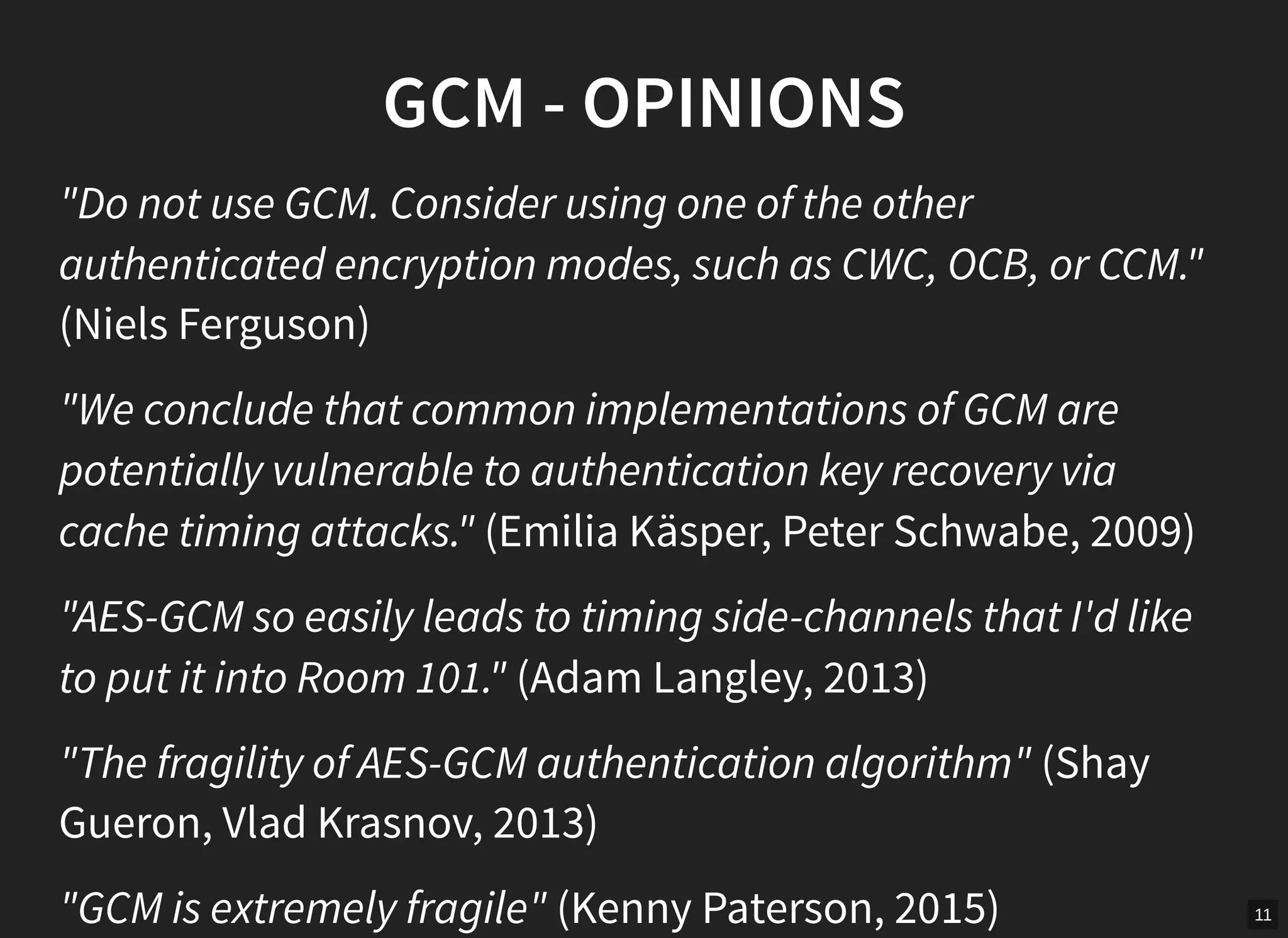
GCM - OPINIONS
"Do not use GCM. Consider using one of the other
authenticated encryption modes, such as CWC, OCB, or CCM."
(Niels Ferguson)
"We conclude that common implementations of GCM are
potentially vulnerable to authentication key recovery via
cache timing attacks." (Emilia Käsper, Peter Schwabe, 2009)
"AES-GCM so easily leads to timing side-channels that I'd like
to put it into Room 101." (Adam Langley, 2013)
"The fragility of AES-GCM authentication algorithm" (Shay
Gueron, Vlad Krasnov, 2013)
"GCM is extremely fragile" (Kenny Paterson, 2015)
12
GCM
Everybody uses GCM, but nobody likes it.
"There's also an annoying niggle with AES-GCM in TLS
because the spec says that records have an eight byte, explicit
nonce. Being an AEAD, the nonce is required to be unique for a
given key. Since an eight-byte value is too small to pick at
random with a sufficiently low collision probability, the only
safe implementation is a counter. [...] Thankfully, all the major
implementations use a counter and I did a scan of the Alexa,
top 200K sites to check that none are using random values -
and none are." (Adam Langley)
13
14
NONCE
Number used once.
If you use the same Nonce twice (with the same key) it's no
longer a nonce.
TLS: 8 Byte / 64 Bit nonce
15
THE SPEC (RFC 5288 / TLS 1.2)
"Each value of the nonce_explicit MUST be distinct for each
distinct invocation of the GCM encrypt function for any fixed
key. Failure to meet this uniqueness requirement can
significantly degrade security. The nonce_explicit MAY be the
64-bit sequence number."
16
INTERNET-WIDE SCAN RESULTS
184 hosts with repeating nonces
72445 hosts with random looking nonces
17
FINDING AFFECTED VENDORS
Certificate info, website content, HTTP "Server:" header.
O en load balancers hiding their true identity.
Contacting website owners hardly works.
18
IT LOOKS RANDOM, BUT ISN'T
Check Point devices using LFSR - this is secure.
19
DUPLICATE NONCES
We could identify two vendors
Radware (Cavium chip), update from vendor
Several pages from VISA Europe (vendor not yet disclosed)
20
DEVICES WITH RANDOM NONCES
A10, IBM Lotus Domino (both published updates).
Sangfor (no vendor response).
21
MORE?
There are more devices with different behaviors that we
were unable to identify.
Security test tools and pen testers should checks for this.
22
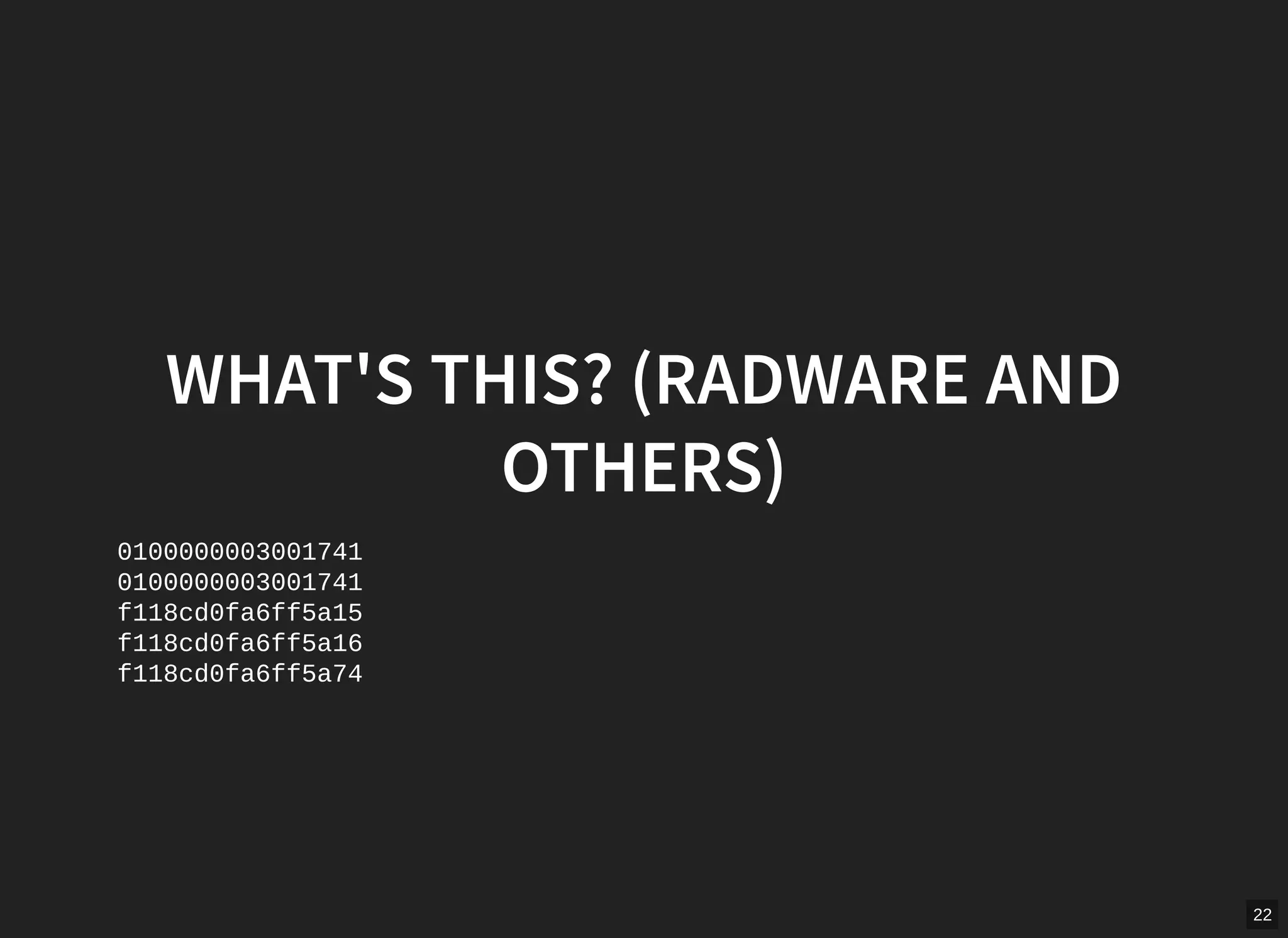
WHAT'S THIS? (RADWARE AND
OTHERS)
0100000003001741
0100000003001741
f118cd0fa6ff5a15
f118cd0fa6ff5a16
f118cd0fa6ff5a74
23
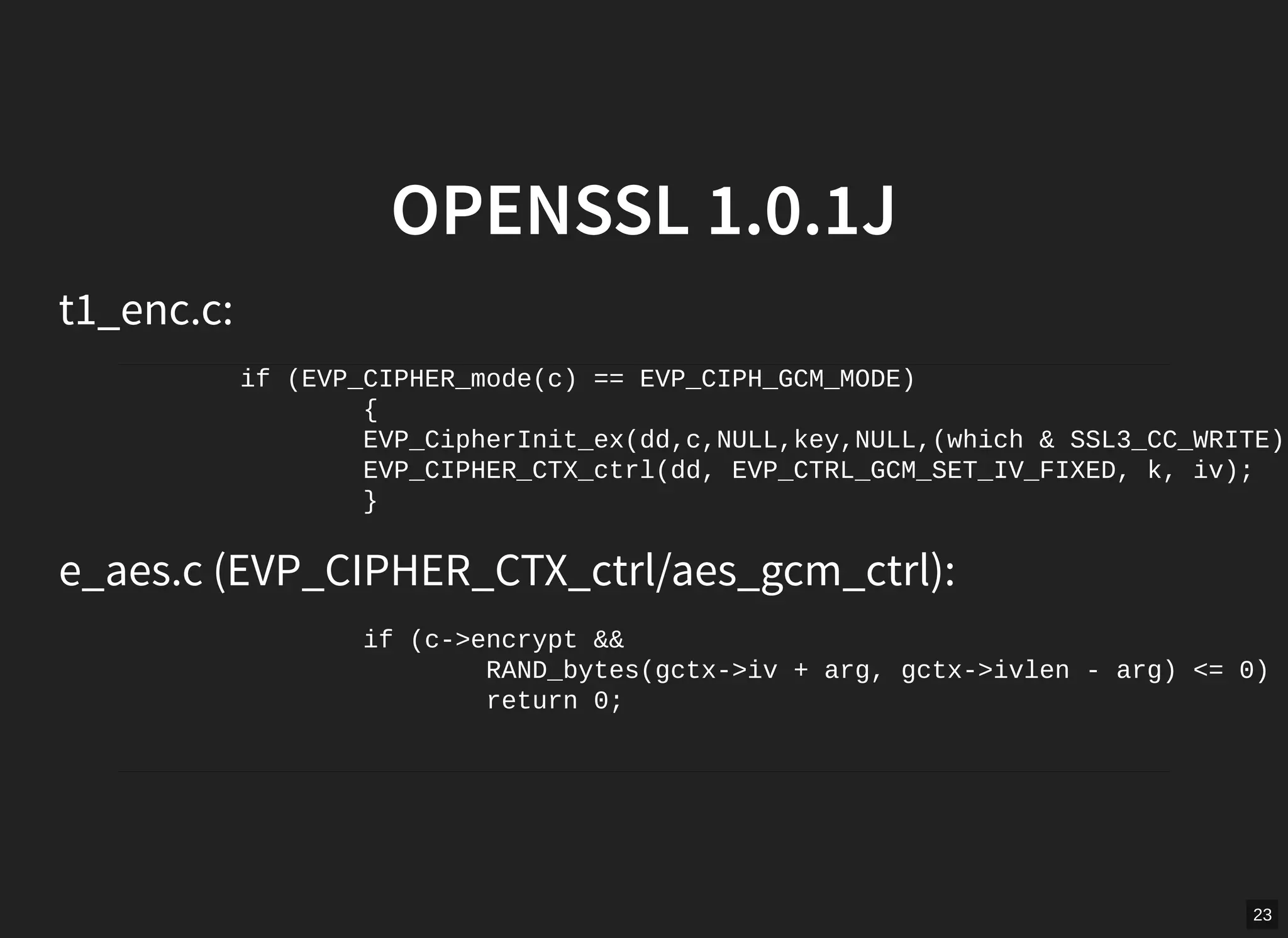
OPENSSL 1.0.1J
t1_enc.c:
if (EVP_CIPHER_mode(c) == EVP_CIPH_GCM_MODE)
{
EVP_CipherInit_ex(dd,c,NULL,key,NULL,(which & SSL3_CC_WRITE))
EVP_CIPHER_CTX_ctrl(dd, EVP_CTRL_GCM_SET_IV_FIXED, k, iv);
}
e_aes.c (EVP_CIPHER_CTX_ctrl/aes_gcm_ctrl):
if (c->encrypt &&
RAND_bytes(gctx->iv + arg, gctx->ivlen - arg) <= 0)
return 0;
24
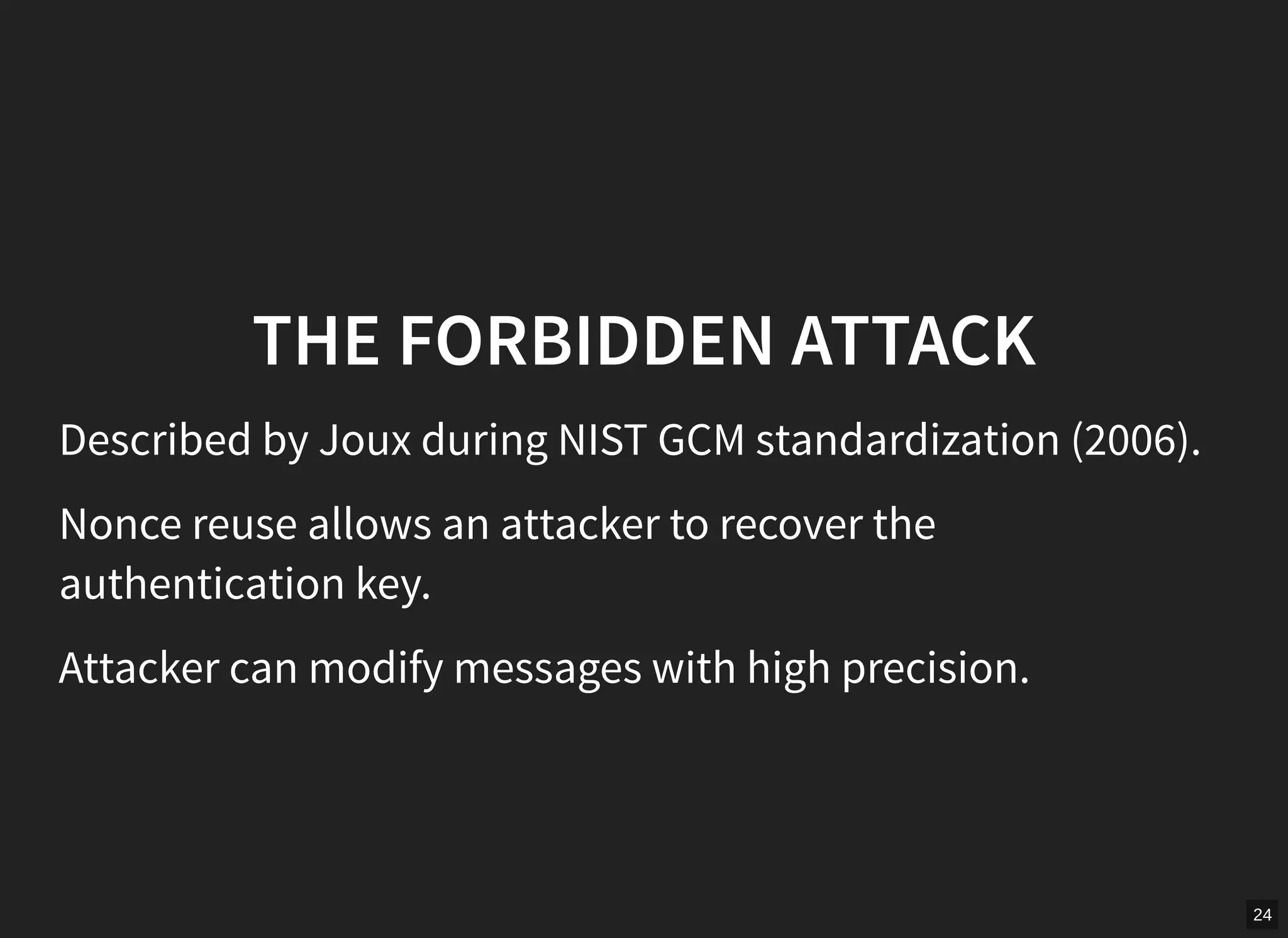
THE FORBIDDEN ATTACK
Described by Joux during NIST GCM standardization (2006).
Nonce reuse allows an attacker to recover the
authentication key.
Attacker can modify messages with high precision.
25
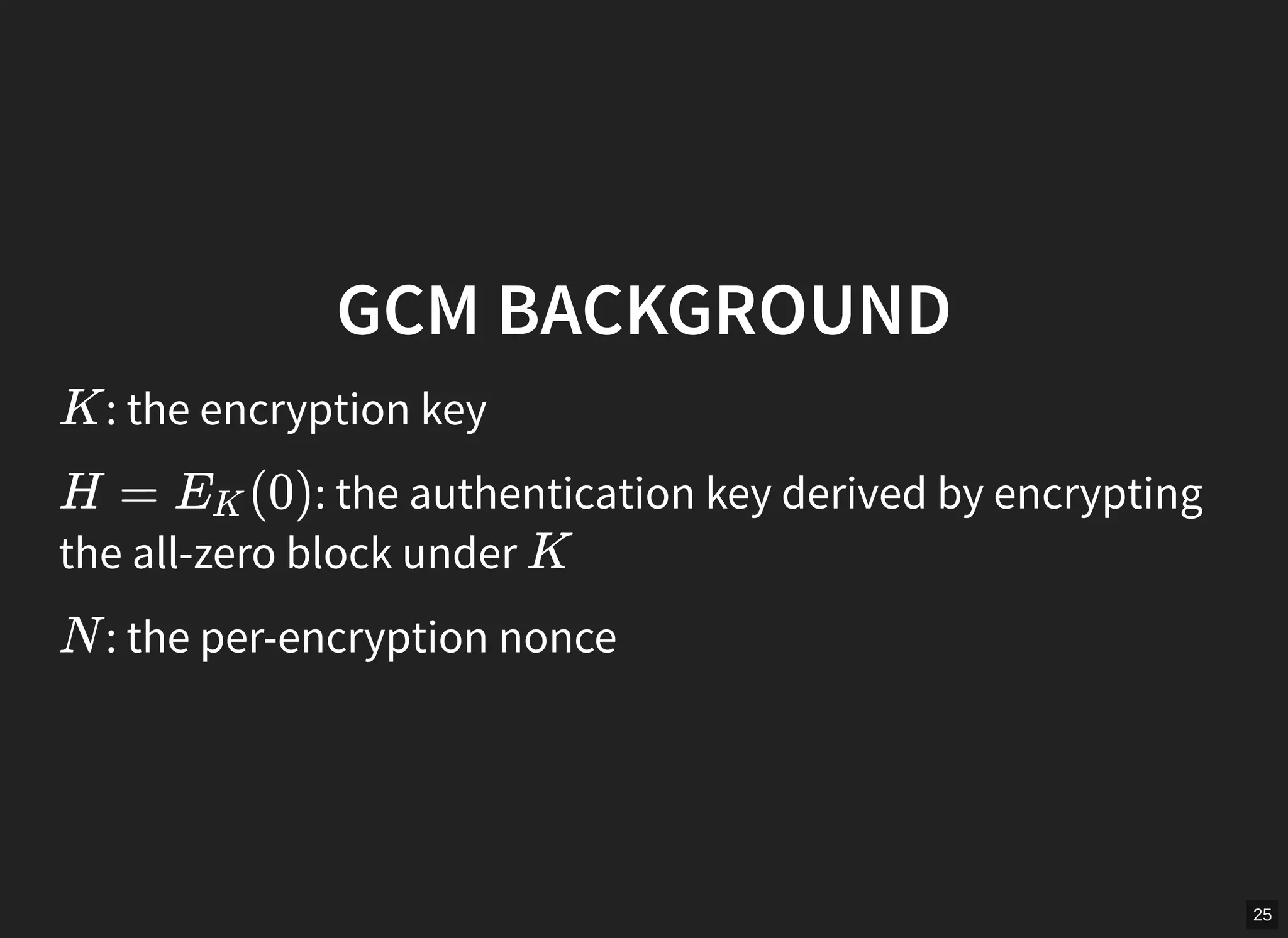
GCM BACKGROUND
: the encryption keyK
: the authentication key derived by encrypting
the all-zero block under
H = (0)EK
K
: the per-encryption nonceN
26
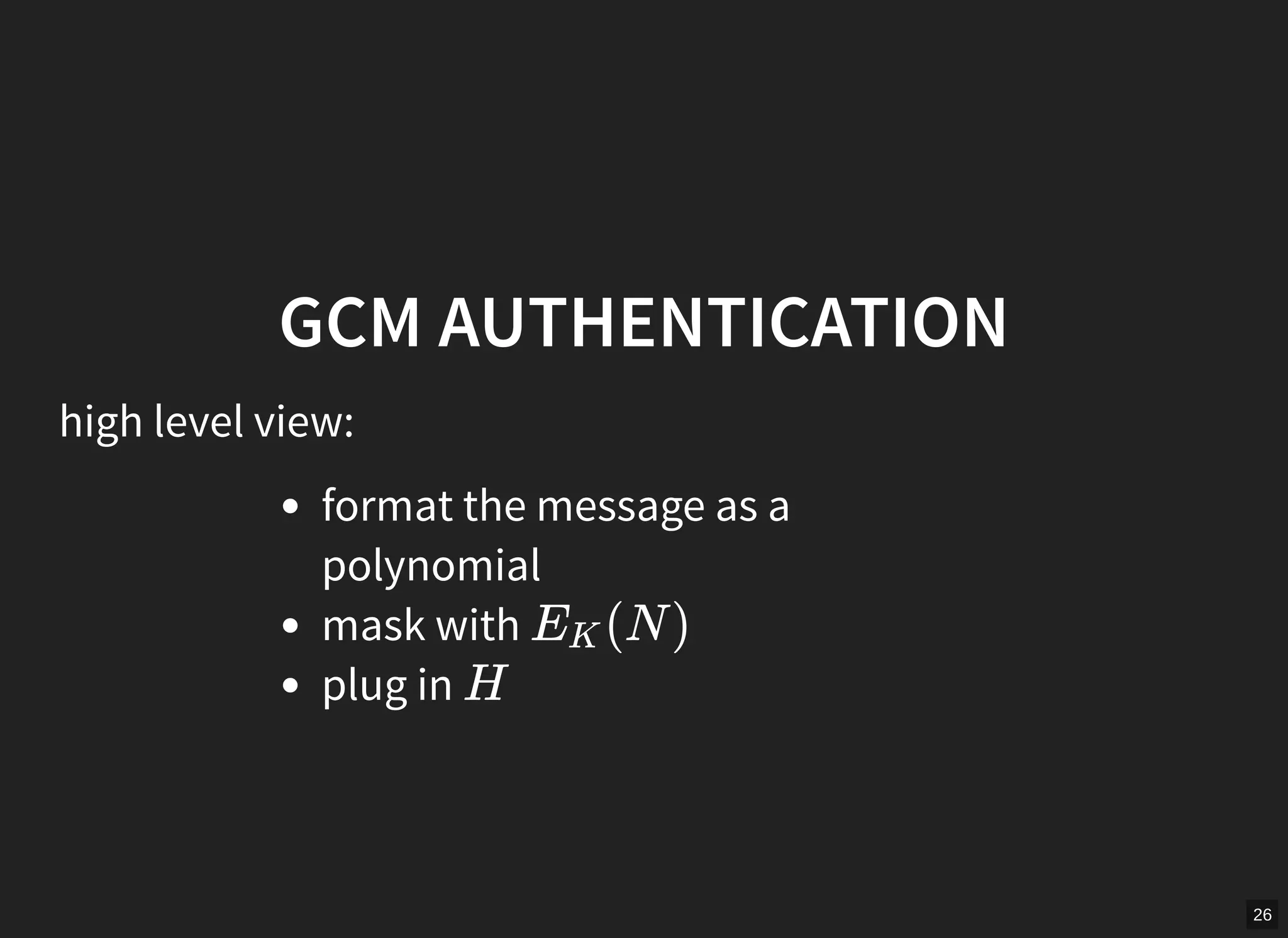
GCM AUTHENTICATION
high level view:
format the message as a
polynomial
mask with
plug in
(N )EK
H
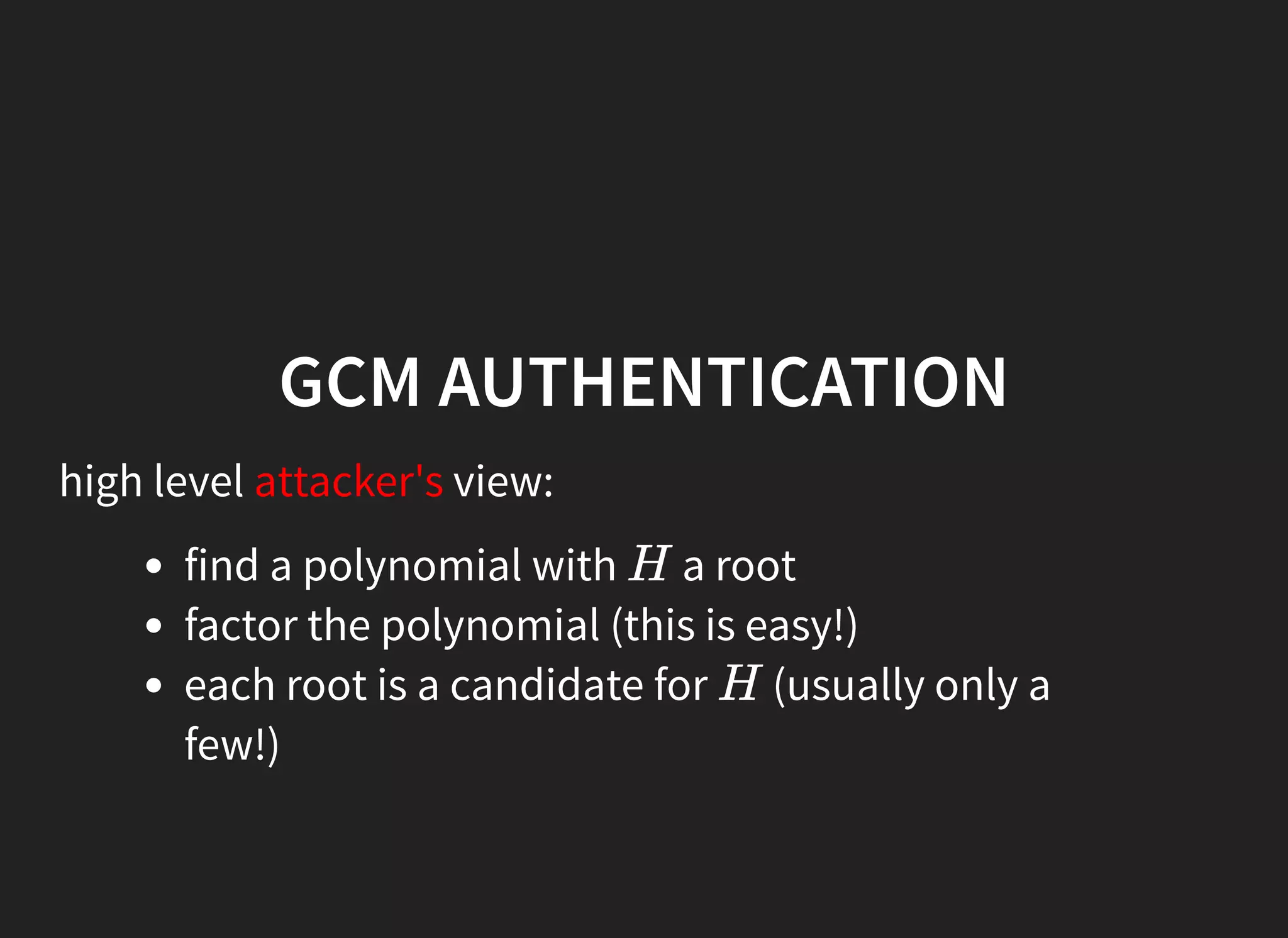
GCM AUTHENTICATION
high level attacker's view:
find a polynomial with a root
factor the polynomial (this is easy!)
each root is a candidate for (usually only a
few!)
H
H
27
28
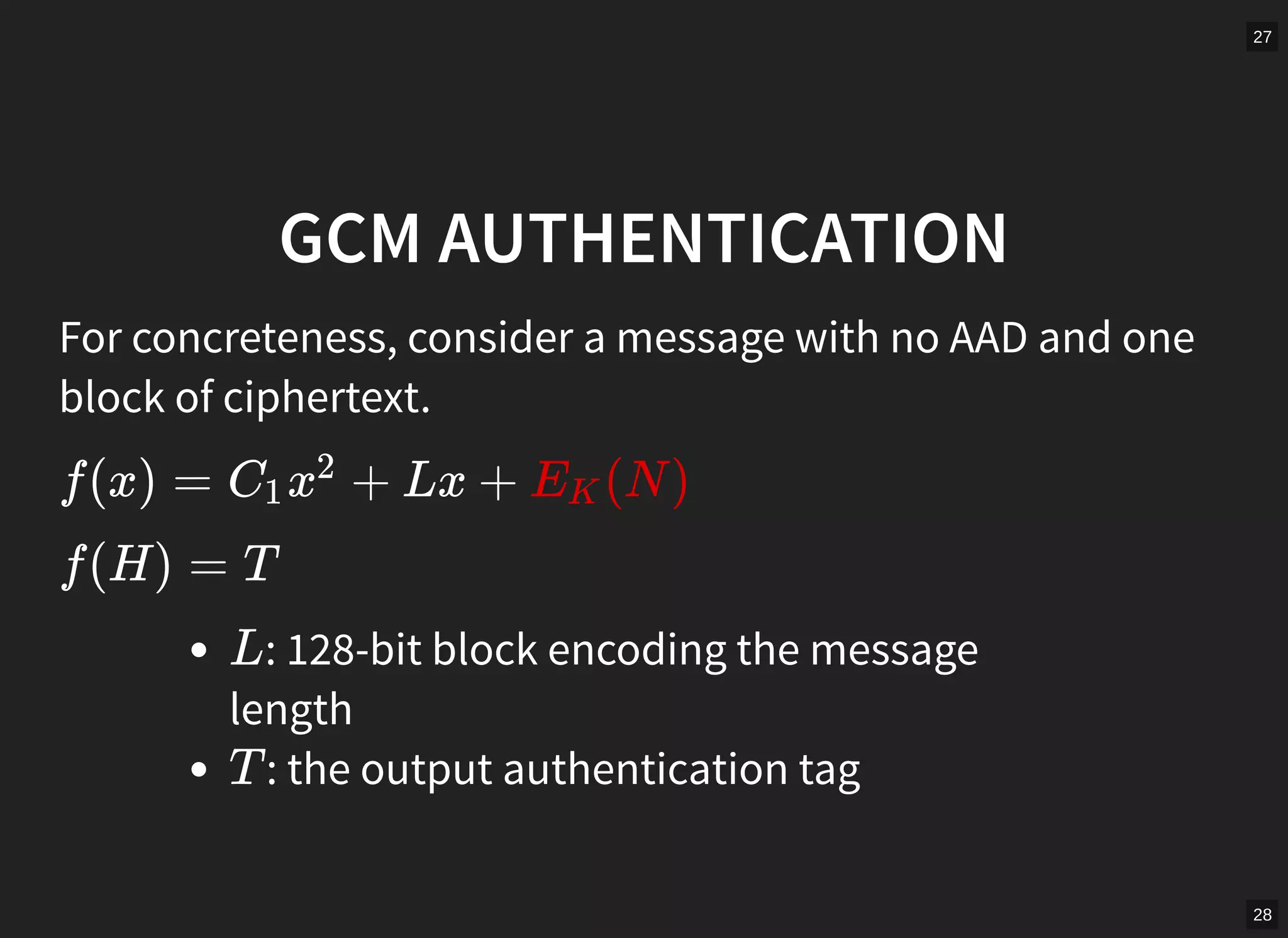
GCM AUTHENTICATION
For concreteness, consider a message with no AAD and one
block of ciphertext.
f(x) = + Lx + (N )C1 x
2
EK
f(H) = T
: 128-bit block encoding the message
length
: the output authentication tag
L
T
29
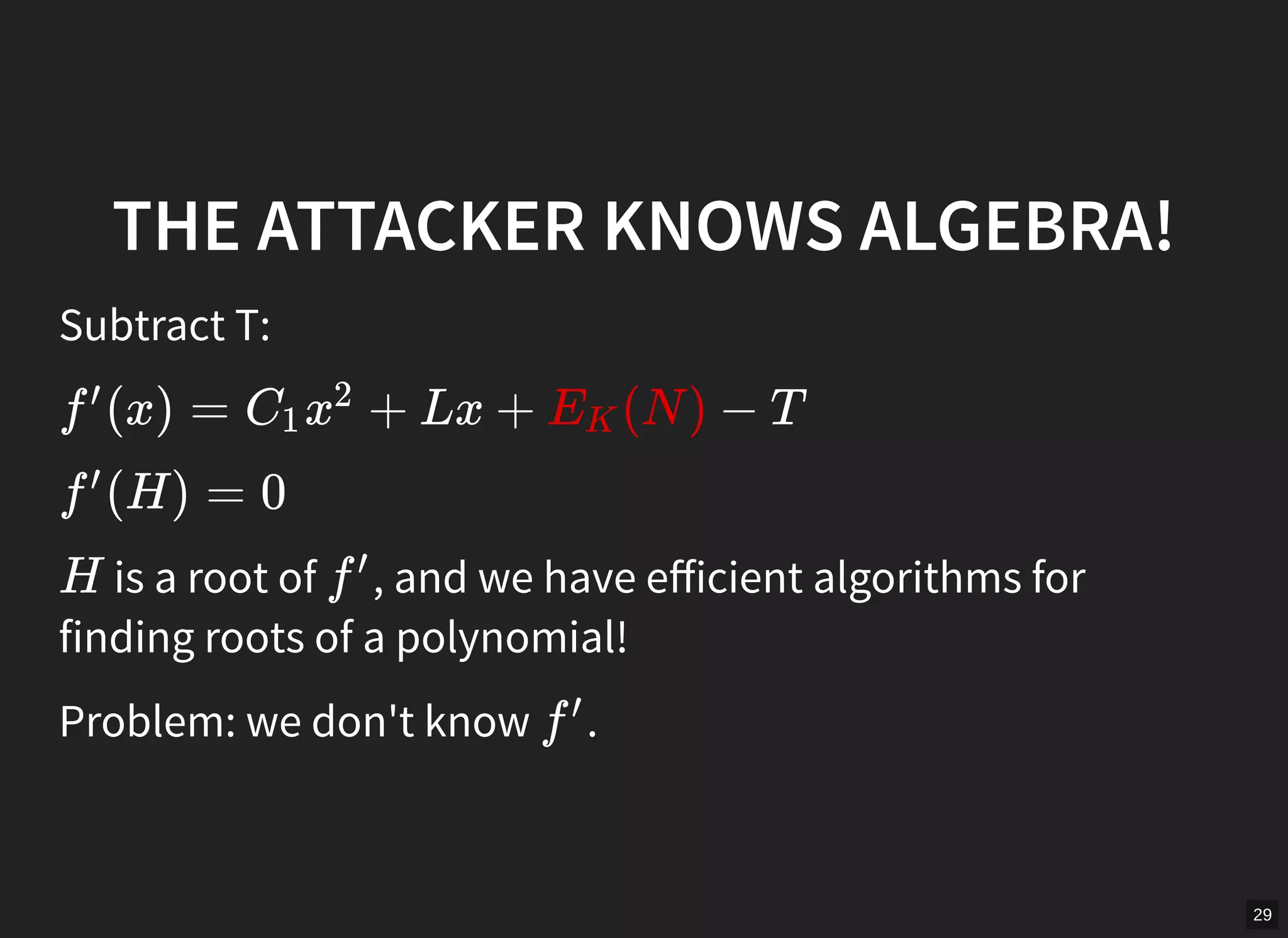
THE ATTACKER KNOWS ALGEBRA!
Subtract T:
(x) = + Lx + (N ) − Tf
′
C1 x
2
EK
(H) = 0f
′
is a root of , and we have efficient algorithms for
finding roots of a polynomial!
H f
′
Problem: we don't know .f
′
30
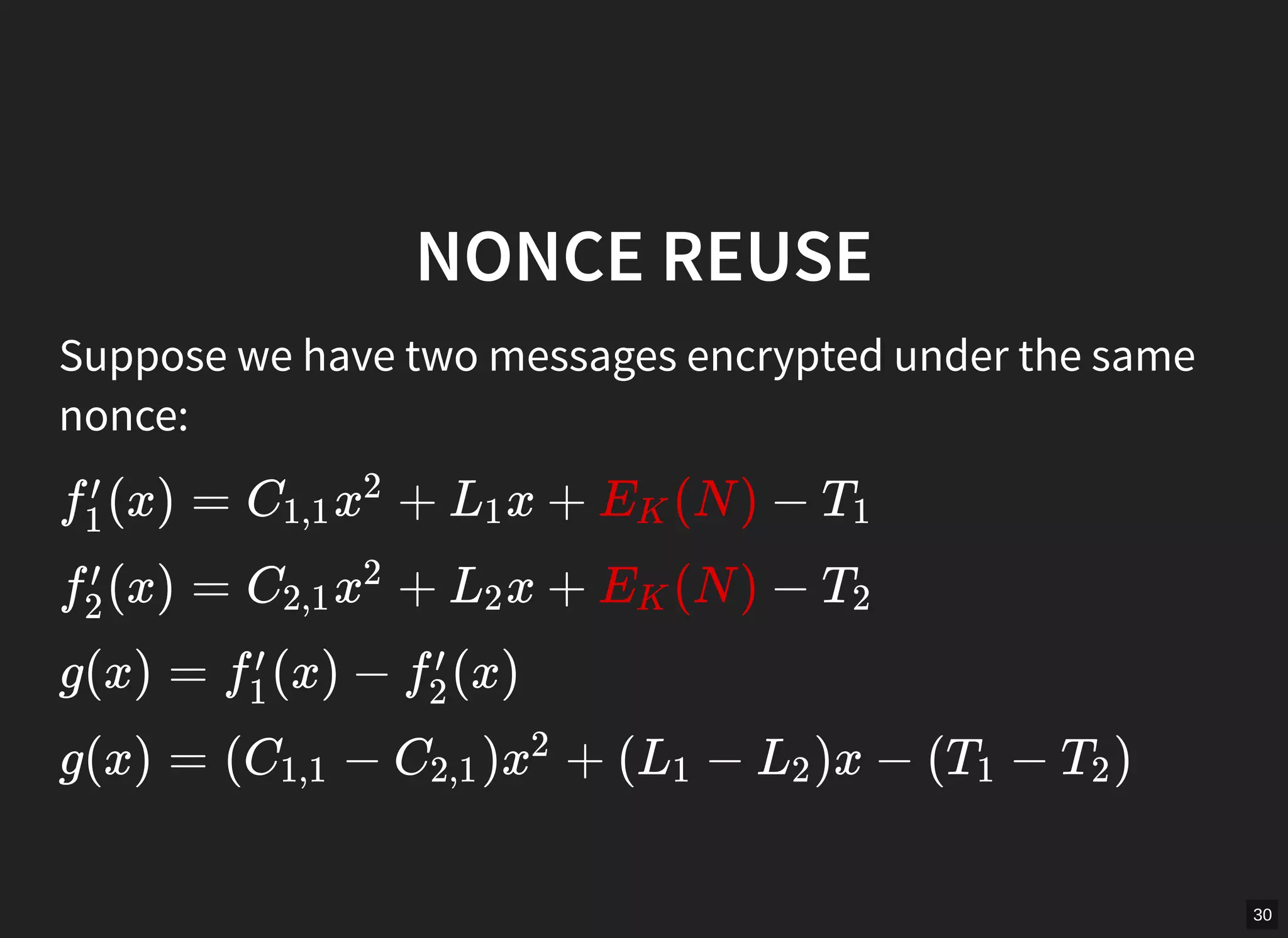
NONCE REUSE
Suppose we have two messages encrypted under the same
nonce:
(x) = + x + (N ) −f
′
1
C1,1 x
2
L1 EK T1
(x) = + x + (N ) −f
′
2
C2,1 x
2
L2 EK T2
g(x) = (x) − (x)f
′
1
f
′
2
g(x) = ( − ) + ( − )x − ( − )C1,1 C2,1 x
2
L1 L2 T1 T2
31
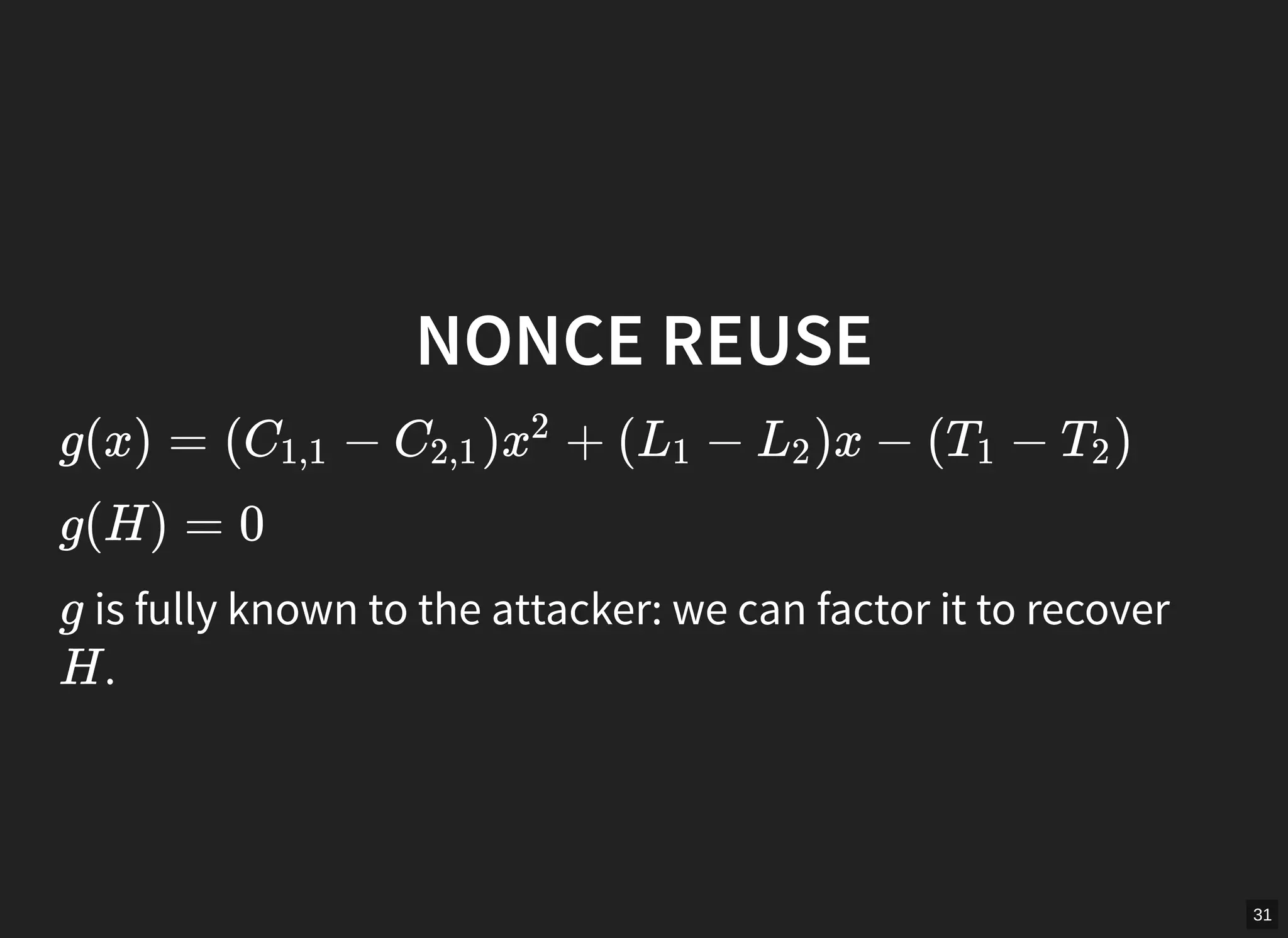
NONCE REUSE
g(x) = ( − ) + ( − )x − ( − )C1,1 C2,1 x
2
L1 L2 T1 T2
g(H) = 0
is fully known to the attacker: we can factor it to recover
.
g
H
32
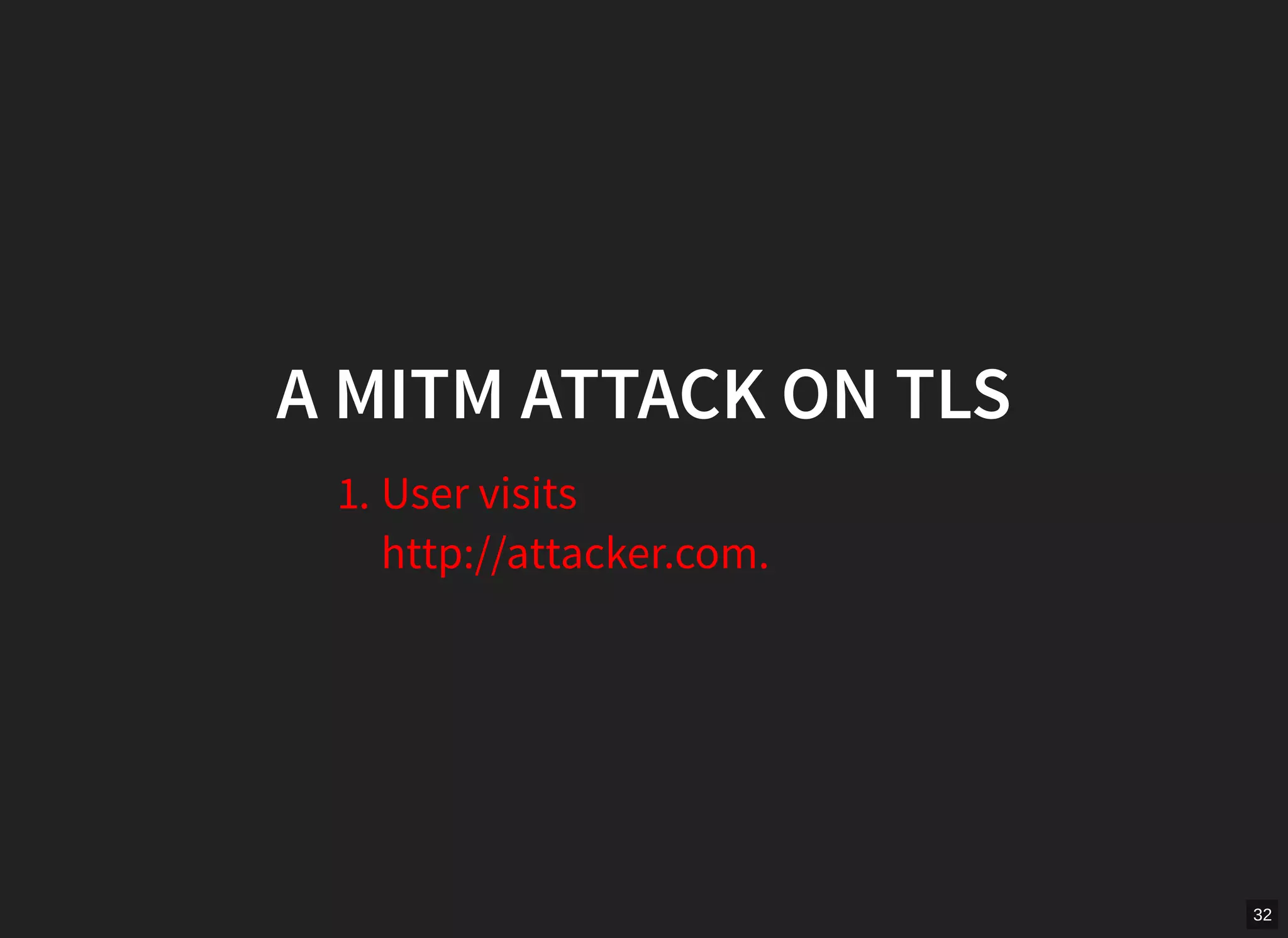
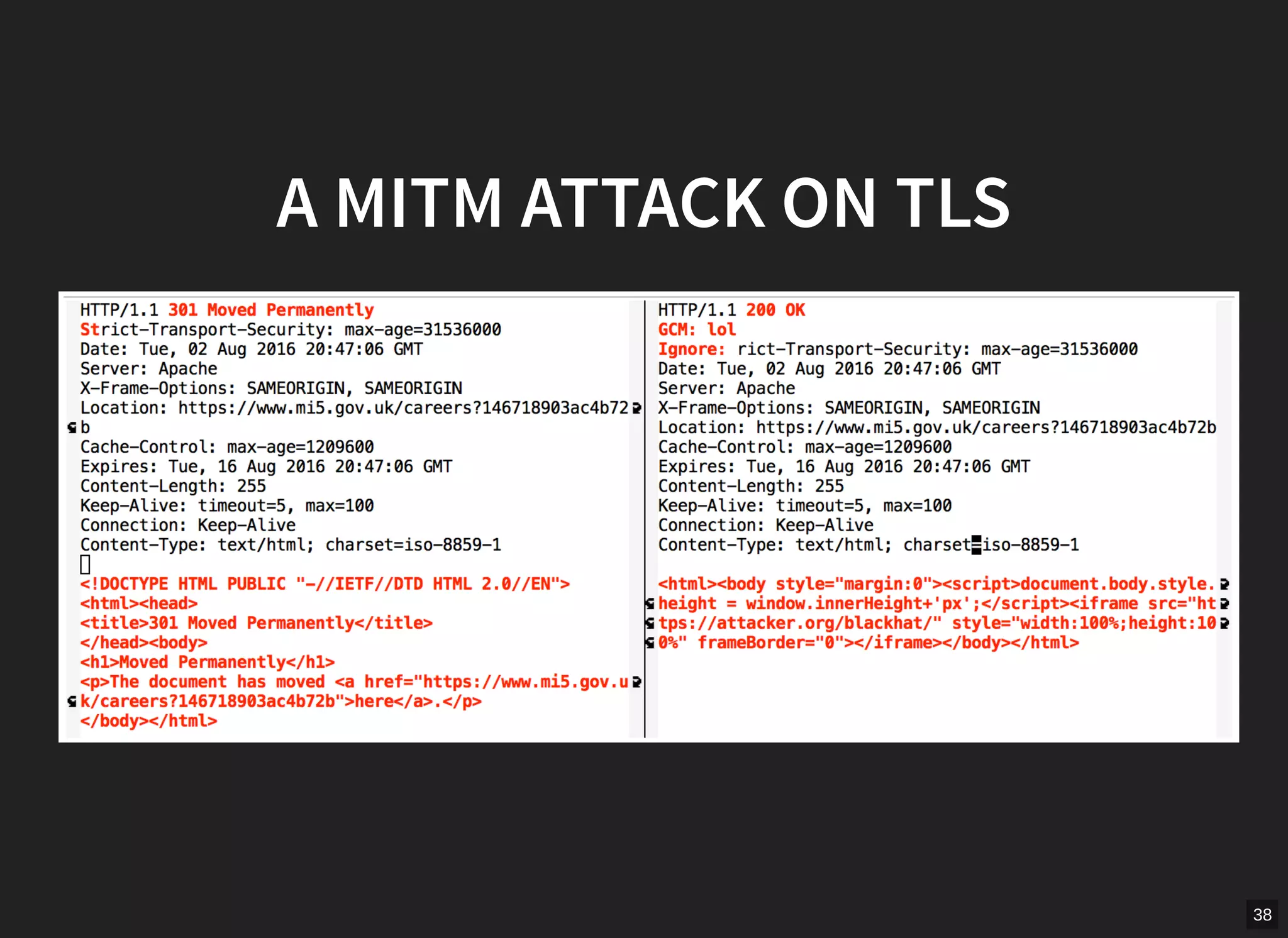
A MITM ATTACK ON TLS
1. User visits
http://attacker.com.
33
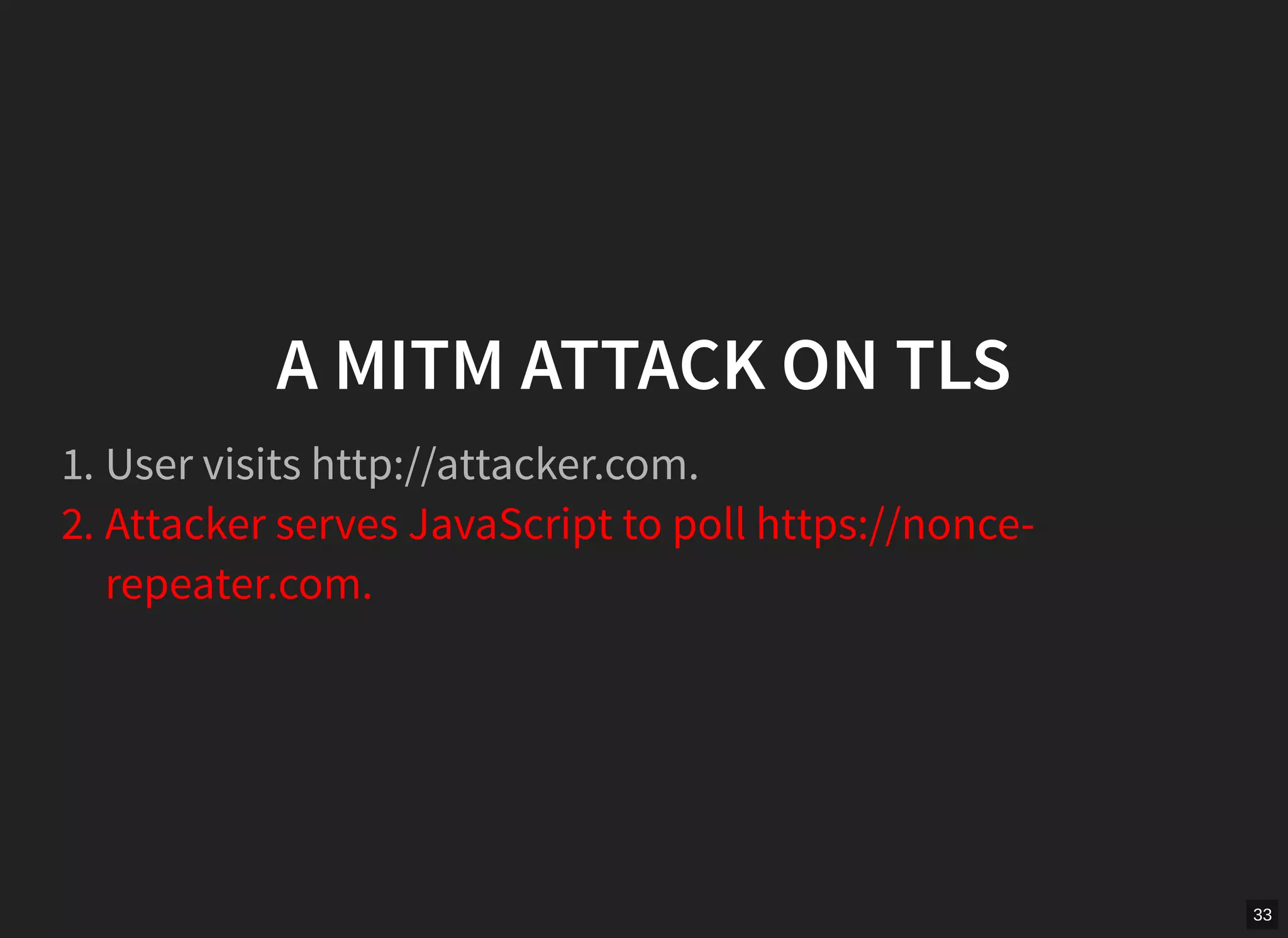
A MITM ATTACK ON TLS
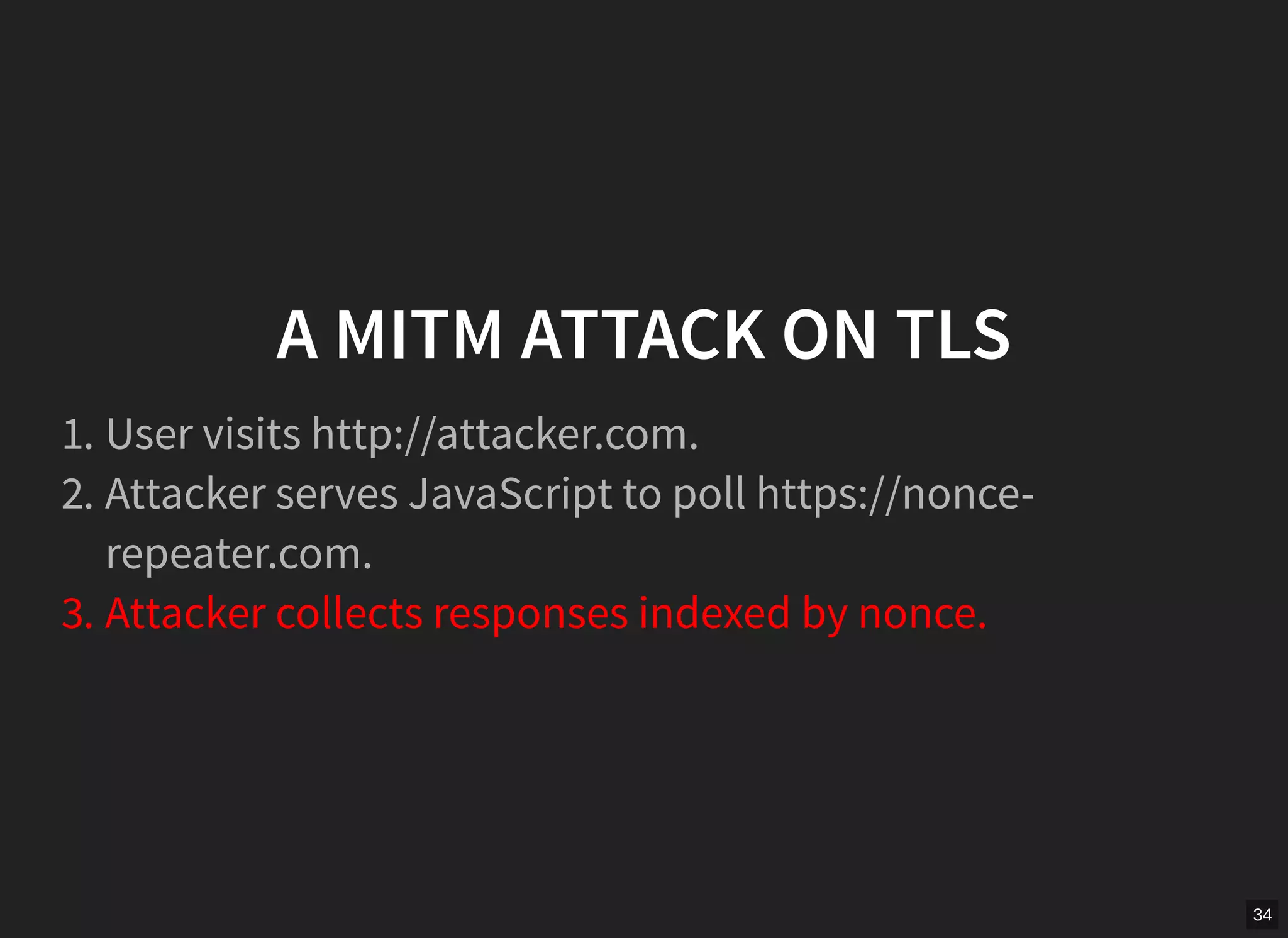
1. User visits http://attacker.com.
2. Attacker serves JavaScript to poll https://nonce-
repeater.com.
34
A MITM ATTACK ON TLS
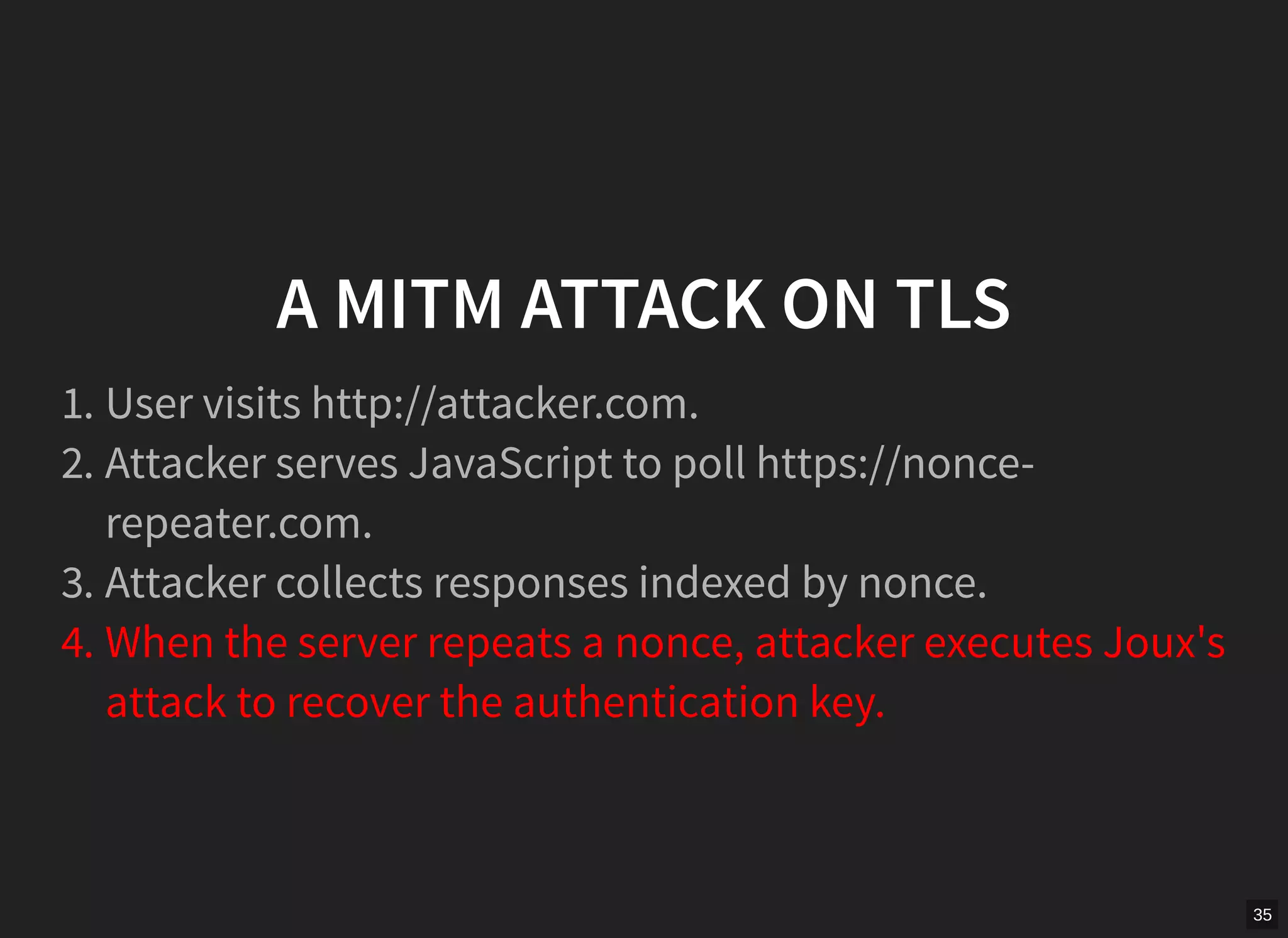
1. User visits http://attacker.com.
2. Attacker serves JavaScript to poll https://nonce-
repeater.com.
3. Attacker collects responses indexed by nonce.
35
A MITM ATTACK ON TLS
1. User visits http://attacker.com.
2. Attacker serves JavaScript to poll https://nonce-
repeater.com.
3. Attacker collects responses indexed by nonce.
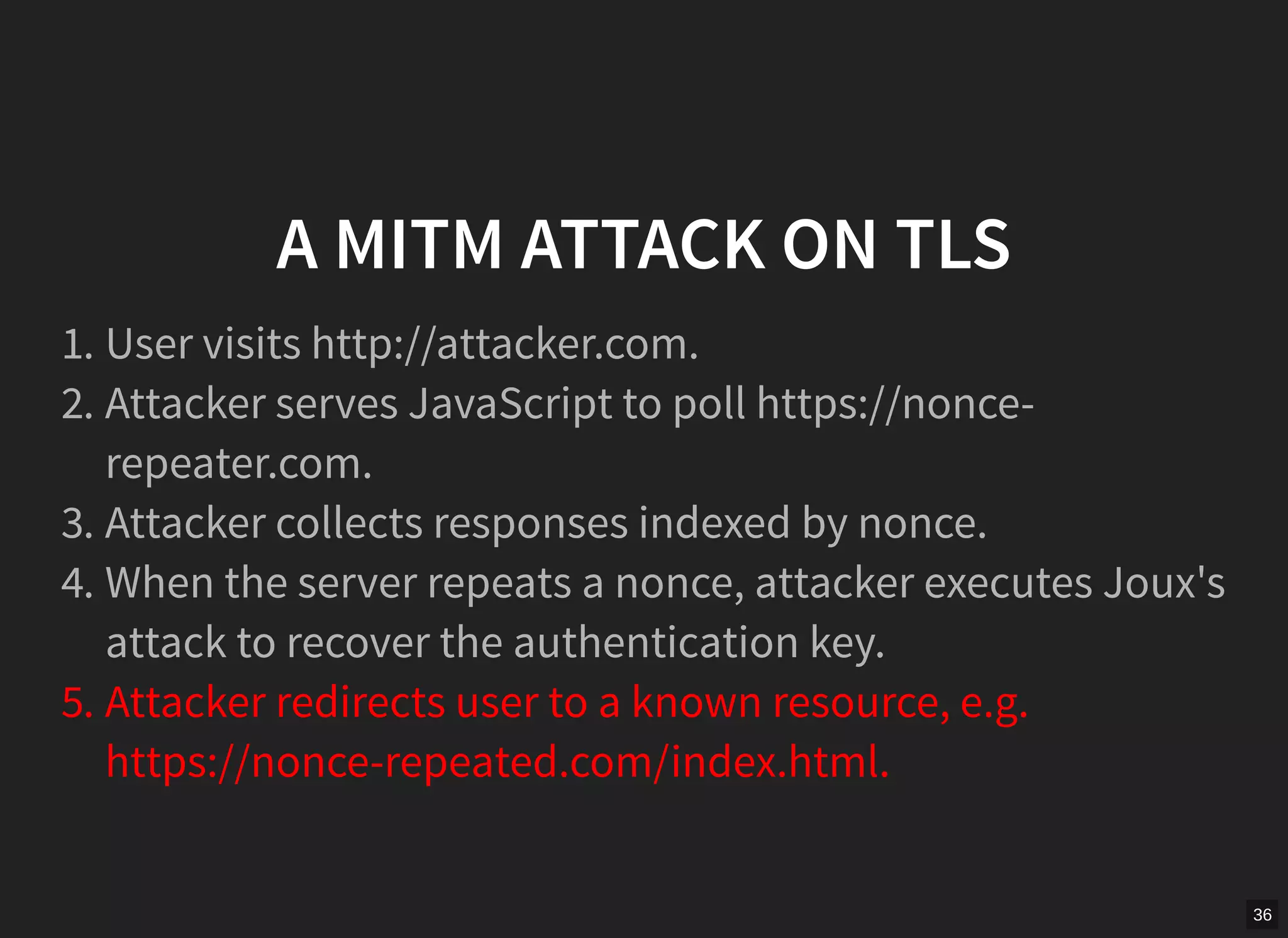
4. When the server repeats a nonce, attacker executes Joux's
attack to recover the authentication key.
36
A MITM ATTACK ON TLS
1. User visits http://attacker.com.
2. Attacker serves JavaScript to poll https://nonce-
repeater.com.
3. Attacker collects responses indexed by nonce.
4. When the server repeats a nonce, attacker executes Joux's
attack to recover the authentication key.
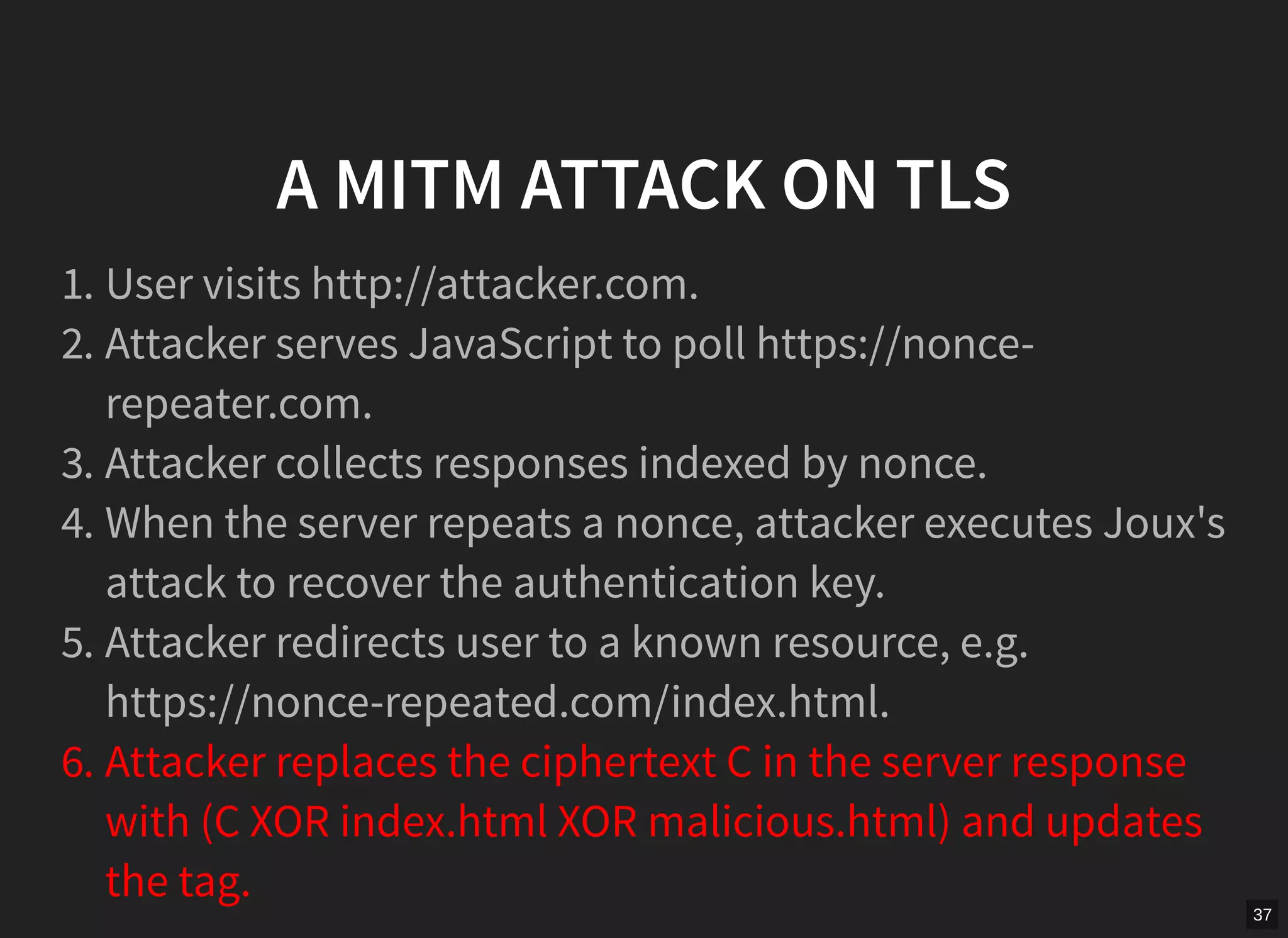
5. Attacker redirects user to a known resource, e.g.
https://nonce-repeated.com/index.html.
37
A MITM ATTACK ON TLS
1. User visits http://attacker.com.
2. Attacker serves JavaScript to poll https://nonce-
repeater.com.
3. Attacker collects responses indexed by nonce.
4. When the server repeats a nonce, attacker executes Joux's
attack to recover the authentication key.
5. Attacker redirects user to a known resource, e.g.
https://nonce-repeated.com/index.html.
6. Attacker replaces the ciphertext C in the server response
with (C XOR index.html XOR malicious.html) and updates
the tag.
38
A MITM ATTACK ON TLS
39
FUTURE
Dra for Chacha20/Poly1305 and TLS 1.3 uses fully implicit
nonce based on record number.
Synthetic IVs and nonce misuse resistant schemes.
40
CONCLUSION
TLS 1.2 tells implementors to use a nonce, but gives no
guidance how to do that properly.
Some people get it wrong.
We need better test tools for TLS implementation flaws (TLS-
Fuzzer looks promising).
41
THANKS FOR LISTENING
https://github.com/nonce-disrespect/nonce-disrespect
Test your hosts:
https://gcm.tlsfun.de/

[BlackHat USA 2016] Nonce-Disrespecting Adversaries: Practical Forgery Attacks on GCM in TLS

  • 1.
    1 NONCE-DISRESPECTING ADVERSARIES PRACTICAL FORGERY ATTACKSON GCM IN TLS Hanno Böck, Aaron Zauner, Sean Devlin, Juraj Somorovsky, Philipp Jovanovic
  • 2.
    2 TLS ENCRYPTION Step 1:Asymmetric key exchange (RSA, DHE, ECDHE) to generate shared keys Step 2: Symmetric encryption and authentication Today we're interested in Step 2.
  • 3.
    3 TLS SYMMETRIC MODES CBC/HMAC RC4(stream cipher) GCM (new: ChaCha20/Poly1305)
  • 4.
    4 CBC/HMAC Vaudenay Padding Oracle(2002), Vaudenay/Moeller (2003/2004), BEAST (2011), Lucky Thirteen (2013), POODLE (2014), POODLE-TLS (2014), more POODLEs (2015), Lucky Microseconds (2015), Padding Oracle in OpenSSL / CVE- 2016-2107
  • 5.
    5 CBC/HMAC PROBLEMS CBC/HMAC inTLS used an implicit IV in TLS 1.0. The padding content in SSLv3 was undefined. All TLS versions use MAC-then-Pad-then-Encrypt. Encrypt-then-MAC extension, but it's rarely used.
  • 6.
    6 TLS 1.2 PREDICTSLUCKY THIRTEEN This leaves a small timing channel, since MAC performance depends to some extent on the size of the data fragment, but it is not believed to be large enough to be exploitable, due to the large block size of existing MACs and the small size of the timing signal. (TLS 1.2, RFC 5246)
  • 7.
    7 LUCKY THIRTEEN ISA BIG MESS Amazon tried to implement countermeasures that didn't work. Some implementations (Go, TLS Lite) are known vulnerable and don't want to fix it. OpenSSL introduced another (worse) padding oracle while fixing Lucky Thirteen.
  • 8.
    8 RC4 A er LuckyThirteen many sites switched to RC4. Fluhrer/Shamir/Mantin (2001), attack on TLS by AlFardan/Bernstein/Patterson (2013), Bar-Mitzva- Attack/Mantin (2015), Garman/va der Merwe/Paterson (2015), Vanhoef/Piessens (2015). RFC 7465: "Prohibiting RC4 Cipher Suites"
  • 9.
    9 GCM GCM - Galois/CounterMode. Usually used with AES. Only available in TLS 1.2. "This seems like a good moment to reiterate that everything less than TLS 1.2 with an AEAD cipher suite is cryptographically broken." (Adam Langley)
  • 10.
    10 WHAT IS GCM? GCMis an AEAD (Authenticated Encryption with Additional Data) Rationale: If you give people an encryption mode and an authentication mechanism they will combine it in an insecure way. So give them a standard that combines both. GCM is a combination of Counter Mode and a GHASH authentication tag.
  • 11.
    11 GCM - OPINIONS "Donot use GCM. Consider using one of the other authenticated encryption modes, such as CWC, OCB, or CCM." (Niels Ferguson) "We conclude that common implementations of GCM are potentially vulnerable to authentication key recovery via cache timing attacks." (Emilia Käsper, Peter Schwabe, 2009) "AES-GCM so easily leads to timing side-channels that I'd like to put it into Room 101." (Adam Langley, 2013) "The fragility of AES-GCM authentication algorithm" (Shay Gueron, Vlad Krasnov, 2013) "GCM is extremely fragile" (Kenny Paterson, 2015)
  • 12.
    12 GCM Everybody uses GCM,but nobody likes it.
  • 13.
    "There's also anannoying niggle with AES-GCM in TLS because the spec says that records have an eight byte, explicit nonce. Being an AEAD, the nonce is required to be unique for a given key. Since an eight-byte value is too small to pick at random with a sufficiently low collision probability, the only safe implementation is a counter. [...] Thankfully, all the major implementations use a counter and I did a scan of the Alexa, top 200K sites to check that none are using random values - and none are." (Adam Langley)
  • 14.
    13 14 NONCE Number used once. Ifyou use the same Nonce twice (with the same key) it's no longer a nonce. TLS: 8 Byte / 64 Bit nonce
  • 15.
    15 THE SPEC (RFC5288 / TLS 1.2) "Each value of the nonce_explicit MUST be distinct for each distinct invocation of the GCM encrypt function for any fixed key. Failure to meet this uniqueness requirement can significantly degrade security. The nonce_explicit MAY be the 64-bit sequence number."
  • 16.
    16 INTERNET-WIDE SCAN RESULTS 184hosts with repeating nonces 72445 hosts with random looking nonces
  • 17.
    17 FINDING AFFECTED VENDORS Certificateinfo, website content, HTTP "Server:" header. O en load balancers hiding their true identity. Contacting website owners hardly works.
  • 18.
    18 IT LOOKS RANDOM,BUT ISN'T Check Point devices using LFSR - this is secure.
  • 19.
    19 DUPLICATE NONCES We couldidentify two vendors Radware (Cavium chip), update from vendor Several pages from VISA Europe (vendor not yet disclosed)
  • 20.
    20 DEVICES WITH RANDOMNONCES A10, IBM Lotus Domino (both published updates). Sangfor (no vendor response).
  • 21.
    21 MORE? There are moredevices with different behaviors that we were unable to identify. Security test tools and pen testers should checks for this.
  • 22.
    22 WHAT'S THIS? (RADWAREAND OTHERS) 0100000003001741 0100000003001741 f118cd0fa6ff5a15 f118cd0fa6ff5a16 f118cd0fa6ff5a74
  • 23.
    23 OPENSSL 1.0.1J t1_enc.c: if (EVP_CIPHER_mode(c)== EVP_CIPH_GCM_MODE) { EVP_CipherInit_ex(dd,c,NULL,key,NULL,(which & SSL3_CC_WRITE)) EVP_CIPHER_CTX_ctrl(dd, EVP_CTRL_GCM_SET_IV_FIXED, k, iv); } e_aes.c (EVP_CIPHER_CTX_ctrl/aes_gcm_ctrl): if (c->encrypt && RAND_bytes(gctx->iv + arg, gctx->ivlen - arg) <= 0) return 0;
  • 24.
    24 THE FORBIDDEN ATTACK Describedby Joux during NIST GCM standardization (2006). Nonce reuse allows an attacker to recover the authentication key. Attacker can modify messages with high precision.
  • 25.
    25 GCM BACKGROUND : theencryption keyK : the authentication key derived by encrypting the all-zero block under H = (0)EK K : the per-encryption nonceN
  • 26.
    26 GCM AUTHENTICATION high levelview: format the message as a polynomial mask with plug in (N )EK H
  • 27.
    GCM AUTHENTICATION high levelattacker's view: find a polynomial with a root factor the polynomial (this is easy!) each root is a candidate for (usually only a few!) H H
  • 28.
    27 28 GCM AUTHENTICATION For concreteness,consider a message with no AAD and one block of ciphertext. f(x) = + Lx + (N )C1 x 2 EK f(H) = T : 128-bit block encoding the message length : the output authentication tag L T
  • 29.
    29 THE ATTACKER KNOWSALGEBRA! Subtract T: (x) = + Lx + (N ) − Tf ′ C1 x 2 EK (H) = 0f ′ is a root of , and we have efficient algorithms for finding roots of a polynomial! H f ′ Problem: we don't know .f ′
  • 30.
    30 NONCE REUSE Suppose wehave two messages encrypted under the same nonce: (x) = + x + (N ) −f ′ 1 C1,1 x 2 L1 EK T1 (x) = + x + (N ) −f ′ 2 C2,1 x 2 L2 EK T2 g(x) = (x) − (x)f ′ 1 f ′ 2 g(x) = ( − ) + ( − )x − ( − )C1,1 C2,1 x 2 L1 L2 T1 T2
  • 31.
    31 NONCE REUSE g(x) =( − ) + ( − )x − ( − )C1,1 C2,1 x 2 L1 L2 T1 T2 g(H) = 0 is fully known to the attacker: we can factor it to recover . g H
  • 32.
    32 A MITM ATTACKON TLS 1. User visits http://attacker.com.
  • 33.
    33 A MITM ATTACKON TLS 1. User visits http://attacker.com. 2. Attacker serves JavaScript to poll https://nonce- repeater.com.
  • 34.
    34 A MITM ATTACKON TLS 1. User visits http://attacker.com. 2. Attacker serves JavaScript to poll https://nonce- repeater.com. 3. Attacker collects responses indexed by nonce.
  • 35.
    35 A MITM ATTACKON TLS 1. User visits http://attacker.com. 2. Attacker serves JavaScript to poll https://nonce- repeater.com. 3. Attacker collects responses indexed by nonce. 4. When the server repeats a nonce, attacker executes Joux's attack to recover the authentication key.
  • 36.
    36 A MITM ATTACKON TLS 1. User visits http://attacker.com. 2. Attacker serves JavaScript to poll https://nonce- repeater.com. 3. Attacker collects responses indexed by nonce. 4. When the server repeats a nonce, attacker executes Joux's attack to recover the authentication key. 5. Attacker redirects user to a known resource, e.g. https://nonce-repeated.com/index.html.
  • 37.
    37 A MITM ATTACKON TLS 1. User visits http://attacker.com. 2. Attacker serves JavaScript to poll https://nonce- repeater.com. 3. Attacker collects responses indexed by nonce. 4. When the server repeats a nonce, attacker executes Joux's attack to recover the authentication key. 5. Attacker redirects user to a known resource, e.g. https://nonce-repeated.com/index.html. 6. Attacker replaces the ciphertext C in the server response with (C XOR index.html XOR malicious.html) and updates the tag.
  • 38.
  • 39.
    39 FUTURE Dra for Chacha20/Poly1305and TLS 1.3 uses fully implicit nonce based on record number. Synthetic IVs and nonce misuse resistant schemes.
  • 40.
    40 CONCLUSION TLS 1.2 tellsimplementors to use a nonce, but gives no guidance how to do that properly. Some people get it wrong. We need better test tools for TLS implementation flaws (TLS- Fuzzer looks promising).
  • 41.