High Pressure Gas Quench
High Pressure
Gas Quenching
Advantages of Gas Quenching
High Pressure Gas Quench
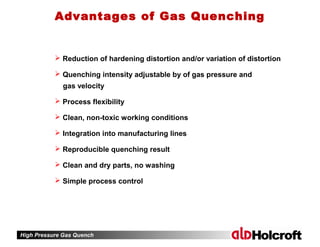
 Reduction of hardening distortion and/or variation of distortion
 Quenching intensity adjustable by of gas pressure and
gas velocity
 Process flexibility
 Clean, non-toxic working conditions
 Integration into manufacturing lines
 Reproducible quenching result
 Clean and dry parts, no washing
 Simple process control
Advantages of Gas Quenching
High Pressure Gas Quench
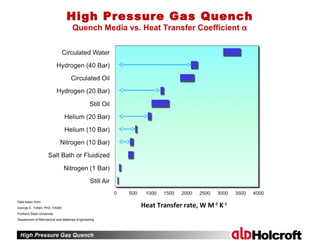
Quench Media vs. Heat Transfer Coefficient α
Data taken from:
George E. Totten, PhD, FASM
Portland State University
Department of Mechanical and Materials Engineering
Heat Transfer rate, W M-2
K-1
High Pressure Gas Quench
0
100
200
300
400
500
600
700
800
900
0 10 20 30 40 50 60
10 bar N2
10 bar He
20 bar He
40 bar He
Fast quenching oil
Bellini FS (70ƒC)
Hot quenching oil
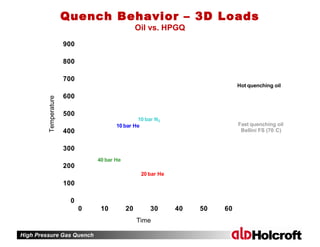
Quench Behavior – 3D Loads
Oil vs. HPGQ
Time
Temperature
High Pressure Gas Quench
Bubble Boiling
Film Boiling
Convection
t = 10 s
750°C
700°C
700°C
600°C
500°C
400°C
300°C
200°C
Temperature distribution
t = 10 s
Heat transfer coefficient α
5000 10000 15000 20000
Öl
oil Wasser
water
[W/m K]
2
ref.: Stick, Tensi, HTM 50, 1995
Heat Transfer & Temperature Distribution
Immersion Quenching
High Pressure Gas Quench
Heat transfer coefficient α
1000 2000 3000 4000 [W/m K]
2
Temperature distribution
750°C
650°C
550°C
450°C
350°C
250°C
Gas direction
Only convection
Heat Transfer & Temperature Distribution
High Pressure Gas Quenching
High Pressure Gas Quench
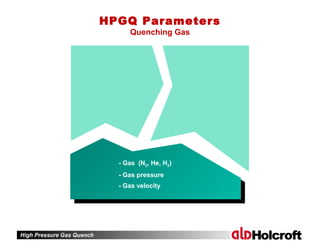
- Gas (N2, He, H2)
- Gas pressure
- Gas velocity
HPGQ Parameters
Quenching Gas
High Pressure Gas Quench
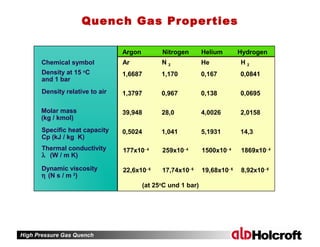
Chemical symbol
Density at 15 o
C
and 1 bar
Density relative to air
Molar mass
(kg / kmol)
Specific heat capacity
Cp (kJ / kg K)
Dynamic viscosity
η (N s / m 2
)
Thermal conductivity
λ (W / m K)
Argon Nitrogen Helium Hydrogen
Ar
1,6687
1,3797
39,948
0,5024
177x10- 4
22,6x10- 6
N 2
1,170
0,967
28,0
1,041
259x10- 4
17,74x10- 6
He
0,167
0,138
4,0026
5,1931
1500x10- 4
19,68x10- 6
H 2
0,0841
0,0695
2,0158
14,3
1869x10- 4
8,92x10- 6
(at 25o
C und 1 bar)
Quench Gas Properties
High Pressure Gas Quench
0
2
4
6
8
10
12
14
16
0 2 4 6 8 10 12 14 16 18 20
N2
He
H2
0
2
4
6
8
10
12
14
16
0 2 4 6 8 10 12 14 16 18 20
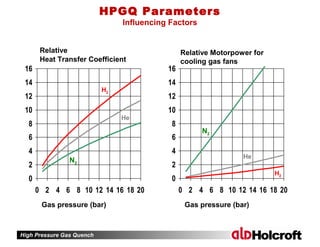
Relative Motorpower for
cooling gas fans
Relative
Heat Transfer Coefficient
Gas pressure (bar) Gas pressure (bar)
N2
He
H2
HPGQ Parameters
Influencing Factors
High Pressure Gas Quench
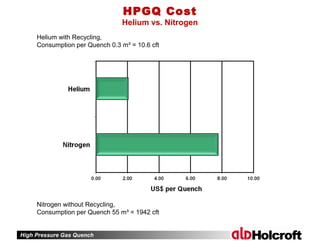
Helium with Recycling,
Consumption per Quench 0.3 m³ = 10.6 cft
Nitrogen without Recycling,
Consumption per Quench 55 m³ = 1942 cft
HPGQ Cost
Helium vs. Nitrogen
High Pressure Gas Quench
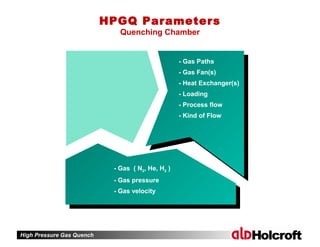
- Gas Paths
- Gas Fan(s)
- Heat Exchanger(s)
- Loading
- Process flow
- Kind of Flow
- Gas ( N2, He, H2 )
- Gas pressure
- Gas velocity
HPGQ Parameters
Quenching Chamber
High Pressure Gas Quench
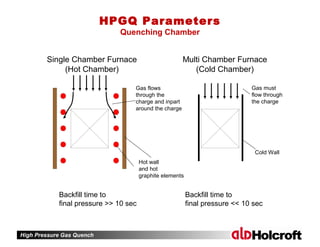
HPGQ Parameters
Quenching Chamber
Multi Chamber Furnace
(Cold Chamber)
Backfill time to
final pressure >> 10 sec
Backfill time to
final pressure << 10 sec
Gas flows
through the
charge and inpart
around the charge
Hot wall
and hot
graphite elements
Gas must
flow through
the charge
Cold Wall
Single Chamber Furnace
(Hot Chamber)
High Pressure Gas Quench
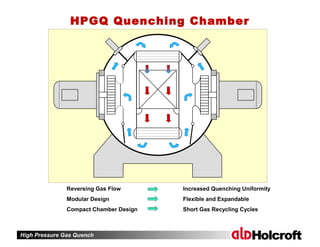
Reversing Gas Flow Increased Quenching Uniformity
Modular Design Flexible and Expandable
Compact Chamber Design Short Gas Recycling Cycles
HPGQ Quenching Chamber
High Pressure Gas Quench
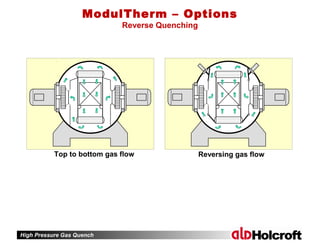
ModulTherm – Options
Reverse Quenching
Top to bottom gas flow Reversing gas flow
High Pressure Gas Quench
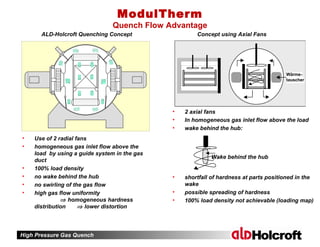
ModulTherm
Quench Flow Advantage
• Use of 2 radial fans
• homogeneous gas inlet flow above the
load by using a guide system in the gas
duct
• 100% load density
• no wake behind the hub
• no swirling of the gas flow
• high gas flow uniformity
⇒ homogeneous hardness
distribution ⇒ lower distortion
• 2 axial fans
• In homogeneous gas inlet flow above the load
• wake behind the hub:
• shortfall of hardness at parts positioned in the
wake
• possible spreading of hardness
• 100% load density not achievable (loading map)
Wärme-
tauscher
Wake behind the hub
ALD-Holcroft Quenching Concept Concept using Axial Fans
High Pressure Gas Quench
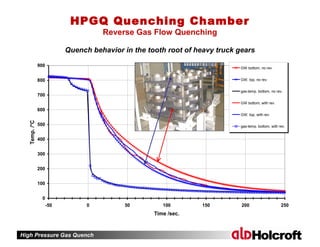
Cooling curves in the tooth root of Truck- Gear Wheels (GW)
0
100
200
300
400
500
600
700
800
900
-50 0 50 100 150 200 250
Time /sec.
Temp./°C
GW bottom, no rev.
GW, top, no rev.
gas-temp. bottom, no rev.
GW bottom, with rev.
GW, top, with rev.
gas-temp. bottom, with rev.
HPGQ Quenching Chamber
Reverse Gas Flow Quenching
Quench behavior in the tooth root of heavy truck gears
High Pressure Gas Quench
300
320
340
360
380
400
420
440
460
No reversing With reversing
CorehardnessatMid-tooth/HV30
Bottom min
Bottom average
Bottom max
Top min
Top average
Top max
Gas flow Gas flow
300
310
320
330
340
350
360
370
380
390
400
No reversing With reversing
CorehardnessatToothroot/HV30
Bottom min
Bottom average
Bottom max
Top min
Top average
Top max
Gas flow Gas flow
300
310
320
330
340
350
360
370
380
390
400
No reversing With reversing
CorehardnessatBulk/HV30
Bottom min
Bottom average
Bottom max
Top min
Top average
Top max
Gas flow Gas flow
BulkBulk
ToothTooth
rootroot
Mid-Mid-
toothtooth
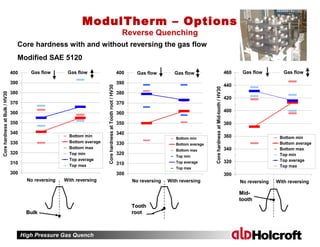
ModulTherm – Options
Reverse Quenching
Core hardness with and without reversing the gas flow
Modified SAE 5120
High Pressure Gas Quench
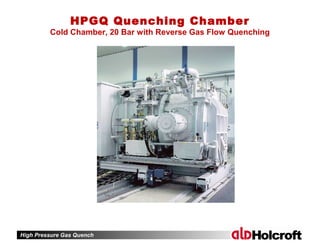
HPGQ Quenching Chamber
Cold Chamber, 20 Bar with Reverse Gas Flow Quenching
High Pressure Gas Quench
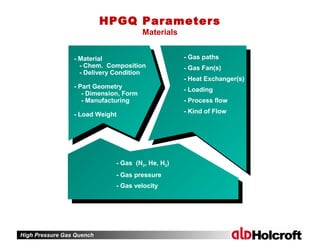
- Material
- Chem. Composition
- Delivery Condition
- Part Geometry
- Dimension, Form
- Manufacturing
- Load Weight
- Gas paths
- Gas Fan(s)
- Heat Exchanger(s)
- Loading
- Process flow
- Kind of Flow
- Gas (N2, He, H2)
- Gas pressure
- Gas velocity
HPGQ Parameters
Materials
High Pressure Gas Quench
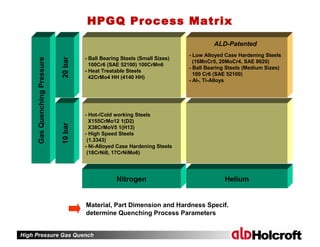
Nitrogen Helium
GasQuenchingPressure
10bar20bar
- Hot-/Cold working Steels
X155CrMo12 1(D2)
X38CrMoV5 1(H13)
- High Speed Steels
(1.3343)
- Ni-Alloyed Case Hardening Steels
(18CrNi8, 17CrNiMo6)
- Ball Bearing Steels (Small Sizes)
100Cr6 (SAE 52100) 100CrMn6
- Heat Treatable Steels
42CrMo4 HH (4140 HH)
- Low Alloyed Case Hardening Steels
(16MnCr5, 20MoCr4, SAE 8620)
- Ball Bearing Steels (Medium Sizes)
100 Cr6 (SAE 52100)
- Al-, Ti-Alloys
ALD-Patented
Material, Part Dimension and Hardness Specif.
determine Quenching Process Parameters
HPGQ Process Matrix
High Pressure Gas Quench
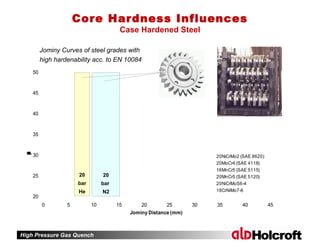
20
25
30
35
40
45
50
0 5 10 15 20 25 30 35 40 45
Hardness(HRC)
Jominy Distance (mm)
20NiCrMo2 (SAE 8620)
20MoCr4 (SAE 4118)
16MnCr5 (SAE 5115)
20MnCr5 (SAE 5120)
20NiCrMoS6-4
18CrNiMo7-6
20
bar
He
20
bar
N2
Jominy Curves of steel grades with
high hardenability acc. to EN 10084
Core Hardness Influences
Case Hardened Steel
High Pressure Gas Quench
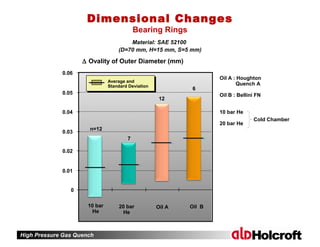
∆ Ovality of Outer Diameter (mm)
Oil A : Houghton
Quench A
Oil B : Bellini FN
10 bar He
20 bar He
Cold Chamber
0
0.01
0.02
0.03
0.04
0.05
0.06
10 bar
He
20 bar
He
Oil A Oil B
Average and
Standard Deviation
n=12
7
12
6
Material: SAE 52100
(D=70 mm, H=15 mm, S=5 mm)
Dimensional Changes
Bearing Rings
High Pressure Gas Quench
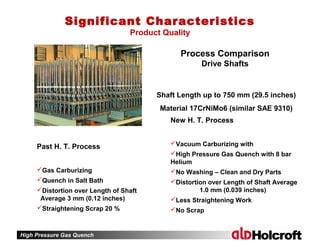
Process Comparison
Drive Shafts
Shaft Length up to 750 mm (29.5 inches)
Material 17CrNiMo6 (similar SAE 9310)
Past H. T. Process
Gas Carburizing
Quench in Salt Bath
Distortion over Length of Shaft
Average 3 mm (0.12 inches)
Straightening Scrap 20 %
New H. T. Process
Vacuum Carburizing with
High Pressure Gas Quench with 8 bar
Helium
No Washing – Clean and Dry Parts
Distortion over Length of Shaft Average
1.0 mm (0.039 inches)
Less Straightening Work
No Scrap
Significant Characteristics
Product Quality
High Pressure Gas Quench
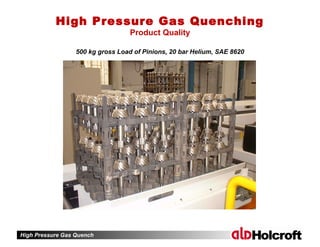
500 kg gross Load of Pinions, 20 bar Helium, SAE 8620
High Pressure Gas Quenching
Product Quality
High Pressure Gas Quench
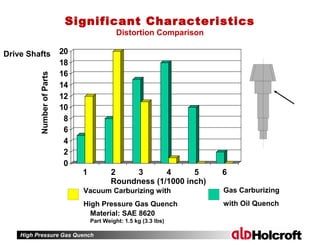
0
2
4
6
8
10
12
14
16
18
20
1 2 3 4 5 6
Roundness (1/1000 inch)
NumberofParts
Gas Carburizing
with Oil Quench
Vacuum Carburizing with
High Pressure Gas Quench
Material: SAE 8620
Part Weight: 1.5 kg (3.3 lbs)
Drive Shafts
Significant Characteristics
Distortion Comparison
High Pressure Gas Quench
0
10
20
30
40
50
60
µ
m
left flank
right flank
Ölabschreckung
Gasabschreckung dyna-
misch (20 sec.- Ventila-
torstopp)
Gasabschreckung
ohne Dynamik
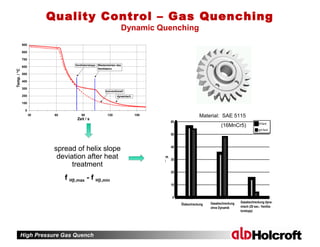
spread of helix slope
deviation after heat
treatment
f Hβ,max - f Hβ,min
0
100
200
300
400
500
600
700
800
900
30 60 90 120 150
Zeit / s
Temp./°C
dynamisch
konventionell
Ventilatorstopp Wiederstarten des
Ventilators
Material: SAE 5115
(16MnCr5)
Quality Control – Gas Quenching
Dynamic Quenching
High Pressure Gas Quench
• High Pressure Gas Quenching can significantly reduce distortion
and/or variation of distortion
• Microstructure, Hardness and Distortion are strongly
influenced by
- Part
- Quenching Parameters
- Cold Chamber Design
• 20 bar Helium Quenching Technology is capable of successfully
hardening low alloyed case hardening steels if material hardenability
can be controlled
• Alloy modification offers the chance to reduce gas pressure/velocity
thereby reducing distortion and/or investment costs
Summary

High Pressure Gas Quenching

  • 1.
    High Pressure GasQuench High Pressure Gas Quenching Advantages of Gas Quenching
  • 2.
    High Pressure GasQuench  Reduction of hardening distortion and/or variation of distortion  Quenching intensity adjustable by of gas pressure and gas velocity  Process flexibility  Clean, non-toxic working conditions  Integration into manufacturing lines  Reproducible quenching result  Clean and dry parts, no washing  Simple process control Advantages of Gas Quenching
  • 3.
    High Pressure GasQuench High Pressure Gas Quench Quench Media vs. Heat Transfer Coefficient α Data taken from: George E. Totten, PhD, FASM Portland State University Department of Mechanical and Materials Engineering Heat Transfer rate, W M-2 K-1
  • 4.
    High Pressure GasQuench 0 100 200 300 400 500 600 700 800 900 0 10 20 30 40 50 60 10 bar N2 10 bar He 20 bar He 40 bar He Fast quenching oil Bellini FS (70ƒC) Hot quenching oil Quench Behavior – 3D Loads Oil vs. HPGQ Time Temperature
  • 5.
    High Pressure GasQuench Bubble Boiling Film Boiling Convection t = 10 s 750°C 700°C 700°C 600°C 500°C 400°C 300°C 200°C Temperature distribution t = 10 s Heat transfer coefficient α 5000 10000 15000 20000 Öl oil Wasser water [W/m K] 2 ref.: Stick, Tensi, HTM 50, 1995 Heat Transfer & Temperature Distribution Immersion Quenching
  • 6.
    High Pressure GasQuench Heat transfer coefficient α 1000 2000 3000 4000 [W/m K] 2 Temperature distribution 750°C 650°C 550°C 450°C 350°C 250°C Gas direction Only convection Heat Transfer & Temperature Distribution High Pressure Gas Quenching
  • 7.
    High Pressure GasQuench - Gas (N2, He, H2) - Gas pressure - Gas velocity HPGQ Parameters Quenching Gas
  • 8.
    High Pressure GasQuench Chemical symbol Density at 15 o C and 1 bar Density relative to air Molar mass (kg / kmol) Specific heat capacity Cp (kJ / kg K) Dynamic viscosity η (N s / m 2 ) Thermal conductivity λ (W / m K) Argon Nitrogen Helium Hydrogen Ar 1,6687 1,3797 39,948 0,5024 177x10- 4 22,6x10- 6 N 2 1,170 0,967 28,0 1,041 259x10- 4 17,74x10- 6 He 0,167 0,138 4,0026 5,1931 1500x10- 4 19,68x10- 6 H 2 0,0841 0,0695 2,0158 14,3 1869x10- 4 8,92x10- 6 (at 25o C und 1 bar) Quench Gas Properties
  • 9.
    High Pressure GasQuench 0 2 4 6 8 10 12 14 16 0 2 4 6 8 10 12 14 16 18 20 N2 He H2 0 2 4 6 8 10 12 14 16 0 2 4 6 8 10 12 14 16 18 20 Relative Motorpower for cooling gas fans Relative Heat Transfer Coefficient Gas pressure (bar) Gas pressure (bar) N2 He H2 HPGQ Parameters Influencing Factors
  • 10.
    High Pressure GasQuench Helium with Recycling, Consumption per Quench 0.3 m³ = 10.6 cft Nitrogen without Recycling, Consumption per Quench 55 m³ = 1942 cft HPGQ Cost Helium vs. Nitrogen
  • 11.
    High Pressure GasQuench - Gas Paths - Gas Fan(s) - Heat Exchanger(s) - Loading - Process flow - Kind of Flow - Gas ( N2, He, H2 ) - Gas pressure - Gas velocity HPGQ Parameters Quenching Chamber
  • 12.
    High Pressure GasQuench HPGQ Parameters Quenching Chamber Multi Chamber Furnace (Cold Chamber) Backfill time to final pressure >> 10 sec Backfill time to final pressure << 10 sec Gas flows through the charge and inpart around the charge Hot wall and hot graphite elements Gas must flow through the charge Cold Wall Single Chamber Furnace (Hot Chamber)
  • 13.
    High Pressure GasQuench Reversing Gas Flow Increased Quenching Uniformity Modular Design Flexible and Expandable Compact Chamber Design Short Gas Recycling Cycles HPGQ Quenching Chamber
  • 14.
    High Pressure GasQuench ModulTherm – Options Reverse Quenching Top to bottom gas flow Reversing gas flow
  • 15.
    High Pressure GasQuench ModulTherm Quench Flow Advantage • Use of 2 radial fans • homogeneous gas inlet flow above the load by using a guide system in the gas duct • 100% load density • no wake behind the hub • no swirling of the gas flow • high gas flow uniformity ⇒ homogeneous hardness distribution ⇒ lower distortion • 2 axial fans • In homogeneous gas inlet flow above the load • wake behind the hub: • shortfall of hardness at parts positioned in the wake • possible spreading of hardness • 100% load density not achievable (loading map) Wärme- tauscher Wake behind the hub ALD-Holcroft Quenching Concept Concept using Axial Fans
  • 16.
    High Pressure GasQuench Cooling curves in the tooth root of Truck- Gear Wheels (GW) 0 100 200 300 400 500 600 700 800 900 -50 0 50 100 150 200 250 Time /sec. Temp./°C GW bottom, no rev. GW, top, no rev. gas-temp. bottom, no rev. GW bottom, with rev. GW, top, with rev. gas-temp. bottom, with rev. HPGQ Quenching Chamber Reverse Gas Flow Quenching Quench behavior in the tooth root of heavy truck gears
  • 17.
    High Pressure GasQuench 300 320 340 360 380 400 420 440 460 No reversing With reversing CorehardnessatMid-tooth/HV30 Bottom min Bottom average Bottom max Top min Top average Top max Gas flow Gas flow 300 310 320 330 340 350 360 370 380 390 400 No reversing With reversing CorehardnessatToothroot/HV30 Bottom min Bottom average Bottom max Top min Top average Top max Gas flow Gas flow 300 310 320 330 340 350 360 370 380 390 400 No reversing With reversing CorehardnessatBulk/HV30 Bottom min Bottom average Bottom max Top min Top average Top max Gas flow Gas flow BulkBulk ToothTooth rootroot Mid-Mid- toothtooth ModulTherm – Options Reverse Quenching Core hardness with and without reversing the gas flow Modified SAE 5120
  • 18.
    High Pressure GasQuench HPGQ Quenching Chamber Cold Chamber, 20 Bar with Reverse Gas Flow Quenching
  • 19.
    High Pressure GasQuench - Material - Chem. Composition - Delivery Condition - Part Geometry - Dimension, Form - Manufacturing - Load Weight - Gas paths - Gas Fan(s) - Heat Exchanger(s) - Loading - Process flow - Kind of Flow - Gas (N2, He, H2) - Gas pressure - Gas velocity HPGQ Parameters Materials
  • 20.
    High Pressure GasQuench Nitrogen Helium GasQuenchingPressure 10bar20bar - Hot-/Cold working Steels X155CrMo12 1(D2) X38CrMoV5 1(H13) - High Speed Steels (1.3343) - Ni-Alloyed Case Hardening Steels (18CrNi8, 17CrNiMo6) - Ball Bearing Steels (Small Sizes) 100Cr6 (SAE 52100) 100CrMn6 - Heat Treatable Steels 42CrMo4 HH (4140 HH) - Low Alloyed Case Hardening Steels (16MnCr5, 20MoCr4, SAE 8620) - Ball Bearing Steels (Medium Sizes) 100 Cr6 (SAE 52100) - Al-, Ti-Alloys ALD-Patented Material, Part Dimension and Hardness Specif. determine Quenching Process Parameters HPGQ Process Matrix
  • 21.
    High Pressure GasQuench 20 25 30 35 40 45 50 0 5 10 15 20 25 30 35 40 45 Hardness(HRC) Jominy Distance (mm) 20NiCrMo2 (SAE 8620) 20MoCr4 (SAE 4118) 16MnCr5 (SAE 5115) 20MnCr5 (SAE 5120) 20NiCrMoS6-4 18CrNiMo7-6 20 bar He 20 bar N2 Jominy Curves of steel grades with high hardenability acc. to EN 10084 Core Hardness Influences Case Hardened Steel
  • 22.
    High Pressure GasQuench ∆ Ovality of Outer Diameter (mm) Oil A : Houghton Quench A Oil B : Bellini FN 10 bar He 20 bar He Cold Chamber 0 0.01 0.02 0.03 0.04 0.05 0.06 10 bar He 20 bar He Oil A Oil B Average and Standard Deviation n=12 7 12 6 Material: SAE 52100 (D=70 mm, H=15 mm, S=5 mm) Dimensional Changes Bearing Rings
  • 23.
    High Pressure GasQuench Process Comparison Drive Shafts Shaft Length up to 750 mm (29.5 inches) Material 17CrNiMo6 (similar SAE 9310) Past H. T. Process Gas Carburizing Quench in Salt Bath Distortion over Length of Shaft Average 3 mm (0.12 inches) Straightening Scrap 20 % New H. T. Process Vacuum Carburizing with High Pressure Gas Quench with 8 bar Helium No Washing – Clean and Dry Parts Distortion over Length of Shaft Average 1.0 mm (0.039 inches) Less Straightening Work No Scrap Significant Characteristics Product Quality
  • 24.
    High Pressure GasQuench 500 kg gross Load of Pinions, 20 bar Helium, SAE 8620 High Pressure Gas Quenching Product Quality
  • 25.
    High Pressure GasQuench 0 2 4 6 8 10 12 14 16 18 20 1 2 3 4 5 6 Roundness (1/1000 inch) NumberofParts Gas Carburizing with Oil Quench Vacuum Carburizing with High Pressure Gas Quench Material: SAE 8620 Part Weight: 1.5 kg (3.3 lbs) Drive Shafts Significant Characteristics Distortion Comparison
  • 26.
    High Pressure GasQuench 0 10 20 30 40 50 60 µ m left flank right flank Ölabschreckung Gasabschreckung dyna- misch (20 sec.- Ventila- torstopp) Gasabschreckung ohne Dynamik spread of helix slope deviation after heat treatment f Hβ,max - f Hβ,min 0 100 200 300 400 500 600 700 800 900 30 60 90 120 150 Zeit / s Temp./°C dynamisch konventionell Ventilatorstopp Wiederstarten des Ventilators Material: SAE 5115 (16MnCr5) Quality Control – Gas Quenching Dynamic Quenching
  • 27.
    High Pressure GasQuench • High Pressure Gas Quenching can significantly reduce distortion and/or variation of distortion • Microstructure, Hardness and Distortion are strongly influenced by - Part - Quenching Parameters - Cold Chamber Design • 20 bar Helium Quenching Technology is capable of successfully hardening low alloyed case hardening steels if material hardenability can be controlled • Alloy modification offers the chance to reduce gas pressure/velocity thereby reducing distortion and/or investment costs Summary