High efficient electrolyser
Alexander V. Frolov
2012
1
Aim
 It is planned to produce experimental unit of
high efficient water – gas splitter, i.e. source of
hydrogen.
 This method use new pulsed mode of water
dissociation.
 In collaboration with industrial partners we can
organize production facilities.
2
The idea
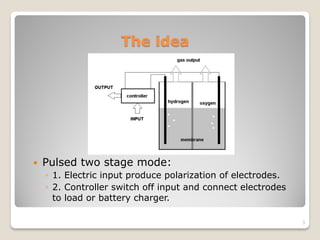
 Pulsed two stage mode:
◦ 1. Electric input produce polarization of electrodes.
◦ 2. Controller switch off input and connect electrodes
to load or battery charger.
3
Analogy
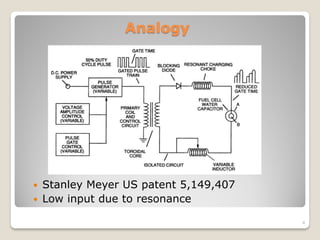
 Stanley Meyer US patent 5,149,407
 Low input due to resonance
4
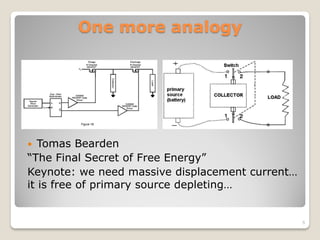
One more analogy
 Tomas Bearden
“The Final Secret of Free Energy”
Keynote: we need massive displacement current…
it is free of primary source depleting…
5
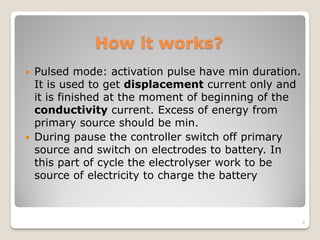
How it works?
 Pulsed mode: activation pulse have min duration.
It is used to get displacement current only and
it is finished at the moment of beginning of the
conductivity current. Excess of energy from
primary source should be min.
 During pause the controller switch off primary
source and switch on electrodes to battery. In
this part of cycle the electrolyser work to be
source of electricity to charge the battery
6
Important on theory
 It is planned to use pure distilled water.
 Electrical permittivity of pure water is about 81,
it is good dielectric.
 Theory: energy of process is depend of energy of
capacitor. It is function of capacitance. Dielectric
placed between electrodes increase this factor.
By this way we can get more energy in capacitor
for free, due to polarization of water.
 Self-cooling of water is estimated here during
operation of the electrolyser.
7
Present stage of the project
 Project in development, video of 2010.
8
Our advantages
 Efficiency: ordinary method require 4 – 7 kW/h
to produce 1 m3 of hydrogen. New method can
provide the same amount using 20 watt/hour.
 We can design self-powered source of energy by
means of integration of new electrolyser and
hydrogen cell. The cell will produce sufficient
electrical power to provide useful load and
operation of the electrolyser.
9
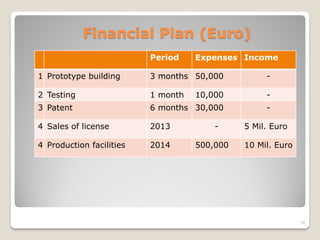
Financial Plan (Euro)
10
Period Expenses Income
1 Prototype building 3 months 50,000 -
2 Testing 1 month 10,000 -
3 Patent 6 months 30,000 -
4 Sales of license 2013 - 5 Mil. Euro
4 Production facilities 2014 500,000 10 Mil. Euro
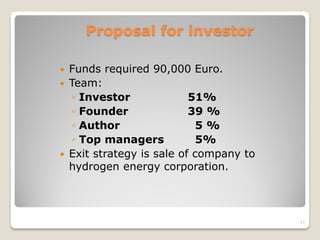
Proposal for investor
 Funds required 90,000 Euro.
 Team:
◦ Investor 51%
◦ Founder 39 %
◦ Author 5 %
◦ Top managers 5%
 Exit strategy is sale of company to
hydrogen energy corporation.
11
Founder
Alexander V. Frolov
7-910-160-9875 7-920-794-4448
www.faraday.ru
a2509@yahoo.com
12

High effcient Electrolyser

  • 1.
  • 2.
    Aim  It isplanned to produce experimental unit of high efficient water – gas splitter, i.e. source of hydrogen.  This method use new pulsed mode of water dissociation.  In collaboration with industrial partners we can organize production facilities. 2
  • 3.
    The idea  Pulsedtwo stage mode: ◦ 1. Electric input produce polarization of electrodes. ◦ 2. Controller switch off input and connect electrodes to load or battery charger. 3
  • 4.
    Analogy  Stanley MeyerUS patent 5,149,407  Low input due to resonance 4
  • 5.
    One more analogy Tomas Bearden “The Final Secret of Free Energy” Keynote: we need massive displacement current… it is free of primary source depleting… 5
  • 6.
    How it works? Pulsed mode: activation pulse have min duration. It is used to get displacement current only and it is finished at the moment of beginning of the conductivity current. Excess of energy from primary source should be min.  During pause the controller switch off primary source and switch on electrodes to battery. In this part of cycle the electrolyser work to be source of electricity to charge the battery 6
  • 7.
    Important on theory It is planned to use pure distilled water.  Electrical permittivity of pure water is about 81, it is good dielectric.  Theory: energy of process is depend of energy of capacitor. It is function of capacitance. Dielectric placed between electrodes increase this factor. By this way we can get more energy in capacitor for free, due to polarization of water.  Self-cooling of water is estimated here during operation of the electrolyser. 7
  • 8.
    Present stage ofthe project  Project in development, video of 2010. 8
  • 9.
    Our advantages  Efficiency:ordinary method require 4 – 7 kW/h to produce 1 m3 of hydrogen. New method can provide the same amount using 20 watt/hour.  We can design self-powered source of energy by means of integration of new electrolyser and hydrogen cell. The cell will produce sufficient electrical power to provide useful load and operation of the electrolyser. 9
  • 10.
    Financial Plan (Euro) 10 PeriodExpenses Income 1 Prototype building 3 months 50,000 - 2 Testing 1 month 10,000 - 3 Patent 6 months 30,000 - 4 Sales of license 2013 - 5 Mil. Euro 4 Production facilities 2014 500,000 10 Mil. Euro
  • 11.
    Proposal for investor Funds required 90,000 Euro.  Team: ◦ Investor 51% ◦ Founder 39 % ◦ Author 5 % ◦ Top managers 5%  Exit strategy is sale of company to hydrogen energy corporation. 11
  • 12.
    Founder Alexander V. Frolov 7-910-160-98757-920-794-4448 www.faraday.ru a2509@yahoo.com 12