Fuel Cell Vehicle
By,
Vinay Tarun Sai
Mohammed Hilal
What is a Fuel Cell Vehicle?
●A type of electric vehicle that employs ‘fuel cell technology’
to generate the electricity required to run the vehicle.
●In these vehicles, the chemical energy of the fuel is
converted directly into electric energy.
●Every FCEVs uses several hundred fuel cells. Individually they
don’t produce much power, so a large number are combined
into what is called a “stack.”
How does fuel cell work?
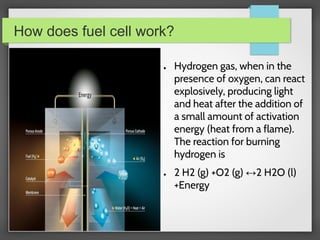
● Hydrogen gas, when in the
presence of oxygen, can react
explosively, producing light
and heat after the addition of
a small amount of activation
energy (heat from a flame).
The reaction for burning
hydrogen is
● 2 H2 (g) +O2 (g) ↔2 H2O (l)
+Energy
● Inside the fuel cell stack, compressed hydrogen gas and
oxygen are passed through an electrochemical catalyst.
● The catalyst in each cell strips the electrons from the
hydrogen atoms.
● The electrons are collected in the stack and released to flow
through appropriate wiring to power the vehicle’s electric
motor.
● A small lithium-ion battery stores any excess power until it is
needed
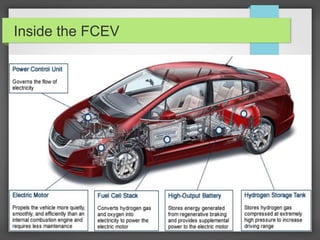
Inside the FCEV
Why do we need FCEV?
● Fuel cell vehicles are being developed because they promise
to meet the requirements expected of automobiles in a
market increasingly constrained by environmental and
resource limitations.
● Air pollution and oil dependence have been persistent
challenges for vehicles powered by petroleum fuels (gasoline
and diesel).
● Global warming presents a new challenge in the need to
limit carbon dioxide (CO2) emissions from fossil fuel
combustion.
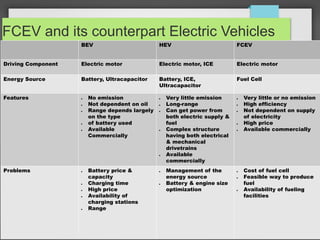
FCEV and its counterpart Electric Vehicles
BEV HEV FCEV
Driving Component Electric motor Electric motor, ICE Electric motor
Energy Source Battery, Ultracapacitor Battery, ICE,
Ultracapacitor
Fuel Cell
Features ● No emission
● Not dependent on oil
● Range depends largely
on the type
● of battery used
● Available
Commercially
● Very little emission
● Long-range
● Can get power from
both electric supply &
fuel
● Complex structure
having both electrical
& mechanical
drivetrains
● Available
commercially
● Very little or no emission
● High efficiency
● Not dependent on supply
of electricity
● High price
● Available commercially
Problems ● Battery price &
capacity
● Charging time
● High price
● Availability of
charging stations
● Range
● Management of the
energy source
● Battery & engine size
optimization
● Cost of fuel cell
● Feasible way to produce
fuel
● Availability of fueling
facilities
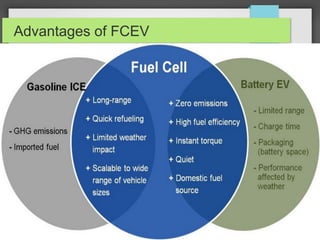
Advantages of FCEV
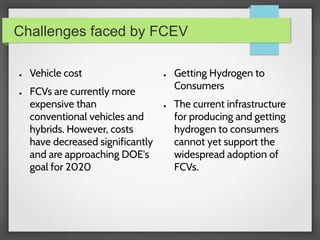
Challenges faced by FCEV
● Vehicle cost
● FCVs are currently more
expensive than
conventional vehicles and
hybrids. However, costs
have decreased significantly
and are approaching DOE's
goal for 2020
● Getting Hydrogen to
Consumers
● The current infrastructure
for producing and getting
hydrogen to consumers
cannot yet support the
widespread adoption of
FCVs.
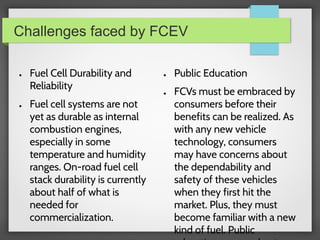
Challenges faced by FCEV
● Fuel Cell Durability and
Reliability
● Fuel cell systems are not
yet as durable as internal
combustion engines,
especially in some
temperature and humidity
ranges. On-road fuel cell
stack durability is currently
about half of what is
needed for
commercialization.
● Public Education
● FCVs must be embraced by
consumers before their
benefits can be realized. As
with any new vehicle
technology, consumers
may have concerns about
the dependability and
safety of these vehicles
when they first hit the
market. Plus, they must
become familiar with a new
kind of fuel. Public

Fuel cell

  • 1.
    Fuel Cell Vehicle By, VinayTarun Sai Mohammed Hilal
  • 2.
    What is aFuel Cell Vehicle? ●A type of electric vehicle that employs ‘fuel cell technology’ to generate the electricity required to run the vehicle. ●In these vehicles, the chemical energy of the fuel is converted directly into electric energy. ●Every FCEVs uses several hundred fuel cells. Individually they don’t produce much power, so a large number are combined into what is called a “stack.”
  • 3.
    How does fuelcell work? ● Hydrogen gas, when in the presence of oxygen, can react explosively, producing light and heat after the addition of a small amount of activation energy (heat from a flame). The reaction for burning hydrogen is ● 2 H2 (g) +O2 (g) ↔2 H2O (l) +Energy
  • 4.
    ● Inside thefuel cell stack, compressed hydrogen gas and oxygen are passed through an electrochemical catalyst. ● The catalyst in each cell strips the electrons from the hydrogen atoms. ● The electrons are collected in the stack and released to flow through appropriate wiring to power the vehicle’s electric motor. ● A small lithium-ion battery stores any excess power until it is needed
  • 5.
  • 6.
    Why do weneed FCEV? ● Fuel cell vehicles are being developed because they promise to meet the requirements expected of automobiles in a market increasingly constrained by environmental and resource limitations. ● Air pollution and oil dependence have been persistent challenges for vehicles powered by petroleum fuels (gasoline and diesel). ● Global warming presents a new challenge in the need to limit carbon dioxide (CO2) emissions from fossil fuel combustion.
  • 7.
    FCEV and itscounterpart Electric Vehicles BEV HEV FCEV Driving Component Electric motor Electric motor, ICE Electric motor Energy Source Battery, Ultracapacitor Battery, ICE, Ultracapacitor Fuel Cell Features ● No emission ● Not dependent on oil ● Range depends largely on the type ● of battery used ● Available Commercially ● Very little emission ● Long-range ● Can get power from both electric supply & fuel ● Complex structure having both electrical & mechanical drivetrains ● Available commercially ● Very little or no emission ● High efficiency ● Not dependent on supply of electricity ● High price ● Available commercially Problems ● Battery price & capacity ● Charging time ● High price ● Availability of charging stations ● Range ● Management of the energy source ● Battery & engine size optimization ● Cost of fuel cell ● Feasible way to produce fuel ● Availability of fueling facilities
  • 8.
  • 9.
    Challenges faced byFCEV ● Vehicle cost ● FCVs are currently more expensive than conventional vehicles and hybrids. However, costs have decreased significantly and are approaching DOE's goal for 2020 ● Getting Hydrogen to Consumers ● The current infrastructure for producing and getting hydrogen to consumers cannot yet support the widespread adoption of FCVs.
  • 10.
    Challenges faced byFCEV ● Fuel Cell Durability and Reliability ● Fuel cell systems are not yet as durable as internal combustion engines, especially in some temperature and humidity ranges. On-road fuel cell stack durability is currently about half of what is needed for commercialization. ● Public Education ● FCVs must be embraced by consumers before their benefits can be realized. As with any new vehicle technology, consumers may have concerns about the dependability and safety of these vehicles when they first hit the market. Plus, they must become familiar with a new kind of fuel. Public