Hierarchal Clustering
N Nasurudeen Ahamed,
Assistant Professor,
CSE
Hierarchal Clustering
• What is hierarchical clustering (agglomerative) ?
• In hierarchical clustering, we assign each object (data point) to a separate
cluster. Then compute the distance (similarity) between each of the clusters
and join the two most similar clusters.
Hierarchal Clustering
• Dendogram :
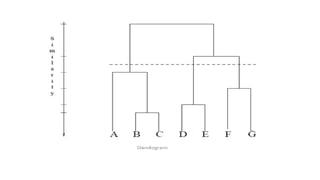
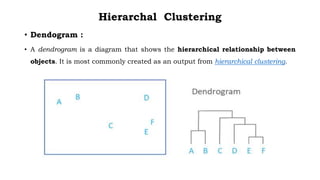
• A dendrogram is a diagram that shows the hierarchical relationship between
objects. It is most commonly created as an output from hierarchical clustering.
Hierarchal Clustering Example
• For the one dimensional data set {7,10,20,28,35}, perform hierarchical
clustering and plot the dendogram to visualize it.
• Solution :
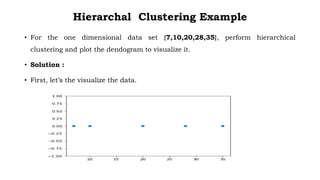
• First, let’s the visualize the data.
Hierarchal Clustering Example
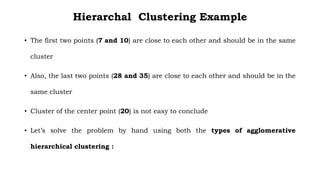
• The first two points (7 and 10) are close to each other and should be in the same
cluster
• Also, the last two points (28 and 35) are close to each other and should be in the
same cluster
• Cluster of the center point (20) is not easy to conclude
• Let’s solve the problem by hand using both the types of agglomerative
hierarchical clustering :
Hierarchal Clustering Example
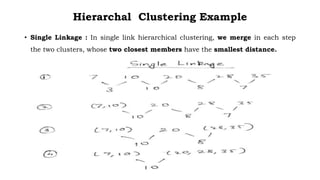
• Single Linkage : In single link hierarchical clustering, we merge in each step
the two clusters, whose two closest members have the smallest distance.
Hierarchal Clustering Example
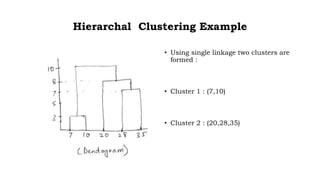
• Using single linkage two clusters are
formed :
• Cluster 1 : (7,10)
• Cluster 2 : (20,28,35)
Hierarchal Clustering Example
• Complete Linkage : In complete link hierarchical clustering, we merge
in the members of the clusters in each step, which provide the
smallest maximum pairwise distance.
Hierarchal Clustering Example
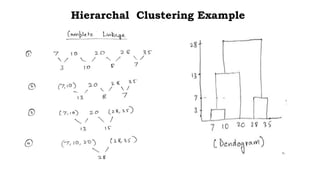
Using complete linkage two clusters are formed :
Cluster 1 : (7,10,20)
Cluster 2 : (28,35)
Conclusion : Hierarchical clustering is mostly used when the application
requires a hierarchy, e.g creation of a taxonomy.

Hierarichal cluster ml

  • 1.
    Hierarchal Clustering N NasurudeenAhamed, Assistant Professor, CSE
  • 2.
    Hierarchal Clustering • Whatis hierarchical clustering (agglomerative) ? • In hierarchical clustering, we assign each object (data point) to a separate cluster. Then compute the distance (similarity) between each of the clusters and join the two most similar clusters.
  • 4.
    Hierarchal Clustering • Dendogram: • A dendrogram is a diagram that shows the hierarchical relationship between objects. It is most commonly created as an output from hierarchical clustering.
  • 5.
    Hierarchal Clustering Example •For the one dimensional data set {7,10,20,28,35}, perform hierarchical clustering and plot the dendogram to visualize it. • Solution : • First, let’s the visualize the data.
  • 6.
    Hierarchal Clustering Example •The first two points (7 and 10) are close to each other and should be in the same cluster • Also, the last two points (28 and 35) are close to each other and should be in the same cluster • Cluster of the center point (20) is not easy to conclude • Let’s solve the problem by hand using both the types of agglomerative hierarchical clustering :
  • 7.
    Hierarchal Clustering Example •Single Linkage : In single link hierarchical clustering, we merge in each step the two clusters, whose two closest members have the smallest distance.
  • 8.
    Hierarchal Clustering Example •Using single linkage two clusters are formed : • Cluster 1 : (7,10) • Cluster 2 : (20,28,35)
  • 9.
    Hierarchal Clustering Example •Complete Linkage : In complete link hierarchical clustering, we merge in the members of the clusters in each step, which provide the smallest maximum pairwise distance.
  • 10.
  • 11.
    Hierarchal Clustering Example Usingcomplete linkage two clusters are formed : Cluster 1 : (7,10,20) Cluster 2 : (28,35) Conclusion : Hierarchical clustering is mostly used when the application requires a hierarchy, e.g creation of a taxonomy.