DM_PPT_NP_v02
Hierarchical Data Formats (HDF)
Update
Latest HDF releases and more
The HDF Group
Elena Pourmal (epourmal@hdfgroup.org)
This work was supported by NASA/GSFC under
Raytheon Co. contract number NNG15HZ39C
DM_PPT_NP_v02
2
Outline
• The HDF Group Website changes
• Update on HDF5 1.8.19, 1.10.1 and HDF 4.2.13
• Compatibility issues
• Updates on HDF-Java, HDFView 3.0 and other
tools
• Supported compilers and systems
• Compression library for interoperability with
h5py and Pandas
• Tell us about your needs!
DM_PPT_NP_v02
3
Where to find us on the Web?
• New Website (https://hdfgroup.org)
– Info about organization
– Latest 1.10 releases and HDFview 3.0
– New commercial tools by The HDF Group
• ODBC (Excel connector to HDF5)
– Registration
– Links to The HDF Group Support Website
(https://support.hdfgroup.org)
• Documentation
• Old releases
• Misc. information about projects
– We are working on the new Support Portal (launch by the
end of 2017)
• Send us your feedback!
DM_PPT_NP_v02
4
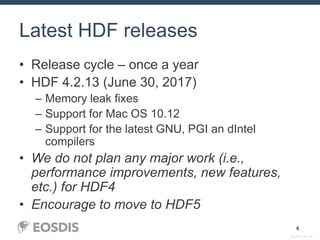
Latest HDF releases
• Release cycle – once a year
• HDF 4.2.13 (June 30, 2017)
– Memory leak fixes
– Support for Mac OS 10.12
– Support for the latest GNU, PGI an dIntel
compilers
• We do not plan any major work (i.e.,
performance improvements, new features,
etc.) for HDF4
• Encourage to move to HDF5
DM_PPT_NP_v02
5
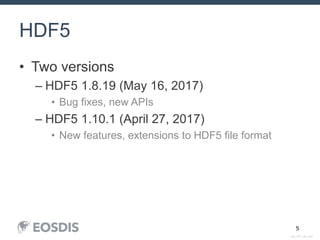
HDF5
• Two versions
– HDF5 1.8.19 (May 16, 2017)
• Bug fixes, new APIs
– HDF5 1.10.1 (April 27, 2017)
• New features, extensions to HDF5 file format
DM_PPT_NP_v02
6
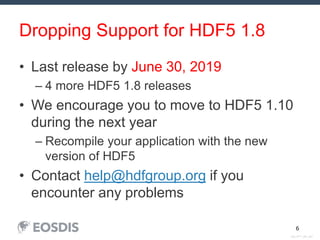
Dropping Support for HDF5 1.8
• Last release by June 30, 2019
– 4 more HDF5 1.8 releases
• We encourage you to move to HDF5 1.10
during the next year
– Recompile your application with the new
version of HDF5
• Contact help@hdfgroup.org if you
encounter any problems
DM_PPT_NP_v02
7
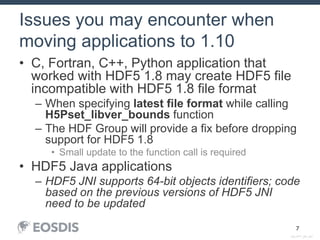
Issues you may encounter when
moving applications to 1.10
• C, Fortran, C++, Python application that
worked with HDF5 1.8 may create HDF5 file
incompatible with HDF5 1.8 file format
– When specifying latest file format while calling
H5Pset_libver_bounds function
– The HDF Group will provide a fix before dropping
support for HDF5 1.8
• Small update to the function call is required
• HDF5 Java applications
– HDF5 JNI supports 64-bit objects identifiers; code
based on the previous versions of HDF5 JNI
need to be updated
DM_PPT_NP_v02
8
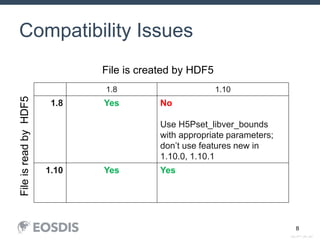
Compatibility Issues
1.8 1.10
1.8 Yes No
Use H5Pset_libver_bounds
with appropriate parameters;
don’t use features new in
1.10.0, 1.10.1
1.10 Yes Yes
File is created by HDF5
FileisreadbyHDF5
DM_PPT_NP_v02
9
HDF5 1.8.19 New Features
• H5DOread_chunk
– Function to read compressed data without
uncompressing it (see H5DOwrite_chunk)
H5DOread_chunk
H5Dread
DM_PPT_NP_v02
10
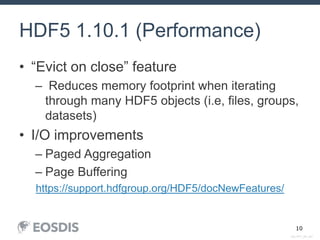
HDF5 1.10.1 (Performance)
• “Evict on close” feature
– Reduces memory footprint when iterating
through many HDF5 objects (i.e, files, groups,
datasets)
• I/O improvements
– Paged Aggregation
– Page Buffering
https://support.hdfgroup.org/HDF5/docNewFeatures/
DM_PPT_NP_v02
11
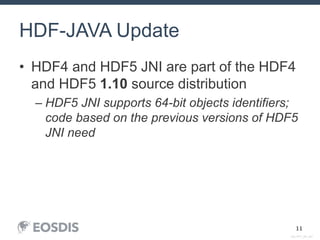
HDF-JAVA Update
• HDF4 and HDF5 JNI are part of the HDF4
and HDF5 1.10 source distribution
– HDF5 JNI supports 64-bit objects identifiers;
code based on the previous versions of HDF5
JNI need
DM_PPT_NP_v02
12
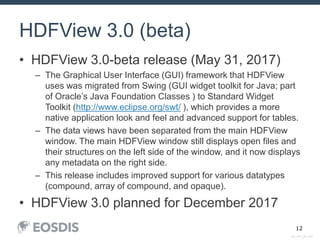
HDFView 3.0 (beta)
• HDFView 3.0-beta release (May 31, 2017)
– The Graphical User Interface (GUI) framework that HDFView
uses was migrated from Swing (GUI widget toolkit for Java; part
of Oracle’s Java Foundation Classes ) to Standard Widget
Toolkit (http://www.eclipse.org/swt/ ), which provides a more
native application look and feel and advanced support for tables.
– The data views have been separated from the main HDFView
window. The main HDFView window still displays open files and
their structures on the left side of the window, and it now displays
any metadata on the right side.
– This release includes improved support for various datatypes
(compound, array of compound, and opaque).
• HDFView 3.0 planned for December 2017
DM_PPT_NP_v02
13
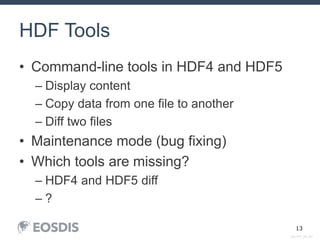
HDF Tools
• Command-line tools in HDF4 and HDF5
– Display content
– Copy data from one file to another
– Diff two files
• Maintenance mode (bug fixing)
• Which tools are missing?
– HDF4 and HDF5 diff
– ?
DM_PPT_NP_v02
14
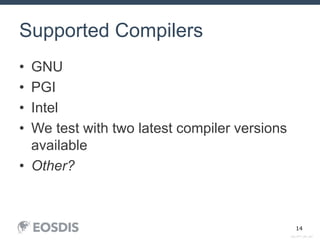
Supported Compilers
• GNU
• PGI
• Intel
• We test with two latest compiler versions
available
• Other?
DM_PPT_NP_v02
15
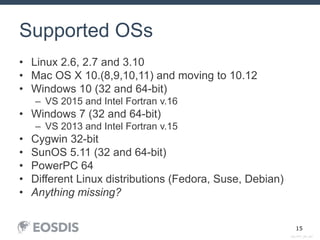
Supported OSs
• Linux 2.6, 2.7 and 3.10
• Mac OS X 10.(8,9,10,11) and moving to 10.12
• Windows 10 (32 and 64-bit)
– VS 2015 and Intel Fortran v.16
• Windows 7 (32 and 64-bit)
– VS 2013 and Intel Fortran v.15
• Cygwin 32-bit
• SunOS 5.11 (32 and 64-bit)
• PowerPC 64
• Different Linux distributions (Fedora, Suse, Debian)
• Anything missing?
DM_PPT_NP_v02
16
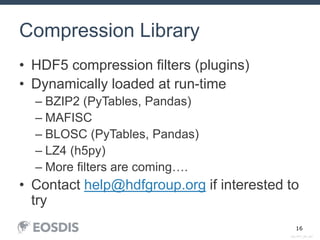
Compression Library
• HDF5 compression filters (plugins)
• Dynamically loaded at run-time
– BZIP2 (PyTables, Pandas)
– MAFISC
– BLOSC (PyTables, Pandas)
– LZ4 (h5py)
– More filters are coming….
• Contact help@hdfgroup.org if interested to
try
DM_PPT_NP_v02
17
Open Discussion
• Tell us about your needs
DM_PPT_NP_v02
18
This work was supported by
NASA/GSFC under Raytheon Co.
contract number NNG15HZ39C

Hierarchical Data Formats (HDF) Update

  • 1.
    DM_PPT_NP_v02 Hierarchical Data Formats(HDF) Update Latest HDF releases and more The HDF Group Elena Pourmal (epourmal@hdfgroup.org) This work was supported by NASA/GSFC under Raytheon Co. contract number NNG15HZ39C
  • 2.
    DM_PPT_NP_v02 2 Outline • The HDFGroup Website changes • Update on HDF5 1.8.19, 1.10.1 and HDF 4.2.13 • Compatibility issues • Updates on HDF-Java, HDFView 3.0 and other tools • Supported compilers and systems • Compression library for interoperability with h5py and Pandas • Tell us about your needs!
  • 3.
    DM_PPT_NP_v02 3 Where to findus on the Web? • New Website (https://hdfgroup.org) – Info about organization – Latest 1.10 releases and HDFview 3.0 – New commercial tools by The HDF Group • ODBC (Excel connector to HDF5) – Registration – Links to The HDF Group Support Website (https://support.hdfgroup.org) • Documentation • Old releases • Misc. information about projects – We are working on the new Support Portal (launch by the end of 2017) • Send us your feedback!
  • 4.
    DM_PPT_NP_v02 4 Latest HDF releases •Release cycle – once a year • HDF 4.2.13 (June 30, 2017) – Memory leak fixes – Support for Mac OS 10.12 – Support for the latest GNU, PGI an dIntel compilers • We do not plan any major work (i.e., performance improvements, new features, etc.) for HDF4 • Encourage to move to HDF5
  • 5.
    DM_PPT_NP_v02 5 HDF5 • Two versions –HDF5 1.8.19 (May 16, 2017) • Bug fixes, new APIs – HDF5 1.10.1 (April 27, 2017) • New features, extensions to HDF5 file format
  • 6.
    DM_PPT_NP_v02 6 Dropping Support forHDF5 1.8 • Last release by June 30, 2019 – 4 more HDF5 1.8 releases • We encourage you to move to HDF5 1.10 during the next year – Recompile your application with the new version of HDF5 • Contact help@hdfgroup.org if you encounter any problems
  • 7.
    DM_PPT_NP_v02 7 Issues you mayencounter when moving applications to 1.10 • C, Fortran, C++, Python application that worked with HDF5 1.8 may create HDF5 file incompatible with HDF5 1.8 file format – When specifying latest file format while calling H5Pset_libver_bounds function – The HDF Group will provide a fix before dropping support for HDF5 1.8 • Small update to the function call is required • HDF5 Java applications – HDF5 JNI supports 64-bit objects identifiers; code based on the previous versions of HDF5 JNI need to be updated
  • 8.
    DM_PPT_NP_v02 8 Compatibility Issues 1.8 1.10 1.8Yes No Use H5Pset_libver_bounds with appropriate parameters; don’t use features new in 1.10.0, 1.10.1 1.10 Yes Yes File is created by HDF5 FileisreadbyHDF5
  • 9.
    DM_PPT_NP_v02 9 HDF5 1.8.19 NewFeatures • H5DOread_chunk – Function to read compressed data without uncompressing it (see H5DOwrite_chunk) H5DOread_chunk H5Dread
  • 10.
    DM_PPT_NP_v02 10 HDF5 1.10.1 (Performance) •“Evict on close” feature – Reduces memory footprint when iterating through many HDF5 objects (i.e, files, groups, datasets) • I/O improvements – Paged Aggregation – Page Buffering https://support.hdfgroup.org/HDF5/docNewFeatures/
  • 11.
    DM_PPT_NP_v02 11 HDF-JAVA Update • HDF4and HDF5 JNI are part of the HDF4 and HDF5 1.10 source distribution – HDF5 JNI supports 64-bit objects identifiers; code based on the previous versions of HDF5 JNI need
  • 12.
    DM_PPT_NP_v02 12 HDFView 3.0 (beta) •HDFView 3.0-beta release (May 31, 2017) – The Graphical User Interface (GUI) framework that HDFView uses was migrated from Swing (GUI widget toolkit for Java; part of Oracle’s Java Foundation Classes ) to Standard Widget Toolkit (http://www.eclipse.org/swt/ ), which provides a more native application look and feel and advanced support for tables. – The data views have been separated from the main HDFView window. The main HDFView window still displays open files and their structures on the left side of the window, and it now displays any metadata on the right side. – This release includes improved support for various datatypes (compound, array of compound, and opaque). • HDFView 3.0 planned for December 2017
  • 13.
    DM_PPT_NP_v02 13 HDF Tools • Command-linetools in HDF4 and HDF5 – Display content – Copy data from one file to another – Diff two files • Maintenance mode (bug fixing) • Which tools are missing? – HDF4 and HDF5 diff – ?
  • 14.
    DM_PPT_NP_v02 14 Supported Compilers • GNU •PGI • Intel • We test with two latest compiler versions available • Other?
  • 15.
    DM_PPT_NP_v02 15 Supported OSs • Linux2.6, 2.7 and 3.10 • Mac OS X 10.(8,9,10,11) and moving to 10.12 • Windows 10 (32 and 64-bit) – VS 2015 and Intel Fortran v.16 • Windows 7 (32 and 64-bit) – VS 2013 and Intel Fortran v.15 • Cygwin 32-bit • SunOS 5.11 (32 and 64-bit) • PowerPC 64 • Different Linux distributions (Fedora, Suse, Debian) • Anything missing?
  • 16.
    DM_PPT_NP_v02 16 Compression Library • HDF5compression filters (plugins) • Dynamically loaded at run-time – BZIP2 (PyTables, Pandas) – MAFISC – BLOSC (PyTables, Pandas) – LZ4 (h5py) – More filters are coming…. • Contact help@hdfgroup.org if interested to try
  • 17.
  • 18.
    DM_PPT_NP_v02 18 This work wassupported by NASA/GSFC under Raytheon Co. contract number NNG15HZ39C

Editor's Notes

  • #2 HDF – Hierarchical Data Format (Version 4 and Version 5) A free and open source (BSD license) General purpose platform for storing, managing, archiving, and exchanging data Extensive facilities for data and metadata association, hierarchies, and annotation A self describing file format that is portable across operating systems and architectures, and that supports flexible user defined types A software library for high I/O performance, parallel I/O and out of core data access (partial I/O), which supports compression and other custom filters High quality documentation A responsive helpdesk and active users’ forum for community based support The HDF Group is a not for profit corporation whose mission is to ensure the long term accessibility to HDF data through the sustainable development and support of HDF technologies. The HDF Group is dedicated to evolving HDF technologies to serve the needs of users in ever changing computational environments, while at the same time maintaining its commitment to ensure the accessibility of data stored in HDF for the coming decades, even centuries. The HDF project started at NCSA and the University of Illinois in 1987. The HDF Group completed its transition to an independent corporation in mid 2006.
  • #10 Use when no decoding is necessary, for example, when rewriting the data from one file to another
  • #11 The HDF5 library's metadata cache is fairly conservative about holding on to HDF5 object metadata (object headers, chunk index structures, etc.), which can cause the cache size to grow, resulting in memory pressure on an application or system. The "evict on close" property will cause all metadata for an object to be evicted from the cache as long as metadata is not referenced from any other open object. See the Fine Tuning the Metadata Cache documentation for information on the APIs. The current HDF5 file space allocation accumulates small pieces of metadata and raw data in aggregator blocks which are not page aligned and vary widely in sizes. The paged aggregation feature was implemented to provide efficient paged access of these small pieces of metadata and raw data. See the RFC for details. Also, see the File Space Management documentation. Small and random I/O accesses on parallel file systems result in poor performance for applications. Page buffering in conjunction with paged aggregation can improve performance by giving an application control of minimizing HDF5 I/O requests to a specific granularity and alignment. See the RFC for details. Also, see the Page Buffering documentation.