HDF Windows Support
MuQun Yang, Xuan Bai, Elena Pourmal, Barbara
Jones, Pedro Vincent, Robert E. McGrath
National Center for Supercomputing Applications
University of Illinois, Urbana-Champaign
Goals
• Support HDF software for Windows
platforms
• Easy to install
• Build from source
What do we support?
All HDF Software is supported on Windows
platforms
• HDF5 library and tools,
• HDF4 library and tools,
• HDF4 to HDF5 conversion library and utilities,
• HDF5 Lite library
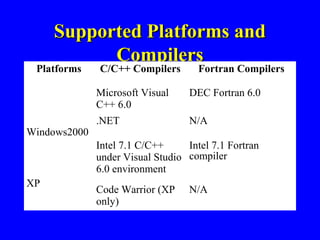
Supported Platforms and
Compilers

Platforms

C/C++ Compilers

Fortran Compilers

Microsoft Visual
C++ 6.0
Windows2000

DEC Fortran 6.0

.NET

N/A

Intel 7.1 C/C++
Intel 7.1 Fortran
under Visual Studio compiler
6.0 environment
XP

Code Warrior (XP
only)

N/A
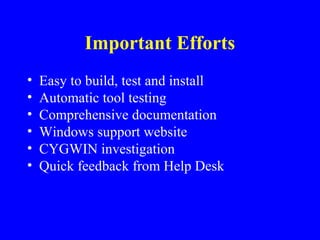
Important Efforts
•
•
•
•
•
•

Easy to build, test and install
Automatic tool testing
Comprehensive documentation
Windows support website
CYGWIN investigation
Quick feedback from Help Desk
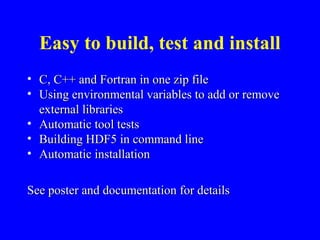
Easy to build, test and install
• C, C++ and Fortran in one zip file
• Using environmental variables to add or remove
external libraries
• Automatic tool tests
• Building HDF5 in command line
• Automatic installation
See poster and documentation for details
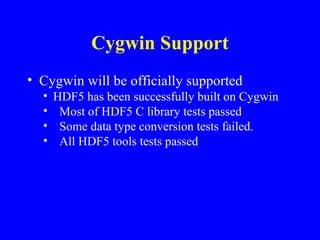
Cygwin Support
• Cygwin will be officially supported
•
•
•
•

HDF5 has been successfully built on Cygwin
Most of HDF5 C library tests passed
Some data type conversion tests failed.
All HDF5 tools tests passed
Extensive Documentation
• FAQ’s and Tips
– Please see:
http://hdf.ncsa.uiuc.edu/windows

• release_docs – detailed installation and
build instructions
Acknowledgements
This report is based upon work supported in part by
a Cooperative Agreement with NASA under NASA
grants NAG 5-0240 and NCC5-599. Any opinions,
findings, and conclusions or recommendations
expressed in this material are those of the author(s)
and do not necessarily reflect the views of the
National Aeronautics and Space Administration.
Other support provided by NCSA and other sponsors
and agencies.
Acknowledgements
This report is based upon work supported in part by
a Cooperative Agreement with NASA under NASA
grants NAG 5-0240 and NCC5-599. Any opinions,
findings, and conclusions or recommendations
expressed in this material are those of the author(s)
and do not necessarily reflect the views of the
National Aeronautics and Space Administration.
Other support provided by NCSA and other sponsors
and agencies.

HDF Windows Support

  • 1.
    HDF Windows Support MuQunYang, Xuan Bai, Elena Pourmal, Barbara Jones, Pedro Vincent, Robert E. McGrath National Center for Supercomputing Applications University of Illinois, Urbana-Champaign
  • 2.
    Goals • Support HDFsoftware for Windows platforms • Easy to install • Build from source
  • 3.
    What do wesupport? All HDF Software is supported on Windows platforms • HDF5 library and tools, • HDF4 library and tools, • HDF4 to HDF5 conversion library and utilities, • HDF5 Lite library
  • 4.
    Supported Platforms and Compilers Platforms C/C++Compilers Fortran Compilers Microsoft Visual C++ 6.0 Windows2000 DEC Fortran 6.0 .NET N/A Intel 7.1 C/C++ Intel 7.1 Fortran under Visual Studio compiler 6.0 environment XP Code Warrior (XP only) N/A
  • 5.
    Important Efforts • • • • • • Easy tobuild, test and install Automatic tool testing Comprehensive documentation Windows support website CYGWIN investigation Quick feedback from Help Desk
  • 6.
    Easy to build,test and install • C, C++ and Fortran in one zip file • Using environmental variables to add or remove external libraries • Automatic tool tests • Building HDF5 in command line • Automatic installation See poster and documentation for details
  • 7.
    Cygwin Support • Cygwinwill be officially supported • • • • HDF5 has been successfully built on Cygwin Most of HDF5 C library tests passed Some data type conversion tests failed. All HDF5 tools tests passed
  • 8.
    Extensive Documentation • FAQ’sand Tips – Please see: http://hdf.ncsa.uiuc.edu/windows • release_docs – detailed installation and build instructions
  • 9.
    Acknowledgements This report isbased upon work supported in part by a Cooperative Agreement with NASA under NASA grants NAG 5-0240 and NCC5-599. Any opinions, findings, and conclusions or recommendations expressed in this material are those of the author(s) and do not necessarily reflect the views of the National Aeronautics and Space Administration. Other support provided by NCSA and other sponsors and agencies.
  • 10.
    Acknowledgements This report isbased upon work supported in part by a Cooperative Agreement with NASA under NASA grants NAG 5-0240 and NCC5-599. Any opinions, findings, and conclusions or recommendations expressed in this material are those of the author(s) and do not necessarily reflect the views of the National Aeronautics and Space Administration. Other support provided by NCSA and other sponsors and agencies.