HOSPITAL INFECTION CONTROL
ESSENTIALS OF HIC
1. UNIVERSAL/STANDARD PRECAUTIONS
 Hand hygiene
 Use of PPE
 Bio medical waste management
 Prevention from NSI & blood/body fluid exposure
Safe linen practices
Safe patient care equipment
Environmental cleaning
Cough etiquettes
2. ISOLATION PROTOCOLS
3. HEALTH CARE ASSOCIATED INFECTIONS
4. ANTIBIOTIC POLICY
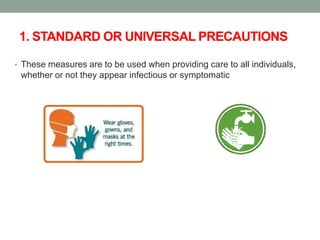
1. STANDARD OR UNIVERSAL PRECAUTIONS
• These measures are to be used when providing care to all individuals,
whether or not they appear infectious or symptomatic
2. HAND HYGIENE:
five moments :
Seven Steps of Hand Hygiene
Comparison of 7 Steps compliance rate &
frequently missed area diagram
Most frequently missed areas
PPE
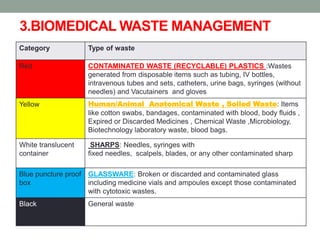
3.BIOMEDICAL WASTE MANAGEMENT
Category Type of waste
Red CONTAMINATED WASTE (RECYCLABLE) PLASTICS :Wastes
generated from disposable items such as tubing, IV bottles,
intravenous tubes and sets, catheters, urine bags, syringes (without
needles) and Vacutainers and gloves
Yellow Human/Animal Anatomical Waste , Soiled Waste: Items
like cotton swabs, bandages, contaminated with blood, body fluids ,
Expired or Discarded Medicines , Chemical Waste ,Microbiology,
Biotechnology laboratory waste, blood bags.
White translucent
container
SHARPS: Needles, syringes with
fixed needles, scalpels, blades, or any other contaminated sharp
Blue puncture proof
box
GLASSWARE: Broken or discarded and contaminated glass
including medicine vials and ampoules except those contaminated
with cytotoxic wastes.
Black General waste
Category 1 (Yellow)
Category 2 (Red)
Category 3 (White)
Category 4 (Blue)
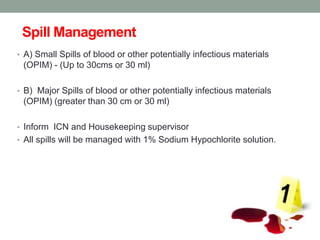
Spill Management
• A) Small Spills of blood or other potentially infectious materials
(OPIM) - (Up to 30cms or 30 ml)
• B) Major Spills of blood or other potentially infectious materials
(OPIM) (greater than 30 cm or 30 ml)
• Inform ICN and Housekeeping supervisor
• All spills will be managed with 1% Sodium Hypochlorite solution.
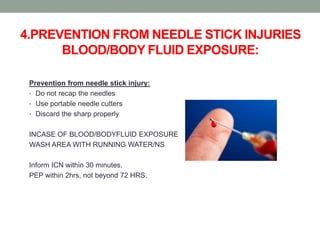
4.PREVENTION FROM NEEDLE STICK INJURIES
BLOOD/BODY FLUID EXPOSURE:
Prevention from needle stick injury:
• Do not recap the needles
• Use portable needle cutters
• Discard the sharp properly
INCASE OF BLOOD/BODYFLUID EXPOSURE
WASH AREA WITH RUNNING WATER/NS
Inform ICN within 30 minutes.
PEP within 2hrs, not beyond 72 HRS.
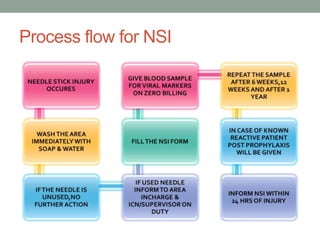
Process flow for NSI
5.ISOLATION/TRANSMISSION BASED
PRECAUTIONS
• There are 3 types of isolation precautions
Airborne
Droplet
Contact
a) Airborne Precautions
INDICATION: to prevent and control transmission of
infectious agents that remain infectious over long distances
when suspended in air.
Eg: Sputum Positive Pulmonary/Laryngeal Tuberculosis, Chichen pox,
Measles, SARS, H1N1, Massive Aspergillosis when mutiple drainages are
required.
Patient is in private negative airflow room.
Room must remain closed and patient must remain in the room.
HCW wears a N95 mask.
But when caring for known or suspected TB patient standard surgical
type mask will suffice.
Patient must be asked to wear surgical mask, during transport.
b)Droplet Precautions
• Observed when caring for patients with diseases
transmitted by large particle droplets that can be generated
by coughing, sneezing or talking.
• Eg: Group A Streptococcus, Pertusis, Respiratory infections caused by
Adeno virus, Rhinovirus.
• Patient placed in a private room
• When co-horting, maintain spatial separation of 3 feet
• Respiratory protection is from a surgical type mask when working
within 3 feet of patient
• Patient wears a surgical type mask, if possible, during transport.
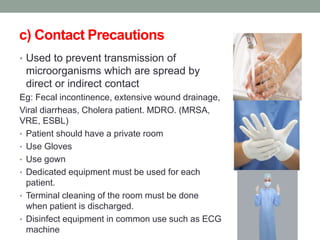
c) Contact Precautions
• Used to prevent transmission of
microorganisms which are spread by
direct or indirect contact
Eg: Fecal incontinence, extensive wound drainage,
Viral diarrheas, Cholera patient. MDRO. (MRSA,
VRE, ESBL)
• Patient should have a private room
• Use Gloves
• Use gown
• Dedicated equipment must be used for each
patient.
• Terminal cleaning of the room must be done
when patient is discharged.
• Disinfect equipment in common use such as ECG
machine
Notifiable Diseases
Policy
Weekly reporting of number of
samples tested for Notifiable
Diseases is done to the Integrated
Diseases Surveillance Project
(IDSP) Authorities, Panchkula,
Haryana Government.
List of Notifiable Diseases
• Chikungunya
• Cholera
• Dengue/DHF/DSS
• Diphtheria
• Leptospirosis
• Malaria
• Meningococcal meningitis
• Shigella dysentery
• Typhoid fever
• TB ,
• Viral Hepatitis A, E
6.HEALTH CARE ASSOCIATED INFECTIONS
• Definition: Healthcare-associated infections are infections that
patients acquire during the course of receiving treatment for other
conditions within a healthcare setting (CDC) after 48 or more than 48
hrs. of admission.
Following are the common health care associated infections :
a. Catheter associated urinary tract infection (CAUTI)
b. Central line associated blood stream infection (CLABSI)
c. Ventilator associated pneumonia (VAP)
d. Surgical site infections (SSI)
HAI PREVENTION BUNDLE CHECKLIST
RCA AND CAPA FORMS
CAUTI
• Catheter-associated UTI (CAUTI): A UTI where an indwelling urinary
catheter was in place for >2 calendar days on the date of event, with
day of device placement being Day 1,
• AND
• an indwelling urinary catheter was in place on the date of event or the
day before. If an indwelling urinary catheter was in place for > 2
calendar days and then removed, the date of event for the UTI must
be the day of discontinuation or the next day for the UTI to be
catheter-associated.
No. of Episodes of UTI Infection x 1000
• Total no. of catheter days
CLABSI
• A central line associated blood stream infection is a laboratory-
confirmed bloodstream infection (BSI) in a patient who had a central
line within the 48 hour period before the development of the BSI, and
that is not related to an infection at another site
No. of Episodes of infection x 1000
Total no. of central line days
VAP
• Ventilator-associated pneumonia (VAP) is defined as pneumonia that
occurs 48-72 hours or thereafter following endotracheal intubation,
characterized by the presence of a new or progressive infiltrate, signs
of systemic infection (fever, altered white blood cell count), changes in
sputum characteristics, and detection of a causative agent
No. of Episodes of Infection x 1000
Total no. of ventilator days
SSI
Infection occurs within 30 days after the operation if no
implant is left in place or within 90 days if implant is in place
on the surgical site is known as surgical site infection.
No. of infections at surgical site x 100
No of pts. Undergoing surgeries
HIC Audits
• Standard precautions audit
• Isolation precautions audit
• Biomedical waste management audit
• Safe injection practices audit
• Pre – op antibiotic audit
• High end antibiotic usage audit
• Hand hygiene audit (5 moments & 7 steps)
• High risk areas audit once in a month
• Linen management audit
• Daily area round
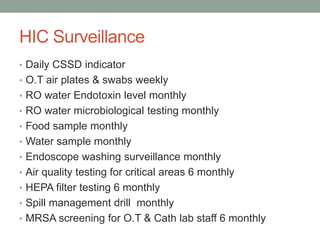
HIC Surveillance
• Daily CSSD indicator
• O.T air plates & swabs weekly
• RO water Endotoxin level monthly
• RO water microbiological testing monthly
• Food sample monthly
• Water sample monthly
• Endoscope washing surveillance monthly
• Air quality testing for critical areas 6 monthly
• HEPA filter testing 6 monthly
• Spill management drill monthly
• MRSA screening for O.T & Cath lab staff 6 monthly
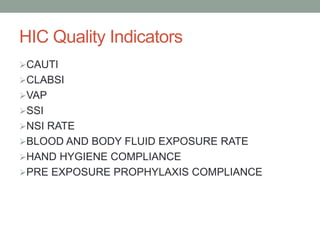
HIC Quality Indicators
CAUTI
CLABSI
VAP
SSI
NSI RATE
BLOOD AND BODY FLUID EXPOSURE RATE
HAND HYGIENE COMPLIANCE
PRE EXPOSURE PROPHYLAXIS COMPLIANCE
Documents of HIC
• HIC manual
• Antibiotic policy
• Spill management policy
• Biomedical waste management policy
• SOP for NSI and blood & body fluid exposure
• Reuse policy
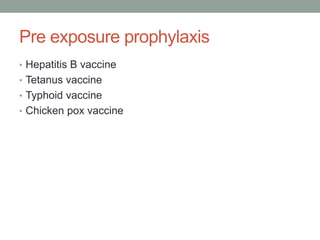
Pre exposure prophylaxis
• Hepatitis B vaccine
• Tetanus vaccine
• Typhoid vaccine
• Chicken pox vaccine
HIC  PPT.pptx

HIC PPT.pptx

  • 1.
  • 2.
    ESSENTIALS OF HIC 1.UNIVERSAL/STANDARD PRECAUTIONS  Hand hygiene  Use of PPE  Bio medical waste management  Prevention from NSI & blood/body fluid exposure Safe linen practices Safe patient care equipment Environmental cleaning Cough etiquettes 2. ISOLATION PROTOCOLS 3. HEALTH CARE ASSOCIATED INFECTIONS 4. ANTIBIOTIC POLICY
  • 3.
    1. STANDARD ORUNIVERSAL PRECAUTIONS • These measures are to be used when providing care to all individuals, whether or not they appear infectious or symptomatic
  • 4.
  • 5.
    Seven Steps ofHand Hygiene
  • 6.
    Comparison of 7Steps compliance rate & frequently missed area diagram Most frequently missed areas
  • 7.
  • 8.
    3.BIOMEDICAL WASTE MANAGEMENT CategoryType of waste Red CONTAMINATED WASTE (RECYCLABLE) PLASTICS :Wastes generated from disposable items such as tubing, IV bottles, intravenous tubes and sets, catheters, urine bags, syringes (without needles) and Vacutainers and gloves Yellow Human/Animal Anatomical Waste , Soiled Waste: Items like cotton swabs, bandages, contaminated with blood, body fluids , Expired or Discarded Medicines , Chemical Waste ,Microbiology, Biotechnology laboratory waste, blood bags. White translucent container SHARPS: Needles, syringes with fixed needles, scalpels, blades, or any other contaminated sharp Blue puncture proof box GLASSWARE: Broken or discarded and contaminated glass including medicine vials and ampoules except those contaminated with cytotoxic wastes. Black General waste
  • 9.
  • 10.
  • 11.
  • 12.
  • 13.
    Spill Management • A)Small Spills of blood or other potentially infectious materials (OPIM) - (Up to 30cms or 30 ml) • B) Major Spills of blood or other potentially infectious materials (OPIM) (greater than 30 cm or 30 ml) • Inform ICN and Housekeeping supervisor • All spills will be managed with 1% Sodium Hypochlorite solution.
  • 14.
    4.PREVENTION FROM NEEDLESTICK INJURIES BLOOD/BODY FLUID EXPOSURE: Prevention from needle stick injury: • Do not recap the needles • Use portable needle cutters • Discard the sharp properly INCASE OF BLOOD/BODYFLUID EXPOSURE WASH AREA WITH RUNNING WATER/NS Inform ICN within 30 minutes. PEP within 2hrs, not beyond 72 HRS.
  • 15.
  • 16.
    5.ISOLATION/TRANSMISSION BASED PRECAUTIONS • Thereare 3 types of isolation precautions Airborne Droplet Contact
  • 17.
    a) Airborne Precautions INDICATION:to prevent and control transmission of infectious agents that remain infectious over long distances when suspended in air. Eg: Sputum Positive Pulmonary/Laryngeal Tuberculosis, Chichen pox, Measles, SARS, H1N1, Massive Aspergillosis when mutiple drainages are required. Patient is in private negative airflow room. Room must remain closed and patient must remain in the room. HCW wears a N95 mask. But when caring for known or suspected TB patient standard surgical type mask will suffice. Patient must be asked to wear surgical mask, during transport.
  • 18.
    b)Droplet Precautions • Observedwhen caring for patients with diseases transmitted by large particle droplets that can be generated by coughing, sneezing or talking. • Eg: Group A Streptococcus, Pertusis, Respiratory infections caused by Adeno virus, Rhinovirus. • Patient placed in a private room • When co-horting, maintain spatial separation of 3 feet • Respiratory protection is from a surgical type mask when working within 3 feet of patient • Patient wears a surgical type mask, if possible, during transport.
  • 19.
    c) Contact Precautions •Used to prevent transmission of microorganisms which are spread by direct or indirect contact Eg: Fecal incontinence, extensive wound drainage, Viral diarrheas, Cholera patient. MDRO. (MRSA, VRE, ESBL) • Patient should have a private room • Use Gloves • Use gown • Dedicated equipment must be used for each patient. • Terminal cleaning of the room must be done when patient is discharged. • Disinfect equipment in common use such as ECG machine
  • 20.
    Notifiable Diseases Policy Weekly reportingof number of samples tested for Notifiable Diseases is done to the Integrated Diseases Surveillance Project (IDSP) Authorities, Panchkula, Haryana Government. List of Notifiable Diseases • Chikungunya • Cholera • Dengue/DHF/DSS • Diphtheria • Leptospirosis • Malaria • Meningococcal meningitis • Shigella dysentery • Typhoid fever • TB , • Viral Hepatitis A, E
  • 21.
    6.HEALTH CARE ASSOCIATEDINFECTIONS • Definition: Healthcare-associated infections are infections that patients acquire during the course of receiving treatment for other conditions within a healthcare setting (CDC) after 48 or more than 48 hrs. of admission. Following are the common health care associated infections : a. Catheter associated urinary tract infection (CAUTI) b. Central line associated blood stream infection (CLABSI) c. Ventilator associated pneumonia (VAP) d. Surgical site infections (SSI) HAI PREVENTION BUNDLE CHECKLIST RCA AND CAPA FORMS
  • 22.
    CAUTI • Catheter-associated UTI(CAUTI): A UTI where an indwelling urinary catheter was in place for >2 calendar days on the date of event, with day of device placement being Day 1, • AND • an indwelling urinary catheter was in place on the date of event or the day before. If an indwelling urinary catheter was in place for > 2 calendar days and then removed, the date of event for the UTI must be the day of discontinuation or the next day for the UTI to be catheter-associated. No. of Episodes of UTI Infection x 1000 • Total no. of catheter days
  • 23.
    CLABSI • A centralline associated blood stream infection is a laboratory- confirmed bloodstream infection (BSI) in a patient who had a central line within the 48 hour period before the development of the BSI, and that is not related to an infection at another site No. of Episodes of infection x 1000 Total no. of central line days
  • 24.
    VAP • Ventilator-associated pneumonia(VAP) is defined as pneumonia that occurs 48-72 hours or thereafter following endotracheal intubation, characterized by the presence of a new or progressive infiltrate, signs of systemic infection (fever, altered white blood cell count), changes in sputum characteristics, and detection of a causative agent No. of Episodes of Infection x 1000 Total no. of ventilator days
  • 25.
    SSI Infection occurs within30 days after the operation if no implant is left in place or within 90 days if implant is in place on the surgical site is known as surgical site infection. No. of infections at surgical site x 100 No of pts. Undergoing surgeries
  • 26.
    HIC Audits • Standardprecautions audit • Isolation precautions audit • Biomedical waste management audit • Safe injection practices audit • Pre – op antibiotic audit • High end antibiotic usage audit • Hand hygiene audit (5 moments & 7 steps) • High risk areas audit once in a month • Linen management audit • Daily area round
  • 27.
    HIC Surveillance • DailyCSSD indicator • O.T air plates & swabs weekly • RO water Endotoxin level monthly • RO water microbiological testing monthly • Food sample monthly • Water sample monthly • Endoscope washing surveillance monthly • Air quality testing for critical areas 6 monthly • HEPA filter testing 6 monthly • Spill management drill monthly • MRSA screening for O.T & Cath lab staff 6 monthly
  • 28.
    HIC Quality Indicators CAUTI CLABSI VAP SSI NSIRATE BLOOD AND BODY FLUID EXPOSURE RATE HAND HYGIENE COMPLIANCE PRE EXPOSURE PROPHYLAXIS COMPLIANCE
  • 29.
    Documents of HIC •HIC manual • Antibiotic policy • Spill management policy • Biomedical waste management policy • SOP for NSI and blood & body fluid exposure • Reuse policy
  • 30.
    Pre exposure prophylaxis •Hepatitis B vaccine • Tetanus vaccine • Typhoid vaccine • Chicken pox vaccine