HIS LIFE
Born inPotsdam, Germany
1838 enrolled at a Berlin medical institute
Seven years as army surgeon
Continued to study mathematics and
physics
Published articles
Emphasized mechanism and determinism
Assumed human sense organs functioned
like machines
(1821-1894) 2
3.
RESEARCH
MECHANICS AND NERVE
PHYSIOLOGY
•Principle of conservation of energy
• Invented ophthalmoscope
• Helmholtz’s contributions to the new
psychology:
• Investigated the speed of neural impulse:
• Used nerves of different lengths and recorded
the delay between stimulation and muscle
reaction
• Found that neural impulses travel at a rate of
90ft.per second
• Nerve impulses are measurable and slow
3
4.
RESEARCH
SENSORY PHYSIOLOGY AND
OPHTHALMICOPTICS
• Sensations are raw elements of experience and perceptions
are sensations after given meaning by the person’s past
experience
• To explain the transformation from sensation to perception
dependent he relied on the ideas of unconscious inference
of past experience
• Helmholtz revolutionized the field of ophthalmology with
the invention of the ophthalmoscope; an instrument used
to examine the inside of the human eye.
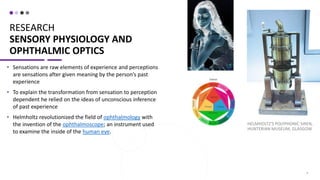
HELMHOLTZ'S POLYPHONIC SIREN,
HUNTERIAN MUSEUM, GLASGOW
4
5.
RESEARCH ON HEARINGAND VISION
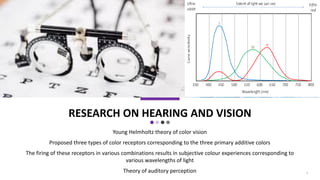
Young Helmholtz theory of color vision
Proposed three types of color receptors corresponding to the three primary additive colors
The firing of these receptors in various combinations results in subjective colour experiences corresponding to
various wavelengths of light
Theory of auditory perception 5
6.
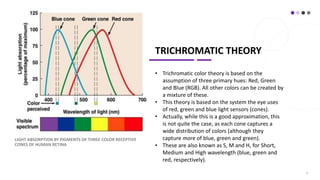
TRICHROMATIC THEORY
• Trichromaticcolor theory is based on the
assumption of three primary hues: Red, Green
and Blue (RGB). All other colors can be created by
a mixture of these.
• This theory is based on the system the eye uses
of red, green and blue light sensors (cones).
• Actually, while this is a good approximation, this
is not quite the case, as each cone captures a
wide distribution of colors (although they
capture more of blue, green and green).
• These are also known as S, M and H, for Short,
Medium and High wavelength (blue, green and
red, respectively).
LIGHT ABSORPTION BY PIGMENTS OF THREE COLOR RECEPTIVE
CONES OF HUMAN RETINA
6
7.
RESEARCH
ACOUSTICS AND AESTHETICS
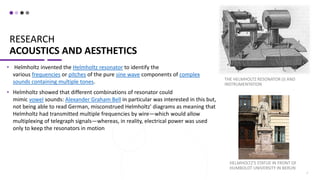
•Helmholtz invented the Helmholtz resonator to identify the
various frequencies or pitches of the pure sine wave components of complex
sounds containing multiple tones.
• Helmholtz showed that different combinations of resonator could
mimic vowel sounds: Alexander Graham Bell in particular was interested in this but,
not being able to read German, misconstrued Helmholtz' diagrams as meaning that
Helmholtz had transmitted multiple frequencies by wire—which would allow
multiplexing of telegraph signals—whereas, in reality, electrical power was used
only to keep the resonators in motion
THE HELMHOLTZ RESONATOR (I) AND
INSTRUMENTATION
7
HELMHOLTZ'S STATUE IN FRONT OF
HUMBOLDT UNIVERSITY IN BERLIN