What is
Visible Light?
In the 1660s, Isaac
Newton discovered
that sunlight is
made up of
different colors.
Through a small opening in his
room, he allowed sunlight to pass
through a glass prism.
Humans can see colors because of
the presence of cone cells in the
eyes.
The human eye has around 6 to 7
million cone cells.
What is visible
to the human
eye?
How the
Eye
Why is it Important?
Helps us interpret the world around us.
Essential for art, design, safety, and daily
life.
What is Color
Perception?
The ability of the human eye to distinguish different
wavelengths of light as colors. A complex process involving the
eyes, brain, and light.
Color
and
Light
Objects absorb and reflect specific
wavelengths.
The reflected wavelengths determine
the color we perceive.
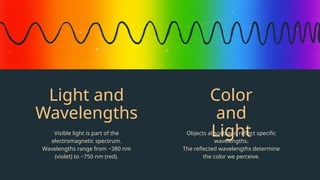
Light and
Wavelengths
Visible light is part of the
electromagnetic spectrum.
Wavelengths range from ~380 nm
(violet) to ~750 nm (red).
Cornea
• It acts as the eye’s first lens, bending
(refracting) incoming light to help focus
it onto the retina.
Lens
• It fine-tunes the focus of light onto the retina by
changing its shape, a process called
accommodation.
Key Structures
Involved in Color
Perception
LENS
CORNEA
Key Structures Involved in Color
Perception
RODS
Rods are photoreceptor cells
responsible for scotopic vision (vision
in low-light conditions).
They are highly sensitive to light and
allow us to see in dim environments,
such as at night.
Detecting Light Intensity
CONES
Cones are photoreceptor cells
responsible for photopic vision
(vision in bright light).
They detect color and provide high-
resolution, detailed vision.
Detecting Color
S-Cones (Short Wavelength)
Sensitive to short wavelengths (blue).
Peak sensitivity around 420-440 nm.
Three
Types of
Cones
M-Cones (Medium
Wavelength)
Sensitive to medium wavelengths (green).
Peak sensitivity around 530-540 nm.
L-Cones (Long Wavelength)
Sensitive to long wavelengths (red).
peak sensitivity around 560-580 nm
Yellow light
Stimulates both L-cones (red) and M-cones
(green), but not S-cones (blue).
White light
Stimulates all three cone types equally.
These cones work together to detect and
differentiate colors.
Each cone type responds to a range of
wavelengths, not just one specific color.
How Cones
Work
Together
A deficiency in one or more types of cones. Most
common type: red-green color blindness.
What is Color
Blindness?
Causes
• Genetic factors.
• Damage to the retina or optic nerve.
Impact
• Difficulty distinguishing
certain colors.
• Does not mean seeing in black
and white.
Animals See Differently
• Some animals (e.g., bees) can see
ultraviolet light.
• Dogs have fewer cones and see fewer
colors than humans.
Fun Facts
About
Color
Perception
Cultural Differences
• Some cultures have more words for specific
colors.
• Language can influence how we perceive
colors.
GAMMA
RADIO
WAVES
MICRO-
WAVES
INFRARED X-RAYS
ULTRA-
VIOLET
10
2
10
-12
1
10
1
10
-1
10
-2
10
-3
10
-4
10
-5
10
-11
10
-10
10
-9
10
-8
10
-7
10
-6
NAME OF
WAVE
WAVELENGTH
(METERS)
a narrow portion of the
electromagnetic spectrum
that humans can see
Its frequency falls between 400 to 750
terahertz (THz).
Its wavelength ranges between
400-700 nanometers.
FREQUENCY WAVELENGT
H
VISIBLE
LIGHT
VISIBLE
LIGHT
What happens
if sunlight is
allowed to pass
through a glass
prism?
?
?
The visible light spectrum is composed of all the rainbow colors. Each color corresponds to a specific
wavelength.
violet (shortest
wavelength)
red (longest
wavelength)
LIGHT AND
COLOR
Visible light is also
used to transmit
high-speed data.
Endoscopes use
fiber optics to allow
doctors to see
internal organs and
vessels.
Humans see
objects in the
visible light
spectrum.
Applications of Visible Light
VISION MEDICINE COMMUNICA
TIONS

VISIBLE LIGHT / LIGHT SPECTRUM / RAINBOW

  • 1.
  • 2.
    In the 1660s,Isaac Newton discovered that sunlight is made up of different colors. Through a small opening in his room, he allowed sunlight to pass through a glass prism.
  • 3.
    Humans can seecolors because of the presence of cone cells in the eyes. The human eye has around 6 to 7 million cone cells. What is visible to the human eye?
  • 4.
  • 5.
    Why is itImportant? Helps us interpret the world around us. Essential for art, design, safety, and daily life. What is Color Perception? The ability of the human eye to distinguish different wavelengths of light as colors. A complex process involving the eyes, brain, and light.
  • 6.
    Color and Light Objects absorb andreflect specific wavelengths. The reflected wavelengths determine the color we perceive. Light and Wavelengths Visible light is part of the electromagnetic spectrum. Wavelengths range from ~380 nm (violet) to ~750 nm (red).
  • 7.
    Cornea • It actsas the eye’s first lens, bending (refracting) incoming light to help focus it onto the retina. Lens • It fine-tunes the focus of light onto the retina by changing its shape, a process called accommodation. Key Structures Involved in Color Perception LENS CORNEA
  • 8.
    Key Structures Involvedin Color Perception RODS Rods are photoreceptor cells responsible for scotopic vision (vision in low-light conditions). They are highly sensitive to light and allow us to see in dim environments, such as at night. Detecting Light Intensity CONES Cones are photoreceptor cells responsible for photopic vision (vision in bright light). They detect color and provide high- resolution, detailed vision. Detecting Color
  • 9.
    S-Cones (Short Wavelength) Sensitiveto short wavelengths (blue). Peak sensitivity around 420-440 nm. Three Types of Cones M-Cones (Medium Wavelength) Sensitive to medium wavelengths (green). Peak sensitivity around 530-540 nm. L-Cones (Long Wavelength) Sensitive to long wavelengths (red). peak sensitivity around 560-580 nm
  • 10.
    Yellow light Stimulates bothL-cones (red) and M-cones (green), but not S-cones (blue). White light Stimulates all three cone types equally. These cones work together to detect and differentiate colors. Each cone type responds to a range of wavelengths, not just one specific color. How Cones Work Together
  • 11.
    A deficiency inone or more types of cones. Most common type: red-green color blindness. What is Color Blindness? Causes • Genetic factors. • Damage to the retina or optic nerve. Impact • Difficulty distinguishing certain colors. • Does not mean seeing in black and white.
  • 12.
    Animals See Differently •Some animals (e.g., bees) can see ultraviolet light. • Dogs have fewer cones and see fewer colors than humans. Fun Facts About Color Perception Cultural Differences • Some cultures have more words for specific colors. • Language can influence how we perceive colors.
  • 13.
    GAMMA RADIO WAVES MICRO- WAVES INFRARED X-RAYS ULTRA- VIOLET 10 2 10 -12 1 10 1 10 -1 10 -2 10 -3 10 -4 10 -5 10 -11 10 -10 10 -9 10 -8 10 -7 10 -6 NAME OF WAVE WAVELENGTH (METERS) anarrow portion of the electromagnetic spectrum that humans can see Its frequency falls between 400 to 750 terahertz (THz). Its wavelength ranges between 400-700 nanometers. FREQUENCY WAVELENGT H VISIBLE LIGHT VISIBLE LIGHT
  • 14.
    What happens if sunlightis allowed to pass through a glass prism? ? ?
  • 15.
    The visible lightspectrum is composed of all the rainbow colors. Each color corresponds to a specific wavelength. violet (shortest wavelength) red (longest wavelength) LIGHT AND COLOR
  • 16.
    Visible light isalso used to transmit high-speed data. Endoscopes use fiber optics to allow doctors to see internal organs and vessels. Humans see objects in the visible light spectrum. Applications of Visible Light VISION MEDICINE COMMUNICA TIONS