By Elisabeth Cortez Animal Cells!
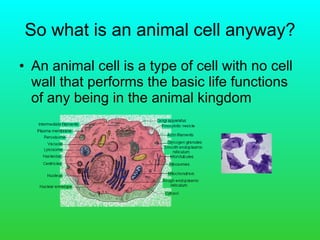
So what is an animal cell anyway? An animal cell is a type of cell with no cell wall that performs the basic life functions of any being in the animal kingdom
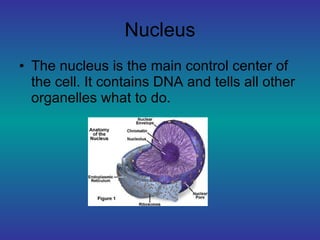
Nucleus The nucleus is the main control center of the cell. It contains DNA and tells all other organelles what to do.
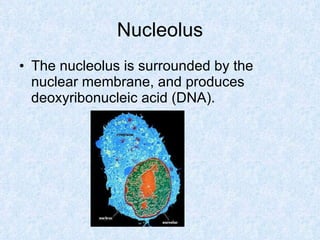
Nucleolus The nucleolus is surrounded by the nuclear membrane, and produces deoxyribonucleic acid (DNA).
Cell Membrane The cell membrane is the ‘gatekeeper’ for the cell. It keeps good things in and bad things out. When a cell gets infected, the cell membrane may dissolve.
Mitochondria The mitochondria is the main energy factory for the cell.  It turns raw energy into usable proteins.
Ribosomes Ribosomes are the smallest organelle.  They, along with the mitochondria, produce proteins for the cell.
Golgi Body The Golgi body is the ‘UPS’ for the cell. It transports nutrients and wastes into or out of the cell.
Endoplasmic Reticulum The endoplasmic reticulum, or ER, is directly attached to the nucleus, and serves to transport ribosomes to different parts of the cell.
Lysosomes Lysosomes are the cleaners of a cell.  Sac-like in form, they digest wastes, as well as other dead cells.
Vacuole The vacuole, found predominantly in plant cells, holds water and other fluids to prevent dehydration in the cell.
Cytoplasm Cytoplasm is a jelly-like fluid that holds all the organelles together in a cell.
IN REVIEW!!! A cell is a living thing that holds all the necessary elements for life.  There are several types of cells, but all of them have at least some of these organelles in common.  Thank you for listening!
Bibliography CellsAlive!.com Biology.utah.edu (pictures) Science textbook Mr. Streich’s lovely class notes
That’s a Wrap! Thanks again!

Hergoldeneyes Cellls

  • 1.
    By Elisabeth CortezAnimal Cells!
  • 2.
    So what isan animal cell anyway? An animal cell is a type of cell with no cell wall that performs the basic life functions of any being in the animal kingdom
  • 3.
    Nucleus The nucleusis the main control center of the cell. It contains DNA and tells all other organelles what to do.
  • 4.
    Nucleolus The nucleolusis surrounded by the nuclear membrane, and produces deoxyribonucleic acid (DNA).
  • 5.
    Cell Membrane Thecell membrane is the ‘gatekeeper’ for the cell. It keeps good things in and bad things out. When a cell gets infected, the cell membrane may dissolve.
  • 6.
    Mitochondria The mitochondriais the main energy factory for the cell. It turns raw energy into usable proteins.
  • 7.
    Ribosomes Ribosomes arethe smallest organelle. They, along with the mitochondria, produce proteins for the cell.
  • 8.
    Golgi Body TheGolgi body is the ‘UPS’ for the cell. It transports nutrients and wastes into or out of the cell.
  • 9.
    Endoplasmic Reticulum Theendoplasmic reticulum, or ER, is directly attached to the nucleus, and serves to transport ribosomes to different parts of the cell.
  • 10.
    Lysosomes Lysosomes arethe cleaners of a cell. Sac-like in form, they digest wastes, as well as other dead cells.
  • 11.
    Vacuole The vacuole,found predominantly in plant cells, holds water and other fluids to prevent dehydration in the cell.
  • 12.
    Cytoplasm Cytoplasm isa jelly-like fluid that holds all the organelles together in a cell.
  • 13.
    IN REVIEW!!! Acell is a living thing that holds all the necessary elements for life. There are several types of cells, but all of them have at least some of these organelles in common. Thank you for listening!
  • 14.
    Bibliography CellsAlive!.com Biology.utah.edu(pictures) Science textbook Mr. Streich’s lovely class notes
  • 15.
    That’s a Wrap!Thanks again!