Medicinal Plants & Herbs
Just so you know:
● Information on the traditional uses and
properties of herbs are provided is for
educational use only & my personal use, & is
not intended as medical advice.
● The information is provided for general
information is not intended as a medical advice
and should not be relied upon as a substitute
for advice from a healthcare professional.
Feverwort:
● Feverwort:
● This common plant was used to stop fevers by making
a tea of the leaves and flowers.
● This plant is still used today for the exact same
reason.
● This is known Native American medicine in the 17th
century.
Disclaimer Stuff:
● You should not use the information for diagnosis or
treatment of any health problem & should consult with a
healthcare professional before starting any diet, exercise
or supplementation program, before taking any
medication, or if you have or suspect you might have a
health problem.
● By reading this you acknowledge that you are
responsible for your own health decisions.
● Please educate yourself on the use of herbs.
● Do not take anything from here & try it without proper
research and a healthcare professional supervision.
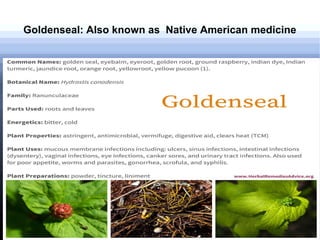
GOLDENSEAL
● Goldenseal: is so popular that it has been
harvested almost to extinction.
● Try growing some Goldenseal of these beautiful
plants for your own personal use.
● Goldenseal: was used as an overall healing
tonic, stimulant, and healing potion.
● Goldenseal: has powerful immune-boosting &
antibiotic compounds that are every bit as
powerful as antibiotics.
Goldenseal: Also known as Native American medicine
Saltbush
● Saltbush:
● This plant is still quite common & was used to
treat most bug bites and stings.
● The Cherokee Indians chewed the stem of the
plant, and then placed the wet, mashed plant
on the affected area until the swelling & pain
subsided.
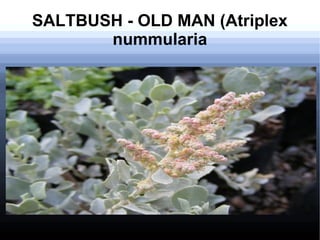
SALTBUSH - OLD MAN (Atriplex
nummularia
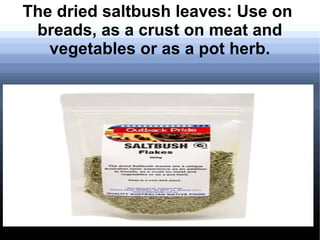
The dried saltbush leaves: Use on
breads, as a crust on meat and
vegetables or as a pot herb.
Partridgeberry
● Partridgeberry
● For pregnant women who were just days away
from giving birth, the Cherokee made a tea
from the leaves of partridgeberry plants.
● By drinking frequent doses of this tea,
Cherokee healers believed that it made for an
easier, quicker delivery.
Arnica:
● Arnica is known to have analgesic compounds that help to
relieve the pain of muscle aches, arthritis, sprains, and
bruises.
● Arnica should never be consumed internally as it can be
fatal.
● Arnica is found in many creams & lotions that are sold in
modern day pharmacies and drug stores.
● You can make your own arnica cream yourself by using
the dried leaves and flowers.
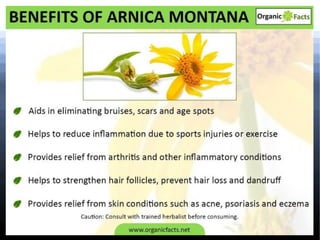
Arnica: Also known as Arnica
Montana
● Arnica Montana: include its ability to relieve
pain, reduce inflammation, eliminate internal
bleeding, promote hair health, prevent hair loss,
moisturize the skin, protect the immune system,
and improve the skin health.
● It is commonly used for injuries, such as
sprains & bruises.
● As an herb, arnica is usually used topically (on
the skin) because it can cause serious side
effects when taken by mouth.
Skunk Cabbage
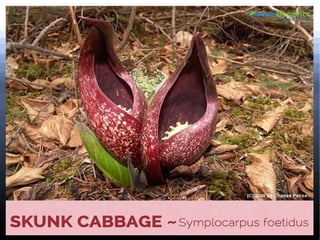
● Skunk Cabbage:
● The root of this plant is so effective at helping to
remove phlegm from the respiratory tract that it
was used and listed in the official United States
Pharmacopoeia between the years of 1820 and
1882. This plant is still available today!
Skunk Cabbage
● The root & underground stem (rhizome) are used to
make medicine.
● The pungent smelling roots of the skunk cabbage
have been a popular conventional cure for bronchitis,
tight coughs and phlegm or catarrh.
● Several herbal medical practitioners recommend the
skunk cabbage to treat nervous disorders as it is said
to have moderate sedative or tranquilizing properties.
● In earlier times, an indigenous tribe of America also
inhaled in the aroma of the mashed skunk cabbage
leaves to get relief from headaches.
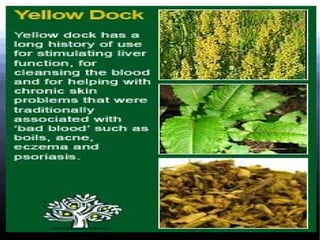
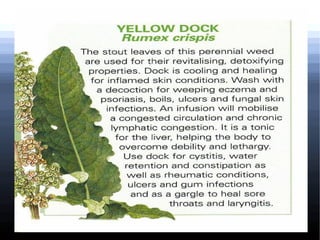
Yellow Dock
● Yellow dock: is not only a medicine, but it can be a source
of food as well.
● It tastes a great deal like spinach, but it has more vitamins
and minerals than spinach does! This herb has a very
long taproot, so it takes in many more nutrients than most
other plants.
● The leaves of this plant are a good source of iron & have
a mild laxative effect.
● The juice from the stems of yellow dock can be mixed with
a base oil , such as olive oil, coconut oil, or even beeswax
to help stop most skin problems such as diaper rash,
poison ivy, & ringworm.
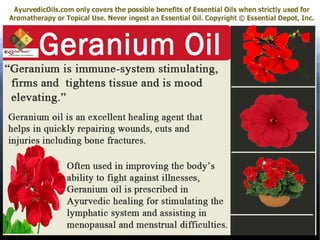
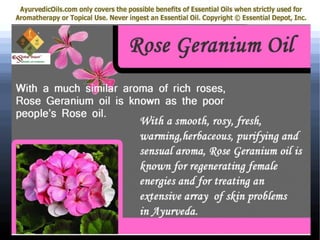
Geranium:
● Geranium
● The root of geranium plants was boiled with
wild grape roots.
● The liquid was strained and used as a rinse to
help stop mouth infections & fungal infections
like thrush.
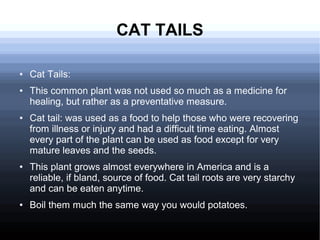
CAT TAILS
● Cat Tails:
● This common plant was not used so much as a medicine for
healing, but rather as a preventative measure.
● Cat tail: was used as a food to help those who were recovering
from illness or injury and had a difficult time eating. Almost
every part of the plant can be used as food except for very
mature leaves and the seeds.
● This plant grows almost everywhere in America and is a
reliable, if bland, source of food. Cat tail roots are very starchy
and can be eaten anytime.
● Boil them much the same way you would potatoes.
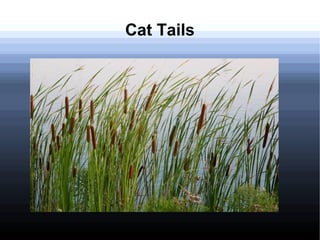
Cat Tails
BLACKBERRY
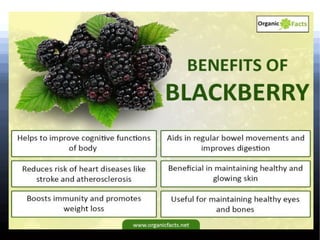
● Blackberry: The Cherokee Indians: had many uses for
blackberry bushes.
● For reliving the pain & inflammation of joints or
damaged tissues, a strong tea was made from the
roots of wild blackberry plans.
● An infusion of the leaves was used as a stimulating
tonic.
● The roots were also boiled, then the water mixed with
a bit of honey to act as an expectorant.
● Chewing the leaves was found to heal sore throats
and stop bleeding gums.
Wild Rose
● Wild Rose:This plant is a terrific source of
vitamin C and is a reliable preventative for
respiratory infections or the common cold.
● The hips from this plant stimulate the kidneys
and bladder with their mild diuretic effect.
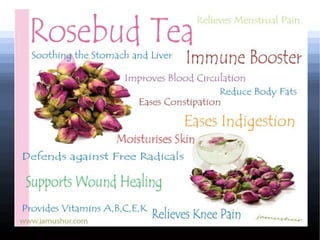
● Rose petals: were used as an infusion for sore
throats or mouth ulcers.
● Even the roots of this plant were boiled and
then strained as a means of stopping diarrhea.
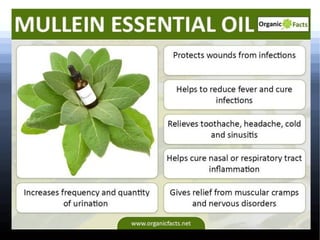
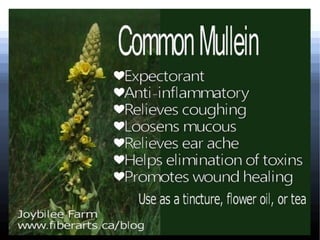
Mullein
● Mullein: This is one of the oldest herbs known
to man, & the Cherokee used it extensively.
● Cherokee healers burned the dried leaves &
roots to ease chest congestion or asthma
attacks.
● The roots were also boiled & mashed to make
a decoction for soaking swollen limbs or
swollen joints.
● Mullein tea made from the flowers makes a
very mild sedative.
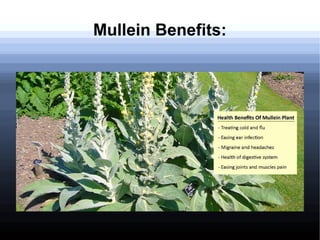
Mullein Benefits:
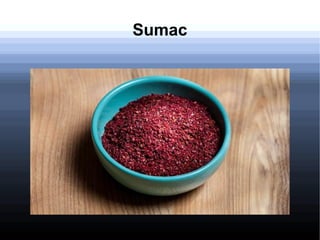
Common Sumac
● Common Sumac:This is another plant that has super
medicinal qualities and can be found almost
everywhere.
● Boiling the bark and then straining the liquid makes a
terrific concoction to stop store throats.
● This as a liquid is a remedy for diarrhea.
● A tea made from the berries was used to stop fevers.
● Tea made from ripe berries is a good source of
vitamin C, and it tastes better than might think.
Sumac
Greenbriar Benefits:
Greenbriar: is a very popular plant that is a
terrific blood purifier.
● Some Cherokee Indian healers made a salve
from the bark and leaves, then mixed it with
animal lard as a means of healing burns or
wounds.
● The root is also used to make a tea for arthritis.
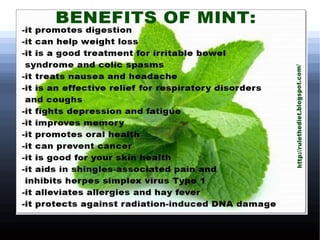
Mint
● Mint:This common plant is used as to improve overall
digestion
● The Cherokee Indians also used the crushed leaves
as a compress to help stop skin problems or itchy skin.
● For lowering blood pressure and stopping nervous
tension, mint was made into a tea, much the same
way it is used today.
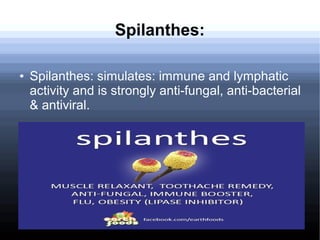
Spilanthes:
● Spilanthes: simulates: immune and lymphatic
activity and is strongly anti-fungal, anti-bacterial
& antiviral.
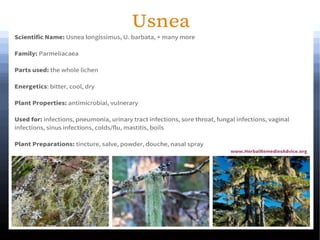
Usnea lichen
● Usnea: is also used for strep throat,
tuberculosis, pneumonia, upper respiratory tract
infections, urinary tract infections, and diarrhea.
● Usnea: is anti-bacterial, anti-viral, & anti-fungal,
making it a premier choice for all sorts of
infections and wounds.
● Unsea: herb that kills all types of bacteria. This
is actually a positive trait for humans.
References:
● Nature's Prescription: Foods, Vitamins, and Supplements That
Prevent Disease Paperback – March 1, 1998,by Publisher:Frank W.
Cawood and Associates (Editor)
● Herbal Antibiotics 2nd Edition by Steven Buhner
● Usnea by Kiva Rose
● Usnea: The Herbal Antibiotic by Christopher Hobbs
● Herbal Therapeutics Manual by Paul Bergner
● www.ajcn.nutrition.org
● https://www.herbalremediesadvice.org
● www.ncbi.nlm.nih.gov

Herbs reference114

  • 1.
    Medicinal Plants &Herbs Medicinal Plants & Herbs
  • 2.
    Just so youknow: ● Information on the traditional uses and properties of herbs are provided is for educational use only & my personal use, & is not intended as medical advice. ● The information is provided for general information is not intended as a medical advice and should not be relied upon as a substitute for advice from a healthcare professional.
  • 3.
    Feverwort: ● Feverwort: ● Thiscommon plant was used to stop fevers by making a tea of the leaves and flowers. ● This plant is still used today for the exact same reason. ● This is known Native American medicine in the 17th century.
  • 4.
    Disclaimer Stuff: ● Youshould not use the information for diagnosis or treatment of any health problem & should consult with a healthcare professional before starting any diet, exercise or supplementation program, before taking any medication, or if you have or suspect you might have a health problem. ● By reading this you acknowledge that you are responsible for your own health decisions. ● Please educate yourself on the use of herbs. ● Do not take anything from here & try it without proper research and a healthcare professional supervision.
  • 5.
    GOLDENSEAL ● Goldenseal: isso popular that it has been harvested almost to extinction. ● Try growing some Goldenseal of these beautiful plants for your own personal use. ● Goldenseal: was used as an overall healing tonic, stimulant, and healing potion. ● Goldenseal: has powerful immune-boosting & antibiotic compounds that are every bit as powerful as antibiotics.
  • 6.
    Goldenseal: Also knownas Native American medicine
  • 7.
    Saltbush ● Saltbush: ● Thisplant is still quite common & was used to treat most bug bites and stings. ● The Cherokee Indians chewed the stem of the plant, and then placed the wet, mashed plant on the affected area until the swelling & pain subsided.
  • 8.
    SALTBUSH - OLDMAN (Atriplex nummularia
  • 9.
    The dried saltbushleaves: Use on breads, as a crust on meat and vegetables or as a pot herb.
  • 10.
    Partridgeberry ● Partridgeberry ● Forpregnant women who were just days away from giving birth, the Cherokee made a tea from the leaves of partridgeberry plants. ● By drinking frequent doses of this tea, Cherokee healers believed that it made for an easier, quicker delivery.
  • 11.
    Arnica: ● Arnica isknown to have analgesic compounds that help to relieve the pain of muscle aches, arthritis, sprains, and bruises. ● Arnica should never be consumed internally as it can be fatal. ● Arnica is found in many creams & lotions that are sold in modern day pharmacies and drug stores. ● You can make your own arnica cream yourself by using the dried leaves and flowers.
  • 12.
    Arnica: Also knownas Arnica Montana ● Arnica Montana: include its ability to relieve pain, reduce inflammation, eliminate internal bleeding, promote hair health, prevent hair loss, moisturize the skin, protect the immune system, and improve the skin health. ● It is commonly used for injuries, such as sprains & bruises. ● As an herb, arnica is usually used topically (on the skin) because it can cause serious side effects when taken by mouth.
  • 14.
    Skunk Cabbage ● SkunkCabbage: ● The root of this plant is so effective at helping to remove phlegm from the respiratory tract that it was used and listed in the official United States Pharmacopoeia between the years of 1820 and 1882. This plant is still available today!
  • 15.
    Skunk Cabbage ● Theroot & underground stem (rhizome) are used to make medicine. ● The pungent smelling roots of the skunk cabbage have been a popular conventional cure for bronchitis, tight coughs and phlegm or catarrh. ● Several herbal medical practitioners recommend the skunk cabbage to treat nervous disorders as it is said to have moderate sedative or tranquilizing properties. ● In earlier times, an indigenous tribe of America also inhaled in the aroma of the mashed skunk cabbage leaves to get relief from headaches.
  • 17.
    Yellow Dock ● Yellowdock: is not only a medicine, but it can be a source of food as well. ● It tastes a great deal like spinach, but it has more vitamins and minerals than spinach does! This herb has a very long taproot, so it takes in many more nutrients than most other plants. ● The leaves of this plant are a good source of iron & have a mild laxative effect. ● The juice from the stems of yellow dock can be mixed with a base oil , such as olive oil, coconut oil, or even beeswax to help stop most skin problems such as diaper rash, poison ivy, & ringworm.
  • 20.
    Geranium: ● Geranium ● Theroot of geranium plants was boiled with wild grape roots. ● The liquid was strained and used as a rinse to help stop mouth infections & fungal infections like thrush.
  • 24.
    CAT TAILS ● CatTails: ● This common plant was not used so much as a medicine for healing, but rather as a preventative measure. ● Cat tail: was used as a food to help those who were recovering from illness or injury and had a difficult time eating. Almost every part of the plant can be used as food except for very mature leaves and the seeds. ● This plant grows almost everywhere in America and is a reliable, if bland, source of food. Cat tail roots are very starchy and can be eaten anytime. ● Boil them much the same way you would potatoes.
  • 25.
  • 26.
    BLACKBERRY ● Blackberry: TheCherokee Indians: had many uses for blackberry bushes. ● For reliving the pain & inflammation of joints or damaged tissues, a strong tea was made from the roots of wild blackberry plans. ● An infusion of the leaves was used as a stimulating tonic. ● The roots were also boiled, then the water mixed with a bit of honey to act as an expectorant. ● Chewing the leaves was found to heal sore throats and stop bleeding gums.
  • 28.
    Wild Rose ● WildRose:This plant is a terrific source of vitamin C and is a reliable preventative for respiratory infections or the common cold. ● The hips from this plant stimulate the kidneys and bladder with their mild diuretic effect. ● Rose petals: were used as an infusion for sore throats or mouth ulcers. ● Even the roots of this plant were boiled and then strained as a means of stopping diarrhea.
  • 30.
    Mullein ● Mullein: Thisis one of the oldest herbs known to man, & the Cherokee used it extensively. ● Cherokee healers burned the dried leaves & roots to ease chest congestion or asthma attacks. ● The roots were also boiled & mashed to make a decoction for soaking swollen limbs or swollen joints. ● Mullein tea made from the flowers makes a very mild sedative.
  • 32.
  • 34.
    Common Sumac ● CommonSumac:This is another plant that has super medicinal qualities and can be found almost everywhere. ● Boiling the bark and then straining the liquid makes a terrific concoction to stop store throats. ● This as a liquid is a remedy for diarrhea. ● A tea made from the berries was used to stop fevers. ● Tea made from ripe berries is a good source of vitamin C, and it tastes better than might think.
  • 35.
  • 36.
    Greenbriar Benefits: Greenbriar: isa very popular plant that is a terrific blood purifier. ● Some Cherokee Indian healers made a salve from the bark and leaves, then mixed it with animal lard as a means of healing burns or wounds. ● The root is also used to make a tea for arthritis.
  • 37.
    Mint ● Mint:This commonplant is used as to improve overall digestion ● The Cherokee Indians also used the crushed leaves as a compress to help stop skin problems or itchy skin. ● For lowering blood pressure and stopping nervous tension, mint was made into a tea, much the same way it is used today.
  • 39.
    Spilanthes: ● Spilanthes: simulates:immune and lymphatic activity and is strongly anti-fungal, anti-bacterial & antiviral.
  • 40.
    Usnea lichen ● Usnea:is also used for strep throat, tuberculosis, pneumonia, upper respiratory tract infections, urinary tract infections, and diarrhea. ● Usnea: is anti-bacterial, anti-viral, & anti-fungal, making it a premier choice for all sorts of infections and wounds. ● Unsea: herb that kills all types of bacteria. This is actually a positive trait for humans.
  • 42.
    References: ● Nature's Prescription:Foods, Vitamins, and Supplements That Prevent Disease Paperback – March 1, 1998,by Publisher:Frank W. Cawood and Associates (Editor) ● Herbal Antibiotics 2nd Edition by Steven Buhner ● Usnea by Kiva Rose ● Usnea: The Herbal Antibiotic by Christopher Hobbs ● Herbal Therapeutics Manual by Paul Bergner ● www.ajcn.nutrition.org ● https://www.herbalremediesadvice.org ● www.ncbi.nlm.nih.gov